




Abstract
This article details the strengths and vulnerabilities that Christian and Muslim immigrant women bring to situations of domestic violence in the Canadian Maritimes. An intersectional theoretical framework grounds the analysis of qualitative data collected from 89 Christian and Muslim women from 27 countries of origin who arrived in the region ten years prior to the field work. Their strengths include high levels of education, experiences of overcoming adversity, the ability to act strategically, and the use of social networks, while factors such as increased dependence on husbands, transnational family situations, responsibilities for family unity, and a lack of knowledge about local services are vulnerabilities. The findings show that Orthodox and Catholic Christians, Muslim women with young children, immigrant women employed full-time immediately upon arrival, and wives whose immigration is sponsored by their husbands lack access to important social support networks.
Introduction
This article is based on qualitative research conducted with Christian and Muslim immigrant women who settled on the east coast of Canada. Its purpose is to provide information about how attitudes and practices that developed in the countries of origin of immigrant women intersect with a particular Canadian social context to create both strengths and vulnerabilities when they are faced with situations of domestic violence. The research contributes to a better understanding of one of the many challenges facing contemporary Canadian immigrants for whom religion is an important aspect of their identity.
Drawing attention to social problems within minority groups is risky because it can be used to reinforce stereotypes held by members of dominant groups. Domestic violence is a persistent problem within every religious and cultural group, dominant or minority, throughout the world. Cultures mediate and shape domestic violence (Liao, 2006) and although religious women are no more likely to be victimized than non-religious women, religious groups are hesitant to recognize the problem (Nason-Clark, 2012). The political, economic, cultural, and religious institutions of immigrant women’s countries of origin as well as those in the contexts to which they migrate influence their understanding and attitudes towards abuse. Some practices within minority groups may actually be more empowering for women than practices within the dominant groups of a local context and contribute to their resiliency. It is also possible that dominant and minority groups collude in practices that make immigrant women more vulnerable when domestic violence occurs (Jiwani, 2005).
Theoretical Framework
The research employs a feminist intersectional framework based on the assumption that women’s lives are best understood by considering the multiple structures, such as gender, ethnicity, class and religion, that impact their lives as well as the multiple identities, such as mother, immigrant woman, Muslim, Christian and professional, that women manage (Crenshaw, 1994; Bilge, 2010). The structuring of gender, ethnicity, class and religion and their intersections create both inequalities and valued differences – something Walby (2009) identifies as complex inequalities. The intersectional framework influenced the sample design as well as the analysis of the qualitative data in this research. The framework did not initially privilege one difference or inequality, such as gender or religion, over another but allowed salient social relations within a particular regime to emerge through the analysis (Johnson, 2005; Sokoloff and Pratt, 2005). Studies of immigrant women conducted in the Canadian Maritimes over the past twenty years have consistently highlighted how the structuring and intersection of gender and ethnicity have resulted in immigrant women’s experiences of under- and unemployment, economic marginalization, discrimination, and social exclusion (Ku et al., 2011; Miedema and Nason-Clark, 1989; Ralston, 1996; Tastsoglou, 2006). Studies of Christian women survivors of domestic violence in the Maritimes have identified their strengths and vulnerabilities but have not taken into account the impact of the intersection of ethnicity and religion (Nason-Clark, 1997). The intersectional framework assists in maintaining a focus on the dynamic relationships of power that emerge through the intersecting social relations of gender, ethnicity, class and religion for Muslim and Christian immigrant women in the Maritimes.
Research on Domestic Violence among Canadian Immigrants
In today’s milieu of increased global migration, women are moving between societies with relatively high levels of domestic violence. The World Health Organization estimates global prevalence rates for domestic violence at 30% (2013). The 1993 national Violence Against Women Survey (VAWS) in Canada estimated that 29% of women aged eighteen years or older who had ever been married or in a common-law relationship had experienced some form of physical or sexual violence (Johnson and Dawson, 2010). Research on domestic violence indicates that immigrant women possess both strengths and vulnerabilities in their ability to respond to domestic violence. Some of the vulnerabilities include: socio-economic inequality (Barata et al., 2005; Fong, 2010), racialization and racism (Bannerji, 2002; Jiwani, 2005), young couples who immigrate with young children (Brownridge, 2009), unfamiliarity with their legal rights and the public support services for abused women (Wachholz and Miedema, 2004), loss of family and friendship support networks (Cottrell, 2008), the pervasiveness of patriarchy, which makes it difficult for women to recognize various forms of violence and abuse (Liao, 2006; Mojab, 2012), the lack of confidentiality within immigrant groups when abuse is disclosed, (Kulwicki et al., 2010), and relatedly, the burden placed on women by cultural, political and economic forces urging them to keep families together despite violent marital relationships (Shiu-Thornton et al., 2005).
Research on domestic violence has also identified some of immigrant women’s strengths: high levels of education and long-term marriages (Brownridge and Halli, 2003), the strategic management of challenges associated with the settlement process (Cottrell, 2008), an ability to quickly adapt to a new society in seeking help and creating social capital (Barata et al., 2005), the support provided by family networks, when they exist (Kulwicki et al., 2010), the capacity to re-negotiate gendered social relations (Krane et al., 2000), experiences of feminist activism in their countries of origin (Mojab, 2012), and social support networks among immigrant women who share a similar cultural background (Menjivar and Salcido, 2002).
Religion is an under-researched factor in the literature on immigrant women and domestic violence in Canada. Religious women are no more likely to be victims of domestic violence than non-religious women (Cunradi et al., 2002; Ellison et al., 1999), yet their social locations, identities and practices can contribute to particular vulnerabilities in an abusive or violent relationship. This study includes Christian and Muslim immigrant women, two groups that encompass a wide range of theological perspectives as well as diverse practices which are often closely tied to ethnic differences (Bramadat and Seljak, 2005). Yet even with the diversity within Christianity and Islam, there are certain characteristics common to conservative religious women’s practices. For example, in Christianity and Islam there is a strong emphasis on the importance of families and the responsibility for keeping families together is placed on women’s shoulders (Chernyak and Barrett, 2011; Kulwicki et al., 2010; Nason-Clark, 1997; Penner, 2000). A subordinate role for women in marriage is often justified using sacred texts, such as passages in the Bible referring to submission (Kroeger, 2011) or verses from the Qur’an permitting the disciplining of wives by their husbands (Ammar, 2007). These texts can increase religious women’s vulnerability to domestic violence, making it difficult for them to identify spousal abuse and seek help. The disclosure of domestic violence often brings intense feelings of shame for religious women (Mojab, 2012; Papp, 2010). Most women of faith have not heard a message from their religious leaders condemning domestic violence (Kulwicki et al., 2010; Nason-Clark, 2000). Many Christian and Muslim religious leaders lack knowledge about the complexity of domestic violence, are not trained in best practices when approached by victims or perpetrators, and are torn between wanting to help and their desire to keep families together (Nason-Clark, 1997, 2012; McMullin, 2013; Kulwicki et al., 2010). The vulnerability of Muslim immigrant women is further compounded by contemporary public discourses and practices in Canadian society that impinge on their basic rights and freedoms (Selby, 2014) as well as fundamentalist and secular feminist factions amongst Canadian Muslims that rob religious Muslim women of their agency (Zine, 2004).
There are, however, aspects of religious teachings and practices that can be sources of strength for religious women in bringing an end to violence in their families. Religious texts also include passages that condemn, outright, violence and injustice in general (Wadud, 1999) as well as offering encouragement to victims (Nason-Clark and Kroeger, 2010), and the interpretations of problematic texts are the source of contemporary debate among Muslims and Christians (Ammar, 2007; Chaudry, 2013; Kroeger, 2011). Many women throughout history have rooted their work for social justice in religious traditions (Fernandes, 2003). Services for the poor in many parts of the world are still supported almost exclusively by faith groups (Krane et al., 2000). Formal and informal support networks of women operate in many religious congregations (Beaman-Hall and Nason-Clark, 1997; Bullock, 2012). Prayer encourages women to seek help in the face of problems (Barata et al., 2005). When religious leaders do publicly condemn violence on the basis of their religious traditions, their words can encourage victims to seek safety (Nason-Clark et al., 2011; Holtmann, 2013).
The inclusion of religion within an intersectional analysis of immigrant women’s attitudes towards and experiences of domestic violence can contribute to our understanding of the complexity of the issue. This is a particularly important contribution in a non-traditional immigrant-receiving context, such as the Canadian Maritimes. Since 2003 there has been a rise in the number of people immigrating to the region, where newcomers encounter very low levels of ethno-religious diversity. In 2006, 78% of the New Brunswick population was comprised of people of European ethnic origins and in Prince Edward Island, 81% of the population claimed European ethnic origins (Statistics Canada, 2006). Although Maritimers are more likely to be religiously engaged than other Canadians (Clark and Schellenberg, 2006), over 80% of the population identify as Christian and less than 1% as Muslim (Statistics Canada, 2011).
Data and Methods
Ethical approval was obtained from the University of New Brunswick for the author to collect qualitative data via interviews and focus groups with Muslim and Christian immigrant women in the Maritimes who were 19 years of age and older. Participants were recruited utilizing contacts in immigrant settlement organizations, the international student offices at universities, religious groups, agencies and program providers for survivors of domestic violence, personal networks of the researcher, and snowball sampling. In addition to receiving detailed information about the study prior to obtaining consent, potential participants were offered compensation for child care and transportation expenses incurred. The women were reminded throughout the research process that their identities would remain confidential, that they did not have to answer questions with which they were uncomfortable and that they could withdraw from the study at any time. Most of the questions posed to the participants were about their experiences of settlement and involvement in social networks, and screening questions pertaining to relationship conflict were included in the interview guides. If experiences of conflict were disclosed in response to screening questions, questions were asked about the nature of the conflict and the women’s responses. The focus group sessions included the viewing of a short clip from the film “Heaven on Earth” (Hamilton Mehta Productions, 2014), which was followed by questions about the women’s attitudes towards domestic violence and the availability of public services for survivors in their countries of origin. At the conclusion of the interviews and focus groups all of the participants were given information about domestic violence, family resources, social development, housing, and legal services in their local areas. Follow up contact was made with women who disclosed experiences of domestic violence during the research.
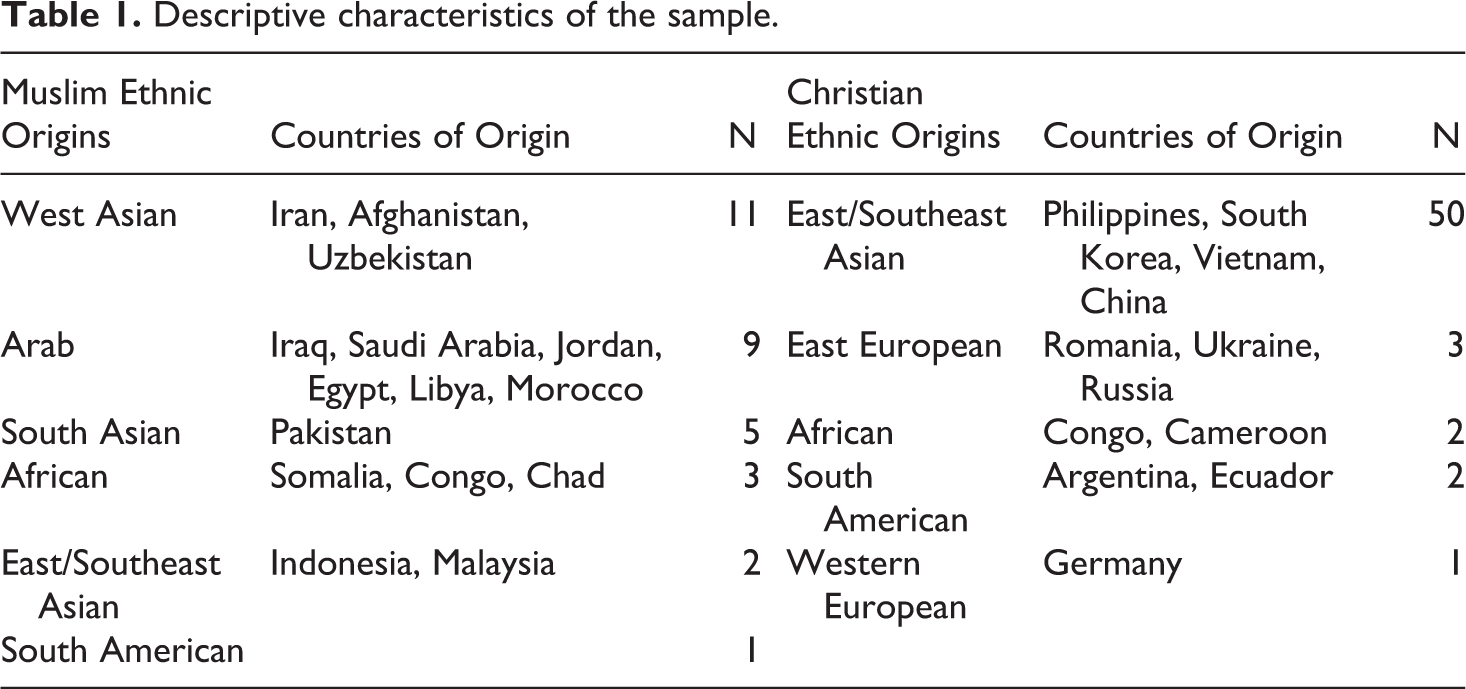
Eighty-nine immigrant women participated in the research, fifty-eight of whom identified as Christians and thirty-one as Muslims. Table 1 provides details about the women’s ethnic origins and countries of origin. On average the women had immigrated to the region about 3.4 years before participating in the research; 57% of the women were mothers. Thirty-four women were primarily occupied with care work in the home (38%), forty-one women had full-time paid employment (46%), and fourteen women were studying at university (16%).
Descriptive characteristics of the sample.
The interview and focus group transcripts were analyzed in four ways: during the first reading, all of the different social networks mentioned by the women were noted; second, the transcripts were read in order to highlight the women’s ethno-religious similarities and differences; they were read a third time arranged according to different stages in the settlement process (0 to 3 years, 4 to 6 years, or 7 or more years); and finally the transcripts were analyzed in order to identify the women’s attitudes towards and experiences of domestic violence. During each reading, themes were identified in each of the three categories: those of ethno-religious practices, stages of settlement, and domestic violence. After the themes were identified in the category of domestic violence, concepts were highlighted and interpreted.
Findings
Shifting Gender Roles
Transnational family arrangements are common in the lives of the research participants as an employment and/or education strategy for immigrant families. Many of the women came to the Maritimes for their children’s education. Some of the Christian women parent their school-aged children alone while their husbands continue to work in South Korea. The women explained that the high stress of the Korean education system took a toll on their children’s physical and emotional health and they believed that a Canadian education would ensure a better future for their children. Having their husbands working abroad means that these immigrant wives are at the forefront of the settlement process. Many spoke about how acquiring the new skills required by this role increased their self-confidence. For some Christian women, the subsequent immigration of their husbands leads to heightened tensions in the family as the men look for work or retrain while their wives are the primary income earners. For other women, the shift to the wife becoming the parent responsible for all aspects of a Canadian household is threatening to their husbands. In these particular transnational situations, immigrant women’s gender roles are shifting with concurrent declines in the husband’s parental presence in the family. This is coupled with the men’s loss of social status in Canadian society compared with that of their country of origin. Such shifts in gender roles and status did result in conflict in some families.
Several Muslim women came to the region as international students with their families, as either mothers or daughters. Once here they have taken responsibility for many aspects of the family household including driving a car and being in charge of financial negotiations with banks. Others are enthusiastic about having part-time paid employment during their university studies – something that they could not have done in their countries of origin due to class divisions. Like their Christian counterparts, most of the Muslim women appreciate the increased autonomy and self-confidence they experience in their new home but it has created some complications. For some Muslim daughters there are parental expectations for them to marry a man who shares their ethno-religious heritage – someone who may or may not live in Canada. The prospect of marriage after having spent years pursuing a Canadian university degree is a source of anxiety. A Muslim woman originally from Iraq spoke about refusing a proposal from a fellow Muslim student whom she described as “totally open.” I never thought I would refuse him, like I was really in love with him. But I refused him because I thought that when it gets serious I’m 100% sure he is going to become a controllable guy. You know what I mean? I feel, ok, maybe he’s not controlling, he is open because he is in love. But I see him really controlling when it comes to be very serious. So that’s why I had to refuse him. [Interviewer: So that was just a sense that you had? Or did you see signs?] Well ok, he had to leave because he came in to a scholarship and once he finished his degree he had to go back to Saudi Arabia and work there. And he tells me about his family and I know they are very religious – they cover even their face and all that. I told him a lot – I really can’t stand … for example they will never sit in a group – they will never sit mixed people and eat together. Even he is married to someone – his wife cannot sit with his brothers. In Iraqi culture that is totally fine. In Iraqi culture we sit mix, we go out mix. It’s totally fine when there is some blood relationship. I can go out with my cousins and nobody cares. But with their culture it is totally wrong. (Muslim #10)
Bonds within and between transnational families mean that immigrant women whose gender roles change in their day-to-day lives in Maritime society are conscious of the differences between these and the norms established in their countries of origin. The women feel torn between the values of their families and their lifestyles as well-educated Canadian women. They want to have both but this leads to conflict in their families and intimate relationships. Conflict is a normal part of all relationships and the immigrant women in this study confirm that conflicts that arise from shifting gender roles are a part of the settlement process.
Social Networks
The immigrant women in the research participate in a variety of formal and informal social networks related to settlement services, employment, education, health care and religion. Many of the women are aware of or have utilized the services of government-funded immigrant settlement agencies, especially in the early months after arrival. These agencies are an important hub for accessing immigrant social networks for some immigrant women. The wives of international students are not eligible for these services and women whose immigration is sponsored by their husbands must also wait for their permanent residency cards before utilizing public services. Immigrant women who are employed full-time or those who care for very young children at home report difficulties accessing settlement services, which are almost exclusively offered during working hours. The inability to engage in formal language learning and employment counseling or participate in immigrant social networks via public settlement service organizations contributes to some women’s feelings of isolation.
Many immigrant women in the study spoke about the difficulties they encounter when they seek services through the public health care system. An example comes from a focus group discussion with Iranian Muslim women:
Now I can say another of my problems, my experiences. I have many experiences and stress about my health.
This is a problem.
This is a problem. I cannot explain my problems; I cannot find a family doctor or some people have my file check and I have thyroid problems. Oh! And after that my hair fell down …
There are problems.
I have many problems, my friends know, I have much stress about my health here. Now I just try not to think about it.
But it can be a big worry?
Yes, but I’m not sure I’m healthy now.
Do you have a family doctor now?
No.
Still not and you’ve been here two years?
One year and two months. (Focus Group #6)
Even if this particular woman had been able to get a referral from a family doctor, she would likely have waited months to see a specialist due to the shortage of physicians in the region (NBMS, 2014). Frustration with accessing public social services in the Maritimes decreases immigrant women’s confidence in and ultimately their use of these services. Public health care and education services as well as paid employment provide immigrant women with access to social networks beyond that of their immigrant peers, thus decreasing isolation and increasing opportunities for learning about legal rights, available domestic violence services and sources of social support.
Christian immigrant women in the study are more likely than Muslim women to participate in public religious social networks because for them, regular public religious participation is normative. Muslim women’s religious practices are primarily based in the context of family life. However, some Muslim women are beginning to develop leadership in organizing formal support networks within some of the mosques in the region, particularly in order to help new immigrant families with young children. Among Christian immigrant women, there are differences in public religious social network participation. Evangelical Protestant immigrant women participate in religious social networks through weekly bible study and faith sharing groups in addition to attending regular Sunday services. Orthodox Catholic immigrant women do not have access to Orthodox churches in the region under study and rely on informal ethno-religious networks: Practically all my contacts started in the church, the Roman Catholic church … here. I met one person who was Ukrainian origin and she told me that she knows some Ukrainians, then she gave me their contacts, I called them, they talked about me to some other people and a Ukrainian woman from the cultural association called me and she said that she knows [an Orthodox priest] … and some other families gave me their contacts and then after that I called [the Orthodox priest] … and then during the Easter mass, the liturgy [which took place in a university chapel], that’s how I met people. Actually I met not many people but I called some of them and I met many more. (Christian #20)
Attitudes towards and Experiences of Domestic Violence
As mentioned, the focus group sessions included the showing of a brief film clip. The scene features a young Hindu woman and her Indo-Canadian mother-in-law getting into an argument while preparing dinner for the family. The mother-in-law complains to her son about her daughter-in-law’s behavior. The husband shoves his wife to the floor and repeatedly kicks her until his father tells him to stop. After viewing the scene, women in the focus groups initially said that physical violence of that kind did not happen in their ethnic or religious groups. Eventually during the conversations, stories did surface about experiences of family violence among friends or family members. For example, a participant from the Democratic Republic of the Congo spoke at length about how her sister was being neglected by her husband. The woman said, But [she] start to deceive him, to go back home and we told her, “No you are Christian and your husband has paid everything and you need to continue to pray for him, perhaps someday he can change.” And after two years, she said, “No, I’m tired. I need to go back to my home. Because I’m going to stay here and years are going to pass and nothing … but if I go back I can get another man and my life can be better than here.” And the whole family decided to have her come back. (Focus group #5, Participant #2)
The intersection of religious and economic structures that ensure immigrant women’s allegiance to their husbands are further compounded by gendered constructions of sexuality in their countries of origin. In an interview, a Muslim graduate student explains that in Saudi Arabia sexual assault is always considered a woman’s fault: If she went to this guy’s house and he did something wrong to her the police can’t do anything because the rule first of all, you shouldn’t be with a guy that he’s not your brother. If a guy, you can be married to and you’re with him without you’re actually married to – like she’s with her brother, she’s with her dad, with her uncles or all these, if a cop sees her, I mean religion police, sees her, that’s ok. She can’t get married to this guy because he’s like … [CH: A relative?] Yes, but if a random guy she’s with and the police sees her – he can’t help her. You chose to be with him. You’re not married to him – you don’t have your dad accompanying you if something goes wrong. Like it’s all on you type of thing. (Muslim #14)
Several survivors of domestic violence participated in the study. In one case, a Muslim woman had immigrated to the region through the sponsorship of her Canadian-born husband, illustrating immigrant women’s vulnerability to encountering domestic violence for the first time in the Maritime context. After her arrival she became dependent on her husband because she could not legally work, did not speak English, and had no friends or driver’s license. She believed that because of this isolation her faith became stronger. Her husband’s emotional and financial control over her was accompanied by physical violence. She prayed for a change in her husband’s behavior and disclosed the violence to a woman at the local mosque, who told her that it would stop if she obeyed her husband. While pregnant, she told her doctor about the abuse and was advised that she and her husband should seek couples counseling. A licensed psychologist told the woman’s husband that his violent actions were unacceptable, but did not advise the couple to separate. Following the birth of their second child, she took the children with her to the local shelter she had learned about from the multicultural organization. She described getting her Canadian citizenship as a milestone in her journey back to the self-confidence she had before her arrival. She said that she now prays for alsbr – patience and perseverance as she faces the challenges of life as a single mother (Muslim #6). This woman’s story reveals how both secular and religious people in the community responded inappropriately when she reached out for help while at the same time there were secular and religious resources that enabled her to eventually seek safety for herself and her children. This story highlights several of the vulnerabilities and strengths of the immigrant women who participated in this study.
Discussion of Vulnerabilities and Strengths
The vulnerabilities of Christian and Muslim immigrant women in the Maritimes, should domestic violence occur, include their increased dependence on their husbands, transnational family arrangements, the belief that it is their responsibility to keep the family together, and their lack of knowledge about Canadian legal frameworks and public support services.
The structural intersections of gender, ethnicity, class and religion contribute to difficulties with finding adequate employment in an economically depressed region and increase immigrant women’s financial and emotional dependence on their husbands. This greater dependence comes at the same time as couples are experiencing shifts in gender roles and social status between those of their country of origin and those of the Maritime context, the combination of which fuels tension and conflict between men and women in immigrant families. In cases of domestic violence, it is through participation in social networks that abused women can transform the ways of thinking and acting that keep them trapped in a cycle of violence (Profitt, 2000). But many immigrant women in this study lack access to formal and informal social support networks, a problem already identified in the literature (Ramos and Yoshida, 2011; Wilson-Forsberg, 2012). Wives’ emotional and financial dependence on their husbands are factors known to heighten immigrant women’s vulnerability in the aftermath of violence (Barata et al., 2005; Cottrell et al., 2009; Fong, 2010; Liao, 2006). This is compounded in the case of women whose immigration was sponsored by their Canadian husbands (Mosher, 2009) and whose religious beliefs can be manipulated by their abusers to justify their marital subordination. There is evidence that Muslim and Christian immigrant women’s increased dependence on their husbands does limit their options for ensuring their safety in the Maritime context.
The vulnerability of families to the structuring of the global economy has led to the reliance of recent immigrants on transnational family arrangements as a strategy for economic security. Immigrant Christian and Muslim families in this study were drawn to educational and employment opportunities. For many this means that immigrant women are at the forefront of the settlement process in the Maritimes. While the strategic marketing of their education and skills in the global labor market has led them to the Maritimes, these women are unlikely to disclose domestic violence (or violence by non-relative men) so as not to jeopardize their families’ futures. Immigrant women whose husbands continue to work in their countries of origin while the women perform the role of single parent to their children have put professional careers on hold, leaving them vulnerable to financial abuse in the family. They are unlikely to do anything that would further destabilize this transnational situation, such as ending an abusive marriage and disrupting their own or their children’s educational pathway.
Immigrant mothers in the study talked about their feelings of responsibility to keep their families together, especially for the sake of their children. This obligation is reinforced by religious leaders eager to protect the sacred character of marriage and is cited by the literature on religion and domestic violence (Nason-Clark, 1997; Penner, 2000; Kulwicki et al., 2010; Chernyak and Barrett, 2011). The findings of this study show that immigrant women’s responsibility for their families is influenced by the intersection of religious values, ethnic origins and the material realities associated with immigration to the Maritimes. The women’s values were formed in their countries of origin, most of which do not have the legal and public service provisions that can assist Canadian women in supporting themselves and their children (albeit minimally) following a separation or divorce. Most of the immigrant women in the study were unaware of these differences even though all are supposed to receive government issued information about domestic violence upon arrival (Wachholz and Meidema, 2004). This study highlights the gap between receiving information and acquiring knowledge. Immigrant women only begin to learn about Canadian law and public services as they pertain to domestic violence when they become personally affected. Similar to the findings in Beaman-Hall and Nason-Clark’s study of Protestant evangelical women (1997), the immigrant women in this study indicate that they would turn to someone they know for help in the aftermath of violence. Information about domestic violence becomes knowledge through interpersonal relationships of trust. For some women, lack of access to formal immigrant or religious social networks means that this process of acquiring knowledge concerning their legal rights in Canada and local domestic violence services is not taking place. As cited elsewhere in the literature (Nason-Clark, 2000; Chernyak and Barrett, 2011), women’s religious beliefs which reinforce their responsibility for their husband’s violent behavior also compromise immigrant women’s safety.
The strengths of immigrant women when it comes to dealing with domestic violence in the Maritime context as highlighted in the findings include their levels of education, experiences of overcoming adversity, abilities to act strategically, and use of multiple social networks. The immigrant women who participated in this study are highly educated – similar to their counterparts throughout Canada (Brownridge and Halli, 2003). The women are seeking to improve their lives through immigration, have embraced change, and are poised to be change-makers in their new homes when given the opportunity. Therefore, the women’s education and attitudes can be strengths to capitalize on by professionals counseling them in situations of domestic violence. Examples of the advantages of living violence- and abuse-free lives can be used to counter religious women’s fears of separation. Immigrant women will learn about their legal rights (Miedema and Wachholz, 1998), especially if information is available in their native language.
The Muslim and Christian women are in the midst of a process of overcoming adversity and this process has revealed qualities that prior to immigration they did not know they possessed. Despite the hardships, the women have acquired new skills. Similar to findings in other studies of immigrant women in the Maritimes (Ku et al., 2011), many of the participants spoke of becoming more emotionally independent, stronger in character, and of gaining a deeper understanding of their ethno-religious beliefs and practices. In reshaping their ethno-religious identities and practices (Bramadat and Seljak, 2005), the women have chosen some aspects of their lives and relationships to preserve and other aspects that can be left aside. As a result, the women may be more willing to enact changes in abusive relationships or to end violent marriages than they might have been in their country of origin. The decision to immigrate to the Maritimes for employment or the education of their children indicates that the immigrant women in this study know how to act strategically. This experience of strategic action can be drawn upon in the wake of domestic violence. Immigrant women may be more willing to see past the difficulties involved in developing a safety plan. Service providers can remind them to draw upon their inner resourcefulness in the face of domestic violence.
The immigrant women share and develop their stories of triumph in the face of adversity in a variety of social networks. This study, like others conducted with immigrants in the Maritimes (Wilson-Forsberg, 2012; Ramos and Yoshida, 2011), shows that the most important of these are networks that include other immigrants, especially those that develop through immigrant settlement organizations. The sharing of stories among immigrant women who take part in settlement programming enables them to develop relationships of trust with other participants and with public service providers. What this study adds to the literature is the role of ethno-religious social networks. Immigrant women will turn to these social networks if they establish levels of trust and learn that it is appropriate to disclose incidents of domestic violence in religious contexts. In some Evangelical Protestant churches in this study, Christian immigrant women rely on religious narratives of hope in the midst of struggle. They can draw upon these narratives in bringing an end to the violence in their lives (Nason-Clark, 2000). These narratives are potentially available to mainline Protestant, Catholic and Orthodox immigrant women, and religious leaders in churches have the opportunity to use them to break the silence about the widespread problem of domestic violence amongst Canadian families. Muslim traditions speak about justice for those who suffer and encourage adherents to help one another with their struggles (Bullock, 2012; Ammar, 2007). Like studies conducted elsewhere, the research described above shows that providing and seeking help is a religious value that should be considered a strength of immigrant women by local domestic violence service providers (Barata et al., 2005).
Conclusions and Recommendations
This qualitative study’s findings indicate that some ethno-religious groups of immigrant women in the Canadian Maritimes, particularly Orthodox Christians, Muslim women with young children or accompanying their international student husbands, and immigrant women sponsored by their Canadian husbands are more vulnerable after domestic violence occurs. Besides addressing social inequalities due to the intersecting structures of gender, ethnicity, class and religion in the region that marginalize immigrant women, more needs to be done to expand the social network access for women from particular groups. The work on domestic violence prevention and intervention can also benefit from the intercultural exchange of information utilizing the strengths of women from ethno-religious minority groups. There are multiple ways that different sectors of Maritime society, and of Canadian regions with similar social conditions, can respond given the Muslim and Christian immigrant women’s strengths and vulnerabilities identified by this qualitative research.
Public service providers as well as religious and cultural leaders would do well to become more familiar with the shifting gender roles and social statuses between women and men within Christian and Muslim immigrant families. They can acknowledge that these shifts lead to conflict between couples and their children and, by doing so, normalize this process. Community leaders and service providers can identify differences between healthy and unhealthy forms of relationship conflict and thereby assist immigrant women in recognizing the signs of abuse and violence. Religious leaders and leaders within cultural associations, in particular, need opportunities and safe spaces in which to discuss their understandings of “proper” gender roles and how these are impacted by changing socio-economic and contextual factors, what constitutes abuse and violence within particular cultures and religious traditions, and how critiques of domination and control within particular patriarchal cultures and religions are not rejections of those cultures and religions.
There is a need for continuing education on religious diversity for service providers including health care workers, social workers, teachers, shelter workers and advocates, therapeutic professionals, immigrant settlement workers, and those working in the criminal justice system. Such education should include basic information on religion, especially non-Christian religions, as well as explanations of the diversity of beliefs and practices within specific religious groups.
Domestic violence service providers and immigrant settlement workers should inquire about the role that an immigrant woman’s ethno-religious practices play, particularly as they concern her family. Due to different intersections of ethnicity, gender and class, not all immigrant women who share the same ethno-religious background incorporate practices into their lives in the same way, if at all. For some women, inviting them to articulate religious practices and their meanings can be the first step in a process of spiritual maturation and safety – a process that can also be facilitated by religious leaders with formal domestic violence training.
Domestic violence outreach services in regions with small immigrant populations can focus on information sharing utilizing immigrant women’s social networks, including networks of religiously engaged immigrant women. Due to multiple structural inequalities, there may be assumptions among service providers that Muslim immigrant women are more vulnerable to domestic violence than other Canadian women. The findings of this study do not confirm these assumptions but do indicate that victimized Muslim women may be more vulnerable after violence has taken place, due to isolation. Orthodox Catholic women in the region were also found to be isolated.
Women form bonds of trust with one another through the shared experiences of immigration and they can be trained to provide domestic violence information to their peer groups. Immigrant women are potential allies in the collaborative response to domestic violence in the region and can help in the translation of information from public service providers. Victims can safely learn that help is available through their peers. This can help to break down the shame that surrounds the topic of abuse in religious immigrant families. Leaders in religious groups and cultural associations can reframe the topic of abuse among immigrant families so that it is understood is an opportunity to strengthen the community through social action. Religious leaders need to condemn domestic violence on the basis of their religious teachings as well as to learn best-practices when it comes to situations of abuse in their faith communities.
Footnotes
Acknowledgement

Declaration of Conflicting Interests
The author declared no potential conflicts of interest with respect to the research, authorship, and/or publication of this article.
Funding
The author received no financial support for the research, authorship, and/or publication of this article.