




Abstract
In academic writings on multiculturalism in India the “Shah Bano controversy” (1985–1986) has been a much cited example of the incompatibility between gender equality and cultural diversity. As a response to the Supreme Court’s Shah Bano verdict in 1985, the then Congress-led Indian government introduced the Muslim Women (Protection of Rights on Divorce) Act, 1986. In this article, I analyze the parliamentary debates on the aforementioned Act in order to examine the dominant normative vocabulary of the Indian state in debating the issue of religious freedom versus demands for democratic citizenship rights. Such an exercise sheds light on how the Indian state has reconciled group-differentiated rights – the legal recognition of Muslim Personal Law in this case – with the liberal democratic principles enshrined in the Constitution of India. The analysis of the parliamentary debates on the Muslim Women’s Bill shows, firstly, that when purportedly incommensurable demands of gender-justice and religious freedom come to an elected deliberative forum, it is not necessary that such demands are resolved through “consensus” or through “negotiation and compromise,” as has been argued by multicultural theorists. Secondly, the analysis of the parliamentary debates also demonstrates that while the proponents of the Bill prioritized group rights at the expense of individual rights, the opponents neglected the concern that vulnerable minority groups should be accorded differential treatment. I thus contend that both the proponents and the opponents of the Muslim Women’s Bill in the Parliament argued in terms of formal equality and lacked arguments based on substantive equality. Finally, I argue that although the Congress government prioritized group rights in the parliamentary debates, it did not give up the ideal of a common civil code, such that the government left the question of accommodating gender-equality concerns unresolved. It was thus left to the judiciary to determine whether to further entrench legal pluralism in the family law of India.
Introduction
In academic writings on multiculturalism in India the “Shah Bano controversy” (1985–1986) has been a much cited example of the incompatibility between gender equality and cultural diversity (Phillips, 2005: 127–129; Spinner-Halev, 2001: 99–101; Shachar, 2004: 81–83). Even after two and a half decades, the Shah Bano case continues to find its place in current books on multiculturalism as it involves not just the issue of accommodating intra-group equality (for example, equality between men and women within a group) versus cultural diversity but a range of issues such as secularism, a uniform civil code, and minority rights in a democracy. By analyzing the parliamentary debates on the Muslim Women (Protection of Rights on Divorce) Act 1986, an Act introduced by the Indian government as a response to the Shah Bano controversy, in this paper I seek to examine the dominant normative vocabulary of the Indian state in debating the issue of religious freedom versus demands for democratic citizenship rights. This paper examines the legitimating vocabulary of secularism employed by the Congress government and members of other political parties to establish or oppose the contents of the Muslim Women’s Bill. Such an exercise will throw light on how the Indian state has reconciled group-differentiated rights – the legal recognition of Muslim Personal Law in this case – with liberal democratic principles enshrined in the Constitution of India.
In the Shah Bano case (AIR 1985, SC, 945) the Supreme Court of India had to settle the thorny question of whether there was any conflict between Muslim Personal Law and the secular provisions laid down in Section 125 of the Code of Criminal Procedure (CrPC) applicable to all Indians irrespective of their religious affiliations. In this case, an appeal to the Supreme Court was filed by the husband, Mohammad Ahmad Khan, against a High Court order directing him to pay maintenance of Rs. 179.20 per month to his divorced wife, Shah Bano, in accordance with an order of maintenance in Section 125 of criminal law. The husband claimed that under the Shariat or Muslim Personal Law he was not required to pay maintenance to the divorced wife beyond three months after the divorce. He thus argued that an order of maintenance under Section 125 CrPC was in conflict with his personal law. The Supreme Court dismissed the husband’s appeal by arguing that there was no inconsistency between the Shariat and Section 125, and granted lifelong maintenance to Shah Bano under the said criminal law. This Supreme Court verdict created a huge uproar among certain sections of the Muslim population who saw this verdict as interfering with their personal law. However, previous verdicts arriving at similar conclusions had barely provoked any response from the Muslim community. 1 The Shah Bano judgment heightened Hindu–Muslim tension (Basu, 1999: 201) and the then Rajiv Gandhi-led Congress government responded to this communal tension by implementing the Muslim Women (Protection of Rights on Divorce) Act in 1986. On the face of it, this short Act seemed to protect the interests not of Muslim women, but Muslim men, as the provisions of the Act debarred divorced Muslim women from accessing the secular law in Section 125 CrPC, which protects women from vagrancy and destitution. This Act seemed to free Muslim men from the obligation to provide lifelong maintenance to their divorced wives, which is safeguarded under Section 125 CrPC. As such, for many people this Act was a misnomer, since it seemed to prevent rather than protect the rights of Muslim women. The Muslim Women (Protection of Rights on Divorce) Bill was passed by the Lok Sabha (Lower House of the Parliament) on 6 May 1986 2 and by the Rajya Sabha (Upper House of the Parliament) on 9 May 1986. 3 The Muslim Women (Protection of Rights on Divorce) Act (MWA for short) has been attacked in civil society and academia as “hurriedly drafted,” “hastily enacted,” “controversial legislation,” “anti-women,” and “unconstitutional.” Indeed, the Act was followed by several writ petitions 4 to the Supreme Court which challenged its constitutionality. In September 2001, after 15 years of sitting on these constitutional petitions, the Supreme Court in the Danial Latifi case ((2001) 7 SCC 740) upheld the constitutional validity of MWA. This judgment maintained that the MWA does not absolve Indian Muslim husbands from maintaining ex-wives, a decision which was already upheld by many High Courts at that time (Agnes, 2001; Menski, 2008; Subramanian, 2008; Nath, 2013). Flavia Agnes, thus, rightly observes that the first response of the protesting groups to MWA was to “challenge its constitutionality, rather than examine its viability” (Agnes, 2001: 3973). The MWA is of immense historical significance as it was the first attempt in post-colonial India to codify the Muslim Personal Law. 5
This paper is divided into three sections. The first section gives a general outline of the position and the justification of various political parties in condoning or condemning the Bill. The second section of the paper examines how the value of secularism was used by the members of parliament to legitimize or oppose the Bill. In this section we will see how the normative concept of secularism was defined and elaborated in several ways by the members of parliament such that it became a tool both to defend and decry the Bill. Following Rajeev Bhargava, I will argue here that since secularism is a “multi-value doctrine” in which values of religious freedom, equality and peace are embedded (Bhargava, 2002: 12), all these values were variously employed by the members of parliament to justify their arguments. In this section the doctrine of secularism is construed in three ways: (i) Secularism as Freedom of Religion, (ii) Secularism as Equality, and (iii) Secularism as Peace. The third section of the paper concludes with three observations. First, secularism was defined and elaborated as religious freedom of groups by the supporters of the Bill while the opposition elaborated it in terms of equality before the law. In other words, while the government’s central concern in introducing the Bill was to pursue inter-group equality (that is, equality between the majority Hindu population and Muslim minorities) and affirm cultural diversity, the opposition criticized the Bill as being opposed to the idea of equal citizenship. Second, the Parliament did not take up the task of accommodating concerns about intra-group equality while protecting and promoting inter-group equality and religious freedom. The government circumvented the dilemma of accommodating concerns for gender-justice while protecting the religious autonomy of groups by employing two strategies: (a) by making religious freedom of groups the locus of legitimation of the Bill; and (b) by drafting the Bill ambiguously. Third, the government did not give up the ideal of legal uniformity, although it introduced a law which seemed to explicitly entrench legal pluralism in the family law of India. 6
Debating the Legitimacy of the Muslim Women’s Bill in the Parliament
In the parliamentary debate, the representatives generally took the position of their political parties on the Muslim Women’s Bill, with the exception of the Janata Party which adopted a neutral stand on the Bill and allowed its members a free vote on the issue. Congress (I) and the Indian Union Muslim League supported the Bill while the Hindu Right Bharatiya Janata Party (BJP), Communist Party of India (CPI), Communist Party of India (Marxist) (CPM) and Telegu Desam Party opposed the Bill. According to the Law Minister A.K. Sen the objective of the Muslim Women (Protection of Rights on Divorce) Bill was: to protect the rights of Muslim women who have been divorced by, or who have obtained divorce from their husbands and to provide for matters connected therewith or incidental thereto. (Lok Sabha (LS), vol. 13, 1986: 322)
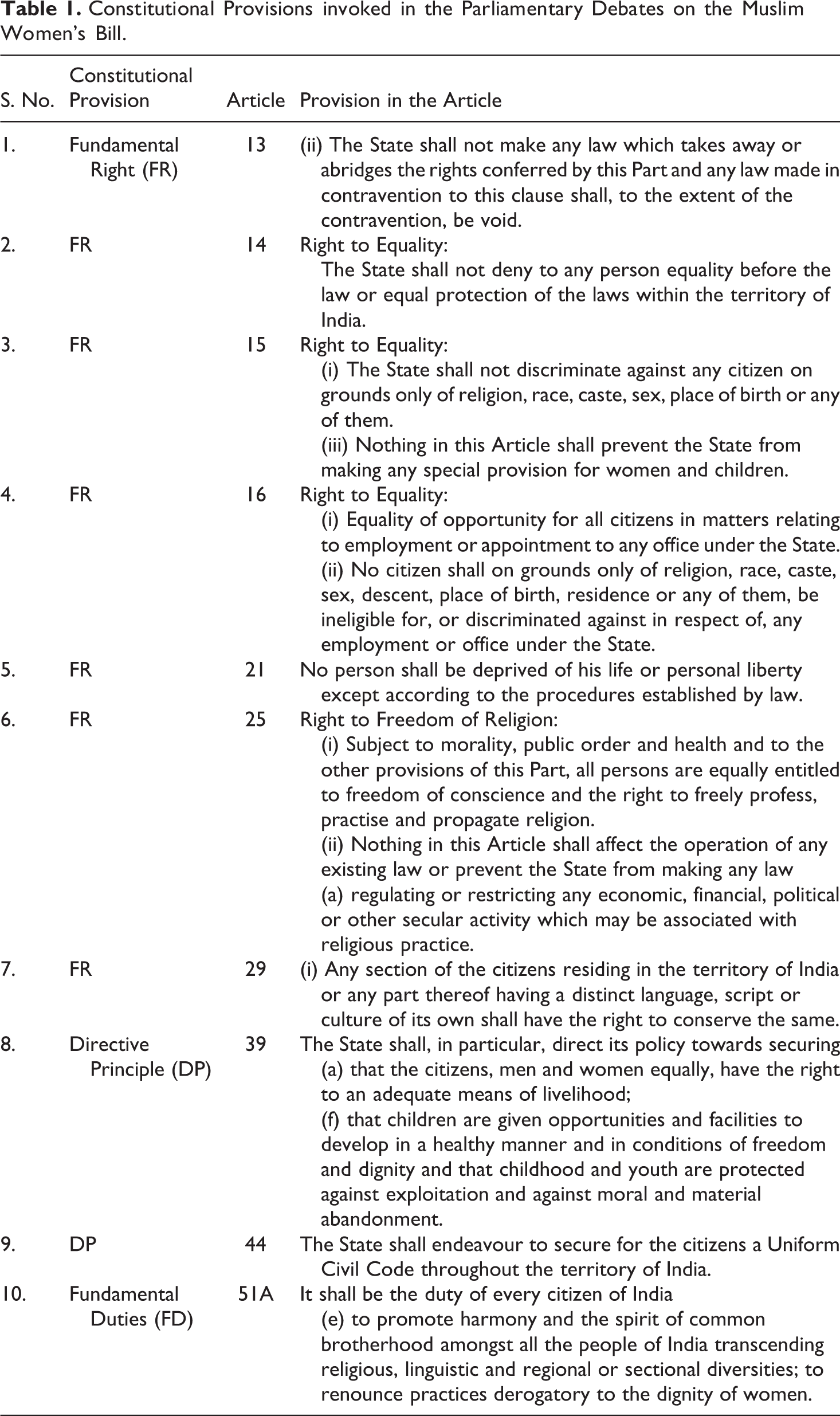
An examination of the parliamentary debates on the Muslim Women’s Bill shows that the members condoning the Bill legitimized their support by invoking ideals/ideas of secularism, national unity and democracy. The Bill was also justified by pointing out that the prevailing provisions in Section 125 CrPC which prevent the destitution and vagrancy of women were insufficient. 10 This was contrasted to the provisions of the Bill, which, though based on religious injunction, was depicted to be far more effective in protecting women as the present Bill put no limit on the amount of maintenance that could be paid. Further, the divorced wife would have the option to claim maintenance from a number of people (that is, those members of her family who would according to Shariat law inherit her property upon her death). Thus, the members of parliament supporting the Bill argued that, as opposed to popular perception, Islamic Law was progressive for women (A.K. Sen, LS, vol. 17: 515; Ebrahim Sulaiman Sait, ibid., 495; Abida Ahmed, ibid., 419). Archana Parashar points out that there was no explanation by the government as to why it was singling out Muslim women to give them better rights than those enjoyed by the rest of Indian women under a state-enacted secular law (Parashar, 1992: 182). The opposition, on the other hand, pointed out that the Bill violated a plethora of Articles in the Constitution and thus ran counter to the spirit of the Constitution. They questioned the constitutionality of the Bill, calling it “ultra-vires” and maintaining that the Bill would be struck down by the judiciary. Article 14, which calls for “equality before the law,” Article 15, which “prohibits discrimination of any citizen on grounds of religion, race, caste, sex or place of birth,” and Article 44, which enjoins the state to introduce a “uniform civil code throughout the territory of India,” were frequently cited by the opposition. Both those condoning and those condemning the Bill argued on the “correct interpretation” of the Quran and pointed to practices in other countries to justify their arguments. Table 1 gives a summary of the Articles in the Constitution of India invoked by the members of parliament to commend or to denounce the Bill. 11
Constitutional Provisions invoked in the Parliamentary Debates on the Muslim Women’s Bill.
Secularism and the Muslim Women’s Bill
In the parliamentary debates on the Muslim Women’s Bill, secularism was defined and elaborated in several ways such that it became a tool both to defend and denounce the Bill. While the Congress party generally construed secularism as “religious freedom of groups,” the opposition defined secularism in terms of “equality before the law.” In other words, the supporters of the Bill defined secularism in terms of group rights, and the opposition saw it in terms of individual rights. Thus, in introducing the Bill, the Congress government was led by concerns of “inter-group” equality rather than “intra-group” equality. 12 In her book Debating Difference, Rochana Bajpai maintains that in the Shah Bano debate the Congress party elaborated the conception of secularism as “equal respect for all religions” and “protection of the rights of minorities.” This, she argues, represented a shift in the Congress discourse from its earlier position on minority rights in the Constituent Assembly debates (the Constituent Assembly framed the Constitution of India in January 1950) where it had emphasized “exclusion of religion from the political domain” and “equal citizenship rights.” She argues that this changed connotation of secularism in the Congress discourse rendered it “more hospitable to special treatment for minority cultures than had been the case in the Constituent Assembly debates” (Bajpai, 2011: 190–191). She however maintains that concerns about equal citizenship had not totally disappeared from the political discourse on secularism in the 1980s as they were now mostly found in the opposition’s criticism of the Bill (ibid., 187). We will see that in the parliamentary debates on the Muslim Women’s Bill, secularism was elaborated in terms of religious freedom of groups/individuals, formal equality, and peace understood as national integration and communal harmony. If secularism is conceived as a “multi-value doctrine” (following Bhargava, 2002), then we can comprehend the proceedings of the Muslim Women’s Bill in the Parliament as exemplifying a trade-off among these liberal-political values. Bhargava maintains that the core idea of secularism is the “separation of religion and state for the sake of civic peace, religious liberty and equality of free citizenship” (Bhargava, 2002: 10). Through this seminal work, he demonstrates why the Indian Constitution is secular. He identifies Articles 25, 27 and 28 (3) of the Indian Constitution as establishing the criterion of religious freedom in secularism. 13 In Articles 14, 15 (1), 16 (1) & (2) and 29 (2), he identifies the liberal value of equality of citizenship. 14 It is important to note here that in identifying the provisions in the Constitution for religious freedom, Bhargava demonstrates not only the provision of freedom of religion but also that of freedom from religion in the Indian Constitution. 15 In the assembly debates on the Muslim Women’s Bill, the aspect of “freedom from religion” was excluded by the Congress government and others supporting the Bill. As such, for the Congress government, Article 25 was generally interpreted to mean religious freedom of groups and minority rights. The opposition, on the other hand, defined secularism in terms of equal citizenship. Thus, while the former legitimized the introduction of the Bill by arguing for inter-group equality and religious autonomy, the latter focused on common citizenship rights, and neglected the idea of “differentiated citizenship” (Young, 1990). The opposition was not concerned that equal treatment of differently placed groups would reinforce the dominant position of the majority group. This “radical individualist position” was prominent among the Hindu right wing members like the BJP, while the “conservative communitarian position” was found mostly among Muslim members supporting the Bill. 16 Thus, both the supporters and the opposition generally argued in terms of formal equality and failed to argue the merits and demerits of the Bill in terms of substantive equality, a point I discuss in the section on Secularism as “Equality.” 17
Secularism as “Freedom of Religion”
In this section, the assembly debate on the priority of Section 125 vis-à-vis Section 127 of the 1973 Act (a criminal law which requires individuals to maintain neglected wives, ex-wives, children and parents) demonstrates the dilemma of accommodating demands of gender-justice with religious freedom. In the old Code of Criminal Procedure of 1898, in Section 488, a husband was obliged to provide maintenance for his wife and children. Section 488 was introduced by the British colonial government in the Code of Criminal Procedure (CrPC) to prevent the vagrancy and destitution of women and children. 18 Divorced wives were not included within its purview. However, when this Act was amended in 1973, in Section 125, the definition of “wife” included ex-wife also. This meant that ex-husbands had to pay maintenance to their divorced wives. The Muslim community argued that Section 125 CrPC interfered with Muslim Personal Law, according to which ex-husbands provide maintenance to their ex-wives only within the three month iddat period. Therefore, through an amendment, Section 127 (3) (b) was added to the Code of Criminal Procedure of 1973, which provided that if the ex-husband discharged his obligation of maintaining his ex-wife according to his personal law, then Section 125 would stand annulled. Thus, by amending the criminal law of the 1973 Act, which is applicable to all citizens of India, the idea of differentiated citizenship was introduced within the purview of criminal law dealing with the vagrancy and destitution of wives, children and parents. The amendment, however, did not specify that this provision was meant for the Muslim community. In principle, this amendment applied to all religions which had provisions of maintenance for divorced wives in their respective personal laws. The amendment alluded to the Muslim Personal Law as it has provision of the mehar (dowry or bride wealth) to be given to the divorced wife. According to the then Law Minister, A.K. Sen, there was no controversy after the amendment, “until Shah Bano’s case came before the Supreme Court” (RS, vol. 138: 285). In his opinion, this Supreme Court judgment upset the balance between clauses 125 and 127 in the 1973 Act as the judgment held that if a divorced woman is unable to maintain herself after the period of iddat, she is entitled to take recourse to Section 125 CrPC. In the Shah Bano verdict the Supreme Court held that Section 125 “overrides” Section 127, if there is any conflict between the two (AIR 1985, SC, 945, pt. 2.3). The Law Minister maintained that this changed the whole situation as envisaged by the framers of the 1973 Code (LS, vol. 17: 444). He argued that as the Supreme Court’s judgment was seen to interfere with Muslim Personal Law, the present Bill was introduced to rectify the incorrect interpretation of Sections 125 and 127 by the Supreme Court. As Ram Niwas Mirdha, who piloted the 1973 Act, argued in the Lok Sabha debate on the MWA, “it is nothing more than correcting the wrong impression that was created, not only a wrong impression but a wrong effect caused by the Supreme Court judgment” (ibid., 447). Thus, the government’s justification for introducing the Muslim Women’s Bill was to allay the fears of the Muslim community that the state, through the backdoor of criminal law, was interfering with their personal law.
If such was the intent in framing the Muslim Women’s Bill, the Congress government argued that nothing new or revolutionary was being proposed by the Bill. The government was simply restating the law, albeit more precisely. While Section 127 made no reference to any religion and only alluded to the requirements of Muslim Personal Law, the present Bill would specifically make provisions for Muslim Personal Law to remain outside the purview of Section 125 CrPC. The Muslim Women’s Bill, then, seems to be an attempt by the Congress government to codify Muslim Personal Law so that the state does not interfere with the religious sensibilities of any minority communities. The Law Minister argued that this step was necessitated due to the requirements of secularism. As Article 25 of the Constitution guarantees “the right to freely profess, practice and propagate religion,” the Law Minister maintained that unless the government abrogated this Article, it could not change the personal laws without the consent of the communities concerned (RS, 290–293). Thus, the Muslim Women’s Bill was justified by the Congress government by construing secularism in two major ways: “religious freedom of groups” and “respect for cultural diversity.” The first justification was to be found in the provisions of the Constitution (Article 25) where secularism was elaborated by the Congress government as “equal respect for all religions” and “non-interference” by the state in the religious affairs of a community; the second justification of respect for diversity was that it was deemed desirable due to the nation’s history of allowing several cultures to thrive and flourish. The Law Minister elaborated the notion of secularism as follows: Our secularism does not mean that every man or woman must follow the same creed and faith in the same manner. The rich cultural heritage of this country is due to the fact that each community which has become part of our nation has contributed its own life-stream into the nation and they follow their own creed and faith in their own way without interference. That is secularism. In other words, it means no inquisition, no persecution of persons in following their own faith. Each one is entitled under Article 25 and 26 to follow his own faith and creed in his own way. (LS, vol. 13: 352–353; emphasis mine)
Secularism as “Equality”
Some of the members of parliament debating the Muslim Women’s Bill construed secularism to imply the requirement of justice, understood particularly as “equality.” While both the Congress government and the opposition espoused the value of equality, the former established equality as “differential treatment” and the latter defined equality as “treating likes alike.” Both these conceptions of equality fall under what Brenda Cossman and Ratna Kapur define as formal equality (Kapur and Cossman, 1999). Here equality is equated with sameness, such that any difference in treatment between similarly situated individuals constitutes discrimination. In formal equality, the focus of differential treatment is “sameness” and “difference.” Cossman and Kapur note that in this model, once difference is established, no further analysis for differential treatment is needed. They contrast this to “substantive equality” where the focus of analysis is not sameness or difference, but disadvantage. Here the object is to eliminate substantive inequality of disadvantaged groups in society (ibid., 41). With the distinction between formal and substantive equality in mind, I argue that since both the supporters and the opposition argued in terms of formal equality, there remained a gap in their legitimation. Since the Congress government justified the Muslim Women’s Bill in terms of formal equality, it remained susceptible to the opposition’s attack on the Bill as “anti-women.” We will see that the reason the Congress government’s position failed to justify the Bill in terms of substantive equality is its elision of accommodating concerns of gender equality with those of religious freedom. We will also see that the Congress government’s stance avoided this dilemma of accommodating gender equality with religious freedom through two strategies: first, by placing “religious freedom of groups” as its central concern and locus of legitimation; and second, by drafting the Bill ambiguously. Although the opposition argued against the Muslim Women’s Bill in terms of substantive equality with regard to women, the same was not extended to the minority Muslim community. That is, the opposition’s invocation of liberal principles of equality and freedom precluded the recognition of group-differentiated rights of Muslims as a minority community. In the parliamentary debates on the Bill we see a broad consensus among the opposition members for an implementation of the Uniform Civil Code (UCC) as a panacea for gender inequality among various religious communities. For the Hindu Right, the UCC has been a tool to construct a Hindu nation, in which the Muslim community would assimilate. The Shah Bano controversy demonstrates that a demand for a common code to achieve gender-justice could easily be appropriated by a masculinist discourse of the Hindu Right for whom a common code has been more of a stick to be wielded against the minority Muslim community.
21
The opposition’s failure to evoke notions of substantive equality for the minority Muslim community put it in a weaker position when concern about the “homogenization” of India’s cultural diversity was raised by those supporting the Bill. As a result of arguing from a standpoint of formal equality, the Communist Party found itself aligned with the Hindu Right BJP.
22
The Law Minister asserted the constitutionality of the Muslim Women’s Bill in the Parliament by arguing that the Bill did not run counter to the provisions of Articles 14 and 15 as the Constitution does not prohibit differential treatment. He pointed out that, … the Constitution … sets up a secular democracy not in the way of the uniformity of the grave. It sets up a fine mosaic where each community has its own part to play, its own culture to show and its own iddat and philosophy to flower. That is Indian secularism … Our secularism … flourishes on an acknowledgement of the different cultures of the various communities and religions which have come to stay in this great country. (LS, vol. 17: 516)
Catharine MacKinnon points out that in the formal model of equality, differential treatment is based upon classification, such that the problem it seeks to solve is “misclassification” (MacKinnon, 2006: 182). She argues that what this results in is “the rationalization of systemic social inferiority by terming it difference, rendering most sex- and gender-based subordination not inequality problems at all” (ibid., 183). We see that in the assembly debates the Congress government and the supporters of the Bill emphasized the difference of the Muslim community to classify it as separate from the rest of the population. For instance, the defenders legitimized the clauses in the Bill which absolve the husband of maintaining his divorced wife beyond the iddat period (see clause 1 (a) of MWA) and require that the woman’s relatives take up the responsibility of maintaining her after her divorce (see clause 4 (1) of MWA) by pointing out the contractual nature of Muslim marriage. The Bill’s advocates contended that unlike a Hindu marriage, since a Muslim marriage is a contract, a woman continues to belong to her father’s family even after marriage and the rights and obligations of a husband towards his wife end upon divorce. 23 Thus, we see that by prioritizing group rights over individual rights and by classifying the Muslim community as separate, the government legitimized the provisions of the Bill.
From the preceding paragraphs it becomes clear that the Muslim Women’s Bill was framed by the government as a corrective to the Shah Bano judgment. That is, the Bill was introduced in the Parliament not with the concern of protecting divorced Muslim women; instead, it was introduced to assure the Muslim community that their religious freedom was being respected and protected from state interference. Now the question arises that if the primary purpose of the Bill was to protect the religion and culture of a minority community that felt threatened by the judiciary’s incursions into its personal law, how did the Parliament balance the requirements of religion with that of gender-justice? I have argued in this paper that through an understanding of secularism as allowing the freedom of religious groups, the government sought to avoid the dilemma of accommodating concerns for gender-justice while protecting religious freedom.
But another way by which the government circumvented this dilemma was by framing the Bill ambiguously. When the Bill was introduced in the Parliament, members of opposition parties argued that the Bill would be struck down in the judiciary as it was unconstitutional. The conviction of those opposing the Bill was proven wrong in 2001 as the Supreme Court in the Danial Latifi judgment ((2001) 7 SCC 740) upheld the constitutional validity of the Act. It seems then, that while the Act, on the face of it, appeared to violate Muslim women’s rights, it did in fact have provisions in it to safeguard the rights of divorced Muslim women. Here, a second question to be asked is whether it was the Supreme Court’s interpretation of the Act, or whether the Parliament itself made provisions in the Act to safeguard the interests of divorced Muslim women. Most academics writing on the Muslim Women’s Act have argued that since the Act was “hurriedly drafted,” it had several loopholes in it because of which the judiciary could interpret the Act in such a way that it would safeguard the rights of divorced Muslim women (Agnes, 2011: 166–167). However, a close analysis of the assembly debates reveals a different picture. The Act, no doubt, was hastily passed but it was assiduously drafted. In the following pages I argue that the government intentionally kept the Act extremely vague.
It is interesting to note that the Supreme Court in the Danial Latifi verdict adjudicating on the constitutional validity of the Muslim Women’s Act reiterated its earlier position, stated in the Shah Bano judgment, that a Muslim husband is liable under Section 125 CrPC if a divorced woman is unable to maintain herself. The judgment observed, … it may look ironical that the enactment intended to reverse the decision in Shah Banos [sic] case, actually codifies the very rationale contained therein. ((2001) 7 SCC 740, 10)
During the formulation of the Act, several amendments were suggested to assist the judiciary in its interpretation of the Act, especially concerning the issue of whether Muslim Personal Law is outside the purview of Section 125 CrPC. G.M. Banatwala who introduced the Bill in the Parliament pointed out that, … unfortunately, at certain places the language is vague and capable of being interpreted in several ways. (LS, vol. 17: 548)
Several other amendments to the Act were suggested as it was seen as susceptible to several interpretations. However, no amendments were made in the Bill that would make it inviolable. Banatwala’s fear that the vague wordings of the Act would continue to cover divorced Muslim husbands under section 125 CrPC proved to be prescient when the Supreme Court in 2001 in the Danial Latifi verdict utilized the ambiguous wordings of the Muslim Women’s Act to keep Muslim ex-husbands within the purview of Section 125.
24
The Danial Latifi judgment distinguished between two separate and distinct obligations of the divorcing husband, namely, “maintenance paid” and “provision made” to the divorced wife ((2001) 7 SCC 740, 10); a distinction that Banatwala warned would continue to require a divorcing Muslim husband to provide lifelong maintenance to the divorced wife. This distinction between “maintenance paid” and “provision made” in the Act meant that a Muslim ex-husband had to make provision for his divorced wife over and above the meager maintenance amount of five hundred rupees, where provision would require a Muslim ex-husband to “contemplate the future needs and make preparatory arrangements in advance for meeting those needs” (ibid., 9). Further, the judges pronouncing the Danial Latifi judgment maintained that: … nowhere the Parliament has provided that reasonable and fair provision and maintenance is limited only for the iddat period and not beyond it. It would extend to the whole life of the divorced wife unless she gets married for a second time. (ibid.; emphasis mine)
Secularism as “Peace”
The value of peace was espoused by both parties condemning and condoning the Muslim Women’s Bill. Bajpai opines that secularism was seen to help in a range of national unity concerns, of which state stability and the maintenance of civil peace were most prominent (Bajpai, 2011: 208). Both the supporters and the opposition pointed to the prevailing situation in the country to demonstrate how peace was in peril. For instance, they frequently pointed to terrorism, religious fundamentalism and the problem of secessionism to argue for the expediency of peace. 25 For example, while the supporters of the Bill argued that by respecting the rights of religious minorities the state would make minorities feel secure and thus promote national unity (K.C. Pant, LS, vol. 17: 392–393), the opposition, on the other hand, argued that by further infusing differences based on religion, the government would incite disunity (H.A. Dora, LS, ibid., 339). Bajpai remarks that in the Constituent assembly which framed the Constitution of India, the Congress party considered religious difference in politics antithetical to national unity. By contrast, in the Shah Bano debate, the non-recognition of religious difference was seen by the Congress party as a greater threat to national unity (Bajpai, 2011: 209).
Peace was generally defined as communal harmony and toleration. 26 The value of toleration was frequently invoked by dwelling on India’s long tradition and history as a tolerant society. In such arguments for secularism, the defenders of the Bill treaded a thin line of eulogizing “Hindu” tradition and culture (A.K. Sen, LS, vol. 13: 353; Krishna Sahi, LS vol. 17: 440). Bajpai remarks that harnessing such Indian/Hindu traditions of toleration “could slip easily into a sense of Hindu superiority vis-à-vis other religions as less open-minded” and as “exploiting Hindu generosity.” In fact, such arguments have been a common feature among the Hindu Right to support their claim that the secular state in India has been an outcome of attitudes of toleration and generosity among Hindus toward members of other faiths. Secularism, in such a discourse of the Hindu Right, is redolent of the superiority of the Hindu religion and generosity of Hindus (Bajpai, 2011: 213–214). For the opposition, on the other hand, the right to freedom of religion was subject to “public order, health and morality.” They maintained that since the Bill had the potential for causing public disorder, it was against Article 25. Quoting Tocqueville, Member of Parliament K.P. Unnikrishnan argued that when “public inclination” is at variance with “public interest,” it is the duty of the representatives of the people to guard those interests (LS, vol. 17: 438). Since the Bill was seen by the opposition as a regressive Act which would condemn Muslim women to penury and increase divorce rates among Muslims, it was against public interest, morality and public order. Thus, the opposition pointed out that secularism cannot mean absolute freedom of religion and is subject to public order, health and morality (ibid., 436).
Peace was also understood as an expression of national integration achievable through a uniform civil code (UCC) throughout the country. While this line of argument was mostly taken up by the opposition, it is important to note here that the Congress government also did not give up the ideal of a UCC, although unlike the opposition they added the proviso that it should be instituted with the consent of minority communities. Congress minister Arjun Singh remarked: … a voluntary common civil code is certainly the need of the hour … I would very much appeal to all sections of the House that they should after passing of this Bill assist the Prime Minister in evolving a civil code of this country which is accepted voluntarily by all sections of the people in India. (LS, vol. 17: 404) … there must be a common civil code in the country. It is necessary for the unity of the country … There must be one code and one language. If you cannot do that, you cannot maintain the unity and integrity of the country. (ibid., 489–490; emphasis mine)
Conclusion
What does the analysis of the parliamentary assembly debates on the Muslim Women’s Bill suggest about the way the secular state accommodates the concerns of gender-justice and religious freedom? The preceding paragraphs have shown that in the parliamentary debates on the Muslim Women’s Bill the Parliament did not take up the task of accommodating concerns of gender-justice while protecting demands for religious freedom. Rather, this paper shows that the government involved itself in a trade-off of liberal-political values where “religious freedom of groups” took precedence over “freedom from religion” and where equality meant formal equality at the neglect of questions of substantive equality for women. Does this analysis of parliamentary debates on the Muslim Women’s Bill then suggest that the demands of a religious community are incommensurable with demands for democratic citizenship and feminist ideals? Or, does it suggest that there was a lack of any attempt by the government to balance the demands of gender-justice and religious freedom?
In this paper I have argued that the government scrupulously avoided the task of accommodating the opposing demands of gender-justice and religious freedom. It did so through two strategies: (a) by construing secularism as “religious freedom of groups” while completely avoiding any meaningful consideration of “freedom from religion,” which is also an essential aspect of secularism; and (b) the government intentionally drafted an ambiguous Bill and left it to the judiciary to resolve the conflict between demands for religious freedom and concerns for gender-justice. Bajpai maintains that there has been a shift to stronger multicultural policies in the late 1980s (Bajpai, 2011: 220). My analysis of the parliamentary debates suggests that at the level of deliberation and discussion in the Parliament, this discursive shift took place at the expense of concerns about intra-group equality. However, my analysis of the assembly debates also suggests that the government framed a loose and ambiguous law which left the conflict between gender-justice and religious freedom unresolved. Through the ambiguity of phrases such as “reasonable and fair provision and maintenance,” “within the iddat period,” the Congress government kept the question of accommodating the demand for gender-justice open.
Given these observations, can we say that the government turned a blind eye to the concerns of gender-justice? At the level of deliberation, the government did not prioritize the issue of gender-justice, even though the law it was promulgating was purportedly for the benefit of divorced Muslim women. However, at the level of formulation, it intentionally framed an ambiguous law and left the question of gender-justice unresolved. The government left it to the judiciary to resolve the demands of gender-justice while accommodating demands for religious freedom. In the Danial Latifi judgment the judiciary utilized vague wording in the Muslim Women’s Act to provide equal citizenship rights to Muslim women without rejecting the dictates of Islamic Law.
These observations have wide implications for liberal-democratic theory engaged in accommodating multicultural demands. The analysis of the parliamentary debates on the Muslim Women’s Bill suggests, firstly, that when purportedly incommensurable demands for gender-justice and religious freedom come to an elected deliberative forum, it is not necessary that such demands are resolved through “consensus” (Cohen, 1997) or through “negotiation and compromise” (Deveaux, 2006). Rather, what we saw in the parliamentary debates on the Muslim Women’s Bill was that realpolitik considerations such as vote-bank politics, the influence of conservative sections of the Muslim community on the government, and the issuance of a “party whip” by the Congress party on its members played definitive roles in deciding the fate of the Bill. Political considerations of the political parties and inadequate democratic institutional structures hindered the balancing and accommodation of concerns about religious freedom and gender-justice. As such, I have argued that the political parties involved themselves in a trade-off of liberal-political values and not a balancing of these values.
Secondly, we saw that while the proponents of the Bill prioritized group rights at the expense of individual rights, the opponents neglected the concern that equal treatment of differently placed groups would result in reinforcing the dominant position of the majority group. The opposition, thus, did not sufficiently take into account the fact that vulnerable groups should be accorded differential treatment. At the same time we also saw that the differential treatment of the Muslim community was justified by the supporters of the Bill not on the basis of their disadvantaged position but on account of their difference itself. Thus, I have argued in this paper that the normative justification for differential treatment of the Muslim community was inadequately provided by the Congress government. I have further contended that the reason supporters of the Bill were susceptible to accusations that the Bill was “pseudo-secular” and “anti-women,” and opponents of the Bill to accusations of “homogenization” of India’s cultural diversity, is because both argued in terms of formal equality. This resulted in a gap in the legitimating vocabulary of both the proponents and the opponents of the Bill. The parliamentary debates therefore lacked arguments based on substantive equality. Thus, another implication of our analysis is that the incompatibility observed in the parliamentary debates between group rights and individual rights was a result of an inadequate discursive development of the normative vocabulary in accommodating the demands for group rights while protecting concerns about gender-equality.
Thirdly, an analysis of the parliamentary debates points out that while the Congress government prioritized group rights, it did not give up the ideal of a common civil code. Thus, the introduction of the Muslim Women’s Act did not entrench legal pluralism in India as the government did not give credence to the idea of legal pluralism in family law. Since the government left the question of accommodating gender-equality concerns unresolved, the judiciary was left to determine whether to further entrench legal pluralism in the family law of India.
Footnotes
Notes
Declaration of Conflicting Interests
The author declared no potential conflicts of interest with respect to the research, authorship, and/or publication of this article.
Funding
The author received no financial support for the research, authorship, and/or publication of this article.