




Abstract
The cumulative weight of evidence supports that religious involvement has a positive association with subjective wellbeing. This association is found to vary by cultural context, gender, and age. No large scale study exists regarding the effects of sexual orientation on the association between religiosity and subjective wellbeing. This article, using nationally representative Canadian data from 2010 to 2014, fills this gap. As a prelude, the sexual orientation-related differences in religiosity, also not previously examined using Canadian data, are assessed. Both gay males and lesbians are found more likely to be unaffiliated than their heterosexual counterparts. The association of religiosity with subjective wellbeing is found to be positive, though small, for heterosexuals of both genders and for gay males. No statistically significant effect is found for lesbians. Various venues of explanation are explored.
I. Introduction
This article, using pooled cross-sectional data from the Canadian General Social Surveys of 2010 to 2014 (N = 77,299), makes two distinct contributions to the literature. First, the degree of religiosity of homosexuals is compared with that of heterosexuals, considering several dimensions of religious involvement. Second, this article examines the impact of sexual orientation on the association between religiosity and subjective wellbeing. Religiosity is often found to be positively associated with subjective wellbeing across populations and demographic groups, but with varying magnitudes (Hadaway, 1985; Ellison et al., 1989; Lewis and Cruise, 2006; Campante and Yanagizawa-Drott, 2015). There are also reports of no relationship or a negative association, for some cultural contexts (Diener et al., 2011; Dilmaghani, 2018a). No scholarly attention has been paid to the effects of sexual orientation on the relationship between religiosity and subjective wellbeing. Only a few studies on the impact of religiosity on the mental health of sexual minorities have thus far been conducted (Barnes and Meyer, 2012; Foster et al., 2015). One of the reasons for this paucity of scholarship is data unavailability. In the Canadian and American General Social Surveys, married and cohabiting homosexuals can be identified based on their own gender and the gender of their domestic partner. These surveys also include standard questions regarding religiosity and subjective wellbeing. The General Social Surveys are the unique source of simultaneous information on sexual orientation, religiosity, and subjective wellbeing.
Sherkat (2002, 2017), using the American General Social Survey, has compared the degree of religious involvement of sexual minorities with that of heterosexuals. The wellbeing implications of religiosity are not examined in Sherkat (2002, 2017). This article first compares partnered lesbians and gay males with their heterosexual counterparts, in their likelihood of unaffiliation and their intensity of religious involvement. The analysis of the Canadian General Social Survey conducted here reveals patterns largely comparable with those reported by Sherkat (2002, 2017). More precisely, the analysis indicates that Canadian lesbians have a lower attachment to religion than heterosexual females. Conversely, Canadian gay males, although more likely to report no formal affiliation with organized religion, are found no different from heterosexual males in their degree of religious involvement.
Sherkat (2002, 2017) motivates the sexual orientation-related differences in religiosity by both supply and demand factors, and notes that sexual minorities under-consume religion and form a lower religious capital than heterosexuals. A lower religious capital reduces the utility attained by the consumption of religious goods (Iannaccone, 1990; Sherkat and Wilson, 1995; McBride, 2015). Since subjective wellbeing scores are assumed to pertain to measures of cardinal utility (Van Praag, 1991; Ng, 1992, 1997; Holländer, 2001), it can be expected that religiosity less strongly contributes to the subjective wellbeing of gay males and lesbians. This article is the first large scale examination of this question. The results regarding heterosexuals remain comparable to those reported in Dilmaghani (2018d), in which a positive association between religiosity and subjective wellbeing is reported. But religiosity is found to be a statistically insignificant predictor of subjective wellbeing of lesbians. Conversely, for gay males, a statistically significant and relatively large relationship is found. The channels of impact of religiosity on subjective wellbeing are also investigated.
II. Literature Review
Sexual orientation scholarship has been constrained by data availability (Badgett, 1995; Carpenter, 2008; Dilmaghani, 2018b). Before Sherkat (2002), the association between sexual orientation and religiosity had only been examined for some subsets of homosexuals, such as those who were religiously inclined (Thumma, 1991; Yip, 1997; Neitz, 2000; Rodriguez and Ouellette, 2000; Wilcox, 2002), or those who sought to instigate their own denominations (Warner, 1995). No previous Canadian study had been conducted. Hence, the literature review is heavily reliant on the US and European studies. To position Canada in this context, this section opens with a comparative overview of the Canadian religious landscape.
The Canadian religious landscape presents similarities to both the relatively more religious United States and the relatively more secular Western Europe (Berger et al., 2008; Lyon and Van Die, 2000; Cadge et al., 2017). In the past few decades, the number of the religiously unaffiliated individuals has substantially grown in both Canada (Clarke and Macdonald, 2011; Hay, 2014) and the US (Kosmin et al., 2009). According to the data from the 2010s, around 24% of Canadians claim no religious affiliation (Dilmaghani, 2018c), up from 4% in the 1970s (Gee and Veevers, 1989). In spite of the continued growth of secular groups, the share of the highly religious has remained stable in many Western countries (Voas, 2009; Kaufmann et al., 2012). In these countries, further secularization is fueled by a fall in the religiosity of those in the religious middle-ground. This pattern is referred to as religious polarization (Martin, 2005; Wilkins-Laflamme, 2014). Putnam and Campbell (2010) note that religious polarization is one of the main developments in the US religious landscape. For Canada, since the mid-2000s, a stabilization of the number of regular churchgoers has been reported (Eagle, 2011; Bibby, 2011). Wilkins-Laflamme (2014), using Canadian, British, and American data, report an emerging religious polarization in certain regions of all three countries. Most recent scholarship continues to debate the accuracy of the polarization characterization of the Canadian religious landscape (Reimer, 2017; Wilkins-Laflamme, 2017). In both the United States and Canada, the largest homosexuality-affirming church is the United Fellowship of Metropolitan Community Churches (UFMCC), initiated in 1968 (Warner, 1995; Lukenbill, 1998).
Sherkat (2002, 2017), comparing American homosexuals with their heterosexual counterparts, amply motivates the premise that religious inclination varies by sexual orientation. In the lines below, these motivations are reviewed and complemented by the recent scholarship. First, in Western Christian societies, women are persistently found to be more religious than men (Argyle and Beit-Hallahmi, 1975; de Vaus and McAllister, 1987; Francis, 1997; Freese and Montgomery, 2007; Collett and Lizardo, 2009; Edgell et al., 2017). The literature often attributes this gap to the lower opportunity cost of time for women (Azzi and Ehrenberg, 1975), women’s primary responsibility for childrearing and the moral socialization of their children (Trzebiatowska and Bruce, 2012), and differences in risk aversion (Miller and Hoffmann, 1995; Roth and Kroll, 2007). Several of these explanations, directly or indirectly, relate to the socioeconomic attainment of women and their compliance with traditional gender roles. A biologically based division of household labour (Becker, 1985) or traditional views on gender roles (Giddings, 2003) implies that women are more likely to specialize in home production and have a lower labour market attainment (Hertel and Hughes, 1987; Sherkat, 2000; Ammerman and Roof, 2014). In parallel, the “family life cycle” hypothesis suggests that women’s religiosity increases with motherhood and peaks when children reach school age (Bahr, 1970). Additionally, Miller and Stark (2002) propose that since women are socialized to be more submissive, they are more likely to fail to reject religion.
Lesbians have significantly fewer children (Patterson and Friel, 2000; Baert, 2014), have a lower propensity to specialize in home production (Jepsen and Jepsen, 2006, 2015; Grossbard and Jepsen, 2008), play a markedly higher part in the labour supply (Blandford, 2003; Tebaldi and Elmslie, 2006), achieve significantly higher earnings (Badgett, 1995; Carpenter, 2008; Mueller, 2014; Klawitter, 2015; Dilmaghani, 2018b), and show a lower inclination to conform to socially sanctioned gender roles (Wright and Perry, 2006). Hence, lesbians are likely to be less religious than heterosexual women and yield lower benefits from their religious involvement.
Across the literature, gay men are reported to earn less, work fewer hours (Badgett, 1995; Carpenter, 2008; Klawitter, 2015; Dilmaghani, 2018b) and more often to be employed in female-dominated jobs than heterosexual men (Blandford, 2003; Tebaldi and Elmslie, 2006; Antecol et al., 2008). These economic factors suggest that gay men may be more religious than heterosexual men (Azzi and Ehrenberg, 1975). In parallel, parenthood is suggested to intensify the religiosity of fathers (Stolzenberg et al., 1995; Berghammer, 2012). With the birth of a child, parents have a greater need for meaning in life (Ingersoll-Dayton et al., 2002) and are willing to expose children to positive religious values (Becker and Hofmeister, 2001). These factors usually steer them towards religion (Dilmaghani, 2018c). Gay men have fewer children than both heterosexual men and lesbians (Black et al., 2002; Riskind and Patterson, 2010). The relatively lower fertility of gay men may exercise a negative influence on their religiosity.
Some scholars argue that religiosity has a biological component (Bradshaw and Ellison, 2008). Norenzayan et al. (2012) report that autistic individuals with mentalizing deficits are unable to conceive of a personal God, while Baron-Cohen (2002) links the “extreme male brain” to mentalizing deficits. A risk-taking attitude, also linked to biological differences and masculine characteristics (Stark, 2002), is another channel (Miller and Hoffmann, 1995; Miller and Stark, 2002). In fact, some scholars suggest that the degree of femininity or masculinity exhibited by an individual is a more accurate predictor of religiosity than gender (Thompson, 1991; Thompson and Remmes, 2002). Empirically, measures of femininity and masculinity are reported to explain differences in religiosity both within and between genders (Francis and Wilcox, 1998; Sullins, 2006; Lizardo and Collett, 2009). Lesbians are regarded as less feminine, more androgynous, and more masculine, compared with heterosexual females (Hooberman, 1979; Oldham et al., 1982; Ross, 1983; Sherkat, 2002). Conversely, gay men are regarded as less masculine, more androgynous, and more feminine, in their social orientations than heterosexual men (LaTorre and Wendenburg, 1983; Sherkat, 2002; Wright and Perry, 2006).
Moreover, Davie and Walter (1998, 2001) suggest that the lower socioeconomic attainment of women insulated them from the secularization process. This insulation, in turn, has led to the “feminization” of Western Christianity. In the context of a “feminized” religious and spiritual practice, there may be risks of social rejection for males if they exhibit high levels of religiosity (Hayes et al., 2000; Sullins, 2006; Trzebiatowska and Bruce, 2012). This social rejection may be less effective as a motivation for gay males, since they likely have a lower propensity to overtly exhibit masculinity (Wright and Perry, 2006). These lines of argument also imply that gay males are likely to be more religiously inclined than heterosexual males, while the reverse seems true for lesbians.
Finally, according to Sherkat (2002, 2017), there are substantial supply-side reasons for homosexuals to consume less religion than heterosexuals, regardless of their own inclinations. The continuing heterosexism of most religious groups makes gays and lesbians more likely to reject religion (Sherkat, 2002). Even in relatively liberal denominations, homosexuality is a polarizing issue among the congregants and the clergy alike (Wood and Bloch, 1995; Anderson, 1997; Wellman, 1999; Koch and Curry, 2000; Finke and Stark, 2001). The UFMCC, the largest homosexuality-affirming church in North America, is still limited in its geographic reach, and is unlikely to meet all religious preferences prevailing among homosexuals (Sherkat, 2002). Moreover, due to the lack of an adequate organic growth by retaining the offspring of the affiliates, queer congregations generally struggle (Hout et al., 2001; Sherkat, 2002). Considering these supply-side limitations, Sherkat (2002) points out that the under-consumption of religion dilutes the religious capital of homosexuals. An inadequate religious capital reduces the benefits of religious involvement (Iannaccone, 1990; Sherkat and Wilson, 1995; McBride, 2015).
The above review suggests that lesbians must be less religiously inclined than heterosexual females. As such, lesbians will consume less religion, and form a smaller religious capital than heterosexual females (Iannaccone, 1990; Sherkat and Wilson, 1995), regardless of the supply in the religious market. Thus, owing to their lower religious capital, the benefits of religion, and therefore the association of religiosity with subjective wellbeing, are likely to be lower for lesbians than for heterosexual females (Sherkat and Wilson, 1995; Iannaccone, 1990; McBride, 2015). Gay males, on the other hand, appear likely to be more religiously inclined than heterosexual males. Provided that an adequate supply exists, gay males are likely to desire a higher religious consumption, and this may ultimately form a higher religious capital. It is, therefore, possible that the contribution of religion to their subjective wellbeing is larger for gay males than for heterosexual males.
The relationship between sexual orientation and subjective wellbeing has only been examined using probability samples from the US, the UK and Australia (Blanchflower and Oswald, 2004; Chakraborty et al., 2011; Powdthavee and Wooden, 2015). Using the American General Social Surveys of 1988 to 2002, Blanchflower and Oswald (2004) did not find a statistically significant difference in the self-reported happiness of American homosexuals and heterosexuals. Using British data of 2007, Chakraborty et al. (2011) found that British homosexuals are significantly less likely to report being “fairly or very happy” than heterosexuals. Finally, using British and Australian data, Powdthavee and Wooden (2015) reported that sexual minorities are less satisfied with their lives than comparable heterosexuals. The effects of religiosity on subjective wellbeing were not explicitly considered in any of these studies.
There is a relatively large literature on the relationship between religiosity and subjective wellbeing (Ferriss, 2002; Greene and Yoon, 2004; Lelkes, 2006; Hayo, 2007; Elliott and Hayward, 2009; Lim and Putnam, 2010; Shor and Roelfs, 2013). Most of these studies report a positive relationship. Despite the host of studies which report a positive association, it has been argued that religion is not a universal predictor of higher subjective wellbeing, across societies (Diener et al., 2011; Diener, 2012). The argument against the universality of the relationship between subjective wellbeing and religiosity lies on the culture–person congruence thesis, postulating that people who possess the characteristics valued in their culture tend to be happier (Diener et al., 2003). Accordingly, Diener et al. (2011) find that in very religious nations and states of the United States, religious people report a higher level of subjective wellbeing than nonreligious people. However, this difference disappears in the least religious nations and states. Dilmaghani (2018d) reports the same for Quebec, the least religious province of Canada (Wilkins-Laflamme, 2016). In none of these studies has the effect of sexual orientation on the relationship between religiosity and subjective wellbeing been considered.
III. Data and Methodology
Few Canadian datasets contain information on sexual orientation. In the Canadian Censuses and the Canadian General Social Surveys (GSS), married and cohabiting homosexuals can be identified based on the gender of their domestic partner. This article pools five consecutive cycles of the Canadian GSS, covering 2010 to 2014 (Statistics Canada, 2017). The oldest cycle employed in this study was conducted in 2010 (N = 8,906), five years after the legal recognition of same-sex marriage in Canada. The latest cycle has been conducted in 2014 (N = 17,993). Since the GSS only allows for the identification of homosexuals who were married or cohabiting at the time of the interview, in all the analyses, the samples are restricted to the married or cohabiting individuals to achieve comparability between heterosexuals and homosexuals.
The Canadian GSS data offer a unique opportunity for the examination of the association between religiosity and subjective wellbeing (SWB). First, in all the cycles of the Canadian GSS, a uniformly formulated SWB question exists. Second, all the surveys contain the standardized questions, covering the main dimensions of religious involvement (Idler et al., 2003). Third, the Canadian GSS datasets are nationally representative random samples of the population, with a much greater number of observations than their American counterparts. The smallest cycle used in this study contains 8,367 observations on partnered individuals, while the largest cycle has 17,993 observations. The number of observations in the pooled sample is 77,299. In accord with all reliable statistics (Statistics Canada, 2015; Dilmaghani, 2018b), partnered homosexuals constitute 1.20% of this sample, partnered lesbians account for 1.14% of partnered females (N = 374), and partnered gay males are 1.25% of partnered males (N = 373).
There are four questions in the GSS that explicitly deal with religion and spirituality. First, religious affiliation is surveyed, explicitly offering the response option of none. Respondent affiliation is recorded, even if an individual is no longer a practicing member, but still identifies with a given group. The three other religion-related questions of the GSS invite the respondents to: (i) rank the importance of their religious or spiritual beliefs in their way of life, from 1 for very important to 4 for not important at all; (ii) report their frequency of religious or spiritual practice on their own, including prayer, meditation or any kind of worship practiced at home; (iii) report their frequency of religious service attendance.
To have an indicator of the overall degree of religious involvement of the respondents, a Composite Religiosity Index (CRI) is created by adding the rescaled responses to these religious commitment questions. The rescaling is done such that each dimension of religiosity varies between 0 for never and 52 for at least weekly, as proposed by Sander (2002). The 4-item response scale of the salience of belief question is also rescaled to vary between 0, for Not important at all, and 52, for Very important. As such, this dimension of religiosity is given the same weight as the two religious practice questions in the CRI. Consequently, the Composite Religiosity Index (CRI) varies between 0 and 156. An almost identical index is used in Clark and Schellenberg (2006) to measure the degree of religiosity, and in Dilmaghani (2018d) to assess the association of religiosity with subjective wellbeing. Although it was possible to implement more sophisticated approaches in the creation of the index, the use of a similar index allows for the comparability of the results with these previous studies.
The subjective wellbeing (SWB) question of the GSS is uniformly formulated as “Using a scale of 1 to 10 where 1 means ‘Very dissatisfied’ and 10 means ‘Very satisfied’, how do you feel about your life as a whole right now?” The surveys also contain employment status, income, educational attainment, self-rated physical and mental health, and demographic indicators such as age, marital status, number of dependent children, ethnic, and immigration background. The data, therefore, allow for the use of a rich set of controls in the multivariate regressions. Table 1 defines the main variables used in the analyses.
Definitions of main variables.
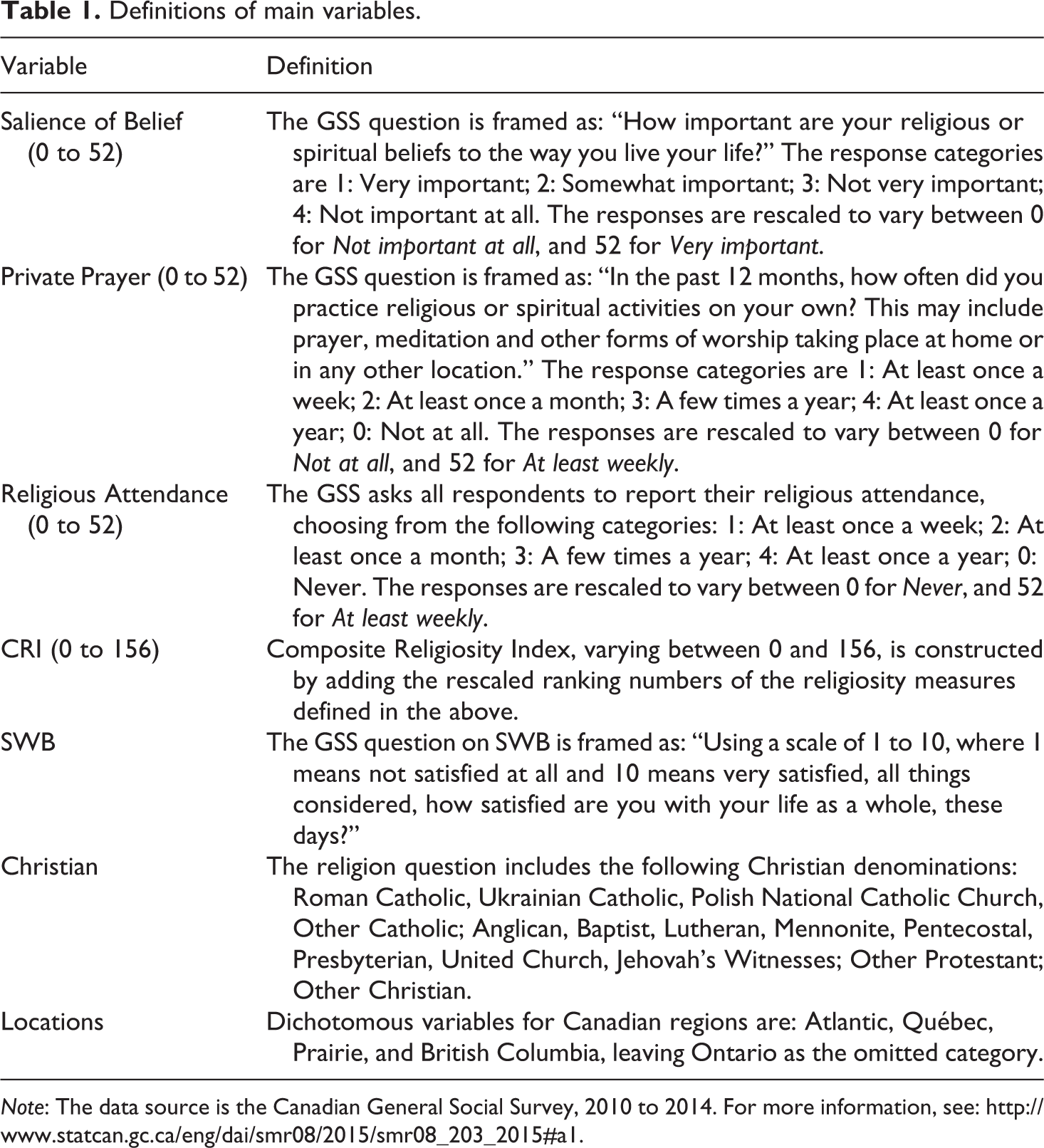
Note: The data source is the Canadian General Social Survey, 2010 to 2014. For more information, see: http://www.statcan.gc.ca/eng/dai/smr08/2015/smr08_203_2015#a1.
Table 2 reports the descriptive statistics extracted from the pooled GSS data. The missing observations, minimal except for the income question, are dealt with through listwise deletion. The missing income data are rather considerable at 12%. But the mean hourly wage and income computed after applying the survey weights did not differ much from those given in the official reports of Statistics Canada. Additionally, several previous studies have used either GSS or Canadian health surveys, which have a comparable number of missing income observations in earnings comparisons (Carpenter, 2008; Mueller, 2014; Dilmaghani, 2018b). Hence, the missing income data are assumed to be “missing at random,” and are also dealt with through listwise deletion. All the estimations reported in Table 2 are made using the survey weights.
Descriptive statistics: Respondents with a domestic partner.
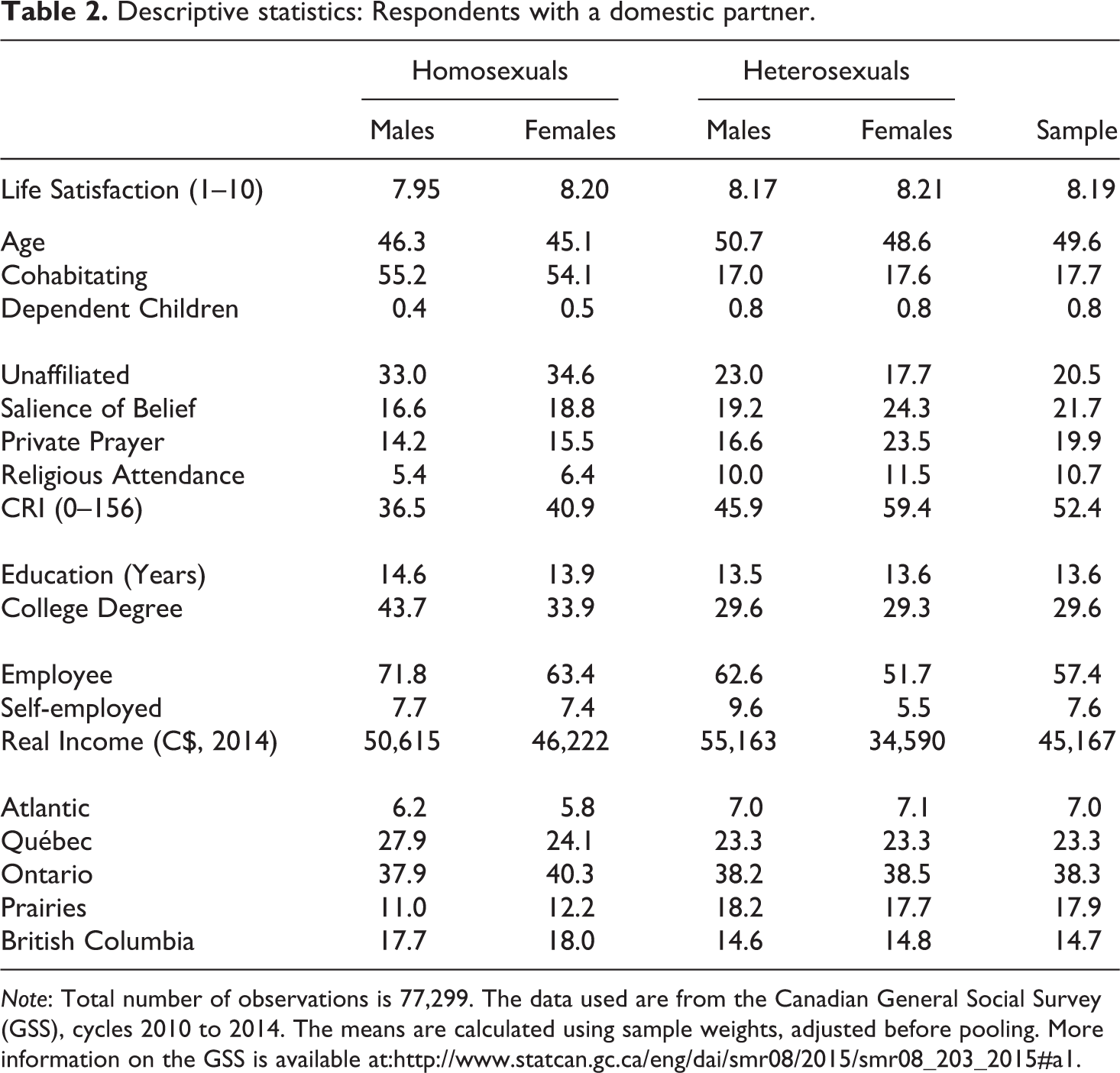
Note: Total number of observations is 77,299. The data used are from the Canadian General Social Survey (GSS), cycles 2010 to 2014. The means are calculated using sample weights, adjusted before pooling. More information on the GSS is available at:http://www.statcan.gc.ca/eng/dai/smr08/2015/smr08_203_2015#a1.
The patterns reported in Table 2 seem to accord with previous reports on the characteristics of sexual minorities in Canada and elsewhere. Partnered gays and lesbians in Canada are more educated, less likely to be married, and have fewer children than their heterosexual counterparts. Geographically, gays and lesbians are somewhat more likely to reside in Ontario, Québec, and British Columbia, owing to the existence of larger urban centers in these provinces. Gay men and lesbians cluster in high amenity cities, partly as a result of their fewer children (Black et al., 2002) and partly to avoid unfriendly neighbourhoods (Gates and Ost, 2004; Spring, 2013). Partnered gay men are less likely than their heterosexual counterparts to be self-employed, while the reverse is true for partnered lesbians (Jepsen and Jepsen, 2016; Waite and Denier, 2016). Since the analysis uses five cycles of the GSS, real incomes are calculated using the Canadian Consumer Price Index (Statistics Canada, 2018), setting 2014 as the base year. Gay men have a lower mean real income than heterosexual males, while lesbians’ mean real income is above that of heterosexual females. Carpenter (2008), using 2002 and 2005 data, reported an earnings premium for lesbians over heterosexual females and an earnings penalty for gay males compared with heterosexual males. Mueller (2014) and Dilmaghani (2018b) provide compatible evidence.
Regarding religiosity, the likelihood of unaffiliation is the highest for lesbians (34.6%), closely followed by that for gay males (33%). In comparison, only 17.7% of heterosexual females and 23% of heterosexual males report no religious affiliation. The degree of religious commitment, regardless of the measurement employed, is the lowest for gay males, closely followed by that for lesbians. Heterosexual females are found to be the most committed. Figure 1 provides visuals for these statistics. As in the SWB scores, they do not show significant differences across sexual orientation and gender groups. The lowest mean SWB score belongs to gay males, at 7.95, against the sample average of 8.19. Figures 2 and 3 plot the histograms of SWB scores for all respondents and by affiliation status. In the figures, some differences in the distributions can be observed. But, given that the SWB scores of the GSS have a wide scale of 1 to 10, no reliable inference can be made using these visuals.
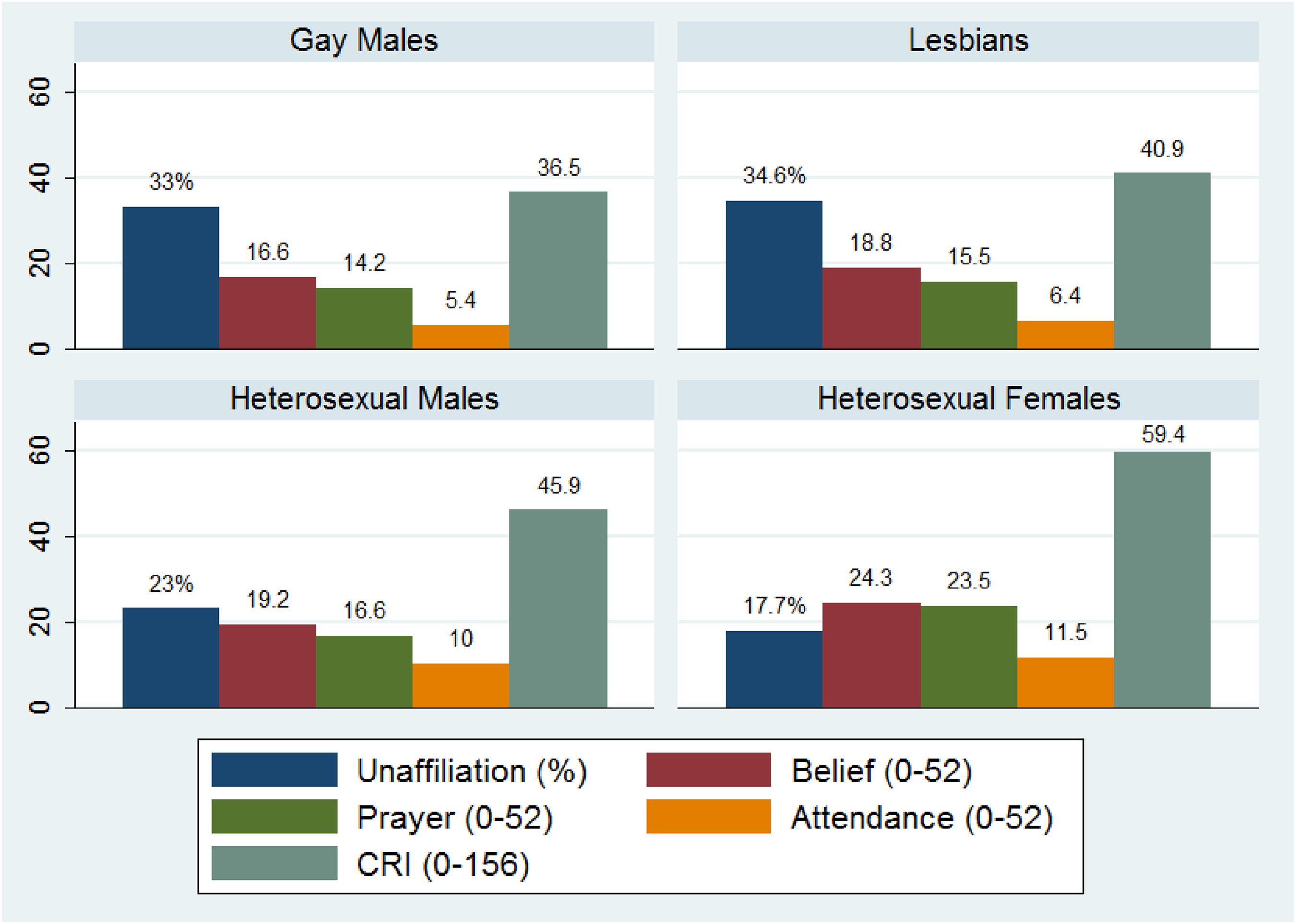
Religiosity by Gender and Sexual Orientation.
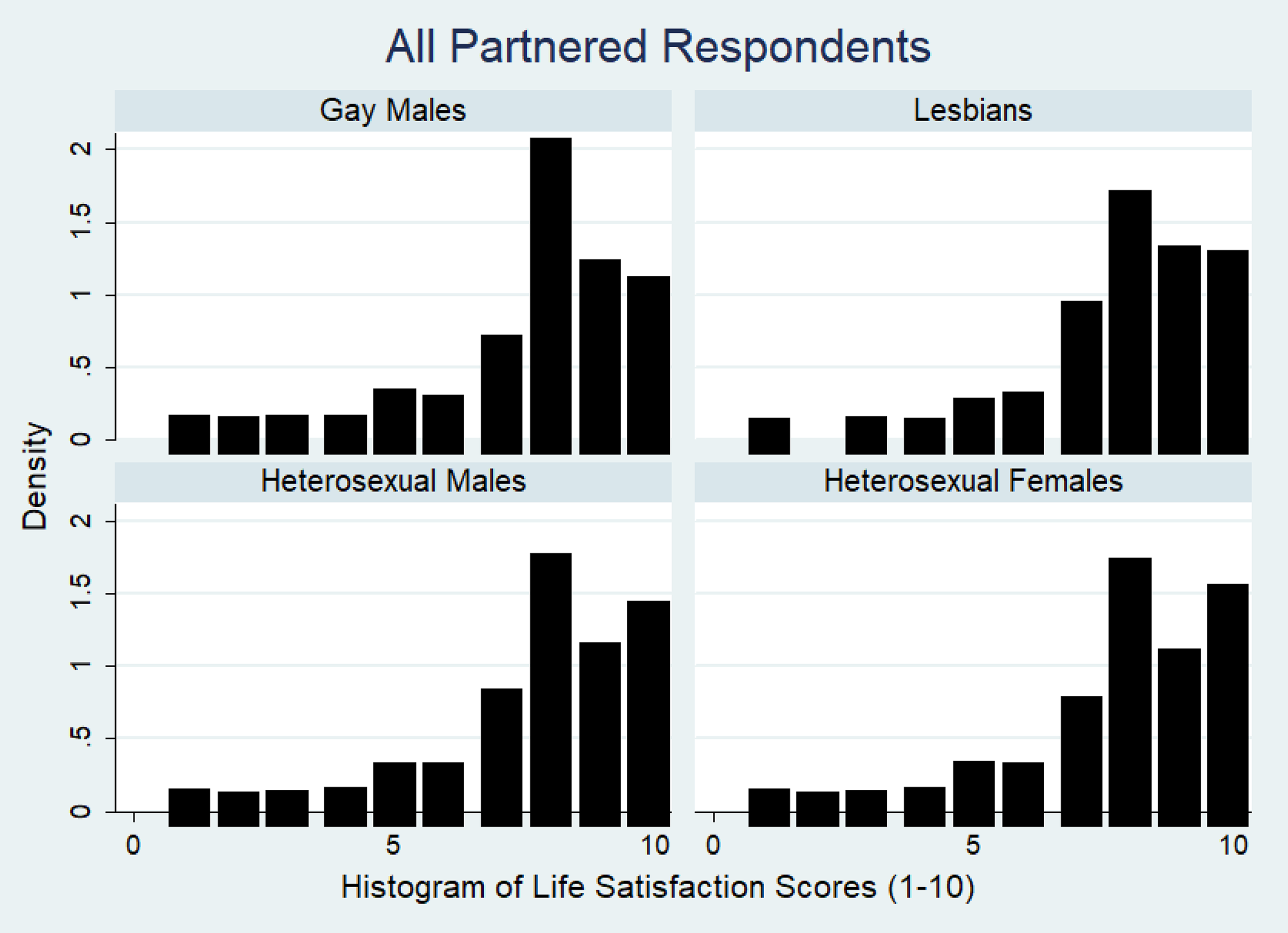
Subjective Wellbeing by Gender and Sexual Orientation.

Subjective Wellbeing and Affiliation Status.
The multivariate regressions described below will better demonstrate the ceteris paribus differences among sexual orientation and gender groups. The first set of multivariate analyses examines the degree of religious commitment by sexual orientation:

In Equation (1), the dependent variable,
Subsequently, the association of sexual orientation with the degree of religious commitment is examined:

In Equation (2), the dependent variable is the natural logarithm of the Composite Religiosity Index (CRI). Since the natural logarithm of the value of the CRI is used, the coefficients will signify percentage changes. The set of controls is identical to those used for Equation (1). Equation (2) is estimated, using Ordinary Least Squares (OLS), with gender restricted samples.
Finally, the association of religiosity with SWB is examined, by sexual orientation:

In Equation (3), the dependent variable is the natural logarithm of the SWB values. Again, since the natural logarithm of the values is used, the coefficients will signify percentage changes. The coefficients of the interaction terms,
IV. Results
To the benefit of parsimony, the tables presented in this section only contain the coefficients of a selection of important variables. The full sets of controls are listed as notes to the tables, and are available upon request. Although at times the terms “effect” or “impact” are used to simplify exposition, all the estimates reveal the partial correlations between the independent variables and the outcomes. It must also be reminded that the samples are limited to the married or cohabitating individuals. Therefore, the results cannot be safely extended to single individuals.
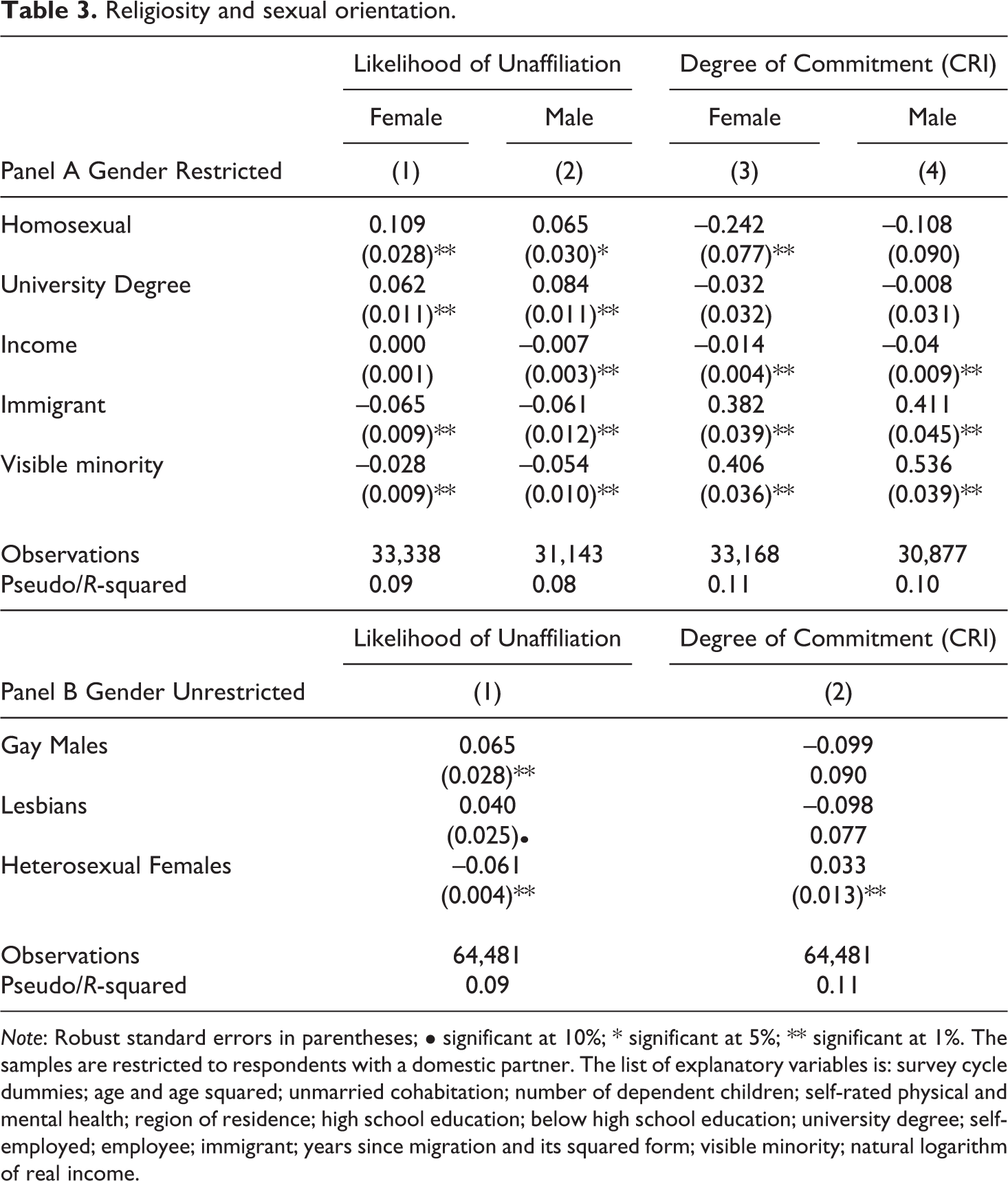
Panel A of Table 3 reports the results of the estimation of Equations (1) and (2), for gender restricted samples. As shown in Column (1), lesbians are 11% more likely to be unaffiliated, compared with similarly situated heterosexual females. As shown in Column (2), gay males have a 6.5% higher likelihood of unaffiliation, compared with otherwise identical heterosexual males. When the degree of religious commitment is considered, as shown in Column (3), lesbians are found to exhibit 24.5% lower religiosity compared with similarly situated heterosexual females. The coefficient for gay males is also negative, although it is not statistically significant. As presented in the table, income has no effect on the affiliation status. But, it is statistically significantly related to the degree of religious commitment. Higher income predicts lower religiosity, as previously reported (Dilmaghani, 2017). Immigrant and visible minorities are found to be more religious than the natives and whites.
Religiosity and sexual orientation.
Note: Robust standard errors in parentheses; • significant at 10%; * significant at 5%; ** significant at 1%. The samples are restricted to respondents with a domestic partner. The list of explanatory variables is: survey cycle dummies; age and age squared; unmarried cohabitation; number of dependent children; self-rated physical and mental health; region of residence; high school education; below high school education; university degree; self-employed; employee; immigrant; years since migration and its squared form; visible minority; natural logarithm of real income.
In Panel B of Table 3, the regressions reported in Panel A are re-run for gender unrestricted samples, to assess the gender religiosity gaps. These regressions pool the data on males and females and include three dummies for gay males, lesbians, and heterosexual females, leaving heterosexual males as the omitted category. These estimations allow for the comparison of the degree of religiosity of lesbians with heterosexual males, and gay males with heterosexual females. The results show that lesbians and gay males are more likely than heterosexual males to be unaffiliated, although the coefficient for lesbians is only significant at 10%. Regarding the degree of religious involvement, lesbians and gay males are found to be no different from heterosexual males. Finally, this table shows that heterosexual females are substantially more religious than all other groups, as could be expected from the past scholarship (de Vaus, 1984; Francis, 1997; Walter and Davie, 1998; Roth and Kroll, 2007; Baker and Whitehead, 2016; Edgell et al., 2017). Not reported in this table, the gender religiosity gap was also examined for the subsample of homosexuals. Unlike for heterosexuals, gay males and lesbians were found to be statistically significantly no different from each other, with regard to both their unaffiliation rate and their degree of religious commitment.
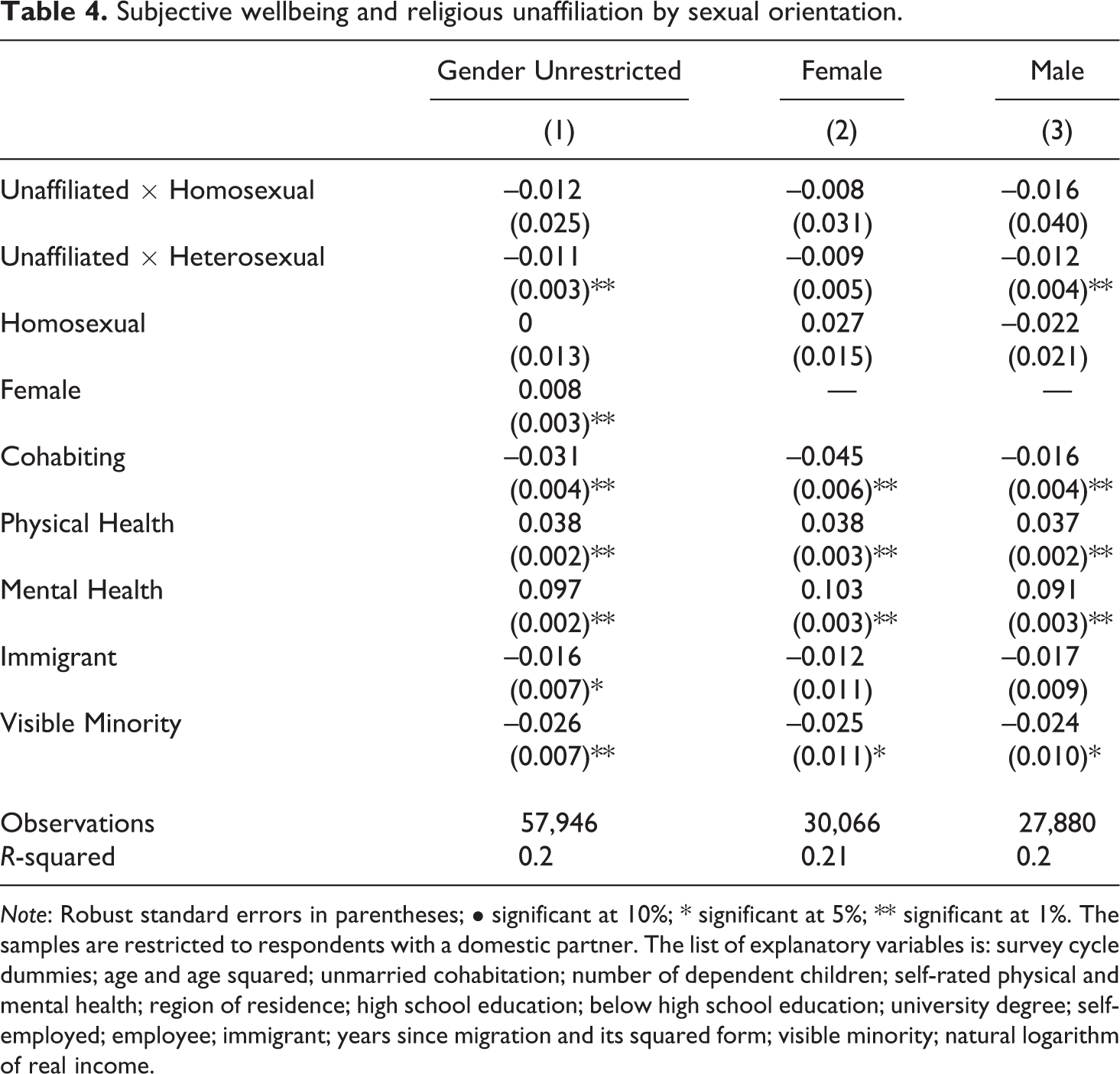
Table 4 examines how affiliation status relates to SWB, by sexual orientation. The underlying model is noted in Equation (3). In Column (1), both genders are pooled to produce a basis of comparison with Dilmaghani (2018d), in which a gender unrestricted sample drawn from 2002 data is used. Column (1) shows that religious unaffiliation predicts 11% lower SWB for heterosexuals, while the coefficient is not statistically significant for homosexuals. The size of the coefficient for heterosexuals is nearly identical to that found by Dilmaghani (2018d), reporting 10.4% lower SWB for the religiously unaffiliated. When the estimations are made over gender restricted samples, it is revealed that unaffiliation is negatively associated with SWB, only for heterosexual males. The size of the association is a 12% lowered SWB.
Subjective wellbeing and religious unaffiliation by sexual orientation.
Note: Robust standard errors in parentheses; • significant at 10%; * significant at 5%; ** significant at 1%. The samples are restricted to respondents with a domestic partner. The list of explanatory variables is: survey cycle dummies; age and age squared; unmarried cohabitation; number of dependent children; self-rated physical and mental health; region of residence; high school education; below high school education; university degree; self-employed; employee; immigrant; years since migration and its squared form; visible minority; natural logarithm of real income.
In Table 5, the degree of religious commitment is considered, including all the three measures of religiosity. Three variables measuring the salience of belief, the frequency of private worship, and the frequency of religious attendance are included in the regressions. Column (1) pools the genders, while separate regressions are run for each gender in Columns (2) and (3). Dilmaghani (2018d) reports that the degree of religiosity has a statistically significant, positive, and small association with SWB of Canadians. The estimate in Column (1) is largely comparable to that found by Dilmaghani (2018d), in spite of a decade difference in the timing of data collection, and the continued secularization of Canada during this decade (Eagle, 2011; Thiessen, 2012; Hay, 2014).
Subjective wellbeing and different dimensions of religiosity by sexual orientation.

Note: Robust standard errors in parentheses; • significant at 10%; * significant at 5%; ** significant at 1%. The samples are restricted to respondents with a domestic partner. The list of explanatory variables is: survey cycle dummies; age and age squared; unmarried cohabitation; number of dependent children; self-rated physical and mental health; region of residence; high school education; below high school education; university degree; self-employed; employee; immigrant; years since migration and its squared form; visible minority; natural logarithm of real income.
As Column (2) shows, religious attendance is a statistically significant, positive, and small predictor of a higher level of subjective wellbeing for heterosexual females. For lesbians the coefficients of all the three dimensions of religiosity are statistically insignificant. Column (3) presents the results for males. For heterosexuals, the salience of religious belief predicts a higher SWB. For gay males, on the other hand, religiosity relates to SWB through the channel of private worship. The coefficient of private worship for gay males is relatively large. This result is notable since, among all dimensions of religiosity, the association of private worship with SWB is at times reported to be negative (Hess et al., 2014; Dilmaghani, 2018d). The negative association of private worship with SWB is attributed to a selection mechanism where individuals facing difficult circumstances resort to prayer as a means of coping (Pargament and Park, 1997). This pattern does not hold for Canadian gay males.
Finally, Table 6 uses the Composite Religiosity Index (CRI) to assess the association of the overall degree of religious commitment with SWB, by sexual orientation. As the table shows, religiosity is positively associated with SWB of heterosexuals, in a manner comparable to that found by Dilmaghani (2018d). The gender restricted estimations show that religiosity is a positive determinant of SWB for gay males; but it is statistically insignificant for lesbians. The size of the association is equally small for heterosexual males and females. For gay males, the magnitude of the association is five times larger than that found for heterosexual males, yet it remains small in magnitude, as well. More precisely, a 10% increase in the degree of religiosity is found to increase the SWB of gay males by about 5%.
Subjective wellbeing and overall religiosity by sexual orientation.

Note: Robust standard errors in parentheses; • significant at 10%; * significant at 5%; ** significant at 1%. The samples are restricted to respondents with a domestic partner. The list of explanatory variables is: survey cycle dummies; age and age squared; unmarried cohabitation; number of dependent children; self-rated physical and mental health; region of residence; high school education; below high school education; university degree; self-employed; employee; immigrant; years since migration and its squared form; visible minority; natural logarithm of real income.
Before discussing the results, the limitations of this study must be noted. One important limitation of the present article is that the data did not allow any means to examine the direction of causality. Hence, the analysis is not informative on whether the associations are due to a causal effect or whether they result from a selection mechanism. More precisely, subjective wellbeing is partly determined by genes and stable personality traits (Lykken and Tellegen, 1996; Diener and Lucas, 2000). At the same time, individual attributes such as religiosity and marital status are concurrently affected by these same latent traits. The data did not contain any information on personality traits. Moreover, in spite of pooling 5 cycles of the GSS, the number of observations on lesbians and gay males remained relatively small. Unfortunately, the datasets, which simultaneously include subjective wellbeing and religiosity questions, are generally not very large, limiting the prospects of remedying this issue in the near future. With the small number of observations, the results remain inevitably tentative. Finally, since the samples had to be restricted to partnered respondents, the analysis remained uninformative regarding single individuals.
V. Discussion and Conclusion
This analysis produced several interesting patterns. First, even after adjusting for confounding factors, unaffiliation rates are found to be substantially higher for lesbians and gay males compared with those for their heterosexual counterparts. This finding is in accord with Sherkat (2002, 2017), examining the US patterns. Second, the degree of religious commitment is found to be substantially lower for lesbians compared with that for heterosexual females, while gay males do not statistically significantly differ from heterosexual males in their degree of religious commitment. Third, religiosity remains a statistically significant predictor of subjective wellbeing of Canadian heterosexuals, as reported in Dilmaghani (2018d), using 2002 data. Fourth, religiosity is not a statistically significant predictor of subjective wellbeing for lesbians, but it statistically significantly and positively contributes to the subjective wellbeing of gay males. The magnitude of this positive association is larger than that found for heterosexuals. A number of conjectures can be offered regarding these patterns.
Lesbians’ lower religiosity and the lack of significance of religiosity for their subjective wellbeing can be viewed in light of the recent scholarship suggesting that the gender religiosity gap shrinks or even fades among high earning and elite women (Hastings and Lindsay, 2013; Baker and Whitehead, 2016; Schnabel, 2015, 2016). Hastings and Lindsay (2013), using a survey of men and women who were alumni of the White House Fellows program, find that elite women are less likely than elite men to report religion as being important to their lives. Baker and Whitehead (2016) report that for highly educated political liberals, the gender religiosity gap effectively disappears, such that men and women are almost equally likely to be secular or religious. Consistently, Schnabel (2016), using the American GSS data, reports that there are no significant gender differences among the high earners, and that high-earning women are less religious than low-earning women.
The higher economic attainment of lesbians, when compared with that of heterosexual women, is consistently reported in the literature (Carpenter, 2008; Leppel, 2009; Antecol and Steinberger, 2013; Mueller, 2014; Klawitter, 2015; Dilmaghani, 2018b). In addition, lesbians have lower fertility rates than heterosexual women (Patterson and Friel, 2000). Previous literature has linked the gender-based religiosity gap to gender role conformity and the presence of children (Bahr, 1970; Stolzenberg et al., 1995; Berghammer, 2012; Dilmaghani, 2018c). In light of the literature reviewed in the above, the higher level of labour market attainment and the lower fertility of lesbians would predict their reduced inclination to be religious. This reduced inclination implies a reduced religious consumption and a correspondingly lower level of religious capital. A low level of religious capital reduces the benefits of religion (Sherkat and Wilson, 1995; Iannaccone, 1990; McBride, 2015). The patterns emerging from the data are fully compatible with these strands of literature.
Canadian gay males, similar to their American counterparts (Sherkat, 2002, 2017), are more likely to be unaffiliated. But, accounting for confounding factors, their religious commitment is not statistically significantly different from that of heterosexual males. The association of religiosity with subjective wellbeing is larger for gay males than for all other groups, although the absolute magnitude remains small. Religiosity exerts its positive influence through the channel of private worship for gay males, in contrast to heterosexual males, for whom the channel of impact is the strength of belief. Previous evidence regarding the lower labour market attainment of gay males (Carpenter, 2008; Klawitter, 2015) and their general psychological characterization, using scales such as the Bem Sex Role Inventory (LaTorre and Wendenburg, 1983; Sherkat, 2002), were suggestive of their higher religious inclination, in comparison with that of heterosexual males. The data did not fully support this supposition.
But it must be noted that in the most recent examinations, the earnings disadvantage of the gay males seems to be disappearing in Canada (Mueller, 2014; Dilmaghani, 2018b) and in the United States (Clarke and Sevak, 2013; Carpenter and Eppink, 2017). Another reason for the lower than expected religiosity of Canadian gay males may lie in the deficits in the supply-side of the religious market. Sherkat (2002, 2017) underscores the supply-side reasons for the lower religiosity of American homosexuals. The finding that gay males achieve a higher level of subjective wellbeing through the private worship channel of religiosity lends further support to this conjecture. Given the supply-side limitations in the religious market, for homosexuals, it is likely that the religiously inclined gay males have substituted private worship for religious attendance. The rather unusual positive association of private worship with the subjective wellbeing of gay males is not incompatible with the conjecture. Previous scholarship on the relative position of gay males on the femininity/masculinity spectrum (Hooberman, 1979; Ross, 1983; Sherkat, 2002) may also be a factor in this positive association, since private prayer is generally attuned with feminine aspects of personality (Francis, 1997; Sullins, 2006; Dilmaghani, 2015).
This study, using individual level data, is more informative about the demand-side of the religious market. A full understanding of the patterns regarding the religiosity–subjective wellbeing nexus for homosexuals can be achieved through a more in-depth analysis of the supply-side factors. Such analysis, however, is impossible to conduct using the surveys collected by the official statistical agencies. Currently, no such data is available for the Canadian context. Future research into the supply-side of the religious market, comprehensive of both data collection and data analysis, is necessary and will constitute an important contribution to the literature.
Footnotes
Declaration of Conflicting Interests
The author declared no potential conflicts of interest with respect to the research, authorship, and/or publication of this article.
Funding
The author received no financial support for the research, authorship, and/or publication of this article.
