



Abstract
With the recent surge of “religious nones” in many Western nations, there is a growing interest among some church attenders to effectively “reach” this demographic. In this article, we build on theories of strictness and social embeddedness to tackle three questions regarding evangelistic belief and behavior in Canadian Catholic, mainline Protestant, and conservative Protestant congregations. First, in what ways are evangelistic beliefs and behaviors similar or dissimilar across theological traditions, notably when comparing stricter and less strict contexts? Second, how are evangelistic behaviors similar or dissimilar based on a person’s frequency of church attendance? Third, what challenges do people confront in their evangelistic efforts? Drawing on survey data with over 9100 Catholic, mainline, and conservative Protestant respondents in over 250 Canadian congregations, this study compares responses across theological sectors, reported levels of importance that church members attach to evangelism, as well as church attendance frequency. Data reveal that those in religious traditions with stricter “insider–outsider” boundaries and who were more socially embedded in their religious groups (i.e., conservative Protestant traditions) were the most likely to embrace evangelistic attitudes and behaviors, in contrast to those in religious groups with less strict boundaries or social embeddedness in their religious group (i.e., United Church of Canada). However, those with the strongest “us–them” boundaries also found those boundaries particularly prohibitive to their evangelistic efforts reflected, in part, in a widespread leaning toward passive versus assertive forms of evangelism.
Introduction
Few sociological studies on evangelism exist. Previous research has focused on topics of evangelicals and evangelicalism, church growth and decline, conversion, switching religious traditions, and church planting. Studies that deal with evangelism specifically do so in the context of evangelical subcultures, including how to define and measure evangelism, levels of emphases on evangelism, and strategies for evangelism (e.g., Hadaway, 1991; Ingram, 1989; Rawlyk, 1996
In this article, we focus on two questions regarding evangelism. First, in what ways are evangelistic beliefs and behaviors similar or dissimilar across theological traditions? Previous sociology of religion research is clear that strictness plays an important role in how religious groups and their members view and interact with “outsiders” (Iannaccone, 1994; Kelley, 1972; Scheitle and Adamczyk, 2009; Sherkat, 1997; Stark and Finke, 2000). The stricter the boundaries between “insiders” and “outsiders,” the stricter the expected beliefs and behaviors of group members (e.g., do not marry outside of the group). One aspect to the strictness thesis is that though groups limit their interactions with outsiders, they also seek to convert outsiders to join their group and benefit from the “one true” salvation that their religion offers. Our assumption in this study is that beliefs about evangelism vary depending on one’s theological context (liberal and conservative), and thus our interest is in how these social environments might intersect with evangelistic behaviors. Presumably, stricter groups will have a more evangelistic focus.
Though theological tradition matters, so too does the strength of one’s association with their religious group. Our second key interest is in the ways that evangelistic behaviors are similar or dissimilar based on a person’s frequency of church attendance. Sociological research consistently reveals that social embeddedness – or the level of connection that one has to a group – is positively associated with a person embracing the beliefs and practices of that group (Berger, 1967; Bullivant, 2019; Durkheim, 1915; Everton, 2018; Reimer, 2003; Stroope, 2012). Our guiding supposition is that the more a person attends religious services, the more socially embedded they are, and thus the more likely they are to embrace that group’s views regarding evangelistic behavior. For example, simply identifying with a more conservative theological tradition that strongly endorses evangelistic behavior is not sufficient to result in evangelistic behavior, if a person is not very involved or connected to that group’s rituals, teachings, and members over time.
In the process of addressing these two questions, we also speak to the challenges that people confront in their evangelistic efforts (where there is such effort). What barriers do people encounter that might hamper or altogether deter their propensity to evangelize others, and how might these variables interact with the social environment that they find themselves in? Here we give attention to areas such as theological tradition and degree of social embeddedness, as well as the wider Canadian social environment.
Strictness and evangelistic beliefs
Building on literature in the sociology of religion, specifically rational choice theory, strict religious groups place high demands upon followers where members incur a range of “costs” in exchange for “rewards” that are believed to be only available through that religious group (Iannaccone, 1994; Kelley, 1972; Stark and Bainbridge, 1985; Stark and Finke, 2000). For example, members of these conservative or exclusive religious groups are expected to attend religious services, donate money to their religious group, abstain from things like alcohol or sex outside of marriage, limit interactions with people outside their religious group, or marry someone within their religious group. Measures of strictness can vary between groups as well. Some groups hold conservative views on morality (e.g., oppose abortion, homosexuality, women in leadership), others stress a complete separation from individuals and institutions not connected to one’s religious group, while others emphasize a proselytization mission toward “outsiders” to believe and behave as they do. Some religious groups embrace all of these strict postures, and others embrace only some of them. Put differently, strictness or “costly” requirements are not limited only to certain religious groups. Moreover, within rational choice theory there is no universal set of “cost measurements,” nor a certain number of costs that must be incurred for a religious group to be considered strict. This is largely because strictness is a relative term to prevailing social norms in a given society (i.e., a particular belief or practice may now be considered strict that never was before due to changing societal norms and standards). Overall, religious groups can be strict in some areas and not others, with some groups demanding greater costs in both number and scope on a person’s or group’s life that make them stricter than other groups. The strictest religious groups tend to be those with the sharpest “us–them” attitude and behavior boundaries between insiders and outsiders.
In exchange for accepting these costlier ways of life, members believe they will receive various “this-world” and “other-world” rewards, such as love and community from religious leaders and fellow members, protection by a supernatural being, meaning and purpose in life, or salvation in the next world. The genius of strict groups is that people believe that the desired rewards cannot be found in another religious setting, hence members are willing to incur stricter costs in exchange for these desired rewards. Simply put, these groups are believed to be more attractive because they are perceived to be so exclusive, with their high costs and rewards associated for belonging.
As it relates to evangelism, stricter groups are more likely to have an evangelistic focus, in part because they believe in the exclusivity and correctness of their religious claims regarding salvation above all (Kelley, 1972; Stark and Bainbridge, 1985; Stark and Finke, 2000). Part of their believed mandate is to “save” the world, accomplished by inviting others to adopt their exclusive attitudes and behaviors that set their “insider” group apart from “outsiders.” Researchers have shown that congregations growing in size, notably conservative Protestant ones, are more likely to emphasize and practice evangelism, as well as to have more converts (Bruce et al., 2006; Hadaway, 1991; Haskell et al., 2016a; Kelley, 1972; Roozen and Hadaway, 1993).
Beliefs about what evangelism is and its ultimate purpose varies within and across Christian traditions of various strictness milieus. At its most basic level, evangelism entails religious groups and individuals who seek new converts to believe, behave, or belong as that group’s members believe they are expected to. Previous researchers suggested that those in conservative Protestant settings—who tend to lean more toward the aforementioned strict end of the religious continuum, particularly regarding salvation and an impetus for proselytization—tend to value and practice evangelism more than do those in Catholic or mainline Protestant contexts (Flatt et al., 2018; James, 2018; Roozen and Hadaway, 1993; Smith, 1998). Even though Catholics and mainline Protestants adopt some stricter beliefs and practices, including Catholics who are more like conservative Protestants on several issues of morality, a key explanation for denominational variations toward evangelism pertains to how each group frames their beliefs about the supernatural, the afterlife, the relationship between “insiders” and “outsiders,” and theological correctness.
Amidst the diversity among conservative (evangelical) Protestants, many take their cue from the Bible as the authoritative Word of God. To be a “true Christian,” one needs to accept Jesus into their heart, believe and behave “the right way” to obtain the afterlife (i.e., embrace stricter religious beliefs and practices), and encourage others to do likewise (Powell et al., 2021). This orientation is premised upon an “us” and “them” posture with the secular world (Rawlyk, 1996; Reimer, 2003; Reimer and Wilkinson, 2015; Roozen and Hadaway, 1993; Smith, 1998; Strhan, 2015). At one extreme, “for a number of conservative Protestant evangelicals, protecting the faith may be far more important than sharing it, one on one, with non-Christians” (Rawlyk, 1996: 125). Although, as John Stackhouse (1993) noted in Canada, some evangelicals see themselves as an important group among many in a pluralized society, cooperation and opposition are necessary with other groups in society, depending on the topic. For conservative Protestants, evangelism is primarily oriented toward personal transformation, though for some, personal conversion is a catalyst for social, cultural, and political change; as people’s hearts change, they vote and lobby for causes in line with their understanding of Christian morality. Interestingly, according to Reimer and Wilkinson (2015), who studied evangelical congregations in Canada, evangelical church leaders frequently preach about evangelism; however, evangelism ranks much lower as an overall congregational priority, and few congregational resources and programs are directed toward evangelism.
In contrast, mainline Protestants—also a diverse group—tend to adopt an inclusive (i.e., less strict) and modernist posture to the Bible and society. Talk of conversion or evangelism is historically less common in these traditions (there are exceptions in the mid-20th century among those in the United Church of Canada, for example), and if or where it is present, it is most often in the context of social justice activities (Airhart, 2014; Flatt, 2013). Less emphasis is placed on the afterlife or personal salvation. Rather, evangelism is rooted in faith communities transforming social structures and making the world a more just and equal place to live for all. Kevin Flatt (2013: 189) noted that in the 1960s the United Church of Canada “replaced evangelistic preaching with listening to the world, jettisoned talk of conversion, and redefined the word ‘evangelism’ to mean direct social action.” Likewise, Phyllis Airhart (2014: 228) showed that evangelism was redefined as “Christian presence, rather than proclamation.” Later she highlighted that as the United Church of Canada sought to more clearly distinguish itself from conservative Protestantism, “evangelism was viewed with suspicion” (Airhart, 2014: 253).
Of late, Catholics have stressed “new evangelization,” which involves reaching out to lapsed Catholics – those who identify as Catholic but are not institutionally active (e.g., don’t attend Mass) (Bibby and Reid, 2016). Relying on rites of passage across the life course, such as baptism, first communion, and weddings, Catholics have a large subculture and opportunity to encourage persons with an existing affinity with Catholicism to consider greater involvement as returnees. Unlike in Protestant settings, Catholics tend to view evangelism as the work of clergy rather than rank-and-file members (Powell et al., 2021).
Taken together, how these different Christian traditions frame their relationship with those outside their group, including the perceived accuracy of their tradition as the “one true” religion” and the reported need to “save” those on the outside, figure into the centrality or aims of evangelism for each religious group.
Evangelistic behaviors
Over the past century, Christian groups in the English-speaking world have employed many strategies for evangelism, such as door-to-door tactics, mass revival-like services, media and multi-media tools, televangelism, seeker-sensitive churches, dynamic and relevant preaching, Sunday School programs, prayer ministries, neighborhood block parties, church plants, and “third space” coffee shops (Hadaway, 1991; Ingram, 1989; Kyle, 2006; Powell et al., 2021; Reimer and Wilkinson, 2015; Roozen and Hadaway, 1993; Stewart, 2015; Wagner, 2010).
At the individual level, Christian Smith (1998) showed that the top three evangelization techniques among American evangelicals include: setting a Christian example to others, giving money or time to help spread the gospel, and defending a Biblical view in intellectual circles. One Canadian social scientific study with evangelicals showed that about half of those who evangelize feel comfortable doing so (Rawlyk, 1996). A National Church Life Survey (NCLS) in Australia with Catholics and Protestants suggested that 18% are at ease discussing their faith, 53% are somewhat comfortable doing so, 16% would find it hard, and 11% believe their life and actions are enough (Powell et al., 2021). Across these three studies, reasons for lower comfort levels include not wanting to force themselves on other people, belief that others are uninterested in attending church, being too shy, belief that actions speak louder than words, or that God works directly with human beings in the conversion process. NCLS (2009) research has previously highlighted that people are more likely to evangelize when their church provided training on how to evangelize, plus offered evangelistic-oriented services or events on a regular basis.
Social embeddedness and evangelism
Individuals are more likely to embrace evangelistic beliefs and practices if they belong to a religious group that holds those views too. But the level of embeddedness that members have with the group also matters. Social embeddedness theory denotes that the more socially embedded a person is in a group, the more likely they are to conform to the desired beliefs and behaviors of that group (Berger, 1967; Durkheim, 1915; Reimer, 2003; Stroope, 2012). For stricter religious groups, social embeddedness is a consequence of stressing distinctive beliefs and behaviors relative to society at large. According to Samuel Stroope (2012: 275), those with stronger social involvements and networks within a group are more susceptible to “monitoring, social sanctions, and social rewards.” For example, the more that one’s social networks are restricted to those within their religious group, the more powerful those social ties are to encourage and reward social conformity and discourage and stigmatize social deviance. These social dynamics are strengthened when group members are continuously and collectively shaped by religious teachings, texts, rituals, and opportunities that form a common “plausibility structure” for individual and group thought and action. As noted earlier, conservative Protestants—and Catholics to a lesser degree—are known for their stronger social embeddedness, stricter beliefs and practices, and “us–them” distinctions with “outsiders” compared to mainline Protestants.
Methods
Our first aim in this article is to explore how important a priority evangelism is across theological contexts with varying strictness levels. Our hypothesis is that stricter religious groups will place a higher priority on evangelism. Next, we examine the degree of social embeddedness across theological contexts, measured by church attendance. Our hypothesis is that members of stricter religious groups are more likely to attend religious services more frequently because they are expected to do so by their host religious group (not all religious groups demand frequent attendance at religious services to be a “good” member), and by extension, those who attend religious services more frequently are more likely to embrace evangelistic beliefs and behaviors. Finally, we pay attention to perceived hurdles for evangelism, accounting for possible social and cultural explanations for those challenges in the process.
We use data from our Canadian-based national congregations survey. This non-random survey was administered online between May 2018 and December 2019 in both English and French. The questionnaire included fifty questions on participants’ socio-demographic characteristics, and then views and experiences in areas such as church leadership, programmatic and structural innovation, discipleship, diversity, neighborhood involvement, and evangelism. We piloted the survey with nearly thirty people across Canada, including scholars, religious leaders, and congregants, from across Catholic, mainline, and conservative Protestant traditions. 1
Our recruitment strategy involved approaching congregations, seeking leaders and attenders to complete the 20-minute survey in exchange for a free report with basic descriptive data from that particular congregation’s results. Email invitations and telephone calls to over 500 congregations, along with advertising on social media plus snowball sampling, yielded 252 congregations and 9109 participants from across Catholic, mainline, and conservative Protestant sectors. In some congregations only a few respondents completed our survey, while in others hundreds of respondents did so. Our sampling started with personal contacts from our research team, referrals, and lists documenting some of the largest congregations in Canada (size was not a precondition for being involved). We also relied upon denominational networks to incorporate our recruitment materials into their own letters of endorsement that were then circulated to churches and parishes in their network. To put these numbers in perspective, estimates suggest there are over 21,000 congregations in Canada (Wood Daly, 2020), with 67% of Canadians identifying in a Christian tradition (Statistics Canada, 2019).
Respondents include 18% who are either paid staff (6.4%) or board/elder/council members (11.7%), with the remaining respondents “attenders” (i.e., anyone not explicitly listed above). Just under two-thirds (62.4%) are female and just over one-third (37.6%) are male. 16.2% are between the ages of 18 and 39, 35.3% are between 40 and 59, and 48.5% are 60+. While we ideally wanted a better distribution across age categories, the skewed age spread is a function of both church attenders themselves, as well as survey respondents in general, being older.
We have respondents from all thirteen Canadian provinces and territories: 57.3% are from Ontario, 19.7% are from Alberta, 8.4% live in Saskatchewan, 5.3% reside in British Columbia, 4.1% are from Quebec, 3.7% are in Nova Scotia, and less than 1% in each of the remaining provinces and territories. As for the size of the city/town that congregations are located in, 26.8% are in areas with fewer than 50,000 people, 10.1% are in settings with 50,000–99,999 in population, 9.5% are in contexts with 100,000–249,999 residents, 6.5% are in regions with 250,000–499,999 inhabitants, 10.5% are in areas with 500,000–999,999 people, and 29.6% are in cities with 1,000,000+ in population.
With respect to the 252 congregational units, data gathered from the senior leader reveal that 85% of congregations had existed for 30+ years. Only 5.6% of congregations had existed for nine or fewer years, while 9.9% of congregations had existed for 10–29 years. In terms of average weekly attendance, senior leader estimates showed that 36.1% have fewer than 100, 46% have between 100 and 499, 9.5% are between 500 and 999, another 5.2% are between 1000 and 1999, and 1.2% have 2000+.
To assess strictness across theological groups as our independent variable, we compared across the eight largest denominational families represented in our sample, with a minimum of 200 respondents: Anglican (N = 219), Baptist (N = 432), Catholic (N = 4480), Christian and Missionary Alliance (N = 863), Lutheran (N = 722), Pentecostal (N = 261), Reformed (N = 466), and United Church of Canada (N = 554). These eight denominations capture just under 8,000 of the 9,100+ in our sample. Though our study is not a representative sample and is not intended to mirror denominational proportions among all Canadian religious affiliates, by way of comparison, the largest group in our sample—Catholics at 49%—is also the largest in the 2011 Canadian Census at 39% (Statistics Canada, 2019). Our proportion of those in the United Church of Canada reflects exactly the Canadian population, at 6.1%, while some of our traditions are slightly higher or lower than the Canadian population as a whole: Christian and Missionary Alliance (9.4% versus <0.2% in the Canadian Census), Lutheran (7.9% versus 1.5% in the Canadian Census), Reformed (5.1% versus 0.3% in the Canadian Census), Baptist (4.7% versus 1.9% in the Canadian Census), Pentecostal (2.9% versus 1.5% in the Canadian Census), and Anglican (2.4% versus 5% in the Canadian Census).
Without dismissing the previously noted costs that stricter religious groups demand of their members (e.g., time or money) to help maintain a boundary between insiders and outsiders, our focus is on a particular type of cost or social expectation to distinguish “us” from “them”—those who hold a theological commitment to evangelizing “outsiders.” We build on our earlier review of the literature and operate with the understanding that those who are part of conservative Protestant traditions (i.e., Baptist, Christian and Missionary Alliance, and Pentecostal) in Canada are, in general, among the strictest denominations in the scale and scope of costs that they require of members, with those at the liberal end of the theological continuum (e.g., United Church of Canada) being the least strict. Again, some groups are strict on some moral issues or even sharply define in-group and out-group boundaries (e.g., Catholic or Reformed), but for our purposes, do not hold to strong evangelistic beliefs relative to outsiders. And then there are some groups that have more internal diversity when it comes to the costs that they ask their members to incur relative to predominant social norms in Canadian society (such as among Anglicans or Lutherans).
For one of two dependent variables, we explored how important members believe evangelism is: “On a scale of 1 to 5 (1 = strongly disagree, 2 = disagree, 3 = neutral, 4 = agree, 5 = strongly agree), to what extent do you disagree or agree with the following statement: A flourishing parish/congregation practices evangelism.” Those who believe evangelism is integral to congregational life would be interpreted as stricter than those who do not. Though we could have asked how important people believe evangelism is to them personally, we suspected such figures would be extremely low and possibly not very helpful for analysis purposes. Thus, we began by exploring their general level of support for evangelism as located in their congregation and theological tradition, which would help us to later compare and contrast with personal practices. We also asked about frequency of church attendance—ranging from “more than once a week” to “weekly,” “2–3× a month,” “once a month,” and “less than once a month.” More frequent church attendance can be associated with greater strictness, and can also serve as a proxy for social embeddedness.
As will become clear, denominational families are strongly correlated with both of the aforementioned dependent variables. As importance of evangelism and frequency of church attendance are stronger concepts to assess strictness and social embeddedness than denomination alone, we then use these two measurements as independent variables to explore evangelistic behaviors as our dependent variables. We asked the following three questions: “(a) On a scale of 1 to 5 (1 = never, 2 = daily, 3 = weekly, 4 = monthly, 5 = annually), how frequently do you verbally share your faith? (b) On a scale of 1 to 5 (1 = never, 2 = daily, 3 = weekly, 4 = monthly, 5 = annually), how frequently do you show your faith through actions? (c) On a scale of 1 to 5 (1 = never, 2 = daily, 3 = weekly, 4 = monthly, 5 = annually), how frequently do you invite non-Christians to your church?”
Finally, from the following list, we asked respondents to identify the three biggest challenges in evangelism for them personally, if any: “I don’t believe I have a responsibility to evangelize, no challenges, few nonbelievers as friends, too busy, lack of confidence, lack of training, fear of rejection, perceived antagonism/resistance to Christian values and the Christian Church, personal apathy, or other (please specify).” Our purpose with this question was to sharpen our understanding of the different obstacles that may factor into people’s evangelistic behaviors, possibly revealing something about the role that strictness or social embeddedness might play for people’s approach to evangelism.
We used SPSS to code and analyze our data. Given our non-random sampling strategy, our data presentation and analysis center on raw data comparisons as well as several one-way ANOVA tests to compare the means of three or more groups in the independent variable with one dependent variable, to see if the group means were significantly different from each other. In each of these cases we ran a Welch’s test, as homogeneity of variance was violated, followed by the Games-Howell post-hoc test that told us which groups differed from each other significantly.
Every data sample has its limits. As our study is based on a non-random and snowball sample, it was difficult to obtain a more representative sample in some provinces, age groups, newer congregations, denominational traditions, and larger churches especially; it was not for lack of trying in our recruitment efforts. We acknowledge that our findings are based on a set of responses from the participant groups identified earlier, and that had other groups or representations been present in our study, then perhaps the findings would have been slightly different, or, at the very least, we could make different comparisons across groups if such data were available. Still, we are confident that our results tap into some noteworthy findings regarding evangelistic beliefs and behaviors among over 9,100 Canadians and over 250 congregations.
Results
Evangelistic beliefs
We wanted to explore the link between denomination and strictness, measured first by level of priority attached to evangelism. We asked respondents to indicate their level of agreement that a “flourishing parish/congregation practices evangelism.” We learned that 34.1% strongly agreed, 39.3% agreed, 16.5% were neutral, 3.8% disagreed, and 1.7% strongly disagreed. At the denominational family level, Table 1 reveals that traditions historically known for their stricter and evangelistic focus were more likely to agree or strongly agree (i.e., Christian and Missionary Alliance, Pentecostal, Baptist) versus the tradition least known for a strict or evangelistic focus (i.e., United Church of Canada), with some variation among other traditions between. These comparisons were statistically significant. Consistent with the previous research summarized earlier on conservative Protestants, mainline Protestants, and Catholics, none of these findings is terribly surprising.
Evangelism by denominational tradition.
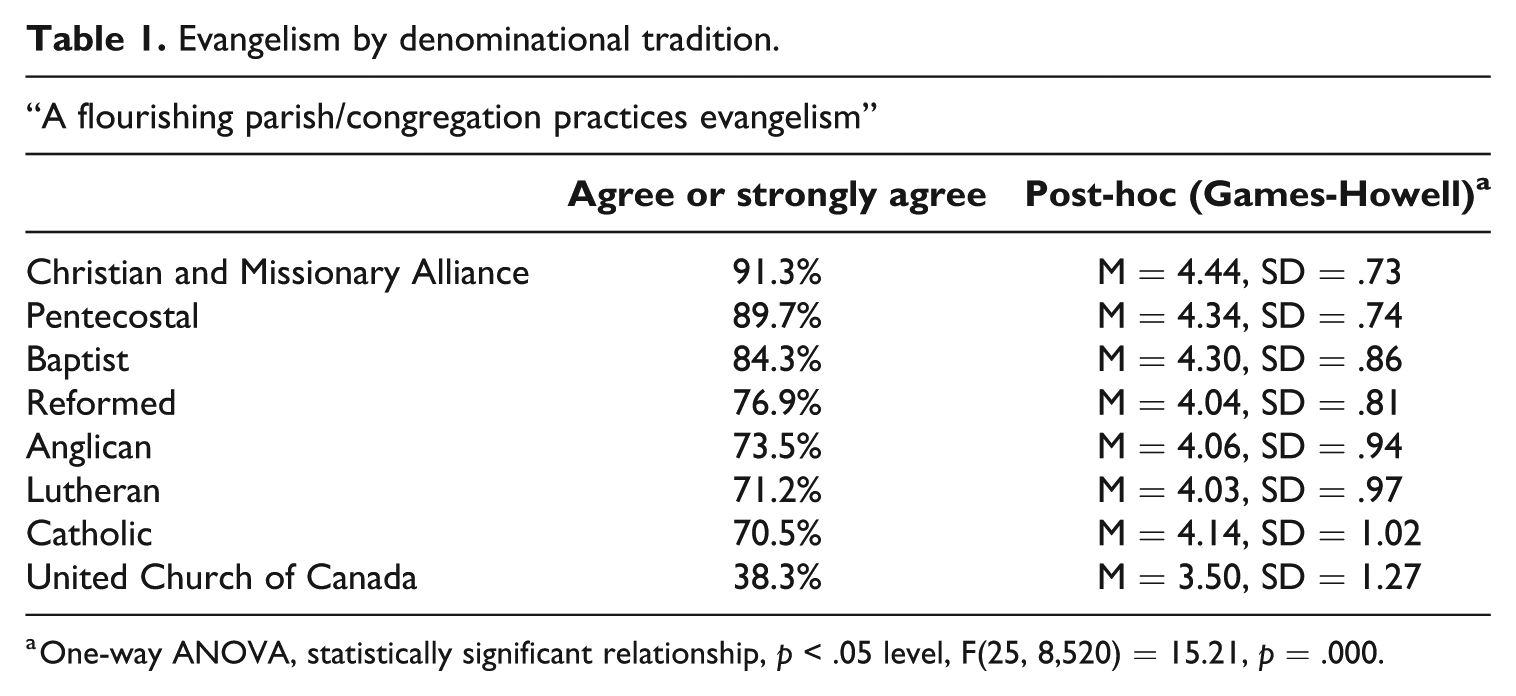
a One-way ANOVA, statistically significant relationship, p < .05 level, F(25, 8,520) = 15.21, p = .000.
With two key exceptions, some of these observations remain when we look at another marker of both strictness as well as social embeddedness, frequency of church attendance (Table 2). As intimated earlier, strictness is manifest in different ways and it is unsurprising that Reformed and Catholic folks are atop this list with higher degrees of social embeddedness. Though neither Reformed nor Catholic traditions historically hold a strong evangelistic impetus (unlike the conservative Protestant groups in the list above), both groups are known for their rather strong in-group and out-group boundaries. This strictness is reflected in part in distinct Reformed or Catholic social institutions (e.g., schools) that members are encouraged to attend and ground their social networks in (in addition to their congregational/parish setting). On the other end of the continuum, we once more find that those in the less strict United Church of Canada are the least likely to attend religious services weekly or more.
Frequency of church attendance by denominational tradition.

a One-way ANOVA, statistically significant relationship, p < .05 level, F(25, 8,248) = 20.49, p = .000.
Evangelistic behaviors
We then probed specific approaches to evangelism. We asked respondents to indicate how frequently they verbally shared their faith, showed their faith through actions, and invited non-Christians to their church. These are not the only or even best indicators of evangelism, but these questions do enable us to test some hunches in light of the longstanding literature that links personal social ties and invitations as the main pathway for someone to join a religious group.
The first finding to stand out is that just over 10% believe they did not have a responsibility to evangelize. Building on our earlier findings from denominational comparisons, United Church of Canada respondents led the way here with 34.3%, followed by Catholics at 14.9% and Lutherans at 11.2% (conservative Protestant traditions were all under 6%). As one person put it in a free-text section: “I despise the seeking of converts. It’s arrogant and rude.” Likewise, those least likely to believe that congregations should practice evangelism were the most likely to say that they did not have a responsibility to evangelize (57%) versus those most supportive that congregations should practice evangelism (3%). Those who attend religious services less than monthly were similarly less inclined to say they had a responsibility to evangelize (35%) compared with those who attend weekly or more (10%).
Next, participants were more likely to show their faith to others through their actions on a monthly or more basis (94.5%) versus verbally share their faith with others (70.7%) or invite people to their church (17.4%). Conversely, 3% never showed their faith to others, 14% never verbally shared their faith with others, and 54% never invited people to their church. These discrepancies that favored showing versus telling or inviting others additionally stood out in roughly 100 survey respondents who provided written feedback: “action and example are more effective than preaching when it comes to spreading the good news” or “preach the Gospel always and use words only when necessary.”
Tables 3 and 4 take us deeper into different evangelistic behaviors based on comparisons of how much of a priority one believes evangelism should be in a congregation (Table 3) and how often one attends religious services (Table 4). The following Tables reveal both the mean scores to arise from post-hoc comparisons using the Games-Howell test, as well as F scores from several statistically significant one-way ANOVA tests. Three observations stand out. First, overall, we see that people are more likely to show their faith versus verbally share their faith or invite others to church. Second, when comparing based on importance of evangelism or church attendance levels, we notice that there is less variation when it comes to showing one’s faith (though differences do exist) compared with verbally sharing one’s faith or inviting others to church. Third, the stronger the belief that congregations should practice evangelism, and the more often a person attends religious services, the more likely people are to practice each of these evangelistic methods.
Evangelistic behaviors and evangelism importance.
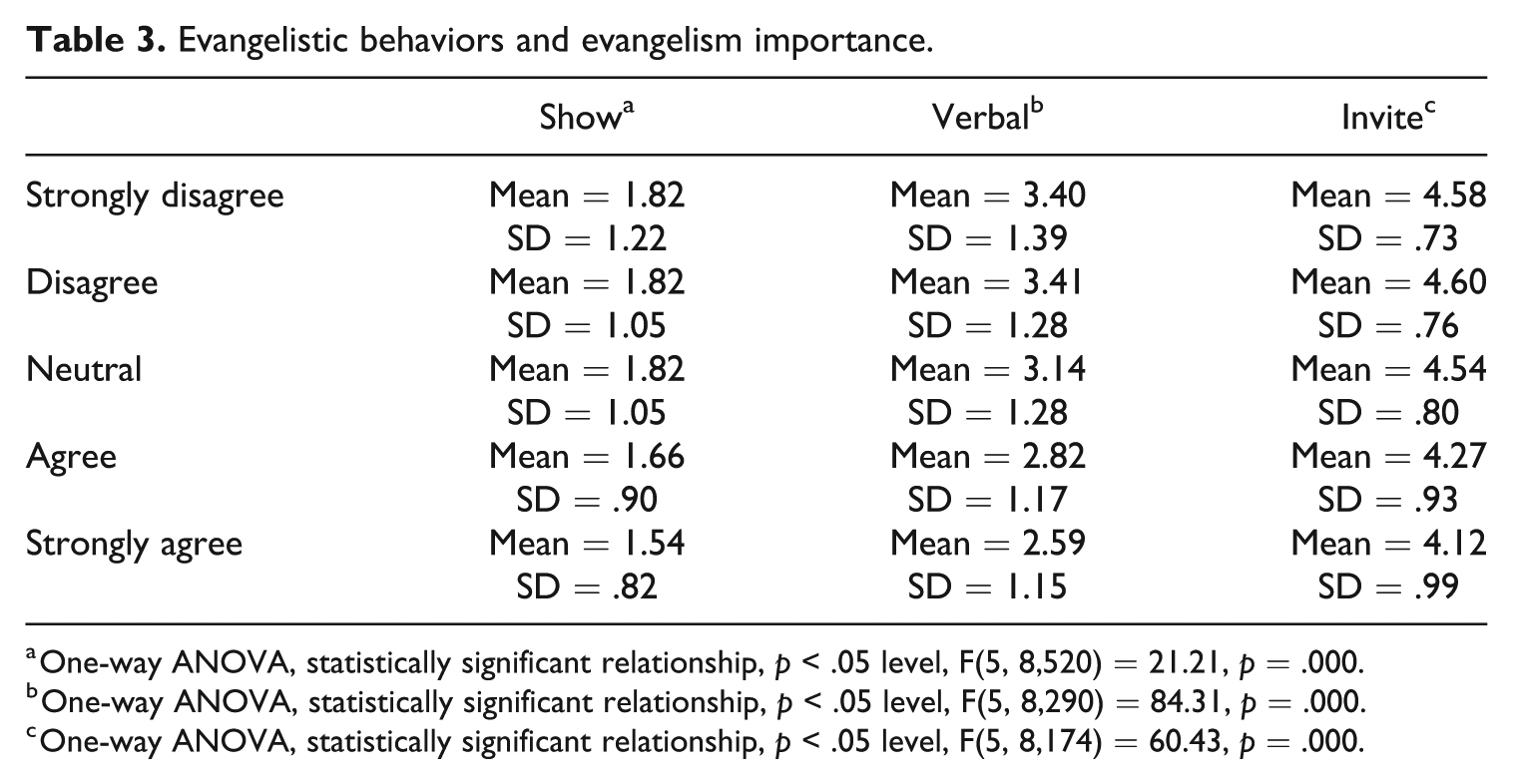
a One-way ANOVA, statistically significant relationship, p < .05 level, F(5, 8,520) = 21.21, p = .000.
b One-way ANOVA, statistically significant relationship, p < .05 level, F(5, 8,290) = 84.31, p = .000.
c One-way ANOVA, statistically significant relationship, p < .05 level, F(5, 8,174) = 60.43, p = .000.
Evangelistic behaviors and church attendance levels.
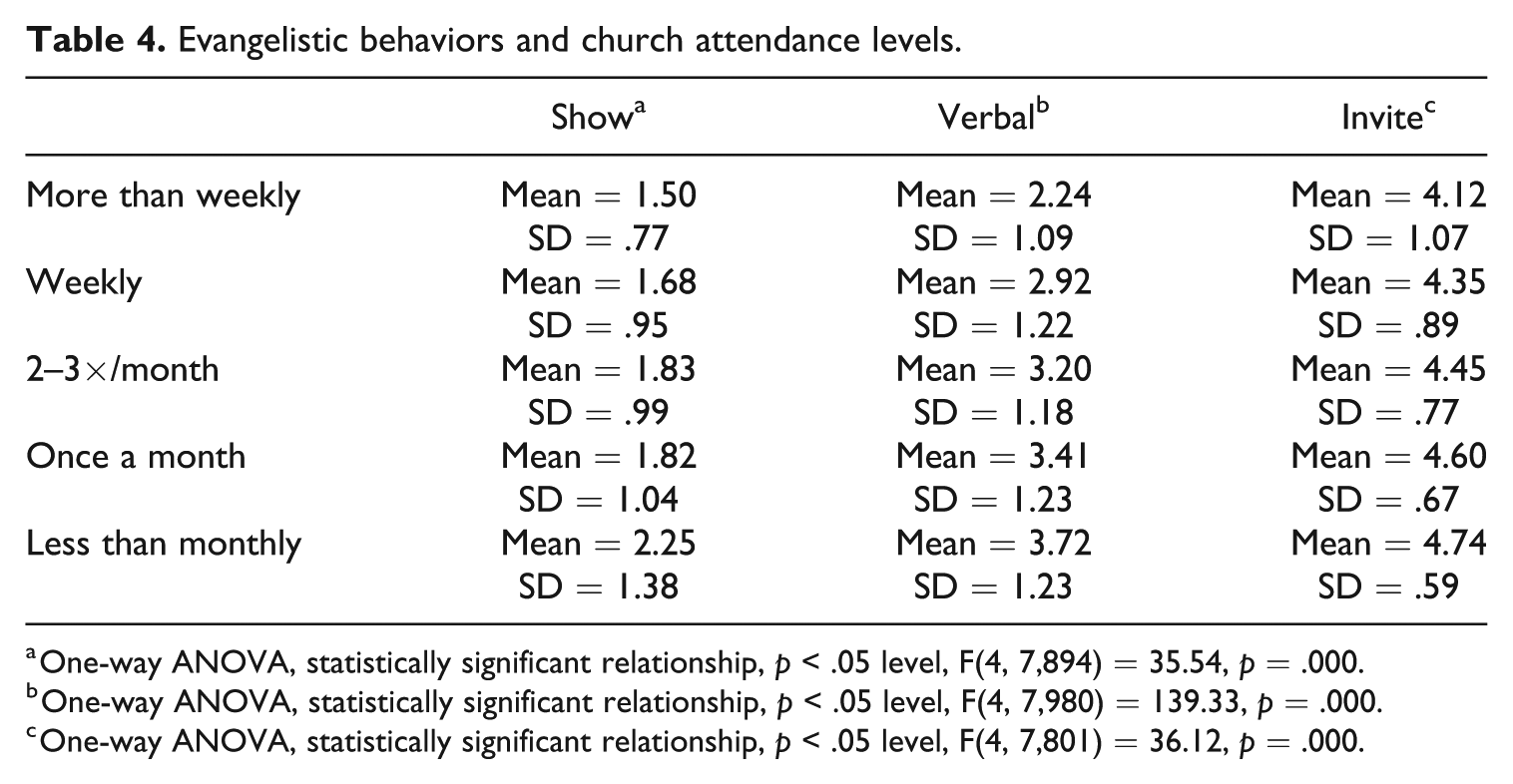
a One-way ANOVA, statistically significant relationship, p < .05 level, F(4, 7,894) = 35.54, p = .000.
b One-way ANOVA, statistically significant relationship, p < .05 level, F(4, 7,980) = 139.33, p = .000.
c One-way ANOVA, statistically significant relationship, p < .05 level, F(4, 7,801) = 36.12, p = .000.
Barriers to evangelism
From a list of ten-plus options, we were interested in congregants identifying “the three biggest challenges in evangelism for you personally, if any.” Reinforcing previous research findings in Australia (Powell et al., 2021) and England (Strhan, 2015), the five most referenced challenges include lack of confidence (41.5%), the perception of increased antagonism or resistance to Christian values and the Christian Church (34.4%), fear of rejection (28.7%), few nonbelievers as friends (25.4%), and lack of training (22.8%).
When we compared these findings across denominational families, two differences stand out. Beginning with lack of confidence, responses ranged from 30% (United Church of Canada) to 64.8% (Reformed). Fear of rejection was held most by conservative Protestants, such as Christian and Missionary Alliance (47.3%), Pentecostal (41.9%), and Baptist (40.4%), with lowest figures in the United Church of Canada (16.9%). Nearly fifty respondents used the free-text option to say that they did not wish to disrespect others by evangelizing. One person noted, “I feel people have their own views and beliefs and have the ability to reach out. I don’t appreciate others being too forward about drawing me to their beliefs nor do I wish to push my beliefs upon others.”
Comparisons based on frequency of church attendance revealed links between social embeddedness and barriers to evangelism. Of those who attend weekly or more, 28% say they have few nonbelievers as friends compared with 18% of those who attend less than monthly. These figures suggest that the more often one attends, the fewer social ties they have outside the religious group. In terms of fear of rejection, 32% of weekly or more attenders say this is a factor versus 16% among less than monthly attenders. Again, the more socially embedded one is, particularly in contexts with strong in-group and out-group boundaries, the higher the perceived risks for evangelism.
Discussion
We were principally interested in the ways that evangelistic beliefs and behaviors were similar or dissimilar based on how strict one’s religious community was and how socially embedded one was in that community. Our guiding premise was that those more socially embedded in stricter religious contexts were most likely to embrace evangelistic beliefs and behaviors, compared with those from less strict religious traditions and/or less embedded in their congregation.
To set up our discussion, recall that to assess the degree of strictness across theological traditions, we examined the belief that a flourishing congregation practices evangelism, as well as noting church attendance levels. Stronger agreement with the first statement and higher levels of attendance would signal a stricter religious environment. As one might expect from our earlier survey of the literature relative to denominational groupings, conservative Protestant traditions were, by and large, the strictest, with the United Church of Canada the least strict.
We then delved into evangelistic behaviors. As we anticipated, conservative Protestants were the most likely to behave in evangelistic ways, with those connected to the United Church of Canada the least likely to do so. Additionally, across the board, the stronger one’s support for evangelism as a congregational priority and the more that a person attended religious services, the more frequently they personally participated in a range of evangelistic behaviors. Aside from this finding that adds credence to our central argument on the ties between strictness, social embeddedness, and evangelistic beliefs and behaviors, it was noteworthy that people were far more inclined to participate in “passive” forms of evangelism (i.e., showing one’s faith through actions) versus more “assertive” expressions of evangelism (i.e., telling others about one’s faith or inviting another to church).
We think our data add support to the important role of social environment in shaping evangelistic attitudes and practices. The combination of identifying with a stricter religious tradition that encourages evangelism among members, alongside being more actively involved in that group’s life, is more likely to yield members who themselves believe that evangelism is important. Evangelistic beliefs alone do not lead to evangelistic practices; beliefs are necessary but not sufficient for evangelistic activity. The construct of social embeddedness is key to explaining how and why evangelistic belief reportedly leads to evangelistic behavior. In step with past literature on conservative Protestant groups in Canada, the United States, Australia, and England (Powell et al., 2021; Reimer, 2003; Smith, 1998; Strhan, 2015), these congregational settings reinforce an embedded theological commitment that lay members ought to evangelize those outside the group. Religious teachings, texts, and rituals exist to strengthen these beliefs, along with opportunities to evangelize via church-wide programs. For those in the United Church of Canada, their lower rates of evangelistic belief and practice also mirrored a theological context where religious rituals, teachings, and texts do not typically prioritize, encourage, or model evangelism or distinctiveness relative to modern society. Exceptions exist, of course. Recent research showed that growing mainline Protestant churches in Canada tend to stress distinctiveness and evangelism more than declining congregations (Haskell et al., 2016b).
The paradox is that while those who generally consider themselves to be conservative Protestants were more likely to encourage evangelistic beliefs and behaviors, and to attend religious services frequently (nearly 80% of those surveyed attended weekly or more), it was those who attended religious services most frequently who more often identified “too few nonbelievers as friends” as a barrier to evangelism. In other words, members of stricter religious groups appear to be so socially embedded that some negate the social bonds and networks with those outside their religious community that are necessary for embodying their group’s “strict” evangelistic beliefs. From a social scientific perspective this is problematic given that research consistently shows that pre-existing social networks with family and friends outside the religious group are the main link for people to join a new religious group (see, e.g., Olson, 1989; Powell et al., 2021; Stark and Bainbridge, 1985). Moreover, weekly attenders were much more likely to indicate “fear of rejection” as a barrier for evangelism. This finding additionally suggests that some are so socially embedded that the boundaries (perceived or otherwise) between insiders and outsiders possibly get in the way of members embracing their group’s stricter evangelistic beliefs in practice.
It is possible that the link between social embeddedness and barriers to evangelism are also fueled by perceptions (real or imagined) of an increasingly secular Canadian environment. Alongside few nonbeliever friends and fear of rejection, many respondents noted the perception of increased antagonism or resistance to Christian values and the Christian Church as a barrier to evangelism. Canadian religious groups operate within a broad social discourse of multiculturalism, diversity, inclusivity, tolerance, political correctness, and secularity. In many ways, Christianity no longer holds the privileged place in society that it once did (this is not to say that Christianity does not still hold a privileged position in many ways); Christianity is less central to education, healthcare, politics, and the social service sector than it once was in the early to mid-20th century (Clarke and Macdonald, 2017). In an increasingly diverse, multi-religious, and secular social space, Canadians are taught to be polite, accepting, and welcoming of all viewpoints and opinions, and to not thrust their own set of beliefs and values onto others. There is an unspoken, and sometimes spoken, assumption that it is fine for people to hold whatever religious beliefs and practices that they wish, so long as they do not impose their religion on to others. Claiming one’s religious beliefs and practices as more true or right versus another’s, or bringing one’s religion into their social networks in work or neighborhood or family settings for the purposes of proselytization, are perceived as acts of exclusivity and intolerance. Research in Canada (Thiessen, 2015) and England (Strhan, 2015) revealed that evangelical Christians perceived evangelism as taboo within a secular environment around them.
These insider–outsider tensions might help to explain the widespread leaning toward passive forms of evangelism (e.g., showing one’s faith) versus active forms of evangelism (e.g., inviting people to church) in our study. Maybe many who attend religious services more frequently recognize the cultural norms that they would transgress by telling others about their religion or inviting people to their church. Perhaps a more passive approach to evangelism is a strategy to avoid the social risks and costs of potentially appearing too strict, exclusive, and intolerant. This same train of thought may also help to account for the strong social embeddedness found among some, reflected in church attendance habits alongside the barriers to evangelism cited. People are possibly retreating to the comforts of their socially embedded religious groups if they perceive themselves to be outsiders relative to the progressively secular social milieu around, which is a prominent discourse held by some in conservative Protestant settings (Haskell, 2010; Schuurman, 2019); social embeddedness is a reaction against “outsiders.” At the same time, some religious groups are aware of outsider perceptions that their religion is too strict or exclusive for a changing social environment. Sam Reimer (2003) documented how Canadian evangelicals have worked to counter these intolerant narratives, attempting to come across as more tolerant and accepting in a diverse Canadian context.
Conclusion
To conclude, we found that those in religious traditions who tend to adopt stricter boundaries between “insiders” and “outsiders” and who were more socially embedded in their religious groups were the most likely to embrace evangelistic attitudes and behaviors, in contrast to those in religious groups with less strict boundaries between “insiders” and “outsiders” or who were less socially embedded in their religious group. Incidentally, those with the strongest “us–them” boundaries also found those boundaries particularly prohibitive to their evangelistic efforts. These boundaries were magnified by the perception among those in this study that Canadian society is generally antagonistic toward Christian values, which may partially have accounted for why those in this sample were more prone to passive versus assertive forms of evangelism.
These findings are best explained by social embeddedness theory, where congregants are located in social environments that presumably teach, model, and empower congregants to evangelize. Social embeddedness is particularly key for evangelistic beliefs and behaviors where religious groups hold distinctive “us–them” boundaries. Short of this posture with society beyond one’s religious group, social embeddedness and evangelism are less likely in general. In other words, one’s social environment both within their religious tradition as well as relative to society at large play a role to explain Canadian evangelistic beliefs and practices.
Together, our data and analysis offer long overdue Canadian-based data on evangelism across theological sectors. As ideal as it would be to garner a representative sample, resources are not available to do so. Still, the benefit of being first to conduct a study like this is that we now have a solid sample size and set of comparative data to test some hunches and theories on how those who are connected to different Christian traditions in Canada approach evangelistic beliefs and behaviors. Several opportunities remain to take these findings and analysis further.
With the simultaneous growth of the “no religion” category and shrinking proportion of Canadians who identify as Christian, how will church leaders and congregants talk about, frame, or practice evangelism in the future? How will groups even measure evangelistic effectiveness? Are religious affiliation and church attendance the best markers, or, in a digital and secular age, might groups consider different evangelistic behaviors or markers of evangelistic effectiveness? Recent research revealed that religious nones and evangelicals hold negative views toward one another (Thiessen and Wilkins-Laflamme, 2020), so how might evangelicals (along with other Christian traditions) approach evangelism with religious nones? Will their strategies, methods, and discourse change? Will evangelistic tactics vary based on those who have no religious background versus those who left their Christian upbringing and are possible returnees (sometimes referred to as “dones”)? For those who indicate that they are open to greater involvement in their religious group, what might longitudinal research reveal with those individuals? Do they actually return? If so, why, and if not, why not? And in cases where religious nones do convert to Christianity, especially those who were not raised with any religious background, what can we learn about their conversion experience and pathway? All of these questions point to the need for more and better qualitative data (e.g., ethnography, interviews, textual analysis) into how religious leaders and groups talk about and frame evangelism, how congregants internalize and possibly act upon group teachings on evangelism, and how converts ultimately came to join a new religious group.
Alongside the social factors that intersect with people’s approach to evangelism, what role does personality play? Are extraverts more likely to evangelize compared with introverts, or are introverts more prone to passive forms of evangelism when compared with extraverts? In a limited way, previous research has explored the link between personality and religiosity (see, e.g., Dillon and Wink, 2007; Francis et al., 2010; Wuthnow, 2004), and it could be illuminating to further examine the ways that personality intersects with evangelistic beliefs and behaviors.
It is one thing to explore people’s evangelistic attitudes and practices, and quite another to measure the effectiveness of those evangelistic endeavors. Pew Research Center (2015) data in the United States showed that just under half of those raised as religious nones identified with a religion as adults, led by evangelical Protestants (19%) and religions beyond Christianity (10%). When looking at church attendance in evangelical contexts, Reginald Bibby and Merlin Brinkerhoff’s “circulation of the saints” thesis, which dates back to the 1970s (Bibby, 2003; Bibby and Brinkerhoff, 1973, 1983, 1994), demonstrated that only about 10–15% of church growth can be attributed to those who transfer from outside of evangelical settings. Mixed within these figures are returnees, those who disaffiliated and then re-affiliated, or whose institutional involvements lay dormant all the while continuing to identify with a religion. Our own survey data in this study yield similar findings, as does Peter Schuurman’s (2019) Canadian-based ethnographic research with The Meeting House congregation (also see Perrin et al., 1997). In short, whether looking at religious affiliation or church attendance, conversion is relatively rare. Most people tend to identify with the (non)religious tradition that they were raised in (Bengtson et al., 2013; Smith and Adamczyk, 2021), and church growth if or when it occurs is largely driven by the “circulation of the saints.” These findings open an opportunity for systematic sociological inquiry into the direct link between evangelistic beliefs, behaviors, and effectiveness. Are those who are more prone to adopt evangelistic beliefs and behaviors actually more effective, and if so, what are the mechanisms in play to yield such outcomes? And if those with more evangelistic zeal are not more effective in terms of garnering more converts, what are we to make of this possibility? One social context to probe these questions further is with new church plants or alternative congregational structures who are adapting and innovating to the cultural context around. Some scholars (e.g., Marti and Ganiel, 2014; Mulder and Marti, 2020; Schuurman, 2019) have given attention to “seeker friendly” congregations that try to engage the unchurched. We know that these congregations grew rapidly; however, data are scant on what proportion of congregants in these churches were new converts, returnees, or arrived via transfer growth. Opportunities remain to develop this research.
Our hope is that this research moves the conversation forward, and ideally sets the stage for other much needed research on evangelism specifically, and interactions between the religious and nonreligious more generally.
Footnotes
Declaration of conflicting interests
The authors declared no potential conflicts of interest with respect to the research, authorship, and/or publication of this article.
Funding
This research was supported by the Social Sciences and Humanities Research Council and Stronger Philanthropy.
