



Abstract
The sustainability of China’s urban social security financing system has recently been seriously questioned. This article divides the financing system’s development into two periods (before and after reform). It compares the capital collection and the distribution and circulation structures and reviews the financing system before and after reform. In this study, we also discuss and explain the ‘empty account’ phenomenon, which severely undermines the financing system’s sustainability. We allege that the money accumulation system adopted after reform, which correlates personal accounts with the social pool, is not running as designed but as a ‘pay-as-you-go’ system. After evaluating the efficiency and cost performance of both periods, testing the financing system’s sustainability and correlating the system during both time periods with economic and social development, we find that the financing systems’ operation after reform corresponds with theories proved by case studies in other advanced states.
Keywords
Introduction
The social security fund, a guarantor of the social security system’s efficiency, is the focus of enormous attention in China. This study provides new insight into the ongoing discussion of the sustainability of China’s urban social security fund. It analyses the financing system of China’s post-1949 urban social security system by dividing the record of that system into two periods: before and after reform. After this study identifies the reasons behind the so-called ‘empty account’ (in the current Chinese social security financing system, a person only has a nominal amount of accumulated money in their account; the majority of funds are used by the administration to finance ‘former workers’ social support, who, as they were employed before the reforms, did not pay for the premium that would have accumulated in personal accounts), it compares and analyses financing system before and after reform, from money collection and expenditure to appreciation. The authors evaluate the social security fund’s administration before and after reform, based on the balance and coverage of the financed social security programme. Then, through testing the correlations between important economic, social, and institutional factors and social security expenditure, the study concludes by exploring whether the same theories that hold true for advanced Western countries can also be applied to China in the periods both before and after financial reform.
Theoretical Background and Literature Review
This section reviews the existing models of social security financing and previous studies on the topic. Using the benefit calculation model as a defining characteristic, the existing financing systems can be divided into the following three categories: defined benefit plans, defined contribution plans and hybrid plans (Cannon and Tonks 2012). Alternatively, depending on the operating model, existing financing systems can be divided into the following: pay-as-you-go (PAYG), money accumulation plans and hybrid plans (personal account and social pool combined) (Huang 2015). Finally, using the level of internal integration as a defining characteristic, the existing financing systems can be divided into the following: project-based, object-based and hybrid systems (Yu 2007). Using money collection, benefit and fund appreciation, we can theoretically characterise China’s current urban social security system: a mixed money accumulation system (SPPA) combined social pool and personal account. According to this system, employers pay a premium for each employee that accumulates in an account controlled by a social support administrator. Until an employer pays the premium’s full amount—normally about 15 years—an employee would have only a nominal social pool account. Meanwhile, employees also pay a premium; this accumulates in their own personal social support account. It is also an object- and project-based mixed and defined benefit plan operated as a fund. Because of the ‘empty account’, the money accumulated in personal accounts is nominal, and the funding system still runs on a PAYG basis, though with a very large balance.
Existing studies on the financing of China’s urban social security system usually treat the two parts of that system—the social security fund and the social insurance fund—as two independent systems and investigate them separately (Pang and Hong 2006). The social insurance fund is generally described as a component of China’s urban social security system. Studies that discuss the social insurance fund normally specifically focus on the general social security system or an individual programme within it (Zhu 2013). The bulk of these studies focus on the money collection, discussing the possibility and necessity of shifting from a system based on insurance premiums to one based on taxes (Yu 2007), though they seldom discuss the efficiency with which that fund is used (Xiang 2006). Studies that focus on individual insurance programmes’ financing, especially pensions, are increasing quickly. The analysis in these studies focuses in particular on the ‘empty account’ problem of the pension financing system, not just its size but also the examination of premium collection and expenditure (Sun 2010).
These studies mainly describe the ‘transaction cost’. Van den Noord and Herd’s (1994) study describes the ‘social security dilemma’: PAYG can only last if there are a limitless number of generations. However, in reality there will at some point be a generation without a following one to support it. Transforming the financing system will make this dilemma real, leaving one or more generations with no clearly identified source of support. The cost involved in this is what is called the ‘transaction cost’. This threatens the stability of China’s urban social security system according to what is referred to as the ‘empty account’ problem, which was caused by the change from PAYG to money-accumulated SPPA and would affect several generations’ benefits. Some argue that the ‘empty account’ can be solved by temporary, government-incurred debt, though any error in setting the debt repayment period could cause several generations’ welfare to suffer even more severely (Kotlikoff 1995). Other scholars argue that the government should cooperate with social organisations and use their resources to deal with the ‘transaction cost’, sharing the burden of financing social security (Serrao 1998). By dynamically simulating different transforming models, scholars find that the percentage of GDP occupied by social security-related debt stays the same when the interest rate is equal to the rate of economic growth (Holzmann 1998).
While the Chinese Communist Party (CCP) government also operates a social security fund programme, its capital collection and expenditure are totally different from those of its American counterpart (Social Security Administration 2007). Although the number of studies evaluating China’s urban social security financing system is increasing, none has evaluated reforms of the financing system; changes in the correlation between important economic, social and institutional factors; or the operation of the social security systems before and after reform. More importantly, the impact of the CCP—the most powerful factor in the Chinese party-state system—on the modification of the social security financing system has never been fully discussed. More specifically, scholars have ignored the impact of the fundamental changes that occurred in the CCP regime on the development of China’s social security financing system. This study addresses this lacuna.
Review of China’s Urban Social Security Financing System After 1949
The implementation of labour insurance is one of the most important initial goals of the CCP (Zheng 2002). In 1948, before the establishment of the People’s Republic of China (PRC), labour insurance was implemented on an experimental basis in CCP-controlled northeast China. In 1951, labour insurance was extended nationally, covering all employees in state-owned companies. After the ‘three reforms’, labour insurance coverage expanded greatly. Meanwhile, collective companies also established labour insurance programmes for their employees. Though the labour insurance system was severely attacked by political movements before 1976, it quickly revived after economic reform. From 1988 to 1997, the ‘state-unit’ co-operative labour insurance, which composed the main body of China’s urban social security system, was replaced by a ‘state-society’ cooperative social insurance. The financing system was also transferred from PAYG to SPPA (Huang 2015). In order to show the differences between the financing systems before and after reform, this study compares them using a variety of criteria.

In respect to fund collection today, the capital sustaining the Chinese social support system is primarily sourced from premiums paid by individuals and work units, as well as treasury funds. As Figure 1 illustrates, work units clearly shoulder the largest proportion of the funding burden. Indeed, even individuals provide a larger share than the treasury. According to a 2014 public finance report, while the Chinese government’s income was 22.07% of the total GDP, just 2.5% of China’s GDP—or 10.5% of the government’s total income—was spent on social security. Thus, the CCP shares the larger financial burden of social security provision with society.
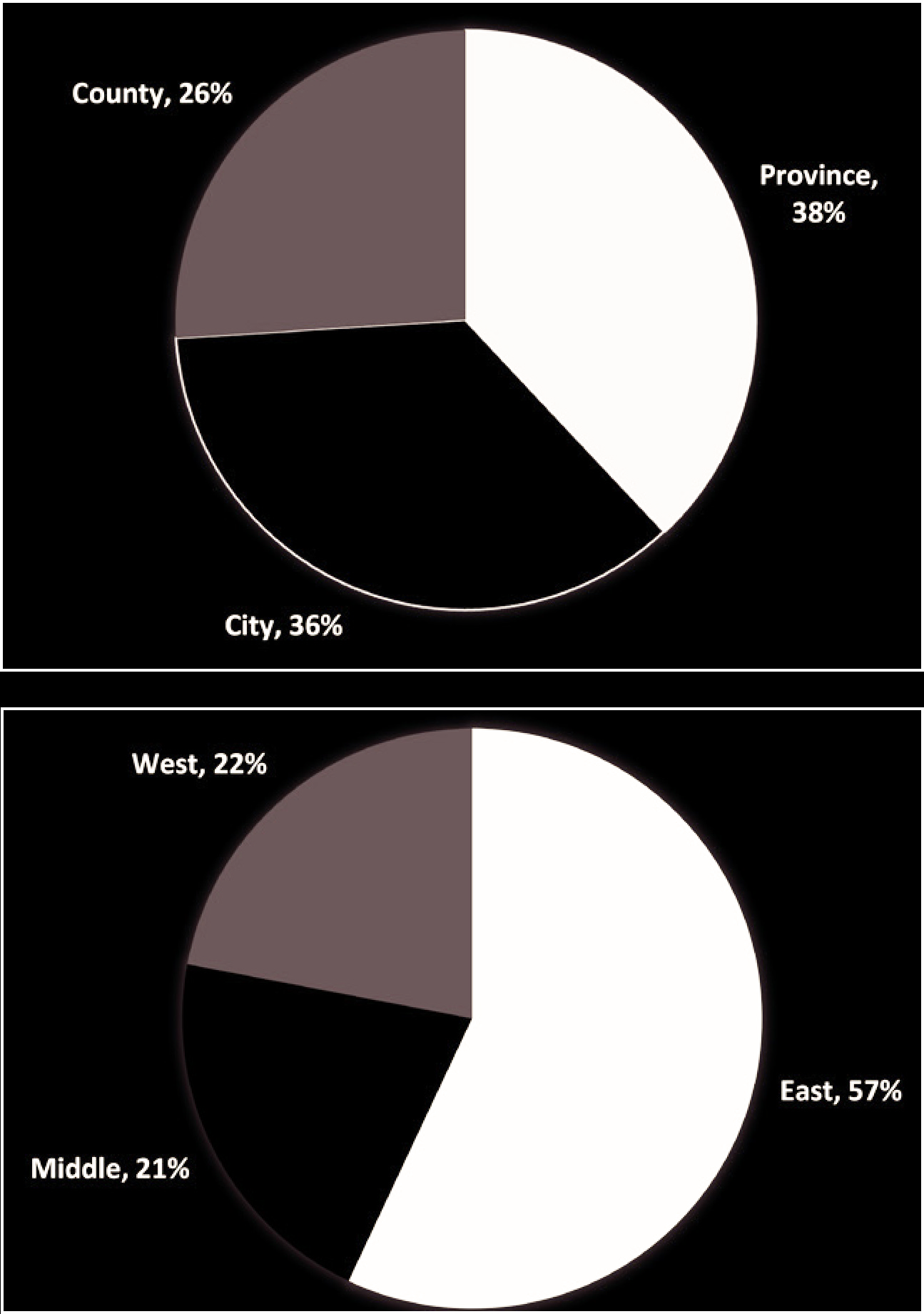
The distribution of social security resources is also extremely uneven (Wang and Long 2011). Provincial governments pay out a much greater sum than the proportion of income they control. In contrast, the central government only provides 4.3% of the total expenditure, despite controlling more than 45.94% of revenue. As the data in Figure 2 indicate, national redistribution is very weak, and people living in different regions receive varying levels of social security. Figure 2 presents two ways in which this uneven distribution is realised. First, the larger the administrative region, the more financial resources it controls. Second, the more developed eastern regions control more resources than the rest of the country. The uneven distribution of resources has much to do with the uneven distribution of benefits (Ke 2009).
The Financing of Labour Insurance before Reform
According to ‘The PRC’s Principles of Labour Insurance’, issued in 1952, the cost of labour insurance was to be paid by those employers that adopted insurance. A part of the cost was to be directly paid by a company in the form of its administration fee, the rest by premiums that are paid by employers and controlled by worker associations. The employers’ share of the premiums amounted to as much as 3% of the total employees’ salary per month. This premium was to be wholly paid by employers, with no cost to the employees. As there was no legal floating population in urban Chinese before reform, the urban social security financing system did not need to consider potential issues caused by migrant workers. Meanwhile, although the CCP has emphasised the need for gender and age equality, female workers can enjoy the same benefits after a shorter period of paying social insurance premiums and can apply for retirement five years before male workers.
Because railway, shipping, and the postal service had already adopted labour insurance while the civil war was still in progress, these three industries were treated separately. Their special labour insurance system was sustained under the CCP regime, and the collected premiums accumulated in the China National Worker Association account during the PRC’s first two years. This money was designated as the primary labour insurance fund and used to finance collective labour insurance. Ever since the third month of the labour insurance national extension in 1951, 30% of the premiums collected from these three industries were submitted to the China National Worker Association account and used in the same way. About 70% accumulated in each enterprise’s worker association committee’s account and constituted the labour insurance fund, which was used to pay allowances, relief fund payments, and worker compensation.
Employers had to pay an overdue fine for late payments: 1% of the amount due per day. If payments were more than 20 days late, the worker association committee of a publicly operated enterprise would inform the relevant bank, who would deduct the delayed premium directly from the company’s account; in a private company, the committee would inform the relevant local governmental departments, who would look into the operation of the company. The National Worker Association entrusted People’s Bank of China with the premiums collected for labour insurance.
The primary labour insurance fund was used by China’s National Workers’ Association to finance collective labour insurance. Each labour insurance fund was controlled by each enterprise’s worker association committee and used to pay for labour insurance-related expenditures. The labour insurance fund accounts were settled each month. The residual money would be submitted to the accounts of the worker associations at city, provincial, and national levels and was nationally redistributed to allow for shortfalls in some companies’ funds or used to finance collective labour insurance. Local institutions were authorised by each industry’s national worker associations to control and distribute those monies. Though the China National Worker Association had the right to control how this residual money was used, it could only use it to finance national collective labour insurance. If a city or provincial worker association lacked sufficient funds to finance its labour insurance costs, they would apply to the China National Worker Association for additional funding.

Figure 3 shows that though all employers paid labour insurance premiums, they were divided into two according to the industries involved, and these two parts were connected by residual money redistribution. As a result, the cross-industry/enterprises distribution of the labour insurance fund was realised, but the financial system was not completely cycled, meaning that funds could be exhausted within a certain period. In addition, though the railway, shipping, and postal industries had to submit 30% of their collected premiums to finance collective labour insurance nationwide, that does not mean they shared more of a financial burden; the balance of the national, provincial, and local labour insurance funds were redistributed nationally.
The Social Insurance Financing System after Reform
Social insurance is the main component of the social security system and, after the reforms, the SPPA became the basic programme financing it. In this system, employers and employees share the financial burden. Specifically, each employer must pay an insurance premium—as much as 36–42% of each employee’s monthly salary—that is deposited into the social pool. In addition, each employee pays an insurance premium equally 11% of his/her salary, which accumulates in his/her personal account. Theoretically, the money in a personal account may only be used by insurers if certain requirements are met. Meanwhile, the money in the social pool should be used to narrow the insurance gap between different classes and to help personal accounts withstand inflation and other financial risks. Moreover, insurance premiums are only deducted for workers whose income is between 60% and 300% of the minimum wage (Wang and Long 2011). Workers who earn more than 300% of minimum wage are exempt from having to pay premiums. In other words, those who can afford high premiums do not have to pay, while workers with lower disposable incomes bear more of the social security burden (He and Sato 2008). Meanwhile, migrant workers are required to pay for social insurance premiums for more than fifteen years before they can qualify for a pension in their city of work; alternatively, they must transfer their accounts to the city to which their ID is registered. However, different cities have different social insurance contribution requirements, resulting in variations in social security provision from one city to another. This has served to intensify social inequality in China. In this respect, the system appears to have strengthened existing social and regional stratification.
Following the social security reforms, each social security department acquired a specific financing system. Though premiums are collected in a tax-like, mandatory way, each person’s salary percentage is different for each insurance programme. In addition, the money collected for each insurance department is submitted to each department’s account, operated independently, and used only for the insurance purpose for which the money has been collected. Figure 4 shows that though employers still bear the main burden of social security financing, the financial system has been completely cycled. In the SPPA system, though the premiums collected from employers are accumulated in the social pool to help the government plan the general use of money, local governments usually decide how these funds will be used. The differences in available resources between different regions mean that there are disparities in the levels of social security they can offer. Moreover, the money that should be accumulating in personal accounts has not been fully separated from the money in the social pool; the balance of personal accounts is only nominal. Thus, in reality the SPPA has been running as a PAYG system. The social insurance fund still mainly appreciates through the interest earned when money is placed in different bank accounts, even though interest rates are now dipping below the inflation rate. In this situation, the allocation from China’s central treasury towards the basic pension of enterprises’ employees has been entrusted to the Chinese National Council of Social Security for investment.

Nowadays, China’s urban social security is generally funded by an SPPA system. Theoretically, the SPPA can run more stably than the former PAYG (Liu and Luo 2009), but the transaction cost, called the ‘empty account’, is shaking its sustainability. Though today the social support system has been fundamentally reformed, the CCP government uses the ‘former measures’ to cover ‘former workers’ and ‘new measures’ to cover ‘new workers’. (The CCP government officially titled employees who were employed prior to the social support reform as ‘former workers’. Logically, employees who were employed after the reform become known as ‘new workers’.) The appearance of the ‘empty account’ exposes the CCP government’s intention of using the funds collected in the name of ‘new workers’ to support its promised social security service to ‘former workers’. When both state and collective enterprises were undergoing reform in the middle of the 1980s, both had to bear the cost of ‘former workers’’ social security expenditure and pay the social pool premiums for ‘new workers’.
The reforms stated that social pooling would support the social security expenditure for ‘former workers’, but the funding resources were not clearly defined. Although ‘former workers’ did not have any personal accounts before the reform, their social security requirements still have to be properly fulfilled. Since the social pooling for those workers’ social security has not been clearly defined, this expenditure has been directly supported from the funds accumulated in the name of the ‘new workers’. As a result, the social pool is seriously inadequate to the demands for funds. When the money in the social pool is insufficient to finance social security expenditure, the money in personal accounts has been used without their owners’ permission. This has become a widespread problem and today the ‘empty account’ exists throughout China’s urban social security financing system and undermines its sustainability (Su and Yang 2007). If that problem cannot be solved by the SPPA, the Chinese treasury may have to take on that burden, which would weaken its stability (Ren 2006). Moreover, the problem of sustainability only affects the social security system as it relates to the common people in China. Public officials, who are exempt from paying social insurance premiums, do not face the same issue.
To solve the intermediate problem caused by ‘empty accounts’, the CCP government set up the so-called ‘social security fund’ as a rescue fund in 2000. Its many capital resources come from the Chinese national budget, transfers from state-owned capital, income from investment funds, and other resources identified by the state council. Today, it is mainly funded by money from the Chinese national budget. The Chinese National Council of Social Security runs this capital, the source of social security funding, like a trust fund. Theoretically speaking, that fund can only be used to complement pension financing and other related social security services when the rate of population aging reaches a maximum. The fund is not open to individual investors and its primary principle is to assure the safety and stability of the monies (Zhou et al. 2012). This fund’s main investment items are banking, national debt, stocks, and other investment products. The council’s investor oversees the low-risk and relatively straightforward investments, and high-risk investments requiring a higher level of professional management are delegated to professional investment companies (Sun 2001). Until now, the fund has been run independently and has remained unconnected with the social insurance fund.
Comparing China’s Urban Social Security Financing System before and after Reform
From the above review of both the labour insurance and social insurance’s financing systems, which compose the main body of China’s urban social security system both before and after its reform, it is obvious that though both are essentially run on a PAYG basis, there are some fundamental differences.
The development of national financial resource distribution: Before reform, in the labour insurance system, all financial resources for all social security departments were collected as a whole. That facilitated the distribution of financial resources between different insurance departments, but it also spread the financial problems of one insurance department to the whole system. Since the reform, each social insurance department’s fund is independent. This prevents financial problems in one department from shaking the stability of the whole system, but at the cost of forbidding (theoretically) the systematic distribution of financial resources.
The financial resources of social security: Before reform, the labour insurance system collected all funds from employers. This meant that economic turbulence severely impacted the operation of the social security system and that enterprises’ social security burden continuously increased and eventually injured the sustainability of social security. Many times, social security expenditure was the first thing cut in times of economic difficulty. Now the social security payment by employers is four times that of employees. The burden on employers is much bigger than during the labour insurance system, but it also frees employers from having the sole responsibility of supporting employees’ social security expenditure. Meanwhile, the premiums paid by employees also enlarge the social security financial resources.
The use of financial resources: In the labour insurance system, fund flowed one way. Social security simply used the money from enterprises to finance employees’ social security—a kind of ‘delayed delivery’ income for employees. Even the ‘national labour insurance fund’ was not run as a fund. The money in that ‘fund’ had no way of appreciating. After reform, the investments accumulated through SPPA can theoretically help the social security fund to appreciate. The fund flow is cycled, and its sustainability and stability have theoretically increased. The national social security fund, kept in reserve to sustain social security payments in the event of financial shortages, also runs as a fund.
The refund of social security: Before reform, the insurant had no way to leave the policy and get a refund. Meanwhile, the benefit levels from social security were not limited, so insurance companies had an unlimited responsibility to support the insurant. Since reform, the social security benefits have been clearly defined. There are options for an insurant to leave and, in most cases, they are able to get a refund.
The equality realised by the redistribution of the two systems: According to the standard calculations of insurance premiums before and after the reform, the redistribution of funds after reform enlarged the inequality created by previous system. The social equity realised by redistribution before the reform is small, and the gap has grown through redistribution after the reform.
From the institutional perspective, the operational model of social security fundamentally changed after the reforms. However, the ‘transaction cost’ issue still has not been solved, and the new SPPA model is still running as PAYG. The redistribution after the reform has further enlarged the inequalities created by the original system.
Further Evaluation of the Post-Reform Social Security System
The article compared the operational models of the social security fund from an institutional basis. The current section now tests the operation of China’s urban social security fund from three perspectives: the difference between the institutional design and its implementation, the difference between the operation of China’s urban social security system and those of other countries, and the economic characteristics of the funding operation before and after reform.
Figure 5 shows that the expenditure from labour insurance fluctuates between 10% and 20% of national human resources expenditure from the period between 1952 and 1984. It is much higher than the 3% defined by the ‘Principles of Labour Insurance’ before the reform. Meanwhile, the trend of that fluctuation is slowly increasing. That means the government underestimated the social security demand when it originally designed China’s urban social security system. Since the reform, however, social security expenditure has been lower than the premiums collected from employers and employees. Though it is increasing quite rapidly, the newly designed system can still afford all expenditures.

According to Esping-Andersen (1990) and Kasza’s (2006) studies on advanced Western countries, GDP per capita, the proportion of the non-productive population, and the age of the social security programmes all lead to an increase in the percentage of GDP spent on social security. Table 1 shows the results of bivariate analysis that detects the correlations (control the impact of time variable) between GDP per capita, the proportion of the non-productive population and the percentage of GDP spent on social security by dividing the records—into the periods 1952–1987 and 1997–2013—and using the Pearson Index to test the significance of those correlations. Since 1988–1996 is a period of reformation, it is impossible to separate the expenditure of the new system from the expenditure of the old one, and we use the data from the period before and after reform to make the comparison. In this table, we can see that only GDP per capita has a significant (at a 0.05 level) positive correlation with the percentage of GDP spent on social security before reform. During 1952–1987, the proportion of the non-productive population who needed the social security most, had no correlation with the percentage of GDP spent on social security (Huang 2013). A rigid increase in social security expenditure observed in Western countries (Kasza 2006) is not evident in China during this period. In contrast, ever since the completion of the social security reforms in 1997, the positive correlations with GDP per capita, the age of the social security programmes, and the percentage of GDP spent on social security can be observed. Though the impact of the proportion of the non-productive population is negative, China’s urban social security system is becoming similar to that of Western counties.
Periodic Bivariate Analysis of the Correlations Between Important Economic Factors and Social Security Expenditure

* indicates correlation is significant at the 0.05 level (2-tailed); ** indicates correlation is significant at the 0.01 level (2-tailed).
Table 1 shows that the statistical performance of China’s urban social security funds before and after reform always has some significant differences with the theories in Western countries. However, after the reform, its operation becomes more similar to its Western counterparts; this article seeks to figure out the reason for those differences and the driving mechanism of change after reform to show the real face of the Chinese funding system. We first attempted to find a linear relation among those variables by drawing a scatter diagram. However, we realised that the model is unacceptable when the age of social security programmes is used as an independent variable. Since political movements, as well as the reforms, have disrupted the continuity of China’s urban social security, rigid growth cannot be observed. According to Huang (2020), CCP doctrine shifted from centring on class-based revolution to reform through economic development, resulting in changes to the way in which the regime governed. More specifically, rather than the political movements favoured prior to the change in CCP doctrine, rule of law became the primary governance tool with the shift to economic reform. In addition to significantly increasing the CCP regime’s consistency, this change in orientation and governance impacted the institutional design of the urban social security. Therefore, this study chose to only use GDP per capita and the proportion of the non-productive population as independent variables for analysis.
As the statistical data comprise time series, a simple regression model cannot be used for analysis and a ridge regression must be applied first. According to the ridge regression analysis, while the results are acceptable, the DW is 0.8, indicating that spurious regression may exist. More significantly, autocorrelation can be observed in the model, and both the autocorrelation and multi-collinearity are synchronised. This issue of multi-collinearity can be resolved by developing a new model without autocorrelation. A stationary test using the ADF method was then conducted, revealing several non-stationary series, with the exception of GDP per capita. This reiterates that a regression model cannot be used to analyse the data. However, these variables were integrated in an order of 1. Accordingly, the co-integration relation among variables was tested using the Johansen-Procedure and EG two-step methods. After applying the OLS to estimate the long-term static regression equation of these variables, the residuals of the estimation were tested using the ADF method, revealing that the residual was stationary at a 5% significance level. This means that a co-integration relation exists among these variables and that the new regression analysis conducted after the co-integration test resolved the flaws of the previous ridge regression analysis.
Table 2 shows that the models both before and after reform are acceptable, though the R2 of the model after the reform is 62.2, much higher than before the reform, when the value was 30.5. From the models, we can find that the impact factor of GDP per capita on the percentage of GDP spent on social security is significantly positive across the two periods, though the impact factor largely decreased after the reforms. Though Chinese politics hugely disrupted the funding system, the correlation between GDP per capita and percentage of GDP spent on social security is still the same as that observed in Western countries. However, the impact from the proportion of the non-productive population reversed after the reform. It is the most influential factor in the operation of the current funding system and its impact on the percentage of GDP spent on social security is negative. This reflects the fact that China’s current system is mainly organised around employees. People who are unemployed do not benefit from it. The study’s findings can be summarised as follows: politics can destroy the rigid growth of a social security system and the system’s design can reverse the correlation between the proportion of the non-productive population and the percentage of GDP spent on social security. However, the impact of GDP per capita is always positive, even if political factors can have a temporary influence.
Results of Regression Analysis of Chinese Urban Social Security Expenditure

Source: Chinese Labour Statistical Documents 1949–1985, and the Chinese Statistics Bureau,
Figure 6 shows the economic characteristics of the funding operation before and after the reforms. As the social security fund was more or less run on a PAYG basis before reform, there was nearly no balance; we can only find the record of the percentage of GDP spent on social security in Figure 6. It is clear that social security expenditure fluctuated, though its trend was slowly increasing. This implies that an increase in social security expenditure was significantly limited in the old funding system. In contrast, the percentage of GDP spent on social security quickly and continuously increases after reform. At the same time, social security income increases much faster than expenditure, which means the new social security system has more resources.

Conclusion
In summary, China’s post-reform social security system is significantly more stable. The financing system of Chinese urban social security has fundamentally changed since reform and the bulk of the cost is now borne by both employers and employees. Although the system is designed to accumulate money and still runs as a PAYG, money collection, expenditure and balances are significantly more stable. The correlations between important economic, social, and institutional factors and social security expenditure have fundamentally changed as a result of the change in governance orientation—that is, the shift to rule of law rather than political movement. This shift in governance orientation corresponds with the change in CCP doctrine from a premise of class-based revolution to reform via economic development. Since reform, China’s social security system has moved towards the standard Western model, resulting in many of the theories effective in advanced Western countries now applicable to China. This study shows that though the impacts of the proportion of the non-productive population and the age of the social security programmes to the percentage of GDP spent on social security can be disturbed, even reversed, by China’s politics, the impact of GDP per capita is always positive. Finally, it demonstrates that the most important change to the financing system is not the reform in structure but the dramatic increase in the amount of money that employers and employees have to pay for insurance premiums. Although China’s urban social security financing system is still changing, this study still has value for scholars in studying the transfer between different social security financing systems.
Footnotes
Declaration of Conflicting Interests
The authors declared no potential conflicts of interest with respect to the research, authorship and/or publication of this article.
Funding
The authors received no financial support for the research, authorship and/or publication of this article.