



Abstract
In this article the authors study delegation problems within multiparty coalition governments. They argue that coalition parties can use the committee system to “shadow” the ministers of their partners; that is, they can appoint committee chairs from other governing parties, who will then be well placed to monitor and/or check the actions of the corresponding ministers. The authors analyze which ministers should be shadowed if governing parties seek to minimize the aggregate policy losses they suffer as the result of ministers pursuing their own parties’ interests rather than the coalition’s. Based on data from 19 mostly European parliamentary democracies, the authors find that the greater the policy disagreement between a minister’s party and its partners, the more likely the minister is to be shadowed.
A growing literature addresses delegation problems within multiparty coalition governments, especially the problem of controlling cabinet ministers (Andeweg, 2000; Hallerberg, 2000; Martin & Vanberg, 2005; Müller, 2000; Thies, 2001). A coalition of parties may agree on a compromise coalitional policy in principle, yet not be able to trust one another’s ministers to implement that policy in practice. For example, if ministers’ efforts substantially affect the efficacy of government policies in their jurisdictions, and their efforts are difficult to observe, then delegating to ministers can be problematic.
The literature suggests three ways in which coalition partners might monitor one another to reduce the “agency loss” each incurs from delegating to the other(s). First, Martin and Vanberg (2005) argue that partners can use the parliamentary process in general as an arena in which to learn about each other’s actions. Second, Müller and Strøm (2001) and Thies (2001) argue that junior ministers from one party can help keep tabs on cabinet ministers of another party. Third, Hallerberg (2000) and Kim and Loewenberg (2005) suggest that committees and/or their chairs can monitor ministers.
In this article, we first reconsider why and how ministers might be monitored or—as we shall also say, shadowed—by their coalition partners. 1 The empirical portion of the article then focuses on whether, and under what conditions, coalition members utilize committee chairs to monitor cabinet ministers, providing systematic data and analyses from 19 parliamentary assemblies.
Previous analyses (Kim & Loewenberg, 2005; Thies, 2001) have investigated whether the percentage of ministers shadowed is greater than would be expected by chance alone. We go beyond this aggregate evidence to determine which specific ministries in each coalition should be shadowed, given the policy positions of the parties. If governing coalitions allocate chairs by taking turns (e.g., first Party 1 chooses a chair, then Party 2 chooses a chair, and so on in some fixed order until all the government chairs are filled), and each partner chooses which chairs it will take to minimize agency losses, then a given minister should be more likely to be shadowed when the ministerial party has more serious policy disagreements in the ministry’s jurisdiction with the other governing parties. We provide evidence for both of our predictions.
Delegating to Cabinet Ministers
Many scholars conceive of parliamentary government as a chain of delegation relationships, with voters delegating to MPs, MPs delegating to the cabinet as a whole, the cabinet delegating to ministers, and ministers delegating to senior bureaucrats (e.g., Andeweg, 2000; Müller, 2000; Strøm, 2000). At each point in the chain, the question arises as to what the principals can do to ensure that their agents perform in their (the principals’) interests. Should the principals pay the costs of monitoring their agents, and, if so, what sort of monitoring system should they devise?
One possibility, of course, is that coalition governments are better off not paying any costs to monitor their ministers, instead leaving them to pursue whatever policies they individually favor. When each governing party knows each other’s ideal policies, such “mutual surrender of control” can lead to stable policy outcomes (Laver & Shepsle, 1996). However, it can also be a recipe for fiscal common pool problems, leading to excessive spending (Bawn & Rosenbluth, 2006; Hallerberg, 2000; Persson, Roland, & Tabellini, 2007). More generally, all members of the coalition could in principle be made better off, were the coalition able costlessly to enforce a compromise policy (rather than resort to the “mutual surrender of control” outcome).
Even if enforcement is not costless, coalition members may still be better off paying those costs, if being able to implement a compromise policy is sufficiently valuable. Assuming that the value of compromise is sufficient, what might a cost-effective system to regulate ministerial behavior in multiparty coalitions look like?
As several scholars have pointed out, such a system would not entail empowering the prime minister to whip the ministers into line because the prime minister must necessarily be from a single party and the other parties in the coalition would have little reason to believe that the premier would act faithfully in pursuit of coalition-wide, as opposed to party-specific, benefits (Andeweg, 2000; Müller, Philipp, & Gerlich, 1993). Delegation to a powerful finance minister to curb the spending appetites of the other ministers would run afoul of the same problem (Hallerberg, 2000).
More plausible systems of delegation would entail some sort of collective leadership—whether the entire cabinet, an inner cabinet, or a “coalition committee” composing both ministers and extraparliamentary party leaders—charged with ensuring that individual ministers comply with the coalition agreement on policy (cf. Andeweg, 2000). Yet the story does not end here because the collective leadership, whatever form it takes, will not wish to review all ministerial proposals and actions themselves. Such comprehensive “police patrol” oversight would be far too costly (cf. Martin & Vanberg, 2005; McCubbins & Schwartz, 1984). Instead, the collective leadership would set up a system of review through which ministerial proposals must proceed and empower key agents in that system with the power to delay legislation and blow whistles, thus giving the collective leadership time to review those pieces of legislation that have been flagged as possibly objectionable.
The role of bill-delayer and/or whistle-blower might in principle fall to various agents. Two of the most prominent candidates are junior ministers and committee chairs. Junior ministers may not have any special ability to delay bills in the legislative process, but they are well positioned to acquire inside information about what is actually happening in the bowels of their ministry. They can thus provide advance information to their superiors in the cabinet, who can then register their complaints in a more informed way. Alternatively, junior ministers may leak information to committee chairs, who can then slow down bills that have already reached the assembly, giving coalition partners time to negotiate their differences. Either way, a system using junior ministers as monitors should exhibit a distinctive pattern of appointment, with juniors drawn from different parties than their seniors.
Here we explore in greater depth how committee chairs may serve as counterweights to cabinet ministers. This becomes more plausible the more specialized committees are (e.g., so that the defense chair is a former or potential future defense minister); the better informed committees are (e.g., having better rights to extract information from their corresponding ministries), and the more powerful committee chairs are (having greater power to delay or expedite business referred to their committees). One case in which counterbalancing seems plausible is Sweden, about which Hagevi (2000) writes, “During the preparation of a government bill in . . . the Swedish Riksdag, the responsible minister takes care to obtain the consent and strategic advice of representatives of the governing party on the relevant committee, particularly the chairman” (p. 238). If a chair-based monitoring system is in place, one again expects a distinct pattern in party control: Committee chairs should be drawn from different parties than the cabinet ministers they oversee (Kim & Loewenberg, 2005).
In the following sections, we investigate empirically whether committee chairs are in fact used as counterbalances. First, we describe how often committee chairs are assigned to parties other than the party of the corresponding cabinet ministers. Second, we analyze which ministries should be most likely to be shadowed by governing partners and test our theory using data from 19 parliamentary assemblies.
Do Committees Parallel Ministries?
To begin our investigation, we need first to identify countries in which shadowing via committees is possible—where there is a reasonably close correspondence between executive ministries and legislative committees. Mattson and Strøm (1995), in a study of West European parliaments, find that “most law-making committees have jurisdictions which are parallel to the ministerial organization. It is, thus, possible to talk of a correspondence between committees and ministries” (p. 270). Crowther and Olson (2002) find legislative committees paralleling executive ministries in most Eastern European legislatures as well. We focus here on 19 parliamentary nations (10 Western European, 8 Eastern European, and 1 former European colony) in which ministerial and committee jurisdictions generally correspond: Australia, Austria, Belgium, Bulgaria, Czech Republic, Denmark, Estonia, Finland, Germany, Hungary, Iceland, Italy, Latvia, Netherlands, Norway, Poland, Slovakia, Slovenia, and Sweden.
Administering and Overseeing Ministries
Operationally, our investigation starts at the level of a “jurisdictional area.” In many countries, ministries combine multiple areas of jurisdiction (e.g., a ministry of culture and sports) and committees do as well (e.g., a committee of trade and industry). We disaggregate all the ministerial and committee jurisdictions in each country in our data set into a list of jurisdictional areas (e.g., culture, sports, trade, industry). 2 For each jurisdictional area, we know the party of the relevant minister and the party of the relevant chair. We then aggregate the jurisdictions to the ministry level. We shall say that a party “administers” a ministry when a member of that party is the minister. A party “oversees” a ministry when a member of that party chairs the relevant committee(s). Shadowing here refers to any ministry overseen by a different governing party than the one administering it. To qualify as shadowed, at least half of the jurisdictional areas of a given ministry had to be controlled by committees chaired by another party.
In the average government in our sample, 86% of the ministries’ jurisdictions are shared by corresponding standing committees in the assembly. Of these ministries, on average 32% were shadowed by a governing partner, 30% faced chairs held by opposition parties, and 34% faced chairs held by the minister’s party (i.e., were not shadowed).
In Table 1, we present an overview of the basic pattern of shadowing by governing partners in parliamentary regimes with multiparty governments.
Average Frequency of Committee Shadowing in 19 Assemblies
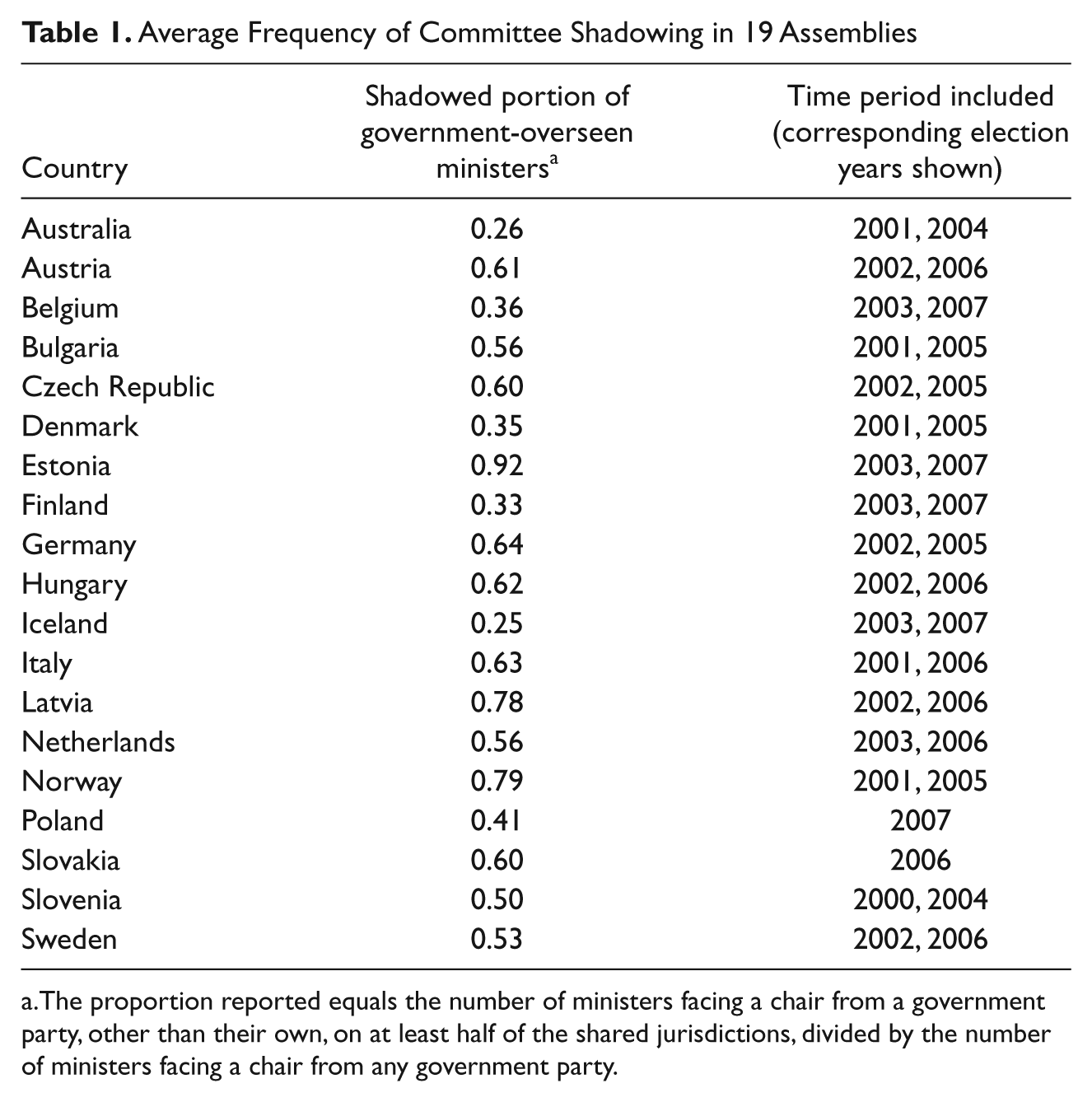
The proportion reported equals the number of ministers facing a chair from a government party, other than their own, on at least half of the shared jurisdictions, divided by the number of ministers facing a chair from any government party.
The table shows that in 13 of the 19 countries we examine, among ministers facing a chair from a governing party, the majority face a corresponding chair from another party.
Determinants of Shadowing
In our data set, there are 443 ministers from coalition governments formed in 19 parliamentary countries between 2001 and 2007 (inclusive). Of these, we focus on the 310 ministers who faced a government chair—calling these the government-overseen ministers—whose appointment would be most clearly influenced by preferences within the coalition. Some of these ministers are shadowed (i.e., the minister faces a chair from a different governing party), the rest are not. What explains which government-overseen ministries are shadowed and which are not?
Two intuitive propositions are that a government-overseen minister is more likely to be shadowed by a chair from another governing party (a “partner”) if (a) the policy disagreements between the ministerial party and the partner are greater (on issues pertaining to the ministry’s jurisdiction) and (b) the chair has more influence over the ultimate policy outcomes in the ministry’s jurisdiction.
We can conceive of two distinct ways to formalize these conjectures about shadowing. The first way would envision chairs as veto players and develop a model similar to those of Krehbiel (1998), Bawn (1999), Tsebelis (2002), or Cox and McCubbins (2005)—all of which describe how status quo policies map into final legislative enactments, when there are one or more veto players. In such a model, the value of shadowing a particular minister would be to affect the legislative outcome, and thus it would seem plausible that shadowing would be more likely when partners feared greater policy losses, were they to leave the ministerial party unchecked, and when chairs indeed had greater ability to influence the legislative outcome.
A second way to formalize the propositions stated above—and the one we take here—focuses not on policy making but on policy implementation. Every minister has a significant range of discretion—for example, in choosing which policies to enforce most vigorously, where to probe the limits of statutory intent, and how to exercise delegated rule-making authority. Formally, one can envision each minister i as having a multidimensional action space, Yi, from which she or he will choose an action vector, yi, representing her or his effort allocation, her or his interpretations of statutes, and her or his rule-making decisions. In some polities, ministers may be free agents in choosing yi; in other polities, the corresponding committee chair in each policy area may exert considerable influence, so that yi is a weighted average of the ideal points of the relevant minister and chair. To formalize this last point, let the ideal point of party j in jurisdiction Yi be xji, let mi denote the party holding ministry i, and let ci denote the party holding the corresponding chair i. Then
In what follows, we imagine that there are two sorts of committee—weak and strong—with weak committees having weight λ0, strong committees having weight λ1, and 0 ≤ λ0 < λ1 ≤ .5. A version of the Laver-Shepsle (1996) 0model emerges as the special case in which all committees are weak and λ0 = 0. Thus, we follow Laver and Shepsle in assuming that policy in each jurisdiction will be decided by the officers with special responsibility in that jurisdiction but adopt a more expansive view of who the relevant officers are. We also focus on policy implementation by executive officials rather than policy making by legislators.
In the appendix, we present a simple model in which each party has additively separable utility over the implementation outcomes in the various ministries, and also directly values holding offices. We investigate the gain to a particular party in government when it chairs the committee overseeing ministry i, rather than allowing the ministerial party to chair that committee—showing that this gain is a function of how much the partners disagree on how to implement the policies in the minister’s jurisdiction and how much chairs can influence the implementation policies chosen by their corresponding ministers.
Although these results are intuitive, there are two caveats to register. First, we know little about the precise bargaining protocols that different coalitions use to allocate chairs among their members. Thus, although we know that a governing party whose members chair three committees probably did not get to pick its three highest-value committees, we cannot say much more than that. Second, several officers—including junior ministers, lower-house committee chairs, and upper-house committee chairs—might shadow any given minister; but our empirical data (described presently) concern only shadowing by lower-house chairs. The existence of shadowing substitutes will likely attenuate any empirical relationship we find between our three predictors and shadowing by lower-house committee chairs. 3
Given these caveats, in what follows we focus on empirically exploring what we believe are plausible conjectures about which ministers will be shadowed by lower-chamber chairs. In particular, we expect that the probability of a particular government-overseen minister being shadowed increases with (a) the average policy distance between the ministerial party and its partners (in the ministry’s jurisdiction) and (b) the power of the committee.
Method
To test our hypotheses, we use the following multilevel model:

The dependent variable is coded Si = 1 if government-overseen minister i is shadowed (by a lower-house chair), 0 otherwise. The probability of this occurrence is a function of (a) a party-specific intercept term, αj[i], where j[i] is the party to which minister i belongs; (b) a measure, di, of the policy distance between minister i’s party and its partners in government; and (c) an error term, ϵi.
The intercept αj[i] determines the expected probability of minister i being shadowed, when the ministerial party, j[i], and its partners are in maximal agreement on the policy to be pursued in minister i’s jurisdiction (di = 0). 4 The variation of the intercept across parties is constrained by the second line of the model. In this line, µα is the average intercept term across all parties and ηj is a mean-zero error term (independent of the first-level error, ϵi). As σ2α→ ∞, the model would place essentially no constraint on what values the various αj’s can take, and hence there would be virtually no pooling in estimating the party-specific intercepts. At this extreme, the estimation would be equivalent to including J-1 party-specific dummy variables (where J is the number of parties). As σ2α→ 0, the model would give all parties the same intercept. This common intercept would reflect the average shadowing rate across all ministers when di = 0. At this extreme, the estimation would be equivalent to an ordinary logit model with αj[i] = α for all j[i].
There are various advantages of using a multilevel model with partial pooling, over either the no pooling or complete pooling extremes (cf. Gelman & Hill, 2006). In our case, using a multilevel model allows us to include data from those parties that have only one government-overseen minister. Using traditional fixed-effects logistic regression would necessitate discarding such data. 5
Operationally, our measure of di is derived from Benoit and Laver’s (2006) survey data set, which provides a “position” score for each party on each of several “policy dimensions.” Such dimensions include nationalism, taxing and spending, and civil liberties. We mapped each of Benoit and Laver’s policy dimensions onto our jurisdictional data, based on the type of issues covered by a given ministry in a given case. In cases where ministries dealt with more than one policy dimension, we used the average of the distances of each dimension for each jurisdiction covered, so that there was only one distance score per ministry. Generally, ministries were contained within a single policy dimension. 6 The ministry-level score is based on the absolute distance between the minister party and the average position of the partners, which is then weighted by Benoit and Laver’s salience measure on the same dimension. We rescale the scores to range from 0 to 1, based on the highest value observed in a given case. The average distance across ministries is 0.46 (SD = 0.30).
Presumably, if committees have very weak oversight powers, then coalition partners will have little incentive to use their chairs as counterweights to ministers: All concerned should recognize that the chairs are too weak. Only when committees have some significant oversight powers does one expect governing partners to make systematic use of committee chairs as overseers of ministers. To account for this, we classify our cases into those with stronger committees and those with weaker committees. A well-known assessment of committee legislative powers in Western Europe, that of Strøm (1998, 2000), is extended by Yläoutinen and Hallerberg (2008) to include Eastern Europe. Yläoutinen and Hallerberg’s index of committee legislative powers assigns points when committees are able to initiate legislation, consolidate or split legislation, amend legislation, and rewrite government bills. We code a committee system as “strong(er)” if it scores in the upper half on Yläoutinen and Hallerberg’s index and as “weak(er)” otherwise. This dichotomization results in a “stronger committee” sample that includes Austria, Belgium, Bulgaria, Estonia, Finland, Germany, Italy, Latvia, Norway, Poland, Slovenia, and Sweden.
Findings
The results of our analysis of shadowing are presented in Table 2. We first examine a sample of 310 government-overseen ministries, grouped by 96 parties. As can be seen, we find that the larger are the policy disagreements between the ministerial party and its partners (in the relevant ministry’s jurisdiction), the more likely the minister is to be shadowed by a committee chair from a partner party. This pattern suggests, in accordance with our argument above, that partners more often balance a minister with a committee chair from a different government party when they foresee a greater risk that the minister will pursue implementation strategies at variance with coalition-wide preferences.
Shadowing of Ministers (multilevel logit, grouped by ministerial party)
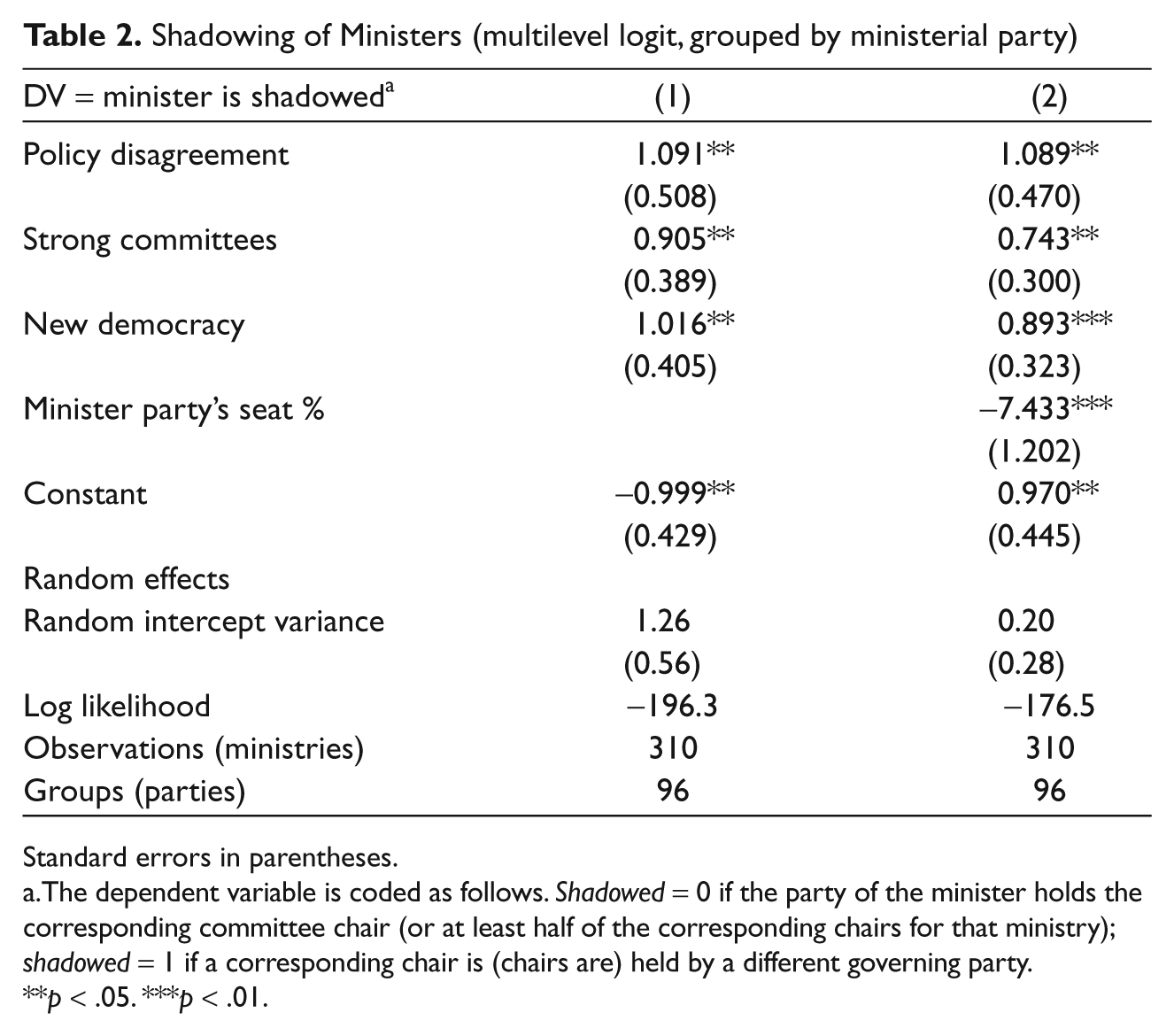
Standard errors in parentheses.
The dependent variable is coded as follows. Shadowed = 0 if the party of the minister holds the corresponding committee chair (or at least half of the corresponding chairs for that ministry); shadowed = 1 if a corresponding chair is (chairs are) held by a different governing party.
p < .05. ***p < .01.
We also included a dummy for “stronger” committees, based on the categorization outlined above. We find that the probability of a minister being shadowed is greater in systems where committees are more powerful, suggesting that such efforts are more prevalent where they are more likely to be effective.
Because our sample pools new and established parliamentary democracies, we also add a dummy (new democracy) to account for this difference. We find that, on average, ministries in new democracies are more likely to be shadowed. Because all new democracies in our sample are Eastern European, our finding may reflect any of the various factors that distinguish parliamentary governments in Eastern Europe from those in Western Europe—which factors include not just experience with democratic governance but also communist legacies, differential rates of modernization, and so forth (Ágh, 1995; Carey, Formanek, & Karpowicz, 2002).
Although we treat the allocation of committee chairs among government members as endogenous to coalition preferences, party-level variation in the baseline probability of being shadowed remains in the model. In the second column of Table 2 we consider whether policy disagreement provides explanatory power even when the size of the ministerial party is taken into account. Although this variable—the share of seats held by the minister’s party— captures most of the cross-group variation in the intercept (and thus the random intercept is not significant), the positive effect of policy disagreement on the probability a minister is shadowed by a governing partner remains in this specification as well. 7
Substantively, an average-sized party in an established democracy is 26% more likely to be shadowed on a jurisdiction with maximum observed policy disagreement than in a jurisdiction with the minimum observed policy disagreement. Given a strong committee system, such a party facing maximum policy disagreement has a 67% probability of being shadowed, whereas this probability is only 25% when policy disagreement is at its minimum and the committee system is weak.
Conclusion
In this article we study delegation problems within multiparty coalition governments. We argue that coalition parties can shadow the ministers of their partners; that is, they can appoint committee chairs (or junior ministers) from other governing parties, who will then be well placed to monitor and/or check the actions of the corresponding ministers.
The previous literature has sought evidence supporting the idea that chairs (or junior ministers) are used to monitor ministers by examining the frequency of shadowing. If the proportion of ministers facing chairs (or junior ministers) of another party is significantly higher than would be expected by chance alone, then these studies conclude that the underlying motivation is indeed keeping tabs on partners (cf. Kim & Loewenberg, 2005; Thies, 2001). In this article, we provide cross-national evidence for the argument suggested by Kim and Loewenberg (2005) that committee chairs are assigned strategically in addition to, or perhaps as a substitute for, conflict-management and information-acquisition mechanisms within the executive branch. More importantly, we have (a) offered a theory of which ministers should be shadowed, if governing parties seek to minimize the aggregate policy losses they suffer because of ministers pursuing their own parties’ interests rather than the coalition’s, and (b) provided evidence consistent with this theory.
We highlight two empirical patterns in particular. First, the greater is the policy disagreement between a minister’s party and its partners, the more likely the minister is to be shadowed. Second, assemblies that have endowed committees with the most significant tools to influence legislation have a greater overall rate of shadowing among governing partners. Furthermore, this baseline probability of a given minister being shadowed is higher in the newer democracies.
Our study illuminates broader theories of coalition governance. In particular, the apparent care with which chairs are used to counterbalance ministers in many systems suggests the following. First, governing partners fear that each other’s ministers will pursue their own interests but take action to reduce ministers’ scope for free legislative action. Thus, the Laver-Shepsle (1996) model may overstate the extent to which ministers are left as free agents but nonetheless identifies an important tendency. Second, to understand the determinants of the government agenda in any given polity, it is important to consider not just the allocation of ministerial posts but also the allocation of legislative posts.
Footnotes
Appendix
In this appendix we consider the preferences of a party, regarding which ministries it should shadow. We assume that each party j in a coalition government has an additively separable utility function over implementation outcomes in the jurisdictions covered by the various ministries, i = 1, . . ., I. Specifically, if y = (y1, . . ., yI) is the vector of implementation outcomes across all I ministries, then party j’s implementation payoff is
Party j also values holding office per se. The value to party j of the office allocations m = (m1, . . ., mI) and c = (c1, . . ., cI) is denoted vj(m,c). We assume that ministry i is worth µi and chair i is worth κi, so that
Finally, there is also a stochastic component of utility, as party j may value the combination of a minister from party mi administering ministry i and a chair from party ci overseeing ministry i for reasons unrelated either to the policies that such a minister-chair pairing will pursue or to the direct “consumption” value of the offices. For example, the administrative competence and integrity of a particular chair may be important considerations. We denote the stochastic component of utility by ϵji(mi,ci) and assume that the ϵji are independently and identically distributed normal variates with mean zero and variance .5σ2.
Now consider the value to party j of shadowing a particular ministry i controlled by party k. How much better will the payoff be for j, when one of its own members chairs the committee corresponding to ministry i, rather than when one of party k’s members chairs the committee? Denoting this value by δjik, we have δjik = [uj(y1, . . ., yi(k,j), . . ., yI) + Кi + ϵji(k,j)] – [uj(y1, . . ., yi(k,k), . . ., yI) + ϵji(k,k)], where yi(k,j) is the outcome in ministry i’s jurisdiction when the minister is from party k and the corresponding chair is from party j, whereas yi(k,k) is the outcome when both the minister and the chair are from party k (giving k a clean line of authority). Given the additive separability of j’s utility function,
Given that policy outcomes are a weighted average of the chair’s and minister’s ideal points, we have yi(kk) = xki and yi(kj) = λxji + (1-λ)xki. Substituting in Equation 1 and simplifying yields δjik = λ (2-λ)wjiDijk + κi + ηji, where Dijk = ||xji – xki||2 is the squared distance between party j’s and party k’s ideal points in the jurisdiction of ministry i; and ηji = [ϵji(k,j) – ϵji(k,k)] ~ N(0,σ). If one views the consumption value of chair i, κi, to be proportional to the strength of the committee—that is, κi = γλ for some scalar γ—then,
Equation 2 clarifies only which ministries a particular party would prefer to shadow, if it had the choice. As chairs are allocated by some bargaining process, it is not clear that any particular party’s desires will be met. Also, it is not clear how preferences would be affected when multiple means of shadowing exist, and whether it would be more valuable to obtain additional monitoring of an important minister or initial monitoring of a less important minister.
In our empirical work, we use the policy distance variable (or di in the text) to represent the average value of wjiDijk for a given ministry i. Because our measure of committee strength is constant within a given country, we include a dummy variable for committee strength. We have not found that the coefficient on policy distance is significantly affected by committee strength—which is perhaps not surprising given the nonlinear relationship implied in Equation 2.
Acknowledgements
We thank Kristen Kao, Pooja Nair, and Jane Lee for research assistance. An earlier version of this article was presented at the presented at the Research Committee of Legislative Specialists conference Albany, New York, August 24–26, 2007.
The author(s) declared no potential conflicts of interest with respect to the authorship and/or publication of this article.
The author(s) disclosed receipt of the following financial support for the research, authorship, and/or publication of this article: This research was supported by National Science Foundation (NSF) grant SES-0749517.