




Abstract
Voter turnout has consistently declined since the 1980s across a wide range of advanced democracies. Much of this decline appears to be the result of young people abstaining. In this article the authors test two arguments for this trend. The first rests on the claim that the character of elections has changed, specifically that elections have become less competitive and that young people’s propensities for voting are particularly negatively affected by this. The second maintains that recent generations have different values and that these value differences explain turnout declines. The authors test these two explanations using three different data sets: (a) individual-level and election-specific data from 83 elections in eight countries since the 1950s, (b) longitudinal individual-level and district-level data from British elections for the period 1974–2005, and (c) panel data from American presidential elections. The findings provide strong evidence for the generational value change argument, whereas the authors find scant support for the competition argument.
Voter participation has declined steadily in recent years across a wide range of advanced democracies. Until the 1980s, mean electoral participation in national legislative elections was around 80%; it is now only slightly above 70% (Blais, 2010; Dalton, 2006). Although there are differences in the rate and starting point of this decline, the negative trend is remarkably uniform even among countries whose electoral systems and other political and social institutions are manifestly distinct. The question then is, what is driving this downward trend in turnout? One observation made by a number of scholars is that much of the decline in turnout is concentrated among young people (Blais, Gidengil, Nevitte, & Nadeau, 2004; Clarke, Sanders, Stewart, & Whiteley, 2004; Dalton, 2007; Lyons & Alexander, 2000; Miller & Shanks, 1996; Wass, 2007; Wattenberg, 2007). Consequently, a plausible interpretation is that turnout decline is the result of generational replacement. More recent cohorts are less inclined to vote. This raises the question of why recent generations are less prone to vote.
Two main lines of argument have emerged. On one side are those who think that the generational gap in turnout reflects a larger cultural value change. These scholars argue that new generations are less interested in politics, and/or have different priorities, and/or are less inclined to conceive of voting as a civic duty (Blais, 2000; Dalton, 2007; Inglehart, 1990; Miller & Shanks, 1996; Wattenberg, 2002, 2007). We refer to this as the “generation school.” On the other side are authors who believe that the low level of voting among recent cohorts is the result of certain characteristics of elections that particularly affect new voters (Franklin, 2004; Franklin, Lyons, & Marsh, 2004; Johnston, Matthews, & Bittner, 2006). These include less competitive elections and changes in electoral laws such as lowering of the voting age. We label this set of claims the “context school.” Our purpose in this article is to further probe these two arguments.
Although both the generation and context schools have produced interesting findings, they both suffer from shortcomings. The generational school has provided compelling evidence of turnout differences between age cohorts, but it has not been able to show that these differences can be accounted for by values. The challenge for this line of interpretation is to provide longitudinal data showing that recent generations have values that are different from those of the previous generations (at the same age) and that these differences have an effect on turnout. Only Miller and Shanks (1996) do this, and they come up with mixed findings. Furthermore, it is not always clear in this line of interpretation which specific values affect turnout and why recent generations differ from previous ones.
The context school is at least partly based on a rational choice model. The model predicts that more competitive elections increase turnout because the probability of casting the decisive vote increases (Downs, 1957). The interpretation also assumes that voting is in good part a habit and that new voters are less likely to have acquired that habit (Plutzer, 2002). The empirical demonstration is not entirely convincing. On one hand, for the interpretation to be valid the level of competition must have decreased, thus driving turnout down among new cohorts. However, Franklin’s (2004, p. 187) own data suggest the opposite; mean margin of victory is going down. Furthermore, Franklin fails to use the logical empirical approach—a hierarchical model—for his analysis. Franklin’s argument implies an interaction effect between a contextual variable (the degree of competition) and an individual-level variable (whether one is a new voter). However, he does not estimate such interactions.
In short, turnout has declined substantially since the late 1980s, and we know that much of it is concentrated among the youth. There is thus an important and clearly specified phenomenon to be explained. There are two major interpretations for this phenomenon. Both are attractive though not entirely compelling. Both interpretations have been tested separately. Below we propose more systematic empirical tests that allow us to compare and contrast the two models.
The article proceeds as follows. In the second section we outline the arguments about turnout decline advanced by the generation school and the context school. The third, fourth, and fifth sections provide empirical tests. We begin by conducting a cross-national analysis of turnout over time in the third section. In the fourth section we focus on turnout in one country—Britain—analyzing the impact of political competition at the district level. The fifth section examines the question of whether more recent generations have different values by looking at generational effects on sense of duty to vote and political efficacy in the United States. The final section concludes.
Generations or Context?
The generation school interpretation is that turnout is declining because people are changing. Older generations with a set of values predisposing them to vote are being replaced by newer generations with another set of values predisposing them to abstain. Authors do not always agree, however, on the definition of generations or on the precise values that are changing and producing turnout decline.
Miller and Shanks (1996) distinguish three generations (New Deal, pre–New Deal, and post–New Deal) defined on the basis of the first presidential election an individual had the right to vote in (before 1932 for pre–New Deal, between 1932 and 1964 for New Deal, and since 1968 for post–New Deal), and they look at a whole set of attitudes: social connectedness, party identification, interest in the election campaign and in the election outcome, sense of political efficacy, and sense of civic duty. But their conclusion, as mentioned above, is mostly negative: “Neither set of explanations . . . accounts for inter-generational differences in turnout” (Miller & Shanks, 1996, p. 111).
The “postmaterialist” school provides a second generational interpretation. According to Inglehart (1977, 1990; also see Dalton, 2006, 2007), there has been a gradual shift from materialist to postmaterialist values, a shift that is strongly linked to generational replacement. More recent cohorts are more inclined to adhere to postmaterialist values. According to this line of thought, the new generation of postmaterialists is keen to get involved in politics, but it is looking for new and more meaningful “elite-directing” rather than “elite-directed” forms of participation. As a consequence, young postmaterialists are less inclined to vote. Inglehart does not define specific generational groups; he rather distinguishes eight (10-year) age cohorts, in line with the view that the value change is gradual. Inglehart and Dalton never specifically test the “postmaterialist” hypothesis with respect to turnout. They do not show that generational differences in turnout vanish, or are considerably reduced, when postmaterialism is taken into account.
Blais et al. (2004) offer a third generational perspective. These authors combine Canadian Election Studies from 1968 to 2000, showing that there remain differences between generational groups even after controlling for life cycle effects. They distinguish pre–baby boomers (born before 1945), baby boomers (born between 1945 and 1959), those born in the 1960s, and those born in the 1970s. They find that turnout is substantially lower among the last two cohorts. Finally, they present data suggesting that the generational differences may be accounted for partly by attention to politics and sense of duty. However, this latter part of the analysis is not very compelling since it is limited to one particular election. Rubenson, Blais, Fournier, Gidengil, and Nevitte (2004) also find strong generational effects on turnout. These authors, again focusing on Canada, find that much of the turnout gap between older citizens and the most recent cohort is explained by differences in political interest and attention to politics.
In their more recent work, Dalton (2007) and Wattenberg (2007) put much emphasis on sense of civic duty as the factor that could explain the recent decline in youth turnout. Dalton distinguishes two norms, sense of duty and engaged citizenship. He shows that younger people are more prone to emphasize engagement over duty and that voting in elections is correlated with duty whereas other forms of political activity are related to the engagement norm. Dalton does not demonstrate, however, that the age gap in turnout is accounted for by these norms, nor that sense of duty has declined over time. Similarly, Wattenberg (2007) shows that the age gap in turnout has increased and that sense of duty is considerably weaker among youth, but he does not present longitudinal evidence about the evolution of duty, nor does he show that the age gap in turnout is explained by the age gap in duty. The generation school has provided solid evidence that turnout is lower among recent generations, but it has failed to specifically demonstrate that values are responsible for the change.
Franklin (2004) has challenged the generational interpretation (see also Franklin et al., 2004). Franklin’s starting premise is that there is a strong inertia, or habitual, component to voting and that overall changes in turnout are triggered by changes taking place among the newly enfranchised (p. 66; also see Plutzer, 2002). This newly enfranchised group is composed of those who have the right to vote for the first time, and these are mostly youth who have recently reached voting age. In short, there are two groups of voters, the “old” and the “new.” The former have acquired the habit of voting or abstaining and continue voting or abstaining independently of what happens in a given campaign. Only the latter are “open” to new information and will decide to vote or not to vote depending on the electoral context.
The question becomes, what are the characteristics of elections that have driven down turnout among recent cohorts? According to Franklin, there are two main culprits: lowering of the voting age and electoral competition. In most countries the voting age has been lowered from 21 to 18. Franklin argues that this is the main reason for the turnout decline (he estimates that the lowering of the voting age has produced a 3-percentage-point decrease in turnout; Franklin, 2004, p. 139). Lowering the voting age meant that people had the right to vote for the first time when they were 18 to 20, at a time of their lives when they have left home and have not yet established social networks. This means that these new cohorts missed the opportunity of getting socialized to the habit of voting.
The second culprit is electoral competition. Franklin is concerned with factors that increase (or decrease) the link between the voting act and public policy (Franklin, 2004, p. 112). He argues that elections in which a party gets a majority of the seats will produce clearer outcomes than those that result in coalition governments. To that effect he creates a “majority status” variable that he shows to be significantly correlated with turnout. The data indicate that departure from majority status increased between 1965 and 1999 and that this contributed to a 1-percentage-point decline in overall turnout during the period (Franklin, 2004, p. 174, Table 7.1).
Franklin also considers features of an election that may increase or decrease its salience. These features include characteristics of the party system such as party cohesiveness and party polarization. The more cohesive parties are, the more meaningful the election outcome, as parties can be expected to fulfill their campaign promises. Likewise, the more polarized the party system, the greater difference the winner of the election makes. Franklin reports that party cohesiveness does foster turnout, but this does not explain the turnout decline, since cohesiveness has increased over time (Franklin, 2004, p. 187, Table 7.4). As for polarization, it does not appear to have a significant impact on turnout. These election “characteristics,” therefore, do not account for the recent turnout decline. 1
More recently, Johnston et al. (2006) use data from the Canadian Election Studies from 1988 to 2004 and show that competitiveness affects turnout, but only among the newly eligible cohorts, defined as those for whom the election for a given year is the first or second opportunity to cast a ballot. Their findings support Franklin’s interpretation. However, the analysis includes no control for generational effects.
Previous analyses have tested the predictions of these two “schools” separately; our model encompasses variables associated with both. Our analyses include specific generational cohorts, and we also consider, like Franklin, whether an individual is a “new” voter, whether voting age was 18 at the first election she or he had the right to vote, and we look at the impact of competition, particularly among new voters. Because our analysis combines individual-level and contextual variables, we use a hierarchical model. The first tests compare the relative salience of these two sets of variables. These tests involve “objective” factors such as age, generation, whether one is a new voter, and the degree of competitiveness of a given election. The generational school argues that recent generations vote less because they have different values or attitudes. In a final test, we specifically examine that hypothesis.
A Cross-National Longitudinal Analysis of Turnout
We use election studies conducted in eight countries since the late 1950s: Britain, Canada, Denmark, Germany, the Netherlands, Norway, Spain, and Sweden. These are the eight countries for which we could assemble data over a relatively long period. 2 We have a total of 86 election studies (see the appendix).
The dependent variable is whether the individual voted. The data have been weighted so as to fit with actual turnout in each election, thus correcting for differentials in turnout misreporting across election studies (Karp & Brockington, 2005.). 3 Our model incorporates all the major variables that have been the focus of the generation and context schools, except for attitudes, which are considered in the last section. We include variables tapping both life cycle and generation effects, plus whether one belongs to a “new” cohort, as well contextual factors such as competitiveness. As far as we can tell, this is the first study to take into account all these variables and to use such a large data set.
Our model first includes two generation dummy variables, the preboomers, born before 1945, and the postboomers, born after 1960 (the baby boomers, born between 1945 and 1960, are the reference category). We add two variables, age and age 2 , which will allow us to sort out life cycle and generation effects (Blais et al., 2004; Johnston, 1992). As Johnston (1992) points out, in any single survey age and cohort are linear transformations of each other and are thus perfectly correlated. The solution to the problem is two pronged. First, the correlation weakens if we merge surveys undertaken at different points in time (as we do here) since we get observations at different ages for individuals belonging to the same generation. Second, the correlation is further reduced if we are willing to make some assumptions about the nature of life cycle and generation effects. We assume that life cycle effects are continuous and can be captured by a curvilinear form (see Wolfinger & Rosenstone, 1980) whereas generational effects are discrete and can be captured by the simple distinction between preboomers, boomers, and postboomers. This approach allows us to substantially reduce collinearity between age and generation. In our data set, when we regress the preboomer dummy on age and age 2 , the pseudo-R2 is “only” .46.
Our model also includes variables that allow us to test the main assertions of the “context” school. The first assertion is about the lowering of the voting age. The hypothesis is that those for whom the voting age was 18 when they had the right to vote for the first time are less likely to vote—in that first election but also in subsequent elections—because of the acquired habit of not voting. We created a dummy variable that equals 1 for all those for whom voting age was 18 at their first election.
The second assertion is about the impact of competition. We have two variables designed to tap lack of competition: margin of victory, the vote share gap between the first and the second parties, and distance from majority status, which equals the absolute distance between the seat share of the largest party and 50%. The expectation is that the greater the margin of victory, the lower the probability of casting a decisive vote and thus the lower the propensity to vote. Likewise, the greater the distance from majority status, the greater the probability that the formation of the government will depend on deals among the parties, the less leverage voters have on who will govern, and the weaker the incentive to vote.
The third and perhaps most original argument of the context school is that lack of competition has a more powerful effect on “new” cohorts. As in Franklin (2004, p. 75), we define anyone facing one of their first, second, or third elections as belonging to a “new cohort.” The hypothesis to be tested is that the effect of competition is larger among these new cohorts than among “old” ones.
The model finally includes dummy variables for the specific countries (Sweden is the reference category) and also a dummy variable for those in the Netherlands for whom voting was compulsory the first time they had the right to vote. We assume that these people have been socialized to voting and are more prone to vote even after voting was no longer compulsory. 4 Because we are interested in the joint effect of individual-level and contextual variables, we use a hierarchical, or multilevel, model (Gelman & Hill, 2006; Raudenbush & Bryk, 2002).
Before we turn to an analysis of the effects of generations and competition on turnout, it is useful to examine the amount of variation in the dependent variable at each level in the data. That is, these data are nested—or multilevel—in nature with individuals nested within elections. 5 By specifying a model that contains no predictors at either the individual or election level, we can determine the proportion of variation in turnout that is accounted for by differences in individuals and that which is accounted for by differences in elections. This statistic is commonly known as the intraclass correlation coefficient (ICC), and the model described is equivalent to a one-way ANOVA with random effects. 6 In the cross-national data analyzed here, the ICC is .086; in other words, 8.6% of the variation in turnout is at the election level. Given that the dependent variable is measured at the individual level, it is unsurprising that this level accounts for a great deal of the variance.
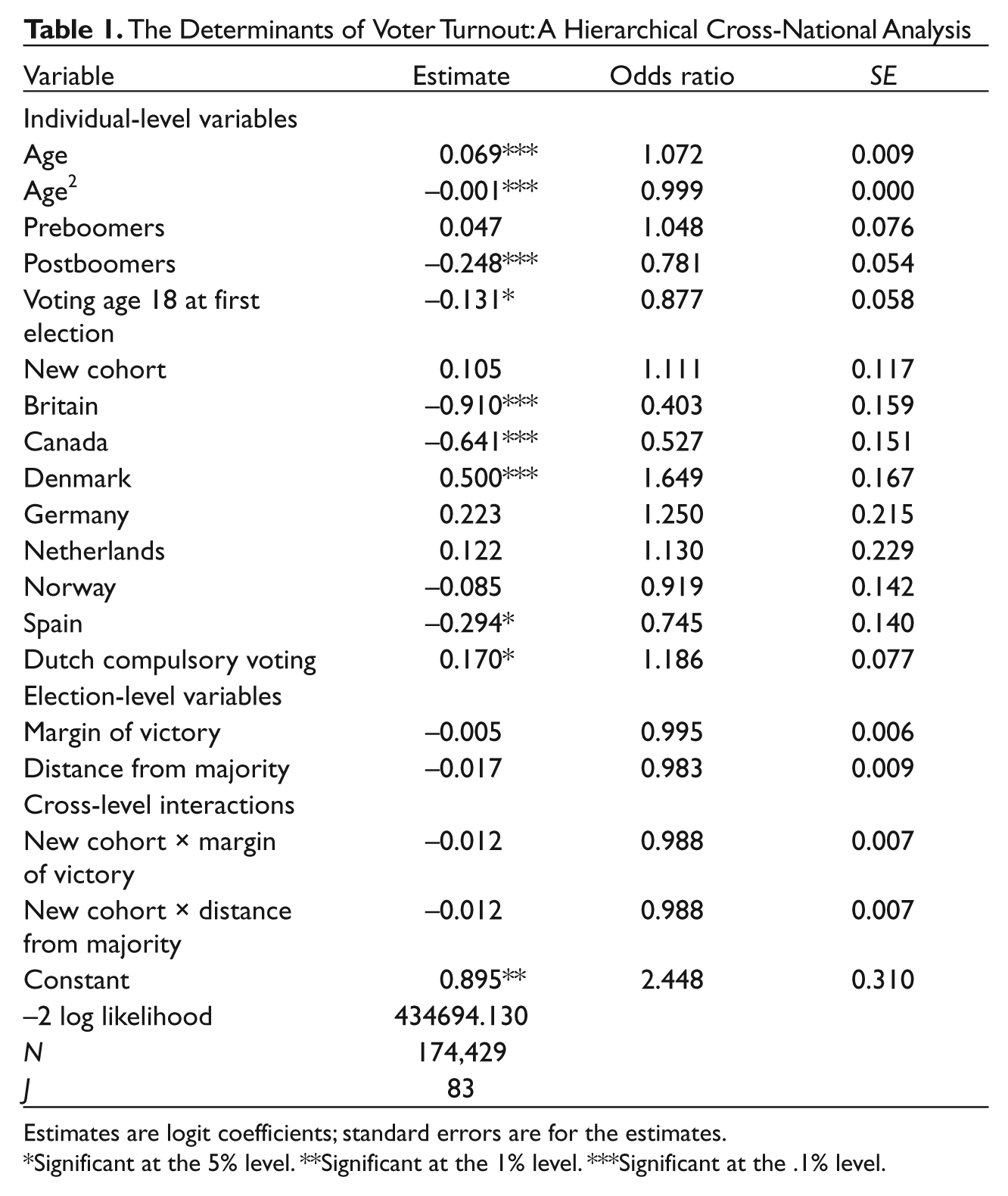
Table 1 presents the findings. 7 The main purpose is to determine whether variables associated with the generation school remain significant when we control for the effects predicted by the context school, and vice versa. The findings confirm the presence of strong life cycle effects. These results are consistent with those of previous studies (Blais, 2000; Blais et al., 2004; Wolfinger & Rosenstone, 1980). Table 1 also shows that the preboomers—those born before, 1945—were not more likely to vote than the boomers. This is an interesting finding; however, it is not central to the generation school argument because the focus is on attitude change among recent cohorts.
The Determinants of Voter Turnout: A Hierarchical Cross-National Analysis
Estimates are logit coefficients; standard errors are for the estimates.
Significant at the 5% level. **Significant at the 1% level. ***Significant at the .1% level.
The most important finding is that the postboomers—those born after 1960—are significantly less likely to vote, even after controlling for life cycle effects, for the fact that the voting age was more likely to be at 18 at their first election, and for the effects of political competition. And the impact is quite substantial. Everything else being equal, the odds of voting are 22% lower among the postboomers than among the baby boomers. This is rather strong evidence in support of the generational interpretation.
What about contextual factors? The results confirm that those for whom the voting age was 18 at their first election are less inclined to vote. Controlling for other factors, the odds of voting are 12% lower in that group. These results support Franklin’s view that the lowering of the voting age contributed to the turnout decline. However, generational replacement appears to be a more powerful factor than voting age.
The most crucial argument of the context school is that margin of victory and absence of majority status have strong effects on turnout and that these effects are particularly powerful among new cohorts who have not yet acquired the habit of voting (or abstaining). The findings reported in Table 1 do not support that argument. Margin of victory and distance from majority status both have the predicted negative coefficients. The estimates for these variables are, however, not statistically significant at the 5% level. Even more important, the hypothesis that margin of victory is a more powerful factor among new cohorts is not confirmed. 8 These data provide little support for the contextual interpretation.
Finally, the findings show that Dutch electors who were eligible to vote for the first time before 1972, at the time voting was compulsory in that country, continued to vote in greater numbers after voting was made optional. One possible interpretation of this result is that these people were socialized to the view that it is a civic duty to vote.
In short, the data are largely consistent with the generational replacement interpretation. Postboomers are less inclined to vote, even after controlling for a host of other factors. The generational interpretation appears more fruitful than the contextual one. There is support for Franklin’s assertion that the lowering of the voting age contributed to the turnout decline, but not for the hypothesis that competition has a stronger impact among “new” cohorts.
This first confrontation of the two “theories” suggests that the recent turnout decline can hardly be accounted for by new cohorts’ response to a less competitive environment. The major factor seems to be generational replacement. For reasons that still need to be elucidated (see below), the postboomers are less prone to vote than the previous two generations. The other part of the story comes from the reduction of voting age, which, as we have seen, “produced” a substantial decline in the likelihood of voting.
These results raise a further set of questions. Perhaps the most important is about the reasons for which postboomers are less inclined to vote than their predecessors. As indicated above, the generational school implies that postboomers vote less because they have different values and attitudes. But is this really the case? Before looking into this, we need to make sure that our verdict concerning the inadequacy of the context school is valid. We examine below whether we obtain different results with different indicators of competitiveness.
Local Margin of Victory and Turnout in Britain
One drawback of the previous analysis is that it tests the impact of competitiveness at the national level. Franklin (2004) looks at margin of victory at both the national and local (district) levels. The nil results obtained above could be the result of the fact that we failed to consider local competitiveness. We therefore perform a new test of the two models with a data set that allows us to ascertain the impact of local competitiveness. We pooled all the British election studies for which we have information about respondents’ constituency, that is, the nine elections held between 1974 and 2005. We chose Britain because of the availability of data but also because Britain is one of the two countries in our data set with a single-member district plurality system. It is precisely in such systems that local competitiveness should matter. In fact, Franklin (2004, p. 137) explicitly argues that local margin of victory affects turnout only in first-past-the-post elections.
Using this data set we can relate the decision to vote or not to vote to local district margin of victory, plus age and cohort variables, and dummies for those for whom voting age was 18 at their first election and for those involved in their first, second, or third election. Because observations are clustered in electoral districts, we use a hierarchical model. This new analysis allows us to check the robustness of the previous findings about the presence of generation effects and the absence of interaction effects between competitiveness and belonging to a new cohort.
As in the analysis of the cross national data, we have estimated an empty model using the British data to calculate the proportion of variance in the dependent variable at each level—the individual and district levels. In the British data, the ICC is .062; that is, 6.2% of the variance in turnout is from differences in the data at the district level.
The findings are presented in Table 2. 9 They confirm the effect of life cycle and generation effects. The age effects are similar to the ones in the cross-national findings presented above. Again, post–baby boomers emerge as less inclined to vote than the baby boomers. Controlling for other variables in the model, the odds of voting are 27% lower among postboomers than among the baby boom generation. Preboomers also appear to vote slightly more than the baby boomers. These data confirm that there is an important generational component to turnout. More recent generations are less inclined to vote, even after taking account of other factors, most particularly life cycle effects.
The Determinants of Turnout: A Hierarchical Analysis of British Elections

Estimates are logit coefficients; standard errors are for the estimates.
Significant at the 5% level. **Significant at the 1% level. ***Significant at the .1% level.
There is no support for the hypothesis that one’s propensity to vote is lower in the first three elections, nor for the view that those for whom voting age was 18 at their first election are systematically less prone to vote. In contrast to the findings above, where competition was measured at the national level, the results reported in Table 2 indicate that local margin of victory does make a difference. The more competitive the respondent’s local constituency the more likely the individual is to vote. However, we note that the magnitude of the effect is close to zero. Although local margin of victory has a statistically significant impact on turnout, there is no support for the most crucial argument that competitiveness (or lack thereof) has a larger impact on new cohorts. As was the case in the cross-national analysis, the interaction between competitiveness and new cohort is not statistically significant in the present model either.
This second set of findings is consistent with the initial results, and they provide further support for the generation school. In Britain, as in the cross-national data set, there are strong cohort differences in the propensity to vote even when one controls for life cycle effects, exactly as predicted by the generational perspective. Local margin of victory does seem to affect British turnout. However, its impact is not more pronounced among new electors (in their first three elections). The substantial turnout decline observed in Britain cannot be accounted for by new cohorts’ greater sensitivity to lack of competition.
The results presented in this section and in the previous one raise doubts about the validity of the context school when it comes to explaining the recent turnout decline. It is true that people are less inclined to vote in local constituencies where one of the parties has a wide lead over the others. This, however, does not account for recent declines in turnout since elections have not become less competitive over time and since new cohorts are not more strongly affected by lack of competitiveness.
The generation school looks more relevant. The crucial finding is that there are strong generation effects, even controlling for life cycle effects, for competitiveness, and for the lowering of the voting age. Given these findings, it is difficult to believe that generational replacement is not part of the story. The results we have presented are incomplete, however. It remains to be determined whether the most recent generation is less inclined to vote because it has different attitudes and values.
Do More Recent Generations Vote Less Because They Have Different Values?
The generational school assumes that the most recent generations are less inclined to vote because they have different values, but it often fails to specify which values and/or to show empirical evidence of generational change in attitudes. We fill some of the gap here. We show that some of the attitudes that are related to the decision to vote or to abstain have changed over time.
To establish those points, we need longitudinal data about attitudes that are related to turnout. Unfortunately there are very few longitudinal data sets in which turnout relevant attitudes have been measured in the same way over a relatively long period of time, long enough to allow us to document the presence of generational differences. The only data set that we have been able to assemble comes from the United States, and it covers a 40-year period. The data set pertains to sense of duty to vote and sense of political efficacy, two attitudes that have been shown to be correlated with turnout (Blais, 2000; Clarke et al., 2004). 10 Our task is to determine whether there indeed exist generational differences with respect to these attitudes and whether these attitudes do indeed affect turnout.
In 10 different American National Election Study (ANES) surveys conducted between 1952 and 1992, respondents were asked whether they agreed or disagreed with the following statement: “If a person doesn’t care how an election comes out, then the person shouldn’t vote in it.” 11 This is an indirect measure of sense of duty. From a rational choice perspective, someone who is indifferent about the outcome has no instrumental benefit in voting. Therefore, a person who disagrees with the statement and thinks that someone should vote even if she or he has no preference is likely to believe that voting is something one ought to do irrespective of its consequences, that it is a moral duty to vote in an election.
The data indicate that sense of duty has been decreasing in the United States. The percentage saying that a person should vote even if she or he does not care went from 54% in the first five surveys to 46% in the last five. 12 A similar pattern emerges with respect to external political efficacy. The concept is measured through responses to two agree versus disagree statements: “People like me don’t have any say about what the government does” and “I don’t think public officials care much what people like me think.” Mean scores on the 0 to 1 efficacy scale decreased from .61 in the first five surveys to .48 in the last five. The situation is different in the case of internal political efficacy. The proportion disagreeing with the statement that “sometimes politics and government seem so complicated that a person like me can’t really understand what’s going on” remained stable over the 40-year period (the mean percentages disagreeing with the statement are 30% and 29%, respectively, in the first and last five surveys).
Our first task is to determine whether the decline in sense of duty and external efficacy can be attributed to the process of generational replacement. Our strategy, as in the previous sections, is to sort out life cycle and generational effects through the construction of a continuous age variable (and age 2 ) and two dummies to distinguish three generations: the baby boomers, the preboomers, and the postboomers.
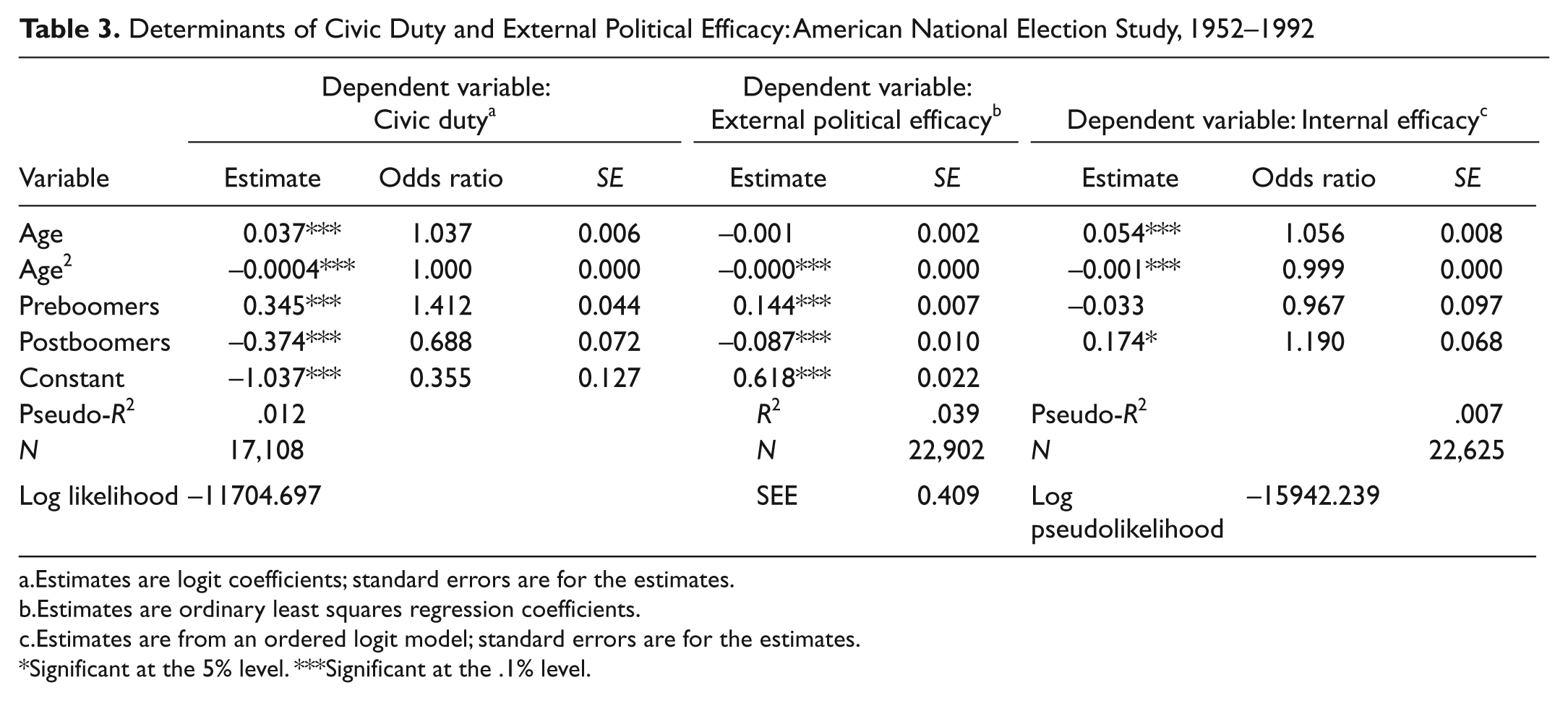
Table 3 presents the findings. They confirm the presence of both life cycle and generational effects with respect to both civic duty and external efficacy. Postboomers are less inclined to think that one should vote even if one does not care about the election. Everything else being equal, the odds of disagreeing with the ANES statement are 31% lower among the postboomers compared to the boomers. The oldest generation—the preboomers—are substantially more likely than the baby boomers to see voting as a civic duty. The odds of disagreeing with the statement are 41% higher among this group, compared to baby boomers. The most recent generations are more likely to reason that the logical thing to do if one has no preference is to stay home.
Determinants of Civic Duty and External Political Efficacy: American National Election Study, 1952–1992
Estimates are logit coefficients; standard errors are for the estimates.
Estimates are ordinary least squares regression coefficients.
Estimates are from an ordered logit model; standard errors are for the estimates.
Significant at the 5% level. ***Significant at the .1% level.
A similar pattern can be observed in the case of external political efficacy. There are both life cycle and generational effects. Sense of external efficacy is highest among the preboomer generation and lowest among postboomers, even controlling for life cycle effects. There is evidence of substantial generational change in how people construe the act of voting and in their perceptions of their potential influence. Things are different with regard to internal efficacy. We find strong life cycle effects here as well, but there is some indication that the postboomers are more likely than older generations to express greater internal efficacy. We argue, however, that external efficacy and duty are the more relevant attitudes when it comes to testing the generation school’s argument about turnout.
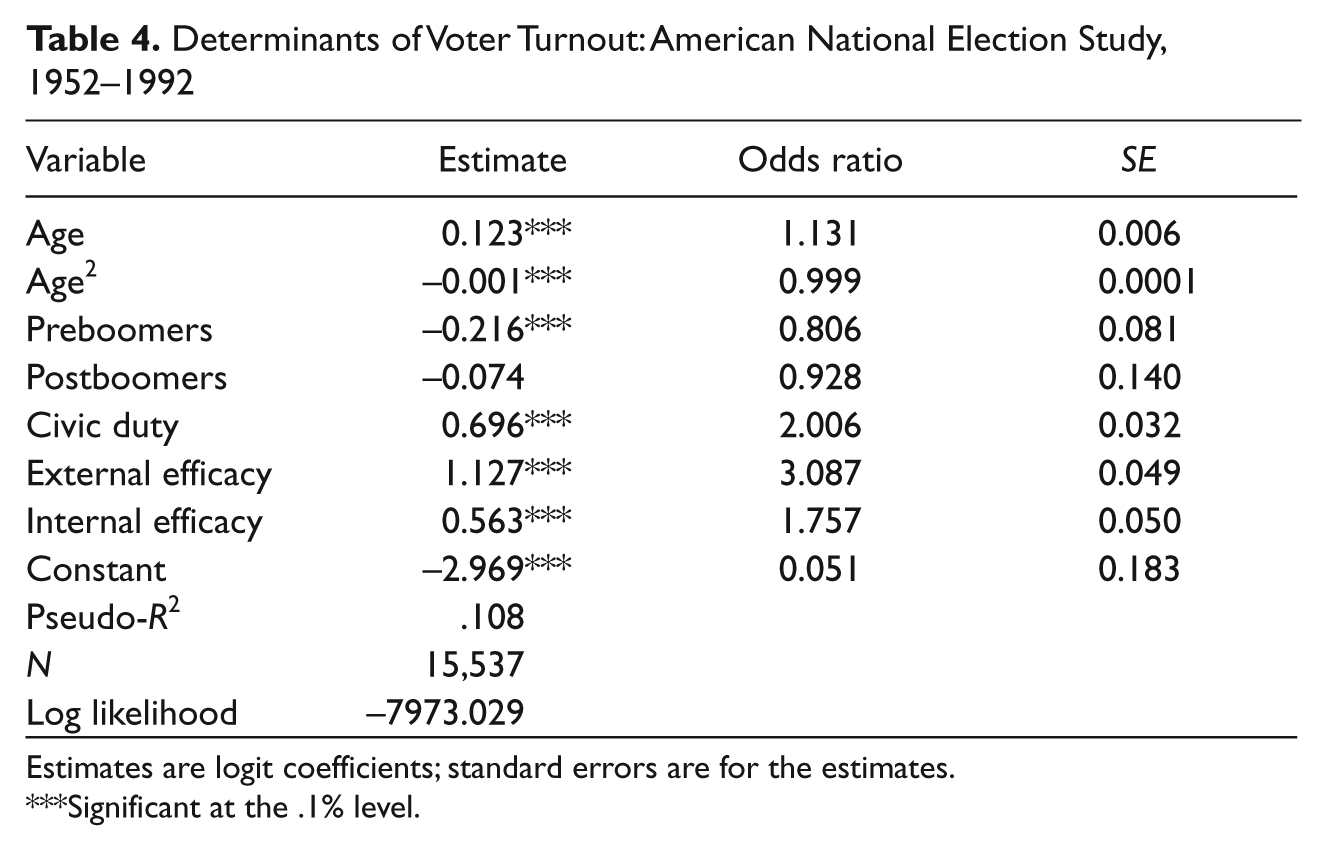
The next step is to demonstrate that these attitudes matter. In Table 4, where the 10 ANES surveys are again collapsed, we show that sense of duty and external and internal political efficacy strongly affect the propensity to vote.
These results show that there is a correlation between voting and sense of duty and efficacy. However, there is the possibility of reverse causality. That is, once people have voted—or have decided to vote—they rationalize that voting is a duty and that they have some political influence. Conversely, those who have abstained come to believe that voting is not a duty and that the government does not care about them anyway. To control for these potential rationalization effects, we use the two panel surveys that were conducted in 1956/1960 and 1972/1976. These two surveys are pooled, and the dependent variable is whether the individual voted or not in the second election (1960 and 1976). We include the same variables as in Table 4, but the three attitudes—duty, external efficacy, and internal efficacy—are measured in the first election (1956 or 1972) and are related to the decision to vote or not to vote in the subsequent election (1960 or 1976).
Determinants of Voter Turnout: American National Election Study, 1952–1992
Estimates are logit coefficients; standard errors are for the estimates.
Significant at the .1% level.
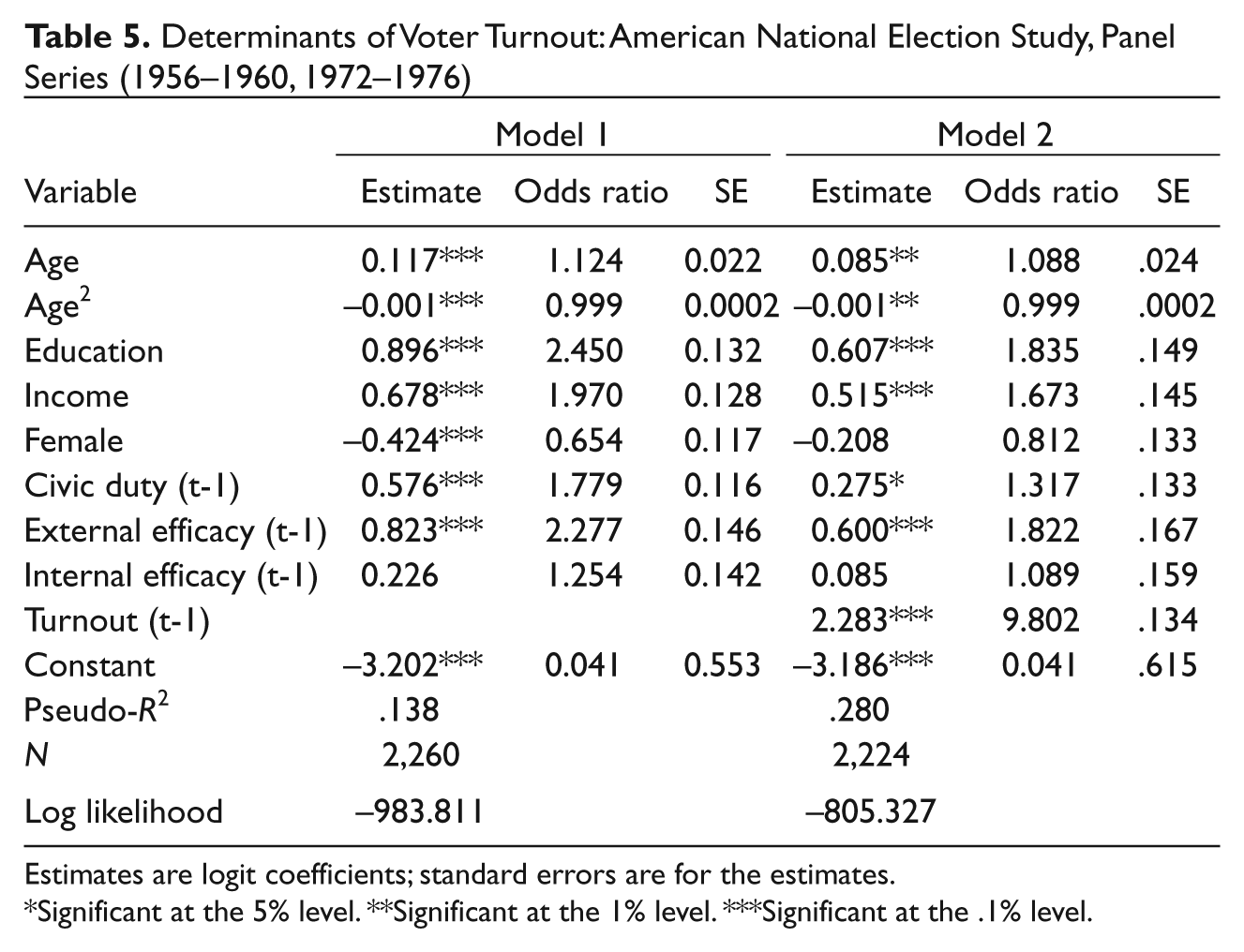
The results, presented in Table 5, are substantially similar. Civic duty and sense of external efficacy, measured 4 years earlier, affect the propensity to vote in the 1960 and 1976 elections. These results control for rationalization effects since duty and external efficacy were measured a long time before the decision to vote or abstain (in the 1960 and 1976 elections) was made. Note, however, that internal efficacy does not come out significant with the introduction of these additional controls.
Determinants of Voter Turnout: American National Election Study, Panel Series (1956–1960, 1972–1976)
Estimates are logit coefficients; standard errors are for the estimates.
Significant at the 5% level. **Significant at the 1% level. ***Significant at the .1% level.
There is the possibility that the attitudes measured in 1956 and 1972 were themselves rationalizations of the decision to vote in that particular election. To rule out such a possibility, we introduce an additional control for the decision to vote or abstain in that election as well. There is a risk of overcontrol here, as we do not allow for the possibility that sense of duty or efficacy had any simultaneous impact in 1956 and 1972. This additional control is bound to produce a conservative (under)estimation of the effects of duty and efficacy. If we still find a statistically significant effect with such a stringent test, we will be able to conclude with more confidence that these attitudes matter. The findings are presented in the second column of Table 5. Duty and external efficacy remain significant, whereas internal efficacy does not. It seems that both duty and external efficacy have an independent impact on the decision to vote or abstain in an election. There is no foolproof solution to reverse causality issues, but at the very least the results presented here are consistent with the view that civic duty and efficacy are important determinants of the decision to vote or not to vote.
The ANES data show that the postboomers have a weaker sense of civic duty and feel less (externally) efficacious. The panel data indicate that these feelings matter. People are less inclined to vote when they believe that voting is not a duty and that politicians don’t care about them. These findings lend support to the interpretation that postboomers are less likely to vote because they feel less dutiful and efficacious.
Conclusion
Turnout is declining, and most of that decline is concentrated among youth. Two interpretations have been offered for this phenomenon, one suggesting that recent generations have different values that make them less inclined to vote and the second that new cohorts are particularly sensitive to the competitiveness of the election.
We have shown that both interpretations have some appeal but also shortcomings. Previous analyses had tested these interpretations in isolation. We proposed and tested models that incorporated factors associated with both schools. Our findings give more support to the generational than to the contextual interpretation. There is support for the claim that people are less inclined to vote when the election outcome is perceived to be a foregone conclusion, but this does not account for the turnout decline since new cohorts are not more strongly affected by lack of competition.
The empirical evidence is more consistent with the interpretation that young voters are less inclined to vote because their generation is less prone to construe voting as a moral duty and is more skeptical about politicians’ responsiveness to their concerns. We have shown that the most recent generation is more likely to abstain even after controls for life cycle effects, that they have a weaker sense of duty and external political efficacy, and that these attitudes affect turnout.
Although our study is more supportive of the generational school, that interpretation is not completely satisfactory, for at least two reasons. First, we would need to explain why sense of duty and sense of external political efficacy are weakening among recent generations. Are these patterns part of a larger syndrome of declining deference (Nevitte, 1996) and/or weakening social ties in schools and communities (Campbell, 2006; Putnam, 2000)? Second, the generational school may be able to explain why postboomers vote less than baby boomers, but it is unable to explain why the latter vote as much as preboomers. Baby boomers have a weaker sense of duty and external political efficacy than do their predecessors (see Table 3), but their turnout rate is similar (see Table 1). The generational school may be able to account for why turnout declined in the 1990s, but it appears unable to explain why it did not decline in the 1970s and 1980s. Some of the puzzle remains.
Footnotes
Appendix
Acknowledgements
AcknowledgmentsWe thank Simon Labbé St-Vincent for excellent research assistance. Previous versions of the article benefited from the helpful comments of Chris Achen.
Declaration of Conflicting Interests
The author(s) declared no potential conflicts of interest with respect to the research, authorship, and/or publication of this article.
Funding
The author(s) received no financial support for the research, authorship, and/or publication of this article.