




Abstract
This article examines the relationship among a country’s democratic experience, its level of economic development, and the prevalence of clientelistic and programmatic modes of democratic accountability. In contrast to the commonly accepted wisdom that clientelistic politics will decrease monotonically as a country’s economy develops and its democracy consolidates, the authors argue theoretically and demonstrate empirically that clientelism tends in fact to increase as a country moves from low to intermediate levels of democracy and development. They also uncover preliminary evidence that a history of regime instability may have independent consequences on the prevalence of one or the other linkage mechanism. Finally, the results suggest that a country’s level of economic development and exposure to the international economy are more consistent predictors of programmatic effort and coherence than are measures of a country’s regime type.
What is the relationship between political uncertainty and political parties’ mix of clientelistic and programmatic effort to build linkages to voters? Clientelism involves an exchange in which politicians provide goods and services targeted to individual or small groups of voters, contingent on the latter reciprocating by surrendering their vote and contributing other services to the politicians’ effort to win electoral office. The exchange may have a single-shot character, or it may build around a longer-term relationship, for example, when voters are appointed to offices or receive social benefits over an extended period of time. Programmatic linkages, by contrast, involve noncontingent exchanges in which politicians promise and supply goods at various scales (collective, large club, and local club goods/pork) to various constituency categories (defined in terms of occupation, age, region, etc.), but without parties targeting the benefits only to their voters.
Comparative and historical research generally argues that as polities become wealthier, programmatic accountability will steadily replace clientelism as the predominant form of citizen–elite linkage (Kitschelt & Wilkinson, 2007; Stokes, Dunning, Nazareno, & Brusco, 2012). 1 Similarly, Keefer (2007) argues that democratic political experience plays an independent role in the choice of linkage strategies, net of economic development. Although he did not have access to a direct measure of politicians’ linkage effort, using proxies for targeted and nontargeted goods (public investment, government wages, secondary school enrollment, political governance, etc.), Keefer’s article empirically does demonstrate a strong and robust negative (positive) relationship between the age of democracy, as measured in consecutive years of competitive electoral contests, and indicators designed to measure the prevalence of clientelistic (programmatic) politics.
This article aims to build on these lines of reasoning. We use as a starting point the notion that countries with lower levels of economic development and shorter democratic histories should, ceteris paribus, be plagued by greater levels of political uncertainty than their more developed and more consolidated counterparts (Lupu & Riedl, 2013). Our analysis suggests a need to reconsider the existence of a simple monotonic relationship among democracy, development, and linkage strategies. For reasons addressed in more detail below, we expect that uncertainty in its various guises will make both clientelistic, and especially programmatic, linkages difficult to credibly maintain in the world’s most underdeveloped and newest democracies. 2 With growing democratic experience and increasing development, however, first clientelistic and later programmatic efforts to build political linkages begin to consolidate. The data we use to investigate the relationship between democratic experience and partisan linkage strategies come from the Project on Democratic Accountability. This project represents a genuinely cross-national effort at gathering comparable data on parties’ linkage strategies as well as on critical organizational features (for earlier efforts, see Janda, 1980; Katz & Mair, 1992).
Our findings largely confirm expectations as to the curvilinear relationship among democracy, development, and clientelism. This is most clearly the case with respect to economic development, where the curvilinear relationship between GDP and clientelism is robust to all model specifications. Similarly, in the world’s newest democracies repeated rounds of electoral competition are associated with more credible and well-established organizational structures, which in turn facilitate the use of clientelistic electoral strategies. 3 As well, we also see that a history of repeated regime transitions tends to increase parties’ relative emphasis on clientelistic as opposed to programmatic linkage strategies. Finally, our results suggest that a country’s level of economic development and exposure to the international economy are more consistent predictors of programmatic effort and coherence, at both the country and party level of analysis, than are measures of a country’s regime type.
Democracy, Development, and Linkage Strategies
Keefer and Vlaicu (2008) argue that when ex post credibility is low, rather than expending effort on the promotion and implementation of programmatic platforms, party leaders will be compelled to develop targeted material appeals grounded in short-term exchange. By contrast, when voters are inclined to accept the credibility of parties’ programmatic appeals, politicians will bypass local brokers and rely on purely programmatic electoral strategies. It is from this theoretical framework that Keefer (2007) adopts his two primary hypotheses: that the prevalence of clientelism should be negatively associated the age of democracy, whereas the opposite should be true regarding the prevalence of programmatism. We agree that programmatic linkages require a fair degree of ex post credibility. Programmatic linkages involve an intertemporally drawn out exchange in which broad categories of voters receive benefits that often accrue with delay and indirectly (e.g., employment, growth, social security). For voters to ground their choice of political parties or candidates in programmatic campaign platforms, they must believe that parties will both remain committed to stated policy platforms if elected and have the capacity to implement these platforms once in office.
However, our argument differs from theirs in our assessment of the challenges that also plague the maintenance of credible clientelist relationships among voters, local brokers, and political parties. Rather than assuming that clientelistic strategies are “there for the taking” anytime programmatic promises are noncredible, we suggest that clientelism itself is a mechanism of electoral accountability requiring some measure of “contractual security” (see Kitschelt & Kselman, 2011, for an extensive discussion). Clientelist political entrepreneurs face the dual challenge of effectively distributing targeted resources, and then of establishing, through processes of monitoring and enforcement, that recipients of clientelistic benefits are indeed holding up their end of the bargaining (voting for the party, participating in rallies, etc.).
These processes of distribution, monitoring, and enforcement are nearly impossible to implement without ties to a knowledgeable and expansive team of local operatives. By way of illustration, consider the following passages, describing the Turkish Welfare Party (precursor to the now incumbent Justice and Development Party) and the Argentinean Peronists, respectively:
The Welfare Party presided over a network of independent, interlocking support groups that was the envy of all other parties. In addition to the party’s formal representation at the provincial, municipal, and neighborhood levels, informal associations and groups of activists rooted the party in every block, in every street. . . . So much information was gathered for party records, including details such as blood group, that the police reportedly called Welfare Party headquarters to ask for blood donor matches after accidents. . . . The foundations were run by local businessmen, the cells by activists drawn from the neighborhood, bridging differences in income, education, and even gender. (White, 2002, pp. 180-181) The Peronist organization consists of a vast collection of informal, neighborhood-based networks that operate out of a range of different entities, including local clubs, cooperatives, soup kitchens, and often activists’ homes. These entities are self-organized and operated. They do not appear in party statutes, are rarely registered with local party authorities, and maintain near-total autonomy from the party bureaucracy. Nevertheless, they routinely participate in party activity, playing a critical mediating role between the party leadership and its base. They recruit new members, distribute patronage, channel local demands, and—most importantly—deliver votes in internal and general elections. (Levitsky, 2003, p. 30)
Beyond providing vivid descriptions of the form(s) that organizational networks adopt, these passages also suggest the need to revisit the assumption that nonpartisan local ties are immediately accessible by any party that lacks programmatic credibility.
Democratic Experience, Political Uncertainty, and Linkage Strategies
All things equal, younger democracies tend to face a higher likelihood of institutional reform and regime change than more established democratic systems. This heightened political uncertainty, in turn, is likely to condition politicians’ capacity and incentive to engage in various democratic linkage strategies. Both clientelism and programmatism require politicians to make downstream commitments, whether to the targeted provision of state resources or the implementation of stated programmatic platforms. This ex post constraint is particularly binding for programmatic strategies, where no portion of parties’ commitment to voters can be effectuated until parties are in office. The possibility of regime change, nearly definitionally, will make all programmatic commitments provisional. Though more subtly, the possibility of institutional reform will likely also create doubt in voters’ minds. When the rules of the game change, so do the incentives of its key protagonists. Moving, for example, from a majoritarian to a proportional electoral system is likely to change politicians’ strategic policy and governance incentives. The possibility of such institutional change ought, in theory, to make programmatic campaign commitments less credible.
Younger democracies are likely also to experience greater party system volatility, making it more difficult to predict with certainty who will be the relevant “players” in subsequent electoral contests. Many policy areas and policy proposals (e.g., regarding social security and industrial policy) require long-term implementation strategies. Parties that aren’t likely to survive from one electoral contest to the next will not be able to make any medium- to long-term programmatic commitments. Similarly, a key to successful programmatic campaigns lies in the ability to communicate a clear and distinctive platform to the electorate (Kitschelt & Kselman, 2011). Absent clarity and consistency, programmatic messages are likely to fall on deaf ears. Short-lived parties are less likely to have the time necessary to develop clear and consistent programmatic messages.
All this might suggest that parties’ programmatic effort allocations should increase as we move from young, to adolescent, to well-established democracies. However, we state this argument with a number of qualifications. With regard to institutional and regime instability, the accumulated “age” of democracy is not likely to be a perfect operationalization. For example, Turkey is a fairly “old” democracy in terms of it cumulative experience, having spent all but 6 of the last 62 years under parliamentary rule. However, it has experienced three short-lived military interventions, which account for the 6 nondemocratic years. Expectations of regime instability might thus be higher than one would anticipate from Turkey’s accumulated democratic experience. Similarly regarding party system instability, many established democracies experience upheavals that create cohorts of “young” parties with little to no reputation. Conversely, as shown in more detail below, some parties exist prior to democratization and may have reputations that date to their legacy in the antecedent authoritarian regime. Although programmatic credibility should increase with democratic experience, the effect may thus be muted by a number of organizational and system-level factors. We thus test the following hypotheses:
Hypothesis 1 (H1): Ceteris paribus, more democratic experience should correlate with more programmatic effort by political parties.
Hypothesis 2 (H2): Holding the age of democracy constant, older and more established parties are likely to make more programmatic effort than are younger parties.
Hypothesis 3 (H3): Holding the age of democracy constant, parties in regimes with a history of regime instability are likely to make less programmatic effort than are parties in stable regimes.
Clientelist linkages also require a measure of organizational longevity. Even the most rote vote-for-stuff exchange, that is, the outright purchase of votes for cash or kind, requires trust on two levels: between voters and the brokers who distribute targeted resources and between independent brokers and the political parties they represent in local constituencies. Such ties are plagued by agency problems, and in particular the possibility of opportunism and shirking by all parties to the “agreement” (e.g., Szwarcberg, 2010). Local brokers may choose to “pocket” resources afforded them by party leaders rather than distribute them to supporters, and elected officials may fail to act on clientelist promises (to electrify a neighborhood, to provide privileged access to social policy, etc.). Credible clientelistic networks are generally the result of long, hard organizing efforts. Politicians in new democracies, and especially in democracies where the very existence of party organizations is in doubt from one electoral cycle to the next, will generally not have had the time to create such networks, and will not be able to credibly commit to the provision of continuing benefits over a series of exchanges.
The relationship between clientelism and the possibility of regime change is less clear. Although both clientelism and programmatism require some measure of downstream credibility, the time horizon necessary to implement programmatic proposals often extends a good deal further than that necessary for resource distribution. 4 Given that some trade-off generally exists between effort devoted to clientelism and programmatism, one might even expect that, where regime instability looms in actors’ minds, parties will have strong incentives to focus the material element of their campaigns on clientelist rather than programmatic vote-seeking efforts. A qualitatively similar argument applies to expectations regarding institutional reform: Changes to the rules of the game are likely to pose a greater challenge to long-time-horizon programmatic commitments than they are to medium-term clientelist commitments.
These arguments suggest the possibility that competing dynamics will affect the prevalence of clientelism moving from young to middle-aged democracies. On one hand, lower expectations of regime and/or institutional change may impel parties to allocate a portion of their resource endowment away from clientelism to programmatic efforts. On the other, increasingly dense and credible organizational networks will make clientelism an ever more attractive strategy than it was in newly formed democracies. Although these effects may wash out, the question is an empirical one, and hinges on the relative size of the effects of increasing organizational strength and decreasing expectations of regime/institutional change.
Eventually, we expect the logic expounded in Keefer’s original article to kick in: After a certain point the relationship between clientelism and democratic experience should become negative. The most obvious reason is the increasing attractiveness of programmatic linkage that emerges in consolidated democracies, which ought to impel politicians to shift their relative campaign emphases. Furthermore, as parties age they will eventually exhaust the available marginal gains to be made in further strengthening ties to local notables, and may eventually attempt to distance themselves from local brokers as they attempt to establish systemic “autonomy” (Panebianco, 1988). It may also be that as democracies become institutionalized, and party systems stabilize more voters will begin to take offense at the political inequality resulting from clientelism, namely, that those with access to large-scale state or private resources can commandeer vast numbers of votes, voiding the regulative democratic fiction of “one voter, one vote.” Exposure to clientelistic practices may thus bring about cynicism concerning the conduct of politicians, as well as material dissatisfaction with the relative deprivation resulting from the special interest bias of clientelistic arrangements. Reduced to concise hypotheses, we argue, therefore,
Hypothesis 4 (H4): In the aggregate there will be a negative relationship between clientelism and democratic experience. The particular dynamic moving from “new” to “middle-age” democracies will depend on the relative size of competing effects. Hypothesis 5 (H5): Clientelism will be positively related to strong ties with local brokers and intermediaries. Hypothesis 6 (H6): Among the subset of younger democracies, the strength of ties to local intermediaries will be positively related to democratic experience. Hypothesis 7 (H7): Holding cumulative democratic experience constant, the prevalence of clientelism will be negatively related to a history of regime instability.
Economic Development, Economic Uncertainty, and Linkage Strategies
Economic uncertainty is a function of vulnerability to international economic shocks and downturns, and the resulting inability to reliably assess a country’s short- and medium-term macroeconomic prospects (Lupu & Riedl, 2013). In the world’s poorest democracies high levels of poverty and underdevelopment make small-scale material and/or professional inducements much more attractive than in the developed world, where material subsistence is, generally speaking, less of a day-to-day concern. Voters in underdeveloped contexts are plagued by not only lower absolute levels of material well-being but also higher uncertainty (or “variance”) regarding both short- and medium-term means of subsistence. This is especially true of rural voters in the agricultural sector, where exogenous climactic and commodity price shocks complicate even the most immediate of downstream calculations. Not only is it inherently difficult to make policy commitments when one’s fiscal and macroeconomic state of affairs is unknown 6 months in advance; perhaps more basically, the social crises brought about by exogenous shocks often leave incumbent governments with little choice but to obey the policy recommendations of external actors (private, public, and nonprofit) whose help is required to stave off humanitarian disaster. This absence of ex post credibility will be further reinforced by the fact that parties in less-developed economies lack both the economic tax base on which broad programmatic commitments are necessarily dependent as well the administrative capacity required for their implementation.
Voters in underdeveloped countries are thus likely to be particularly responsive to clientelistic forms of electoral linkage and to largely discount the credibility of broad programmatic statements. It is important that this is a statement about relative allocations of effort between clientelism and programmatism and does not imply that, in absolute terms, clientelism will be either more prevalent or more effective in the world’s least developed democracies than elsewhere. Indeed, both the low absolute level of state resources and the high uncertainty associated with their downstream availability ought to make voters weary of any clientelist exchange that involves more than a one-shot trade of support for resources, and ought to impel politicians to employ other, less “material” vote-seeking strategies grounded, for example, in charisma or ethnicity.
When moving from highly underdeveloped to middle-income countries, the resources available to political parties will increase and the economic uncertainty they face will decrease. Greater sectoral diversity associated with the growth of industry and services will make exogenous climactic and commodity prices shocks less inhibiting. Parties will also have greater access to resources in interventionist states that assume an important position in economic production and economic governance. This heightened economic role is most often found in middle-income countries, where either import-substituting industrialization (ISI) or export-oriented industrialization (EOI) constitutes the main strategy of rapid economic advancement. Where these strategies actually pay off in high growth, states provide parties with a windfall of control over revenue and public employment they can put to use.
How will political parties allocate these newly available public resources between clientelist and programmatic strategies? Such contexts are generally characterized by persistent pockets of poverty and underdevelopment, implying that on a purely material basis many voters will remain responsive to targeted material and professional inducements. Processes of mass industrialization and urbanization create new social segments susceptible to clientelist exchange, and new social networks via which to effectively consummate this exchange. As well, the state’s heightened role in implementing ISI or EOI strategies provides political parties access to a variety of new “goods” (civil service jobs, employment in public sector industry, etc.) with which to maintain clientelistic relationships that transcend simple one-shot interactions. Furthermore, unlike in highly underdeveloped societies, where the very existence of state fiscal and administrative resources cannot be counted on from one trimester to the next, states in middle-income countries can credibly commit to a certain basic level of material solvency in the medium term. As a result, the means for maintaining clientelist relationships should increase moving from underdeveloped to middle-income countries, and increased medium-term economic security should make these relationships more effective and credible.
These same processes, however, may also generate increased responsiveness to programmatic appeals among new industrial workers and a growing middle class. Electorates in middle-income countries will contain new voter segments amenable to both forms of accountability, and may also begin to display smaller middle-class and upper-middle-class segments whose primary interests are programmatic. Furthermore, parties in middle-income countries will no longer face the overwhelming ex post commitment challenges to programmatism found in underdeveloped, primarily rural economies. A larger overall tax base, increased administrative capacity, and a measure of independence from exogenous economic shocks will make it plausible for parties to begin taking small steps toward programmatic credibility in political campaigns. It is thus primarily in middle-income countries where the electorate may be responsive to both clientelist and programmatic appeals.
In advanced industrial societies, dynamics at both the supply and demand level should eventually tilt parties’ campaign and governance strategies nearly completely to programmatism. These highly diversified economies will exhibit a greatly heightened security from climactic and commodity price shocks, a large tax base, and a well-established administrative apparatus, making programmatic politics more credible in voters’ eyes. Perhaps more basically citizens will, on the whole, have transcended the challenges of short-term subsistence that provide the material basis for clientelist exchange. In the aggregate, these dynamics ought to yield an inverted U relationship between development and clientelistic linkages, and a linear relationship between development and programmatic linkages. More concisely summarized in hypotheses,
Hypothesis 8 (H8): There will be a curvilinear (hump-shaped) relationship between economic development and the prevalence of clientelistic politics. Hypothesis 9 (H9): There will be a monotonic positive relationship between economic development and the prevalence of programmatic politics.
A Data Set on Democratic Accountability
The Democratic Accountability Expert Survey (DAES), implemented in 2007 and 2008, takes an important step toward providing reliable cross-national data on parties’ linkage strategies and organizational forms at a single point in time. 5 The survey’s core unit of observation is an individual party, of which there are 506 altogether. Experts from each of 88 countries were asked to score all of that country’s relevant parties on a series of items. To measure clientelism, the survey’s second module contains a battery of five items, each of which asks experts to score parties on a 4-point scale measuring the extent to which they emphasize the provision of distinct clientelistic benefits: gifts, jobs, preferential social policy benefits, company procurement contracts, and regulatory favors. The full wording of the questions in the generic questionnaire, not yet customized for individual countries, can be found at the project website (http://www.duke.edu/web/democracy/index.html). To measure clientelist effort, we first generate a party’s mean score on each of the five items (averaged across experts). Since the five items are highly intercorrelated and yield a single underlying factor in factor analysis, we create a simple additive index across all items, yielding a summary variable for each party. Rescaled, this index ranges from 1.6 to 3.93 for the 506 parties in our data set. 6 To create country-level scores, party scores are averaged across all parties in a polity, weighted by each party’s vote share in the most recent legislative election.
The fourth module of the DAES asks experts to identify party positions on a battery of programmatic policy dimensions (each of which is measured on a 10-point scale), including social welfare policy, state intervention in the economy, public spending, nationalism, and traditional values, along with a series of country-specific issues with current resonance (e.g., the “head scarf” issue in Turkey). 7 To measure the extent to which parties deploy effective programmatic strategies, we follow a procedure developed previously by Kitschelt and Freeze (2010), who identify three crucial criteria on the basis of which to evaluate a party’s programmatic messages: coherence, salience, and polarization of the scores the experts assign to the parties. A voter can choose programmatically among parties only if she or he can recognize that (a) politicians speak roughly with one voice on (b) issues that are relevant for voter choice and on which (c) they take a position distinct from that of other parties. Failure to meet any one criterion makes it difficult to maintain strong programmatic linkages between voters and politicians.
To measure cohesiveness, the authors use the standard deviation of expert judgments for each party on each issue. 8 The standard deviations were standardized on a 0–1 scale, as were the other components of the index. The value for standard deviation was then subtracted from 1 so as have high scores always yield more programmatic partisan appeals. For a policy position to be salient, a party’s key personnel must bring this issue to the public eye (through advertising, speech making, etc.), or at least promote underlying principles that allow them to generate perceived issue positions. 9 A rough measure of salience, therefore, is the proportion of experts who choose to score a party, that is, who don’t choose the don’t know or party has no clear position options. 10 For voters to vote based on programmatic considerations, party positions must produce a measure of differentiation and polarization. The distinctiveness of parties’ issue positions is measured by the average distance of a party’s issue position from that of other parties’ positions. 11
For each policy question in the survey, this process yields three 0–1 scaled indices of cohesion, salience, and polarization, all three with similar distributions over the support set [0,1]. On any given issue, their product (cohesion × salience × polarization) then constitutes the summary index of a party’s issue-specific programmatic appeal. To create a composite index of programmatic effort and effectiveness, we take the average of a party’s scores on the four policy dimensions where it generated the highest programmatic scores. 12 In theory this indicator can vary from 0 to 1; among the 506 parties in our data set, it varies from .012 to .780. To create country-level scores, party scores are averaged across all parties in a polity, weighted by each party’s average vote share in the most recent legislative election. Figure 1 presents the covariation between our two primary dependent variables.

Covariation of clientelism and programmatism.
There is a fairly strong negative correlation between clientelism and programmatism, both at the party (r = –.521) and at the country level (r = –.537). However, these inverse correlations are far from perfect. For example, there are plenty of parties that are above the median on both variables, labeled 1 in the party-level plot.
In operationalizing democratic experience, we follow the measurement strategy promoted by Gerring, Bond, Barndt, and Moreno (2005). The authors argue that measuring the time elapsed since the beginning of the current democratic period fails to distinguish between countries that share very different democratic histories, but whose most recent transition to democracy occurred at roughly the same historical juncture. 13 To capture such differences in democratic endowments, the measure sums up a country’s total score on the Polity index of democracy beginning in 1900, using a 1% annual depreciation rate so as to give greater weight to recent experience than historical experience. 14 We use this indicator as our core measure of democratic experience and normalize the measure so that it varies between 0 and 1. Throughout, we also control for a country’s 5-year average on the Polity index (2003–2007), so as to distinguish the statistical effect of “democratic experience” from that of the current state of democratic competition. The correlation between the two is moderate (r = .365). A number of the hypotheses developed above apply not to a country’s accumulated experience with democracy but rather to its history of regime instability. As a preliminary measure of regime instability, using the Przeworski, Alvarez, Cheibub, and Limongi (2000) data on regime transitions, we developed two regime instability measures, one counting the total number of times a country experienced either a change from authoritarianism to democracy or vice versa between 1945 and 1980, and second a count from 1980 to 2007, so as to distinguish between a long history of instability and a history of recent transition (the two are correlated at r = .465).
To measure the strength of political parties’ local network ties, we use a survey item from DAES’s first module:
Do the following parties have local intermediaries (e.g., neighborhood leaders, local notables, religious leaders) who operate in local constituencies on the parties’ behalf, and perform a variety of important tasks such as maintaining contact with large groups of voters, organizing electoral support and voter turnout, and distributing party resources to voters and supporters?
Experts are then asked to mark whether individual parties have such intermediaries in most districts, in some districts, or in almost no districts (they are also given the option don’t know). In turn, we assign the value 2 to the score most, the value 1 to the score some, and the values 0 to the score almost no, and then create a party average across all experts that both can and does vary from 0 to 2 in our sample of 506 parties.
As noted above, at the advent of democracy some political parties will dispose of organizational capital, and in particular strong local network ties, which date to their participation in the antecedent authoritarian regime. 15 To test H5 and H6 it will be essential to control for the presence of these authoritarian legacy parties, since the presence of parties that do not require repeated rounds of electoral competition to build strong networks is likely to dilute the relationship between democratic experience and both local network ties and clientelist effort. Therefore, we created a dummy variable coded 1 if two conditions obtain: (a) the party must have been an important instrument of authoritarian rule no longer than 20 years before 2008 (when the DAES was put into the field); (b) the authoritarian regime in which the party served must have been a regime lasting longer than one decade. The supplemental appendix (available online at http://www.march.es/ceacs/personal/personales/datasets.asp?id=5154&Idioma=) contains a list of the 38 parties assigned the status “authoritarian legacy.”
H2 suggests that a political party’s age and historical legacy will be important determinants of its ability to make credible programmatic commitments. Coding political parties’ age, let alone their historical legacy, is a tricky endeavor made complicated by the occurrence of frequent party splits, fusions, and name changes. As a first cut, which will certainly require updating in future research, we proxy for party age with the following additional item from the DAES:
Please indicate the extent to which parties draw on and appeal to voters’ long-term partisan loyalty (“party identification”). Parties may invoke their historical origins or the achievements of historical leaders. They may feature party symbols and rituals to reinvigorate party identification.
Experts were given options ranging from 1 (not at all) to 4 (to a great extent) and were asked to assign a score to each relevant party in the system. Scores were averaged across experts to generate an assessment of a party’s historical legacy. Additional party-level controls include the electoral size of parties as measured by their average vote share over the most recent two elections and their incumbency status as measured by the percentage of government ministers the party held at the time the survey was implemented.
Economic development is a multifaceted phenomenon, comprising not only increasing individual incomes but also improvements in well-being indicators such as infant mortality, life expectancy, and literacy. Although we experimented with distinct indicators, in this article we proxy for development using a country’s per capita gross national product (GNP), adjusted for purchasing power parity. 16 To further approximate the notions of economy uncertainty and economic vulnerability, we also control the natural log of population size, the ratio of imports plus exports to GNP, and the ratio of foreign direct investment (FDI) to GNP. 17 Finally, to control for region-specific affects we include a series of regional dummies as controls. The appendix contains a detailed catalogue of the variables used in the following statistical analyses.
Democratic Experience, Clientelism, and Programmatism
Consider first country- and party-level plots of linkage strategies as a function of logged per capita GNP (Figure 2).

Linkage strategies and GDP.
On the whole, these plots are strongly consistent with H8 and H9. Beginning with H8, we see that at both country and party levels there is a noticeably curvilinear relationship between economic development and the use of clientelist linkage strategies (moving from moderate, to high, to negligible). This curvilinear fit is a good deal stronger than a simple linear specification, as attested to by the significantly higher explained variance in a quadratic regression analysis as compared those in a simple linear analysis (from r2 = .489 to r2 = .692 at the country level, and from r2 = .330 to r2 = .477 at the party level). As for H9, there exists a strong linear relationship between GNP and programmatism.
Figure 3 reproduces these same plots, now substituting democratic stock for economic development as the x-axis variable. These simple relationships allow us to assess in a preliminary way H1 and H4, that programmatic accountability (clientelism) should be positively (negatively) related to democratic experience.

Linkage strategies and democratic stock.
As compared to the relationship with economic development uncovered in Figure 2, democratic experience exhibits a much lower intercorrelation with programmatic accountability. With regard to clientelism the curvilinear specifications once again perform significantly better than the linear models (from r2 = .447 to r2 = .566 at the country level, and from r2 = .255 to r2 = .393 at the party level), suggesting that, moving from young to middle-aged democracies, stronger and more credible organizations have the expected effect of making clientelism a more effective means of electoral linkage. Below we test whether it is indeed the mechanism of strengthening party organizations that generates the curvilinear result.
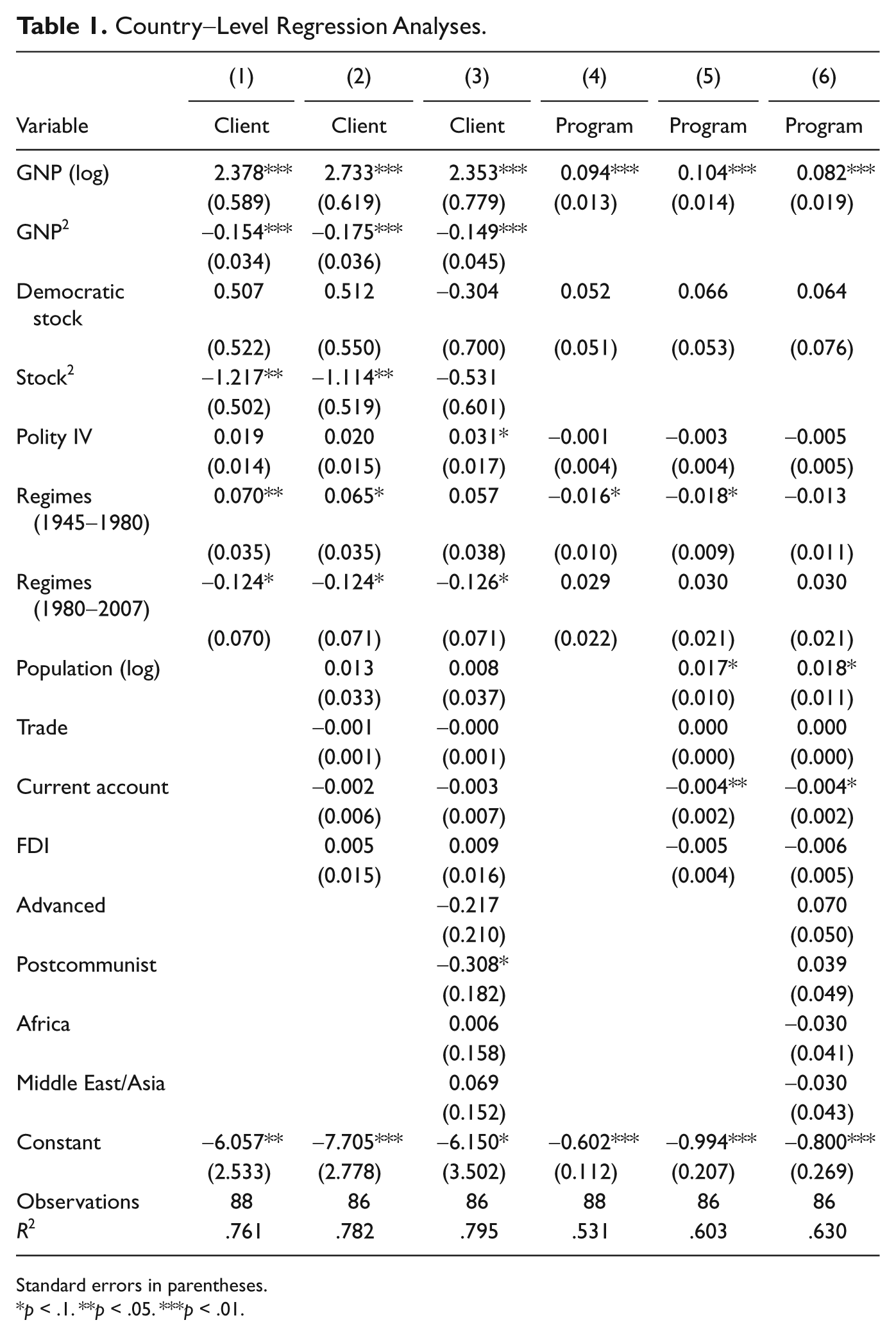
Our two key independent variables, GNP per capita and democratic stock, are strongly correlated (r = .562 and r = .542 at the country and party levels, respectively). As such, we now employ ordinary least squares regression analysis to assess whether or not these bivariate relationships hold in a controlled environment. Table 1 contains a series of country-level regression models. The excluded regional dummy variable is Latin America, such that coefficients on these variables capture the extent to which other world regions are distinct from Latin America.
Country-Level Regression Analyses.
Standard errors in parentheses.
p < .1. **p < .05. ***p < .01.
The first thing to notice is the overwhelming strength of economic development as a predictor across the board. The curvilinearity uncovered in Figure 2 holds up in a controlled statistical setting (using the coefficients from column 1, the “crest” of the hump occurs around GNP per capita of $3,300, equivalent to the Philippines’ level of development), and it is substantively relevant. The curve becomes very steep as one moves to the upper end of the income spectrum, such that the near the upper tail a standard deviation increase in logged per capita GNP leads to a full standard deviation decrease in the clientelism index. As well, there is a strong and positive linear effect of development on the strength of programmatic linkages.
On the other hand, democratic experience has a less consistent effect across the board. In the clientelism regressions, the quadratic term is significant in the first two columns whereas the simple linear term is not. In analyses that contain only a simple linear term, there is a significant negative effect of democratic experience in the first two columns; but similar to the results in Table 1, this effect disappears in the fully controlled analysis (column 3). This weak curvilinear effect may be explained by the fact its key mechanism, namely, the increasing density and credibility of organizational networks, is a party-level prediction that is masked in data aggregated up to the national level. We examine this possibility below. As might have been expected from glancing at the programmatism plots in Figure 3, democratic experience has no clear impact on programmatism. To summarize, at the country level we find substantial support for the predictions regarding economic development (H8 and H9), some support for expectations as to the effect of democratic stock on clientelism (H4), and no support for the hypothesis that increasing democratic experience will have a positive effect on programmatism (H1).
As for additional measures, though the effects weaken below standard significance levels in the fully controlled regressions, a history of regime instability between 1945 and 1980 has the effects predicted in H3 and H7: The more transitions a country experienced between 1945 and 1980, the more (less) clientelistic (programmatic) it tends to be. On the other hand, recent experience with regime instability has the opposite effects: It leads to statistically significant decreases in the clientelism index and has a positive effect on the programmatism index (although the effect just misses standard significance levels). Finally, although none of the additional economic or regional controls have much impact on clientelism, it is interesting that population size has a positive effect on programmatism whereas high current account imbalances have a negative effect on programmatism. Both variables were included as ways to tap more specific dimensions of economic uncertainty (small countries and indebted countries tend to more susceptible to international market fluctuations); if these results are robust, they provide further suggestive evidence that economic uncertainty impinges the development of programmatic accountability.
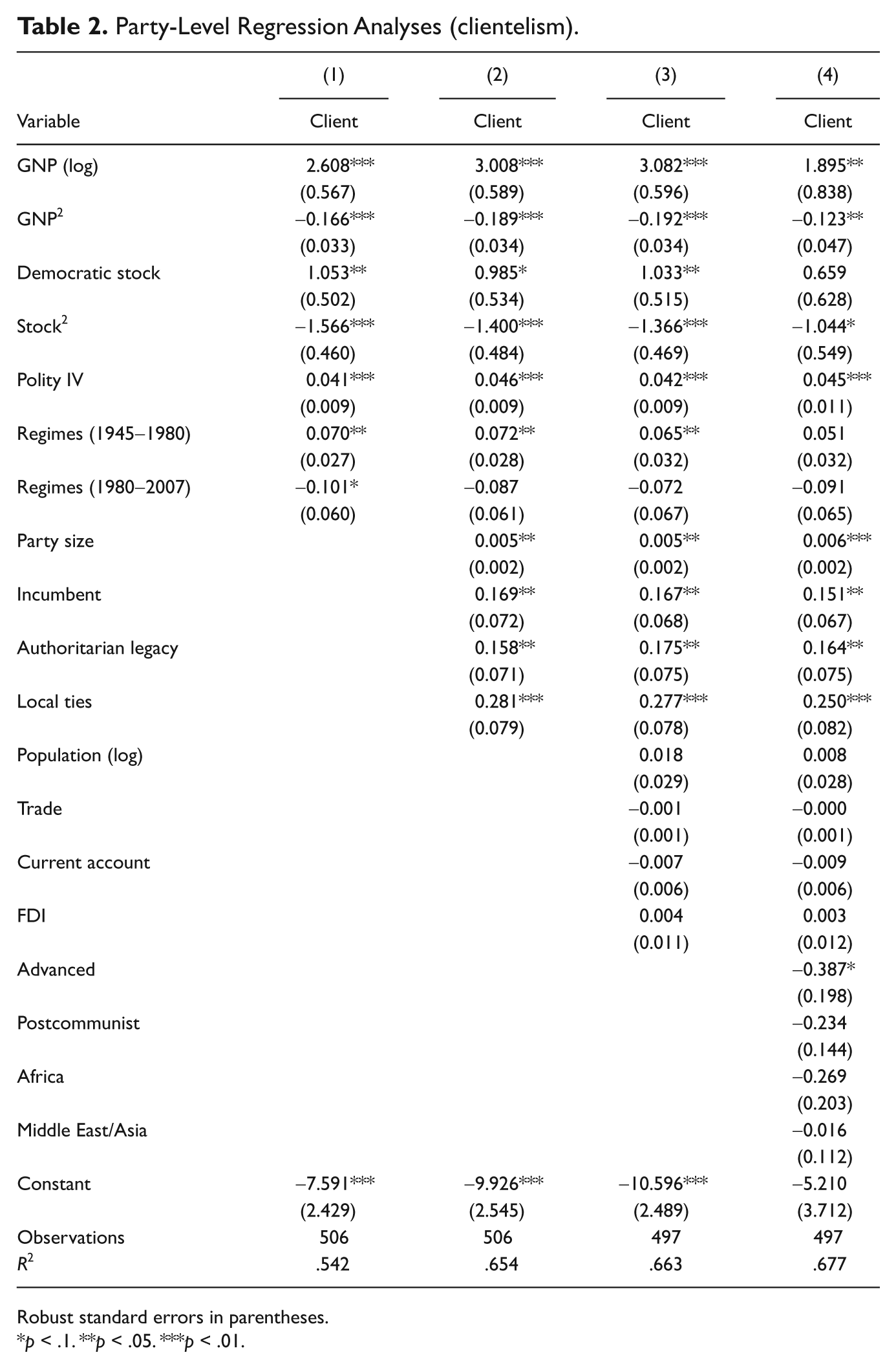
Although having a certain suggestive value, these country-level results necessarily mask much of the variation between parties within a single national context. Table 2 presents a series of party-level regressions with clientelism as the dependent variable. For party-level regressions, we employ the Huber–White standard error correction, clustering on countries, to account for the fact that standard errors may be systematically correlated among parties within a country.
Party-Level Regression Analyses (clientelism).
Robust standard errors in parentheses.
p < .1. **p < .05. ***p < .01.
The first thing to note is that GDP continues to have a strong curvilinear effect, reaching its crest at roughly the same income level as it did in the country-level sample (again using the first column coefficients, the crest occurs at roughly GNP per capita $2,700, about India’s level of development), and increasing in substantive size such that, by the upper end of the income continuum, a unit increase in GNP per capita once again leads to a standard deviation decrease in the clientelism index. Furthermore, at the party level a country’s democratic experience emerges as a more consistent predictor of clientelism; and the curvilinearity, which was murky in the country-level analyses, now appears more clearly. The shift in direction here occurs at the democratic stock value of .336 (roughly the level found in Portugal), which is a bit below the indicator’s mean of .447. Furthermore, it is interesting to note that, holding constant a country’s historical experience with democracy, clientelism is more prevalent in countries whose current “level” of democracy is higher.
In support of H7, a history of regime instability prior to 1980 makes clientelism more likely, though the effect weakens in a fully controlled environment. Once again the opposite is true of a more recent experience with regime change: Regime changes since 1980 have a reductive impact on parties’ clientelistic efforts, though the effect tends to fall just short of statistical significance. The party-level regressions also strongly confirm H5 above, concerning the importance of ties to local intermediaries in sustaining clientelist linkages: These ties have a statistically and substantively significant impact that persists across all model specifications. Among other measures, parties having an authoritarian legacy are more clientelistic than those without, and it is not surprising that larger parties (as measured by vote shares in the past two elections) and incumbent parties tend to engage in more clientelism than their smaller, nonincumbent counterparts.
Table 3 reports the results of a series of party-level models in which programmatism is the dependent variable. These results reaffirm a number of findings from the country-level analysis. Economic development continues to be a very strong and positive predictor of parties’ programmatic efforts (in support of H9). On the other hand there continues to be no evidence that either a country’s democratic stock or its current level of democracy affects programmatism (contradicting H1). A history of regime instability now has a robust and negative impact on programmatism, consistent with H3, but experience with recent regime changes has little to no impact. Among the party-level variables, only a party’s size matters (larger parties are more programmatic), and of particular interest, there is no relationship effect of a party’s historical and symbolic heritage, as captured by the indicator described above, on programmatism. To the extent that this indicator does indeed proxy for a party’s age and establishment, this could be interpreted as evidence against H2. We remain cautious, however, and suggest withholding conclusions until better measures of party age and historical legacy can be constructed. Finally, note that once again a country’s population is a significant positive predictor of clientelism, whereas FDI (trade) as a percentage of GNP has a negative (positive) predicted impact on programmatism. The discussion below returns to these findings on the role of incorporation into the international economy.
Party-Level Regression Analyses (programmatism).

Robust standard errors in parentheses.
p < .1. **p < .05. ***p < .01.
We hypothesized that strengthening ties to local networks would be responsible for generating an increase in the effectiveness of clientelist strategies moving from new to middle-aged democracies. To test this mechanism, Table 2 presents a series of analyses that restrict the sample of cases to those falling below the 75th percentile on democratic experience. We exclude regional dummies here, as their inclusion has little effect on the substantive size and statistical significance of coefficients.
In the first three columns, the dependent variable is once again our clientelism index. Development continues to exert a strong curvilinear effect, although the substantive size is reduced as compared to party-level analyses in Table 1 because of the exclusion of advanced democracies (which also tend to be highly developed). On the other hand, in this sample neither a simple linear nor a quadratic specification of the relationship between democratic stock and clientelism yields significant results (the simple linear version is included in the table). Confirming implications from analyses above, both the current “level” of democracy (as measured by recent Polity scores) and a history or regime instability have a statistically significant positive impact on the clientelism, even with a restricted sample.
The effects captured by key party-level variables (party size, incumbency, authoritarian legacy, local network ties) are all essentially reproduced from Table 2 to Table 4, in terms of both substantive size and statistical significance, which in itself is an interesting fact given the exclusion of some 120 cases. Indeed, the substantive effect of local organizational ties on our clientelism index increases markedly in this restricted sample, suggesting that, among younger democracies, local organizational networks are seminally important for distinguishing between clientelistic and nonclientelistic parties. Despite the fact that the effect of democratic stock on clientelism disappears in the restricted sample, H6 above suggests that democratic experience might “work through” organizational density in affecting clientelism among parties in young democracies. To investigate this possibility, columns 4–6 in Table 4 place the strength of local times themselves as the dependent variable, to determine whether or not, consistent with H6, democratic experience has an effect on the organizational forms that make clientelism possible. In these final three columns we exclude the variables for party size and incumbency, as these variables are endogenously related to the dependent variable in question: Nearly by definition, the stronger contacts with local notables are, the more likely a party will register electoral success. As well, we drop the curvilinear specification on GDP since we have no priors (this has no effect on substantive results).
Party-Level Regression Analyses (new democracies).

Robust standard errors in parentheses.
p < .1. **p < .05. ***p < .01.
In column 4, we find little evidence in favor of H3, that is, democratic experience appears to do little for the strength of local ties. However, remember that this effect may be muted by the fact that a subset of parties disposes of organizational endowments left over from antecedent authoritarian regimes, thus confounding the role of iterated elections. To control for this confounding factor, column 5 introduces the dummy variable for authoritarian legacy parties on the right-hand side. In conformity with expectations, not only does this measure have a strong independent effect on local network ties; its inclusion also renders democratic experience a statistically and substantively significant predictor local ties. In words, parties endowed with the organizational capacity to engage in clientelist targeting tend be either (a) parties with roots in antecedent authoritarian regimes or (b) parties that have built their organizational reach over successive democratic elections. 18 The latter provides evidence for H6, suggesting that the key mechanism through which democratic experience exerts its positive impact on clientelistic targeting in less developed democracies is the increasing organizational strength that comes with iterated elections.
Conclusion
Our results confirm that the political uncertainty characteristic of younger and less economically developed democracies has an important impact on political parties’ optimal mix of clientelistic and programmatic linkage strategies. However, the particular relationships we uncover among democratic experience, economic development, and linkage strategies are of a distinct form and more complex than those posited in past research. First, we demonstrate that both per capita income and accumulated democratic experience exhibit curvilinear relationships to the prevalence of clientelism as a means of democratic accountability. In the world’s newest and least developed democracies, clientelism exists; but the overall prevalence, effectiveness, and variety of clientelistic politics increase moving from low-income to middle-income states, and from brand-new to middle-aged democracies. In addition to the aggregate relationship, we also uncovered strong evidence in support of our argument as to the mechanism generating this curvilinearity with respect to democratic experience, namely, the increasing strength of parties’ organizational networks that comes with iteration of electoral contests.
With regard to the determinants of effective programmatic linkage, the results are again distinct from those of past research. Most notably, we find no evidence that neither accumulated democratic experience nor a country’s current level of democratic quality has any identifiable statistical effect on programmatism. Rather, political-economic variables seem to be paramount. Economic development has a strong effect on programmatic accountability in all of the distinct analyses conducted above. In addition, distinct measures of integration into the international economy have some impact on programmatism; in particular, the population size has a consistent positive effect. Given the well-known fact that smaller countries tend to be more dependent than larger countries on international markets, this result can be interpreted as providing further suggestive evidence that economic uncertainty has an undermining effect on programmatic politics. However, further research dedicated to creating more precise measures of international dependence (trade concentration, commodity concentration, etc.) will be necessary to confirm these preliminary results.
Additional measures of political uncertainty per se also provide suggestive results begging of future research. A history of regime instability, as measured by the number of regime transitions that occurred between 1945 and 1980, has a strong and robust positive (negative) effect on the prevalence of clientelism (programmatism). On the other hand, recent experience with regime transitions seems to have a much smaller impact on the relative use of the two linkage strategies. The measure we use is of course preliminary, and should be complemented in future research with more sophisticated indicators capturing attempted coups, instances of political violence, attempted secessions, and so on. However, the finding that long-term instability coexists with clientelistic tendencies is consistent with emerging research on cyclical instability in regimes with heavily clientelistic tendencies (Kselman, in press). It is also interesting to note that, holding accumulate democratic experience constant, a country’s current level of democracy, as measured by recent Polity scores, is associated with higher and not lower levels of clientelistic targeting. Although this result also requires further probing in future research, when combined with the finding that clientelism increases moving from new to middle-aged democracies, it lends further credence to the idea that, rather than emerging in purely “fluid” and perverse environments, under certain circumstances clientelism is a genuine democratic accountability relation for want of better alternatives, not just a strategy of domination that reaffirms the asymmetry of power between those with assets and those without.
Footnotes
Appendix
Variable Definitions and Sources
| Variable | Definition | Source |
|---|---|---|
| Clientelism index | Party average on five clientelism indices | Democratic Accountability Expert Survey |
| Programmatism index | Combined measure of party’s programmatic coherence, salience, and differentiation (described in detail in the text) | Democratic Accountability Expert Survey |
| Local ties | Party average from survey item on ties to district-level social networks | Democratic Accountability Expert Survey |
| Party history | Party average from survey item on the strength of party identification | Democratic Accountability Expert Survey |
| Authoritarian legacy | Dummy variable coded 1 for parties with organizational roots in antecedent authoritarian regimes (see the text and supplemental appendix) | Author coded: see the supplemental appendix |
| Party size | Average of party vote shares in the two most recent elections | Adam Carr’s Election Archive, the Inter-Parliamentary Union’s Parline Database, and in some cases individual national election websites |
| Incumbent | Percentage of executive ministries party help in previous government | Adam Carr’s Election Archive, the Inter-Parliamentary Union’s Parline Database, and in some cases individual national election websites |
| Democratic stock | Weighted sum of a country’s polity scores over the past 100 years, weighting with a discount factor over past Polity scores | Gerring et al. (2005) |
| Polity IV | Average of Polity IV scores over the 5 years prior to Democratic Accountability Expert Survey (2003–2007) | Polity IV |
| Regimes (1945–1980) | Count of total number of regime changes (both to and from democracy) a country experienced 1945–1980 | Przeworski et al. (2000) |
| Regimes (1980–1987) | Count of total number of regime changes (both to and from democracy) a country experienced 1980–2007 | Przeworski et al. (2000), updated where necessary by the authors for coups that occurred between 2002 and 2007 (PACL data go up to 2002) |
| GNP per capita | 5-year average of natural logarithm of GNP-per capita, adjusted for purchasing power parity (PPP) | World Bank Development Indicators |
| Population size | Natural logarithm of a country’s population | World Bank Development Indicators |
| Trade | 5-year average of the total value of (exports + imports) as a percentage of GNP (PPP adjusted) | World Bank Development Indicators |
| Current account | 5-year average of the current account balance as a percentage of GNP (PPP adjusted) | World Bank Development Indicators |
| FDI | 5-year average of total foreign direct investment as a percentage of GNP (PPP adjusted) | World Bank Development Indicators |
| Advanced | Dummy variable coded 1 for Western Europe, the United States, Canada, Australia, New Zealand, and Japan | Author coded |
| Postcommunist | Dummy variable coded 1 for all postcommunist countries in Eastern Europe, and also for Georgia | Author coded |
| Africa | Dummy variable coded 1 for all Saharan or sub-Saharan African countries (not including Egypt and Morocco) | Author coded |
| Middle East/Asia | Dummy variable coded 1 for Middle Eastern and East Asian Countries (including Egypt and Morocco) | Author coded |

Acknowledgements
We would like to thank Josh Tucker, Neil Beck, Noam Lupu, Rachel Riedl, and participants in the 2011 Princeton University Workshop on Political Parties in New Democracies for valuable comments on past drafts.
Declaration of Conflicting Interests
The author(s) declared no potential conflicts of interest with respect to the research, authorship, and/or publication of this article.
Funding
The author(s) disclosed receipt of the following financial support for the research, authorship, and/or publication of this article: This paper is based on a dataset collected under the auspices of the project―Political Accountability in Democratic Party Competition and Economic Governance, || implemented by a political science research group at Duke University (Principal Investigator: Herbert Kitschelt). Funding for the data collection was provided by the World Bank, Duke University, and the Chilean Science Foundation (research grant directed by Juan Pablo Luna and David Altman, Catholic University of Chile). Data analysis and conclusions of this paper are the sole responsibility of its author(s).