




Abstract
Denmark and Norway have experienced significant political changes during the past three decades, changes that affect the constraints and opportunities organized interests are facing. Corporatist representation in the policy-making process has declined, and changes in executive-legislative relations have increased the power of parliaments. Organized interests are expected to adapt to these changing circumstances to maintain their political influence. This article shows how Danish and Norwegian interest groups have coped with the decline of corporatism and the revival of parliaments. Representation in corporatist policy-making committees and lobbying toward civil servants in government ministries have been supplemented and in some cases substituted by political lobbyism directed toward elected representatives in the parliament and the government. The analysis is based on panel data from several surveys carried out among nationwide interest groups in Denmark and Norway.
The Scandinavian countries have a long-lasting tradition for integrating trade unions, business associations, and other interest groups in policy making. In his analysis of “corporate pluralism” in Norway in the 1960s, Rokkan (1966, 1975) concluded that “votes count but resources decide,” thus indicating that the resources of various pressure groups were more important than the allocation of seats in parliamentary elections. Schmitter (1979, p. 21) mentioned Norway, Sweden, and Denmark among the five best examples of “societal corporatism.” Rokkan’s and Schmitter’s analyses have been followed by a number of comparative studies showing that the Scandinavian countries are among the most corporatist in the world (e.g., Armingeon, 2002; Lijphart, 1999; Lijphart & Crepaz, 1991; Siaroff, 1999). It is not surprising that in a context of corporatist policy making, interest groups perceived contacts with civil servants who acted on behalf of government in the corporatist bodies to be politically more important than contacts to parliament (Buksti, 1984; P. Christiansen & Nørgaard, 2003; Kvavik, 1976; Rokkan, 1966).
According to Rokkan (1966), the Norwegian parliament, Stortinget, was weak and major decisions were made at the negotiating table where interest groups met with civil servants acting on behalf of strong governments. He was supported by Kvavik (1976, p. 118), who interviewed leaders of Norwegian interest groups in the 1960s and found that “[p]arliamentary institutions receive an exceedingly weak evaluation.” Hallenstvedt (1974, p. 205) maintained that “[a]pproaching Parliament is an indication of powerlessness.” A few years later, when summarizing the findings of a major study of power relations in Norway, Hernes (1983, p. 300, 303) drew attention to “the weakening of the parliament” and the “widespread agreement among power holders” that power had moved “away from the Storting and towards the public administration and interest organizations.” In the 1960s and 1970s most Danish observers saw the role and position of the Danish parliament, Folketinget, as quite similar to those of its Norwegian counterpart. Some argued that the political system could increasingly be seen as neocorporatist (Dahlerup, Jarlov, Johansen, & Kristensen, 1975). Others noted that despite “numerous reforms and adjustments,” Folketinget experienced a “parliamentary capacity problem” because of increasing decision making complexity (Damgaard, 1982, p. 43). Damgaard (1992a), summarizing most of his contemporaries’ conclusions, found that parliaments were “widely assumed to have ‘declined’ in modern times” (p. 11).
Since then, the “decline of parliaments” thesis has been challenged. As early as in 1983, Olsen found that the Norwegian parliament had become more important. An “ebb-and-flow” perspective on the role of parliament was more adequate than a “decline of parliaments” perspective (Olsen, 1983, pp. 42, 72). A comparative study of the Nordic countries showed that in the 1980s the parliaments of Denmark, Norway, and Sweden “assumed increased importance and influence in relation to the governments” (Damgaard, 1992b, p. 203), and Damgaard (1994) later referred to the three legislatures as “The Strong Parliaments of Scandinavia.” Later studies indicate that the Norwegian Storting and the Danish Folketing have maintained their strong positions in recent decades (Damgaard, 2003; Rommetvedt, 2003; Togeby, Andersen, Christiansen, Jørgensen, & Vallgårda, 2003).
In roughly the same period, scholars have observed changes in Scandinavian and European interest group systems. Lewin (1994) and Crepaz (1994) reported that corporatism was declining in highly corporatist countries such as Sweden and Austria. Lijphart’s argument that “to the extent that there has been a decline in some countries, it has been merely a matter of degree” seems to be substantiated by the scores of corporatism calculated by Siaroff (Lijphart, 1999, p. 173; Siaroff, 1999, p. 198). However, other studies indicate that the decline of Scandinavian corporatism is more significant than Lijphart’s and Siaroff’s indicators suggest, in particular when it comes to policy making rather than policy implementation and when we look beyond traditional areas of labor market corporatism (Blom-Hansen, 2000; P. Christiansen & Rommetvedt, 1999; P. Christiansen et al., 2010; Hermansson, Lund, Svensson, & Öberg, 1999; Rommetvedt, 2005).
Assuming that interest groups will try to maintain their political influence, we expect organized interests to adapt to these changes in their political environment. In short, the question we address is, how do Danish and Norwegian interest groups cope with the decline of corporatism and the revival of parliaments? First, we inspect how and when corporatism declined and parliaments revived in Denmark and Norway. On the basis of the changes in the strategic terrain we then discuss various propositions as to how influence-seeking interest groups adapt their pattern of contacts with political authorities to influence the policy-making process. Finally, we examine our propositions on the basis of a survey panel of nationwide Danish and Norwegian interest groups that have answered similar questions in the 1980s, 1990s, and 2000s.
Interest Group Adaptation: Push and Pull Factors
We analyze changes in the relationship between organized interests and public authorities from the perspective of the interest groups and focus on formal interest groups that pursue goals that are affected by political decisions. We assume that interest groups act as intended rational and unitary “corporate” actors that pursue interests in the political arena (see Scharpf, 1997, pp. 51-68) and that organized interests therefore will take opportunities and constraints in the institutional environment into account when they pursue their goals (see Ostrom, 1991). Interest groups may operate as “venue shoppers” and move between access points depending on the political opportunity structure (Baumgartner & Jones, 1993; Beyers & Kerremans, in press; Eising, 2007; Princen & Kerremans, 2008; also see Kriesi, Tresch, & Jochum, 2007).
In general, two factors, push and pull, are important when interest groups decide how to adapt to changes in the opportunity structure. Push factors are environmental changes that drive actors away from a strategy, for example, by blocking previous channels of influence. Pull factors are changes that draw actors in new directions because new promising venues for political influence are opened. In Denmark and Norway, the push comes from the narrowing of the corporatist channel of participation, which incites interest groups to pursue other access channels. The pull factor relates to changes in executive–legislative relations. In the period we analyze (1980–2005), Danish and Norwegian parliaments strengthened their position vis-à-vis the executives. The push factor suggests that interest groups will compensate for their loss of access to formal corporatist bodies by increasing their informal lobbying activities vis-à-vis public authorities. The pull factor suggests that interest groups should redirect their attention toward political actors rather than the civil servants in the ministries.
The Push Factor: Corporatism in Decline
Corporatism is a highly contested concept, and its use in empirical analyses varies between scholarly traditions. A distinction may be made between the political economy school, which sees corporatism as a variety of capitalism, and the interest group school, which sees corporatism as a variety of liberal democracy (P. Christiansen et al., 2010). We build on the latter and define corporatism as the institutionalized and privileged integration of organized interests in the preparation and/or implementation of public policies. Corporatism is frequently contrasted with pluralism (e.g., Heinz, Laumann, Nelson, & Salisbury, 1993; Schmitter, 1979). However, we find that the term pluralism is too broad and prefer the term lobbyism in this context. Corporatism may be seen as one end of a continuum and lobbyism as the other. Consequently, we define lobbyism as noninstitutionalized and nonprivileged participation in the preparation and/or implementation of public policies. However, in this article we leave out implementation and focus on interest group strategies of influence in the preparation of public policy.
The political logic of integrating privileged interest groups into the policy-making machine of central government is to exchange influence for information and interest group support for policy (Öberg et al., 2011; Molina & Rhodes, 2002). In Scandinavia, the foremost institutional expression of corporatism is probably government-appointed public committees, commissions, boards, and councils—hereafter committees—in which organized interests are represented (see Hallenstvedt, 1974; Johansen & Kristensen, 1982). Over the years, numerous bills have been prepared or even written by corporatist committees. P. Christiansen and Nørgaard (2003, pp. 106-108) find that at the height of corporatism in the 1970s, committees with representatives from interest groups were involved in the preparation of more than 40% of all government bills introduced in the Danish parliament. Members of policy preparing committees represent affected interest groups, professional expertise, the civil service, and in a few cases parliamentary parties (P. Christiansen & Nørgaard, 2009; Rommetvedt, 2005). Government ministers are almost never members of policy preparing committees, so to be able to negotiate and give influence to interest groups in exchange for support civil servants need a mandate from the government and to fulfill their end of a bargain. By implication, the government needs sufficient capacity to delegate these powers to civil servants acting on its behalf.
We find that the development of the committee system is a reliable indicator of the strength of corporatism. 1 The more willing the government is to partially delegate policy preparation to bodies in which interest groups are represented, the stronger corporatism, and vice versa. With Danish data, this indicator has been shown to correlate nicely with other measures of corporatism (P. Christiansen & Nørgaard, 2003). 2 We consider policy preparation committees to be corporatist if at least one member represents an organized interest group. 3 The development in the number of corporatist policy preparation committees in Denmark and Norway since the early 1980s is shown in Figure 1 (based on P. Christiansen et al., 2010, Table 1).

Corporatist policy preparation committees in Denmark and Norway (public committees with at least one interest group representative).
Danish and Norwegian Interest Groups With at Least Monthly or Yearly Contacts With Public Authorities.
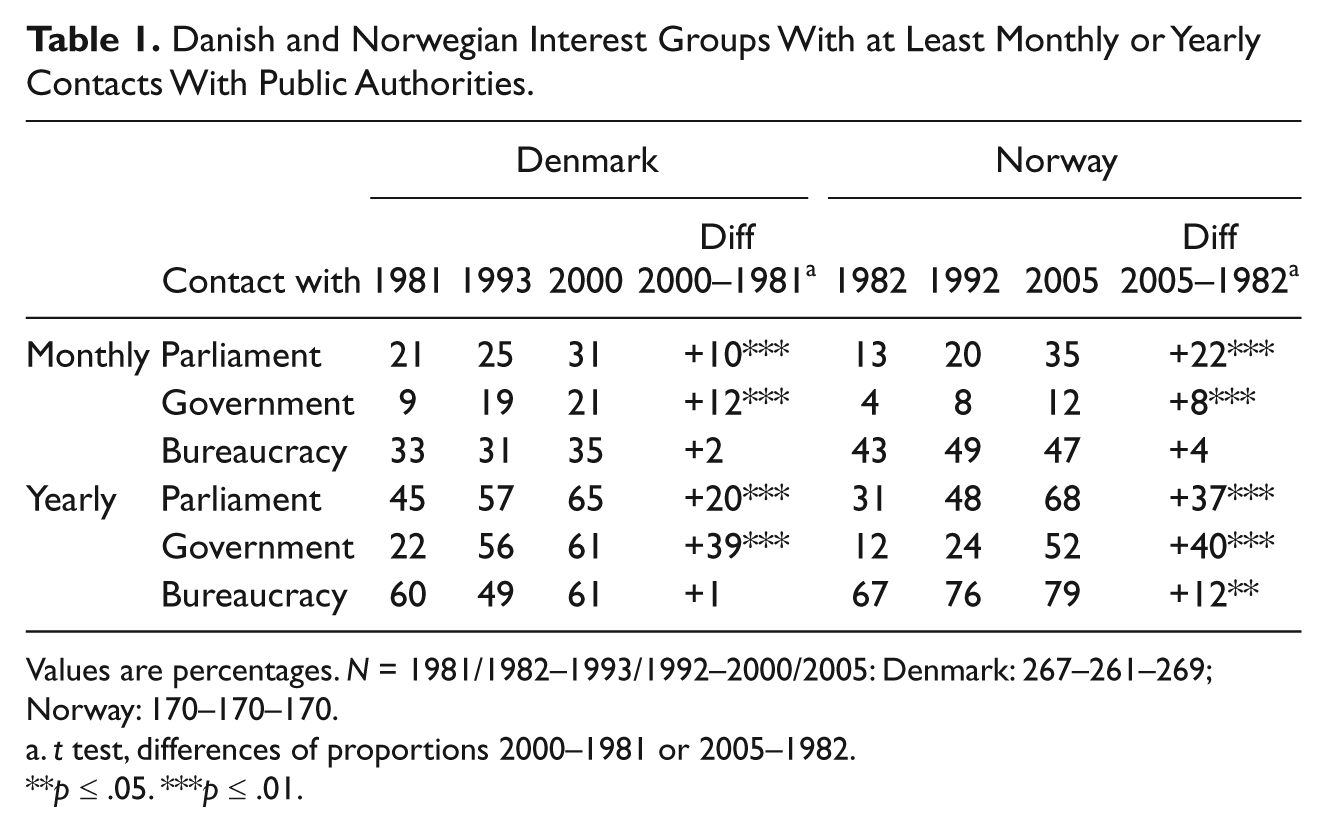
Values are percentages. N = 1981/1982–1993/1992–2000/2005: Denmark: 267–261–269; Norway: 170–170–170.
t test, differences of proportions 2000–1981 or 2005–1982.
p ≤ .05. ***p ≤ .01.
The number of corporatist policy preparation committees has declined substantially in both countries. In Denmark the number of policy preparation committees peaked around 1980 (P. Christiansen & Nørgaard, 2003, pp. 99-101), dropped from 188 in 1980 to 59 in 1990, and after a relatively stable period declined to 39 in 2005. A parallel development is found in Norway. The Norwegian data do not allow us to distinguish between policy preparation committees and policy implementation committees before 1983. However, the total number of corporatist committees in Norway seems to have peaked in the late 1970s or early 1980s (Rommetvedt, 2005). In 1983, Norway had 68 policy preparation committees with at least one member from an organized interest group. That number dropped to 36 in 1986 and, after a fairly stable period, to 12 in 2005.
Calculating on the basis of P. Christiansen et al. (2010, p. 31), we find an increase in the proportion of policy preparing committees with interest group representation from 70% in 1980 to 87% in 2005 in Denmark and almost constant in Norway (an increase from 59% to 60% over the same period). Some would argue that in the Danish case this demonstrates an increase in the level of corporatist representation and not a decrease. However, each committee represents an opportunity to participate in policy preparation in which interest groups may or may not be represented. In this case we deal with an increased percentage of a substantially reduced number of public committees or policy preparation opportunities. 4 Consequently we find a sharp decrease in the absolute number of committees with interest group representation from 188 to 39 in Denmark and from 68 to 12 in Norway during the years 1980–2005. This represents a fairly dramatic fall in corporatist policy preparation. The government, which decides whether or not to establish a committee for preparing a political decision, has become less inclined to establish such committees. The opportunities for Danish and Norwegian interest groups to influence policy preparation through corporatist committees have consequently become substantially fewer.
Over the past few decades the apparatus for corporatist policy preparation has thus been dramatically downsized in both Denmark and Norway. From the beginning of the 1980s to 2005 the number of policy preparation committees with representatives from organized interest groups decreased by approximately 80%. Corporatism may be understood as a political exchange mechanism where interest group support of the government is exchanged for public policies that are more favorable to the group than they would otherwise be. The downscaling of the corporatist committee system may be related to changing preconditions for exchange. On one hand, interest groups seem less capable to deliver support for the government because of weakened control over members, and on the other hand governments seem less capable to guarantee the outcome of the policy-making process because of stronger and more influential oppositions in parliament (see Öberg et al., 2011).
This means two things. First, interest group influence on policy preparation through formalized, corporatist structures has been reduced. To a larger extent than three decades ago policy preparation is now directed by the government ministers. Second, the weakening of corporatist structures does not preclude interest groups from still significantly influencing public policy formulation. However, being “pushed out” of or denied access to the core corporatist channel, they have to find new ways to influence public policy making.
The Pull Factor: Revival of Parliaments
As mentioned, Scandinavian parliaments were for a long time believed to be “declining” and losing power to other political institutions. Most scholars “thought that parliaments had become rather weak institutions compared with powerful governments, bureaucracies, interest organizations, and mass media” (Damgaard, 1992a, p. 11), and in fact the Scandinavian parliaments did seem to be declining in the 1960s and early 1970s.
However, from the late 1970s and in particular during the 1980s, the level of activity of the Danish, Norwegian, and Swedish parliaments increased significantly, indicating that they had become more influential vis-à-vis government (Damgaard, 1992b, p. 203). Damgaard concluded,
Weaker governments, more active and influential parliaments and more party competition suggest the possibility that standard accounts of Nordic corporativism are no longer adequate. A certain “reparlamentarization” or “revitalization of parliaments” seems to have taken place. (Damgaard, 1992b, p. 204).
Damgaard and his coauthors pointed to a number of factors that contributed to the revitalization of parliaments, such as the representation of new and more extreme parties in parliament, more volatile voters leading to stronger party competition, and increased economic, technical, and staff resources in the parliaments. 5
A variety of indicators show that the importance of the Danish and Norwegian parliaments has increased since the late 1970s, also beyond the period studied by Damgaard and colleagues. At the end of the period we study here (2005) the parliaments held strong positions in Danish and Norwegian politics (P. Christiansen & Togeby, 2006; Damgaard, 2003; Rommetvedt, 2003, 2005; Togeby et al., 2003).
In the first period after World War II, Scandinavian politics was dominated by the Social Democrats. However, after “earthquake” elections in 1973 in both Denmark and Norway, the number of parties in parliament increased significantly. Minority governments and coalition governments became more frequent, and since 1973 the two countries have enjoyed only a few periods of majority government. As a consequence, government parties were forced to negotiate and compromise with one or more opposition parties to establish a majority in parliament, which meant more influence for opposition parties. An expert survey of country experts in 1989 showed that among 18 West European countries, the opposition parties in Norway and Denmark were surpassed only by the Italian opposition in terms of influence on government policy (Gallagher, Laver, & Mair, 1995, p. 308; also see Laver & Hunt, 1992).
In Denmark, shifting minority governments headed by the Social Democrats between 1975 and 1982 experienced few legislative defeats, but the situation changed dramatically from 1982 to 1988. The so-called “four-leaf clover” center-right government (Conservatives, Liberals, Christian People’s Party, and Center Democrats) lost 108 votes, or every 12th final vote, but “the government chose to stay in office even if it had to implement policies with which it strongly disagreed.” It seemed as if the government “had resigned without abdicating,” and the term alternative majority was used to characterize the phenomenon (Damgaard, 1992a, p. 32, 34). The dramatic increase in legislative defeats not only corresponded to a similar increase in the strength of parliament and a weakening of government but also was a matter of a shift in “style” in the sense that the cabinet decided to accept these defeats. According to traditional parliamentarian norms, the government should have resigned, but it chose not to do so.
In 1993, a center-left majority coalition under Social Democratic leadership assumed power (Social Democrats, Center Democrats, Social Liberals, and Christian People’s Party). As the first majority government in decades, it avoided legislative defeats. The government lost its majority the following year, but the proportion of government defeats remained small (Damgaard & Jensen, 2006, pp. 427-429). Thus, government and opposition seem to have adapted to a more or less permanent state of minority governments, partly through increased use of legislative settlements, called forlig, in which the government makes compromises with a parliamentarian majority for a specific issue, for example, reform of the primary school system or reform of an early retirement scheme. This type of ad hoc policy coalitions, often with changing majorities, has become more frequent since the late 1970s. During the 1980s settlements covered around one fifth of all enacted bills, and during the 1990s this number was one out of four, except under the majority government of 1993–1994, when only 6% of the bills were covered by settlements (F. Christiansen & Damgaard, 2008, p. 60). In general, the increasing frequency of legislative settlements is an indication of a more influential opposition in parliament.
From the turbulent 1970s through the calmer 1990s, shifting Danish governments and opposition parties established norms that improved their capacity to balance between political competition, which is necessary for democracy, and cooperation, which is necessary to deal adequately with political problems under minority rule (F. Christiansen, 2008; also see Green-Pedersen, 2001). Cooperation is manifested through the many settlements and the high level of supermajorities in Danish lawmaking. Conflict is manifested through different indicators; the number of parliamentary questions, interpellations, and resolution proposals increased steadily from the 1970s through the 1990s (Damgaard & Jensen, 2006, p. 428). The government is still the strongest player in the preparation of bills, but opposition parties have come to play a bigger role in the legislative process and in day-to-day scrutiny of the government.
In Norway there are traces of a parallel although slightly different development. Since the 1970s the number of private members’ bills, parliamentary questioning of government ministers, and the number of dissenting remarks in the recommendations from the standing committees have increased considerably (Rommetvedt, 2005, p. 749). As in Denmark, government defeat in parliamentary voting occurred more often after 1980, and it increased even more in the 1990s (Rommetvedt, 2011, pp. 94-95). In 1979–1981 the Labour governments lost less than one vote per active month in parliament (votes on budget not included). 6 The following single-party Conservative government lost 2.2 votes per month in 1981–1983. In 1983 a majority coalition government was formed by the Conservatives, the Christian People’s Party, and the Center Party, and government defeat dropped to 0.9 votes per month in 1983–1986. The two Social Democratic minority governments from 1986–1989 and 1990–1996 suffered 5.3 defeats per month, respectively. When Gro Harlem Brundtland resigned as prime minister and was followed by party fellow Thorbjørn Jagland in 1996–1997, the government lost an all-time high of 19.6 votes per active month in parliament. The subsequent three-party coalition government (Christian People’s Party, Center Party, and Liberals, 1997–2000) suffered defeats in 5.7 votes per month, whereas the following single-party Labour government (2000–2001) lost 7.7 votes. In 2001–2005, Norway was governed by a coalition government formed by the Christian Peoples’ Party, the Conservatives, and the Liberals. This government lost 6.5 votes per active month in parliament. 7
The number of parliamentary amendments to government bills has also increased since the 1990s. The percentage of bills proposed by the government that were amended by the parliament increased from 13% in 1989–1990 to nearly 30% in 1990–1995. After a record high of 46% during the short-lived Jagland government in 1996–1997, it dropped to nearly 30% in 1997–2005 (Nordby, 2010, p. 98). 8
More government defeats in parliamentary voting, more negotiated policy settlements with opposition parties (particularly in Denmark), more amendments to government bills (particularly in Norway), and significant increases in other measures of parliamentary activity, for example, the number of private bills, dissenting remarks, and alternative recommendations from standing committees, all clearly show that the Danish and Norwegian parliaments have become more active, less predictable, and more influential since the late 1970s. In a recent article on the relationship between government and opposition in Scandinavian parliaments, F. Christiansen and Damgaard (2008) even talk about increasing integration of some opposition parties in government. We expect the revival of parliaments in Norway and Denmark to have made them more interesting for organized interest groups that seek to influence public policy. 9
The Combined Effect of Push and Pull
The decline in institutionalized corporatist representation in policy making in Denmark and Norway indicates that interest groups have to find alternative ways to exert influence on public policies. Our first proposition is that because of the decreasing number of policy preparing committees with interest group members, interest groups will increase their lobbying efforts vis-à-vis public authorities (P1). Traditionally the term lobbying refers to informal meetings in the lobby of the parliament. However, lobbying may be directed not only toward MPs and members of the government but also toward civil servants in the government bureaucracy. A distinction may therefore be made among parliamentary lobbyism, governmental lobbyism, and bureaucratic lobbyism. Interest groups may direct their lobbying effort toward any of these three types of actors.
Corporatist committees are forums for contacts between the government’s civil servants and interest group representatives. From the perspective of interest groups, corporatist policy preparation includes two types of advantages. Interest groups may receive important information about the government’s policy intentions early in the decision making process, and this informational advantage can be used as a strategic resource later on in the process. Interest groups may also be able to get policy concessions when they negotiate with civil servants who act on a mandate from the government, but only if the government has the capacity to make credible commitments through its civil servants (see P. Christiansen & Nørgaard, 2006).
On one hand the information imperative suggests that interest groups will compensate for the decline in corporatism by increasing their lobbying of civil servants in the government bureaucracy (P2). The weakening of government vis-à-vis parliament, on the other hand, suggests that civil servants can no longer make credible commitments on behalf of the government and therefore cannot offer policy concessions to interest groups in exchange for political support. That, in fact, seems to be part of the reason why corporatism has declined in the first place (Öberg et al., 2011). The policy advantage from interacting with civil servants has declined, so even if interest groups have contacts with civil servants (in corporatist committees or through lobbying) they will have to safeguard their policy concessions and lobby political actors as well. Close networks with civil servants are not sufficient. Interest groups will focus their attention more on parliamentary and governmental lobbyism than on bureaucratic lobbyism. Hence, lobbying efforts vis-à-vis civil servants will drop when corporatism declines, either in absolute terms or, at least, relative to political lobbyism, that is, lobbyism directed at government and/or parliament (P3). P2 and P3 are not necessarily competing, as bureaucratic lobbyism could rise in absolute terms and still decline in relative terms compared to political lobbyism. However, the propositions do rest on different strategic calculations. Consequently, the extent to which each receives empirical support should reflect the prioritization of these strategies and indicate which causal interpretation provides the best fit.
The strengthening of parliaments relative to governments suggests that in particular parliamentary lobbyism should increase. In the heyday of corporatism Hallenstvedt (1974, p. 205) may have been right that turning toward “parliament is an indication of powerlessness.” But when the outcome of parliamentary voting is uncertain, minority governments suffer repeated defeats; and as parliaments are more eager to and capable of changing government proposals, organized interests may find it rewarding to direct their attention toward MPs. Still, not only MPs have become more relevant. Normally, government has the initiative when it comes to preparing policy and introducing new legislation. Following the decline of corporatist policy preparation, this initiative has become increasingly centralized and politically supervised by government ministers. In a more politicized and less predictable political process we conjecture that interest groups will increasingly lobby both the government and members of parliament (P4) to make the process more predictable and to maximize their chances of influencing the outcome. Combining parliamentary and governmental lobbying seems to be the most promising strategy when the government and its bureaucracy can no longer make credible commitments. Targeting only one or the other may seem risky.
Although the government may have increased its importance compared to bureaucratic actors, it has nevertheless lost ground to parliament. The relative increase in the power of parliaments suggests that interest groups will pay increasing attention to parliamentary actors in particular. Consequently, we expect parliamentary lobbyism to increase more than governmental lobbyism (P5).
In the previous sections we saw that the major trends in Norway and Denmark are similar but not identical. Since the 1990s Danish minority governments have been supported by fairly stable majorities in parliament, whereas in the period we study here Norwegian governments faced an increase in legislative defeats. This may suggest that the trend toward more parliamentary lobbying will be stronger in Norway than in Denmark (P6).
Parliamentary Lobbying: Substitute or Supplement?
The next question is whether the first-best multifaceted interest group strategy is possible. Can interest groups that, on and off, sit on corporatist committees and that lobby the government also lobby parliament at the same time? According to Evers (1995), interest groups have a “polyvalent” character performing a mixture of functions, and recent studies indicate that many Danish and Norwegian interest groups apply a variety of strategies and activities to influence public policy making (Binderkrantz, 2003, 2005, 2008; P. Christiansen & Nørgaard, 2003; Thesen & Rommetvedt, 2009; Opedal, Rommetvedt, & Vrangbæk, 2012).
Two factors seem decisive: interest group resources and strategic intentions. Plausibly, economically powerful and politically relevant interest groups are more capable of pursuing several strategies simultaneously than less powerful groups (Binderkrantz, 2005; Wolfsfeld, 1984). However, the issue is not determined solely by interest groups. Governments may not be willing to give access to groups that also go to the opposition parties in parliament to make their case (P. Christiansen & Nørgaard, 2006). If interest groups opportunistically pursue short-term interests in their interaction with parliament, this will weaken the government, and the government may exclude them from corporatist committees and decline to talk with them. If, on the other hand, interest groups make credible commitments to the government, simultaneous lobbying in parliament can improve the government’s bargaining power vis-à-vis the parliament (see P. Christiansen & Nørgaard, 2003; Nørgaard & Klemmensen, 2009). Interest groups that pay attention to their long-term political and institutional interests may be an asset to a weak government exactly because they can help the government persuade a recalcitrant parliament (P. Christiansen & Nørgaard, 2006; Lehmbruch, 1984; Lindvall, 2010; Rokkan, 1966).
Whether turning to parliament is a substitute for interest groups that do not have the ear of government or a supplement cannot be settled definitively with the data at hand. However, we can examine whether “insider” interest groups that sit on corporatist committees or have close contacts with government and the government bureaucracy lobby parliament less or more than “outsiders” (Binderkrantz, 2005; Grant, 2000). This will give us an idea of the extent to which parliamentary lobbyism is predominantly an alternative for excluded interest groups or a supplement for interest groups that are already included in corporatist committees or have close contacts with the government apparatus, and we can inspect if the pattern changes over time. If privileged “insider” groups increase parliamentary lobbying activities more than “outsiders,” who are not part of the government–interest group nexus, this indicates that parliamentary lobbying is a supplement rather than a substitute for a corporatist and government-centered strategy.
Data and Measures
The analysis is based on data from a number of surveys carried out among all nationwide formally organized nonprofit organizations in Denmark and Norway. There are no official registrations of interest groups in the two countries. The lists of the populations of interest groups have been put together by the research groups that have made the surveys. Lists of interest groups were compiled from a number of different sources, for example, registers such as the Arbejdsmarkedets Håndbog (the yearly labor market handbook), telephone directories, newspapers, and, for the later surveys, the Internet. The results are believed to come fairly close to the “true” populations. Surveys to the populations of interest groups were conducted in Denmark in 1976, 1981, 1993, and 2000 (see P. Christiansen, in press; P. Christiansen & Nørgaard, 2003, pp. 233-238.) and in Norway in 1964, 1971, 1976, 1982, and 1992 (Andersen & Lauritsen, 1990; Hallenstvedt & Trollvik, 1993; Holmefjord, 1998). In 2005 a more limited electronic survey was distributed to the 738 Norwegian organizations that stated that they had contacts with public authorities in the 1992 survey (Thesen & Rommetvedt, 2009). 10
For the purpose of this article we have constructed two panels comprising 261 to 267 Danish and 170 Norwegian organizations that responded to questions about contacts with public authorities in all three surveys carried out in 1981, 11 1993, and 2000 in Denmark and in 1982, 1992, and 2005 in Norway. 12 This allows us to examine contacts with public authorities and access to corporatist committees for the two groups of organizations through more than two decades. The use of panel data solves the problem of control for changes in the composition of the population of interest groups caused by the dissolution of old groups and the establishment of new groups. The changes we can observe on the basis of panel data reflect changes in the answers given by the same organizations at three different points in time. 13
Our measures of lobbyism rely on questions about if and how often interest groups had contacts with various political and administrative authorities. For the purpose of this article we distinguish between interest group contacts with parliament and MPs, members of government, and civil servants in ministries or departments, that is, the government bureaucracy closest to the minister, as indicators of parliamentary, governmental, and bureaucratic lobbyism, respectively. In the Danish case we do not have strictly comparable data for bureaucratic contacts in 1981. We can make a reasonable estimate, but the 1981 indicator for bureaucratic lobbyism should be interpreted with some caution. 14
We cannot infer lobbyism from contact data unless interest groups initiate the contact. We do not have valid comparative data on contact initiative for all years, but in the Danish 2000 survey and in the Norwegian 2005 survey interest groups were asked—in somewhat different ways—how the contacts with various authorities were established. In both countries, interest groups overwhelmingly initiate contacts with members of government and parliament. In Denmark interest groups initiate parliamentary contacts 3 times as often as MPs, and twice as often as ministers when contacts with government are established. In Norway around 80% of the contacts with government and parliament are “most often” initiated by interest groups. Contacts with the bureaucracy are also predominantly initiated by interest groups, but in both countries civil servants quite often initiate contact with interest groups. This suggests that bureaucratic contacts are a result not only of lobbyism, but also of civil servants soliciting the inputs and opinions of interest groups. All in all, contact data seem a valid indicator of interest group lobbyism when the target is parliament and government, and a little less valid when it comes to bureaucratic lobbyism.
Even if we find a correlation between the strength of corporatism and the level of lobbyism we cannot be sure that the relation is causal. Lobbyism may be increasing for many other reasons than shrinking corporatism. It is not possible for us to solve this problem in toto. The way we deal with it is to scrutinize the structure of contacts. To the extent that the structure resembles the ways predicted by our hypotheses, our argument for a causal relation is strengthened.
Patterns of Interest Group Lobbyism
Table 1 shows the percentages of Danish and Norwegian interest groups that had at least monthly or at least yearly contacts with public authorities. With the exception of bureaucratic contacts, we find continuous and significant increases in the shares of interest groups that had contacts with the various authorities. 15 In Denmark interest groups with monthly contacts to parliamentarians increased from 21% in 1981 to 31% in 2000. Government contacts increased roughly the same, from 9% to 21%, whereas changes in monthly contacts with bureaucrats were negligible (33% to 35%). The share of interest groups with yearly contacts to parliament and in particular government increased more dramatically. By 2000, 61% of the Danish interest groups had at least yearly contacts with elected officials in government and parliament.
In Norway the share of interest groups with monthly parliamentary contacts increased from 12% in 1982 to 35% in 2005, whereas monthly contacts to government increased from 4% to 12%. Again we find only minor changes in monthly contacts with civil servants (43% to 47%). The share of Norwegian interest groups with yearly contacts to parliament and government increased even more, from 31% to 68% and from 12% to 52%, respectively. Interest group contacts with government civil servants have been rather stable in both Norway and Denmark since the early 1980s; only yearly bureaucratic contacts in Norway increased significantly.
The findings suggest that P1 is supported. Being increasingly excluded from corporatist committees, interest groups have increased their lobbying efforts vis-à-vis public authorities. Political lobbying of parliament and government was more frequent in 2000/2005 than in the early 1980s. However, with the exception of yearly contacts in Norway, we find minimal changes in bureaucratic lobbyism. Consequently, P2, stating that interest groups would increase bureaucratic lobbying because of the need for policy-relevant information early in the policy-making process, cannot be sustained. Instead, P3 seems sounder. In relative terms bureaucratic lobbying has declined compared to lobbying of political decision makers. Following our theoretical reasoning, this suggests that in relative terms interest groups have downscaled lobbying of civil servants because the government bureaucracy has lost its capacity to give policy concessions and make policy bargains on behalf of the government.
Although governments became weaker vis-à-vis parliaments in both Norway and Denmark, we argued that because the former have the policy initiative, interest groups would lobby not only parliament, but also government (P4). Hence, to minimize uncertainty and unpredictability interest groups are well advised to lobby both government and parliament. This proposition is supported on an aggregate level by Table 1, which shows a significant increase in both parliamentary and governmental lobbyism in both countries and throughout the entire period. The proposition suggesting a higher increase in parliamentary lobbyism relative to governmental lobbyism (P5) receives more mixed support. In Norway monthly contacts with parliament have increased more than monthly contacts with government. In Denmark the increase in governmental lobbyism is somewhat stronger, but this is related to the fact that parliamentary lobbyism was quite substantial already in the early 1980s. The increase in parliamentary lobbying is stronger in Norway than in Denmark, and accordingly P6 is supported.
Table 1 shows that government lobbying is the least frequent form of lobbyism for both yearly and monthly contacts in Norway and for monthly contacts in Denmark. In 2000, yearly contacts with Danish government ministers occurred with almost the same frequency as yearly contacts with parliament and the civil service. The different patterns may be the result of weaker governments in Norway than in Denmark.
Strictly speaking, P4 cannot be settled only by inspecting aggregate data on interest groups’ contacts with public authorities. We need to take a look at some of the possible combinations of contacts. If P4 is sound, interest groups that lobby government should increasingly safeguard their lobbying efforts by also targeting MPs. In addition, more interest groups may find it worthwhile to lobby MPs but not the bureaucracy, which increasingly cannot make deals on behalf of government.
The results shown in Table 2 support P4. The proportion of interest groups with at least monthly contacts with both parliament and government grew significantly in both countries: in Denmark from 9% in 1981 to 17% in 1993 and 2000; in Norway from 2% in 1982 to 11% in 2005. However, in Norway the proportion of interest groups with monthly contacts with parliament, but not with the government, grew even more, from 11% to 24%. In Denmark this proportion was fairly stable (12%, 8%, and 14%, respectively) and the change from 1981 to 2000 was not significant. Again, this may reflect somewhat weaker governments in Norway than in Denmark.
Selected Combinations of at Least Monthly Contacts With Public Authorities in Denmark and Norway.
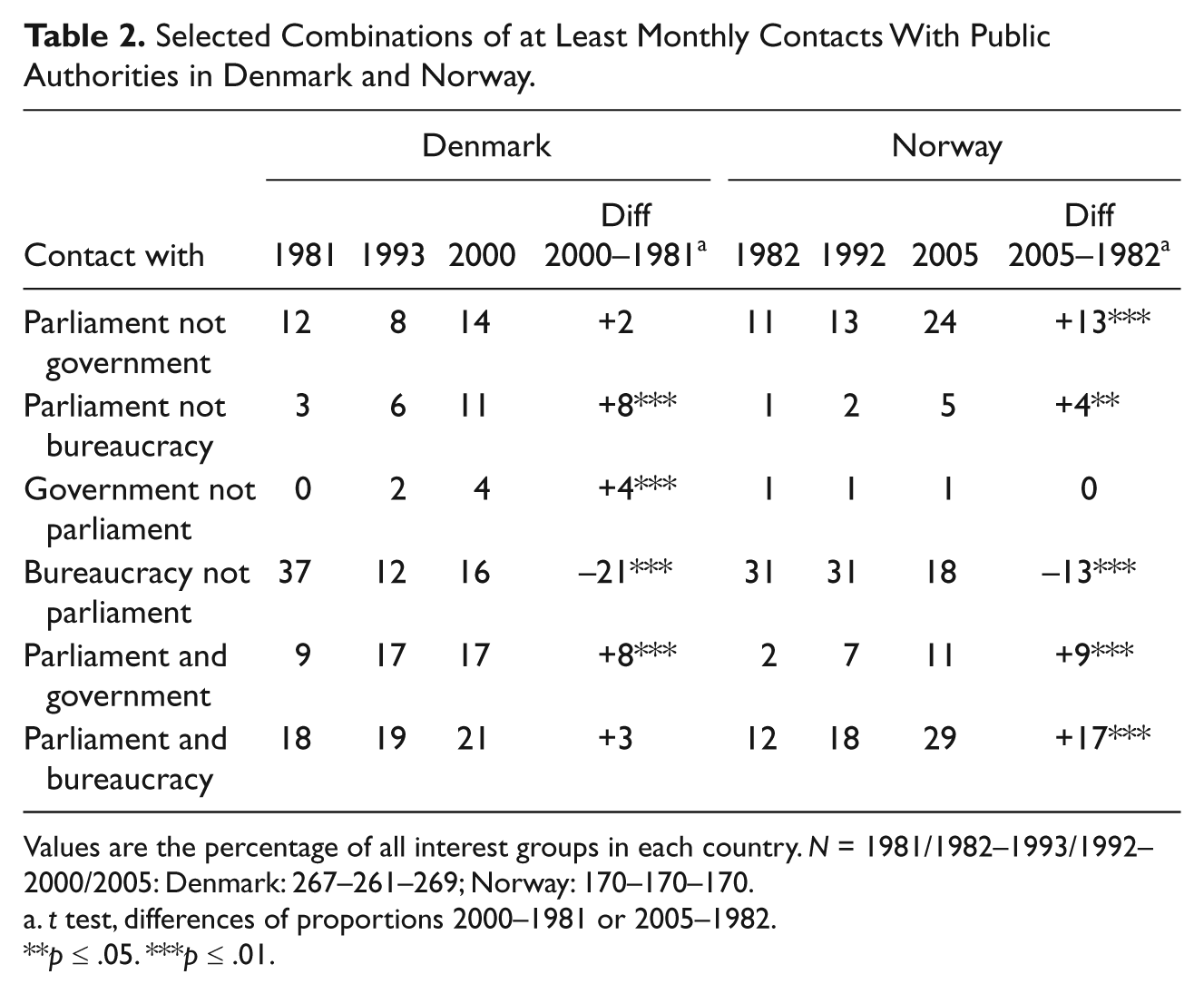
Values are the percentage of all interest groups in each country. N = 1981/1982–1993/1992–2000/2005: Denmark: 267–261–269; Norway: 170–170–170.
t test, differences of proportions 2000–1981 or 2005–1982.
p ≤ .05. ***p ≤ .01.
Furthermore, Table 2 shows that a lobbying strategy targeted exclusively at civil servants has become less widespread. The proportion of interest groups that lobby civil servants without lobbying parliament has dropped significantly, in Denmark from 37% to 16% and in Norway from 31% to 18%. 16 We find minor but significant increases in the proportion of interest groups that lobby parliament without lobbying the bureaucracy, from 3% to 11% in Denmark and from 1% to 5% in Norway. The combination of lobbying both parliament and the bureaucracy increased significantly from 12% to 29% in Norway, but only insignificantly from 18% to 21% in Denmark. Finally, very few interest groups lobby government without lobbying parliament (0% to 4%). Table 2 indicates that parliamentary lobbying, governmental lobbying, and bureaucracy lobbying are supplementary strategies for many interest groups. A substantial share of interest groups has frequent contacts with MPs without simultaneous contacts with the government, but this probably testifies to the fact that government ministers can spare less time and attention than MPs, who are far more numerous.
The next question is whether lobbying is a substitute for or a supplement to corporatist representation. To answer this question, we distinguish between “corporatist insiders,” or interest groups that have been represented in at least one public policy preparation committee within the last year on one hand, and “corporatist outsiders,” defined here as interest groups that have not been represented in any corporatist policy preparation committee within the past year on the other. For corporatist outsiders, lobbying various authorities may serve as a substitute for the lack of corporatist representation. For corporatist insiders, lobbying may serve as a supplement to corporatist representation.
Table 3 shows the frequencies of at least monthly contacts with various authorities among corporatist insiders and outsiders, respectively. The table supports the notion that parliamentary, and for that matter governmental lobbyism is overwhelmingly a supplementary strategy for “insider” groups rather than an alternative for the “outsiders.” In all years in both Norway and Denmark more insiders than outsiders lobby members of government and parliament (measured by at least monthly contacts). The table also shows that an increasing share of insiders lobby MPs and members of government. Governmental lobbying has increased significantly in both Denmark (from 19% in 1981 to 30% in 2000) and Norway (from 8% to 29%). Parliamentary lobbying has increased significantly among Norwegian insiders (from 23% to 65%), whereas the increase in parliamentary lobbying among Danish insiders is very modest (from 38%/35% to 42%) and not significant. The level of parliamentary lobbying in the early 1980s was higher in Denmark than in Norway, but in 2005 parliamentary lobbying was substantially higher in Norway than in Denmark in 2000.
Interest Group Contacts With Parliament and Government Among “Corporatist Insiders” and “Corporatist Outsiders” in Denmark and Norway.

Values are the percentage of those with at least monthly contact. N = 1981/1982–1993/1992–2000/2005: Denmark: insiders: 121–156–185, outsiders: 146–105–84; Norway: insiders: 73–49–48, outsiders: 97–121–122.
t test, differences of proportions 2000–1981 or 2005–1982.
p ≤ .05. ***p ≤ .01.
Outsider groups do not lobby parliament and government much, although Norwegian outsiders have increased parliamentary lobbying significantly. In 1982, 5% of the corporatist outsiders in Norway had at least monthly contacts with MPs. By 2005 the comparable figure was 23%. Parliamentary lobbying has thus increasingly become an alternative channel of influence seeking for some outsider groups in Norway.
Summing up, our expectations find considerable support with the exception of P2 (increased lobbying of the bureaucracy). Not only are interest groups increasingly lobbying parliament and government, they increasingly target both at the same time. Numerous interest groups still lobby civil servants in the government bureaucracy, but increasingly they lobby members of parliaments at the same time to maximize the chances that policy outcomes observe their interests. The number of interest groups that lobby the bureaucracy without also lobbying the parliament has dropped substantially.
In the heyday of strong corporatism, parliaments were weak and interest groups in Norway and Denmark did not have to pursue their interests in the political arena as vehemently as they do today. Today parliamentary and governmental lobbying have become important supplementary strategies for interest groups that have close contacts to civil servants in the government bureaucracy, and that from time to time are invited to join corporatist committees. In Norway, corporatist outsiders increasingly lobby parliament, but many more insiders than outsiders have close contacts with political decision makers. Outsider groups in both countries are less frequent guests in the lobby of parliament and in the ministerial offices.
Conclusion
In the consensual democracies of Denmark and Norway, interest groups have traditionally played a strong and important role in the preparation of political decisions. In corporatist committees and in close interaction with civil servants in government bureaucracy important interest groups exchanged their support of government policy for influence. Two major changes have altered the strategic conditions under which interest groups seek influence on public policy. First, interest group participation in corporatist policy preparing committees has declined dramatically since the early 1980s, and today political decisions are rarely prepared in corporatist committees. Policy is increasingly prepared by the government and civil servants in the ministries, and unless interest groups engage in lobbying they will have difficulties influencing policy decisions. Second, in the period we have analyzed (1980–2005), the Danish Folketinget and the Norwegian Stortinget became politically more powerful. Most Danish and Norwegian governments were minority governments that had to seek parliamentary majorities in cooperation with one or more opposition parties. The two parliaments became more active and assertive vis-à-vis the governments, and the outcome of the decision-making process in parliament became more uncertain. Quite often, political parties in the opposition succeeded in changing and amending government policy proposals in ways the government did not intend or foresee.
The decline of corporatism and revival of parliaments have changed the strategic terrain in which influence-seeking interest groups operate. Excluded from the early and less openly politicized phases of policy preparation, interest groups increasingly engage in political lobbying. We have seen that interest groups that want to minimize uncertainty and political risk focus their lobbying efforts on civil servants, as well as on government and parliament. Bureaucratic lobbyism has been supplemented and in some cases substituted by political lobbyism because civil servants increasingly cannot make credible commitments and durable deals on behalf of a weaker government. The strengthening of parliaments has pulled interest groups in the direction of more parliamentary lobbying, but governments normally have the policy initiative and are therefore still politically important for interest groups.
Norwegian and Danish interest groups increasingly compete for political influence. They are not invited by government to participate in corporatist committees as often as they used to be, and when they are the political benefits from being part of the corporatist–bureaucratic nexus have declined. A combination of push and pull factors has encouraged interest groups to increase their lobbying activities toward the politicians in the government and the parliament. It is not surprising that as rational influence-seeking actors interest groups have adapted to the new political incentives. Interest groups have to be more proactive and focus more on elected officials than before. In particular parliamentary lobbying has become more important, but increasingly interest group lobbying targets both government and parliament.
Highly institutionalized corporatist policy-making privileges have been replaced by a more pluralist policy-making pattern in which interest groups compete for influence. This does not imply that the terrain has become leveled. Even though outsider interest groups lobby parliament in Norway more than outsiders in Denmark, insiders in both countries are considerably more active in the lobbies of parliament and government than outsider interest groups.
Footnotes
Acknowledgements
The article has benefited from a long-lasting research collaboration with PerOla Öberg and Torsten Svensson on the development of Scandinavian corporatism. We thank Anne Skorkjær Binderkrantz, the participants in the Current Issues in Interest Group Research workshop at the Department of Political Science, Aarhus University, in May 2009, and the three anonymous readers of Comparative Political Studies for useful comments on earlier drafts, and John-Erik Ågotnes at the Norwegian Social Science Data Services for his assistance and advice.
Declaration of Conflicting Interests
The author(s) declared no potential conflicts of interest with respect to the research, authorship, and/or publication of this article.
Funding
The author(s) disclosed receipt of the following financial support for the research, authorship, and/or publication of this article: The study has been funded by the Joint Committee for Nordic Research Councils for the Humanities and the Social Sciences, the Danish Power and Democracy Study, and the Research Council of Norway.