




Abstract
This article provides a new comparative methodology for the study of party–voter linkages from the perspective of voters, where the critical question that distinguishes clientelistic from programmatic parties is access to publicly provided benefits. In the former case, partisan networks mediate access to goods. In the latter, beneficiaries are defined by policy and access is independent from partisan distribution networks. We show that these different access mechanisms shape voters’ distributive expectations and the nature of their linkages to political parties by developing a unique methodology to measure party networks. We test it using original survey data from Argentina and Chile and show variation both across and within countries on party–voter linkages based on differential access to benefits and parties’ organizational capacity.
This article provides a new framework for the comparative study of programmatic and nonprogrammatic party–voter linkages. From the perspective of voters, the critical question that distinguishes clientelistic from programmatic linkages is how recipients become eligible to access publicly provided benefits. In the former case, activist networks screen deserving from undeserving voters and mediate access to goods. In the latter case, the group of beneficiaries is defined by policy and access is independent from partisan distribution networks. In this article we study how the type of access to goods shapes the distributive expectations of voters, uncovering distinctive party- and country-level effects in the process. We measure the effect of party–voter linkages on the distributive expectations of voters and introduce a novel methodology for the study of partisan networks that can be broadly applied in a wide range of comparative settings.
The widespread democratization of countries since the 1970s has generated a reassessment of the literature on party–voter linkages. In recent times, it has become apparent that the assumptions of organizational encapsulation and programmatic party linkages that characterize the Western European sociological tradition do not adequately reflect the behavior of voters and the dynamics of party competition in most new democracies (Keefer & Vlaicu, 2008; Kitschelt, 2000; Kitschelt & Wilkinson, 2007; Magaloni, Diaz-Cayeros, & Estevez, 2007). 1 To provide a theoretical framework that explains the nature of representation in recently democratized countries, a broad literature has emerged contrasting the organizational characteristics of programmatic versus clientelistic parties. 2 The resulting framework presumes that programmatic party elites are responsive to voters with whom they share an ideological affinity and, consequently, will enact policies that redistribute public goods to the benefit of their constituencies. Meanwhile, clientelistic parties specialize in the delivery of private goods to a restricted menu of voters. Most of the emerging literature on distributive politics in new democracies, therefore, distinguishes programmatic or clientelistic parties by the type of public or private goods they deliver to voters.
However, distinguishing programmatic and clientelistic parties by the types of goods they deliver is problematic. As noted by Kitschelt (2000), it is difficult to classify the clientelistic or programmatic intent of the delivery of public, club, or private goods. This subjective assessment hinders within- and across-country comparisons of party–voter linkages. Access to unemployment insurance, for example, could be mediated by party brokers in one country and by bureaucratic agencies in another. Public-sector posts could be filled by open searches under civil service rules or at the discretion of senior party figures. Enrolment in targeted cash transfer programs may result from personal referrals and direct access to party brokers or based on bureaucratically defined rules that identify a deserving target population. In other words, the same public or private goods may serve diverse political goals in different political environments.
First, rather than focusing on the type of goods delivered by party elites, we study whether voters perceive that partisan networks mediate benefit access. We understand partisan networks as social structures composed of individuals (nodes describing party members and voters) and personal ties (edges describing acquaintance status). We consider a larger number of ties between a voter and party members as reflective of higher proximity to a party. Therefore, we propose to measure partisan networks and assess the importance that voters attach to the type of venue used to access publicly funded excludable goods (e.g., handouts, jobs, and public works). To this end, we provide a novel methodology for measuring how voters perceive partisan networks and for estimating the number of ties or connections between voters and party members. Using this unique methodology, we compare the effects of proximity to party members (e.g., the structure of partisan networks) and ideological affinity on voters’ expectations of accessing excludable benefits in the future. Using this measure, we are able to assess the character of party–voter linkages—either programmatic or clientelistic—across political parties and party systems.
To measure ties between voters and party members, we take advantage of recent developments in social network analysis that use indirect survey questions of the form “how many X’s do you know” to estimate the size of hard-to-count populations and to uncover social structure in individual-level data (McCarty, Killworth, Bernard, Johnsen, & Shelley, 2000; Zheng, Salganik, & Gelman, 2006). This methodology provides a unique strategy for the study of political networks, where respondents supply information that describes their partisan environments by reporting counts of individuals they know across a range of social categories. By analyzing the effect of political networks on the voter’s distributive expectations, we are able to identify clientelistic linkages with a measure that can be broadly applied in comparative research.
The remainder of the article has five sections. The next two sections describe our theoretical framework, methodological design, and research strategy. The fourth section applies the proposed methodology to study political networks in Argentina and Chile. The fifth section tests the effect of ideological and network proximity on the distributive expectations of voters, and the sixth section concludes.
Political Networks and Party–Voter Linkages
Our research explains the distributive expectations of voters who are embedded in a complex web of individual, social, and political networks. We acknowledge that these voters have heterogeneous distributive preferences and that they develop expectations about the capacity of party elites and party activists to deliver excludable goods, such as handouts, public-sector jobs, and public works.
We define linkages as either clientelistic or programmatic based on the voter’s expectation of accessing benefits through partisan networks or programmatic policies. These expectations are informed by the voters’ prior interactions with party members and by their knowledge of parties’ programmatic offerings. These prior interactions and policy knowledge explain the importance that voters attach to either partisan networks or programmatic policy when developing distributive expectations. Consequently, whereas socioeconomic traits such as income, class, or education may explain the demands for redistribution, we contend that distributive expectations are shaped by prior experiences in accessing benefits through partisan networks and/or programmatic policies.
Political Networks and Party Linkages
Earlier research on mass political parties in advanced democracies highlighted the essential role of partisan networks for explaining party–voter linkages. This literature hypothesized that parties would eventually supersede clientelistic networks as local attachments faded and electoral competition became effectively nationalized (Kirchheimer, 1966; Panebianco, 1988). Responsible party scholars, consequently, expected that modern political parties would bundle issue positions into platforms and that nationally oriented constituents would make use of ideological cues to reach informed electoral decisions. Although it is unclear how well the responsible party model describes consolidated democracies today, widespread democratization in the developing world has been accompanied by the rise of nonprogrammatic parties that rely heavily on the distribution of clientelistic resources to satisfy the demands of ideologically uncommitted voters. Consequently, current research in democratizing countries has prompted renewed interests on political networks and modern party machines. 3
Partisan networks serve different functions beyond the delivery of excludable goods. Political networks allow politicians to gather critical information about the voters’ moods, needs, and desires while presenting a local party face for the dissemination of ideas and policy goals. However, in the particular case of clientelistic parties, networks serve the critical purpose of screening prospective clients (Ujhelyi & Calvo, 2010), enrolling beneficiaries, and reducing dead-weight losses in the distribution of goods (Dixit & Londregan, 1996; Szwarcberg, 2008). Hence, although both programmatic and clientelistic parties may finance extensive partisan networks, we expect only the latter to generate distributive expectations among their voters.
The Distributive Expectations of Voters
We characterize the distributive expectations of voters based on three main components. First, voters have different preferences for distribution, which are largely explained by socioeconomic traits that determine the marginal value of the goods they seek to receive from parties (Cox, 2007; Diaz-Cayeros, 2008; Dixit & Londregan, 1996). However, distributive expectations are derived not simply from each voter’s needs but also from assessments about the ability of parties to deliver goods. Therefore, they include two other components. The second component shaping the distributive expectation of voters is the weight that individual voters attach to the probability of receiving benefits based on their ideological proximity to parties. In this case, targeted distribution is the result of policies that voters perceive as beneficial to their group category. Finally, the third component is the importance that each individual voter attaches to his or her proximity to party members in developing expectations for accessing benefits. That is, how much weight does each voter assigns to his or her contact with members of each party organization who are in a position to distribute excludable goods. We treat all three of these components as independent and exogenous determinants of the voters’ distributive expectations. 4
It is important to note that proximity to partisan networks is not simply need based. Even if a voter is eager to receive private goods from a clientelistic party, he or she may not be connected to party members who are in a position to provide those goods. Hence, whereas ideological affinity is defined by voters’ attitudes and the policy offer of the party, the connection to political networks is a function of the size of an individual’s personal network, the organizational reach of each party, and the specific ties that connect voters to members of each party.
We expect that voters will perceive dense organizational networks as an asset for accessing clientelistic goods and thin organizational networks as a liability. Therefore, positive distributive expectations for parties that lack organizational capacity will be restricted to programmatic assessments and ideological affinity. We expect perceived differences in organizational capacity and programmatic affinity to shape the distributive expectations of voters and their assessment of the different venues to access goods. If voters perceive networks as a crucial venue for accessing benefits, distributive expectations will be more significantly explained by the number of ties that connect them to party members. By contrast, perceived differences in policy capacity will increase the weight or importance that voters attach to ideological proximity when forming expectations about the future distribution of benefits by parties. Although the former process will reinforce clientelistic linkages between parties and voters, the latter will contribute to fostering programmatic linkages.
This conceptual framework leads us to expect variation in distributive expectations as a function of political linkages that vary within and across political systems. We expect variation in political linkages across political parties within the same polity because parties differ in their perceived organizational capacity to access and deliver resources. We also expect variation across political systems, as different historical developments and institutional constraints enter into the voters’ assessments of the organizational capacity and policy intent of parties.
A Statistical Model to Measure Political Networks
To test our model of clientelistic linkages and distributive expectations, we require survey instruments that measure how voters perceive the distinct organizational capacity of parties. That is, we need measures of organizational capacity that voters observe and may use to form clientelistic and programmatic distributive expectations. To this end, we take advantage of a survey strategy first proposed by McCarty et.al. (2000) that can be used to estimate the prevalence of groups that are sparsely represented in the population.
Using Survey Data to Measure the Size of Political Networks
To measure the size and structure of political networks, we use a survey design that considers every respondent in the sample as an observer who discloses information about the number of ties between him or her and various party member categories. The survey is designed with questions of the form “how many X do you know,” asking each respondent to provide counts of groups whose frequencies in the population are known (“How many individuals do you know whose name is Silvia?”) and counts of groups whose frequencies in the population we seek to estimate (“How many activists from the Socialist Party do you know?”). We instructed respondents that knowing someone means that “you know them, they know you, that you may contact them by phone, letter, or in person and that you have had some contact during the last two years.” A tie or connection between the voter and a member of the target group, consequently, implies that there is an acquaintance relationship and that some type of interaction has occurred within the past 2 years.
In this survey design, we use the information about the known groups as offsets to rescale the parameters that measure the size of the respondents’ personal networks. For example, if a respondent knows two Silvias, given that the relative prevalence of the name Silvia in the population in Argentina is 0.86%, a naïve estimate of the respondent’s personal network would be approximately 232 individuals
Once we estimate the size of the respondents’ personal networks, a different set of questions asks about populations whose frequencies we are interested in retrieving, such as the number of activists or candidates from each relevant political party. We can use this information both to estimate the prevalence of each group in the population and to estimate how closely connected voters are to each group. For example, if the same respondent who knows two Silvias also knows one UCR (Radical Civic Union) activist, we could measure the relative prevalence of UCR activists as a fraction of the respondent’s personal network
The Statistical Strategy: An Overdispersed Poisson Model
Once we collect reported data on the raw counts of each subgroup for each respondent, we need a statistical model that will estimate all the parameters of interest. Zheng et al. (2006) propose an overdispersed Poisson model that both estimates the size of the personal network and allows us to explore the social structure in the data. The model estimates three sets of parameters: the relative size of each respondent’s personal network, the relative prevalence of each group in the population, and a parameter that explores individual-level deviations from the personal network and group prevalence. The overdispersed Poisson model uses the count of individuals known to each respondent as the dependent variable and estimates three sets of latent parameters,

where αi describes the size of the personal network of respondent i, βk describes the expected prevalence of group k in the population, and the overdispersion parameter δik estimates a multiplicative factor with individual- and group-level deviations from the personal network α1 and group prevalence βk (Gelman & Hill, 2007). The vector of overdispersed parameters, δ1k, . . . ,δnk, provides critical information about individual-level deviations from the overall group prevalence, allowing us to study the social structure of networks—how different political categories relate to each other—by comparing the overdispersion parameters of individuals for different groups. That is, we can assess whether respondents with more ties to a party network, conditional on the size of their personal network, are also associated with other political attitudes that we want to explore (e.g., such as their ideological distance from a political party). 7
Ideology and Partisan Networks in Chile and Argentina
We conducted surveys in Chile and Argentina to measure the size and structure of partisan networks as well as to assess the effect of programmatic and clientelistic linkages on the distributive expectations of voters. We selected Chile and Argentina because these countries have party systems that have been characterized as predominantly programmatic and clientelistic, respectively. Chile and Argentina also allow us to control for the effect of other contextual variables that have been theorized to affect voter–party linkages. Both countries have democratized recently—1983 and 1990, respectively—and have well-established mass parties, which rely on clearly identifiable party labels and on their power over candidate nominations. Both countries have a presidential executive, multiparty environments, similar levels of economic development, and common ethnic, religious, and cultural legacies.
We conducted two nationally representative surveys with 2,800 cases each, sampling individuals in cities with populations of more than 40,000 in Chile and 10,000 in Argentina. The survey contains three modules, including questions designed to measure the (a) size of political networks, (b) political behavior of voters, and (c) sociodemographic status of respondents.
The first module was subdivided into two parts. The first part asked respondents about populations with known frequencies (i.e., names, professions, life events) that satisfy three criteria: They are easily and unambiguously identified by voters, reduce variation within electoral districts, and have prevalence ranges between 0.1% and 2% in the overall population (ideally around 0.5%) to minimize recall distortions. We chose these rates because respondents tend to underrecall categories that are very common in the population and overrecall group categories that are very uncommon (Gelman & Hill, 2007; McCarty et al., 2000). Based on those criteria, we used approximately 15 questions referring to categories for which we knew the prevalence rate. 8
The second part of the first module asked for counts of populations whose frequencies we were interested in retrieving, such as the number of political activists from the most important parties and the number of individuals receiving handouts from each party. The following two modules center on political attitudes, including ideological self-placement and ideological placement of the main political parties, whereas the last module includes questions about sociodemographic characteristics that should affect distributive preferences. The survey, thus, allowed us to retrieve the main variables of interest to measure the impact of ideological distance, partisan networks, and skill endowments on voters’ distributive expectations in Chile and Argentina.
Ideology and Party–Voter Linkages
The existing comparative literature suggests that Chilean voters can more easily identify the ideology of political parties than Argentine voters (Kitschelt, Hawkins, Luna, Rosas, & Zechmeister, 2010). In Chile, scholars recognize two well-defined ideological coalitions that have characterized elections since the plebiscite that preceded democratization in 1988. The center–left coalition, Concertación de Partidos por la Democracia (Coalition of Parties for Democracy), which won the first four democratic presidential elections since 1989 and lost one in 2010, includes three main parties: the Socialist Party (PS), the Christian Democratic Party (DC), and the Party for Democracy (PPD). The center–right coalition, Alianza por Chile (Alliance for Chile), includes two parties: the National Renovation (RN), heir to the old conservative party called National Party, and the Independent Democratic Union (UDI), created in 1987 by close associates of Pinochet’s military regime (Huneeus, 2007). Although RN and UDI ran separate campaigns in the 2005 election, they coordinated their legislative races and presented a joint presidential candidate in all other elections, including the 2010 election, when they won the presidency.
The Chilean voters in our survey could readily identify the ideological location of parties in a dominant left–right dimension. As shown in Figure 1, a majority of respondents identifies the PS on the left of the political spectrum, with 70% of respondents placing the party as outright left (40.3%) or center–left (30%). Of respondents, 76% identify the DC in the center and locate the PPD as center–left, between the PS and the DC. Respondents also clearly identify the RN and UDI by their ideological placement on the right of the political spectrum.

Reported ideological location of largest political parties in Chile and Argentina.
By contrast, our survey confirms the difficulty of Argentine voters for the ideological placement of the two main Argentine political parties. Both the UCR, born in the 1890s, and the Partido Justicialista (PJ), created by Juan Perón in the 1940s, were established as catchall parties appealing to broad multiclass coalitions. As a result, neither party established clear ideological niches—even though the PJ has more extensive labor-based roots. Voters’ perceptions in our survey reflect their ill-defined ideological features. The ideological mode of the PJ, located in a centrist position, includes only 21% of respondents; this increases to 47% if we combine the categories of center, center–left, and center–right. Similarly, the UCR mode includes only 18.4% of respondents, increasing to 45% if we include the categories of center, center–left, and center–right. The survey also reported a high number of nonresponses to the ideology questions, with 36% of nonresponses for the PJ and 40% for the UCR. Two newer but politically relevant parties are also described in Figure 1. The Alliance for a Republic of Equality (ARI) and Republican Proposal (PRO) display better defined ideological profiles, catered to voters on the center–left and center–right, respectively. Overall, ideological cues are more useful for identifying the distributive behavior of parties for Chilean rather than Argentine voters.
Party Organization and Party–Voter Linkages
In assessing the impact of partisan networks on voters’ distributive expectations, we first measured the size of party organization for the main political parties in both countries and found that the total number of political activists was quite similar, comprising roughly ≈1.4% of the population in Argentina and ≈1.2% in Chile (Table 1). However, we found that the five Chilean political parties analyzed have organizations of similar size, whereas the playing field was quite uneven in Argentina. That is, estimates from the respondents counts of partisans show that all Chilean political parties have roughly similar contingents of activists. The PS has the largest network, including approximately 45,000 activists (0.356% of the Chilean population). The PS, however, is not much larger than their competitors, the Christian Democrats (0.299%), the PPD (0.2%), the UDI (0.2%), and the smaller RN (0.147%). By contrast, the number of Peronist (PJ) activists is considerable larger than the numbers of activists for all other parties in Argentina. The PJ has around 291,000 activists (0.766% of the population), which is twice as many as the number of UCR activists (≈160,000, or 0.42% of the population), and both the PJ and the UCR are several times larger than the PRO and ARI. 9 In sum, our survey suggests that although parties in both countries had political organizations that they could deploy for either programmatic or clientelistic strategies, in Argentina the PJ and, to a lesser extent, the UCR have an advantage vis-à-vis their competitors in reaching constituencies. As voters have difficulties using ideological cues for identifying those parties, the capacity of these networks to deliver benefits should be crucial in shaping voters’ distributive expectations.
Rate of Prevalence of Political Group as a Share of the Population and in Absolute Numbers in Chile and Argentina.
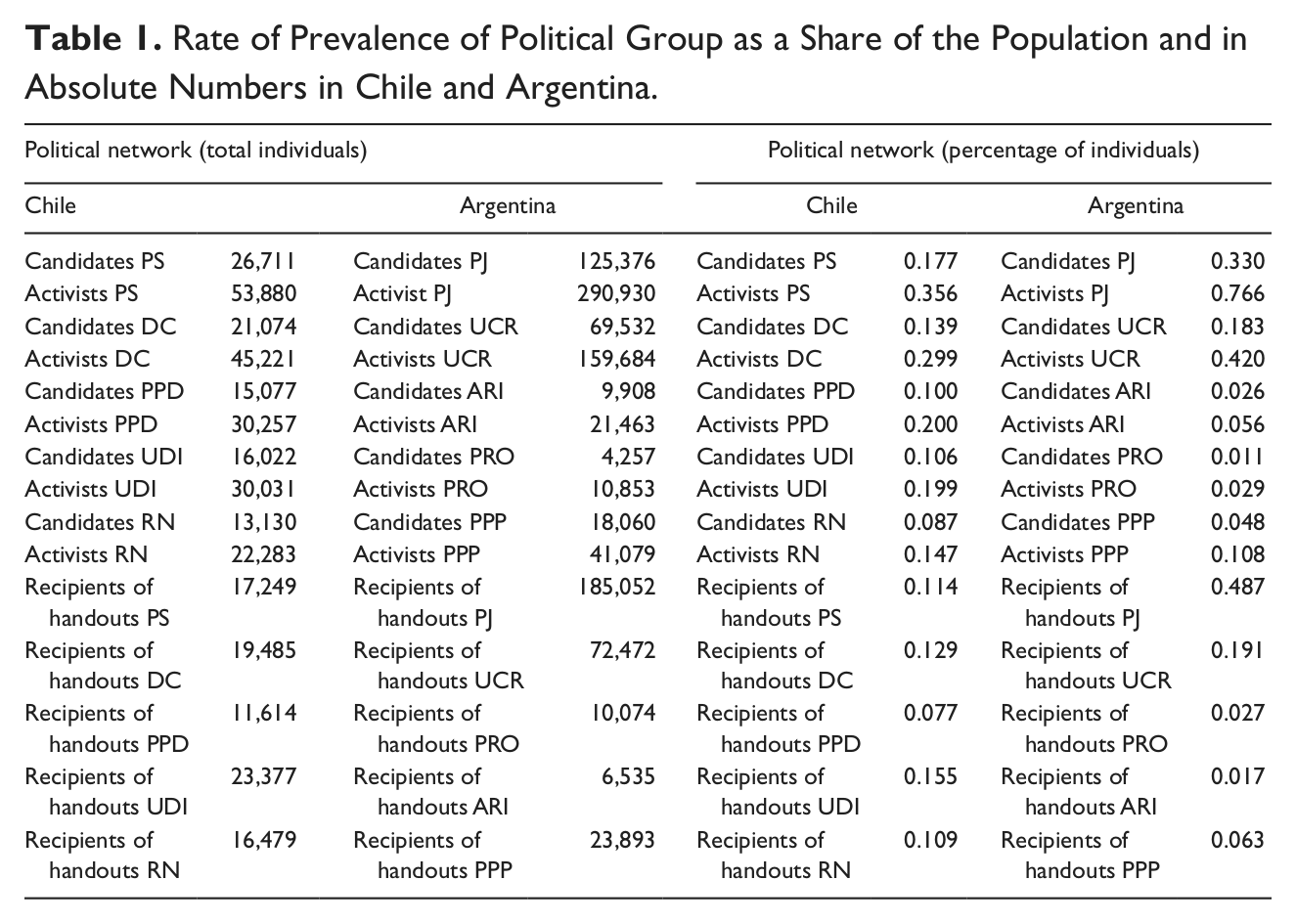
Table 1 also reports the estimated size of handout recipients for all political parties.
10
This number is considerably larger for recipients of handouts delivered by Peronists (0.48% of the population). The number of individuals receiving handouts from the Peronists is 2.5 times larger than the number of those receiving handouts from the UCR (0.19% of the population) and many times larger than the number of those of all other parties. The data also show that partisan networks grow and decay slowly over time, as shown by UCR networks that are considerably larger than expected given their weak electoral performances since 2001. As described by UCR senator and former presidential candidate Leopoldo Moreau,
The Radicalism is a party that keeps its organization. Because it is true that each town has a priest . . . it is a network that was developed in more than a hundred years, it cannot collapse overnight. It can have ups and downs, it can go forward or backward, but it does not disappear overnight. (Leopoldo Moreau, personal interview with the authors, 2009)
Partisan networks in Chile have roughly similar sizes, with the PS enjoying a small advantage in reported number of activists and the UDI enjoying a small advantage in reported number of handout recipients. Our findings fall in line with recent research that describes the UDI as the Chilean party that most actively distributes clientelistic goods during elections (Luna, 2010). Still, the network of handout distribution of the UDI is significantly smaller than those of the PJ and the UCR. Consequently, the ratio of partisan networks to distribution networks in Chile is significantly smaller than that observed for the UCR, and especially the PJ in Argentina.
Political Parties and Distributive Practices
Our theory posits that the type of party–voter linkage explains differences in voters’ distributive expectations. In the previous section we describe a number of within- and across-country similarities in the size and structure of partisan networks in Argentina and Chile. In particular, we have shown the relatively even competition among the main Chilean political parties in contrast to the broader reach of the UCR and especially the PJ networks of activists in Argentina. In addition, significant differences exist in how voters perceive the programmatic stance of parties. Our survey results show the difficulties of Argentine voters in placing the PJ and the UCR in the ideological space—as opposed to the two newer parties. By contrast, Chilean respondents in our survey more readily placed the different parties on the policy spectrum.
In addition to the organizational and ideological differences among political parties, cross-national variations among institutions that shape politicians’ ability to appropriate resources for distribution to their constituencies further affect the formation of voters’ distributive expectations. Because of existing institutional constraints, Chilean parties are more tightly regulated and face significant difficulties in allocating publicly funded goods through their political networks. 11 Furthermore, civil service rules in Chile should also inform voters that public-sector jobs are excludable goods, access to which is not mediated by networks (Bau Aedo, 2005; Rehren, 2000). As a result, we expect that Chilean voters will, on average, report a lower probability of receiving clientelistic goods through partisan networks.
By contrast, Giraudi (2007) and Weitz-Shapiro (2006, 2008) provide evidence of significant discretion by Argentine public officials in the distribution of unemployment benefits and food assistance. Similarly, public-sector jobs in Argentina are heavily politicized and depend on political contacts, thereby shaping voters’ perceptions that the likelihood of obtaining a public-sector job increases with their proximity to partisan networks (Kemahlioglu, 2006; Szwarcberg, 2008). These different practices in the implementation of the distribution of publicly funded resources should thereby reinforce voters’ perceptions about the role of networks in accessing benefits.
In sum, we expect variation both across and within political systems. At the country level, we expect that institutional constraints will inform the distributive expectations of voters, such that Chilean respondents will weigh down the role of partisan networks compared to respondents in the Argentine survey. In addition, we expect that Chilean voters of all five parties will be more likely to develop distributive expectations that are informed by their ideological affinity to parties, which is unconstrained by partisan networks and reinforced by their prior historical experiences. Meanwhile, we expect Argentine voters to be less likely to rely on ideological affinity and more on connections to party networks when informing their distributive expectations vis-à-vis the PJ and UCR. By contrast, ideological cues should be more useful in informing such expectations with regard to the PRO and the ARI. We now turn to empirical tests of these expectations based on the methodology described above.
Political Linkages and Voters’ Distributive Expectations
In this section we test the influence of ideological affinity and proximity to party members on voters’ expectations of receiving excludable goods. We take advantage of three survey questions asking voters about the likelihood of receiving handouts, such as clothing, food, other material benefits (clientelism), being offered a job in the public sector (patronage), or witnessing increased public investment in their community (pork) if a given party wins the election. The first question asked respondents to indicate on a 10-point scale, “How likely would it be that, after winning the election, [Party j] would provide [him or her] with food, clothing, money, or other material benefits?” A similarly worded question asked, “How likely would it be that, after winning the election, [Party j] would provide [him or her] with a job in the public sector?” (patronage). Finally, the third question asked, “How likely would it be that, after winning the election, [Party j] would invest in the public works required by the community?” (pork). We include a question on attitudes about delivering by parties each of these private goods to control for the bias of individuals regarding such distribution. Using the responses to these questions as dependent variables, we run beta regression models for each party and estimate whether ideological distance and proximity to party members explains the perceived propensity to receive goods, jobs, or public works. 12
We test for the effect of our two main independent variables: (a) the relative proximity of voters to party activists and (b) the self-reported ideological distance between voters and parties. The proximity of voters to political activists is measured by the relative number of ties between voters and party activists. We define this as a relative rather than an absolute measure of proximity, given that it adjusts for difference in personal network size for each respondent and group prevalence in the population. Such information is captured by the overdispersion parameters
In testing for the determinants of the distributive expectations of voters, we measure the effects of two main sets of independent variables. Our first independent variable tests for the effect that proximity to the network of activists and candidates has on distributive expectations. We expect the relationship to be positive, with higher proximity to partisan networks increasing the perceived probability of receiving goods. However, we anticipate this effect to be stronger among Argentine respondents and in particular for the PJ and UCR partisan networks. We expect that network proximity will be a weaker predictor of distributive expectations among Chilean voters and for the newer Argentine political parties with less extensive organizations.
Our second independent variable measures the ideological distance from respondents to parties. This variable is measured by taking the absolute distance between the self-reported ideological location of each respondent and the respondent reported location of each party: Ideology(k) = |xi − sk|. We expect ideological distance to have a negative effect on the distributive expectations of respondents—with voters that are more distant from the reported ideological location of a party resulting in lower expectation of perceiving benefits. However, we expect this effect to be stronger in Chile and for the smaller Argentine parties because of the already-mentioned differences in the importance of ideology as an informational shortcut.
We also add as controls a number of independent variables that shape the marginal returns of respondents to the distribution of excludable goods. We include a battery of respondent specific variables measuring personal network size (ln), the educational level of the respondents, socioeconomic status, age (ln), and gender. Lower education and income are expected to increase the marginal utility of the perceiving benefits. Consistent with existing research, we expect the effect of education on the utility of a public-sector jobs to increase at lower levels of education and to decrease at higher levels of education. We have no clear expectations about the effect of education on the expected benefits from higher investment in public works. We hold no particular theoretical expectations about the respondent’s age, gender, or gregariousness either.
Beyond the pocketbook benefits of distribution for each respondent in the sample, we also expect sociotropic evaluations in regards to the desirability of distributing goods. Because voters have different perceptions of how appropriate it is that parties distribute handouts, public jobs, and public works, we include an independent variable that asks respondents to express their positive or negative feelings in regard to the distribution of handouts, public-sector jobs, and public works. 14 To assess the impact of institutional differences in the distribution of publicly funded benefits mentioned above, we include the proximity of respondents to the network of beneficiaries for two workfare programs with similar design and locally decentralized implementation: Chile Solidario (Chile) and Jefes y Jefas (Argentina). Because these are cash-transfer programs, we expect they should have a positive effect on distributive expectations regarding handouts. Because of cross-national differences in the delivery of publicly funded benefits, however, we expect these effects to be significant in Argentina, but not in Chile. We also control for proximity of individuals to party members involved in the party primaries. We expect that proximity to individuals involved in primaries will have a positive effect on distributive expectations because the literature on Argentina associates clientelism with participation in primaries, given that it is easier to monitor turnout than in the general elections where vote is compulsory.
Empirical Results
Tables 2 and 3 present the estimates of the beta regression models for Chile and Argentina. All coefficient estimates of the beta regression models can be interpreted as ordinary least squares coefficients, with a one-unit variation in the independent variable leading to the estimated coefficient change in the perceived likelihood of receiving handouts, a public-sector job, or the public works that the community needs. 15 For example, a one-point increase in ideological distance from the PS in Chile would result in a 3.46% decrease in the likelihood of receiving a handout from that party. In both tables the first set of five columns describes model estimates measuring the expectations of receiving handouts from each of the main five parties, the second set of five columns describes the expectation of being offered a public-sector job, and the third set of five columns describes the expectation that parties will invest in the public works that the community requires. We discuss the results comparing distributive expectations for each type of good in both countries to assess the weight of programmatic and clientelistic linkages.
Distributive Expectations, Ideological Distance, and Proximity to Party Members in Chile.
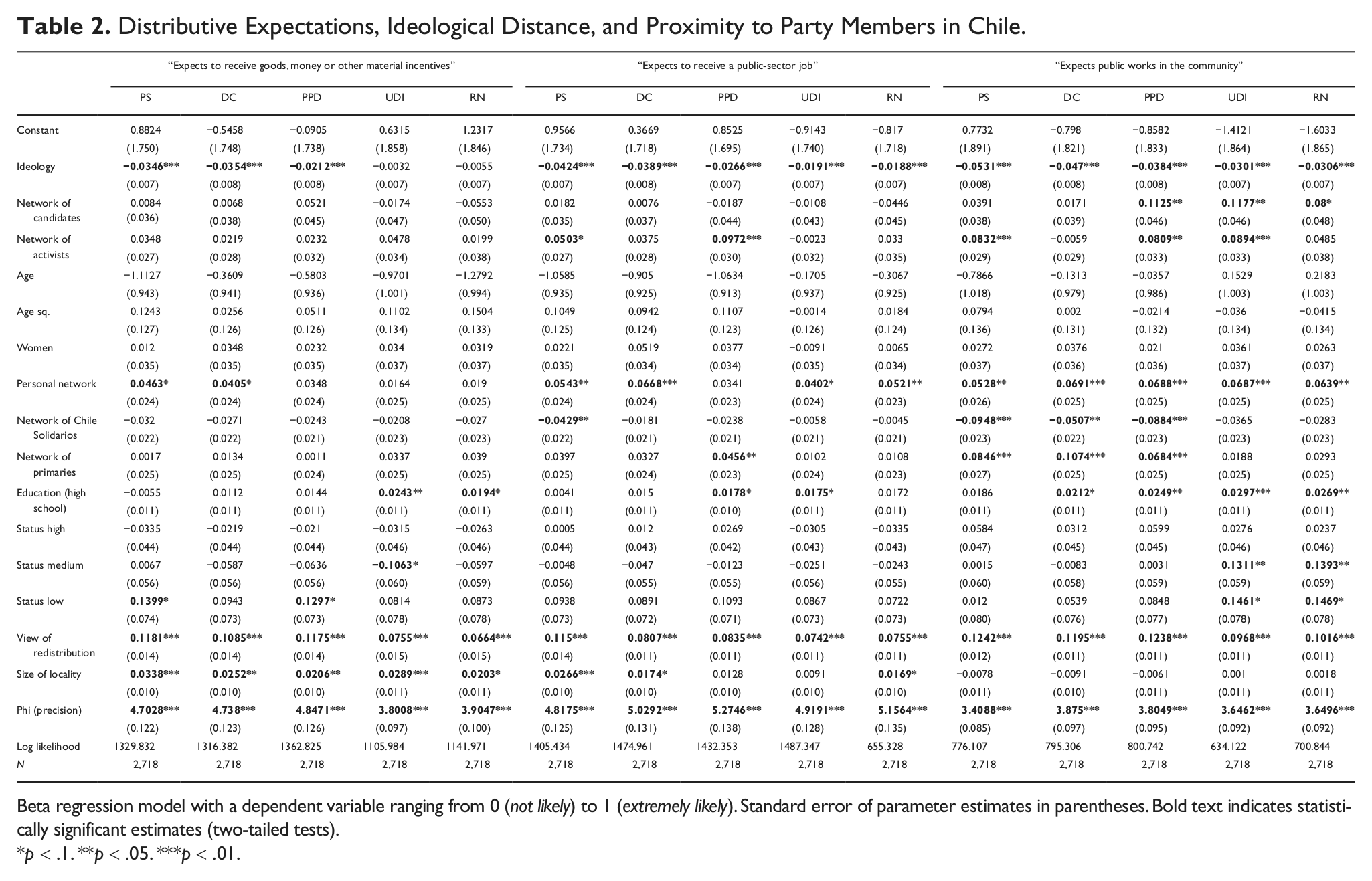
Beta regression model with a dependent variable ranging from 0 (not likely) to 1 (extremely likely). Standard error of parameter estimates in parentheses. Bold text indicates statistically significant estimates (two-tailed tests).
p < .1. **p < .05. ***p < .01.
Distributive Expectations, Ideological Distance, and Proximity to Party Members in Argentina.

Note: Beta regression model with a dependent variable ranging from 0 (not likely) to 1 (extremely likely). Bold text indicates statistically significant estimates (two-tailed tests).
p < .1. **p < .05. ***p < .01.
The statistical results provide a wealth of information, broadly supporting the hypotheses detailed before. A visual comparison of the effect of ideological distance and network proximity on the expectations of receiving goods (Figure 2) shows that proximity to party activists of the PJ is a statistically significant predictor of the respondents’ expectation of receiving handouts, a public-sector job, and public works from that same party. Similarly, proximity to the UCR network of activists increases the expectations for receiving handouts, jobs, and public works among UCR voters. The figure shows no evidence that proximity to activists of the smaller parties in Argentina raises the expectation of receiving handouts.
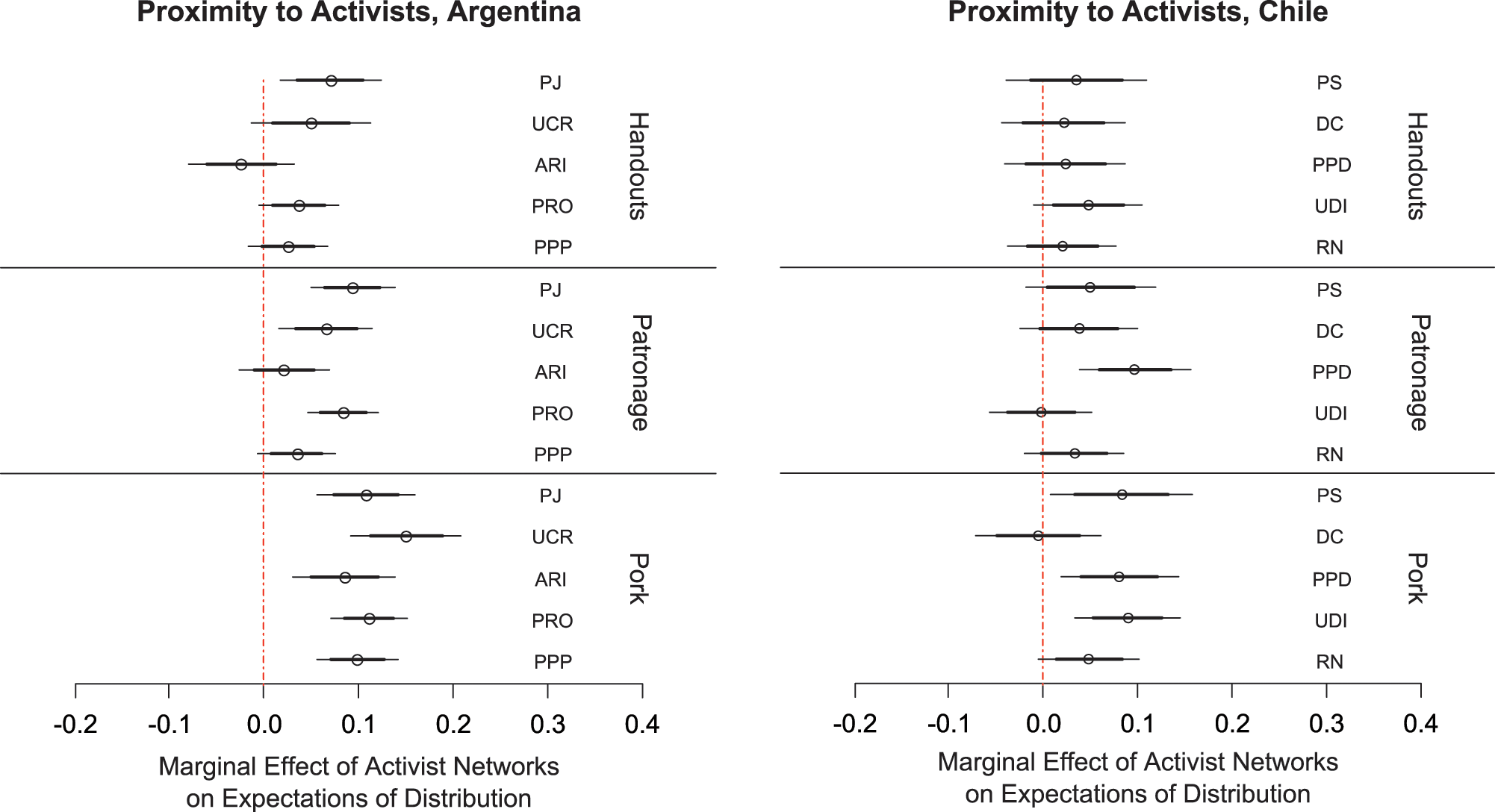
Marginal effect of ideological distance and activists’ networks on the expectation of receiving handouts, a public-sector job, or public works for the community.
Figure 2 also shows that proximity to party activists has no effect on the distributive expectations of handout delivery among Chilean voters, whereas ideological distance remains a strong predictor for all three Concertación parties in Table 2. Differences between large and small parties in Argentine and across respondents from Argentina and Chile are more noticeable in regard to the delivery of handouts and patronage jobs. By contrast, in both countries results show that both ideological distance and network proximity are important determinants of the expectations of receiving the “public works that the community needs” (although the magnitude of the effect is weaker for the Argentine PJ).
As shown in Table 2, ideological distance is statistically significant (and in the expected negative direction) when explaining the voter’s expectation of being offered handouts by parties from the Concertación in Chile. The greater the ideological distance to the voter, the less likely he or she expects to receive targeted benefits. The effect of ideological distance is statistically significant for all parties of the Concertación, leading to a decline of ≈3.5% in the expectation of receiving handouts from the PS or the DC for every unit of increase in ideological distance measured on a 10-point scale. The effect is more moderate for the of PPD (≈2) and statistically insignificant for the parties on the right, UDI and RN, consistent with a political discourse that deemphasizes distribution in favor of market coordination. Proximity to party activists, by contrast, has no statistically significant effect on the distributive expectation of receiving handouts from any of the five political parties in Chile. Against our expectations, socioeconomic status and education fail to achieve statistical significance among Chilean voters. This result is consistent, though, with qualitative work showing that Chilean parties distribute different types of goods and services catering to populations of different socioeconomic status. 16 By contrast, as expected, neither proximity to beneficiaries of Chile Solidario nor proximity to individuals participating in party primaries increases the perceived likelihood of receiving handouts among Chilean voters. Finally, the respondent’s view of redistribution has the expected positive effect, whereas population density has a significant positive effect for all parties, thus suggesting the targeting of voters in larger cities.
Table 3 shows that in Argentina, by contrast, ideological distance has no significant effect on the respondents’ expectations of receiving handouts from the PJ or the UCR, whereas proximity to party activists has a strong and positive effect both for the PJ and the UCR. Neither ideology nor proximity to activists explains the distributive expectations of ARI voters, whereas ideology of party activists is a significant predictor of distributive expectations for the PRO. As expected, we also found a significant effect from proximity to beneficiaries of the Jefes y Jefas program for the PJ and the UCR. Other control variables have the expected effects. A more positive view of the distribution of handouts is associated with higher expectations of receiving these goods, and proximity to the individuals involved in party primaries increases distributive expectations of receiving handouts from the PJ among respondents. In contrast to Chile, we find that population density has a negative effect suggesting the targeting of smaller localities in line with earlier findings by Brusco, Nazareno, and Stokes (2004). Finally, in Argentina higher socioeconomic status has both a negative and a statistically significant effect on expected benefits perceived from all parties (with the poorest category of voters as the baseline).
Distributive expectations regarding public-sector jobs show similar patterns to those of handouts. The perceived likelihood of being offered a job in the public-sector decreases with ideological distance for all five Chilean parties and increases with socioeconomic status for the PPD and UDI—the effect is positive but not significant for the DC, PS, and RN. Proximity to party activists has a statistically significant effect only in regard to the PS and the PPD.
In Argentina the perceived likelihood of being offered a public job increases as respondents are more connected to the networks of both activists and candidates of the PJ and UCR (Table 3). The effect is also stronger for jobs than for handouts. These results suggest that jobs are more likely than handouts to go to core supporters who serve as brokers getting votes for the party rather than being persuaded to cast a ballot in return for handouts. For the PJ, knowing one standard deviation more activists than the prevalence rate increases the expectation of being offered a public-sector job by 8.65%. The effect is more moderate for the UCR, producing an increase of 5.26% if the respondent knows one standard deviation more activists than the prevalence rate. Control variables have the expected effects. As with handouts, proximity to the network of PJ primaries has a positive and significant effect. Population density has a significant negative effect as well for both the PJ and the UCR, in line with the literature that shows the dependence of the population of less urbanized provinces on public employment in Argentina (Gibson & Calvo, 2000).
Lastly, we analyze expectations about the delivery of public works if a party wins the respondent’s district. Our expectations were less clear in this case because of the nonexcludable nature of public works at the local level, and we find that voters in both countries identify both networks and ideology as mechanism shaping their perception about the distribution of public goods. In both Chile and Argentina, ideological distance and proximity to party members have the expected effects—although the effect of networks is not significant for the Chilean DC and RN. In Chile, the effect of socioeconomic status is positive, although its significance varies. In line with that, the impact of the workfare program Chile Solidario is negative and significant for the three Concertación parties. In Argentina, it is worth noting the decline in the importance of socioeconomic variables and the positive effect of education except for the PJ. Finally, the network of primary participants has a positive effect for the Concertación parties in Chile and for the Argentine PJ. This association of public works with political participation in primaries is consistent with the literature on Argentina, showing that participation in Peronist primaries (and public meetings) can easily be monitored by majors and rewarded through the allocation of public works, especially during election time. However, it has not been previously identified for Chile, even though it affected the PS, the PPD, and the DC; the three parties in the national government coalition at the time of the survey.
In sum, Chilean voters consistently use ideological cues when forming their distributive expectations for all types of goods—even handouts for the Concertación parties. Meanwhile Argentine voters rely more heavily on their proximity to PJ and UCR activists when forming their distributive expectations for handouts and jobs, whereas the effect declines for public work, which is the least excludable of all three types of goods at the local level. Ideological distance shapes distributive expectations from the PRO for the three types of goods. That is, in Argentina, the impact of political networks is different for the two more established political parties because of their more extensive organizational capacity and the difficulties to locate these parties ideologically. These results suggest that even though both countries rely extensively on political networks, such networks play a larger role in defining the distributive expectations for Argentine voters regarding the PJ and UCR. Our findings confirm cross-national predictions regarding the different types of party–voter linkages (programmatic or clientelistic), despite the recent debate among Chilean scholars in regard to the increasing influence of clientelism. Although we find evidence of clientelism in Chile in line with recent work (Luna, 2010), our results show that Chilean voters continue to rely on ideological cues even when defining their expectations about handouts. The fact that we do not find this effect for the UDI regarding handouts further confirms Luna’s argument that their ideological constituencies finance the distribution of handouts to ideologically distant voters. Finally, our results show that both partisan networks and ideology influence the distributive expectations regarding public works in both countries because of their less excludable character at the local level.
Conclusion
In this article we propose a new conceptualization of programmatic or clientelistic political linkages based on the distributive expectations of voters. From the point of view of voters, we argued, clientelistic and programmatic parties differ in how goods are delivered. In the former case, voters expect that handouts, public-sector jobs, and public works will be delivered through activist networks. In the latter case, voters anticipate that goods will be delivered by public policy, when parties that are ideologically proximate have access to public resources. To test our model, we propose a new methodology that measures party–voter linkages both in ideological and organizational terms. This contribution to the comparative study of political parties was then tested in two countries, showing variation both across and within party systems.
The main contributions of this study are twofold. First, it emphasizes the value of focusing on “access” to publicly funded benefits to assess the “voter side” of party–voter linkages and predict patterns of variation in such linkages. In particular, it explores how organizational capacity, ideological identification (across parties) and institutional constraints on policy discretion (across countries) shape those linkages. Second, it provides a new comparative methodology for measuring party–voter linkages that can be applied to other cases and could also be extended to nonpartisan distributive networks.
This article provides an important contribution for assessing party–voter linkages from the perspective of voters by focusing on the type of access to excludable goods. Political parties provide a portfolio of both nonexcludable and excludable goods to voters. However, the mechanisms determining access to excludable goods—either through some general policy criteria or through political networks—shape voters’ perceptions of subsequent iterations in benefit distribution. Voters need to define their own distributive expectations regarding both types of goods to act on those expectations when casting their ballots.
It is important to emphasize that it is access to excludable benefits that shapes voters’ expectations by generating predictability in distribution patterns. However, differences in access to benefits are defined not only at the level of institutional constraints that generate variation across political system but also by differences in the organizational capacity and endowment of fiscal resources within political systems. Hence, in classifying party–voter linkages, it is important to consider that parties provide different types of goods, and voters will value access to both nonexcludable and excludable goods, depending on their own experiences and the marginal value of the benefit for them.
Moreover, we present an innovative methodology that allows cross-sectional comparisons on party–voter linkages based on patterns of access to publicly funded benefits. This methodology allows us to measure the size and structure of partisan networks as well as to estimate the effect of network and ideological proximity on voters’ distributive expectations. The estimates we derive provide a crucial comparative tool in measuring the nature of party–voter linkages across different contexts. This methodology can be applied in other contexts to uncover political linkages between parties and voters. Moreover, it can also be applied to nonparty networks. For instance, in contexts where the origin of networks for distribution of publicly provided benefits is not a political party but a religious or ethnic organization, we expect this methodology to be able to assess the impact of such networks on voters’ distributive expectations. Indeed, this methodology could be used to test whether the electoral impact of such ascriptive categories is based on descriptive identification or access to excludable benefits, which is a critical debate in the extant literature on identity politics.
To conclude, this article provides a new way of understanding party–voter linkages by showing that parties generate different distributive expectations for voters, who have different sensitivities to their proximity to party members. We believe that future work on distributive politics needs to devote effort to exploring differences in the voters’ distributive demands based not only on the impact of different types of access to such benefits but also on the effect that access to benefits has on the determinants of individual vote choice. Future work should focus on the electoral strategies of political parties given different voters’ expectations, institutional constraints, and diverse endowments of organizational capacity and fiscal resources.
Footnotes
Acknowledgements
We want to acknowledge useful suggestions as well as data sharing by Gerardo Adrogue, Javier Auyero, Terri Caraway, Gary Cox, Tulia Falleti, Andy Gelman, Daniel Gingerich, Noah Kaplan, Robert Kaufman, Juan Pablo Luna, Christopher McCarty, Matthew McCubbins, Charles Munnell, Patricio Navia, Virginia Oliveros, Iñaki Sagarzazu, David Samuels, Mariela Szwarcberg, Susan Stokes, Mariano Tommasi, Gergely Ujhelyi, Rebecca Weitz-Shapiro, and Steven Wilkinson as well as comments by participants in seminars at the University of North Carolina–Duke comparative politics workshop, the University of Chicago, New York University, the University of California, Los Angeles, the Catholic University of Chile, the Universidad Torcuato Di Tella, the University of Virginia, the University of Minnesota, and the University of Houston. We also want to acknowledge the assistance of Mariana Gutierrez, Lucila Falus, Milan Vaishnav, and Virginia Oliveros.
Declaration of Conflicting Interests
The authors declared no potential conflicts of interest with respect to the research, authorship, and/or publication of this article.
Funding
The authors disclosed receipt of the following financial support for the research, authorship, and/or publication of this article: The authors acknowledge support from the National Science Foundation (Grant 0617659), the University of Houston Department of Political Science, the Columbia University Institute for Latin American Studies, and Institute for Social and Economic Research and Policy.