




Abstract
What drives differences across countries in levels of civic engagement? Both the United States and Japan have been described as having high levels of civic engagement, but a variety of measures show that the type of involvement that is most common varies. Americans join and contribute to national political groups, but membership in PTAs and volunteer firefighting units is low and declining. Japanese participate at a much lower level in national advocacy organizations, but they join local neighborhood associations at very high rates, participate extensively in PTAs, and volunteer to clean up neighborhood parks. This article seeks to unravel why Japanese have such high rates of local civic engagement by examining how parents and volunteers have mobilized to maintain high rates of walking to and from school during a period in which walk-to-school rates have plummeted in the United States. The higher rate of Japanese local engagement in this area, I argue, is motivated by housing markets that limit residential mobility to much lower levels than in the United States. High cost of residential “exit” in Japan drives citizens to exercise “voice” to maintain the safety and walkability of their neighborhoods.
On July 27, 1981, a 6-year-old boy named Adam Walsh was abducted after his mother left him for a few minutes to play video games while she shopped in another part of the department store. Adam’s decapitated head was recovered about 2 weeks later, propelling the case into national headlines and feeding popular concern about what was for a time considered an epidemic of child abduction. 1 One consequence of this incident and others like it was a plunge in the proportion of children who were allowed to walk to school. Although 48% of American elementary and middle school children walked or biked to school in 1969, the share of children getting to school on foot or by bike had plummeted to just 12% by 2009. Many parents were not even willing to entrust their children to a school bus. Fully 47% arrived at school in a private vehicle, typically dropped off by a parent. 2
In 2005, Japan experienced a pair of similar incidents. Two 7-year-old girls, one in an urban area of western Japan and the other in a rural hamlet in eastern Japan, were abducted and killed within a week of each other. One perpetrator was arrested, but the other case, which took place while the first offender was in custody, remains unsolved. What the two cases had in common was that both girls were abducted as they walked home from school, unaccompanied by any adult, as was customary throughout the nation.
Needless to say, these incidents made Japanese parents extremely nervous about allowing their children to walk to and from school, but their response has been quite different from the one observed in the United States. Japanese communities responded to the incidents by volunteering in massive numbers to step out onto the street to keep an eye on children as they made their way to and from school. Some even created “wan wan patrols,” which gave sashes labeled in this way to individuals who agreed to walk their dogs (who make the sound “wan wan” in Japan) during the times when children were traveling to and from school. Other community members volunteered to post signs outside their gates indicating that their home was a designated refuge for any child who felt he or she was being followed or harassed. Children were told that if they knocked on the door of such a home, they would be welcomed in to wait while the police were called.
Japanese communities have made similar efforts to keep children safe from motor vehicle traffic. Several times a year, PTA volunteers walk the designated “routes to school” (tsūgakuro) with an eye out for possible hazards, such as places where a child might dash out into traffic. They then meet with local traffic safety officials to request the installation of railings and crosswalk improvements needed to keep the children safe. Localities make improvements every year in response to these demands. 3 These efforts supplement routine safety activities that include stationing volunteer crossing guards at dangerous intersections, outfitting first-graders with yellow hats and sashes, and organizing these young children into walking groups led by older children on the first day of school. As a result of these efforts, Japanese school children continued to travel to school on foot, even after the abduction incidents. In 2009, 98% of Japanese elementary school children arrived at school on foot. About 12% of Japanese schools, mostly in very rural and mountainous areas, run school buses, but the proportion of students who ride them accounted for just 1.7% of school children. 4 Public schools routinely ban private vehicle drop-offs by parents.
These extensive community efforts to keep children safe as they walked to and from school in Japan are typical of similar efforts across a range of local concerns. Japanese parents are very involved in local schools, especially in the elementary and middle schools that serve their residential area. PTA membership rates in Japan are 4 times as high as current rates in the United States. Japanese participate in volunteer firefighting organizations at twice the rate of U.S. residents (Haddad, 2004). Meanwhile, 90% of Japanese belong to neighborhood associations, with an estimated 40% to 70% serving as active members (Pekkanen, 2006). These associations spearhead activities that range from keeping local parks weeded and clean to organizing crime patrols at night in their neighborhoods to assisting garbage collectors by managing complicated recycling efforts.
Curiously, according to Pekkanen’s careful study, Japanese civil society is relatively weak at the national level. Outside the realm of interest groups set up to serve sectoral economic interests, there are few powerful membership-based national organizations working to shape national policy in the public interest. Japanese are much less likely to join national civic organizations. The United States, in contrast, has been described as having the exact opposite pattern of civic engagement. It has vibrant and powerful national civic organizations like the Audubon Society, National Rifle Association, and Sierra Club, but participation in local civic organizations like the Rotary Club, volunteer firefighters, and PTA has been declining steadily (Putnam, 2000; Skocpol, 1998).
In this article, I investigate why Japanese are so much more engaged in local civic activities than Americans. The fact that they behave so differently with regard to national civic organizations suggests that the explanation cannot be cultural. Both peoples are “joiners.” The puzzle is why Japanese readily join and volunteer at the local level, whereas Americans tend to be less engaged locally and join and contribute instead to national civic organizations. I explore this question by focusing on the specific area of local concern illustrated by the cases of Adam Walsh and the Japanese schoolgirls. Why have the two societies responded so differently to the challenge of keeping their neighborhoods safe enough for children to walk to school in the face of child predators and growing motor vehicle traffic? Why have American parents by and large relied on private, uncoordinated strategies (drive the kids themselves, move to the suburbs) whereas Japanese parents have demanded local improvements, demanded better safe-walking programs, and put in their own time to building these community-wide efforts?
The different outcomes, I argue, cannot be explained entirely by differences in population density or crime rates that somehow make safe walking to school impossible across the United States. To fully answer this question, we have to look at the forces that have propelled Japanese citizens to demand that their neighborhoods be kept safe for children and commit personal time to serving as crossing guards and lookout patrols that keep the walk-to-school routes safe. What propels the difference in levels of local activism, I argue, are differences in housing markets that limit residential mobility to much lower levels than in the United States.
The argument is developed as follows. I begin by examining the most common explanations for differences in the ways Japan and the United States organize their transportation and land use systems, starting with those that attribute it entirely to differences in geography. As I raise questions about each of these explanations in turn, I develop an alternative explanation that emphasizes the path-dependent interaction between past policies and the political and economic choices made by Japanese households. A variety of scholars have emphasized path-dependent influence of past policies on later policies (e.g., Iversen, 2005; Myles & Pierson, 2001; Pierson, 2004; Thelen, 2004). In my view, however, these studies have undertheorized the relationship between political and economic choices available to political actors in response to past policies. My explanation draws on the insights of Albert Hirschman (1970) and his exit-voice framework to model how economic (exit) options interact with political (voice) opportunities to shape behavior. High levels of local civic engagement, the model suggests, are more likely when local residents find it costly to move to a new location. The Japanese housing market, I show, imposes much higher costs on residents who wish to move than does the housing market in the United States. Thus, I argue, the critical factor driving Japanese citizens to get involved in their local communities to preserve safe walking routes is the costliness of their exit options.
Geographic Determinism
When confronted with dramatic contrast in walk-to-school rates, the first reaction of most Americans and Japanese is to point to the well-known difference in population density between the two countries. Japan has 127 million residents living in 364 thousand square kilometers, for a population density level of 336 persons per square kilometer. In contrast, the United States has 307 million residents living in 9.8 million square kilometers, for a population density level of 31.3 persons per square kilometer. 5 Since Japan is 10 times as densely populated as the United States, perhaps it is only natural that Americans faced with traffic and crime dangers have given up on keeping their communities safe for walking children and have instead turned to parental drop-offs and school buses to serve their widely dispersed population.
The problem with this argument is that it boils each country down to a single density figure when in fact different regions of each country differ greatly in their density. The need to consider this variation becomes clear if you examine the density levels of prefectures and counties in Japan and California. I chose California as a reference point because its total area is similar to Japan’s and its counties are roughly the same size as Japanese prefectures. California’s statewide population density of 84 persons per square kilometer is still much lower than the 336 persons per square kilometer in Japan, but at the county level some areas of the state are just as densely populated as Japanese cities. San Francisco County is more densely populated than Tokyo Prefecture. Orange County and Aichi Prefecture (Japan’s fifth most densely populated prefecture) have similar levels of density. At the same time, parts of Japan are as sparsely populated as many California counties. Kumamoto and Okayama, for example, have population densities similar to San Diego and Santa Cruz Counties (see Table 1). What is striking about Japan’s walk-to-school program is that it operates just as vibrantly in the less populated areas of Japan, like Kumamoto and Okayama, as it does in Tokyo. Even in relatively rural prefectures, virtually all elementary students walk to school. In contrast, studies of transportation-to-school patterns in California communities show that even when the sample is restricted to densely populated areas of Oakland, Berkeley, Albany, and Richmond with a grid network of streets, sidewalks, and flat topography, just 32% of children aged 10 to 14 walk or bike to school (McDonald, Deakin, & Aalborg, 2010). The geography of the two countries cannot by itself account for the differences we have observed.
Densities of Selected Japanese and Californian Localities.
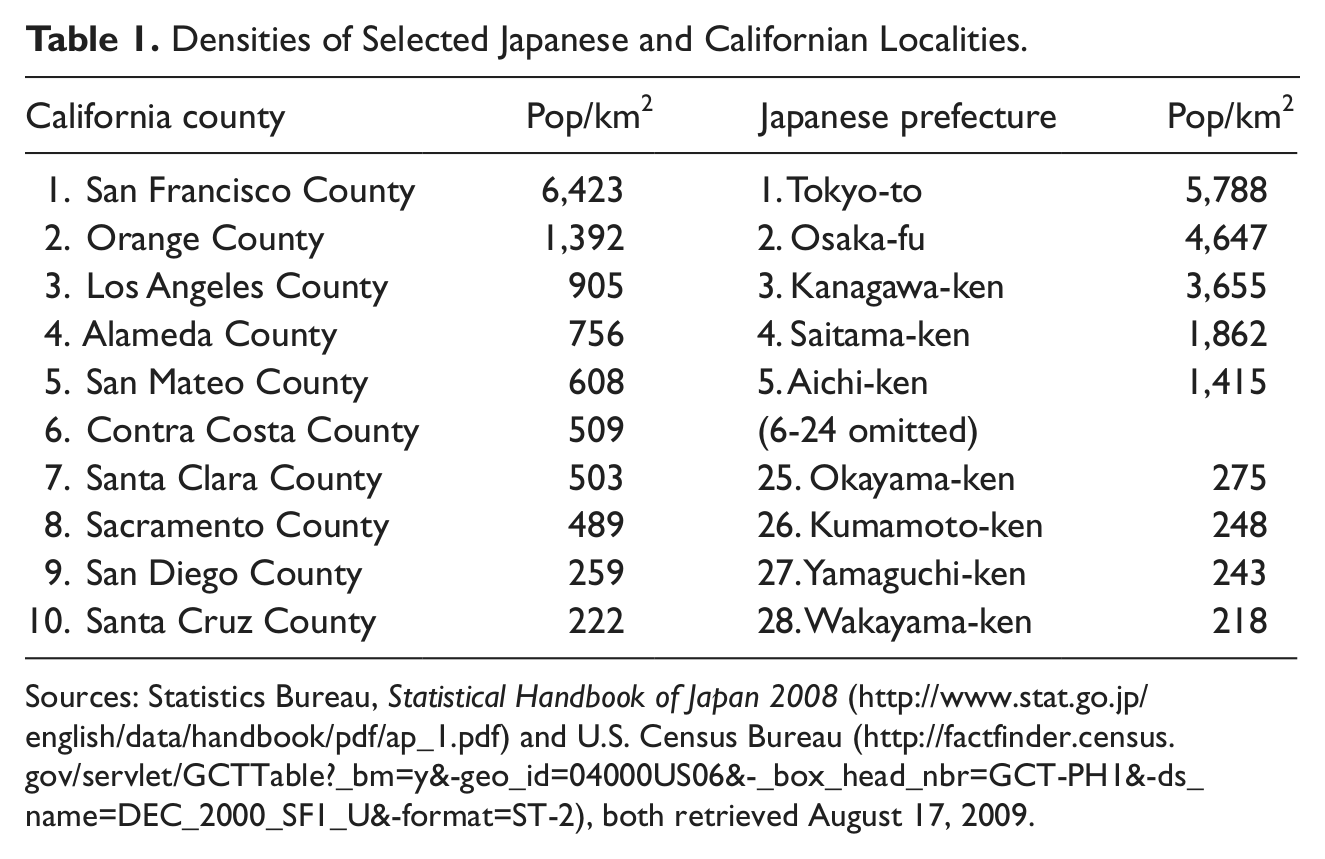
Sources: Statistics Bureau, Statistical Handbook of Japan 2008 (http://www.stat.go.jp/english/data/handbook/pdf/ap_1.pdf) and U.S. Census Bureau (http://factfinder.census.gov/servlet/GCTTable?_bm=y&-geo_id=04000US06&-_box_head_nbr=GCT-PH1&-ds_name=DEC_2000_SF1_U&-format=ST-2), both retrieved August 17, 2009.
Neither can a change over time in American residential patterns (“sprawl”) account by itself for the drop in U.S. walk-to-school rates. Sprawl has put more school children further from school. The National Household Transportation Survey shows that the share of American school children living more than 2 miles from their home grew from 40% in 1969 to 60% today. 6 Yet even when the sample in both periods is limited to children living less than a mile from school, the number walking or biking has plummeted from close to 90% in 1969 to just 35% in 2009. 7 So it is not just recent sprawl but also the failure of communities to address concerns about traffic safety and crime that have led parents to deliver their children to the schoolhouse door in person or rely on school buses.
The Timing of Urbanization
Scholars who study land use and transportation patterns in localities around the world have established that a great deal of the variation can be attributed to the timing of population growth and urbanization. 8 Cities that took shape when walking and horse-powered transportation were the only options continue to be much more densely populated today and tend to rely much more on transportation modes other than the automobile. Those that grew rapidly during the railroad boom, around 1900, are more spread out but tend to be well served even today by public transportation. In contrast, areas that grew rapidly after the automobile became widely available are the most likely to be auto dependent and poorly served by alternative modes today. This explanation, according to Pietro Nivola (1999), accounts for much of the difference in land use and transportation patterns between the United States and Europe. Between 1950 and 1996, the U.S. population grew by 74%, whereas those of Germany and Italy grew by about 20% and the U.K. population by just 14%. The fact that these European countries grew so little in the postwar period allowed their populations to find housing mostly in areas settled before the age of the automobile. In contrast, the need to find new homes for an exploding population prompted Americans to carve out new suburban territories that were naturally designed around the availability of the automobile.
While Japan is often better compared with European nations because of the timing of its industrial development and other similarities, it is striking that on this dimension, Japan more closely resembles the United States. Over the 1950 to 1996 period, its population grew by 40%—twice as fast as the major European nations. This was also a period in which Japanese surged out of the countryside into the cities to find employment in the booming industrial sector. As a result, Japanese (like Americans) were forced to carve out new suburban territories to accommodate all of these newcomers during a period in which citizens in Japan too were purchasing their own family vehicles. Japan developed one of the world’s leading automobile industries, and domestic sales boomed during the 1960s and 1970s. By 1970, most Japanese with children had an automobile.
It is this similarity that prompted me to compare Japan’s policies in this issue area with those of the United States, despite the fact that the two countries have many other differences. The similar timing of their suburbanization experiences makes it all the more puzzling how Japanese communities were able to create and maintain environments where children could walk to school, even in new suburban areas where families relied on the automobile for other errands. The explanation for their divergence in this policy areas must lie somewhere else.
Crime
Americans’ eagerness to spread out into the suburbs and rely on automobiles is often explained by the country’s high crime rate (Nivola, 1999). In 2006, there were 17,030 murders in the United States and just 1,307 in Japan. The murder rate was 5.7 per 100,000 in the United States, compared to just 1.03 in Japan. 9 The gap was even larger in the period from 1970 to the mid-1990s, when the U.S. murder rate was in the 8 to 10 range and Japan’s was close to 1. Could this large difference in crime rates explain why Americans have pulled their children off the road even as Japanese have put energy into maintaining a walk-to-school system?
The cases mentioned at the start of this article make it clear that crime is certainly a factor affecting parent choices in this realm. It is no coincidence that the walk-to-school rate in the United States began dropping sharply in the 1970s through the 1990s, when the media featured a series of sensational stories about child abductions, starting with the case of Adam Walsh. For years, that case remained unsolved, keeping it alive in the public sphere—especially after Adam’s father, John Walsh, became the host of America’s Most Wanted, a television show focused on unsolved crimes. 10 Other cases that became household names during this period include Polly Klaas, Danielle van Dam, and Elizabeth Smart (Shutt, Miller, Schreck, & Brown, 2004). Adding to public anxiety was the announcement by researchers who did some of the early studies on child abduction that the nation was experiencing an “epidemic” of this type of crime, with annual cases of child abductions estimated to total up to 600,000 (Shutt et al., 2004). Milk cartons brought the “epidemic” home to families in the United States by featuring an ever-changing series of faces of missing children, including Adam’s.
American community activists attempting to promote higher rates of walking to school under the banner of “Safe Routes to School” confirm that cases such as those listed above have led parents to choose buses or drive and drop-offs as the preferred mode of delivering their children to school. The survey of parents in the Oakland and Berkeley areas mentioned above (McDonald & Aalborg, 2009) found that “stranger danger” was cited as a reason by 31% of parents of children living less than 2 miles from school who drove their children to school rather than allowing them to walk. A larger proportion (75%) listed the greater “convenience” of the drop-off option, but the authors note that the inconvenience of walking was in part a product of the parents’ feeling that (for safety reasons) they had to accompany their children on their walks to school. As a result, it was quite inconvenient for them to then double back to drive to work.
So have we solved our puzzle? Not quite. As in the case of population density, national figures for crime obscure a great deal of local variation. It was noted above that the murder rate in the United States in 2006 was 5.7, more than 5 times the rate in Japan of 1.03. A quick look at Table 2 shows, however, that there are some states in the United States where the murder rate is not too different from Japan’s. What is true at the state level is even truer at the level of specific towns or neighborhoods. There are many neighborhoods in the United States where there has not been a single murder in many years. Likewise, there are neighborhoods in Japan that have more murders than some of these American localities. Despite this local variation in crime rates, walk-to-school rates in the United States are consistently low, even in low-crime areas, while walking rates are close to 100% in Japan, even in high-crime areas.
Murder Rates in New England, 2009.
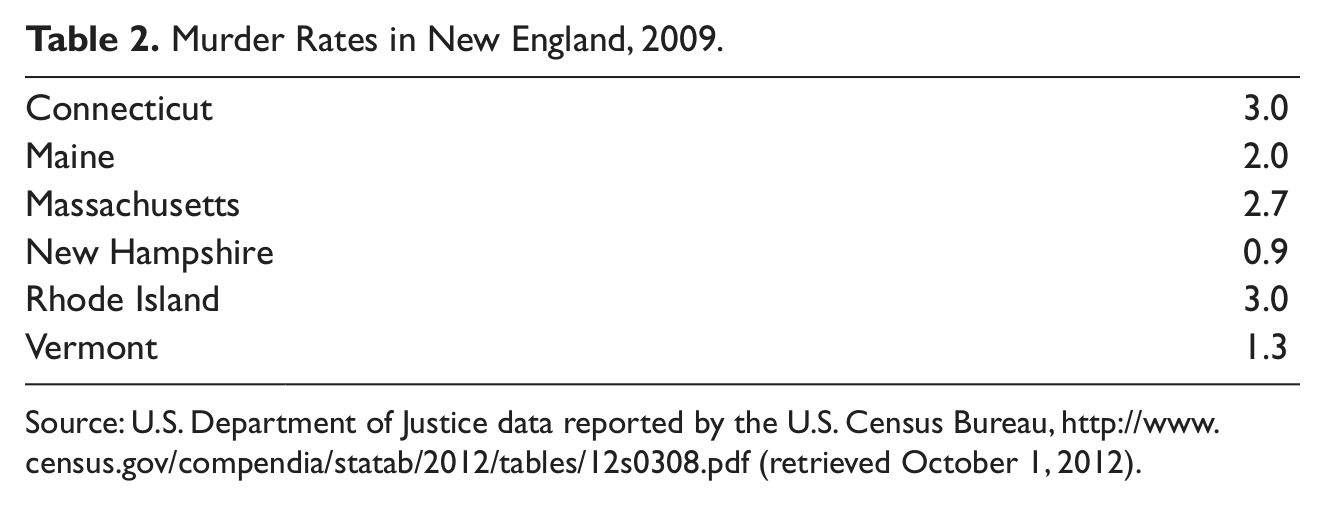
Source: U.S. Department of Justice data reported by the U.S. Census Bureau, http://www.census.gov/compendia/statab/2012/tables/12s0308.pdf (retrieved October 1, 2012).
This point can be made even more directly for the more specific crime of child abduction and murder. First, it turns out that the early estimates of an “epidemic” of child abduction in the United States were wildly off the mark. They conflated cases in which children had been taken by noncustodial parents in divorce disputes and other cases where the child was taken by a family member with cases of abduction by strangers. The most comprehensive recent study in the United States, published in 2002 based on 1997–1999 data, found that of 58,200 cases of nonfamily child abduction, there were just 115 “stereotypical stranger abductions” in which children were taken by strangers or slight acquaintances, kept overnight, killed, transported 50 miles or more, and ransomed or kept with the intension of permanence (Shutt et al., 2004). Of these, 40 resulted in death. With such small numbers of cases a year, there are many communities that have never been touched by crime of this kind. And yet Americans have pulled their children off the streets across the United States, even in the safest jurisdictions.
What the American pattern suggests is that it is perceptions of danger to children, more than local crime rates, that have driven so many parents to pull their children off the street. 11 Japan has had more than enough crime cases involving children to generate similar anxiety. In 2007, children were victims of abduction in 82 cases, indecent assault in 907 cases, indecent exposure in 73 cases, and murder in 82 cases. 12 The most notorious of the child abduction cases in recent years were the two 2005 cases mentioned at the start of the article, in which 7-year-old girls were killed after being abducted by strangers while walking home from school. In the first case, 7-year-old Kinoshita Airi was found dead in a cardboard box shortly after leaving school in Hiroshima on November 22. Her school bag became an important item of evidence after it was discovered carefully packaged for disposal by the killer, who had attempted to have it picked up for incineration. 13 On November 30, a man of Peruvian-Japanese decent was taken into custody on suspicion of murdering Airi. The very next day, 7-year-old Yoshida Yuki was reported missing after she failed to come home after leaving school in a rural area of Tochigi Prefecture. Less than 24 hours later, her naked body was found on a mountainside in the adjoining prefecture where the killer was believed to have taken the girl after snatching her in his van. 14 Despite the fact that a security camera captured the image of what was believed to be the suspect’s van, her murderer has not yet been apprehended.
Needless to say, these two cases attracted the full attention of the Japanese media, with television stations running lengthy coverage and the weekly tabloids featuring the story in large spreads. The Yomiuri Weekly featured coverage that focused on how the cases revealed dangers in the two girls’ routes to school. Yuki had a daily walk to school of about two kilometers, which took her through forested areas in which houses were often quite widely spaced. She walked the first part of the way home from school with two friends, but at a certain point, she broke off to take the final leg alone. It was on this leg that she was abducted. The rest of the article reported on the many dangers that lurk on a typical child’s route to school and consulted with experts about how best to keep children safe in these situations. 15
The Japanese public certainly responded to these incidents. 16 Like American parents, they wanted their children to be safe on their way to and from school. What is striking, however, is how the Japanese response took such a different form from the American response to similar incidents. Instead of pulling children off the streets and putting them onto school buses or insisting on delivering children to and from school by private vehicle, Japanese parents demanded that their local PTA and school, as well as the national authorities, do everything in their power to keep the walking routes to school safe for their children. The Japanese weekly AERA, reporting just 2 weeks after the two incidents, found a high level of activism across the country. 17 A PTA leader at a school in Saitama City reported that her school was stepping up a program that called on 20 assigned volunteers from her group to report to duty stations near their homes each day 15 minutes before walk-to-school time to greet all children with a vigorous “good morning” and keep their eyes on the street. Other efforts to increase the numbers of eyes on street, AERA reported, included bicycle patrols in the afternoons, greater use of police car patrols, and the “wan wan patrols” mentioned above.
Many localities turned to greater use of technology. AERA found one school that was using email lists to notify groups of parents who subscribed to the service of the exact time their children had left the school. That would allow parents to meet the children partway, if they wished, by anticipating when they would arrive (which can vary greatly in the afternoon, when children go home at different times depending on club activities). Other localities installed security cameras on vending machines along walking routes. Several schools made plans to install digital tracking devices into the children’s school bags that were designed so that an email message would automatically be sent to parents once their child walked through the school gates on the way home.
Many of these activities were already under way before the two incidents in 2005, but reporting of this kind and the efforts of the Ministry of Education (MEXT) helped spread programs like this across the country quite quickly. MEXT helped this process along by calling on schools to take additional measures to protect children on their way to and from school, identifying ways in which they could do so, and offering limited financial assistance with sums sufficient to buy sashes, for example, to identify volunteers in the “wan wan patrols.” MEXT also called on the public to volunteer and assist schools that were seeking to do more, prompting approximately 80,000 individuals to step forward to help. Many of them joined local hachi-san undō, movements to get residents to step outside at around 8:00 in the morning and 3:00 in the afternoon to check on the kids walking to and from school. 18 In these ways, communities got through the panic by reinforcing, rather than abandoning, the walk-to-school programs that were in place. According to a MEXT official I spoke to, a few communities (including the rural town where Yuki was abducted) were interested in introducing school buses, but only a few took this step. 19 AERA considered it newsworthy when one school in Niigata ordered nine school buses, not for the purpose of transporting students over long distances but to keep children on rural roads safer. 20
A Strong State?
The involvement of the MEXT in coordinating the response to the child abduction incidents points to another possible explanation for the different response by parents to crime and traffic dangers in Japan and the United States. Perhaps the difference simply reflects the greater strength of the Japanese state: its ability to direct society’s energies toward goals it sets, or at least shares. The argument that Japan has a strong state has a long and rich pedigree (C. Johnson, 1982; Tilton, 1996; Vogel, 1996). Perhaps most relevant to the type of policy discussed here is the more nuanced work of Sheldon Garon (1997), who recognizes how the state’s goals are shaped by societal input but nevertheless credits the state with an important role in reinforcing social norms that govern “everyday life” of Japanese citizens, encouraging them to work hard, save, eat well, and abide by high standards of public morality. If Garon is right, the persistence of walk-to-school patterns in Japan might simply be a result of the state’s success in guiding social behavior in the name of public health and order. Robert Pekkanen’s (2006) study of neighborhood associations takes a similar tack, arguing that these groups have remained a powerful and active force in Japan largely because the Japanese state and local governments have found them useful and have given them financial support.
In all of these realms, the American state is widely described as pluralistic and weak. Instead of using social groups such as the neighborhood associations to achieve its own ends, it tends to be captured and manipulated by the groups with the most organizational clout and money (Dahl, 1961; Heinz, Laumann, Nelson, & Salisbury, 1993). If this line of argument is correct, schools and communities in the United States may have given up on walk-to-school support because they were captured by powerful interests that wanted life in the United States to revolve around use of the automobile. There is certainly evidence that the auto lobby pushed and paid local governments across the country to tear out streetcar tracks to make way for buses and cars. It is also possible that local governments in the United States are simply responding to parental demands that they be allowed to drive their children to school (or that school buses be made available) to keep them safe.
In my view, the state’s role in each country is important, but it cannot be the sole explanation. Families in both the United States and Japan put the health and safety of their children at the very top of their concerns. It is difficult to believe that the two states (one out of its own sense of national goals and the other because it was captured by the auto lobby or parents) could push policy in such opposite directions entirely on their own. Where did the Japanese state’s goals come from, and how exactly does it force society to follow its leads in an area like this that is central to parental anxiety? And why do American parents seem to demand policies that are so different from those of Japanese parents? These questions are motivated not only by my specific doubts about the strong state–weak state thesis in this particular case but also by the work of many scholars who—in response to the work of Johnson and others—have demonstrated that the Japanese state is not as strong as we thought. In many areas of economic policy, it does what powerful interest groups want it to do, even if this calls for the support of inefficient industries (Uriu, 1996). In recent work, Rosenbluth and Thies (2010) and Estevez-Abe (2008) argue that social and economic policy in Japan consistently reflects the demands of society expressed through the electoral system. Kent Calder (1988), in his work on city planning in Japan, argues that the postwar Japanese state has been particularly weak in this area. Finally, Andre Sorensen (2002) comes to the same conclusion, writing,
The formal urban planning system has played only a minor role in the creation and maintenance of these inner city urban areas. They have instead been shaped by the legacy of the pre-modern street layouts, and by unplanned urbanization in the modern period, and are a product of enduring social structures and housing preferences. (p. 4)
Structures Governing the Costs of Exit and Voice
What we need to better understand how states interact with society to shape policy in an issue area like this is a better model of how individuals (parents in this case) evaluate their options and act. Most work in the field of political science has focused on the structures that shape individual choices in the political arena. Thus, Estevez-Abe, Rosenbluth, and Thies, for example, focus on how the pre-1996 Japanese electoral system empowered producer interests and disempowered those who were less organized (taxpayers, consumers). They then describe how the new electoral system adopted in 1996 and other institutional changes have empowered Japanese political leaders to respond more to the “median voter,” thereby increasing the power of consumer and taxpayer interests in ways that have shifted policy outcomes. Similarly, a great deal of scholarship on the United States has focused on institutional features that empower special interest groups.
Although these models of the political marketplace certainly identify an important part of the structure shaping public policy, they do not get us very far toward explaining why Japanese and American parents have mobilized and acted in such different ways in response to worries about child abduction and traffic danger. Perhaps U.S. policy supported automotive modes for getting children to school because of the way American institutions empower automobile interests, but Japan’s institutions have also empowered producer interests (like autos), so that does not seem to get us very far. The old Japanese electoral system encouraged politicians to compete for votes by lining up construction projects for the home district, so maybe that is why local governments there had an easy time finding the money to improve sidewalks and build bike paths. But then the U.S. system too has been known to encourage pork barrel politics. Political institutions do not tell us much about what kind of public works were emphasized in the two countries.
Instead of limiting our attention to the political marketplace to explain policy outcomes in this case, we need to look at the structures affecting the opportunities actors have in the uncoordinated economic marketplace, the opportunities they have to “exit.” If parents become worried that children walking to school risk getting hurt, they sometimes have options they can take on their own—instead of mobilizing in the political arena to force local governments and local schools to make the streets safer. If school buses are already available, they can simply choose to put their child on a school bus. If they have a car and the school allows drop-offs, they can drive their child to school. If the school seems unsafe, they can move their child to private school and drive them there. And if the entire community seems unsafe and they can afford to move without financial hardship, they can simply relocate to someplace better. How and when parents mobilize to seek school or local government solutions, I propose, depends very much on whether these “exit” options are available and attractive.
So what do we know about how the economic marketplace affects politics in this area? The most influential strand of the literature argues that markets that make “exit” easy produce the best policy. Thus, Tiebout (1956) and his followers argue that local expenditure will be optimal (taxes and spending will most closely match the desires of residents in all parts of a metropolis) if residents have many choices about where to live and can move between them at no cost. According to his model, local officials learn what public services residents are willing to pay taxes for by watching them “vote with their feet.” With a “free” residential marketplace of this kind, residents will get exactly what they want from local government and no more. If this way of modeling the impact of economic markets on local policy is correct, we should see local governments responding most efficiently to citizen wishes in places where residential markets are highly mobile and citizens have other cheap exit options. Tiebout’s model predicts that structures raising the cost of moving result in suboptimal outcomes since they reduce the ability of residents to “vote with their feet.”
We get quite different predictions about the effects of rising exit costs, however, from the work of Hirschman (1970). In his view, individuals frustrated with the status quo frequently have a choice between a “voice” strategy (mobilize through the PTA to improve the schools) and an “exit” strategy (move your child into private school). He pointed out that both of these mechanisms hold the potential to bring about improved performance, but that neither can be assumed to work efficiently under all conditions because organizations specialize in whether they are attuned to exit or voice and because exit and voice are related to each other in “hydraulic” fashion: “deterioration generates the pressure of discontent, which will be channeled into voice or exit; the more pressure escapes through exit, the less is available to foment voice” (Hirschman, 1993). What this means is that when parents who are frustrated with the quality of their school system respond by moving their children into private school, this tends to make them less involved in groups calling on the schools to try harder. The availability of exit options draws those most concerned about the decline in the quality out of the political process. Since state schools have traditionally been structured to respond more to this political process than to enrollment trends, this hydraulic effect of exit on voice has a deleterious effect on the ability of the school system to recognize what is going wrong and respond. In the worst cases, the quality of education may simply spiral downward.
Although Hirschman does not offer a formal model demonstrating exactly how exit and voice are likely to interact, his logic (and the stylized example of the school system presented here) suggests that the key variable affecting the quality of a state’s response to exit trends is the cost of exit relative to the costs of exercising voice. 21 The reason school systems have particular difficulty maintaining their responsiveness to concerns about the quality of education is because it is moderately costly to take children out of public education and put them into private school. The price of private school is within reach of many families but is not so cheap as to enable mass defections when the quality of education first begins to fall. The cost is low enough to drain away the families that are most sensitive to educational quality (causing the voice mechanism to work poorly) but too high to allow the large and rapid outflow of children that would get the attention of school officials who are not accustomed to worrying about enrollment declines.
Advocates of a voucher system—building on logic similar to Tiebout’s—have long pointed to this problem and argued that school systems would work better if all parents were able to move their children out of failing schools for free or at subsidized rates (Chubb & Moe, 1990). Lowering the cost of exit in this way would allow market forces to go to work and force school managers to respond before they lost all of their pupils. Hirschman’s logic suggests that the performance of public schools would also improve if parents were given no choice over where to send their children. With “no way out” (exit costs so high that exit is impossible), parents would have a strong incentive to voice concerns over declining quality, organize petition drives, attend PTA meetings, and volunteer in the school until results improved.
Hirschman’s logic thus suggests a U-shaped relationship between the cost of exit—for example, through residential mobility—and the local response. Communities will respond quite effectively to citizen concerns where the cost of moving is so low that people move all the time, or make use of other cheap exit options. But the response will be just as effective at the other extreme, where residents have no way out and citizens consequently raise their voices and lend their energies to making sure that their concerns are addressed. We can expect the worst outcomes when exit costs are at a moderate level, too high to allow the volume of exit (or threats of exit) that will propel a market-driven response but too low to drive frustrated individuals to overcome barriers to collective action and mobilize in the political arena.
Exit Opportunities Along the Walk to School
When neighborhoods decline in the United States, whether the issue is worries about the safety of children on their way to school or some other concern, the first reaction of many residents is to think about moving away. The Washington Post found such sentiments expressed by a real estate blogger in Waldorf, Maryland, which had seen a spike in the murder rate. Waldorf is on what used to be considered the southeastern fringe of the Washington suburbs. It was settled by residents who fled crime in the inner suburbs of Prince George’s County, which in turn had been settled by residents escaping from crime in the District of Columbia. The blogger’s response, “It’s time to move further south.” 22
These sentiments have contributed to a rate of residential mobility that is much higher in the United States than in most industrialized nations. In 2000, 10.3% of American homeowners had moved in the past 15 months. Renters moved even more frequently: 38.8% had moved within that period. 23 For the full population, including owners and renters, the proportion of Americans who moved over the past 5 years was 48.7%. 24 It is not unusual for Americans to live in many different homes between their departure from their parents’ home and their death: multiple rental apartments when single; a purchased townhome after marrying; a single-family “starter” home while the children are younger than school age; a larger home in a good school district while the kids are in school; a new “dream home” when the kids are teenagers; another home when employment opportunities force a relocation; and then, after retirement, a single-level condo where the couple can age in place.
Facilitating this lifestyle is a residential marketplace that makes moving quite cheap. Rental contracts typically provide for a one-year lease and charge only one month’s security deposit. After this one-year period, a resident can usually move from one apartment into another without financial loss. Moving between owned homes is also cheap relative to the costs of selling and buying residential property in other societies. Ample financing is available for the purchase of existing, as well as new, homes. Down payments need to cover only 20% of the value of the land and home (less during the housing bubble). Homes generally appreciate in value (except in the aftermath of the bubble), so many Americans have found that they can trade in a smaller, older home for a newer, bigger home, over the course of their lives, without significant financial loss. In fact, many consider “moving up” the housing ladder a strategy for building wealth. Even those with stagnant incomes have been able to trade one home for a similar one in a different neighborhood, without significant loss and with financing to make the deal affordable. These are the economic structures that allow most American families, faced with a decline in neighborhood quality such as threats to the safety of their children walking to school, to consider moving a relatively cheap and attractive option. Not free—as in Tiebout’s theoretical world—but cheaper than most other societies.
Faced with a decline in neighborhood quality, most Japanese do not move. Japanese rates of residential mobility are much lower than those in the United States. Although 10.3% of American homeowners had moved in the past 15 months, just 6.1% of Japanese homeowners had moved within the past 5 years. 25 Japanese renters move less frequently as well, with the proportion reporting that they moved within the past 5 years in Japan (36.4%) roughly equal to the proportion of U.S. renters who had moved in just 1 year (38.8%). For the full Japanese population, including owners and renters, the proportion moving within 5 years stood at 28.1% at the time of the 2000 census, compared to the U.S. figure of 48.7%. 26 Many younger Japanese move a few times, into a tiny unit designed for young singles or an employer-provided apartment. Young couples sometimes buy a starter condominium before trading up to a single-family home or nicer condominium. But unlike Americans, who often move frequently as their children’s needs change, for job relocation, or because of neighborhood decline, Japanese couples who have settled into their home—often built on their parents’ land—usually do not move again until they die. They may tear down their home and build a new one in the same spot, but they rarely move.
This rootedness of Japanese families has often been attributed to the nation’s culture: its attachment to the soil where farmers made their living for generations and where revered ancestors are buried. But it is also a product of residential market structures. Japanese renters do not move as frequently as American renters because Japanese rental contracts require several months of key money (which does not have to be returned when the contract is over) and security deposits (which is supposed to be used to protect against damage but is frequently used to cover routine maintenance after a tenant leaves). A renter who pays 3-4 months worth of rent up front to take up a lease is loath to do the same thing all over again a year later. Further encouraging renters to stay in place are tenant protections making it difficult for owners to terminate leases or raise rents sharply, holding down rents for long-term renters (Ito, 1994; Seko & Sumita, 2007).
Selling one home and buying another is an even more expensive proposition. Loans have long been available to purchase land and a portion of a new structure’s cost, but until recently financing was not available to purchase existing homes, pejoratively termed “used” (chūko). Japanese tax authorities have similarly placed little value on older residential structures, considering them to be depreciating assets—like a used car with a steadily declining “blue book” value. Single-family homes depreciate at a rate that makes them worthless in 20 years. Condominiums depreciate at a rate the makes them worthless in 30 or 35, depending on construction type. No one forces sellers to peg the price of used homes to the tax assessment, but these are frequently used as a guideline, so that 5-year-old structures sell at a significant discount over what the house cost when new, and 10-year-old structures sell for much less. A structure that is more than 20 years old is often considered worthless, with only the land under it retaining value.
Figure 1 shows what these market structures mean for the typical homeowner. This homeowner is assumed to have financed the total value of the land on which her new home sits, plus half the value of the structure, for a total debt (in dollars) of $350,000. The homeowner supplied the remaining $100,000 as a down payment. The house and land initially cost $450,000, but like a new car, it loses a significant share of its value as soon as it is “driven off the lot.” The structure then continues to decline in value until the value of the land is all that is left. Although the homeowner has been steadily paying off her loan, for most of this time the sum she could net for selling the home is less than the down payment she would need to purchase a new one. By year 25, she owns the land and has sufficient net worth to consider moving.

Typical financial situation of homeowner (assuming stable land price, 50% down payment on structure, and 5% interest)
The structures I have described have helped to suppress the market in used homes in Japan to a level where it is only a tiny fraction of the size of the existing home market in the United States. Although Americans buy about 20 used homes each year for every 1,000 residents, Japanese buy only about 1.3 (Shimada, 2003). As a result, Japanese who become concerned about the deteriorating quality of their neighborhood have much less attractive “exit” options. The market for used homes is so small, and prices on used homes are so low, that selling one home and buying another almost always requires a family to take a financial loss. Staying and working to improve the neighborhood often turns out to be the more attractive option.
Thus, we arrive at my explanation for the diverging paths taken by Americans and Japanese as they confronted neighborhoods that grew more dangerous because of growing traffic and fears of crime from the 1970s until today. In the United States, residents who confronted these problems had many exit options. No schools required children to walk to school, and many school districts already ran school buses, so parents whose children had been walking or biking to school and became worried about their safety could simply opt to have their child take the school bus instead. Few schools banned parents from dropping off children in person, and most American schools were located in places that could be accessed by drop-off drivers, so delivering a child in this way was another exit option that was available to many American parents. If a school was in a location where school buses were not used and drop off was not possible, the U.S. residential market provided parents with one more way out if they became worried about their children’s safety. They could move to a new location.
As more and more parents took one of these exit options, two things happened—and one thing did not. First, as the number of parents sending their children to school on foot declined, holdouts became worried about whether a fall in the number of “eyes on the street” would make their children unsafe, and they pulled their children off the streets as well. Second, high levels of residential mobility took families to cul-de-sac suburbs that were even less well served by sidewalks and bikes.
The thing that did not happen is that there was no local community civic engagement to try to address the problems that were causing traffic and crime to endanger children walking and biking to school. Exit led to more exit, so that rather than trying to fix the old system of getting children to school, Americans ended up creating a whole new system in the suburbs where children got safely to school on buses and automobile drop-offs. Twenty years after children stopped walking to school, there is finally a new movement today that is trying to revive this old way of getting to school—in the name of health. Safe Routes to School programs now exist in many U.S. states, and they are starting to identify safe walking routes to schools, where the infrastructure allows it. They are also organizing “walking school buses” and walk-to-school days so that children walk to school in safer groups. 27 So far, the impact of these programs has been marginal since many families still prefer the perceived safety and convenience of buses and cars, but the parents who are getting involved—of interest—are being motivated by one problem it turns out children cannot “exit” from: their health. Parents can keep their children safe from crime by driving them everywhere, but children who grow up with this lifestyle are more likely to end up overweight and suffering from health problems.
Why did the story play out differently in Japan? The story there starts in the 1950s when Japan was building and rebuilding a large number of schools. At the time, Japan was very poor. School districts could barely afford the cost of building and staffing schools, so they had no money for school buses. And many families did not own their own vehicle. It was at this time that schools, with support from MEXT, initiated tsūgakuro programming that asked schools to identify the safest routes to each school and get all children to follow them. The ministry refused to supply money for school buses, except when schools were located in extremely rural and mountainous areas. Only if it took more than one hour each way for children to walk or bike would the state provide support for school buses. In the name of equal opportunity, which is enshrined in the Fundamental Law of Education, schools adopted policies that encouraged all children to walk to school.
What this meant was that when Japanese faced problems with growing traffic or crime, local parents had few exit opportunities. They could not put their children on school buses because there were not any. They could not drive their children to school since school policy required children to walk or bike. Adding to the difficulty of moving in this direction was the fact that many Japanese schools are sandwiched into urban spaces that are not well served by roads. They were built with the expectation that students would be walking up narrow allies through the school gate and that even teachers would arrive by bike or public transport. It would be very costly to retrofit many of these schools to accommodate 200 carpool drop-offs every morning and afternoon, so few parents even thought of this as an option. Finally, Japanese families faced daunting costs of relocation. If they wanted to sell their home in an area where traffic or crime was seen as a danger to their children, they had to take a major financial loss.
Faced with such limited exit options, Japanese families behaved very differently from their American peers. They put more time into PTA and neighborhood association volunteer activities aimed at beefing up crossing guards and “wan wan patrols.” Through the PTA and neighborhood associations, they contacted their local representatives to get the local government to install better crosswalks and signals, pedestrian overpasses, bike paths, and other infrastructure improvements that would allow their children to get to school safely on foot. Yes, government support for the PTA and neighborhood associations have helped make these organizations effective, but it is impossible to explain this kind of involvement and activism purely with a top-down strong state story. What made these organizations effective was the energy local residents put into them because they have no easy way out of their neighborhoods.
Footnotes
Declaration of Conflicting Interests
The author declared no potential conflicts of interest with respect to the research, authorship, and/or publication of this article.
Funding
The author disclosed receipt of the following financial support for the research, authorship, and/or publication of this article: The author received a grant from the Japan Foundation Center for Global Partnership to fund research in Tokyo that informed this article.