




Abstract
Early studies of electoral behavior proposed that party identification could be negative as well as positive. Over time, though, the concept became mostly understood as a positive construct. The few studies that took negative identification into account tended to portray it as a marginal factor that went “hand-in-hand” with positive preferences. Recent scholarship in psychology reaffirms, however, that negative evaluations are not simply the bipolar opposite of positive ones. This article considers negative party identification from this standpoint, and evaluates its impact in recent national elections in Australia, Canada, New Zealand, and the United States. Our findings highlight the autonomous power of negative partisanship. They indicate as well that ideology has an influence on positive and negative partisan identification.
In April 2002, the first round of the French presidential election produced a political earthquake. Undermined by a high level of abstention and by the fragmentation of the left, the socialist candidate, Lionel Jospin, finished third, leaving conservative Jacques Chirac and far-right leader Jean-Marie Le Pen to fight for the presidency in the second round (Miguet, 2002). Shocked, voters from the left mobilized to prevent the worst, and they rallied under an unlikely call to “vote for the crook, not the fascist” (Hayter, 2002). For these voters, the reasons to cast a ballot appeared purely negative. Their motives were nevertheless powerful, and the participation rate increased significantly in the second round.
This atypical development indicates how negative motivations can influence voters’ decisions. Yet, relatively little is known about such negative views. Even though the early, and seminal, studies of electoral behavior proposed that party identification could be negative as well as positive (see, notably, Campbell, Converse, Miller, & Stokes, 1960), over time, the concept became mostly understood as a positive construct (Garry, 2007; Vlachová, 2001). The possibility that party identification could be multidimensional and that positive and negative evaluations may not be correlated was acknowledged (Weisberg, 1980), but the few studies that took negative political attachment into account tended to portray it as a factor that only became relevant in exceptional situations (Rose & Mishler, 1998), or as an underlying dimension of party identification that probably went “hand-in-hand” with a preference for a given party (Greene, 1999, p. 395; see also Maggiotto & Piereson, 1977).
Recent scholarship in psychology reaffirms, however, that attitudes are not necessarily reciprocally activated. In other words, negative evaluations are not simply the bipolar opposite of positive ones. They may have distinct antecedents and consequences (Cacioppo & Berntson, 1994). Largely neglected by political scientists, negative evaluations may also, in numerous circumstances, prove more powerful than positive ones, because humans tend to give more weight to bad than to good experiences or information (Baumeister, Bratslavsky, Finkenauer, & Vohs, 2001). Identities themselves may be negative, and defining who one is not may not respond to the same determinants and have the same consequences as defining who one is (Zhong, Phillips, Leonardelli, & Galinsky, 2008).
This article considers negative party identification from this standpoint, and uses data from recent national election studies in Australia (2007), Canada (2008), New Zealand (2008), and the United States (2008) to probe comparatively the relationships between group identity, ideology, positive and negative partisanship, and voting intentions. Our findings lend support to the standard view associating ethnic origins with party identification and consequently with the vote, but they highlight as well the autonomous power of negative partisanship and its specific association to ideology. More precisely, in the four countries under study, we find that negative party identification is a significant determinant of the vote, acting alongside positive party identification. Added to positive party identification in a model predicting voting intentions, negative party identification noticeably increases the explanatory power of the equation. In other words, negative partisanship moves the vote. In turn, this distinct factor has its own determinants: Whereas positive party identification reflects long-standing ethnic cleavages and ideology, negative party identification seems more related to ideology and, generally, is not influenced by ethnic identity.
This article only begins to address what remains a broad, largely unexplored question. We do not claim, for instance, to have a complete model that could account for the determinants and consequences of negative party identification. Our aim is more modest. We simply seek to draw attention to a dimension of political life that appears very important to voters and politicians, not only in trying times—when the only choice left seems to boil down to “the crook and the fascist”—but also in the more mundane politics of everyday conversations.
The Unmoved Mover
“The discovery of party identification,” writes Russell Dalton (2008), “is one of the most significant findings of public opinion research” (p. 173). The political science literature on this concept is vast, long-standing, and relatively consensual. In the classical statement proposed by Angus Campbell and his colleagues (1960) in The American Voter, party identification is presented as a stable attitude determined early in a person’s life by his or her psychological association to a reference group. Near the top of the “funnel of causality” that leads to the vote, party identification comes just after sociodemographic characteristics, and ahead of important but more transient factors such as current issues and candidates. It stands as an “unmoved mover,” a “simple loyalty” that is “learned early and (remains) largely unimpaired by subsequent learning,” to become “an object in its own right, not just a synecdoche for social structure or ideology” (Johnston, 2006, p. 331).
Later works updated the psychological foundations of the concept, with the help, in particular, of “social identity theory,” which presented party identification more as an identity defined by one’s relations to “in-groups” and “out-groups” than as an attitude that is a simple positive or negative response to a stimulus (Greene, 2002; Tajfel & Turner, 1985). These refinements, however, only reinforced the established understanding of party identification as a “prepolitical and arational” foundation of political behavior, a “psychological attachment” based on affect more than on cognition, and one likely to stand the test of time because it was anchored in “a person’s self-concept” (Johnston, 2006, p. 333; Lewis-Beck, Jacoby, Norpoth, & Weisberg, 2008, p. 134).
For years, scholars informed by rational choice theory tried to do away with these psychological, “arational” features of electoral behavior, to emphasize instead the voters’ ongoing willingness and capacity to evaluate issues and candidates, and the importance of short-term changes associated with the economic context and electoral strategies (Holmberg, 2009). These skeptics had success raising doubts about the stability of partisan identities, but in the end, they also had to acknowledge that citizens did not change all that much from one election to the next (Vlachová, 2001). A consensus gradually developed around the idea that, without being impervious to the context, electoral decisions remained strongly anchored in lasting partisan identities, themselves rooted in stable psychological predispositions. In the “funnel of causality” that led to the vote, party identification remained near the top, above context, current issues, and candidates (Green, Palmquist, & Schickler, 2002; Johnston, 2006, p. 333; Lewis-Beck et al., 2008, pp. 134-136).
The association of party identification to group identities—understood as meaningful, national-scale social categories—also seemed well established. In the United States, for instance, Catholics, Jews, and African Americans were historically more likely to identify as Democrats (Lewis-Beck et al., 2008). Likewise in Canada, Catholics and visible minorities favored the Liberal Party (Blais, 2005). In many European countries, the fit between social and partisan identity also proved close, so much in fact that some scholars questioned the relevance of party identification as a mediating variable between group identities and the vote (Budge, 2010; Johnston, 1992, 2006; Rosema, 2006).
At times, however, partisan identities changed. In the last 50 years in the United States, for instance, Catholics and Southern Whites gradually abandoned the Democratic Party (Abramowitz, 2010; Lewis-Beck et al., 2008), just as African Americans had broken with the Republican Party starting in the 1930s (Miller & Shanks, 1996). Such movements in allegiances unavoidably raised questions about the psychological roots and stability of the supposedly “unmoved mover,” and they gave munitions to the skeptics, who hoped to anchor party identification less in lasting psychological traits than in evolving political factors. In their longitudinal study of Southern White voters, Alan Abramowitz and Kyle Saunders (2006) found indeed that it was ideology that moved the mover: Those who left the Democratic Party were first self-identified conservatives.
With this finding, Abramowitz and Saunders opened the door to a reconciliation of psychological and economic perspectives. They also helped bridge American electoral studies, prone to see party identification as an affective trait, and European work, more inclined to approach it with a cognitive lens (Vlachová, 2001). The possibility that ideology contributed to determine party identification, and probably weighted as much in explaining the vote, was indeed compatible with a rationalist interpretation and in tune with the conclusions of many European studies (Bélanger, Lewis-Beck, Chiche, & Tiberj, 2006; Holmberg, 2009; Klingemann, 1995). In an age characterized by the declining electoral impact of ethnic divisions, ideology could also emerge as a key, and as a consistent determinant of party identification, rather high in the funnel of causality (Dalton, 2008).
Linking ideology to party identification, however, introduces new considerations. First, as many of the critics of the classical version of party identification have pointed, ideology has a cognitive and rational dimension that may not be present in group identities, more anchored in emotions (Holmberg, 2009). As such, it could yield a coherence in attitudes that is not necessarily expected with ethnic divisions. Second, and more important, ideology as measured in public opinion surveys introduces a bipolar representation that opposes the left and the right, or in the United States, liberals and conservatives. When one identifies as a Catholic, she does not necessarily think of herself as non-Protestant, non-Jewish, or non-Buddhist. Opting for a self-placement on the right, however, automatically means rejecting one on the left (Jost, Federico, & Napier, 2009). Because it introduces this bipolar choice, and because it is a cognitive-rational instrument used by persons to guide their decisions, ideology is likely to engender not only a party identification but also a negative party identification, a relatively stable view of what is one’s rejected side.
The Forgotten Side
National election studies always ask respondents whether they have negative feelings toward the different parties, or more pointedly, outside the United States, whether there are parties they would “never vote for.” Intriguingly, electoral studies have rarely taken advantage of these questions, even though intuitively they seem to capture a core element of any voting decision. Perhaps this neglect can be explained by the influence of the American tradition, where the question asked is about feelings and does not capture negative views as explicitly. Whatever the case, we know little about the causes and consequences of such negative partisanship.
In a pioneering study, Michael Maggiotto and James Piereson (1977) argued that negative evaluations of parties should not be considered as simply equivalent to positive ones: “Democrats, weak and strong, vary in their evaluations of the Republican party,” they wrote, “and the same is true of Republican attitudes toward the Democratic party” (pp. 747-748). In a number of instances, the authors found an independent impact of negative evaluations on vote choice, suggesting that these attitudes played a distinct role, alongside positive party identification. Maggiotto and Piereson chose, however, to treat hostility as another dimension of partisanship, rather than as a variable in itself, to avoid undermining the canonical concept of party identification. In a similar way, Bradley Richardson (1991) understood partisan hostility among European voters primarily as a complementary dimension of party identification, which contributed to better translate existing social cleavages into stable voting patterns. Likewise, in a recent study of voting in Northern Ireland, John Garry (2007) combined positive and negative identities into a new, more sophisticated measure of party identification.
If, however, positive and negative evaluations of parties tap two different sets of attitudes that are not correlated, these two identifications may not have the same determinants and consequences (Weisberg, 1980). In this case, one would need to track both factors and to build, as Kathleen Knight (1984) once suggested, “a theory of separate effects” (p. 329).
A Theory of Negative Partisanship
The few political scientists who took into account negative party identification found distinct effects on the vote and, sometimes, specific determinants, but they did not treat negative partisan identity as a variable in itself, for fear perhaps of breaking with the conventional and broadly accepted view of party identification. Negative partisanship remained theoretically undetermined. Research in psychology, however, suggests there may be a coherent structure to negative partisanship, which makes it distinct from positive partisanship in its effects and antecedents.
First, as mentioned already, negative evaluations are not simply the opposite of positive ones. Traditionally in psychology, scholars have assumed that positive and negative evaluations were two ends of a bipolar continuum, which was reciprocally controlled, that is, activated by the same mechanisms. Attitudes could be measured as points along this continuum and explained by a single mechanism (Cacioppo & Berntson, 1994). In this perspective, negative party identification would simply be the polar opposite of positive party identification (Green & Citrin, 1994). Recent scholarship indicates, however, that positive and negative evaluations are activated separately. Positive and negative attitudes toward racial minorities, for instance, may coexist among the same respondents, each being determined by distinct factors and activated by different events (Cacioppo & Berntson, 1994). This is exactly what Maggiotto and Piereson (1977) observed when they considered positive and negative party identification in the United States. The two dimensions had, so to speak, a life of their own.
Second, positive evaluations come before negative ones. In his seminal presentation of social identity theory, Henri Tajfel (1974) stated simply that before members of a group could even begin to dislike another one, they “must first have acquired a sense of belonging to a group which is clearly distinct from the one they hate, dislike or discriminate against” (p. 66). This idea that the in-group was logically prior became broadly accepted in psychology (Zhong et al., 2008), and it was reinforced by the related observation of a “positivity offset,” a human propensity to adopt a moderately positive outlook when faced with neutral, unfamiliar objects (Cacioppo, Gardner, & Berntson, 1997, p. 12). Political scientists also noted this propensity, which some called a “positivity bias,” whereby citizens initially tended to rate positively the various political figures and groups, even when they were not particularly close to them (Knight, 1984, p. 318). This antecedence of positive evaluations suggests that, logically at least, positive party identification should have a greater impact on the vote than negative party identification, and should be anchored higher up in the funnel of causality, probably in group identity.
Third, and despite the presence of an initial positivity offset, negative evaluations weigh heavily in shaping decisions. When they are activated, by a bad experience for instance, negative perceptions may produce faster and stronger effects than positive or neutral ones (Baumeister et al., 2001; Cacioppo et al., 1997; Ito, Larsen, Smith, & Cacioppo, 1998). This negativity bias implies that negative party identification is not only a distinct but also, potentially, a powerful influence on the vote (Vlachová, 2001).
In addition, recent work in psychology indicates that ideology may be less instrumental-rational and more deeply anchored in the self than is usually assumed by political scientists. “A growing body of evidence,” note John Jost and his collaborators (2009), “suggests that left-right ideological stances reflect, among other things, the influences of heredity, childhood temperament or personality, and situational and dispositional variability in social, cognitive, and motivational needs to reduce uncertainty and threat” (pp. 317-318). Some have even proposed that ideological positioning is related to physiological traits in individuals (Oxley et al., 2008; Schreiber, Fonzo, Simmons, Dawes, Flagan, Fowler, & Paulus, 2013). A full model accounting for ideological predispositions remains out of reach, but the deep psychological roots of left–right predispositions seem rather well established. From early childhood, people on the left would be better disposed toward change and equality, and persons on the right more animated by insecurity, the fear of loss, and a desire for order (Jost, 2006; Jost et al., 2009). If this is true, ideology should be high in the funnel of causality, probably right after group identities, also acquired early in childhood. This is what European political scientists usually assume when they understand ideology as an anchor and as a determinant of party identification (van der Eijk, Schmitt, & Binder, 2005). In the United States, the literature has been more ambivalent in this respect, sometimes leaving ideology as a more or less effective symbolic label, somehow related to party identification (see, for instance, Conover & Feldman, 1981). Recent work on American elections, however, has highlighted the importance of ideology and brought the conclusions of U.S. scholars closer to those of their European colleagues (Abramowitz, 2010; Jacoby, 2010). A similar evolution has taken place in the Canadian case (Cochrane, 2010; Nevitte, Blais, Gidengil, & Nadeau, 2000).
These theoretical considerations about the psychological roots of negative party identification and conclusions drawn from the literature suggest three interrelated hypotheses. The first one adds negative party identification to the conventional model and suggests that it is a significant determinant of the vote, alongside positive party identification.
Hypothesis 1: Positive and negative party identification act as significant determinants of the vote.
The second hypothesis is informed by the expectation that positive party identification is influenced by group identity and by ideology, two psychological dispositions that are deeply anchored.
Hypothesis 2: Group identity and ideology are significant determinants of positive party identification.
Finally, our third hypothesis concerns the determinants of negative party identification. As it comes after its positive counterpart, negative party identification should be influenced by positive party identification. In addition, because ideology is a bipolar cognitive tool (left and right, liberal and conservative), it is likely to influence negative as well as positive party identification. Group identity, however, does not share this bipolar characteristic and it is likely to act mainly through positive partisanship, as is suggested by social identity theory. Our third hypothesis is thus,
Hypothesis 3: Positive party identification and ideology are significant determinants of negative party identification.
Once again, these three hypotheses do not amount to a comprehensive model that would account fully for voting behavior, or even for positive or negative party identification. Our aim is simply to establish the relevance of a long-neglected variable, negative party identification, and to show that it has a distinct impact on the vote, and specific social and psychological antecedents.
Four Anglo-American Democracies
The hypotheses proposed here can best be tested in a comparative perspective, which offers a general control for particular national circumstances that may affect the observed relationships. In this perspective, we have selected four Anglo-American democracies, Australia, Canada, New Zealand, and the United States. This choice of cases is fairly standard in the comparative study of party identification, because it brings together countries that have relatively similar social cleavages and political systems, and comparable measures of partisanship (Blais, Gidengil, Nadeau, & Nevitte, 2001; Johnston, 2006). 1 For each country, we have retained what were at the time of analysis the most recent documented election that determined the executive, that is the 2007 federal election for the House of Representatives in Australia, the 2008 federal election in Canada, the 2008 general election in New Zealand, and the 2008 presidential election in the United States. In the Canadian case, we have followed the now standard practice of considering only data for respondents outside Quebec. Since 1991, there is a strong prosovereignty party on the federal scene in Quebec, the Bloc québécois, which in effect makes Quebec a distinct party system within Canada. 2 Canadian election studies have thus separated Quebec from the rest of Canada (Blais, Gidengil, Nadeau, & Nevitte, 2002; Nevitte et al., 2000) or excluded altogether the Quebec situation (Blais, 2005; Gidengil, Blais, Nadeau, & Nevitte, 1999; Stephenson, 2010).
In each case, the partisan system has featured an opposition between two dominant parties, one on the left and the other on the right. In Australia, governments have alternated between the left-of-center Australian Labor Party and the right-of-center coalition formed by the Liberal Party of Australia and the National Party of Australia (Liberal–National coalition). In Canada, two parties have also monopolized government, the Liberal Party of Canada and a conservative party, known since 2003 as the Conservative Party of Canada. In New Zealand, the New Zealand Labour Party and the conservative New Zealand National Party have governed in turn. Finally, in the United States, two parties have shared the political scene, the Democrats on the left and the Republicans on the right.
The elections studied here were all competitive. In three of the four cases, the party that formed the government lost power, and in the fourth case, Canada, it was reelected but did not succeed in obtaining a parliamentary majority. In Australia, on November 24, 2007, Kevin Rudd’s Labor Party soundly defeated the Liberal–National coalition of John Howard, in power since 1996 (Qvortrup, 2008). A number of factors played a role in a campaign dominated by the economy and by the respective qualities of the contending leaders, but overall the election reaffirmed the importance of party identification and of long-standing cleavages in Australian politics (Bean & McAllister, 2009). In New Zealand, on November 8, 2008, it was the National Party, now led by John Key, that defeated Helen Clark’s Labour Party, in power since 1999. Key positioned his party near the center and emphasized change and leadership, somehow blurring the usual ideological cleavages, in a campaign that ended with the second-lowest voter turnout in over a century of elections (74.7%; Levine & Roberts, 2010; Vowles, 2009, 2010). In the United States, on November 4, 2008, the presence for the first time of a Black presidential candidate, Democrat Barack Obama, who competed against Republican John McCain, defined the election, along with the financial crisis that had started in September. With 53.4% of the vote and the highest turnout since the 1960 election (63%), Obama’s victory was impressive, especially given the remaining impact of racial prejudice (Brunell, 2009; Lewis-Beck, Tien, & Nadeau, 2010; Weisberg & Devine, 2010). The economic context certainly played an important role in a campaign marked as well by racial considerations and a growing ideological polarization (Abramowitz, 2010; Jacoby, 2010). Finally, in Canada, Stephen Harper’s Conservatives, in power since 2006, once again obtained a governing minority on October 14, 2008, taking advantage of the perceived weakness of their Liberal opponent, new leader Stéphane Dion, whose proposal for a carbon tax became an Achilles’ heel when the recession became a reality (Gidengil, Nevitte, Blais, Everitt, & Fournier, 2012; LeDuc, 2009). The Conservative’s victory, however, was lackluster, and the country registered its lowest turnout in history, 59.1% (LeDuc, 2009).
Socially, the four countries share similar ethnic cleavages. The specifics vary, but in every case, electoral studies have established clear and relatively stable majority–minorities patterns.
In the United States, the main contrast is strong and uncontested: Whereas Whites tend to be closer to the Republican Party, Blacks, Hispanics, and other racial minorities remain strongly attached to the Democratic Party, which they see as more attentive to their interests (Abramowitz, 1994, 2010; Cain, Kiewiet, & Uhlaner, 1991; Carmines & Stanley, 1992; Lewis-Beck et al., 2008; Miller & Shanks, 1996). Historically, mainline Protestants have also preferred the Republicans whereas religious minorities, including Catholics, have favored the Democrats (Kellstedt & Green, 1993; Miller & Shanks, 1996). Compared with racial divisions, however, this religious cleavage has tended to vanish over time, to become less significant in recent elections (Kelly & Kelly, 2005; Lewis-Beck et al., 2008).
Canada displays similar divisions. For a long time, the Liberal Party has obtained the preference of voters of Southern European or non-European origins, possibly because of its implementation of multicultural policies (Blais, 2005; Blais et al., 2002; Johnston, Blais, Brady, & Crête, 1992; Nevitte et al., 2000). Although the reciprocal tendency has been less documented, persons of northern European ancestry apparently have favored the Conservative Party (Johnston et al., 1992; Meisel, 1973). The same asymmetry has developed for religion. The propensity of Catholics to vote Liberal has been often noticed and discussed, but the similar connection between Protestants and the Conservative Party, albeit noted, has not been as often commented (Blais, 2005; Blais et al., 2002; Irvine & Gold, 1980; Johnston, 1992; Nevitte et al., 2000; Meisel, 1973). Contrary to the United States, the Catholic/Protestant divide may have persisted in recent elections, more so perhaps than the propensity of visible minorities to support the Liberal Party (Gidengil et al., 2012; Gidengil, Fournier, Everitt, & Nevitte, 2006).
The Australian pattern is similar to that of Canada. Associated to nondiscriminatory immigration policies and to multiculturalism, the Labor Party has gained the support of many among non-English speakers and non-Anglo-Celtic communities (Kelley & McAllister, 1983; Marks, 1993; Smith, 1998). Catholics also have preferred Labor, whereas Protestants favored the Liberal–National coalition (Irvine & Gold, 1980; Marks, 1993). Although the strength of these factors has varied over time, religious affiliation has remained to this day a good predictor of party identification (Bean, 1999; Bean & McAllister, 2009; Warhurst, 2010).
In New Zealand, visible minorities, Maoris, and Polynesians historically identified with Labour, the National Party being seen as closer to the White majority (Aimer & Vowles, 2004; Banducci, Donovan, & Karp, 2004; Vowles, Aimer, Catt, Lamare, & Miller, 1995). There was also a pattern of hostility between the Catholic minority and the Protestant majority, but while this situation tied the Protestant vote to the National Party, it did not seem to attach Catholics as strongly to the Labour Party (Bean, 1988; Mulgan & Aimer, 2004).
With respect to group identity and party identification, the patterns are thus consistent across the four cases. Racial and religious minorities preferred the center-left party, and White, Protestant majorities favored the center-right party. The specific components changed over time, with religion becoming less significant in the United States, for instance, but the cleavage between a conservative majority and left-of-centre minorities persisted. 3
Ideology also featured recurrent patterns. In the four cases, scholars used to argue that a majority of voters did not hold coherent or sophisticated ideological views and based political decisions on self-interested or emotional considerations. Campbell and his colleagues (1960), for instance, contended that Americans did not divide meaningfully along liberal and conservative lines, and did not determine their party identification on ideological grounds (see also Converse, 1964). Likewise, Canadian politics was broadly understood as detached from ideology, and based on the “brokerage” of compromises between various groups and regions (Johnston, 1988; Pammett, 1987). In Australia, voters were also described as remote from the language of left and right, and influenced by other factors, which determined their party identification and their vote (Graetz & McAllister, 1988; Kelley, 1988; Marks, 1993). Only in New Zealand did the old class and left–right cleavage seem to hold, and even there it appeared to be declining (Bean, 1988).
Recent studies, however, have challenged these conventional views, reaffirming the coherence and relevance of ideology, and possibly its growing importance (for the United States: Abramowitz, 2010; Jacoby, 2010; Jost, 2006; Lewis-Beck et al., 2008; for Canada: Cochrane, 2010; Gidengil et al., 1999; Nevitte et al., 2000; Scotto, Stephenson, & Kornberg, 2004; for Australia: Charnock, 2010; Johnson, 2010; Singh, 2009; for New Zealand: Vowles, 2010). In this perspective, it seems plausible to assume that in the United States, respondents who identify as liberals are more likely to be Democrats and to dislike Republicans, while those who see themselves as conservatives would tend to favor the Republicans and reject the Democrats. In the three other countries, those who locate themselves on the left are likely to support Labor or Liberal parties and dislike National or Conservative parties, and vice versa.
Data
Our hypotheses include five variables: group identity, ideology, positive party identification, negative party identification, and vote choice. To operationalize these variables, we rely on data from national election studies, namely, the Australian Election Study (AES), the Canadian Election Study (CES), the New Zealand Election Study (NZES), and the American National Election Studies (ANES). In the last case, we use responses given in the panel survey wave closest to the election. All the measures are coded into dichotomic variables, except for education, used here as a control for socioeconomic conditions and converted into a 0 to 1 scale. Education has been selected because it is a classic proxy for socioeconomic status and also a variable for which there is a high response rate. 4
As explained above, group identity is measured along two dimensions, one defined by origins or race, the other by religion. The origins/race questions are not exactly the same in the four countries considered, but in each case it is possible to differentiate the majority from the main racial minorities. In Australia, for instance, where the AES does not include a question on race as such, we use a question on a person’s or his or her parents’ country of birth to distinguish citizens who are Australian-born or of Northern European origins from persons of other origins (this cleavage being identified as the most significant in the literature; Kelley & McAllister, 1984). We adopt similar categories for Canada, where the CES asks many rounds of questions specifically to establish a respondent’s origins (on these questions, see Blais, 2005). In New Zealand and the United States, questions are different but they make it possible to distinguish Whites and racial minorities, probably the most relevant cleavage in these two cases. With respect to religion, the procedure is more straightforward: In each case, it is possible to distinguish respondents who identify to a mainline Protestant denomination from those who associate with Catholicism.
The ideology variable also travels well. All three Commonwealth countries ask respondents to place themselves on a scale of 0 to 10, where 0 stands for the left and 10 for the right. To make this variable dichotomic, we code answers between 0 and 4 as indicating a self-placement on the left (others not being on the left), and answers between 6 and 10 as the equivalent on the right (others not being on the right). 5 The American survey uses the liberal and conservative labels, and combines three self-placement questions to locate respondents on a scale going from extremely liberal to extremely conservative. In this case, we consider respondents classified as extremely liberals and liberals as liberals, and do the same for conservatives.
Party identification questions are similar as well in Australia, Canada, and New Zealand. In the three countries, respondents are asked whether “you think of yourself as a (party).” American respondents have more nuanced options. They can be “strong” or “not very strong” Republicans or Democrats, or independents “closer” to one or the other party. Following others (Johnston, Hagen & Jamieson, 2004; Miller & Shanks, 1996), we exclude independent learners and pool “strong” and “not very strong” Republicans and Democrats.
Question wording also vary for negative party identification. In Australia, Canada, and New Zealand, respondents are asked whether there is “any party you would never vote for.” There is no such question in the United States. The closest option to capture negative party identification is a question demanding whether someone has “unfavorable thoughts and feelings” about a party. This survey discrepancy, like the other differences in wording mentioned above, is not ideal for a comparison. We believe, however, that the different questions capture a similar reality. It should be emphasized, as well, that our four cases are not pooled but analyzed in parallel, a procedure that should alleviate any concern about comparability.
Binomial logistic regressions are employed to ascertain the influence of the independent on the dependent variables, each major national party being analyzed independently. 6
Results
Hypothesis 1 concerns the relationship between positive and negative party identification and vote choice. The theory outlined above suggests that both variables should influence the vote. Table 1, which presents the results for eight major national parties, lends support to this expectation.
Determinants of Vote Choice.

Numbers reported are logistic coefficients. When these are significant, impacts are calculated and presented between brackets.
p < .1. ** p < .05. ***p < .01.
Not surprisingly, given the abundant literature to that effect, there is, in every case, a significant relationship between positive party identification and voting intentions. More interestingly, the relationship is just as significant and ubiquitous for negative party identification, suggesting that the decision to vote for a party is determined not only by a person’s long-standing identification with a party but also by a strong negative perception of the opponent.
As could be expected from the theory, the impact of positive party identification appeared much greater than that of negative party identification. 7 For positive party identification, the impacts on vote choice were consistently high, ranging from 28 points (which meant that the propensity of voting for Obama was 28% points higher, everything else being equal, when one identified as a Democrat) to 69 points (for the Australian Labor Party and for the Conservative Party of Canada). For negative party identification, these impacts proved more modest, at levels between 4 and 19 points. Still, they proved significant for every party, and too sizable to be overlooked. On average, a negative party identification with the adversary increased the propensity of voting for a party by almost 10 points. When Canadians said they would “never vote for” the Liberals, for instance, the propensity of voting for the Conservatives increased by 9 points. These results are consistent with Hypothesis 1, which can be accepted: The decision to vote for a party is determined not only by a person’s long-standing identification with this party, but also by a strong negative perception of the opponent. 8
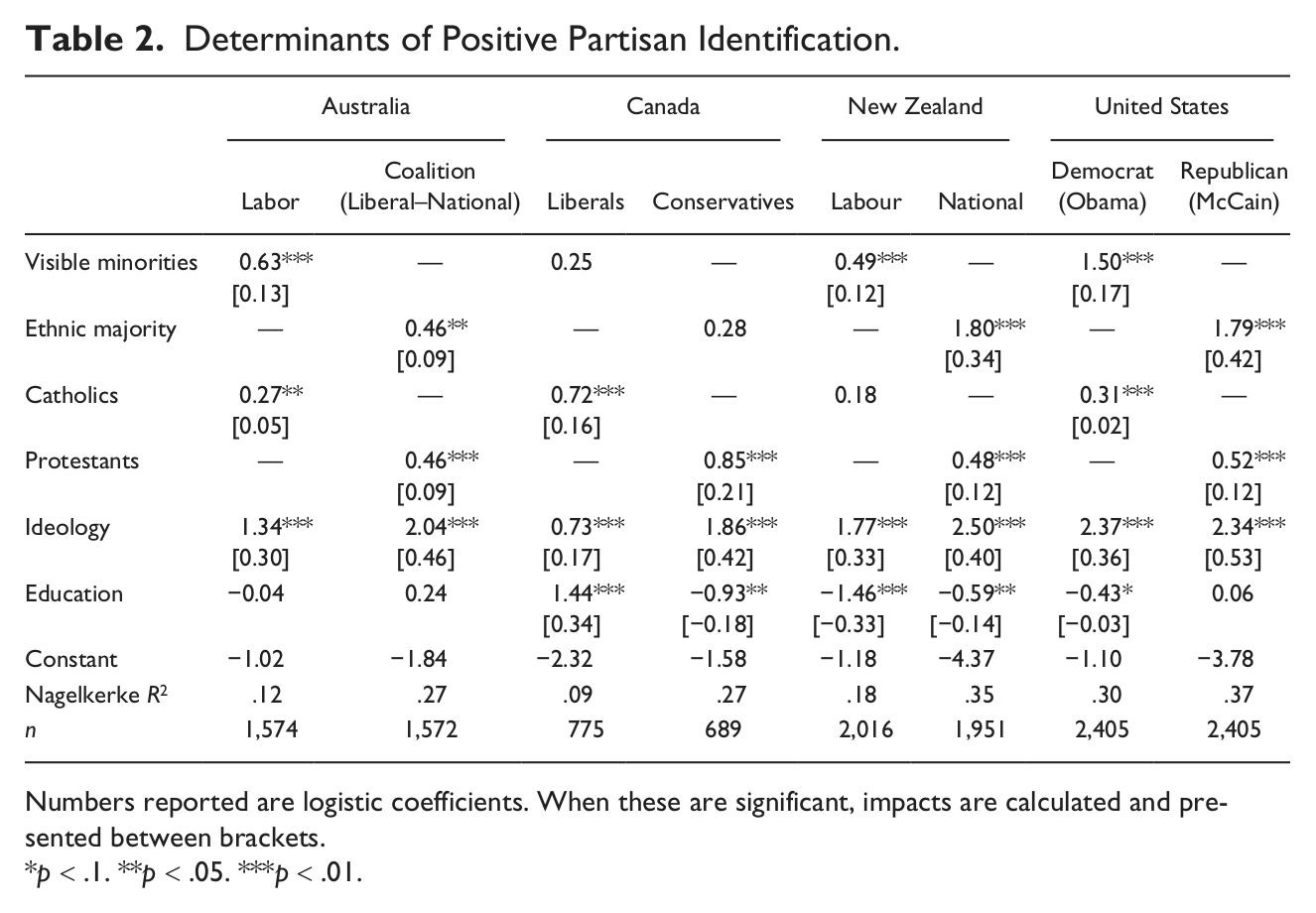
Party identification, positive and negative, thus plays an important role in explaining vote choice. Accordingly, it seems important to determine what lies behind these two variables. Table 2 presents the main determinants of positive party identification. The results indicate, first, that group identity matters. In every country except Canada, the Northern European or White majority is more likely to favor the Conservative Party, and in New Zealand and the United States, this relationship is quite strong. In these two countries, being in the majority increases the propensity of identifying with the centre-right by 34 and 42 points, respectively. As for visible minorities, they tend to support the left, with an impact ranging from 12 points in New Zealand to 17 in the United States. The exception is again Canada where, surprisingly, this relationship is not significant. Everywhere, mainline Protestants also favor the right, with an impact on positive party identification going from 9 points in Australia to 21 in Canada. As for Catholicism, it plays a significant role in all cases except for New Zealand, with a stronger impact in Canada (16 points).
Determinants of Positive Partisan Identification.
Numbers reported are logistic coefficients. When these are significant, impacts are calculated and presented between brackets.
p < .1. **p < .05. ***p < .01.
Three observations can be drawn from these findings. The first is that, comparatively, the influence of group identity seems stronger on the right than on the left. This result is intriguing because the literature on political behavior has paid more attention to the behavior of Catholics and racial minorities than to that of Protestants and ethnic majorities, sometimes seen as categories too broad and disparate to be considered as groups (Lewis-Beck et al., 2008). The second observation concerns the Canadian case, the only one where the majority/visible minorities divide seems irrelevant in 2007 and 2008. This result is surprising given the past significance of this cleavage in Canada (Blais, 2005), but it is compatible with observations already reported by the CES team, which pointed to the decline of visible minorities support for the Liberal Party in 2006 and 2008 (Gidengil et al., 2012). The third observation goes in the opposite direction, and confirms the strength of the racial question in the 2008 American presidential election (Abramowitz, 2010; Lewis-Beck et al., 2010).
Ideology also plays a strong and significant role in partisan identification, across all cases. The effect of left–right or liberal–conservative self-placement is consistently stronger on the right than on the left, and always significant and important. In all our cases, right or conservative self-placement increases the propensity of identifying with a party of the right by 40 points or more. Left self-placement also has a consistent impact on party identification, which ranges from 17 (Canada) to 36 points (United States).
Education, used as a proxy to control for socioeconomic position, yields less consistent results, as we expected. The impact of this variable is nonsignificant or weak in Australia and the United States, and it has a negative impact on party identification for both parties in New Zealand. Even when the impact of education is significant and positive, it remains minor, hardly affecting the model.
Ideology, however, matters. When it is included in a model of positive party identification, as is done in Table 2, the coefficients of determination range between .09 (Liberals in Canada) and .37 (Republicans in the United States). In regressions performed without this variable (not reported here), the same coefficients decrease to levels between .01 (Labor in Australia) and .07 (Republicans in the United States). Consider, for instance, Republican identity in the United States. If, along with education, we take Protestant identity and White as independent variables, the Nagelkerke R2 is .07; when ideology is included, it comes up to .37.
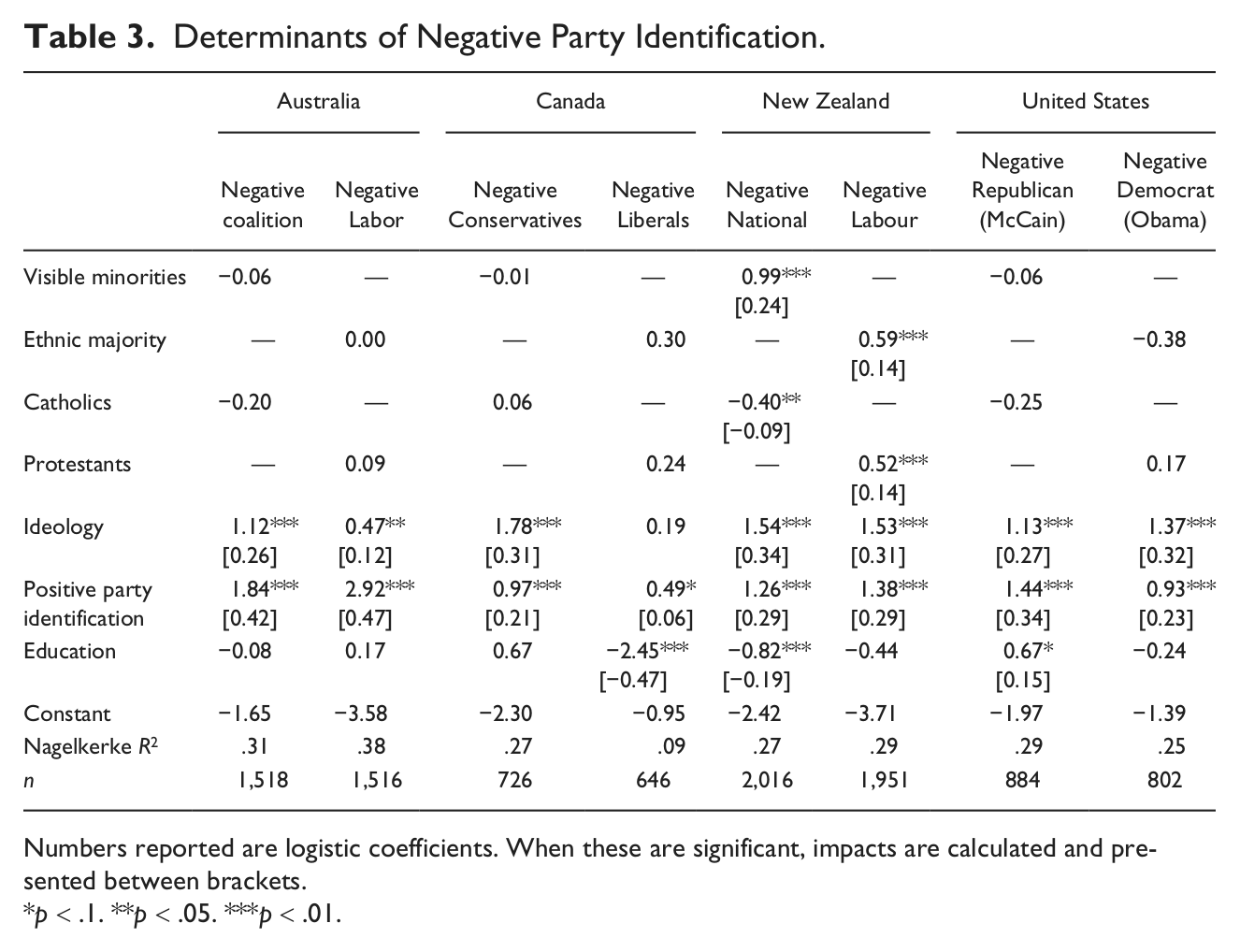
Ideology thus appears as a powerful determinant of positive party identification, alongside group identity. We can thus accept Hypothesis 2, on the significance of these two factors. We can now turn to the forgotten side of party identification. Table 3 presents results for the determinants of negative party identification.
Determinants of Negative Party Identification.
Numbers reported are logistic coefficients. When these are significant, impacts are calculated and presented between brackets.
p < .1. **p < .05. ***p < .01.
Positive party identification obviously has a strong and significant influence on negative party identification. Having a positive party identification increases the probability of never wanting to vote for the main opponent by at least 6 points (for those who would never vote for the Liberals in Canada) and by as much as 47 points (for those who would never vote for Labor in Australia).
Negative party identification, however, is not simply the bipolar opposite of positive party identification. Indeed, group identity, which is a significant determinant of positive party identification, stands as a very poor determinant of negative party identification. Only in New Zealand are the religious and racial divides related to negative party identification. Elsewhere, the relationships between group identity and negative party identification remain weak and nonsignificant.
Ideology, however, emerges as a powerful determinant of negative partisanship, with an impact ranging between 12 and 34 points. The only instance in which ideology remains nonsignificant is the Liberal Party of Canada. This specific situation may be explained by the 2004-2006 sponsorship scandal, which damaged the party’s image across all ideological families (Gidengil et al., 2012). Whatever the case, ideology remains overall a strong predictor of negative party identification, alongside positive party identification. We can thus accept Hypothesis 3.
The two sides of partisanship work together, so to speak, to produce a coherent personal vision, which in turn determines vote choice. Anchored in emotions and reason, positive party identification is an expression of group identity and ideology, whereas negative party identification seems more rooted in instrumental reasoning, with generally no connection to group identity but strong anchors in ideology and positive party ideology, which it reinforces, to end up sustaining vote choice. Interestingly, education hardly plays a role in this model, suggesting that socioeconomic background or sophistication may be less important than the basic psychological determinants of positive and negative party identification.
Conclusion
In his ambitious study of the formation of national electorates and party systems in Western Europe, Daniele Caramani (2004) shows how over time, the left–right cleavage displaced deeply anchored territorial and cultural divisions to fashion national political systems along functional lines. In the long run, politics became less a question of group identity and more one of ideology, and it became organized around the most basic and universal of all political oppositions, that between the left and the right (Noël & Thérien, 2008).
Our study on negative party identification in four Anglo-American democracies indicates that racial and religious identities create a majority/minorities arrangement that still matter for citizens. Ethnic origin, however, does not matter as much as ideology, which is found to shape positive and negative party identification and, ultimately, vote choice. Acquired early in life, group identities contribute significantly, along with ideology, to shape party identification, but intriguingly, they do not, except in New Zealand, influence negative party identification. This variable, which also has an impact on the vote, appears as a more instrumental, or cognitive instrument, determined primarily by ideology and positive party identification. In other words, ethnic and religious divisions still fashion party identification, but they do so in tandem with ideology. Even in Anglo-American democracies, where this opposition often has been considered less relevant, the politics of left and right end up driving the politics of party identification and vote choice.
One would need to consider variations over a longer period of time and across a larger number of cases to establish more precisely the meaning and relevance of negative party identification, an aspect of partisanship that is generally neglected in electoral studies. The main purpose of this article, however, is to underline the relevance of this forgotten side of partisanship. A person’s long-held commitment never to vote for a disliked party matters. Such a commitment is important in explaining the vote and, as the psychology of negative evaluations suggests, it is not fashioned by the same underlying forces as positive party identification. As our four recent cases indicate, negative views help explain political behavior and electoral outcomes, and not only when voters have to chose between “the crook and the fascist.”
Footnotes
Acknowledgements
An earlier version of this article was presented at the 2011 Conference of the Midwest Political Science Association in Chicago. We are grateful to Jim Caporaso, Patrick Fournier, Bertram Gawronski, Richard Johnston, John Jost, Jay Van Bavel, Greg Vonnahme, Herbert F. Weisberg and this journal’s anonymous referees for their help and suggestions.
Declaration of Conflicting Interests
The author(s) declared no potential conflicts of interest with respect to the research, authorship, and/or publication of this article.
Funding
The author(s) disclosed receipt of the following financial support for the research, authorship, and/or publication of this article: The authors are grateful to the Social Sciences and Humanities Research Council of Canada for the financial support of this study.