




Abstract
What are the dynamics of distributive politics in a setting of multiparty competition? Existing studies on the allocation of resources across multiple electoral districts focus primarily on a setting of two-party competition and consider only the core versus swing district hypotheses. This framework does not correspond to the actual electoral setting in many countries and ignores valuable information furnished by a context of multiparty competition. Compared with two-party elections, multiparty elections provide more information about the underlying distribution of the ideological preferences of voters in a district; this information could be utilized by the incumbent party to maximize electoral returns. In this article, I argue that a setting of multiparty competition presents incentives to the incumbent party to channel disproportionately more resources to districts with an ideologically close challenger. Systematic evidence from the Conditional Cash Transfer program spending in 878 districts of Turkey from 2005 to 2008 supports this hypothesis.
What are the dynamics of distributive politics in a setting of multiparty competition? While public spending patterns in democratic regimes suggest that electoral considerations play an important role in the distribution of expenditures, both theoretically and empirically, the focus of the extant literature has been on settings of two-party competition (Cox, 2009). However, a survey of the legislative elections in 125 countries between 1946 and 2000 reveals the mean effective number of electoral parties during this period to be 4.3 (Golder, 2005). Thus, there is a discord between the existing approaches to the study of distributive politics and the actual electoral setting in many countries, and we know little about whether the two-party framework could be readily applied to the cases of multiparty competition.
In this article, I take the first step toward addressing this concern by considering the dynamics of distributive politics in a setting of multiparty competition. Specifically, I argue that the core versus swing district dichotomy is not an adequate framework for studying the optimal strategy of the incumbent party in a multiparty setting, and an important factor in this regard is whether the incumbent party faces an ideologically close or distant challenger in an electoral district. 1 My hypothesis is that in a setting where parties have relatively stable and distinguishable ideological positions, the incumbent party would spend more resources in a district where the challenger is an ideologically close party, compared with what the incumbent party would spend in a district with an ideologically distant challenger. This prediction is distinct from those of both core and swing district hypotheses; the former posits that the incumbent party should focus on its electoral strongholds, whereas the latter implies that resources should be directed toward highly competitive districts with scant attention given to the partisan identity of the challenger.
My argument is based on the observation that multiparty election results provide more information compared with two-party elections regarding the underlying distribution of voters’ ideological preferences in electoral districts. This information can be utilized by the incumbent party to identify the districts where ideologically similar parties have a strong presence. Specifically, I argue that the incumbent party would be able to obtain relatively more votes in response to a material offering when it directs resources to districts with an ideologically similar competitor. Evidence has been presented in the literature that “voters have a greater propensity to switch their [party] preferences in a context in which the policy space is relatively abbreviated” (Bartolini & Mair, 1990, p. 208); this suggests that ceteris paribus, the larger the constituency of an ideologically close party in the district, the larger is the pool of voters who can potentially switch their votes in response to a material inducement from the incumbent party. This inference would not be possible if we adopt the simple core versus swing framework.
I test my hypothesis using data on elections, socioeconomic indicators and expenditures of the Conditional Cash Transfer (CCT) program in 878 subprovincial districts (ilçe) of Turkey from 2005 to 2008. Turkey is an appropriate case for empirical analysis given its multiparty electoral setting where party labels are important and the presence of a social program that leaves room for discretionary decision making. The analysis provides strong evidence in support of my argument. After controlling for socioeconomic factors, level of electoral competition, and incumbent support, there has been more spending in districts where the incumbent party faces an ideologically close challenger compared with districts where the challenger is an ideologically distant one. This result highlights the relevance of the partisan identity of the challenger to the incumbent party for the dynamics of distributive politics in a multiparty environment.
The rest of the article is organized as follows: The following section provides an overview of the relevant literature and presents my argument. Next, I introduce the empirical context by giving a synopsis of the CCT program during the period of interest. In the subsequent section, I discuss some advantages of the research design employed for the study. The penultimate section presents the empirical analysis and discussion of the results, followed by conclusion.
Distributive Politics and Multiparty Competition
Several empirical studies suggest that economic factors alone do not satisfactorily explain the variation in the geographic allocation of targetable goods or social program spending. Political factors play an important role as well. In turn, there are primarily two views on how incumbents can optimize their electoral prospects through the allocation of distributive programs. The swing district hypothesis posits that incumbents should channel disproportionately more resources to highly competitive districts, that is, swing districts, because “doing a bit better in a swing district can . . . make the difference between losing and winning a seat” (Cox, 2009, p. 346). In contrast, the core district hypothesis holds that material benefits should be directed toward the strongholds of the incumbent. Díaz-Cayeros, Estévez, and Magaloni (2011) argue that the partisan loyalties of voters are conditional on the history of previous spending patterns, so that a party has to take care of its core constituency to maintain its electoral coalition over the long run. Cox (2009) offers alternative explanations for the logic behind the core district hypothesis, noting that incumbents might be probability-of-majority maximizers rather than vote maximizers or that the targeting of benefits might follow a legislative, rather than an electoral, logic.
To date, empirical studies have yielded mixed results (Stokes, 2007). In support of the core district hypothesis, Calvo and Murillo (2004) report that in Argentina the provincial vote share of the incumbent Peronist party is positively associated with federally financed expenditures. Yet in Argentina, Giraudy (2007) finds that Peronist governors have been rewarded with a greater proportion of employment programs than their Radical counterparts. Díaz-Cayeros et al. (2011) suggest that in Mexico, larger Pronasol transfers are strongly associated with the traditional strongholds of the incumbent PRI in municipal elections. Horiuchi and Lee (2008) report that in South Korea, the incumbent president’s strongholds have received disproportionately larger amounts of pork-barrel benefits. Studies presenting evidence in support of the swing district hypothesis are not less numerous. Dahlberg and Johansson (2002) study the distribution of a grant program from the central government to municipalities in Sweden and find that the closer the race was in the last election, the higher was the probability of getting money from the central government. Magaloni (2006) reports that in Mexico, the incumbent PRI assigned less funding to the municipalities that it expected to win by landslide and more to those that were highly contested. Similarly, Weitz-Shapiro (2006) finds that in Argentina, the distribution of unemployment compensation funds was biased in favor of swing districts. In South Korea, Kwon (2005) reports that larger amounts of national subsidies have been allocated to competitive provinces. Schady (2000), on the other hand, presents evidence in both directions: In Peru, both the swing and the core districts received a disproportionately large share of the Peruvian Social Fund (FONCODES) expenditures.
A crucial observation about existing studies is their exclusive focus on a theoretical and empirical framework of two-party competition. Under the assumptions of symmetry and single-peakedness about the distribution of voters’ ideological preferences in a two-party system, there is a one-to-one correspondence between the size of the swing voters (i.e., the group of voters who are relatively indifferent ideologically between the two parties) and the closeness of the last election in an electoral district (Dahlberg & Johansson, 2002, pp. 29-30). Thus, the predominant approach in the literature has been to focus on a case of two-party competition and examine the relationship between the competitiveness of districts and the distribution of resources. Such a conceptualization of the research question implies that incumbents focus on only one characteristic of the districts—competitiveness, that is, the margin of victory—and empirical tests are carried out accordingly. For example, the political explanatory variables in the analysis of Schady (2000) consist of measures of marginality and core support for the incumbent. Dahlberg and Johansson (2002) focus on the vote shares of socialist versus conservative blocs. In the Argentine studies, the typical explanatory variable is the Peronist vote share, while for Mexico, during the PRI hegemony, the focus is on the PRI vote share and its margin of victory.
While such an approach might be appropriate for studying distributive politics in two-party systems, I argue that we need to go beyond this simple dichotomy of swing versus core districts in a multiparty context. In a multiparty environment, the main competitor (i.e., the challenger) of the incumbent party might be a different party in different districts. It follows that not all swing districts are the same in such a context: There will be swing districts where the incumbent party faces an ideologically similar challenger party as well as districts where the challenger party is ideologically distant. I argue that it is this multitude of district types in a multiparty context that enables the incumbent party to optimize its strategy.
Specifically, when there are multiple competitive parties, an incumbent party can gather valuable district-level electoral information by observing the vote shares of other parties and looking at the ideology of the party that was its nearest competitor in terms of votes, that is, the challenger, in the most recent election. This information is useful because if the challenger party in the district is ideologically close to the incumbent party, the pool of voters who could switch their votes from the challenger party to the incumbent party in response to a material benefit would be relatively larger compared with a district where the challenger is an ideologically distant party. Accordingly, the correct inference for the incumbent party would be to target the districts where the challenger party is ideologically closer. It is possible, however, that this strategy might be further conditioned by electoral incentives due to different electoral rules. For example, if the incumbent party is interested only in maximizing its vote share across the districts, as in elections with multimember districts and proportional representation, then it would be optimal to focus on districts with an ideologically close challenger without regard to the competitiveness of districts. In contrast, in elections that stipulate a single-member district-plurality rule, the incumbent party might choose to focus only on moderately to highly competitive districts because directing resources to districts where the incumbent party is very strong or very weak would yield no direct electoral benefits. In this case, the effect of the presence of an ideologically close challenger should be observed in moderately to highly competitive districts only.
To recapitulate, I argue that the dynamics of distributive politics in a setting of multiparty competition, where the incumbent party might face different challengers in different districts, cannot be properly understood by employing the core versus swing district dichotomy only. In a multiparty context, not all swing districts are the same and the incumbent parties might be strategic in selecting the swing districts to which they target their resources. There are strong incentives for the incumbent party to focus on districts where the challenger is ideologically closer, and a setting of multiparty elections renders this strategy feasible. By doing this, the incumbent party would be able to attract relatively more voters for a given amount of resources. Accordingly, the aforementioned theoretical reflections result in the following testable hypothesis for my argument.
Hypothesis 1: In a setting of multiparty competition, the incumbent party should channel disproportionately more resources to districts with an ideologically close challenger. In elections with plurality rule, however, this effect should be observed in moderately to highly competitive districts only.
The alternative to my argument is that the dynamics of distributive politics in a setting of multiparty competition are not different from that of a two-party competition, and thus we would have two alternative hypotheses—the core and swing district hypotheses.
Hypothesis 2 (Core district hypothesis): In a setting of multiparty competition, the incumbent party should channel disproportionately more resources to its electoral strongholds regardless of the partisan identity of the challenger in the district.
Hypothesis 3 (Swing district hypothesis): In a setting of multiparty competition, the incumbent party should channel disproportionately more resources to highly competitive districts regardless of the partisan identity of the challenger in the district.
This framework will guide my empirical investigation of the CCT program in Turkey. The next section provides a brief description of the empirical context around the time period of interest, followed by a discussion of the research design.
The Empirical Context
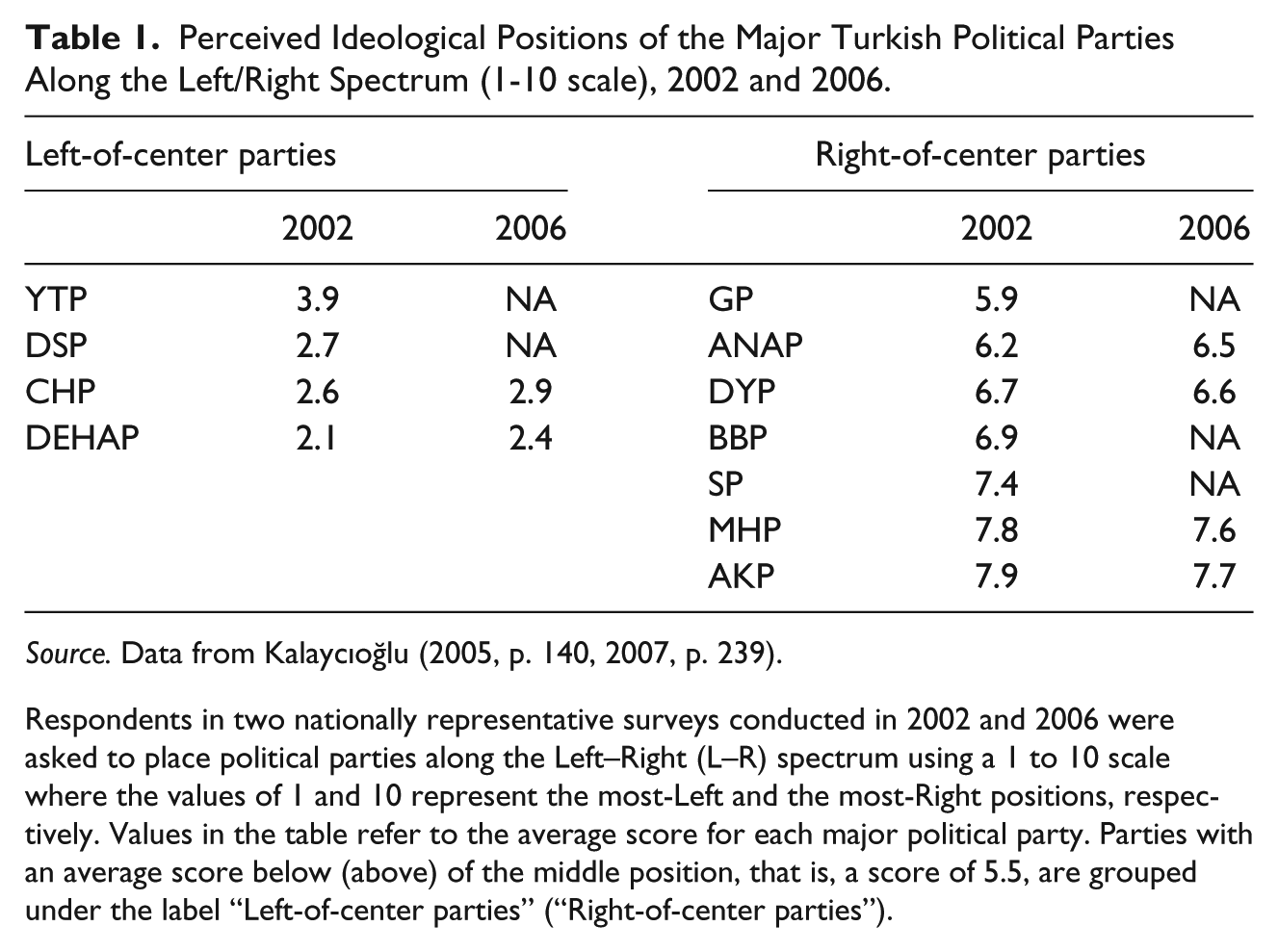
Turkey is an appropriate case for empirical analysis. It has a multiparty system where party labels are important and parties have relatively stable, distinguishable ideological positions. 2 By the time of the 2004 local elections, Turkey was ruled by the one-party government of the Justice and Development Party (Adalet ve Kalkınma Partisi; AKP). 3 The last national elections were held in 2002 when newly founded AKP emerged as the leading party of the country with 34.3% of the votes, followed by the Republican People’s Party (Cumhuriyet Halk Partisi; CHP). 4 Table 1 presents the perceived ideological positions of the major parties along the Left–Right (L–R) spectrum (drawn from nationally representative surveys conducted in 2002 and 2006); it can be seen that there has been little change in placements from 2002 to 2006, providing evidence for the stability of the parties’ ideological positions. In addition, the fact that the design of the social program to be studied leaves room for discretionary decision-making at the enrollment stage (discussed later) provides an opportunity to analyze the effects of political factors on the distribution of benefits. Beyond these particular merits of the Turkish case for testing the proposed argument, the comparative analysis of subnational units within a single country offers a number of advantages, including a larger number of observations and the ability to control for broad cultural and historical factors to a greater extent than is possible by comparing national units (Snyder, 2001).
Perceived Ideological Positions of the Major Turkish Political Parties Along the Left/Right Spectrum (1-10 scale), 2002 and 2006.
Source. Data from Kalaycıoğlu (2005, p. 140, 2007, p. 239).
Respondents in two nationally representative surveys conducted in 2002 and 2006 were asked to place political parties along the Left–Right (L–R) spectrum using a 1 to 10 scale where the values of 1 and 10 represent the most-Left and the most-Right positions, respectively. Values in the table refer to the average score for each major political party. Parties with an average score below (above) of the middle position, that is, a score of 5.5, are grouped under the label “Left-of-center parties” (“Right-of-center parties”).
The CCT Program in Turkey
CCT programs provide cash payments to poor households on the condition that they make prespecified investments in the human capital of their children. Such investments are usually embodied in two types of conditions: health and nutrition conditions that require periodic checkups, and education conditions that include a measure of school attendance. The first large-scale CCT program was launched in Mexico in 1997, and interest in such programs has grown significantly since. Today, virtually every country in Latin America has such a program, and there are large-scale programs in Bangladesh, Indonesia, and Turkey (Fiszbein & Schady, 2009).
The pilot phase of the CCT program in Turkey was launched in February 2002 in six districts as a part of the Social Risk Mitigation Project initiated with a loan from the World Bank. The decision to expand the program was made in March 2003, and nationwide implementation began in May 2004. By the end of 2012, approximately 2.9 million children were enrolled in the program and total yearly payments reached 690 million TL (approximately US$390 million). Monthly payments to households depend on the number of children in the program and the specific subcategory they are enrolled in, ranging from 30 to 55 TL (approximately US$17 to US$31) per child as of 2012.
The program is implemented by the General Directorate of Social Assistance and Solidarity (GDSAS), a government agency directly responsible to the Prime Ministry. 5 GDSAS is funded by the national budget and these funds are distributed to Social Assistance and Solidarity Associations (hereafter “local associations”) that are established in all subprovincial districts of Turkey. 6 These local associations have an executive committee headed by the centrally appointed governor (or district governor) and a majority of its members are centrally appointed local bureaucrats. 7 The selection of beneficiaries to the program is the responsibility of this committee, which also has the authority to override certain formal eligibility requirements for enrollment, and thus can enroll individuals who are formally not eligible but are considered “needy.” This autonomy of the local executive committees and its composition of mostly centrally appointed local bureaucrats have important implications for the research. 8
The enrollment process into the CCT program during the period of interest can be summarized as follows. Individuals apply to the local association in their district by filling up a questionnaire, which is a proxy-means test based on a poverty-scoring formula, and they submit supporting documents about their financial situation. 9 A computer program assigns a “poverty score” for each application. Applicants with scores below a certain threshold become “potentially eligible”; they become “formally eligible” only after information given in the questionnaire is verified on house visits by association officials. Next, the executive committee evaluates all applications (eligible as well as ineligible). Applicants with poverty scores above the threshold are not automatically excluded from consideration, and they can still be enrolled at the discretion of the executive committee. 10 Finally, approved applications are entered into the system, and the GDSAS takes over the responsibility for payments.
The fact that there is room for discretionary enrollment by the executive committee exposes it to political pressure. The committee, which is largely composed of centrally appointed local bureaucrats including its head, could be pressured by the local operatives of the (national) incumbent party to increase the number of beneficiaries in the district by enrolling applicants into the program who would be formally ineligible. In theory, local operatives of any party should not play a role in the operations of the local associations; in practice, however, this principle could be violated because the bureaucrats have incentives to serve the interests of the (national) incumbent party given that they are centrally appointed. Over the years, there have been several reports in the media suggesting that the operations of the local associations were supervised by the local operatives of the (national) incumbent party and that they have played a significant role in determining the recipients of the programs (e.g., Aykır, 2006; Çağlar, 2009). A case that received considerable attention in the media was the distribution of household appliances in Tunceli, a small province in Eastern Turkey, just 2 months before the local elections of 2009. The opposition condemned the practice as election bribery, and in a few days the High Election Board filed a complaint to courts against the governor—acting as the head of the local association—arguing that the distribution of goods constituted a breach against the laws regulating the neutrality of public officials. Eventually, the governor was found guilty of using governorship facilities for a party’s election campaign, yet the verdict was delayed. 11 Prime Minister Erdoğan praised the governor for his “sensitivity to people’s needs” and as of 2013 the bureaucrat serves as the governor of another province, Kırklareli. His new appointment can be considered a promotion as he moved from a relatively poor and small province to a larger and more developed one.
Research Design
For the empirical analysis, I use district-level data on CCT expenditures, socioeconomic indicators, and electoral outcomes to establish whether between-district differences in CCT expenditures can be partly explained by political factors. While a detailed description of the variables and data will be presented in the next section, here I briefly discuss my research design to address some potential concerns.
First, studies that investigate the effect of electoral outcomes on the distribution of resources usually suffer from a simultaneity problem in the sense that electoral outcomes are affected by the distribution of resources in the previous periods. Accordingly, scholars highlight the value of research that focuses on new social programs (Magaloni, 2006; Schady, 2000). The Turkish CCT program represents such an opportunity, as its nationwide implementation began in May 2004, shortly after the local elections of March 2004. Given that I base my electoral variables on the 2004 elections to analyze the allocation of CCT expenditures from 2005 to 2008, the results of the 2004 elections should not have been affected by CCT expenditures, and thus simultaneity should not be a source of bias for the parameter estimates. Figure 1 presents a sketch of the temporal framework of the empirical analysis.
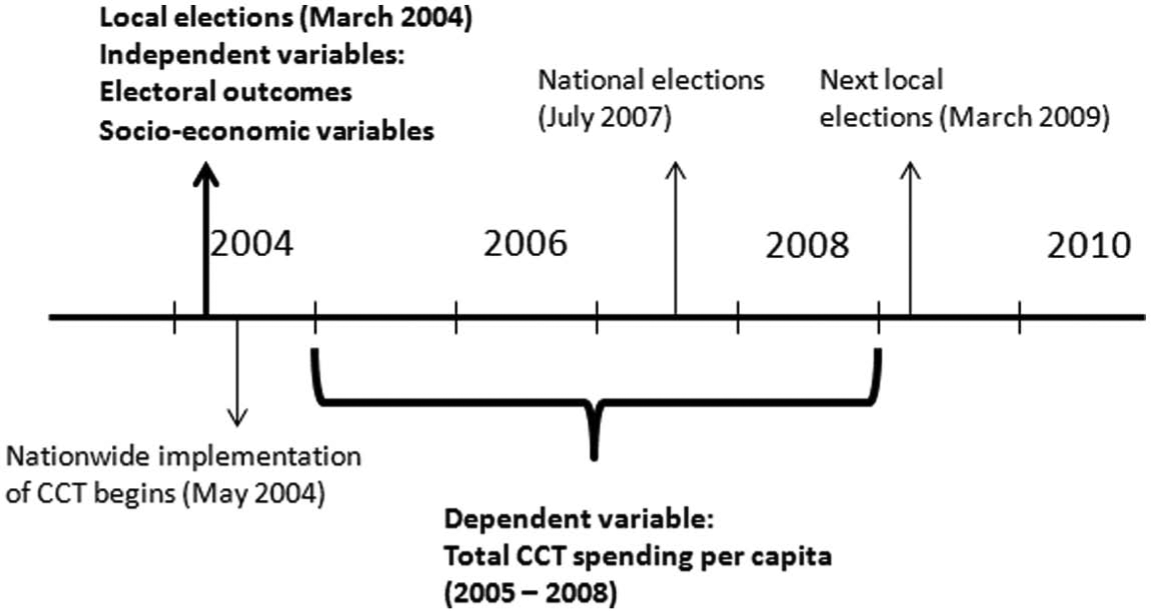
The temporal framework of the empirical analysis.
Second, in the context of the Turkish CCT program, the core argument of the article corresponds to the expectation that there should be more spending in districts where the national incumbent party AKP faces an ideologically close challenger after controlling for other relevant factors. Conceivably, we can expect two mechanisms to result in this observation. The local operatives of AKP could either wield political pressure on the local association to enroll a large number of formally ineligible applicants, or could exert more effort to publicize the program in their districts to increase awareness and hence the number of beneficiaries. I argue that two features of the Turkish CCT program make both interpretations plausible. First, as I have already indicated, the executive committees of the local associations have a certain level of discretion that allows them to enroll formally ineligible applicants. There is evidence that they have exercised this discretion to a considerable degree: As of 2010, for every three beneficiaries who were formally eligible, there was roughly one formally ineligible beneficiary who was enrolled into the CCT program by the decision of the executive committees. 12 Second, my interviews with officials at the local associations and at the central organization (GDSAS) indicate that, at least during the period of analysis, the local associations did not face any budget problems regarding the number of beneficiaries they could enroll. 13 This budgetary largess is also reflected in the increases in stipends. Increases in monthly stipends ranged from 22% to 50% for 2011, whereas inflation in Turkey during 2010 remained at 6.4%. These two elements of the Turkish CCT program suggest that investigating whether there has been more CCT spending in districts where the incumbent party competes with an ideologically close party, after controlling for other relevant factors, is an appropriate strategy to test my hypothesis. 14
Finally, another concern about the research design might be the level of analysis. Are the subprovincial districts the appropriate level of analysis in terms of relevance for party strategies, and why do we focus on local elections instead of national elections? In addition, if the program originates at the national level, why would it support the election of the local candidates of the national incumbent party? Regarding electoral incentives, the subprovincial districts that I analyze are the lowest-level electoral constituencies in Turkey, and in local elections the plurality winner in each district wins the district municipality; thus, they are the relevant units for party strategies in such elections. Moreover, the local associations that are responsible for enrolling beneficiaries are also organized at the subprovincial district level and are independent from each other. Therefore, there is a match between electoral incentives in local elections and the structure of the CCT program. However, for national elections, Turkey has a closed-list proportional representation system with multimember constituencies corresponding to provinces (the units above the subprovincial districts). Accordingly, subprovincial districts are not pivotal for party strategies in national elections because they are not separate constituencies, and a focus on local elections is more appropriate in this context.
Regarding the link between the national origin of the program and support for the local candidates of the national incumbent party, available survey evidence suggests that national-level outcomes weigh heavily in the voting decision of the Turkish electorate in local elections. While one might speculate that in such elections, parties’ local candidates should be the most important consideration in the voters’ eyes, remarkably, supporters of all the major parties participating in the 2009 local elections have reported “parties’ local candidates” as either the fourth or the fifth most important factor (behind national-level factors such as party ideology, party leader, and party’s track record in services without a national- vs. local-level distinction) in their voting decision according to a nationally representative survey (A&G Araştırma, 2009). Thus, it is plausible to argue that a national-level program such as the CCT could benefit the national incumbent in the local elections as well, at least in the Turkish context. In addition, the CCT program is a recurring theme in the campaign speeches—in the national and local elections —of Prime Minister Erdoğan, and it is hard to miss photographs of him in the local associations.
Empirical Analysis
To test my hypothesis on the relevance of the partisan identity of the challenger to the incumbent party for the dynamics of distributive politics in a multiparty environment, I estimate a model in which past electoral outcomes and socioeconomic variables are used to determine the district-level distribution of future CCT expenditures. The unit of analysis is the subprovincial district and the dependent variable of the model is the natural logarithm of (aggregated) per-capita CCT expenditures from 2005 to 2008 in a district. 15 This period corresponds to the years between two consecutive local elections (held in March 2004 and 2009). Figure 2 presents the distribution of expenditures across the districts.
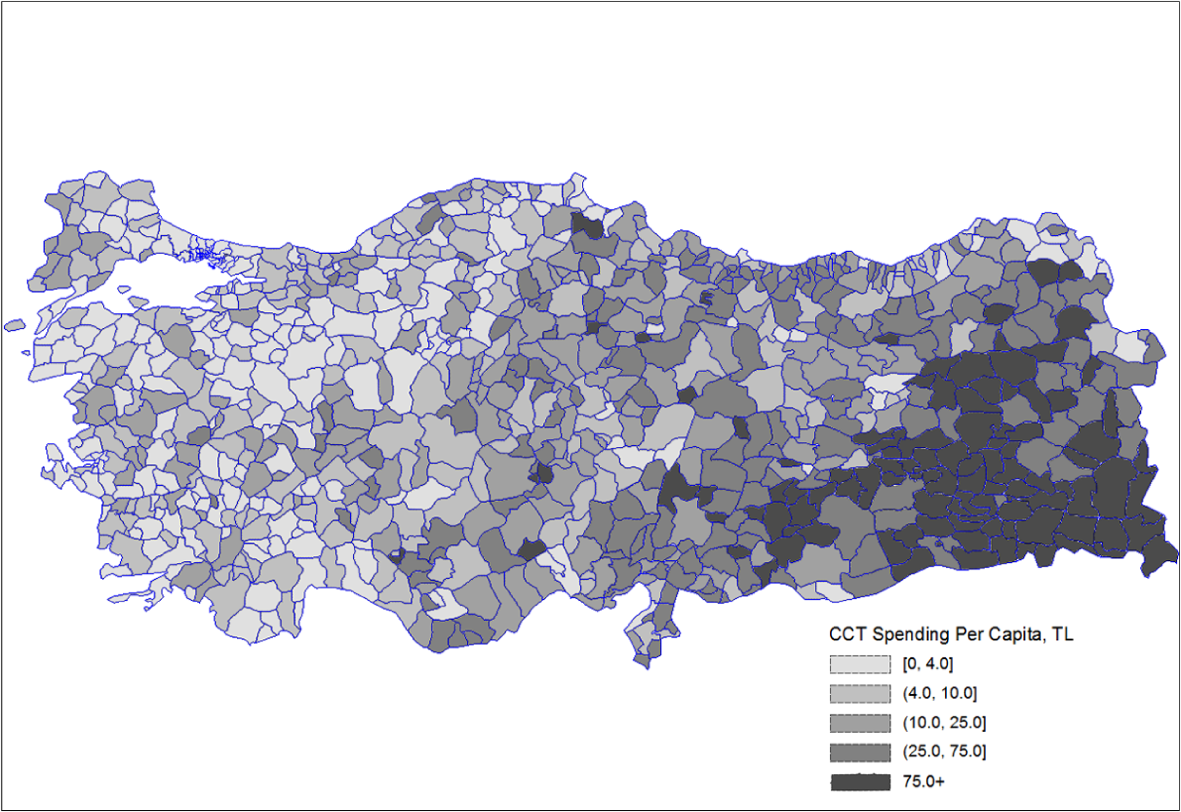
The distribution of aggregate CCT spending per capita, 2005-2008.
In the benchmark model, four district-level socioeconomic factors are utilized as independent variables: population, urbanization rate, infant mortality rate, and a dummy variable indicating whether the district is located in Eastern/Southeastern Anatolia. In rural areas, it might be difficult for state officials and potential beneficiaries to reach each other, so urbanization might have a positive effect on spending. However, the latest poverty study by the Turkish Statistical Institute suggests that individuals in rural areas have greater poverty risk (Turkstat, 2011). Thus, the overall effect of urbanization on spending is not clear. The infant mortality rate refers to the number of infant deaths before the age of one for every thousand births; these data are drawn from a comprehensive government report about the socioeconomic development levels of Turkish subprovincial districts. 16 Finally, the rationale for the Eastern/Southeastern Anatolia dummy variable is that this region is the least developed and mostly Kurdish-populated area of Turkey, where armed confrontations between the Turkish army and Kurdish insurgents occasionally intensify. CCT expenditures might have a different pattern in this region and there are anecdotal accounts suggesting that state institutions are pressured to develop this region. Data for urbanization rate and infant mortality rate are as of 2004, while population data are from 2007.
Key political explanatory variables are based on 2004 local election results. AKP vote share is the vote share of the national incumbent party, and thus is a proxy for the (national) incumbent party support in the district. Competitiveness refers to the negative of the absolute value of the vote difference between AKP and its challenger. 17 While the core district hypothesis (Hypothesis 2) would predict a positive effect for AKP vote share on spending, the swing district hypothesis (Hypothesis 3) would predict a positive effect for Competitiveness.
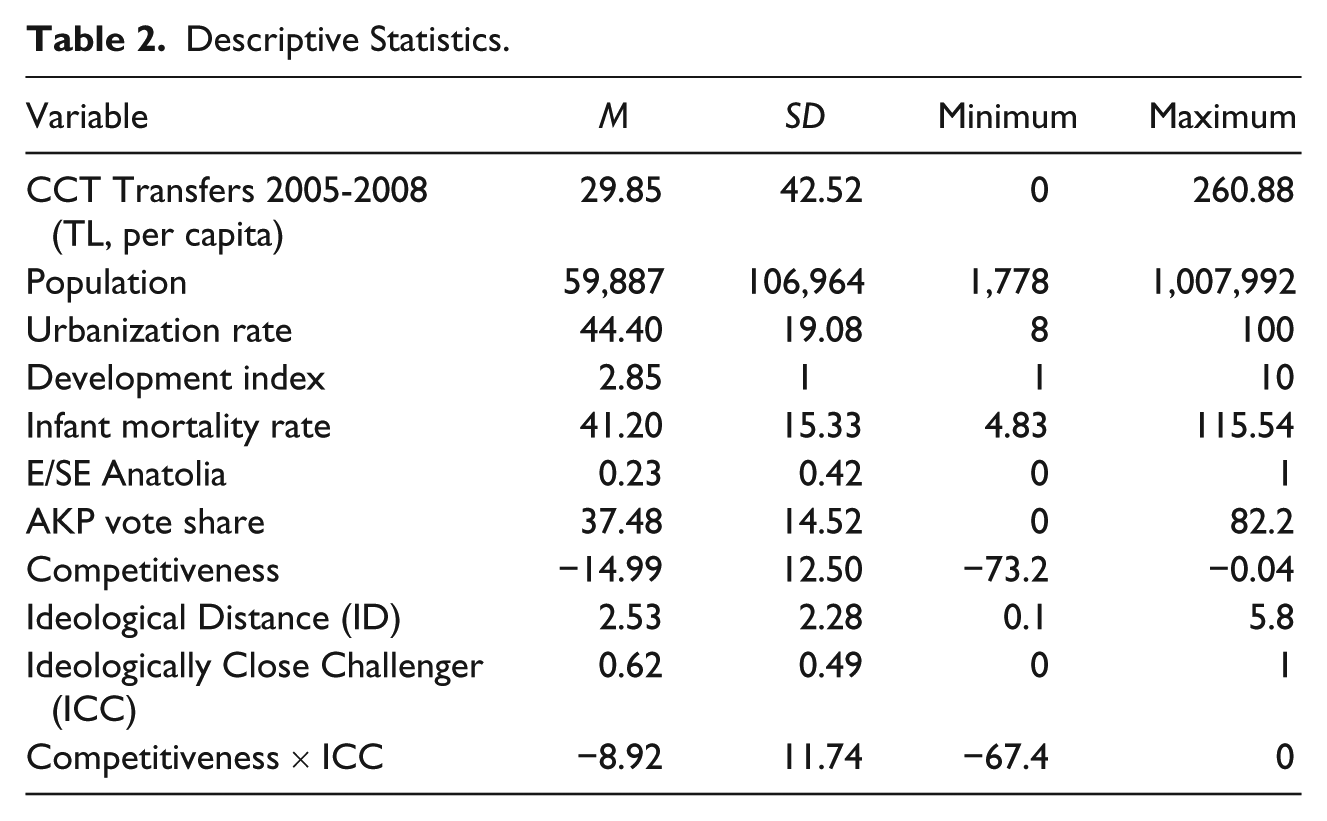
The third political variable, and the most important one for the hypothesis of this research, is the dummy variable Ideologically Close Challenger (ICC). To construct this variable, I employed the data from the nationally representative survey conducted in 2002 as presented in Table 1. It shows that Turkish voters locate the incumbent AKP at the right end of the ideological spectrum. Using this scheme, I coded this dummy variable as unity when the challenger party is located at the right of the middle position of 5.5. Among the major parties, MHP and DYP are identified as ideologically close parties to AKP, whereas CHP and DEHAP are not. I employed a dichotomous measure instead of coding the ideological distance as a continuous variable because it is more intuitive in the light of the argument presented. Moreover, in the Turkish case there seems to be a natural clustering of major parties along the L–R spectrum. Figure A1 in the appendix shows the number of districts according to the ideological distance of the challenger from AKP; it can be seen that in most districts the challenger is either ideologically very close to or very distant from AKP. Thus, we do not lose much information by employing a dichotomous structure. Nevertheless, I also repeat the analysis with the continuous measure of ideological distance. The last independent variable in the benchmark model is the interaction term Competitiveness × ICC. This variable is especially important due to the electoral context under consideration—that is, the election of the mayor with plurality rule—because the plurality rule presents incentives to the incumbent party to focus only on moderately to highly competitive districts. Hence, the effect of the presence of an ideologically close challenger (ICC = 1) should be particularly manifest in such districts. Table 2 reports the summary statistics for the variables used in the analysis.
Descriptive Statistics.
Model Estimation and Results
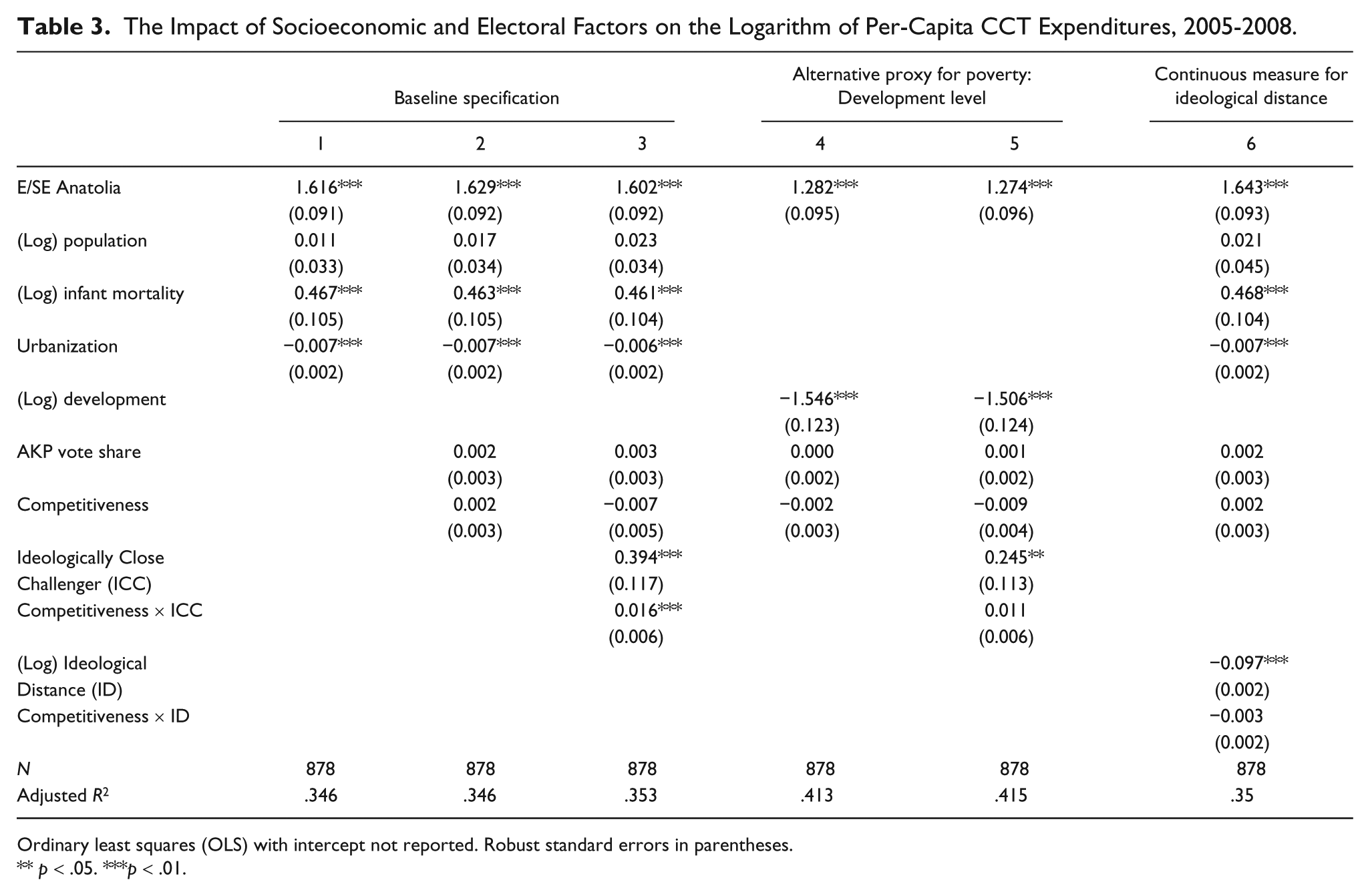
In Table 3, I present the estimates of the impact of socioeconomic and electoral factors on the logarithm of per-capita CCT expenditures from 2005 to 2008 using ordinary least squares (OLS) regression. Column 1 reports results of the regression on the four socioeconomic variables only. The analysis suggests that the CCT program has had an important redistributive function, as per-capita spending is positively associated with infant mortality rate and districts in Eastern/Southeastern Anatolia. The fact that the districts in Eastern/Southeastern Anatolia, the mostly Kurdish-populated area of Turkey, receive disproportionally more spending even after controlling for poverty resonates well with recent research that reports that social assistance programs in Turkey are directed disproportionately to the Kurdish region (Yörük, 2012). The urbanization rate is negatively associated with spending, supporting the observation that individuals in rural areas of Turkey have a greater poverty risk, although substantively the estimated effect is not large.
The Impact of Socioeconomic and Electoral Factors on the Logarithm of Per-Capita CCT Expenditures, 2005-2008.
Ordinary least squares (OLS) with intercept not reported. Robust standard errors in parentheses.
p < .05. ***p < .01.
In column 2, I add the two measures that are extensively used in the literature to determine political impact on spending, namely, measures of core support for the incumbent party (AKP vote share) and competitiveness of a district (Competitiveness). Interestingly, both variables are insignificant. Accordingly, empirical evidence does not lend support to Hypotheses 2 and 3 (core and swing district hypotheses, respectively). Thus, if we had analyzed CCT spending patterns among districts in Turkey using only conventional measures of political influence that are intended for a setting of two-party competition, we would have concluded that political factors played no role in this case.
The model in column 3, where I add the dummy variable ICC and the interaction term Competitiveness × ICC, presents a different picture. Given that the model includes an interaction term, the coefficients are not illuminating on their own, and thus Panel A in Figure 3 illustrates the estimated effect of the presence of an ideologically close challenger (ICC = 1) and the corresponding 95% confidence interval across the whole range of the variable competitiveness. We see that the presence of ideologically close challenger has a positive and statistically significant effect on CCT spending in all moderately to highly competitive districts (62% of all districts, to be precise). This result is in line with my prediction given that the plurality electoral rule presents incentives to the incumbent party to focus on districts that are at least moderately competitive. Moreover, the effect of the presence of ideologically close challenger on CCT spending is increasing with higher levels of competition in a district, and its magnitude is substantively significant as well: For example, for a district at the 50th percentile of competitiveness (corresponding to a vote margin of 11.8 points between AKP and its challenger), the estimated increase in per-capita CCT spending due to the presence of ideologically close challenger is 23%. For a districts at the 90th percentile of competitiveness (corresponding to a vote margin of 2.4 points), the estimated effect jumps to 43%. The results confirm that there has been more spending in districts with an ideologically close challenger, and we can detect some influence of political factors in the (district-level) distribution of CCT funds if we move beyond the conventional measures operationalized in a setting of two-party competition.

The effects of the presence of an ideologically close challenger and the ideological distance of the challenger on CCT spending in districts.
To check whether the results are robust to a different proxy for poverty, I replace the infant mortality rate with district development index, development, in columns 4 and 5 of Table 3. This index is a composite measure consisting of the weighted average of thirty-two variables, such as infant mortality rate, literacy rate, and per-capita electricity consumption, and it represents the most recently available district-level data on socioeconomic development (Dinçer & Özaslan, 2004). 18 In this case, I drop population size and urbanization rate as independent explanatory variables because they are already employed in the construction of the development index. 19 We see that the results are again in line with my argument: While the estimates for the measures of core support for the incumbent party and competitiveness of a district are insignificant (column 4), the presence of ideologically close challenger has a positive and statistically significant effect on CCT spending in moderately to highly competitive districts (Figure 3, Panel B). In this specification, the relationship is statistically significant for 32% of districts, and for a district at the 75th percentile (90th percentile) of competitiveness, the estimated increase in per-capita CCT spending due to the presence of ideologically close challenger is 20% (25%).
Finally, I investigate whether the results are driven by my choice of coding the ideological distance of the challenger as a dummy variable. Using data for the year 2002 as presented in Table 1, I define a new variable, Ideological Distance (ID), which designates the difference in perceived ideological positions between the incumbent AKP and the challenger party in a district. For example, in Table 1, we see that the perceived ideological positions of AKP and CHP in 2002 are 7.9 and 2.6, respectively. Thus, if the challenger party in a district is CHP then the variable Ideological Distance takes the value of 5.3. Column 6 of Table 3 and Panel C of Figure 3 report the results of the analysis when I replace the (dummy) variable ICC with ID in the benchmark specification. Again, we see that the results are robust when we operationalize ideological distance as a continuous variable. Ideological distance of the challenger to the incumbent party has an increasingly negative and statistically significant effect on CCT spending in moderately to highly competitive districts (71% of the districts, Figure 3, Panel C).
Overall, the empirical results provide strong support for my hypothesis that in a context of multiparty competition, the incumbent party should direct more resources to districts where the challenger is an ideologically close party. In the Turkish CCT program, the positive effect of the presence of an ideologically close challenger on program spending is statistically significant in all but the least competitive districts. This observation is in line with the incentives presented by the specific electoral context under consideration where plurality rule should motivate a focus on moderately to highly competitive districts. The results are robust to different measures of the key variables and the effect is substantively important; in the benchmark specification, for a district at the median level of competitiveness, the presence of an ideologically close challenger leads to a 23% increase in per-capita CCT spending.
Potential Causal Mechanisms
As briefly discussed previously, there are two potential causal mechanisms that could explain the observation that there has been more spending in districts where the challenger is an ideologically close party to the incumbent. First, we should note that the CCT program is demand-driven where potential beneficiaries need to be aware of the opportunity and reach the local association to submit their application. Accordingly, it might be the case that the local officials of AKP have exerted relatively more effort to publicize the program in districts where the challenger is ideologically close, which led to an increased awareness of the program and a high number of beneficiaries. Alternatively, the local operatives of AKP could have wielded relatively more political pressure on the local associations to enroll a large number of formally ineligible applicants in the districts where the challenger is ideologically close, knowing that the potential electoral returns of such an effort would be higher in such districts.
To distinguish between these two possible mechanisms, I present an analysis of the number of district-level household applications to the CCT program. One observable implication of the first mechanism—that the local officials of AKP could have exerted more effort to publicize the program in districts where the challenger is ideologically close, —is that there should be more applications in such districts. In contrast, if the number of applications in districts where the challenger is ideologically close is not different from other districts, it would lend support to the second mechanism—that local associations face pressure to enroll a larger number of applicants.
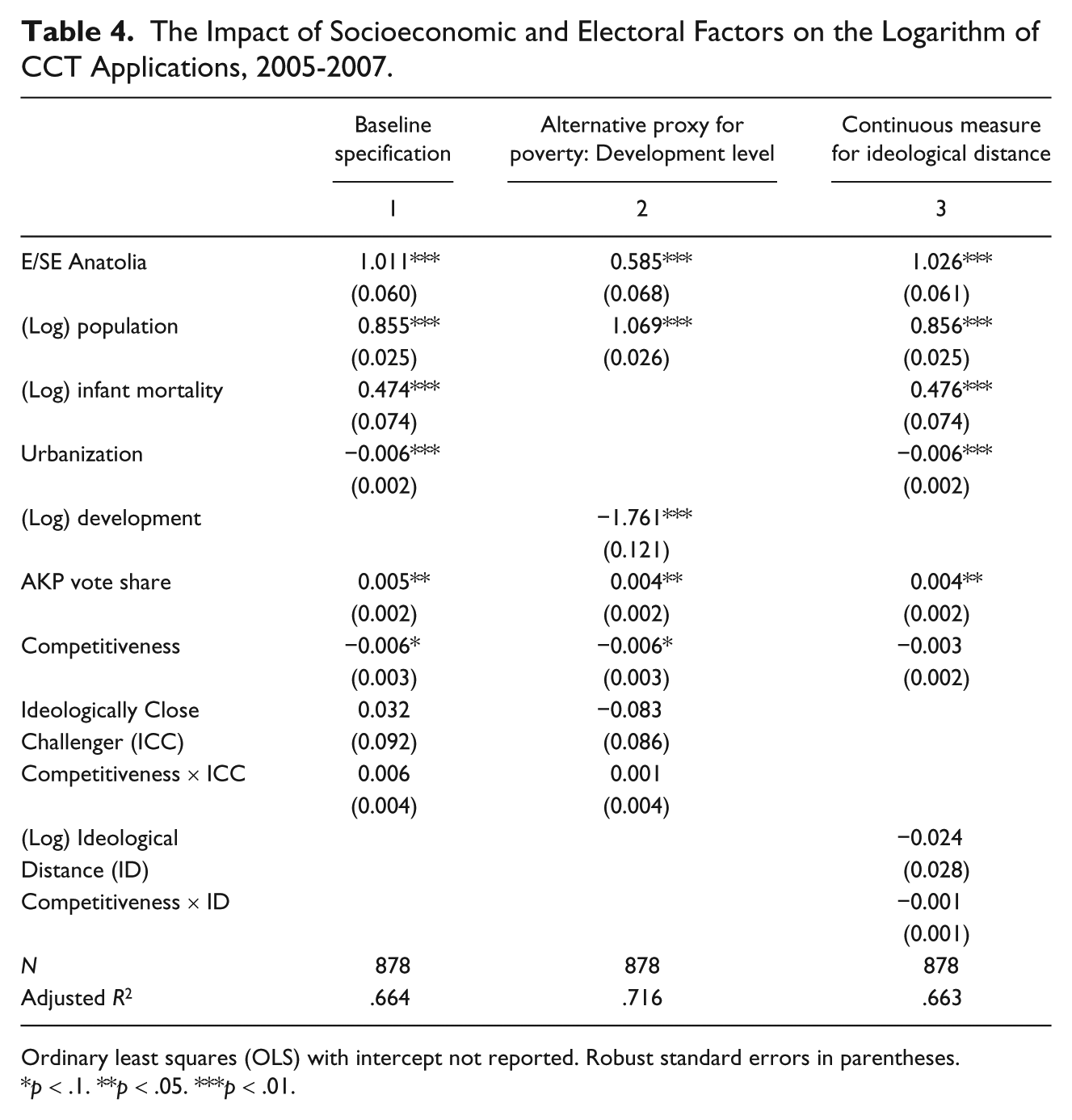
Table 4 replicates the previous analyses but takes the logarithm of the number of applications to the CCT program from 2005 to 2007 as the dependent variable. 20 We see that across all the three specifications, the variables of interest (ICC, Competitiveness × ICC, ID, and Competitiveness × ID) are statistically insignificant. That is, the number of applications to the CCT program in districts with an ideologically close challenger is not different from the number of applications in other districts. Interestingly, the coefficient estimate of AKP vote share is positive and statistically significant while the coefficient estimate of competitiveness is negative and (weakly) significant, implying that the number of applications is higher in the strongholds of AKP. This suggests that awareness of the program might be higher in districts where AKP has a strong presence. The coefficient estimates of other relevant variables are statistically significant and in the expected directions.
The Impact of Socioeconomic and Electoral Factors on the Logarithm of CCT Applications, 2005-2007.
Ordinary least squares (OLS) with intercept not reported. Robust standard errors in parentheses.
p < .1. **p < .05. ***p < .01.
This analysis of applications to the CCT program lends support to the pressure at enrollment mechanism that the local associations might be facing pressure from local operatives of the incumbent AKP to enroll a larger number of applicants in districts where the challenger is ideologically close. While the presence of an ideologically close challenger has a positive effect on program spending, no such effect is present in the number of applications. Thus, it is likely that the difference in program spending between districts with an ideologically close challenger and others is due to the different behaviors of the local committees at the enrollment stage. The career trajectory of the former governor of Tunceli, who was convicted of breaching the neutrality of public officials and yet was praised by the Prime Minister and continued to climb the bureaucratic career ladder, provides additional anecdotal evidence that the incentive structure of state agents governing the locales is amenable to such behaviors.
Conclusion
In this article I have argued that the conventional theoretical framework on distributive politics, which is based on the core versus swing district dichotomy, might not be satisfactory to analyze the dynamics of multiparty settings. Given the existence of parties with distinguishable and relatively stable ideological positions, elections in a multiparty setting provide more information on the nature of competition in an electoral district compared with two-party elections, and an incumbent party can utilize this information to tailor its strategy for the allocation of resources. A simple theoretical framework suggests that the incumbent party would be better off directing resources to districts where the challenger is ideologically closer, and systematic evidence from the Turkish CCT program supports this hypothesis. While previous work considers the competitiveness of a district as the only relevant factor for the incumbent’s decision, I show that there are reasons to move beyond this framework in a setting of multiparty competition.
Three avenues for future research emerge from this analysis. First, the argument that I advance in this article should not be specific to the case of Turkey. My framework of distributive politics in a setting of multiparty competition can be easily adapted and tested using data from countries with parties that have relatively stable and distinguishable ideological positions. Second and closely related with the first point, in the Turkish case the incumbent was the same party government of AKP throughout the period of analysis while in many multiparty systems there are coalition governments where two or more parties rule jointly. It would be interesting to see whether the politics of coalition formation and maintenance would have any effect on the framework I propose. Finally, while my analysis was at the level of districts, so that I have studied the allocation of benefits across electoral districts, the same logic should apply to the distribution of benefits within districts. Stokes (2005) notes that a tentacle-like organizational structure allows parties to monitor and target individual voters. In such a setting, my hypothesis predicts that the voters of the incumbent party’s ideologically similar competitors should receive a disproportionately large share of distributive benefits.
Footnotes
Appendix
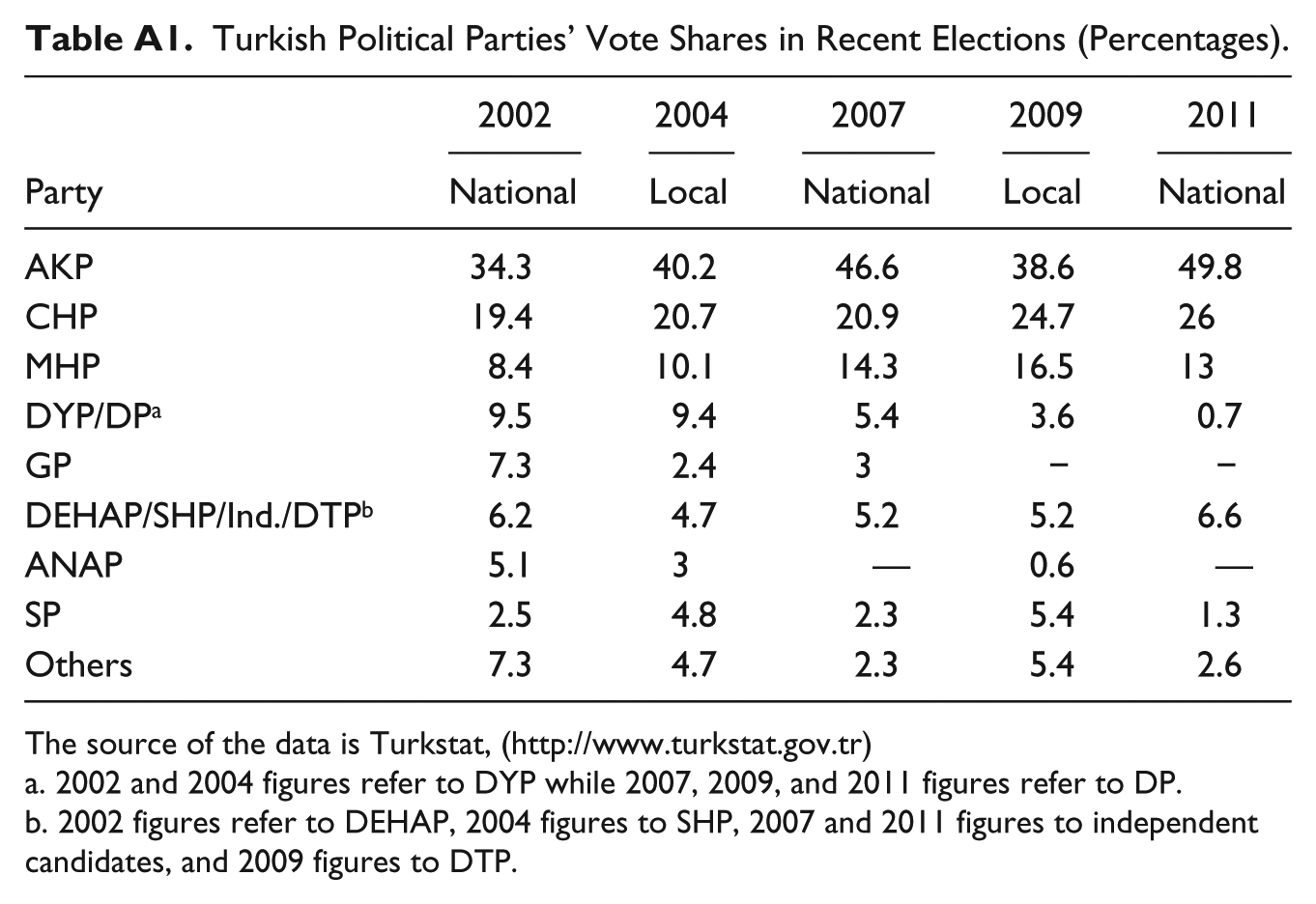
Turkish Political Parties’ Vote Shares in Recent Elections (Percentages).
| 2002 |
2004 |
2007 |
2009 |
2011 |
|
|---|---|---|---|---|---|
| Party | National | Local | National | Local | National |
| AKP | 34.3 | 40.2 | 46.6 | 38.6 | 49.8 |
| CHP | 19.4 | 20.7 | 20.9 | 24.7 | 26 |
| MHP | 8.4 | 10.1 | 14.3 | 16.5 | 13 |
| DYP/DP a | 9.5 | 9.4 | 5.4 | 3.6 | 0.7 |
| GP | 7.3 | 2.4 | 3 | − | − |
| DEHAP/SHP/Ind./DTP b | 6.2 | 4.7 | 5.2 | 5.2 | 6.6 |
| ANAP | 5.1 | 3 | — | 0.6 | — |
| SP | 2.5 | 4.8 | 2.3 | 5.4 | 1.3 |
| Others | 7.3 | 4.7 | 2.3 | 5.4 | 2.6 |
The source of the data is Turkstat, (http://www.turkstat.gov.tr)
2002 and 2004 figures refer to DYP while 2007, 2009, and 2011 figures refer to DP.
2002 figures refer to DEHAP, 2004 figures to SHP, 2007 and 2011 figures to independent candidates, and 2009 figures to DTP.
Acknowledgements
I am grateful for the comments and guidance of Ana De La O, Susan Stokes, Thad Dunning, Tariq Thachil, and Nikolay Marinov. Earlier versions of the article have benefited from the feedback of Gregory Huber, Nicholas Sambanis, and participants in the Research and Writing seminar at Yale University and the GLODEM & IR seminar at Koç University. The usual caveat applies.
Declaration of Conflicting Interests
The author declared no potential conflicts of interest with respect to the research, authorship, and/or publication of this article.
Funding
The author received no financial support for the research, authorship, and/or publication of this article.