




Abstract
This article analyzes the relationship between collective protest and social spending in Latin America from 1970 to 2007. I argue that under democracy, organized labor is in a better position relative to other groups in society to obtain social policy concessions as a consequence of their collective action efforts. Labor insiders mobilize around specific demands, and labor strikes carry significant economic and political costs on governments. In contrast, other groups in society rarely protest around specific social policy issues and are more often subject to successful demobilization tactics from political leaders. Results from an error correction model (ECM) show that in democracies, collective protest has differentiated effects on social spending. While strikes have a strong positive long-term effect on social security and welfare spending, none of the different forms of collective protest affect education or health spending. Importantly, I also find evidence of a deterrent effect of mass protests in democratic regimes; cutbacks in human capital spending are less likely as peaceful large-scale demonstrations increase.
Introduction
Does collective protest affect the social policy choices of Latin American governments, and if so, does this influence vary according to the type of protest and social spending? The literature on welfare state policies in developing countries consistently finds that democracy is an important determinant of social spending (Avelino, Brown, & Hunter, 2005; Brown & Hunter, 1999; Huber, Stephens, Mustillo, & Pribble, 2008; Kaufman & Segura-Ubiergo, 2001; Rudra & Haggard, 2005; Stasavage, 2005). In line with political economy approaches on redistributive politics and public goods provision (Bueno de Mesquita, Smith, Siverson, & Morrow, 2003; Meltzer & Richard, 1981), democratic governments spend more on social policies than their authoritarian counterparts. This is particularly the case for those policies aimed at promoting human capital such as education and health spending. Compared with social security spending, which benefits a privileged group of formal sector workers, education and health spending reaches a larger segment of the population. Hence, to win elections, democratic leaders have incentives to increase the types of social spending that benefits a majority of the population, including low-income groups (Avelino et al., 2005; Brown & Hunter, 2004; Segura-Ubiergo, 2007; Stasavage, 2005).
This growing literature has contributed significantly to our understanding of the relationship between democracy and social spending in developing countries. However, much emphasis has been placed on politicians’ incentives to increase/reduce certain categories of social spending as a result of the expansion of the electorate. Less attention has been devoted to alternative channels of political participation that citizens have at their disposal to show their discontent and attempt to influence public policy (but see Garay, 2007; Giraudy, 2007). This is somewhat surprising given that mobilization by lower income and working class groups has played a central role in studies of welfare state development in industrialized democracies (e.g., Hicks & Misra, 1993; Hicks & Swank, 1984; Isaac & Kelly, 1981).
Empirical research on collective protest in developing countries has analyzed the causes of popular mobilization (e.g., Arce & Bellinger, 2007; Arce & Kim, 2011; Robertson & Teitelbaum, 2011) as well as several outcomes associated with it. For instance, existing research shows that governments respond differently depending on the tactics used by challengers. While the most common response is toleration, the likelihood of repression increases as a result of violent disruption, but nonviolent disruption increases the probability of concessions (Franklin, 2009). Moreover, collective protest is an important determinant of regime transitions from dictatorship to democracy (e.g., Bermeo, 1997; Celestino & Gleditsch, 2013; Collier & Mahoney, 1997; Teorell, 2010), as well as of presidential falls in Latin American democracies (Hochstetler, 2006). Surprisingly, the effect of collective protest on policy change in developing countries, has not been systematically analyzed in a cross-national setting.
Using data from 18 Latin American countries for the period 1970-2007, this article analyzes the relationship between different types of protest and human capital (i.e., education and health), and social security and welfare spending. I argue that under democracy, organized labor 1 is in a better position relative to other groups in society to obtain social policy concessions as a consequence of their collective action efforts. Labor insiders mobilize around specific demands, and labor strikes carry significant economic and political costs on governments. In contrast, other groups in society rarely protest around specific social policy issues and are more often subject to successful demobilization tactics from political leaders. The empirical results largely support this argument and show that while organized labor protest in the form of strikes has a long-term positive effect on social security spending under democracy, none of the different forms of collective protest affect human capital spending. Importantly, however, I also find evidence of a deterrent effect of protest by the masses. The results from a multinomial logistic regression show that as the number of large-scale demonstrations increases, democracies are less likely to cut back human capital spending compared with dictatorships.
By stressing the role of popular mobilization and collective protest in policy outcomes, this article contributes to current debates on the democratic politics in the region (see Munck, 2004). Whereas existing research has emphasized how citizens influence governments’ decisions through formal political institutions, this article considers state-society relations from a broader perspective and shows that citizens are able to influence governments’ policy choices through collective protest.
Furthermore, analyzing the impact that different types of protest by labor insiders and the masses have on separate categories of social spending enables us to forge a better understanding on the relationship between democracy and social spending. While there is a general consensus that democracies in the region invest more in human capital than authoritarian regimes, there has been less consensus on the effect of democracy on social security spending (Avelino et al., 2005; Kaufman & Segura-Ubiergo, 2001). By taking into account the mobilization capacity of labor, this article shows that democratic regimes increase social security spending only when they face labor militancy. In addition, this article adds to our understanding on human capital spending in Latin American democracies by considering whether in addition to competitive elections, mass protests affect policy choices related to education and health.
The Argument
Political Regimes and Collective Protest
My starting point is the contention that citizens’ collective protest is more likely to influence public policy under democracy than under dictatorships. Political regimes structure the opportunities for groups to organize and mobilize to voice their demands or express their discontent (Eisinger, 1973; Tilly, 1978; for a review, see Meyer, 2004). Compared with authoritarian regimes, democracies reduce the costs of organizing state-oriented challenges by refraining from using widespread repression against those who engage in different forms of collective protest (Arce & Kim, 2011; Carey, 2008; Davenport, 1995).
Not only through elections are democratic leaders held accountable for their performance while in office but also mechanisms of horizontal accountability involving oversight and investigation by other public agencies constrain their exercise of power (Manin, Przeworski, & Stokes, 1999; Schedler, Diamond, & Plattner, 1999). Moreover, democratic institutions are associated with normative values that facilitate the channeling of dissent by peaceful means, so that resorting to violent confrontation is costly and severely damages political legitimacy (Davenport, 1999; Henderson, 1991). In particular, freedom of the press exposes public officials’ behavior to a larger group of the citizenry beyond those involved in the act of protest, thus, increasing the potential costs of repression. 2
There is systematic evidence that compared with autocracies, the democracies of the region are less likely to respond with repression to collective protest, especially when challenged by peaceful forms of protest (Carey, 2008). Moreover, repression is not a useful strategy to put an end to collective protest in democratic regimes, as repressive tactics often trigger further protest (Carey, 2006). Thus, it is plausible to expect that compared with authoritarian governments democratic leaders will have greater incentives to address challengers’ discontent and to deploy strategies other than repression for dealing with social instability. These strategies range from ignoring/tolerating protestors to the deployment of maneuvers aimed at demobilization (Lipsky, 1968), to policy concessions such as the expansion of welfare state policies (e.g., Hicks & Misra, 1993; Hicks & Swank, 1984).
Collective Protest and Social Spending
In this article, I focus on the social policy impact of different types of collective protest. Analyzing policy change as an outcome of protest implies focusing at the intermediate level of analysis, rather than at the structural level where other types of outcomes are possible, such as gains in democratization or the formation of new political parties (Amenta, Caren, Chiarello, & Su, 2010; Amenta & Young, 1999b). It also entails departing from approaches that focus on protest actions and evaluate their consequences based on the short-term governmental responses related to the challengers’ specific programs. 3
Governments can use social policy as a tool for maintaining political legitimacy and social peace, and for preventing the exacerbation of social discontent once it materializes (e.g., Piven & Cloward, 1971; Rudra, 2005; Taydas & Peksen, 2012; Thyne, 2006). While mobilization has included other nonwelfare issues, the question of social inclusion has been central to most large-scale collective protests in the highly unequal societies of the region (Almeida, 2007; Arce & Bellinger, 2007; Bellinger & Arce, 2011; Eckstein, 2001; Roberts, 2008; Silva, 2009; Walton & Ragin, 1990; Walton & Shefner, 1994). Thus, without neglecting that other types of outcomes are possible, this article’s main focus is on the potential long-term social spending choices that may result from the sustained mobilization of social groups (Amenta et al., 2010). 4 However, governments may not necessarily increase all types of social spending in response to collective protest. As Tilly (1978) puts it, “Governments respond selectively to different sorts of groups, and to different sorts of actions” (p. 106).
Building on the central insight of the insider-outsider approach that distinguishes preferences for social policies between different groups within labor (Rueda, 2005, 2007) as well as on the literature on collective protest in the region, I argue that governments facing challenges from different groups of the population have incentives to respond to the interests of relatively more organized groups, those who impose the highest costs on them as a result of their protest. In contrast, governments are inclined to deploy alternative strategies aimed at the disarticulation and demobilization of the relatively unorganized and more heterogeneous protest movements when faced by competing pressures from different sectors of society (Lipsky, 1968).
The segmentation of the labor market in Latin American countries implies that preferences over social policies differ between labor market insiders and outsiders. Labor insiders (i.e., formal sector workers), the sole beneficiaries of social insurance programs, mobilize around issues that directly affect their status as a privileged group, and not to defend or pressure the government for redistributive policies such as human capital spending. 5 Outsiders (i.e., informal sector workers) benefit from human capital spending but rarely mobilize to demand expansions of education and health policies. The lack of an organized constituency in favor of human capital spending in turn contributes to the vulnerability of this type of spending during times of economic decline (Wibbels, 2006).
There is indeed consistent evidence that being a union member is associated with less support for redistribution in developing countries (Haggard, Kaufman, & Long, 2013), that labor strength has negative effects on income equality and that it slows, rather than accelerates reductions in infant mortality rates (McGuire, 1999). In addition, it is well known that in stark contrast to industrialized democracies, where all components of social spending help to improve the income distribution, in the developing world, and specifically in Latin America only human capital spending is progressive, that is, it reaches the most disadvantaged segments of society (CEPAL, 2005). In addition, empirical research shows that in the context of economic openness, as human capital spending increases, income inequality decreases while the opposite effect is found for social security spending (Rudra, 2004).
Organized labor protest
Relative to other groups of society, organized labor enjoys an advantaged position to effectively press governments and obtain policy concessions. They mobilize around concrete demands and possess organizational resources that aid in sustaining challenges to the state that other groups do not readily enjoy. Strikes by organized labor carry significant costs on governments due to its capacity to disrupt economic activity and mobilize political support (Hicks & Misra, 1993; Hicks & Swank, 1983; McHugh, 1991; Swank, 1983).
As one of the main actors of the corporatist arrangement between labor and the state, labor unions were provided with organizational and economic resources to meet their needs in exchange for political support and the acceptance of state-imposed constraints (Collier & Collier, 1991). In some countries, the assets inherited by state sponsored unions gave them sufficient advantage to remain as the major actors in labor politics in the post-transition period and helped them play an influential role in the process of labor reform (Caraway, 2012; Cook, 2006). Organized labor has often resorted to its powerful weapon, the strike, as a means to demand better working conditions and to oppose policies that most affect its interests. Labor and pension reforms have met the most vigorous opposition from organized labor, as these reforms impose significant loses on them relative to other reforms (Madrid, 2003).
Although in some cases negotiation took place without militancy, other times unions choose to confront their long-standing political allies carrying successful strikes, which in some instances eventually “undermined the governance of labor-based administrations” (Murillo, 2000, p. 142). There is strong evidence that governments who faced powerful organized labor at home were able to negotiate less intrusive loan conditions with regard to labor with the International Monetary Fund (IMF; Caraway, Rickard, & Anner, 2012). Several studies also point out to a more general pattern in the region of partial deregulation of labor and enactment of union-friendly labor legislation in the context of free market economic reforms (Madrid, 2003; Mosley & Uno, 2007; Murillo, 2001; Murillo & Schrank, 2005). For instance, Murillo and Schrank (2005) show that “13 of the 18 collective labor reforms approved in Latin America between 1985 and 1998 have enhanced rather than undercut labor’s ability to organize and bargain collectively” (p. 972). Certainly, the strengthening of collective labor rights improves its capacity to resist unwanted policy changes and demand better working conditions. In her analysis of Venezuela, Mexico, and Argentina, Murillo (2000) shows that in a significant proportion of instances of labor militancy, unions were successful in obtaining government concessions. Based on the above discussion, I expect mobilization by organized labor to be positively associated with increases in social security spending in democracies.
Mass protest
The masses have also engaged in collective protest to show their discontent with or opposition to state policies, and often the largest protest movements included the participation of organized labor in coalition with other sectors of society. However, unlike labor-dominated protest in the form of strikes which are organized around specific demands for collective rights, social security entitlements or wage increases, ordinary citizens rarely mobilize proactively in large numbers around redistributive policies such as human capital investment (Bermeo, 2010; Wibbels, 2006).
Indeed, two of the central features of large-scale protest have been its reactive and heterogeneous nature. The mobilization of diverse groups and formation of alliances have been facilitated on the basis of convergence around the common purpose of resisting unwanted economic policies (Almeida, 2007; Eckstein, 2001; Roberts, 2008; Silva, 2009). Certainly, gaining resonance within a broader public helps to build strength and increases the capacity to exert pressure on governments through disruptive tactics and large-scale demonstrations. At the same time, however, diversity implies fragmentation of interests and greater difficulty to align and reconcile heterogeneous preferences once the moment to act proactively to channel protestors’ demands arrives. As it is well documented in the literature of social movements very often the factors that contribute to the rise and strength of social movements limit their influence at later stages of the policy process beyond the agenda setting stage (Amenta et al., 2010). Relatedly, governments are more likely to tolerate and/or deploy other strategies at their disposal to deal with protest by relatively less organized and disadvantaged groups of society. These strategies are facilitated by the very heterogeneous nature that characterizes mass protest and are frequently used with the purpose of weakening and further demobilization of the group. According to Lipsky (1968), these tactics involve, among others, the dispensation of symbolic satisfactions, directing attention to the most dramatic cases, postponement of action, and the discredit of protest leaders.
In Latin America, there are several cases that illustrate the above logic. For instance, the student Pingüino movement (2006) in Chile succeeded in mobilizing hundreds of thousands of secondary students for educational reform. As the movement grew in strength, the government was forced to open access to formal channels for the processing of their demands. Once the students accepted to participate in formal discussions, their large numbers made decision making difficult, and their organizational resources and expertise were insufficient to have an impact beyond the policy agenda (Donoso, 2013). Similar dynamics appeared to be at work in the Piqueteros movement of the unemployed in Argentina and the Ecuador’s indigenous movement. In both cases, their heterogeneous and fragmented nature contributed to their eventual demobilization by their respective governments. As Wolff (2007) puts it:
Very clearly, the destabilization in both countries did not involve any significant redistribution of power and wealth. Rather, it was based, in part, on the division, co-optation and marginalization, partial disarticulation and demobilization of the contentious “protest alliances” . . . (p. 22)
In accord with the above logic that highlights the reactive and heterogeneous nature collective protest by the masses, I do not expect mass protest to influence social spending.
However, I also consider a potential counter argument, which would suggest that successfully sustained protest by the masses intensifies pressure on democratic governments to expand social policies with broad appeal, such as investing in human capital. Competitive elections have provided incentives to democratic leaders for expanding social policies that reach large segments of the population (e.g., Avelino et al., 2005; Kaufman & Segura-Ubiergo, 2001), and in a context of widespread discontent the “power in numbers” (DeNardo, 1985) may encourage democratic leaders to expand policies in these areas. Political leaders could use human capital spending to signal that they care about disadvantaged groups of the population and are resolved to enhance policies that improve their prospects and for redressing long-standing inequalities. After all, there is a wide agreement among scholars that grievances rooted in feelings of injustice and social exclusion provided the basis to build coalitions among different sectors of the population (Eckstein, 2001; Roberts, 2008; Silva, 2009). In addition, they could do so as a preventing strategy to avoid undesirable political outcomes as a result of an exacerbation of discontent such as being forced out of office by the masses (Hochstetler, 2006). Consequently, if this argument is correct and there is a positive “unintended consequence” (Amenta et al., 2010; Giugni, McAdam, & Tilly, 1999) of large-scale collective protest, one should expect that democratic governments in the region increase human capital spending in the face of mass protest.
Data
Dependent Variables
To estimate the effect of collective protest on social spending, I use Cross-National Time-Series (CNTS) data from 18 Latin American countries for the period 1970-2008. The main dependent variables are human capital spending (i.e., the sum of spending on health and education) and social security and welfare spending, both as a percentage of GDP. These data are taken from the Social Policy in Latin America and the Caribbean Dataset, which covers the period 1970-2000 (Huber, Stephens, et al., 2008). I updated these data up to 2008 using data from the Economic Commission for Latin America and the Caribbean (ECLAC).
Independent Variables
The key independent variables are the different types of collective protest, democracy, and their interactive term. To measure collective protest, I use the CNTS data archive (Banks, 2011). Banks data provide event counts of politically motivated strikes, anti-government demonstrations, and riots. Protest by organized labor (Strikes) includes “any strike of 1000 or more industrial or service workers that involves more than one employer and that is aimed at national government policies or authority.” Demonstrations include “any peaceful gathering of at least 100 people for the primary purpose of displaying or voicing their opposition to government policies or authority, excluding demonstrations of a distinctly anti-foreign nature.” Riots are defined as “any violent demonstration or clash of more than 100 citizens involving the use of physical force.” To measure mass protest, I use the total sum of demonstrations and riots (Demriots). 6 As has been discussed by some scholars, there are several advantages of using Banks data. First, it provides the most comprehensive cross-national comparable data on different kinds of protest events covering a long period of time. Second, it reports only large-scale events. This is particularly important in this article because these types of events are most likely to have an influence on national policy (Bellinger & Arce, 2011; Teorell, 2010).
To distinguish democratic from autocratic regimes, I employed the Polity score and following standard practice, I created a binary indicator for democracy (Democracy), coded “1” if a country has a Polity score equal or above 6, and “0” otherwise (see, for example, Kaufman & Segura-Ubiergo, 2001). For robustness checks, I use Cheibub, Gandhi, and Vreeland’s (2010) dichotomous classification of political regimes and Mainwaring, Brinks, and Pérez-Liñán’s (2001) classification of political regimes in Latin America. 7 To test the hypotheses presented in the previous section, each indicator of collective protest is interacted with the democracy variable.
Control Variables
Following existing research on social spending, several control variables have been included. Two indicators account for the effect of globalization on social spending. One is total trade, measured as exports plus imports as a percentage of GDP (Trade openness). The second indicator is foreign direct investment (FDI), measured as the net inflows of investment as a percentage of GDP. 8 There is no consensus in the literature on the effect of globalization on social spending. While some scholars have found support for the efficiency hypothesis (Kaufman & Segura-Ubiergo, 2001), others find support for the compensation hypothesis (Avelino et al., 2005; Rudra & Haggard, 2005), and still others find no effect (Huber, Mustillo, & Stephens, 2008). Thus, I adopt a nondirectional hypothesis for the impact of globalization on social spending. 9 Three demographic controls are incorporated that account for arguments about the expansion of social policy as a consequence of industrialism. 10 Urbanization is measured as the percentage of the total population that resides in urban areas (Urban population). For social security spending, it is a common practice to include the percentage of the total population that is 65 and older (Aged population). This variable represents the constituency who benefits from social security spending and thus, its impact on social security spending reflects the difficulty of cutting entitlements of organized groups (Brown and Hunter, 1999). For education and health spending, the demographic variable that is employed is the percentage of the population that is in the age range between 0 and 14 (Youth population). Finally, logged inflation rates (Inflation) and two additional controls that account for the level of economic development and economic growth are entered in all models. Both, the log of real GDP per capita and annual GDP growth is measured by purchasing power parities (GDP). 11
Model
Changes in the allocation of resources to social policies are not likely to occur immediately, as it takes time to agree upon the public budget and implement changes. Consequently, I use a single equation error correction model (ECM) 12 for time-series cross-sectional (TSCS) data that facilitates the distinction between short-term and long-term effects. In the ECM, the dependent variable is measured in changes or first differences. To deal with panel heteroskedasticity and spatial correlation, all models are estimated through ordinary least squares (OLS) with panel corrected standard errors (PCSE) (Beck & Katz, 1995). In addition, it is important for the purposes of the article to account for the effect of time-invariant variables, which are not included as controls and may cause problems of omitted variable bias, as well as for time trends common to all countries that may contribute to explain variation in social spending. Thus, all specifications include fixed effects with unit and time period dummies. 13 Also, a lagged dependent variable is included in the right-hand side of the equation to deal with the problem of serial correlation of errors (Beck & Katz, 1996). The ECM rests on the idea that the independent variable X and the dependent variable Y are in a long-term equilibrium relationship, which is disturbed by short-term “shocks.” Eventually, the equilibrium relationship between both variables is reestablished at a rate dictated by the coefficient of the lagged dependent variable (De Boef & Keele, 2008). Thus, the lagged dependent variable has a dynamic interpretation and allows the estimation of long-term effects of X on Y.
To separate out the short-term effects from the long-term effects of the independent variables on Y, the model requires that all independent variables be entered in both, lagged levels and first differences, along with the lagged level dependent variable. It is important to note that the ECM and the often used linear autoregressive distributive lag (ADL) model are equivalent in the sense that the relationship implied in each model between dependent and independent variables is the same, and thus, the same information can be derived from them (Banerjee, Dolado, Galbraith, & Hendry, 1993, Chapter 2; De Boef & Keele, 2008). As described above, the main variables of interest are the interaction terms between democracy and the different types of protest events (e.g., Strikes and the sum of demonstrations and riots, Demriots). Thus, in the next section, I estimate a set of models given by the following equation:

where
In this article, the main variable of interest is the interaction term between the number of protest and the dummy indicator for democracy, thus, the total long-term effect of, say, strikes in democracies is given by
Results
Table 1 reports the results of the different ECMs for human capital, and social security and welfare spending. For presentation purposes, country and time dummies have been excluded from the tables. The focus will be on the marginal effects of the different interaction terms between democracy and protest by organized labor and the masses. Recall that the effect of protest when democracy is present is given by the sum of the coefficient for protest and the coefficient of the interaction term (for the short-term effect, this is given by
Estimated Effects of Labor Strikes and Mass Protests on Social Spending.

Panel corrected standard errors in parentheses. Models include country and time fixed effects. ECM = error correction model; LRM = long run multiplier; FDI = foreign direct investment. Variables preceded by “L” are measured in levels with a one-year lag; variables preceded by “D” are measured in first differences.
p < .10. **p < .05. ***p < .01.
Columns 1 to 3 of Table 1 show the results of the models for social security spending. Alongside each model, the LRMs for each variable are shown. As indicated by the coefficient of the lagged levels of the dependent variable, the rate at which equilibrium errors are corrected is around 18% per year. In other words, after a change in one of the predictor variables that disturbs the equilibrium, long-term levels of social spending will move at this rate year after year until the disequilibrating shock is corrected and a new equilibrium level for social spending is achieved. Consistent with path dependency, social security and welfare spending responds to equilibrium errors slowly. This reflects the strong persistency through time of this type of social spending that benefits powerful constituencies and hence is difficult to change. In column 1, the results from the baseline model for social security and welfare spending are shown. It includes all control variables and the signs for all of them are consistent with previous literature. Similar to Avelino et al. (2005), I do not find evidence that democracy has an independent effect on social security spending, neither in the short nor in the long run. In Model 2, I include the indicator for both types of protest. While the coefficient for the LRM of strikes is positive, it does not reach conventional levels of statistical significance. However, the LRM for protest by the masses (Demriots) is negative and statistically significant. It shows that one additional protest by the masses has the total effect of reducing social security spending by 0.3 percentage points of GDP. This result is difficult to interpret because it does not take into account the type of regime under which mobilization occurs.
Column 3 presents the main model, which includes the interaction terms between democracy and protest by organized labor, and the interaction term between democracy and protest by the masses. First, only the indicator for protest by the masses (i.e., the sum of demonstrations and riots) is statistically significant in the short run, though its substantive impact is very small. It shows that a unit change in mass protest has the immediate effect of reducing social security and welfare spending by 0.036 in nondemocratic regimes. Consistent with the idea that the effect of protest is more likely to be felt in the long term, the results show that none of the interaction effects are significant in the short run.
However, once we consider the interaction effect between democracy and protest by organized labor over the long run, I do find strong support for the argument developed in this article. The coefficient for the lagged level of strikes is negative and statistically significant at the p < .10 level in the long term. Since the strikes variable is interacted with the democracy indicator, none of these can be interpreted in the conventional way. The coefficient for the strikes variable represents the effect that a change in strikes has on social security spending when democracy equals zero, that is, in nondemocratic regimes. The LRM for this variable shows that a one-unit increase in strikes has the total effect of reducing social security and welfare spending by 1.5 percentage points in nondemocracies. This is consistent with research showing that the repressive character of authoritarian regimes is associated with the exploitation of workers and the deterioration of their living conditions in addition to physical repression (e.g., Przeworski, Alvarez, Cheibub, & Limongi, 2000). More central for the argument of this article is the effect of protest by organized labor when democracy is present. Calculating the marginal effect shows that under democracy a one-unit increase in strikes increases social security and welfare spending by 1.1 percentage points in the long run, and this effect is statistically significant at the p < .05 level. Interestingly, the results also reveal that in the absence of mobilization by organized labor, democratic governments reduce this type of spending, so that in the long run, social security spending decreases by 1.8 percentage points. While Kaufman and Segura-Ubiergo (2001) find that democratic governments decrease social spending and Avelino et al. (2005) find no effect of democracy on social security spending, the results in this article show that the effect of democracy is conditional on the mobilization of labor insiders. It may be that when governments do not face opposition from labor insiders, they have more room for maneuver to cut back this type of regressive spending, and perhaps, allocate more resources to other components of social spending. Thus, the behavior of democratic leaders with regard to social security spending is contingent on the mobilization of labor. Notice that all control variables behave similar to the previous model suggesting stability of the results. It is also important to note that with an error correction rate of 16%, after 5 years around 50% of the total effect would have taken place (see Figure A1 in the online appendix).
Columns 4 to 6 show the results for human capital spending. Consistent with previous studies, in all models the youth population variable has a positive and significant effect on human capital spending in the long run. Moreover, the short-term effect of democracy, that is a transition from an authoritarian to a democratic regime, has the immediate effect of increasing human capital spending by about 0.3% of GDP. It is, however, apparently surprising that the effect of democracy is not significant for the long term. To see whether this effect differs between education and health spending I analyzed education and health spending separately and the results indicate (not shown) that the positive effect of democracy is sustained over the long term for the case of education but not for health. The immediate effect of a transition to democracy on education spending is an increase of about .24 as a percentage of GDP, while the LRM is .64, both statistically significant at the .01 and .10 level, respectively. Turning now to the impact of the variables for the different types of protest, the results in column 6 show that neither protest by the masses nor protest by organized labor have an effect on human capital spending. Furthermore, I find no evidence for a conditional effect of protest depending on regime type. 15
I consider two alternative specifications to the models presented above. First, it could be argued that it is the level of collective protest and social unrest rather than the type of protest what encourages political leaders to increase social spending on education and health. As investing in human capital benefits broad sectors of society, compared with nondemocratic politicians democratic leaders could benefit from responding in this way to generalized social discontent. However, reestimating the models using an aggregate measure of collective protest (i.e., demonstrations, riots, and strikes) does not change the results presented here. Collective protest does not significantly affect investment in human capital. However, consistent with the main finding of this article, collective protest does affect social security spending. Aggregating the different types of protest masks the effect of strikes on social security and welfare spending because according to the results presented above only protest by labor insiders increases this type of spending in democratic regimes. 16
Second, I consider the possibility that protest by the masses has an effect, not in the form of increasing human capital spending, but on preventing cutbacks in these areas. Conceivably, as argued above, much of large-scale protest in the region can be characterized as societal resistance to unwanted economic policies (e.g., Roberts, 2008). As the literature on protest and social movements has emphasized, citizens often mobilize as a result of a perceived threat, that is, as a consequence of the costs they may expect to suffer if they do not act collectively (see, for example, Almeida, 2007; Goldstone & Tilly, 2001; Tilly, 1978). Thus, it is plausible that governments’ response takes the form of refraining from cutting back important components of social spending that benefit a majority of the population when the masses are largely mobilized. I find evidence in support of this argument. Specifically, the results from a multinomial logistic regression model show that as nonviolent mass demonstrations increase, the likelihood of education spending cutbacks is significantly reduced in democratic regimes. 17 In contrast, this effect is positive for nondemocratic regimes, and the difference between the two is statistically significant. This is certainly an important result, which suggests that compared with autocracies, democratic governments refrain from cutting back human capital spending when citizens engage in peaceful forms of collective protest (see Figure 1).
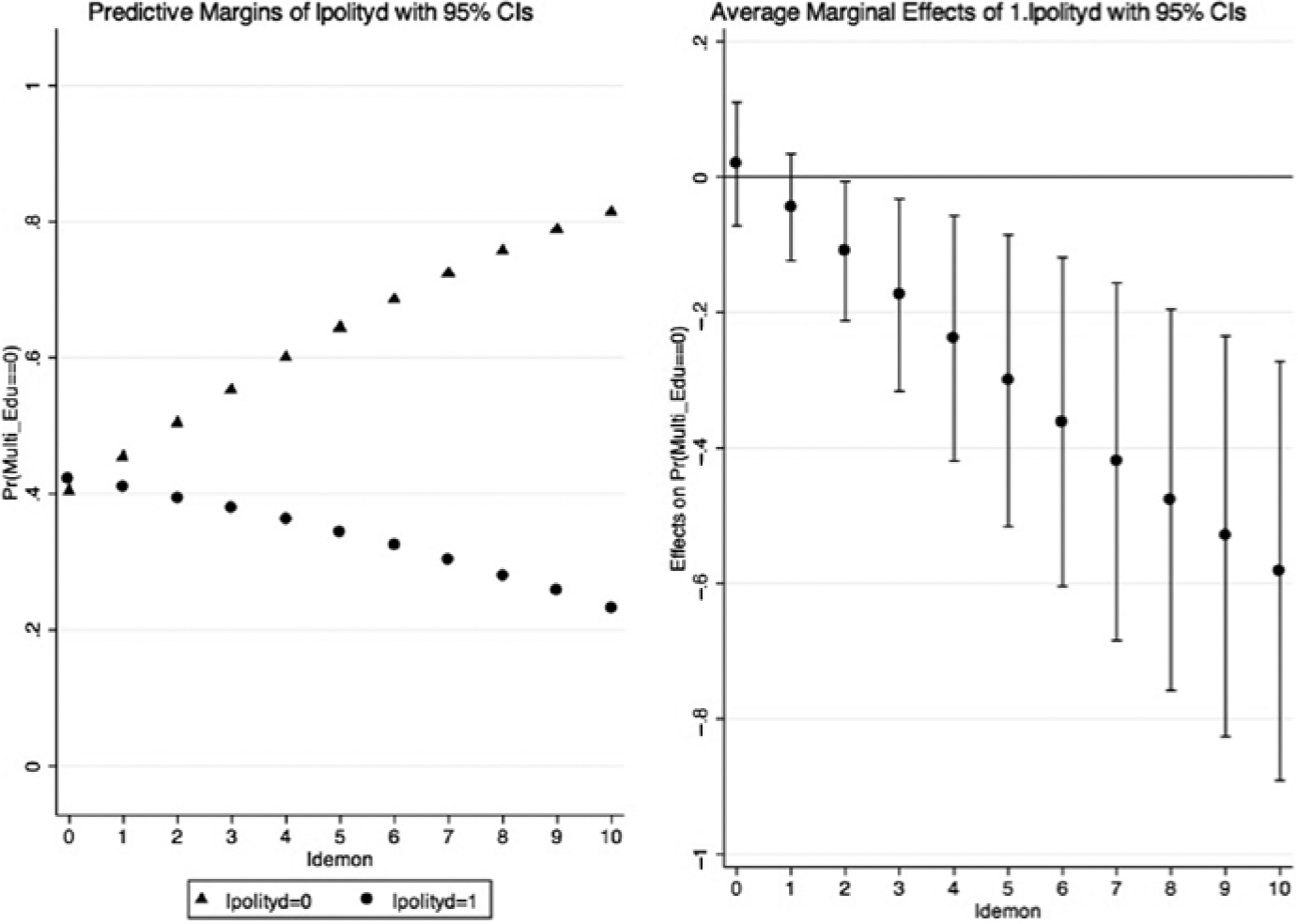
AME of democracy on the probability of a negative change of education spending as mass demonstrations increase.
Robustness Checks
To check for robustness of the main results of this article with regard to the effect of protest by organized labor on social security spending, I performed a modified jackknife procedure in which each country was excluded from the regression analysis at a time. The results reported in Table 1, column 3, are robust to the exclusion of one country at a time from the analysis. As a second robustness check, I used Cheibub et al.’s (2010) and Mainwaring, Brinks, and Pérez-Liñán’s (2007) indicators of democracy. Again, the main results hold using these alternative measures of democracy. In addition, the results are robust to the inclusion of a number of additional controls: an indicator of potential labor power (Rudra, 2002), a measure of state repression (Wood & Gibney, 2010), an indicator of capital account openness (Chinn & Ito, 2006), a dummy variable that indicates the presence of an agreement with the IMF, a measure of debt service (World Bank, 2010), and a variable that proxies for the age of the social security system (see Table A2 in the online appendix). The results also reveal that the negative effect of strikes in nondemocracies that is reported in Table 1 is not robust to the inclusion of additional control variables. One reason for this result might be that different types of autocracies behave differently in response to mobilization and thus further disaggregation may be needed to sort out these effects.
Conclusion
This article incorporates nonconventional forms of political participation in the analysis of social spending in Latin America. The results suggest that distinguishing between labor insiders’ protest and mass protest and assessing their impact on different categories of social spending are relevant for the study of social policy and democratic politics in the region. While previous research reached contradictory findings about the effect of democracy on social security spending, this article provides evidence that the effect of democracy on social security spending is conditioned by organized labor protest. Their organizational capacity inherited from earlier periods puts them in a better position relative to other groups to effectively mobilize to defend their entitlements. However, mass protest has also had important consequences for human capital spending. While democratic leaders increase human capital spending as a consequence of electoral incentives, mass protest inhibit cutbacks in these areas in democratic regimes. Taken together, these results advance our understanding of democratic politics in the region and of how citizens influence policies through different democratic channels.
This article is a first step in systematically analyzing the social policy outcomes of collective protest. While the focus of this analysis has been on particular components of social policy measured through social spending, the range of social policy programs in Latin America is certainly not fully captured through social spending measures. Future research should explore the relationship between social mobilization and the introduction and expansion of social programs targeted at specific groups.
Footnotes
Acknowledgements
I am especially grateful to David Rueda, Martin Seeleib-Kaiser, and Mauricio Rivera for their support, comments, and advice on earlier versions of this article. I would also like to thank Nancy Bermeo, Timothy Power, Jaree Pinthong, as well as three anonymous reviewers for their very helpful comments and suggestions. For methodological advice, I thank Luke Keele, Suzanna Linn, and Juan José Dolado. Thanks to Nita Rudra as well for sharing her potential labor power data.
Author’s Note
Any errors are my own.
Declaration of Conflicting Interests
The author declared no potential conflicts of interest with respect to the research, authorship, and/or publication of this article.
Funding
The author received no financial support for the research, authorship, and/or publication of this article.
Notes
Author Biography
References
Supplementary Material
Please find the following supplemental material available below.
For Open Access articles published under a Creative Commons License, all supplemental material carries the same license as the article it is associated with.
For non-Open Access articles published, all supplemental material carries a non-exclusive license, and permission requests for re-use of supplemental material or any part of supplemental material shall be sent directly to the copyright owner as specified in the copyright notice associated with the article.
