




Abstract
Studies on retrospective voting argue that voters under presidentialism tend to assign co-responsibility for the president’s performance to her party in congressional elections. However, it is not uncommon for presidential parties to distance themselves from an unpopular president or for opposition parties to cooperate with a popular president. In doing so, parties can signal to voters that they side with a popular (or against an unpopular) president. Yet little is known about whether this strategic behavior has electoral payoffs. This study proposes a popularity-response model, where parties’ electoral outcomes are a product of how they respond to public opinion on the president. I hypothesize that parties defecting from an unpopular president (or cooperating with a popular president) minimize electoral losses and obtain a further electoral boost. Analysis using an original dataset coding issue congruence between presidents and parties prior to 35 elections in 18 Latin American countries supports this claim.
Keywords
In presidential systems, the president and congress share responsibility for policy outcomes. Yet studies on retrospective voting find that presidential popularity—not the policy responsiveness of Congress—largely influences congressional electoral outcomes, even in midterm elections. While the retrospective voting theory provides a parsimonious and persuasive explanation for how parties are held accountable through elections, there has been little attention to the role of strategic behavior by political parties.
More specifically, governing parties can mitigate electoral losses by distancing themselves from an unpopular president. Conversely, opposition parties can choose to cooperate with a popular president when they expect a confrontation with a popular president would not help the public image of the party. An abundance of real-world cases illustrates such strategies.
For example, in the impeachment vote in the Paraguayan lower chamber in 2002, the Colorado Party turned against its leader, President Macchi, deciding not to shield him from impeachment (Pérez-Liñán, 2007). President Macchi’s approval rating at that time was below 10%. Similarly, the faction from Honduran president Zelaya’s Liberal Party (PN) voted for ousting the unpopular President in 2009. In both examples, the presidents’ parties behaved strategically to distinguish themselves from unpopular presidents.
However, it is not surprising that a popular president can garner broader political support. It is well known that presidents usually enjoy broader support from the public in honeymoon periods or under the rally-around-the-flag effect at times of national crisis. In those times, opposition parties are reluctant to criticize presidents with broad public support (Brody, 1991; Hetherington & Nelson, 2003; Mueller, 1973). This strategic support from legislative actors is not necessarily limited to honeymoon periods or national crises, but is more generally applicable. For instance, when the Mexican President Vicente Fox publicized his position on Iraq in 2003, the main opposition party PRI, along with the president’s party PAN, trumpeted its support for the president’s position. At that time, Fox had 56% support, 12 percentage points above his vote share in 2000. Moreover, sometimes favorable public opinion toward the president allows her party to maintain its support in spite of political blows from the opposition. During the impeachment process for President Clinton, the Democrats successfully shielded the President. At that time, despite the scandal and impeachment, public support for him was almost unwavering (Miller, 1999; Zaller, 1998).
This study investigates whether parties’ decisions to cooperate with (confront) a popular (unpopular) president, as exemplified, has electoral payoffs. Specifically, I examine how parties’ responsiveness to presidential popularity influences their electoral payoffs in congressional elections, where “party responsiveness” refers to a party’s cooperative stance toward a popular president or an oppositional stance toward an unpopular president. There are several reasons to believe that parties will take positions contingent on the president’s reputation. The strategic politicians theory suggests that support for the president in the legislature varies depending on the president’s popularity (e.g., Edwards, 1976; Kramer, 1971; Neustadt, 1960; Tufte, 1975). That is, the president and her party do not always have a cooperative relationship. The president’s party may want to change its relationship with the president if cooperation is expected to damage its electoral goals. Similarly, by signaling distance from an unpopular president or demonstrating an amicable relationship with a popular one, non-presidential parties can also increase their electoral payoffs. As such, there are incentives for parties to respond to voters’ assessment of the president. Yet, there has been little effort to examine the electoral consequence of parties’ responsiveness to presidential popularity and the conditions under which such responsiveness has electoral implications.
By examining the electoral consequences of party behavior, this study contributes to our understanding of the mechanisms of electoral accountability in presidential systems. First, this study investigates whether (and to what extent) party strategy matters for electoral outcomes. If this type of party responsiveness has electoral implications, it would suggest that congressional accountability under presidentialism is not as closely tied to the president’s influence as the retrospective voting literature suggests. Second, this study provides a more generalized test of such a mechanism by looking at governing and opposition parties, and their responsiveness on a wide range of domestic political issues. Accordingly, this study fills a void in the retrospective voting literature. While that work has focused on electoral consequences of the president’s economic performance for her party, I demonstrate that this operates in domains other than the economy and for parties other than the president’s.
In the following section, I discuss two lines of literature to suggest that voters can utilize two president-related elements for their vote in congressional elections: their evaluation of the president and the actual relationship between the president and each party. First, strategic politicians theory addresses the incentives for parties and politicians to respond to voters’ assessments of the president (Kramer, 1971; Tufte, 1975). Second, retrospective voting theory explains the rationale for voters to utilize their retrospective assessment of the president as a cue in elections (cf. Fiorina, 1981). Driven by the literature, I hypothesize that when a president’s party responds to an unpopular president by defecting (or conversely, when a non-presidential party responds to a popular president by cooperating), it can attenuate electoral losses. In other words, congressional election outcomes are associated with citizens’ collective judgment of the president and political parties’ responsiveness to it.
To test this argument, I develop an index measure of party responsiveness incorporating presidential popularity and issue congruence between the president and each political party. To measure issue congruence, I collect an original dataset based on news coverage of salient national issues prior to 35 elections in 18 Latin American countries. Using this dataset, combining archival electoral results, presidential popularity from public opinion polls, and issue congruence, I demonstrate in the analysis section that responsive parties garner more electoral support relative to the previous election, while non-responsive parties are penalized. Particularly, responsive governing parties reduce their expected electoral loss (e.g., the cost of governing) while non-responsive governing parties lose, on average, 11.5 percentage points of electoral support.
Presidential Popularity and Congressional Elections
A large body of research illustrates how and why presidential popularity matters for congressional electoral outcomes. According to retrospective voting theory, voters utilize their evaluations of the government’s past performance to make voting decisions. The rationale behind this argument is that voters perceive past government performance (e.g., economic outcomes) as a primary “competency signal” about the incumbent. Therefore, voters hold politicians accountable by withholding support from poorly performing incumbents or by rewarding well-performing incumbents, in the expectation of a better future led by a competent leader. Empirically, the positive relationship between incumbent votes and the (perceived condition of the) national economy found across political systems supports this claim and highlights that voters primarily attribute responsibility for economic outcomes to incumbents (e.g., Duch & Stevenson, 2008; Lewis-Beck & Ratto, 2013; Lewis-Beck & Stegmaier, 2000).
In presidential systems, such retrospective evaluations of the president influence votes for president and congress. As voters perceive the president and her party as “a team” (Kramer, 1971), and as it is difficult to know who is responsible for policy outcomes, voters tend to hold both responsible for economic performance (Fiorina, 1981; Tufte, 1975). Even under divided government, voters tend to solve the responsibility problem by “singling out the president and absolving the congress” (Norpoth, 2001, p. 433).
In Latin American countries, voters can be even more dependent on the president for the allocation of credit or blame to congressional actors. Executives in the region possess a host of legislative powers: in most cases, presidents have the ability to introduce legislation, to influence the legislative agenda, to set budget spending and revenue levels, and to establish budgetary priorities (Mainwaring & Shugart, 1997; Payne, Zovatto, & Díaz, 2007). Given the relatively passive role of legislative actors (Morgenstern & Nacif, 2002), legislative parties’ responsibility for policy outcomes is more ambiguous than in countries where the legislature plays a more active role. Moreover, the unstructured multiparty systems in many Latin American countries reinforce the tendency for voters’ assessment of the parties to go along with the relationship of the party to the president. 1
The importance of the president’s role in policymaking and the unclear responsibility of legislative actors can, on one hand, lead voters’ evaluation of political responsibility to be incumbency-oriented and president-centered. On the other hand, it can create room for strategic action by legislative parties to avoid responsibility for policy outcomes. Recognizing that voters tend to project their assessments of the president onto their congressional vote choices (particularly for the president’s party), parties can strategically manage how voters perceive their relationship vis-à-vis the president to survive in the elections. Doing so can help parties bolster their electoral prospects because presidential popularity reflects the public’s overall judgment of the president, which might influence voters’ congressional electoral support as well.
Such expectations on the part of parties are built on several assumptions about voters. First, voters primarily assess the president retrospectively. Second, they project their impression of the president primarily onto the president’s party and allies, while projecting the opposite onto opposition parties. That is, as the image of the president’s side gets worse, the image of opposition parties becomes better (as an alternative to the incumbent). In addition to these two assumptions from the retrospective voting theory, the main argument of this study also relies on a third, that voters can update their impression of a political party if they perceive changes in its actual relationship with the president and reward or punish the party accordingly in congressional elections. This process (voters updating information) is neither unrealistic nor a demanding task for voters, given the general increase in public interest in and exposure to political information during electoral campaigns. This micro-level mechanism allows parties to expect certain electoral payoffs from their association with (or disassociation from) a generally popular (or unpopular) president.
Conditioning Party Strategy on Presidential Popularity
Legislative actors have their own goals, from policy advocacy to reelection and office-holding (Mayhew, 1974; Strom, 1990), and take different strategies to attract voters: Some parties may emphasize policy while others invest most of their resources to maximize votes; some may target core voters while others appeal to a broader range of voters including the unaligned; and some strategies sacrifice votes in the short term to maximize them in the long run. Although those strategies are not necessarily mutually exclusive, there are trade-offs between these choices of strategies (Rohrschneider, 2002) and parties often need to select among them.
Strategy regarding the relationship with the president is one such consideration that parties can make as elections approach. This strategy is more likely to be observed among parties seeking to maximize votes as a short-term goal (than those prioritizing policy/ideology advocacy in the long run). Recognizing their fate is tied to the president’s, parties can weaken or reinforce their relationship with the president depending on the voters’ collective judgment of the executive.
Two important empirical questions follow this intuition. First, do legislative actors generally take actions to exploit presidential popularity? Second, do such behaviors have electoral payoffs? The second question, which this article has proposed to examine, is yet unanswered. The answer to the first has inconclusively weak empirical support, despite the theoretical expectation.
Previous studies postulate that presidential popularity can be a substantial source of presidential influence in Congress (Edwards, 1976; Neustadt, 1960). Thus,
dips in presidential popularity, in particular, prompt congresspersons to distance themselves as much as possible from the chief executive . . . [O]pposition congresspersons attack the president, and . . . the president’s own party members try to stake out some space far enough from the president that they can divorce their political fate from his or hers. (Shugart & Carey, 1992, p. 34)
Accordingly, scholars expect to see more support from Congress as presidential popularity increases, and conversely, that Congress will defect more frequently as presidential popularity decreases. This is likely to happen if legislative actors fear the electoral consequences of opposing presidential initiatives widely approved by the public or supporting presidential initiatives widely opposed by the public (Edwards, 1976; Przeworski, Stokes, & Manin, 1999).
Despite the theoretical reasoning, empirical evidence is mixed. A substantial body of research conducted in the U.S. context suggests that the influence of presidential popularity on legislative behavior (roll-call support) is null or marginal at best (Bond & Fleisher, 1984; Bond, Fleisher, & Wood, 2003; Collier & Sullivan, 1995; Edwards, 1976; Mouw & MacKuen, 1992). In the Latin American context, Calvo (2007) finds that presidents in Argentina are more successful in the legislature as they are more popular, whereas Alemán and Navia (2009) demonstrate this is not the case in Chile. 2
There are several possible reasons for such inconsistency. First, political parties have diverse goals and strategies, and exploiting presidential prestige may not always serve these. Parties typically have numerous goals, and primary goals vary among parties and perhaps within parties across time (Harmel & Janda, 1994, p. 265). If a party does not place much value on vote-seeking compared with other goals (e.g., policy advocacy, regional autonomy, and ideological representation), the party is likely to take no particular action in response to presidential popularity. Second, and more importantly, even if we assume that all parties pursue vote maximization leading up to the election, strategically responding to presidential popularity may conflict with other strategies. An example is the case when associating with a popular president (or disassociating from an unpopular president) is expected to significantly deteriorate a party’s core values and vote base. Moreover, there is always some degree of uncertainty that makes it difficult for parties to accurately predict the electoral consequence of taking a certain strategy (e.g., whether to coalesce with the president) and the trade-offs between the choices of strategies. Considering those possibilities, it is fair to observe that not all parties will ride on presidential popularity.
Once parties decide to react to presidential popularity, they will try to find an effective way to appeal to voters regarding their relationship with the president. From this perspective, legislative roll-call voting, which previous research has almost exclusively studied to find the influence of presidential popularity, is not the most efficient channel for accomplishing the specific goal of signaling a party’s relationship with the president. The information cost to perceiving roll-call behavior is very high for typical voters; thus, I expect that parties will act on nationally salient issues to signal their side with or against the president. Likewise, Canes-Wrone and de Marchi (2002) demonstrate that the president’s popularity only matters on salient issues for garnering legislative support in the United States.
In this study, the issue arena where political parties can strategically act is not constrained to the legislative agenda. This is because legislative voting captures the president’s achievements only on policy issues, whereas presidential popularity is influenced by both policy and non-policy considerations. When issue positions of political actors are uncertain, valence issues come to play a critical role (Enelow & Hinich, 1982; Magaloni & Poiré, 2004; Somer-Topcu, 2007; Stokes, 1992). Under the consideration that valence factors—such as competence, integrity, and images of unity and division—also matter for voters to evaluate parties and political leaders, strategic reactions to presidential popularity are more likely to direct to the issues that voters find more easily accessible, across policy and non-policy domains. 3
In summary, it is not necessarily unreasonable for parties not to respond to the president’s popularity. But still, parties in peril may decide to make some effort to diminish expected electoral loss or to increase electoral advantage. Enhancing their valence image by exploiting presidential popularity is a way to accomplish this goal. Once parties decide to take this strategy, they will more likely act on nationwide salient issues with high visibility, through diverse political channels (not merely by votes in congress). Such an effort will be marked during the period leading up to an election. I consider these aspects in conceptualizing and measuring party responsiveness to presidential popularity (i.e., the influence of presidential popularity on legislative actors).
How Party Responsiveness Can Enhance Electoral Prospects
Presidential popularity reflects citizens’ overall retrospective evaluation of the president, composed of her performance and images on multiple dimensions. The influence of presidential popularity on her party in congressional elections is regularly observed in presidential systems. While it is rather straightforward that the public image of the president’s party is on par with the president, it is less straightforward how the president’s image influences the image of the (sometimes multiple) opposition parties. Nevertheless, we can expect at least that the opposition camp in a broader sense is more likely to lose support as the president enjoys more extensive public support.
Following this logic, it is a good time for the president’s party when the president is popular, and for the opposition party when the president is unpopular. These are good times because parties can benefit from voters’ common stereotyping regarding the president’s party as the president’s team and the opposition party as opponents to the president. Using information about the label of the president’s party and the distinction between parties in and out of the government, this belief can be formed at almost no information cost in contemporary presidential systems as voters are able to infer the distinctive stances among parties using the simple heuristic of party labels (e.g., Popkin, 1991; Rahn, 1993). In bad times, however, political parties have incentives to adjust the voters’ common perception that the president’s party backs the president and opposition parties oppose the president. A presidential party that tries to signal it is not a team with an unpopular president would probably expect this signaling to help diminish its expected electoral loss. Likewise, an opposition party may try to signal they do not always oppose a popular president, in the expectation of enhancing its electoral prospects.
On voters’ side, this signal helps solve a dilemma arising when assigning co-responsibility. Suppose a situation arises in which the president is from a voter’s preferred party, but disappoints the voter with a corruption scandal and poor handling of the economy. Although the voter still thinks the president’s party best represents his or her policy position, if he or she is an economic voter the choice will be defection, and if a spatial voter, he or she is likely to keep supporting the party. However, once the voter witnesses the party criticizing the president for such misdemeanors, the voter can continue supporting the party with less cognitive dissonance between the two preferences, that is, punishing the immoral or incompetent president and supporting the preferred party. On the other hand, if the party stays silently on the president’s side, there will be more chance that the voter defects from the party as far as he or she is a purely retrospective voter, putting the foremost responsibility on the president and reflecting this to the congressional vote. (The same can be said for a voter who keeps supporting an opposition party after perceiving the party has a good relationship with a president who is doing his or her job fairly well.)
As such, congressional electoral outcomes are not always predestined to be tied to presidential popularity, but have some leeway for party strategy. Shedding light on whether parties’ reactions to presidential popularity have electoral payoffs, I argue that parties’ efforts to respond to presidential popularity can mitigate the president’s outright influence in congressional elections.
Given the definition of “responsiveness” (of parties to presidential popularity)—that is, taking a cooperative stance when the president is popular or taking an oppositional or non-cooperative stance when the president is unpopular—there are four specific cases of “responsive” parties: (a) a president’s party agreeing with a popular president, (b) a president’s party disagreeing with an unpopular president, (c) an opposition party agreeing with a popular president, and (d) an opposition party disagreeing with an unpopular president. Such responsiveness can be seen as an effort to enhance the party’s valence image. Given that voters tend to use their evaluations of the president to inform their votes in congressional elections, responding to citizens’ aggregate opinion can have electoral payoffs. This is because voters may use party labels and actual stances to evaluate the relationship between presidents and individual parties. As a result, voters will recognize parties’ attempts to cooperate with or defect from the president and take this into consideration at the polls. Therefore,
The Conditional Impact of Party Responsiveness
This main expectation is derived from the assumptions that (a) voters project their retrospective assessment of the president onto their vote choice in congressional elections, and at the same time, (b) they recognize and consider parties’ actual relationship with the president to reward or punish congressional parties. However, if this mechanism is mainly applied to incumbent parties, as found in the retrospective economic voting literature in general, 4 then the effect of responsiveness for non-presidential parties could be blurred. Moreover, given the zero-sum structure of electoral gain and loss among parties, the aggregate margin of some non-presidential parties can be collateral rather than genuine. For this reason,
In addition, I account for another important president-related factor: the coattail effect, that is, the tendency for a popular political party leader to attract votes for other candidates of the same party. This can impede voting based on retrospective assessments, thereby mitigating the impact of responsiveness. In presidential systems, the electoral fortunes of political parties in congressional elections are coupled with the fate of the party’s presidential candidate when presidential and congressional elections are concurrent (Cox, 1997; Golder, 2006; Shugart & Carey, 1992). As the focal point in concurrent elections tends to be the presidential race, the information cost for voters to be knowledgeable of legislative actors’ behavior is higher than in midterm elections. Consequently, concurrent elections make it harder for voters to make correct judgments about political parties. Moreover, preferences for presidential candidates may encourage straight ticket voting in legislative elections, in favor of the party of the preferred presidential candidate. As a result, retrospective voting based on party responsiveness will likely be overwhelmed by the preference for prospective presidential candidates. Thus,
Data and Measurements
I test the three hypotheses using electoral outcomes for political parties in free and democratic elections held in the recent decade (2000-2010) in Latin American and Caribbean countries. Elections are included in the sample if rated “free and fair” (Freedom House, 2010) and the country has a Polity2 score of six or higher throughout the sample period. Thirty-five elections in 18 countries in Latin American and Caribbean countries meet the requirements. 6 The unit of analysis is the political party in a given election. The dataset includes parties that participated in at least two consecutive legislative elections (lower house elections in bicameral systems).
Electoral Payoffs
The outcome variable, electoral payoffs, is measured as change in vote share for each party between two consecutive elections. 7 The electoral payoffs range from −28.6 to 32.8: from −28.4 to 23.3 for presidential parties, and from −28.6 to 32.8 for other parties.
Measuring Responsiveness
Given the conceptualization of responsiveness—a cooperative (oppositional) stance when the president is popular (unpopular)—the parties’ relationships with the president and the president’s popularity are the two key elements of responsiveness. I construct an index measure of responsiveness, the main explanatory variable, by first coding each element separately and then incorporating them into one measure. I first detail how I measure cooperation with the president, then explain how I measure popularity, and finally describe how I combine these in a single index.
Cooperation
To evaluate whether a party is cooperative, I measure issue congruence between the president and each political party. Cooperation is a dichotomous variable that denotes whether a party takes a pro-presidential position. To code this variable I identified the main issues reported during the election periods in each country. These include foreign-economic policy (e.g., CAFTA), privatization (e.g., Pomex), budget bills, constitutional and electoral reform, corruption scandals, decentralization (regional autonomy), intra-party conflicts over presidential candidate nomination, and a series of other debates in the campaign periods. I then classified the position of the president and parties for each main issue on which the actors confronted each other. In each election period there were normally a few salient issues (one or two in most cases) on which the news reports articulate the stances of each actor (the president and multiple political parties). By default, the presidential parties are coded as being cooperative. However, if the party positioned itself against the president or the government at least once over any of those salient issues, I code it as being non-cooperative. Opposition parties are assumed to take different positions from the president, thus by default they are coded as being non-cooperative. However, if they are on the same side with the president at least once on such salient issues, I code it as being cooperative. 8
I use Latin American Regional Reports published during the 13 months ahead of each election. The Reports, published in English on a weekly and monthly basis, is the world’s foremost current events newsletter containing qualified intelligence on political and economic issues in Latin American and Caribbean countries since 1967 (Jones, 1995). As the issues are on the debate just ahead of elections, and had been repeatedly dealt with in reports during the periods, I regard the issues mentioned in the reports as having high salience and accessibility. Therefore, voters might be well-enough exposed to such political controversies to be knowledgeable of how parties divided on these issues.
Differential popularity
The second part of the responsiveness index assesses whether the parties’ observed positions were taken with a popular or an unpopular president. A cooperative stance should return electoral payoffs only when the president is popular. Although it is hard to identify a general threshold in approval ratings to distinguish popular from unpopular presidents, it is possible to infer when a party would be threatened by a given level of presidential popularity. Therefore, this second component of responsiveness captures the extent to which the level of presidential popularity motivates parties to reshape their relationships with the president.
Accounting for the different incentives for responsiveness is important to predicting the impact of responsiveness on electoral outcomes. As Edwards (1976) pointed out, “the members of congress respond not to the President’s overall popularity but to his popularity among subgroups in the public that are part of their own electoral coalitions” (p. 107). Therefore, it is by no means appropriate to assume that all parties have the same incentives to act in a responsive way at a given level of presidential popularity. Opposition parties might not be threatened by presidential popularity as long as they believe their supporters are unfavorable toward the president and her party. For example, when the president enjoys 60% approval ratings under a two-party system, it will not threaten an opposition party that garnered 30% of votes in the previous election because their sub-constituency may be a subset of the 40% of disapproving opinions. As such, each party has different incentives to cooperate with the president depending on the size of its sub-constituency. In other words, presidential popularity will induce parties to care about their relationship with the president only when it reaches a threshold at which a party’s current support is endangered. To account for this, I measure differential popularity by considering the gap between a party’s and the president’s popularity, rather than using the latter only.
For a president’s party, the differential popularity is simply calculated by subtracting the party’s popularity from the presidential popularity. I measure the party’s popularity as the percentage of votes from the previous election, and presidential popularity as the president’s approval ratings ahead of congressional elections. 9 When the level of electoral support the party attained in the previous election is greater than the presidential popularity (negative value for differential popularity), the incentives for and the payoffs from differentiating itself from the president will be greater.
For a non-presidential party, differential popularity is calculated by the difference between the party’s popularity, measured by the percentage of the vote it received in the previous election, and its expected vote share in the upcoming election given the percentage of voters who disapprove of the president. To calculate a non-presidential party’s expected share, I take the following steps. First, I assume that the proportion of the electorate that does not support the president (i.e., the proportion of disapproval) will support an opposition party. Second, I assume that the proportion of the dissatisfied electorate that will support a given party is proportional to the party’s popularity (vote share) among the entire opposition bloc. Therefore, I use the president’s disapproval rating combined with a given party’s opposition bloc vote share to calculate its expected electoral support.
Consider, for example, a president with 50% approval. If the electorate projects their assessment of the president onto the parties, the 50% of the electorate not approving of the president will vote for an opposition party. If an opposition party P received 50% of the votes in the entire opposition bloc in the previous election, then I assume party P will win 25% of overall votes, all else equal. Finally, to calculate the differential, I simply subtract the party’s expected vote share (25%) from its previous vote share. 10 If party P won 20% of votes in the previous election the differential popularity is −5. The values on this measure capture a party’s hypothetical degree of incentive to cooperate with the president. Thus, the negative value of differential popularity for party P indicates that it may have no particular incentive to cooperate with the president.
Responsiveness
The variable Responsiveness is measured by multiplying Cooperation and Differential Popularity. Figure 1 illustrates how this concept is measured. A party is considered responsive (a) if it took the same stance as that of the president when its differential popularity was positive (e.g., the president is more popular than the party) or (b) if it opposed the president when its differential popularity was negative. Conversely, a party is non-responsive: (a) if it took an oppositional stance when its differential popularity was positive or (b) if a party supported the president when its differential popularity was negative. Moreover, the impact of responsiveness will be proportional to differential popularity, meaning that as the differential gets larger, the risk from being unresponsive and the benefit from being responsive will grow. 11

Conceptual illustration of the responsiveness index.
The classification resulting from coding Cooperation and Responsiveness is displayed in Table 1. Not surprisingly, the presidential parties in the sample tend to cooperate with the president (76%) and the majority of the non-presidential parties tend to be non-cooperative (75%). However, when accounting for whether such stances are responsive to presidential popularity, half of non-presidential parties turned out to be responsive, and more than one third of presidential parties non-responsive.
Distribution of Cooperative and Responsive Parties.

Coattail Effects
Previous research demonstrates that political parties with viable presidential candidates reap electoral benefits from the executive’s popularity in concurrent elections. This is generally known as the coattail effect. Parties that benefit from coattail effects should perform better than parties that do not. I code parties as benefiting from coattail effects if they meet two conditions: (a) the party is competing in a concurrent election, and (b) a viable presidential candidate represents the party. Parties that meet these two conditions should have an electoral advantage over parties without a viable presidential candidate or parties competing in midterm elections. Of 35 elections in my sample, 22 were held concurrently with presidential elections. In these 22 elections, there were a total of 48 viable presidential candidates, and hence these 48 parties are coded as benefiting from coattail effects. 12 Among presidential parties, only half had such strong candidates.
Analysis
Does Responsiveness Matter?
I begin my analysis by testing the simple bivariate relationship between the responsiveness index and electoral payoffs to explore whether responsiveness pays off and the extent to which it matters. For this preliminary analysis, I dichotomized the responsiveness index, coded as zero if the responsiveness index has a positive value and one otherwise, to allow a more intuitive and straightforward interpretation of the relationship. 13
The top panel in Figure 2 presents a simple comparison of the mean difference in electoral payoffs between responsive and non-responsive parties. On average, the responsive parties in the sample increased their portion of votes by 0.9 percentage points, while the vote share of the non-responsive parties declined by 4.8 percentage points, compared with the previous election. The difference is statistically significant at the .05 level (two-tailed). This suggests that non-responsive parties were penalized. Meanwhile, responsive parties were likely to minimize their electoral losses and may even have obtained a small electoral boost.

Electoral payoffs for responsive and non-responsive parties.
However, this effect of responsiveness may not be identical for all parties. As the incumbency-oriented hypothesis (H2) posits, the impact will be significant and much stronger for presidential parties than for non-presidential parties. I test this by adding a variable for party status (presidential or non-presidential) and its interaction term with the responsiveness index to the bivariate model. The results presented in the bottom panel of Figure 2 are somewhat surprising in terms of the size of the electoral losses of presidential parties. There is a striking damage to presidential parties when they are non-responsive: an average loss of 11.5 percentage points. However, the electoral losses for responsive presidential parties were minuscule, averaging 1.5 percentage points. 14
This result demonstrates that an additional electoral loss due to non-responsiveness is evident for presidential parties. Consistent with the empirical regularity of “the cost of ruling” observed in countries in other regions, a baseline electoral loss for presidential parties is evident in this sample. Presidential parties in Latin American and Caribbean countries in this study suffered greater costs of ruling than those from established democracies (e.g., an average loss of 1.6 percentage points in Organisation for Economic Co-Operation and Development [OECD] countries; Paldam, 1991, p. 18) but lower costs than those from post-communist European countries (e.g., an average loss of 14.8 percentage points; Roberts, 2008), with an average loss of 5.7 percentage points in vote share. In addition to this baseline governing costs, electoral losses for presidential parties are doubled when they are non-responsive (average loss of 11.5 percentage points). However, when responsive, they reduced the governing costs (average loss of 1.5 percentage points).
By demonstrating that non-responsive presidential parties in the sample bear a much greater electoral cost than the average while responsive presidential parties may minimize it, this preliminary analysis provides an explanation about the foundation of the cost of governing in presidential systems: parties’ response to presidential popularity matters.
The Popularity-Response Model
For the preliminary analyses, I used a dichotomization of the responsiveness index. Although the measure allows us to interpret the relationship more intuitively, it is not the best measure of the explanatory variable because it only accounts for direction (whether a party is responsive) but not for degree of responsiveness. In this section, I test the three hypotheses with the continuous index of responsiveness. I analyze the data with a series of regression models that include responsiveness (main explanatory variable), party type (presidential or non-presidential party), coattail effects, and interactions between responsiveness and the latter two variables. 15
I expect a positive coefficient for Responsiveness (H1) and for the interaction between Responsiveness and Presidential Party, suggesting that responsive presidential parties alleviate their cost of governing (H2). Also, I expect that the presence of viable presidential candidates will have a direct and an indirect effect on a party’s electoral fortunes. The independent effect of coattail effects will be positive, but its interaction with responsiveness will be negative or insignificant, meaning a blurring effect of coattails on the party responsiveness reward-punishment mechanism (H3).
Three statistical models are used to test the hypotheses: a naïve linear regression model and two random-effects models. Considering the hierarchical structure of the data, 16 in which elections are nested in countries, random-effects models allow us to statistically deal with unmeasured factors and the dependency of errors at each level of the hierarchy. Therefore, I estimate (a) a random intercept model considering that the components of errors might be correlated within an election nested in a country, and (b) a random slope model considering that the effect of the main explanatory variable (responsiveness) can vary in each election where elections are nested in countries and that the components of errors might be correlated within elections nested in a country.
Estimates from the three models are reported in Table 2. The independent effects of responsiveness, presidential party status, and coattail are evident and in the anticipated direction in all three models. In particular, it is clear that the positive effect of responsiveness is robust across the models, supporting the main hypothesis. However, the inclusion of multiple interaction terms makes it difficult to interpret the conditional effects from the results in an explicit way. For this reason, I rely on the marginal effects of the independent variables to interpret the conditional impact of responsiveness based on the first two models in Table 2.
The Popularity-Response Model.
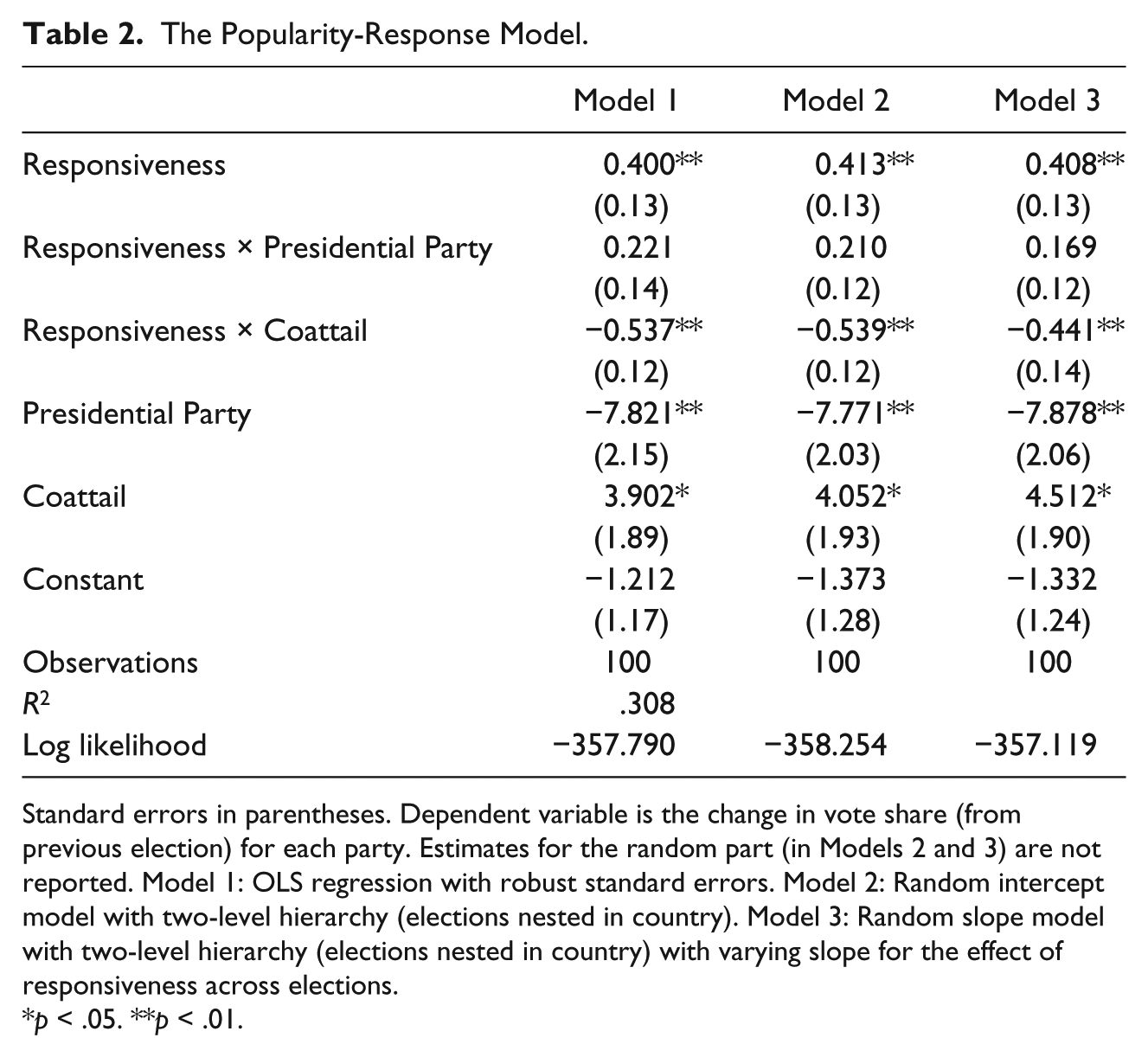
Standard errors in parentheses. Dependent variable is the change in vote share (from previous election) for each party. Estimates for the random part (in Models 2 and 3) are not reported. Model 1: OLS regression with robust standard errors. Model 2: Random intercept model with two-level hierarchy (elections nested in country). Model 3: Random slope model with two-level hierarchy (elections nested in country) with varying slope for the effect of responsiveness across elections.
p < .05. **p < .01.
Figure 3 demonstrates the decomposed marginal effects of responsiveness for four scenarios. Because responsiveness is hypothesized as being conditioned by the type of party (presidential or non-presidential) and the presence of coattail effects, the estimates display the impact of responsiveness for (a) presidential parties that had viable presidential candidates for the upcoming concurrent election, (b) non-presidential parties that had viable presidential candidates, (c) presidential parties without coattail effects, and (d) non-presidential parties without coattail effects.
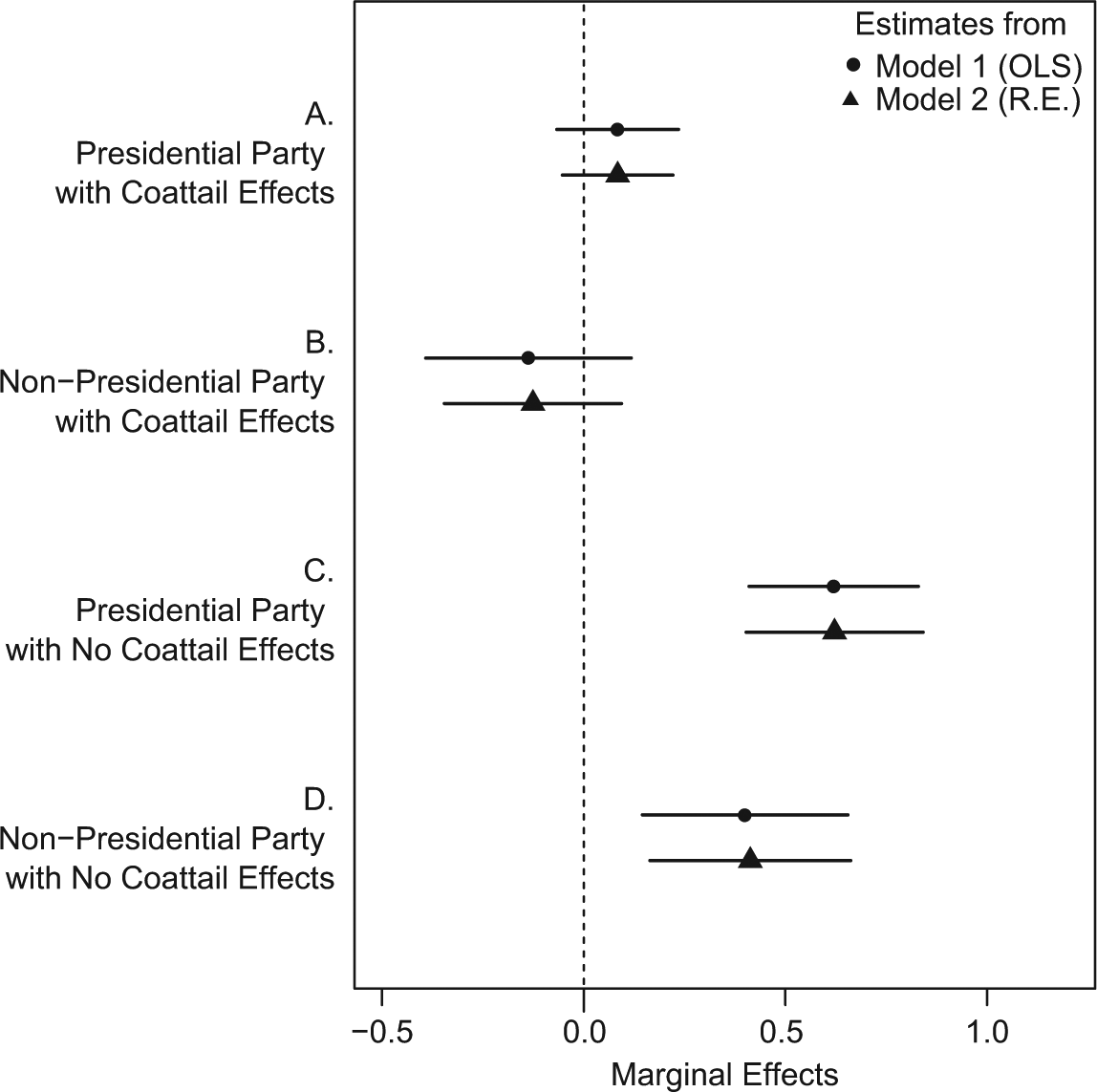
Marginal effects of responsiveness, conditional on party type and coattail effects.
The estimated marginal effect on the x-axis indicates the changes in votes share when the continuous responsiveness index increases by one unit. The positive sign of the estimates denotes the positive relationship between responsiveness and electoral payoffs. For example, suppose the marginal effect for a presidential party is equivalent to 0.5 and the president’s approval ratings were 10% higher than the party’s vote share received from the previous election (responsiveness = 10). If the party allied with the president (i.e., being responsive by cooperating with the popular president), the party can increase its vote share by five percentage points more than its electoral support in the previous election. Conversely, if the party defected from the president, the electoral support for the party is expected to decrease by that amount.
As presented in Figure 3, the impact of responsiveness is most pronounced when parties are not on their presidential candidate’s coattails (i.e., when the election is non-concurrent or when they do not have viable presidential candidates in concurrent elections). However, the effect of responsiveness tends to disappear or diminish when parties are beneficiaries of coattail effects (rows A and B vs. C and D). This supports the third hypothesis, the confounding effect of coattails on responsiveness-based vote choice.
Conclusion and Discussion
Although the separation of powers in the presidential system allows voters to hold presidents and congress accountable separately (Shugart & Carey, 1992), many analysts believe congressional election outcomes are heavily influenced by voters’ evaluations of presidential performance as voters tend to assign co-responsibility for this to her party in congressional elections. What has not been fully accounted in this explanation is the role of parties’ strategic behavior. In reality, it is not unusual that presidents tend to position themselves independently of their parties under certain circumstances (Wiesehomeier & Benoit, 2009), and presidential parties (opposition parties) are not always friendly toward (opposed to) the president. This happens because political parties have incentives to reshape their relationships with presidents to improve their pubic images, in the expectation that voters might catch this signaling and support them in congressional elections.
This study proposes that parties’ electoral outcomes under presidential systems can be a product of how the party responds to public opinion toward the president. This main argument is based on a slightly different assumption about voters’ responsibility assignment process from that used in the retrospective voting theory. The voters in this study are assumed to evaluate parties based on how well they respond to a popular or an unpopular president. That is, rather than simply assigning co-responsibility to the president’s party, some voters will be able to recognize the efforts of parties echoing public opinion toward the president.
The empirical results address several interesting points for the explanation of the electoral fortunes of political parties in Latin America and Caribbean presidential systems. First, electoral losses for governing parties are relatively greater than those observed in established democracies. Second, a party’s signaling of their sympathy with a popular president and/or alienation from an unpopular one has a hand in determining the party’s electoral success. Considering this together with the first finding, it suggests that when presidential parties defect from unpopular presidents or have a good relationship with popular ones, they can mitigate their baseline electoral losses. Third, however, this relationship tends to be diminished by candidate effects: Parties with relatively popular, viable presidential candidates are advantaged regardless of their responsiveness. When it comes to opposition parties, they can also enhance their electoral prospects by cooperating with popular presidents or by confronting unpopular ones. While this relationship is less clear for non-presidential parties than for presidential parties, responsiveness can certainly help non-presidential parties, particularly when those parties’ viable presidential candidates do not overshadow such behavior.
Taken together, the findings tell a nuanced story about electoral accountability in this region. The popularity-response model reaffirms the discontinuity and volatility that is typically attributed to Latin American politics: When a candidate is elected as a president, her party gets benefits together in the election (if concurrent); however, in the following election the party will be at risk of incurring governing costs. But, why are governing parties usually ill-fated? This study suggests an explanation for this question, and accordingly a possible way for parties to divert from this regularity: governing costs regularly imposed on governing parties may be partly the consequence of their unresponsiveness to voters’ collective assessment of the president. This includes the case in which a governing party stays silently on the president’s side even when the public’s assessment of the president is not favorable. Hence, for such presidential parties, standing against the president is a better tactic to prepare for the election than remaining silently on the side of the unpopular president, at least in a short-term electoral perspective.
This finding has mixed implications for electoral accountability under presidential systems. The study evidences a pathway through which political parties appeal their responsiveness to the electorate. This party-level mechanism rewards parties that endeavor to improve their image by following public opinion toward the head of the government. On one hand, this suggests that what parties do can influence congressional electoral outcomes in presidential systems. On the other hand, presidential popularity still plays an important role in this mechanism by directing how parties take (strategic) stances on salient issues. In addition, the responsiveness investigated in this study does not necessarily guarantee better policy representation because this type of responsiveness (as a strategy for valance-based competition) can be rather opportunistic behavior on the part of parties to maximize votes. Nevertheless, it is generally a good sign for the working of representative democracy when parties are responsive. Demonstrating the aggregate consequences of a kind of responsiveness centered on valence image (riding on the valence of the president appraised by the public) in congressional elections, this study contributes to our understanding of electoral accountability of legislative actors in president-centered systems.
Footnotes
Acknowledgements
I am grateful to Tiffany Barnes, Royce Carroll, Matt Loftis, Randy Stevenson, and the anonymous reviewers for their thoughtful comments and suggestions.
Declaration of Conflicting Interests
The authors declared no potential conflicts of interest with respect to the research, authorship, and/or publication of this article.
Funding
The authors received no financial support for the research, authorship, and/or publication of this article.
Notes
Author Biography
References
Supplementary Material
Please find the following supplemental material available below.
For Open Access articles published under a Creative Commons License, all supplemental material carries the same license as the article it is associated with.
For non-Open Access articles published, all supplemental material carries a non-exclusive license, and permission requests for re-use of supplemental material or any part of supplemental material shall be sent directly to the copyright owner as specified in the copyright notice associated with the article.
