



Abstract
At the psychological level, ethnic conflict can be seen as an extreme result of normal group identification processes. Bridging perceived intergroup boundaries is therefore key to improving intergroup relations. In contrast to the dominant association of nationalism with racism, chauvinism, xenophobia, and intolerance, we highlight the constructive potential of national identification. In a survey experiment, we find that the increased salience of a shared (Indian) national identity increases donations by members of a dominant ethnic group (Hindus) to members of a rival, minority group (Muslims). This effect is moderated by social status (caste). We suggest that national identification leads to a greater transformation in the behavior of low-status members of an ethnic group because they are more likely to be drawn to national identity as an enhancement of their social standing. Our study has implications for theories of social identity and interethnic cooperation, as well as for the literature on nationalism.
Introduction
There are many important studies of the causes of ethnic conflict (e.g., Horowitz, 1985; Posen, 1993; Varshney, 2003; Wilkinson, 2004). At the most basic psychological level, however, ethnic conflict is rooted in the existence of boundaries that separate an ingroup, which elicits preferential attitudes and behavior on the part of members, from an outgroup, which could be a target for discrimination or hostility (Barth, 1969; Lamont & Molnár, 2002; Lieberman & Singh, 2012b; Tilly, 2005; Wimmer, 2008). The very factors that make loyalty to the ingroup a powerful and beneficial force also “provide a fertile ground for antagonism and distrust of those outside the ingroup boundaries” (Brewer, 1999, p. 442). Ingroup identification enables collective action on behalf of the ingroup and thus “lay[s] the groundwork” for violent conflict, pogroms and ethnic cleansing (Brewer, 2001, p. 28). Ethnic conflict and even genocide can then be seen as an extreme result of normal group identification processes (Kreidie & Monroe, 2002; Moshman, 2007).
An influential body of scholarship has shown the extension of pro-social attitudes and behavior across ethnic boundaries to be an important route toward ethnic peace (Putnam, 2007; Varshney, 2003). 1 In this article, we showcase a relatively underemphasized way—the salience of a shared national identity—through which to encourage pro-social behavior across ethnic boundaries. Building on constructivist theorizing about the malleable nature and varying salience of identities, we show that a common national attachment can encourage individuals from mutually hostile ethnic groups to engage in cooperative behavior across the us–them divide.
Such an argument is in sharp contrast to the dominant association of nationalism with odious tendencies such as racism, chauvinism, xenophobia, and intolerance directed not only toward non-national groups (e.g., Dunn, 1979; Saideman & Ayres, 2008; Schrock-Jacobson, 2012) but also, more critically from the viewpoint of this article, at groups within the national community (Abrams, Hogg, & Marques, 2005; Theiss-Morse, 2009). An influential model within social psychology, the group projection model, suggests that recategorization into a superordinate national identity can foster ethnocentrism on the part of a majority prototypical high-status ethnic group and lead its members to discriminate against a relatively low-status ethnic minority. There are numerous, well-known instances of nationalism being appropriated by dominant ethnic groups, sharpening rather than reducing ethnic boundaries. Contemporary Russian nationalism, for example, has been argued to view other Slavs as “little brothers” and non-Slavic minorities as foreigners (Kaufmann, 1996); the rise of ethnic nationalism in Turkey has fueled derogation of the Kurdish, Armenian, and Jewish minorities (Cirakman, 2011); in the United States, non-White and non-Christian Americans have been marginalized because they do not fit the national prototype (Devos & Banaji, 2005; Theiss-Morse, 2009).
Instead, we showcase the relatively underemphasized constructive potential of national identification. Confirming the predictions of an alternate common ingroup identity (CII) model, we find that perception of an overarching national identity makes members of a majority high-status ethnic group less likely to discriminate in altruistic giving toward a rival, relatively low-status ethnic minority. The altruism toward the outgroup that is elicited in our study can itself be seen as an important starting point for thinking about improved inter-ethnic relations (Alexander & Christia, 2011; Brewer, 1999; Fehr & Fischbacher, 2004; Trivers, 1971). More generally, charitable giving to non-co-ethnics is an important instance of pro-social behavior across ethnic boundaries, which has been theorized to reduce ethnic tensions and conflict (Putnam, 2007; Varshney, 2003).
In our findings about the ability of nationalism to generate altruism across ethnic lines, we build on a small but important set of experimental studies that show how increased identification with the nation triggers increased interethnic trust (A. L. Robinson, 2012) and greater support for redistribution toward non-co-ethnics (Transue, 2007). We, however, move beyond these studies, in a number of important ways. For a start, unlike some of these studies, we examine the concrete behavioral consequences of national identification, focusing in particular on how it can trigger monetarily costly behavior (see also Miguel, 2004; Sachs, 2009). This is an important empirical contribution, given the potentially weak association between attitudes and behavior, especially in situations that involve material costs (Diekmann & Preisendoerfer, 2003). In addition, we advance beyond an emphasis on the differences in behavior toward co-ethnics versus non-co-ethnics to also examine the distribution of ingroup favoritism within an ethnic group. Our study incorporates a novel examination of how variations in status can moderate the effects of recategorization into a superordinate national identity. We start from and advance studies about the effect of national identification on the behavior of majority, high-status ethnic groups (Mullen, Brown, & Smith, 1992), but we also recognize that not all individuals of high-status groups are of equal within-group status. Extending a recent, influential argument by Shayo (2009), we find a surprising variation in the way in which national identification influences the behavior of low- and high-status members within a higher status ethnic group. We suggest that national identification leads to a greater transformation in the behavior of low-status members of an ethnic group because they are more likely, as compared with their higher status co-ethnics, to be drawn to national identity as an enhancement of their social standing. In addition to its theoretical contribution, the shining of an analytical spotlight on the hitherto understudied interplay between national-, ethnic-, and status-based identities also has substantive policy implications. Recognizing the way in which the potential of nationalism to improve inter-ethnic relations is moderated by social status within ethnic groups holds critical lessons for policy makers on how national identity should be constructed and targeted.
Our findings are based on the results of an online survey experiment, which examined the effect of varying the salience of Indian national identity on monetary contributions by 918 individuals of differing status, conceptualized in terms of caste, from the dominant high-status Hindu ethnic group toward the ingroup (Hindu) or outgroup (Muslim) victims of a (fictitious) fire accident. Indian national identity has from its very inception been characterized by a tension between an ethnocentric Hindu nationalism and a secular Indian nationalism—making it a nice case for testing the competing predictions of the group projection versus the CII models. The recent resurgence of a Hindu national identity directed specifically against the minority Muslim community would in fact appear to make India ripe for the confirmation of the predictions of the group projection model. That we instead find that the increased salience of an Indian national identity reduces Hindu bias against Muslims is surprising and has important scholarly and policy implications, even more so because the Hindu–Muslim cleavage has historically been a site of intense competition and deadly conflict in India, making this a particularly hard test for the CII model. India is also the site, in the form of the ritually sanctioned caste system, of one of the most historically enduring and trenchant status hierarchies in the world, making it a rich case for an analysis of the intersection of national and ethnic identities with status.
In the next section, we present our theoretical framework, specifying hypotheses about intergroup altruism based on the interaction of ethnic, national, and status identities. We then briefly sketch out a context for ethnic divisions and national attachment in India. Next, we describe the design of, and results from, our experiment. We then discuss the implications of our findings and conclude.
Theoretical Framework and Expectations
In this section, we build on influential theories in social psychology to generate hypotheses about intergroup relations at the intersection of ethnic, national, and status identities. First of all, we draw on the well-known minimal group paradigm to specify how group boundaries might generate a bias toward co-ethnics, such ethnic discrimination serving as a starting point for inter-ethnic competition and conflict. We then derive two opposing hypotheses about the effect of a superordinate national identity on altruism across ethnic boundaries, with the group projection model predicting greater but the CII model suggesting reduced discrimination on the part of a dominant, high-status ethnic group toward a relatively low-status, rival minority. Finally, we specify hypotheses about how variations in status within an ethnic group might generate differences in ethnic discrimination both when the ingroup is defined in ethnic and also recategorized in national terms.
We construct our hypotheses with reference to the aforementioned online survey experiment, which draws on a sample of Indian Hindus. Detailed more thoroughly in “General Design and Procedure” section, the experiment involves randomly assigning half of the respondents to the national identity prime. Subjects are then asked to donate money to the co-ethnic (Hindu) or non-co-ethnic (Muslim) victims of a fire accident.
Consequences of Group Attachment
The powerful cognitive and motivational consequences of group attachment have been well established (Allport, 1954). Going back to the pioneering studies by Tajfel, Flament, Billig, and Bundy (1971), laboratory and field experiments have consistently demonstrated that group boundaries, even when drawn arbitrarily, can generate bias in favor of ingroup members (Tajfel et al., 1971). It has also been shown that because the expectation of reciprocity is greatest with mutually acknowledged ingroup members, altruistic behavior often stops at group boundaries (Bernhard, Fischbacher, & Fehr, 2006; Brewer, 1999; Fehr & Fischbacher, 2004). Moreover, people feel greater empathy and responsibility toward ingroup members than toward outgroup members (Mullen et al., 1992). Based on this, we expect to observe ingroup bias when national identity is not salient:
National Identity and Ethnic Discrimination
Although the reduction of discrimination across group boundaries is recognized as important for improving inter-ethnic relations, there are contrasting views on how ethnic boundaries might be bridged. In particular, two leading theories in social psychology—the CII model and the group projection model—give rise to opposing predictions about whether recategorization of ethnic groups of varying status into a shared national identity will reduce intergroup bias.
Common ingroup identity model
Studies within the CII model propose that recategorization can reduce intergroup bias and conflict. They argue that if members of different groups are convinced to see themselves as members of a single, superordinate group, their attitudes toward former outgroup members improve through processes involving the pro-ingroup bias (Gaertner, Dovidio, Anastasio, Bachman, & Rust, 1993). A common ingroup extends or redirects the cognitive and motivational processes that produce positive feelings toward ingroup members to former outgroup members (Gaertner, Dovidio, & Bachman, 1996). Members’ perceptions change from “us” and “them” to the encompassing “we.” 2 In a series of experiments, Kramer and Brewer (1984) find that inclusion within a common social boundary reduces social distance among group members. These lab experiments have also been supplemented by studies in the field (e.g., Nier, Gaertner, Dovidio, Banker, & Ward, 2001; West, Shelton, & Trail, 2009). Experimental results by Transue (2007) suggest that increasing the salience of American national identity promotes support for a tax increase directed at a racial minority among U.S. respondents. A. L. Robinson (2012) finds that increased national identification extends interpersonal trust across ethnic lines in Malawi and Zambia. From this perspective, priming a shared national identity should lead to the bridging of subnational ethnic boundaries and to the elimination of intergroup bias:
Group projection model
Recognizing and taking seriously differences in status between ethnic groups, the group projection model reaches a contrary conclusion from the CII model, suggesting that upon recategorization into a shared superordinate identity, the dominant, high-status ethnic group will seek to project its own characteristics and exclude a relatively low-status ethnic minority. Group projection—that is, claiming prototypicality within the superordinate category—on the part of a dominant ethnic group (Wenzel, Mummendey, & Waldzus, 2007) forms the basis for ethnic nationalism. Devos and Banaji (2005), for example, uncover group-based hierarchies within an American national identity, concluding that “the cultural ‘default’ value of ‘American’ is ‘White’” (p. 464). Similarly, Waldzus and Mummendey (2004) find that a German national identity is associated with exclusively West German characteristics. “Deviations” of low-status ethnic groups from the “prototypical” characteristics of the dominant ethnic group are likely to trigger devaluation and discrimination (Peker, Crisp, & Hogg, 2010; Waldzus & Mummendey, 2004; Waldzus, Mummendey, & Wenzel, 2005; Wenzel et al., 2007). Prototypical national group members may evaluate the marginalized members even more negatively than they evaluate members outside the national ingroup because they are seen as “tarnishing” the ingroup image (Marques, Abrams, & Serodio, 2001; Marques & Paez, 1994).
More recently, Theiss-Morse (2009) used survey data and a series of experiments to show that Americans with strong national identification are willing to help prototypical ingroup members, defined as White or Christian or native-born citizens, but not marginalized Americans. In her study, strong identifiers are more likely to have a restrictive, ethnocultural understanding of national identity than weak identifiers. From this perspective, recategorization of ethnic groups of differing status into a shared national identity may actually increase discrimination on the part of the dominant ethnic group against members of the lower status ethnic minority:
Status, Ethnic Discrimination, and National Identity
In this section, we move beyond an analysis of status differences between ethnic groups, to examine how intragroup status differences might moderate intergroup bias and recategorization effects. 3 Here we follow Shayo (2009) and others and define status by the differences in power between groups, rather than the differences in group size. Although the two categories tend to be coterminous (e.g., Whites in the United States), they sometimes diverge (e.g., Whites in South Africa during apartheid). Multiple studies in social psychology suggest that when group identity is negative, people seek to either associate with a different group or to improve the valuation of their existing group (Tajfel & Turner, 1979). Scholars including Roccas (2003), Ellemers, Doosje, Van Knippenberg, and Wilke (1992), and Hogg and Hains (1996) show that people are more likely to identify with groups of high rather than low status when multiple group identities are available. Roccas (2003) has further shown that individuals “tend to perceive an ingroup as having higher status, and to identify with it more, if they are simultaneously members of a different group which has low rather than high status” (p. 363). Drawing on this insight, Shayo (2009) argues that lower status groups (e.g., the poor) are more likely to be nationalistic (i.e., have a stronger national rather than class identity) and, at high levels of nationalism, overlook their economic interests by opposing redistribution (i.e., they are willing to give up material payoffs because “redistribution enhances the status of the lower class more than it does national status,” p. 148). Extending Shayo’s (2009) logic to interethnic altruistic behavior, we hypothesize that lower status members of an ethnic group will demonstrate a stronger ingroup bias prior to recategorization because “their more immediate social group has a lower status” (p. 148).
The studies mentioned above examine status differences between subgroups that are recategorized into a common ingroup. Our article, however, ventures into relatively uncharted terrain by examining the interplay of intra- and inter-group status considerations. We extend the line of research on status in intergroup relations to test whether an individual’s position within an ingroup—in addition to the relative status of groups that are recategorized into a common superordinate group—moderates the effect of recategorization on ingroup bias. We start with the proposition that individuals are likely to evaluate both their within-group status and their group’s status vis-à-vis other groups when choosing group identification (Seta & Seta, 1992, 1996). Most individuals prefer to occupy high status within a high-status ingroup. Low-status individuals within a high-status ingroup might then prefer intergroup to intragroup comparisons and demonstrate stronger attachment to the higher status ingroup. This will lead to greater ingroup bias, as proposed in H3. Alternatively, low-status individuals might demonstrate a stronger identification with a superordinate group, if such identification elevates their perceived social status and is salient in a given situation. This is in contrast to the individuals of high intragroup status, for whom recategorization may mean an erosion of status. This dynamic may be especially likely when the available superordinate identification is national because nationalism tends to be grounded in the principles of equality and social mobility (e.g., Deutsch, 1966; Smith, 1999). Low-status individuals are therefore more likely to strongly identify with their national group, made salient through recategorization, than high-status individuals. By contrast, individuals who hold higher status within their ethnic groups are more likely to view recategorization as a threat to their privileged position, which will result in weaker identification with the national identity.
Ethnicity, National Identity, and Status in India
In this article, we focus on India, which is characterized by a very high level of ethnic diversity and divisions (Singh, 2011), irrespective of how one chooses to conceptualize ethnicity (Lieberman & Singh, 2012a). Demographically, as measured by various fractionalization indices, India is one of the most diverse countries in the world. The Ethno-Lingiustic Fractionalization Index (ELF) for India is 0.811 as compared with a global average of 0.48. On Fearon’s Cultural Fractionalization index India scores 0.67, twice as high as the global average of 0.3 (Fearon, 2003). In terms of cognitive measures, such as responses to attitudinal surveys, India exhibits a high level of dividedness. For example, in the World Values Survey (World Values Study Group, 1994), 44% of Indians said that they would not want a neighbor of a different religion or caste (race), as compared with 17% and 16%, respectively, of respondents worldwide. In terms of a behavioral comparison, according to the Minorities at Risk Project (2009), India has more minority ethnic groups at risk (9) than all other countries except Russia (11). State institutions in India have also enshrined ethnic distinctions to a very high degree (Lieberman & Singh, 2012a).In the six decades since independence, India has experienced considerable violence along different ethnic cleavages including caste, language, religion, and the indigenous cleavage.
Among all the different ethnic cleavages in India, however, religion has been the most conflictual. Wilkinson (2008) shows that religious mobilization has typically led to more violence than mobilization around non-religious identities such as caste, region, or language. A number of scholars have pointed to the less tractable nature of religiously framed conflict in India (e.g., Chadda, 1997; Juergensmeyer, 1993). Most recently, Capoccia, Sáez, and de Rooij (2012) have shown that through the post-colonial period, demands for autonomy or secession in India put forward by religious organizations have been much more durable than identical demands advanced by non-religious organizations.
Within religious conflict, it is the Hindu–Muslim cleavage that has been the site of the greatest competition and bloodshed. Since at least the beginning of the 20th century, the relationship between majority Hindus, who constitute 82% of the population, and Muslims, the largest religious minority, who constitute just more than 12% of the total population, has been characterized by tensions and outbreaks of violence. The late colonial period witnessed many instances of “communal violence” (F. Robinson, 1974). The most horrific Hindu–Muslim violence, however, occurred in the months preceding and following the partition of the subcontinent along religious lines, in which up to 17 million people were displaced and one million killed. Hindu–Muslim riots and anti-Muslim pogroms have been endemic in independent India. As a noted scholar of ethnic violence in India observes, hardly a month passes in which a Hindu–Muslim riot—large enough to be noted in the press—does not occur, and it is likely that not a day passes without many instances of quarrels, fights, and fracases, many of which carry the potential for conversion into large-scale riots involving arson, looting, and killing (Brass, 2003, p. 6).
Indian national identity can be said to have emerged in the context of the struggle for independence from British colonial rule. From its inception, Indian nationalism has been characterized by a tension between a secular Indian nationalism and a religious, Hindu nationalism (Varshney, 1993). Secular Indian nationalism has been characterized by ideas of syncretism, pluralism, and tolerance. In contrast, in Hindu nationalism, Hinduism or Hindutva is the source of Indian identity. Muslims are the principal adversary; Hindu extremists believe Muslims should be excluded while more moderate Hindu nationalists believe they must be assimilated, which involves accepting the central importance of Hinduism to Indian civilization (Varshney, 1993). Either way Hindu nationalism represents, in terms of group projection theory, an attempt by a dominant religious subgroup at the projection of their identity onto the shared superordinate identity. The emergence of the Hindu nationalist Bhartiya Janata Party (BJP) as an important player on the national electoral stage since the 1990s, and especially the recent election of its leader Narendra Modi as Prime Minister, may be seen as a sign of the growth of Hindu nationalism. 4
In our experiment, we manipulate Indian national identification through exposure to a map of India shaded in the colors of the Indian tricolor. 5 The powerful symbolism of the national flag is well established: It is both used to express national unity, often in times of crisis (Skitka, 2005), and is capable of producing such unity (Billig, 1995; Hassin, Ferguson, Shidlovski, & Gross, 2007). The map of the national territory further reinforces the message of unity by representing the nation as an integral whole. 6
India also provides an appropriate and analytically rich context for studying the role of an individual’s status in ethnic and national identification. With its segregation of people on the basis of traditional occupations (most broadly, Brahmins, Kshatriyas, Vaishyas, and Shudras as well as untouchables who were beyond the pale entirely), caste has historically been the most salient markers of social status, especially among Hindus (Bayly, 1999; Srinivas, 1962). It is in fact one of the most deeply ingrained symbols of status in the world. After independence, India’s Constitution abolished discrimination on the basis of caste and instituted a system of quotas for lower castes in state education and employment. Although there is increasing socio-economic mobility across caste lines, caste distinctions have persisted nonetheless, constituting a key indicator of social standing. Furthermore, lower castes’ pursuit of improved status has led them to contradictory impulses vis-à-vis a Hindu identity. On one hand, they have been attracted, as represented clearly by the process of “Sanskritization” (Srinivas, 1962), to a “classic” Brahmanical Hindu identity as a route to higher standing within the fold of Hinduism. On the other hand, lower castes have also mobilized explicitly against a Hindu identity, seeking “exit” from Hinduism as a way of escaping the caste hierarchy.
The Survey Experiment
To test our theoretical expectations, we conducted a survey experiment on Indians recruited through an online service offered by Amazon called Mechanical Turk (hereafter MTurk). MTurk is an increasingly popular tool for experimental research in social sciences (Huff & Tingley, n.d.; Lawson, Lenz, Baker, & Myers, 2010; Tingley & Tomz, 2014). The primary attraction of MTurk is that it allows for “low-cost experiments . . . with a diverse subject pool” (Berinsky, Huber, & Lenz, 2012). A number of studies have shown that experiments on MTurk generate high-quality data that replicate well-documented lab findings (Buhrmester, Kwang, & Gosling, 2011; Paolacci, Chandler, & Ipeirotis, 2010). Berinsky et al. (2012), in particular, find that samples drawn from MTurk replicate the results of important published experiments in political science.
We are, however, by no means suggesting that our Mturk sample is representative of all Indians. Because our respondents must understand English and have access to the Internet, they are, on average, more educated, wealthier, and more likely to be from an urban area than the general Indian population (see Table 1 for demographic information). This is not necessarily a “defect,” however. First, among Indians, this group is perhaps one of the most able to contribute to charities and influence relief efforts (A. Deshpande & Spears, 2012). Second, these sample characteristics would only bias our findings in a conservative direction, as multiple studies have shown that higher education and income are associated with weaker outgroup prejudice (Coenders & Scheepers, 2003; Gijsberts, Hagendoorn, & Scheepers, 2004). Indeed, our experimental findings might be all the more relevant as the Indian middle class grows rapidly, fundamentally transforming Indian politics (Fernandes, 2006). Finally, this sample is more representative of India than an in-person convenience sample that we might have used, such as one drawn from college students. It is also important to keep in mind that because our treatment is randomly assigned, it is independent of possible confounders (and so, internally valid), including any variables on which the MTurk sample might differ from the general Indian sample. As demonstrated in Table 1, the subsamples are balanced on theoretically important observables. Nonetheless, one might wonder if these demographic characteristics limit the degree to which our results generalize to the broader Indian population. We seek to mitigate these concerns in the “Robustness and Manipulation Check” section by testing for heterogeneous treatment effects within our sample.
Demographic Characteristics of the Sample.

With the exception of the number of observations (n) and age (which is simply mean age at the time of the experiment), the values above are the proportion of subjects in each condition described by the indicator for the respective row (e.g., the proportion male).
General Design and Procedure
Our survey experiment, labeled “A quick research survey,” was fielded to MTurkers with an Indian IP address in November 2012. The informed consent page gave no information about the substance of the research, indicating only that respondents would participate in a survey. We paid a base rate of Rs. 18 for completing the questionnaire and were able to recruit a diverse sample of Indians from across the country due to the large presence of Indians on MTurk (Berinsky et al., 2012). Because we are interested in the effect of the salience of a superordinate identity on the behavior of the members of a dominant ethnic group, our analysis is restricted to the 918 subjects who self-identified as Hindu. 7 We estimate intent-to-treat effects and thus did not exclude any Hindu participants from the analysis.
At the very beginning of the experiment, each respondent was notified that, as one of the first 100 respondents, she would receive a Rs. 5 bonus. Immediately after, respondents were shown a newspaper report about a fire accident and asked about their willingness to contribute a portion of their bonus to an Indian NGO raising donations for the victims. We primed the salience of Indian national identity by randomly assigning half of the respondents to a treatment condition, in which they were shown a picture of the Indian map shaded in the colors of the Indian tricolor. The image was not displayed to respondents in the control group.
To examine the differences in pro-social behavior toward the ingroup versus the outgroup, we varied the name of the neighborhood in which the fire took place. Half of the respondents were told that a fire broke out in Ramnagar, the other half, in Muzaffarnagar. Ramnagar, as a putatively Hindu name, signals that the victims were likely Hindu, while Muzaffarnagar, a putatively Muslim name, signals that the victims were likely Muslim. Furthermore, we mention specific victims of the fire and vary their names according to the supposed religion of the neighborhood. For the Ramnagar condition, we name Pradeep Kumar, Sunil Raj, and Jaya Kumari as victims. These are deliberately chosen to be ‘pan-caste’ names that cannot be associated with a specific jati or classified as upper or lower caste. For the Muzaffarnagar condition, we mention Abdul Rahim, Fatima Khan, and Ijaz Ahmed. This strengthens the perception of the neighborhood as either Hindu or Muslim. Figure 1 shows a screenshot of one of four experimental conditions (treatment combined with a Ramnagar condition).
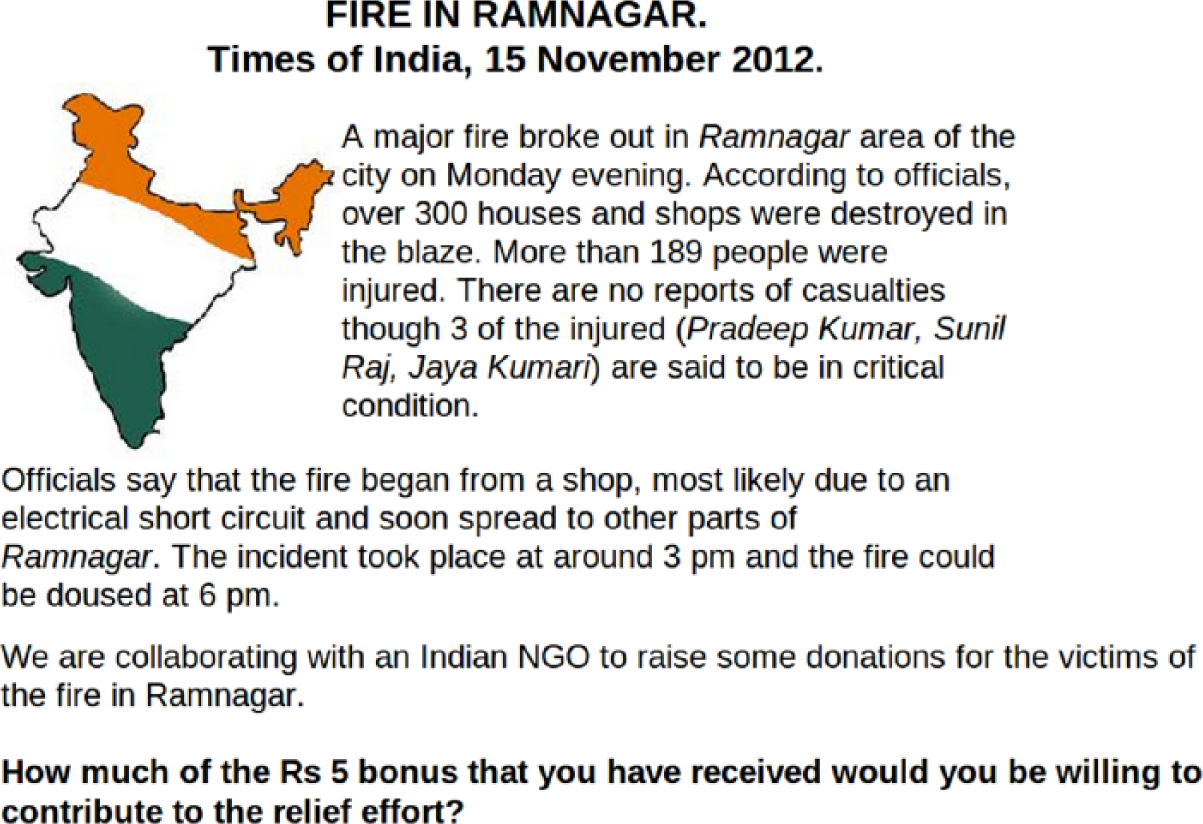
A screenshot of the experimental page, as seen by a subject receiving the nationalism prime and asked to contribute to victims in the putatively Hindu city “Ramnagar.”
The prime and the decision to contribute were followed by a battery of demographic questions. In this section of the survey, respondents were also asked to rank various identities and to tell us how important their Hindu identity was to them. Because the wording of some demographic questions was dependent on answers to others, demographic questions were split into two blocks and randomized within-block. Figure 2 displays a visual map of the experimental flow.
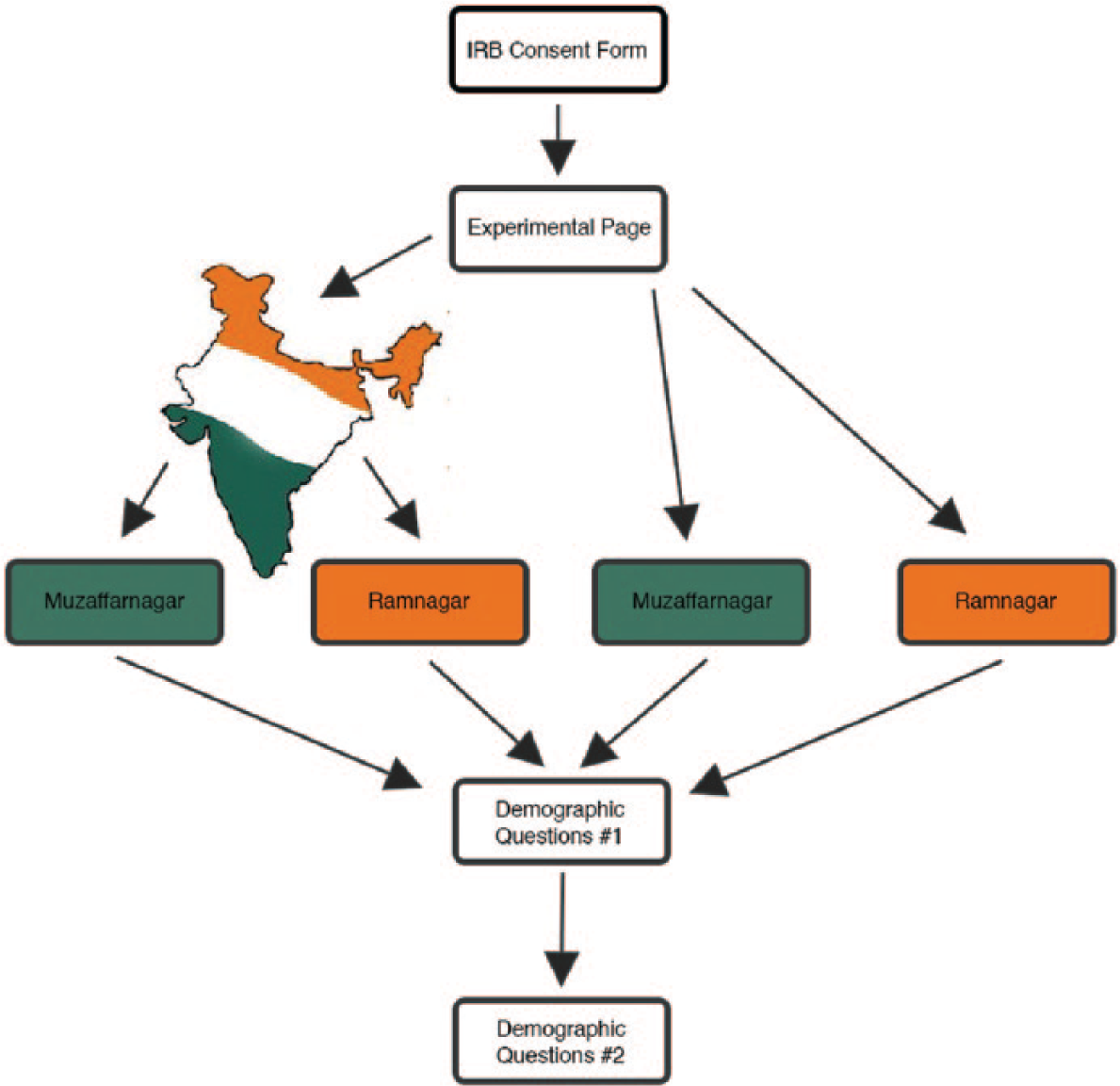
A map of our experimental design.
Although the news article was entirely fictitious, respondents were led to believe that the story and the contributions were real. The prompt was designed to mirror real newspaper reports about similar accidents that appear across India almost daily 8 and echoed the commonplace involvement of local NGOs in relief efforts for such accidents. Because we needed to isolate treatment effects across otherwise identical Hindu and Muslim conditions, the news story had to be identical in all respects except the names of the communities and victims. Insofar as this situation would never arise naturally, this small amount of deception was unavoidable. We did explore a number of different ways to conduct our study without deception but found it necessary in order to avoid Hawthorne effects (Bassett, Basinger, & Livermore, 1992; Bortolotti, 2006). Some of the situations that did not involve deception, such as soliciting contributions toward Hindu and Muslim charities, were also problematic. 9 Importantly, our choice of deception posed minimal risk to the participants. Although the situation was fictitious, the participants had a “real” opportunity to donate to a worthy charitable cause 10 . Moreover, a number of social-psychology experiments have shown that asking people about a certain activity, such as exercising or donating blood, encourages respondents to engage in that activity (Williams, Block, & Fitzsimons, 2006). By giving people an opportunity to make a donation, especially across ethnic lines, we are, therefore, increasing the likelihood that our respondents will engage in such activity in the future, which might help foster a more general norm of charitable giving toward minorities. The moral benefits of conducting such research might, in this way, be seen as outweighing any potential costs of deception, which are likely to be negligible when investigating innocuous public behaviors such as donating to a charity (Christensen, 1988). Further, research has revealed that subjects who have participated in deception experiments did not mind being deceived or having their privacy invaded (Christensen, 1988). In addition, in our case, the contamination of the subject pool, a concern as regards some studies using deception, was minimal, at worst affecting responses of Indian MTurkers only in very similar experiments (Brock & Becker, 1966; Cook et al., 1970).
Results
The experiment thus has four conditions: Ramnagart, Ramnagarc, Muzaffarnagart, and Muzaffarnagarc, where the subscripts “c” and “t” stand for control and treatment, respectively. Each condition has an associated mean contribution which we denote by
The primary results from the experiment are displayed graphically in Figure 3 and summarized numerically in Table 2. Table 3 presents these results with additional statistical information, and also displays results from one-way comparisons. The next section interprets these results as they pertain to the hypotheses laid out in “Theoretical Framework and Expectations” section.

Observed average contributions in each of the four conditions against the counterfactual that the difference in differences equals zero.
"Overall Effects: Does the Nationalism Prime Change Ingroup Bias?"
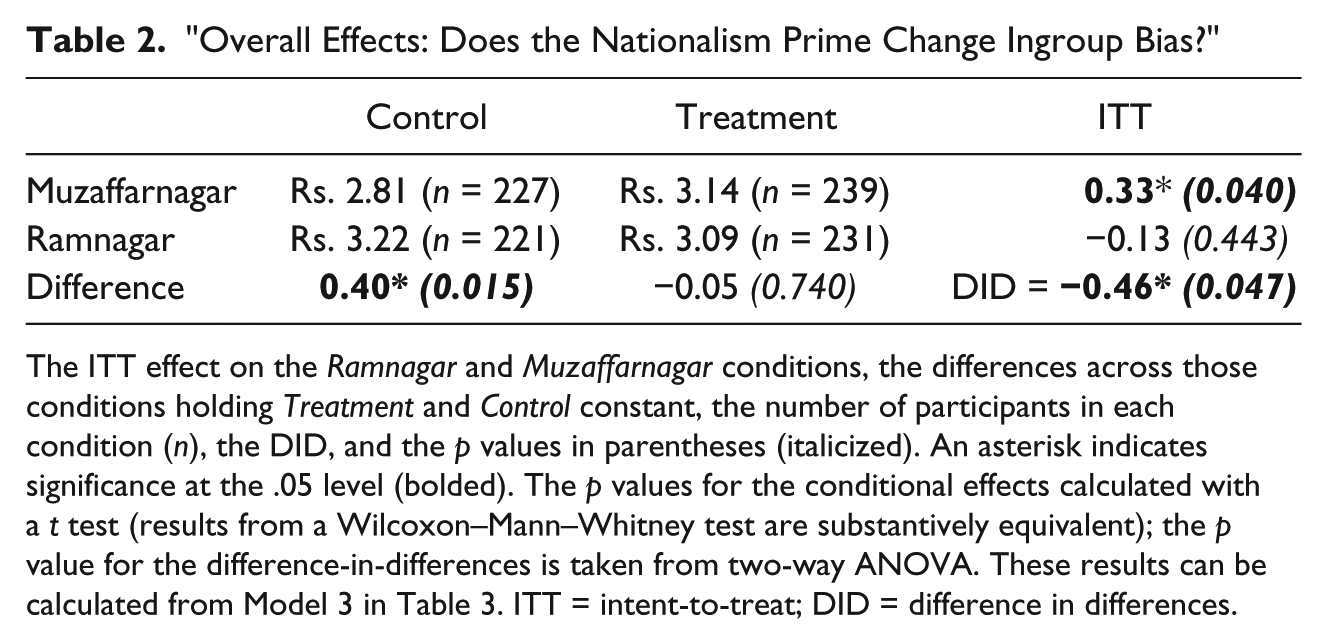
The ITT effect on the Ramnagar and Muzaffarnagar conditions, the differences across those conditions holding Treatment and Control constant, the number of participants in each condition (n), the DID, and the p values in parentheses (italicized). An asterisk indicates significance at the .05 level (bolded). The p values for the conditional effects calculated with a
Regression Results.
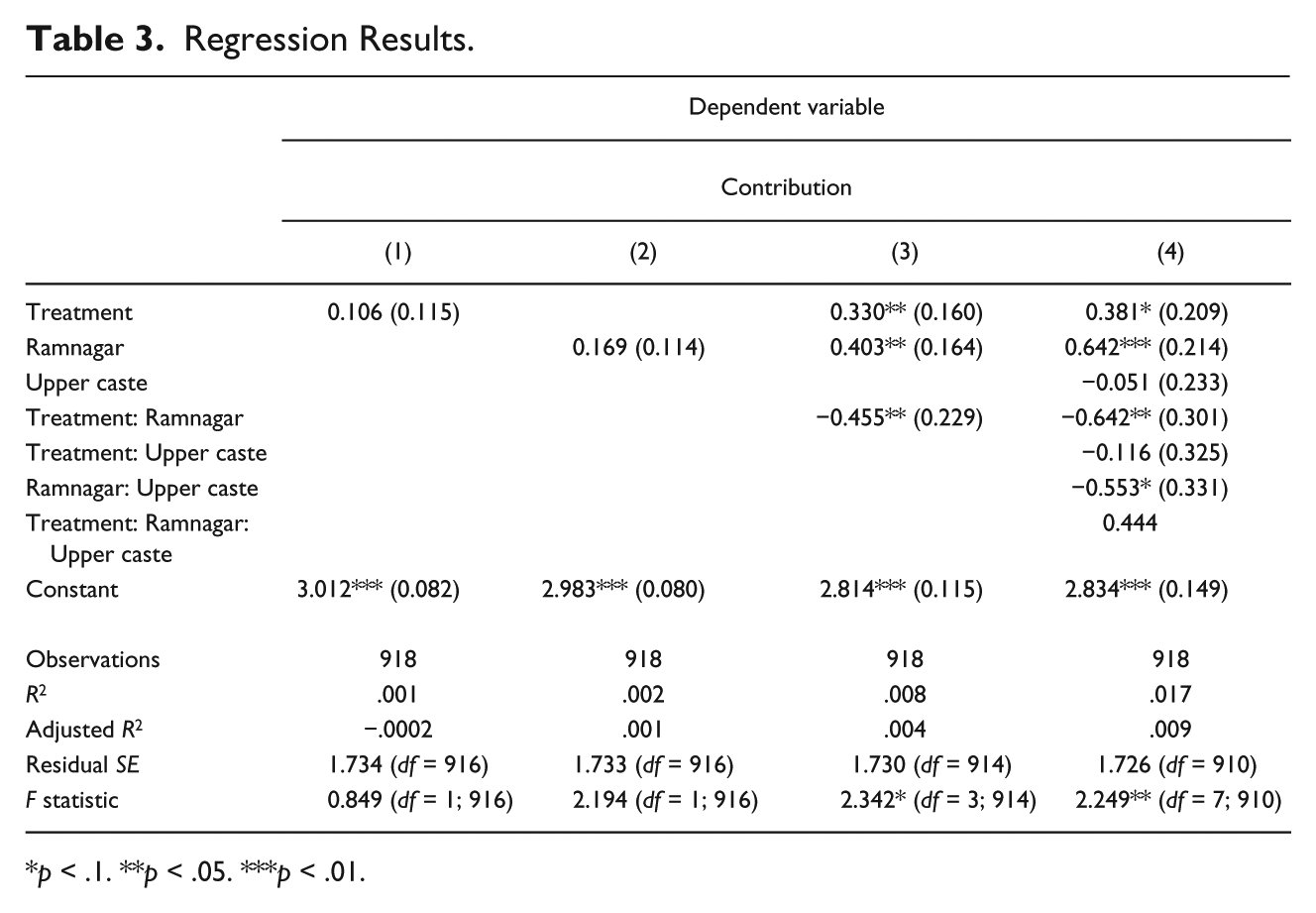
p < .1. **p < .05. ***p < .01.
Salience of Identity and Ingroup Bias
In line with H1, we find that subjects in the control condition are biased in favor of fellow Hindus. The average contribution from subjects assigned to Ramnagarc is Rs. 0.40 higher than in Muzaffarnagarc, which is suggestive of an ingroup (Hindu) bias
Of even more interest are
Confirming
Identity and Intragroup Status
In line with our theoretical discussion, we find differentiated responses to the priming of national identity across upper and lower castes, which as mentioned earlier, are important markers of social standing within the Hindu group in India (see Figure 4 and the fourth model in Table 3).11 Respondents’ status within the Hindu ingroup may determine the extent of outgroup bias in the control condition and also moderate the effect of recategorization into a superordinate identity in the treatment condition. The first interesting difference between upper and lower castes is the strong ingroup bias demonstrated by lower castes in the control, as predicted by
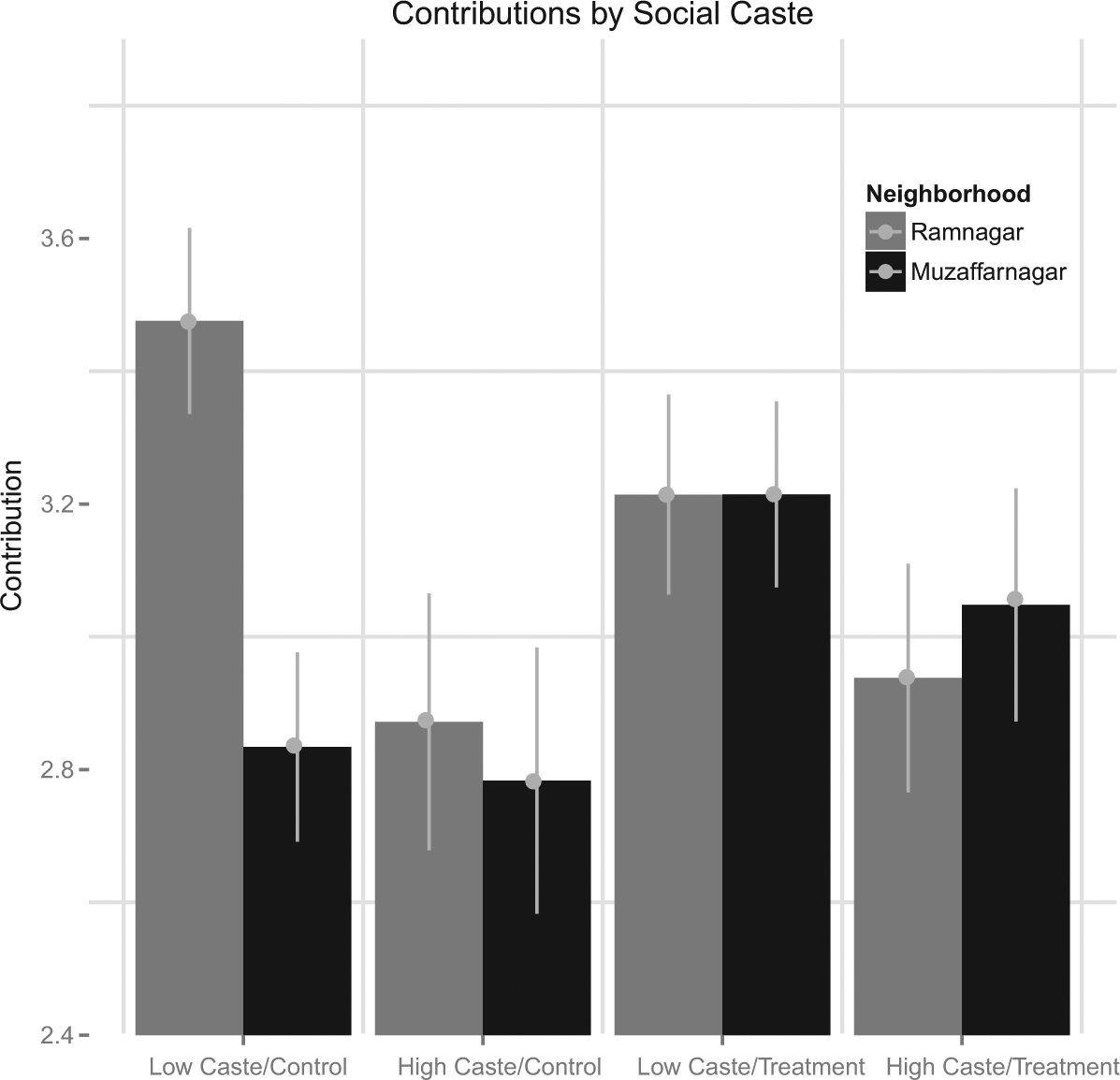
The amounts contributed by subjects in each condition, separated by caste.The bars display standard errors.
More importantly, we also find heterogeneous effects of the prime on respondents of different castes, in line with
Robustness and Manipulation Checks
In this section, we seek to show the robustness of our findings by addressing some potential concerns. Firstly, whether our treatment actually influence national identity salience; second, if the treatment varies on dimensions in our sample that do not represent India more generally, and thirdly, the concern that the relatively low stakes in our experiment might bias our findings.
Manipulation Checks
Does our prime indeed work by increasing the salience of Indian national identity? To answer this question, we ran an experiment (N = 270) in which we tested the effect of our prime on the salience of national identity (instead of on monetary contributions). To avoid all other priming effects, we used an open-ended question that measured salience by asking respondents to “choose one word that best defines them as a person.” In the control, only 41% of respondents chose to indicate Indian national identity while in the treatment, 69% of respondents stated Indian national identity. Thus, exposure to a map of India shaded in the colors of the national flag accounted for a 28% increase in the salience of national identification (
In addition, our original survey experiment asked respondents to rank various identities (state, gender, religion, nation) in order of importance. This question was included in the second block of demographic questions (see Figure 2), as we wanted to ensure that respondents did not understand the purpose of the survey; therefore, we could not measure the relative salience of various identities at the time when respondents were viewing the prime on the screen and making decisions about how much money to donate. Responses to this question are nevertheless instructive. Overall, 46% of the sample selected Indian identity as their most important, and the mean importance assigned to Indian identity was higher in the treatment group, with 48.5% of Hindus stating their Indian identity was most important to them as compared with 43.9% in control. Tested against the null hypothesis that treated and control units have identical distributions, a Mann–Whitney U test yields a
It is possible that in the course of the survey, our respondents may have guessed that the survey was related to Hindu-Muslim relations and this might have affected their allocation decisions, for example, through social desirability bias. To guard against this possibility, the prime and the opportunity to donate were presented at the very beginning of the survey. Furthermore, the first 100 respondents who completed the survey were asked what they thought the survey was about. Their open-ended responses suggest that even at the end of the survey many remained unaware of the true purpose of the study.
Heterogeneous Treatment Effects
Although randomization provides internally valid inferences, it is of course possible that our inferences do not generalize to the broader Indian population. This is likely if the effects we measure are heterogeneous with respect to dimensions in our sample that are not reflective of India more generally. Although we cannot rule out this possibility entirely, we test for heterogeneous treatment effects within our sample by including a triple interaction, as in Model 4 of Table 3. Tests for three such variables—urban/rural, income, and education—are presented in Online Appendix B. We see that the results are stable across the inclusion of these additional interactions. Therefore, even though the effects may be somewhat different in size in a more representative sample, our experiment still provides valuable insights concerning the broader Indian public.
Stake Size
Could relatively low monetary stakes bias our results? Several studies have found that an increase in stakes does not significantly affect the behavior of decision-makers in a broad range of economic games, including ultimatum and dictator games (Carpentera, Verhoogen, & Burks, 2005) and also critically, from our point of view, in the context of voluntary contributions to public goods provision (Kocher, Martinsson, & Visser, 2008). Moreover, even if one believes that stake size is relevant, it is not obvious what the level of stakes should be. As Falk and Heckman (2009) write, “We would ask in reply how often do people make decisions involving monthly incomes, and how representative would such high stake experiments be for the many decisions people make on a daily basis, which involve relatively small stakes” (p. 7). It is also important to note that when placed relative to costs outside the experiment, these stakes are not as trivial as they might initially appear. The average per capita daily expenditure in India is roughly Rs. 35 in rural areas and Rs. 66 in urban areas (R. Deshpande, 2012), which means that in the relatively smaller towns from which our population is mostly drawn, their experimental earnings could purchase our Mturkers a cup of tea/ coffee and/or a snack.
Discussion
These results substantively suggest that priming the salience of a superordinate national identity can generate altruistic behavior towards an ethnic outgroup, even when the ethnic boundary has been a site of competition and violence. Respondents demonstrate pro-ingroup bias in the control, donating significantly more to Ramnagar than to Muzaffarnagar. However, when national identity is made salient, the pro-ingroup bias is extended to the former outgroup and donations to the Muslim neighborhood increase significantly. The extension of ingroup bias to former outgroup members signals the erosion of group boundaries, which are, as noted earlier, the basic psychological starting point for ethnic competition. In the treatment condition, we see no difference in donations to Ramnagar and Muzaffarnagar—both Hindu and Muslim communities are viewed as belonging to the superordinate Indian ingroup.
This finding points to the validity of the CII rather than the group projection theory. It also has important implications for the scholarship on nationalism, which has enjoyed a notorious scholarly reputation. Nationalism has been associated with exclusion and xenophobia and is seen as inimical to the values and functioning of democracy (Spencer & Wollman, 2002). It has even been described as “the starkest political shame of the twentieth century” (Dunn, 1979, p. 57). We seek to reorient the discussion away from the emphasis on the negative consequences of nationalism to instead shed light on its constructive potential. This is in line with scholarship that argues for the unifying, egalitarian potential of nationalism, conceptualized variously as a “coordination mechanism” (Deutsch, 1966), a set of “common sympathies” (Mill, 1875, p. 229), or as an “imagined community” (Anderson, 1991). It provides evidence for the arguments of the liberal nationalist paradigm within political theory that national identities create bonds of solidarity that supersede individual differences of religion, ethnicity, and social status (Miller, 1999; Smith, 1999) and lead to pro-social attitudes and behavior toward fellow conationals (Tamir, 1993).
Our findings also resonate with the arguments of a number of different observational studies that have posited a link between national identification and pro-social behavior, especially support for redistribution (Singh, 2014). A number of scholars (e.g., McEwen & Parry, 2005; Sleeman, 1973; Wilensky, 1975) have argued that the increased salience of national consciousness and solidarity in Western Europe in the wake of the Second World War formed the basis for the introduction of key welfare reforms. It is interesting to note that even recent discussions about the retrenchment of the welfare state in Europe are characterized by an underlying assumption about the role of national solidarity in fostering popular support for social policies. As Banting and Kymlicka (2006) write, “citizens have historically supported the welfare state, and been willing to make sacrifices to support their disadvantaged co-citizens because they viewed these citizens as ‘one of us,’ bound together by a common identity and common sense of belonging” (p. 11). The main mechanism by which increased ethnic diversity has been hypothesized to strain the welfare state is through its corrosion of the national solidarity required to sustain support for redistributive policies (Banting & Kymlicka, 2006). Wolfe and Klausen (2000), for example, argue that “if the ties that bind you to increasingly diverse fellow citizens are loosened, you are less likely to share your resources with them” (p. 8). A recent study on Canada has shown that respondents with higher national identity scores are more likely to support redistribution (Johnston, Banting, Kymlicka, & Soroka, 2010). Using a colonial era boundary placement as a natural experiment, Miguel has shown that Tanzanian nation-building allowed ethnically diverse communities in rural Tanzania to succeed in fund-raising for local public goods, while the diverse communities across the border in Kenya, which did not experience any consistent nation-building strategies, failed. In a similar vein, Singh (2011, 2013, 2014) has shown that a shared identification at the subnational level generates support for public goods provision across Indian states. The primary advantage of our study over these observational studies is that we systematically manipulate the salience of a superordinate identity and ensure, through randomization, that no other differences between the respondents bias our survey results. In this way, we can make causal claims about the effect of a shared national identity. Our findings echo those of other studies on the positive attitudinal and behavioral consequences of national identification (Miguel, 2004; A. L. Robinson, 2012), and on how increasing the salience of a shared, superordinate national identity triggers pro-social attitudes on the part specifically of the dominant group toward members of minority communities (Gibson & Gouws, 2002; Sachs, 2009; Transue, 2007).
Our experimental results on caste resonate with studies that show an increased identification on the part of individuals toward high-status groups. Low-caste respondents, for whom both Hindu and Indian identities are associated with a status improvement over the low-caste identity, not only demonstrate stronger pro-Hindu ingroup bias than upper-caste Hindus in the control group but also, on average, donate more to both Ramnagar and Muzaffarnagar than upper castes, when exposed to the national identity prime. In the advanced economies examined by Shayo (2009), status was based on income. In India, although class is an important marker of social differentiation, the most prominent status groupings are based on caste (with the ritually “pure” upper castes having a higher status than non-upper castes) and religion (with the majority group, Hindus, having a higher status than minority groups—Muslims, Sikhs, and Christians). Nonupper castes are simultaneously members of a lower status group (lower castes) and a relatively higher status groups (Hindus and Indians). In line with Shayo (2009), we find that non-upper castes prefer to identify more with the higher status alternatives—Hindus or Indians. All else equal, lower caste respondents are, therefore, more ethnocentric in the control condition and more nationalistic in the treatment condition. Importantly, in this case, numeric superiority and social status are separate concepts: If on the national level, the Hindu majority occupies higher status than other religious groups, on the group level, the more numerous lower-caste Hindus have lower social standing than upper- caste Hindus.
Conclusion
This article represents an attempt at thinking about a theoretically important and empirically urgent question—What are the ways in which we might foster cooperative behavior between individuals from competitive ethnic groups? We point to a relatively unusual answer—the increased salience of a shared national identity. In particular, our findings suggest that the perception of a superordinate national identity can induce members of the dominant group to engage in altruistic behavior toward members of a minority outgroup, even when that cleavage has historically been a site of conflict. This counterintuitive finding—as described in the introduction, the dominant focus has been on the negative effects of nationalism—not only pushes forward the scholarship on nationalism and ethnicity but also serves as a useful starting point for (re)thinking the value of policy interventions such as patriotic/nation-building campaigns launched by various multi-ethnic countries at different points in time including India, Tanzania, Brazil, Mexico, China, Indonesia, and most recently, Russia and the post-Soviet states. Our findings suggest that the first step toward improving interethnic relations may be as simple as increasing the presence of shared national symbols, such as a national flag, an anthem, or a coat of arms. As Billig (1995) has argued, such displays of “banal nationalism” can be effective in forging a sense of national unity due to their constant repetition.
The article raises important questions about the interplay between national-, ethnic-, and status-based identities and underscores the importance of understanding recategorization from the perspectives of both low- and high-status individuals. We propose that both intra- and inter-group comparisons contribute to the strength of group attachment and affect the outcomes of recategorization. In particular, our findings suggest that policy interventions may work best when targeted at low-status group members, who both have greater ingroup bias and are more likely to view superordinate national identity as an elevation of their status. Furthermore, superordinate identities that elevate the status of all subgroups are likely to be more effective in bringing groups together. This finding is particularly important given how common intra- and inter-group status differences are outside the laboratory.
We do not, however, want to overstate the importance of our findings. We recognize that nation-building has historically been a fraught and difficult process and that it is by no means easy for states, especially those emerging from conflict between ethnic groups, to construct an inclusive national identity. Although many ethnically diverse states have tried to build an inclusive national identity to de-emphasize divisions between groups, only some have succeeded (e.g., Tanzania; Miguel, 2004). In other states, as group projection theory predicts, nation-building projects were hijacked by the dominant ethnic group (e.g., Turkey; Cirakman, 2011). Moreover, we recognize that national identities are not ‘value-free’ and might be explicitly associated with normative values. Egalitarian and/or unifying national values might then be seen as a scope condition for our theory of the effects of national identification on interethnic altruism.
It is important to note the caveats that arise from the design of our study. Insofar as our experiment allows us to look only at a one-off voluntary contribution, we remain unsure about the extent to which it can form the basis for sustained interethnic cooperation. We are also not in a position to generate insights about the mechanisms through which a national identity can lead to altruistic behavior across ethnic group lines; this is a question for future research. Concerns about external validity remain the albatross around the neck of most experimental studies. However, it is important to reiterate that our sample is first, more representative than one we might have gathered in a traditional lab setting, and second, particularly interesting insofar as Indians demographically similar to our respondents are more likely to have been exposed to Hindu–Muslim tensions, to engage in charitable giving, and also to become a target for state patriotic campaigns. In addition, our findings resonate with those of other experimental studies of the effect of the increased salience of a national identity on interethnic attitudes and behavior.
Footnotes
Acknowledgements
For their excellent feedback during our work on this project, we are grateful to Rikhil Bhavnani, Daniel Corstange, Aditiya Dasgupta, Thad Dunning, Ryan Enos, Rafael Hortala-Vallve, Lakshmi Iyer, Evan Lieberman, Irfan Nooruddin, Stephen Pettigrew, Dan Posner, Alexandra Scacco, Dustin Tingley, Ashutosh Varshney, Adam Ziegfeld, four anonymous reviewers, and the editors of Comparative Political Studies. We also thank participants in Government 2008, Government 3006, and the Working Group in Political Psychology and Behavior at Harvard University, as well as participants at MPSA, APSA, the NYU-CESS Experimental Political Science Conference, and the Ethnic Politics Conference at Dartmouth College organized by Simon Chauchard .
Authors’ Note

Declaration of Conflicting Interests
The authors declared no potential conflicts of interest with respect to the research, authorship, and/or publication of this article.
Funding
The authors received no financial support for the research, authorship, and/or publication of this article.
Notes
Author Biographies
References
Supplementary Material
Please find the following supplemental material available below.
For Open Access articles published under a Creative Commons License, all supplemental material carries the same license as the article it is associated with.
For non-Open Access articles published, all supplemental material carries a non-exclusive license, and permission requests for re-use of supplemental material or any part of supplemental material shall be sent directly to the copyright owner as specified in the copyright notice associated with the article.
