



Abstract
Although there are theoretical reasons to expect foreign aid to promote trade liberalization, empirical research has found no relationship. Without disputing this general nonresult, we argue that foreign aid can incentivize liberalization under certain conditions. In the absence of aid, the incentive to liberalize trade depends on government time horizons: Far-sighted governments have incentives to do so, whereas short-sighted governments do not. It follows that foreign aid should not encourage far-sighted governments to liberalize, as they do so in any case. Foreign aid can, however, induce short-sighted governments to liberalize by ameliorating short-term adjustment costs. We thus hypothesize that aid is more likely to promote trade liberalization when given to governments with short time horizons. We support this hypothesis with an analysis of aid, time horizons, and two measures of trade policy. Our results contribute to the growing debate about the conditions under which foreign aid encourages growth-enhancing policies.
Does foreign aid encourage market-oriented policy reform? Scholars remain divided on this question. Theoretically, foreign aid might encourage reform either through explicit policy conditions or by enabling recipients to buy off potential opponents (Bearce, 2013; Collier, 1997). However, it could also discourage reform by helping recipients survive despite poor economic performance (Hsieh, 2000; Rodrik, 1996). Empirically, the evidence not only supports the latter position, but it also shows that the aid–reform relationship varies across time and policy domains (Heckelman & Knack, 2008). This suggests that the effects of aid on recipient policies vary depending on the political circumstances of donors and recipients (Bearce, 2013; Bearce & Tirone, 2010; Wright, 2008b).
One potentially important conditioning variable is the time horizon of recipient leaders: that is, how long they expect to stay in power. Scholars have argued that politically secure leaders are more likely than insecure ones to encourage long-term economic growth (Clague, Keefer, Knack, & Olson, 1996). Because insecure leaders expect to leave office soon, they have strong incentives to adopt policies that enrich themselves in the short run, even at the cost of long-term growth. Conversely, because secure leaders expect to remain in power, they have incentives to adopt growth-enhancing policies that generate more tax revenue in the long run. Building on this argument, Wright (2008b) claims that aid recipients with longtime horizons are more likely to invest foreign aid in productive ways than recipients with short time horizons. Although Wright (2008b) does not focus on economic reform per se, his analysis suggests that the aid–reform relationship could depend on the time horizons of recipient governments.
We address this question by asking how foreign aid affects trade liberalization, an important type of market reform. We argue that the effects of aid indeed depend on recipient time horizons. We begin by noting that the costs and benefits of trade liberalization are unevenly distributed over time: The costs are immediate, as trade liberalization causes politically unpopular adjustment costs (Porto & Hoekman, 2010), but the benefits are deferred, in the form of longer term growth and higher potential tax revenues (Edwards, 1998; Frankel & Romer, 1999; Sachs & Warner, 1995). This implies that the incentives to liberalize depend on leaders’ time horizons. Politically insecure leaders should fear the short-term costs of liberalization while discounting the long-term benefits. In contrast, politically secure leaders should be willing to bear the short-term costs for the sake of long-term gains. Hence, in the absence of aid, only politically secure leaders have incentives to liberalize trade.
Foreign aid can change these incentives because—by providing resources for either repression or co-optation—it can help leaders stay in power (Bueno de Mesquita, Smith, Siverson, & Morrow, 2003; Licht, 2010). Put differently, it can lengthen recipient leaders’ time horizons. Whether or not this affects recipient behavior depends on how far-sighted recipients are in the absence of aid. If leaders are already secure enough to liberalize trade, then foreign aid will not make them any more likely to do so. However, if leaders are insecure—so that they would otherwise avoid the short-term costs of liberalization—then foreign aid that helps them weather these costs might induce them to liberalize trade.
We say “might” because aid affects leaders’ incentives in other ways. Rather than using aid to offset the political costs of liberalization, leaders might forgo liberalization and keep the aid for themselves. In this scenario, aid could reduce the incentives to liberalize by making the status quo more attractive.
Which effect is more prevalent—that is, whether aid encourages or discourages liberalization on average—is an empirical question. We can predict, however, that aid’s liberalizing effects are stronger, and its protectionist effects are weaker, when leaders’ time horizons are short. Foreign aid is thus more likely to promote liberal trade policies when leaders’ time horizons are short than when they are long.
We test this hypothesis with an analysis of aid, Wright’s (2008a, 2008b) measure of time horizons, and two measures of trade policy: average statutory tariffs and the multidimensional Sachs and Warner (1995) openness measure. Like Wright (2008a, 2008b), we restrict our analysis to autocratic regimes. Our results strongly support our hypothesis, showing that foreign aid promotes trade liberalization when time horizons are short but not when they are long. Moreover, we find that time horizons themselves encourage liberalization in the absence of aid, but this effect diminishes as aid grows larger. This is also consistent with our theory and lends additional support to our argument.
Although Wright (2008b) also argues that time horizons mediate the impact of foreign aid, our theory departs from his in important ways. Wright essentially argues that foreign aid reinforces extant behavior: far-sighted (short-sighted) leaders, who use nonaid resources well (poorly), will also put foreign aid to good (bad) use. We argue, in contrast, that aid can induce short-sighted leaders to behave like far-sighted ones. These arguments are not mutually exclusive, and in part reflect our different policy foci: Wright is interested in how productively aid per se is spent, while we are interested in how even unproductively spent aid can facilitate reform in a policy domain (trade) that does not involve spending. Nonetheless, our arguments have different implications for donors concerned about the policy impact of aid. Whereas Wright (2008b) implies that donors should target aid to stable leaders, we conclude that it may be better to help unstable leaders look a little farther down the road.
Foreign Aid, Time Horizons, and Trade Policy
In theory, foreign aid could facilitate trade liberalization in two ways. First, aid is sometimes conditional on market-oriented reforms such as trade liberalization (Morrissey, 2004). In this case, aid donors demand liberalization from recipients in exchange for continued aid. Second, even without such conditionality, foreign aid might encourage liberalization if it reduced the political costs relative to the benefits. Although trade liberalization typically improves economic performance (Edwards, 1998; Frankel & Romer, 1999; Sachs & Warner, 1995), it also causes adjustment costs that might threaten politically insecure leaders (Porto & Hoekman, 2010). By helping leaders compensate or repress the losers from liberalization, foreign aid could increase the incentives to liberalize trade.
Although aid conditionality is a theoretically plausible channel through which aid could incentivize trade reform, there are good empirical reasons to question its relevance. Not only does aid often lack such conditions, but there is also an emerging consensus that such conditionality has not worked (Collier, 1997; Easterly, 2005; World Bank, 1998). This is perhaps not surprising, as compliance with aid conditions may not be incentive-compatible. As Heckelman and Knack (2008) note, If countries have to be bribed to reform in the first place, they have every incentive to implement the reforms to the minimum extent necessary to gain release of funds, and then to reverse the reforms—with the possibility of promising these same reforms again in the future in exchange for additional aid. (p. 526)
The widespread failure of aid conditionality makes this channel a poor foundation for theories linking aid and reform. We thus do not assume that aid is conditional on trade liberalization, or that conditionality plays any role in recipient choices.
The second argument—that foreign aid can mitigate the costs of trade reform, thus encouraging leaders to liberalize—seems more promising, although it rests on a number of assumptions. First, recipient leaders must have something to gain from trade liberalization, even without a conditionality quid pro quo. This seems likely, given that liberalization tends to promote economic growth (Edwards, 1998; Frankel & Romer, 1999; Sachs & Warner, 1995). Although leaders may not care about growth per se, they presumably value some of its benefits. For example, higher growth rates increase the economy’s tax base; hence, even a rent-seeking leader might value growth for the extra tax revenue it brings. Growth may also reduce domestic unrest (e.g., strikes and protests), thus reducing the likelihood of coups (Galetovic & Sanhueza, 2000; Powell, 2012; Thyne, 2010). Ceteris paribus, the trade–growth relationship thus gives leaders good reason to liberalize trade.
Second, however, liberalization must also have costs—otherwise all leaders would liberalize even in the absence of aid. These costs, like the benefits, are well understood. Liberalization generally hurts import-competing industries that had been protected by trade barriers. Although the capital and labor employed in these industries may find new employment elsewhere, they will suffer at least temporary unemployment and income loss. This could be politically costly for liberalizing leaders in a number of ways. Protected industrialists might belong to the leader’s “winning coalition,” as in Milner and Kubota (2005), and might withdraw their support in response to trade liberalization. Liberalization might also cause threatened workers to protest, thus increasing the risk of a coup (Galetovic & Sanhueza, 2000; Powell, 2012; Thyne, 2010). If leaders fear such political reactions, they might rationally forgo the potential benefits of liberalization.
Third, we must assume that foreign aid is fungible: that is, aid given for one purpose frees up resources that can be used for others. Otherwise, it is not clear that aid could be used to ameliorate the costs of liberalization. Intuitively, it is easy to see why aid might be fungible: For example, if a government receives aid targeted to health care, this allows it to reduce its existing health budget and to shift those funds to other uses, such as rents or military spending. Numerous empirical studies show that such substitution occurs (Collier & Hoeffler, 2007; Feyzioglu, Swaroop, & Zhu, 1998; Khilji & Zampelli, 1994; Kono & Montinola, 2012). Given this, it seems plausible that aid recipients might use aid to either repress or buy off the losers from trade. If so, then aid might encourage trade liberalization.
The main problem with this argument is that it is empirically wrong, at least as a general claim. Although there is little systematic research on how foreign aid affects trade policy, available evidence does not point to a liberalizing effect. Heckelman and Knack (2008) examine the impact of foreign aid on various components of the Fraser Institute Economic Freedom Index, including “Openness to Trade and Investment.” They find that aid has no statistically significant impact on such policies. This does not mean that foreign aid never facilitates trade liberalization, as it may have such effects in certain times and places. However, this result does imply that aid has no unconditional effect on trade policy, and forces us to consider the factors that might mediate the effects of aid.
Wright (2008b) identifies one potentially important factor—the time horizons of recipient leaders—building on earlier work by Clague et al. (1996). Clague et al.’s theory has several planks. First, secure property rights encourage long-term economic growth, which in turn leads to higher tax revenues. Second, leaders have short-term incentives to violate property rights by seizing property they can enjoy now. Third, leaders have long-term incentives to respect property rights, as this increases their long-run revenue stream. Together, these arguments imply that leaders’ respect for property rights should depend on their time horizons. Short-sighted leaders, who expect to lose power soon, should violate property rights because they will not be around to enjoy the long-term revenue gains from respecting them. Conversely, far-sighted leaders who expect to stay in power should respect property rights to maximize these long-term gains. Clague et al. find strong empirical support for this hypothesis. Hankla (2006) and Hankla and Kuthy (2013) make similar arguments in the context of trade policy, arguing that longer time horizons encourage leaders to seek the longer term benefits of trade liberalization.
Wright (2008b) applies this logic to foreign aid and economic growth. Following Clague et al. (1996), he argues that leaders with short time horizons are likely to spend their resources (including aid) in unproductive ways. Not only might they keep this money for themselves, but they also have strong incentives to use it to prolong their rule. As Wright (2008b) notes, Unstable autocrats who face short time horizons have an incentive to use aid money to pay for repression or buy off potential threats to the regime . . . The short time horizon these autocrats face forces them to raid any available revenue, including foreign aid, in an effort to repress or pay off challengers to the regime. (p. 974)
In contrast, leaders with longtime horizons have more freedom and incentive to spend resources in growth-enhancing ways. Wright (2008b) thus hypothesizes, and finds empirically, that foreign aid is more likely to promote growth when given to leaders with longtime horizons.
Wright’s (2008b) argument provides the starting point for our own. We agree that insecure leaders are more likely to use foreign aid to prop up their rule. We also agree that such expenditures are not inherently productive. However, it does not necessarily follow that aid promotes growth-enhancing policies only when recipients have longtime horizons. In fact, we reach the opposite conclusion when we consider a key implication of Wright’s (2008b) theory: By helping leaders stay in power, foreign aid itself lengthens leader time horizons. Foreign aid might thus induce short-sighted leaders to behave like far-sighted ones. Moreover, this effect should be greatest when leaders are insecure to begin with. Aid might thus provide the greatest support for pro-growth policies when leader time horizons are short.
To illustrate this point, we consider the following simple scenario. Suppose that a leader is deciding whether to liberalize trade or not. If the leader does not liberalize, she stays in power and continues to obtain modest tax revenues, a payoff we denote as M. If the leader liberalizes, this weakens her short-term political support: workers may protest, protected industries may defect to political rivals, and so on. Liberalization thus leads to a lottery in which the leader survives with probability
If the leader chooses not to liberalize, her payoff is

Note that time horizons appear in two parameters: the leader’s survival probability
Equation (1) shows that both
How does foreign aid fit in? As noted above, leaders can use foreign aid to enhance their survival prospects. In other words, foreign aid can be used to increase
If the leader liberalizes trade and enters a costly survival lottery, it makes sense for her to use aid to improve her survival prospects. However, if the leader chooses not to liberalize trade, then she remains in power by assumption. In this case, it makes no sense to use aid to maintain power. Instead, nonliberalizing leaders who receive aid should simply keep the aid for themselves. Introducing aid to the model thus changes the nonliberalizing payoff to
Again, the leader liberalizes if the expected value of doing so exceeds the value of the status quo: that is, if

As before, the choice to liberalize or not depends on parameter values. However, by making
If a donor provides the leader with foreign aid
We use the terms more likely and less likely deliberately, for our predictions are inherently probabilistic. In any given case, foreign aid could promote liberalization, obstruct liberalization, or have no effect, depending on the values of
To illustrate this point, we perform simulations that show how the effects of aid on liberalization vary with
In Scenario 1,
This approach yields 440,000 cases with different combinations of
Our simulations generate all three possibilities: Aid promotes liberalization in some cases, obstructs liberalization in some cases, and has no effect in some cases.
5
Given that aid affects trade policy some of the time, our main question is whether these effects are liberalizing or protectionist on balance. That is, does aid promote liberalization more frequently than it obstructs liberalization, or vice versa? And do these relative frequencies vary with

Net effect of aid on trade policy.
The y-axis shows the proportion of “effect” cases in which aid promotes liberalization. The horizontal line at y = .5 indicates the critical tipping point: Above this line, the cases where aid promotes liberalization outnumber the cases where aid obstructs liberalization; below this line, the opposite is true. The x-axis shows leaders’ “given” time horizons (
The main point to note is that the net impact of aid becomes less liberalizing/more protectionist as
The exact values in Figure 1 are not important. As the four scenarios illustrate, different parameter values will cause aid to have net liberalizing or net protectionist effects at lower or higher values of
Although we are primarily interested in how the effects of aid depend on
Analysis
We test our hypotheses by examining the relationship between foreign aid, time horizons, and trade policy in all countries and years for which data are available. Like Wright (2008a, 2008b), we restrict our focus to autocratic regimes. We do this partly because we use Wright’s (2008a, 2008b) measure of time horizons, which is available only for autocracies. However, we also restrict our sample because there are serious obstacles to pooling observations across regime types.
First, as discussed below, Wright’s (2008a, 2008b) time horizons measure—the predicted probability of leader survival—is constructed using a survival analysis for autocratic leaders. Although one could perform a similar analysis for democratic leaders, this analysis would have to differ dramatically from Wright’s. At a minimum, it would have to include a very different set of right-hand-side variables: For example, whereas Wright includes autocracy-specific variables such as dummies for military and single-party regimes, a survival analysis for democratic leaders would have to include democracy-specific factors such as the timing of elections, the degree of electoral competition, the possibility of recall elections, party structure and electoral institutions (Hankla, 2006), and so on. It would also have to incorporate the possibility of term limits.
Second, it is not clear whether the relevant time horizon for democracies is always the leader’s. Clague et al. (1996) argue that autocrats and democrats face such different political incentives that the former are guided by their personal time horizons and the latter by the time horizons of their regimes. Similarly, Hankla (2006) focuses on the time horizons of democratic parties. This makes sense, as democratic leaders (more so than autocratic leaders) often continue to play active roles in their parties even after losing elections, giving them incentives to care about the party’s survival prospects. The upshot is that Wright’s (2008a, 2008b) focus on leader survival—while appropriate for autocracies—might be less appropriate for democracies.
Although it would be interesting in future research to examine time horizons in democracies, the above complications place this task beyond the scope of this article. We thus employ Wright’s (2008a, 2008b) data on autocracies and, necessarily, restrict our focus to autocratic regimes.
We employ two measures of trade policy for our dependent variable. First, Tariff i,t is country i’s average statutory tariff in year t. This is the same variable used by Milner and Kubota (2005), but the data have been updated since then. 7 With other variables included, the tariff sample includes 66 autocracies from 1982 to 2002. Second, Openness it is a dichotomous measure of trade policy developed by Sachs and Warner (1995) and extended by Wacziarg and Welch (2008). This measure codes countries as 1 if their trade policies are “open” and 0 if their policies are “closed.” 8 Compared with tariffs, the Sachs–Warner measure has two drawbacks. First, it is coarse: It does not capture small variations in trade policy and classifies countries as open and closed on the basis of somewhat arbitrary thresholds. Second, because many countries do not experience any changes in openness, it does not allow us to include these countries in our fixed-effects regressions—resulting in a much smaller sample of 33 autocracies. For these reasons, we treat tariffs as our primary measure and the Sachs–Warner results as a robustness check. That said, the Sachs–Warner analysis is valuable because it captures variation in nontariff barriers and includes many more years (1960-2001). Summary statistics on these and all other variables are presented in the online appendix.
Our key independent variable, aid/GDP, is the log of country i’s net inflows of official development assistance (ODA) as a percentage of gross domestic product. 9 ODA includes official grants and loans at concessional rates offered for the purpose of promoting economic development. We express aid as a percentage of GDP because its ability to “buy off” opponents of liberalization depends on both the number and income level of these opponents. For a given income level, aid will go further if there are fewer opponents to buy off. Conversely, for a given number of opponents, aid will go further if the people to be compensated are poorer. As GDP incorporates both population and per capita income, it controls for both.
Because the impact of aid should depend on recipient time horizons, we interact aid with Time Horizon, a measure of authoritarian time horizons developed by Wright (2008a, 2008b). Wright derives this measure from an empirical model of regime failure. Specifically, he estimates the probability of failure for each regime-year, conditional on various predictors of regime survival. These predictors include GDP per capita, economic growth rates, the share of the population that is Islamic, dummies for seven authoritarian regime subtypes, and dummies for civil war and foreign occupation. Higher predicted probabilities of failure represent shorter time horizons. To construct a direct (rather than inverse) measure of time horizons, we subtracted Wright’s measure from one to obtain predicted probabilities of survival. These probabilities range from .54 to .99. To facilitate interpretation of our results, we subtracted the minimum value from this measure before performing our regressions so that our time horizons variable ranges from 0 to .46. This does not affect our results in any way, but it does allow us to interpret the coefficient on aid/GDP as the impact of aid when time horizon is at its observed minimum.
Note that this time horizons measure corresponds exactly to
Because the impact of aid is theoretically ambiguous, we cannot say how aid/GDP should be signed. If aid has a net liberalizing effect, aid/GDP will be negatively signed in the tariff regression and positively signed in the openness regression. If aid has a net protectionist effect, the opposite will be true. We can predict, however, that the effects of aid will become less liberalizing/more protectionist as time horizons grow longer (H1). This implies that the Aid × Time horizon interaction term should be positively signed in the tariff analysis and negatively signed in the openness analysis. We also predict that longer time horizons encourage liberalization (H2): Hence, time horizon should be negatively signed in the tariff analysis and positively signed in the openness analysis. H2 also predicts that the liberalizing effects of longer time horizons diminish as aid increases: Hence, the interaction term should again be positively and negatively signed for the tariff and openness analyses, respectively.
Our inclusion of time horizons on the right-hand side raises important questions about what control variables to include. Note first that our outcome variable is a policy choice rather than an economic outcome such as growth or inflation. This means that it is wholly under government control. Second, we typically assume that governments set trade policy to maximize political support (Bueno de Mesquita et al., 2003; Grossman & Helpman, 1994; Magee, Brock, & Young, 1989; Mayer, 1984; Milner & Kubota, 2005)—or, put differently, to maximize their probability of survival. Together, these points imply that most variables do not affect trade policy directly: Rather, they do so via their effects on government survival calculations. To the extent that we can model these calculations directly, their determinants should not be included on the right-hand side.
As a concrete example, consider Hankla and Kuthy’s (2013) argument that “more institutionalized autocratic regimes will have longer time horizons and therefore greater incentives to adopt . . . trade openness” (p. 492). For this reason, Hankla and Kuthy predict a relationship between authoritarian regime subtype and trade policy. Although this makes sense, note that regime subtype affects trade policy via the intervening variable of government time horizons. Inclusion of the latter, mediating, variable should thus render the former insignificant.
This point is important because Wright’s (2008a, 2008b) survival model includes a number of determinants of trade policy, such as economic development, the state of the economy, regime subtypes, and so on. These variables arguably should not be included in our analysis, as their effects on government incentives are already incorporated into the time horizons measure. Our baseline model is thus parsimonious. That said, we include some controls that may affect trade policy but are not included in Wright’s (2008a, 2008b) regressions, as the effects of these variables are not incorporated into our time horizon measure. First, we include WTO, a dummy for membership in the GATT or World Trade Organization, as GATT/WTO membership may impose pressures on members to liberalize trade (Tomz, Goldstein, & Rivers, 2007). 11 Second, we follow Milner and Kubota (2005) and include an annual measure of global trade policy: Global Tariff and Global Openness for the tariff and openness analyses, respectively. The former is the average unweighted global tariff, while the latter is the global average openness score. These variables control for possible tariff competition among countries, as well as incorporating unobservable influences that may affect trade policy in all countries. Third, we include logged Inflation, as inflation may generate pressures to reduce prices via trade liberalization (Tornell, 1998). Finally, we include logged Population, because countries with smaller populations tend to be more open than those with larger ones (Rodrik, 1995). We also include the real effective exchange rate (REER), as exchange rate appreciation (depreciation) may increase (decrease) pressures for protectionism (Nicita, 2013). However, because including this variable results in a huge loss of cases, we include it as a robustness check only. 12
We begin with the tariff analysis, employing an error-correction model (ECM) of the following form:

where ΔTariff
i,t
is the annual change in country i’s tariff rate,
We use an ECM because it captures both the immediate and the lagged effects of all variables and thus imposes few assumptions about the timing of these effects (De Boef & Keele, 2008). The immediate and lagged effects are given by
Table 1 presents our results. The first column presents the immediate and lagged effects of all variables, while the second column reports LRMs. Beginning with the first column, both the first-differenced and the lagged aid/GDP coefficients are negatively signed and significant. This implies that aid leads to tariff reductions, both immediately and with a lag, when given to autocrats with the shortest time horizons. In contrast, the interaction terms are positive and significant, indicating that the liberalizing effects of aid diminish as time horizons lengthen. The LRMs reinforce these results, displaying the same signs and significance levels as the first-difference and lag coefficients. The results for the interaction term strongly support H1: The liberalizing effects of aid grow weaker as time horizons grow longer. The results for time horizon and its interaction with aid also support H2: Longer time horizons encourage tariff reductions when aid is absent, but these liberalizing effects grow weaker as aid increases. The baseline results thus support both of our hypotheses.
Aid, Time Horizons, and Tariffs.

Dependent variable: ΔTariff i,t . Robust-cluster standard errors are in parentheses. REER = real effective exchange rate; ECM = error-correction model; LRM = long-run multiplier.
p < .10. **p < .05. ***p < .01.
Although our core H1 predicts only how the marginal effects of aid change as time horizons increase—and not whether these effects are liberalizing or protectionist on balance—it is nonetheless important to ask how aid affects tariffs in an absolute sense. Figure 2 answers this question by showing the marginal effects of aid at different values of time horizon. The y-axis shows conditional aid LRMs, while the x-axis shows the full range of time horizon values in our sample. 13 The solid line shows how LRMs change as time horizons increase, while the shaded area depicts the 90% confidence interval. Figure 2 shows that when time horizon equals .80, a one-unit increase in logged aid leads to a 45-percentage point tariff reduction. The impact of aid on tariffs continues to be negative and significant until time horizon equals .92. Beyond this threshold, the aid LRM becomes insignificant. Foreign aid thus promotes liberalization for autocrats with the shortest time horizons but has no effect for autocrats with longer time horizons. It is worth noting that, in our sample, the net impact of aid is sometimes liberalizing but never protectionist. That is, when aid has any net effect, it is to encourage liberalization. This is consistent with our theoretical model but need not have been the case.
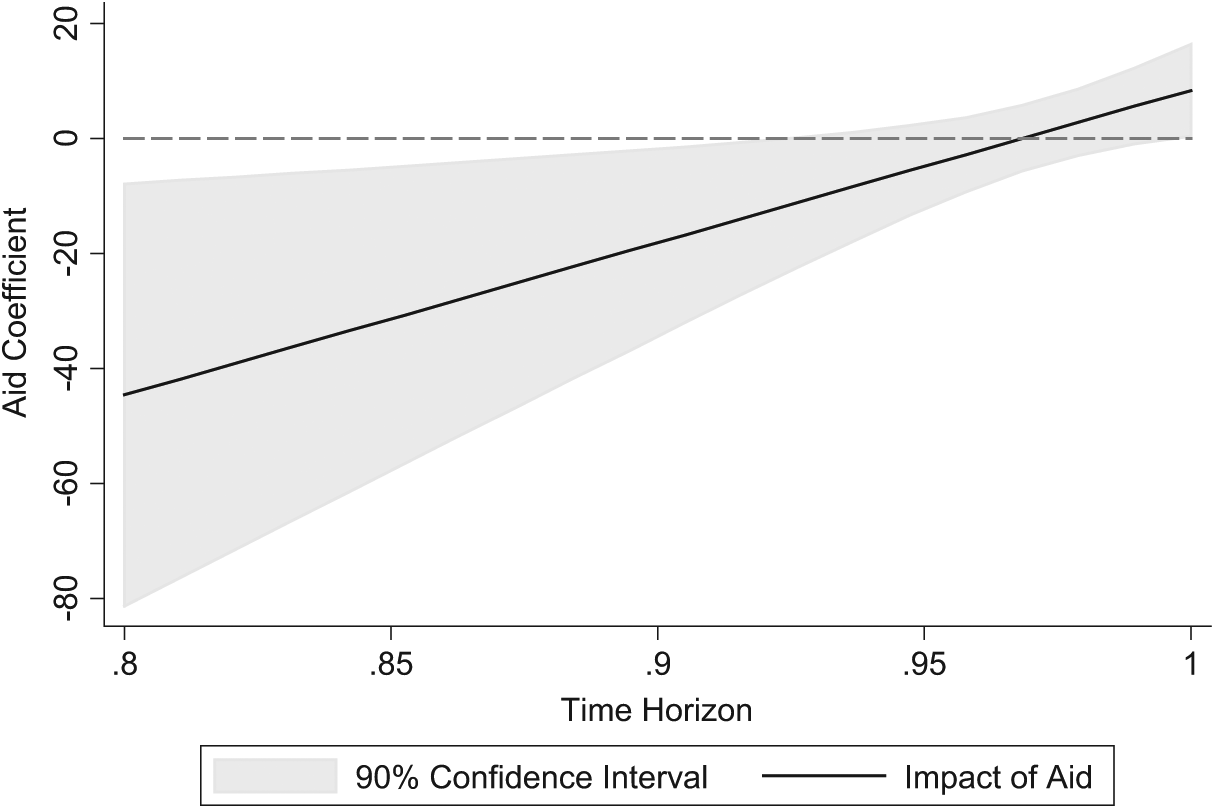
Foreign aid, time horizons, and tariffs.
Although the impact of aid looks surprisingly large, it is actually more modest than it appears. First, the standard deviation in logged aid is only .66, so the impact of a one-standard deviation increase in aid when time horizons is at its minimum is a 30-percentage point tariff reduction: still large, but smaller. More importantly, the minimum value of time horizon is an extreme case: Only 1% of the sample falls below .85. At the fifth percentile of our sample—a time horizon of .90—the conditional aid LRM is −17, so a one-standard deviation increase in aid leads to a tariff reduction of 11 percentage points. At the 10th percentile of our sample—a time horizon of .92—the corresponding effect is 7 percentage points. Beyond this, aid ceases to be significant. The substantive effects of aid thus seem intuitively reasonable: Foreign aid promotes tariff liberalization in about 10% of our sample, and within this subsample, it leads to major liberalization in a few cases but modest liberalization in most.
Real exchange rate movements may affect trade policy (Nicita, 2013) but are not included in Wright’s (2008a, 2008b) first-stage regressions. We thus estimate a second ECM in which the REER is included: Results are shown in columns 3 and 4 of Table 1. We include REER in a separate model because, as Table 1 indicates, its inclusion leads to a huge loss of cases: We lose 51% of our observations and 61% of our countries. Despite this sample change, the inclusion of REER does not change our central results: The LRMs for aid/GDP, time horizon, and their interaction remain signed as before and highly significant. These LRMs become larger, but this reflects the sample change rather than the inclusion of REER. Because including REER does not affect our results but does reduce our sample dramatically, we omit this variable from subsequent regressions.
As noted above, our baseline model omits the variables from Wright’s (2008a, 2008b) survival model because the effects of these variables should, in principle, be mediated by Wright’s time horizon measure. However, some of these variables could arguably influence trade policy through channels unrelated to leader time horizons. For example, Hankla and Kuthy (2013) argue that autocratic regime type matters, not only because it affects leader time horizons but also because it affects the size of the leader’s winning coalition. Autocratic regime type could thus have a “direct effect” on tariffs that is not mediated by our time horizon variable. Likewise, GDP per capita could affect tariffs via state capacity: Poorer states with weak tax-collecting bureaucracies could rely disproportionately on tariffs for revenue. In this case, GDP per capita would also affect tariffs in ways not mediated by leader time horizons.
For this reason, we reestimate our model with the Wright (2008a, 2008b) first-stage variables that, theoretically, might affect trade policy. Specifically, we include logged GDP per capita, economic growth rates (via the first difference of logged GDP per capita), and regime subtype variables. We cannot include all regime subtypes from Wright’s (2008a, 2008b) analysis because many of them exhibit too little longitudinal variation to be included in our fixed-effects model. 14 We thus include dummies for military and military-personalist regimes, with the other regime types serving as the reference category. Results of this expanded model are shown in columns 5 and 6 of Table 1.
Including these additional variables does not alter our central results. Focusing again on the LRMs, aid/GDP and its interaction with time horizons remain significant and signed as before. The marginal effects of aid/GDP at different values of time horizon (not shown here) are also much the same as before. Time horizon itself loses significance, but this is not surprising, as it is constructed from variables that are now included on the right-hand side. Including Wright’s (2008a, 2008b) first-stage variables thus has little effect on our key results. In addition, most of the new variables are insignificant in the expanded model. This suggests that their effects are mediated by leader time horizons and supports our parsimonious baseline model. Only the lag and LRM of GDP per capita are significant, suggesting that economic development affects tariffs in ways not fully mediated by leader time horizons. For this reason, we include GDP per capita in all further robustness checks.
Robustness Checks
We perform a series of robustness checks to ensure that our results do not reflect particular modeling or measurement choices. The results of these robustness checks are presented in Table 2. All robustness checks are based on our preferred model—that is, the baseline model plus GDP per capita—for reasons discussed above. With the exception of Model 3 (discussed below), all results are based on ECMs. Due to space constraints, we present only LRMs for our variables of interest (aid, time horizon, and their interaction) and do not present first-differenced or lagged results or results for control variables. These results are similar to those in Table 1 and are presented in the online appendix.
Robustness Checks.

Dependent variable: ΔTariff i,t (Models 1,2,4,5), Tariff i,t (Model 3).
Robust-cluster standard errors in parentheses, ***p<.01, **p<.05, *p<.10.
Coefficients are LRMs from ECMs, except for Model 3, which shows Prais-Winsten estimates.
First, we estimate the model without country fixed effects, as some readers may feel that the cross-national variation in our variables is important and should be reflected in our results. Results without fixed effects are shown in column 1 of Table 2. The results are very similar to our original ones, indicating that the presence or absence of fixed effects makes little difference. We thus continue to use fixed effects in subsequent robustness checks, as this specification is more conservative and ensures that our results are not biased by unobserved heterogeneity across countries.
Second, we perform a two-stage least-squares (2SLS) regression to address possible endogeneity concerns. It is possible, for example, that donors target aid to countries that liberalize trade or to leaders facing survival threats, and this reverse causality could bias our results. The 2SLS estimator addresses this concern. We treat four variables as endogenous: the first difference of aid/GDP, the lag of aid/GDP, and the interaction of each of these variables with time horizon. We consequently need at least four exogenous instruments—that is, instruments that affect our dependent variable only through the endogenous variables—to perform 2SLS. We prefer to have even more instruments, as this permits diagnostic tests discussed below.
We use three sets of instruments. The first two include measures of recipient need and donors’ strategic interests, which have been shown to influence the allocation of aid (e.g., Alesina & Dollar, 2000; Easterly & Pfutze, 2008). We proxy recipient need with infant mortality rates and strategic interests with U.S. military assistance as a percent of GDP. 15 These instruments are plausibly exogenous because, while it is clear why they should affect aid, it is not clear why they would affect trade policy. 16 The third set of instruments includes higher order moments of the endogenous variable, as suggested by Lewbel (1997): Specifically, we first mean-center and then square aid/GDP. This instrument has no substantive theoretical motivation but is exogenous and relevant by construction and can be used either when other instruments are unavailable or to supplement other instruments (Lewbel, 1997).
We use first differences and lags of all three instruments—infant mortality, U.S. interests, and higher order moments—to instrument first-differenced and lagged foreign aid, respectively. We also interact the first-differenced and lagged instruments with time horizon: These interactions instrument first-differenced and lagged Aid × Time horizon interaction terms, respectively. 17 We thus have 12 instruments for the four potentially endogenous regressors.
To perform 2SLS, we first regress each of the four endogenous regressors against the 12 instruments and all other independent variables. We then employ the first-stage results to generate predicted values of each endogenous regressor. 18 Finally, we include these predicted values on the right-hand side of the second-stage regression, in which tariffs are the dependent variable. Because the predicted values of the endogenous regressors should be uncorrelated with the second-stage error term by construction, the second-stage results should not be biased by endogeneity.
The 2SLS results are shown in column 2 of Table 2. Before discussing the results, we briefly note some tests of instrument validity. First, to verify that our instruments are relevant, we perform an underidentification test in which the null hypothesis is that the instruments are uncorrelated with the endogenous regressors. As shown at the bottom of Table 2, we can reject this null hypothesis (p = .008) and conclude that our instruments are relevant. Second, to verify that our instruments are exogenous, we perform a test of overidentifying restrictions in which the null hypothesis is that the instruments are uncorrelated with the error term from the second-stage regression. This null hypothesis cannot be rejected (p = .450). Our instruments thus meet the standard criteria for instrument validity. In addition, we also examine whether the potentially endogenous regressors are actually endogenous by performing an exogeneity test in which the null hypothesis is that these regressors are exogenous. This null hypothesis cannot be rejected (p = .635). Although this implies that endogeneity is not a concern, we present the 2SLS results for robustness. These results are very similar to our previous ones: All three variables of interest remain correctly signed and significant. Our results are thus robust to 2SLS.
Third, another possible response to endogeneity concerns is to use more distant lags of the potentially endogenous variables. If these variables are sufficiently lagged, it becomes difficult to argue that their values are caused by the dependent variable. To ensure that our results are not biased by endogeneity, we employ this solution as well. Including further lags in an ECM complicates interpretation of the results, particularly the calculation of LRMs. We thus employ an alternative estimator for this robustness check, using Prais–Winsten regression with a panel-specific autocorrelation (AR1) correction and panel-corrected standard errors. 19 The dependent variable is the tariff level, while the independent variables of interest are 2-year lags of aid/GDP, time horizon, and the interaction term. Results are shown in column 3 of Table 2. Again, the results are very similar to previous ones. The coefficients are smaller than the previous LRMs because the former capture only the effect of one particular lag while the latter capture aid’s total effect. However, aid continues to have the predicted conditional effects even when lagged by 2 years, further allaying endogeneity concerns.
Fourth, although our measure of time horizons corresponds closely to our theoretical concept—it is the probability of survival given other survival determinants
Fifth, readers may wonder whether our results are robust to an alternative measure of aid. For example, many growth researchers avoid deflating aid by GDP because results could be driven by movements in the denominator rather than the numerator. Although this is clearly a concern when the dependent variable is economic growth, it is less obviously an issue when the dependent variable is tariffs—particularly when we also include changes and levels of GDP per capita on the right-hand side. Nonetheless, we repeat our analysis with Aid/Population (i.e., aid per capita) and present the results in column 5 of Table 2. Again, the results are similar to previous ones and support both H1 and H2.
Finally, although our tariff results strongly support our hypotheses, tariffs are only one type of trade barrier, and governments also protect their markets with nontariff barriers. Hence, as a final robustness check, we repeat our analysis with the Sachs–Warner openness measure, which incorporates both tariff and nontariff barriers. Because this measure is dichotomous, we employ a logistic regression. To account for the possibility of temporal dependence, we include a natural spline function with three knots as recommended by Beck, Katz, and Tucker (1998). As in the previous analyses, we employ country fixed effects and robust-cluster standard errors to correct for serial correlation.
Results of the openness regression are shown in Table 3. Aid/GDP is positively signed and significant, indicating that aid promotes trade openness when time horizons are at their minimum. The interaction term is negatively signed and significant, indicating that this effect declines as time horizons grow longer. The openness results, like the tariff results, thus support H1. In addition, the results for time horizon and the interaction term support H2: Longer time horizons promote trade openness in the absence of aid, but this effect declines as aid receipts grow. The openness results thus mirror the tariff results for all variables of interest.
Aid, Time Horizons, and Sachs–Warner Openness.

Dependent variable: Openness i,t . Robust-cluster standard errors are in parentheses.
p < .10. **p < .05. ***p < .01.
As with tariffs, we examine the marginal effects of aid on openness at different values of time horizon. We present these marginal effects in Figure 3. The y-axis shows how a one-standard deviation increase in aid (from the mean) affects the predicted probability of country i being open, with the WTO dummy set to one and all other variables at their means. The x-axis shows time horizon values. As the figure shows, aid significantly increases the probability of openness for lower values of time horizon, but this effect diminishes as time horizon grows. Specifically, a one-standard deviation increase in aid increases the probability of openness by .46 when time horizon equals .80, by .20 when time horizon equals .91 (the 10th percentile of our sample), and becomes insignificant thereafter.

Foreign aid, time horizons, and Sachs–Warner openness.
It is noteworthy that the range in which aid promotes liberalization is very similar in the tariff and openness analyses. In both analyses, aid/GDP leads to significant liberalization until a time horizon threshold of .91 to .92 and ceases to be significant thereafter. This close correspondence between the two analyses is striking—given the large differences in trade policy measures and sample composition—and gives us confidence in this result. Note also that this result is consistent with previous research showing that foreign aid does not, in general, affect trade policy (Heckelman & Knack, 2008). We find that aid promotes liberalization in only 10% of our country-years: too few to produce a general relationship between aid and trade policy. This does not mean, however, that aid’s effects on trade policy are unimportant: as our results show, these effects can be quite large. This is only true, however, when aid is given to leaders who are relatively insecure.
Conclusion
Empirical research has shown that, on average, foreign aid has failed to promote economic growth (Doucouliagos & Paldam, 2009). In response, a growing number of policy makers and scholars have asked whether there are conditions under which aid nonetheless has positive effects. A number of studies suggest that aid is more likely to be used in growth-enhancing ways when given to democracies rather than autocracies (e.g., Dollar & Levin, 2005; Isham, Kaufmann, & Pritchett, 1997; Kosack, 2003; Svensson, 1999). This begs the question, however, of whether aid should ever be given to autocracies, which still account for the majority of aid recipients.
Wright (2008b) argues that aid is more likely to be spent in growth-enhancing ways when given to autocrats with longtime horizons. We do not dispute his results or the logic of his argument: indeed, we share his two key assumptions that (a) secure leaders have a greater interest in promoting long-term growth, and (b) insecure leaders are more likely to use aid to repress or buy off political rivals. Nonetheless, we reach a different conclusion: Aid may be more likely to encourage growth-enhancing policies when given to short-sighted leaders. Our conclusions differ in part because we focus on different policies: Wright (2008b) examines how efficiently aid itself is spent, whereas we examine how even inefficient aid spending affects policy choices in other domains. However, our conclusions also differ because we explicitly consider how aid lengthens leaders’ time horizons. Although this point is implicit in Wright’s (2008b) argument that insecure leaders use aid to “repress or pay off challengers to the regime” (p. 974), he does not explore the resulting policy implications. One important implication is that aid can induce insecure leaders to behave more like secure ones. A corollary is that aid could be more likely to promote growth-enhancing policies when given to autocrats who are otherwise more insecure.
Wright (2008b) tests his hypothesis by examining the impact of aid on economic growth, rather than on specific policy measures. This suggests that, when the various policy effects are added up, aid leads to “better” policy on balance when given to autocrats with longtime horizons. This may be so. For policy makers interested in the effects of aid, however, the discussion should not end there. A wide range of policies affect growth, and policy imperatives differ across countries. In some countries, the most pressing need is for increased government spending on roads, education, and other public goods. In these cases, Wright’s (2008b) normative implications outweigh our own. Other countries, however, might benefit more from trade liberalization and other structural reforms, in which case our results are highly relevant. As with other recent research on the conditional effects of aid, the results presented here should permit more informed decisions about aid allocation.
Footnotes
Acknowledgements
We thank John Tuman, the editors of Comparative Political Studies, and four anonymous reviewers for helpful comments. We also thank Joseph Wright for generously providing his data on autocratic survival.
Authors’ Note

Declaration of Conflicting Interests
The authors declared no potential conflicts of interest with respect to the research, authorship, and/or publication of this article.
Funding
The authors received no financial support for the research, authorship, and/or publication of this article.
Notes
Author Biographies
References
Supplementary Material
Please find the following supplemental material available below.
For Open Access articles published under a Creative Commons License, all supplemental material carries the same license as the article it is associated with.
For non-Open Access articles published, all supplemental material carries a non-exclusive license, and permission requests for re-use of supplemental material or any part of supplemental material shall be sent directly to the copyright owner as specified in the copyright notice associated with the article.
