




Abstract
An increasing number of scholars have established that authoritarian regimes employ quasi-democratic institutions as part of their efforts to retain power. However, we know little about the potential variation among institutions providing citizens with opportunities for voice and the conditions under which such institutions are true channels of responsiveness. In this article, we develop and test the concept of “receptivity,” that is, whether autocrats are willing to incorporate citizen preferences into policy, using a list experiment of 1,377 provincial-and city-level leaders in China. Contrary to expectation, we find that leaders are similarly receptive to citizen suggestions obtained through either formal institutions or the Internet unless they perceive antagonism between the state and citizens, in which case receptivity to input from the Internet declines, while receptivity to formal institutions remains unchanged. Our findings show that whether quasi-democratic institutions are mere window dressing or true channels of responsiveness depends on the perceived quality of state–society relations.
Introduction
An increasing number of scholars have established that authoritarian regimes strategically employ quasi-democratic institutions as part of their efforts to retain power. Those institutions normally associated with democracy include formal institutions, such as parties and legislatures (Blaydes, 2011; Boix & Svolik, 2007; Gandhi, 2008, 2009; Gandhi & Przeworski, 2006, 2007; He & Thogersen, 2011; He & Warren, 2011; Lust-Okar, 2006; Magaloni, 2008; Malesky, Abrami, & Zheng, 2011; Malesky & Schuler, 2012; Nathan, 2003; Wright, 2008), as well as vital components of democratic governance, such as a free media (Edmond, 2013; Egorov, Guriev, & Sonin, 2009; Liebman, 2011; Lorentzen, 2014; Shirk, 2010; Zhao, 2000). Evidence also reveals that authoritarian regimes may be responsive to citizen demands on issues ranging from domestic to foreign policy (Chen Z., 2009; S. Wang, 2004; Weeks, 2008). However, although a number of recent studies have found that autocratic leaders may respond to citizens through quasi-democratic institutions (Distelhorst & Hou, 2014; Malesky & Schuler, 2012; Truex, 2014), other studies suggest that these institutions are merely window dressing and they have little impact on policy making (X. Wang, 2003). Overall, we still know very little about whether there is variation in the responsiveness of leaders to different types of quasi-democratic institutions and under different political conditions.
In this article, we focus on two questions related to the conditions for nondemocratic responsiveness: First, is there variation in responsiveness to different types of quasi-democratic institutions that provide citizens with opportunities for voice? Second, under what conditions will such channels be mere window dressing as opposed to true channels of responsiveness? We address the first question by comparing how formal institutions existing in the real world on one hand and venues for public expression on the Internet on the other provide opportunities for voice. We address the second question by exploring the perceived impact of social contention and the potential for collective action on the responsiveness of political leaders to these formal and Internet channels. More specifically, we focus on one component of responsiveness, what we call “receptivity,” that is, the willingness of political leaders to incorporate citizen preferences into policy.
Using an original survey experiment of 1,377 government and Party leaders in China, through indirect questioning, we find that when making policy and expenditure decisions, slightly over one-half of provincial-and city-level leaders are receptive to suggestions from citizens expressed through formal institutional channels or through the Internet. However, we find that receptivity to citizen feedback is conditional on perceptions of social contention. In localities where officials attribute poor government performance and public disobedience to antagonism between leaders and citizens, receptivity to citizen feedback obtained from the Internet declines. Our results also suggest that respondents may be less receptive to feedback from the Internet than input from formal institutions when faced with social contention. In Chinese, antagonism between leaders and citizens is ganqun guanxi jinzhang (干群关系紧张), a concept that the Chinese Communist Party (CCP) connects with social instability in the form of protests and collective action (see “Quasi-Democratic Institutions to Mitigate Social Contention” section for more details). Our experimental design also reveals very high levels of social desirability bias whereby in direct questioning, nearly all respondents appear to be receptive to both formal and Internet channels.
Research on quasi-democratic institutions typically assumes that these institutions are not mere window dressing (Gandhi, 2008; Malesky & Schuler, 2012). Our findings show that whether or not these institutions are facades varies by institution and is dependent on how leaders perceive the quality of state–society relations. In addition, the finding of social desirability bias through direct questioning indicates that almost all leaders believe it is socially desirable to be responsive to citizens. Nevertheless, only slightly more than one-half of the leaders express willingness to incorporate citizen suggestions into policy decisions through indirect questioning, and the remainder appear only to be paying lip service to the idea.
A number of explanations link quasi-democratic institutions to the durability of authoritarian regimes. Among the most prominent are co-optation theory, rent distribution theory, and accountability theory. In co-optation theory, institutions such as legislatures support regime survival by co-opting potential opposition (Boix & Svolik, 2007; Gandhi, 2009; Gandhi & Przeworski, 2006; Malesky & Schuler, 2012). In rent distribution theory, institutions that are nominally democratic allow access to rents by leaders who have been elected to represent important social groups (Blaydes, 2011; Lust-Okar, 2006). Finally, in accountability theory, institutions reveal information about the performance of officials and policies, ultimately improving the quality of governance (Charron & Lapuente, 2011; Lorentzen, 2014; Magaloni, 2006; Nathan, 2003; Oi, 1992; Rosberg, 1995). Our finding of conditional responsiveness lends some support for accountability theory; specifically, that when political leaders are receptive, they have an opportunity to incorporate citizen voice and potentially to improve governance.
Finally, these results have implications for both political participation and collective action under authoritarianism. A great deal of scholarship has focused on how collective action that takes place outside the boundaries of state institutions influences state responses (Bernstein & Lu, 2003; Li, 2014; O’Brien & Li, 2006; Perry, 2002, 2008, 2010; Wasserstrom & Perry, 1994; Chen X, 2009). Our findings show that among subnational leaders, whose political careers may be jeopardized when local collective action occurs (Edin, 2003), even a perceived threat of collective action is sufficient to close down certain channels of responsiveness. This encapsulates a dilemma faced by authoritarian regimes, that is, collective action is an existential threat to regime survival, but, ironically, fear of collective action may make it more difficult for the state to resolve social tensions.
In the next section, we begin by developing the concept of receptivity and reviewing existing research on quasi-democratic institutions in China. We describe the survey methods and experimental design in “The Survey Experiment” section. We present our findings in the “Results” Section, and close with the “Concluding Remarks” section.
Receptivity: A Precondition for Responsiveness
Responsiveness refers to the ability of citizens to influence policy, or, conversely, the adherence of policy makers to the preferences of citizens. 1 Dahl (1971) famously wrote, “a key characteristic of democracy is the continuing responsiveness of the government to the preferences of its citizens (p. 1).” As a concept fundamentally tied to democracy, we must be careful when applying the concept of responsiveness to an authoritarian context. Oftentimes in studies of democracies, responsiveness is assessed based on the congruence of public preferences and actual government policy or roll-call votes (Bartels, 2002; Gilens, 2005; C. Glynn, Herbst, O’Keefe, Shapiro, & Lindeman, 2004). However, congruence between preferences and policies may also result because policy makers influence citizen preferences or because some other factors change the preferences of both the citizens and the policy makers.
Instead of assuming responsiveness to be based on the congruence of preferences and outcomes in authoritarian regimes, we disaggregate the concept. The ability of citizens to influence policy implies that all of the following are true. First, citizens are willing and able to express their preferences through channels that reach the political leaders. Second, leaders are willing to incorporate these demands into policy. Finally, leaders can and do incorporate some of these demands into policy.
In China, with its legacy of totalitarianism and the endurance of a robust propaganda and censorship apparatus, the willingness of citizens to express their preferences undoubtedly differs from that in a consolidated democracy. Although Chinese citizens do express their preferences to the state through formal and informal channels on a large variety of topics (Cheng, 2011; Cho, 2008; Gong, 2008; Gui & Cui, 2000; Landry, Davis, & Wang, 2010; J. Liu, 2003; Ren, 2005; Shi, 1997; Tang & Chen, 2003; Tao, 2006; Xiang & Song, 1997; Yu, 2007; Zhong & Mol, 2007), speech on certain issues, for example, discussions of ongoing protests, is sharply curtailed through censorship and at times physical repression (King, Pan, & Roberts, 2013; Lorentzen, 2014; Shirk, 2010). Limitations on speech mean that Chinese citizens express a circumscribed set of preferences.
In this article, we focus on the second condition of responsiveness, that is, the willingness of political leaders to incorporate citizen preferences. We refer to this as “receptivity.” In light of the constraints on the first condition for responsiveness, even if all political leaders are receptive, the scope of their responsiveness will be truncated and the meaning of “responsiveness” will be very different from that in a democracy.
Receptivity ties citizen preferences to political action. Receptivity assumes that leaders have some degree of openness and autonomy in making policy and, importantly, policy making is influenced by different interests. Taking each of these assumptions in turn, receptivity means that, rather than rejecting citizen suggestions outright, to some degree leaders may be open to citizen inputs. An example of a lack of receptivity here would be a leader who perceives citizens to be ill-informed or incapable of providing sound suggestions, and, as a result, the leader dismisses the citizen input out of hand. Receptivity also means leaders have some degree of autonomy in policy making and they do not act out of compulsion. Here, an example of a lack of receptivity would be a leader who only follows upper-level mandates when making policy and who has no room to incorporate public opinion or any other interests. Finally, receptivity implies that policy making is a process influenced by a variety of interests, whether they be personal preferences, expert opinions, the preferences of business elites, or bottom-up suggestions. An example of a lack of receptivity with respect to the influence of varying interests would be a leader who makes policy based solely on personal preferences. 2
Quasi-Democratic Institutions to Mitigate Social Contention
China has adopted a wide array of quasi-democratic institutions, ranging from village elections to people’s congresses to public participation mechanisms, such as public administrative hearings and online government forums (Martinez-Bravo, Padro i Miquel, Qian, & Yao, 2011; Shi, 1997; Truex, 2014; X. Wang, 2003). The CCP has emphasized the importance of both formal institutions and the Internet for gaining insights into citizen preferences and the sources of citizen discontent to mitigate social contention and to bolster its survival in power. In this article, we use the term “formal channel” to refer to institutions created and controlled by the state existing in the real world, rather than online. In contrast, we use the term “Internet channel” to refer to online platforms and venues for discourse, including websites set up by the state, such as government portals, as well as by private Internet content providers. We use social contention to mean antagonism between the state and its citizens.
During the past several years, the CCP has identified antagonism between representatives of the state and citizens as the main source of collective action against the state and as a threat to Party rule. In 2010, an editorial in the People’s Daily, an organ of the Central Committee of the CCP, reported
3
:
Relations between the Party and the masses and between the government and the masses concerns the long-term stability of our country and determines the prosperity or decline, success or failure of the Chinese Communist Party . . . In recent years, mass incidents and forced demolitions in some localities have garnered a great deal of attention. These incidents reflect antagonism and mistrust between the state and citizens and test the governing capacity of the Party . . . Every day, the need to improve state-citizen relations becomes more urgent.
The CCP has explicitly stated that formal institutions and the media should be strengthened to relieve state-citizen antagonism. In the wake of the Weng’an incident when the death of a teenage girl led to large-scale protests,
4
Shi Zongyuan, the Party secretary of Guizhou province and Central Committee member of the 17th National Congress of the CCP, stated the incident reflected long-standing social tensions and was caused by antagonism between the local state and citizens.
5
To prevent similar incidents from recurring, Party Secretary Shi urged localities to amply reflect citizen opinions in state decision-making mechanisms and government policies.
6
To do so, he emphasized the role of people’s congress representatives, community organizations, grassroots Party organizations, and the media, and he asked that local officials limit the use of repression:
[We must] increase effective interactions between people’s congress representatives and the masses . . . We must pay attention to the expressed interests of community groups . . . Media is uniquely suited as a funnel for public expression, and as a result should be the main channel to capture different needs and interests . . . Party and government units as well as leaders and cadres at every level need to make efforts to improve institutions to identify problems and expand sources of information . . . we cannot simply use repression even if certain individuals engaged in aggressive actions.
Although the importance of both formal institutions and the media has been promoted by CCP leaders, because of the low cost of expressing opinions online and the absence of opportunities to form exchange-type relationships with anonymous online commentators, officials in an authoritarian regime may be less receptive to opinions expressed through the Internet than through more traditional state channels. Most websites, including government online portals, still allow anonymous postings or postings that do not require real names. In contrast, traditional formal channels, such as residents’ committees, people’s congress representatives, or Party committees, could facilitate particularistic relationships between citizens and agents of the state, who mediate between these institutions, through face-to-face interactions. In contrast, it is much more difficult, if not impossible, for citizens and political leaders to build particularistic relationships through online interactions.
Social Contention and Receptivity
Although the CCP has emphasized the need to relieve antagonisms between the state and citizens by using formal institutions and media channels to generate transparency and trust, these quasi-democratic institutions are merely window dressing if political leaders are not receptive to the demands expressed through these channels. Although the aim of adopting these nominally democratic institutions is to mitigate social contention, evidence suggests that there may be limits to the leaders’ receptivity to these channels, especially when local leaders are facing state–society antagonism and social discontent.
Given the importance of social stability to the survival of the CCP party-state, the Party has linked social stability to incentives for political promotion. Beginning in the 1980s, the CCP reformed its cadre evaluation system so that promotion became tied to meeting economic as well as social targets, such as avoiding collective action and controlling birthrates (Edin, 2003; O’Brien & Li, 1999). Meeting the social stability target is decisive for political advancement because it is a target with “veto-power,” meaning that failure to meet the target jeopardizes career advancement even if other targets, such as GDP growth rates, are met (Edin, 2003; M. Liu & Tao, 2007). As a result, local officials go to great lengths to avoid collective action, including taking repressive actions that negate the intended benefits of formal institutions for channeling citizen preferences. For example, China’s petitions (xinfang) system is a state institution intended to provide citizens with a channel to air complaints and grievances, but in response to increasing instances of collective petitions, local governments will use repression to prevent citizens from using this channel (Chen X., 2009).
The Internet channel faces similar tensions as a vehicle for understanding citizen demands and relieving social contention. With 564 million current Internet users and the number still rising, Internet platforms, such as microblogs and forums, are trafficked by millions of Chinese citizens every day, 7 and the Internet provides the government with direct access to citizen opinions. However, loss of control over the media has been associated with the downfall of authoritarian regimes (Lawson, 2001; McMillan & Zoido, 2004; Nye, 2004), and the rise of new media platforms that allow any citizen to be a broadcaster has the potential to increase coordination among opponents to autocratic regimes (Aday, Farrell, Lync, Sides, & Freelon, 2012; Bellin, 2012; Edmond, 2013; Lorentzen, 2014). To mitigate this threat, China employs a sophisticated and multilayered online censorship apparatus that focuses in particular on curtailing discourse during periods of collective action (Bamman, O’Connor, & Smith, 2012; Crandall et al., 2013; King et al., 2013, 2014; Zhu, Phipps, Pridgen, Crandall, & Wallach, 2013). King et al. (2013, 2014) find that even though the regime permits a great deal of online discussion and criticism, discussions of events with collective action potential are heavily censored, suggesting that the Internet is not an appropriate channel for citizen participation under all circumstances. Along similar lines, Lorentzen (2014) finds that when the danger of revolt is high, censorship of investigative reporting increases.
Thus, based on previous research as well as statements by the CCP, we have reason to believe that when state–society relations are harmonious, leaders may be equally receptive to opinions expressed on the Internet and to those expressed through formal channels. However, when leaders believe that antagonism exists between the state and citizens, we expect that they will be less receptive to both formal and Internet channels.
The Survey Experiment
To determine whether leaders in China are receptive to citizen suggestions obtained through the country’s quasi-democratic institutions and the Internet, we conduct a survey experiment of provincial-and city-level officials. We measure receptivity using a list experiment to determine whether, when making policy and expenditure decisions, leaders are willing to seriously consider suggestions from residents obtained through these channels. (Detailed replication information and data for the paper can be found at: Pan, Jennifer; Meng, Tianguang; Yang, Ping, 2014, “Replication data for: Conditional Receptivity to Citizen Participation: Evidence from a Survey Experiment in China”, https://dx-doi-org.web.bisu.edu.cn/10.7910/DVN/26626 Harvard Dataverse Network [Distributor] V1 [Version]).
Eliciting truthful answers in surveys is challenging, especially in this case where leaders may have incentives to conceal their opinions to adhere to social norms and expectations. List experiments have received increased attention as a potential solution to this methodological problem (Blair & Imai, 2012; Corstange, 2009; Coutts & Jann, 2011; Gilens, Sniderman, & Kuklinski, 1998; A. Glynn, 2010; Gonzalez-Ocantos, Kiewiet de Jonge, Melendez, Osorio, & Nickerson, 2012; Holbrook & Krosnick, 2010; Imai, 2011; Janus, 2010; Kane, Craig, & Wald, 2004; Kuklinski, Cobb, & Gilens, 1997; Redlawsk, Tolbert, & Franko, 2010; Sniderman & Carmines, 1997; Streb, Burrell, Frederick, & Genovese, 2008; Tsuchiya, Hirai, & Ono, 2007).
List experiments are a form of indirect questioning that ask respondents how many items on a list of responses apply to them. The list includes a treatment, or sensitive, item. As long as the respondent does not select either none or all of the items on the list, the respondent knows that her privacy is protected because the researcher will not know which specific items apply. 8 Then, by varying the items on the list across randomly selected groups of respondents, list experiments allow us to estimate the proportion of respondents who are more likely to answer each treatment item in the affirmative.
We pretested the components of our list experiment with government and Party officials prior to implementation of the survey. We asked the following question of the control group:
Policies related to the “needs of the people” refer to民生政策 minsheng zhengce, which can also be translated as policies related to the “livelihood of the people.” These policies encompass education, public health, social welfare, employment, housing, and environmental protection. For simplicity, we refer to these policies as “people-oriented policies.”
Among the control items, local administrative expenditures refer to overhead expenses, such as the salaries of government workers, which might offset or constrain policies and expenditures related to the needs of the people. For example, a city that has trouble paying government employees may decide to reduce its policy commitments and spend less on people-oriented policies. The second control condition, influence in attracting foreign investment, relates to people-oriented policies because these policies could help develop human capital and attract foreign investment, but people-oriented policy expenditures could also detract from direct expenditures, such as real estate subsidies, used to attract foreign capital. Finally, the scope of the migrant population refers to the size of the population of migrants, who are defined as individuals without residence permits (hukou) in the city where they are working. Migrants are typically ineligible for the services, such as free education and social welfare benefits, which are provided to city residents, but in recent years some cities have begun providing limited services to migrants, such as access to education for migrant children.
Based on prior knowledge as well as survey pretesting, we believed that the chosen control items were negatively correlated. Local leaders who are focused on administrative expenditures are more likely to be from localities with less fiscal revenue and are less likely to have significant resources to spend on the welfare needs of migrants (Shue & Wong, 2007). Similarly, a focus on economic issues, such as foreign investment, is often an alternative strategy to one that focuses on social policy issues, such as migrant welfare. This trade-off in terms of emphasizing economic policies versus welfare policies is embodied in divergent policy positions of top leaders. For example, former president Jiang Zemin placed priority on economic liberalization, whereas his successor, former president Hu Jintao, launched social welfare reforms (Zheng & Tok, 2007).
Treatment Conditions
To measure and compare the receptivity of state officials to citizen participation through formal and Internet channels, we divided the sample of provincial-and city-level officials into two treatment groups. One treatment group tests receptivity to suggestions from formal institutions, including a community-based institution (a residential committee), a Party-based institution (a Party committee), and a legislative institution (a people’s congress), to reflect a range of quasi-democratic institutions adopted by the CCP. The second treatment group tests receptivity to suggestions from the Internet.
The first formal channel, the residential committees or juweihui (居委会), is an entity at the neighborhood level that interacts most directly and most frequently with urban residents on a large range of issues, from family planning to public safety to social services. 9 Chinese cities are organized into districts (qu), which are divided into subdistricts (jiedao), and subdistricts are then further divided into neighborhoods (shequ). Neighborhoods, equivalent to rural villages, are under the purview of a residential committee. In recent years, with the decline of the work unit (danwei), the CCP has focused on reforming the neighborhood so that the residential committee acts as the first line of defense against citizen unrest by surfacing and addressing discontent (Gong, 2008; Gui & Cui, 2000; J. Liu, 2003; Tang & Chen, 2003; Xiang & Song, 1997; Yu, 2007).
The second formal channel, the Party committee or dangweihui (党委会), is part of the CCP’s grassroots organization, existing in every enterprise, rural area, office, school, institute, community organization, or People’s Liberation Army (PLA) unit, where there are 100 or more CCP members. 10 As the CCP has recruited a more diverse constituent base, including the wealthy and capitalists, Party committees represent the co-optation of broad swathes of society (Dickson, 2003; Tsai, 2007). Previous research has examined how Party committees transmit information about the interests of citizens (Cheng, 2011; Ren, 2005; Tao, 2006).
The last state institution included in the formal channel treatment is the people’s congress system, which exists at the national, provincial, city, county, and township levels. Since the revitalization of the National People’s Congress in the 1980s, there has been increasing interest in the functions and impact of local legislatures (Cho, 2008; MacFarquhar, 1998; Manion, 2000, 2008; O’Brien, 1994; O’Brien & Luehrmann, 1998; Xia, 2007). Although there has been a great deal of debate as to whether local people’s congresses facilitate representation, local people’s congresses have been found to increasingly reflect the opinions of the populous (Cho, 2008; Truex, 2014).
For the first treatment group, we asked a question identical to that of the control group, with the exception that a treatment item concerning suggestions of residents obtained from formal state institutional channels is appended to the list:
The second treatment condition focused on examining receptivity to suggestions obtained through the Internet. Over the past decade, the Internet has become an increasingly important channel for citizens to express their preferences and interests and to convey them up to the state (King et al., 2013, 2014; Shirk, 2010; G. Yang, 2009). We do not use traditional media as a channel, because traditional media remains primarily a venue for communications from the state down to the citizens (Stockmann, 2013). We do not specify the type of website the citizens use, and we simply use the term Internet (网络) because citizens in different localities may use different arrays of online platforms, ranging from Bulletin Board System (BBS) forums to microblogs, which include both government and private sites. Even though our Internet channel treatment may be interpreted to include government forums or portals, the channel remains qualitatively distinct from the “traditional” formal institutions such as residental committees, Party committees, and people’s congress representatives because the Internet channel provides a more anonymous yet communal way for citizens to interact with the state, the Internet channel is used by a different subset of the population, and the Internet channel may funnel different sets of preferences (see “Receptivity: A Precondition for Responsiveness” and “Antagonism Between Citizens and Officials” sections for additional discussions).
For the second treatment group, the question again is identical to the control condition, with the exception that a treatment item concerning suggestions from residents obtained through the Internet is appended to the list:
Measuring Antagonism
Our measure of antagonism between the state and citizens represents the respondents’ perceptions of tensions between the state and citizens. Antagonism (干群关系紧张) is one of seven possible responses to the question: “In the course of governing, there may be obstacles to governance and public disobedience at the local level. What do you think are the main reasons for these problems?” (See Online Appendix C for the survey instrument in Chinese and English.) Other possible responses to this question include low public competence (公众素质不高), 11 inappropriate policies (政策不合理), and poor policy implementation (执行方式不当).
While this question does not explicitly ask the respondents to reflect exclusively on their own localities, we have strong reason to believe that the respondents are reporting on the conditions in their own jurisdictions when answering this question. In pretesting, respondents provided recent examples from their current localities. In addition, the immediately prior questions in the survey all explicitly ask the respondents to reflect on their experiences in their own jurisdictions, thus, we believe, priming the respondents to answer this question on obstacles to governance and public disobedience in a similar manner.
We are primarily concerned with whether these leaders perceive state–society tensions rather than any actual variation in local state–society relations. Actual measures of social contention are extremely difficult to obtain for Chinese localities, but even if such measures were available, we would still be focused on leaders’ perceptions. For example, say two cities have the same number and scope of protests during a given period of time, but the leaders in one city report antagonism as the source of the public disobedience, whereas the leaders in the second city do not. We are more interested in this perception than we are in the actual variation, as it is what leaders believe to be real that directly influences their receptivity.
Our measure of antagonism is taken after the survey experiment. As a result, we must discuss the possibility that the treatment items in the list experiment are directly affecting the respondents’ reported perceptions of social antagonism. We believe it is extremely unlikely that our experiment affects the respondents’ reported perceptions of antagonism. The question measuring antagonism (Question C9) occurs 10 min (32 responses) after the survey experiment (Question B5). Because of this distance, we expect that any priming effect of the survey experiment would be very small. Furthermore, immediately before the question measuring antagonism, the respondents are asked how they obtain information about citizen preferences (Question C8). Answers to this question include in-person communications, focus groups, research, phone, email, online, and petitions. Because respondents in all treatment groups (and the control group) see this question immediately before our measure of antagonism, we believe any effect the survey experiment has in priming respondents is negated prior to our assessment of the antagonism variable.
Sampling and Balance
Our list experiment was conducted as part of the Local Governance and Public Goods Survey, which took place from May to August 2013 (P. Yang & Meng, 2014). To our knowledge, this survey is the first large-scale academic survey of government and Party leaders in China. Survey respondents are provincial-and city-level leaders who make and implement policy and expenditure decisions; they preside over Party organs and legislative bodies; and they have the authority to remove lower level officials. 12
The sampling method for the Local Governance and Public Goods Survey divided China into an eastern region and a west-central region, and three provinces (or provincial-level municipalities) were selected from each region. In the eastern region, the provinces of Beijing, Shandong, and Zhejiang were selected, and in the west-central region, the provinces of Henan, Sichuan, and Guangxi were selected. Within each province, two to three city-level administrative units were selected, resulting in six city-level units in eastern China and nine city-level units in west-central China. 13 Figure 1 compares the population and per capita GDP of the cities in the survey sample against all Chinese cities, and shows that the sample cities are representative of Chinese cities in terms of population size and level of economic development.

Histogram of the population of sample cities compared with all Chinese cities (left panel). Histogram of the per capita GDP of sample cities compared with all Chinese cities (right panel).
The surveys were distributed to officials in all 15 of the cities as well as the two provinces based on a quota sampling method aimed at reaching a certain number of respondents by the type of state unit and the rank of the respondent. 14 Every effort was made to ensure that respondents across localities belonged to a similar mix of state entities and represented a similar mix of seniority rankings. In each selected locality, we provided local government collaborators with the following list of state units by category:
Government administrative units: office of the local government (政府办公室), development and reform commission (发改委), finance (财政), education (教育), human resources and social security (人力资源和社会保障), public security (公安), health (卫生), taxation (税务), state-owned asset supervision and administration (国资委).
CCP units: office of the party committee (党委办公室), organization department (组织部), propaganda department (宣传部).
Other units: people’s congress (人民代表大会), people’s political consultative conference (人民政治协商会议), court (法院), procuratorate (检察院), Communist Youth League (共青团), Federation of Trade Unions (工会), Women’s Federation (妇女联合会), Federation of Industry and Commerce (工商业联合会).
The local collaborator then enrolled officials from the listed organizations in each of the three categories based on a ratio of 6:2:2.
In addition to the category of the work unit, respondents were also enrolled to ensure a similar distribution in the government rank of the respondents across localities. Respondents included vice section chiefs and below (副科长级及以下), section chiefs (科长级), vice department chiefs (副处长级), and department chiefs and above (处长级及以上).
The surveys were distributed at the respondents’ place of work, and randomization was achieved through the randomized ordering of the surveys. The surveys were completed by the respondents in private, and no personal identifiers were collected. The human subjects aspect of our experimental protocol was preapproved by our university’s Institutional Review Board.
A total of 1,800 survey experiments were distributed, with 500 surveys containing the control condition and 650 surveys for each of the two treatment conditions. Of the 1,800 surveys distributed, 1,377 survey experiments were completed (76.5%). Of the completed surveys, 843 (61%) came from government administrative units, 211 (16%) from CCP units, and 313 (23%) from other units (for additional details, see Online Appendix D).
We find that the response rate for the control condition (75%) is similar to the response rate for the treatment conditions: 78% for formal institutions and 76% for the Internet. We believe it is very unlikely that differences in the response rate between treatment and control groups resulted in a selection bias because the response rates are similar and because the respondents have already spent a few minutes on the survey answering demographic and background questions before encountering the list experiment; they are thus invested in the survey and are unlikely to stop completing the survey because they have encountered the control condition, which had the lowest response rate.
Table 1 shows the preintervention characteristics of the respondents by treatment group: an education level of 1 = completion of secondary education, 2 = completion of college, and 3 = completion of graduate school; and a Gov rank of 1 = vice section chief and below, 2 = section chief, 3 = vice department chief, and 4 = department chief and above. Other than age, the F test results show that no other characteristics are significant. Table 1 shows that the average age of the respondents receiving the Internet treatment is lower than the average age of the respondents receiving the formal institutions treatment. A robustness check in Online Appendix B confirms that this age difference does not alter our substantive results.
Preintervention Characteristics of Respondents by Treatment Group.
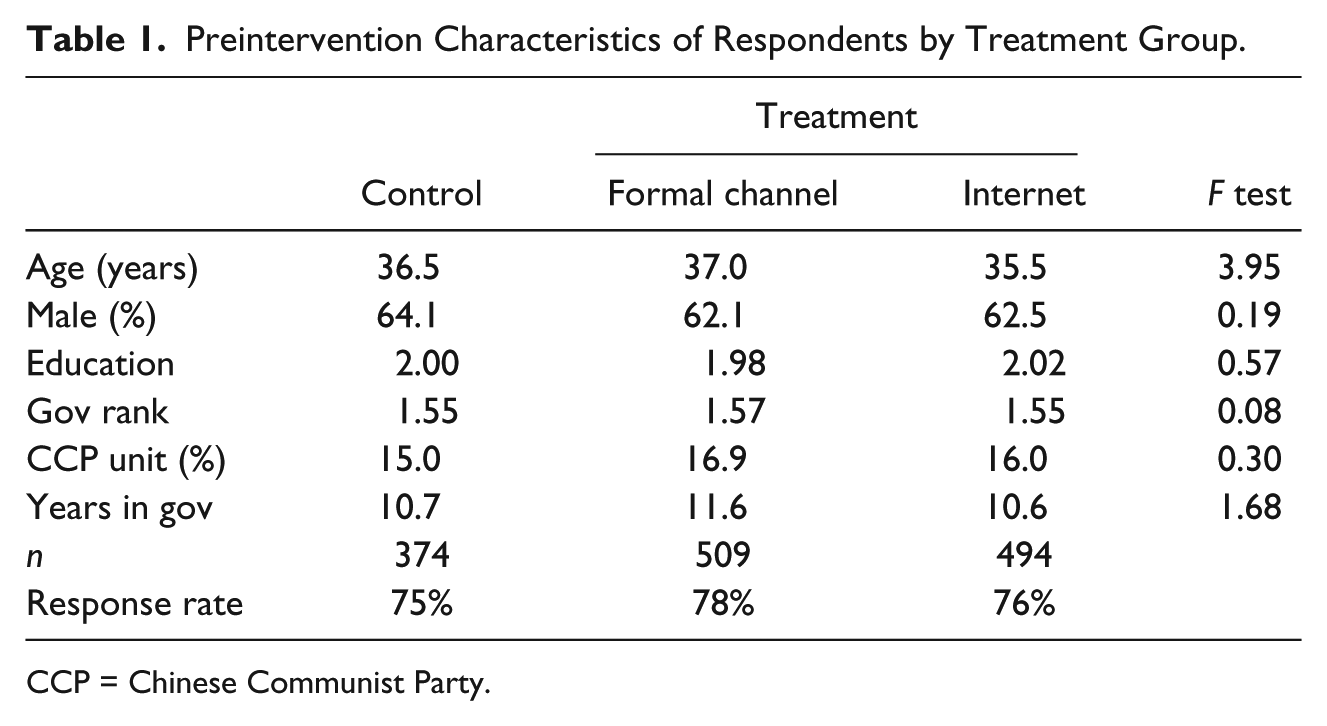
CCP = Chinese Communist Party.
Results
First, we present the observed data and mean results by treatment group from the list experiment to compare the receptivity between the formal and Internet channels. Then, to evaluate whether receptivity is conditional on antagonism, we present the results using difference-in-means estimators with subsets of data and maximum likelihood estimators with an array of model specifications (see Online Appendix A for results from nonlinear least squares estimator models).
Overall Receptivity
Table 2 summarizes the observed data for the control group and each treatment group in our survey experiment. More than 40% of the respondents in the control group answer affirmatively to all three control items. While this indicates a potential risk of ceiling effects, we find that when modeling ceiling and floor effects, the estimated population proportion of ceiling liars and floor liars is close to zero and does not alter our substantive conclusions (see Online Appendix B.2). The left panel of Figure 2 shows the mean response rate for each group—2.3 items for the control group, 2.8 items for the formal institutions treatment group, and 2.9 items for the Internet channel treatment group.
Observed Data From the List Experiment on What Factors Should Be Considered When Making Policy and Expenditure Decisions Related to the Needs of the People.
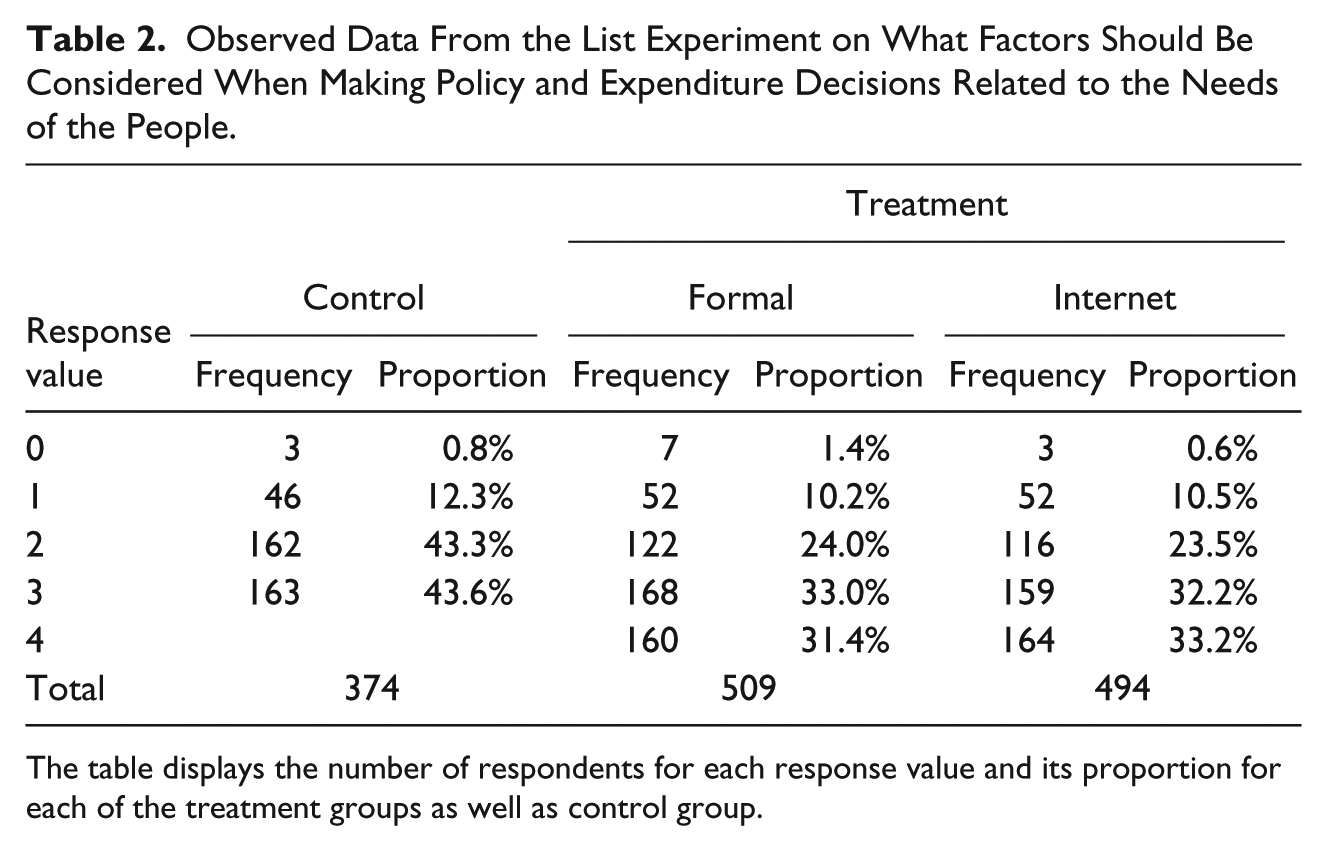
The table displays the number of respondents for each response value and its proportion for each of the treatment groups as well as control group.
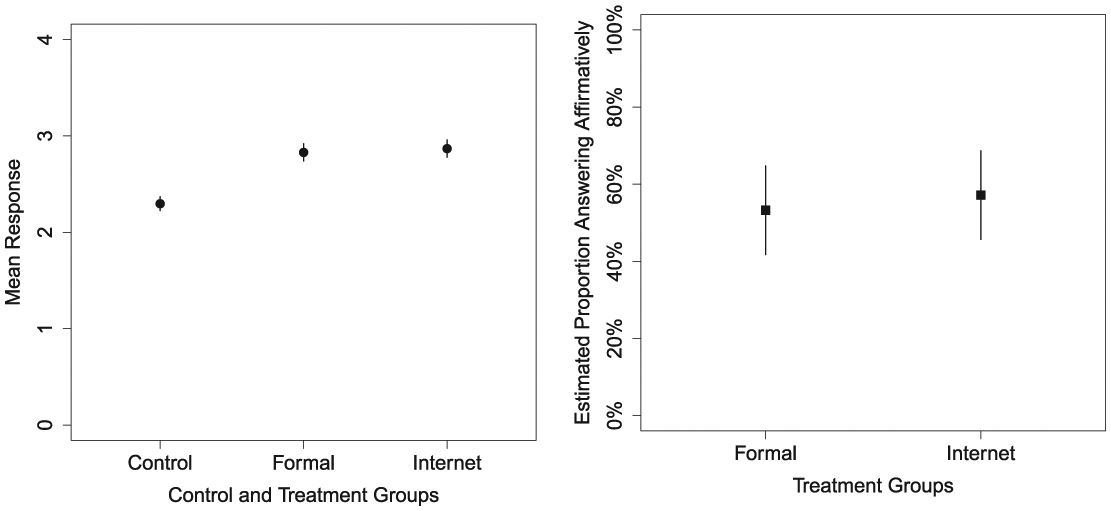
Mean response to control and treatment items (left panel). Estimated proportions of respondents answering treatment items in the affirmative (right panel).
Based on these mean responses, the right panel of Figure 2 shows that the estimated proportion of respondents who are receptive to citizen suggestions from formal channels is 53% (95% confidence interval of 42%-65%) and the estimated proportion of respondents who are receptive to citizen suggestions from the Internet is 57% (46%-69%). This shows that, on average, receptivity to formal and Internet channels is very similar. Slightly more than half of local officials would be willing to incorporate citizens preferences from either channel when making policy and expenditure decisions. This similarity in the level of receptivity to formal and Internet channels is surprising, given our theoretical expectations that autocratic leaders would be less responsive to anonymous, low-cost opinions expressed on the Internet than to opinions expressed through real-world formal channels.
To provide a sense of context, we compare our results with the attitudes of U.S. politicians toward different channels of citizen feedback. There are serious limitations to this comparison due to differences in the survey design, respondent characteristics, regime characteristics, and a host of other factors. Our goal is simply to place our findings in perspective. Based on a survey of congressional staffers, 77% of the respondents feel that formal events, such as meetings in the district/state, are very important for understanding constituents’ views and opinions, but only 8% believe that Facebook and only 4% believe that Twitter are very important for understanding constituents’ opinions (Congressional Management Foundation, 2011). The results of the U.S. survey contrast with the similar levels of receptivity to formal and Internet channels in China, which may stem from differences in the types of opinions expressed through these two types of channels. Citizens reveal their real identities when expressing opinions through formal institutions and thus expose themselves to the possibility of future retribution from the state. 15 In contrast, Internet platforms afford a degree of anonymity. 16 It is perhaps for this reason that citizens express certain types of preferences on the Internet that the state cannot obtain via formal institutions, and due to a desire to obtain a wider array of opinions, political leaders are receptive to preferences expressed via the Internet as well as through formal channels. Furthermore, government entities may be proactively using the Internet to collect differing sets of public opinions, which would also contribute to similarity in receptivity.
Even though slightly over one-half of the respondents say they would seriously consider suggestions from residents through our list experiment, in direct questioning of the respondents in the control group, 98% (96%-100%) report they would be receptive to suggestions obtained through formal channels and 96% (93%-98%) report they would be receptive to suggestions obtained from the Internet. This shows that social desirability bias is large and is present for both treatment items (Berinsky, 2004; Campbell, 2002; Gilens et al., 1998; Janus, 2010). In other words, receptivity is a socially desirable behavior for provincial and city-level leaders. 17
Respondents who answered our treatments affirmatively in the list experiment are not expressing receptivity because it is simply the social norm. However, the remaining 40% 18 or so of respondents who only express receptivity in direct questioning are paying lip service to citizens suggestions. For this group of leaders, the formal and Internet channels are not true channels of responsiveness. This variation in behavior among subnational leaders means that although the majority of leaders take these channels for citizen feedback seriously, for a nontrivial proportion of leaders, these institutions are simply window dressing.
Antagonism Between Citizens and Officials
To evaluate whether the receptivity of leaders to citizen suggestions is conditional on perceptions of antagonism between state and society, we employ a difference-in-means analysis as well as a maximum likelihood estimator. 19 These estimators provide different trade-offs in terms of statistical efficiency and consistency. Even though the difference-in-means estimator is consistent, it is statistically inefficient due to the aggregation of responses, and even though the maximum likelihood estimator is more efficient, it may be less consistent (Blair & Imai, 2012; A. Glynn, 2010).
Using the difference-in-means estimator, we compare the mean response with our list experiment between the formal and Internet channels for (a) all respondents, (b) respondents who do and do not perceive antagonism, and (c) matched subsets of respondents who do and do not perceive antagonism. For the difference-in-means analysis of matched respondents, we use coarsened exact matching to divide the respondents into two data sets: those who do report antagonism and those do not report antagonism, which are similar in terms of the preintervention covariates of age, gender, level of education, government rank, whether they belong to a CCP unit, years in government, and the local level of economic development (Iacus, King, & Porro, 2012). 20 The right panel of Figure 3 shows the covariate balance for the matched subset of respondents.
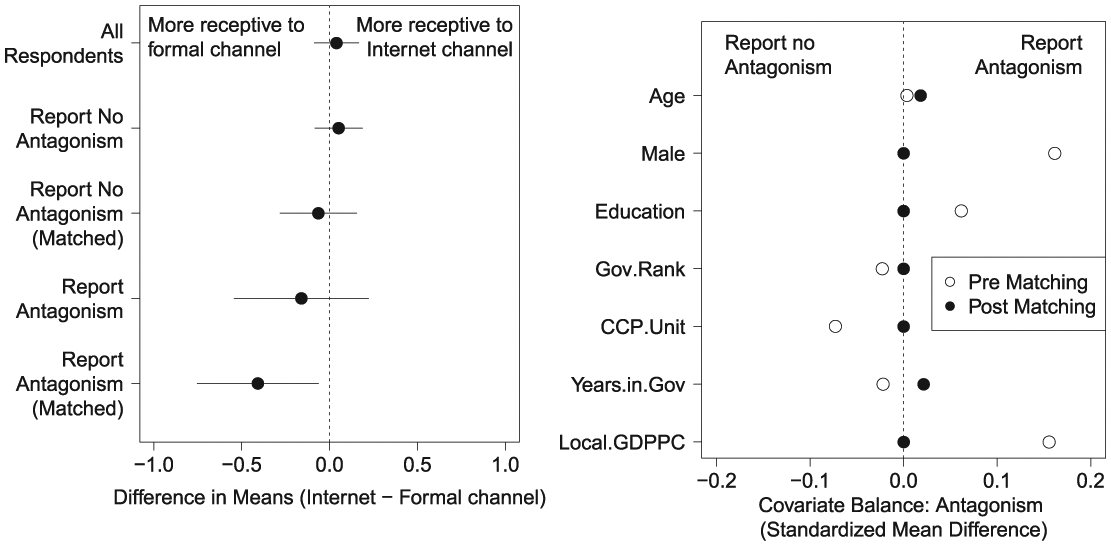
Difference-in-means estimator between Internet and formal channels for all respondents and subsets of respondents who do and do not report antagonism (left panel). Covariate balance of preintervention variables for respondents who do and do not report antagonism pre-and postmatching (right panel).
The left panel of Figure 3 shows the results of the difference-in-means analysis. This figure shows the mean response to the Internet channel treatment minus the mean response to the formal channel treatment. Positive estimates denote respondents are more receptive to the Internet channel treatment, and negative estimates denote they are more receptive to the formal channel treatment. Looking at all respondents, as expected, there is no statistical difference in receptivity to formal and Internet channels. Similarly, when examining all respondents who do not report antagonism as well as the matched subset of respondents who do not report antagonism, the respondents do not reveal more receptivity to formal or Internet channels. However, when examining all respondents who do report antagonism as well as the matched subset of respondents who do report antagonism, we see a negative difference in the means estimates, which shows respondents are more receptive to formal channels than to the Internet channel. For respondents who perceive antagonism, the mean response to the formal institutions treatment is 2.8, and the mean response to the Internet treatment is 2.6. Due to the lack of statistical efficiency, this difference-in-means estimate is not statistically significant at the 95% level. However, among the respondents who perceive antagonism in the matched subset of data, the average response to the formal institutions treatment is 2.8, the avearge response to the Internet treatment is 2.4, and the difference in the average responses is statistically significant at the 95% level. This difference-in-means analysis shows that among respondents who perceive antagonism between state and society, receptivity to the Internet channel is lower than receptivity to formal channels, whereas among respondents who do not perceive antagonism, there is no difference in receptivity to these two types of channels.
In the above analysis, we only examine the difference between receptivity to formal and Internet channels. To examine the effect of antagonism on the difference in receptivity to Internet versus formal institutional channels, we compare the difference-in-means results between the matched set of respondents who do perceive antagonism and those who do not (rows 3 and 5 of Figure 3). The difference in the average response to Internet versus formal institutions among matched respondents who report antagonism is −0.408 (SE = 0.176), whereas the difference in mean response to Internet versus formal institutions among matched respondents who do not report antagonism is −0.064 (SE = 0.111). This implies we can reject the null hypothesis of no difference in the effect of antagonism on the mean response between Internet and formal institutions treatment items at the 10% level (90% confidence interval [CI] = [−0.687, −0.001]). In other words, the data suggest that receptivity to input obtained through the Internet may be lower than receptivity to input from formal institutions when there is social antagonism.
We employ two additional estimators proposed by Blair and Imai (2012) and Imai (2011) to further test the robustness of our finding—a nonlinear least squares estimator and a maximum likelihood estimator. As the substantive results of these two estimators are essentially the same, we present the results from the maximum likelihood estimator here and show the results from the nonlinear least square estimator in Online Appendix A.
Table 3 shows the coefficient estimates of the maximum likelihood estimator for six model specifications where the dependent variable is receptivity to formal channels, and Table 4 shows the coefficient estimates of the same model specifications where the dependent variable is receptivity to the Internet channel. The first model specification examines the effect of antagonism on receptivity. The second model specification includes as controls the preintervention variables of age, gender, level of education, government rank, whether the respondent belongs to a CCP unit, and the number of years the respondent has worked in government. The third model adds local per capita GDP in 2012. The fourth model adds fixed effects for city-level respondents, the fifth model adds provincial fixed effects, and the sixth model includes all preintervention covariates as well as the city and provincial fixed effects.
Maximum Likelihood Estimator for Formal Channels.
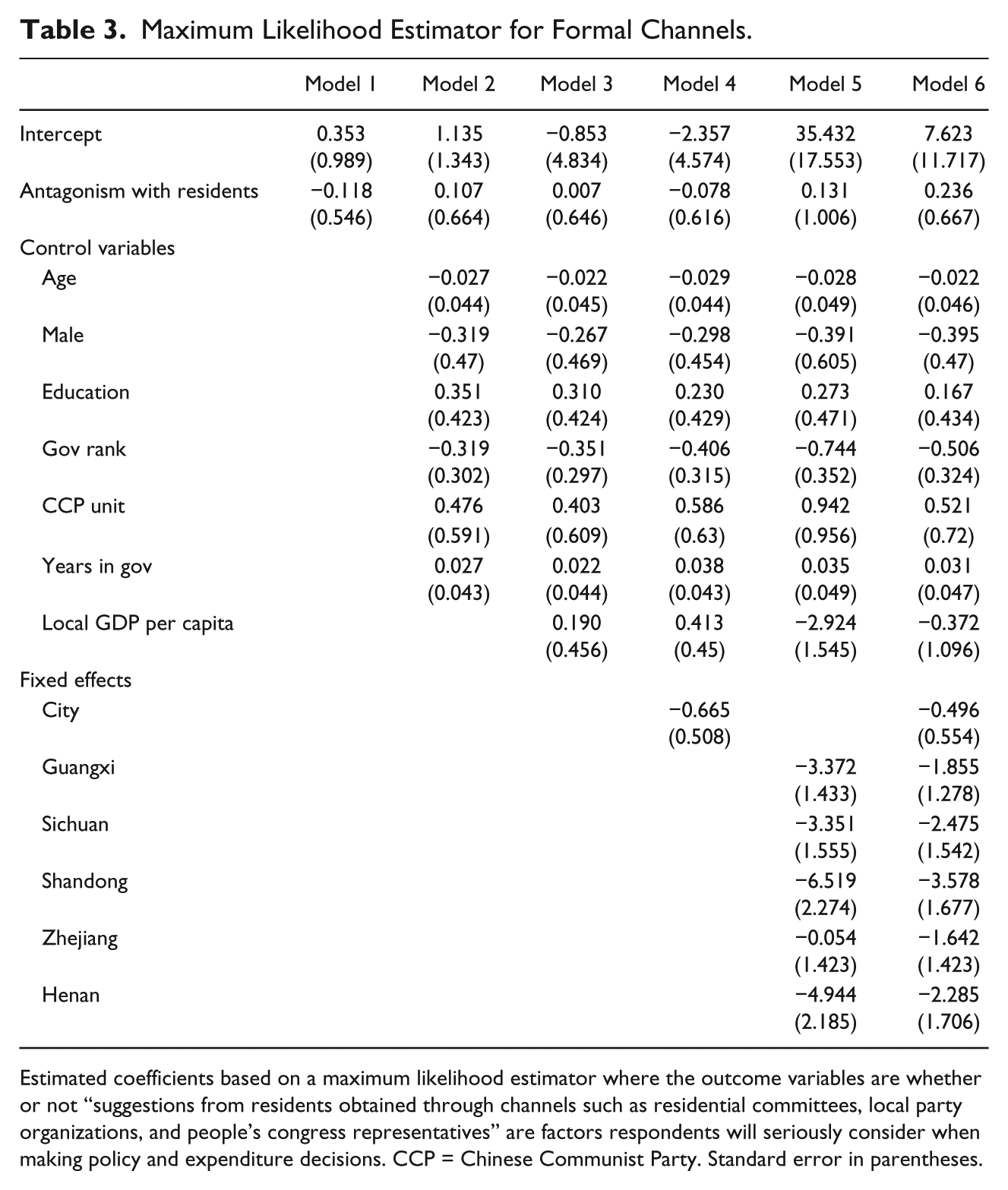
Estimated coefficients based on a maximum likelihood estimator where the outcome variables are whether or not “suggestions from residents obtained through channels such as residential committees, local party organizations, and people’s congress representatives” are factors respondents will seriously consider when making policy and expenditure decisions. CCP = Chinese Communist Party. Standard error in parentheses.
Maximum Likelihood Estimator for the Internet Channel.
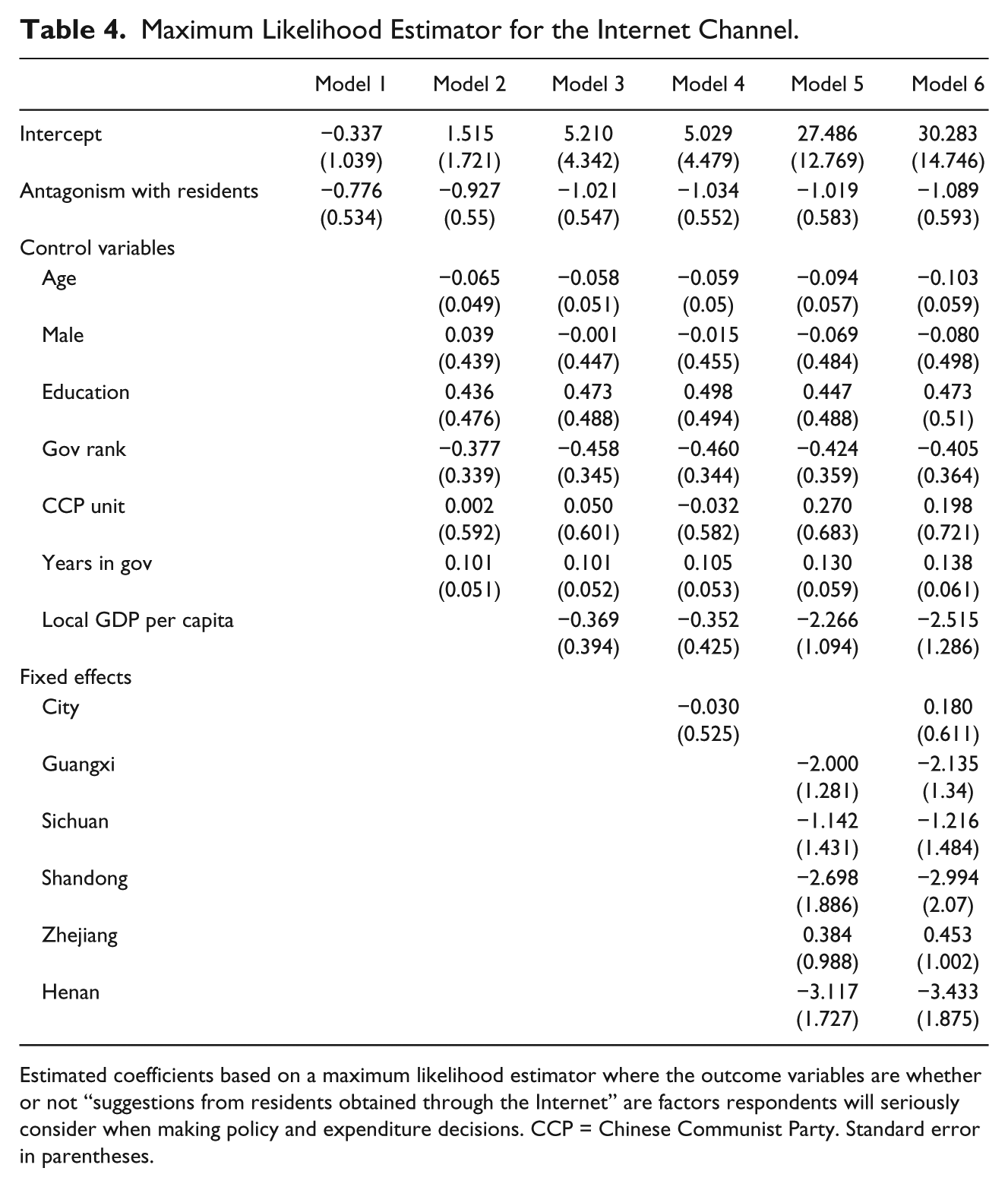
Estimated coefficients based on a maximum likelihood estimator where the outcome variables are whether or not “suggestions from residents obtained through the Internet” are factors respondents will seriously consider when making policy and expenditure decisions. CCP = Chinese Communist Party. Standard error in parentheses.
Table 3 shows that across all six model specifications, perceptions of state–society antagonism do not predict whether or not the respondents would seriously consider “suggestions from residents obtained through channels such as residential committees, local party organizations, and people’s congress representatives” when making policy and expenditure decisions related to the livelihood of the people. Three coefficient estimates are positive, two are negative, one is near zero, and none are statistically significant.
In contrast, Table 4 shows that across all six model specifications, perceptions of state–society antagonism negatively predict whether respondents would seriously consider “suggestions from residents obtained through the Internet” when making policy and expenditure decisions related to the livelihood of the people. The coefficient estimates are all negative, and results in Models 2 through 6 are statistically significant at the 90% level. 21
Although we know from Tables 3 and 4 that antagonism predicts decreased receptivity to the Internet channel but not to the formal channel, we hone in on our quantity of interest—the difference in the estimated percentage of respondents who are receptive to each type of channel conditional on antagonism by estimating the mean difference in predicted values in Figure 4. 22

Difference in estimated proportions of respondents answering the treatment item in the affirmative based on respondents who do and do not report antagonism.
Figure 4 shows the mean difference in predicted values across two data sets, one data set of respondents reporting antagonism and one data set of respondents reporting no antagonism, where all other covariates are set to the observed values of each respondent. This figure shows that for formal channels, there is no difference between those who perceive antagonism and those who do not perceive antagonism in the estimated proportions of respondents who are receptive. The difference in the estimated percentage of respondents who are receptive to formal channels between those who do and those who do not perceive antagonism is 0%, with 95% CIs of −24% to 25%. In contrast, for the Internet channel, Figure 4 shows that respondents are less receptive to the Internet channel when they perceive antagonism. Specifically, the difference in the estimated percentage of respondents who are receptive to the Internet channel between those who do and those who do not perceive antagonism is −23%, with 95% CIs of −46% to −1%.
To compare the effect of antagonism on the Internet channel and the formal institutions channel, we examine the statistical significance of the difference in mean predicted values of the maximum likelihood estimator based on Model 3 from Tables 3 and 4. In other words, we compare the difference in the two statistical estimates presented in Figure 4. The effect of antagonism on the proportion of respondents answering the Internet treatment versus the formal institutions treatment items in the affirmative is −0.235 with standard error of 0.142. This means we can reject the null hypothesis of no difference in the effect of antagonism on the estimated proportion of respondents answering the Internet channel and the formal institutions treatment items in the affirmative at the 10% level. In other words, similar to the difference-in-means analysis, receptivity to citizen feedback from the Internet is lower than receptivity to citizen feedback from formal institutions when respondents perceive antagonism between the state and citizens.
The conditional receptivity we observe to citizen suggestions from the Internet given social antagonism may be due to the characteristics of the channel itself, to the distinct characteristics of citizens who use the Internet channel, or due to the types of demands expressed on the Internet channel. Of course, these three explanations are related, but if the first explanation is correct, perhaps the anonymity afforded by online communications makes leaders less willing to consider citizen demands. Because leaders cannot verify the identity of online claimants, they are less willing to consider their input when state–society relations are tense. A second explanation for decreased receptivity to the Internet relates to the characteristics of those who use the Internet to communicate to the state. Individuals who use the Internet to express opinions on political and policy issues tend to be young and well educated, and they tend to belong to more elite socioeconomic sectors. 23 A final explanation for decreased receptivity to the Internet given social antagonism relates to the types of demands expressed online. Perhaps online demands are viewed by leaders as being less relevant to policy decisions or more difficult to incorporate.
The data also suggest that receptivity is conditional on the type of input channel, given social antagonism. This difference in receptivity between channels could be due to the level of state mediation implicit between the channels. In all of the formal channels we test, individuals associated with the government or Party—residential committee administrators, Party committee leaders, people’s congress representatives—are involved in funneling citizen preferences. In contrast, citizen preferences expressed online may be seen by government officials, but they are broadcast directly and publicly from citizens rather than via agents of the government. Furthermore, differences in who uses these channels and what preferences they express among different channels could also contribute to the heterogeneity we observe in receptivity to opinions from the Internet versus formal institutions.
Concluding Remarks
In this article, we seek to expand our understanding of responsiveness under authoritarianism. We do so by disaggregating the notion of responsiveness and developing the concept of receptivity. Receptivity refers to the willingness of autocratic leaders to incorporate citizen preferences into policy decisions and outcomes. Receptivity assumes autocratic leaders have some degree of openness and autonomy in making policy, and, importantly, policy making is a process influenced by different interests. As such, the concept of receptivity—and, by definition, responsiveness—should not be applied wholesale to all authoritarian, competitive authoritarian, or even transitional regimes.
We find, based on individual-level analysis of China’s provincial-and city-level leaders, that receptivity is possible at the subnational levels through both formal institutions and the Internet, but receptivity to opinions expressed online declines when leaders perceive state–society tensions, whereas receptivity to formal channels remains unchanged. Thus, our prior expectation that when state–society relations are harmonious, leaders will be similarly receptive to formal institutions and the Internet channel is borne out empirically. However, how receptivity changes with state-society antagonism is surpirising given our theoretical expectations. When there is perceived state–society antagonism, we had reason to believe that leaders would be relatively less receptive to both formal and Internet channels. However, we find strong evidence that receptivity declines for the Internet channel, and receptivity appears to differ between Internet and formal channels.
Our finding reveals that for many (though not all) local leaders, these quasi-democratic institutions are more than mere window dressing. Because our research is focused at the subnational level, our findings cannot automatically be extended to Chinese national institutions, “Chinese governance” writ large, or to other nondemocratic regimes. Receptivity may be present in local government institutions because expressed preferences at these levels may be less threatening politically, while receptivity may be nonexistent at the national level, or the conditions for responsiveness may be qualitatively different at the national level. Finally, although we show that local leaders are receptive to citizen suggestions, we do not know whether they actually incorporate these suggestions into policy decisions. And, as noted in the“Receptivity: A Precondition for Responsiveness,” because of explicit and implicit limits on citizen expression, even if subnational leaders in China do incorporate suggestions into action, the scope of their responsiveness is truncated, and “responsiveness” in China’s authoritarian context differs from responsiveness in a democratic setting. Finally, these findings point to several potential avenues for future research, including examination of the reasons for the conditional receptivity we observe and how actual levels of social contention and collective action influence responsiveness to different types of quasi-democratic institutions.
Footnotes
Acknowledgements
Our thanks to Jason Anastasopoulos, Jorge Dominguez, Archon Fung, Shelby Grossman, Kyle Jaros, Daniel Koss, Jason Lyall, Chris Lucas, Michael MacKenzie, Quinton Mayne, Gwyneth McClendon, Elizabeth Perry, Tomer Perry, Amanda Pinkston, Molly Roberts, Chiara Superti, Xiaojin Zhang, and Daniel Ziblatt for their comments and suggestions, and to Graeme Blair and Adam Glynn for their help in the design and analysis of the survey experiment.
Declaration of Conflicting Interests
The author(s) declared no potential conflicts of interest with respect to the research, authorship, and/or publication of this article.
Funding
The author(s) disclosed receipt of the following financial support for the research, authorship, and/or publication of this article: This work was supported by the China Scholarship Council [grant number [2011]3005]; the China Postdoctoral Science Foundation [grant number 2014M550040], and the Desmond and Whitney Shum Fellowship.