




Abstract
In democratic Africa, where ethnicity is a key driver of vote choice, politicians must attract voters across ethnic lines. This article explores one way politicians can do this: by appealing to a coethnic bond through their spouse. We propose that cross-ethnic spouses can help candidates send credible signals of coalition building before an election. We test this argument with a survey experiment in Benin, where President Yayi has married across ethnic lines. Our results confirm that priming the first lady’s ethnicity increases support for President Yayi among her coethnics. We generalize these results by combining new data on leader-spouse ethnicity with Afrobarometer survey data. Our results suggest that cross-ethnic marriages are one tool leaders can use to shore up support in multiethnic elections.
Keywords
In the recently democratized states of Africa, where ethnicity is a key driver of vote choice and where most countries lack a majority ethnic group, politicians must reach across ethnic lines to build a winning electoral coalition to secure office. To do so, they must convince non-coethnic voters that they will represent them while in power. How do they achieve this?
There are a number of ways politicians can appeal to non-coethnics. One method is to create political alliances with ethnic others. In Kenya’s 2013 presidential election, front-runner Uhuru Kenyatta—a Kikuyu—won by appealing to his ethnic group’s political rivals in offering the vice presidency to William Ruto, a Kalenjin. In Nigeria, presidential tickets are expected to comprise Northerners and Southerners as well as Muslims and Christians, and the media criticized the All Progressive Congress (APC)’s deviation from this norm when individuals within the party suggested it was planning to run a Muslim–Muslim ticket in 2015 (Kayode-Adedeji, 2014). In the end, the APC changed its ticket back to a Muslim–Christian coalition. More generally, in many African democracies, alliances are built through the strategic distribution of political resources. Baldwin (2014) shows that political leaders empower chiefs who have the ability to mobilize votes from unaligned ethnic groups. Arriola (2012) shows that political incumbents rely on state resources, such as cabinet positions, to build multiethnic coalitions and secure their tenure. In Ethiopia, for example, Meles Zenawi headed a four-party multiethnic coalition for more than two decades (Davison, 2012). 1
Alternatively, politicians can rely on their own individual characteristics to signal a commitment to ethnic others. Politicians who know multiple local languages can signal an affinity with other groups. In Sierra Leone, Siaka Stevens spoke both Mende and Temne fluently and Ahmad Tejan Kabbah spoke five of the local languages (Kandeh, 2003). In Benin, President Yayi leverages his membership in more than one ethnic group to garner support across ethnic lines (Adida, 2015). In this article, we elaborate on this type of strategy by exploring another way in which candidates can play the ethnic card to appeal to non-coethnics: via their spouse. We investigate the prevalence of cross-ethnic marriages by African leaders, and whether a non-coethnic spouse can be leveraged to shore up support across the ethnic aisle. We argue that non-coethnic spouses are useful to candidates who wish to signal support for ethnic groups other than their own, and thus offer one way in which African leaders can build multiethnic coalitions.
Elite marriages have played a dramatic role in politics historically, where elites used marriages explicitly to build political alliances (Dixon, 1985). 2 Today, even in the context of modern democratic politics, elite marriages may have implications for coalition building in democratic African countries. In Benin, where North, Southeast, and Southwest jockey for political power, President Yayi has emphasized his personal ties to the North and, via marriage, to the South. After the 2006 firing of Vice President Chilumpha in Malawi, President Mutharika faced tremendous pressure not to appoint another Southerner. Yet, journalists and politicians alike believed that Joyce Banda was a real contender, in spite of being a Southerner, because she was married to a Northerner (Gondwe & Mnelemba, 2006).
This article systematically explores the extent and the potential effects of cross-ethnic marriage among leaders in sub-Saharan Africa, where ethnicity is a key determinant of voting behavior (e.g., Bates, 1983; Ferree, 2006; Posner, 2005) and of public goods distribution (e.g., Franck & Rainer, 2012; Kimenyi, 2006). In doing so, we join recent scholarship that examines the nuanced ways in which ethnicity intervenes in African politics. Ichino and Nathan (2013), for example, show that in rural Ghana, local ethnic demography and the non-excludable nature of local public goods can lead voters to vote for a non-coethnic. Our focus on cross-ethnic marriages similarly helps us understand how leaders and candidates build broad coalitions in countries where ethnicity and ethnic divisions are politically salient (Posner, 2004).
We argue that spouses in multiethnic democracies can act as “high-profile surrogates” in a political contest (MacManus & Quecan, 2008, p. 337). Cross-ethnic spouses are uniquely positioned to offer a credible signal of coalition building before an election. Unlike the ad hoc nature of political coalitions, marriages typically occur long before candidates enter a political race; furthermore, they represent a significant personal investment in an individual and that individual’s identity. Cross-ethnic spouses can thus send the pre-election signal that the candidate will build cross-ethnic coalitions after the election. Those signals are credible because marriages are long-term commitments. We derive and test from our argument two observable implications: (a) In cases where an incumbent is married to a non-coethnic, individuals who share an ethnic identity with the spouse (spouse coethnics) are more likely to be supportive of the incumbent than individuals who share no ethnic identity with either spouse or incumbent (non-coethnics; see Figure 1); (b) in cases where an incumbent is married to a non-coethnic, support for the incumbent among spouse coethnics increases when spouse coethnics are primed to their coethnicity with the spouse.
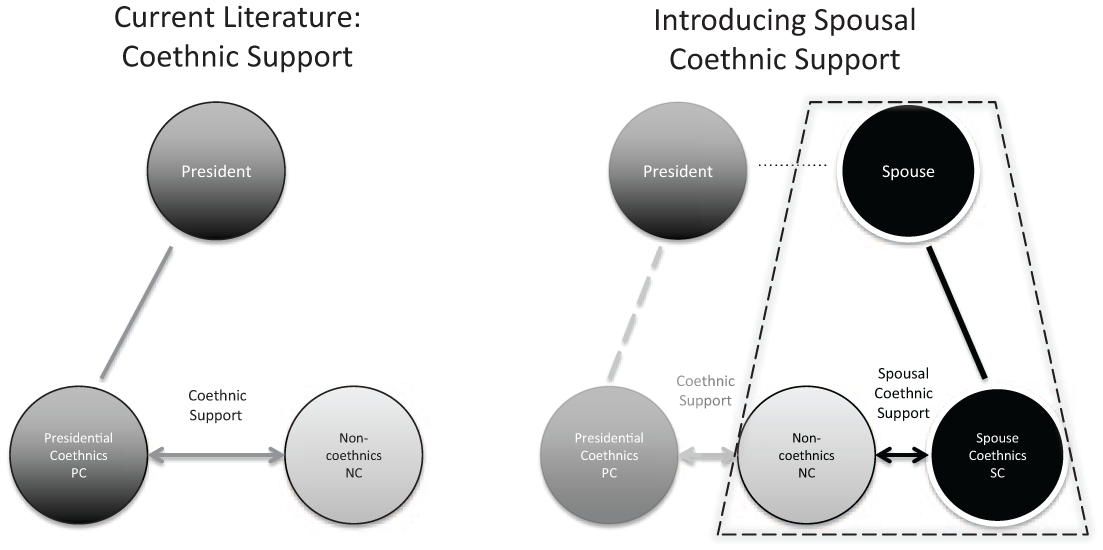
Introducing spouse coethnics.
Our empirical strategy is twofold. First, we conduct a randomized survey experiment in Cotonou, Benin—where President Yayi, a Yoruba, 3 is married to Chantal Yayi, a Fon. Our experiment shows that spouse coethnics, who hold low baseline levels of support for their leader relative to non-coethnics, respond positively to coethnic priming via Chantal’s Fon identity, and that this effect seems to occur through a psychological rather than an instrumental mechanism.
We then generalize beyond the Cotonou case with a systematic investigation of the characteristics and implications of cross-ethnic marriages among Afrobarometer countries. 4 To do so, we combined new data on the ethnic identity of leaders’ spouses in Afrobarometer countries (Rounds 3 and 4) with the Afrobarometer survey data to explore the prevalence of cross-ethnic marriage and to capture the baseline attitudes associated with spousal coethnics relative to respondents who share an ethnicity with neither the leader nor the leader’s spouse. We find that cross-ethnic marriages at the leadership level are prevalent, occurring in about half of the Afrobarometer countries for Rounds 3 and 4. We also find that, relative to respondents who share an ethnicity with neither their leader nor their leader’s spouse, survey respondents who do not share an ethnicity with their leader but do share an ethnicity with their leader’s spouse are more likely to express support for that leader. These patterns, together with the important observation that spouses who do not share the leader’s ethnicity tend to stem from large ethnic groups, suggest that spousal coethnics represent a large source of potential voters to attract in an election period. Based on these results, we suggest that cross-ethnic marriages have the potential to rally support beyond the leader’s ethnic base and thus offer one political tool for coalition building in African democracies.
The rest of the article is organized as follows. First, drawing on an extensive literature on ethnic politics in Africa, we develop our argument as to why and how cross-ethnic spouses may shore up support for a leader or candidate. Next, we present results showing a causal effect of priming the spouse’s ethnicity on spouse coethnic support for President Yayi in Benin, and discuss their scope and implications. Third, we generalize beyond Benin with an investigation into the prevalence of, and patterns associated with, cross-ethnic spouses in the Afrobarometer Rounds 3 and 4. Finally, we conclude with implications for our understanding of ethnic politics in multiethnic democracies.
The Many Faces of Ethnic Politics in Africa
That ethnicity matters in African politics is a claim neither new nor controversial. Although some have attributed this to expressive, psychological motivations (Horowitz, 1985), a more widely accepted explanation is an instrumental one: Voters rely on ethnicity as a cue for candidates or parties most likely to deliver goods their way (Bates, 1983; Ferree, 2006; Kimenyi, 2006; Posner, 2005). And, apparently, they are right to do so (e.g., Franck & Rainer, 2012; van de Walle, 2007). 5
Yet, as Ichino and Nathan (2013) point out, the correlation between ethnicity and vote choice, while strong, is imperfect (Ichino & Nathan, 2013; see also Koter, 2013). One reason for this is that, as many Africa scholars have shown, ethnicity is not the sole determinant of vote choice in Africa. In Ghana, for example, Lindberg and Morrison (2008) suggest that candidate performance and policy platforms matter more to Ghanaian voters than do ethnic ties. In Kenya in 2007, Bratton and Kimenyi (2008) identify two types of voters: Ethnics prioritize ethnic ties while non-ethnics focus instead on policy issues such as corruption and socioeconomic well-being. Across 16 Afrobarometer countries, Bratton and co-authors find that ethnicity and economic concerns matter to the African voter (Bratton, Bhavnani, & Chen, 2012). In Zambia, Posner and Simon (2002) show that economic factors play an independent role in the reelection of an incumbent. In Uganda, Carlson (2015) offers a vote choice experiment demonstrating that voters will favor only those coethnic candidates with a demonstrated record of past performance. And in an experiment embedded in an exit poll of Kenyan voters, Gibson and Long (2012) propose that Kenyans care more about performance than coethnicity.
A second explanation for the imperfect correlation between ethnicity and vote choice, although not mutually exclusive with the first, emphasizes a more comprehensive and nuanced set of strategies on which both leaders and voters rely to achieve their goals (electoral victory for leaders, access to public goods for voters) in the face of diversity. Ichino and Nathan (2013), for example, take into account the local ethnic demography a rural voter faces when making her voting decision. They argue that members of local ethnic minorities face a rational basis for voting for a non-coethnic, in this case a member of the majority ethnic group that surrounds them, to enjoy the non-excludable local public goods that such a leader would deliver to his coethnic constituencies. They show that this is indeed the case in the 2008 Ghanaian elections. Here, voters are clearly voting ethnically, but they are also taking into account their local context.
Recent literature on ethnic politics in Africa recognizes that leaders use a number of strategies to build cross-ethnic coalitions in the face of ethnic diversity. Adida (2015) has shown that leaders of dual ethnic heritage can leverage their multiple ethnic identities to shore up support across both coethnic groups. Arriola (2012) documents African leaders’ strategic use of cabinet positions to broaden support and lengthen tenure. Baldwin (2014) shows that African leaders devolve power to local elites, for example, chiefs, to mobilize votes from unaligned ethnic groups. Similarly, Koter (2013) argues that African leaders rely on intermediaries in settings where, for historical reasons, local leaders are strong; in Senegal, for example, where religious leaders have maintained a prominent role in local politics, leaders rely on these intermediaries to build cross-ethnic coalitions. A similar logic might underlie the choice of a running mate. The absence of electoral violence in Kenya’s 2013 presidential election can be attributed, at least in part, to the fact that two former ethnic rivals (Kenyatta, a Kikuyu and Ruto, a Kalenjin) were running together—and winning—on the same ticket (Long, Kanyinga, Ferree, & Gibson, 2013).
We add to this menu of options the politicization of a cross-ethnic spouse, and propose that cross-ethnic marriages can rally support among spouse coethnics. Although most leaders are unlikely to marry their spouses for strategic political reasons, 6 we contend that spouses may play a unique role in helping candidates send credible signals of coalition building before the election. In other words, although marriages are unlikely to be strategic, the strategic use of a cross-ethnic spouse during a political campaign is a tool on which politicians can rely to shore up support across the ethnic aisle. Indeed, unlike the ad hoc nature of political coalitions, marriages often happen long before candidates enter a political race or campaigns heat up; they represent a much more personal investment in an individual, and by extension, in that individual’s identity. Because they are present from the beginning, cross-ethnic spouses can send the pre-election signal that the candidate will build cross-ethnic coalitions after the election. And because marriages are long-term commitments, candidate spouses can also improve the credibility of the signal sent by candidates. We thus join MacManus and Quecan (2008) in focusing on spouses as “high profile surrogates” on the campaign trail (MacManus & Quecan, 2008, p. 337). 7
Drawing on the ethnic politics literature, we propose three reasons why a cross-ethnic marriage might boost support from spouse coethnics. First, scholars have argued that there are psychological benefits to seeing one’s coethnic in power; powerful coethnics can improve a voter’s self-esteem as well as her sense of belonging (Horowitz, 1985). Although this mechanism has found little empirical support in the literature examining the relationship between voters and leaders, we argue that it may be salient in this case: According to social identity theory, individuals gain self-esteem by associating themselves with positively valued groups (Tajfel, 1981; Tajfel & Turner, 1986). In other words, voters may receive an expressive benefit by supporting their coethnic as first spouse, and voting for that leader may serve as an affirmation of the voter’s ethnic identity.
Alternatively, according to theories of instrumental voting, voters prefer to elect leaders who are more likely to direct the provision of development goods and services their way (Ichino & Nathan, 2013); and they tend to rely on ethnicity as a credible signal for the post-election fulfillment of pre-election promises (Chandra, 2004; Posner, 2005). Hence, for spouse coethnics, a cross-ethnic marriage may act as a credible signal that the leader will favor their ethnic group in the same way, or close to the same way, he will favor his own; or, at the very least, a cross-ethnic marriage might counter the impression or delegitimize the claim by rivals that the leader is ethnically exclusive. 8
Third, cross-ethnic marriages may increase support from spouse coethnics not at all because of ethnic favoritism but rather because cross-ethnic marriages signal a certain degree of cosmopolitanism and national orientation. Via marriage, a leader might signal that she or he is above ethnic rivalries, reinforce the notion of a unified nation, and potentially bolster support among voters across ethnic lines.
All three of these mechanisms support the same hypothesis: Cross-ethnic marriages can be used to increase support from spouse coethnics. In the following section, we test this hypothesis using a survey experiment from Benin. We then present evidence adjudicating between these three mechanisms.
Identifying the Causal Effect of Priming Coethnicity With the Leader’s Spouse
In this section, we aim to identify the extent to which cross-ethnic marriages can be used to sway political support; to do so, we turn to a survey experiment implemented in Cotonou, Benin in August 2012, where President Yayi, a member of the Yoruba ethnic group, 9 is married to Chantal Yayi, a member of the Fon ethnic group. We rely on a cueing experiment to approximate what politicians tend to do in campaigns. We randomize respondents’ exposure to cues about President Yayi’s wife and her ethnic identity, and thus gauge the effectiveness of such strategies for building cross-ethnic coalitions.
Benin is a small West African country of approximately 10 million people that transitioned into democracy in 1989-1991, a first-mover during the wave of democratization that characterized sub-Saharan Africa that same decade (Banégas, 2003; Bierschenk, 2009; Lynch & Crawford, 2011). On April 6, 2006, the Beninois elected Thomas Boni Yayi; they re-elected him in March 2011 for a second and final term. In both elections, Yayi enjoyed high levels of support, winning the 2006 election with approximately 75% of the vote in the run-off, and the 2011 election with a majority vote in the first round.
Since independence, the main cleavage in Benin politics has been a regional one, with Southeast, South-Central, and North jockeying for political power. 10 Indeed, during the first 12 years of independence, leaders hailing from each of these regions struggled for power in coups and counter-coups, until Mathieu Kérékou established a military regime in 1972 that lasted until 1990. However, the regional cleavage persists in Benin politics to this day (Bio Bigou, 2011; Deboe, 1995; Wantchekon, 2003). 11 The most populous ethnic groups in each of these three regions are the Bariba (North), the Yoruba (Southeast), and the Fon (South-Central).
In that light, President Yayi seems to have covered all his ethnic bases: He is a Yoruba from his paternal line, a Bariba from his maternal line, and he has married a Fon wife. In addition, political parties in Benin are weak, and President Yayi is an independent, meaning that voters cannot rely on partisan cues the way they might in other African democracies such as Ghana; they must, instead, revert to other cues such as personal—namely ethnic—identity. President Yayi is thus a particularly useful case for our study of the political implications of a cross-ethnic marriage. Indeed, previous work suggests that President Yayi benefits from his mixed ethnic heritage (Adida, 2015). Does he also benefit from his cross-ethnic marriage?
When we examine actual electoral results from the presidential elections in which Yayi ran, we find patterns consistent with our claim that Yayi successfully rallied support from his spouse’s coethnics. Consider Benin’s 2006 run-off presidential election: It offers a simple way to observe correlations between ethnic loyalties and electoral outcomes because it pitted two candidates with different ethnic backgrounds against one another—Boni Yayi and Adrien Houngbédji. Recall that Boni Yayi is a Bariba from his mother’s side and a Yoruba from his father’s side. The Bariba are largely located in Northeastern Benin, whereas the Yoruba are prevalent in the central and southeastern parts of the country. Adrien Houngbédji, however, is a full-fledged Southerner. He hails from Porto-Novo (Southeast) on his father’s side and from Abomey (Southwest) on his mother’s side. Pure ethnic voting based solely on Yayi’s paternal and maternal ethnic heritage would yield the electoral support map illustrated in Figure 2a, which represents 41% of registered voters in 2006 (27% for the North, 12 14% for the Center/Southeast). This leaves open close to 60% of registered voters, located in the South and where the Fon predominate.

(a) Yayi’s ethnic strongholds with percentage of registered voters in 2006 and (b) Benin’s presidential run-off electoral results in 2006.
Houngbédji’s great hope—in his third race for president of Benin at the time—was that he could unify and rally the South in his support (Soudan, 2010). He was, after all, the son of a Fon mother and the Fon constitute Benin’s majority ethnic group in the South. Yet the electoral results in the second round of Benin’s 2006 presidential election reveal Houngbédji’s inability to garner support beyond Ouémé department in the Southeast, his ethnic stronghold from his paternal line. Figure 2b reveals that, in the actual run-off election, candidate Yayi, with no personal links to the Fon—except via his spouse—was able to capture, on top of the Northern and Central blocs already guaranteed to him by his Bariba/Yoruba membership, most of the Fon South.
Is this interpretation of Benin’s presidential election plausible? Chantal Yayi was a relative political unknown when her husband ran for president of Benin in 2006; she has since gained political gravitas by maintaining a delicate balancing act of maneuvering mostly behind the scenes so as not to upset social norms, which look down on the political involvement of a first lady. She often appeared with her husband when he first campaigned for the 2006 presidency, and worked on mobilizing key political figures in her hometown of Ouidah, a Fon stronghold. She subsequently ran in the 2011 legislative elections to become a representative of Ouidah. She won the election, and ceded the position to her brother-in-law. Over the past 8 years, she has maintained an important political role in Ouidah, canvassing for political hopefuls and mobilizing party activists. To wit, even in the face of a Southern opponent, candidate Yayi carried Ouidah in 2006 and in 2011.
As a mixed Bariba-Yoruba, President Yayi embodies two of the salient regional cleavages in the country; with his marriage to a Fon wife, it seems that he captures all three. To test this possibility, we fielded a survey experiment in Cotonou, Benin in August 2012. 13 Cotonou is the economic capital and the largest city in Benin. It provides a particularly useful opportunity to test the questions we introduce in this article for two reasons. First, as the economic capital, it draws migrants from all parts of the country and thus offers an ethnically diverse landscape from which to recruit respondents from various key ethnic groups. Second, as a southern city located in Fon-land, Cotonou is majority Fon and thus offers a unique opportunity to examine how the Fon—Chantal’s coethnics—respond to Yayi’s cross-ethnic marriage. Alternatively, we could have recruited respondents from Ouidah, Chantal’s hometown; in doing so, however, we would have faced greater difficulty recruiting members of other ethnic groups. Cotonou thus offers the optimal combination of ethnic diversity and Fon concentration to field a survey meant to compare how Fon and non-Fon respond to Yayi’s marriage to a Fon wife. 14
After collecting a set of pretreatment variables on the respondent’s gender, age, ethnic identity, religion and religiosity, place of birth, number of years in Cotonou, education level, occupation, and socioeconomic well-being, enumerators read to the respondent a short biographical paragraph about President Yayi. This section appeared in three versions. The control made no reference to President Yayi’s wife. The second mentioned his wife, and the third mentioned his Fon wife, thus stressing her ethnic identity. Although we are primarily interested in identifying the effect of the Fon wife cue relative to the control condition, we include a Wife treatment to control for the fact that our Fon Wife treatment includes both a reference to Yayi’s wife and to the fact that she is Fon. The prompt is reproduced below: {∅; Accompanied by his wife, Chantal; Accompanied by his Fon wife, Chantal}, Yayi Boni became President of Benin on April 6, 2006 and was just re-elected for a second term. He has led a presidential campaign based on economic growth and suppressing corruption. However, some critics claim that the country’s economic growth has been disappointing, and that Boni’s administration is, itself, corrupt.
Immediately following the reading of the prompt, respondents were asked the following: “If there were no term limits and the election were held today, would you vote for Yayi Boni for President?” 15 This question emulates the Afrobarometer question on vote choice, which we utilize in the next section. 16 At the end of the survey, respondents were then asked—as a manipulation check—to identify the ethnic membership of President Yayi’s wife.
We first note that respondents who share an ethnicity with Chantal hold significantly lower baseline levels of support than do respondents who share an ethnicity with neither Chantal nor Boni Yayi. In the control condition (where no cueing occurred), 71% of non-coethnics would vote for Yayi compared with merely 19% of Chantal coethnics. This more-than 50-percentage-point difference is statistically significant beyond the 99% confidence level. It is also easily explained by the fact that the Fon have rarely had a coethnic president in spite of being the country’s plurality group, and that Yayi’s main political opponent in both presidential elections (2006 and 2011) was from the South, just like the Fon, whereas Yayi is largely considered to be a Northerner. As such, Benin’s Fon comprise a disgruntled opposition group. 17
However, can Yayi use his cross-ethnic marriage to his advantage? To answer that question, we analyze our experimental results. 18 In Table 1, we compare support for President Yayi in the control condition, for respondents exposed to the wife cue, and for respondents exposed to the Fon wife cue. We compare these effects for Chantal coethnics (the Fon) and for non-coethnics (those who share an ethnicity with neither President Yayi nor his wife). Table 1 shows that Chantal’s coethnics, the Fon, react positively to cues about Yayi’s Fon wife. Indeed, although a mere 19% of Fon support Yayi in the control condition, this proportion increases to more than 41% in the Fon Wife condition. This effect is statistically significant at the 99% confidence level, and is not driven by the fact that the treatment also cued the term wife. 19
Vote Choice Difference-in-Means in Benin Survey Experiment.

Note. The unit of observation is the respondent. The Control condition makes no reference to President Yayi’s wife or to ethnicity. The Wife condition makes a reference to President Yayi’s wife. The Fon condition makes a reference to President Yayi’s Fon wife. Chantal coethnics is a sub-sample of Fon respondents (the president’s wife’s ethnic group). Non-coethnics is a sub-sample of respondents who do not share an ethnicity with Yayi or his wife. DV = dependent variable.
* and ** indicate 95% and 99% confidence levels, respectively.
In Table 2, we estimate the effect of cueing Yayi’s Fon wife more precisely on sub-samples of Chantal coethnics and non-coethnics. Specifically, we estimate the following equation:

Determinants of Yayi Vote Choice on Chantal Coethnics and Non-Coethnics in Benin Survey Experiment.
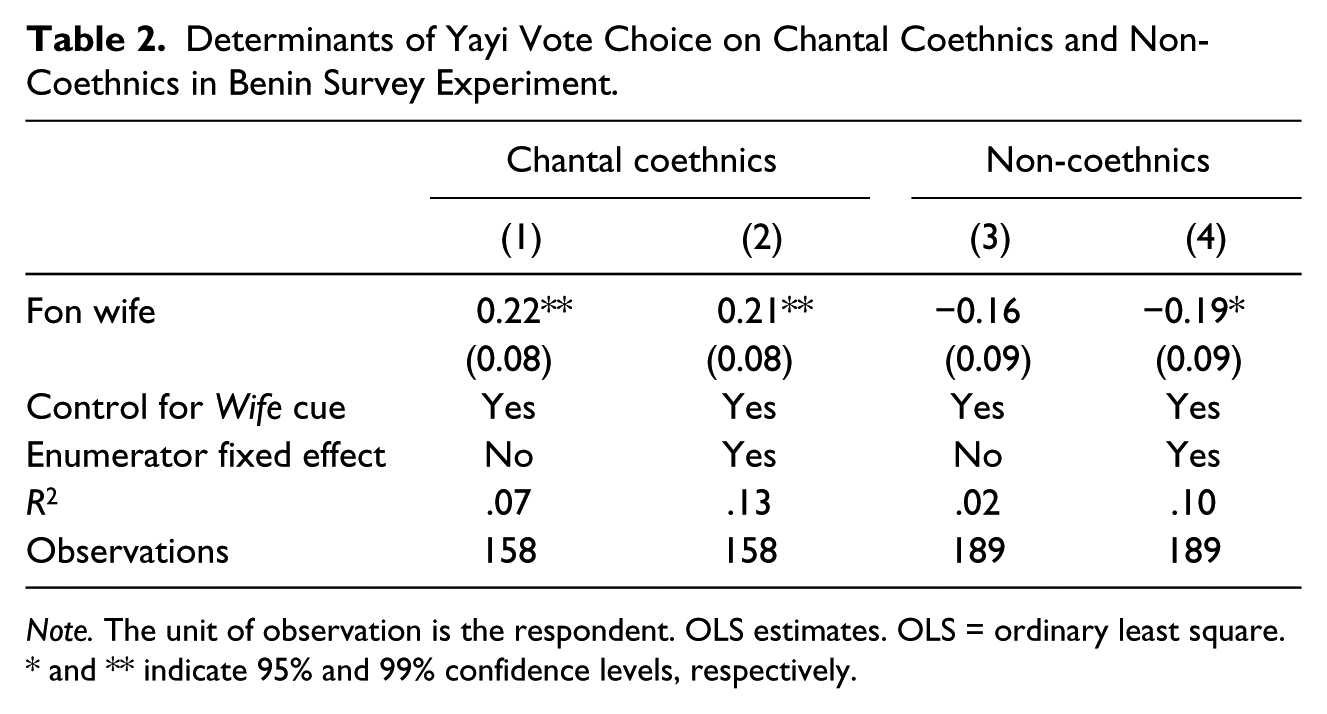
Note. The unit of observation is the respondent. OLS estimates. OLS = ordinary least square.
* and ** indicate 95% and 99% confidence levels, respectively.
where Support captures whether or not the respondent would vote for Yayi, Wife Cue captures whether the respondent received the wife prompt, Fon Wife Cue captures whether the respondent received the Fon wife prompt, and the omitted category is the control condition where the respondent received neither prompt about Yayi’s wife or her ethnicity.
In a cueing exercise where we randomly introduce references to President Yayi’s wife, and specifically to his Fon wife, we find out that the Fon—who hold low baseline levels of support for President Yayi—increase their support by more than 20 percentage points when they are cued to the fact that President Yayi has a Fon wife. 22 We now turn to the potential mechanisms underlying this effect: Are Fon respondents more favorable toward President Yayi when his Fon wife is mentioned because they experience psychological benefits from seeing a coethnic in the presidential palace (the psychological mechanism), they expect greater redistribution of goods their way (the instrumental mechanism), or they perceive President Yayi as rising above ethnic divisions (the cosmopolitan mechanism)?
Tables 1 and 2 already allow us to rule out the cosmopolitan mechanism. Indeed, if marrying a non-coethnic sends the signal that the leader is a cosmopolitan who rises above ethnic divisions, then we expect to observe a positive effect of priming Yayi’s Fon wife on all survey respondents, not just on the Fon. And yet we observe that the positive cueing effect in our survey applies only to Chantal’s coethnics, the Fon. Indeed, other respondents in the survey—who are coethnic with neither Yayi nor Chantal—see a decrease in support that is not robustly statistically different from zero when exposed to either the Wife or the Fon Wife cue. Our evidence here is not consistent with a cosmopolitan mechanism. 23
Alternatively, Fon respondents may respond positively to the Fon Wife cue because they expect a better distribution of resources for the Fon. We test this instrumental mechanism by estimating the effect of our survey cue on a second outcome, measured immediately after the voting question: “In your opinion, does President Yayi favor Northerners or Southerners more?” Although Yayi is generally considered to be a Northerner, his wife Chantal is undeniably a Southerner. In our sample, just over one third of respondents claimed that President Yayi favors Southerners over Northerners. Yet, only 9% of those are Fon. Does our cue about President Yayi’s Southern spouse affect Fon perceptions of regional favoritism? We find no evidence that it does. Indeed, approximately 9.8% of Fon respondents in the control condition claimed that Yayi favors Southerners. This number increases to 13.7% for Fon respondents who received the Fon Wife cue. However, this difference is not statistically distinguishable from zero (p = .513). In other words, we do not find evidence that Fon respondents are more likely to claim that President Yayi favors them when they receive the spouse coethnic cue. 24
So far, we find no evidence consistent with either the cosmopolitan or instrumental mechanism. This leaves only the psychological mechanism, whereby voters enjoy a psychological benefit from seeing their coethnic in power (Horowitz, 1985). By its very nature, this mechanism is difficult to test directly. Can we—at least—find evidence of a non-rational element to the phenomenon we have identified? To do so, we exploit our manipulation check. This manipulation check enables us to identify whether respondents who received the Fon Wife cue were given new information or were simply primed to information they already knew. We propose that evidence of a priming effect over a learning effect would be consistent with a non-rational mechanism. In Table SI-5 of the online appendix, we present results from a manipulation check where all respondents were asked, in an open-ended question post treatment, what Chantal’s ethnic identity is. If respondents do not know that she is Fon, then the Fon Wife treatment should provide new information, and we should see this effect in the manipulation check. The results in Table SI-5, however, indicate that all respondents know that Chantal Yayi is Fon: In the control condition, 100% of Chantal’s coethnics and 98% of non-coethnics are able to identify her ethnicity. The Fon Wife cue has no statistically significant effect on respondents’ ability to identify Chantal’s ethnic identity. These results indicate that the Fon Wife treatment effect is not an information effect, but rather a priming effect. 25 This result, combined with the fact that we fail to find evidence supporting the cosmopolitan and instrumental mechanisms, suggests that there is a non-rational element to spouse coethnic support. 26
We recognize, however, that these results are tentative. Indeed, in light of substantial evidence to the contrary in the current literature—which has found support for instrumental ethnic voting—they may seem surprising. We propose that our finding may very well be specific to the particular phenomenon we study: ethnic voting on the part of spouse coethnics. Indeed, it may be the case that instrumental motivations underlie ethnic voting for a leader’s coethnics, whereas psychological motivations underlie ethnic voting for a leader’s spouse’s coethnics. If spouses are perceived, not as consequential political figures but as symbolic figures instead, then it is conceivable that psychological motivations may be at play for spouse coethnics.
Cross-Ethnic Marriages in Democratic Africa: Beyond Benin
The previous section demonstrated a causal effect of priming President Yayi’s Fon wife on Fon support for Yayi. In this section, we attempt to generalize beyond the Benin case by comparing the political attitudes of individuals who share an ethnicity with the leader’s spouse but not with the leader, against those who share an ethnicity with neither leader nor spouse in the Afrobarometer Rounds 3 and 4.
We begin this analysis with an identification of the prevalence of cross-ethnic marriages, and the broad patterns with which they are associated. To do so, we collected original data on the ethnic identity of leaders’ spouses for the 18 African countries covered by the Afrobarometer project Rounds 3 and 4. We offer only a snapshot of this phenomenon for a subset of African countries—primarily democracies—and during one period of time (2005-2009). 27
We find cases of leader cross-ethnic marriage in more than half of the countries in our sample, and for half of all country-rounds. In Table 3, we compare the set of cases where the leader in office is married to a coethnic to the set of cases where the leader in office is married to a non-coethnic. Unsurprisingly, the cross-ethnic marriage rate in the population—calculated using the Demographic Health Survey for each country—is higher for countries where leaders marry across ethnic lines (24%) than for those where they do not (13%). Furthermore, countries with leader cross-ethnic marriage seem to be more populous and slightly more democratic. However, both sets of countries have similar levels of ethnic diversity (measured either as ELF or PREG 28 ). At the country-round level, leaders who out-marry tend to belong to larger ethnic groups (their ethnic group comprises 50% of the population) than those who do not (their ethnic group comprises 32% of the population); and they tend to marry into groups that are, on average, substantially larger (by 8 percentage points).
Comparing Cross-Ethnic and Coethnic Marriage Cases.
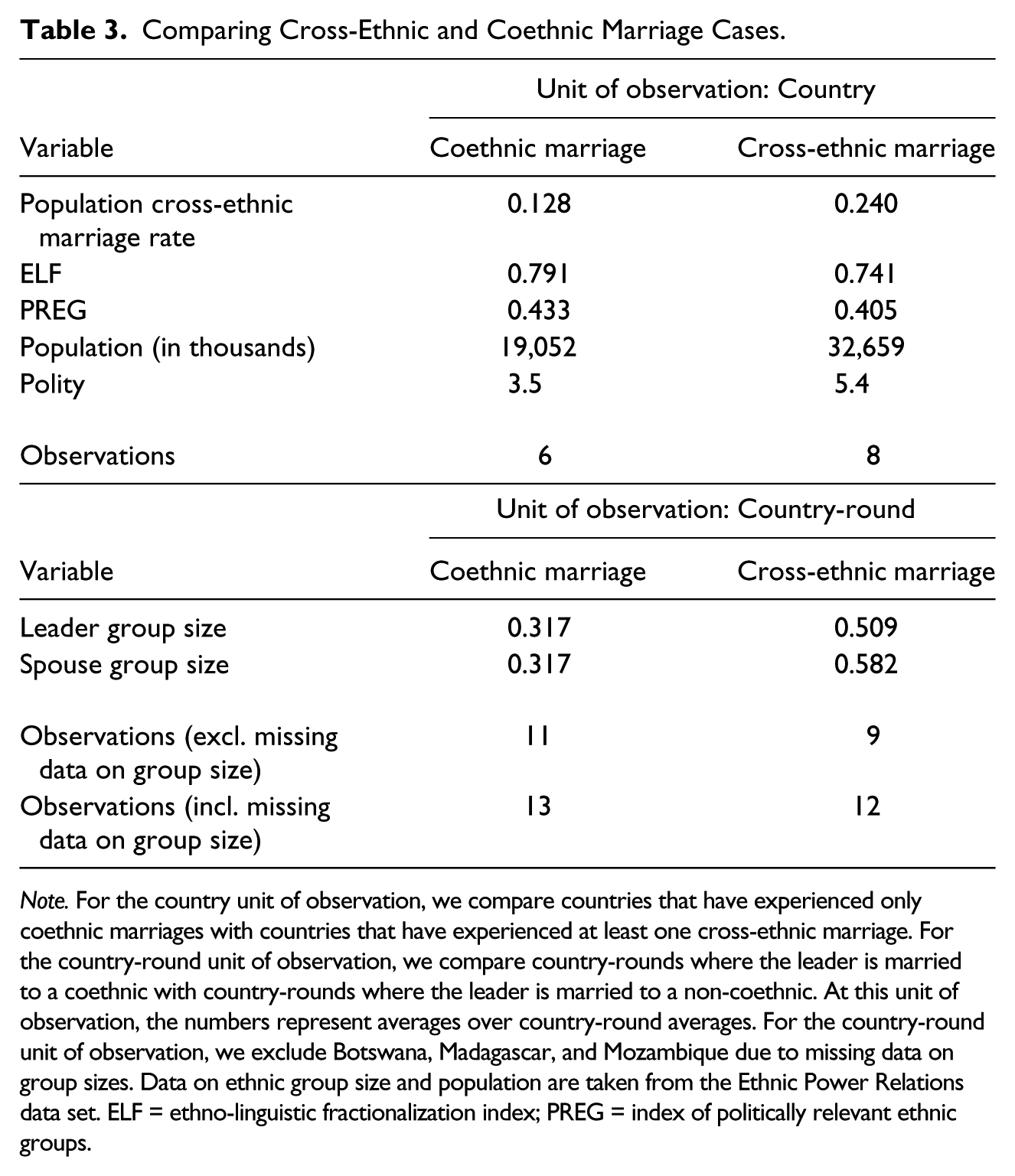
Note. For the country unit of observation, we compare countries that have experienced only coethnic marriages with countries that have experienced at least one cross-ethnic marriage. For the country-round unit of observation, we compare country-rounds where the leader is married to a coethnic with country-rounds where the leader is married to a non-coethnic. At this unit of observation, the numbers represent averages over country-round averages. For the country-round unit of observation, we exclude Botswana, Madagascar, and Mozambique due to missing data on group sizes. Data on ethnic group size and population are taken from the Ethnic Power Relations data set. ELF = ethno-linguistic fractionalization index; PREG = index of politically relevant ethnic groups.
The incidence of leader cross-ethnic marriage is high. As Table 3 points out, eight out of 14 Afrobarometer countries have experienced at least one cross-ethnic marriage case, and 12 out of 25 leadership tenures are cases of cross-ethnic marriage. As a result, the proportion of respondents who are coethnic with the leader’s spouse in the Afrobarometer data set is not trivial. An Afrobarometer respondent’s coethnicity with the leader’s spouse occurs about 23% of the time, a slightly higher rate than that of coethnicity with the leader (see Online Appendix Table SI-3).
With these data, we are able to compare the political attitudes of respondents who are not coethnic with the spouse with those of respondents who are, in countries where leaders have married an ethnic-other. 29 We investigate these patterns for four political outcomes of interest: whether the respondent would vote for the incumbent’s party if the election were held tomorrow (Vote), whether the respondent approves of the leader’s job performance (Job performance), whether the respondent believes her ethnic group has influence in politics relative to other ethnic groups (Ethnic political power), and the extent to which the respondent believes his ethnic group is treated unfairly by the government (Ethnic unfair). These four measures most directly capture political support for the leader as well as political attitudes about access to power. 30 We estimate Equation 2 as follows:

where
Determinants of Support for Leader in AB Survey.

Note. The unit of observation is the AB survey respondent. The sample is limited to cases of cross-ethnic marriage and respondents who are not coethnic with their leader. Demographic controls include the respondent’s sex, age, education level as well as whether the respondent is coethnic with the primary opponent, and the ethnic group size. All models include country and round fixed effects. AB = Afrobarometer; SES = socioeconomic status.
* and ** indicate 95% and 99% confidence levels, respectively.
The results in Table 4 effectively compare, in cases of cross-ethnic marriage, the political support and attitudes of respondents who are coethnic with the leader’s spouse to the political support and attitudes of respondents who are coethnics with neither leader nor spouse. We find that respondents who share an ethnicity with the leader’s spouse express greater support for the incumbent leader. 32 These effects are statistically significant at the 99% confidence level and hold whether or not we control for a plethora of socioeconomic variables. 33 They are also substantively interesting. Relying on our most restrictive model and holding fixed all covariates, spouse coethnics are 4.3 percentage points more likely to express support for the leader than are non-coethnics.
In cases where leaders marry an ethnic-other, spouse coethnics are more supportive of the leader than are non-coethnics. In addition, as Table 3 suggests, leaders who marry across ethnic lines tend to marry into the largest eligible group. In Benin for example, both Presidents Kérékou and Yayi have married women from the Fon plurality ethnic group. In Botswana, President Mogae—a member of the largest ethnic group in the country—married a woman from the second largest ethnic group. In Mali, President Touré—a member of the sixth largest ethnic group in the country—married a woman from the Bambara plurality ethnic group. In South Africa, President Mbeki, a Xhosa (second largest ethnic group) married a Zulu (plurality ethnic group). None of this is to say that these leaders chose their spouses strategically. Rather, this pattern emphasizes the potential resource that cross-ethnic spouses represent in multiethnic elections. 34
Conclusion
This article provides a systematic investigation into the political implications of cross-ethnic marriages in contemporary Africa. It argues that cross-ethnic spouses can send credible signals of coalition building before an election because marriages occur long before candidates enter a political race, and because they represent a significant political investment in an individual and that individual’s identity. We test this argument causally with a survey experiment in Cotonou, Benin—where President Yayi has married a cross-ethnic spouse. Our results confirm that respondents who are coethnic with Yayi’s spouse increase their expressed support for President Yayi when they are cued to this coethnicity. We then generalize these results with a cross-national analysis that relies on the Afrobarometer surveys and original data on the ethnic identity of leaders’ spouses. This analysis indicates that spouse coethnics are more supportive of their leader than are non-coethnics. Cross-ethnic marriages, we conclude, offer one potential tool for rallying cross-ethnic support.
Although tentative, we also find evidence that the mechanism underlying spouse coethnic support is a psychological rather than an instrumental one. One interpretation, and an avenue for future research, is that leader spouses are largely seen as symbolic figures, eliciting a non-rational response. Hence, although leader coethnics are likely to vote ethnically out of instrumental incentives, spouse coethnics may instead vote ethnically out of psychological ones. Still, given the difficulty of testing a psychological mechanism, and the urban nature of our sample, we put forward this interpretation as a preliminary one only, and encourage future work on the mechanisms underlying coethnic voting.
Our results raise new questions about the strategies and implications of cross-ethnic marriages in contemporary African democracies and beyond. If a cross-ethnic marriage can be used as a tool to rally support from non-coethnics, do political systems favor politicians with marriages to strategically important ethnic groups? The high rates of cross-ethnic marriage in our sample suggest that this may be the case. Identifying this selection effect would require a broader investigation into the political processes that may interact with politicians’ marriages; looking into the ethnic identities of candidates and their spouses, as well as the strategies that candidates pursue on the campaign trail, is a promising avenue for future research.
In addition, if a non-coethnic spouse is used to send credible signals about post-electoral outcomes, do leaders make good on the signals they send during the campaign? Although our analysis finds no evidence of an instrumental mechanism, in that spouse coethnics do not necessarily expect greater rewards, future work should investigate whether leaders reward spouse coethnics during their tenure, relying, for example, on the detection of patterns of public goods provision for the spouse’s ethnic base. Such an analysis would enable us to test more explicitly the instrumental voting mechanism that might underlie the spouse coethnic effects we have identified.
Finally, we have no reason to believe that spouse coethnic effects prevail in Africa only. In fact, our study is inspired in part by the prevalence of political marriages in Europe at least since the Roman Empire. In an effort to better understand the myriad ways in which political actors build broad coalitions in diverse societies, future work should investigate this phenomenon beyond Africa, namely, in democracies where social divisions such as ethnicity, race, or caste are politically salient.
Meanwhile, our results bring texture to the literature on ethnic voting in Africa, which tends to remain silent about the ethnic motivations of voters who have no coethnic options. 35 We focus precisely on those non-coethnic voters, and consider ways in which ethnicity could continue to shape their political choices. Doing so helps us confirm that the cross-ethnic marriages we have identified have important political implications, and that even voters who share no ethnic identity with their leader may be driven by ethnic motivations.
Footnotes
Acknowledgements
The authors thank Leonardo Arriola, Jaimie Bleck, Adam Chabi Bouko, Hannah Britton, Elizabeth Carlson, Katherine Casey, Ashley Currier, Kim Yi Dionne, Jesse Driscoll, James Fowler, Willa Friedman, Desha Girod, Jessica Gottlieb, Seth Hill, Amaney Jamal, Cara Jones, Michael Kevane, Eric Kramon, James Long, John F. McCauley, Gwyneth McClendon, James Morrison, Lisa Mueller, Njunga Mulikita, Matthew Nanes, Melina Platas Izama, Daniel Posner, Taylor Price, Amanda Robinson, Laura Seay, Moumouni Chabi Sika, Branislav Slantchev, Etienne Smith, Scott Straus, David Wiens, Tom K. Wong, Brigitte Zimmerman, and workshop participants at Penn State University, Princeton University, Stanford University, and the University of Southern California for their help and feedback.
Authors’ Note
All errors are our own.
Declaration of Conflicting Interests
The author(s) declared no potential conflicts of interest with respect to the research, authorship, and/or publication of this article.
Funding
The author(s) disclosed receipt of the following financial support for the research, authorship, and/or publication of this article: This study was funded by a University of California, San Diego (UCSD) Academic Senate Grant PLS104G and by the Hellman Foundation.