




Abstract
Why do authoritarian regimes permit elections in some settings but not in others? Focusing on the decision to hold subnational elections, we argue that autocrats can use local elections to assuage powerful subnational elites. When subnational elites control significant political resources, such as local political machines, leaders may need to co-opt them to govern cost-effectively. Elections are an effective tool of co-optation because they provide elites with autonomy and the opportunity to cultivate their own power bases. We test this argument by analyzing variation in the decision to hold mayoral elections in Russia’s 207 largest cities between 2001 and 2012. Our findings suggest that Russian mayoral elections were more likely to be retained in cities where elected mayors sat atop strong political machines. Our findings also illustrate how subnational elections may actually serve to perpetuate authoritarianism by helping to ensure elite loyalty and putting the resources of powerful elites to work for the regime.
Introduction
Almost all modern autocracies hold elections, and most hold multiparty elections. 1 The prevalence of electoral authoritarian regimes has led an increasing number of scholars to study them (Brownlee, 2010; Levitsky & Way, 2010; Lindberg, 2009; Miller, 2014). However, one topic that has received less attention is subnational elections. Subnational officials play a central role in the governance of authoritarian regimes. Regime leaders rely on local officials to maintain political stability, implement policy, and gather information about the provinces. Many autocracies hold elections to fill subnational offices and these elections have significant consequences. 2 They may directly affect the prospects for democratization, as when opposition parties use subnational elections as staging areas from which to mount broader challenges (Cornelius, Eisenstadt, & Hindley, 1999; Eisenstadt, 2004). Alternatively, autocrats may use subnational elections to improve their information gathering capacity and entrap voters in state-dependent, clientelist relations (Lust, 2009; Reuter & Robertson, 2012; Sharafutdinova, 2014). Subnational elections may also affect government responsiveness (Malesky, Nguyen, & Tran, 2014; Zhang, Fan, Zhang, & Huang, 2004) and the quality of officials that are selected (Buckley, Frye, Garifullina, & Reuter, 2014; Buckley, Garifullina, Shubenkova, & Reuter, 2014). Yet, in spite of their importance, there are few studies that attempt to explain why subnational elections are held in some settings, but not in others. This article offers one explanation to help fill that gap.
In addressing this question, we draw upon and contribute to the broader literature on elections under authoritarianism. Much of the recent scholarship on authoritarian elections focuses on the functions that elections perform for autocrats. Elections may help autocrats earn legitimacy (Schedler, 2006), gather information on cadres or society (Blaydes, 2011; Magaloni, 2006), or signal strength (Magaloni, 2006; Simpser, 2014). However, as we argue, these explanations are not able to tell us when elections will be held and when they will not. A different class of explanations focuses on the role that elections can play in assuaging social demands for representation, spoils, and/or policy concessions (Acemoglu & Robinson, 2006; Gandhi, 2008). This line of literature predicts that elections will be more likely when social demands for elections are pressing. A third line of literature focuses on how elections help autocrats manage relations with other elites (Blaydes, 2011; Magaloni, 2008). We draw from and build upon this line of literature to argue that autocrats can use subnational elections to co-opt and appease powerful local elites. When subnational elites control political machines, entrenched clientelist networks, personal power bases, hard-to-tax economic assets, positions of traditional authority, or other such political resources, leaders may need to grant concessions to these elites to govern cost-effectively. Elections are a useful way of co-opting elites because they provide elites with some autonomy and the opportunity to cultivate their own independent power bases. Thus, we predict that leaders are more likely to allow subnational elections when subnational elites are strong in political resources that the autocrat would like to co-opt.
To test this argument, we analyze variation in the decision to hold direct mayoral elections in Russia’s 207 largest cities between 2001 and 2012. Testing cross-national hypotheses about why autocrats hold elections is difficult because the decision to hold elections (or cancel them) is almost always bundled within broader processes of (de)liberalization. Our empirical approach circumvents this problem by focusing on diachronic variation in the decision to hold individual elections within one country. In the late 1990s, almost all of Russia’s mayors were directly elected, but between 2001 and 2012, elections were cancelled and replaced with appointment schemes in almost half of Russia’s large cities. This approach allows us to focus narrowly on the decision to cancel elections.
Using an original dataset on mayors and local elections in Russia’s large cities, we find that elections are indeed more likely to be retained in those cities where mayors are strong in political resources, as measured by their own margin of victory in prior elections. Where mayors won their elections by large margins, they were less likely to be replaced with appointees. This finding stands in contrast to the conventional wisdom from Russia, which holds that governors sought to eliminate the independent power bases of powerful mayors who challenged them.
In addition, we also find that mayors who have a track record of helping the regime win elections at other levels (regional and national) are more likely to be allowed to retain their elected offices. Direct elections are least likely to be cancelled in cities where the mayor has a large electoral mandate of his own and where he has proved effective at mobilizing votes for the ruling party, United Russia (UR). It appears that, in the 2000s, Russia’s leaders were keen to co-opt and draw upon the electoral machines of locally powerful mayors.
Our research has several implications for the study of elections under autocracy. First, our findings add to a growing stream of literature that highlights the elite nature of political exchange under authoritarianism (Blaydes, 2011; Svolik, 2012). Our approach also suggests that elections can be effective tools of co-optation even if they do not engender high turnover or competition among the elite (cf. Blaydes, 2011). In fact, our argument implies that electoral co-optation is effective precisely because it allows elites to cultivate a political machine that can ensure their political longevity. This is consistent with recent studies of elite appointments in Russia, which find that appointed governors and mayors turn over at a significantly higher rate than elected officials (Buckley, Frye, et al., 2014; Buckley, Garifullina, et al., 2014). Finally, and perhaps most importantly, our findings illustrate how subnational elections may actually serve to perpetuate authoritarianism by helping to ensure elite loyalty and putting the resources of powerful elites to work for the regime.
Elections Under Autocracy
Scholarly interest in subnational authoritarian elections is growing. For example, there is now a voluminous literature on local elections in China. Topics such as voting behavior (Chen & Zhong, 2002), electoral accountability (Luo, Zhang, Huang, & Rozelle, 2007; Manion, 1996; Zhang et al., 2004), and the effect of elections on citizen efficacy (Manion, 2006; O’Brien, 2001) have all received ample attention in the literature on China. In electoral authoritarian regimes, scholars have examined how subnational elections help perpetuate the regime (see Golosov, 2014; Sharafutdinova, 2014 on Russia and Cornelius et al., 1999, on Mexico) and used subnational elections as case studies to draw inferences about how autocrats manage electoral competition (see Aalen & Tronvoll, 2009, on Ethiopia; Ross, 2008, 2011, on Russia). And yet, amid all this recent work, there is little research that seeks to explain why subnational elections are held in autocracies (see O’Brien & Li, 2000, for an important exception).
By creating opportunities for opposition forces to organize and challenge the regime, elections create uncertainties for autocrats (Bunce & Wolchik, 2010; Teorell & Hadenius, 2007). Moreover, holding elections is costly because winning elections requires autocrats to expend scarce resources on buying voter support (or perpetrating fraud) and taking public positions. Hence, it is puzzling that autocrats hold elections at all. And yet, most modern autocrats do hold elections. In the broader neo-institutional literature on authoritarianism, scholars have confronted this puzzle by pointing out that elections provide a number of benefits to autocrats. Some have argued that elections provide leaders with information about either the distribution of support in society (Little, 2014; Magaloni, 2006) or about the performance of cadres (Blaydes, 2011; Reuter & Robertson, 2012; Zaslavsky & Brym, 1978). Others have argued that winning elections by large margins helps autocrats signal their invincibility (Magaloni, 2006; Simpser, 2014). Meanwhile, an older stream of literature holds that elections provide legitimacy to autocrats (Schapiro, 1964; Schedler, 2002). Such arguments are persuasive but also functionalist. As such, they do not tell us when elections will be held and when they will not. After all, most autocrats, it would seem, want legitimacy, good information, and an image of invincibility. At the very least, the factors that affect an autocrat’s need for these things remain undertheorized.
A second set of theories holds that elections are introduced in response to social demands. For modernization theorists, elections are held to assuage demands for representation that emerge in complex, modern societies (Deutsch, 1961; Lipset, 1961). More recently, scholars of democratic transition have argued that elections may be held to appease the poor’s demand for redistribution (Acemoglu & Robinson, 2006; Boix, 2003). Alternatively, scholars of authoritarian politics have written about how elections can facilitate the co-optation of social groups (Gandhi, 2008) or entrap voters in clientelistic exchanges (Lust, 2009). Although society-based arguments disagree as to which social actors are being co-opted and how, they all share a focus on the role that elections play in relieving social pressures. We attempt to examine this argument empirically below.
A third set of arguments focuses on how elections help autocrats manage relations with other elites. Magaloni argues that regularized elections and term limits can make a leader’s promises of future power sharing credible by “obliging the ruler to promote the rank-and-file to power positions with certain regularity” (Magaloni, 2008, p. 274). By making power sharing credible, elections help the regime co-opt powerful elites. Similarly, Blaydes (2011) argues that elections allow leaders to institutionalize spoil sharing by providing regularized opportunities for elites to enter office and seek rents. In return for access to these spoils, Blaydes argues, elites use their own resources to fund election campaigns, thus allowing regime leaders to outsource the task of electoral mobilization. These arguments are enlightening but, as with informational and legitimacy arguments, they offer few specific predictions. All leaders, it would seem, want to ensure elite loyalty, so the question of why leaders choose to hold elections in some settings, but not in others remains open.
Our argument builds on elite-based theories of elections by specifying the conditions that prompt leaders to use subnational elections to co-opt elites. As the holding of elections creates costs and uncertainties for autocrats, it stands to reason that leaders will be more likely to allow local elections when they have a pressing need to co-opt subnational elites. By elites, we mean individual actors outside the central leadership of a country who exercise influence over and demand loyalty from other political actors, including citizens. The need to assuage elites, we argue, varies with the political resources of those elites. Such resources may include personal popularity, political machines, clientelist networks, hard-to-tax economic assets, or positions of traditional authority. When subnational elites are weak in such political resources, they may be removed or controlled with little consequence. By contrast, when subnational elites are strong in political resources, regime leaders may need to grant them concessions to govern cost-effectively. Indeed, a long tradition of literature in comparative politics emphasizes the ways that elites, and especially subnational elites, use their authority to exercise control over society and cultivate autonomous power bases (Hale, 2003; Herbst, 2000; Koter, 2013; Lemarchand, 1972; Migdal, 1988; Sidel, 1999). Leaders may be able to remove any local strongman, but the “pattern of social control” that they represent is costly to displace or duplicate (Migdal, 1988, p. 141).
By co-opting strong subnational elites, leaders can enlist their help in ensuring social quiescence, maintaining political stability, extracting revenue, implementing policy, mobilizing votes, and other such tasks. If these elites are not co-opted, the regime can lose access to the political machines they control, and co-opting these machines may be more cost-effective than expending resources on creating, from whole cloth, new mechanisms for achieving social control. At the very least, rebuilding these machines takes time. More worrying still, if not assuaged, these elites may conspire against regime leaders or use their political resources to mobilize opposition to the regime.
Elections are an effective instrument of co-optation because they provide benefits to elites. Elections afford subnational officials the opportunity to cultivate their own political machines and personal followings. In turn, officials can use their independent power bases and electoral legitimacy as bargaining chips in relations with other elites or even with regime leaders. Elections, thus, provide some modicum of autonomy from regime leaders. In addition, being elected provides additional opportunities for rent seeking, for whereas appointed officials must send a portion of corruption rents up the administrative chain, elected officials have more freedom to keep these rents for themselves.
For leaders, subnational elections certainly come with grave costs and uncertainties, but they also confer certain benefits. Elected subnational officials are better able to build effective political machines because their autonomy serves as a more credible signal to clients that the patron can be relied upon. Moreover, subnational leaders who must endure the trials of electoral competition are likely to be more popular and more politically capable (Reuter, 2013).
One important implication of this argument is that elections can be effective tools of targeted co-optation even if they do not generate high levels of rotation among the subnational elite (Blaydes, 2011). Quite to the contrary, individual elites may value being elected because it allows them to cultivate a political machine that will help ensure their political longevity. Indeed, to the extent that an autocrat needs to draw on the machines of subnational elites to help him govern, the autocrat also has an interest in ensuring stable careers for the architects of those machines. This observation is consistent with recent studies of elite appointments in Russia, which find that appointed governors and mayors turn over at significantly higher rates than do elected officials (Buckley, Frye, et al., 2014; Buckley, Garifullina, et al., 2014).
It is worth noting that we do not consider the existence of local strongmen to be a necessary condition for the holding of subnational elections. We discuss and examine several other explanations below. But when local elites are strong, we believe that the need to co-opt these elites can motivate autocrats to hold elections.
It may be the case that local elites tend to be stronger in countries with local elections. If this is so, then our argument is better suited for explaining why elections are retained (or cancelled) than it is for explaining why they are introduced in the first place. In other words, the factors motivating the decision to introduce elections may sometimes differ from the factors that influence the decision to retain elections. At the same time, it is not unreasonable to think that preexisting elite resources (e.g., traditional authority, economic resources, and clientelist networks) might also influence the decision to introduce elections. In the empirical tests below, we are only able to test the effect of elite resources on the retention of elections, but we offer more discussion of this important issue in the section “Scope Conditions.”
Summing up, we argue that one important function of subnational elections under autocracy is to co-opt and/or assuage elites. Elections are more likely to be held when the need for such co-optation is high. In turn, the need for co-optation is higher when elites control significant political resources. Thus, our main hypothesis is that subnational elections will be more likely in settings where elites are strong in such political resources.
Empirical Setup
There are few studies that test hypotheses about when elections are held under autocracy. Some examine the question indirectly by illustrating either the functions of these elections (Blaydes, 2011; Lust, 2005; Magaloni, 2006) or by showing that regimes with elections persist for longer (Gandhi & Przeworski, 2007). Other studies use a bundle of authoritarian institutions—such as parties, legislatures, and elections—as the dependent variable (Gandhi & Przeworski, 2006). Only recently have several authors used the holding of elections as a dependent variable (Miller, 2014; Seki, 2014). Yet one shortcoming of these approaches, and possibly one reason why such empirical tests are so rare, is that it is difficult to separate the decision to hold elections from the decision to liberalize. At the national level, the decision to hold elections is often bundled within broader processes of liberalization such as franchise extension, legalization of political parties, and the expansion of civil liberties. Similarly, the decision to cancel elections is often accompanied by other deliberalizing tendencies. This makes it difficult to analyze (de)liberalization and the holding of elections separately.
In this article, we address this issue by focusing on subnational variation in the holding of elections across Russia’s 207 largest cities. Since 1995, Russian law has allowed local councils to determine how the chief executives of municipal administrations are selected. As described in Table 1, local councils have several different models to choose from.
Models of Mayoral Appointment in Russia’s Cities.
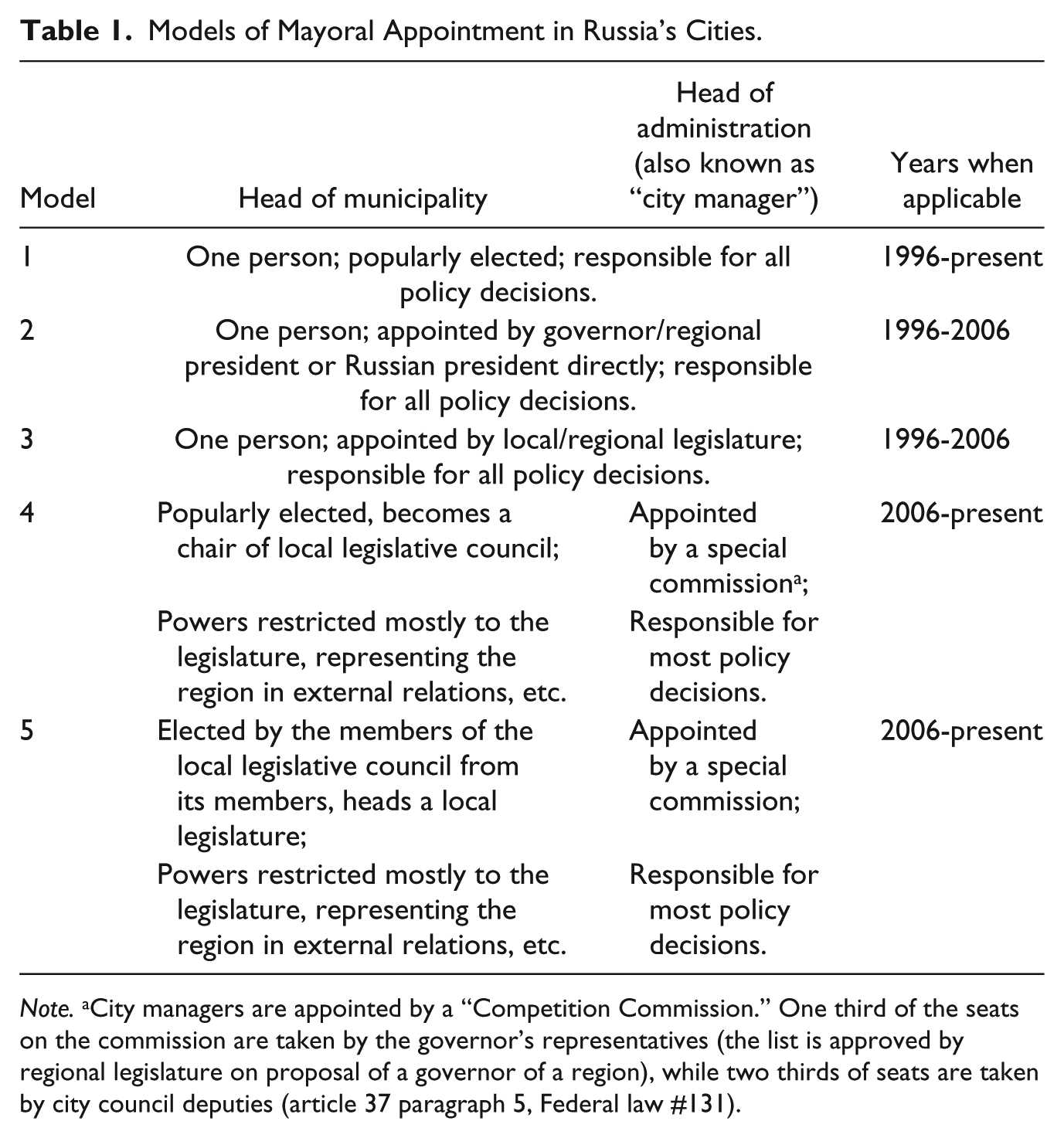
Note. aCity managers are appointed by a “Competition Commission.” One third of the seats on the commission are taken by the governor’s representatives (the list is approved by regional legislature on proposal of a governor of a region), while two thirds of seats are taken by city council deputies (article 37 paragraph 5, Federal law #131).
In the 1990s, almost all cities chose to have directly elected mayors, such that by 1999, 90% of the mayors in Russia’s large cities were elected. 3 In the mid-2000s, however, an increasing number of cities began to replace their directly elected chief executives with so-called “city managers” who were appointed by a commission that is two thirds comprised of appointees from the city legislature and one third comprised of appointees from the regional administration. 4 As Figure 1 shows, the number of cities with appointed mayors increased gradually over the course of the decade and, by 2012, almost half of Russia’s large cities had appointed mayors.
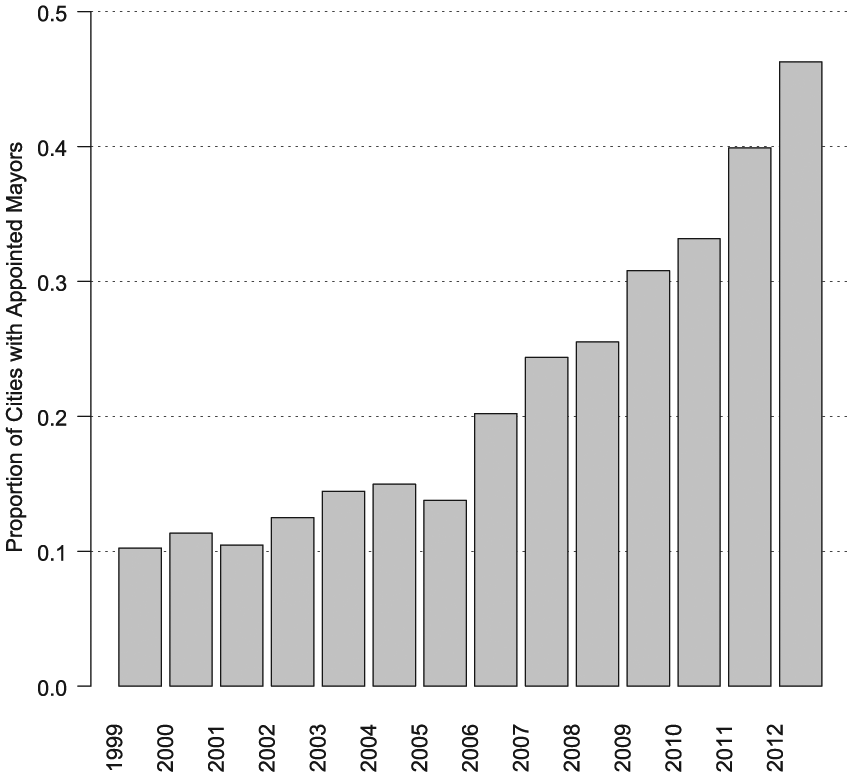
Proportion of large Russian cities with appointed mayors.
On paper, city councils were ultimately responsible for deciding which model would be used, but the shift toward appointed mayors was widely seen as part of Vladimir Putin’s efforts to recentralize political authority. This impression is supported by the fact that cancellations increased over the course of the decade just as the balance of political power in Russia was shifting toward the central government. Over the course of the 2000s, President Putin’s UR party gradually accumulated majorities in the city councils of Russia’s large cities, such that by 2012, it had a majority in 86% of these councils. In turn, regional governors—who became centrally appointed in 2004 and who were increasingly being integrated into UR during the 2000s—worked through UR factions in city councils and applied informal pressure on individual deputies to secure the cancellation of mayoral elections. 5 Although it can be assumed that the presidential administration was sometimes also involved in the decision, public information on the consultations between governors and presidential administration officials is not available. Most observers focus on governors as the key decision-makers and we do the same here. As appointed agents of the Kremlin, governors in this period were tasked with managing politics in their region, so it is safe to assume that the decision would be delegated to them. Given the dependence of governors on the Kremlin during this period, we assume that the presidential administration was usually in agreement with any such decisions.
As Figure 1 shows, the rate of election cancellation began to increase in 2006. In November of that year, UR deputies, reportedly at the behest of the Kremlin, introduced a bill to the State Duma that would allow governors to decide on the fate of mayoral elections in their region.
6
The bill sparked speculation that elections would be cancelled in all cities. Mayors, unsurprisingly, opposed the bill. In early November, the mayors of 50 Siberian cities organized a conference under the aegis of the Inter-Municipal Movement of Russia and issued a joint statement criticizing efforts to cancel mayoral elections.
7
UR, for its part, was divided on the issue, even though its own deputies had introduced the bill. Valerii Galchenko, an outspoken parliamentarian from Moscow Oblast who came out against the bill during a meeting of UR’s faction presidium offered the following explanation for his opposition:
We need to be careful in passing such laws. This law could lead to the cancellation of mayoral elections and major problems for established modes of municipal governance. And this could lead to a collapse in turnout in major cities during the next federal elections.
8
UR thought that cancelling elections would have significant political consequences and so the decision was made to withdraw the bill. Some cities would have their elections cancelled, but most would retain them, for the time being.
Interestingly, just a month after the bill was withdrawn, UR organized the founding congress of the “Club of Russian Mayors.” At the congress, UR mayors promised to help the party mobilize votes in future elections and asked the party leadership to help push through amendments to the law on local self-government. 9 Commenting on the conference, the former mayor of Samara, Oleg Sysoev, put it bluntly: “[The authorities] want to use the mayors as a resource for fulfilling current political tasks.” 9 And, indeed, over the course of the next several years, an increasing number of elected mayors joined UR. The quid pro quo seems clear: Mayors would be allowed to keep their elected positions so long as they continued to help the regime “fulfill political tasks.”
The dependent variable we use in our models—Cancel—captures variation in the decision to cancel (or hold) elections across Russia’s cities during the 2000s. Specifically, this variable is a dichotomous variable equal to 1 in the year when a city cancels direct elections and 0 in years when elections are held. 10 The unit of analysis is the city-year and we exclude from analysis years under the appointment system. Thus, our models are binary time-series cross-sectional (BTSCS) duration models that analyze the time it takes for a city to cancel elections (Beck, Katz, & Tucker, 1998). Naturally, the decision to hold elections is the obverse of the decision to cancel elections. When elections are not cancelled, they continue to be held. If a city never cancels elections, all years are coded as 0. All of these outcomes are captured in our dependent variable.
Figure 2 illustrates our data structure and shows how the mode of selection for the chief executive in each city in the dataset changed over the course of the decade. These data come from an original dataset collected by the authors, containing information on the biographies, electoral history, partisanship, and method of selection of the mayors and city managers in Russia’s 207 largest cities between 2001 and 2012. 11

Elections in Russia’s large cities.
This empirical approach is advantageous because it offers the opportunity to analyze a wide range of variation in the decision to hold elections. Autocracies often make one-time decisions to introduce or cancel subnational elections (e.g., the 2004 cancellation of gubernatorial elections in Russia or the 2012 decision to reinstate them). By contrast, our research design allows us to analyze hundreds of instances of election cancellation and non-cancellation. Another key advantage of our empirical approach is that it focuses narrowly on the decision to cancel (or hold) elections. Although observers may rightly judge these cities to be less democratic when an elected mayor is replaced by an appointee, the decision to cancel these elections is not bound up in a larger process of transition to authoritarian rule.
A further advantage of this approach is that it allows us to hold constant some key alternative explanations in the literature. One such explanation is international pressure. Several have argued that autocrats in developing countries hold elections to assuage aid donors (Ethier, 2003; Knack, 2004). Russian cities do not receive aid from international donors, so this explanation can be excluded in the present context.
Another explanation that can be excluded is demands for redistribution by the poor (Acemoglu & Robinson, 2006). In Russia, mayors do not have the discretion over taxation or social programs that would be needed to effect any appreciable redistribution of wealth. Similarly, modernization-based arguments seem ill-suited to explaining variation in the election of mayors, given that all Russian cities are urban and have a relatively high level of economic development. The same goes for experience with the holding of elections (Gandhi & Przeworski, 2006), which is relatively constant across all cities.
Finally, there is some prima facie evidence that the decision to permit elections had little to do with popular demands for direct elections, as society-based explanations would predict. 12 Polls from 2006 and 2011 indicated that large majorities of Russians wanted the heads of municipal administrations to be elected. Figure 3 shows the mean number of respondents in each region who were in favor of direct elections for city mayors in these years. 13 As the figure shows, a majority of Russians favored direct elections in every region in 2006 and in all but three regions in 2011. In the vast majority of regions in both 2006 and 2011, more than 60% supported direct elections. 14
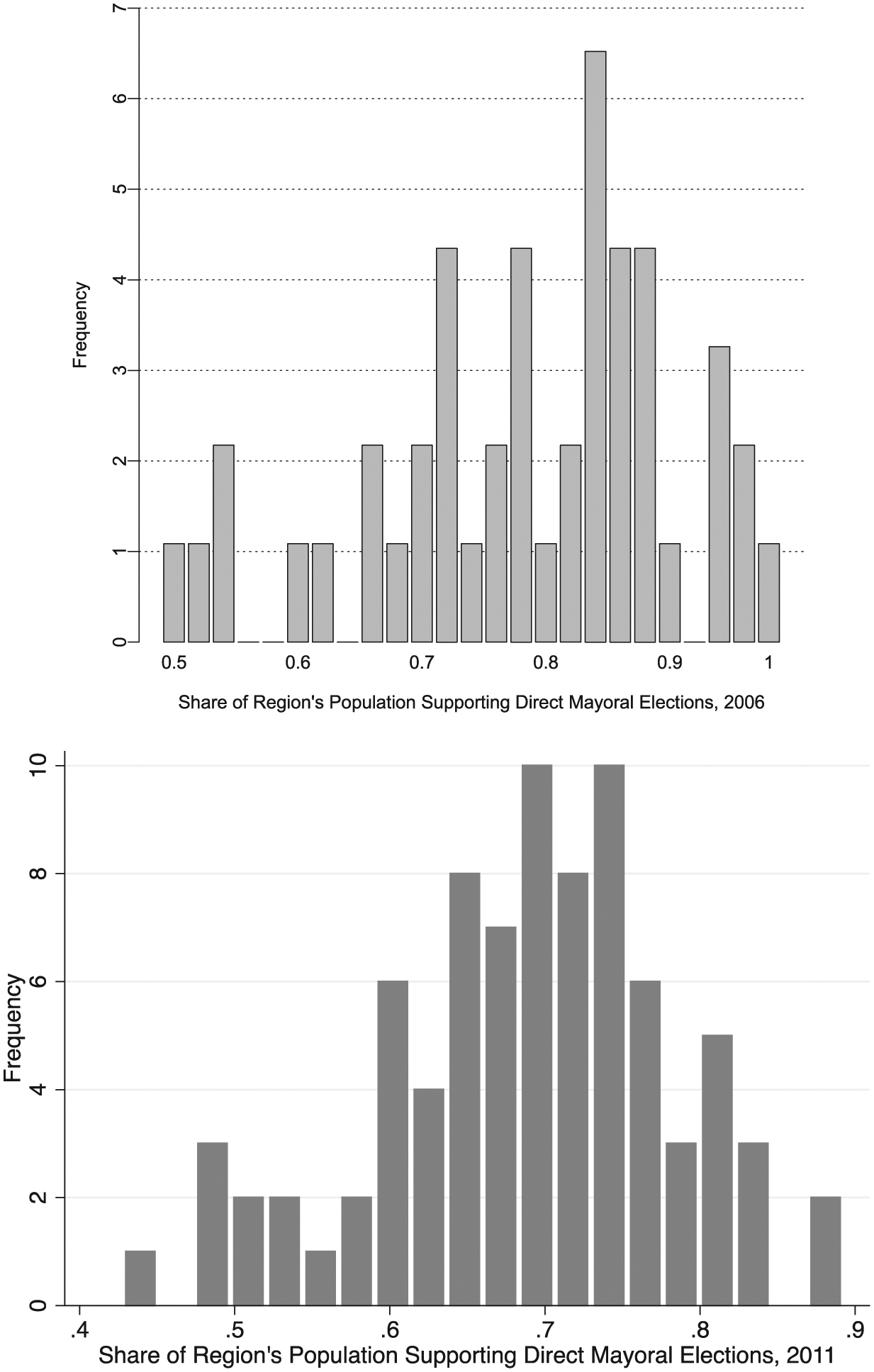
Public support for mayoral elections (left, 2006; right, 2011).
Independent Variables and Modeling Strategy
Our main hypothesis is that mayoral elections are more likely to be retained when elected mayors control significant political resources—such as independent power bases and political machines—that regime leaders would like to co-opt. In Russia, the concept of a local political machine is not a foreign one. Numerous scholars have written about the local machines that mayors built over the course of the late 1990s and early 2000s (e.g., Brie, 2004; Bychkova & Gel’man, 2010; Gel’man & Ryzhenkov, 2011). As the heads of these machines, mayors used carrots and sticks to cultivate clientelist networks in local officialdom, extract rents from local businesses, and win votes.
To measure these resource endowments, we use the Mayor’s Margin of Victory in his or her most recent mayoral election contest. 15 To our minds, this is the most intuitive and direct measure of a mayor’s power base. A similar measure has been used by others to capture the strength of gubernatorial machines in Russia (Golosov, 2011; Reuter, 2013; Robertson, 2007). We expect the coefficient on this variable to be negative.
A corollary of our argument is that regime leaders will not cancel elections if elected officials are using these political resources effectively and in a way that benefits the regime. Russian press accounts have speculated that the failure of some mayors to mobilize votes for the regime could have led to the cancellation of elections in select cities. 16 In electoral authoritarian regimes, one of the main priorities for leaders is to win elections and win them well. Thus, leaders are especially keen to co-opt subnational elites that can help the regime win elections at other levels. Thus, we hypothesize that the regime will be less likely to cancel direct mayoral elections when the mayor has a proven track record of generating votes for the regime. Cancelling elections would deprive these mayors of the autonomy that allows them to craft an electoral machine capable of winning votes for the regime.
A good indicator of a mayor’s ability to generate regime support is the electoral performance of UR in the city. To measure this, we gathered data on the share of the party list vote won by UR in the mayor’s city during the most recent regional legislative election held in the region under the sitting mayor. 17 This variable is called UR Regional Election Margin in City.
We also include in our models several variables that proxy for alternative explanations of election cancellation. Modernization-based accounts predict that elections will be more likely in polities with higher levels of economic development. All of Russia’s cities are modern polities, but we nonetheless include a variable, log Income Level, that proxies the level of socioeconomic development in these cities. Another variety of society-based explanation predicts that elections will be more likely in settings where citizens have the organizational resources to press for elections. To proxy for the level of organizational capacity in society, we include a measure of the development of civil society in the region taken from the widely used Petrov-Titkov subnational democracy ratings (Petrov & Titkov, 2013). We use the value of this variable that covers the period from 1991-2001 to ensure that the measure taps levels of civil society development before elections were cancelled.
We also include an indicator, UR Majority, which is a dummy variable equal to 1 if UR has a majority in the city council for a given year. City councils must make changes to the city charter to cancel elections. Thus, if the authorities have an inherent preference for cancelling elections during this period, election cancellations should be more likely when the ruling party has a majority in the city council. 18 Note, however, that our perspective suggests that the authorities will not always want to cancel elections. In many cases, they may opt for co-optation.
Finally, we also examine a view of the election cancellation process that is often encountered in popular accounts of Russian local politics. In the 1990s and early 2000s, regional governors and mayors often entered into political conflict with one another. Hence, according to some, governors sought to eliminate the electoral mandates of strong mayors that posed a threat to them. 19 This perspective would lead one to expect a positive coefficient on Margin of Mayor’s Victory (our theory predicts a negative coefficient). But another measure of the potential for conflict between the mayor and governor might be the size of the city. Governors may have been more keen to push for the cancellation of mayoral elections in large cities because these mayors represented more of a threat. To examine this, we include as a control the percent of the region’s population that is accounted for by the city, City’s Share of Regional Population.
As noted above, our data are structured as BTSCS duration data and the unit of observation in our models is the city-year. This data structure allows us to account for time-varying city and region characteristics as well as the mayor’s duration in office. With a dichotomous dependent variable, we employ logistic regression for all models, and, given the duration nature of our data, we also include a cubic polynomial of each mayor’s elapsed tenure in office in that year. 20 This captures individual-level time dynamics in a manner equivalent to a Cox proportional hazard model (Carter & Signorino, 2010). We also include time fixed effects-indicator variables for 2-year periods. 21 All results presented below are robust to the exclusion of the cubic polynomial and the exclusion of time fixed effects. All models include standard errors clustered at the city level.
Results
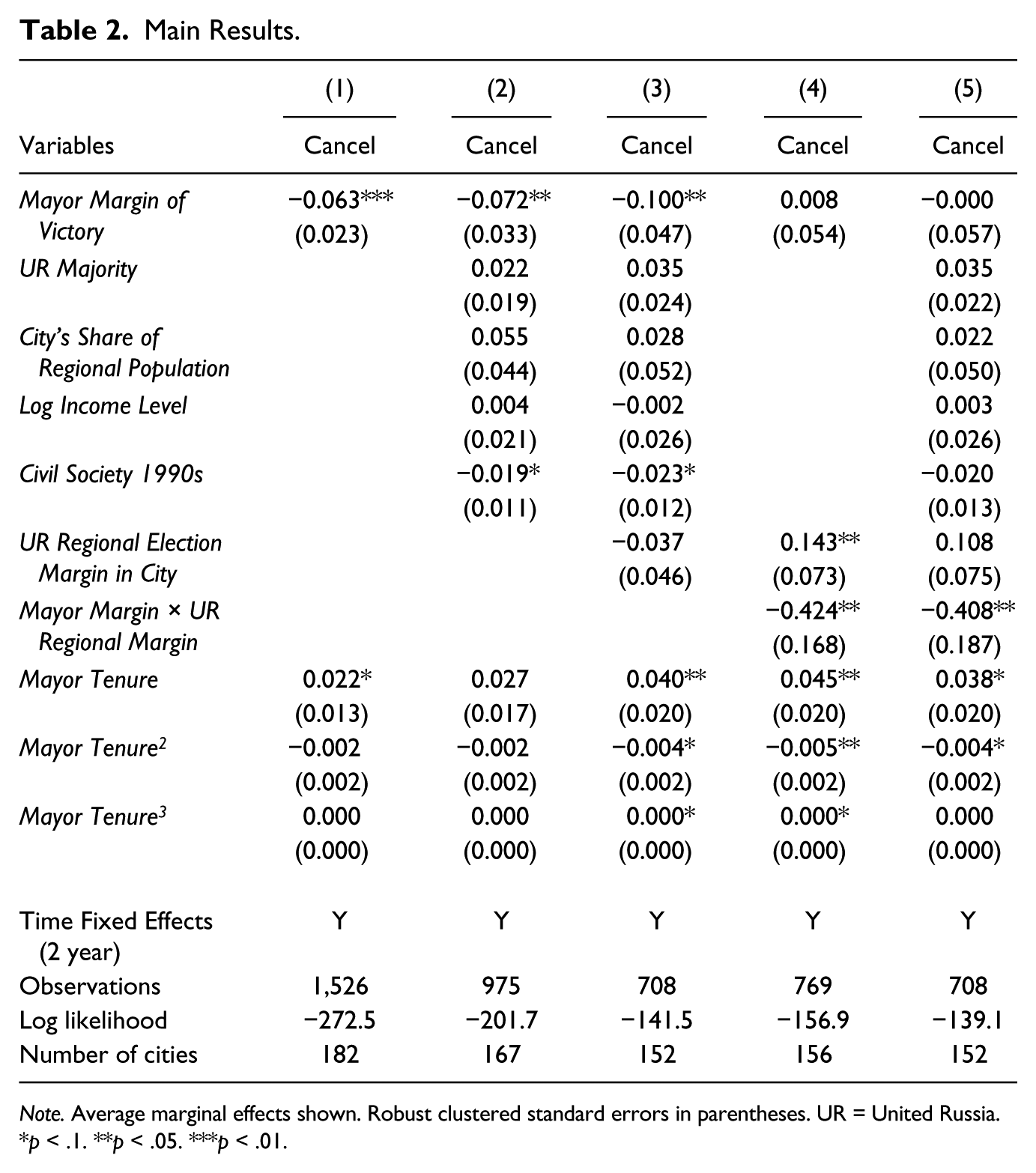
Our main results are presented in Table 2. In column 1, we present a minimal model that includes only our main variable of interest, Mayor’s Margin of Victory, along with the cubic time polynomial and time dummies. The coefficient (displayed as an average marginal effect) is statistically significant and negative, indicating that elections are less likely to be cancelled when mayors’ won office by large margins. In column 2, we add some basic controls to the model. The coefficient on Mayor’s Margin of Victory changes very little, remaining negative and significant. Figure 4 shows how the predicted probability of election cancellation changes across values of Mayor’s Margin of Victory, while holding other covariates at their mean values. When the mayor won his election by 75 percentage points (the 90th percentile in the data), the probability that an election will be cancelled in any given year is 0.031. But when the mayor won his election by a narrow margin (5 percentage points, the 10th percentile in the data), the probability that direct mayoral elections will be cancelled in any given year more than doubles to 0.075.
Main Results.
Note. Average marginal effects shown. Robust clustered standard errors in parentheses. UR = United Russia.
p < .1. **p < .05. ***p < .01.
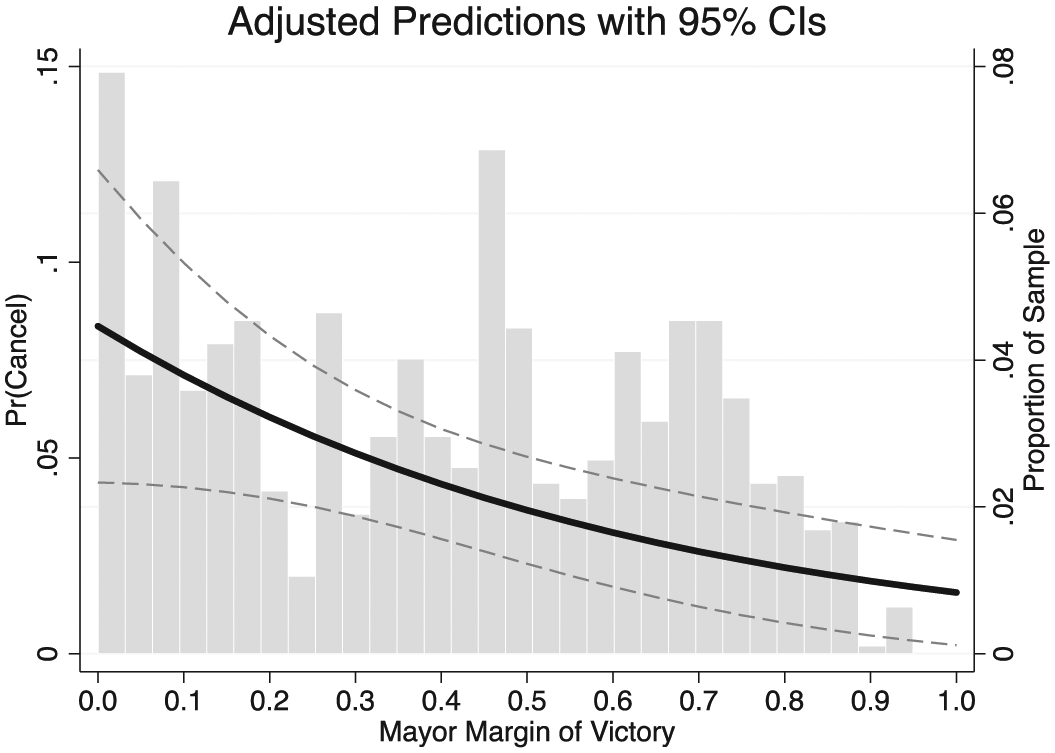
Predicted probability of election cancellation across values of Mayor’s Margin of Victory.
It is important to note that these findings stand in contrast to the conventional wisdom from Russia. If Russian governors cancelled elections when they felt threatened by powerful mayors, then we should have expected to see that elections would be more likely to be cancelled when mayors’ won their elections by large margins. We find the opposite.
The results on other variables are also of note. UR Majority is positive, but falls short of statistical significance. This may be, in part, due to the lack of variation in this variable. During the latter half of the 2000s—when most cancellations occurred—UR controlled most city councils. It may also suggest that governors can push cancellations through city councils with informal carrots and sticks, even if UR does not control a majority. 22 Perhaps surprisingly, the coefficient on Population Share is insignificant (although positive). Governors are not more likely to cancel elections in larger cities. Nor is log Income Level statistically significant. Finally, Civil Society in 1990s is negative and statistically significant, although only at the .1 level. This may suggest that elections are less likely to be cancelled in settings where society has the organizational capacity to defend direct elections.
In Model 3, we add UR Regional Election Margin in City to the model. Unfortunately, the nature of this variable’s construction leads to a significant reduction in the number of observations, so we exclude it from Models 1 and 2. 23 In Model 3, this variable is positive, but insignificant. It is, as our theory would predict, correlated with Margin of Victory at .38, but the variable is still insignificant in a model that excludes Mayor’s Margin of Victory from the estimation. The insignificance of the variable, we speculate, likely owes much to the small sample size that is used. Nonetheless, one conclusion that can be drawn from the negative and insignificant coefficient is that elections are not more likely to be retained when levels of opposition to the ruling party in the city are higher, as some existing explanations might expect (Gandhi, 2008).
However, in Model 4, we interact UR Regional Election Margin in City with Mayor’s Margin of Victory to determine whether the effect of Mayor’s Margin of Victory is amplified when a mayor is also turning out the vote for UR. The significant coefficient on the interaction term indicates that there is a multiplicative effect and, as Figure 5 shows, it is the case that Mayor’s Margin of Victory has an even more pronounced negative effect on the probability of election cancellation when the mayor has been successful at mobilizing votes for UR. Recalling from Table 2 (column 3) that the marginal effect of Mayor’s Margin of Victory was −.072, we see from Figure 4 that the marginal effect of Mayor’s Margin of Victory more than doubles to −.14 when UR Regional Election Margin in City is at the 90th percentile in the data (0.566). Indeed, when both UR Regional Election Margin in City and Mayor’s Margin of Victory are at the 90th percentile in the data (i.e., both are high), the probability that direct elections will be cancelled in any given year is a mere .009. When both are at the 10th percentile, the probability of cancellation increases more than sevenfold to .064. This indicates that the authorities in Russia are least likely to cancel elections when mayors who are strong in political resources are successfully putting those resources to use for the regime by helping the ruling party win elections.
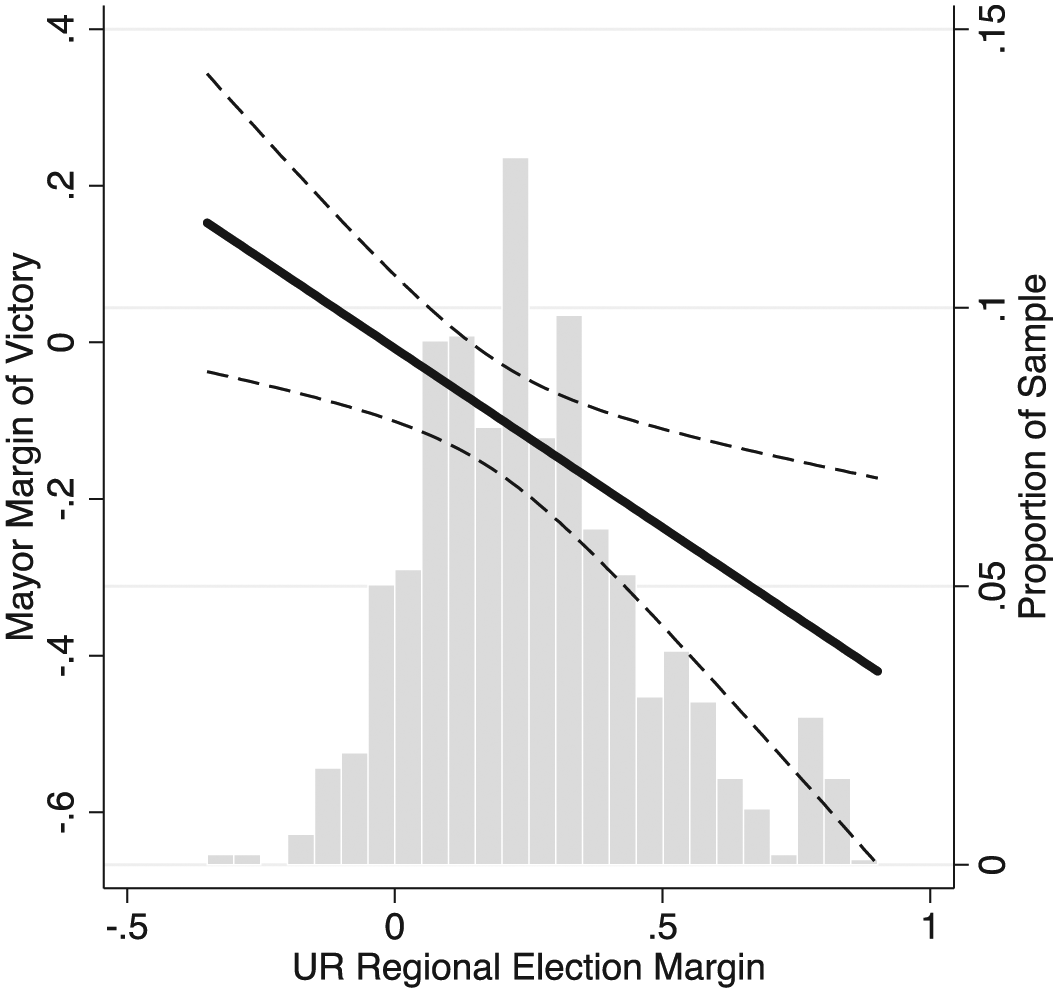
Marginal effects of mayor margin of victory, conditional on UR regional election margin.
Robustness Checks and Alternative Explanations
We find consistent evidence that mayoral elections in Russia are less likely to be cancelled when mayors have won their seats by large margins. We believe this is because regime leaders seek to co-opt electorally strong mayors and put their political machines to work for the regime. But there are several alternative interpretations of our main empirical finding that should be explored as well. One such alternative interpretation is that regime leaders fear losing elections and seek to cancel elections to avoid losing. Under this interpretation, narrow margins of victory are an indicator of a mayor’s electoral vulnerability, which increases the chance that regime leaders will cancel elections to avoid electoral defeat. Of course, one might object that such a decision would be rash and regime leaders should wait until the opposition wins and then cancel the election—a scenario that has occurred in Russia. But if we assume that losing an electoral contest results in a loss of face for regime leaders or that cancelling elections after the opposition wins reflects badly on the regime, then this alternative interpretation for our findings remains plausible.
The first thing to note about this alternative interpretation is that it assumes elected mayors are regime cadres, such that losing an election would reflect poorly on the regime. And while it is true that many mayors joined UR over the course of the 2000s, it is far from true that all or even most mayors during the period under analysis were viewed by local actors as being part of the “power vertical” that was being created by Putin at the time. The 2000s were a time when many regional elites were making decisions about whether to join UR (Reuter, 2010). In the early 2000s, a clear minority of both mayors and governors were party members, while by late 2007, almost all governors had joined UR. Many mayors joined later, however, and most continued to run as independents in elections until the late 2000s. In 2005, only 30% of elected mayors ran with a UR nomination, and it was not until 2010 that more than 75% ran under the UR banner. So the first point to be made is that not all elected mayors during this period were clear regime allies.
We move further, however, and exploit this variation to examine the empirical implications of this alternative interpretation. If this alternative explanation were correct, then we should expect to find that the electoral weakness of the mayor has an especially pronounced impact on election cancellation in cities with mayors that are regime allies. By contrast, we should not expect to find that electoral weakness will have an effect in cities where the mayor is oppositional or independent. The regime would not lose face if these mayors lost, because they are not tied to the regime in the eyes of voters.
To examine this alternative interpretation, we split our sample into two parts: that subset of elected mayors who were nominated by UR and the subset of mayors who ran as independents or were nominated by an opposition party. 24 Model 1 in Table 3 is restricted to those observations where the sitting mayor was not nominated by UR, and we see that the coefficient on Mayor Margin of Victory is statistically significant and negative, as in our main models. Model 2, meanwhile, shows results from models restricted to those observations where the mayor was nominated by UR. The coefficient on Mayor Margin of Victory is much smaller and statistically insignificant. Thus, it seems that our findings are strong among those mayors that are less likely to be viewed as regime allies in the eyes of voters. It is implausible that regime leaders would lose face if these mayors lost their bid for reelection, so we interpret these findings as supportive of our perspective.
Probing Alternative Interpretations of Main Finding.
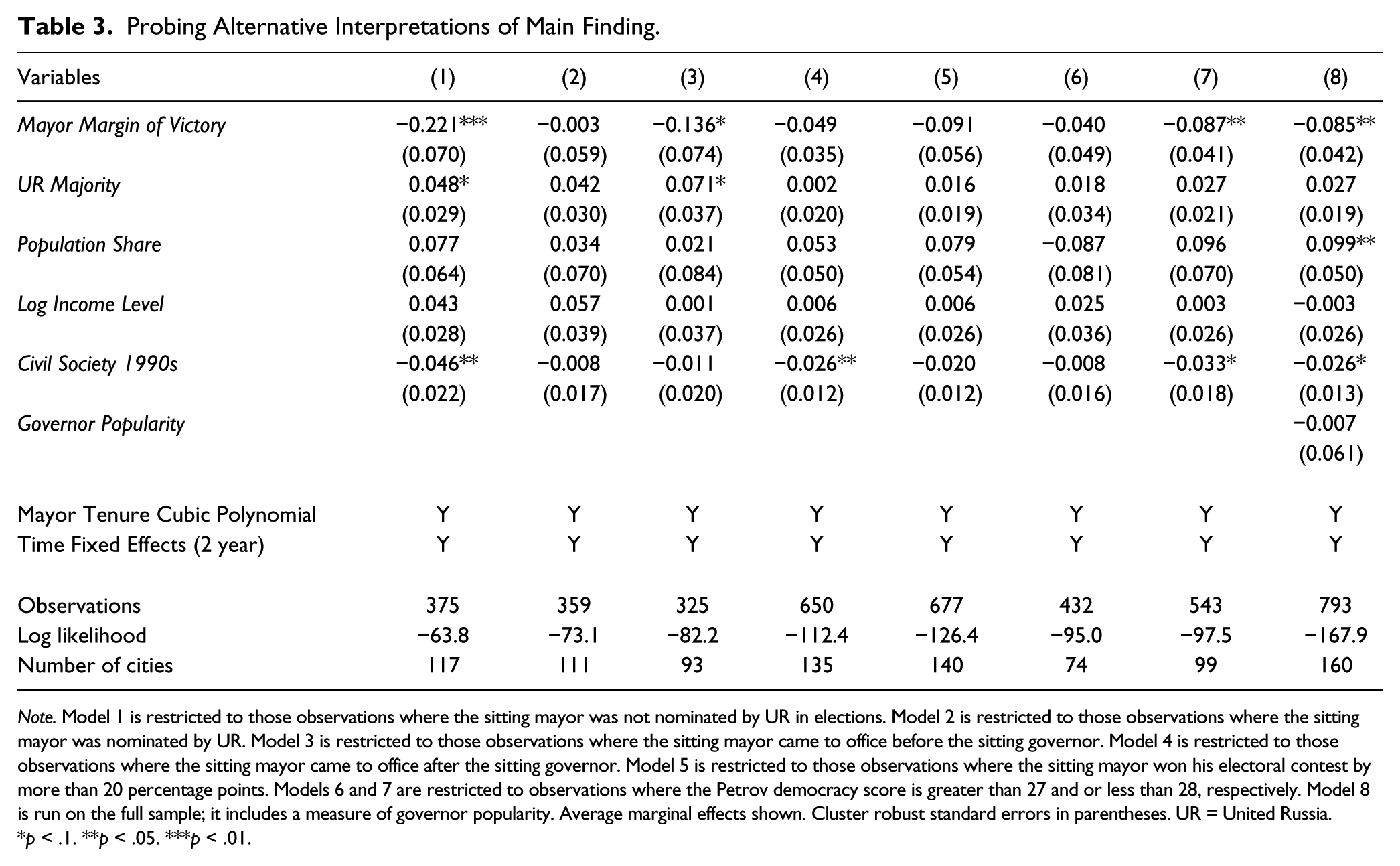
Note. Model 1 is restricted to those observations where the sitting mayor was not nominated by UR in elections. Model 2 is restricted to those observations where the sitting mayor was nominated by UR. Model 3 is restricted to those observations where the sitting mayor came to office before the sitting governor. Model 4 is restricted to those observations where the sitting mayor came to office after the sitting governor. Model 5 is restricted to those observations where the sitting mayor won his electoral contest by more than 20 percentage points. Models 6 and 7 are restricted to observations where the Petrov democracy score is greater than 27 and or less than 28, respectively. Model 8 is run on the full sample; it includes a measure of governor popularity. Average marginal effects shown. Cluster robust standard errors in parentheses. UR = United Russia.
p < .1. **p < .05. ***p < .01.
UR is one of the key actors that drive the cancellation process. The other is the regional governor (although most governors are UR members, so it is usually difficult to distinguish between the two). One might object to our above discussion by noting that alignment with the regional governor is a better indicator of regime affiliation than mayoral partisanship. If most mayors were the clients of governors, then governors might seek to cancel elections preemptively if their clients are expected to perform poorly. This is also plausible, and it is certainly true that some mayors are the clients of powerful governors, but it is also true that much of the literature on governor-mayor relations in Russia characterizes these relationships as rivalrous and, often, confrontational. In the 1990s and early 2000s, mayors often entered into direct conflict with governors and the federal center enlisted mayors as allies in their struggle to reign in powerful governors (Gel’man, Ryzhenkov, Belokurova, & Borisova, 2008; Slider, 2005).
We attempt to capitalize on variation in the extent to which mayors are clients of governors to examine this alternative interpretation. To do this, we split our sample into a set of observations where the sitting mayor entered office prior to the sitting governor and a set of observations where the mayor came to office after the governor. It seems unlikely that a mayor who came to office before the sitting governor would be the client of that governor. By contrast, mayors who came to office after the governor may have obtained their office due to their connections with the governor, or they may be independent of the governor. In our view, coming to office after the governor is a necessary, but not sufficient, condition for being a client of the governor.
Model 3 in Table 3 shows the results of our main models when we restrict the sample to those observations where the sitting mayor came to office before the sitting governor, while Model 4 restricts the sample to those observations where the sitting mayor came to office after the sitting governor. Mayor Margin of Victory remains negative and close to statistically significant in all models, but the coefficient has a substantially larger magnitude in the subsample of observations where mayors came to office before the governor. Thus, our results hold and are indeed stronger when mayors are not the clients of governors than when they are clients of the governor, casting doubt on this alternative interpretation.
In Model 5, we further investigate the alternative interpretation described above by restricting our models only to those observations where the sitting mayor won his electoral contest by more than 20 percentage points. Our hypothesis about the link between Mayor Margin of Victory and the probability of election cancellation is linear, such that higher vote totals indicate a stronger electoral machine, which makes it more imperative that regime leaders co-opt these mayors. By contrast, the alternative explanation offers, in our view, a more dichotomous prediction: when regime-affiliated mayors are in danger of losing, the regime cancels elections to avoid that outcome, otherwise, they leave elections in place. According to this perspective, a mayor whose victory seems assured (perhaps due to reliable opinion polls or a fragmented opposition) and is expected to win by a 25% margin should be no more likely to have his electoral mandate removed than a mayor whose victory is assured and is expected to win by a 60% margin. The results in Model 5 are largely inconsistent with this alternative perspective and consistent with our linear hypothesis: Mayor Margin of Victory is still negatively associated with election cancellation when we restrict the sample to mayors who won their elections by sizable margins. 25
In Models 6 and 7, we address another alternative interpretation of our findings. One might argue that a mayor’s electoral margin is better viewed as an indicator of ideological support for the regime than as an indicator of the mayor’s electoral machine. Under this interpretation, our findings demonstrate not that mayors with strong electoral machines are co-opted, but that the regime refrains from alienating its base by cancelling elections where it has high levels of ideological support.
In addressing this alternative, it is first worth noting that this explanation assumes that mayors are viewed by voters as members of the regime such that support for the mayor can be taken as a direct indicator of support for the regime. This brings us back to the discussion above, which made clear that not all mayors during this period could be viewed as regime cadres, and our results appear to hold for those mayors who were independent.
Second, this perspective would assume that vote totals in Russia are determined exogenously by voters’ ideological preferences. As in most countries, however, ideology and partisanship play a lesser role in Russian second-order elections than they do in national elections. Moreover, such an assumption would seem to ignore the large body of evidence that attributes vote results in Russia’s authoritarian elections to non-programmatic factors such as clientelism, administrative resources, and outright electoral subversion, tactics that are usually deployed by regional and local officials (Frye, Reuter, & Szakonyi, 2014; Golosov, 2014; Hale, 2006; Reuter, 2013; Sharafutdinova, 2014). In conjunction with these methods, popular local and regional officials have proven adept at using their skill, charisma, and personal authority to generate support for preferred candidates and parties. In this way, mayors can generate popular support for the regime, such that levels of regime support in the city are partially attributable to those mayors. This would be consistent with the view we offer here.
Nonetheless, it seems clear that “exogenous” ideological preferences also affect Russian voting behavior, especially in more open and democratic regions. So, to probe this alternative explanation empirically, we use the Petrov–Titkov measure of regional regime type to divide our data at the sample mean of the democracy score. Model 6 shows the results in more democratic regions, while Model 7 shows our main results in more autocratic regions. 26 In the more autocratic regions, vote totals depend more on electoral subversion, machine politics, and clientelism, while in more democratic regions, they may depend more on the ideological and partisan affinities of voters. Therefore, if this alternative explanation were to hold, narrow margins of victory should be especially likely to result in election cancellation in the more democratic regions. We do not find this. Rather we find that the effect of Mayor Margin of Victory on election cancellation is actually attenuated in more democratic regions. In more autocratic regions, the coefficient on Mayor Margin of Victory is larger and statistically significant. Thus, our results hold and are indeed slightly stronger in those regions where elections are more likely to be won by dint of administrative resource and clientelist politics. This is consistent with the perspective we offer.
A final alternative interpretation is that the Kremlin and its agents were simply unable to cancel elections in some cities because mayors there were sufficiently powerful to stop them from doing so. This is similar to our perspective, but rather than viewing the process as one in which strong mayors’ confronted and defeated the Russian state, we prefer to view the process as one of co-optation and exchange between the two.
The political history of this period makes clear that the Kremlin and its agents could and often did use the formal and informal resources at their disposal to cancel elections and remove mayors. There have been a number of instances in which popular opposition mayors were simply arrested on dubious charges.
27
Indeed, our own data reveal many cases where mayors who won their elections by large margins had their electoral mandates removed. The conventional wisdom among Russian analysts is not that mayors were too powerful to be confronted, but rather that they were almost completely dependent on the will of regional governors. As one prominent Russian analyst put it in early 2007:
In modern Russia the political weight of mayors is not enough to guarantee them independence from governors. With political maneuvering, they can make pragmatic arguments and appeal to European values to hold off attempts to reduce their independence. But any success they have is unstable and subject to revision. (Makarkin, 2007)
The notion that Russia’s local officials were able to stand up to regime leaders in the late 2000s also runs counter to most scholarly literature, which tends to argue that Kremlin was much more powerful than subnational elites during this period (e.g., Gel’man, 2015; Petrov, 2010). Our approach suggests that regime leaders were somewhat weaker than these accounts allow, but that they were still strong enough to co-opt local officials.
Patterns of party affiliation among mayors offer prima facie evidence of this co-optation. As the pace of election cancellation quickened, so did the rate at which elected mayors joined UR. In 2005, only about 30% of them were members, while by 2011, more than 90% were. Elected mayors not only joined, but served in leadership organs and helped the party mobilize votes. Since joining UR represents a restriction on autonomy and engaging in party work is an investment of time and resources, this indicates that mayors were making concessions to the regime.
In addition, if this alternative explanation were correct, we would expect that elections would be more likely to be retained when the governor is “weak,” since “weak” governors would presumably have a more difficult time removing the electoral mandates of weak mayors. In Table 3, we examine this hypothesis by including in our main model a variable that captures the popularity of the governor (Governor Popularity). 28 As Model 8 shows, the coefficient is positive, as the alternative interpretation predicts, but it does not come close to statistical significance. It does not seem that “weak” governors are statistically less likely than “strong” governors to cancel elections.
Finally, although the measure has its shortcomings, the insignificant coefficient on UR Majority does indicate that governors are often able to secure the cancellation of mayoral elections even when the ruling party does not have an institutionalized majority in the city council.
Scope Conditions
The need to co-opt strong elites is clearly not the only factor that prompts autocrats to hold elections. Our argument suggests that when strong local elites exist, autocrats will have more incentive to hold subnational elections. Thus, for example, our argument is ill-suited for explaining why local elections are introduced in Communist systems, such as China and Vietnam. In settings where a powerful centralized state has eliminated most independent power bases, the decision to introduce elections likely has more to do with social factors, as suggested by Manion (1996). And, as an empirical matter, it may be the case that elites in countries with local elections are stronger. This means our argument will probably be most useful as a guide for understanding why autocrats decide to retain or cancel local elections in competitive authoritarian regimes (e.g., Ethiopia, Kazakhstan, Malaysia, Uganda, or Algeria) and in new autocracies that have yet to consolidate political control (e.g., Ukraine under Yanukovych, Venezuela and Nigeria until 2015). At the same time, we are hopeful that our perspective will offer some useful insights for those studying the introduction of elections in such settings. After all, preexisting elite resources—such as positions of traditional authority, mobile economic assets, or patronage networks—may push leaders in these settings to consider introducing local elections as a mode of co-optation.
Another important caveat concerns levels of analysis. Our empirical tests have focused on how the individual resources of elites affect the decision to cancel (retain) individual elections. There are some important empirical advantages to this approach that are discussed above, but it also has some potential limitations. Can, for instance, our study shed light on cases where the system-wide introduction or cancellation of local elections is under consideration? As the resource endowment of elites varies not only within but also across countries—that is, in some countries, subnational elites as a whole are stronger than they are in other countries—we think that our approach may offer some insight into these cases. However, when applying our argument in such settings, scholars should take care to consider additional country-level variation that may complicate analysis at the system level. Important factors include the ability of elites to engage in collective action, which would make them more of a threat, and variation in the coercive and organizational capacity of the regime. Although our empirical analysis has elided potential divisions between regional and federal authorities, divides within the regime about whether to introduce (cancel) elections will make it more likely that the status quo is retained. Future research should investigate how political disagreements within an authoritarian regime might influence institutional choice.
Finally, our analysis has focused on large cities in Russia, but dynamics may differ in smaller, less urban municipalities, which tend to be poorer and, in recent years, have been more likely to vote for the regime. Little is known about political dynamics in Russia’s small towns. Future research could profit by extending the research undertaken here to smaller towns.
Conclusion
Electoral authoritarianism is the most common type of autocracy in the world today. Although an increasing number of scholars have begun studying the functions and causes of autocratic elections, few have examined these questions in a subnational context. This is surprising given the importance of subnational officials in authoritarian settings, and surprising given the significant effects that subnational elections have on democratization, government responsiveness, and the selection of cadres.
In this article, we have argued that subnational elections serve as tools for assuaging powerful subnational elites. We argued that when these elites hold significant political resources, leaders may need to co-opt them to govern cost-effectively. Elections are useful tools of co-optation because they provide elites with the opportunity to cultivate their own autonomous power bases. Thus, we predicted that leaders will allow subnational elections when subnational elites are strong in political resources that leaders would like to co-opt.
Using an original dataset that taps variation in the decision to hold direct mayoral elections in Russia’s 207 largest cities between 2001 and 2012, we find empirical support for this proposition. Russian mayors who won their elections by large margins were less likely to be replaced with appointees. Elections were even less likely to be cancelled when strong mayors demonstrated that they could successfully turn out votes for the ruling party. This suggests that electoral authoritarian leaders put a premium on co-opting the electoral machines of subnational elites, especially when those elites have a track record of putting those machines to work for the regime.
Other possible explanations for the holding of elections perform less well. In particular, society-based explanations drawn from the modernization tradition do a poor job of explaining when elections are held, as do explanations that focus on the puissance of opposition parties. We do, however, find some support for the idea that regions with a history of strong civil society were less likely to cancel direct mayoral elections.
Our findings have important implications not just for the study of subnational politics under autocracy, but also for the broader literature on elections. While our theory was devised to explain variation in the holding of subnational elections, it may also shed some light on the decision of autocrats to hold legislative elections, and relatedly, the choice of electoral rules in those elections. National legislative elections can be useful tools for co-opting powerful regional elites, and we think it more likely that leaders will use elections to co-opt when regional elites are powerful. Furthermore, it stands to reason that leaders will choose an electoral system with a small district magnitude when their goal is to co-opt regional elites. After all, this type of electoral system affords individual candidates the best chance to cultivate local political machines that can help ensure their political survival and be used as bargaining chips in relations with other actors.
Our study fits within a recent line of literature that focuses on how authoritarian institutions are used to co-opt elites (Blaydes, 2011; Magaloni, 2008; Reuter, 2010; Svolik, 2012). However, our study points toward a problem that is not well addressed in the existing literature. Authoritarian leaders want local cadres to have the political resources necessary to mobilize votes, maintain social order, and implement policy. They may design institutions that give elites the autonomy necessary to achieve these goals. The problem is that elites may seek to use their autonomous power bases against leaders at some point. Thus, leaders must find a way to co-opt elites, while guarding against attempts by their number to use regime institutions against regime leaders. This is a problem that deserves further study.
Footnotes
Declaration of Conflicting Interests
The author(s) declared no potential conflicts of interest with respect to the research, authorship, and/or publication of this article.
Funding
The author(s) disclosed receipt of the following financial support for the research, authorship, and/or publication of this article: The authors acknowledge financial support from the Government of the Russian Federation within the framework of the Basic Research Program at the National Research University Higher School of Economics and within the framework of the 5-100 Programme Roadmap of the National Research University Higher School of Economics.
Notes
Author Biographies
References
Supplementary Material
Please find the following supplemental material available below.
For Open Access articles published under a Creative Commons License, all supplemental material carries the same license as the article it is associated with.
For non-Open Access articles published, all supplemental material carries a non-exclusive license, and permission requests for re-use of supplemental material or any part of supplemental material shall be sent directly to the copyright owner as specified in the copyright notice associated with the article.
