




Abstract
This article revisits and seeks to challenge one of the most powerful hypotheses in the political economy scholarship: the supposedly negative relationship between ethnic diversity and public goods provision. We suggest that the relative lack of attention to politics and history makes much of this literature vulnerable to endogeneity problems. In response, we develop a state-centered approach that brings time and temporality to the analytical foreground. This approach addresses issues of reverse causality and spuriousness by examining how different historical trajectories of nation-state formation, and the state strategies and capabilities to provide public goods associated with each, might have shaped both contemporary diversity and public goods provision. Bringing in politics and history and putting the analytical focus on the state also allows the article to open up the debate around how distinct manifestations of politicized ethnicity might influence state provision of public goods.
Keywords
This article revisits and challenges “one of the most powerful hypotheses in political economy” (Banerjee, Iyer, & Somanathan, 2005, p. 639), namely, the negative relationship between ethnic diversity and the provision of public goods. 1 A large and influential body of scholarship has shown that ethnic diversity impedes the provision of a wide range of public goods across countries, regions, cities, and communities from sub-Saharan Africa and South Asia to North America. 2 Such has been the “consensus” that ethnic heterogeneity dampens public goods provision that scholars working in this research tradition have now sought to take the “next step” of exploring the micro-logics of this connection (Habyarimana, Humphreys, Posner, & Weinstein, 2009, p. 5; see also Baldwin & Huber, 2010; Lieberman & McClendon, 2013). And yet, this article, and the special issue it introduces, argues that it is essential to pause to reexamine the foundations of this scholarship and how this might provoke a step back from the conventional wisdom.
Specifically, we contend that the case for the so-called “diversity-development deficit thesis” is overstated, largely because it has been derived, for the most part, in isolation from a serious consideration of history and politics. In fact, a doggedly ahistorical perspective prevails in the political economy scholarship. The lion’s share of evidence for the diversity-development deficit thesis comes from studies that use a measure of ethnic diversity constructed with data from the 1960s (e.g., Alesina, Baqir, & Easterly, 1999; Easterly & Levine, 1997; La Porta, Lopez-de-Silanes, Shleifer, & Vishny, 1999) or from the 1990s (Alesina, Devleeschauwer, Easterly, Kurlat, & Wacziarg, 2003). This temporally limited focus bears the danger of overlooking the distinct causal contexts of different time periods (Grzymała-Busse, 2011; Pierson, 2004). More fundamentally, it leads to the treatment of ethnic heterogeneity as exogenous, similar to variables such as climate or topography. There have been notable attempts to address problems with the conceptualization and measurement of ethnicity, 3 but the potential endogeneity of ethnic diversity has been relatively unaddressed and remains, even by the admission of some of the prominent contributors to the scholarship, an important shortcoming (Banerjee et al., 2005). 4 Could it be that contemporary levels of ethnic diversity are endogenous to historical levels of public goods provision? Or that contemporary public goods provision is itself a product of prior provision of goods and services? These questions gain particular urgency in light of a rapidly expanding body of work that questions whether the supposedly negative impact of diversity on public goods provision is really as straightforward and robust as the political economy scholarship suggests. 5
Building on, yet also pushing beyond these “revisionist” findings, we develop an alternative theoretical approach that examines the relationship between ethnic diversity and the provision of public goods from a historical perspective. We are aware that an assessment of the full impact of history and politics on the causal relationship between ethnicity and public goods provision requires close attention to a variety of macro-historical processes, including, but not limited to, capitalist development and market expansion, civil society formation, and the legacies of violent conflict and conflict settlement. Yet, in light of the vast scholarship on the unique significance of the modern state for both public goods provision (e.g., Huber & Stephens, 2001, 2012; Skocpol, 1992) and collective identities (e.g., Laitin, 1986; Lieberman & Singh, 2012; Marx, 1998; Wimmer, 2002), this article focuses on the state, and, in particular, on patterns of nation-building and state institutional development.
Most studies that show a negative relationship between ethnic diversity and public services emphasize provision via local communities (e.g., Algan, Hémet, & Laitin, 2011; Bardhan, 2000; Fearon & Laitin, 1996; Khwaja, 2009; Miguel & Gugerty, 2005). Although collective action by communities is clearly important, an excessively narrow focus on communities stands at odds with the global historical reality of public goods provision. Across most parts of the world, the provision of public services has been, and remains, primarily the responsibility of the state. This has recently been recognized even within the political economy scholarship itself. 6 Moreover, a large social science literature on welfare states highlights the truly dramatic (yet uneven) historical rise and expansion of state-sponsored public infrastructure and social services across the globe over the last 150 years. 7
Similarly, a significant body of work in sociology and political science has shown that, to a much greater degree than local communities, states have the power to create or modify patterns of ethnicity over time. For example, ethnic categories used in censuses and official identity documents often make what they appear to reflect, eventually turning into sources of self-identification and bases of collective mobilization (Lieberman and Singh, 2015; Loveman, 2014; Nagel, 1995; Nobles, 2000; Torpey, 2000). Similarly, public schools constitute a powerful institution through which states engender or change ethnic divisions and national attachments (Gellner, 1983; vom Hau, 2009; E. Weber, 1976).
This article builds on this scholarship by putting the analytical focus squarely on the state and studying its relationship to ethnicity explicitly over time. In doing so, we push away and forward from the conventional wisdom in two main ways. First off, we argue that past state intentions and capabilities to provide public goods shape both contemporary patterns of ethnic diversity and state provision of public services. We also suggest that the relationship between diversity and state provision of public goods looks different when we extend our analytical lens back in time and investigate the relationship in different temporal contexts. A state-centered analytical framework thus provides new leverage to explore the issues of reverse causality and potential spuriousness in the diversity-development deficit thesis by identifying theoretically relevant macro-historical processes to endogenize the relationship between ethnic diversity and public goods provision. More specifically, we focus on the initial mode of nation-building pursued by states and the public goods provision strategies associated with it, as well as distinct long-term patterns of state institutional development and the varying capabilities for public goods provision linked to them—and their role in influencing both contemporary ethnic heterogeneity and public service provision.
Second, bringing in politics and history and putting the state at the center of theoretical attention also allows us to open up the debate around the causal relationship between ethnicity and public goods provision. Our argument that the dampening effects of contemporary ethnic diversity on public service provision are overstated because both might be endogenous to historical patterns of nation-building, and state development does not mean that contemporary levels of diversity are unrelated to the provision of public goods. However, this is where we need to start revisiting another established wisdom in the political economy literature, that state provision of public goods is a function of ethnic heterogeneity and the resulting patterns of ethnic lobbying. Going back to Max Weber and Alexis de Tocqueville, we instead draw on a theoretically more sophisticated and historically more nuanced understanding of states as institutional structures in which state elites may act on their own interests, worldviews, and identities (Vu, 2010). More precisely, we argue that the ethnic threat perceptions and self-identifications of state actors and their normative concerns about ethnic differences constitute a different set of causal pathways—independent of ethnic demographics—by which distinct manifestations of politicized ethnicity might shape the provision of public goods. This alternative perspective highlights the need for a new research agenda around the causal relationship between ethnicity and public goods provision that takes history and politics seriously.
The remainder of the article is organized accordingly. The next section develops in more detail our state-centered approach to endogenize diversity and addresses the potentially spurious relationship between ethnic diversity and public goods provision. The subsequent section discusses the role of timing and different temporal contexts, while the third section thinks through an alternative set of mechanisms by which different manifestations of politicized ethnicity might still influence the public goods provision strategies of states. In the two concluding sections, we situate our framework in light of other, empirical contributions to this special issue and highlight possible implications for a new research agenda on ethnicity and public goods provision that is historically informed and takes politics seriously.
Endogenizing Diversity and Public Goods Provision: A State-Centered Approach
Where does ethnic diversity come from? Could the same factors that affect ethnic diversity also affect public goods provision? The political economy scholarship has recently begun to wrestle with these questions. Stelios Michalopoulos’s (2012) article, to our knowledge, the first systematic attempt to endogenize ethnicity within this scholarship, links ethnic diversity to geographic variations in land quality. Abhijit Banerjee, Lakshmi Iyer, and Rohini Somanathan (2008) attempt to think through factors
that can affect heterogeneity (such as urbanization, being in a border area, being near a major road or waterway, being next to a region where there was a war and therefore a large exodus) [and] can also directly influence . . . the demand for and the supply of public goods. (p. 3138)
Yet, all these remain, at the end of the day, fundamentally apolitical and ahistorical understandings. We instead introduce an explicitly political focus on the state—and more specifically, the institutional configurations and political actors constitutive of the state—and their role in shaping ethnicity. Such an approach is necessarily historical because the goals of state officials and the form of state institutions are not given a priori, but need to be understood as embedded in and shaped by world time (Skocpol, 1979).
Our point of departure for historicizing the relationship between ethnic diversity and public goods provision is nation-state formation. The last two centuries witnessed the emergence of a world order in which the nation-state became the dominant model of political organization (Meyer, Boli, Thomas, & Ramirez, 1997; Wimmer, 2012). In fact, the rise of nationalism as the central organizing principle for political communities has meant that actual or prospective states all inevitably confront the question of how to define membership in the nation and govern the expression of ethnic differences (Aktürk, 2012; Mylonas, 2013; Wimmer, 2002). In what follows, we develop a new inductively derived theory 8 to unpack how not only distinct modes of nation-building and long-term patterns of state development but also the different strategies and capabilities for public goods provision associated with these varying historical processes can affect both levels of ethnic diversity and state provision of public goods at a later period in time. This state-centered approach has been developed in close interaction with the empirical contributions to the special issue and allows us to assess issues of potential circularity and the spuriousness of the relationship between ethnic diversity and public goods provision in the present period.
Drawing on important new work in the study of nation-state formation (Aktürk, 2012; Mylonas, 2013; Wimmer, 2002), we can think of assimilation, accommodation, and exclusion as three distinct historical modes of nation-building. When states sought to nation-build through assimilation, they tended to ignore demographic diversity and sometimes even actively discouraged or prohibited the institutionalization of ethnic differences. States that adopted accommodation aimed to establish (or maintain) a national political community by recognizing ethnic distinctions. Finally, states that pursued exclusion usually limited national membership to one ethnic group, while systematically excluding other groups from full citizenship.
Most importantly, for our purposes, these three historical modes of nation-building were associated with different state strategies to provide public goods. As shown in Table 1, assimilation, accommodation, and exclusion varied both in terms of scope—who should receive public goods from the state (e.g., all citizens or only members of certain ethnic groups)—and nature—what kind of public goods should be provided (e.g., those that ignore or recognize ethnic differences).
Modes of Nation-Building and Public Goods Provision Strategies.
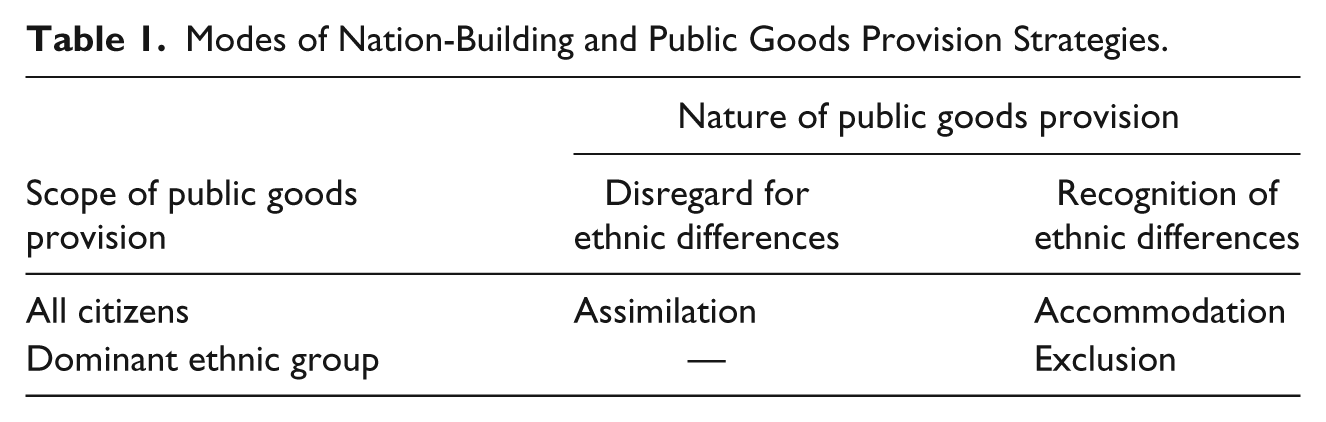
States that seek to nation-build through assimilation are likely to provide public goods such as schooling or health care on a universal basis to all citizens without regard to ethnicity, yet often with the implicit aim of establishing congruence between the ethnic markers (e.g., language, religion) of the dominant group and the national political community. States that pursue accommodation share a similar aspiration of integrating a potentially diverse population into a broader, encompassing political community and are also inclined to provide public goods on a universal basis. In contrast to assimilationist states, however, accommodationist states recognize ethnic differences and are, therefore, open to the provision of distinct kinds of public goods to different ethnic groups, in line with their preferences (Banting & Kymlicka, 2007; Tilly, 1998). 9 For example, schooling might be universally accessible but unlike assimilationist states, where the content would be homogeneous and usually reflective of the preferences of the dominant ethnic group, accomodationist states might offer non-dominant ethnic groups opportunities for education in their native language. Similarly, public health care might recognize distinct medical traditions, while remaining oriented toward covering all citizens. Finally, states that seek to forge a national political community through exclusion usually limit national membership, either in terms of formal citizenship and/or the actual exercise of citizenship rights 10 to one dominant ethnic group and target public goods toward this group. For example, exclusionary states might systematically ban certain ethnic groups from access to higher education or concentrate first-rate hospitals and schools to areas primarily inhabited by members of the dominant ethnic group.
Although states might aspire to assimilate, accommodate, or exclude minority groups, they might not be able to fully implement their preferred mode of nation-building and the distinct public goods provision strategies associated with it. In fact, there are, and have been, dramatic variations in the extent to which states are capable of providing public services. Our theoretical framework therefore emphasizes the centrality of a second, equally relevant aspect of nation-state formation: historical state capacities to provide public goods. At the most basic level, state capacity refers to the ability of states to apply their projects throughout the territory they claim to govern (Saylor, 2013; Soifer & vom Hau, 2008). For our purposes, two components of state capacity are particularly relevant. First, the implementation of public goods provision strategies requires a minimum of bureaucratic centralization. States are better at providing public goods if they can rely on a centralized administration with some degree of merit-based recruitment, standardized procedures, and a sense of cohesion among officials (Ertman, 1997; Evans & Rauch, 1999; M. Weber, 1978). Second, infrastructural power is also crucial. States are better able to target public goods, whether to all citizens or certain ethnic groups, if they have wrestled away control over basic social services from local communities and are able to reach throughout society (Mann, 1984; O’Donnell, 1993; Soifer, 2008). Recent research on 19th-century Latin America, for instance, shows that more bureaucratically centralized and infrastructurally powerful states were better able to create national mass schooling or hold accountable local providers of other public goods, such as health care and sanitation (Soifer, 2015). The long-term consequences of assimilation, accommodation, and exclusion for ethnic diversity and public goods provision at subsequent periods thus might vary, depending on whether states had the capacity to implement a particular nation-building strategy throughout their realm.
Historical Patterns of Nation-State Formation and Contemporary Diversity and Public Goods Provision
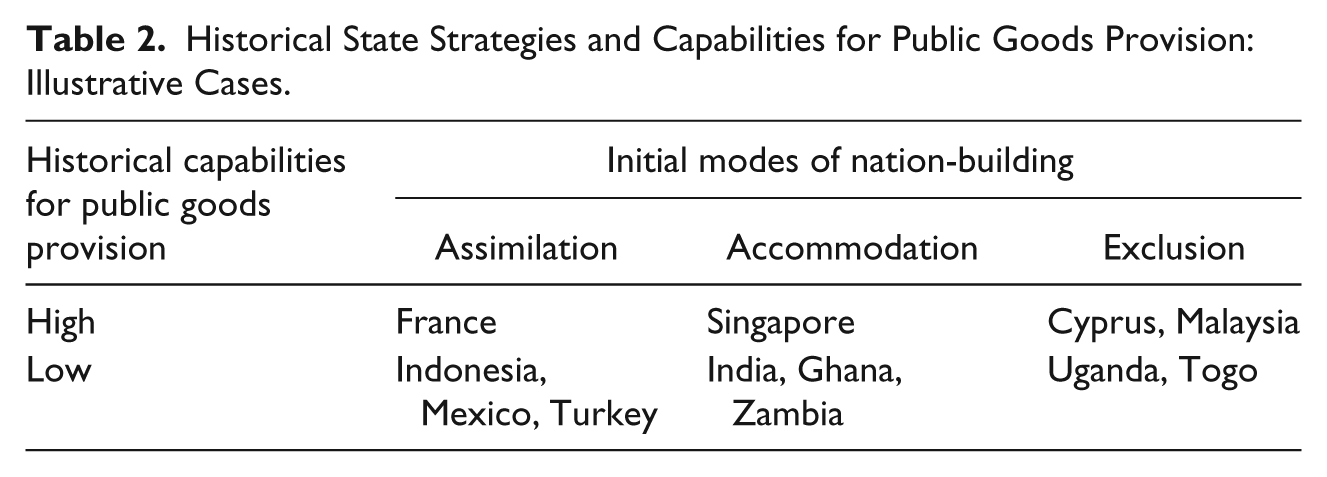
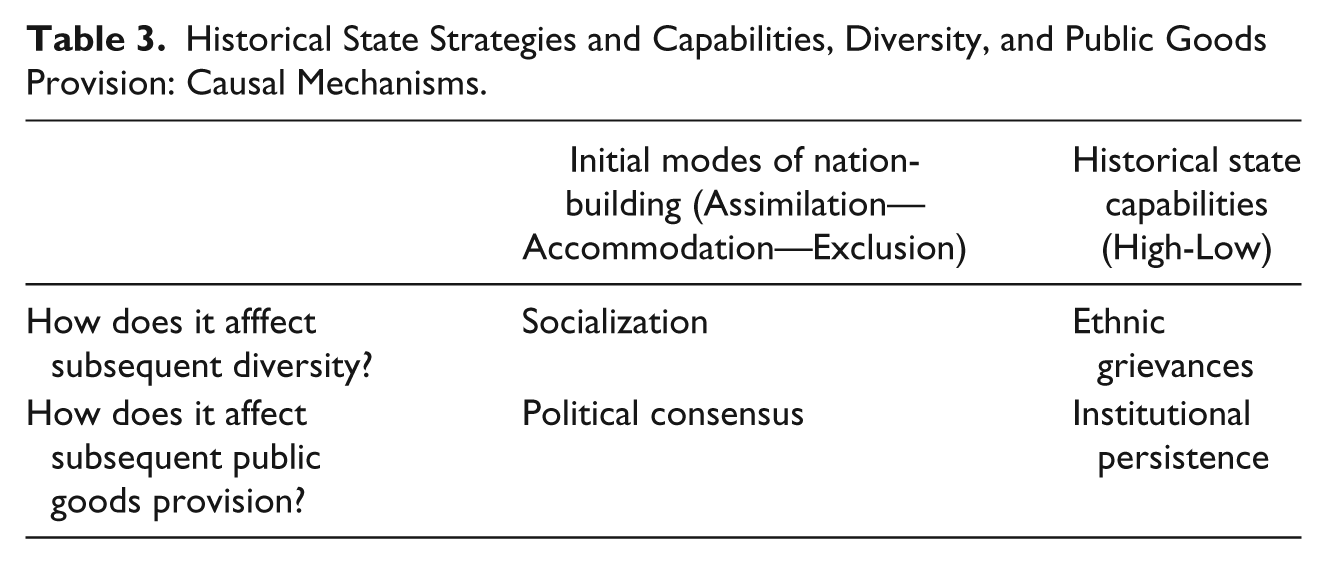
To further unpack how historical patterns of nation-state formation influence contemporary levels of ethnic diversity and public goods provision, we propose a two-dimensional typology. Drawing primarily on empirical examples from the articles included in this collection, Table 2 shows how the interaction of initial nation-building modes and historical state capacities looks like in the real world through the classification of country cases into six major patterns of nation-state formation. Table 3 delineates the major causal mechanisms through which past state intentions and capabilities to provide public goods were likely to shape subsequent levels of ethnic heterogeneity and public services, while Figure 1 visualizes the hypothesized effects of historical nation-building and state institutional development on contemporary diversity and public goods provision outcomes.
Historical State Strategies and Capabilities for Public Goods Provision: Illustrative Cases.
Historical State Strategies and Capabilities, Diversity, and Public Goods Provision: Causal Mechanisms.

Predicted impacts on contemporary diversity and public goods provision.
Assimilation
Whether or not states institutionalize ethnic distinctions in public services signals the importance of ethnic categories for how public goods are provided, which in turn makes it more or less likely that citizens are socialized, for example, to make political claims and frame their lived experience in ethnic terms (Lieberman & Singh, 2012). States that pursue an assimilationist nation-building model, by deliberately eschewing all ethnic distinctions in state institutions such as the census and—most relevant for our purposes—the provision of public goods, are therefore likely to minimize ethnic diversity. We expect the explicit avoidance of ethnic differentiation in the public service provision to have diversity-reducing effects both in the context of strong and weak assimilationist states.
It is important to clarify, however, that historical levels of state capacity are not irrelevant when assessing the consequences of assimilation for contemporary diversity. Strong assimilationist states, or relatively centralized and infrastructurally powerful states that pursue assimilationist nation-building, are usually likely to accomplish their intentions of socializing a diverse population into a homogeneous core identity, leading to a significant decline of diversity over time. The paradigmatic example is France, where state officials managed to forge a homogeneous national identity by bringing privately run local schools under central control and establishing nationalizing mass education across national territory (E. Weber, 1976). Weak assimilationist states similarly seek to avoid the institutionalization of ethnic differences, yet their effects on subsequent levels of diversity are more ambivalent. This is to an important extent because of ethnic grievances. Illustrated by cases such as Mexico or Turkey (Kroneberg & Wimmer, 2012; Wimmer, 2002), weak assimilationist states usually lack in centralization and infrastructural power, which tends to de facto limit the provision of public services to the dominant ethnic group. This, in turn, might lead to anger and frustration, motivate minorities to mobilize along ethnic lines, and, in the long run, likely lead to higher levels of diversity (Petersen, 2002).
Assimilation, and the scope of public goods provision associated with it, also has important ramifications for contemporary levels of public goods provision. An aspiration, on the part of the state, to provide public services to all citizens is likely to facilitate the rise of a political consensus and cross-cutting alliances in favor of public goods provision by the state (see Huber & Stephens, 2001; Pierson, 1996). In assimilationist states, demands for social services that are specifically targeted to ethnic minority groups therefore tend to hold only limited political purchasing power. As a consequence, citizens, even if from different ethnic backgrounds, are more likely to agree on holding the state accountable to its universal aspirations and find it worth their efforts to organize for more and better state-provided public goods.
What differentiates strong from weak assimilationist states, however, and strong from weak states more generally, are the long-run effects of historical state capacities on contemporary public goods provision. There is broad-based agreement in the literature that a legacy of bureaucratic centralization and infrastructural power leads to higher aggregate levels of public goods provision in the present period (Wimmer, 2016; see also Bockstette, Chanda, & Putterman, 2002; Ertman, 1997; Gennaioli & Rainer, 2007; Rueschemeyer, 2005). Collective expectations play a central role here. Where states had the capacity to provide public services such as education, health care, or sanitation across their territories, citizens started seeing the state as an effective means to obtain those goods, and they make further demands on the state when seeking to improve their conditions. An alternative dynamic emerges where states lacked the capacity to provide basic services. In these instances, citizens largely abstain from holding the state responsible and draw on non-state solutions to obtain public goods (Soifer, 2015).
Accommodation
The main difference between states that pursue accommodationist nation-building and their assimilationist counterparts are the types of public goods provided, with distinct consequences for subsequent levels of ethnic diversity. Regardless of whether accommodation comes in the form of multiculturalism policies or federalist arrangements, 11 accommodationist states are likely to increase ethnic diversity over time because ethnically distinct public services provide incentives for ethnic identification and collective action. For example, the adoption of public schooling in different languages or health care facilities specifically tailored toward distinct medical traditions might induce members of both the dominant group and ethnic minorities to understand and in turn mobilize for public goods through an ethnic lens. Moreover, public officials directly involved in ethnic-based provision become invested in the perpetuation of those services for their own livelihoods, an illustrative example for this being the teachers and educational officials providing “intercultural education” to indigenous children in Peru (García, 2005).
Yet, the long-term effects of accommodation on subsequent diversity outcomes also depend on historical levels of state capacity. Strong accommodationist states are likely to succeed with inculcating their citizenry into a multicultural national identity. As powerfully illustrated by the case of Singapore (Hill & Lian, 2013; Slater, 2010), public mass schooling with a centralized curriculum that recognizes ethnic differences (e.g., by teaching distinct languages and variants of history) reproduces or even intensifies ethnic identification. By contrast, weak accommodationist states are likely to enhance subsequent ethnic heterogeneity through a different set of processes. 12 On one hand, weak accommodationist states signal and open up the space for making ethnic-based claims. On the other hand, their limited bureaucratic competence and territorial reach to deliver on these demands generates grievances. This is brought out, for example, by the case of India (Singh, 2015), where scarce and geographically bounded public service provision played a central role in prompting ethnic-based competition.
Accommodation also mirrors assimilation in its long-run consequences for public goods provision. When providing members of different ethnic groups with distinct public services, accommodationist states, even weak ones, aspire to provide those services to all citizens. Seen in this light, accommodationist states are equally likely to generate a political consensus in favor of universal public goods provision because citizens share a mutual concern for the collective responsibilities of the state toward all citizens, regardless of their ethnic background and the distinct services provided (e.g., Singh, 2011; Steele, 2013). Moreover, as the literature on welfare states (Heller, 2005; Huber & Stephens, 2001, 2012; C. S. Lee, 2012) reminds us, sustained collective pressures in favor of universal social services tend to have cumulative effects, likely leading to more public goods provision over time.
Exclusion
Exclusionary nation-building limits the provision of public goods to members of the dominant ethnic group and is therefore, ceteris paribus, likely to deepen ethnic identifications and even delineate ethnic groups over time. For a start, similar to states that follow accommodation, the consistent ethnic differentiation in the delivery of public goods is likely to lead citizens to understand social reality and their individual life chances as shaped first and foremost by their ethnic identities (Lieberman & Singh, 2012; Singh, 2015). However, in contrast to accommodationist states, exclusionary states explicitly deny non-dominant ethnic groups access to (certain) public goods. As exemplified by Cyprus (Darden & Mylonas, 2016), this denial of or limited access to public services for minorities is likely to lead to intense and widespread ethnic grievances and precipitate distributional conflicts over state resources along ethnic lines that will in turn further harden group boundaries and increase diversity.
Yet, the extent and form ethnic grievances take is also crucially shaped by past state capacities. Weak exclusionary states often do not even consider the long-term possibility of non-dominant groups becoming part of the national political community. Rather, as the case of Togo shows (Metz McDonnell, 2016), state officials tend to concentrate the provision of scarce public goods to strongholds of the dominant group. Consequently, these states are marked by persistent struggles over which ethnic group embodies the nation and therefore can claim access to limited state resources. Over time, recurrent (and often violent) conflict over both state control and national inclusion is likely to instigate deep ethnic divisions.
By contrast, strong exclusionary states such as Malaysia (Slater, 2010) are better able to contain ethnic grievances. These states are unlikely to experience outright conflict over who is in control of the state. Excluded ethnic groups are comparatively less likely to resort to violence when confronted with a state apparatus that has the infrastructural power to control, coerce, or even forcefully remove excluded groups (Fearon & Laitin, 2003). In fact, although strong exclusionary states have the capacity to specifically target public goods to the dominant ethnic group, for example, first-rate health care exclusively supplied to Whites in Apartheid South Africa, even excluded groups tend to still have access to comparatively more public services than excluded groups in weak exclusionary states.
Exclusion also contrasts with assimilation and accommodation in its effects on subsequent levels of public goods provision. Exclusionary nation-building is not conducive to a long-term consensus around public goods provision by the state. In exclusionary states, citizens of different ethnic backgrounds are more likely to distinguish between their own and others’ welfare, and therefore, to understand their respective goals for public goods provision as incompatible with each other. As already noted, the ethnic group in control of the state tends to treat other groups as outsiders and potential antagonists, while excluded groups respond by attempts to capture (parts of) the state, making organized political action in favor of more generous social services more difficult, with ultimately negative consequences for contemporary public goods provision.
In sum, bringing in politics and history casts doubts on the notion of ethnic demography as destiny. The theory developed so far highlights issues of circularity and spuriousness that plague much of the existing political economy scholarship and therefore cautions against moving too quickly to accept the claim that ethnic heterogeneity necessarily brings about low levels of public goods provision. Specifically, we argue that contemporary diversity and public service provision are better approached as historically constituted in long-term processes of nation-state formation: Different historical patterns of nation-building and state institutional development, and the strategies and capabilities to provide public goods associated with them, likely shaped subsequent levels of diversity and public goods provision, leading to a spurious association between contemporary heterogeneity and the extent of public services.
The Origins of Historical Patterns of Nation-State Formation and Their Persistence and Change Over Time
Treating contemporary ethnic diversity and public goods provision as endogenous to historical processes of nation-state formation, however, raises two concerns. One is the potential endogeneity to preceding ethnic diversity. Could it be that patterns of nation-state formation are in turn shaped by previous levels of heterogeneity? To avoid infinite causal regress, a brief discussion of the likely origins of distinct nation-building and state development processes is therefore in order.
A variety of competing approaches seek to account for variations in historical state capacity. Scholars highlight factors ranging from differences in global capitalism (Wallerstein, 1974), interstate competition and warfare (Ertman, 1997; Tilly, 1975), and domestic alignments and conflicts (Anderson, 1974; Kurtz, 2013); to geography (Herbst, 2000; Stasavage, 2011), climate and vegetation (Diamond, 1997), and urban primacy (Alesina & Spolaore, 2005); to the role of ideology (Mahoney, 2001; Soifer, 2015) and religion (Gorski, 2003). The origins of differences in initial nation-building projects are equally debated. Some researchers emphasize the structure of political alliances (Aktürk, 2012; Wimmer, 2002), while others point to the global diffusion of distinct nation-building models (Joppke, 2007; Meyer et al., 1997). For our purposes, the main take-away message is that these debates are primarily concerned with the relative weight of geographical, sociostructural, political, and ideational factors. In neither the literature on state institutional development nor the scholarship on the causes of nation-building is ethnic diversity pointed to as a relevant cause.
Contributions to this collection further confirm that preceding diversity is an unlikely determinant of historical nation-building and state development. Using an instrumental variable approach, Andreas Wimmer (2016) tests a number of established theoretical claims about the rise of centralized states. His analysis shows that variations in 19th-century state capacity had multiple causes and are not consistently related to preceding levels of diversity. Similarly, Keith Darden and Harris Mylonas (2016) demonstrate that the adoption of a particular mode of nation-building cannot be reduced to ethnic heterogeneity. Rather, whether state officials chose to pursue assimilation, accommodation, or exclusion was crucially shaped by external threats to the state’s territorial integrity.
A second concern is when patterns of nation-state formation, and with that, existing levels of diversity and public goods provision, are likely to change. Once in place, distinct modes of nation-building and historical state capacities tend to be path dependent (Aktürk, 2012; Ertman, 1997; Rueschemeyer, 2005). Yet, this does not prevent change. For one thing, the weakening of powerful vested interests in an established nation-building mode facilitates the adoption of another one. This dynamic is exemplified by the dissolution of the former Soviet Union, when the removal of officials from the Union republics and the rise of a new state elite with different ideas about national inclusion led to a shift from accommodation toward assimilation. The case of post-Soviet Russia similarly illustrates that such a change of established power relations is often associated with changing geopolitics, including state breakdown and/or the redrawing of international borders (Aktürk, 2012). Yet, as the recent shift from assimilation toward accommodation in Brazil shows, the weakening of established interests might also be driven by the political hegemony of a new reform coalition that opposes the existing nation-building strategy (e.g., Black and indigenous movements, in tandem with the Workers’ Party; Telles, 2004).
The path dependency of initial nation-building patterns might also be upset by a “legitimation crisis,” 13 when current state authorities lose confidence in dominant understandings of national membership. Such a decline in state elite support might be again driven by dramatic changes in geopolitics, yet it might also be shaped by new global norms about how states should deal with ethnic differences (Cramsey & Wittenberg, 2016). As illustrated by recent moves toward accommodation in Argentina and Tanzania, the quest for international legitimacy might lead state officials to embrace new multicultural templates of nation-building, sometimes even in the absence of major external pressures or a powerful reform coalition (Aminzade, 2013; Gordillo & Hirsch, 2003).
Ruptures in historical state capacities to provide public goods are driven by a different set of processes. Most prominently, major “exogenous shocks” related to military conflict and organized violence are likely catalysts of changes. This can work both ways. A large scholarship suggests that international warfare can lead to the rapid expansion of public goods, largely because this type of conflict makes economic elites more likely to pay taxes and state elites to trade conscription for more generous social services (Downing, 1993; Hobsbawm, 1990; Tilly, 1990). At the same time, an equally large literature highlights the devastating effects civil wars have on the provision of public goods by states, whether through the destruction of physical infrastructure, massive population displacement, or the hardening of societal cleavages (Kalyvas, 2006; Thies, 2005).
Dramatic changes in the collective expectations about the state are an equally plausible historical turning point. Even in relatively strong states, citizens might come to perceive the state as an ineffective means to provide public goods and, accordingly, abstain from collective mobilization for more generous social services from the state. 14 As illustrated by the case of Great Britain during the 1980s, the rise of neoliberalism as a market-oriented ideological platform not only led to policy prescriptions with largely negative implications for public goods provision, but it also changed how ordinary citizens understood and evaluated the responsibilities of the state and, ultimately, what kinds of services they politically demanded (Blyth, 2002).
Taken together, this section has not only added nuance but also reinforced our argument. We have shown that preceding ethnic diversity is an unlikely cause of historical state capabilities to provide public goods. Moreover, our emphasis on historical causation and path dependency does not imply stasis. Identifying likely ruptures in the reproduction of initial nation-building modes, and historical state capacities shed new light on when to expect significant changes to established levels of ethnic diversity and public goods provision.
The Contextual Effects of Timing
Another critical aspect of inserting history and politics into the relationship between ethnicity and public goods provision is the placement of ethnic heterogeneity and the provision of public services in different temporal contexts (Falleti & Lynch, 2009; Grzymała-Busse, 2011). Specifically, we are concerned with the role of period-specific causal contexts in shaping levels of diversity, and potentially, even the supposedly negative association between diversity and public goods provision.
Most of the established political economy works examine very circumscribed periods in time—they tend to measure ethnic diversity primarily in the 1960s, or in some cases, in the 1990s—and focus their analysis of public goods provision on (some combination of years) from the 1960s to the 1990s. Some of the seminal studies that constitute the bedrock of the diversity-development deficit hypothesis, including articles by William Easterly and Ross Levine (1997), Rafael La Porta and his coauthors (1999), and Alberto Alesina et al. (1999), measure ethnic diversity through data compiled by Soviet ethnographers in a global survey of ethnic groups published in the Atlas Narodov Mira (1964). The use of this data has been widely criticized, most broadly for its violation of constructivist insights, and specifically, on the grounds on which ethnic groups are counted and how they are grouped (e.g., Lieberman & Singh, 2012; Posner, 2004). In this section, we point to an alternative and hitherto underemphasized problem that has less to do with how the data were compiled and more to do with when the data were collected. Specifically, levels of diversity in the 1960s might have been endogenous to circumscribed temporal effects, including period-specific patterns of public goods provision, which raises the issue of reverse causality. Furthermore, we suggest that a focus on the 1990s renders these studies vulnerable to temporally specific state transformations that might have increased both ethnic diversity and dampened state provision of public goods, prompting the question of whether the negative relationship posited between them might, in fact, be spurious.
In much of the developing world, the 1960s were characterized by anticolonial struggles, decolonization, and the rise of newly independent states (Slater, 2010; Young, 1994). Departing colonial administrations often removed the organizational structure and human capital necessary for even the most basic state services, leading to distributional conflicts and the massive politicization of ethnicity, especially during the first decade after independence (Wimmer, 2012, pp. 2-3, 88-89). And once violent conflicts along ethnic lines broke out, they often entailed the destruction of physical infrastructure and further undermined the effective provision of public goods. In other words, during the 1960s, the decline of the British and French colonial empires and the resulting wave of nation-state formation greatly contributed to the rise of ethnic diversity through the decline of public goods provision by the state.
However, timing effects vary. For the 1990s, an analytical focus on the state points to different period-specific effects that might have led to a spurious relationship between ethnic diversity and public goods provision. After the end of the Cold War, states underwent dramatic transformations. Class lost much of its purchasing power, whether as a source of mobilization or as a basis for structuring state-society relations, while ethnicity gained in not only political significance (Castells, 1997; Yashar, 2005) but also economic importance (Comaroff & Comaroff, 2009). Simultaneously, changes in global models of statehood—cognitive and normative orientations that define and legitimate state action (Meyer et al., 1997)—led states to recognize multicultural rights, providing ethnic groups with new legal resources to engage in collective action and make their demands heard.
State transformations during the 1990s equally affected public goods provision. The rise of neoliberalism as a new, market-oriented ideological platform and the policy prescriptions of the “Washington Consensus,” led to a significant decline in provision of public goods, whether by concentrating public infrastructure investments on areas attractive to international capital (Brenner, 2004; Sassen, 2001), privatizing social services (Mesa-Lago, 1997; Portes & Hoffman, 2003), or, as already noted, by changing collective expectations about what public services should be expected from states (Blyth, 2002). State capacities to provide public goods were similarly affected by the end of Cold War superpower competition and the disengagement of both the United States and Russia from the material support that they had provided to many of their former client states (Kalyvas & Balcells, 2010). One needs not go as far as Charles Hale’s (2002) contention that multicultural rights and the accommodation of ethnic differences were a deliberate strategy to justify state withdrawal from public goods provision, to understand that—when measured during the 1990s—the supposedly negative relationship between ethnic diversity and public goods provision might be a product of the dramatic state transformations unfolding during this decade.
This brief discussion of possible timing effects thus reaffirms our insistence on taking history and politics seriously when revisiting the diversity-development deficit thesis. A focus on timing allows us to adjudicate among path-dependent effects of historical patterns of nation-state formation and more recent period-specific patterns of state (trans)formation when investigating the relationship between contemporary diversity and levels of public goods provision.
New Causal Pathways: State Responses to Ethnicity and Public Goods Provision
Our emphasis on bringing in politics and history prompts us to argue that far from being exogenous, as the political economy scholarship assumes, both contemporary levels of heterogeneity and public goods provision have been affected by macro-historical processes of nation-building and state development and more recent state transformations. Yet, our treatment of ethnic diversity as endogenous and our argument against overstating its influence on public goods provision does not suggest that we see ethnicity as all together irrelevant for explaining variations in public service provision. Rather, the endogeneity issues we identified in the previous section provide an invitation to rethink the causal relationship between ethnicity and public goods provision from a theoretical perspective that takes both history and politics seriously. A state-centered approach allows us to take a first step in this new research agenda.
Moving Beyond Ethnic Lobbying: How Does Ethnicity Influence State Provision of Public Goods?
Works within the political economy paradigm focus almost exclusively on how the presence of people from different ethnic groups makes it more difficult for a community to lobby the state. In their review of this scholarship, Habyarimana et al. (2009) delineate three broad sets of mechanisms through which ethnic diversity is hypothesized to dampen public goods provision. The first emphasizes heterogeneous preferences—members of different ethnic groups are less likely to take each other’s welfare into account, to agree on what kinds of services should be provided, and to prefer working together. The second mechanism highlights the logistical difficulties faced by members of different ethnic groups attempting to act collectively. Non-coethnics are less likely to be able to gauge each other’s preferences, to track down each other, and thus to collaborate. The third mechanism emphasizes that norms of reciprocity and threats of sanctioning are more difficult to enforce across distinct ethnic groups.
The bottom line of all these mechanisms is, however, the same. Preference heterogeneity, technical difficulties, or the absence of social sanctions all impede the ability of multiethnic communities to work collectively. For the modal case in which states act as the main providers of public services, this implies that members of different ethnic groups face difficulties in coordinating their efforts to pressure the state for public goods. Indeed, Habyarimana et al. (2009) write that
if residents . . . can lobby together . . . then the likelihood of a positive response from the local government increases. But if community members are unable to coordinate their lobbying . . . then the likelihood that the government will increase its support . . . diminishes. (p. 8)
The political economy scholarship thus not only draws on a highly limited ahistorical understanding of ethnicity, but it also embraces a highly problematic conception of the state. It simply assumes that lobbying by ethnic groups translates in an almost mechanical fashion into the provision of the demanded services by states.
In this article, and the larger collection of essays it introduces, we seek to depart from this reductionist view. Moving beyond the political economy scholarship’s narrow, group-pluralist conceptualization of the state as an arena for collective interest aggregation, we draw on state-theoretical approaches that are more attuned to politics and history (see vom Hau, 2015). Specifically, we embrace a far richer understanding of the state that—going back to the works of Max Weber and Alexis de Tocqueville—treats states as institutional configurations in which state authorities and their personnel interact (Vu, 2010). This conceptual move allows us to identify a commonly overlooked set of causal pathways through which various manifestations of politicized ethnicity might affect state provision of public goods.
Ethnicity, the Perceptions and Actions of State Officials, and Public Goods Provision
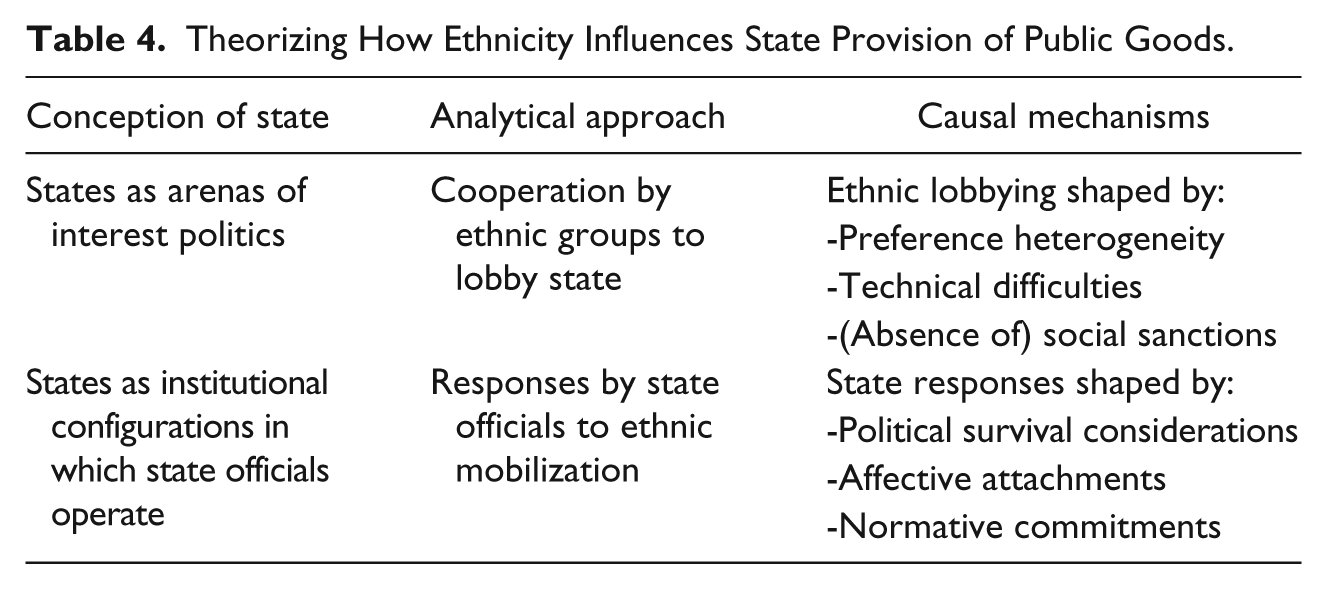
Our state-centered approach puts the emphasis on the interests, preferences, and perceptions and consequently, the actions of state officials when seeking to unpack how ethnicity might affect the provision of public goods by states. As detailed in Table 4, we specifically highlight the state leaders’ political survival considerations molded by perceptions of threat as well as their affective attachments to particular political communities and normative commitments in shaping how they respond to politicized ethnic differences. This focus on state elites allows us to move away from the political economy scholarship’s limited concern with solely the collective action of ethnic groups and instead pay closer attention to the demands, location, and intersectionality of ethnic mobilization 15 and how state officials understand and act on these mobilizing efforts.
Theorizing How Ethnicity Influences State Provision of Public Goods.
Political survival considerations
Political survival is widely believed to be an important, even primary, motivation for the public goods provision strategies pursued by executive authorities and high-level bureaucrats (e.g., North, Wallis, & Weingast, 2009; Slater, 2010). Their responses to ethnic mobilization are then likely to be reflected through this strategic prism of maximizing state resources and staying in power. More specifically, state officials’ decisions about whether, how, and to whom to provide public goods are shaped by the extent to which they perceive ethnic differences as a major threat, that is, as a direct challenge to the established political order. In other words, even in contexts of similar ethnic demographics, different kinds of ethnic threat perceptions held by state leaders might lead to distinct levels of public goods provision.
We can think of ethnic threat perceptions in both domestic and international terms. Domestically, state authorities are particularly concerned about the overlap of ethnic and class divisions. Investments in schools, hospitals, or roads vary, depending on whether state elites perceive ethnic differences as coupled with redistributive claims and thus as endemic and potentially unmanageable. Dan Slater (2010) develops and tests this argument for the context of Southeast Asia. In the mid-20th century, Thailand and Malaysia were characterized by roughly equivalent levels of ethnic diversity. 16 However, in Malaysia, ethnic cleavages coincided with class distinctions. Politically relevant ethnic distinctions were most pronounced in the capital and other major urban areas. Divisions between Malays, ethnic Chinese, and ethnic Indians overlapped with dramatic socioeconomic differences. These ethnically charged class politics prompted state elites to greatly expand the state’s investment in public goods to establish and sustain “protection pacts” with various economic elite factions. Ethnic differences in Thailand, by contrast, were not entwined with class-based cleavages, and state officials felt less threatened and formed flimsy elite pacts, resulting in relatively low levels of public goods provision.
In terms of international threats, state elites are especially fearful of transnational ethnic configurations because of potential challenges to the state’s sovereignty and territorial integrity. According to Keith Darden and Harris Mylonas (2016), state leaders invest in public services, most importantly national mass schooling, when they feel threatened by the possibility of military conquest or ethnic groups connecting across international borders. For example, in early independent Indonesia, sustained border disputes with former colonial powers and neighboring countries prompted state leaders to pursue an all-out literacy campaign and with that the opening of thousands of new schools. In Congo/Zaire and Zambia, by contrast, comparable threats to the state’s territorial integrity were largely absent, and postcolonial state authorities lacked a similar incentive to expand mass schooling (Darden & Mylonas, 2016).
Affective attachments
Although strategic considerations tend to be given primacy, an equally important impetus for the actions of state elites is their affective attachments to particular political communities (Singh, 2015), and the resulting inclination to (un)equally distribute public resources and services. In this view, state responses to politicized ethnic differences are ultimately based on the kinds of reactions state officials consider appropriate, given their own communal allegiances and understandings of ethnic proximity. Most fundamentally, state elites are likely to be more positively inclined toward demands for public goods provision by their own ethnic group.
When dealing with other ethnic groups, dominant conceptions of cultural difference thus have major implications for how state leaders respond. When state officials view a particular ethnic group as amenable to assimilation, they might respond favorably to its lobbying for public goods. This decision is primarily motivated by the expected returns following assimilation, in the form of political loyalty and/or economic contributions as new tax payers. By contrast, perceptions of stark cultural differences might discourage state leaders from investing extensively in public services. A prominent example for this mechanism comes from George Steinmetz’s (2007) study of German colonial state-building. During the late 19th century, German officials, inspired by dominant ethnographic representations, deemed the indigenous populations of Southwest Africa as having the potential for entering “civilization,” and therefore combined severe repression of local revolts with the provision of public goods. 17 By contrast, colonial state officials perceived Samoans as noble and endangered savages and therefore responded more mildly to local revolts while also refraining from the provision of basic public services in German New Guinea.
A variant of the same mechanism emphasizes the relationship between ethnicity, identification with a superordinate community, and public goods provision. In this perspective, the extent to which state officials identify with a wider (sub)national community shapes how they respond to ethnic mobilization. If in addition to their affective attachments to their particular ethnic groups, state elites also have a sense of a shared belonging to a superordinate identity, they are more likely to provide public services across ethnic cleavages, while strong ethnic allegiances among state officials tend to result in highly unbalanced geography of public goods provision Singh 2011, Singh 2015a, Singh 2015b. The explanatory power of this mechanism is powerfully illustrated by the comparison of Ghana and neighboring Togo. Both countries display similar levels of ethnic diversity and thus should—according to the political economy perspective—exhibit broadly similar patterns of public goods provision. 18 Yet, post-independence state leaders in Ghana sought to mute ethnic-based politics and foster a sense of national belonging to “one Ghana” by engaging in broad-based public works, while in Togo, postcolonial state elites concentrated the provision of services and infrastructure to the Ewe as their co-ethnics (Metz McDonnell, 2016).
Normative commitments
Distinct from affective attachments, we also focus on norms as a major transmission belt through which ethnicity might influence state provision of public goods. State leaders evaluate politicized ethnic differences in light of dominant normative frameworks about nation-building and adjust their responses to ethnic mobilization with an eye on what line of action is considered appropriate within their reference groups and epistemic communities. 19 In this perspective, then, state responses to politicized ethnicities are, to an important extent, shaped by state elite concerns about legitimacy and their international standing.
Sarah Cramsey and Jason Wittenberg’s (2016) comparative-historical analysis of Poland illustrates this mechanism. In the immediate aftermath of World War I, international requirements to respect minority group rights constrained Polish state elites in their assimilation efforts of ethnic minorities and led to accommodationist nation-building, for example, through state-funded bilingual schools. After World War II, a rising global concern with individualized human rights provided state authorities with a new opportunity to pursue the construction of a homogeneous Polish nation, first through forced expulsions and later through the systematic assimilation of ethnic minorities, most prominently with public education becoming uniformly Polish in language and culture.
In sum, treating contemporary ethnic heterogeneity and public goods provision as endogenous to nation-state formation not only emphasizes the limitations of the diversity-development deficit thesis, but it also highlights the need to revisit the causal linkages between ethnicity and public goods provision more generally. In this section, we have departed from the political economy scholarship’s narrow focus on ethnic lobbying as the main mechanism by which ethnicity might influence public goods provision. Instead, we have focused on the perceptions, identities, and normative commitments of state officials as largely overlooked mechanisms, thereby opening up the debate around how politicized ethnicity might influence state provision of public goods.
Empirical Illustrations
The contributions to this collection not only lend support, expand on, but also on occasion, move beyond the analytical approach we have developed above. However, taken together, they provide additional support to the central claim of our introductory article: It is imperative to move beyond the presentism that characterizes much of the existing political economy scholarship and instead bring politics and history to the analytical forefront when studying the relationship between ethnicity and public goods provision.
Some articles in the special issue provide fresh evidence for the empirical limitations of the diversity-development deficit thesis. Covering a large number of cases from different world regions and time periods and using a vast array of methods, these articles contribute to a growing but as yet inchoate literature that shows that ethnic diversity might not dampen public goods provision by states. 5
Hillel Soifer’s (2016) article on 19th-century Latin America starts from the observation that high levels of diversity are indeed correlated with lower levels public good provision across the region. Yet, Soifer does not find evidence that ethnic heterogeneity had a negative effect on public goods provision. Rather, the relationship is spurious. Variation in public goods provision was first and foremost determined by the salience of demographic and economic regionalism, that is, the presence of multiple large population centers and distinct economic units within a single country’s borders, which in turn led state authorities to subscribe to different understandings of national development and the place of public goods in it. In late 19th-century Colombia, an extreme case of regionalism, state leaders endorsed anti-statist views that rejected public service provision as a nation-building strategy. In Ecuador, a case of less pronounced regionalism, officials saw the nation-wide provision of public goods such as schools or railroad lines as a crucial strategy for achieving national development, leading to comparatively higher levels of public service provision in 1900.
Eleanor Gao’s (2016) subnational analysis of municipalities in Jordan even contends that—in certain specified contexts—ethnic heterogeneity might in fact lead to improved service provision. Specifically, her contribution argues that in semidemocratic countries, where political parties are weak, ethnic diversity can be an important source of electoral competition. In ethnically heterogeneous municipalities where multiple ethnic groups are politically mobilized, candidates are forced to seek the support of voters outside of their group, who are more likely to vote based on qualifications rather than ethnic affiliation, leading to better public goods provision. By contrast, in homogeneous municipalities, candidates run on an ethnic-based platform and are less concerned about appealing to voters from other ethnic groups, the consequence being subpar public services.
Building on these empirical challenges, the articles in this collection also take issue with the methodological and theoretical limitations of the diversity-development deficit hypothesis. Equipped with the state-centered approach outlined above, several contributions contest the idea of ethnic diversity as exogenous and instead treat contemporary heterogeneity as a product of historical nation-building and state development.
Based on a cross-national statistical analysis of Asia and Africa, Andreas Wimmer (2016) shows that the relationship between contemporary levels of ethnic diversity and public goods provision is spurious. Both are, in fact, the outcome of a deeper historical cause: precolonial state capacity. Historically, more centralized and infrastructurally more powerful states had a head start with the creation of a more homogeneous population and the provision of public goods. Wimmer further argues that variations in historical state capacity cannot be reduced to preceding levels of diversity but are the outcome of a combination of factors, most importantly, favorable topography and climate, high population densities, and a history of warfare.
The article by Keith Darden and Harris Mylonas (2016) demonstrates the importance of historical nation-building efforts for endogenizing contemporary diversity. Comparing cases with similar levels of initial linguistic heterogeneity, state capacity, and development, but in different international environments, the authors find that states which did not face external threats to their territorial integrity were more likely to outsource education to non-state actors or not to invest in national mass schooling at all, leading to higher ethnic heterogeneity on the long run. By contrast, states in high-threat environments were more likely to invest in assimilationist nation-building strategies, with the aim to homogenize their populations, entailing lower levels of contemporary diversity.
Evidence for the importance of timing and temporal context comes from the article by Sarah Cramsey and Jason Wittenberg (2016). Their comparison of Poland before and after WWII points to international norms as crucial in shaping whether state officials prefer to nation-build by assimilating, accommodating, or excluding minority groups. In other words, the adoption of a particular nation-building mode is not just a function of geopolitical context, but needs to be situated within world time and the prevailing norms about statehood and minority rights.
The articles in this collection also illustrate the need to revisit the mechanisms that link politicized ethnicity to public goods provision outcomes. In doing so, they support our call for a theoretically more sophisticated perspective on states and their responses to ethnicity than currently offered by the political economy scholarship. Erin Metz McDonnell (2016) shows that affective attachments and group identifications of state officials constitute a crucial mechanism. Based on an analysis of Ghana, together with abbreviated case studies of Guinea, Togo, and Kenya, the article argues that the extent of contemporary public service provision is shaped by the public service provision strategies of the first post-independence African state leaders and that these initial choices were in turn affected by particular ethno-demographic structures. State authorities from an ethnic minority, especially when operating in the context of a modest plurality, were particularly likely to pursue universal as opposed to exclusionary public goods provision.
Our call for a new historically informed research agenda on the relationship between ethnicity and public goods provision gains further support from the tensions and disagreements among the various contributions, pointing to important open questions and avenues for future research. One area of disagreement is the relative weight of historical nation-building and state institutional development in influencing subsequent patterns of diversity and public goods provision. In Wimmer’s account, states that were weakly developed in the past left behind both high levels of diversity and limited capacities for public goods provision, regardless of the nation-building strategy used. By contrast, Darden and Mylonas, Cramsey and Wittenberg, and Metz McDonnell highlight past political efforts to nation-build as crucial in shaping subsequent patterns of diversity and public goods provision, often independently of historical levels of state capacity. These differences in theoretical emphasis also imply distinct approaches to temporal context and duration. Wimmer’s emphasis on state development as a slowly evolving process that may take generations leads him to draw on measures of late 19th-century precolonial state capacity, whereas the other authors are more concerned with critical moments during, or shortly after, national independence. Although this article’s theoretical framework brings together these two lines of argument for endogenizing diversity, more work is warranted on how historical state strength and early nation-building modes interact in producing subsequent levels of ethnic heterogeneity and public goods provision.
The contributions to this special issue also vary in the extent to which they challenge the core claim of the political economy scholarship that (contemporary) ethnic diversity dampens public goods provision. On one hand, Wimmer finds that even though ethnic heterogeneity stops being associated with public goods provision as soon as a measure of historical state capacity is introduced into the analysis, lending support to his claim that the relationship is spurious, there continues to be support for the diversity-development deficit hypothesis, and the preference heterogeneity mechanism in particular, when this historical measure is not included in the statistical analysis. On the other hand, the articles by Gao, Metz McDonnell, and Soifer suggest a more radical break with both the negative relationship between diversity and public goods provision and the causal mechanisms underpinning it. Gao’s subnational statistical analysis of Jordan, and Metz McDonnell’s comparative-historical analysis of Ghana show that diversity in fact might have encouraged more extensive and universal public goods provision, whereas Soifer demonstrates for 19th-century Latin America that the relationship was spurious and not driven by interethnic preference heterogeneity. Ultimately, these disagreements among individual contributions reinforce our plea for a new research agenda that takes history and politics seriously.
Conclusion: Toward a New Research Agenda
Slowly, but surely, a growing scholarship has begun to question one of the holy grails of political economy, namely, the negative relationship between ethnic diversity and public goods provision. This article and the special issue as a whole build on these revisionist empirical analyses of the diversity-development deficit thesis but go beyond them by introducing a focus on time and temporality. In a sense, ours is a call to pay close attention to history and politics when studying the causal nexus between ethnicity and public goods provision.
Our state-centered approach has allowed us to endogenize contemporary diversity and public goods provision, by treating them as likely outcomes of macro-historical processes of nation-building and state development, and the state strategies and capabilities to provide public goods associated with them. The integration of such a temporal perspective has the succinct advantage of addressing issues of reverse causality and potential spuriousness that plague much of the established political economy scholarship.
Taking politics and history seriously has also led us to revisit the causal relationship between ethnicity and state provision of public goods. The established political economy scholarship treats ethnic lobbying as the main causal mechanism. Although our state-centered approach cautions against overstating the influence of contemporary levels of ethnic diversity on public goods provision, it also has introduced a more nuanced perspective on states and their responses to politicized ethnicity. Specifically, we have focused on the threat perceptions, group identifications, and normative commitments of state officials when seeking to understand how politicized ethnicity might affect public service provision.
In what remains, we briefly sketch out, arguably in broad brush strokes, a new research agenda that builds on the historical perspective advocated by the special issue. Three interrelated areas of inquiry appear to be crucial for this agenda. First, we invite future research to further explore when and to what extent ethnic diversity dampens public goods provision through research designs that incorporate a focus on history and politics. Patterns of nation-building and state institutional development are not the only possible macro-historical processes that might account for the potentially spurious relationship between ethnicity and public goods provision. More work is needed on the role of capitalism and markets. For example, trade liberalization might incentivize ethnic identifications while also reducing state capabilities to provide public goods (Comaroff & Comaroff, 2009). Moreover, the ways in which business elites understand ethnic divisions affect their inclinations toward cross-class alliances and elite-state coalitions (e.g., Arriola, 2013) with potentially major implications for public goods provision outcomes (e.g., Eaton, 2007; Lieberman, 2003). Future research could also build on insights from the literature on violent conflict (e.g., Kalyvas, 2006; Tilly, 1990) to examine possible causal connections between historical episodes of war, ethnic identity formation, and public goods provision. Another possible approach would focus on the historical development of civil society networks and their impact on contemporary diversity and public goods provision (e.g., Putnam, Leonardi, & Nanetti, 1993; Wimmer, 2015).
A focus on politics and history could also be fruitfully deployed to historicize current debates around the importance of ethnically based policy preferences for explaining variations in public goods provision (Habyarimana et al., 2009; Hopkins, 2009; Lieberman & McClendon, 2013). Future work in this area would benefit from incorporating a historical perspective: To what extent are ethnic preferences shaped by macro-historical processes of state development and nation-building (but also market expansion, violent conflict, and civil society configurations)? Such a contextualization of ethnic preferences would, in turn, further advance insights into when the relationship between ethnic diversity and public goods provision is spurious and when it is likely to be causal.
A third line of future inquiry would further explore how different manifestations of politicized ethnicity influence public service provision more generally. The special issue has made the case for treating state officials and their interests, attachments, and commitments as important causal pathways. Building on this, a historical perspective could complement existing work on the mediating role of institutions. Scholars—including contributions to this collection (Gao, 2016)—have shown that not only formal political institutions such as federalism or electoral rules but also economic institutions such as property rights and land tenure systems (Brancati, 2006; Weldon, 2006) crucially shape how ethnic divisions affect the provision of public goods. What have received comparatively less attention are the power relations that underpin the often contrasting effects of the same institution in different contexts (see Acemoglu & Robinson, 2012; Khan, 2010). A focus on history and politics helps to do precisely that: to gain further insights into the macro-historical processes that shape how particular institutions mediate the relationship between ethnicity and public goods provision.
On the whole, then, this article and the special issue it introduces develop a new research agenda that moves beyond the presentist approach characteristic of the political economy scholarship. By treating contemporary diversity and public goods provision as endogenous to macro-historical processes of nation-state formation and revisiting the mechanisms that link heterogeneity to low levels of public services, we have opened up the path toward an alternative perspective that puts history and politics squarely at the center of the study of the relationship between ethnicity and public goods provision.
Footnotes
Acknowledgements
The authors especially thank Fulya Apaydin, Jorge Dominguez, Sam Hickey, Steve Levitsky, Kunal Sen, Hillel Soifer, Deborah Yashar, and all the participants of the October 2013 Workshop on “The Impact of Ethnicity on State Capacity” at the Weatherhead Center for International Affairs (WCFIA) in Cambridge, Massachusetts, the May 2014 Workshop on “Politics Over Ethnicity: Revisiting the Ethnic Diversity and Public Goods Provision Hypothesis” at the Institut Barcelona d’Estudis Internacionals (IBEI), the attendees of a session with the same title at the 2014 Annual Meeting of the American Political Science Association, Washington, D.C., and the 2015-2016 cohort of the Fung Global Fellows program at Princeton University for their excellent comments and suggestions.
Authors’ Note
Authors are listed alphabetically and contributed equally to the article and to the editorship of the special issue. All errors are the authors’ own.
Declaration of Conflicting Interests
The author(s) declared no potential conflicts of interests with respect to the authorship and/or publication of this article.
Funding
The author(s) disclosed receipt of the following financial support for the research, authorship, and/or publication of this article: The Effective States and Inclusive Development (ESID) Research Centre at University of Manchester, the Ministerio de Ciencia e Innovación (MICINN) in Spain (Grant CSO2011-28387), and the Weatherhead Center for International Affairs (WCFIA) at Harvard University provided generous funding of the workshops (October 2013 at WCFIA and May 2014 at IBEI) leading up to this article and the special issue it is part of.