



Abstract
What is the relationship between ballot reforms and electoral malpractice? This article contributes to the growing comparative politics literature on the causes of election fraud in democratizing countries using the case of the 19th-century United States. We examine adoption of the Australian ballot and disenfranchisement laws, and estimate their effects on multiple types of election fraud. Using a new measure of fraud in elections to the House of Representatives from 1860-1930, we find that the Australian ballot and disenfranchisement measures reduced vote-buying and voter intimidation. However, we further find that the Australian ballot had an “iatrogenic effect” of increasing registration and ballot fraud. Voting secrecy therefore led to substitution of one illicit electoral tactic for another.
Introduction
Ballot secrecy is considered a vital component of democracy, allowing voters to choose their elected officials free of interference or coercion. Yet procedural changes in the conduct of elections may not guarantee less fraud and manipulation. Instead, they may serve the interests of political officials, either by disenfranchising part of the electorate or by making other manipulation strategies more effective. This calls for more rigorous examination of the consequences of such reforms on distinct types of election malpractice.
In this article, we use the case of the historical United States, which is considered by one astute observer to be “at least a distant parallel [to] contemporary nations currently undergoing transformation from agrarian to industrial societies” (Bensel, 2004, p. xi). Electoral fraud was widespread in the early history of American democracy, particularly during the second half of the 19th century. Elections in the United States in this time period were characterized by a combination of spectacle—rallies, parades, lavish quantities of food and drink—as well as fraud. Allegations of stuffed ballot boxes, padded registration lists, vote-buying, repeated voting, voter intimidation, and violence at the polls were ubiquitous, both in urban and rural areas (Allen & Allen, 1981; Altschuler & Blumin, 2001; Argersinger, 1985). Over the past century, however, these practices have become a rarity. Serving food at election precincts or finding a repeated vote are noteworthy exceptions to a far cleaner election regime (Minnite, 2010). Converse’s (1972, p. 284) summary from over 40 years ago still rings true: “Despite persistent rumors of a specific fraud or two perpetrated in almost every modern national election, the running expectation of gross and endemic fraud has largely vanished from the American political culture.”
We use a new data set on fraudulent elections from 1860 to 1930 to examine how changes in the conduct of elections affected different types of fraud. Two significant changes in election administration occurred in this period. 1 The first was the adoption of the Australian ballot, which aimed to guarantee voting secrecy by replacing party-created with state-printed ballots (Ware, 2002, p. 32). The secret ballot is considered a critical protection against fraud, as it undermines the ability of brokers to monitor, and therefore to punish or reward, vote choice (Baland & Robinson, 2007). The second change was the disenfranchisement of African American and socioeconomically disadvantaged voters through literacy tests, poll taxes, and other similar suffrage restrictions (Keyssar, 2000; Kousser, 1974).
Although a large body of research dating to Burnham’s (1965) seminal study has gauged the effects of these changes on outcomes such as voter turnout (Dugan & Taggart, 1995; Heckelman, 1995, 2000), split-ticket voting (Engstrom & Kernell, 2014; Rusk, 1970), and the size of government (Anderson & Tollison, 1990; Lott & Kenny, 1999), ours is to the best of our knowledge the first to directly assess their impact on practices of election fraud across all states. 2 To accomplish this, we draw on a novel measure of election fraud based on charges of electoral misconduct filed with political authorities (Lehoucq, 2003). Candidates who lost Congressional elections filed contests to the House of Representatives Committee on Elections; these contests contain accusations of multiple types of fraud and corruption. While these contests have been used to examine partisanship in the House (Green, 2007; Jenkins, 2004, 2005), we extend the analysis of Bensel (2004), who used contests in a historical investigation of democratic norms and procedures in 19th-century elections. In an attempt to move beyond Bensel (2004), we use these accounts as a systematic source of information to reconstruct the nature of electoral malpractice during and after reconstruction.
Relying on data on 12,451 House races from the 37th to 72nd Congress (1860-1930), and controlling for other potential drivers both of election fraud and of the incidence of contested elections, we find that both the Australian ballot and disenfranchisement reduced types of election fraud that rely on information about how voters voted, such as vote-buying and personal intimidation. However, more opaque forms of election fraud, such as registration fraud and ballot stuffing, actually increased as an effect of the introduction of state-printed ballots. Drawing on Birch’s (2011) distinction, we thus find that whereas these ballot reforms decreased incidences of “manipulation of the voter,” disenfranchisement did not affect “manipulation of the vote,” and the Australian ballot actually increased it.
Our findings contribute to a growing literature on election administration and fraud in democratizing societies, both in American political development and comparative politics. Jenkins (2004) finds that disputed elections in the United States were used for partisan maneuvering in Congress, while Green (2007) finds that disputed elections were less likely after disenfranchisement laws had been adopted, and were more likely in districts with large Black populations. We build on work by Ziblatt (2009), Mares (2015), and Kam (2016) in controlling for the economic correlates of contesting elections, and take partisanship into account when making inferences about the conduct of elections, finding that partisanship itself cannot explain variation in election corruption in the United States. More broadly, this study contributes to the large and growing literature on electoral malpractice in contemporary developing countries (Birch, 2011; Hyde, 2011; Schedler, 2002; Simpser, 2014; Stokes et al., 2013). In particular, there is a striking resemblance between the substitution effect among different form of electoral malpractice we unravel in the American historical case and current efforts by dictators to manipulate elections strategically (Beaulieu & Hyde, 2009; Collier & Vicente, 2012; Kelley, 2012).
This article is organized as follows. In the next section, we review theories of election fraud and ballot reform in the American context. In “Research Design and Data” section, we introduce a new measure of fraud in American elections, along with a framework for understanding the motivations behind claims of fraud. In the section “Assessing the Effects of Ballot Reform on Election Fraud,” we present the key descriptive data on contested elections, and use this data to test hypotheses about the spatial-temporal distribution of election fraud and the impact of ballot reforms in the period 1860-1930. We conclude by discussing the broader implications of our findings.
Election Fraud and Ballot Reform: Theoretical Expectations
We define election fraud as “conduct intended to corrupt the process by which ballots are obtained, marked or tabulated; the process by which election results are canvassed and certified; or the process by which voters are registered” (Donsanto, 2008, p. 22). The assumption of intentionality is critical here. We must distinguish election fraud, which is “a plot to overturn election results,” from non-intentional irregularities (Lehoucq & Molina, 2002, p. 17). Fraud encompasses actions aimed at manipulating election registries and ballots, as well as those aimed at manipulating voters themselves (Birch, 2011). While the exact extent and nature of such fraud in the American case remains disputed historically (Allen & Allen, 1981; Argersinger, 1985; Burnham, 1974; Campbell, 2003, 2005; Converse’s, 1972; Cox & Kousser, 1981; Gist, 1961; Jensen, 1971; Keyssar, 2000; Mayfield, 1993; Reynolds, 1980, 1993; Rusk, 1974; Summers, 2001), according to most observers, the turn of the last century marked the heyday of electoral manipulation (Allen & Allen, 1981, p. 163; Harris, 1934, pp. 19-20; Sikes, 1928, pp. 36, 90).
One of the most common explanations for reduction in election fraud is the introduction of the Australian ballot, which swept the majority of states in the 1890s. Although most states had introduced printed ballots by then—only Kentucky maintained viva voce voting until 1891—the ballots had previously been printed and distributed by the parties themselves. Election secrecy was easy to violate, since the tickets varied in color and size, and the party agents near the polling stations could monitor with whom the voters associated before they approached the voting window (Bensel, 2004, pp. 30-31, 44, 48-49; Ware, 2002, pp. 34-35). The Australian ballot, by contrast, made the state responsible for printing ballots at public expense. Ballots included candidates from all parties, were distributed only at the polls, and were marked in secret (Harris, 1934, pp. 17, 154; Saltman, 2006, p. 96).
The Australian ballot was first adopted in municipal elections in the United States in the mid-1880s. By 1891, the majority of states used some form of the Australian ballot, and by 1912 only four former Confederate states had not yet introduced it. The exact motive behind this reform has been debated, and varies across states and regions. In the South, it seems the secret ballot was adopted—along with literacy requirements and poll taxes—as a way to disenfranchise African Americans (Kousser, 1974). But these motivations were pervasive across the United States. Just as Gingerich (2013) finds that adoption of the Australian ballot in Brazil was motivated by a desire to disenfranchise illiterate and poor voters, reformers in the Republican strongholds of Northern and Western states were motivated to reduce the electoral power of newly-arrived and illiterate immigrants. Reformers also wanted to reduce the ability of machine bosses to buy votes and intimidate voters. Long before the rise of machine politics, Massachusetts and Connecticut adopted literacy requirements in elections (Fredman, 1968; Keyssar, 2000). However, Democrats in the South enforced voting restrictions much more universally and violently than Republicans in the North (Kousser, 1974).
Regardless of the intention behind reform, there are prima facie reasons to expect the Australian ballot to lead to a decline in election fraud. This is most explicitly argued by Converse (1972, pp. 281-282) and Rusk (1974, pp. 1032-1033), who assume that the market for votes as well as intimidation of the individual voter was abandoned as parties no longer could observe and monitor the voters’ actions (also see Heckelman, 2000; cf. Cox & Kousser, 1981). 3 This expectation also accords with the predictions of the models developed in Aidt and Jensen (2016) and Kam (2016). We therefore hypothesize that
While voting secrecy may make manipulation of voters more difficult, there is no logical relationship between secrecy and ballot or registration fraud. The fact that voter preferences cannot be observed is not a safeguard against padding election registries or stuffing ballot boxes. A more likely possibility is that reducing one form of electoral mischief might actually induce another. Lehoucq and Molina (2002), for example, show that voting secrecy reduced direct forms of vote-buying and intimidation in Costa Rica, but this “encourage[d] parties to expand their repertoire of illegal actions” by turning to more illicit forms of ballot stuffing (Lehoucq & Molina, 2002, p. 21). Similarly, an effect of international election observation is that blatant election-day fraud is replaced by techniques of electoral manipulation that observers are less likely to catch (Beaulieu & Hyde, 2009; Kelley, 2012). One mechanism that could explain such a pattern is that different types of electoral malpractices act as strategic substitutes (Collier & Vicente, 2012). When one type of fraudulent practice becomes suppressed or subverted, actors turn to another. Thus, we expect
We now turn to the second ballot reform enacted across the states in this time period: poll taxes, literacy tests, and strict residency requirements that effectively narrowed the extension of the franchise. The explicit purpose behind and direct consequence of these reforms in the South was to disenfranchise the Black population (Kousser, 1974; Perman, 2001). However, similar reforms were enacted in many Northern states, with an “enormous potential impact” on the number of voters who were in practice able to cast their votes on election day (Keyssar, 2000, p. 118). As Keyssar (2000, p. 128) argues,
Proponents of ballot reform . . . invariably defended such steps as necessary to prevent fraud and corruption . . . The goal of reform, according to its advocates, was not to shrink the electorate or to prevent certain social groups from voting, but to guarantee honest elections.
Such intentions should not be taken at face value, since the reformers’ “antagonism toward poor, working-class and foreign-born voters was thinly disguised at best” (Keyssar, 2000). As in the case of the Australian ballot, however, we can assess the impact of these reforms regardless of their driving motives.
What effect should we expect disenfranchisement to have on election fraud? Based on Kousser’s (1974) and Perman’s (2001) reading of the Australian ballot reform in the South, we might first and foremost expect disenfranchisement to have the same negative effect as voting secrecy on the manipulation of voters. To the extent that it obstructs poorer voters, who are likely targets of bribery and intimidation, from voting, disenfranchisement should lead to a decline in those practices of electoral misconduct. 4 Yet disenfranchisement might also affect ballot and registration fraud, as the precise voters who were disenfranchised were those who previously had their votes undermined by registration padding, ballot stuffing, and other illicit measures. As Teorell, Ziblatt, and Lehoucq (2016) point out in the introduction to this volume, ballot secrecy can be viewed as equivalent to de facto restriction of the suffrage. Politicians can disenfranchise a segment of the population either by preventing them from casting their votes, or by preventing their votes from being counted fairly. To the extent that disenfranchisement functioned as a legal and institutionalized way to control election outcomes, the Australian ballot and disenfranchisement may have had similar effects. Unlike the case of ballot secrecy, though, suffrage restrictions should have the same effect on all types of fraud. This leads to our final proposition:
A third type of reform also swept the states toward the late 19th and early 20th century: the introduction of registration laws and registration requirements. There are two reasons why we have decided to exclude voter registration from our analysis. The first is the enormous variation both within and across states in terms of registration deadlines, registration requirements, which voters could register, when the registration deadlines fell, and what voters needed in order to register (Harris, 1929, pp. 6-7; chapter III; Keyssar, 2000, pp. 122-128; Kleppner & Baker, 1980, pp. 207-208). Further, many states adopted registration only for cities over a certain population threshold, while rural areas were given discretion to register or not (Piven & Cloward, 1988). Unlike the Australian ballot and disenfranchisement laws, the introduction of voter registration systems is thus a highly variable and very imprecise treatment, and its consequences for election fraud are hard to assess. Even in theory, it is unclear what the consequences of registration laws would be. One of the motivations behind registration reform was to prevent common forms of malpractice such as “the voting of the graveyard” or “repeating” (Harris, 1929, p. 5). The requirement to register could be considered another tool of disenfranchisement, with the same consequences as H3 above (Kousser, 1974; Piven & Cloward, 1988). On the other hand, the very introduction of these laws enabled a new type of more opaque fraud, such as the padding of registration lists. This means that the expected effect of the introduction of registration laws is not clear, which is our second reason for excluding it. 5
Research Design and Data
We test the above propositions about institutional reforms and fraud by drawing on the series of contested elections to the U.S. House of Representatives from 1860-1930. 6 We are not the first to study contested congressional elections, nor are we alone in relying on these cases as indicators of election fraud. Allen and Allen (1981, pp. 176-178) presented an overview of contested congressional elections from 1789-1917 across eight regions of the Unites States, but dismissed this source of evidence on election fraud on account of the infrequency with which elections were contested, and because the “highest frequency of charges of vote fraud occurred . . . in the post-Reconstruction South and border states when political conditions were unstable and highly unusual.” Argersinger (1985, p. 682) countered that the congressional investigations resulting from election contests “provide indisputable proof of election fraud.” More recently, both Anderson (2000) and Bensel (2004) have used these cases to draw qualitative conclusions of the nature of elections and voting habits at the time. Seymour (1915) first used election contests to study voting habits in Victorian Britain (also see Kam, 2016; O’Leary, 1962), and contested elections have now also been used with some success to study election fraud in France (Kreuzer, 1996), Costa Rica (Lehoucq & Molina, 2002), Germany (Anderson, 2000; Mares, 2015; Ziblatt, 2009), and Sweden (Teorell, 2016).
There are comparative advantages to using contested election cases over other measures of election fraud, such as media reports or biographical accounts. First, they are based on a procedure that does not differ from one part of the country to the other, and that has been fairly unified across time. Under Article I, Section 5, of the United States Constitution, each House of Congress “shall be the judge of the elections, returns, and qualifications of its members.” Although the Constitution does not spell out how these cases should be dealt with, the House established a procedure for election disputes early in the 19th century. Each contested election case was submitted to the standing House Committee on Elections, which evaluated the evidence and reported back to the House a recommendation in favor of the contestant (the individual disputing the election), the contestee (the person originally elected), or neither (in which case the seat would be vacated). Between 1851, when the House established a uniform mode of procedure governing election contests, and the Federal Contested Election Act of 1969, no major changes occurred in this procedure (Dawes, 1870, pp. 60-63; Dempsey, 1956, pp. 45-58; Jenkins, 2004, p. 114; Rammelkamp, 1905, pp. 425-427). As a result, the “rules of the game” concerning contested election cases are comparable across time and space (at least after 1851). They do not vary by state-specific legislation, the access and proliferation of media outlets, or other local peculiarities that could affect other sources of election fraud.
A second advantage of relying on contested elections is that they have the outer characteristics of a judicial trial. In 1929, the Supreme Court ruled that the Houses of Congress acted “as Judicial Tribunals” in deciding election contests (Dempsey, 1956, p. 42). Long before this, the contests relied heavily on evidence and committee investigations in order to reach a verdict. The committee first implemented standards and procedures to regulate the taking of testimony in contested elections in the 18th century, formalizing them over time.
Yet there are also pitfalls involved in making inferences about election fraud from the incidence of contested elections, based on the potential for selective contestation. Drawing on an informal argument by Green (2007, p. 159), we formalize three considerations that affect a potential contestant’s calculus over whether or not to contest a lost election: the value the congressional seat holds to him (B), the chance that he will succeed in winning the seat despite having lost (p), and the costs (C) in terms of time, money, and other resources that may be required to sustain a challenge. Losers choose to contest if the expected benefits outweigh the costs, that is, if p*B > C. 7 This implies two potential sources of bias in relying on contested elections to infer fraud. First, the fact that a challenge is costly (C > 0) means that not everyone will undertake it, even when convinced that the race would have been won absent of fraud. As a result, the frequency of contested elections might underestimate the actual number of fraudulent elections. But the perceived value of winning and the chances of success (p*B) might vary systematically from one potential contestant to the other. Most importantly, the fact that cases were determined by the majority party in the House meant that the prospects for winning a contest were considerably larger for losers belonging to that majority party. The partisan adjudication of cases could lead either to instances of frivolous cases being brought to Congress, with losers from the minority party filing contests for strategic reasons, or could deter minority members from filing contests. Therefore, partisan considerations could lead contested elections either to overestimate or to underestimate the frequency of actual election fraud. 8
Of these two sources of bias, partisanship has received much more scholarly attention. The chairman of the Committee on Elections acknowledged the role of partisanship in deciding election contests in his 1869 study of contested elections (Dawes, 1870). Charges of the partisan nature of the handling of contested elections have predominated ever since (Alexander, 1916; Dempsey, 1956; Rammelkamp, 1905; Reed, 1891), although some observers have argued that partisanship has declined since the early 20th century (Barnett, 1939; Polsby, 1968, pp. 161-163). Most contestants in the late 19th century were Republicans from the South, and the Republican Party tended to favor these contestants when in control of the House (Bensel, 1984, pp. 84-87; Valelly, 1995, pp. 199-200). Jenkins (2004, 2005) goes so far as to argue that Republicans used contested elections as a strategic tool to gain a foothold in the increasingly Democratic post-reconstruction South, and that this “Southern strategy” explains the upsurge in contested cases toward the end of the 19th century.
Partisanship may affect decisions over many contested elections, but we contend that this does not pose an insurmountable threat to inferring election fraud from these cases. The fact that some (or many) of these decisions were determined along partisan lines does not deny that fraud actually occurred (Green, 2007, p. 160). The perceived likelihood of success (p) is thus not only a function of the expectation that the Committee or House will rule in one’s favor (partisanship), but should also increase as the amount of fraud committed increases, or, more importantly, as the quality of the evidence for the alleged fraud increases. 9 Therefore, all else being equal, the more fraud or the better proof for fraud, the likelier it is that an election will be contested.
This suggests two strategies for correcting the potential bias in relying on contested elections to infer fraud. First, the grounds of the contest must be taken into account. Where allegations of fraud are substantiated by witness testimony and other instances of proof, there is less likelihood of frivolity. Second, the other factor affecting the likelihood of success (p)—that is, partisanship—needs to be accounted for in order for “all else” to be “equal.” In more common statistical parlance, these other factors need to be measured and controlled for.
With respect to the first and less widely discussed source of bias related to the perceived costs for challenging the winner (C), we argue there is less cause for concern. True, the costs incurred went beyond the legal costs associated with taking testimony and collecting evidence. One contestant, John Clayton, was shot to death while obtaining testimony from locals in the town of Plumerville, where a ballot box had been stolen in an 1890 House race in Arkansas (Barnes, 1993; Rowell, 1901, pp. 468-470). However, barring extreme exceptions like this, the costs in general were not excessive. Congress actually reimbursed contestants for their expenses, at least up to a certain amount. As per the law of 1879, each party was allowed a maximum of $2,000 for expenses, but larger amounts were commonly approved, making the contests more of a costly affair for Congress than for the contestants themselves (Alexander, 1916, p. 325; Rammelkamp, 1905, pp. 426-427). Additionally, of the countless examples of election fraud in the history of the United States collected by Campbell (2005), the few pertaining to congressional elections are all based on cases of contested elections. This suggests that cost-induced underestimation might not be the most serious problem for our inquiry. We nevertheless control for proxies related to systematic variation in the costs involved in contesting elections.
Data
To assess the consequences of ballot reform on types of fraud, we analyze contested elections in 12,451 House district races occurring between 1860 and 1930. Our statistical models include measures of ballot reform, partisan incentives, 10 and costs of alleging fraud by contesting the election, together with a set of control variables. Our data on election returns and the partisanship of the candidates from the 37th to the 72th Congress are taken from Dubin (1998), who provides “more complete and accurate election returns” than the ICPSR collection of election more commonly utilized (Querubin & Snyder, 2011, p. 17 n.9). Our sociodemographic district-level data are from the U.S. censuses 1840-1930. 11 We now turn to a more detailed description of these measures.
Disputed Elections
Although both Jenkins’ (2004) and Green’s (2007) original data sets on contested elections have been generously made available to us by the authors, they both rely on the compilations or “digests” of contested election cases throughout the history of the House of Representatives (such as Deschler, 1977; Moores, 1917; Rowell, 1901). 12 These digests, however, exclude much of the evidence from the cases themselves, so we rely instead on the original source material from the archives of the U.S. House of Representatives Committee on Elections. Specifically, we use the petitions of each contestant, the depositions and testimonies collected by the Committee, and the majority and minority reports from each election contest. These are printed in the Congressional Serial Set; for some cases we have also used the original sources from the House archives. By returning to the original archival material on contested elections, we find many more instances of fraud—as well as variety in the types of fraud—than previously uncovered by Jenkins (2004) and Green (2007).
Ballot Reform
We largely follow Lott and Kenny’s (1999, p. 1167) coding of the year in which each state adopted the Australian ballot (coded as a 0 for all previous years and as a 1 from this year onward). 13 We relied on the same source to code separately the introduction of a poll tax or a literacy test. We have also separately coded split states, which adopted the Australian ballot for some but not all elections, to test the robustness of our findings. 14 The length of residency requirements for voting has been extracted from Keyssar (2000, Table A.14, 346-55). We capture this with three dummy variables coded 1 from the year the state adopted a policy of (a) 3 months or more, (b) 1 year or more, or (c) 2 years. We also rely on a composite disenfranchisement index that sums the incidence of a poll tax, literacy test, and a 1-year or more residency requirement.
Partisanship
Following Green (2007), we apply two controls for partisan incentives to contest the election net of fraud. First and foremost, the perceived probability that one’s case would be received favorably by the House should be a direct function of the partisanship of the winner. If he belongs to the House majority, the chances of unseating him should be lower. Secondly, the recent history of how the House has handled contested election cases could arguably be used as a signal to its predisposition in this regard. We measure this as the proportion of contested cases in the previous congress that were decided in the majority party’s favor.
Costs to Contest
We also apply two proxies for the costs of contesting an election. First, districts with larger populations should be costlier to contest, in part because the amount of testimony needed would be larger, and in part because population size also proxies for other factors making electoral conditions more complicated to assess. Moreover, we presume that socioeconomic modernization should make contestation costlier. Rising levels of literacy and education in the electorate raises the information costs for potential contestants, who then face a more competent and critical audience when collecting evidence. We proxy for modernization through census data on the percentage of the population employed in manufacturing (as opposed to agriculture), and include a state-level measure of average years of schooling of the workforce. As the schooling variable also works as a general control variable to explain ballot reform (Aidt & Jensen, 2016), there are twin reasons to include it in the model. 15
Control Variables
We include control variables to take into account the structural varieties of elections at the time. The first controls for the log of the number of candidates returned from the district, or what is commonly known as the district magnitude. Although 99% of the electoral races in our data were single-member districts, there were a few multi-member elections, particularly in “at large” or statewide elections that were held after decennial apportionment awarded additional seats to a state (Martis, 1989, p. 7). Moreover, we control for whether the election was a regular election or special election.
Next, we apply two measures of competitiveness, which is a potential source of electoral change in the time period under study (Burnham, 1965, 1974; Kleppner, 1987). The first is a dummy for whether the election had only one candidate who ran unopposed; the second is a measure of the closeness of the race, or the log of the percent of the vote that separated the winner from the loser (or, in multi-member districts, the last winner from the first loser). Apart from working as a control for the sharp decrease in competitiveness around the turn of the 19th century, these variables also indirectly control for the likelihood of filing a complaint (Green, 2007; Mares, 2015). The expectation is that if the election did not involve a loser, the likelihood of someone contesting the election should decrease. Further, the smaller the margin of victory, the stronger the incentives to contest, as fewer votes need to be proven invalid to unseat the winner. 16
The final two control variables take sociospatial variation in election fraud into account. First, there is a near consensus that electoral manipulation was more commonly practiced in the South, particularly the use of violence and intimidation to prevent Blacks from voting (Allen & Allen, 1981, pp. 164-165; Jensen, 1971, p. 37; Seip, 1983, pp. 74-76; see Kousser, 1974). The South is thus measured as a dummy for each of the former 11 confederate States. Second, urban machine politics was characterized by widespread election fraud (Banfield & Wilson, 1963; Erie, 1988; Shefter, 1994; Scott, 1969; Stone, 1996; Troesken, 1999; Trounstine, 2006, 2008; Wolfinger, 2009). We therefore include a variable for urbanization, which is measured as the percentage of the population living in areas of 2,500 people or more. 17
Assessing the Effects of Ballot Reform on Election Fraud
From 1789-2010, there were 609 disputed elections in the House. As Figure 1 makes clear, the vast majority of these contests (465 cases, over 76% of the total) were filed between 1860 and 1930. 18
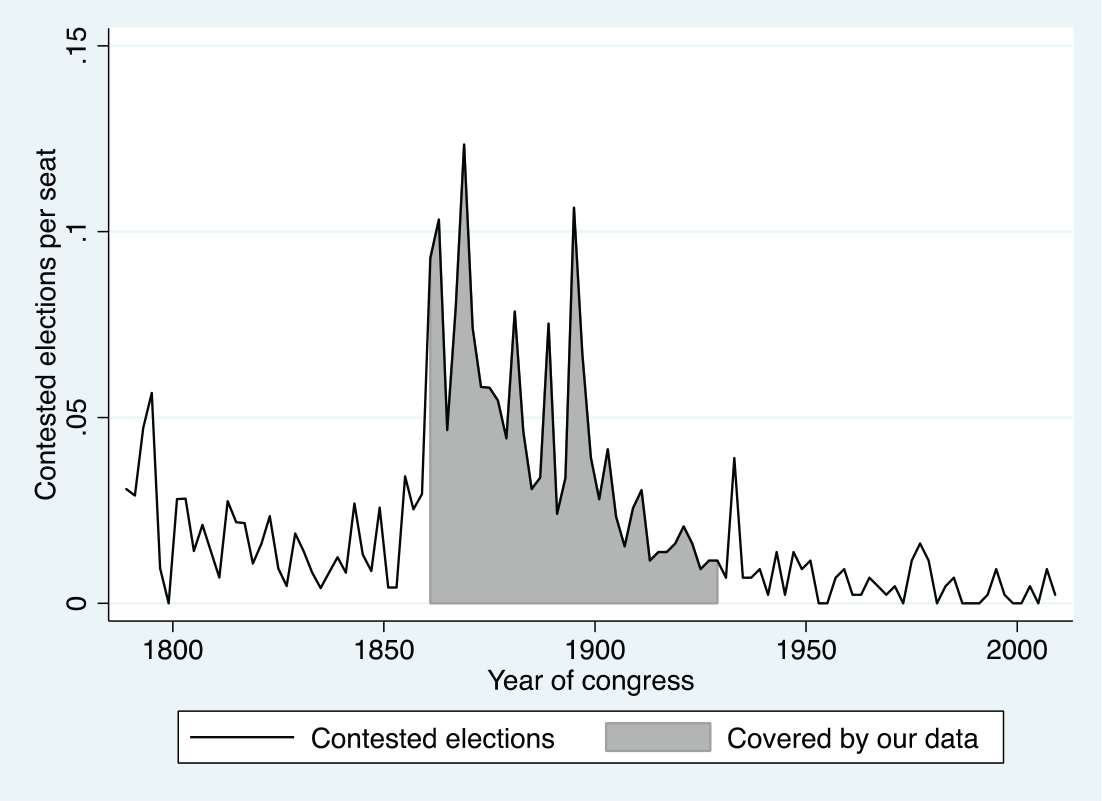
Contested elections to the house of representatives, 1789-2010.
Turning to the original contests filed in the House Committee on Elections archives, we have applied a rigorous coding scheme to account for the motivation for petitioning and the varieties of fraud alleged. First, we distinguish between fraud, referred to as a deliberate plot to influence an election outcome, and irregularities, which refer to unintentional disruptions of election procedure (Lehoucq & Molina, 2002, p. 17). We find over 548 cases of fraud between 1860-1930. We then distinguish fraudulent activities in administering the vote from fraudulent activities aimed at manipulating voters themselves. The first category of fraudulent activities in election administration includes both ballot box tampering on election day, as well as registration fraud before elections (Donno & Roussias, 2012; Kelley, 2012). 19 The second category of fraudulent activities aimed at voters themselves includes vote-buying as well as violence and intimidation. We also account for procedural irregularities by coding instances of registration or balloting errors. 20
The result of the new coding scheme is that there are four types of fraud we can identify (see Figure 2): ballot fraud, registration fraud, vote-buying, and violence and intimidation. For each contested election, we code up to five allegations of fraud or irregularities found in the contest materials. Some cases included many types of fraud, such as elections in the Reconstruction South (which we coded for violence, tampering with ballot boxes, and denying registered voters access to the polls). 21 The evidence for fraud comes from the cases themselves, since the Committee on Elections required ballots, voter registers, witness testimony, and other relevant materials to adjudicate election disputes. Because of the judicial nature of the Committee’s activities, we accept these materials as evidence of fraud. On occasion, we also came across corroboration of fraud in archives, local histories, and print journalism sources, further reinforcing the validity of election disputes. Some of the cases were so notorious that they received national attention, such as those involving railways, 22 fraudulent naturalization, 23 and Reconstruction in the South. 24 The coding decision involved reading the original complaint by the contestant, which enumerated specific claims of fraud, and going through the accompanying materials, which included depositions of voters and election administrators, relevant state case law and campaign materials, and election returns.
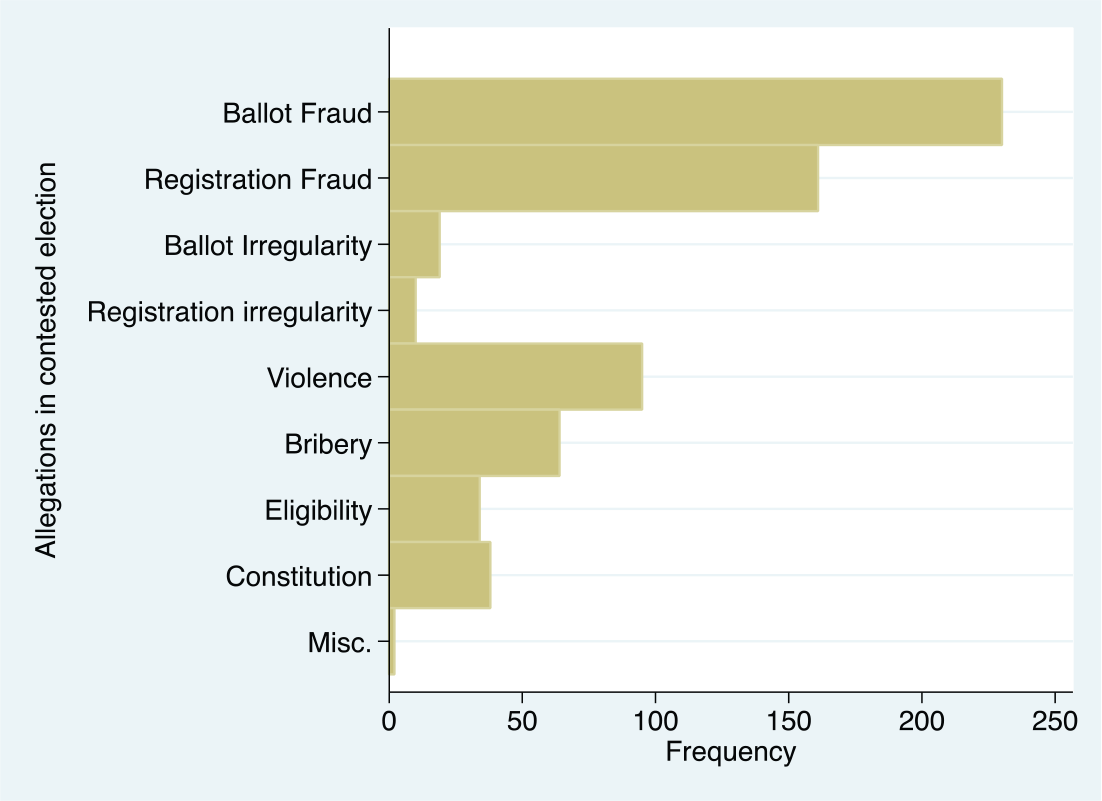
Distribution of types of allegations in cases of contested elections, 1860-1930.
In most cases, contestants alleged multiple types of fraud, although we never found evidence of more than four distinct types of allegations. In an election to the Ninth district of Virginia in 1888, for example, Henry Bowen, the Republican candidate, alleged that the victorious Democrat, John A. Buchanan, had won his seat through illegal voting, bribery, violence, and a conspiracy on the part of election administrators to rig the election. 25 Bowen presented evidence that non-registered voters were brought in to vote, and that election agents used a “Corruption fund” to pay voters sums of between $2.50 and $6 to vote for Buchanan or to abstain from voting. Witnesses testified that the sheriff had offered to forgive fines or refrain from pursuing prosecution if they voted for Buchanan, and employees of Stewart Land and Cattle Company testified to thinking they would lose their jobs if they did not vote for Buchanan. Voters also reported that Republicans engaged in drunken, disorderly conduct, and came to the polls armed with weapons and threatening Democratic voters. This case was coded as including registration fraud, bribery, and intimidation.
There were also cases in which only one or two types of fraud were present. In an election between John Rinaker and Finis Downing in Illinois in 1894, Rinaker alleged many forms of fraud by Downing, including the rejection of legal ballots, illegal voting by non-registered voters, and illegal marking of ballots for illiterate voters. Rinaker presented evidence on all these charges, and also alleged that ballots had been intentionally mis-counted by election supervisors, who tampered with the ballot boxes after the election. This case was coded as indicating ballot fraud and registration fraud. 26 In the case of John Grace versus Richard Whaley, Grace presented evidence that Whaley had spent thousands of dollars before and during the election to bribe voters. 27 This case was coded as indicating vote-buying.
After coding all of the elections to the House of Representatives that were contested between 1870-1930, we find that the most common type of fraud was ballot fraud (see Figure 2). Most contests involved some type of manipulation of the ballot, such as stuffing the ballot box, stealing and destroying ballots, or intentionally mis-counting ballots. Registration fraud was also common, with accounts of election agents denying registered voters access to polling stations or bringing in non-registered voters to vote. Violence and bribery were less common, occurring far less often than ballot and registration fraud. This contradicts the findings of Anderson (2000, p. 27), who argues that violence and intimidation were the most common form of fraud in the United States, and also contradicts Stokes et al. (2013, chapter 8), who uses contested elections as a measure of vote-buying in the 19th century. Violence and vote-buying were not rare—in the South and in some cities, they were common—but ballot and registration fraud were far more widespread. 28
In what follows, we use contested elections based on allegations of fraud, which are coded as 1. We then run a series of logit regressions at the district level over the time period 1860-1930. To take potential time dependency into account, we follow Carter and Signorino’s (2010) recommendation to control for cubic polynomials of time elapsed since last event. We also report robust standard errors clustered on districts to take additional serial autocorrelation into account. 29
The results from the first set of regressions, where we do not distinguish different types of fraud, are reported in Table 1. In the first model we only apply controls for partisan incentives and incurred costs for contesting, the type of election, electoral competitiveness, ex-confederate states, and urbanization. Only some of the variables in this control model affect the likelihood of contesting an election on grounds of election fraud. As expected, a loser is less likely to contest when the winner belongs to the House majority party (in line with Green, 2007), in a high-literacy/educational context, and when the margin of victory is large. Also confirming expectations on the spatial distribution of electoral malpractice, fraud was most prevalent in the South and in larger cities.
Determinants of Fraud in House Elections, 1860-1930.
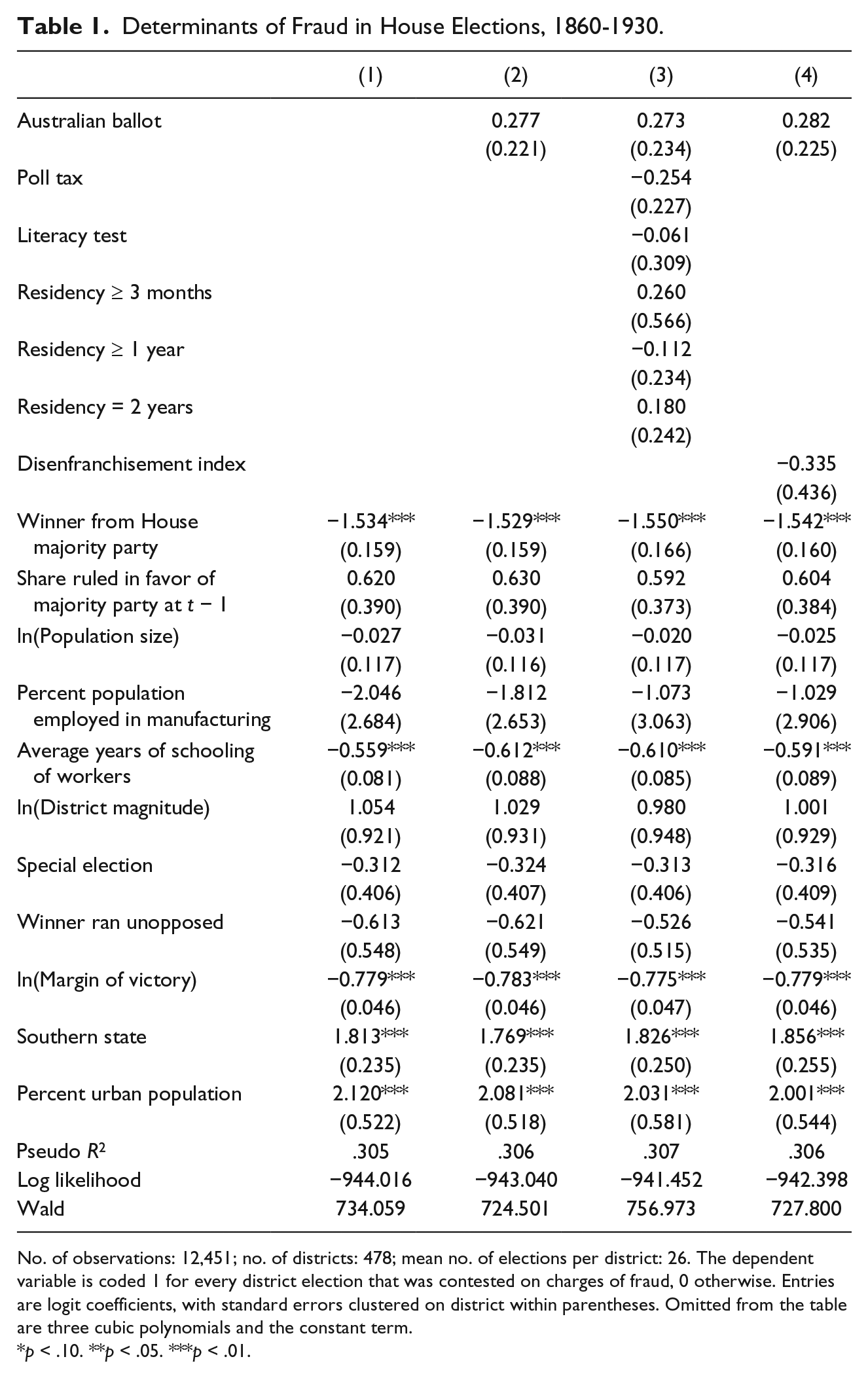
No. of observations: 12,451; no. of districts: 478; mean no. of elections per district: 26. The dependent variable is coded 1 for every district election that was contested on charges of fraud, 0 otherwise. Entries are logit coefficients, with standard errors clustered on district within parentheses. Omitted from the table are three cubic polynomials and the constant term.
p < .10. **p < .05. ***p < .01.
Once these socioeconomic and strategic features of the probability to contest have been controlled for, we can assess the impact of ballot reform. We start in Model 2 by introducing the dummy for Australian ballot. In Model 3 we add the distinct features of disenfranchisement reform: poll taxes, literacy tests, and three thresholds of residency requirements for being allowed to vote. To avoid issues of multicollinearity, in Model 4 these are replaced by an index taking the average of the dummies for poll taxes, literacy tests, and the 1-year residency requirements. All these tests, however, come to a naught. Without disaggregating election fraud into its distinct types, neither the introduction of the Australian ballot nor disenfranchisement seemed to have any impact on the incidence of fraud in congressional elections.
We then further distinguish among different types of election fraud. In Table 2 the dependent variable has been replaced for a dummy coded as 1 if an election was contested on the grounds of either vote-buying or violence/intimidation; in other words, the dependent variable here is voter manipulation, not ballot or registration fraud. We start with the control model, rendering similar results to Model 1 of Table 1. In Model 2, we take the important additional step of controlling for the contested cases that were also based on allegations of ballot and registration fraud. As these two forms of election fraud to a large extent overlap (with a correlation of .55 in our estimation sample), we need to control for one to assess the impact of ballot reform on the other. This is accomplished in Models 3 and 4, where we sequentially introduce the measures for Australian ballot and disenfranchisement.
Determinants of Vote-Buying/Intimidation, 1860-1930.
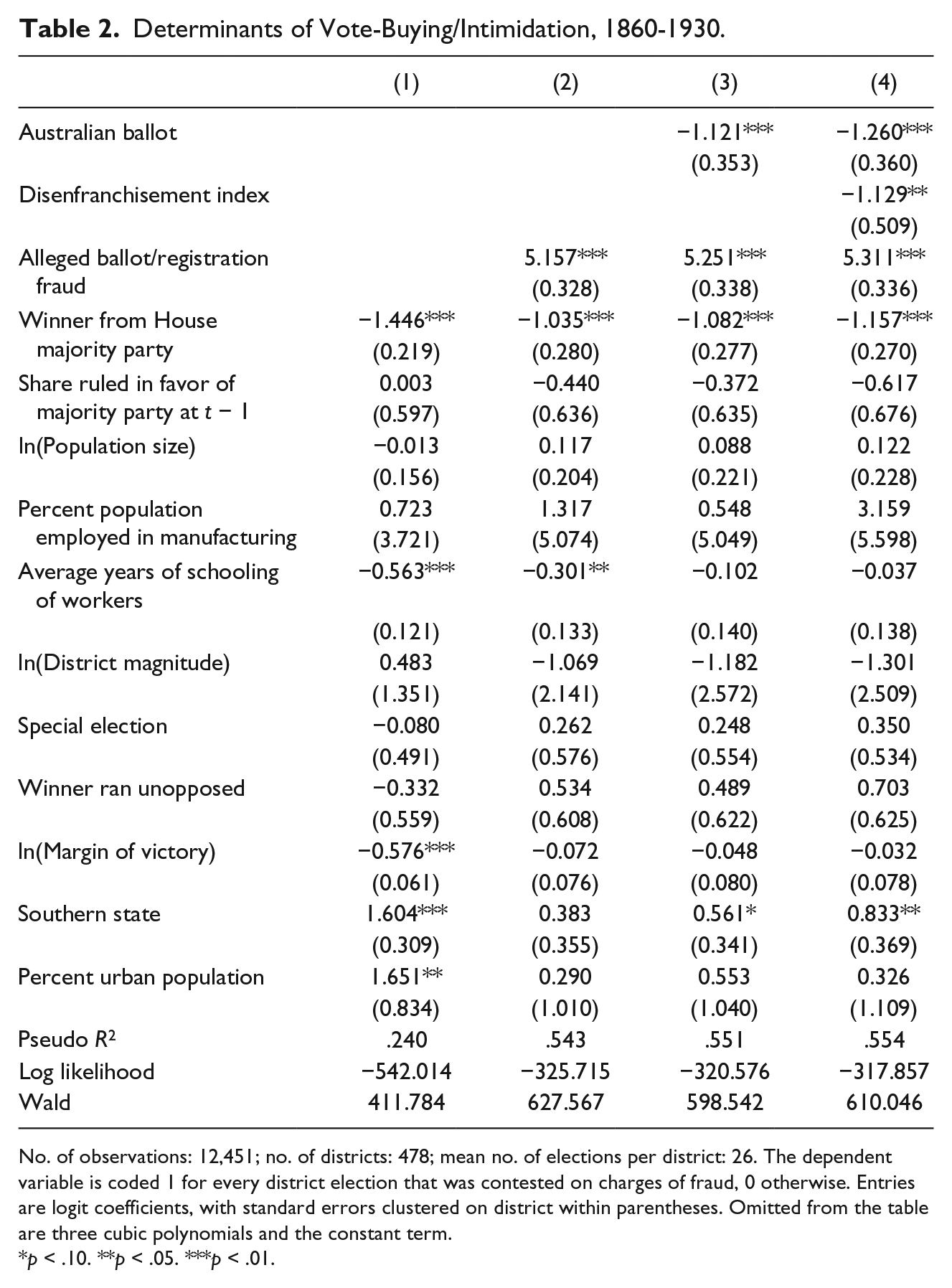
No. of observations: 12,451; no. of districts: 478; mean no. of elections per district: 26. The dependent variable is coded 1 for every district election that was contested on charges of fraud, 0 otherwise. Entries are logit coefficients, with standard errors clustered on district within parentheses. Omitted from the table are three cubic polynomials and the constant term.
p < .10. **p < .05. ***p < .01.
The results clearly confirm H1 that ballot secrecy reduced the extent of voter manipulation. In line with Converse (1972), Rusk (1974), and Heckelman (2000), the Australian ballot seems to have constrained the market for votes and the practice of voter intimidation and violence in the American electorate. 30 Moreover, disenfranchisement seems to have had a similar effect, lending partial support to the argument (H3) that voter manipulation was less common when those most likely to be manipulated lost their right to vote. 31
In Table 3 we examine the determinants of ballot and registration fraud. Model 1 again largely confirms previous findings: elections are far less likely to be contested when the winner belongs to the House majority party, in a context with highly educated voters, where the margin of victory was large, in Southern states and in urban areas. In addition, ballot and registration fraud seems to be an unlikely strategy in races where candidates ran unopposed. These patterns largely remain robust to the inclusion of vote-buying/intimidation in Model 2, thus confirming that they pertain to the practice of vote fraud per se. As can be seen in Models 3 and 4, however, where ballot reform is being assessed, the pattern deviates significantly from that in Table 2. Whereas the introduction of the Australian ballot seems to have increased the incidence of ballot stuffing, registration padding, or more obscure illicit election tactics, in line with H2, disenfranchisement has no similar effect. 32
Determinants of Ballot/Registration Fraud, 1860-1930.
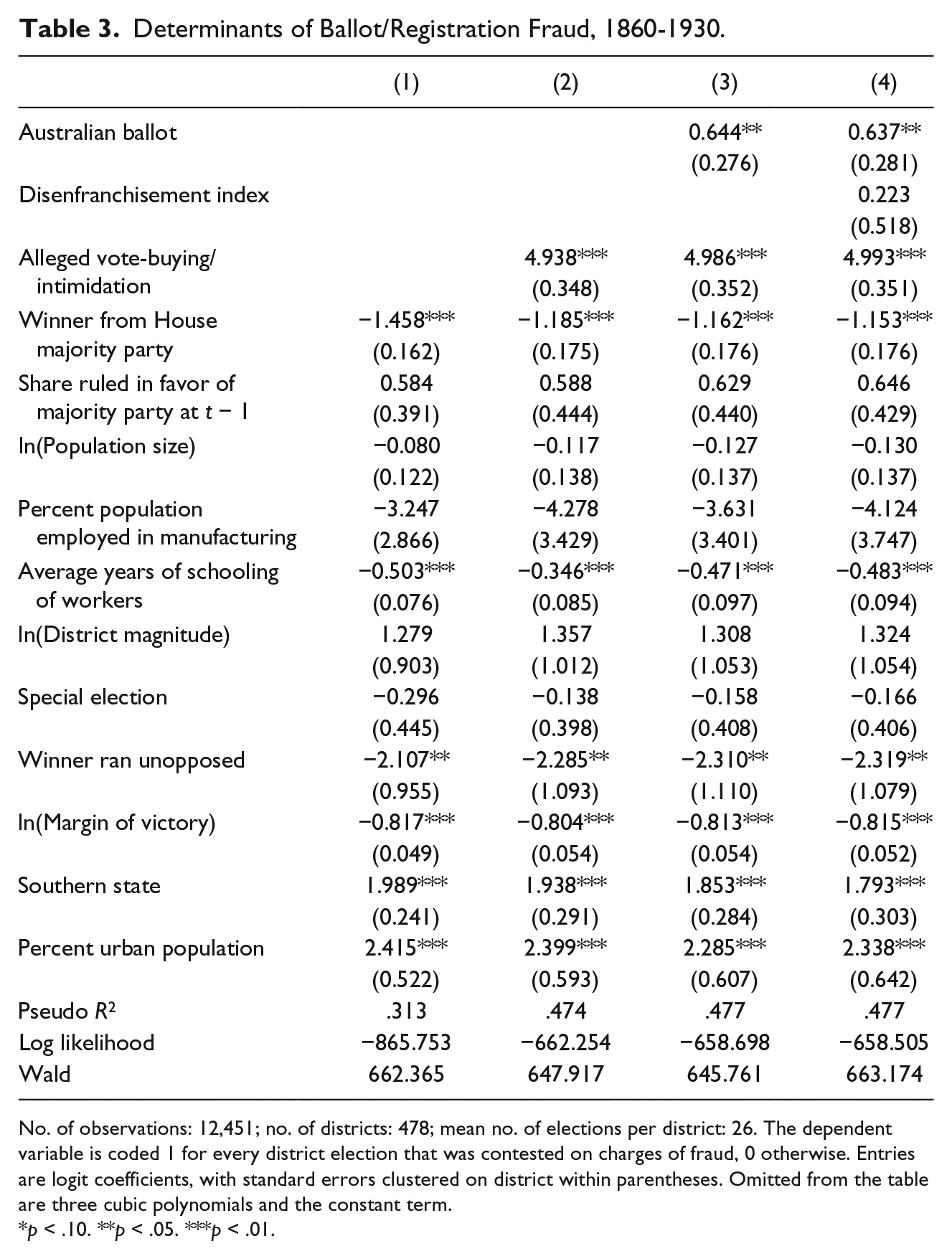
No. of observations: 12,451; no. of districts: 478; mean no. of elections per district: 26. The dependent variable is coded 1 for every district election that was contested on charges of fraud, 0 otherwise. Entries are logit coefficients, with standard errors clustered on district within parentheses. Omitted from the table are three cubic polynomials and the constant term.
p < .10. **p < .05. ***p < .01.
In Figure 3 we combine these results and display the substantive effects in terms of predicted probabilities. The upper panel graphs the effects of Australian ballot and disenfranchisement reform from Model 4 of Table 2, and the lower panel the corresponding effects from Model 4 of Table 3. As should be clear, contested elections alleging fraud of any kind are rare events, but the relative frequencies before and after reform mark fairly substantial effects. In line with H1, the introduction of the Australian ballot reduced the likelihood of vote-buying and/or intimidation by some 60% (upper left). The corresponding reduction induced by disenfranchisement is some 50% (upper right), confirming H3. By contrast, voting secrecy led to an increase in alleged ballot and/or registration fraud by some 40% (lower left), confirming H2. As the overlapping confidence intervals indicate, this effect is estimated with far less certainty than the effects concerning vote-buying and intimidation, but it is statistically significant at conventional levels. There is no effect of disenfranchisement (lower right), which means we only partially confirm H3.
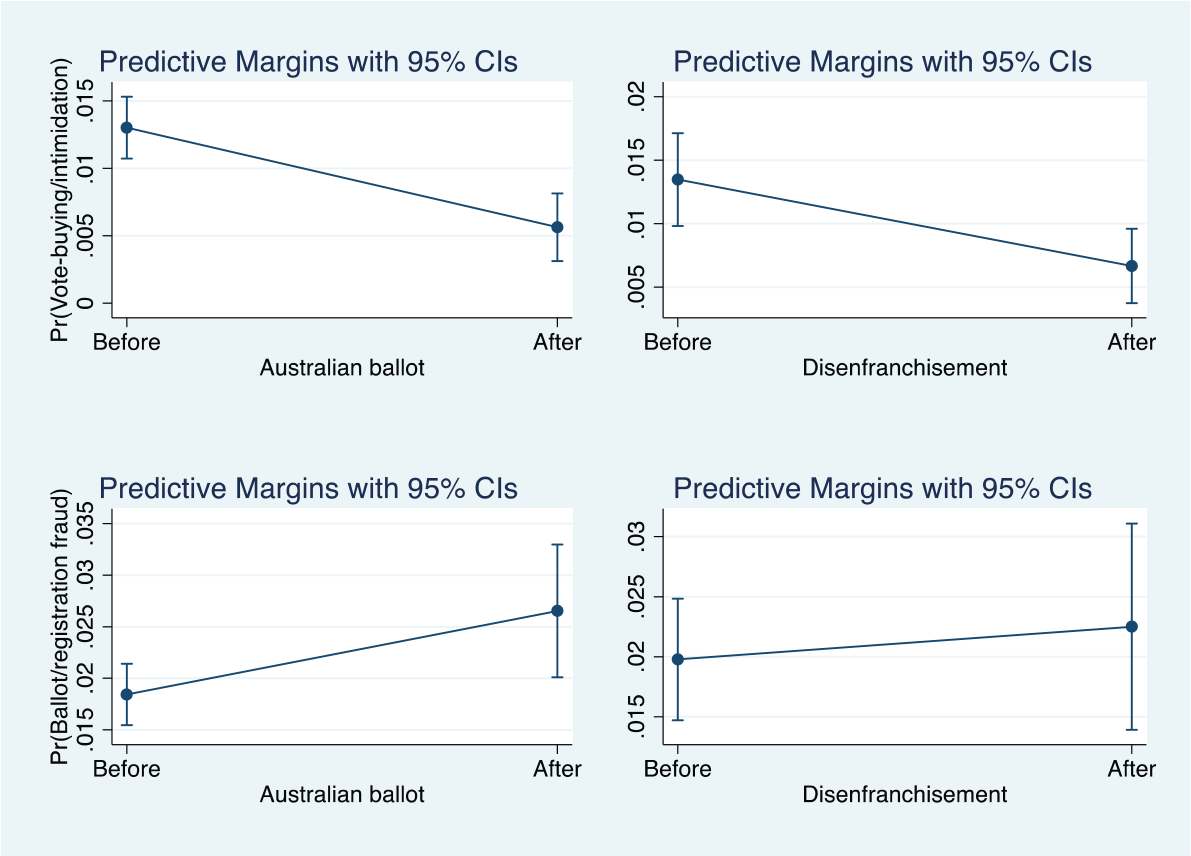
Probability of types of fraud before and after ballot reforms.
These findings are robust to several alternative specifications: (a) a more generous coding of Australian ballot reform that codes “adoption” as the year any part of state introduced the Australian ballot, rather than the entire state 33 ; (b) allowing shoe-string ballots to count as “Australian”; (c) to the application of other residency thresholds in the disenfranchisement index; and, finally, (d) to the exclusion of races where the winner ran unopposed. 34
Conclusion
Although scholars debate the extent and types of fraud in 19th-century American elections, most agree that the level of fraud has declined over time. In this article, we use contested elections to the House of Representatives to examine fraud from 1860-1930, a period of widespread electoral abuse. By developing a more rigorous coding scheme accounting for different types of election fraud, this article assesses the impact of two institutional reforms on the incidence of two types of fraud. In sum, we find the clearest evidence in favor of H1 and H2. The Australian ballot reduced voter manipulation by making it more difficult for election agents to monitor the effects of intimidation and vote-buying. Instead, agents relied more heavily on fraudulent ballot and registration tactics, such as manipulating election registers and stealing elections at the ballot box. We further find that disenfranchisement obviated the need to manipulate voters directly, but had no visible effect on ballot fraud.
This article contributes to the literature on electoral fraud by showing that institutional reforms have an important, but limited, impact on fraud. Ballot secrecy in the American case deprived election agents of the ability to engage in fraud with individual voters, but did not affect the ability of election agents to steal elections. Instead, party agents often substituted other forms of electoral manipulation. This is an example of what Schaffer (2008) calls an “iatrogenic” effect of clean election reform—that is, a cure that itself caused illness.
Our result that voting secrecy reduced vote-buying and other clientelistic practices is consistent with similar arguments about developments in Chile after the 1958 introduction of the Australian ballot (Baland & Robinson, 2007), and about Britain after the Ballot Act of 1872 (Kam, 2016). That voting secrecy increased the incidence of other types of electoral malpractice supports Collier and Vicente’s (2012) argument to view these as strategic substitutes. More research is needed to pin down the potential calculations behind this shift in tactics among the key players in American elections—that is, the political parties themselves. Our approach to theorize the calculus of whether or not to contest an election needs to be complemented by a similar calculus of whether or not to engage in fraud (cf. Beaulieu & Hyde, 2009; Hyde, 2011; Simpser, 2014). We also need to examine the extent to which ballot reform had similar repercussions across different types of elections in the United States, including presidential, state, and local elections.
Finally, although there was variation in the type and extent of fraud over time in the United States, fraud of all sorts declined over a half-century in national elections. The substitution effect was short-lived. Future research should therefore address how deeper structural factors that reduce election fraud also explain variation in fraud over time.
Footnotes
Acknowledgements
The authors would like to thank Jim Alt, Fabrice Lehoucq, Federica Genovese, and Daniel Ziblatt for invaluable comments to previous versions of this paper. We would also like to thank the Center for Legislatives Archives in Washington, DC, and the Center for American Political Studies, Harvard University, for support, as well as the Wenner-Gren Foundation and Swedish Research Council for funding.
Declaration of Conflicting Interests
The authors declared no potential conflicts of interest with respect to the research, authorship, and/or publication of this article.
Funding
The authors received no financial support for the research, authorship, and/or publication of this article.