



Abstract
Personality research is a growing field in political behavior, but most research to date is confined to democracies. We expand the scope to Russia, an authoritarian regime, and find that the impact of personality is substantial but different from the existing literature. We find that agreeableness, a personality trait associated with a desire to maintain positive relations with others that is usually peripheral to politics, becomes the single most important and consistent trait affecting attitudes. This perspective helps us to understand why individuals who are socioeconomically and demographically similar can have quite different attitudes to the regime. Our analysis also helps us to understand the mechanisms through which personality works and how it shapes attitudes to such important elements as religion and state propaganda. Our findings suggest a new, and empirically testable, mechanism behind situations in which regimes rapidly dissolve, including revolutions.
Keywords
Why do some people living under authoritarian regimes support and even vote for their rulers, while others do not? The underlying dynamics of regime support and opposition are central to our theories of revolution (Kuran, 1991) and democratization (Bunce & Wolchik, 2011), and there has been voluminous research into patterns of political attitudes and voting in nondemocratic and semidemocratic regimes. Most of the literature focuses on pocket-book or sociotropic economic sentiment (Magaloni, 2006; Treisman, 2011), social class (Roberts & Arce, 1998), ethnic identities (Posner, 2005), and basic ideological orientations toward democracy and authoritarianism (Seligson & Tucker, 2005). In addition, other strands in the literature stress the effect of regime strategies such as patronage distribution (Blaydes, 2011), manipulation of media (Enikolopov, Petrova, & Zhuravskaya, 2011), and cooptation (Reuter & Robertson, 2015).
However, students of political behavior have discovered that divergences in political opinions and behaviors have other, often deeper, sources of variation than economics, information, or the behavior of political authorities. People in the same economic situation, with the same information, in the same social context can still differ wildly in their political perceptions and participation. One source of such variation are deep and durable orientations or personality traits that structure the different ways in which people experience and interpret their social surroundings and lead them to interact differently with the political world (Bakker, Rooduijn, & Schumacher, 2015; Gerber, Huber, Doherty, Dowling, & Ha, 2010; Haidt & Joseph, 2004; Hetherington & Weiler, 2009; Mondak, Hibbing, Canache, Seligson, & Anderson, 2010).
Although we know increasing amounts about the relationship between personality traits and political preferences, social and economic orientations and participation in democracies, contemporary thinking about the role of personality has not yet been applied to authoritarian contexts. However, the idea that support for authoritarianism might be related to personality is not new. Adorno, Frenkel-Brunswik, Levinson, and Sanford (1950) posited such a relationship more than 50 years ago in their highly influential book, The Authoritarian Personality, and others have used variants on Adorno’s concept to look at distributions of personality types in different regimes. In fact, the particular case we look at, Russia, has been a rich source of theories on how personality and politics are shaped by everything from swaddling infants (Gorer & Rickman, 1949) to government-organized education (Mead, 1951), to the experience of living in a state that officially espoused egalitarianism (McFarland, Ageyev, & Djintcharadze, 1996). In this article, we look at the relationship between personality and political regime drawing neither on Adorno nor the literature on authoritarian personalities (although our results are robust to including measures of authoritarianism), but instead—by focusing on the most widely accepted contemporary approach to understanding and measuring personality in contemporary psychology—the so-called “Big Five” personality traits of “openness,” “conscientiousness,” “extraversion,” “agreeableness,” and “neuroticism.” In doing so, we make three principal contributions.
First, we show that the relationship between personality and politics changes enormously when we move out of the democratic context. Although the personality traits of conscientiousness and openness are the central factors in determining political attitudes in most of the existing literature, they are not the most important factors in our study. Instead, agreeableness, a personality trait associated with a desire to maintain positive social relations, which the existing literature finds weakly and inconsistently related to politics, becomes the single most important and consistent trait affecting attitudes in authoritarian contexts. How agreeable a citizen is plays a central role in shaping that person’s vote choice, the emotions he or she feels toward the leadership, and his or her position on specific issues.
Second, our article contributes to understanding the mechanisms that connect personality and politics. The issue of just how personality traits interact with context to create specific outcomes at the individual level is a cutting edge issue in personality psychology (Fleeson & Jayawickreme, 2015), and one we cannot resolve definitively here. Nevertheless, there are a number of features of authoritarian regimes that we argue are likely to shape the relationship between personality and politics. Whereas democracy legitimizes the existence of different political positions, autocracy delegitimizes difference and disagreement, particularly in contexts where the regime is able to link support for the incumbents with patriotism. The delegitimization of dissent is reinforced by state media, political leaders, and officially approved social institutions. In such a context, to disagree is to invite conflict, leading opposition to be primarily the domain of people willing to accept social marginalization.
We illustrate this causal chain using the example of attitudes to gay rights. Modeling the relationship between personality and political preferences as mediated by other factors, we present evidence that personality traits matter mostly indirectly, primarily by shaping media choices, basic political orientations, and attachment to the official church, factors that in turn have a large effect on attitudes. Hence, the relationship between personality and politics is highly contextual. Rather than simply underpinning an innate preference for liberal or conservative leaders, or for pluralism or authoritarianism, how personality interacts with politics depends heavily upon the nature of the political environment.
Third, the research presented here also has important implications beyond the literature on personality and politics, contributing to a new way of thinking about the political foundations of authoritarian regimes and the potential sources of political change. To date, political psychology is marginalized in the study of regime dynamics, which have typically been understood in largely material terms (Acemoglu & Robinson, 2009; Magaloni, 2006). The most influential analyses of regime change that focus primarily on individual-level psychology are either strictly rationalist in orientation (Lohmann, 1994) or rely on preference falsification (Kuran, 1991). By contrast, we provide a richer and more realistic perspective on how authoritarianism is constructed and how it might change by basing our analysis on well-established general conceptions of human psychology. Our results confirm earlier work emphasizing the importance of social conformity to authoritarian regimes (Havel & Wilson, 1985) and suggest an empirically tractable way of monitoring key factors likely to shape dynamics.
Our arguments are based on evidence from contemporary Russia. In developing our story, we seek to be explicit about what might be general and what might be specific to the Russian case. To the extent that our findings are a product of unique features of Russian culture or history, the argument may not travel far. However, there are a number of features of contemporary authoritarianism in Russia that are quite general. In recent years, Russia has shifted from a relatively soft form of authoritarianism to a variant that involves considerably more coercion, control, and mobilization, as the state actively tries to mobilize a “healthy” and “patriotic” majority against threats from outsiders and “deviants.” This strategy of accentuating an “us” and “them” distinction is clearly an important tool used by a variety of contemporary authoritarians. Moreover, the political strategy of the regime is implemented in a context where the state plays a major role in the economy and where politics are largely de-ideologized, conditions that are common in the contemporary world.
Personality Traits
The idea that there are deep underlying personality traits at the individual level that shape how a person interacts with the world has a long theoretical and empirical history in psychology (John & Srivastava, 1999). The basic model of personality traits sees them as “core dispositional personality traits” that are prior to “values, [and] attitudes (including political attitudes such as ideology)” (Gerber et al., 2010, p. 113). Traits are acquired very early in life (Caspi et al., 2003) as a result of the interaction of genetics (Bouchard, 1994) and early childhood experiences (Krueger, Johnson, & Kling, 2006; Mondak et al., 2010). Traits show significant stability over the course of a person’s life (Caspi & Bem, 1990; McCrae & Costa, 1984), though they can continue to evolve even into old age (Roberts & Mroczek, 2008).
While there are a number of different ways of conceptualizing personality, much of the most promising work in contemporary personality research focuses on the so-called “Big Five” personality traits (Goldberg, 1981). The term Big Five is intended to underline not only the importance of the five traits but also the fact that the traits are conceptualized at a high level of abstraction, and that each contains subelements within it. Although there are differences of opinion over the labels used, the five factors are generally labeled openness/intellect, conscientiousness, extraversion, agreeableness, and neuroticism (OCEAN).
Research on the Big Five in psychology has been prodigious, both in the direction of tracing the sources of traits and in understanding their effects. Work by personality neuroscientists has uncovered the roots of traits in the biology of the brain, demonstrating associations between the traits and differences in neural reactivity when cognitive and emotional processing is taking place (DeYoung, 2010). At the other end of the causal process, studies have shown strong relationships between personality traits and important life outcomes such as self-esteem and subjective well-being, spirituality and values, health and life expectancy, mental illness, peer and family relationships, romantic love, occupational choice, job performance and success, volunteerism and criminality (Ozer & Benet-Martinez, 2006; Roberts, Kuncel, Shiner, Caspi, & Goldberg, 2007).
Personality Traits and Politics
The literature on the relationship between the Big Five personality traits and politics is dense, but clear in its conclusions. As Carney, Jost, Gosling, and Potter (2008) put it, a remarkable consensus [has emerged] over more than seven decades (and across numerous cultures and languages) that the two personality dimensions that should be most related to political orientation are openness to experience—consistently theorized to be higher among liberals—and conscientiousness—sometimes theorized to be higher among conservatives. (pp. 815-816)
Other traits have played a relatively minor role, though they do figure in some studies. For example, Bakker, Klemmensen, Nørgaard, and Schumacher (2015) found that while openness was a key explanation of who was likely to switch political parties from one election to another, extraversion might also play a (negative) role.
In contrast to most of the existing literature, however, in this article, we focus not on conscientiousness and openness but on agreeableness. As we discuss in the next section, although agreeableness has played an inconsistent role in the research on personality and politics, there are good reasons to expect it to be particularly important in authoritarian contexts.
Agreeableness
Agreeableness is the personality factor primarily concerned with interpersonal relationships and is defined in terms of an underlying desire to maintain positive relations with others (Digman, 1997; Graziano & Eisenberg, 1997). As with the other personality traits, different kinds of language are used by different scholars to elucidate just what the prosocial trait of agreeableness entails, but Mondak (2010, p. 58) reports “virtually all scales used to represent agreeableness employ terms such as warm, kind, and sympathetic.” This characterization of agreeableness would seem to link most obviously to social and economic liberalism and to general attitudes of tolerance and, indeed, there are many studies that support this idea. Highly agreeable people have been shown to engage more in a variety of behaviors such as sharing, donating, caring, comforting and helping (Caprara et al., 2010). Highly agreeable people are more likely to contribute their time as volunteers (Carlo, Okun, Knight, & de Guzman, 2005) and are more likely to show “normative commitment” to a job or organization, due to an enhanced sense of social identity (Erdheim, Wang, & Zickar, 2006).
However, research suggests that agreeableness is not just a placid state but also involves “effortful control” of frustration (Ahadi & Rothbart, 1994; Jensen-Campbell et al., 2002). Kieras, Tobin, Graziano, and Rothbart (2005) show that school-age children who score high on agreeableness exhibit less disappointment when receiving an unsatisfactory gift than other children. Similarly, Jensen-Campbell and Graziano (2001) find that highly agreeable people process conflict differently, generating positive perceptions of what less agreeable people see as provocative behaviors (Jensen-Campbell and Graziano 2001). In looking at the relationship between agreeableness and social prejudices, Graziano, Bruce, Sheese, and Tobin (2007) find that the prosocial desire to “get on” of agreeable people makes them act in less prejudiced ways and exhibit less racial bias. However, there is evidence that this result derives more from an effort on the part of agreeable people to “suppress normatively inappropriate prejudices” rather than from simply being less prejudiced. The authors attribute lower levels of behavioral prejudice to the ability “to deploy attention strategically and to engage in positive interpersonal behaviors in the face of frustration” (Graziano et al., 2007, p. 567), and find that highly agreeable people exhibit prejudice when given permission to do so by the context (Graziano et al., 2007).
Despite the centrality of social approval and conflict management in the psychology literature on agreeableness (two elements, one might think are important in politics), the political science literature has tended to see agreeableness as peripheral. Barbaranelli et al. (2007) found that agreeableness (along with openness) was associated with voting for the Democratic presidential nominee, John Kerry, in 2004, a finding consistent with previous research in Italy suggesting that higher agreeableness was associated with support for center-left candidates (Caprara, Schwartz, Capanna, Vecchione, & Barbaranelli, 2006). Gerber et al. (2010), using very large samples (N = 12,472), found evidence that agreeableness was positively associated not only with economic liberalism but also with social conservatism, and not at all with ideology. More recently, Bakker, Rooduijn, et al. (2015) have shown that people low on agreeableness are more likely to support populist candidates or groups such as the U.S. Tea Party, the Dutch Party for Freedom, or the German Left Party.
In perhaps the most comprehensive study to date, Mondak (2010) looked at a range of possible relationships between personality and politics in the United States. As with Gerber et al., the findings for openness and conscientiousness were strong and consistent, while those for the other traits were generally weak and variable. On agreeableness, Mondak found “sparse” results for the effect of agreeableness on political knowledge, attention, and opinion, arguing that agreeableness might be “modestly depoliticizing” (Mondak, 2010, p. 119). On political efficacy and ideology, he found no effect (Mondak, 2010, p. 124-128). On partisanship, there was some evidence that agreeable Americans were more likely to be Democrats, but it was not possible to distinguish this effect from the effects of a particular political context (Mondak, 2010, p. 132-134). Finally, there was weak evidence that agreeableness “may matter on the margins for moral traditionalism and moral judgment” (Mondak, 2010, pp. 135-138). Taken together, these studies suggest agreeableness is weakly and inconsistently associated with politics in democracies, in sharp contrast to what we see in authoritarian Russia.
Agreeableness and Authoritarianism
Given the nature of agreeableness as a trait, how it interacts with politics in authoritarian regimes is of particular interest. Authoritarian regimes, almost by definition, delegitimize difference and debate. Whereas in democracies, being critical of the head of state or government is generally seen as compatible with being a loyal citizen, in authoritarian regimes, being critical can be dangerous. The degree to which this applies, of course, varies significantly across authoritarian regimes—publicly criticizing the government is a much more dangerous thing to do in North Korea, for example, than it is in contemporary Kazakhstan. However, even in those authoritarian contexts where expressing dissent is not particularly dangerous, loyalty to the state and the regime are inevitably mixed up in assessments of the incumbent administration. Consequently, being critical or supportive of the government has quite different social meaning than it does in a democracy.
In a democracy, support for the incumbents is likely to be met with social approval in some contexts and disapproval in others. By contrast, in authoritarian regimes the sphere of legitimate and socially acceptable disagreement with incumbents is much smaller and, typically, there is an active propaganda effort to make sure citizens are aware of these limits. To disagree is to actively invite conflict with accepted norms in all but the most politically marginal of settings. Hence, people who are more strongly disposed toward social acceptance will be more reluctant to express oppositionist sentiment, while those who like to be different and stand out will tend to take oppositionist stands. This effect is likely to be even more important where the incumbents are able to equate support for them and their policies with patriotism. As a result, we would expect agreeableness to be both more important and more closely related to positive evaluations of the existing political regime and its policies and values than in democracies.
There are also deeper reasons to expect that agreeableness will matter more in autocracies than in democracies. One of the pillars of democracy is a free press, in which different viewpoints are accorded (at least in theory) equal legitimacy and state support. This is not the case in autocracies, where there is typically a clear set of state-owned and/or state-allied media outlets that support the personnel, policies, and values of the regime. This is likely to be true even in those contexts in which nonofficial or even opposition news sources exist and are accessible. More agreeable people, valuing social acceptance more highly, are more likely to pay attention to official sources than to opposition sources and so, consequently, they are more likely to be exposed to and accept official versions of events than less agreeable people.
Furthermore, the case of the media is likely to be just one special case out of several “official” institutions that are state supported and follow the regime line. Such institutions are likely to vary across contexts, but might include churches, youth organizations, and even social customs. It is plausible to think that more highly agreeable people may be more likely to participate in those officially sanctioned institutions, too, than less agreeable people (assuming some sort of choice is possible). If so, participation in state-sponsored or state-supporting institutions will also serve to increase the importance of agreeableness as a factor in explaining patterns of support and opposition.
Research Design
In the rest of the article, we investigate these claims using a two-stage strategy. First, we demonstrate the importance of personality traits in shaping support for the regime, orientations toward the leadership, and views on a range of contemporary socioeconomic and policy issues. We show the fundamental role of personality, and in particular agreeableness, even once we control for socioeconomic and demographic factors generally thought to shape political opinions.
In the second stage, we investigate the mechanisms through which personality influences political views. Taking the specific example of attitudes to gay rights, we show how personality “mediates” opinion through its effects on media choice, support for the president, and religiosity.
Case Selection: Authoritarianism and Personality in Russia
We conduct our analysis using data from Russia. As noted above, research suggests that the particularities of context are likely to be important in shaping the relationship between personality and politics (Mondak et al., 2010). Consequently, it is important to reflect on what might be specific about the Russian experience and what might be more general. In this section, we identify three factors that might shape how Russians interact with their political environment and may be consequential for our results—the nature of the political regime, the structure of the economy, and the role of ideology and nationalism in politics.
After a period of relative political liberalization in the decade following the collapse of the Soviet Union, Russia appeared by the mid-2000s to have consolidated as a hybrid authoritarian state, in which a carefully curated political space allowed for multiparty elections, a modicum of opposition, and a degree of open political debate (Colton & Hale, 2009). While precise levels of support for President Vladimir Putin, his proxy Dmitry Medvedev, and their ruling United Russia party fluctuated, the regime was bolstered throughout most of the decade by robust economic growth, rising standards of living, and general feelings of personal and national well-being.
That changed in December 2011. In parliamentary elections, the ruling United Russia party garnered only 49.3% of the officially reported vote, a 15-percentage-point drop from their previous result. To make matters worse, a series of protests in Moscow and other big cities brought hundreds of thousands of people out to the streets alleging widespread electoral fraud. The Kremlin responded with a significant shift in rhetoric, accusing the protestors and opposition leaders of being a Western-backed fifth column, accentuating wedge issues such as homosexuality, the Orthodox Church, and a supposed foreign threat to Russia’s sovereignty, and mobilizing around a conservative, “us vs. them” political narrative. This discursive shift was reinforced after Putin’s reelection in March 2012, supplemented by much heavier reliance on arrests, trials, and judicial persecution than before (Greene, 2014). This is the political context in which we conducted our survey.
Nevertheless, as much as they may have been affected by current developments, our respondents are also bearers of much more deeply rooted traditions, practices, and habits of political behavior. Some 48% of our respondents are above 40, meaning that many were politically socialized in the USSR. Moreover, even those who are too young to remember that era are likely to have been influenced politically to some degree by Russia’s long historical experience with dictatorship and absolutism. It is not clear, therefore, how to weight the impact of the contemporary political environment and the legacies of the Soviet experience. To the extent that what we find is the result of the contemporary context, the Russian results are likely to be generalizable across a range of authoritarian regimes to which the contemporary Russian regime bears a family resemblance. By contrast, to the extent that what we are picking up the legacies of Soviet history, the universe of comparative cases may be more limited.
A second factor that makes Russia look more similar to some contemporary authoritarian regimes is the structure of the economy. The Russian middle class—which is overrepresented in our sample by design, and which was overrepresented in the 2011-2012 protest movement by most accounts—is heavily dependent upon the state (Gontmakher & Ross, 2015). McMann (2006) has described at length the mechanisms that discourage political activism among Russian citizens who are directly or indirectly dependent on the state, and some 45% of our sample reported working in the state sector. In addition, independent election observers have repeatedly reported that state employees are expected (and often coerced) into voting for the ruling party and its candidates (Panfilova & Sheverdiaev, 2005). Thus, it may be that our results are more relevant to the (relatively common) situation in which an authoritarian state plays a major role in the economy.
Third, Russian politics are weakly ideologized but heavily influenced by nationalism. Ideology has not been found to shape citizens’ party affiliations (Hanson, 2010) or vote choice (Hale, 2008), supplanted by “effective calculations of their costs and benefits and risk-aversion under conditions of uncertainty” (Gel’man, 2015, p. 35). Citizens, in turn, learned to mistrust ideological debate and politicians who cloaked themselves in ideological trappings (Clément, 2013). The only thing that comes close to a broadly accepted ideology is the idea of Russia’s and Russians’ “uniqueness” (Dubin, 2011, p. 225). This differentiation of the unique Russian “us” from the universal, non-Russian “other” has the unavoidable effect of suppressing any divisions among “us”; individuals who accept the idea of Russian uniqueness are thus incentivized to be just like everyone else. To illustrate this effect, recent focus group research into how young Russians process political information, received through online social media, finds that having an “opinion corresponding to the majority” is a critical marker of trustworthiness; Russians seek out (and reproduce) ideational conformity not to reinforce their own views, but for “avoidance of risk and ‘betrayal’” (Mickiewicz, 2014, pp. 88-89).
The extent to which each of these factors shapes the results that follow will only become clear with research in other contexts. Many contemporary authoritarian regimes are marked by sharp “us vs. them” rhetoric, large state sectors, and de-ideologized and nationalistic politics. However, states inevitably vary in the degree to which each of these elements is present, and further research will be needed to uncover the extent to which our findings generalize beyond Russia.
Data Collection
Our data collection took place in October 2013, 1 month after mayoral elections in Moscow, Ekaterinburg, and a number of other cities. The survey included Moscow and respondents from all 13 cities in Russia with a population of more than one million people.
The survey was conducted online and focused on a key political demographic in Russia—educated, upper income, Internet-using urbanites. The target sample was designed to represent upper and middle-income Internet users between 16 and 65 years, with some higher education and who live in cities with a population of more than one million. Invitations were stratified on age and gender based on Internet penetration data. Respondents were screened on the basis of education, city of residence, and income, with only those who said they could at least afford food and clothes being surveyed. About 1,200 respondents completed the full questionnaire. 1
The sampling strategy we adopted offers a number of significant advantages over a classic nationally representative sample. To learn about a relatively small group such as supporters of the Russian opposition, we need a tailored sample that provides significant numbers of people willing to oppose the incumbent regime (and admit to it). Although broad national surveys indicate some level of opposition, the population sampled here demonstrates considerably higher levels. This is important because the more balanced distribution of opinion in this group means we can expect more meaningful answers to survey questions and greater statistical power.
Clearly, however, this advantage is also potentially a drawback—the specific distribution of attitudes and opinions we find are not representative of patterns in the population as a whole. This nonrepresentativeness would be a problem if we were trying to estimate mean levels of key variables in the population. Fortunately, we are not. Instead, we are interested in the interrelationships between personality measures and political variables, and there is no reason to believe that the range restriction in our sample would either flip the relationships of interest or so severely curtail variation as to radically change the size of the coefficients of interest. As the descriptive statistics in Supplementary Appendix B demonstrate, there is ample variation within our sample on all the personality variables.
Measuring Personality
There are many different approaches to measuring traits in personality psychology. In particular, approaches vary enormously in the number of questions used to measure traits (Gerber, Huber, Doherty, & Dowling, 2011, p. 267). Many studies include up to 20 questions per trait to maximize the internal validity of the measures. In our study, we followed Gerber et al. (2010; Gerber, Huber, Doherty, & Dowling, 2011; Gerber, Huber, Doherty, Dowling, Raso, et al., 2011) in using the simple standard Ten-Item Personality Inventory (TIPI) of Gosling, Rentfrow, and Swann (2003). Respondents were asked, “Here is a list of characteristics that a person might have. For each of them, please tell us the extent to which each describes or does not describe you personally.” As in the standard TIPI, respondents were offered a seven-point scale and the following traits:
Openness—“open to new experiences, complex”; “conventional, uncreative”
Conscientiousness—“dependable, self-disciplined”; “disorganized, careless”
Extraversion—“extraverted and enthusiastic”; “reserved and quiet”
Agreeableness—“sympathetic, warm”; “critical and quarrelsome”
Neuroticism—“calm, emotionally stable”; “anxious, easily upset”
The TIPI approach is extremely useful for political science applications where surveys include many questions on issues other than personality, and so brevity is important. Despite being short, the TIPI scale correlates well with longer batteries of personality questions (Gosling et al., 2003). Moreover, while the TIPI is clearly quite crude, Carney et al. (2008) examined a range of more subtle measures designed to address the possibility that liberals and conservatives might present themselves to the world differently, and their findings confirmed much of the existing literature. Gerber, Huber, Doherty, and Dowling (2011) compared the TIPI with the longer (44 items) Big Five Inventory (BFI) and found “little evidence that the choice of personality battery is particularly consequential in models predicting political attitudes” though for political interest and turnout, there was variation between the two measures across all five traits (Gerber, Huber, Doherty, & Dowling, 2011, pp. 280-282). Given that we are primarily interested here in attitudes, these results are reassuring.
Another key reason for using the TIPI measure was that because we were working in a new context, it was important to use a well-known and widely validated battery of personality questions to maximize the degree to which our findings would be comparable with the existing literature. Thus, rather than developing our own battery as some scholars have done (Mondak et al., 2010), we translated an existing measure that has been used in a number of very prominent studies in political science (Gerber et al., 2010; Gerber, Huber, Doherty, & Dowling, 2011; Gerber, Huber, Doherty, Dowling, Raso, et al., 2011) and in hundreds of more studies by personality psychologists. At the time of writing this article, the TIPI has been cited some 3,000 times. 2 Nevertheless, this approach still raises the issue of translating the TIPI into Russian. Because there is no standard Russian language TIPI, we made our own translation in consultation with native speakers with decades of experience of survey research in Russia (see Supplementary Appendix D).
A common criticism of the TIPI scale is that the Cronbach’s alpha typically used to measure the internal validity of an index is low for measures of traits produced by the TIPI. Our study is no exception (see Supplementary Appendix C). However, this criticism is, to a significant extent, misdirected in the current context. As Gosling notes, the TIPI was designed to capture broad personality traits using only two questions and so should not generate high alpha scores—if it did, the measure would only be measuring one facet of the trait. 3
Nevertheless, some shortcomings are inevitable when we are forced to use a short personality inventory such as the TIPI. As Crede, Harms, Niehorster, and Gaye-Valentine (2012) point out, short inventories are inevitably more subject to the effect of random measurement error and have less content validity than longer inventories that can explore the multiple facets of the Big Five. However, the principal effects of this error are to understate the importance of personality traits both through Type 2 errors on the personality variables and Type 1 errors on other variables resulting from the decreased amount of initial variance explained by the shortened Big Five measures (Crede et al., 2012, pp. 876-877). Given these different measurement issues, which arise at least to some degree in all work on personality and politics, certainty about the validity of our results will require replication using different approaches to personality measurement. Nevertheless, as we show below, our results are remarkably consistent, which adds to confidence in the findings.
Dependent Variables
Our principal theoretical concern in this article is how different personality traits relate to support for an authoritarian regime and its policies and values. We measure the general notion of “support” in three different ways: presidential approval, voting behavior, and emotional orientation toward the regime. Each of these gets at increasingly deep notions of support for the authoritarian regime in place in Russia on October 2013 when the survey took place.
The most straightforward measure of support—and the most followed indicator in Russia and elsewhere—is a simple measure of approval of the president. To capture this, we used the wording that the leading independent polling firm in Russia, Levada, has been using in its monthly tracking of presidential approval for the last decade. The question asks, “Overall do you approve or disapprove of the work of Vladimir Putin as President of Russia?” Respondents have five options—fully approve, rather approve, rather disapprove, fully disapprove, and hard to say.
Our second measure of support is the response to the question of whether the respondent voted in the 2012 presidential election and, if so, for whom. In the analysis here, we use a dummy variable to indicate whether the respondent voted for Vladimir Putin or not. Although presidential election voting is clearly the most important part of voting behavior, the question used here relies on recall and is also only one of the ways of voting “for” the regime. In Supplementary Appendix A, we show that the main results hold for other measures of voting for the regime—voting for United Russia in the Duma elections and answering hypothetical questions about future voting intentions.
The next dependent variable focuses on a deeper sense of relationship with the regime than approval or voting—emotional connection. Following Tausch et al. (2011), we looked at the emotion of contempt toward the “leadership,” asking the degree to which respondents would agree that they despised Russia’s leaders. There are vigorous debates about the role of different kinds of negative emotions in politics, but “contempt” is thought to contrast with anger and to lead to either withdrawal from politics or to nonnormative actions designed to “remove” the object of contempt (Tausch et al., 2011, pp. 131-132). In this article, what matters are not the specific consequences of the emotion, but that contempt is considered to be an important emotional orientation with political consequences.
Beyond support for the regime and emotions, we looked at measures of both economic and social liberalism to test the extent to which the findings of the existing literature hold up in the context of educated, urban Russians in 2013. On economic liberalism, we asked respondents how important it was (on a five-point scale) that there should be an equal distribution of income in the country. For social values, we focused on two issues that were very hot topics of political conversation in the fall of 2013: gay rights and migration. Each of these issues is of particular interest because they have a clear liberal/conservative dimension and they were very centrally at play in the politics of the country at the time. Moreover, because most of the literature suggests that highly agreeable people are more tolerant, these variables represent a key test of the argument that this relationship changes where intolerance is actively propagated by the state.
On gay rights, we asked how people felt about a new law that provided major fines for those convicted of “propaganda” for “nontraditional” sexual relationships (same five-point scale). We also asked the extent to which people agreed that the government should take measures to remove most immigrants from the country (same scale). Finally, we asked how important it was to have strong military and police forces in the country (same scale), a question that we expect would tap very directly into a liberal/conservative dimension.
Alternative Explanations and Control Variables
In the analysis, we control for a number of other factors that have been commonly used in the literature to explain variations in public opinion in Russia. Because we might expect state and private sector workers to have different views, we use a dummy variable (private employment) to indicate whether a respondent works in the private sector. We control for family income using the screener question described above. We use a simple three-category variable to measure whether the economic circumstances of the respondent’s family have gotten worse, stayed the same, or improved over the last year (family economy) and a dummy for whether the respondent lives in Moscow or not. Education is measured in three categories—some higher education, complete higher education, and advanced degree. Because women and younger people have typically been found to be more anti-Western and supportive of the regime, we also control for gender and age (Colton & Hale, 2009; Mendelson & Gerber, 2008).
We also consider a prominent alternative approach to thinking about the relationship between personality and politics—the literature on authoritarian personalities. Although early approaches derived from Adorno were founded on a conception of personality that was heavily criticized on both conceptual and empirical grounds (Jost, Glaser, Kruglanski, & Sulloway, 2003), subsequent work has made real progress. Prominent work on authoritarianism includes the prodigious research of Altemeyer (1981) on Right Wing Authoritarianism (RWA), Stenner (2005) on the interaction of authoritarian personality with the experience of threat, and Pratto, Sidanius, Stallworth, and Malle (1994) on Social Dominance Orientation (SDO).
Although there is debate over whether authoritarianism is a trait in itself or is derived from something deeper such as the Big Five, most of the existing research finds authoritarianism to be related to conservative political attitudes. As such, we would expect that authoritarianism might play a similar role to conscientiousness in predicting conservative political and social attitudes. There may also be a negative relationship to openness and agreeableness (Aichholzer & Zandonella, 2016) or even all Big Five traits except neuroticism (Ekehammar, Akrami, Gylje, & Zakrisson, 2004).
A separate issue in the authoritarianism literature is whether the trait is measurable separate from the attitudes it is used to predict. Hetherington and Weiler (2009) resolve this issue by focusing not on political attitudes but instead on values related to child rearing, which, they argue, allow researchers to assess the degree of authoritarianism independent of politics and then make arguments connecting the two. In our analysis, we construct a measure of authoritarianism using the same child-rearing questions as Hetherington and Weiler and use it as a control in our regressions.
Finally, since at least the 1950s, personality researchers have recognized the tendency of some people to say yes to questions at higher rates than others. The possibility of such “response set” bias raises questions about the measurement of personality itself (Erdle & Rushton, 2011) and about the relationship between personality and outcomes of interest, such as the political attitudes we focus on here. To address this issue, we follow convention in the TIPI by asking respondents to agree/disagree to descriptions that are at opposite ends of the scale (e.g., “sympathetic, warm” and “critical and quarrelsome”).
However, because our focus here is on agreeableness, readers might wonder the extent to which our results are the product of a tendency to agree with questions (acquiescence bias) rather than a function of connections between agreeableness and the substantive issue at stake. To address this concern, we take a number of precautions. First, we include a dependent variable capturing voting behavior that requires respondents to pick a name from a list, rather than to agree or disagree with a proposition. Second, our questions about emotional attachments refer to negative rather than positive emotions toward the regime, separating out a simple tendency to agree with questions from the substance of those questions. Third, in asking questions about immigrants and gays, agreeing with the question requires respondents to express negative attitudes toward a social group. Finally, we construct an index of the general tendency of respondents to be “yea-sayers,” using questions in our survey other than those central to our analysis and show that our results are robust to including this index. 4
Personality and Support for the Regime
Table 1 presents the results looking at voting, approval, and emotions. In the case of presidential vote choice (Models 1-3), we use a simple logit model to distinguish Putin voters from others. Models 4 to 9 use ordered logit models. The table presents odds ratios with z statistics in parentheses.
Personality Traits and Orientations Toward Russia’s Leadership in October 2013.

z statistics in parentheses.
p < .05. **p < .01.
Model 1 looks at the effect of the Big Five without controls on the likelihood of voting for President Putin in 2012. The results show that personality type plays a major role in helping us understand why some educated urbanites support the Putin regime and others do not, but that the patterns are different from what we might expect based on the literature in democracies. As we hypothesized, more agreeable people were more likely to vote for President Putin than people who are low on agreeableness. This finding would be quite unexpected from the existing literature on personality and politics, though it is consistent with the framework we outlined above. Model 1 also suggests that conscientiousness—the trait associated with attention to detail and self-discipline—is positively associated with approval of President Putin. This is in line with the existing literature that would lead us to expect conscientiousness to be associated with conservatism. However, openness to experience, the liberal counterpart to conscientiousness in the democracies literature, has no effect.
In Models 2 and 3, we add the control variables. Model 2 includes the effect of authoritarianism, which has the expected sign—more authoritarian people have a higher probability of voting for Putin—but it is not statistically significant at conventional levels. Adding the full battery of controls described above, the effect of agreeableness holds, but the effect of conscientiousness does not. With the full set of controls, authoritarianism becomes significant at the .05 level.
Adding controls confirms the view in the literature that voting for Putin is very closely tied to economics (Treisman, 2011). People whose family economic situation had improved over the preceding year are more likely to approve of the president, and people whose economic fortunes have declined are less likely to approve. Also consistent with what we already know about voting behavior in Russia, being older is associated with voting for Putin. The effect of working in the public sector as opposed to private sector is positive, though only marginally significant.
Although there are some complexities in comparing across independent variables that are measured on different scales, Figure 1 gives us a sense of the size of the effects, by showing how the probability voting for President Putin in 2012 changes with shifts in the substantively most important independent variables, holding other variables fixed at their means. The figure shows the effect of moving from one standard deviation below the mean to one standard deviation above in the score of conscientiousness, agreeableness, authoritarianism, and age, from a worsening family economic situation to an improving one, and in moving from public sector employment to private. Among all the variables that affect the likelihood of voting for President Putin, agreeableness has some of the largest effects, increasing the likelihood of voting for Putin from .25 to .38, a more than 50% increase in probability. The effect is comparable with a change in age from 27 years to 52 years, or from reporting that one’s family income worsened in the last year to reporting that it improved. The effects of the other personality variables are somewhat smaller. A two standard deviation change in conscientiousness increases the likelihood of voting for Putin by 6 percentage points and a similar change in the authoritarianism scale increases the probability by 7 percentage points.

Comparing size of effects of probability of voting for Putin.
Models 4 to 6 show the results of ordered logit models (on a four-point scale) looking at the effects of personality on approval of President Putin. Again, agreeableness, with or without controls, stands out as highly significant and substantively important. More agreeable people are more likely to approve of Putin. Conscientious again matters (Models 4 and 6), though its effect is somewhat reduced by the inclusion of authoritarianism (Model 5), which also affects approval of the president. Interestingly, neuroticism also matters, with respondents who score higher on neuroticism being less likely to approve of the president. The control variables behave similarly on approval as they do on voting.
Models 7 to 9 show that the results of looking at the third dependent variable, emotions, are very similar to approval and voting. The regression models are ordered logit models, this time on a seven-point scale, examining the intensity of feeling of emotions toward the leadership. We find that agreeableness is significantly and negatively associated with contempt. The findings on contempt are important in themselves but are also useful because they demonstrate that our strong and consistent agreeableness results are not driven by a tendency for agreeable people simply to agree with the framing of the question at a higher rate. In Models 7 to 9, more agreeable respondents are more likely to disagree with the statement that they despise Russia’s leaders. Neuroticism, as before, was positively associated with contempt for the leadership. Once again, openness and extraversion seem to have no effect.
Personality and Economic and Social Liberalism
In this section, we look at the relationship between personality, issues, and values. We deliberately selected values and issues that had a clear liberal/conservative dimension to them, so that we could compare our findings with existing comparative research. Moreover, we looked for issues that would reflect both economic (Table 2, Models 1 and 2) and social (Table 2, Models 3-8) liberalism and conservatism (Gerber et al., 2010).
Personality Traits and Values.
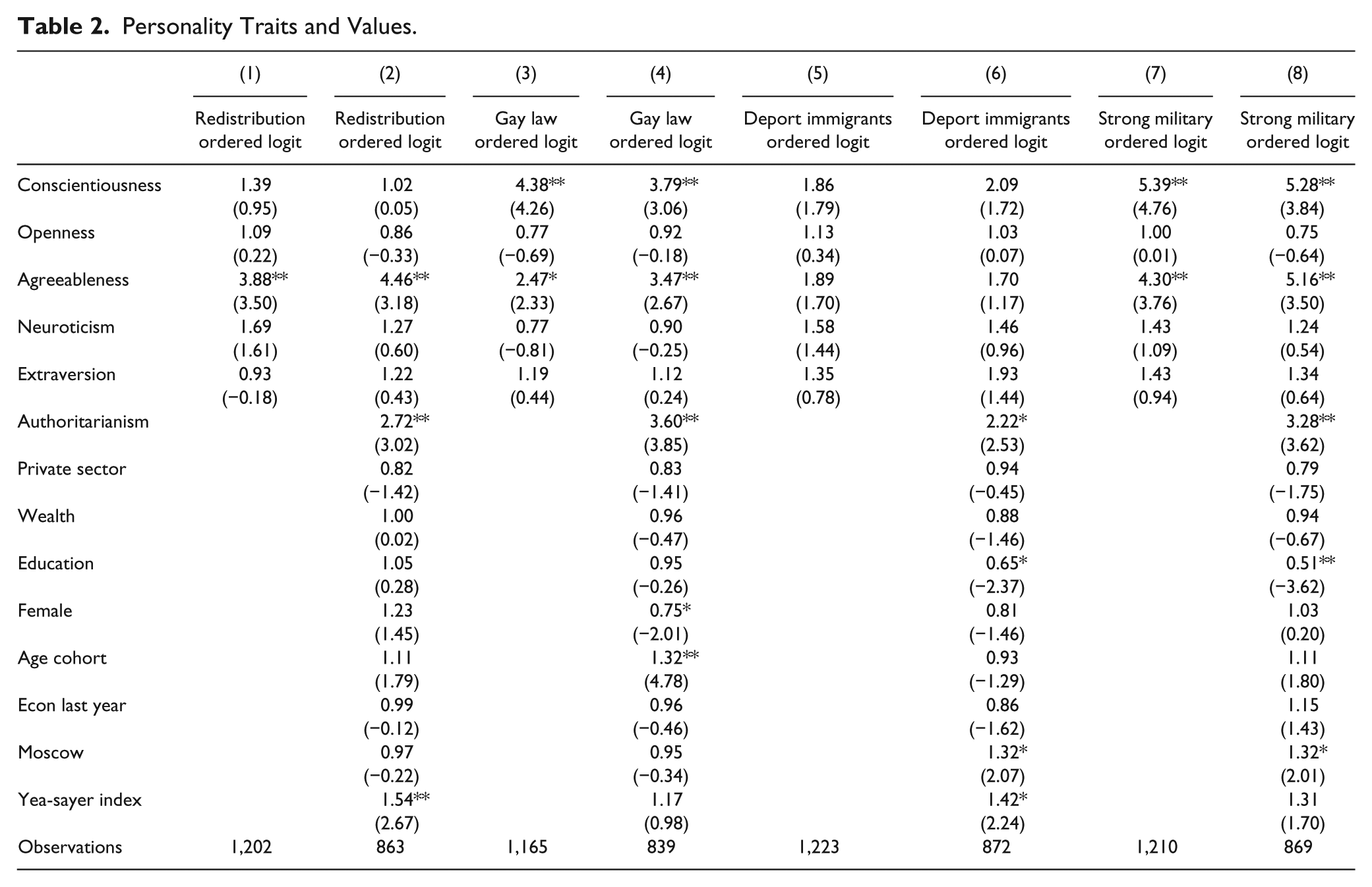
In Model 1, we find that support for economic redistribution is shaped only by agreeableness, even when we include our battery of controls (Model 2). Interestingly—and contrary to our expectations—more conscientious and more open Russians do not differ systematically in their attitude to economic redistribution, quite unlike Americans (Gerber et al., 2010). On social issues, once again agreeableness plays the biggest role in shaping views on each issue, but the effect is not in the direction of tolerance. Instead, consistent with experimental studies on agreeableness (Graziano et al., 2007, p. 567), in a context where the media are aggressively pushing antigay legislation (Models 3 and 4) and where anti-immigrant attitudes are common (73% of respondents showed some support for deporting immigrants), more agreeable people are more likely to share intolerant attitudes (Models 5 and 6). More agreeable people are also more likely to support a strong military and police, even if it means trading off freedom (Models 7 and 8).
The results on conscientiousness look more like the existing literature. Conscientious people are more likely to support antigay legislation and to favor a strong military and police. There is also some weaker support for the notion that more conscientious people are more likely to be in favor of deporting all immigrants. Interestingly there is no effect of conscientiousness on redistribution, an issue that is not emphasized by the incumbent regime in Russia.
While none of the other Big Five traits seem to matter for explaining variation in the degree of social and economic liberalism, authoritarianism is associated with more conservative positions on the social issues of gay rights, immigration, and the military, but also, like agreeableness, with support for economic redistribution. This correlation of social conservatism and support for redistribution is a well-known feature of post-Communist politics more generally (Pop-Eleches & Tucker, 2014).
How Agreeableness Shapes Attitudes
Although we have demonstrated the importance of personality in general and agreeableness in particular in shaping support for the regime and positions on important issues, we have not yet shown evidence of how personality comes to matter. Although we know an increasing amount about the correlates of agreeableness, there is little agreement theoretically on the mechanism by which agreeableness (or any other personality trait) is related to social attitudes. Approaches range from those that focus on the specifics of how the person and the situation interact to the more ambitious “whole trait theory,” which posits that a complete account of traits requires an explanation of the emergence of traits from social-cognitive mechanisms (Fleeson & Jayawickrem, 2015). While there is no space here to pursue a full review of different approaches, in this section, we present preliminary evidence on one key mechanism—mediation. 5
One way to think of how personality shapes outcomes is to think of traits as shaping a person’s interaction with their environment, which in turn shapes the outcome of interest. Here, the model is trait–mediator–outcome (MacKinnon, Fairchild & Fritz (2007)). Using such a mediation model, researchers have shown, for example, that personality has large effects on morbidity and mortality, as personality affects smoking, alcohol use, and risk-taking behavior, which in turn affect life span (Martin, Friedman, & Schwartz, 2007).
To examine mediation in the context of political and social attitudes, we look at the process by which agreeableness shapes attitudes toward antigay legislation in Russian. The gay rights question is a particularly interesting and useful issue to study for a number of reasons. First, this issue was not politically prominent before it was picked up by the Kremlin in 2012 as a strategic wedge issue employed to solidify support versus an emergent opposition (Smyth & Soboleva, 2014). Moreover, existing personality psychology literature suggests that more agreeable people should be less prejudiced (Sibley & Duckitt, 2008). However, as we saw in Table 2, in Russia, people who scored higher on agreeableness were in fact more (not less) likely to support legislation intended to persecute gays and lesbians. As such, the issue sheds light on how politicization shapes the interaction between personality traits and politics. From our theoretical discussion, we expect context to shape interaction in at least three ways—selection of information sources, respect for Presidential positions, and relationship with official institutions. We look at each of these in turn.
First, to investigate the relationship between attitudes and information sources, we look at habits of consumption of political news, focusing on the highly propagandistic state television and on a key source of opposition news and discussion, the blogging site LiveJournal (Koltsova & Shcherbak, 2015). Respondents reported whether they used state television “to get political news and information” daily, a few times a week, a few times a month, rarely, or never. Respondents were also asked whether they subscribed to LiveJournal.
Second, we consider the issue of general approval of the Putin regime. We think that this is likely to mediate attitudes toward antigay legislation (rather than the other way around), precisely because of the political novelty of antigay legislation in Russia. Although it is possible that some people had strongly formed opinions on the “threat” posed by gay people, they are likely to be largely outnumbered by those inclined to accept that a threat exists and requires legislation because they trust Putin and his administration. Third, we consider the mediating effect of religiosity. Much of the impetus for antigay legislation, first in Russia’s regions, then in the national parliament, has come from politicians claiming to be staunch supporters of Orthodoxy, and the Orthodox Church leadership itself has played a major role in mobilizing its adherents against gays and lesbians. 6 To measure religiosity, we asked respondents how important Orthodoxy (the dominant religion in Russia) was to them personally, using a five-point scale.
In recent years, there has been much discussion about the methodological challenges of causal identification in mediation models (K. Imai, Keele, & Tingley, 2010, J. Imai, Keele, Tingley, & Yamamoto, 2011). Hicks and Tingley (2011) identify two key practical problems with the method of estimating mediation effects that is most commonly used in personality psychology (Baron & Kenny, 1986)—the problem of extending to nonlinear models and the inability to analyze the sensitivity of results to violations in a key assumption, known as sequential ignorability. To address these issues, we use the mediation software for Stata developed by Hicks and Tingley (2011). Our state television and religion mediators are measured on a five-point scale and Putin approval on a four-point scale, so we are able to treat them as approximately continuous and use ordinary least squares (OLS) regressions. For these mediators, the results are equivalent to those of using the traditional product of coefficients approach. For the binary LiveJournal variable, we estimate a probit model in the mediation equation. In addition to allowing the use of a binary mediator, the software allows us to illustrate the sensitivity of the results to violations of the identification assumptions underlying the analysis. The results of the sensitivity analysis are in Supplementary Appendix D.
We estimated four mediation models using the full battery of controls. The idea is to estimate a predicted value of the mediator at minimum and maximum values of agreeableness (the treatment variable). These predicted values are then used in estimating support for antigay legislation (the outcome variable) to give average causal mediation effect and the direct effect. It is not currently possible to calculate meaningful estimates of multiple treatment variables at the same time and provide simple results, so we ran each of the mediation models separately. Although the mediation analysis presented here cannot be conclusive, it is highly suggestive of the importance of context in shaping the effects of personality traits.
The results are shown in Table 3. The total unmediated effect of agreeableness on support for antigay legislation is positive, statistically significant and about the same size in each model. However, once we include mediators—the effect of agreeableness on media choice (watching state television and using LiveJournal), on general orientation toward President Putin and on the degree of commitment to the Orthodox Church—the substantive argument changes somewhat. Agreeableness does matter for support for antigay legislation, but not simply because highly agreeable people in Russia are more willing to express support for official homophobia. Instead, much of the connection between agreeableness and support for antigay legislation comes indirectly. Agreeable people are more likely to watch state television, less likely to use LiveJournal for news, are more likely to approve of Putin and are more committed to the Orthodox Church. All these factors are in turn significantly connected to attitudes to antigay legislation—state television watchers, those who approve more of Putin and Orthodox believers, are all more supportive of homophobic legislation, whereas LiveJournal subscribers are less supportive. Table 3 summarizes the direct and indirect effects. Because Table 3 presents the results of each mediator separately it is necessarily a simplified version of the true underlying process. Nevertheless, the results show large indirect effects with as much as 22% of the effect of agreeableness being mediated through choices about state television, 13% through reading LiveJournal, 20% through attitudes toward the president, and 29% through attitudes to the state religion, Orthodoxy.
Effect of Agreeableness and Mediators on Support for Antigay Legislation.

95% confidence intervals are based on nonparametric bootstrap with 1,000 resamples. Equations were estimated with least squares except for the LiveJournal equation where the binary mediation outcome was calculated using probit. The results are computed via the mediation software (Hicks & Tingley-, 2011).
The mediation analysis illustrates the importance of context in shaping the effects of personality traits. Specifically, attitudes to antigay legislation are to a large degree a function of attention to the media and official institutions. However, that the effect is largely indirect does not mean that agreeableness is not important—quite the contrary. Many scholars have pointed to a key role for state media in Russia and other authoritarian regimes among those people who choose to pay attention to it (Enikolopov et al., 2011), though of course not all do. Agreeableness, it seems, is one important factor that helps us to understand why some people pay attention to the state media and some do not. Agreeableness also helps to explain why some read opposition information sources and others do not. Moreover, agreeableness shapes attitudes to other key official institutions through which support is channeled, including the presidency and the church, and so is fundamental to shaping the attitudes of citizens to the regime and its projects. Consequently, as other research on personality and politics suggests, the relationship between traits and the content of attitudes is not necessary but contingent. It is the content of the media and the policy prescriptions of the state institutions that in turn shape specific attitudes. This is likely to be particularly true of agreeableness, which, as previous experimental work suggests (Graziano et al., 2007), is itself a measure of responsiveness of the individual to cues given by the external environment.
Conclusion
Our results point to an important role for the personality trait of agreeableness in shaping support for incumbent leaders, in mitigating negative emotional responses to the regime, and in creating proregime political values in Russia. The findings are particularly interesting when contrasted with the existing literature on personality and politics. In democracies, conscientiousness and openness play a leading role in explaining political attitudes and affinities, whereas agreeableness is a largely peripheral personality trait. By contrast, in Russia, agreeableness is central.
In addition to showing the broad political significance of agreeableness, we used the issue of support for antigay legislation to trace the pathways through which agreeableness creates its effects. We presented evidence that agreeableness works to a substantial degree indirectly, by shaping basic behaviors such as media consumption and deeper orientations toward the regime or religion. These institutions in turn shape understandings about what is “normal” and what is “deviant” and serve to attach agreeableness to conservative social values—promoting support for laws punishing homosexuals. This finding is also interesting in the light of Bakker, Rooduijn, et al. (2015), who show that people low in agreeableness tend to support populist outsiders challenging the liberal status quo in the United States, the Netherlands, and Germany. Although those populists, especially in the case of conservative populists, are often supporting a similar social policy agenda to that of Russia’s current leadership, agreeableness has opposite effects because of the switch in which positions the mainstream establishment supports. Were the political establishment and its institutions to become attached to a different set of issues and orientations, our analysis suggests that agreeable Russian citizens would come to support those orientations instead.
This article represents a first assessment of the importance of personality traits in shaping support for or opposition to authoritarian regimes and opens as many questions as it answers. Most obvious is the question of how the results in Russia travel to different authoritarian contexts. In this study, we find patterns that are quite different from the existing literature and we have made an argument about why we think this difference is best explained by the mobilizing authoritarian political context in Russia. This context is one of a largely nonideological, nonethnic, patriotic form of authoritarianism, which invites all but a tightly defined group of “deviants” and “foreign agents” to be supporters of the regime. Whether the relationships we find in Russia will hold in more ideological or ethnically based dictatorships, further research will tell.
It could, of course, be objected that what we found are differences between Russians and the other kinds of people studied in the psychology literature, rather than between democracies and authoritarian regimes. We have made what we think are sound theoretical arguments for the difference being regime type rather than nationality. Nevertheless, without data from other authoritarian countries, we can neither rule out a cultural element to the story nor be sure of how the role of traits actually varies across authoritarian regimes. Conducting such research in other authoritarian states represents an important new research agenda that this article opens up.
Beyond the literature on personality, our findings are highly relevant for scholars interested in authoritarian regimes and democratization more broadly. Although we still understand little about personality traits and regime dynamics, it is fascinating to see the crucial role played by agreeableness in support for regime policies and positions. These findings point to the importance of the appearance of social unanimity in maintaining authoritarianism, a factor first discussed in detail by Havel and Wilson (1985) in the famous essay, The Power of the Powerless. Most people, as Havel and Wilson pointed out, are willing to continue to participate in the “lies” of a regime while they think that others will too. However, this reliance on social conformity is both a strength and a weakness. When unanimity breaks down and alternative positions become socially acceptable, regimes can dissolve very quickly.
A similar story, in a very different style, is told by Kuran (1991) in explaining how cascades of defections from authoritarianism—revolutions—generally are surprising to observers. Kuran, however, relies on an exogenously generated individual “internal cost of preference falsification” or “revolutionary threshold.” Our approach has two key advantages compared with this. First, our analysis is based on well-established theories of human psychology and can explain changes in behavior and attitudes without resort to preference falsification. If agreeableness is an important factor underlying commitment to authoritarian leaders and their projects, then one would expect to see similar switching dynamics as estimations of the political winds change. Second, Kuran’s “revolutionary threshold” is by definition unobservable. By contrast, we have the tools to measure agreeableness and associated attitudes. This means we have at least the possibility of watching in real time how well a given regime is maintaining its mass support basis and when that support is in danger of crumbling.
Although the connection to Havel and Kuran is enticing, we do not yet know the extent to which our findings are general. A key issue in this regard is that our arguments and data suggest that highly agreeable people, on average, respond to the social incentives created by the state, the state media, and state-sponsored institutions, as opposed to other potential sources of social approbation such as the family or friend groups. Based on our experience in Russia, this sounds very plausible. However, the extent to which such a focus on the state is replicated in other regimes is very much a new question. It might be the case that family networks in places such as Pinochet’s Chile were more important, and so agreeableness plays less of a role in the selection of media and institutions and thus has a weaker influence on attitudes toward the regime and its projects. Looking at how social context might vary across different authoritarian regimes is another important line of research that our findings help to open.
Footnotes
Declaration of Conflicting Interests
The authors declared no potential conflicts of interest with respect to the research, authorship, and/or publication of this article.
Funding
The author(s) disclosed receipt of the following financial support for the research, authorship and/or publication of this article: The authors gratefully acknowledge the support of the Smith Richardson Foundation in providing financial support for the research behind this article.
Notes
Author Biographies
References
Supplementary Material
Please find the following supplemental material available below.
For Open Access articles published under a Creative Commons License, all supplemental material carries the same license as the article it is associated with.
For non-Open Access articles published, all supplemental material carries a non-exclusive license, and permission requests for re-use of supplemental material or any part of supplemental material shall be sent directly to the copyright owner as specified in the copyright notice associated with the article.
