




Abstract
New approaches to citizen-building are flourishing, yet theoretical tools are lacking and empirical research is limited. This article contributes in several ways. Theoretically, it offers a reconceptualization of the traditional “making of citizens” framework, aiming to adapt it to contemporary needs and concerns. Empirically, it offers an examination of the content of civics curricula as well as original data on the outcomes of an ambitious state-led social engineering campaign in the United Arab Emirates, where leaders seek to build more “globalization-ready” citizens—more entrepreneurial, market friendly, patriotic, and civic minded, yet still loyal to the regime. Using a difference-in-differences framework, I find evidence that social engineering is succeeding in some respects but backfiring in others, giving rise to citizens not only more patriotic but also more entitled—in other words, entitled patriots. Findings contribute to knowledge of state-led social engineering and citizen-building in the contemporary era.
The question of how states shape citizens is a classic one in comparative political science. Yet, despite a rich body of research on the making of citizens across history and the social sciences, important gaps remain in our knowledge, not only of why and how states shape citizens at different times and in different places but also about the outcomes they achieve and the reasons for those outcomes. Such gaps are particularly striking when it comes to the contemporary era.
This article helps to address these gaps. It adds to knowledge about how the “making of citizens,” to use the shorthand associated with Charles Merriam (1931) and his seminal series, is evolving. Theoretically, I offer a reconceptualization of the traditional “making of citizens” framework, aiming to adapt it more effectively to contemporary needs and concerns as well as render it more portable across diverse political contexts. Empirically, I focus on new approaches to citizen-building in the United Arab Emirates (UAE), where leaders seek to cultivate a new kind of “globalization-ready” citizen through education reforms, state symbolism, and other tools of social engineering. Are they succeeding? Why or why not?
To help answer these questions, I draw from more than 15 months of fieldwork in the UAE between 2010 and 2014. Ethnographic data collected in palace settings build knowledge about the motives of leaders and the goals of the state-led social engineering campaign (Jones, 2015). But the focus here is on outcomes—both intended and potentially unintended. Are leaders making the “globalization-ready” citizens they want? In other words, are they successfully building citizens who are more entrepreneurial, market friendly, patriotic, and civic minded, yet still loyal and politically quiescent? To assess outcomes, I use original survey data and a difference-in-differences (diff-in-diff) empirical strategy across control and treatment groups of UAE youth, focusing on a nationwide public school reform spearheaded by Abu Dhabi’s powerful crown prince.
Findings are mixed and theoretically intriguing. On one hand, “pro-globalization” social engineering appears to be succeeding in enhancing love of country, civic mindedness, and tolerance in line with rulers’ vision. On the other hand, I find evidence that it is failing to enhance market friendliness. In fact, there is evidence of perverse outcomes, suggesting it is reinforcing and heightening young citizens’ belief in their right to a government job, while reducing their entrepreneurial spirit. The data also suggest it is making citizens themselves more interested in contributing to political decision making, but less supportive of extending that right to others. Overall, the results point to the formation of citizens who are highly nationalistic, yet also highly entitled—what I call entitled patriots.
This research contributes to the literature on citizenship and state-led social engineering in several ways. First, it turns the lens toward the contemporary era and the question of how the “making of citizens” is shifting; much of the literature focuses on historical trajectories of citizen formation. Second, it offers a reconceptualization of the traditional “making of citizens” framework. Third, it seeks to assess social engineering outcomes in ways that are more rigorous and systematic than is typical, showing how the modified framework can be used, as suggested in Tilly (1999), to build more nuanced knowledge about social engineering success and failure. In so doing, it also offers insights into key shifts in the nature of citizen-building from an original content analysis of authoritarian civics curricula.
Finally, the challenge of building citizens better adapted to the pressures of globalization is also an important practical issue in the global policy-making community. Although the UAE has some distinctive characteristics, it is also one of the few Arab states with the resources, political will, and minimal level of legitimacy to be capable of launching a “pro-globalization” social engineering campaign. Indeed, in Jordan, social engineers recently revised grade school textbooks not only to reinforce national unity but also to emphasize what they see as more “globalization-ready” material—for example, diversifying away from gender-stereotypical portrayals of women, adding images of Jordanian churches as well as mosques, and removing some aspects of religion from science textbooks, while broadly aiming to make curricula more aligned with labor-market needs—yet they have met with significant local resistance, including the burning of the new books in schools. 1 Some suggest that a lack of “globalization-readiness” is linked to dangerous trends in terrorism and political violence (Faour & Muasher, 2011; United Nations Development Programme [UNDP], 2003). As a result, this article should be of interest to Middle East and policy specialists as well as comparative scholars of citizenship and state-led social engineering.
Rethinking the Making of Citizens
A large literature addresses the question of the “making of citizens,” yet much of it is historical, focusing on early state-building needs. This classic work sheds light on the struggle to build citizens in a very basic sense who possess some semblance of national identity, recognize the state as a legitimate political authority, and are willing to obey its rules and fight for it on the battlefield. Much of this literature focuses on the era of nationalism (Bendix, 1964; Gellner, 1983; Hobsbawm, 1990), roughly spanning the late 18th and 19th centuries when European rulers engaged in ambitious efforts to shape and homogenize their populations, through the 20th century, as newly empowered postcolonial elites did the same.
Yet there is far less work on the nature of citizen-building in the contemporary era—what I term the making of citizens, 2.0. 2 Although the language of “1.0” and “2.0” may run the risk of suggesting too clean a distinction between “old” and “new,” it is a helpful shorthand for capturing the key insight that citizen-building is not a singular process, fixed in time, and incapable of adapting to circumstances. As Charles Merriam (1931) put it in the landmark work, The Making of Citizens, “The state must make its case not once and for all, but continuously for each new generation and each new period” (p. 10). The central point is not that citizen-building “today” is completely different from citizen-building “back then,” but rather that citizen-building is itself a dynamic process that may shift in response to differing international conditions and incentives.
To be sure, the earlier “first-order” goals for citizen-building—instilling a basic sense of national identity, preparing citizens to fight in wars—are not gone. However, they are receding in importance in the context of a more evolved international system, one in which national identities are largely “given,” war is less frequent, and the global economy is more competitive than ever. Consider a striking example. Today, it is simply no longer the norm for state leaders to contend with “masses of human beings, devoid of any patriotic idea,” to use the words of the Hashemite prince Faisal, installed as the first king of Iraq after World War I. 3 Billions of people have a national identity. Of course, some contest their “given” national identity, while others have more than one, and still others continue to live without one. But these are exceptions to the rule. 4
In addition, state leaders need worry less about readying their citizens for war. It is well known that interstate war is far less common. Of course, interstate war could always come roaring back, and intrastate war is still a major problem. Even so, it is unlikely that masses of ordinary citizens will have to fight on the battlefield as they did in times past because the nature of war itself has shifted away from mass armies and the levée en masse associated with the era of nationalism, and toward smaller, more specialized forces and technology to replace manpower, often in the context of irregular war. 5 War has certainly not disappeared, but preparing ordinary citizens to fight on the battlefield, in terms of their physical, cognitive, or emotional “war-readiness,” is of less concern.
At the same time, the global economy is more fast moving and competitive than ever. Potentially more important to state leaders than citizens’ “war readiness” may be their “market readiness”—the ability and willingness of citizens “to fight,” not on battlefields but in market economies. In line with this expectation, Ong (2006) shows how states in Southeast Asia now focus on cultivating “valuable citizens” who are more able and willing to compete in the global economy. Citizens are being encouraged to embrace what she calls “neoliberal norms,” such as self-management, entrepreneurialism, creative thinking, and risk taking. Likewise, under President Nicolas Sarkozy, state-led social engineering in France sought to modify ideas of collective identity and responsibility to “reconcile the French people to the joys of the market and to a vision of France grounded in hard work, enterprise, and honest competition” (Waters, 2012, p. 73). And President Obama, in his 2014 State of the Union Address, also linked the American “spirit of citizenship” with similar themes of hard work, individualism, responsibility, and innovation, in connection with success in the global economy (Obama, 2014). As he put it, “We know that the nation that goes all-in on innovation today will own the global economy tomorrow.”
Although not directly concerned with the question of citizen-building, a large literature now explores how the welfare state models that arose in Europe after World War II, and subsequently spread to much of the colonial world, can best adapt to the evolving pressures of globalization. 6 In some places, the social benefits to which citizens have become accustomed may not be sustainable, with citizens’ expectations needing to be scaled back and social contracts renegotiated. Despite the important questions that these issues raise, there is only limited work on varieties of what we might think of as “pro-market” or “pro-globalization” citizen-building. These include efforts to build greater entrepreneurialism, productive risk taking, industriousness, adaptability, and other development-friendly attitudes, as well as lessened dependence on the state, into the fabric of citizenship. 7
Thus, I define the making of citizens, 2.0 as the challenge of building citizens “after” the era of nationalism, when states already have populations who know “who” they are, need to focus less on preparing them to fight on the battlefield, and find themselves having to compete in increasingly competitive global markets. This is not to say that earlier periods have not witnessed some of these trends, particularly related to economic globalization, nor that such trends are irreversible, but rather to underscore the importance of a shifting international context for the ever-evolving citizen-building challenge. This discussion also does not imply that existing theory surrounding the “making of citizens” is obsolete. Nationalism, for instance, is not disappearing, but its meaning may fluctuate in an era in which most “nations” already have some form of recognition, such as statehood. Likewise, the desire for innovative, hard-working, self-reliant citizens, better able and more willing to contribute to economic growth, is hardly unique; indeed, it was a particular concern for the absolutist monarchs of early modern Europe (Riesenberg, 1992, p. 207). My goal here is simply to highlight broad shifts in emphasis when it comes to the making of citizens, which are linked to larger changes in the international system and call for new and more systematic research on the evolving nature of the challenge.
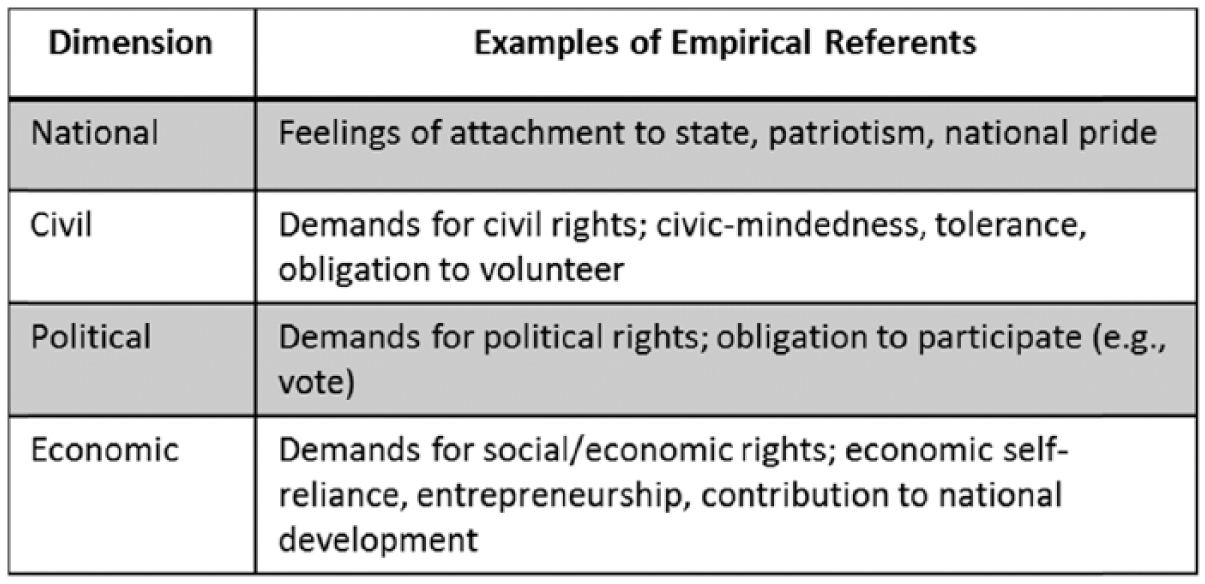
Below, I offer a conceptual framework designed to help achieve that goal. A key aim is to enrich and open up new avenues for comparative research by unbundling aspects of the state–citizen relationship that are often lumped together under elusive categories such as “national identity” and “modern citizen.” 8 I follow T. H. Marshall (1950) in conceiving of the state–citizen relationship as defined by civil, political, and social or economic dimensions, but I also modify his approach in several ways in response to some important critiques.
First, I relax the concept of citizenship, so that it need not be associated exclusively with Western-style democratic regimes; instead, I use it to capture the wide variety of ways in which the relationship between “the rulers” and “the ruled” may emerge and evolve in democratic as well as hybrid regimes and even authoritarian settings that may have alternative social contracts (in which citizens do get something in exchange for their allegiance, just not the typical Western set of political and civil rights). 9 Second, within each dimension, I incorporate not only demands for rights but also conceptions of responsibility, reflecting the concern that citizenship theorists have focused on the rights side of modern citizenship at the expense of the responsibilities side (Kymlicka & Norman, 1994). Marshall’s critics suggest that his conceptualization is not only too Anglo centric and teleological but also ignores the question of what the citizen owes the state and community of fellow citizens. Third, I reorient the framework so that it accommodates the perspective of the “ruling class,” as Mann (1987) and Smith (2001) have suggested, thus allowing for newer constructivist approaches to the shaping of identity more commonly found in the nationalism literature. Finally, I add a fourth component, which captures patriotic and nationalistic attitudes—feelings of love for, identification with, and special concern for one’s nation and country (Nathanson, 1993; Smith, 1998).
The resulting framework, shown in Figure 1, consists of four dimensions, which rulers and citizens alike may seek to renegotiate over time. It should be clear that this framework focuses on what Kymlicka and Norman (1994) call “citizenship-as-desirable-activity”—that is, what citizens expect the state to provide and what they expect to contribute and provide for themselves—and not the more formal concept of “citizenship-as-legal-status.”
Modified framework.
Contemporary Citizen-Building in the UAE
I now use the framework to study a contemporary case of citizen-building. Although the UAE is in some ways unusual, it has much to offer comparative scholars of citizenship. It is a valuable microcosm for the making of citizens, 2.0: Having moved through the early stages of state-building after its founding in 1971—during which time its leaders understandably focused on “first-order” citizen-building needs, such as instilling a national identity above and beyond tribal allegiance—it now confronts widely shared “second-order” citizen-building challenges. In the UAE as elsewhere, these have less to do with citizens’ willingness to fight in wars and more to do with their willingness to “fight” or compete in the global economy. An investigation of what social engineers there achieve (and do not achieve) can, therefore, furnish important insights into the evolving nature of citizen-building.
As background, the UAE was founded in 1971 when the British withdrew from the Gulf region. It consists of seven emirates of which Abu Dhabi and Dubai are the most prominent. Each emirate has its own ruling family, but Abu Dhabi tends to dominate because it contains the overwhelming majority of the country’s substantial oil reserves. Although Dubai is not directly dependent on oil reserves, having diversified more effectively into areas such as financial services, Dubai nevertheless depends indirectly on Abu Dhabi’s resource wealth in a variety of important ways, much like the poorer northern emirates do. 10 As with other “rentier” states, the UAE has a small citizen population, and citizens enjoy access to generous social and economic benefits on the basis of a rentier social contract in which citizens trade political rights for economic security. 11 The hallmark of the UAE’s rentier social contract has traditionally been a government job. Hence, the government is the largest employer of citizens, while the private sector is dominated by a globally diverse expatriate community that dwarfs the citizen population. 12 Yet, as oil reserves run down and renewable energy sources expand, the prospect of a post-petroleum age grows ever more real, and the status quo becomes harder to sustain.
The UAE is in some respects unusual, but its distinctiveness should neither be exaggerated nor overshadow the country’s usefulness as a case. Although resource wealth provides a temporary cushion, the UAE faces several of the same structural problems that others in the region face (Davidson, 2012). In the Middle East more generally, governments are typically the largest employers of citizens, public sectors are reaching saturation points, and unemployment among the growing youth populations is high. With the region’s mounting refugee crisis, large migrant populations living alongside “citizen” populations are also increasingly common, along with related tensions and the need to ensure peaceful coexistence. Thus, although the UAE naturally faces its own version of these problems, the problems themselves are not unique, and the UAE is in a special position to address them.
In the UAE, a key response has been an ambitious state effort to build a new kind of citizen better prepared for globalization—what I call a “globalization-ready” citizen. Leaders’ motivations, constraints, and reasoning are complex, and I deal with them elsewhere drawing from palace-based ethnography (Jones, 2015). Suffice it to say here that they are interested in cultivating what they envision as a more modern society suited for the contemporary globalizing age, which involves certain Western-influenced ideas about how modern and productive peoples ought to act. They essentially aim to fashion the young into more self-reliant, achievement-oriented adults who will demand less from the state in terms of social welfare, while showing greater willingness to volunteer in their diverse communities and contribute to market-driven economies. 13 Not surprisingly, they also hope to maintain the authoritarian status quo, preserving citizens’ loyalty and political quiescence while boosting patriotism. Their vision of the “globalization-ready” citizen appropriate for the UAE is, therefore, more than a passive authoritarian subject—but less than a true democratic citizen.
The result has been a state-led social engineering campaign that is at once liberal, neoliberal, and authoritarian in character, involving radical education reforms, state symbolism, and other time-honored tools of social engineering. Education reforms, for instance, emphasize skills such as creativity, critical thinking, and English fluency, as well as attitudes such as self-reliance, tolerance, civic consciousness, a spirit of entrepreneurship, and a lessened sense of entitlement, which are promoted by newly designed civics programs. State-sponsored spectacles such as the Celebration of Entrepreneurship, the Festival of Thinkers and the Summer of Semiconductors, and state programs such as Takatof, which aims to foster a stronger culture of volunteering, also promote ruling elites’ particular “globalization-ready” ideal—more market oriented, entrepreneurial, and civic minded; highly patriotic; less government dependent; and uninterested in politics.
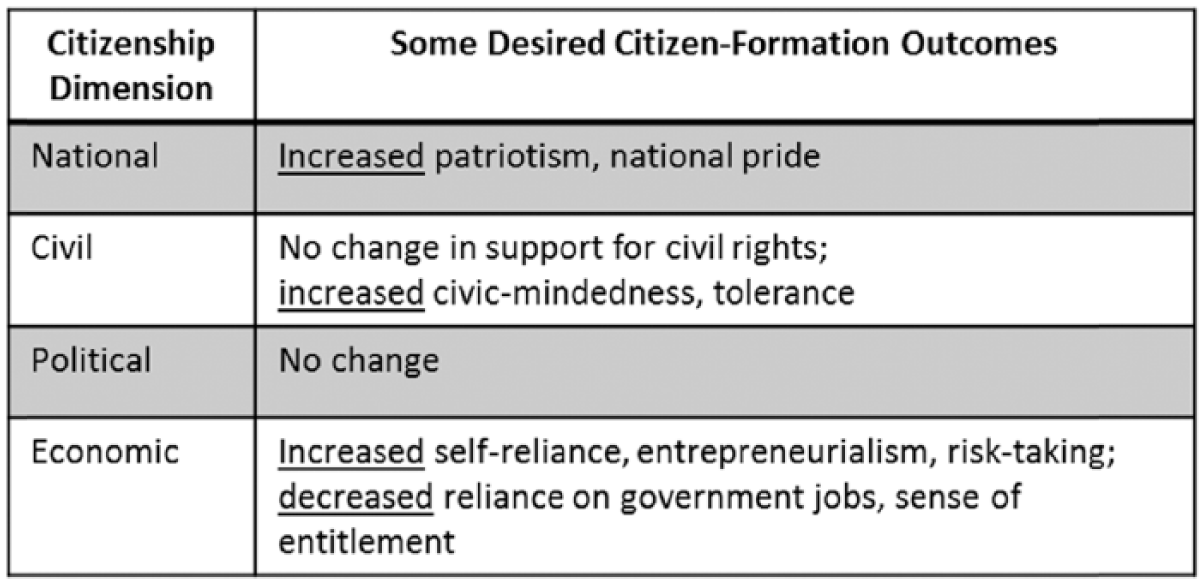
These new citizen-building goals are captured in Figure 2. As shown in the adapted framework, leaders essentially wish to effect change in the national, civil, and economic dimensions of the state–citizen relationship, while leaving the political dimension relatively unchanged.
Social engineering goals.
Hence, social engineering initiatives aim to heighten patriotic and nationalistic attitudes (national dimension), enhancing a feeling of “UAE first” that transcends tribal allegiances, as well as boost civic mindedness—not in the form of a greater interest in civil liberties, but rather tolerance and willingness to volunteer in service to the community (civil dimension). Social engineering initiatives also aim to reduce dependence on government jobs and other forms of state largesse, and inculcate a stronger spirit of entrepreneurialism and self-reliance (economic dimension). Overall, ruling elites, many of whom see themselves as father- or mother-like figures, want to transform their young subjects, whom they see as not yet having been corrupted by a larger culture of rentierism, into adult citizens with a lessened sense of entitlement, and a greater willingness to work hard and contribute to development in the context of a diverse society.
It is also important to note that this social engineering effort cannot be reduced to an apolitical, technocratic matter of building a stronger local workforce. Skills and knowledge are not being promoted in a vacuum, but rather as part and parcel of the new “globalization-ready” UAE citizen. As Sheikh Khalifa bin Zayed, the UAE’s President, aptly put it in the much-publicized national strategy document, Vision 2021: “Work is a true criterion of citizenship. It is evidence of sincerity and loyalty” (United Arab Emirates Cabinet, 2010). Likewise, as a civics curriculum reformer explained, the new “civic skills” being promoted are “twenty-first century skills,” such as, in her own words, “problem solving” and “critical thinking,” needed for development. 14
Theoretical Expectations
What does theory tell us about the likelihood of success in such new approaches to citizen-building? Existing research offers conflicting predictions. The “making of citizens” is essentially a form of state-led social engineering, and such efforts are often portrayed as complex and messy processes, prone to failure (Mitchell, 2002; Scott, 1998; Weber, 1976). The classic, qualitative-historical work emphasizes inherent difficulties, the “stickiness” of culture, and basic material prerequisites for change. In the UAE case, it is easy to see why many prefer the status quo, particularly in the economic dimension: The rentier state offers inflated public sector salaries and unrivaled job security in exchange for political quiescence. In the absence of major change in incentive structures, why should rational citizens change their preferences, adopting more “globalization-ready” mind-sets? Thus, this perspective predicts elite failure.
However, there are reasons to expect some success. In the nationalism literature, many adopt a constructivist outlook, emphasizing the critical role played by elites in consciously shaping citizen identities, seen as invented and malleable. 15 Apparent successes are easily found, ranging from Atatürk’s efforts after the First World War to create a pro-Western outlook (Hanioğlu, 2011) and communist social engineering (Alesina & Schuendeln, 2007; Cantoni, Chen, Yang, Yuchtman, & Zhang, 2014) to narrower advocacy-centered education campaigns (Blattman, Hartman, & Blair, 2014; Finkel & Smith, 2011; Paluck & Green, 2009). Some studies have also evaluated programs to encourage promarket orientations in the former Eastern bloc, with some modest successes identified (Slomczynski & Shabad, 1998; Thomas & Campbell, 2006). 16 Overall, then, the constructivist perspective predicts at least some degree of elite success.
Finally, there is a third well-known perspective focused on the fact that the UAE is an authoritarian country. This predicts change—but not of the intended variety. It emerges from modernization theory. As Huntington (1968) famously argued with the concept of the “king’s dilemma,” autocrats’ efforts at modernization can backfire by unintentionally raising citizens’ political consciousness. Applying insights from this literature, we should expect to find evidence of unintended effects in the political and civil dimensions of citizenship, particularly in the direction of heightened interest in political participation, personal freedom, and civil liberties. The theory is less clear on what to expect in the national and economic dimensions, and thus, it may lend itself more readily to the possibility of mixed outcomes.
Investigating the Effects of Social Engineering
To assess outcomes, I collected original survey data on citizenship attitudes from several thousand UAE youth nationwide, using a diff-in-diff strategy across treatment and control groups. 17 For the treatment group, I focused on a set of new (public) high schools developed as a central part of the broader social engineering campaign. As with several of the country’s experiments in education reform, this one has a royal patron, Sheikh Mohammed bin Zayed, the powerful Crown Prince of Abu Dhabi, and it was deliberately designed to operate outside the purview of the Ministry of Education, where religious conservatives remain powerful. In the Crown Prince’s words, the mission of the new high schools is to fashion the citizens “needed for the UAE to build a knowledge-based economy,” 18 and the schools are indeed viewed by their designers as a powerful instrument for social engineering. In short, they are widely seen as successful in teaching the skills as well as fostering the attitudes in UAE youth necessary to turn them into “globalization-ready” citizens, more able and willing to contribute to social, cultural, and economic development.
Below, I draw from field interviews with school staff as well as original content analysis of hard-to-obtain civics curricula to demonstrate how the new schools offer a valuable lens through which to study new and globalization-oriented social engineering in the UAE case. I also present the empirical strategy before proceeding to an investigation of the effects of social engineering.
Content Analysis of Curriculum Materials
The new public schools broadly promote the ideal of “globalization-ready” citizens conceived by the leadership, and they are, thus, different from regular or “traditional” public schools in several respects. For example, English is the main language of instruction, viewed as the more globalization-relevant language over Arabic (and already the main language of instruction in UAE public universities). 19 In addition, the schools offer their own brand new civics and character-building program to transform Emirati youth into “loyal, responsible and productive citizens of the UAE,” and the program explicitly links the idea of good citizenship with notions of work and self-management, as shown below. 20 The overall curriculum is also new; compared with the Ministry’s curriculum found in regular public schools, the new curriculum is more vocational and development oriented, adapted from a U.S. curriculum that emphasizes creativity, problem-solving, and student-centered teaching methods over the rote memorization method of learning linked to the Ministry, and it also has more emphasis on science, technology, and individualized career counseling. In keeping with the social engineering campaign’s emphasis on fostering an ethos of work and contribution, the new curriculum also requires a summer internship and 100 hours of community service for graduation, unlike in regular government schools. Finally, the schools enforce stricter rules and regulations, intended to promote professionalism, conscientiousness, and a stronger work ethic, and students are paid a stipend to encourage attendance and high achievement.
A more vivid illustration can be found from a content analysis of curricula used in treatment and regular government schools, focusing here on the civics curricula. 21 Like many Arab nations, the Ministry of Education’s civics curriculum (attarbiya al-wataniya, meaning civics, or “national education”) has traditionally focused on the younger years, not extending into high school (United Nations Educational, Scientific and Cultural Organization [UNESCO], 2011). In contrast, a completely new civics curriculum is being implemented in treatment schools (which are high schools). This highlights a key curriculum difference across the two school types, and again shows that social engineering, for the ruling elites driving it, is not merely a matter of upgrading skills; social engineering is also, and more fundamentally, about citizen-building, with the skills, attitudes, and values of “globalization-ready” citizens seen as highly interconnected.
I compared civics textbooks from regular government schools with curriculum material in treatment schools, and important differences were identified, highlighting the dramatic change in focus. The Ministry’s textbooks offer a “baseline” of citizenship education that reformers are eager to change. Indeed, far from embracing the “globalization-ready” ideal, the introduction to the Ministry of Education’s 2011 civics textbook for Grade 1 describes the main purpose of civic education as fighting what are described as the “dangers of globalization,” which “threaten Arab and Islamic identity” (p. 4). Such themes of collective danger, threat, and resistance, often explicitly linked to globalization, are prominent throughout the Ministry-produced civics textbooks that I examined, and their content is very revealing.
Consider, for example, the 1992 version of the Grade 8 civics textbook, which remained much the same in the 2008 and 2011 editions of the book. Students are offered a primordialist account of the “Arab nation” as one cohesive entity arising with the birth of Islam (with little if any mention of Arabs prior to Islam, or Arab Christians and Jews) and facing common “threats” to its security and unity throughout history, including the Mongol invasion, the crusades, the European colonizing occupations, and the “Zionist occupation of Palestine” (pp. 38-40). To hammer home this threatening message concerning the rest of the world, a section asks students to list reasons why Arab militaries today ought to be strengthened or mobilized (p. 41). A lesson on food security also describes dependency on Western imports as another “threat,” linked to globalization, which students must struggle against by, for example, supporting farming (pp. 68-78).
The 2008 and 2011 versions of the same Grade 8 civics book are largely the same in their core content, with some minor changes in the latter reflecting the adoption of Vision 2021, the country’s recently developed strategic plan. Both versions’ introduction, for instance, explains that a key goal of the Ministry’s civics curriculum is to push students to understand and resist “colonial and Zionist challenges and schemes” (p. 5). Another lesson emphasizes the “enemies” working to disrupt the Arab world (p. 36-37), as through supporting “the Zionist entity,” creating unnatural borders, sabotaging shared Arab projects, and kindling sectarian conflicts among Arabs. Students are then asked to consider more ways Arab unity is being actively fought, and to brainstorm strategies to fight the enemies’ conspiracies against the Arab nation. An important addition to the 2008 and 2011 textbooks is the introduction of yet another “threat” for students to ponder—the influx of foreign workers. Students are asked to list the threats that large numbers of foreigners pose to their community and also to think of solutions to this self-described “problem” (pp. 13-14). Here, the book explicitly focuses on “non-Arab” foreigners as the problem, even though non-Arabs, especially South Asians, make up a huge portion of the UAE’s population as the backbone of its economy, and peaceful, tolerant coexistence is therefore necessary.
Curriculum materials in treatment schools are strikingly different, pushing forward the ideal of the “globalization-ready” citizen with a more development-friendly outlook. Globalization is not presented as a threat at all, but rather as an opportunity for learning, innovation, and success. As explained in the opening pages of the 2010 curriculum prospectus, “We are living in an age of momentum, progress, and innovation, where the keys to success lie within our ability to master new concepts and ideas” (p. 2). 22 Students are urged not to fight the dangers of globalization but to “develop their knowledge and skills . . . so that they can live and work meaningfully in a knowledge-based society” (p. 2). Nor are non-Arab residents of the UAE presented as a “threat.” Rather, UAE youth must learn to live and work “with people from diverse cultural and educational backgrounds” (p. 9). Whereas the curriculum discussed above required students to brainstorm all the ways other countries are seeking to undermine them, the 2008 yearbook for treatment schools describes how “students explored and discovered the cultural heritage of countries of their choice” (p. 5), giving final presentations in the school auditorium.
The central message of the curriculum in treatment schools is not fighting against, but flourishing within, a context of globalization. Evidence in the curriculum for the promotion of ruling elites’ “globalization-ready” ideals is abundant. In the economic dimension, for example, the curriculum offers courses around “career clusters,” as well as individualized career counseling and a required internship, none of which are typically found in the Ministry’s schools. Work in business and the private sector is encouraged. In the civil dimension, the new civics program emphasizes interactive modules on teamwork, tolerance, work, personal empowerment, and responsibility as well as a community service requirement, again not found in regular government schools. 23 For example, one unit emphasizes self-management and focuses on how to “identify personal strengths and weaknesses when working in a team.” A new civics instructor explained that much of the new civics program is designed to support broader “life skills” and developmental goals, including readiness for a diverse workplace, self-reliance, and entrepreneurialism. 24 Nationalism is present throughout the curriculum, but it is a “globalization-ready” variant emphasizing UAE national identity linked to success in a globalizing world, rather than threats to pan-Arab identity. Treatment schools are thus rife with globalization-oriented social engineering. But what are the results?
Empirical Strategy
As with many educational experiments in the United States, students are not randomly assigned to these schools; here, an admissions test is required to assess basic skills. In the school effects literature, these are familiar selection challenges, and several strategies have been used to address them, including, in the case of Catholic school effects, instrumental variables models (Neal, 1997) and the “selection on observables” approach used by Altonji et al. (2005). In the case of charter school effects, propensity score matching has been used (Woodworth, David, Guha, Wang, & Lopez-Torkos, 2008). Here, I use a diff-in-diff strategy comparing the differences in UAE youth attitudes across younger and older cohorts within control schools to the differences in those same attitudes across the same “pre” and “post” cohorts in treatment schools. The difference in attitudes in treatment schools—from entry to exit—is thus compared with the difference in attitudes in regular public schools. Hence, I combine diff-in-diff with standard cohort analysis, following Duflo (2001) and Bleakley (2010). 25
This approach has some key advantages for causal inference (Angrist & Pischke, 2008). First, it controls for selection bias in treatment assignment. Initial differences in outcomes between control and treated students are subtracted out. Such factors may include initial income levels, innate ability, levels of parental education, and other demographic differences. Second, the strategy removes bias stemming from aggregate factors that would in any case cause change in the outcome variables over time or across grade cohorts. Such factors include age or maturation, and broad socioeconomic and political changes. One important ingredient in this approach is the identifying assumption of common trends, because the control group is used to infer the counterfactual change in outcomes for the treatment group. We assume that the average change in outcomes would be the same for both groups, had treated students not been treated.
Treatment effects are estimated using the diff-in-diff strategy by fitting the following ordinary least squares (OLS) regression model, in which

Here,
Survey Design and Measurement
To measure attitudes, I developed a survey adapting validated instruments from well-known surveys such as the Arab Barometer (AB) and World Values Survey (WVS), and I piloted it extensively in the UAE before use. Question wording and answer scales are in the online appendix. First, in the national dimension, the survey tapped patriotic and nationalistic attitudes, using Likert-type statements such as “I love the UAE” and “People should support the UAE government even if they think it is doing something wrong” (Kosterman & Feshbach, 1989, p. 264). 26 To measure national pride, the survey adapted an index from the International Social Survey Programme (ISSP) with items capturing feelings of national pride in areas such as the UAE’s history and culture, political influence in the world, style of government, and economic achievements. 27
In the civil dimension, the survey measured civic responsibility by giving respondents a scenario in which littering had sullied a landmark, and asking how much time they would be willing to volunteer to help with the cleanup over a 2-week break. 28 Following Jamal and Nooruddin (2010), the survey tapped tolerance by asking respondents to what degree they thought it important to encourage children to value “tolerance of others.” The survey also measured support for civil liberties such as freedom of information and government transparency. 29
In regard to the political dimension, the survey measured personal interest in participating in politics as well as support for the general right. For the former, two questions were combined: “How interested are you in contributing to public decision making in the UAE?” and “How interested are you in contributing to public decision making in your own emirate?” 30 To tap support for the general right, respondents were asked, “For the development of the UAE, please rate how important you consider the right of UAE nationals to have a say in government policy making?” with an answer scale ranging from 1 = not important at all to 7 = very important.
Finally, in the economic dimension, the survey measured support for the right to a government job, the hallmark of the rentier social contract. Respondents were asked, “For the development of the UAE, please rate how important you consider the right of UAE nationals to receive a government job” with an answer scale ranging from 1 = not important at all to 7 = very important. In addition, respondents were asked to rate their willingness to start a business to support the development of the country, with responses coded on a scale ranging from 1 = not willing at all to 7 = very willing.
Data Collection and Sample
Of the seven treatment schools that had been launched as of 2015, five were boy’s schools, and two others, launched last, were for girls. 31 (K-12 public education is gender segregated by law.) The schools were established in several different emirates, with four in Abu Dhabi, and one each in Dubai, Ras al Khaimah, and Fujairah.
All five of the boys’ treatment schools were included in the study. 32 To establish the control group, I selected five government schools for boys that were comparable in terms of demographics, after consulting with local education experts and administrators. The Emirati student population in these five control schools matched the treatment schools in terms of size, ethnic background, and emirate. They were also geographically proximate to treatment schools. Most important, local experts confirmed that no reforms had been initiated in them and they had no outlier characteristics. Thus, they are typical of the larger set of “regular” government schools in the country, which are relatively homogeneous in character, all following the official Ministry of Education curriculum known for its emphasis on memorization and poor preparation of students for college admission and the labor market. The final sample included two treatment and two control schools in Abu Dhabi, and one of each in Dubai, Fujairah, and Ras al Khaimah.
Within each school, I selected appropriate “pre” and “post” samples of students to meet the requirements of the diff-in-diff design. The “pre” category comprised boys in younger, incoming grade cohorts (Grade 9 or 10) and the “post” category comprised boys in Grade 12. Within each school, the surveys were administered during class time to all students in each available classroom, and sometimes an entire grade. Typically, I introduced students to the survey in Arabic, and then administered it by paper. Although students could not be randomly selected, there is little reason to expect sampling bias due to self-selection because no students opted out. Students (n = 2,001) were surveyed in 2011-2012. All participants were UAE citizens, Emirati Arab, and Sunni Muslim.
Descriptive Statistics and Evidence Supporting Identifying Assumption
Because the diff-in-diff identifying assumption is not directly testable, indirect evidence can be used to evaluate its plausibility. A reasonable control group is important. To give a famous example, to estimate the effects of an increase in the New Jersey state minimum wage on employment, Card and Krueger (1994) used a control group of fast-food restaurants in Pennsylvania to infer the counterfactual change in employment. In the UAE case, students at regular government schools—selected in consultation with local experts because of their proximity and comparability with treatment schools—serve as the control group.
Figure 3 displays self-reported income for treated and control students across younger (“pre”) and older (“post”) grade cohorts. As we might expect, differences do appear. Overall, treated students reported higher incomes and parental education, and so did younger students. 33 However, such differences should not introduce bias into the diff-in-diff estimator so long as they are roughly parallel, and Figure 3 shows that they are; additional demographic characteristics illustrate the same pattern, as shown in Table 1.
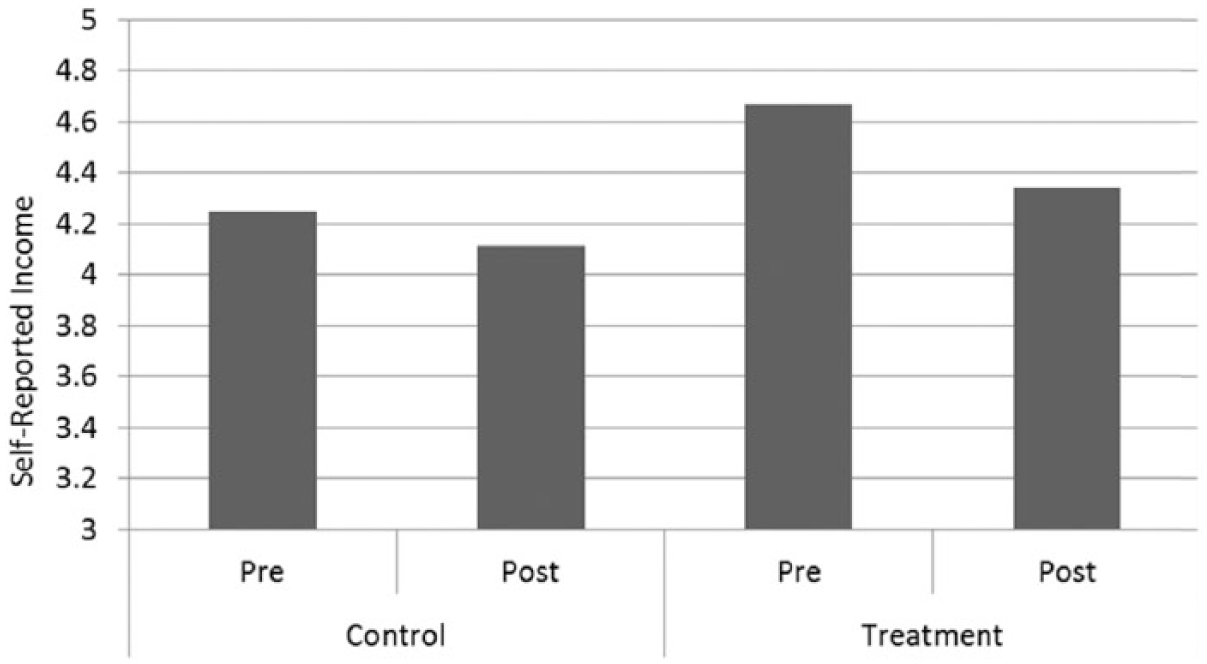
Higher scores (on a scale from 1 to 7) indicate higher self-reported incomes.
Descriptive Statistics.
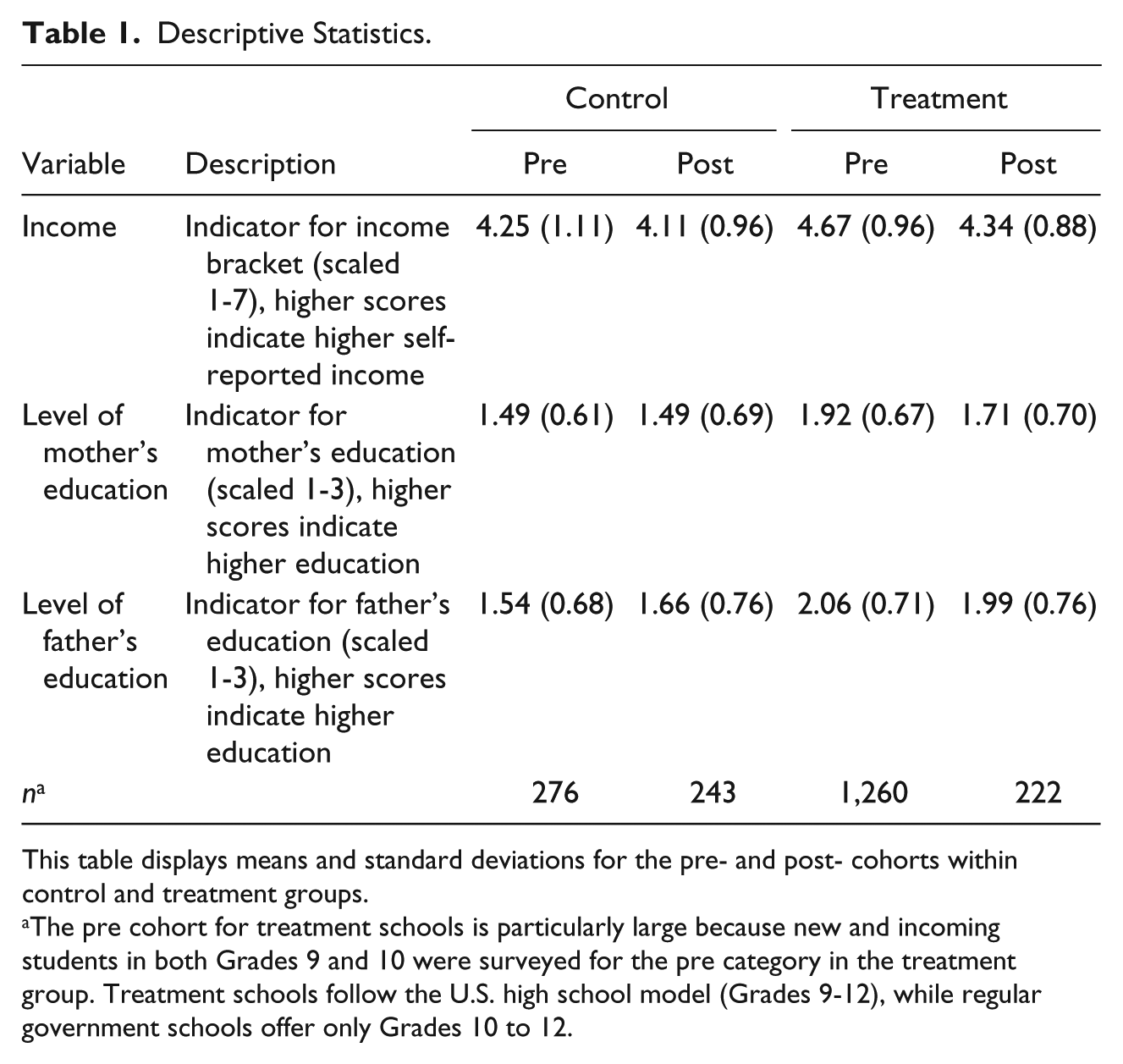
This table displays means and standard deviations for the pre- and post- cohorts within control and treatment groups.
The pre cohort for treatment schools is particularly large because new and incoming students in both Grades 9 and 10 were surveyed for the pre category in the treatment group. Treatment schools follow the U.S. high school model (Grades 9-12), while regular government schools offer only Grades 10 to 12.
A “placebo” test is a more precise measure. In conventional designs, it focuses on variables that the treatment is not expected to influence, and tests the hypothesis that their trajectories from pre to post (i.e., “change scores”) are significantly different for treated as compared with control subjects. In this case, treatment schools are not expected to influence students’ reported incomes and levels of parental education from pre to post. I estimated the diff-in-diff “effect” of treatment schools on these variables, using the OLS model described above clustering standard errors by school with appropriate controls. As expected, no significant treatment effects were found.
Although the diff-in-diff design offers powerful controls, it is always possible that different starting points propel students to differing trajectories. However, an index assessing general attitudes toward science argues against the hypothesis that initial attitudes have such effects. Online Appendix C not only suggests that students in treatment schools were initially more interested and favorable toward science, as might be expected, but also suggests that this initial difference did not lead to a different trajectory in science attitudes from pre to post. This is the kind of fixed difference across groups that diff-in-diff is designed to address, and further suggests that the parallel trends assumption is a reasonable one.
Findings and Discussion
What are state leaders achieving in their drive to build more “globalization-ready” citizens? In this section, I discuss the results of the diff-in-diff analysis, focusing on the most conservative regressions clustering standard errors by school and controlling for income, parental education, emirate-level fixed differences, and date surveyed, displayed in column 4 of Table 2. Consistent with constructivist expectations, the data suggest that leaders are indeed achieving their goals in the national dimension of the state–citizen relationship: Treated students showed heightened patriotic and nationalistic attitudes, relative to students in regular government schools across pre- and postgrade cohorts. 34 For example, treatment schools appeared to boost overall feelings of national pride, as shown in Table 2. This is noteworthy because a central concern among critics of the UAE drive for more “globalization-ready” citizens has been that youth will grow up without appreciation for their own national identity and culture, particularly with the emphasis on English and bilingualism.
Diff-in-Diff Estimates of Treatment Effects on Citizen Attitudes.
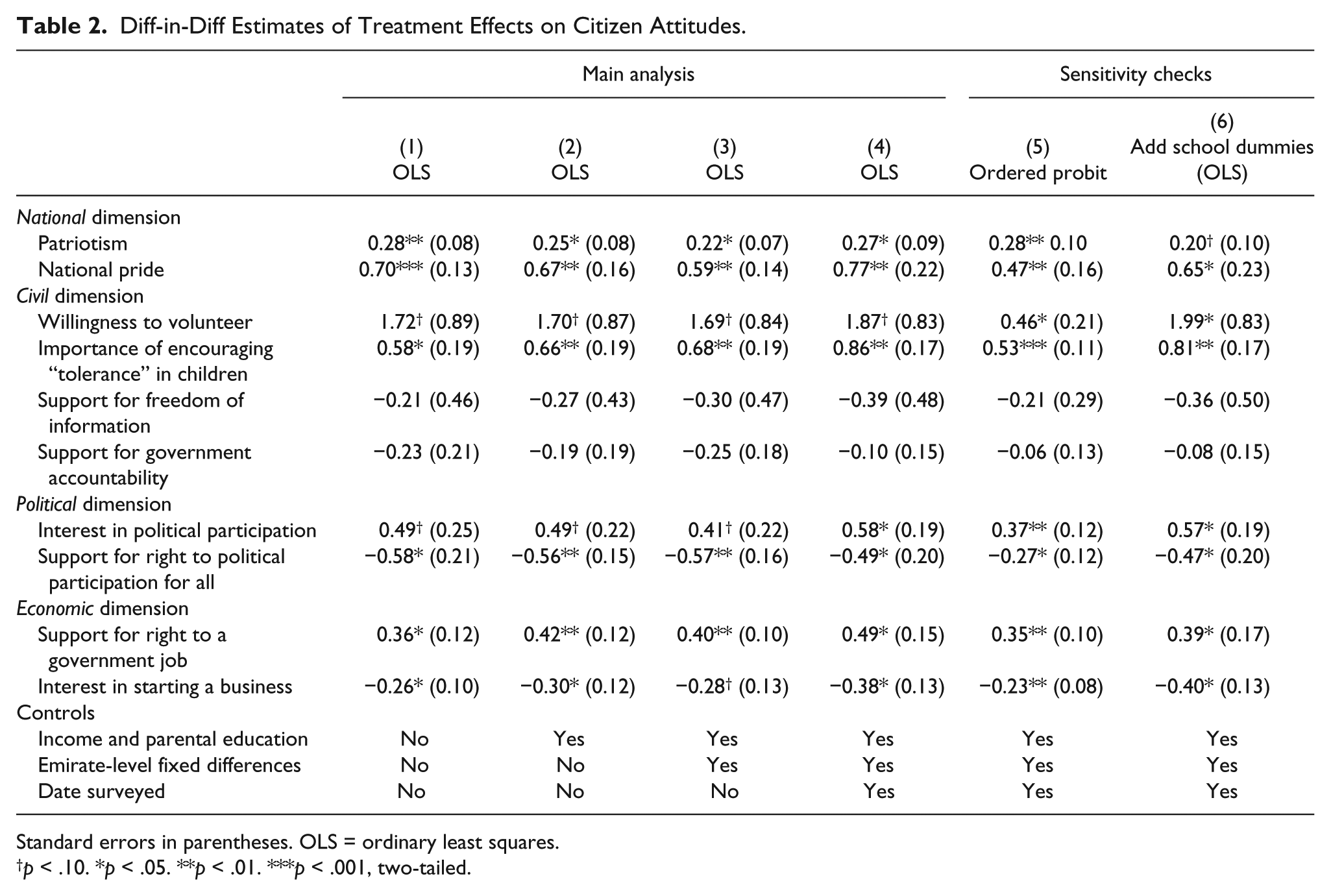
Standard errors in parentheses. OLS = ordinary least squares.
†p < .10. *p < .05. **p < .01. ***p < .001, two-tailed.
In the civil dimension, the evidence is again consistent with constructivist predictions. Here, the data suggest social engineering enhanced civic responsibility, increasing citizens’ willingness to volunteer to assist with a community cleanup effort. As Table 2 shows, the data also indicate a positive treatment effect for tolerance, suggesting that treatment schools succeeded in encouraging students to view “tolerance for others” as an important value. At the same time, no significant treatment effects were found for the civil attitudes leaders do not wish to change, despite the predictions of modernization theory. In other words, treated students did not display heightened support for freedom of information and/or government accountability, relative to control students across pre- and post-grade cohorts. 35 The fact that social engineering apparently succeeded in producing “regime-friendly” civil attitudes such as tolerance and volunteerism—but not more challenging ones related to rights—is aligned with a broader pattern in the Arab region in which “civil society” becomes top–down and de-politicized in connection to evolving autocratic survival strategies. 36
Results in the political dimension are more mixed. Consistent with modernization theory, treated students from pre to post displayed an increase in their interest in participating in political decision making, compared with control students. 37 Importantly, however, the results do not reflect an overall shift toward liberal democratic orientations, as much of modernization theory envisions. Instead, they suggest more of a personal “empowerment” dynamic with antidemocratic undertones. As shown in Table 2, although treated students displayed greater personal interest in political participation, that is, for themselves, they demonstrated lessened support for the idea of political participation as a right for others, compared with controls from pre to post.
Interestingly, then, in both the civil and political dimensions, social engineering appeared to boost personal interest in engagement, while not triggering an interest in rights for all. Insofar as autocratic rulers do not generally want citizens demanding rights for all, the results in the political dimension are aligned with rulers’ expectations. Yet the results clearly do not reflect the overall political passivity that UAE rulers value most; indeed, given plans to expand public school reforms such as these, more and more citizens may end up demanding greater political power for themselves, if not others. Either way, the effect we see here is a far cry from the common view in the nationalism literature that the nation, as Benedict Anderson (1983) put it, is “always conceived as a deep, horizontal comradeship” (p. 7).
The economic dimension also reveals unintended consequences. Here, the data suggest that social engineers are not only failing in their drive to build more market-oriented, entrepreneurial citizens, who will be less dependent on government jobs, but also, their efforts are backfiring. Treated students did not show lessened belief in the right to a government job, relative to students in regular government schools across pre and post. However, rather than leaving the belief unchanged, the evidence suggests that treatment schools perversely preserved and reinforced it, displaying an overall positive and significant treatment effect, as shown in Table 2. Because this is the most direct measure available of perceptions of the social contract in the economic dimension, this result is very striking. In the same vein, the data suggest that treatment schools did not inculcate a stronger spirit of entrepreneurialism; rather, the data show a negative treatment effect on interest in starting a business, which seems consistent with their heightened convictions surrounding the right to a government job.
Overall, are ruling elites getting what they want? In sum, in the national and civil dimensions, the evidence indicates success: Youth exposed to social engineering appear to have become more patriotic, proud of their country, willing to volunteer in service to the community, and tolerant. However, the findings point more toward failure and perverse outcomes in the political and economic dimensions. Here, the data suggest that social engineering is heightening entitlement, strengthening belief in the right to a government job, dampening entrepreneurial ambition, and triggering interest in political participation for self but not others. It would appear that treated students became not only more patriotic but also more entitled—in other words, entitled patriots. As shown in Table 2, the results are generally not sensitive to the addition of school fixed effects or ordered probit models.
For additional analysis, I investigated the correlation of general demographic variables with rentier attitudes. To include gender as a demographic variable, I examined the surveys administered in both boys’ and girls’ regular government schools as well as treatment schools; as noted, females could not be included in the main diff-in-diff analysis because their treatment schools were too new, without any outgoing seniors. In Online Appendix D, I show regression results for the key rentier attitude—support for the right to a government job. Strikingly, the only significant demographic predictor is gender, with females showing greater support for the right to a government job (p = .002). This is an important finding, given that rentier theory often leaves an impression of economic determinism, as if all citizens are equally “rentier” in their outlooks. The gender difference may reflect tensions in role expectations for women, with ruling elites increasingly pushing women to work outside the home combined with social pressures to find careers “appropriate” for women, amounting to higher female rentierism. 38 Overall, more research is needed on gender and citizenship attitude trajectories.
Probing Causal Mechanisms
Why would state-led social engineering succeed in some areas, yet fail and produce perverse outcomes in others? Causal mechanisms are not the main focus of this article, whose primary contributions are to rethink the making of citizens and assess outcomes in a contemporary case. Yet it is worth noting that none of the three well-known theoretical perspectives discussed above are fully satisfactory. That is primarily because the results are a mix of intended and unintended outcomes, and they are, thus, more complex than existing theory predicts. For example, it is by now a truism to observe that elites are likely to fail when they seek to mold society by design because of a certain inherent hubris in the exercise and lack of local knowledge. 39 Yet, can insufficient local knowledge explain the UAE results? Although this argument provides important insights, it is ultimately too broad-brushed to be fully satisfactory. If UAE social engineers lack local knowledge, why should this undermine their social engineering efforts in some areas but not others? Likewise, a constructivist perspective does not account for mixed results; it may explain success in the national and civil dimensions, but not failure elsewhere.
At first glance, modernization theory is more promising. Yet it tends to predict the rise of Western-style liberal democratic citizens, and that does not capture the complexity of these results. In this sense, critiques of modernization theory are more appealing; in the “social reproduction” school, for instance, scholars argue that modern schooling, especially of an elite variety, can encourage acceptance of rather than a tendency to challenge the status quo. 40 Yet, applied to the UAE case, such an approach is also not wholly satisfying. First, although treatment schools are somewhat selective, they are by no means “elite” in the context of UAE society; not only are they government (and not private) schools but they are also more vocational in emphasis—not an elite marker—than regular government schools. Second, treated students cannot be described as truly “accepting” of the status quo; relative to control students, they demanded more, both politically and economically.
As Tilly (1999) has emphasized, further research is needed in general on the reasons for social engineering outcomes, with greater attention to the likelihood for results to be mixed and uneven. In this case, ruling elites have thrown many ideas and strategies into their social engineering toolkit, with the result that treatment schools are different from control schools in a variety of ways, making causal mechanisms difficult to disentangle. But a key first step is investigating outcomes, as has been done here. Although preliminary, qualitative fieldwork evidence also points to the possibility that the new nationalism linked to social engineering is itself partly responsible. Because ruling elites believe that young citizens lack the confidence to succeed in a competitive and globalizing world, they shower those in treatment schools with nationalistic praise, both for their nation and for themselves as its citizens.
Yet nationalism as “self-esteem boosting” may have complex effects, boosting feelings of national and civic pride and self-efficacy, yet also intensifying the very rentier-style entitlement—with its citizenly sense of exceptionalism from markets and perhaps reliance on expatriates—that social engineers set out to dampen in the first place. Ironically, the new, positive-themed nationalism of the social engineering campaign, by stressing praise for the UAE, its citizens, and the country’s drive to succeed in a globalizing world, may foster greater entitlement than the negative-themed nationalism of the past, which emphasized the UAE and larger Arab nation under threat. Certainly, the idea that nationalism may, in certain forms, “crowd out” development-friendly mind-sets deserves further thought, given that nationalism is typically assumed to be a powerful citizen motivator.
Conclusion
This article investigates new approaches to citizen-building in a globalizing era. It offered a rethinking of the classic “making of citizens” challenge, showing how contemporary conditions call for new theoretical tools and a renewed empirical research agenda. Whereas the making of citizens, 1.0 focused on “first-order” challenges such as instilling a national identity and preparing citizens to fight on the battlefield, the making of citizens, 2.0 focuses on “second-order” challenges. These derive from the fact that we live in a more mature international system, one in which basic national identities are largely “given,” war is less common, and the global economy is more integrated and competitive than ever. The nature of the citizen-building challenge is evolving accordingly, yet relatively little research examines the contemporary making of citizens from a systematic comparative perspective.
To help fill this gap, I have offered an updated conceptual framework to capture shifting needs, goals, and outcomes, and used it to study a contemporary case of citizen-building. My analysis focused on the drive to foster more “globalization-ready” citizens in the UAE—a first mover in these respects in the context of the Middle East and a vivid counterexample to Beblawi and Luciani’s (1987) claim that authoritarian rentier states need not bother with national myth making (p. 75). Evidence from a key public school reform suggests that UAE leaders are successfully reshaping the national and civil dimensions of the state–citizen relationship along what they see as “globalization-ready” lines. But it also points to failure and unintended consequences in the political and economic dimensions. Hence, the “globalized” citizens borne out of state-led social engineering appear highly patriotic and proud, even more civic minded and tolerant, yet not especially willing to work hard, take risks, and contribute to economic development—in other words, entitled patriots. Thus, a heightened national identity and love of country need not translate into a heightened willingness to contribute to that same country’s development. This underscores a key point that, although national identities are largely “given” today, their deeper meanings are not.
Future research should continue to examine how the “making of citizens” is evolving in the contemporary era, and particularly how the “globalization-ready” ideal is being interpreted and pursued in differing contexts. For example, are entitled patriots linked primarily to authoritarian and/or rentier state efforts at “pro-globalization” social engineering, or might they also arise from similar efforts in democracies and nonrentier contexts? Overall, the goal should be to broaden the empirical base for more nuanced theory about state-led social engineering, which moves beyond “success” and “failure” in the classic historical cases to why and how specific outcomes may emerge. As states continue to adapt to an era of intensifying globalization, such research should offer significant practical as well as theoretical benefit.
Footnotes
Acknowledgements
The author thanks Ellen Lust, James Scott, Thad Dunning, Rogers Smith, Michael Herb, Marc Lynch, Natasha Ridge, Samar Farah, Rania Turk, Ghadah al Khadri, Patricia Wallace, Julian Jones, Eric Adler, and Lili Katz-Jones for excellent comments and feedback. The author also thanks Nasser Albanna, Farah Hallaba, and Hassan Abuhashish at the University of Maryland, College Park, who provided valuable research assistance, as well as the Yale University MacMillan Center for International and Area Studies and the Project on Middle East Political Science (POMEPS) for financial support. She is also grateful to Ben Ansell, David Samuels, and anonymous reviewers from Comparative Political Studies for valuable suggestions. For outstanding research support in the United Arab Emirates, she thanks the Al Qasimi Foundation for Policy Research.
Declaration of Conflicting Interests
The author declared no potential conflicts of interest with respect to the research, authorship, and/or publication of this article.
Funding
The author disclosed receipt of the following financial support for the research, authorship and/or publication of this article: The author is grateful for the financial support for this research from the Yale University MacMillan Center for International and Area Studies, the Project on Middle East Political Science (POMEPS), and the Al Qasimi Foundation for Policy Research.
Notes
Author Biography
References
Supplementary Material
Please find the following supplemental material available below.
For Open Access articles published under a Creative Commons License, all supplemental material carries the same license as the article it is associated with.
For non-Open Access articles published, all supplemental material carries a non-exclusive license, and permission requests for re-use of supplemental material or any part of supplemental material shall be sent directly to the copyright owner as specified in the copyright notice associated with the article.
