



Abstract
Previous studies have argued that democracy diminishes the extent to which leadership contests depress economic growth, by reducing the violence and uncertainty attendant on such contests. We reconsider the theoretical basis for this claim, highlighting the separate roles of executive constraint and electoral accountability. Exploiting panel data from 1850 to 2005, we show that the executive’s horizontal accountability to the legislature significantly moderates the economic downturns associated with leadership turnover, while its vertical accountability to the electorate does not. These results suggest that, in terms of moderating succession-related downturns and thereby promoting steadier economic growth, the health of legislatures is more important than the health of elections.
Many scholars have advanced one or both of the following claims: that economic growth improves political leaders’ chances of staying in office; and that stable leadership enhances investment and growth. The literature (reviewed below) has provided increasingly sophisticated means to measure these simultaneous effects. In this article, we diverge from previous work in two main ways.
First, we argue that economic growth and political stability are both outcomes of a single coordination game whose participants are the incumbent political leader and an array of potential investors. The profitability of some economic investments, dubbed “politically sensitive,” depends on the incumbent ruler staying in power. But that leader’s chance of political survival depends on economic performance, hence on the overall level of investment. The interrelationship of investment profits and leadership survival mean that two coordination equilibria exist. In a “low” equilibrium, investors shun sensitive investments due to self-fulfilling fears that the ruler will not stay in power. Thus, expected economic growth and political stability are both low. In a “high” equilibrium, investors embrace sensitive investments due to self-fulfilling beliefs that the ruler will remain in power. Thus, expected economic growth and political stability are both high.
Second, we argue that the number of politically sensitive investments in an economy depends on the polity’s structural characteristics. Under dictatorship, many investments are politically sensitive. Thus, the economic and political cost of being trapped in the “low” equilibrium can be substantial. As the chief executive’s scope for unilateral action declines, due either to “checks and balances” or electoral accountability, fewer investments are exposed to executive predation. Thus, the gap between the “low” and “high” equilibrium diminishes. These observations lead us to investigate how the effect of stability on growth varies, as a function of the executive’s horizontal and vertical accountability. This contrasts with the previous literature, which has focused on the dichotomy between democracies and autocracies.
Empirically, we use panel data from 1850 to 2005 to explore how executive constraints and electoral accountability mediate the effect of political turnover on economic growth. Given our long study period, we observe changes in executive constraints (as measured by the Polity IV Project) in 62 countries, changes in electoral accountability (as measured by Boix, Miller, & Rosato, 2012) in 65 countries, and change in both kinds of accountability in 53 countries.
Our main findings, derived from a difference-in-differences estimation strategy, can be summarized as follows. Increased executive constraints significantly reduce the economic downturns associated with leadership turnover but improvements in electoral accountability do not. When it comes to reducing a country’s risk of getting stuck in an instability-poverty trap such as those identified by Londregan and Poole (1990), it is more important to have a strong legislature constraining the executive than to subject the executive to free and fair elections.
This result has an important policy implication. In many states emerging from violence, the international community emphasizes the importance of instituting elections. Our results suggest that, with respect to the goal of fostering economic and political development, the democracy promotion community’s emphasis on electoral processes may be misplaced. Creating political stability and fostering the growth necessary to move a country beyond its past violence may be better served by devising institutions that constrain the executive’ scope for unilateral action.
Political Stability and Economic Growth
Many scholars claim that economic growth enhances political stability, while others claim that political stability promotes economic growth. Let us review each claim and some models that incorporate both effects.
The literature on political agency (e.g., Barro, 1973; Besley, 2006; Ferejohn, 1986, 1999) assumes, and the literature on economic voting (e.g., Duch & Stevenson, 2008; Kayser & Peress, 2012; Kramer, 1971) provides evidence—that higher rates of economic growth promote political stability—in the specific sense that incumbent leaders are more likely to continue in office. Both literatures focus on democracies but similar claims have often been made about autocracies (e.g., Geddes, 1999, p. 119; Haggard & Kaufman, 1995).
Meanwhile, the literature on political economy offers several reasons that political stability should promote economic growth. First, leaders whose days are numbered may be tempted to steal from state coffers, default on state contracts or repudiate debts on their way out (cf. Przeworski et al., 2000, p. 189). Thus, instability may reduce trust that the state will honor its obligations, causing a contraction in economic transactions with the public sector. Call this the problem of last-period predation.
Second, as argued by Bernanke (1983), Canes-Wrone and Park (2012, 2014) and others, some industries may hold back on making irreversible investments when leadership succession is likely, because the profit from those investments depends substantially on government policies—which may change under new leadership. Call this the problem of policy change.
Third, in crony capitalist regimes, many firms rely on political connections to secure state favors and protect themselves from economic competition that erodes their rents. Such firms are likely to reduce their investments, when the probability of the incumbent continuing in office declines. 1 Call this the problem of crony change.
Building on the insights reviewed above, some studies allow both directions of causality, with political stability and economic growth influencing each other. For example, Alesina, Özler, Roubini, and Swagel (1996), Feng (1997), and Jong-A-Pin (2009) have investigated systems of equations in which stability linearly improves growth and growth linearly improves stability. Under appropriate conditions, these models lead to a single stable equilibrium, given by the intersection of two lines, one showing how growth reacts to stability, and one showing how stability reacts to growth. Identification proceeds by positing that certain variables shift one reaction function but not the other (exclusion restrictions). 2
In this article, we complement the structural equations approach just cited. We focus on how institutions of horizontal and vertical accountability mediate the relationship between stability and growth. The main threats to our analysis stem from the endogeneity of institutions—those constraining the executive or subjecting it to electoral discipline—rather than the endogeneity of leadership transitions (as in the studies above). Our strategy to deal with the endogeneity of institutions is to use a difference-in-differences estimator using panel data.
A Politicoeconomic Model of Stability and Growth
As noted above, the previous literature has suggested that political stability enhances economic growth by mitigating last-period problems, stabilizing policies, and stabilizing cronies. We focus on the last two mechanisms in what follows.
Define a “politically sensitive project” as one whose profitability depends on policy and/or crony stability. Such projects may cluster in particular sectors; and typically require political clout to undertake. Thus, we can partition investors into two sets—those in a position to invest in politically sensitive projects (“political” investors) and the rest.
Each political investor has a budget Y to invest, and can invest either in politically insensitive projects returning R0 or in politically sensitive projects returning R1 > R0. Let y denote the amount invested in politically sensitive projects, and P denote the probability of political stability (i.e., the probability that both policies and cronies will be stable). Letting Pcrit ≡ R0 / R1, each (risk-neutral) political investor will follow a simple rule of optimal investment:
When P ≥ Pcrit, all political investors will invest in politically sensitive projects. If political stability falls below the critical level, however, then political investors, like rats leaving a sinking ship, will avoid politically sensitive investments.
The rational decisions of political investors pose a problem for rulers. New leaders in particular may struggle to convince other actors that their grip on power is firm. If they succeed, then policy- and connection-dependent firms will undertake investments. Such investment in turn will boost growth and help stabilize the new rulers in power. On the contrary, if new rulers fail to convince investors that their grip on power is firm, then growth will stall and there will be another reason to try someone new. This account resonates with one of the most striking empirical patterns observed in autocracies—namely, that new leaders’ risk of expulsion is by far the greatest in their first year and declines steeply thereafter (Svolik, 2008).
One example of “rats leaving sinking ships” is the inability of declining regimes to sell sovereign debt. Such debt provides a pure example of a politically sensitive investment, if investors believe that the old regime’s debts may be repudiated by new rulers. The collapse of Confederate debt in 1865, the collapse of tsarist debt in 1919, and many other examples illustrate the process.
Other examples of “rats leaving sinking ships” involve equity. When Suharto became ill, the share prices of firms reliant on cronyist connections to his regime declined (Fisman, 2001). When the Republicans unexpectedly lost control of the U.S. Senate, shares of firms reliant on their connections to that party declined in value (Den Hartog & Monroe, 2008; Jayachandran, 2006). And so forth.
The discussion above suggests that economic growth is a step function of political stability:
here, Xζ represents the expected growth given economic conditions X and “low” political stability (P < Pcrit); I[P ≥ Pcrit] = 1 if P is above the critical level; and ε ~ N(0, σ) is an error term.
The coefficient β ≥ 0 reflects how much economic growth improves on average when political stability is above Pcrit and, consequently, politically sensitive investments are undertaken. β increases with the size of the “politicized economy”—that is, how many political investors there are and how many politically sensitive investments are available to them. We shall assume that
here, β0 > 0 reflects the average size of the politicized economy in polities lacking any accountability mechanisms.
The variable Horizontal is an indicator for the presence of horizontal constraints on the executive. Improving horizontal accountability should reduce policy and crony uncertainty by limiting the chief executive’s scope for unilateral action. Thus, we expect βH < 0. 3
The variable Vertical is an indicator for vertical (i.e., electoral) constraints on the ruler. The coefficient βV represents how much electoral constraints moderate the stability-on-growth effect, holding horizontal accountability constant. We expect βV to be small in magnitude.
To explain why, consider first a case in which the executive faces no horizontal constraints. Will adding vertical accountability significantly moderate the risks associated with leadership turnover? The problem is that unconstrained rulers have enormous structural advantages in winning elections and can corrupt the process, should they wish. Unconstrained rulers allow free and fair elections only when they are confident of winning. If less confident, they rig the process to secure the desired outcome (cf. Schedler, 2002). 4 Thus, elections held by horizontally unconstrained rulers—even if they qualify as free and fair—do not actually constrain them much and, accordingly, should not substantially mitigate succession-related uncertainty.
What if horizontal constraints are already in place? In this case, adding vertical constraints should have only a marginal additional moderating effect. Thus, holding the level of horizontal constraint constant, we expect variations in the level of vertical constraint to have only small effects (βV should be small in magnitude).
How Constitutional Structure Mediates the Effect of Leadership Turnover on Growth
In this section, we develop an estimation strategy to assess whether βH < 0. Our dependent variable is Gjt, the growth rate of annual real per capita gross domestic product (GDP) in country-year jt.
We cannot observe P, hence we cannot observe whether it exceeds Pcrit or not. Thus, a direct estimation of Equation 2 is not feasible. If the variables X are all predetermined, however, then expected growth (before P is realized) is
Thus, if we can proxy Pr[P ≥ Pcrit], we can proceed.
Our approach is to use leadership turnover(s) as a proxy for heightened policy and crony uncertainty, thus inversely measuring Pr[P ≥ Pcrit]. If entrepreneurs withhold politically sensitive investments during political successions, then we should observe temporary succession-related growth slumps.
However, not all exits create the same level of uncertainty. For example, when an old king dies and his sole heir has publicly pledged to retain his advisers and continue his policies, P will be high despite the turnover. At the opposite extreme, when a revolutionary group seizes power by force, P will be quite low.
To assess the level of succession-related uncertainty that investors in a given country-year experienced, we keep track of three features: (a) the number of leadership transitions that occurred: more turnovers, more uncertainty; (b) the type of transitions that occurred: constitutionally irregular turnovers should engender more uncertainty than those occurring pursuant to constitutional processes; (c) whether the transition was foreseen (on which more below). We rely on the Archigos data set in coding these features (Goemans, Gleditsch, & Chiozza, 2009).
The most flexible approach would be to code a series of dummy variables Exit(n,s,a) jt indicating that n exits of constitutional status s ∈ {regular, irregular} and predictability a ∈ {anticipated, unanticipated} occurred in country-year jt. This approach, however, is rather unwieldy. Thus, to begin with, we proxy uncertainty just by the number of leadership successions occurring a given country-year. We then proxy uncertainty by two dummy variables, one indicating at least one irregular succession and one indicating at least one regular succession. Finally, we try some more elaborate codings that keep track of the number of each kind of turnover and whether they could be anticipated.
To begin with, we code a variable Exitsjt = ln(1 + n_exitsjt), where n_exitsjt equals the number of chief executives exiting office in country-year jt. Note that Exitsjt = 0, when there are no exits and is concave increasing in the number of exits. Our interest centers on whether exits affect growth differently, as a function of the horizontal and vertical accountability of the chief executive. Thus, we also include the interactions Verticaljt- 1 × Exitsjt and Horizontaljt- 1 × Exitsjt. 5
Our estimating equation is as follows:
Here, αj is a country-specific fixed effect, θt is a year-specific fixed effect, and X jt is a matrix of economic control variables (namely, the first two lags of growth and the third lag of GDP per capita, the last to test for the presence of “convergence”).
As Papaioannou and Siourounis (2008) point out, the estimation model in Equation 4 avoids several limitations of standard cross-country growth regressions. Most importantly, it controls for time-invariant country characteristics and accounts for global influences on growth, such as those produced by the two oil shocks in the 1970s. The standard errors are clustered by country.
Verticaljt- 1 equals 1 if Boix et al. (2012) classified country j as an electoral democracy in year t– 1 6 ; while Horizontaljt- 1 equals 1 if Polity IV classified country j as imposing “substantial limitations” on its chief executive in year t– 1 (cf. Marshall & Jaggers, 2002). Although these variables were fairly highly correlated (Spearman’s rho = .80) over the study period (1850-2005), there were 497 country-years in which executive constraints existed, yet the polity was not an electoral democracy (e.g., the United Kingdom in 1875); and 243 country-years in which an electoral democracy lacked executive constraints (e.g., Cuba in 1910). To check the robustness of our results, we considered both an alternative measure of vertical accountability and an alternative measure of horizontal accountability (as described below).
We expect that exits will be associated with the largest downturns in growth when both horizontal and vertical accountability are absent. When horizontal constraints are put in place, succession-related growth slumps should become milder.
Relating our estimating Equation 4 to our theoretical model in Equations 1, 2′, and 3, δ5 (the coefficient on Horizontaljt-1 × Exitsjt) provides an estimate of βH (how much implementing executive constraints reduces the depressive effect of leadership turnover on economic growth). We argue below that one can interpret |δ5| as providing a lower bound on |βH|.
Results
Our results—see Table 1, Model 1 (and appendix)—can be read as follows. Lagged growth predicts current growth and lagged GDP correlates negatively with growth, consistent with the well-known convergence hypothesis. The main effects of horizontal and vertical accountability—about which we offered no predictions—are both substantively small. We comment on the statistical significance of horizontal accountability’s main effect below.
How Constitutional Structure Mediates the Economic Costs of Leadership Turnover, 1850-2005.

GDP = gross domestic product. Dependent variable: Growth rate.
Standard errors clustered by country.
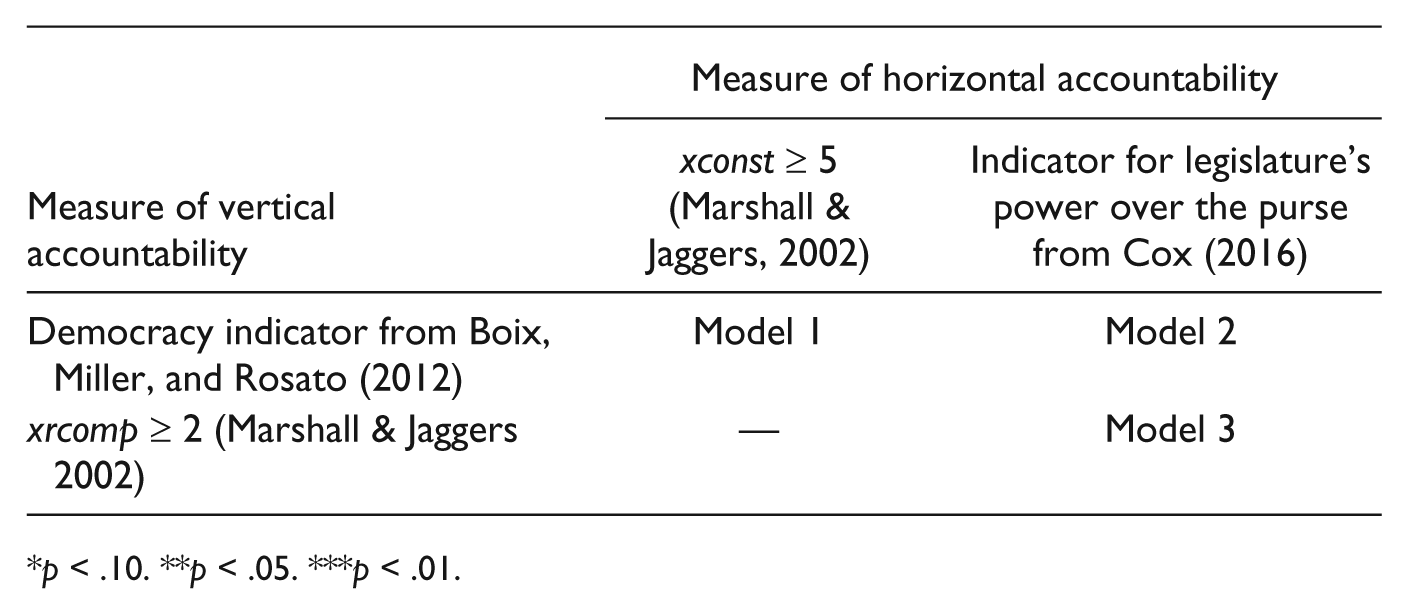
The variables used to measure vertical and horizontal accountability in each of the models were as follows:
p < .10. **p < .05. ***p < .01.
Leadership turnover in polities lacking both vertical and horizontal constraints on their chief executive is associated with a significant decline in the economic growth rate. The estimates imply that a single exit depresses growth by 1.74 percentage points, a dual exit by 2.77 percentage points, and a triple exit by 3.48 percentage points. 7 Adding horizontal constraints has a significant moderating effect, such that a single exit depresses growth by .73 percentage points less, a dual exit by 1.17 percentage points less, and a triple exit by 1.46 percentage points less. Adding vertical constraints has a statistically insignificant but substantively nontrivial effect, reducing the growth-depressing effect of leadership turnover by about .41, .64, or .83 percentage points, respectively, when one, two or three exits occur.
Polity IV’s measure of executive constraint has been criticized as not really tapping institutions and instead being “constructed to reflect the outcomes of most recent elections” (Glaeser et al., 2004, p. 273; see also Gleditsch & Ward, 1997). To avoid these problems, we redefine the variable Horizontaljt-1 in terms of the legislature’s fiscal power. In particular, we let Horizontaljt-1 equal 1 when the executive cannot continue spending money (in the new fiscal year) without the explicit prior approval of the legislature, and 0 otherwise. The legislature’s power over the purse has been viewed as the key constraint on the executive since the Enlightenment (cf. de Secondat baron de Montesquieu, 1748/1989; Madison, 1788/2009). Moreover, the presence or absence of such a power can be coded directly from each country-year’s constitution (per Cox, 2016), thus avoiding any reliance on political events (other than constitutional amendments or suspensions). 8
The results for Model 2 are similar to those for Model 1. One difference is that the main effect of horizontal accountability (measured by the legislature’s control of the purse) is now positive and insignificant. Because Polity IV’s executive constraints variable was coded partly based on political outcomes, it correlates both with political instability and electoral democracy. This makes it harder to interpret what its main effect means in a regression that controls for both turnover and democracy. In any event, the simpler variable tapping the legislature’s power of the purse is both conceptually closer to what we mean by horizontal constraint and operationally cleaner. Thus, in what follows, we use this variable in our main results, confining results based on Polity IV’s variable to the online appendix (see https://sites.stanford.edu/gwcox/data).
Model 2’s results concerning the impact of leadership turnovers and the moderating effects of vertical and horizontal constraints are all quite similar to Model 1’s. The main difference is that the moderating effect of horizontal constraint (measured by the legislature’s fiscal power) is estimated to be 45% larger.
In Model 3, we measure vertical accountability using Polity IV’s competition variable, xrcomp, instead of the Boix–Miller–Rosato indicator. In particular, we consider countries in which at least one chief executive was elected (xrcomp ≥ 2) to have had vertical accountability. As can be seen, the results are qualitatively similar to those in Model 2.
All told, the evidence is consistent with our central claims. First, when leadership turnover looms, economic agents in regimes with less constrained leaders face more acute uncertainty about how policies and cronies might change under a new leader than do their counterparts in regimes with more constrained leaders. Thus, growth is more strongly (negatively) correlated with the exit of unconstrained rulers than it is with the exit of constrained rulers. Second, the conditioning effects of horizontal accountability are both substantively larger and statistically more consistent than those of vertical accountability.
Reverse Causality
Is the negative correlation between leadership turnover and economic growth due to low growth driving leaders out of office or to perceived risks of turnover drying up investment? Both directions of causality are plausible. The most common approach to isolating the risk-on-growth effect is to identify variables that affect the probability of leadership exit but do not affect growth (cf. Alesina et al., 1996). For our purposes, however, such exclusion restrictions may be problematic.
To see why, suppose that some variable Z increases the probability that the incumbent ruler will fall from power. If this variable is known in advance to investors in the relevant country-year, then they should retrench their politically sensitive investments. Thus, any variable that foreseeably affects the risk of government turnover will (under our theory) also affect growth.
Should we then focus on unforeseen political successions, such as those produced by accidental deaths? The problem here is that the “treatment” of interest is investors’ exposure to a risk of policy and crony change. Focusing on unforeseen turnovers is equivalent to focusing on cases in which the treatment’s temporal duration is truncated (because investors perceive risk only after the turnover occurs) and, thus, the “dosage” is small.
In the remainder of this section, we try two alternative approaches to mitigate worries about reverse causality. First, we argue that the interaction term, Exits × Horizontal, can be interpreted as giving a lower bound on |βH|. Second, we isolate a subset of regular exits that were plausibly unconnected to growth—namely, natural deaths—and show that our results for this subset are similar to those in the broader sample of exits.
Interpreting the Interaction Term
Suppose economic growth rates affect leaders’ chances of remaining in office no more in autocracies with unconstrained rulers than in those with horizontally constrained rulers. This assumption seems plausible: It should be harder to hold pure dictators accountable for good economic performance than their horizontally constrained counterparts. This assumption is also supported by some simple statistical patterns: High recent growth rates are good news for pure dictators but equally good news (perhaps better) for horizontally constrained autocrats. 9
If pure autocrats are held no more accountable for growth rates than their horizontally constrained counterparts, then the large growth declines that coincide with turnover in pure autocracies are not due to the fact that leaders are more apt to be removed for poor economic stewardship. Rather, these growth slumps reflect the fact that economic actors are more uncertain about what decisions new leaders will take, when they face fewer constraints.
Irregular Exits, Regular Exits, and Natural Exits
To bolster this interpretation, we consider several different types of leadership turnover—irregular, regular, and natural. Those who reach power irregularly thereby exhibit a willingness to break the old regime’s rules. Preexisting horizontal constraints should thus not greatly constrain them, as they are just another old regime rule. To put the point in relative terms, horizontal constraints should have a stronger moderating effect when turnovers follow constitutional rules than when they do not.
Within the category of regular turnovers, some are plausibly less affected by reverse causality. In particular, some leaders exit office by a process—natural death—that is relatively unconnected to recent economic growth rates (Jones & Olken, 2005).
In Table 2, we explore how the different types of leadership turnover just identified affect growth. In Model 1, we include two separate dummy variables—one indicating the occurrence of one or more irregular exits, Exit(irr) jt , and another indicating the occurrence of one or more regular exits, Exit(reg) jt . We do not expect horizontal constraints to greatly mitigate the effect of irregular exits and thus do not include an interaction between Exit(irr) and Horizontal (including this interaction, as we do in the robustness checks reported in the online appendix, does not change our conclusions). In contrast, we do include the interaction Exit(reg) × Horizontal. The point of this specification is to show that proxying uncertainty by the type of exit (regular, irregular) rather than the number of exits (as in Table 1) does not affect our results.
Different Types of Leadership Turnover.

Dependent variable: Growth rate. Standard errors clustered by country. GDP = gross domestic product.
p < .10. **p < .05. ***p < .01.
As can be seen (Model 1), irregular exits are associated with larger growth slumps on average than are regular exits. This makes sense because irregular seizures of power often coincide with (a) particularly large policy and crony differences between the old and new rulers, and with (b) violence. The results indicate that vertical accountability has little moderating effect while horizontal accountability significantly mitigates the growth slumps associated with regular turnovers.
In the online appendix, we show that much the same patterns hold if one codes not just the presence/absence of each type of exit but the number. We also show that neither vertical nor horizontal accountability significantly moderates the slumps associated with irregular exits.
In Model 2, we add another dummy variable indicating the occurrence of one or more regular exits due to the natural death of a ruler over the age of 70, Exit(nat) jt , along with an interaction term Exit(nat) × Horizontal. When old rulers die in office, it is likely that economic actors will have considered the possibility of death, and they may have had advance warning, if the ruler made fewer public appearances or was reported to be ill. If reverse causality was the only factor driving the correlation between growth and exit, then natural deaths should not be associated with significant growth slumps; and horizontal constraints should have no moderating effect (as there is nothing to moderate). In contrast, if the anticipation of leadership succession (and hence policy and crony change) contributes to the correlation between growth and exit, then natural deaths of old rulers should (as they are easily anticipated) be associated with significant growth slumps, and horizontal constraints should mitigate such slumps.
Model 2’s results reveal the following main effects. First, the biggest growth slumps are associated with irregular transitions. Second, growth slumps after regular exits are about 2/3 the size of those occurring after irregular exits. Third, when rulers die natural deaths at advanced ages, the subsequent growth slumps are, if anything, larger than those occurring after other regular exits. This last pattern is not consistent with the idea that all the action is low growth driving rulers from office.
The estimated interactions are also inconsistent with the primacy of reverse causality. The moderating effect of horizontal constraints is particularly large in the case of natural deaths, not particularly small. This makes sense from our perspective because horizontal constraints should have their largest moderating effect when investors have ample time to anticipate leadership turnover; and they do have ample time when leaders die natural deaths due to old age.
Checks Versus Removals
Thus far, we have shown that the legislature’s ability to block the executive from taking action (by defunding those actions) has a strong moderating effect, while the electorate’s ability to remove the executive from office does not. In this section, we consider whether the legislature’s ability to remove the executive (via votes of no-confidence) matters more than the electorate’s.
We explore this issue by including a separate variable, Confidence, that equals 1 when the legislature can remove the chief executive by a simple or absolute majority, 0 otherwise. When we add this variable, along with its interaction with Exits, to Model 2 of Table 1, our previous results are preserved. Meanwhile, neither the main effect of Confidence nor its interaction with Exits is statistically discernible from zero. These results (see the online appendix) show that reforms imposing checks on the executive drive our results, rather than reforms allowing the legislature to remove the executive.
To interpret these results, consider reforming a hereditary absolutist monarchy by creating a parliament and endowing it with the right to elect and remove the monarch (while preserving his absolute powers). This kind of elective dictatorship should run afoul of the same problems that we noted above when discussing vertical electoral constraints. In particular, unconstrained rulers throughout history have used their power to corrupt whatever electoral processes putatively constrain them. Power corrupts the electoral process and absolute power corrupts it absolutely.
Robustness Checks
We have already shown that our results are robust to (a) using either of two measures of horizontal constraint, (b) using either of two measures of vertical constraint, and (c) using either of two ways of coding exits. In this section, we describe a further series of robustness checks in which we ran Model 1 of Table 1 on a number of different subsamples of data. First, for the time period, 1850 to 2005, we excluded each country from the analyses, one at a time, and reran the analysis. Second, we altered the starting year, SY, of the analyses. In particular, we examined the period (SY, 2005), for SY = 1875, 1900, 1925, 1950. Third, we altered the ending year of the analyses, examining the period (1850, 1950).
When we examine the period 1950 to 2005, the moderating effect of horizontal accountability is statistically significant when we measure vertical accountability using Polity IV’s xrcomp variable but not when we use the Boix–Miller–Rosato democracy indicator. Other than that, none of the changes listed above materially affects our main results (see the online appendix). In each case, horizontal accountability significantly moderates the effect of leadership succession on economic growth, while vertical accountability’s moderating effect is considerably smaller and statistically insignificant.
Exploring Fixed Investment
In this section, we explore an alternative indicator of investors’ willingness to invest—gross fixed capital formation as a percent of GDP (from the World Bank’s World Development Indicators). Fixed capital is often vulnerable to state predation and investments in it are typically irreversible. Thus, our theory predicts that rates of capital formation should be sensitive to leadership turnover.
Because planning for capital investments entails a significant lead time, investment slumps (as opposed to growth slumps) might be larger for regular exits (which are more easily anticipated) than for irregular exits (whose occurrence is less predictable). Moreover, because preexisting horizontal accountability mechanisms do not constrain rulers who enter power by force, we expect that the moderating effect of horizontal accountability should be visible only for regular exits.
As the World Bank’s data begin in 1960, we restrict our analysis here to the post-1960 period. As can be seen in Table 3, capital formation declines significantly (by .56 percentage points of GDP) when leaders facing neither horizontal nor vertical constraints exit office by regular means. But the regular exit of horizontally constrained leaders produces an insignificant decline in investment. Meanwhile, there is no evidence that vertical accountability mitigates investors’ uncertainty about policy and crony changes.
Leadership Turnover and Fixed Investment, 1960-2005.

Dependent variable: Gross fixed capital formation (as percent of GDP). Standard errors clustered by country. GDP = gross domestic product.
p < .10. **p < .05. ***p < .01.
Because our post-1960 sample includes only one observation on a leader exiting in a regime that had vertical but not horizontal constraints, our results are driven by comparisons of exits in three types of regime: those without any checks, those with horizontal checks only, and those with both horizontal and vertical checks. The insignificant coefficient on Regular Exit × Vertical tells us that regular exits in full democracies are not significantly different in their economic impacts than regular exits in horizontally constrained autocracies.
Our results remain qualitatively similar if we use the logged number of exits of each type, rather than their presence/absence. If we measure horizontal accountability using Polity IV’s executive constraints variable (rather than by the legislature’s control of the purse), our results remain substantively similar but fall short of statistical significance.
Focusing on Autocracies
Many scholars have claimed that democracy promotes economic growth (e.g., Acemoglu, Naidu, Restrepo, & Robinson, 2014; Papaioannou & Siourounis 2008; Persson & Tabellini, 2006). The main novelty of our approach is to focus on an institutional feature—executive constraint—that often historically precedes electoral democracy. In this section, we seek to learn more about the effect of horizontal accountability by excluding electoral democracies entirely from our analyses.
The results of doing so are presented in Table 4. As can be seen (in the coefficient on Regular Exit × Horizontal), the moderating effect of horizontal accountability is evident in autocracies.
Leadership Turnover and Economic Growth in Nondemocracies, 1850-2005.

Dependent variable: Growth rate. Standard errors clustered by country. GDP = gross domestic product.
p < .10. **p < .05. ***p < .01.
In some autocracies, horizontal checks are the only constraints on the executive; but others also allow multi-party electoral competition. If we add an indicator Multiparty and an interaction Regular Exit × Multiparty, we find (see Model 2) that a weak form of electoral accountability—legal multi-party competition—has little effect on growth, either directly or by mitigating the effects of leadership turnover.
Discussion
We have focused on three structural features: horizontal accountability due to checks and balances, horizontal accountability due to the ability of legislators to remove the executive from office (i.e., the vote of no confidence), and vertical accountability due to the ability of voters to remove the executive from office. We argue that such features determine the extent of complementarities between political and economic inputs—which in turn determines the nature of the politicoeconomic equilibria in a polity.
When leaders face few checks on their actions and are difficult to remove, complementarities are large, which means that the politicized economy is large and, thus, uncertainty connected to leadership successions can significantly dislocate economic activity. When checks and balances are imposed—even on a ruler who cannot be removed by either parliament or the electorate—the politicized economy shrinks and leadership transitions generate less uncertainty and smaller growth slumps. Adding vertical electoral accountability—either the mere legality of multi-party competition or full electoral democracy—produces no further improvement. Nor does adding horizontal electoral accountability—in the form of votes of no confidence—seem crucial.
Complementary evidence of the primacy of horizontal constraints is provided by Canes-Wrone and Ponce de Leon (2015). Where we have focused on all regime types over a relatively long period, they focus on partial and full democracies in the period 1975-2012. Where we use actual leadership turnover to proxy for political uncertainty, they use the holding of an election. Otherwise, however, Canes-Wrone and Ponce de Leon follow a similar logic to ours and reach similar conclusions. In particular, they find that higher executive constraint “moderates election-induced declines in irreversible investment” (p. 3).
Other studies bolster our claim that more investments are politically sensitive in regimes with less constrained executives. In particular, several studies suggest that the impact of leadership turnover on politically connected firms is larger in autocracies (Earle & Gehlbach, 2015; Ferguson & Voth, 2008; Fisman, 2001) than in democracies (Khurana et al., 2012).
Our analyses do not allow us to say whether investors worry the most about last-period predation, policy change or crony change. Other studies, however, suggest that worries about crony change are an important component of investor uncertainty. In particular, Earle and Gehlbach (2015, p. 709) find “a sharp divergence after the Orange Revolution in the relative performance of firms between regions supportive of and opposed to Viktor Yushchenko.” They are able to discount the idea that these gains were mediated by changes in public policy by including a full set of industry-year controls, along with firm-specific fixed effects. Industry by industry, firms in pro-Yushchenko portions of Ukraine outperform their counterparts in anti-Yushchenko areas, suggesting that it was not industrywide policies but political connections that mattered.
It is worth stressing that the focus of our investigation is not how democracy affects growth. Rather, we focus on horizontal constraints on the executive, something that predates electoral democracy in many countries. The most well-known claim about executive constraints is North and Weingast’s (1989) argument that they enhance the credibility of property rights and thus underpin economic growth. Here, we have argued that executive constraints, because they reduce the executive’s capacity to change economic policies (and cronies) unilaterally, reduce the uncertainty that political investors face when successions loom or have just occurred.
Our results help explain why growth in autocracies is comparable in mean but more variable than in democracies—a pattern noted by Pritchett (2000) and Mobarak (2005), among others. In a nutshell, the succession-driven economic cycles in democracies—regimes that typically institutionalize both horizontal and vertical accountability—are much milder than the succession-driven economic cycles in autocracies (which often lack both accountability mechanisms). Yet investors in democracies more often face the milder uncertainties posed by electoral exits: The relative frequency of such an exit is about 0.2 in a randomly sampled democratic country-year. In contrast, investors in stable autocracies less often face the graver uncertainties posed by violent successions: The probability of such an event is about 0.05 in a randomly sampled autocratic country-year. Thus, to the extent that growth is driven by cycles in political uncertainty associated with leadership turnover, democracies and autocracies may have similar mean growth rates: the first suffering more frequent but less severe shocks, the latter less frequent but more severe shocks. Nonetheless, democracies should have a noticeable advantage in the variability of growth, because the variance in democratic uncertainty from nonelection years to election years is smaller than the variance in autocratic uncertainty from iron-grip years to years of coup or revolt.
Conclusion
A substantial literature explores how regime type, dichotomized as democracy and autocracy, affects political stability and hence economic growth. In these studies, stability and growth are both endogenous, and a single stable equilibrium exists in the system of linear equations that connect them.
In this article, we replace the democracy-autocracy dichotomy with a four-way regime classification, depending on the presence or absence of both horizontal and vertical accountability. The motivation for adopting a four-way categorization of regimes is partly that horizontal and vertical accountability have often been introduced at different times in a given country’s history, and partly that such reforms should theoretically have different effects. Our data, which come from the period 1850-2005, allow us to observe many changes on both dimensions of accountability.
In our model, economic agents combine political and economic inputs to produce their goods and services. When they become uncertain about the supply of key political inputs, their demand for economic inputs declines. Thus, political economies are inherently prone to correlated downturns in stability and growth, corresponding to transitions from a high equilibrium, in which investors expect stability and accordingly invest, which in turn ensures stability; to a low equilibrium, in which investors expect instability and accordingly do not invest, which in turn ensures instability.
How much stability and growth vary between a polity’s two equilibria depends on its structural characteristics—here, the presence or absence of horizontal and vertical accountability mechanisms. Our main finding is that horizontal accountability reduces the growth gap between the high and low equilibria substantially and consistently, whereas the effect of vertical accountability is substantively smaller and statistically insignificant.
Our results resonate with previous work emphasizing the importance of executive constraints, ranging from the classic observations of Enlightenment theorists (e.g., Madison, 1788/2009; Montesquieu, 1748/1989) to more recent discussions of constitutional commitment (North & Weingast, 1989), horizontal accountability (O’Donnell, 1999), and the importance of political institutions in general (Acemoglu & Robinson, 2012) and legislatures in particular (Cox, 2016; Fish, 2006). Our results also suggest that democracy promotion may hinge more crucially on reforms that enhance legislative power vis-à-vis the executive than on reforms that ensure freer and fairer elections.
Footnotes
Appendix
Declaration of Conflicting Interests
The authors declared no potential conflicts of interest with respect to the research, authorship, and/or publication of this article.
Funding
The authors received no financial support for the research, authorship, and/or publication of this article.