



Abstract
While democratic accountability is widely expected to reduce corruption, citizens to a surprisingly large extent opt to forgo their right to protest and voice complaints, and refrain from using their electoral right to punish corrupt politicians. This article examines how grand corruption and elite collusion influence electoral accountability, in particular citizens’ willingness to punish corrupt incumbents. Using new regional-level data across 21 European countries, we provide clear empirical evidence that the level of societal grand corruption in which a voter finds herself systematically affects how she responds to a political corruption scandal. Grand corruption increases loyalty to corrupt politicians, demobilizes the citizenry, and crafts a deep divide between insiders, or potential beneficiaries of the system, and outsiders, left on the sidelines of the distribution of benefits. This explains why outsiders fail to channel their discontent into effective electoral punishment, and thereby how corruption undermines democratic accountability.
Keywords
Introduction
While international organizations, policy experts, and nongovernmental organizations promote democratic accountability as a critical component to curb corruption, citizens to a surprisingly large extent opt to forgo their right to protest and voice complaints, and refrain from using their electoral right to punish corrupt politicians. The election and reelection of corrupt politicians pose a major challenge to democratic theorists as it allows democracies to underprovide public goods, such as health care, economic development, or environmental protection, which in turn threatens to undermine the legitimacy of the democratic system in the eyes of the electorate (Norris, 2011).
This study examines why politicians involved in corruption continue to be reelected. In doing so, we distinguish between two types of corruption—one, political corruption scandals among elected officials, and, two, what we refer to as high-level, “grand corruption” (GC). We explore how the latter influences voter behavior in response to the former type of corruption, and suggest that pervasive GC corrodes electoral accountability and explains why institutions rife with venality remain unchecked. In other words, the extent to which a citizen punishes corrupt politicians is highly contingent upon the context in which she finds herself. A polity dominated by egregious GC among elites is organized around informal extended networks of acquaintances, and the personalized interchange of concrete rewards and punishment, rather than around abstract impartial principles involving people who may not even be part of your network (Hale, 2015, p. 20; Karklins, 2005; Ledeneva, 2013). Such a systemic level of corruption permeates polities and “dictates every political and economic pursuit” (Hale, 2015), and thereby shakes the very foundations of liberal democracy, as it builds on “personal bonds where detached judgment should be” (Piliavsky, 2014, p. 2) and particularism (Mungiu-Pippidi, 2006) in lieu of impartiality (Rothstein & Teorell, 2008).
We broadly define GC as collusion among the highest levels of government that involves major public sector projects, procurement, and large financial benefits among high-level public and private elites (Rose-Ackerman, 1999, p. 27), transactions which are rarely directly observed by the general public. We suggest that the level of GC varies considerably in scale and severity between countries, and, at times, within countries from region to region and risks corroding electoral accountability through three parallel but interrelated electoral effects. In environments where GC is systemic, patronage-like exchanges are common and enhance loyalty to corrupt politicians, as defectors may be deprived of spoils and face the moral costs involved of breaching loyalty obligations. A polity with high or even systemic levels of GC also produces resignation and voter abstention, as the electorate is more likely to experience alienation and cynicism about the potential of the political system to contain corruption. In addition, polities dominated by egregious GC craft deep divide between citizens, particularly between the insiders of collusive networks of exchange and spoils, or the real or potential beneficiaries of GC, and outsiders, those excluded from such collusion. In particular, insiders remain loyal to corrupt politicians, irrespective of the politicians being involved in a corruption scandal, whereas outsiders are more likely to abstain from voting altogether. This contributes to explaining the failure of outsiders to canalize their grievances into effective electoral punishment in places where such behavior is most needed—in democracies with systemic corruption.
Our analysis contributes to the growing literature on how corruption affects voting behavior in democracies. We make a theoretical contribution by developing a comprehensive multilevel theory, explaining why and how GC corrodes electoral accountability and maintains corrupt politicians in power. This contributes toward explaining why both virtuous and vicious cycles of corruption are maintained and perpetuated. We model individual characteristics of voters and macrolevel factors to interact to explain electoral responses to a political corruption scandal. At the individual level, our insider–outsider framework distinguishes between respondents, and at the macrolevel we focus on variation in the level of grand (elite-level) corruption across polities. In addition, as opposed to only focusing on isolated responses to corruption, such as whether a voter would vote for a corrupt party or whether they would abstain from voting altogether, we analyze three types of electoral responses to corruption using a development of Hirschman’s (1970) framework of Exit, Voice, and Loyalty. How citizens express discontent is of central importance to the functioning of democracy, and mechanisms of accountability operate very differently depending on the type of response that citizens perceive to be most viable.
We also make an empirical contribution. We test our theory with a large original survey that asks respondents directly how they would respond electorally if their preferred party was involved in a corruption scandal, and combine these survey data with a newly developed, hard measure of GC among 185 European regions in 21 countries. Our findings provide clear empirical evidence that pervasive GC creates an environment where corrupt incumbents are more likely to be reelected, undermining the effectiveness of elections in curbing political corruption. In such contexts, voters are less inclined to hold a corrupt incumbent accountable by switching to another party. Furthermore, insiders are more likely to be loyal to their preferred party, whereas outsiders become more inclined to abstain from voting. Thus, we provide systematic evidence for a growing sentiment in the literature that has mostly been anecdotal—that elections can perpetuate (or even increase) corruption in places where elite collusion is pervasive (Bauhr & Grimes, 2014; Mungiu-Pippidi, 2006; Persson, Rothstein, & Teorell, 2013). Conversely, we find that, in environments where GC is less prevalent, accountability in the form of voting for an alternative party becomes much more likely, and this is particularly so among insiders. In other words, we find that insiders perpetuate the status quo and defend the prevailing system in low as well as high corrupt contexts: In “cleaner” societies, insiders defend the low corrupt equilibrium, in contexts where GC is pervasive insiders loyally maintain corrupt politicians in power.
The article proceeds as follows: First, we provide a brief overview of the literature on electoral responses to corruption, and argue for the importance of better integrating knowledge about how the functioning and nature of GC shape loyalty structures and cynicism, and how these effects vary systematically across different groups of citizens. We then develop a theory about how GC influences citizens’ responses to corruption scandals, focusing particularly on loyalty, demobilization, and the divisiveness of GC. Third, we discuss our data and measurements: We test our hypotheses using novel survey data for more than 85,000 respondents in 24 European countries along with new data on high-level administrative corruption in 185 regions. The data uses approximately 1.45 million awarded public procurement contracts and measure in particular restrictions on open competition for government contracts to benefit well-connected companies (Fazekas & Kocsis, 2015). The fourth section presents our results, and the fifth section concludes the article.
Corruption and Democratic Accountability
Cross-national analysis has so far failed to produce conclusive evidence on whether democracies are less corrupt than nondemocracies (Sung, 2004; Treisman, 2007; Fukuyama, 2015; Keefer, 2007; Montinola and Jackman, 2002). The broad differences in the extent to which democracies contain corruption suggest that fundamental mechanisms of democratic accountability work very differently in different contexts, and that voters far from always punish corrupt politicians (Chang, Golden, & Hill, 2010; Manzetti & Wilson, 2007).
While the empirical evidence for whether the electorate punishes corrupt politicians remains mixed (see, for example, Bågenholm, 2013; Basinger, 2013; Crisp, Olivella, Potter, & Mishler, 2014), several case studies suggest that voters’ punishment of corrupt politicians remains limited. For instance, evidence from the United States (Welch & Hibbing, 1997), Brazil (Ferraz & Finan, 2008), Italy (Chang et al., 2010), the United Kingdom (Eggers & Fisher, 2011), and Mexico (Chong, De La O, Karlan, & Wantchekon, 2015) suggests that candidates are punished to only a very limited extent for being implicated in corruption scandals. 1
An emerging literature seeks explanations for the shortcomings of electoral and societal accountability and for why it fails to contain corruption. This body of research typically assumes that political corruption leads to some level of indignation, but that this indignation is for various reasons not canalized into electoral punishment (see, for instance, de Sousa & Moriconi, 2013). At least three explanations seem to be particularly prominent in this literature. Explanations related to trade-off suggest that the reason why corrupt politicians survive in office is that voters simply do not prioritize having a noncorrupt political representative. Other factors, such as the politician’s ability to attract investment, build successful coalitions, generate economic growth, or make otherwise popular decisions, are often valued more highly by most voters (see, that is, Konstantinidis & Xezonakis, 2013; Zechmeister & Zizumbo-Colunga, 2013). Others find limited support for the existence of trade-offs, and instead suggest that the reason why corrupt officials can maintain political support is that voters lack information about wrongdoings (Winters & Weitz-Shapiro, 2013, see also Chang et al., 2010; Costas-Pérez, Solé-Ollé, & Sorribas-Navarro, 2012). Furthermore, various institutional explanations, such as press freedoms, electoral and party systems, the delegation of power and the level of independence of the judiciary (Charron & Bågenholm, 2016; Ferraz & Finan, 2008; Gerring & Thacker, 2004; Kunicová & Rose-Ackerman, 2005), may contribute toward explaining reelection, not least because they can influence the effectiveness of protests and citizen mobilization. In short, the reason why citizens do not voice complaints is that they lack information, lack institutional opportunities to do so, or simply do not prioritize anticorruption efforts.
While all these explanations are plausible, we seek to take a step back in this article and ask a more fundamental question: What determines citizens’ institutional opportunities to punish corrupt politicians, information about corruption, and the extent to which they prioritize politicians running on anticorruption mandates? We suggest that the importance of these explanations varies by context, and is in turn partly determined by the level of GC, and in particular the extent to which such corruption pervades a given society. While previous studies have distinguished between the effects of experiences of corruption/bribery and perceptions of societal-level corruption on voting behavior (Klašnja, Tucker, & Deegan-Krause, 2016) or compared the effects of different forms of corruption on voting behavior and civic engagement (Bauhr, 2016; Fernández-Vázquez, Barberá, & Rivero, 2016), our study is unique in that we model the level of societal corruption as a macrolevel variable using an objective measure, as opposed to the perceptions of individual respondents. We believe that simple indicators of individual-level perceptions of societal levels of GC may be less likely to capture the deep-rooted societal effects of GC. Furthermore, many studies focus on electoral responses to corruption in single countries (with data from either experimental or “actual” scandals), which limits tests of macrolevel contextual factors. 2
In other words, this study seeks to bring in insights from the large literature on GC to explain the reelection of corrupt politicians in Europe (see, for example, Stokes, Dunning, Nazareno, & Brusco, 2013; Nichter and Peress, 2016). GC and other elite types of collusions (see Jain, 2001) often have deep-rooted effects on the functioning of society, which may have both direct and indirect effects on the tolerance for political corruption. Electoral responses to corruption are not necessarily influenced by the nature of the corruption scandal and how much citizens morally oppose such activities, or by whether politicians are involved in direct vote buying. We believe that electoral responses to corruption are also influenced by the norms, benefits, and expectations that high levels of GC corruption convey to citizens.
Furthermore, the mechanism that explains the willingness to punish a corrupt politician is not necessarily the same as the explanations for why citizens stay loyal to a corrupt politician, or abstain from voting altogether. Using the logic of collective action theory (Karklins, 2005; Ostrom, 1998; Persson et al., 2013), some studies suggest that exposure to corruption leads to resignation and demobilization (Bauhr & Grimes, 2014), voter abstention (Sundström & Stockemer, 2015), or cynicism and alienation (Pavão, 2015). These studies suggest that resignation is often a fundamentally different type of response than the indignation or voice that may constitute a more democratically desirable response to corruption.
In an attempt to understand different forms of electoral responses, we take Hirschman’s (1970) conceptualization of Exit, Voice, and Loyalty as a point of departure. Put simply, citizens are faced with three choices in response to corruption: Voice, Exit, or Loyalty. We define loyalty as citizens’ staying loyal to the party despite it facing a corruption scandal, and suggest that citizens can express discontent in two very different ways: Citizens can either use voice, defined as voting for an alternative party, or exit, defined as abstaining from voting altogether. How citizens express discontent is of central importance to the functioning of democracy. If citizens use voice, that is, change political parties, the mechanisms of electoral accountability work to punish political leaders who abuse their power. It gives the political system a chance to recover from its mistakes and change directions. Exit, such as not voting at all, however, may be induced by disillusionment with the ability of the political system to deal with the problems at hand. It is often associated with resignation, alienation, and disengagement.
How Grand Corruption Corrodes Electoral Accountability: Loyalty, Demobilization, and the Insider–Outsider Divide
Our theory suggests that the nature of GC influences the functioning of democracy and the reelection of corrupt politicians. GC influences expectations and voting behavior through partly different channels than experiences of petty corruption. Similar to Manzetti and Wilson (2007), we are concerned with the institutional context in which a voter finds herself. Our contextual focus is on the extent to which a polity is permeated by GC, and thereby collusive corrupt exchanges at high levels of society, and the extent to which elites in the public and private sectors trade favors for their own benefit, mainly at the public’s expense. In “cleaner” societies, norms of impartiality and merit are more likely to dictate high-level exchanges in sectors such as public investment and procurement (Charron, Dahlström, Lapuente, & Fazekas, 2017). In particular, we suggest that when GC becomes systemic citizens expect that the entire elite of one’s polity is involved in collective collusion at the public’s expense, which corrodes electoral accountability and the electoral punishment of corrupt politicians as it increases loyalty to corrupt politicians, depresses voter turnout, and divides societies between insiders and outsiders. Several explanations are discussed below.
Grand Corruption and Loyalty
Perhaps the most important key to understanding the deep-rooted effects of corruption is to understand how it induces loyalty among certain groups of citizens, and mobilizes citizens to support and maintain corrupt polities. GC tends to promote patronage-like relationships driven by norms of reciprocity and a normative sense of obligation toward the network (Auyero, 2001), and perhaps even more decisively by a fear that real or anticipated flows of benefits will be cut off (Stokes et al., 2013). The broader literature on voting behavior suggests that an electorate bound by strong loyalty ties to the incumbent will be more likely to disregard improper or even immoral behavior, including corruption (De Mesquita, Morrow, Siverson, & Smith, 2002). In high GC contexts, we can expect such loyalty effects to be particularly strong and forgiving as politicians in these contexts often attain power with the aid of corruption and paternalistic networks (Golden, 2003; Wantchekon, 2003).
Recent studies show that elites have used patronage jobs in the public administration to help U.S. parties to retain power, and that the “degree of control over patronage jobs affected a political party’s probability of winning future elections” (Folke, Hirano, & Snyder, 2011, p. 568; Golden, 2003). In settings with high levels of GC, less formal rules (as opposed to impartial merit) tend to dictate employment, and winners in the marketplace consequently tend to be privileged insiders (Rose-Ackerman, 1999). GC increases the importance of informal exchanges and produces strong loyalty ties among both real and potential “clients” in a GC system, which reduces the extent to which citizens elect to switch parties. These loyalty codes extend far beyond the presence of direct vote buying, and may be present even in contexts where elections are considered “free and fair,” violence and fraud are relatively uncommon and voters are generally neither directly incentivized nor coerced to vote for a corrupt incumbent.
Political change in contexts dominated by egregious GC often comes at a great risk as it threatens potential and future job, career and even subsistence opportunities for many citizens and their extended families. Thus, high levels of GC often increase the stakes of defection and voice. Long-term exposure to business, public career, and recruitment structures built on GC, where public contracts and positions are distributed on the basis of personal contacts rather than merit, fundamentally shapes loyalty structures in society as well as perceptions of “How things get done” (Hale, 2015; Ledeneva, 2013). This forms our first hypothesis.
Grand Corruption and Demobilization
If politicians involved in corruption scandals are ultimately voted out of office, then this depends not only on the extent to which citizens switch parties but also on the extent to which citizens decide to abandon the political system and abstain from voting altogether. If citizens who are unfairly treated by a system of corruption and favoritism, as suggested by Pollock (1937) and others, respond by widespread party switching, then GC is not necessarily beneficial for the reelection of corrupt politicians. If, however, protests take other forms, in particular if they lead to voter abstention, citizen discontent may not be canalized into effective electoral punishment and thereby contribute to maintaining corrupt politicians in power. 3
While mobilization and turnout have traditionally not been granted much systematic attention in studies on corruption, GC could perhaps in some instances facilitate the favoring of particular constituents and even vote buying, and mobilize otherwise unorganized voters by offering them direct and tangible rewards. This “turnout buying” (Nichter, 2008) or “participation buying” (Schaffer & Schedler, 2007, p. 25), driven partly by the difficulties involved in monitoring vote choices when ballots are cast in secrecy (Remmer, 2010), may contribute to maintaining corrupt politicians in power. Studies that use aggregate perception-based measures of corruption seem, however, to arrive at a conflicting conclusion. These studies suggest that exposure to egregious corruption may demobilize the citizenry (Bauhr & Grimes, 2014; Chong et al., 2015), and that perceptions of corruption lead to voter abstention (Birch, 2010; Davis, Camp, & Coleman, 2004; Stockemer, LaMontagne, & Scruggs, 2013; Sundström & Stockemer, 2015). One possible explanation for the demobilizing effect of corruption is derived from the logic of collective action theory and, in particular, that a citizen’s mobilization is highly contingent upon evidence that others will do the same (Bauhr & Grimes, 2014; Karklins, 2005; Ostrom, 1998; Persson et al., 2013). In contexts in which corruption reaches systemic levels, it may be difficult to find individuals willing to face the risk and costs of mobilizing against corruption when the chances of success are slim. Corruption may therefore lead to resignation and alienation (exit) rather than protest (voice).
In other words, the stronger the dominant network becomes, the more difficult it is for those who want to protest against it to succeed in their endeavor. Such contexts may both reduce the supply of non or low corrupt candidates who run for office, and undermine the potential of competing patronage-based networks to mobilize support, as such mobilization tends to work better for incumbents, or dominant parties, than for challengers (Remmer, 2010; Wantchekon, 2003). Not voting at all may be perceived as a more viable way to breach loyalty structures than “voice,” as the risk of doing so can be very tangible in societies dominated by a strong corrupt network. Citizens who are discontent with the state of affairs therefore opt to abstain from voting altogether rather than risk the consequences of expressing loyalty to competitors.
In a polity dominated by GC, citizens may therefore be more likely to develop cynicism and resignation about the potential of political systems to contain corruption, or of challenging networks to contain corruption, and such citizens may therefore opt to abstain from voting altogether. GC may therefore channel discontent into various forms of exit options rather than citizens expressing discontent in ways that may be more democratically desirable (i.e., changing political parties if your own is involved in a corruption scandal), and thus depress voter turnout. 4
Grand Corruption and the Insider/Outsider Divide
H1 and H2 suggest that GC corrodes electoral accountability and maintains corrupt politicians in power as it increases voter abstention (exit) and decreases the likelihood of abandoning a party involved in corruption (i.e., reduces voice). What may be driving these effects? Perhaps the most powerful explanation for the detrimental effects of GC is that it often produces a deep divide in societies between insiders, that is, real and potential beneficiaries of the corrupt network, and those left on the sidelines of the distribution of spoils and benefits, or outsiders. This divisive effect of systems dominated by GC is not only often deeply polarizing but may also be directly detrimental to the punishment of corrupt politicians. Some groups of citizens obtain real or anticipated benefits from the prevailing system, and thereby develop solid loyalty ties to corrupt politicians. Others left on the sideline may feel alienated by the political system, and therefore be more likely to abstain from voting altogether. While the responses of “victims,” including the extent to which discontent is channeled into extraelectoral forms of protest, are more often explored, less attention is directed to “. . . how the winners from this process—the recipients of spoils jobs and their families—become more or less attached to their patrons as a result” (Gingerich, 2014). A recent study on how patronage divides societies in Africa furthermore finds that patronage insiders “simultaneously perceive corruption as ubiquitous and are more tolerant of malfeasance,” and such insiders are also less likely to punish corrupt politicians (Chang & Kerr, 2017).
We suggest that those who are, or anticipate being, future beneficiaries of the system, develop strong loyalty ties. These loyalty ties may become increasingly deeply ingrained as the strength of the system increases. Furthermore, we expect that insiders play a radically different role in societies depending on the level of GC. While insiders perpetuate corruption in contexts where it is pervasive, we expect that in contexts with limited GC insiders instead play the role of vigilant defenders against corrupt politicians. In other words, we expect insiders to perpetuate the prevailing system, regardless of what that current system may entail. If the dominant system is plagued by GC, insiders will support it by staying loyal to corrupt politicians. If GC is the exception rather than the norm, insiders will instead be more likely than outsiders to rise up to defy corrupt politicians.
Our theory thus posits that GC both decreases voice and increases exit, but that these effects are strongly heterogeneous between different segments of the population and depend on the extent to which GC corruption permeates the system. GC divides societies between insiders and outsiders and, as the prevalence of GC increases, insiders become increasingly loyal to corrupt incumbents and less likely to punish corrupt politicians.
Research Design, Sample, and Data
The dependent variable and research designs in general of corruption voting studies vary substantially. Some cross-country comparative studies building on multilevel survey data use an indirect proxy for voting, such as government support or satisfaction (Manzetti & Wilson, 2007), or whether the respondent stated to have voted in a previous election for the incumbent (Ecker, Glinitzer, & Meyer, 2016). Others employ data looking at actual scandals and electoral turnout (Basinger, 2013; Chang et al., 2010; Peters & Welsch, 1980; Praino, Stockemer, & Moscardelli, 2013; Stockemer et al., 2013; Sundström & Stockemer, 2015), or electoral party volatility (Crisp et al., 2014). Yet, the motivation as to why voters do or do not show up to cast their ballot for the incumbent, vote for an alternative or stay home is left unaccounted for due to the aggregation of the data to the macrolevel.
We elect to test the hypotheses empirically employing an observational, multilevel design, using a large survey of 85,000 individuals in 24 European countries. 5 Europe offers an excellent test case, in that corruption varies significantly from country to country (Charron, Dijkstra, & Lapuente, 2014) and all countries have—to varying degrees—multiparty, democratic systems. This spatial, comparative design allows us to best test our hypotheses, which capture spatial variation both within and across countries.
The survey utilized was started in February 2013. The study, which was conducted in the local language of each country, randomly selected between 1,200 and 10,500 respondents per country (varying by population size of the country), providing a high degree of reliability due to the large sample size. In all, 34 questions were posed to the respondents, and several are of particular interest here in capturing the key concepts.
As per our dependent variable, with no perfect way in which to capture the concepts of voice, exit, and loyalty, we measure them as closely as possible using the following questions, which express how an individual intends to respond to a corruption scandal in his or her preferred party in an upcoming election.
In all, 20.7% of all respondents answered “1,” whereas 33.7% and 38.6% responded “2” and “3,” respectively. About 6.9% responded “Don’t know.” The third response most closely represents our idea of exit, as the respondent is clearly choosing to abstain from the democratic process. Thus, we create a dummy variable that equals “1” if an individual selected this response and “0” if otherwise. The second response, “vote for an alternative party not involved in the corruption scandal,” most closely captures our idea of accountability, or voice, as the respondent intends to vote, but elects to punish the corrupt party (despite it being their first preference) by voting for an alternative. A dummy variable is thus created with this response as well, where an individual receives a “1” if he or she gave the second answer and “0” if otherwise. Loyalty is coded “1” if the respondent answered “still vote for the preferred party” and “0” if otherwise. Figure 1 gives the proportion of each response by country.
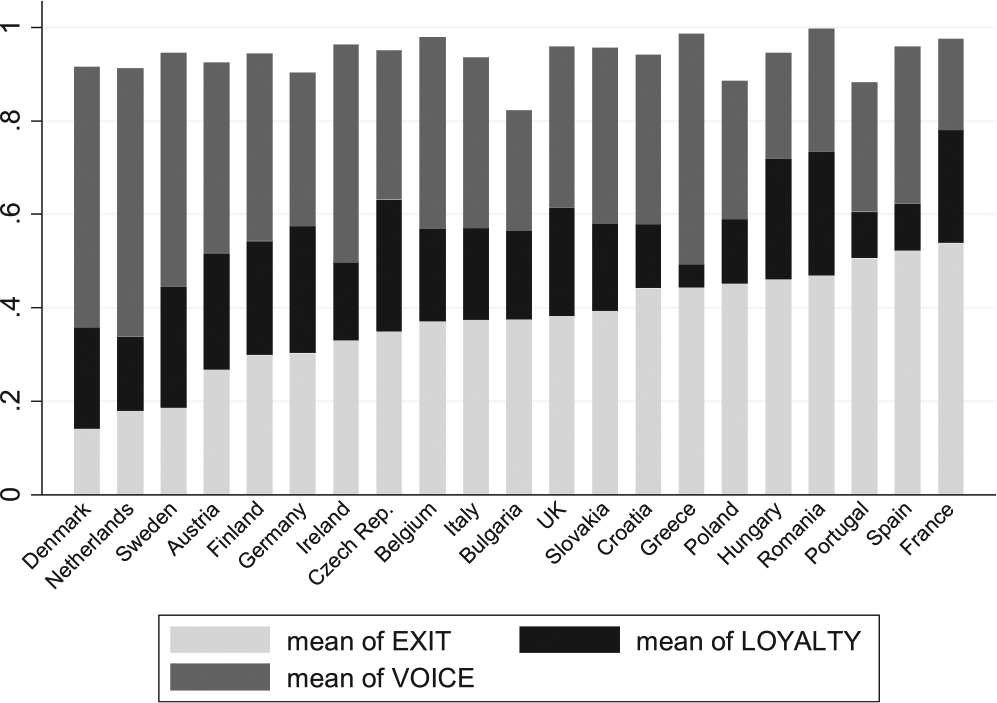
Proportion of “exit,” “voice,” and “loyalty” responses by country.
There are of course shortcomings with broad, hypothetical questions such as these. First, the magnitude of the scandal is not mentioned and, even if this was the case, individual interpretations of this would be expected to vary. While we may lose some internal validity with the lack of specificity, we argue that it is beneficial on the whole. For example, if we had imposed a certain type of scandal, it could very well be interpreted differently by respondents across countries. In our case, we permit respondents themselves to evaluate how relevant a corruption scandal is when using their vote, resulting in a more general test of our hypotheses. 6 Second, the question pertains to the party and not an individual candidate. In countries that have single-member districts, such as the United Kingdom, the salience of the candidate might trump that of the party, which could under/overestimate our findings in such cases. Third, the question is a hypothetical one, and thus the respondents might behave differently in real life compared with how they answer a survey question, resulting in “hypothetical bias.” This is of course a problem for many other studies in the field of corruption voting, in particular in experimental studies where many research designs have been based on hypothetical scenarios. However, we would argue that this is less of a problem than one might believe at first glance, as several recent empirical studies have tested the external validity of hypothetical survey questions in relation to “actual” electoral outcomes and found results to be remarkably similar (Hainmuller, Hangartner, & Yamamoto, 2015; Johnston, 2006; Vossler & Kerkvliet, 2003). Another weakness is that one of our “treatments” (the corruption scandal) is built into the question, and is thus without a quasi-experimental design, where we are comparing the voting pattern with a “control” group.
Finally, given the content of the question involved, there may be a degree of “social desirability bias” at work. However, we do observe that almost 21% claim they would continue to support their preferred party despite a corruption scandal, and thus, underreporting would not necessarily cause such bias if randomly distributed across individuals. However, this type of bias could of course produce misleading results if correlated with one of the individual-level variables, or if it was systemic in certain countries. Unfortunately, we cannot directly test the presence of hypothetical bias or social desirability bias, and we therefore highlight this as a caveat in interpreting the results.
While we are not able to fully address all of these potential problems, our data do have several advantages in relation to previous studies, in particular our ability to employ a multilevel design, combining a large number of individuals in 21 countries, and allowing us to directly test cross-level interactions. Moreover, our study employs a more direct measure of the dependent variable with the “treatment” (corruption scandal) specified in the question, as opposed to an indirect measure such as government satisfaction, perceptions, or tolerance of political corruption.
Our key independent variables are as follows: First, while there is no clear consensus in the field as to how this concept should be measured, to avoid possible endogeneity with a perceptions measure, we capture GC with an objective measure with the aid of data from Fazekas and Kocsis (2015). This measure uses public procurement data to assess the risk of high-level corruption and favoritism, which is the best measure available given that our concept of high-level corruption among elites is of concern here. The data, for EU28 between 2009 and 2013, contain information on individual public procurement tenders that has to do with regulated administrative procedures in which public bodies purchase goods and services, including contract value, the number of bidders, the deadline for submitting bids, and the assessment criteria used. The measures tap into deliberate restrictions on open competition for government contracts to benefit well-connected companies, which we argue is the best available comparative metric of our concept of GC. To avoid distortion from less competitive markets such as defense, the indicators are defined only when at least 10 contracts were awarded in the period 2009-2013, indicating a sufficient demand for bids from at least two operating companies. In all, the dataset is based on approximately 1.45 million awarded contracts. The simplest indication of corruption risk is when only one bid was submitted on a tender in an otherwise competitive market. Hence, the percentage of single-bidder contracts awarded in all the awarded contracts is the most straightforward measure we use to capture our concept and, we argue, this indicates a climate very favorable for the type of GC corruption we envision in our theory. As this—like most other measures of corruption—is not a direct measure of corruption, one clear potential pitfall with this measure is that it is not actually capturing GC, but something else, such as lack of competitive markets. We find however that correlations between this measure and alternative measures based on citizen or expert corruption perceptions and experiences are quite significant at both the country and regional levels for this sample, which gives us some assurance of validity. 7 The data are also available at the regional level for NUTS 1 and NUTS 2 levels. Country-level averages are reported in Online Appendix Table A2.
Second, there is also a lack of consensus on how one should operationalize an insider. In political economy, particularly labor market studies, an insider is someone with full-time (or willing part-time) employment, whereas outsiders are those who are outside of the labor market, those who are unemployed (Rueda, 2005). However, this distinction has been used much less so in studies of voting behavior (Lindvall & Rueda, 2014). Most studies in political science and development economics about how corruption affects electoral behavior focus on the related concept of clients (a type of insider), whereby voters are considered clients if they claim to directly rely on a powerful patron for help when in need (Stokes et al., 2013). In a recent study on corruption tolerance in African countries, Chang and Kerr (2016) distinguish two types of insiders—“network insiders” (similar to the aforementioned concept of client) and “identity insiders,” citizens who either share partisan or ethnic ties with the sitting government. Most of these past studies however focus on Latin American or African countries, whereas studies of Europe using the insider–outsider framework focus on one’s position in the labor market.
Our conception of an insider is similar to Kitschelt and Wilkinson’s (2007, p. 10) idea of “contingent direct exchange,” in that we attempt to capture whether a respondent potentially has “something to lose” politically and economically by a political change resulting from an election. We therefore attempt to merge the operationalization of the concept insider from both past corruption and labor market studies, and thus include two components of insiderness—economic and political. On the economic side, we follow the operationalization of most political economy scholars of the labor market (Rueda, 2005)—insiders are those with full-time employment. In several robustness checks, we go one step further and include only full-time public sector workers as a new administration can make political appointments, particularly within the public sector, making this type of employment potentially especially relevant in this context. In addition, we add a political element. Using a similar operationalization for the political element to Chang and Kerr (2016) whereby we code an individual as an insider if he or she is a partisan supporter of a sitting party in government. 8
Each respondent is provided with a country-specific list of relevant political parties (party lists included all sitting parliamentary parties and potentially relevant parties outside parliament, based on country-expert assessments). If a respondent answered that they would support a party in the sitting government (at the time of the survey), then they would be coded “1” and “0” if they said they would support any other party, 9 and thus the component of political insiderness is nonideological and has only to do with the current power of one’s party. The binary measures are combined to equal “1” for respondents with full-time employment who support the sitting party in power and “0” if otherwise.
As stated in the hypothesis, we expect that insiders will be more inclined to express loyalty as an electoral response as the level of contextual GC increases, meaning that their personal gain through political ties would outweigh their desire for a cleaner political party. Conversely, the extent to which insiders are also expected to opt for voice decreases in contexts with higher levels of GC. We also hypothesize that GC affects insiders differently than outsiders in terms of electoral outcomes. Therefore, we test the cross-level interaction term—“insider×GC.”
Several control variables are included at both the individual and country levels based primarily on empirical research of election studies and voter turnout (Geys, 2006; Smets & van Ham, 2013). First, we account for gender, income, age, education, population of one’s residence, one’s self position on the left–right scale, and general satisfaction with the economy. In addition, we control for whether the respondent has paid a bribe in the last 12 months for any public service. Thus, bribe corruption is measured at the microlevel, whereas GC corruption is measured at the macrolevel (regional and country level). The second-level fixed effects are population density (logged), ethnic heterogeneity, recent past levels of voter turnout (average of the past two election cycles), and the number of parties in the system, which Charron and Bågenholm (2016) find to be relevant to corruption voting.
Due to our dependent variables being binary, we test the effects of corruption on voice and exit with logit estimation. Given that GC varies systematically within and across countries, we test for the effects with both logit controlling for the country-level fixed effects described above as well as with hierarchical logit, allowing for random country intercepts. Structuring the data hierarchically has the added advantage of allowing us to test the cross-level hypothesis more directly—that is, the insiders are more prone to loyalty as the context of GC becomes greater.
Estimation
We begin by employing a hierarchical design, whereby the cross-level interaction effects are tested directly for the three outcomes separately. We find that country-level differences in the dependent variable are present, and thus country-level effects must be taken into account to avoid bias estimates. 10 Simply accounting for regional and/or country dummy variables for individual-level variation in an ordinary-least-squares (OLS) model can lead to problems because the error terms of the lowest level unit (individuals) within the same group will still be correlated. Thus, we elect to explain individual levels of voting in a hierarchical logit model with two levels, “i” and “j,” to represent individual and country levels, respectively. The basic model used here is as follows:
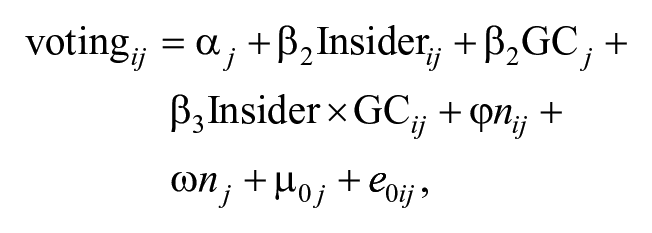
where
As the number of second-level observations (countries) is only 21, the sample thus somewhat violates the so-called “30/30 rule” (Maas & Hox, 2005); we elected to remedy this in two ways: First, we estimate several of the main models reported as individuals nested in regions (NUTS 1 and NUTS 2 depending on the country). 12 This has several advantages, as we see it. One, the second level of the estimation becomes 185 (as opposed to 21), giving us more than a sufficient sample size for hierarchical modeling, greater degrees of freedom, and greater accuracy in the results as compared with the limited country-level estimation on the second level (Maas & Hox, 2005). Two, although the country context is salient, there is sufficient spatial variation in corruption, loyalty, and voting outcomes to warrant accounting for regional differences, 13 thus giving us a more precise picture of the landscape, in particular in countries such as Italy, Spain, Belgium, and Germany that have considerable regional variation. However, we do run models where the country is used at the second level as well as standard logit with country fixed effects. We also check for the effects of outliers in each model, and rerun the analyses removing one country at a time in subsequent models (found in the online appendix).
Results
Table 1 elucidates the results for each of the three outcomes. For the sake of space, we report only the effects of GC and essential model statistics. For each outcome, a baseline model was run (no controls—Models 1, 3, and 5) along with a second model with full controls (Models 2, 4, and 6). We report odds ratios to make the results more interpretable. We see that while GC does not appear to have a significant effect on the probability of choosing loyalty, it has an independent and significant effect in the full models for voice and exit. For example, all things being equal, a 1-unit increase in the GC measure is expected to increase the odds of exit by 13% and decrease the likelihood of voice by 8%.
Electoral Responses to Corruption: Hierarchical Estimation Test of H1 and H2.
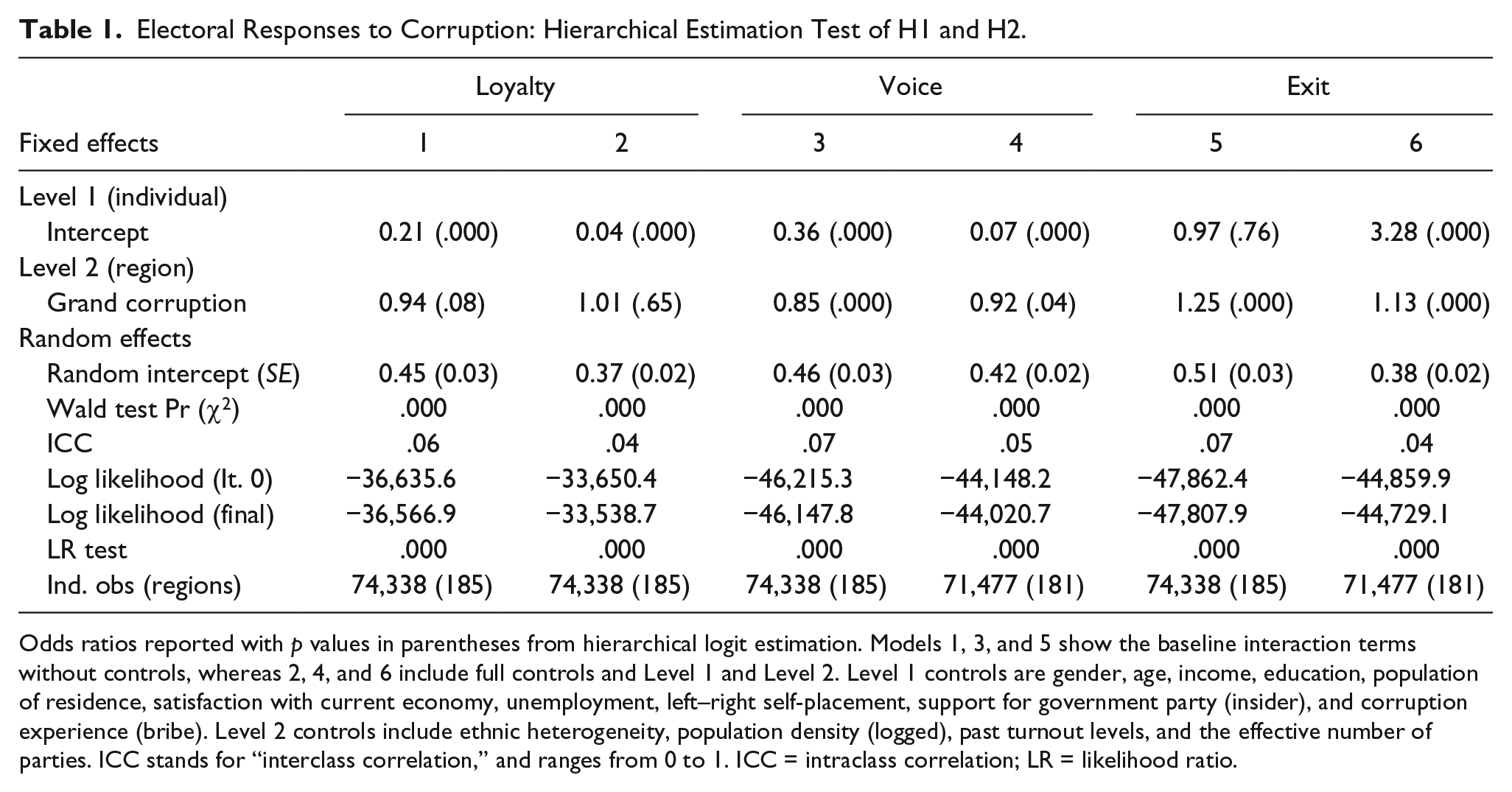
Odds ratios reported with p values in parentheses from hierarchical logit estimation. Models 1, 3, and 5 show the baseline interaction terms without controls, whereas 2, 4, and 6 include full controls and Level 1 and Level 2. Level 1 controls are gender, age, income, education, population of residence, satisfaction with current economy, unemployment, left–right self-placement, support for government party (insider), and corruption experience (bribe). Level 2 controls include ethnic heterogeneity, population density (logged), past turnout levels, and the effective number of parties. ICC stands for “interclass correlation,” and ranges from 0 to 1. ICC = intraclass correlation; LR = likelihood ratio.
Overall, these results are more or less in line with our first two hypotheses—that all things being equal, GC undermines electoral accountability by decreasing the likelihood of voice and increasing the likelihood of exit, although the effects for the latter are more robust to the inclusion of controls. For example, as can be observed in Figure 2, for roughly the “cleanest” 20% of the regions in the sample, the model predicts that the most likely electoral response is voice, whereas for more corrupt regions exit becomes the option of the plurality of respondents, demonstrating evidence for Hypotheses 1 and 2.
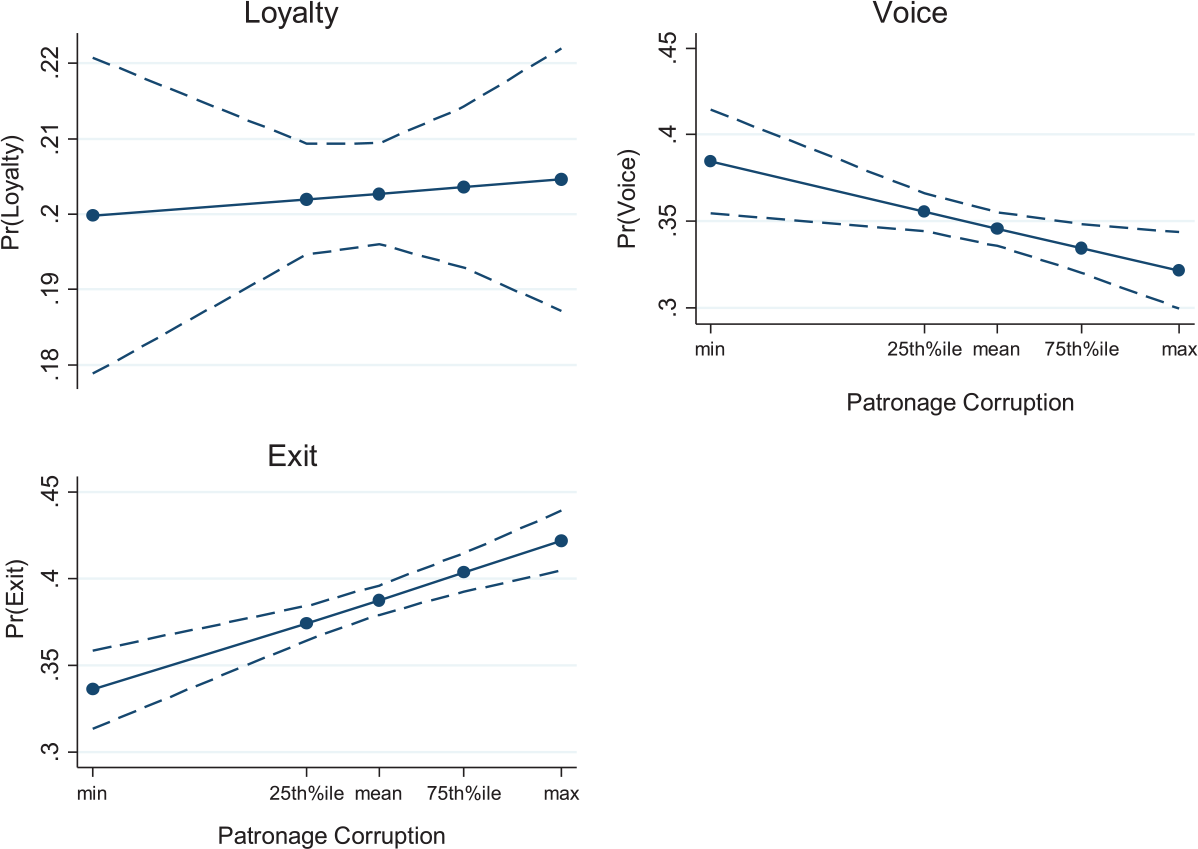
Visual summary of the effects of GC on corruption voting in voter response to political corruption scandal.
In Table 2, we test Hypotheses 3 and 4 by including a cross-level interaction between GC and whether an individual respondent is an insider or not. Our anticipation is that being an insider will have an impact on how someone views a corruption scandal in his or her party, and that this decision is also conditional on the level of GC in the region where they reside. In Models 1, 3, and 5, we produce baseline estimates with only the main variable and the interaction, whereas in 2, 4, and 6 all controls are included. Due to the insider variable being binary, “1” for insiders and “0” for outsiders, the GC coefficient can be interpreted as the effect of GC among outsiders. Again, odds ratios are reported.
Electoral Responses to Corruption: Tests of H3.

Odds ratios reported with p values in parentheses from hierarchical logit estimation. Models 1, 3, and 5 show the baseline interaction terms without controls, whereas 2, 4, and 6 include full controls and Level 1 and Level 2. Level 1 controls are gender, age, income, education, population of residence, satisfaction with current economy, unemployment, left–right self-placement, corruption experience (bribe). Level 2 controls include ethnic heterogeneity, population density (logged), past turnout levels, and the effective number of parties. ICC stands for “interclass correlation” and ranges from 0 to 1. ICC = intraclass correlation; LR = likelihood ratio.
With regard to loyalty, we find a significant interaction effect, implying a divergence of behavior between insiders and outsiders, as GC increases. At almost all levels of GC, insiders are more inclined to show loyalty than outsiders. However, as the level of GC increases, the likelihood of loyalty actually increases rather strongly among insiders, suggesting strong empirical support for Hypothesis 3. We notice however the reverse trend among outsiders—when comparing two otherwise similar outsiders—one living in a context where GC is pervasive and the other in a context of low GC, the outsider living in the context of pervasive GC is expected to be slightly less likely to express loyalty. In turn, we see that outsiders in high GC contexts are most likely to choose exit over voting. Figure 3 highlights the interaction visually.
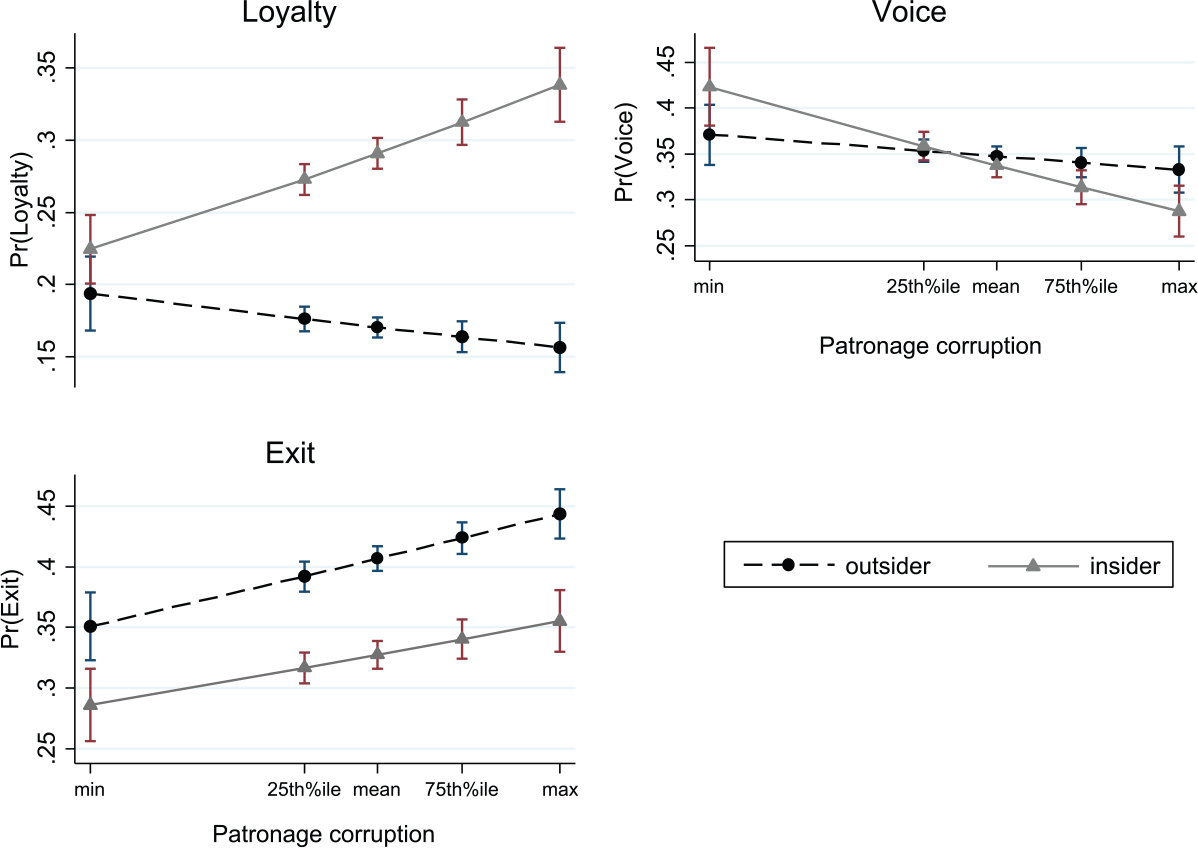
Marginal interaction effects.
With respect to voice, there is also a significant interaction effect between insider and GC. We find that insiders seem to be driving the negative effects of GC on voice substantially. At the lowest levels of observed GC, insiders are actually more likely than outsiders to vote for an alternative party (voice). However, GC sharply decreases the odds of insiders choosing voice, yet among outsiders there is no independent effect of GC on voice (p = .11) as shown in Model 4. We interpret this to mean that as the polity becomes increasingly permeated by GC, the relationship flips, and insiders become less likely than outsiders to express voice. In other words, insiders play radically different roles in society depending on the extent to which the system is dominated by GC. While insiders will perpetuate corruption in deeply corrupt contexts, they will choose to hold those who engage in it accountable in contexts where corruption is already comparatively low.
With regard to the third outcome, exit, we find that both being an insider and the level of GC have strong independent effects. The odds of exit among outsiders increase by 13% for every unit increase of GC, and there is even a slight interaction effect between these two factors (the odds of outsiders exiting compared with insiders increase slightly as a function of greater GC). Yet in all cases, outsiders are considerably more likely to exit than insiders, as seen in Figure 3, which corroborates Hypothesis 4.
Table 3 highlights the findings of the effects of the control variables. The results corroborate much of the existing literature on turnout and party loyalty. On average, given a corruption scandal in one’s preferred political party, females are less prone to loyalty and more prone to voice and exit. People with higher socioeconomic status (education and income) show a greater propensity for voting—either expressing loyalty or voice—than for abstention. Participants older than 60 are more loyal and less likely to switch parties, while the effects of age on exit are strongly negative, with younger voters being the most likely to abstain. Residents of larger urban areas show more loyalty than rural residents, while the latter are more prone to voice and exit. On a left–right spectrum (5-point scale), we observed clear “u-shaped” (and “inverted u-shaped” patterns), with center voters least likely to show loyalty and most likely to either voice or exit relative to voters on the ideological fringes. The effects of perceptions on the economy work according to our expectations—less satisfaction leads to exit, and more satisfaction leads to loyalty, while economic satisfaction is negligible in explaining voice. Of the macrolevel variables, we find that greater levels of past turnout are associated with a greater propensity to loyalty and voice, with a greater effective number of parties (ENPs) being associated with less voter abstention. Finally, on average, greater levels of ethnic diversity are also associated with slightly higher levels of loyalty.
Summary Results of Control Variables by Outcome.
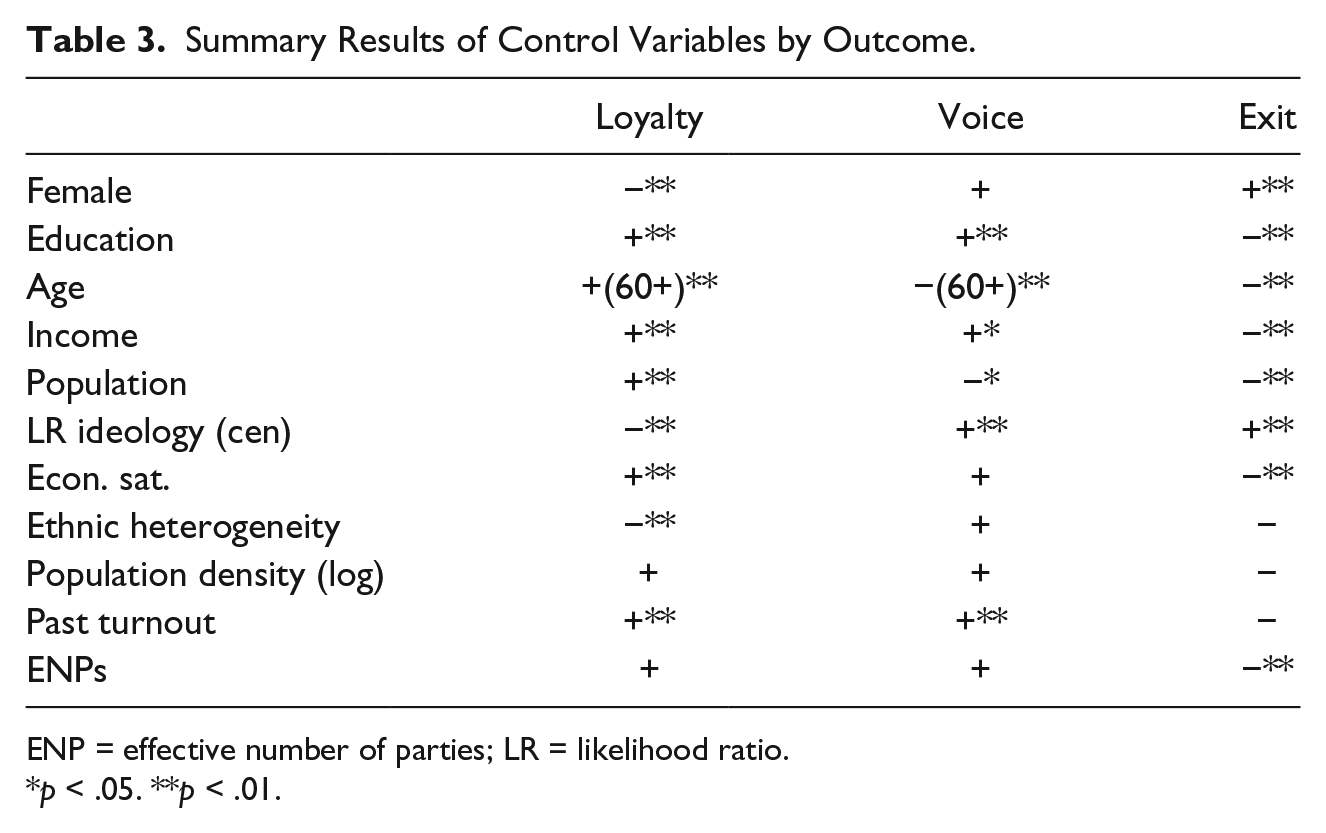
ENP = effective number of parties; LR = likelihood ratio.
p < .05. **p < .01.
Checking for Robustness
We began by checking to see if any of the results reported in Tables 1 or 2 are driven by observations from a single country. Thus, we reran all models with a country-wise jackknife to test whether the results are robust to excluding each country one at a time. We find the results in all cases to be strongly robust (see Table A5 in the online appendix). Second, we recoded the variable insider, taking only those who are partisan supporters and employed in the public sector (and therefore possibly most susceptible to political reappointments given a change in government). We find no distinguishable changes in the results (Table A6). Some recent studies find personal experiences with petty corruption to be more relevant in explaining voting patterns than macrolevel corruption (Chang & Kerr, 2016; Klašnja et al., 2016), and thus the findings of our model, which focuses on macrolevel variation in corruption, might be simply proxying for the effect of respondents’ personal experience with petty corruption (as petty corruption plausibly occurs more often in places with higher levels of GC). We tested for this by running several models, including a triple interaction between insider and personal experience with corruption (petty bribery) and GC. We find that the main effects are not affected by whether respondents have personal experience with bribery 14 —indicating that, at least in the European context, it is not personal experience with corruption that drives electoral behavior among either insiders or outsiders. We reran the models in the two main tables with standard logit estimation, controlling for country-level fixed effects (Table A7); the main interaction effects proved to be relevant on average, even among regions within countries. Next, we combined the three outcome variables into a single categorical variable and used multinomial logit estimation (Table A8). Finally, it is plausible that the choices presented are not completely independent but the result of a sequence of decisions. 15 For example, when faced with a corruption scandal in their party, it is possible that individuals first choose between being loyal or not; if they choose not to be loyal, they then elect between choice and exit. Or possibly, the first choice is between not voting and voting (exit or other), and then second, between loyalty and voice. We estimate these two sequences in Table A9 via sequential logit models. The main findings are remarkably consistent and robust to these alternatives.
Conclusion
While democratic accountability is perhaps not only the most desirable but also the most indispensable means to reduce political corruption, democracies clearly vary in their ability to contain corruption. This study suggests that GC corrodes electoral accountability and explains why institutions rife with venality remain unchecked. In particular, we suggest that egregious GC is severely detrimental to the electoral punishment of corrupt politicians as it canalizes grievances into resignation, alienation, and exit rather than indignation and voice, enhances loyalty to corrupt politicians, and crafts deep societal divides between insiders, or beneficiaries of the dominant system, and outsiders, those left on the sidelines of the spoils of the dominant network. All these effects—loyalty, demobilization, and divisiveness—we suggest maintain corrupt politicians in power.
Using a large-N multilevel comparative design that allows us to directly model cross-level interactions between individual and societal factors, a new objective measure of GC using approximately 1,45 million procurement contracts and surveys at the regional level for 185 European regions in 21 countries, we provide several novel and noteworthy findings: First, we provide clear empirical evidence that GC and elite collusion create an environment where corrupt incumbents are more likely to be reelected, even if politicians’ involvement in corruption scandals is widely known. In contexts where GC is high, citizens respond to corruption scandals either by simply staying loyal to the corrupt politician (loyalty) or by abstaining from voting altogether (exit). Conversely, in contexts where elite-level GC is low, citizens are more likely to switch parties in response to a corruption scandal (voice). Interestingly, we find no evidence for a systematic effect of personal experience with petty corruption on either voice or loyalty, and only a relatively small effect on exit, suggesting that the contextual effects of elite-level corruption are more powerful in affecting voting behavior than personal experiences in a comparative European context. 16
Second, we develop an insider–outsider framework and observe important differences not only in the way in which insiders and outsiders respond to a corruption scandal but also that these responses are highly contingent upon the context in which voters find themselves and in particular on the level of GC in their polity. Insiders in polities where GC reaches systemic levels typically stay loyal to corrupt politicians, whereas outsiders in such contexts are instead more likely to refrain from voting and exit the electoral system altogether in response to a corruption scandal. In other words, outsiders, or those excluded from the spoils of the dominant network and the benefits of favoritism, fail to canalize their grievances into effective electoral punishment. Interestingly, insiders in contexts where GC is low are, instead, significantly more likely to punish corrupt politicians than outsiders.
The level of corruption in a given political system is at times framed as a type of systemic equilibrium, varying from low to high (e.g., see Johnston, 1998). Our study helps us understand how the vicious (or virtuous) cycle of corruption operates in democratic societies, that is, why corrupt equilibria are maintained and perpetuated. We show that insiders play a different role than outsiders, particularly that insiders are more likely to remain loyal supporters of the dominant system and status quo, regardless of what that dominant system may be. In polities permeated by corruption, insiders will use their electoral power to reelect corrupt politicians and thereby perpetuate corruption. In contexts where corruption is low, insiders will use their electoral power to defend the low corruption system. The vicious cycle of corruption is also perpetuated by outsiders. We show that a near majority of outsiders chooses to abstain from voting altogether, thereby contributing to maintaining corrupt politicians in power. We can speculate that these voters view the system as “rigged” and, without a proper alternative to their preferred party, are unable to collectively compete with and outweigh the increased loyalty of insiders. In the European context, these results mirror and explain the steady decline over the past two decades in voter turnout trends in the areas where elite corruption is relatively pervasive, such as Romania, Bulgaria, Slovakia, and Greece.
Furthermore, our design has given us new insights into how “partisanship biases” may shape electoral responses to corruption. While previous studies suggest that voters have a higher tolerance of political corruption when committed by their own party (Anduiza, Gallego, & Muñoz, 2013), we suggest that this effect may have a larger electoral impact in contexts plagued by egregious GC. In low corruption settings, respondents are quite willing to abandon partisan loyalties in favor of alternative parties when their preferred party has committed malfeasance. Furthermore, in high corruption settings we find that outsiders are quite willing to abandon partisan ties in the face of a corruption scandal, yet their response is to abstain from voting altogether. We interpret both these findings to mean that when viable alternatives exist a preference to maintain clean governance trumps partisan loyalties; while in settings with higher corruption—at least for outsiders—partisanship is trumped by resignation.
Our findings thereby add several insights into the growing literature on how corruption affects electoral accountability. In many ways, this study shows the benefit of better integrating knowledge on the societal effects of corruption, its heterogeneous effects among different segments of the population, and the varieties of electoral responses to corruption (exit, voice, and loyalty) to understand how and why the electorate sometimes fails to punish corrupt politicians. While interesting and insightful current research explores these aspects individually (see, that is, Chang & Kerr, 2016; Chong et al., 2015; Karklins, 2005), this is to our knowledge the first study that integrates these insights into a single framework and tests it using a large-N comparative design. We believe that moving toward a more integrated approach and exploring how these factors interact, reinforce, and undermine each other contribute to a more dynamic understanding of how corruption influences democratic accountability.
The study does not provide a simple panacea for how to reduce political corruption. It does indicate, however, that serious reforms that include increased transparency, competition, and the implementation of laws prohibiting preferential treatment of firms in public bids, or otherwise undermining opportunities for administrative corruption, can contribute not only to horizontal accountability, that is, elites’ opportunities to monitor each other, as suggested by previous studies, but also to increased vertical accountability by reducing the probability of corrupt politicians to become elected and reelected.
Footnotes
Declaration of Conflicting Interests
The authors declared no potential conflicts of interest with respect to the research, authorship, and/or publication of this article.
Funding
The authors disclosed receipt of the following financial support for the research, authorship, and/or publication of this article: This project has received funding from the European Research Council (ERC) under the European Union’s Horizon 2020 research and innovation programme (Grant Agreement No. 339571) called “PERDEM,” the Swedish foundation for humanities and social sciences and the Seventh Framework Programme for Research and Development of the European Union (Project Number 290529) called “ANTICORRP” ( ).
).
Notes
Author Biographies
References
Supplementary Material
Please find the following supplemental material available below.
For Open Access articles published under a Creative Commons License, all supplemental material carries the same license as the article it is associated with.
For non-Open Access articles published, all supplemental material carries a non-exclusive license, and permission requests for re-use of supplemental material or any part of supplemental material shall be sent directly to the copyright owner as specified in the copyright notice associated with the article.
