




Abstract
Why have European large parties lost electoral ground in recent decades? Whereas most explanations draw on theories of dealignment, this article advances a novel, institutional, argument by focusing on the introduction of direct elections to the European Parliament (EP) in 1979. Archetypes of second-order elections, EP elections are characterized by lower vote shares for (a) large and (b) incumbent parties. Bridging the second-order elections theory with theories of political socialization, we posit that voting patterns in EP elections spill over onto national elections, especially among voters not yet socialized into patterns of habitual voting. In so doing, they increase the national vote shares of small parties. This proposition is examined using an instrumental variables approach. We also derive a set of testable propositions to shed light on the underlying mechanisms of this pattern. Our findings show that EP elections decrease support for big parties at the national arena by inculcating voting habits.
Keywords
Almost any attempt to portray the trajectory of European party systems over the last half century pays pride of place to what is known as the era of political dealignment (e.g., Dalton, 2002). Traditional, cleavage-driven, partisan lines, it is argued, have gradually eroded, leaving voters increasingly more disengaged from conventional politics in general and detached from mainstream political parties in particular (Crewe & Denver, 1985). The stylized European voter that emerges from this thesis is more reluctant to embrace parties’ ideological stances (Knutsen, 1998) and more volatile in her party preferences (Dalton & Wattenberg, 2002; Franklin, Mackie, & Valen, 1992).
Perhaps the most unequivocal manifestation of dealignment is the evidence that challenges the key theoretical pillar of the cleavage thesis—namely Lipset and Rokkan’s (1967) freezing hypothesis. In contrast to the picture of party system stability described by these two scholars, European party systems eventually witnessed the emergence of new parties in recent times. Although in most cases these newcomers failed to replace the established parties, they succeeded in entering and often remaining in the club of parliamentary insiders.
But if these facts are clear, their explanation remains a matter of long-standing dispute. The existing literature seems divided into two fronts: On the demand side, many studies point to the role of globalization and other structural developments that have altered the socioeconomic profile of many previous core party supporters (Kriesi et al., 2008). On the supply side, mainstream parties are deemed to have abandoned their constituencies by converging into the position of the median voter (Evans & Tilley, 2012; Ezrow, de Vries, Steenbergen, & Edwards, 2011).
Although these explanations enhance our understanding of the changing number of political parties in Europe, they fail to consider the role that institutional developments have played in this process. Drawing on these developments, we offer a complementary explanation for the increasing fragmentation of European party systems. Our starting point is the recognition that the current European electoral setting is not the same today as it was in 1967. Undoubtedly, the most evident funnel of institutional change has been the process of European unification. In their macrosociological overview of European party systems, Lipset and Rokkan could not foresee the increasing importance of the European integration project. The initial European Communities have gradually evolved into the currently complex multitier structure of the European Union. This process of integration has been accompanied by the creation and expansion of supranational representative institutions. Perhaps the most notable development in this respect is the introduction of direct elections for the European Parliament (EP) in 1979. 1
We argue that, at least in part, national party system fragmentation is a function of these European Union (EU)-wide elections. Similar to other institutional designs, EP elections have had unintended consequences, opening the way for the entry and long-term survival of small parties in national electorates. In our view, the second-order nature of these elections and the downstream effects of the act of voting are responsible for this phenomenon. Let us briefly elaborate on these two critical points of our argumentation.
First, one of the leading theories of voting behavior asserts that EP elections are “second-order elections” fought by national parties on the basis of domestic concerns and preferences, and where little is at stake (Reif & Schmitt, 1980). Precisely because these elections do not determine the formation of any executive power, they invite less strategic thinking, creating incentives for a protest vote, which often goes to small parties. 2 Second, previous studies have indicated that voting choices can leave a long-term imprint on people’s voting trajectories. By converting a preference into a behavioral choice, the act of voting reinforces prior sentiments about the party or candidate voted for (Bølstad, Dinas, & Riera, 2013; Markus & Converse, 1979). This effect seems to be stronger among first-time voters, who are yet to crystallize into particular voting patterns (Meredith, 2009; Mullainathan & Washington, 2009).
Combining these two lines of reasoning, we derive the following expectations: First, voters should be more likely to vote for a small party in the coming national election if they have voted in the most recent EP election. First-time voters are particularly affected by this pattern. Second and most importantly, this effect might endure over time, leaving its shadow through an enhanced likelihood of opting for small parties in future national elections. Granted on the magnitude of these effects, the continuation of EP elections increases the pool of voters who are likely to opt for a small party in national elections.
To test this hypothesis, we need to identify the effect of EP vote on future national voting choices. The problem, of course, is that people choose whether to vote and if so what party to opt for in each election. Without a way to randomly assign party choice in EP elections, the selection mechanism cannot be distinguished from the potential—if any—impact of prior vote choices on future voting patterns. We address this problem by using an instrumental variables approach and exploiting the leverage provided by first-time vote experiences. In particular, we use voters’ first-time eligibility for an EP election as an instrument of actual first-time voting behavior. Thus, we compare people whose first eligible election was an EP election with people whose first eligible election was a national election. The interesting question, then, is whether their first electoral experiences have implications for national party vote.
Bridging two strands of literature that talk past each other, this study provides a new institutional explanation for the success of small parties in the European electoral setting. The findings indicate that EP elections leave a significant footprint on people’s vote records in national elections. In so doing, they help small parties endure and survive in national party competition. Taken as a whole, the results suggest that EP elections are conducive to higher party system fragmentation over time. This finding calls for a shift in scholarly attention from sociological explanations of dealignment toward institutional factors, pointing in particular to the unintended consequences for national party systems of a specific intervention aimed at establishing a direct chain of delegation between the European citizenry and EU institutions. We elaborate more on the implications of this finding for the standard determinants of national party system fragmentation in the concluding remarks.
EP Elections and the Long-Term Consequences of the Act of Voting
Party systems during the first decades after the Second World War in Western Europe were described as “frozen” (Lipset & Rokkan, 1967). In such a world, the number of parties was relatively small, and their levels of electoral support remained moderately stable over time. Moreover, the levels of vote shares lost by incumbent parties were kept at rather low rates. None of these patterns hold nowadays. First, a considerable number of countries have registered rising levels of party system fragmentation in recent decades (Best, 2010). Second, predictions of increasing party volatility have been confirmed for a number of countries and years now (Mair, 2002, 2005). And, third, in multiparty systems it is increasingly more frequent to find negative rather than positive effects of government incumbency (e.g., Narud & Valen, 2008; Rose & Mackie, 1983; Strøm, 1990). We posit that these developments are in part accounted for by the spillover effects of the direct EP elections introduced in 1979.
Many scholars have argued that EP elections are “second-order elections” fought by national parties on the basis of domestic concerns and preferences where strategic considerations apply to a lesser extent (Hix & Marsh, 2007, 2011; Reif & Schmitt, 1980; van der Brug & van der Eijk, 2007). At the heart of this characterization is the proposition that there is less at stake in such elections than in first-order elections (Franklin & Hobolt, 2011, p. 68). Reif and Schmitt offer three broad propositions, based on these arguments, to characterize regular differences between aggregate behavior in European and national elections: (a) turnout will be lower in EP elections than in national elections, (b) national government parties will suffer losses in EP elections, (c) large parties will do worse and small parties will do better in EP elections (Marsh, 1998, p. 592).
We focus on propositions (b) and (c). Small parties and opposition parties are likely to benefit in EP elections for various reasons: First, the lower relevance of strategic orientations, often crucial in national elections, renders party size less important in vote choice (van der Eijk & Franklin, 1996). Second, as an election that takes place amid the national election cycle, EP elections favor antiincumbent vote, which again makes a vote for small parties more likely (Weber, 2011). Third, given that support for the EU resembles a bell-shaped curve (i.e., it is higher among centrist parties and lower among extreme parties), Eurosceptic vote is more often than not associated with a vote for an extreme party, which is typically also a relatively small party in national party competition. Hix and Marsh (2007) find that in all EU states from 1979 to 2004 almost 40% of the volatility in party vote shares in European elections compared with national elections is explained by the transfer of votes from large and governing parties to small and opposition parties.
Although Reif and Schmitt’s propositions have been frequently tested with both aggregate- (e.g., Curtice, 1989; Hix & Marsh, 2007; Marsh, 1998) and individual-level data (Hobolt & Wittrock, 2011), they have also been subject to criticism. A first line of criticism focuses on whether this process of electoral change across arenas is driven by sincere voting (Reif & Schmitt, 1980), or whether we should refer to this type of voting change as “instrumental,” aiming either at sending a signal to national parties (Oppenhuis, van der Eijk, & Franklin, 1996) or at balancing representation between national and supranational elections (Carrubba & Timpone, 2005), similar to subnational and federal elections in the United States and Canada (Erikson, 1988; Erikson & Filippov, 2001). Other authors have argued that vote choice in European elections cannot be solely attributed to domestic politics, as it also reflects preferences over the EU policy agenda (Clark & Rohrschneider, 2009). For example, the “Green tide” across Europe in the 1989 elections has been explained by voters’ demand for having environmental issues tackled at the European level (Curtice, 1989). The Eurosceptic vote can also be linked to this idea. According to Hobolt, Spoon, and Tilley (2009), voters punish governing parties in EP elections because they are generally far more pro-European than the typical voter. Finally, de Vries (2007) casts some additional doubts on the characterization of European elections as mere second-order national elections in those countries where European issues are on the agenda of the national electoral contest.
In light of these alternative theorizations of EU voting, it is important to emphasize that the goal of our study is not to assess the underlying roots of the voting patterns observed in EP elections. Rather, remaining agnostic about the driving forces of vote choices in these elections, we want to highlight the potential long-standing implications stemming from the largely uncontested fact that the vote share of small and opposition parties increases in these elections. 3 It is evident that previous theoretical accounts see no spillover effect from one arena to the other, which is the building block of our argument. The underlying microlevel mechanism driving such spillover effects is rooted in socialization theories of habit formation and voter learning. It is to these theories that we now turn.
Drawing on Converse’s work on political learning (Converse, 1969; Markus & Converse, 1979), various studies have found that elections are consequential in building habitual support for political parties (Dinas, 2014; Gerber, Green, & Shachar, 2003; Green & Shachar, 2000; Meredith, 2009; Mullainathan & Washington, 2009; Shachar, 2003). The mechanism driving these results seems to lie in psychological processes of cognitive dissonance (Festinger, 1957) and identity formation (Turner, 1982). Cognitive dissonance theory postulates that behavior helps individuals justify and rationalize prior attitudes (Festinger & Carlsmith, 1959). Previous experiments have shown that after having chosen among a series of objects, individuals tend to exacerbate their preference over the selected object (Brehm, 1956). The logic is analogous when choosing among different parties in an election (Beasley & Joslyn, 2001). The manifestation of a preference into a behavioral choice strengthens the perceived link between the party and the individual. In so doing, it helps people forge political identities by classifying themselves into coarse categories (Bølstad & Dinas, 2016; Mullainathan, Schwartzstein, & Shleifer, 2008). Individuals can think of themselves as voters of a specific party or group of parties, defined by their ideology, size, or some other characteristic. Group membership is accompanied by stereotyping; that is, perceptions of how a typical member of the group should behave (Turner, 1982), and voting for the party that classifies into this category forms part of this description (Lupu, 2013). This is how the process of self-categorization fosters continuity in voting patterns over the life trajectory.
Similar to other identities, political identities and self-classifications are formed and crystallized primarily during the period of early adulthood (Plutzer, 2002). It is during these “impressionable years” (e.g., Delli Carpini, 1989; Sears, 1983) that young adults are more responsive to changes in their political environment (Dinas, 2013; Franklin, 2004). These responses tend to leave a long-term imprint on their attitudinal profile (Ghitza & Gelman, 2013; Stoker & Jennings, 2008). In contrast, for older people it seems that the prior stock of political information is already too heavy to allow new shocks generate significant changes in people’s attitudinal and behavioral outlooks (Schuman & Corning, 2012). Party choice seems to adhere to this pattern. Early vote decisions are shown to influence the future partisan outlooks of young voters (Dinas, 2014; Meredith, 2009; Shachar, 2003). Their effects do not seem to necessitate long repetitions of past voting behaviour. Even a small number of consecutive elections is sufficient to generate inertia in voting habits (McPhee and Ferguson 1962; Meredith 2008).
Let us now bring these insights into the context of EP elections. Seen as second-order elections, EP elections are more likely than national elections to encourage a vote for small parties. Voting a small party in one’s first election might, in turn, reinforce one’s self-identification as a supporter of this party in particular or a specific type of parties to which the chosen party belongs (in our case, small parties). Lack of prior electoral experience makes it easier that such a vote brings young voters into grips with the idea of supporting a small party in general. Having voted for a small party in an EP election, nonestablished voters are thus more likely to do the same in the coming national elections. In contrast, young individuals who have not voted for the first time for a small party in an EP election are more susceptible to the type of motivations that make large parties increase their support in national elections and are thus more likely to vote for the latter at the national level. If electoral choices have spillover effects, these initial electoral stimuli will diffuse across arenas (from EP to national elections) and over time (from the first to future elections). This reasoning leads to the first main hypothesis of this study:
H1 is based on a two-stage logic: The first stage assumes that voting in EP elections increases the chances of having voted a small party in these elections. The second stage postulates that this voting pattern translates into the national arena. Both stages represent probabilistic statements, which can be conditioned by several factors. By considering some of these factors, we derive and test a set of complementary hypotheses, which serve to shed light on each of these stages separately. In particular, the first two additional hypotheses identify conditions that render the first stage stronger, whereas the last two look at factors that facilitate the second stage. In all four hypotheses, we expect to see an overall increase in the magnitude of the main effects.
First, EP elections do not just provide an opportunity to opt for small parties but often tend to favor a vote against the government. Even if the degree of antiincumbent vote in EP elections might vary between countries and across elections, it usually affects all parties in office, both minor and major coalition partners (Hix & Marsh, 2007). Thus, we expect voting for the first time in an EP election to help small parties even more when they are not in the government. Although small parties are in general less likely to participate in cabinets, we also find some of them in multiparty cabinets. This logic implies that the first stage becomes stronger for small parties which were not incumbent when the first election takes place:
A second factor that qualifies the magnitude of EP electoral effects is the particular location of these elections within the national electoral cycle. Voting patterns between the two types of elections differ more when there is a temporal distance between them. For example, big parties are expected to lose more votes when the EP elections take place at the middle or toward the end of the national cycle than when they take place at the beginning of the national cycle, when honeymoon effects are still vivid (Hix & Marsh, 2011). Previous research has established a monotone relationship between second-order effects and the electoral cycle because EP elections can act as marker setting when they take place close to the next national elections (Oppenhuis et al., 1996). According to this idea, voters would be more likely to engage in antiincumbent voting in elections with significant temporal distance from the previous first-order election because their discontent would be taken more into account by the parties in government. 4 Similarly, we could argue that EP elections should be more likely to translate into a vote for a small party when they take place closer to the end of the national electoral cycle, which again would imply a stronger first stage in our argumentation:
We now turn to the conditions that might qualify the transmission rate of EP vote choices onto the national electoral arena; that is, the second stage of our argument. The first condition draws on the expectation that individuals’ self-classifications can relate to a specific party or to a type of parties. Thus, those who opted for a small party in their first election become more likely to vote for a small party in future elections either because they want to vote for the same party or because they want to vote for a small party, even if it is not the same party as the party they voted for in their first election. We are not in a position to disentangle the two mechanisms because we lack information about individuals’ first vote. Yet, both mechanisms are more likely to operate if a party that is small in the current national election was also small in the first EP election. With regard to the first mechanism, having a party that was small in both elections increases the possibility that voters are actually voting for the same party in both elections. With regard to the second mechanism, a party that was small in both elections reduces uncertainty about whether it can be generally classified as a small party. According to both mechanisms, being small in both elections strengthens the second stage of our argument (facilitating the transferability of an EP vote into national elections). Consequently, we expect that a first EP vote is more likely to lead to a vote for small parties in future national elections if the current size status of parties goes back to the time of the socializing election:
Our last hypothesis draws on the fundamental difference between EP and national elections. As national elections are considered more important than EP elections, strategic considerations are more likely to apply. A key aspect of such considerations is avoiding a wasted vote, which depends largely on the level of permissiveness of the electoral system (Gallagher, 1991). At least since the seminal contribution of Duverger (1954/1964), electoral success of small parties has been understood as a matter of inclusiveness of the electoral institutions: Minor parties are expected to perform particularly well in elections conducted according to rules that impose low barriers to their entry into Parliament. In contrast, the emergence and survival of small parties are generally prevented when the electoral system tends to overrepresent large parties in the Parliament (Cox, 1997). The existence of these institutional differences has obvious implications for our argument. The patterns guiding voting behavior in EP elections are more difficult to be reproduced when the national electoral system is restrictive. Although a first EP vote is more likely to produce a vote for a small party, friendly institutional settings for small parties are expected to reinforce these preferences, making EP-driven habits easier to be built. Therefore, the likelihood of voting for a small party in a future national election if you have voted for the first time in an EP election should increase as the permissiveness of the national electoral rules also increases:
To sum up, previous evidence on the spillover effects of EP elections on national party competition is only scarce. An important exception is Franklin and Hobolt (2011), who compared the turnout rates of those who came of age before an EP election against those who came of age before a national election, and found that the former are less likely to vote in future national elections than the latter. Although this evidence points to the unintended consequences of the introduction of direct EP elections for national turnout rates, it does not address whether there are differences among those who actually vote. We argue that there are such differences, and that these differences might have played a significant role in party competition and party system change over the last few decades. The next section discusses the data and the “Empirical Strategy” used to test our argument.
Empirical Strategy
To empirically examine our hypotheses, we need to construct two groups to be compared with respect to their overall voting choice trajectories: The treatment group consists of those individuals who first voted in an EP election, whereas the control group consists of those individuals voting for the first time in a national election. We expect a difference in the future voting profiles of the two groups because of their divergent voting choices in their first elections: The treatment group is expected to vote a small party at higher levels than the control group. Thus, the treatment indicator is the type of first election one takes part in, whereas the mechanism expected to drive the treatment effect is the actual party choice stemming from each election.
The problem with comparing groups on the basis of their actual party choice is that voters are free to decide whether to vote and if so which party to opt for. Therefore, we cannot know whether resulting differences in future voting patterns between the two groups are due to their unobservable taste for voting for a particular party, or whether they are due to their vote choice in their first election. To address this problem, we use voter eligibility as an instrument of actual voting behavior. In particular, we compare people whose first eligible election was an EP election with individuals whose first eligible election was a national election. We assume that those who came of age before an EP election actually voted and thus took the treatment. Conversely, we assume that those whose first eligible election was a national election did vote in that election and are thus in the control group. We also assume that the former on average opted more for small parties than the latter. We remain agnostic about whether each individual actually behaved according to our expectations, given her eligibility status. Failing to comply with these expectations makes these individuals immune to our theoretical predictions. Thus, including them into the analysis makes the design more conservative, and finding treatment effects becomes more difficult. 5
Eligibility is, of course, determined by one’s age, and age, in turn, predicts both turnout and vote choices. However, the relationship between age and EP eligibility is nonmonotone. This means that those who came of age before an EP election can on average be approximately as old as those who came of age before a national election. Take the example of Francesca, Italian and born in December 1984. Francesca turns 18 in 2002 and is, thus, ineligible to vote in the 2001 general election. The next general election is in 2006. Before then, however, there is an EP election in 2004 when Francesca is 20 years old and thus eligible to vote. Essentially, we try to see what would be the difference in the probability that Francesca would vote for a small party in the 2013 Italian general election under the counterfactual scenario that she would have been first eligible to vote in a national election. To construct this comparison group, we can use Italian voters who were born either in December 1986 or in December 1982. On average, they would be of the same age as Francesca. They would differ, however, in that their first election would be a national election. The interesting question, then, is whether these first electoral experiences have left an imprint on their vote choices in subsequent national elections.
To perform our analyses, we need data that cover as many European countries as possible and for as much time as possible. For this reason, we use the European Election Studies (EES) surveys from 1989 until 2009 (van Egmond, van der Brug, Hobolt, Franklin, & Sapir, 2011). EES surveys were fielded in all member states of the EU during the 4 weeks immediately following each EP election. National samples are independently drawn and have approximately 1,000 respondents in each of the EU member states. 6 We thus start with 12 countries in 1989 to go up to 27 countries in 2009. 7
The main shortcoming of the data is the lack of information about the exact birthdate of the respondents. 8 This fact prevents us from using in our analyses those individuals who turn 18 in a year in which either a national election or an EP election takes place because we cannot know whether they do so before the election date or not. In total, 9,224 respondents were excluded for this reason. 9
As the EP elections started only in 1979, older cohorts who had already come of age when the last national election before the first EP election in each country took place would be all assigned to the control group, thus making this group on average much older than the treatment group. It would, hence, be difficult to disentangle whether any difference between the two groups is due to EP elections or due to their age difference. To eliminate this possible source of bias, we include only a subset of our survey respondents. In particular, our oldest group of considered voters includes those individuals who were eligible to vote for the first time in the first EP election that takes place in each country.
Figure 1 shows the relative age distributions of the two groups. The zigzagged pattern observed is what would be expected if some year-of-birth cohorts have an EP first election and their adjacent cohorts (either to the left or to the right) are first eligible to vote in a national election. The two vertical lines denote the average age among EP and national eligible voters. There is a slight gap (2.5 years), which is mainly due to the fact that for every country-year observation the youngest cohort of voters is EP-eligible because it is formed by those people that came of age before the last EP election. As a way to account for this gap, all our analyses include up to a fourth polynomial of age. The results are robust to the inclusion or exclusion of age as a control variable. 10
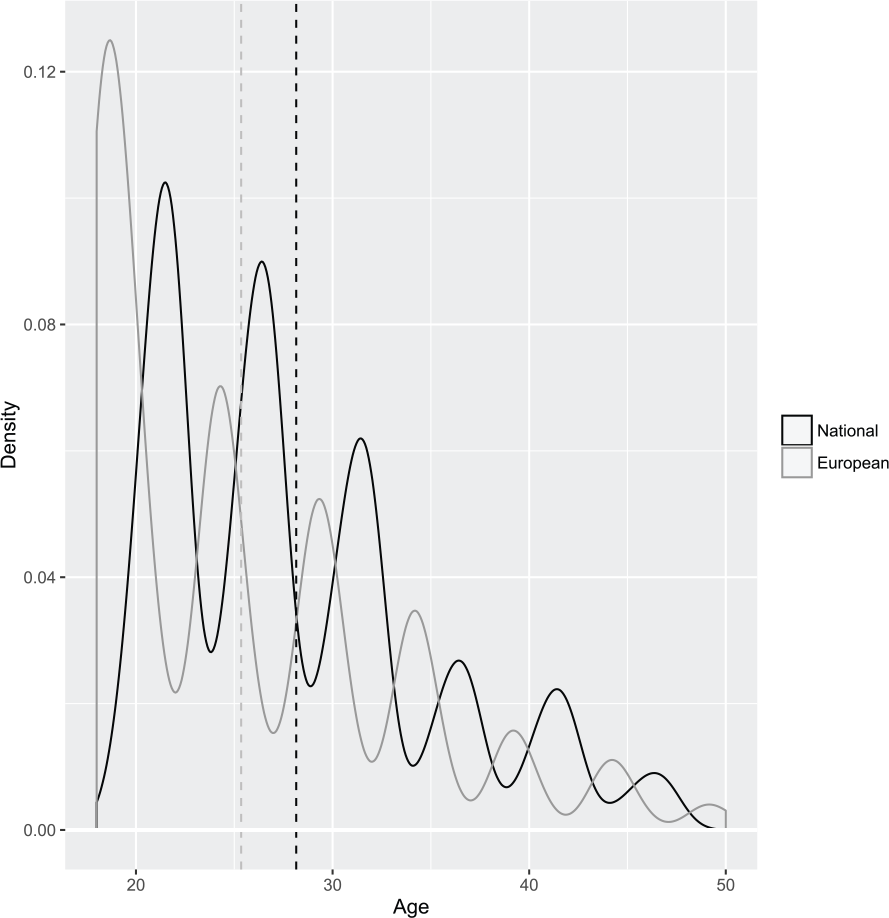
Density plot of age, for EP eligibles and national eligibles.
Table 1 presents information about other socioeconomic covariates: gender, education, and class. 11 In general, we find high degree of similarity between the two groups. Yet, some imbalances emerge, especially with respect to class categories. EP eligibles appear more likely to locate themselves into lower socioeconomic class categories. To assess the extent to which these imbalances confound our estimates, we present our results both with and without these controls, and they remain robust. The existence of balance with regard to covariates and the robustness of results to the inclusion of them in our specifications lead us to conclude that no other variable (e.g., the existence of popularity mechanisms over the electoral cycle) could affect differently the treatment and the control groups and drive, hence, our results.
Balance Statistics on a Series of Demographics.
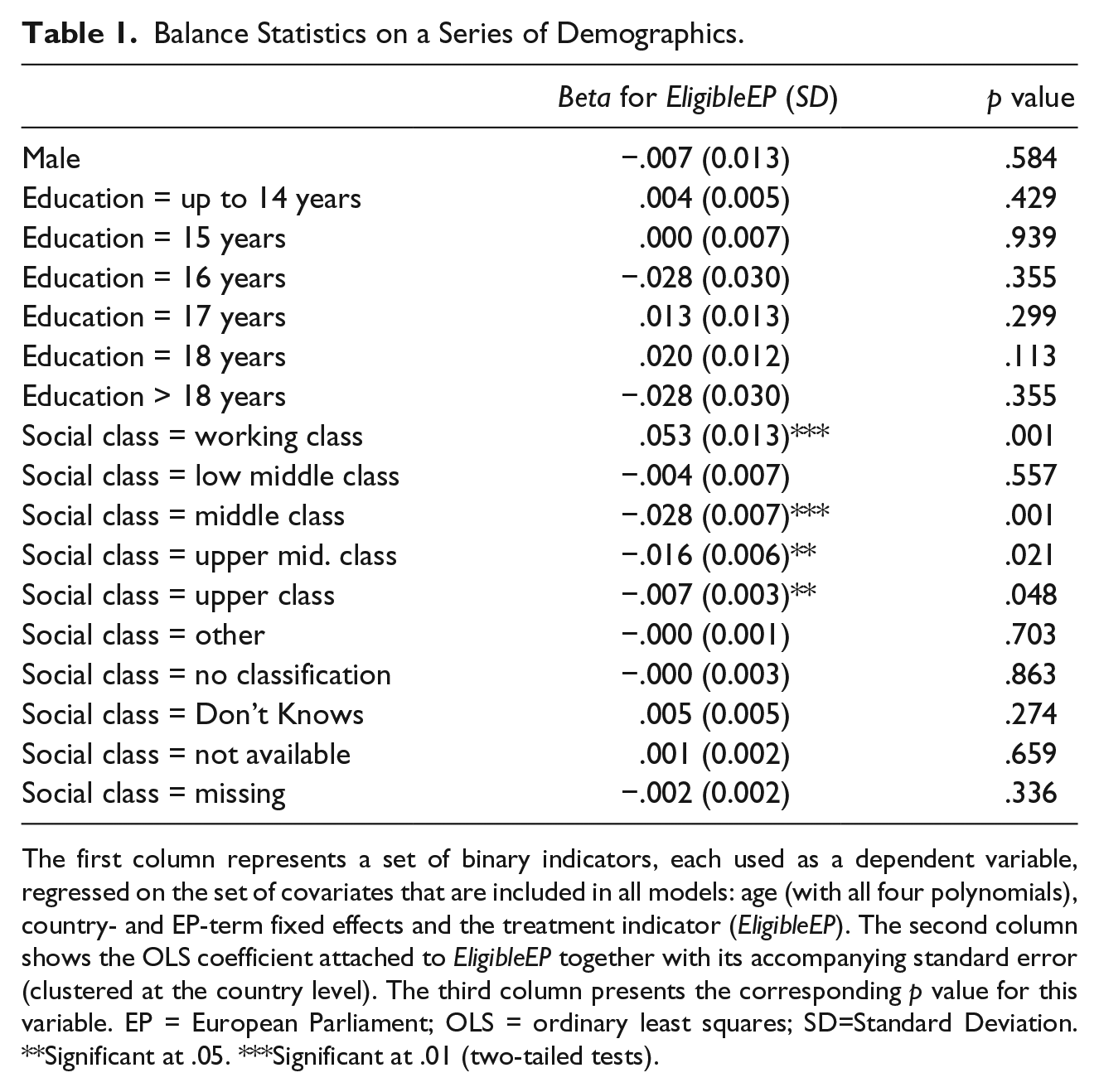
The first column represents a set of binary indicators, each used as a dependent variable, regressed on the set of covariates that are included in all models: age (with all four polynomials), country- and EP-term fixed effects and the treatment indicator (EligibleEP). The second column shows the OLS coefficient attached to EligibleEP together with its accompanying standard error (clustered at the country level). The third column presents the corresponding p value for this variable. EP = European Parliament; OLS = ordinary least squares; SD=Standard Deviation.
Significant at .05. ***Significant at .01 (two-tailed tests).
Turning into estimation issues, given that we do not have information about people’s actual vote choices in their first eligible elections, we use only the reduced form equation, just comparing the two groups on the basis of their eligibility status. We can thus only recover the intent-to-treat effect, as given by δ, the coefficient attached to the eligibility indicator 12 :

where SmallParty is a dummy that switches on for a vote for small parties for individual i of country s in election t (i.e., it takes value 0 if the respondent votes for a large party). EligibleEP is also a binary indicator that denotes an EP first eligible voter. The notation also indicates that apart from the inclusion of country- and EP-term fixed effects, 13 the standard errors are clustered at the country level. This equation tests H1. To test H2A and H2C, we use only a subset of SmallParty; that is, those small parties that were not in government and were not big in the socializing EP election either, respectively. To test H2B and H2D, we interact eligibility with Cycle (i.e., the elapsed proportion of national electoral cycle) and national Average District Magnitude (DM), respectively. 14 All hypotheses are tested using linear probability models. 15
Moving to measurement issues, we obtain information on respondents’ national vote (i.e., our dependent variable) from the question included in each EES survey on the party they intend to vote in the next national election. We take these responses, go back to electoral results and accordingly code each of the parties mentioned by the respondent as big or small. To do so, we employ two different strategies: First, we consider a party to be small if it is not one of the two top parties in the last national election. Second, we consider a party to be small if it gets less than 10% of the total votes in the last national election. Each of these two definitions is applied to the moment in which the EES survey is conducted. 16
Results
Table 2 presents the first set of results looking at the effect of being eligible to vote for the first time in an EP election on the probability of voting a small party in the next national election. In the first two columns of the table, small parties are considered to be those that are not one of the two top parties in the last national election (Models 1a and 1b). The last two columns use a different dependent variable, namely a dummy that denotes those parties with less than 10% of the total vote in the last national election (Models 2a and 2b). In all cases, those eligible to vote for the first time in an EP election are between 3% and 4% more likely to vote for a small party in the next national election (H1). The size of the coefficients is substantively unchanged when different measurements of the dependent variable are used. The results remain robust to the inclusion of covariates (Models 1b and 2b). This similarity in the findings enhances our confidence that what we show here is not simply an artifact of measurement error. The impact of a first-time EP vote does not depend on either the exact operationalization of the dependent variable or the addition of sociodemographic variables.
Voting for a Small Party in the Next National Election.
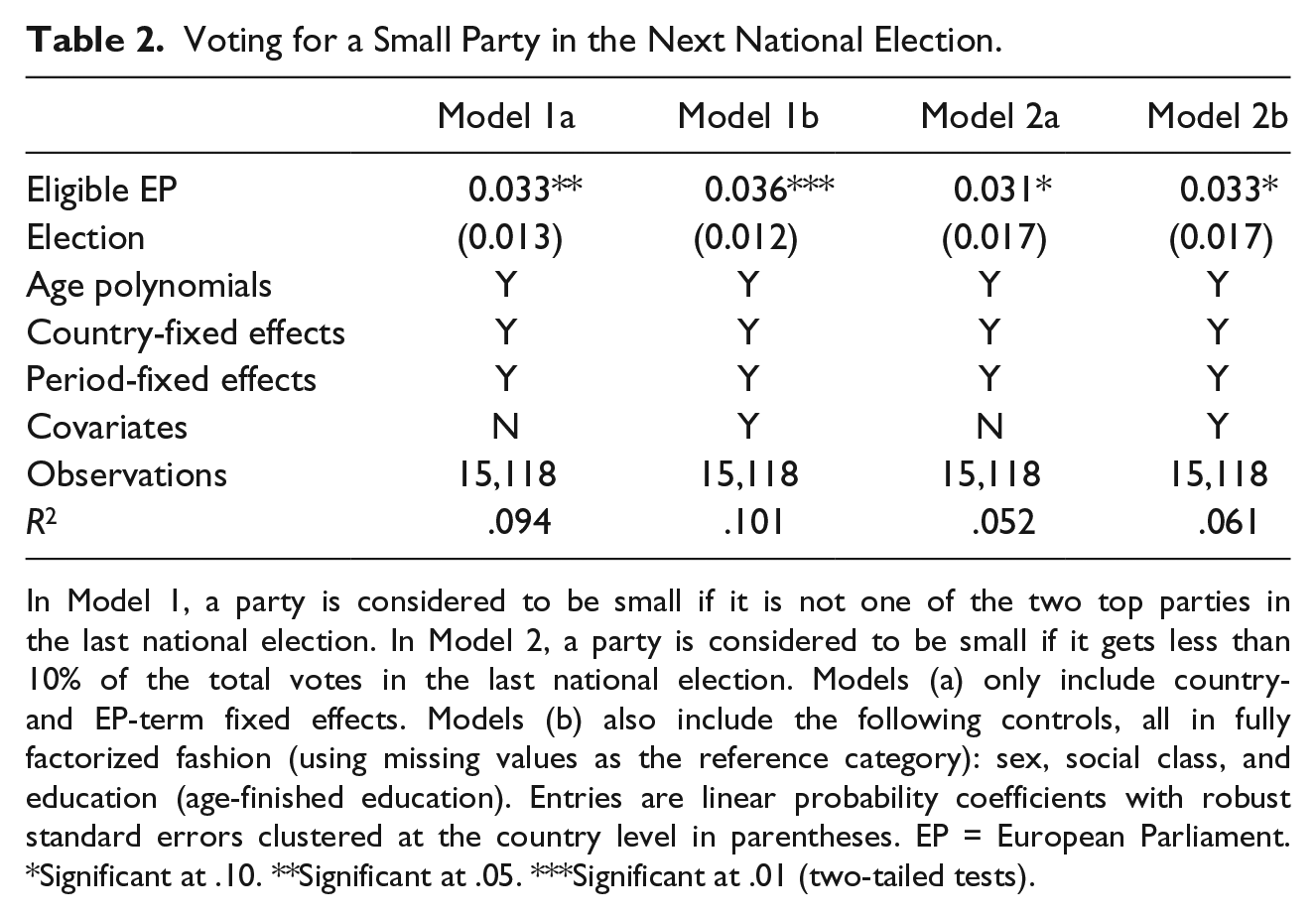
In Model 1, a party is considered to be small if it is not one of the two top parties in the last national election. In Model 2, a party is considered to be small if it gets less than 10% of the total votes in the last national election. Models (a) only include country- and EP-term fixed effects. Models (b) also include the following controls, all in fully factorized fashion (using missing values as the reference category): sex, social class, and education (age-finished education). Entries are linear probability coefficients with robust standard errors clustered at the country level in parentheses. EP = European Parliament.
Significant at .10. **Significant at .05. ***Significant at .01 (two-tailed tests).
We now turn to the conditioning effects. Do we observe the same pattern for parties that were not in government when the socializing election took place? The evidence that is provided in Table 3 is moderately affirmative. Coming of age before an EP election increases even further the likelihood of voting for a small party if this party was not incumbent at the time of the socializing election. However, the extent to which it does so depends on the exact operationalization of small party. Parties that were not in office when the first EP election took place and were not one of the two top are not more likely to be voted among the individuals of the treatment group (Models 1a and 1b). Although the estimates point to the right direction and the size effects are similar to those reported in Table 2, no statistically significant pattern emerges. This would mean that the results in Table 2 are not strengthened by the fact that most small parties are not in the government. In contrast, our instrument is a very good predictor of respondents’ intended voting behavior in future national elections when we define small parties as those that obtain less than 10% of the vote in the last national election (Models 2a and 2b). In such circumstances, voters eligible for the first time for an EP election are about 4.5% more likely to vote in national elections for a small party that was not in government when that first EP election took place. Similarly to H1, none of these conclusions are affected by the inclusion of covariates.
Voting for a Small Party in the Next National Election (Interaction With Incumbency Status in the Socializing Election).
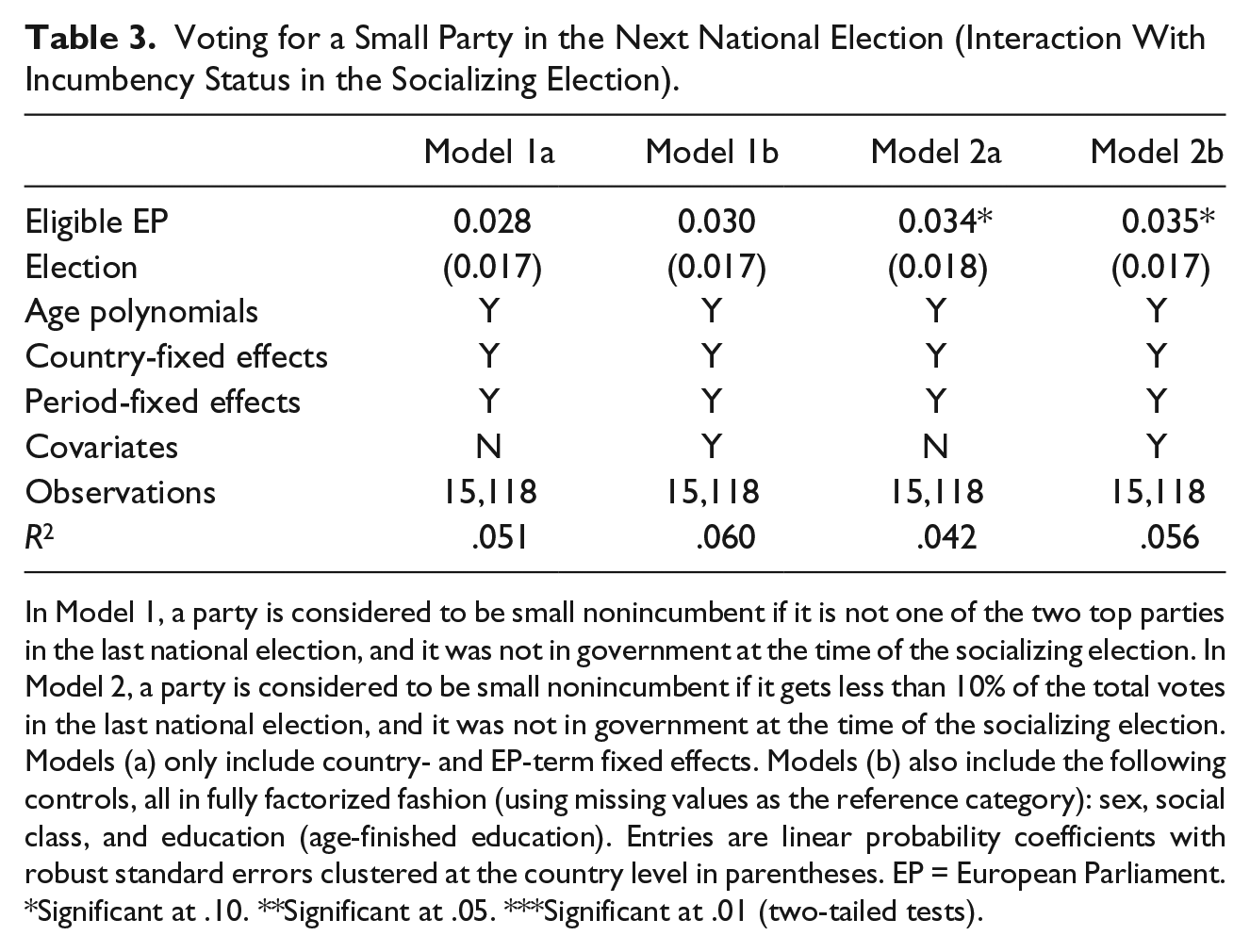
In Model 1, a party is considered to be small nonincumbent if it is not one of the two top parties in the last national election, and it was not in government at the time of the socializing election. In Model 2, a party is considered to be small nonincumbent if it gets less than 10% of the total votes in the last national election, and it was not in government at the time of the socializing election. Models (a) only include country- and EP-term fixed effects. Models (b) also include the following controls, all in fully factorized fashion (using missing values as the reference category): sex, social class, and education (age-finished education). Entries are linear probability coefficients with robust standard errors clustered at the country level in parentheses. EP = European Parliament.
Significant at .10. **Significant at .05. ***Significant at .01 (two-tailed tests).
As the next step in the analysis, we look at H2B. Drawing on the previous empirical evidence (Hix & Marsh, 2011), we expect that the probability of voting a small party in an EP election increases monotonically as the temporal distance between the socializing EP election and the previous national election also increases. 17 Consequently, EP eligibility should increase even more future votes for small parties when the EP election takes place later along the electoral cycle. Figure 2 illustrates the marginal effect of EP eligibility conditional on the date of one’s first election. 18 As predicted by H2B, the positive effect of our treatment on the likelihood of voting a small party increases as the national electoral cycle goes by. Tardy elections appear to exacerbate the effect of EP eligibility on future small-party vote in national elections. 19 As each panel of the figure illustrates, the results are robust to different operationalizations of the dependent variable.
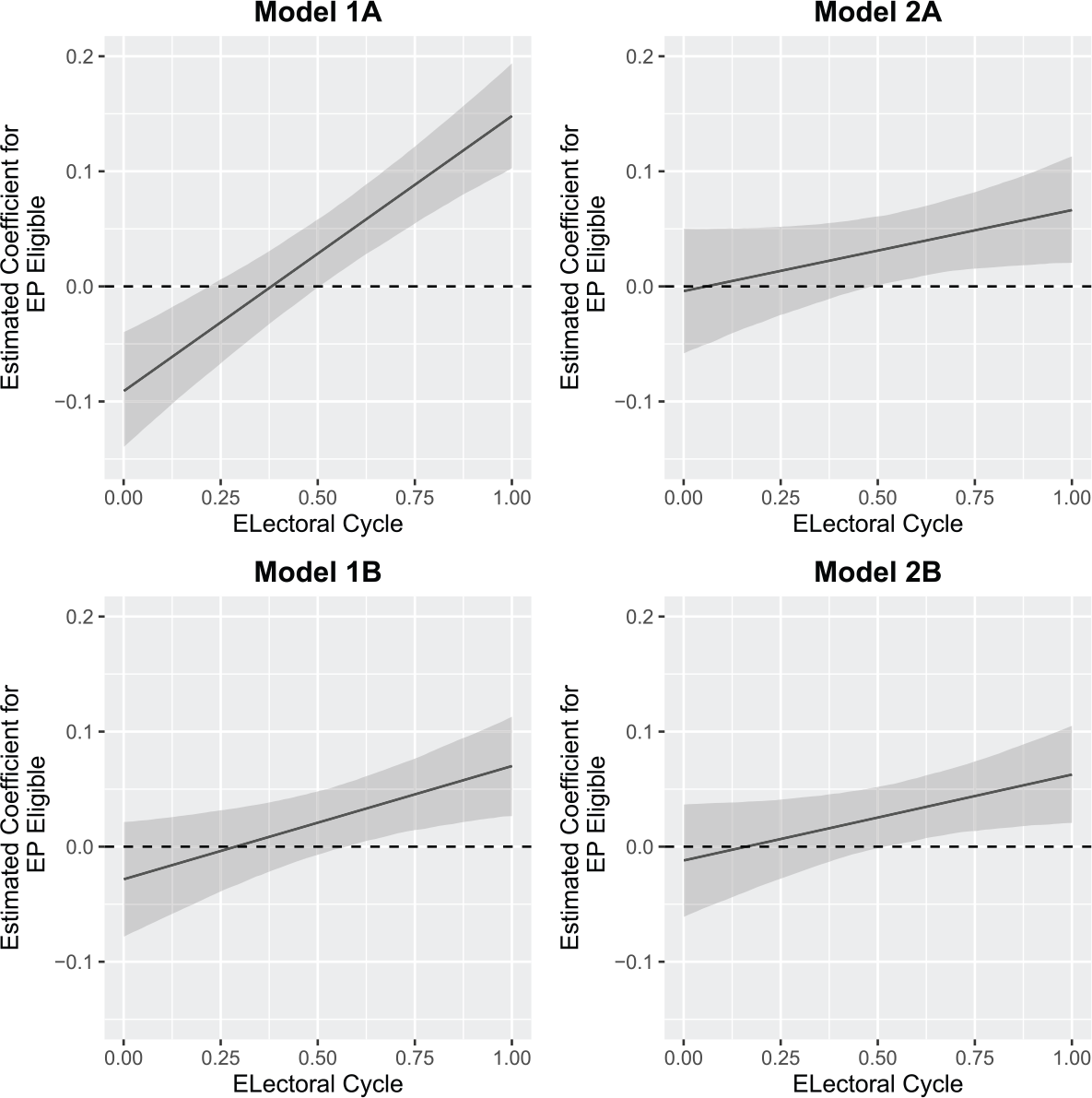
The marginal effect of EP eligibility on voting for a small party in the next national election conditional on national electoral cycle.
The analyses used to test the two previous hypotheses examine variables that affect the first stage of our argumentation. In other words, we looked at factors that increased the likelihood of voting for a small party in the first place. We now turn to features that qualify the second stage; that is, the transmission rate of EP vote choices onto the national electoral arena. For example, models in Table 4 account for the interactive effect of the size status of the party now and in the past, and perform according to expectations. In all models, respondents who come of age before an EP election are more likely to vote for a small party that was also small in the socializing election. Both operationalizations of the dependent variable point to the same pattern. However, it is the combination of not being either first or second in any of the two elections under consideration that seems to be particularly susceptible to the long-term effects of EP elections.
Voting for a Small Party in the Next National Election (Interaction With Small Status in the Socializing Election).
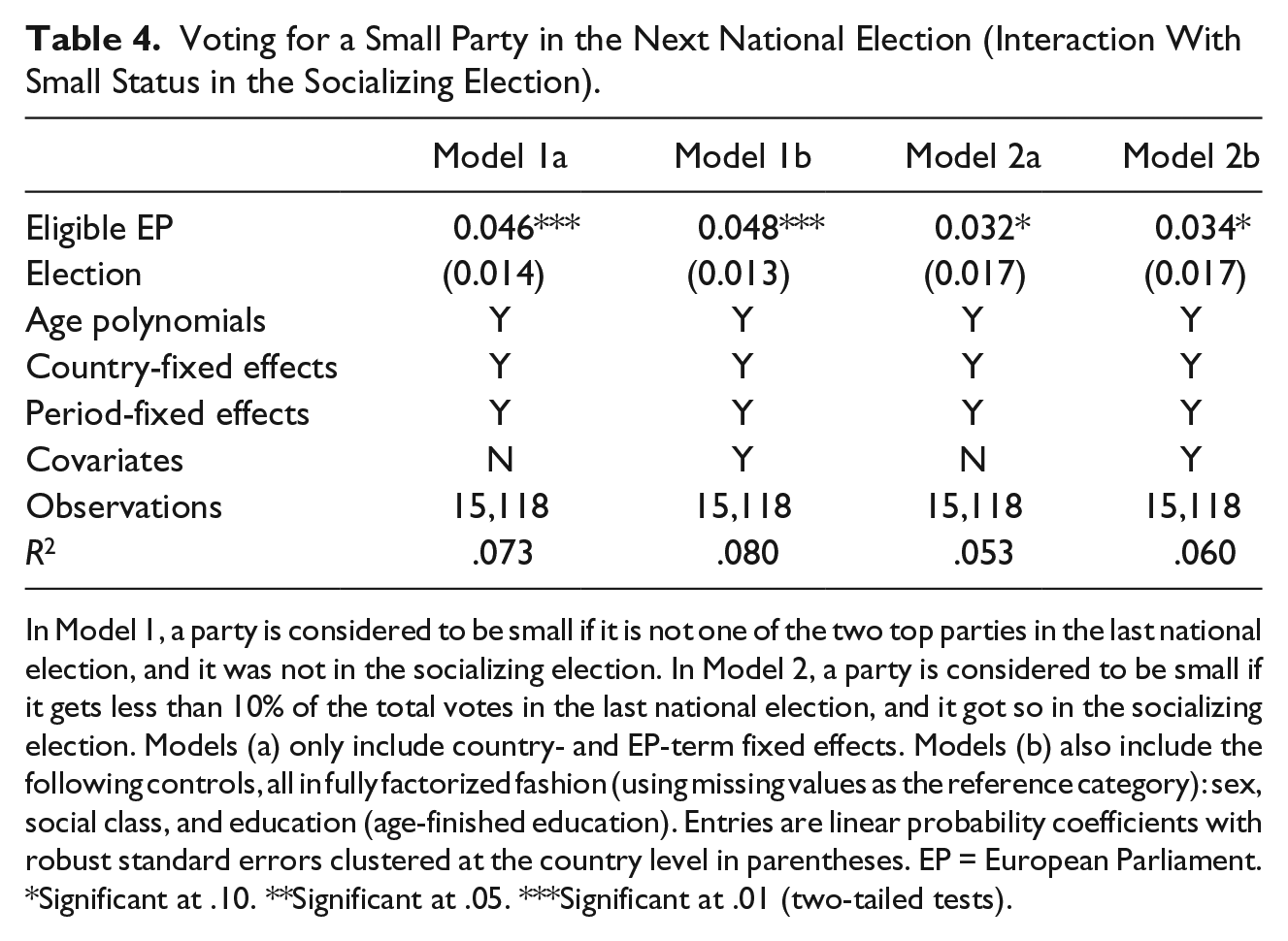
In Model 1, a party is considered to be small if it is not one of the two top parties in the last national election, and it was not in the socializing election. In Model 2, a party is considered to be small if it gets less than 10% of the total votes in the last national election, and it got so in the socializing election. Models (a) only include country- and EP-term fixed effects. Models (b) also include the following controls, all in fully factorized fashion (using missing values as the reference category): sex, social class, and education (age-finished education). Entries are linear probability coefficients with robust standard errors clustered at the country level in parentheses. EP = European Parliament.
Significant at .10. **Significant at .05. ***Significant at .01 (two-tailed tests).
Finally, we examine H2D. To test whether the impact of first-time eligibility for EP elections on subsequent party choice depends on the permissiveness of the national electoral system, we interact EP eligibility with average district magnitude in national elections. The complete results of this exercise are presented in the online appendix. Figure 3 graphically illustrates the marginal effect of first-time EP eligibility on voting for a small party across the observed range of average district magnitude at the national level. The figure shows that the effect of voting for the first time in an EP election is strongly conditioned by the permissiveness of the domestic electoral rules. High levels of proportionality exacerbate the direct effect of first-time eligibility in an EP election on the subsequent likelihood of voting a small party. As shown in the figure, the results are clearly robust to different operationalizations of the dependent variable. It seems safe to conclude that permissive electoral rules at the national level augment the long-term effects of EP eligibility on national electoral trajectories. 20

The marginal effect of EP eligibility on voting for a small party in the next national election conditional on national average district magnitude.
Robustness
Three sets of robustness checks are conducted: The first is a falsification test, which examines whether it is the EP election rather than some unobservable factor that drives the differences between EP and national eligibles. The second intends to assess the robustness of the results to different operationalizations of small parties. The third looks at the mechanism explaining this effect. In particular, it tests whether EP elections drive small-party support not because of their second-order nature but rather due to the higher relevance of the EU at the national level for the EP eligibles. We present the key findings from each of these tests in turn.
To examine whether the effects attributed here to the EP elections could have been driven by other unobservable factors, we perform a placebo test. We take the countries that were not member states when the first EP election took place in 1979 and create an “artificial” EP election for them. Consider the example of Austria, which becomes a member state in 1995 and celebrates its first EP election in 1996. Although the first four EP elections (i.e., 1979, 1984, 1989, and 1994) did not take place in Austria, we will assume that they did so for the placebo test. If the registered differences so far related to some other confounder, we would have to observe similar findings for the placebo test. We use both operationalizations of small parties, as we also did in the previous analyses. Thus, results replicate Table 2, using the placebo indicator instead of the actual treatment indicator. Table 5 presents the results and allows us to rule out this hypothesis. The coefficients of our treatment variable are essentially 0 in all the models. Hence, becoming eligible to vote for the first time before an EP election in a country that is not a member state yet does not increase the likelihood of voting for a small party in the future.
Voting for a Small Party in the Next National Election (Placebo Test).
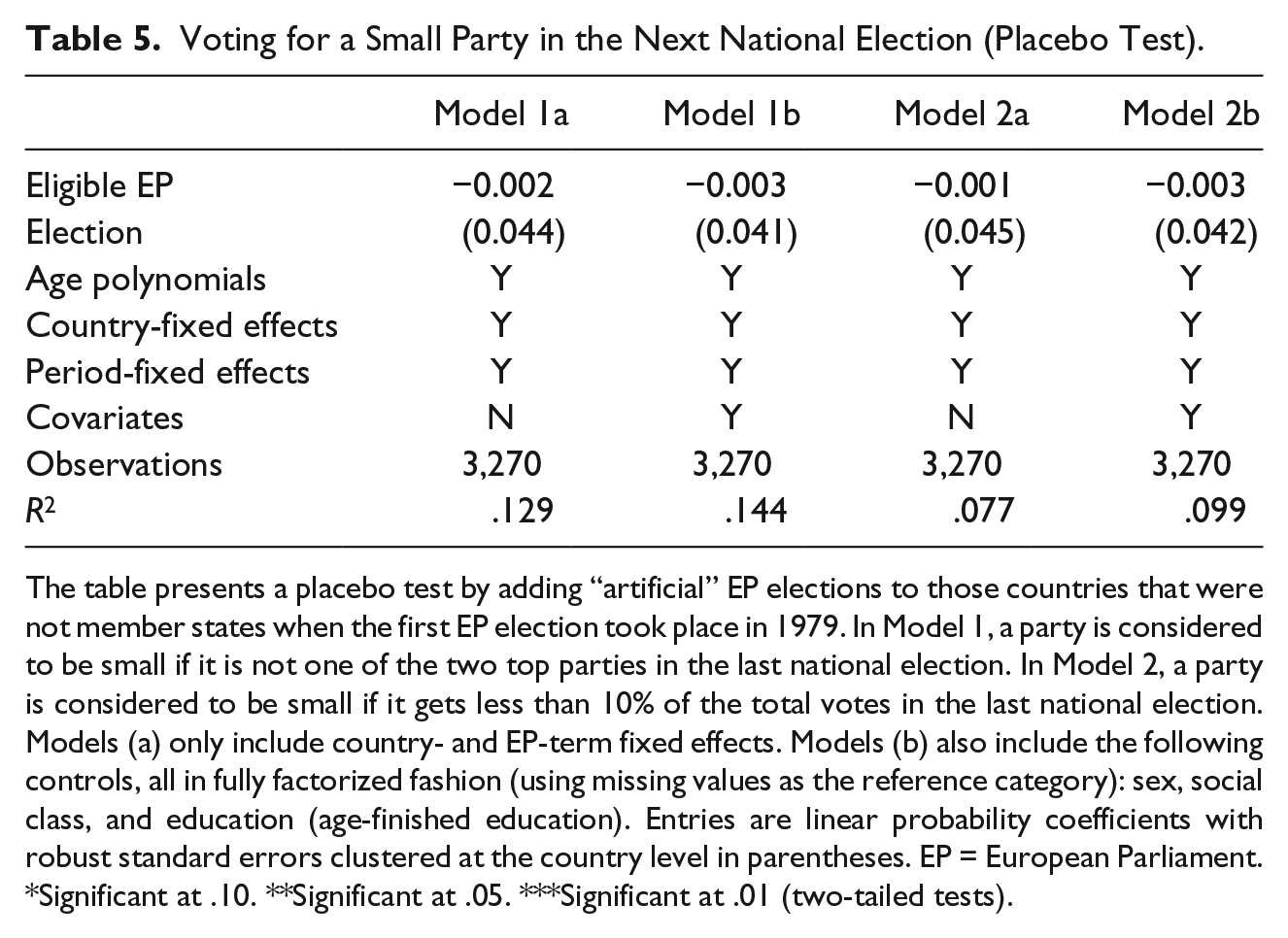
The table presents a placebo test by adding “artificial” EP elections to those countries that were not member states when the first EP election took place in 1979. In Model 1, a party is considered to be small if it is not one of the two top parties in the last national election. In Model 2, a party is considered to be small if it gets less than 10% of the total votes in the last national election. Models (a) only include country- and EP-term fixed effects. Models (b) also include the following controls, all in fully factorized fashion (using missing values as the reference category): sex, social class, and education (age-finished education). Entries are linear probability coefficients with robust standard errors clustered at the country level in parentheses. EP = European Parliament.
Significant at .10. **Significant at .05. ***Significant at .01 (two-tailed tests).
The second set of tests relates to the coding of small parties. We use two alternative measures, both shrinking further the set of small parties. In particular, we code as small all parties: (a) with up to the fourth highest vote share in the last national election, or (b) with up to 5% of the total vote in the last national election. We use these measures to replicate the analysis shown in Table 2 and Figures 2 and 3. The results, shown in the online appendix, largely confirm those presented here. Irrespective of how small party is coded, EP eligibles are more likely to vote for them than national eligibles, and this difference increases when (a) the EP election is situated far from the national election and (b) the national electoral system is permissive.
The third set of tests explores the validity of an alternative mechanism that could be driving our results. If small parties are also those parties with more popular views toward the EU among the electorate and if EP eligibles are more likely to think about the EU when voting nationally, it might be that EP elections lead to party system fragmentation not because of their second-order characteristics but rather because they operate as channels through which considerations about the EU become more salient among voters. Within this framework, we could conceivably think of a spillover from the EU to the domestic arena even if integration is only loosely connected to the left–right dimension (Dalton, Farrell, & McAllister, 2011; Rohrschneider & Whitefield, 2012). In either way, this line of reasoning would only qualify the habituation mechanism driving our theory rather than our testable predictions.
To see whether EP elections lead to small-party vote by converting the EU into a more important issue among EP eligibles, we compare the two groups—EP and national eligibles—with respect to their attitudes toward the EU. We employ a variety of tests, capturing differences both in the direction and in the extremity of preferences. We provide a detailed description of these analyses together with the results in the online appendix. The findings suggest that the two groups do not differ in their attitudes toward the EU. Taken as a whole, the results provide little support to the argument that the EP elections generate fragmentation by making the EU more salient among EP eligibles. Rather, it seems that higher levels of small-party vote among EP eligibles are more likely to be the outcome of a habituation process based on early voting experiences.
Conclusion
It is hardly surprising that, when the elections for the EP were introduced in 1979, there was no discussion about how they might affect party competition within the member states. The fundamental aim of this reform was to enhance political representation and add legitimacy to what seemed an ever-increasing elite-driven process of European integration. The fact that until recently the EP did not have significant competencies has been reflected in the second-order character of these elections. This did not seem to be a problem until the Eurosceptic political actors that gradually emerged in many member states found channel into national politics. The findings from this study suggest that one of the factors that have fostered support for Eurosceptic parties at the national arena is actually the introduction of direct EP elections. These elections encourage a vote for small parties, which are more likely than major parties to hold anti-EU stances.
Perhaps more importantly, this study has several implications for the evolution of national party competition over the last few decades. First, even indirectly, this study provides evidence in favor of Panebianco’s (1988) view that electoral arenas operate as communicating vessels. Given that the same political actors are very often competing at different tiers, results in one election might generate spillover effects with potentially significant long-standing implications. And if the second-order election thesis had already pointed to such effects from national to supranational elections, the results from this study shed light on a reverse link from supranational to national arenas. In this respect, it might be worth exploring and further testing the argument made here using subnational elections or referenda. Importantly, these effects are not necessarily short term. Rather, given the importance of early voting experiences, they might have long-run consequences for people’s voting profiles.
The last point brings us to the second contribution of this study, which relates to the pervasive effects of early political socialization. Elections, as funnels of political stimuli, denote the importance of early political experiences in the formation of distinct voting patterns over the life trajectory. Young adults are more susceptible to events, contextual influences, and other political signals than their older counterparts (Ghitza & Gelman, 2013). Here, we find that such effects leave a long-standing imprint on individuals’ profiles. Moreover, they do so even if the initial stimulus is allegedly weak, as any second-order election is expected to be (e.g., Meredith, 2009). Furthermore, even if the evidence is inconclusive, there are signals that voters do not simply develop identities as to the exact party of support but with regard to a more encompassing group of parties that relates to their size. Previous evidence on coarse party categorizations is only scarce and primarily focused on ideological labels Bølstad and Dinas (2016). Here, we extend this line of research to consider the importance of size and find preliminary evidence of small-party voters. That said, as we do not have information on respondents’ party choice in their first eligible election, these conclusions are only tentative at the moment.
Third, by looking at a largely neglected feature of European elections, this study provides a novel explanation of some of the most significant developments in the European political space, namely the increase of party system fragmentation and electoral volatility and the emergence of a negative incumbency advantage. To be sure, existing explanations based on societal change and the transformation in the structure of political opportunities it has generated for political parties are clearly pivotal in understanding these developments. However, representative institutions—much easier to manipulate and change than structural processes—are also contributing to this pattern. It is, thus, important to delve into these effects and appropriately investigate how they have challenged domestic partisan equilibria. Doing so might qualify the conventional wisdom about the role of structural processes in party system fragmentation. For instance, one of the key explanations for the partisan dealignment in Europe is Dalton’s cognitive mobilization theory, which posits that the increase in education levels of population generates more “sophisticated apartisans”; that is, new cohorts who are interested in politics but are critical toward traditional forms of political engagement, including supporting mainstream political parties (Dalton, 1984). At least in part, the introduction of EP elections could operate in a similar fashion, namely by mobilizing young voters against established parties. As these elections are affecting only more recent cohorts, they could also account for some of the effects attributed to cognitive mobilization theory.
Even though our investigation has highlighted the importance of EP elections for performance of small parties in national elections, several questions still need to be addressed to better understand the working of this relationship. More specifically, future research should test the possible application of our arguments to other second-order elections such as local and regional elections. For example, many EU countries are divided into subnational entities that elect their own Parliaments. These regional tiers of government increasingly administer greater portions of public budgets and decide over wider policy areas. If our arguments were valid, we would also expect that voting patterns in subnational elections spill over onto national elections, especially among voters not yet socialized into patterns of habitual voting. Moreover, it would be important to assess the explanatory power of our proposed theory relative to other classic determinants of the fragmentation of national party systems. Especially electoral systems change only very occasionally, and social heterogeneity evolves very slowly. So it is quite possible that our reasoning provides a better account of the increasing number of parties registered in European countries in recent times than previous studies. Finally, if our reasoning is true, the incentives of large parties in government to call early elections would be modified to hold them in a point in time as much close as possible from the next EP election. In either way, we hope that our article will trigger the interest necessary to address some of these questions and improve our understanding of why European party systems are transformed over time.
Footnotes
Acknowledgements
We are grateful to Mark Pickup, Pedro Magalhaes, three anonymous reviewers, and the participants in the corresponding panels of the 2013 European Union Democracy Observatory (EUDO) Dissemination Conference (European University Institute [EUI], Florence), the 2014 EPSA Annual Conference in Edinburgh, the 2014 European Consortium of Political Research (ECPR) General Conference in Glasgow, and the 2016 Juan March Institute Conferencia de Doctores (University Carlos III, Madrid), and the Politics Colloquia of the School of Government and Public Policy of the University of Strathclyde (Glasgow) and the Department of Political Science of the Central European University (Budapest) for their helpful suggestions in previous versions of the manuscript. All remaining errors and omissions are ours. We are particularly thankful to Aisling Leow and Raluca Pahontu for their excellent research assistance. We also acknowledge financial support of the Spanish Ministry of Innovation through Grant CSO2013-40870-R. The order of names reflects the alphabetical order of authors’ family names. Both authors have contributed equally.
Declaration of Conflicting Interests
The authors declared no potential conflicts of interest with respect to the research, authorship, and/or publication of this article.
Funding
The authors received no financial support for the research, authorship, and/or publication of this article.
Notes
Author Biographies
References
Supplementary Material
Please find the following supplemental material available below.
For Open Access articles published under a Creative Commons License, all supplemental material carries the same license as the article it is associated with.
For non-Open Access articles published, all supplemental material carries a non-exclusive license, and permission requests for re-use of supplemental material or any part of supplemental material shall be sent directly to the copyright owner as specified in the copyright notice associated with the article.
