



Abstract
Why do some citizens remove the same politicians that they elected from office? This article examines the use of recall referenda, an increasingly prevalent process in which citizens organize a vote to remove politicians from office before they complete their terms. Although celebrated as a tool to improve electoral accountability, we argue that recall referenda are organized to pursue political vendettas. We test this claim using an original data set on the different stages leading to subnational recalls in Peru. Recalls are initiated more often when politicians lose by narrow vote margins and when women hold office. Once put to a vote, citizens do use office performance to decide whether to retain their politicians. Losing politicians organized fewer recall referenda following an institutional reform that allowed politicians to name their successors. The implication is that recall referenda create weak incentives to improve office performance, but careful institutional design can improve their functioning.
In 2011, a scandal broke in Uchumayo, Peru when a tape recording caught the mayor accepting a bribe in exchange for a contract to build a park (La República, 2011). The district of Uchumayo was flush with cash from Peru’s mining boom. Mayors invested the windfall in public works, but not in the schools, health clinics, and water infrastructure that the district needed. Rather, the mayor built a park filled with life-size dinosaurs to attract tourists (Fernández, 2015). The tape exposing the bribe was the last straw for many residents. Citizens demanded that the local council impeach the mayor and that the judiciary convict him. But the mayor hired the family members of local councilors to block the impeachment. The judiciary took years to reach a guilty verdict. 1 Faced with evidence of corruption, Uchumayo’s residents did what is common in Peru: They organized a recall referendum. Local organizers collected signatures denouncing the mayor’s corruption. 2 Voters then cast their ballots to kick out the mayor and his local councilors.
Cases like Uchumayo represent the promise of recall referenda. Voters can hold their politicians accountable between election cycles. Electoral accountability can be limited because citizens lack performance information, or because they only get one chance to punish or reward politicians at the polls (Przeworski, Stokes, & Manin, 1999, pp. 40-48). A vast literature has developed trying to provide voters with more information (e.g., Ashworth, 2012; Dunning, Grossman, Humphreys, Hyde, & McIntosh, 2019). But there has been less attention to how the time lag between politician behavior and electoral sanctions limits accountability. Because voters act in a short time frame and no competitor is specified, recalls can be one of the purest examples of retrospective voting.
Yet, recall referenda also are vulnerable to manipulation by political elites. Recalls involve office removal, much like impeachments that have received greater scholarly attention. The optimistic view is that impeachments allow for the removal of corrupt, abusive, or incompetent presidents (Marsteintredet & Berntzen, 2008; Valenzuela, 2004). However, research finds that impeachments often stem from interbranch conflicts that have less to do with an indignant society than with the comparative strength of political parties (Helmke, 2017; Pérez-Liñán, 2007). High-profile recall referenda involving presidents, governors, and city mayors likewise have been linked to elite power grabs, rather than political misbehavior (e.g., Altman, 2010; McCoy, 2006; Miró-Quesada Rada, 2013). Welp (2015) dubs recall organizers “sore losers.”
Less is understood about the use of recall referenda at the local level. Recall referenda have spread across Latin America, as part of a wave of direct democracy and participatory reforms (Altman, 2010; Goldfrank, 2011). Most of the Andean region incorporated recalls into their constitutions—Colombia in 1991, Peru in 1993, Venezuela in 1999, Ecuador in 1998 and 2008, and Bolivia in 2009. The introduction of recall referenda coincided with a wave of political decentralization in which local citizens were portrayed as best informed to select, as well as remove, their officials. Can citizens hold their politicians accountable when given the chance to act immediately and locally?
When recall referenda occur and succeed is an important empirical question because it shapes the quality of local government. If a politician only faces removal when performing poorly, then she has a clear incentive to keep her behavior within acceptable political bounds and satisfy constituents. Conversely, if a politician faces recall elections irrespective of her performance, then there is no incentive to improve behavior. The threat of new elections actually can strengthen a politician’s incentives to plunder or pander in the short term.
We explore the determinants of recalls using an original database of all subnational recall referenda in Peru since the return of democracy in 2002. Peruvians have used recall referenda to get rid of politicians with abandon: Between 2002 and 2014, there were more than 6,000 petitions to recall subnational politicians. Peru also has passed important reforms to recall rules. A successful recall vote resulted in new elections prior to 2015. The legislature then changed the rules so that elected politicians appoint their successors in the case of a recall. This institutional reform reduced the electoral incentives for competitors to initiate a recall referendum. Our data are unique in that they allow us to distinguish between different stages of the recall process—the petition for a recall, the approval of a vote, and the removal outcome. Throughout, we supplement our statistical analysis with qualitative evidence from fieldwork in Peru and text analysis of petitions to electoral authorities.
To preview, we find that losing politicians organize recall referenda, but office performance matters when citizens vote to retain their politicians. First, losing politicians petition to recall and gather signatures against those who are perceived to be weak opponents. Politicians who win by narrow margins and women are most vulnerable to recall attempts. Institutional reforms reduced the frequency and politicization of recall referenda. Second, office performance matters once voters are given the choice to retain or reject their politicians. Politicians who spend less of their budget and build fewer public works are less likely to survive a recall vote. Thus, even with greater proximity to politicians, subnational recall referenda follow many of the same patterns of elite power struggles observed in presidential impeachments and national recalls. But careful attention to institutional design can reduce their political manipulation.
The next section reviews the institutional context. We then turn to the theoretical debate around office removals and present our argument based on the stages of recall referenda. Third, we describe our data sources and empirical strategy. Fourth, we present evidence that electoral competition catalyzes the organization of subnational recalls. The fifth section demonstrates that office performance matters at the moment at which voters decide whether to keep their officials. We conclude with a discussion of the implications of our findings for electoral accountability, and return to the possible effects of recall referenda on local government quality.
Institutional Context: Recall Referenda in Peru
Few observers would have expected that Peru would become a leader in the use of recall referenda when the institution was introduced. Recall referenda began as a convenient tool to unseat political challengers during the competitive authoritarian regime of Alberto Fujimori. After disbanding Congress in 1992, Fujimori convened a constituent assembly to write a new constitution. Drafters came largely from new parties with little political experience, including almost half from Fujimori’s newly formed Nueva Mayoría/Cambio 90. Fujimori’s followers inserted the option of recall referenda in part to emphasize the failure of traditional representative democracy (Barczak, 2001, p. 45; Tuesta Soldevilla, 2014, pp. 47-48). 3
The rules surrounding recall referenda in Peru reflect their origins in a competitive authoritarian regime. First, Peru only permits the removal of subnational politicians, not the president or national legislators. 4 Second, initially, recall referenda led to new elections as long as the executive and a third of the local council were removed. Such provisions are not uncommon: Recall referenda end in new elections in Bolivia and Colombia, and sometimes in Venezuela (depending on the number of authorities removed). Nevertheless, this rule opens the door for politicians to use recalls to convene new elections and retake power. Third, Peru has relatively permissive institutional rules to convene a recall referendum. Quorum requirements are easier to meet due to enforced compulsory voting (Welp, 2014, p. 33). Permitting easy access to recall referenda provided a way for Fujimori to retake power from provincial and regional politicians whom he saw as potential challengers to his power (Tanaka, 2002).
Once full democracy returned in 2001, President Alejandro Toledo deepened the process of political and administrative decentralization. But he left recall rules relatively unchanged. 5 Democratic reformers saw recalls as an important way for citizens to control and improve the quality of local government. Peru has weak parties and subnational elites, making it difficult for local politicians to push back against participatory institutions that threatened their hold on power (McNulty, 2011). The use of recall referenda took off with time, as shown in Table 1.
Recall Petitions, Approvals, and Removals by District, 1996-2018.

Source. Compilation from Oficina Nacional de Procesos Electorales (ONPE) and Jurado Nacional de Elecciones (JNE).
All counts consider whether a district recalled a mayor or councilor (not the total number of recalled politicians). The total number of districts has increased over time due to the creation of new districts.
Recalls consist of three basic stages: a petition, a vote approval, and a removal decision. First, citizens petition to hold a recall vote. They do so by requesting an electoral “kit” from the agency that organizes elections (Oficina Nacional de Procesos Electorales [ONPE]). While a recall petition may seem like a costless action, it can generate substantial media attention on local radio stations and newspapers. 6 Politicians start to worry about defending their posts. 7 There is substantial variation in whether districts initiate these proceedings. Across all district-periods since democratization, 42% of districts submitted a petition.
The second stage is the approval of a recall vote. The electoral kit allows organizers to collect signatures in favor of a recall vote. Mayors, as well as local councilors, can be subject to a recall vote if 25% of registered voters (or 400,000 people in the case of Lima) sign the petition to hold a vote. The national registry (Registro Nacional de Identificación y Estado Civil [RENIEC]) reviews the signatures for accuracy and authorizes the recall vote. Only 18% of districts across periods collected sufficient signatures to hold a recall vote, or 43% of those that requested a kit.
Third, citizens vote on whether to remove a politician, that is, the removal stage. Electoral authorities (Jurado Nacional de Elecciones [JNE]) convene these off-cycle elections several times a year. Just 8% of districts actually removed a politician, or 44% of those that held a vote. The fact that citizens decide the fate of their politicians differentiates recall referenda from impeachments, where legislators vote to remove a politician. A local politician can be removed by a simple majority of valid votes cast. Recall votes, however, do not specify a replacement candidate. Voters must first remove their politician, and then hold a new election for a replacement.
Recall procedures changed through a major reform in 2015. The reforms followed the highly politicized attempt to recall Lima’s mayor, Susana Villarán. Villarán squeaked out a narrow victory in the 2010 mayoral election. The popular outgoing mayor, Luis Castañeda, did not seek reelection to run for president in 2011. After making little headway in national politics, Castañeda hoped to return to the mayor’s office and vocally opposed Villarán’s administration. As he joked in an interview, “What type of animal is Villarán? She’s a crab because that’s the only animal that can move backwards.” 8 Castañeda worked with a close friend and legal expert, Marco Tulio Gutiérrez, to organize the recall referenda. Villarán survived the attempted recall, despite almost 80% disapproval ratings (Tanaka & Sosa, 2014). Many voters suspected political chicanery. Top electoral officials concluded from the case that recall elections are “instruments of revenge,” and convened a commission to review recall procedures (Tuesta Soldevilla, 2014).
National electoral authorities drafted a law to limit the conditions under which citizens can recall their elected officials. When Fujimori introduced citizen-led recalls, new elections followed a recall vote and elected officials could be recalled after their first year in office. 9 The reforms changed the rules so that mayors designate a replacement (accesitario) to take power if recalled, and recalls only take place after the third year in a 4-year term. Congress passed the reforms, which President Ollanta Humala signed into law in 2015. 10 As we return to below, this institutional discontinuity allows us to probe the electoral motivations behind recall votes.
More broadly, mayors in Peru are elected on closed lists through first-past-the-post rules. The winning party list then controls the mayor’s office and receives an automatic majority on the local council; the remaining council seats are allocated proportionally. The automatic council quorum is one of the many institutional rules that Peru has adopted to strengthen its fragmented party system. Peru has a notoriously weak party system, especially at the subnational level. The incongruence of the competition structure between the national and subnational level is the highest in Latin America (Freidenberg & Suárez Cao, 2014). Local party systems are fragmented: On average, seven parties contested subnational elections and mayors won with 35% of the vote in 2010. Most political parties that compete in subnational contests are loose coalitions of candidates that only come together during election times. Politicians fluidly switch among different groupings (Levitsky & Zavaleta, 2016). Tellingly, Peruvian mayors are more likely to know fellow mayors than other politicians in their own party (Muñoz, 2019).
Electoral campaigns have little programmatic content. Campaigns focus on promises of local public works and constituency service. Even vote buying is complicated in such a weak party system because few party actors exist to monitor vote choice. Some politicians rely on local leaders, or organizational brokers (Holland & Palmer-Rubin, 2015), to mobilize their members and distribute goods. Local politicians hand out goods in indiscriminate ways prior to elections to cultivate the impression of electability and get voters to listen to their campaign promises (Muñoz, 2014, 2019). Rates of reelection are low—less than a third of Peruvian mayors were reelected in the 2010 and 2014 election cycles—suggesting an “incumbency curse” and deep dissatisfaction with mayoral performance. 11 Voters worry that experienced mayors will rob from the public once they know how the office works (Klašnja & Titiunik, 2017).
Recall referenda may be used to challenge government incompetence, malfeasance, and, crucially for the period studied, mining projects. Management of natural resource rents became increasingly important in local elections due to the commodities boom of the 2000s. Natural resource transfers increased seventeenfold from US$65 million to US$1.1 billion over the course of the decade (M. L. Vasquez, 2015, p. 16). Social conflicts spiked around mining due to the negative externalities and resource windfall (Ponce & McClintock, 2014). Flush with cash, half of Peru’s governors (13 of 26) from the 2011 to 2014 period faced investigations for corruption related to public works contracts (Perú21, 2017).
In short, recall referenda originally were introduced during the competitive authoritarian regime of Fujimori. They have become increasingly common with time and may be a particularly important way to hold politicians accountable in the context of an inchoate party system and resource boom. Whether they serve this goal is an open question.
A Sequential Theory of Recall Referenda
What explains the uneven use of recall referenda within the same country? An important literature exists on the determinants of office removals at the national level, which stresses their partisan motivations. Their functioning at the local level has received less attention. Greater information, weaker partisanship, and easier coordination at the local level may allow voters to use recalls to sanction their politicians for misbehavior or incompetence. We briefly review the debate across types of office removals and levels of government. We then present our argument based on the sequential nature of recall referenda and empirical hypotheses.
Theoretical Context
Recall referenda are tools of direct democracy in that they allow citizens to initiate and decide whether to replace an elected authority (e.g., Altman, 2010; Breuer, 2007). From progressives in the United States (Cronin, 1999) to populists in Latin America (Barczak, 2001), reformers have introduced recall referenda to control perceived corruption in the political system. Voters can throw out politicians who do a poor job in office or otherwise pursue policies with which they disagree or did not vote for.
Unlike issue referenda, recalls cut short a politician’s term in office. They therefore generate concerns of partisan manipulation similar to other forms of office removals such as impeachments. Impeachments initially were taken as a positive sign that presidential systems were adopting more “parliamentary traits” in which poorly performing executives were removed from power (Marsteintredet & Berntzen, 2008; Valenzuela, 2004). This optimism gave way to criticism that political elites used impeachments for electoral ends. For instance, Pérez-Liñán (2007) shows that a major determinant of presidential impeachments is the president’s control over Congress. Similarly, Helmke (2017) argues that the legislature’s payoff to impeach a president rises in scenarios where the president has limited support of her party.
National recall referenda generate analogous concerns of partisan manipulation. One of the most salient national recall referenda was the attempt to remove President Hugo Chávez in Venezuela in 2004. The impetus for the recall came from the political coalition ideologically opposed to his government (Kornblith, 2005; McCoy, 2006), rather than any particular act of malfeasance. In a global study of national tools of direct democracy, Altman (2010) bluntly characterizes recalls as “motivated by political reasons” so that “the party of the incumbent is most likely to shield the politician in question” (p. 16). Party strength also has been shown to be central to the use and success of national policy referenda (Breuer, 2007; Durán-Martínez, 2012).
How office removals are used at the local level is less clear. Reformers hoped that subnational referenda would improve accountability due to several differences between local and national politics. First, citizens may have better information about local politics because issues can be observed more directly. Second, collective action is easier in smaller groups at the local level (Olson, 1965). Third, parties tend to be weaker at the subnational level. Local politics often is viewed as more about management and service provision, rather than grand ideological struggles (Holland, 2015; Oliver, Ha, & Callen, 2012). Studies show that voters often do not sanction politicians for corruption, even when they condemn the behavior in the abstract, because of their partisan loyalties (Anduiza, Gallego, & Muñoz, 2013; Boas, Hidalgo, & Melo, in press; Pavão, 2018). Limited partisan attachments at the local level may make voters willing to act on performance information.
Empirical studies have divergent findings about whether subnational office removals are used to sanction politician performance or advance political careers. Hiskey and Seligson (2003) find that local legislators in Bolivia target opposition politicians for removal, and “brought ceaseless and clearly politically motivated turnover to the mayor’s office” (p. 71). Several case studies of the Lima recall referendum against Villarán emphasize that political rivalries drove the process (Miró-Quesada & Rada, 2013; Vásquez Oruna, 2014; Welp, 2015). In Colombia, local politicians tend to organize recall procedures, not citizens (Welp & Milanese, 2018). However, many studies focus on high-profile mayors and governors, where parties are better organized and politicians are integrated into national parties. In analyzing a wider set of recall referenda in the United States, Bowler (2004) concludes that fears that recalls are used to pursue political vendettas at the local level are “exaggerated and, at worst, groundless” (p. 211).
A Sequential Argument
We argue that performance and electoral motivations matter at different stages of recall referenda. Losing politicians tend to organize recall proceedings, but voters still have the final hand in deciding whether to remove their politicians.
Recall elections require substantial organizational capacity to initiate a vote. Losing politicians are most capable and motivated to petition and gather signatures for a recall. Political opponents hoping to take office have clear reasons to promote recall elections. As one mayor put it, “Those who lose are bitter and want to find a way to bring you down so they start recalls . . . they also have their campaign people to help organize.” 12 Ordinary dissatisfaction generally is inadequate to spend time and resources to organize a recall referendum. We expect:
Of course, if losing politicians target poorly performing politicians, recall referenda still can be aligned with citizens’ preferences and improve politicians’ behavior. Our view is that losing politicians rarely consider performance measures that matter to citizens, in part because politically motivated recalls should occur early in a politician’s term before performance is apparent:
Opposition politicians should be most likely to initiate recalls when they see a chance to take power. The strength of the sitting politician can be judged by the fraction of votes received. Politicians who win in a fragmented field without a clear majority are easier targets for removal because they lack a popular base. As the head of the main association of municipalities in Peru put it, “If there are seven candidates with pretty similar votes, then the losing six know that they can get together and take the mayor out.” 13 Conversely, fragmentation could create organizational difficulties in which losing candidates fight each other and struggle to collect signatures for a recall vote.
Losing politicians also may be more likely to target female politicians for recall due to biased assessments of performance. The impeachment of Dilma Rousseff in Brazil set off speculation on whether female politicians are judged more harshly and removed more than male ones. In cases where female mayors won office in Peru, male candidates brought up gender in interviews. As one candidate put it, “Losing to a woman was just unacceptable so we looked to start a recall.” 14 It is unlikely that a greater chance of targeting female candidates is related to their office performance. If anything, studies suggest that female candidates are less likely to engage in corruption (Brollo & Troiano, 2016) and more qualified in contexts of perceived electoral discrimination (Anzia & Berry, 2011).
Electoral rules affect the incentives of losing candidates to initiate recalls. If a politician gets to appoint her successor, then political losers are less likely to bother with removal proceedings. This point parallels an observation made by Helmke (2017) that legislators often appoint a new leader from the political opposition in impeachment proceedings, which reveals the political motivations behind the action. Applied to recall referenda, our expectation is:
The second piece of our argument is that performance concerns matter when citizens decide whether to retain an elected politician. Recall elections differ from standard elections in that they do not present voters with a choice of alternative candidates. They are closer to a no confidence vote in that they ask voters to choose whether to retain or eject a politician. Put otherwise, recall votes are a way for voters to express their disapproval of particular elected politicians in real time. A vote expresses “not this.” Voters have a much harder time answering “What next?” in a recall vote, given the lack of concrete alternatives. Ideological concerns often are weaker at the local level, so partisan loyalties may not limit voters’ choices. We therefore expect poor local government performance to shape the outcome of recall elections.
By ignoring the different stages of a recall process, analysts have missed the subtleties in when partisan and performance motives matter. Unlike impeachments, voters ultimately decide whether to remove their politicians. Strong office performance cannot deter removal attempts, especially against politicians who narrowly win or face underlying resentment. It may improve the odds of survival once a vote is scheduled.
Data and Empirical Strategy
To test our theory, we gathered original data on subnational recall processes in Peru. All of our data are collected at the district level, which is the smallest administrative unit in Peru. Our data set includes 1,639 districts across the four election cycles that have occurred since the return of full democracy (2002, 2006, 2011, and 2014). 15 Overall, there are 6,558 district-periods in our data set.
In each interelectoral period, we measure three dependent variables to understand the sequential nature of recall processes: whether a district (a) petitioned for an electoral “kit” to organize a recall vote (Petition), (b) gathered sufficient signatures to hold a recall vote (Approval), and (c) voted to remove a politician (Removal). An office removal is a contingent outcome; it requires first a petition and then sufficient valid signatures to hold a recall vote. Thus, while all districts are included in the analysis of recall petitions, we restrict the sample to districts that requested kits in the models of vote approvals and to districts that held votes in the models of office removals. 16
Given binary dependent variables, logistic regression models are most appropriate. However, the coefficients are not readily interpretable and the results are similar using ordinary least squares (OLS) models. We therefore report the OLS coefficients for ease of interpretation and present the logit results graphically and in the coefficient tables in the online appendix. All models include period dummies to account for differences in the rate of recalls across time. We run the models using region fixed effects in the online appendix to account for possible heterogeneity across regions.
To explore the role of sore losers, we consider the winning candidate’s margin of victory (Competition). This variable measures the difference in vote share between the winning and second place political party. If both parties receive the same vote share, then it takes a value of 0; if the winning party takes all the votes, then it takes on a value of 1. A tight election creates a strong incentive to hold a recall vote so the coefficient should be negative. We expect competition to matter most for the petition and vote approval stages. A divided electorate is not necessarily any more likely to recall a politician once presented with a recall vote, given that the politician may have a substantial constituency to rally behind her.
We hypothesize that politicians perceived as stronger are less likely to face a recall request. We operationalize the mayor’s electoral mandate by the number of effective parties (Fragmentation), which is a common index that counts parties and weights the count by their relative strength. More relevant parties are indicative of a fragmented party system and lower vote shares for the winning candidate. Indeed, the number of effective parties is highly correlated with the mayor’s vote share (ρ = −.87), and the results are similar using vote share. Such fragmentation should be associated with a higher probability to request a recall, but it might make it harder to gather sufficient signatures and votes to remove a politician. The coefficient on a recall petition therefore should be positive, while the effects on vote approval and removal are less clear. 17 We also include an indicator variable for whether the mayor is female (Female). We suspect female mayors are perceived as weaker and more vulnerable to recall efforts, so the coefficient should be positive.
It may seem that incumbency, meaning mayors who have held office for more than one period, signals a stronger mayor who will be less likely to face a recall request. However, incumbents face a disadvantage in many weak party systems. Mayors who manage to be reelected could be high performers if they overcome the incumbency curse, or they could be more vulnerable to removal due to voters’ proclivity to throw out long-serving politicians. We therefore have no clear predictions for how incumbency affects the recall process, but include an indicator (Incumbency) to examine its impact. In addition, we indicate whether the district held a recall vote in the previous period (Previous). This variable captures a process of institutional learning in which citizens and competitors realize that they can organize recall votes, making it more likely to petition for recalls in the future.
We suspect that electoral motivations are strongest when recall votes result in new elections. We use the discontinuity created by the change in recall rules to test this proposition. We analyze the 2015 to 2018 period separately and expect the number of recall petitions (especially from losing politicians) to drop and the coefficient on competition to be attenuated.
Finally, we expect office performance to matter most for the outcomes of recall votes. Measuring government performance is tricky. We focus on the extent of budget execution in the first year in office, or actual expenditures divided by the total budget (Execution). We calculate execution for the politician’s first year in office to avoid capturing spending cycles unleashed by ongoing recall processes. The percent of the budget that is spent is widely used in the Peruvian media and government to evaluate performance. There are few reasons for deliberate underspending: Even corrupt politicians need to spend money to steal it. Few austerity-minded parties exist in Peru to promote deliberate fiscal restraint. Instead, bureaucratic capacity predicts budgetary underspending (Loayza, Rigolini, & Calvo-González, 2014). Qualitative interviews affirm that budget execution is associated with mayoral competence. As the head of the national municipal association relates, “Some districts are ready to carry their mayors out on donkeys if they don’t spend the budget.” 18 In an extreme case, the mayor of Ilave was tortured and assassinated for failing to spend the budget (Ponce & McClintock, 2014).
Citizens most likely experience budget execution through the extent of visible public works like schools, roads, and basic sanitation. As an additional performance measure, we therefore consider public works expenditures per capita (Investment) and include the results in the online appendix. We also measure total revenue (Budget), given that it represents the money at a mayor’s disposal to fund projects. All budget variables come from the Ministry of Economics and Finance (Ministerio de Economía y Finanzas [MEF]) but unfortunately were only collected in a standardized way beginning in 2008.
We also look more directly at the occurrence of social conflicts. The Peruvian government directly tracks the monthly number of “social conflicts” through reports by the Public Defender (Defensoría del Pueblo). These reports provide detailed data on active protests by location. We code whether each district had a new conflict during the electoral period studied (Conflict). Given that mining has spurred many social protests, we also include a measure of how much revenue a district receives from mining royalties per capita, a system known as the canon (Canon). Mining taxes are allocated both to the region and the local district where a mining company operates. Slightly under half of districts receive some mining royalties; on average districts receive US$450 per capita. 19 In an ideal world, we also would include measures of local government corruption as a source of scandals, but unfortunately, no data exist on objective malfeasance during the period studied. 20
As another proxy for grievances, we measure the ethnic composition of a district by the fraction of residents who speak languages other than Spanish at home (Indigenous). Indigenous populations have tended to reelect politicians at lower rates and also may be more likely to remove mayors from office in recall referenda. This measure comes from the 2007 census and is time invariant.
We include several demographic control variables in all models. First, we include the number of voters in a district. District size is thought to affect the logistical ease of recall referenda. Most recall procedures require a fraction of the electorate to sign a recall request. Getting, say, a quarter of the electorate to sign a petition is easier in a district of 1,000 voters than 100,000. Unlike past analysts (Altman, 2010, pp. 18-26; Breuer, 2011), however, we expect district size to matter at the approval stage in which organizers must collect signatures. It should not affect petitions or the outcomes of recall votes.
We also include a measure of the district poverty level (Poverty) although we have no strong priors about its impact. On one hand, poverty indicates that more needs go unfulfilled, which could create greater citizen expectations and a proclivity to recall politicians. On the other hand, poverty generally is associated with less civil society engagement and greater obstacles to organizing (Collier & Handlin, 2009) and therefore may make it less likely that a district will attempt a recall. We use a simple census classification of districts that ranges from nonpoor (“0”) to poor to extremely poor (“1”). We also include a measure of geographic remoteness, operationalized as the fraction of the population classified as rural (Rural). Rural districts are less connected to state institutions, which may make it harder to organize a recall vote.
Organizing Recall Referenda
We explore the organization of recall referenda before turning to the vote to remove a politician. We first provide descriptive evidence on recall petitions and organizers. We then conduct a statistical analysis of petitions, measured as the number of requests for electoral kits, and approvals, measured by the number of districts that collect sufficient valid signatures to hold a recall vote. Both variables capture the motivations for organizing a recall. Third, we compare recall attempts before and after institutional reforms, probing whether recalls have become less frequent and less politicized.
Descriptive Evidence
We collected the texts from all recall requests to understand the formal reasons to remove local politicians. Organizers must state a reason to recall their officials, but these justifications carry no legal weight or limits. In this sense, citizen recalls differ from impeachment proceedings (vacancias). Impeachments can only occur for specific legal infractions, rather than poor performance or deviations from election promises. 21 Figure 1 presents a word cloud of the terms that occur most frequently in recall petitions from 2002 to 2014; larger words represent a higher frequency. The most common phrases were a failure to fulfill electoral promises (incumplimiento), complaints about management (gestión), incompetence (incapacidad), misuse of funds (fondos, malversación, presupuesto, abuso), and public works investments (obras). 22 The formal petitions thus suggest that citizens organize against poorly performing mayors and reject a broader set of behaviors than proscribed by impeachment proceedings.
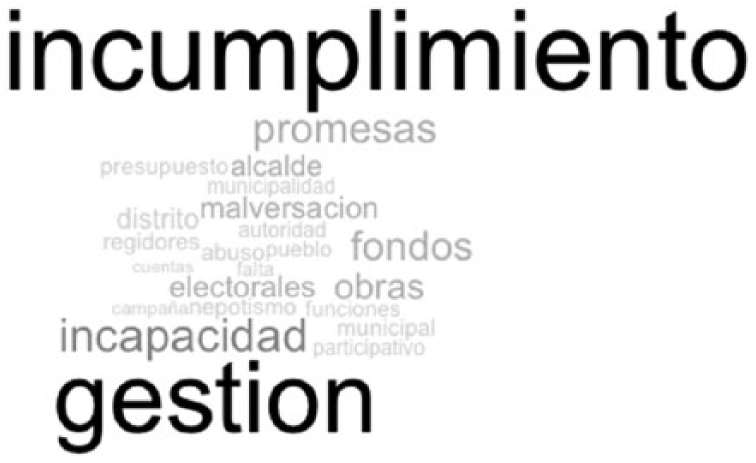
Stated reasons to recall politicians.
The organizers of recall referenda also must identify themselves. We collected the identification numbers provided on recall requests and matched them to candidate registration in the previous electoral period. Recall organizers were candidates in the previous electoral cycle in 18% of cases between 2002 and 2014. This estimate probably is a lower bound on the electoral ambitions of recall organizers, given that losing candidates easily can ask their friends or family to file recall requests to mask their political motivations. The substantial fraction of political competitors who directly organize recall referenda is consistent with our electoral theory.
If sore losers organize recall referenda, we should see them begin the process soon after the election. Citizen-organizers, in contrast, may be more likely to wait for an egregious event. We therefore coded the number of days since electoral authorities permitted a recall request to the filing. 23 Figure 2 shows the results. Half of all requests were made within 100 days of the mayor’s first year in office (the first moment when organizers could file). Almost all filings (96%) occurred within the first year possible. Organizers thus start recall proceedings almost immediately, consistent with our first hypothesis. Although it may be possible to detect poor performance within a year in some cases, the speedy decision to file a recall suggests political competitors waiting in the wings.
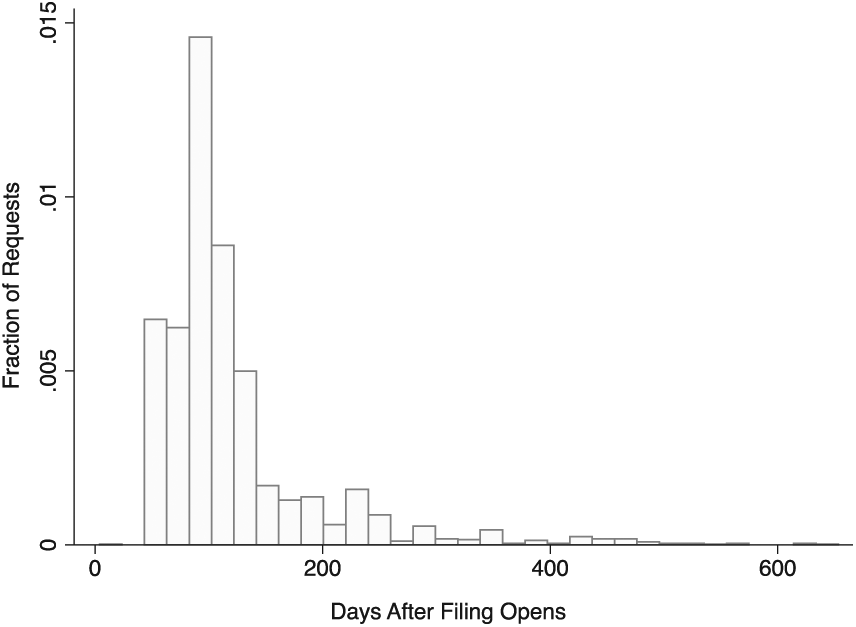
The timing of recall petitions, 2006-2014.
The Determinants of Recall Petitions and Votes
We now turn to a statistical analysis of the determinants of recall petitions and votes in the period when recalls ended in new elections (2002-2014). We present our district-level results from OLS models in Table 2. We standardize all variables (except for indicator variables) for ease of interpretation. In other words, the coefficients can be interpreted as the predicted probability of a recall petition or approved vote, given a standard deviation change in the independent variable.
The Determinants of Recall Petitions and Approvals.

Standard errors in parentheses.
p < .05.
Model 1 considers the basic set of electoral variables and district demographics prior to institutional reforms. Our first hypothesis is that competitive local elections create an incentive to request a recall vote. Indeed, there is a significant and substantively important relationship between competition and the probability of a petition to hold a recall vote. Going from a typical district in which the mayor wins by 9 percentage points to one in which the mayor barely wins by a point (a standard deviation below average) decreases the predicted probability of a recall petition by 5 percentage points. The predicted change is similar, even somewhat larger, in the logistic regression model (see the online appendix).
Our third hypothesis is that mayors who are perceived as weak based on observables are more likely to face a recall request. Mayors who win with small fractions of the vote and female mayors may be seen as vulnerable to removal. We find strong evidence that the fragmentation of the party system, which is correlated with a weak mandate, is associated with a higher chance of a recall petition. Female mayors also face a disproportionate number of recall petitions. There are very few female mayors, but even basic descriptive statistics are suggestive: Of 203 female mayors, 120 had recall petitions filed against them. Incumbency, in contrast, has no association with the chances of a recall petition, which probably reflects the fact that incumbency provides little electoral advantage in Peru.
Model 2 considers explanations based on citizen grievances. A larger budget is associated with a lower probability of recall petitions; execution is negatively signed, but does not reach statistical significance. Having a social protest and mining resources are associated with a higher probability that someone petitions to hold a recall, providing some support for grievance theories. Crucially for our theory, however, competition remains significant, even when accounting for spending, ongoing protests, and mineral rents. Competition also explains more of the variation in petitions for recalls. 24
Models 3 and 4 repeat the basic and expanded specifications using the approval of a recall vote as the dependent variable. Competition and gender remain associated with a higher chance of organizing a recall vote. The main difference from the petition models is that the signs on fragmentation and population reverse. Fragmented candidate fields may struggle to unite to collect signatures for a recall vote. The difficulty of getting a fraction of the electorate to sign a recall petition increases with population. Whereas larger districts are more likely to petition to hold a recall, they are less likely to succeed in collecting the signatures to hold one. Surprisingly, budget execution also is associated with a somewhat higher probability of approving a recall petition.
An Institutional Discontinuity
To test our fourth hypothesis, we explore the link between the level of political competition and requests for recall referenda after legislative reforms in 2015 eliminated the possibility of new elections. The reform should reduce the incentives to hold recall referenda if sore losers use them as a means to take office.
We have data on one postreform recall cycle. There was a notable drop in recall petitions, from a peak of 63% of districts requesting kits in 2011 to 2014 to just 35% of districts in 2015 to 2018 (Table 1). We also matched the data on the identity of recall organizers by period. Consistent with an interpretation that losing politicians are less interested in recall referenda if they cannot take office, past candidates organized fewer recalls. Prior to reforms, 18% of organizers were losing politicians. Following the reforms, the fraction of losing candidates requesting recalls dropped to 8%.
In Table 2, we also explore whether the coefficient on competition is attenuated following the institutional reforms. Models 5 through 8 repeat the same analyses for the postreform period. The results for competition are substantively similar for recall petitions, but tellingly, competition is not a significant determinant of approved votes in the postreform period. On the flip side, there is no evidence that popular grievances became more important for recall processes. In fact, the coefficients on social conflicts and mining rents lose significance for the postreform period, although this may reflect the much smaller number of recall cases.
Figure 3 demonstrates the changing relationship between competition and recall processes. The top row plots the predicted probability of a recall petition against the level of competition in a district for the pre- (left) and post- (right) reform period. 25 The number of recall petitions has fallen, but close electoral races still have a higher chance of a recall petition. The bottom row shows that the number of successful votes has fallen dramatically, with competition playing no role in the postreform period.
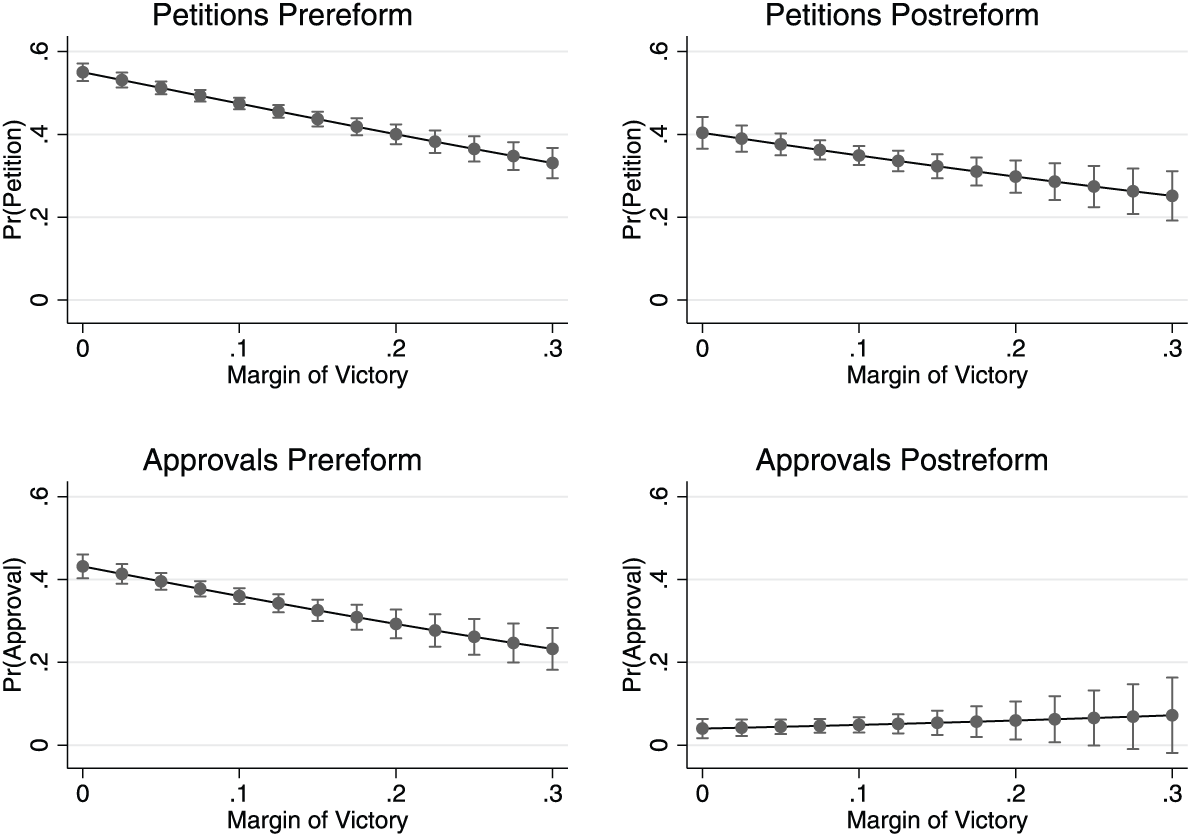
The role of electoral competition pre- and postinstitutional reforms.
In short, legislative reforms have been a mixed bag. They have dampened interest in recall referenda. Political losers are somewhat less likely to act as registered organizers. Their efforts are less likely to convert into recall votes. However, recall petitions still are more common around tight elections.
The Choice to Remove Politicians
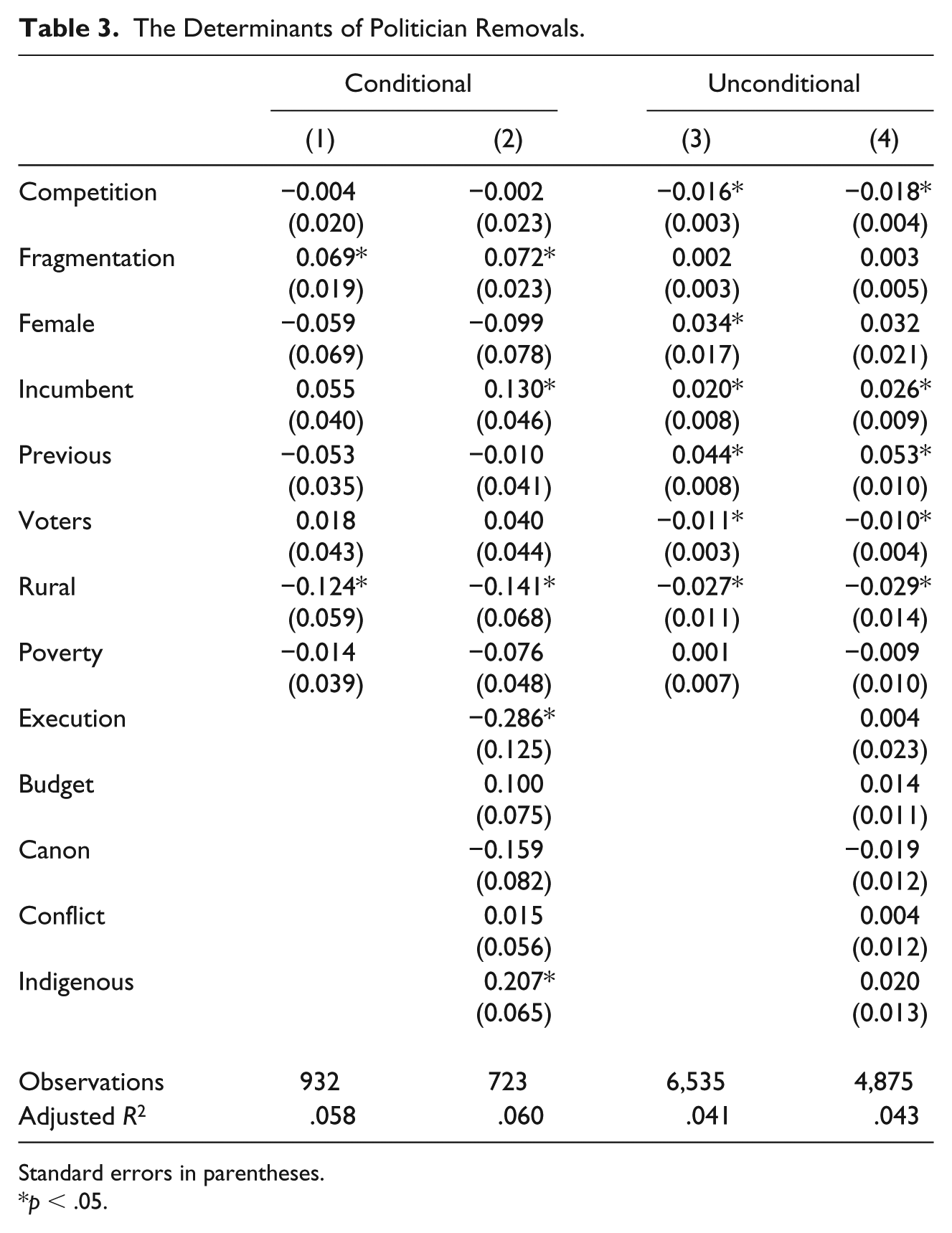
Once a recall referendum is organized, voters still must decide whether to remove or retain their elected officials. Even if opposition politicians organize recall votes, it is possible that office performance shapes voter decisions. We therefore turn to the outcomes of recall votes in Table 3, where the dependent variable is whether voters choose to remove their elected politician from office. This is a contingent outcome, so we limit the sample to districts that collected sufficient signatures to hold a vote in Models 1 and 2, and compare the results for all districts in Models 3 and 4.
The Determinants of Politician Removals.
Standard errors in parentheses.
p < .05.
Model 1 repeats the basic OLS model for office removals. What stands out is that the effects of competition disappear. This may reflect that competitive districts have polarized electorates and some faction continues to support the elected politician. It also could be the case that voters turn against sore losers who organize recall votes. In the case of Lima, for instance, many voters rallied behind Villarán because they saw her as unjustly attacked by a competitor. Even some of Villarán’s rivals rejected the recall effort as “destabilizing” and “dangerous” (Miró-Quesada & Rada, 2013, p. 99). Unsurprisingly, politicians who received a smaller fraction of the vote in the initial election, as operationalized through party fragmentation, are more likely to be removed. Female politicians are no more or less likely to be removed.
Model 2 adds the grievance variables. Although budget execution has no relationship with petitions to hold a recall and a positive association with vote approvals, it is associated with a lower probability of removal. Voters seem to sanction politicians who have not spent their budgets early in their terms. Figure 4 makes this clear by plotting the predicted probability of a recall request (left panel) and a removal (right panel) by levels of budget execution. The probability of removing a politician falls from 57% to 43% as budget execution increases from the bottom to top decile of performance (roughly 30% to 95% execution). The small number of removal votes means that these are noisy estimates, as seen by the overlapping confidence intervals in Figure 4. Reassuringly, we find similar results, although just shy of statistical significance, linking greater public works investments to a lower chance of office removal (see the online appendix).

The role of budget execution in recall petitions and removals.
In addition to office performance, districts with larger indigenous populations are more likely to remove their elected officials. This is consistent with work that finds greater electoral volatility in areas with larger indigenous communities because voters tend to be underrepresented politically (Madrid, 2005). Contrary to conventional wisdom, mining resources and social conflicts are not associated with higher removal rates.
Models 3 and 4 present the results of unconditional models in which we include all districts and look at the determinants of removing a politician. These specifications make clear the nuances that are lost by treating recalls as a single process. For instance, past analysts largely have missed the impact of competition on different stages of the recall process. Slim margins of victory matter for organizing recall votes but not for the ultimate decision about whether to retain a politician. Likewise, many scholars stress the role of logistical challenges, and especially district size, in explaining office removals. But large districts petition for more recalls, struggle to gather signatures to hold votes, but then are no more or less likely to remove their politicians. Social conflicts and mining resources also motivate recall petitions, but they are not associated with successful signature drives or actual office removals once a vote is held. Rather, factors plausibly related to office performance—budget execution and a weak initial mandate—shape the likelihood that voters “kick the bums out” in removal votes.
Conclusion
Since the 1990s, office removals have become common throughout Latin America. Most scholarship has focused on “presidencies interrupted” or national-level conflicts between legislatures and executives. But cases in which subnational politicians’ mandates are cut short have become even more frequent occurrences. Colombia’s Inspector General (Procuraduría) suspended 780 mayors and 71 governors from office between 1999 and 2012 (Procuraduria General de la Nación, 2016). Courts have removed 542 mayors from office in Brazil (Gehrke Ryff Moreira, 2015). Recall referenda, in particular, alter the mechanisms that citizens have at their disposal to hold local leaders accountable. In Ecuador, citizens organized more than 700 recall referenda just between 2008 and 2010 (Welp, 2015, p. 25). Peru leads the count in recall requests and removals in the region.
This article considered whether recall referenda are useful tools to improve the quality of local democracy. We made an empirical contribution by separating the desire to hold a recall from the collection of signatures and actual vote to remove a politician from office. This more nuanced treatment of the recall process yields mixed results. On one hand, reformers should be wary of recall elections, especially when they result in new elections. They tend to be activated by local elites attempting to oust those who won by narrow margins or with limited support. There also are gender dimensions to recall referenda: Female candidates are more frequent targets. On the other hand, institutional reforms may improve the process. Preliminary evidence from the first cycle of elections following reforms in Peru suggests that rules that prevent recalls from ending in new elections have somewhat reduced revenge-seeking uses. Separating the recall organization from the removal vote also shows that voters are more likely to throw out poorly performing politicians and to do so in areas where political representation historically has been weak such as majority-indigenous districts. The results thus suggest that citizens can and do sanction their politicians for office performance, at least when given the chance to act in the short run.
Future studies of office removals may look at countries that vary in party-system institutionalization. Peru has a collapsed party system, especially at the subnational level, so it is unclear how presidents and their parties interfere to advance partisan agendas through recall referenda. In countries with greater congruity between the national and local party system, it is possible to imagine partisan alignment playing a much larger explanatory role in the use of recall referenda. That said, weak party systems have become the norm in Latin America (Luna, 2014), and Peru indicates how personal vendettas can shape local politics apart from larger partisan battles.
Finally, an important open question is how recall referenda affect the subsequent behavior of local politicians. Ideally, recall referenda improve democratic responsiveness. Mayors constantly need to consider their public approval, which should lead them to hew more closely to citizens’ demands. In theory, then, mechanisms of direct democracy could bring politicians’ behavior closer to voter preferences. The criticism is that recall elections exacerbate the short-termism and majoritarian tendencies of democracy (Bowler, 2004, p. 205). It can make it more difficult for local politicians to engage in necessary, but unpopular, actions in the public interest, like tax collection or regulatory enforcement. The threat of recall votes similarly can be a tool for organized minorities to impose their preferences. For instance, unlicensed street vendors threatened to revoke the mayor of Chiclayo if he did not allow them to stay in city streets (La República, 2015). Squatters made similar threats against the governor of Arequipa, when she tried to evict their illegal constructions (La República, 2016). Recall elections are another tool that social organizations and political opponents can use to leverage their claims, for better or worse.
Supplemental Material
Appendix03.22.17-2 – Supplemental material for Imperfect Recall: The Politics of Subnational Office Removals
Supplemental material, Appendix03.22.17-2 for Imperfect Recall: The Politics of Subnational Office Removals by Alisha C. Holland and José Incio in Comparative Political Studies
Footnotes
Acknowledgements
Thanks to the Peruvian electoral institutions (Jurado Nacional de Elecciones [JNE]-INFOGOB, Oficina Nacional de Procesos Electorales [ONPE]) for making the data available. Special thanks to Barry Ames, Tulia Falleti, Maria Gracia Becerra, Stephan Haggard, Ana Neyra, Scott Morgenstern, Tariq Thachil, Madai Urteaga, Julie Weaver, and three anonymous reviewers for comments on earlier versions of this article. We are also grateful for feedback from participants at workshops at Brown University, University of Pennsylvania, University of Pittsburgh, Harvard University, and the 2016 American Political Science Association Annual Meeting.
Declaration of Conflicting Interests
The authors declared no potential conflicts of interest with respect to the research, authorship, and/or publication of this article.
Funding
The authors received no financial support for the research, authorship, and/or publication of this article.

Notes
Author Biographies
References
Supplementary Material
Please find the following supplemental material available below.
For Open Access articles published under a Creative Commons License, all supplemental material carries the same license as the article it is associated with.
For non-Open Access articles published, all supplemental material carries a non-exclusive license, and permission requests for re-use of supplemental material or any part of supplemental material shall be sent directly to the copyright owner as specified in the copyright notice associated with the article.
