



Abstract
Scholars have long claimed that political movements founded by charismatic leaders must undergo “routinization,” or depersonalization, to survive. Yet many such movements appear to have sustained their charismatic nature and have persisted or reemerged in cases as diverse as Argentina, Venezuela, Peru, Turkey, and China. Focusing on Argentine Peronism and Venezuelan Chavismo, this article examines the potential of new leaders to revive their charismatic predecessors’ legacies to perpetuate the movement and gain the followers’ support. Through face-to-face survey experiments conducted in both countries, the article shows that new leaders who (a) implement bold, initially impressive policies and (b) symbolically tie themselves to the charismatic founder cause citizens to express stronger emotional attachments to the movement and garner political support. The results challenge the notion that charismatic movements are short-lived and underscore the potential of these movements to impact democratic politics and party-system development long after their founders disappear.
Introduction
Charisma—“supernatural, superhuman, or at least specifically exceptional powers or qualities”—is widely considered ephemeral (Weber, 1922/1978, p. 141). Indeed, conventional wisdom indicates that the magnetic appeal of charismatic leaders, as well as the direct, unmediated, and deeply emotional bonds they cultivate with their followers, fade away when the leader dies. For a charismatic movement to survive, then, some scholars claim that the followers’ profound attachments to the leader must be converted into indirect ties based on programmatic appeals or membership in affiliated social groups. This process of depersonalization, or “routinization,” replaces the leader’s personal authority with a party organization that coordinates voters’ and politicians’ complex preferences over the long term (Kitschelt, 2000, p. 846; Madsen & Snow, 1991, p. 24; Weber, 1922/1978, p. 246). When scholars entertain the possibility that the followers’ charismatic attachments with the leader endure, they believe that charisma can persist only in attenuated and depersonalized forms—such as offices, institutions, and corporate bodies—rather than becoming reactivated by a new leader (Jowitt, 1992, p. 91, 107; Shils, 1965, p. 205). 1 In short, the literature on charisma does not consider that new leaders can reinvigorate citizens’ charismatic bonds in their original, personalistic state.
Curiously, however, movements in countries as diverse as Argentina, Venezuela, Peru, Turkey, and China have survived or reemerged following the death of their charismatic founder while sustaining their personalistic nature. For instance, Argentine Peronism—the movement founded over 70 years ago by Juan and Eva Perón—remains a dominant political force and has sustained a large base of fervently loyal supporters. The movement’s most successful leaders have tied themselves to the Peróns’s savior-like image and have governed based on an intense cult of personality rather than on strong party institutions (Gervasoni, 2018; Levitsky, 2003). In Venezuela, Nicolás Maduro has similarly leaned on the charismatic figure of Hugo Chávez to sustain the movement he inherited upon Chávez’s death in March 2013. Perhaps as a result, about one third of Venezuelans have continued to express fervent attachments to Chavismo (Briceño, 2015; Morales, 2016). 2 And in Peru, Alberto Fujimori’s personalistic, paradigm-shifting movement of the 1990s has sustained a larger support base than any other party (Tanaka, 2011, p. 80). In addition, Fujimori’s daughter, Keiko, has tied herself to his charismatic image in recent years to garner support. Although she did not win the 2016 presidential elections, she received 40% of the vote in the first round—over 18 points more than the second-place candidate (Dargent & Muñoz, 2016, p. 145).
These cases challenge the notion that charisma is short-lived in two ways. To begin, citizens’ deep, emotional attachments to charismatic leaders and movements may be more resilient than much of the current literature suggests. That is, these ties may survive in their original, affective state rather than becoming routinized into programmatic or organizational linkages. In addition, political successors may be able to tap into citizens’ charismatic attachments to garner support rather than relying on party institutions. As a result, similar to the founder, new leaders could consolidate their own concentrated, personalistic authority. This article investigates these possibilities by developing and testing a theory on the revival of charisma by new leaders.
Drawing insights from scholarship on political psychology, sociology, leadership, and electoral campaigns, I argue that a new leader must fulfill two conditions to successfully reactivate voters’ charismatic attachments and pick up the founder’s mantle. First, the successor must establish his or her own charisma as a heroic leader by proposing and implementing bold policies that translate into tangible benefits for the followers and alleviate their suffering.
Second, the successor must cultivate symbolic ties to the founder to associate his or her charisma with the founder’s glorified legacy and convince the followers that he or she has taken up the founder’s transformative mission.
I analyze original, face-to-face survey experiments conducted with 999 movement followers in Argentina and Venezuela to determine whether and how new leaders can associate themselves with their charismatic predecessor’s legacy, revive citizens’ affective ties to the founder’s movement, and win political support. 3 Specifically, I construct a 2 × 2 design in which a potential successor running for president implements (or does not implement) a set of cues related to bold policies and symbolic ties. Contrary to the conventional wisdom, which suggests that charismatic linkages do not survive beyond the founder’s death, the results indicate that citizens’ deep, emotional attachments to Peronism and Chavismo endure. Moreover, in the context of presidential campaigns, I show that a new leader’s bold, initially successful policies and symbolic ties to the founder can politically reactivate these attachments by intensifying followers’ positive feelings toward the movement, enhancing their perceptions of the new leader’s charisma, and boosting the leader’s support.
The article proceeds as follows. First, I briefly review the initial formation of charismatic attachments between leaders and followers. Next, I explain how new politicians can reactivate charismatic attachments and garner support. I then lay out the hypotheses, design, and results of the survey experiments in Argentina and Venezuela. Finally, I discuss the substantive implications of the findings and suggest avenues for future research on the revival of charismatic movements.
The Initial Formation of Charismatic Attachments
To understand the reactivation of charismatic bonds, I begin by reviewing how they are initially formed. Studies of charisma generally indicate that the formation of these bonds rests on three factors. First, a leader who explicitly recognizes and incorporates historically marginalized people into the center of politics has the potential to form fervent ties with those citizens. These people, who often experience feelings of hopelessness and loss of control, are especially likely to seek out a leader who claims to resolve their problems and save them from their distress (Bandura, 1982; Madsen & Snow, 1991; Merolla & Zechmeister, 2011; Spruyt, Keppens, & Van Droogenbroeck, 2016; Weyland, 2003). Notably, citizens are not forced to support the leader; rather, they feel moved by their . . . need to overcome their frustrations through projecting their fears, hopes, and aggressions onto heroes who can provide at least symbolic solutions; by their need for identification with the mighty and the awesome; by their need for esteem from performers who bestow recognition and flattery on them. (Burns, 1979, p. 246)
The top-down nature of this symbolic recognition establishes an asymmetrical relationship between leader and follower in which the latter feels indebted to, rather than empowered by, the former (Madsen & Snow, 1991, pp. 14-15).
Second, to secure the people’s devotion, the leader demonstrates the capacity to single-handedly resolve their suffering. Weber (1922/1978) states, “If proof and success elude the leader for long, if he appears deserted by his god or his magical heroic powers, above all, if his leadership fails to benefit his followers, it is likely that his charismatic authority will disappear” (p. 242). To provide evidence of charismatic power, the leader must achieve impressive performance by promising and implementing bold policies that showcase seemingly miraculous capacities (Pappas, 2011; Weber, 1922/1978). From the followers’ perspective, the daring character and ability of these policies to confer tangible benefits—rather than their programmatic content and long-term sustainability—are essential for “proving” the leader’s extraordinary abilities. Once implemented, these policies confirm the leader’s superhuman image and can temporarily protect the leader from subsequent drops in performance (Merolla & Zechmeister, 2011).
Third, the leader constructs a symbolic narrative that glorifies his or her position as the people’s savior, stresses the movement’s transformative mission to deliver the followers a more prosperous future, and demonizes opposing groups as enemies blocking the people’s path to salvation. This narrative, which frames the leader’s political mission as an all-out battle against evil forces, infuses followers’ attachments with a profound moral intensity (Zúquete, 2008).
Thus, the followers’ support for the leader rests not just on much-needed recognition and tangible goods but also on a deep sense of righteousness that inspires religious devotion to the leader, whom the followers come to view as brave and selfless (Zúquete, 2008, p. 106). To ensure that the narrative forms an intrinsic part of followers’ identity, the leader disseminates it through discourse, constant contact with the followers, and infusion of public spaces with affiliated symbols that reinforce the leader’s power and spiritual superiority (Capriles, 2012; Plotkin, 2003; Zúquete, 2008).
The Revival of Charismatic Attachments
Scholars acknowledge the importance of the above-mentioned characteristics for the formation of charismatic linkages. I go a step further to argue that these bonds have the potential to become reactivated in their original, charismatic state by new politicians after the founder disappears. Insights from social psychology suggest that the followers’ identification with the founder can shape their worldview and thus influence their political preferences and expectations. Specifically, this identity provides citizens with a “framework that allows [them]. . .to make sense of social, political, and economic conditions” that occurred in the past, are unfolding in the present, or are yet to occur (Abdelal, Herrera, Johnston, & McDermott, 2009, pp. 24-25). It also gives individuals “ways of recognizing, identifying, and classifying other people, of constructing sameness and difference, and of ‘coding’ and making sense of their actions” (Brubaker, Loveman, & Stamatov, 2004, p. 47, as cited in Abdelal et al., 2009, p. 25). As a worldview, then, citizens’ identification with a charismatic leader can shape their perceptions and evaluations of future politicians.
Given that followers’ charismatic identity primes them to look for an inspiring successor, new leaders have an incentive to strategically associate themselves with the founder’s image to politically reactivate that identity and gain a loyal base of support. To do so, political psychologists suggest that a new leader should disseminate cues through speech, symbolic gestures, and policies that associate the core symbols and values of the identity with the current context and the new leader’s personal profile (Abdelal et al., 2009; Haslam, Reicher, & Platow, 2011; Klar, 2013; Vavreck, 2009). If successfully executed, these cues signal to the followers that the leader genuinely embodies the founder and will revive the founder’s mission to save them. Moreover, by appearing as the symbolic archetype with which the followers identify—the charismatic founder—successors who employ these cues are also likely to appear more charismatic in their own right (Haslam et al., 2011; Hogg, 2001).
To revive citizens’ charismatic attachments, I argue that successors must communicate a specific set of material and symbolic cues to the followers. The material cue substantiates successors’ charismatic authority, while the symbolic cue depicts that authority as being directly reincarnated from the founder. First, in material terms, successors—like the founder—must demonstrate extraordinary abilities through impressive performance. 4 They achieve this through promising and enacting audacious policies that demonstrate the capacity to “save” the historically marginalized followers from their misery. Specifically, the policies must favor grandeur and alacrity over ideological consistency (Weber, 1922/1978, p. 242). Indeed, successors must embrace opportunism through initiating policies that prioritize swift relief rather than sustainability, even if those policies contradict the substance of the founder’s original programs. In addition, the policies must deliver tangible benefits to the followers to prove successors’ superhuman capacities. Although successors must become chief executives before delivering goods at the national level, past records of bold, impressive performance as subnational executive officeholders—for example, as governors—can provide followers with an initial cue regarding successors’ potential to fulfill their promises.
To be sure, this material cue should enhance voters’ evaluations of the successors’ performance. But more importantly for charismatic attachments, as Weber (1922/1978) stresses, it should also suggest to the followers the new leaders’ extraordinary abilities to resolve their urgent problems. Thus, the material cue should reinvigorate followers’ enthusiasm for the movement and strengthen their affective attachments. Furthermore, it should cause the followers not only to increase their positive assessments of successors’ performance but also to view the successors as more charismatic—as noble, selfless heroes capable of transforming society and ensuring a more prosperous future for the followers (Pappas, 2011, p. 3; Weber, 1922/1978).
Second, in symbolic terms, new leaders must weave themselves into the founder’s narrative by depicting themselves as heirs who will resume the founder’s mission to rescue the people. Specifically, successors must craft and disseminate verbal, auditory, and visual signals that associate themselves with the founder’s heroic project and tap into the followers’ quest for salvation (Abdelal et al., 2009; Klar, 2013; Vavreck, 2009). These verbal and nonverbal cues serve as a form of “aesthetic politics” that revive the founder’s mission in a contemporary light and mobilize followers to politically reengage with it (Spotts, 2002, as cited in Haslam et al., 2011, p. 180). For example, successors can reference the founder’s name, use a similar tone of voice, play music associated with the founder, adopt similar dress, make personal contact with the followers as the founder did, or incorporate colors associated with the founder’s movement to demonstrate their likeness. These cues, spread through the successor’s speech, gestures, and symbols, not only remind followers of their beloved founder but also reenergize their zeal for his redemptive mission. The cues can therefore reactivate the followers’ identity as part of the founder’s “moral community” (Zúquete, 2008, p. 104), distinguish them from their (real and imagined) enemies, and confirm the successor as the movement’s new champion (Abdelal et al., 2009; Tajfel, 1974).
In sum, I argue that citizens’ charismatic attachments need not transform into depersonalized linkages to survive and remain politically salient after the founder disappears.
Rather, followers can sustain a deep, emotional identification with the movement that reinforces their commitment to the founder’s heroic mission to transform society, shapes their worldview, and influences their expectations of future politicians. Subsequent leaders can therefore reactivate followers’ attachments and gain support by depicting themselves as charismatic revivers of the founder’s mission by (a) promising and implementing bold policies that deliver tangible benefits to the followers and (b) symbolically linking themselves to the charismatic founder and his transformative project.
Testing the Reactivation of Charismatic Attachments: Evidence From Survey Experiments
The present section uses survey experiments to test the individual and combined effects of successors’ bold policies and symbolic ties on followers’ expressions of emotional attachment to the movement and support for the heir. To implement this test, I draw on the priming, cue-taking, and identity literatures from political psychology (Abdelal et al., 2009; Hogg, 2001; Klar, 2013; Tajfel, 1974; Van Vugt & Hart, 2004) to design two manipulations that represent strategic cues enacted by a hypothetical candidate seeking the presidency: bold policies and symbolic ties to the charismatic founder. The first manipulation corresponds to the material cue: the promise and implementation of bold policies. Because it is ultimately the fulfillment of these policies that “proves” the successor’s charisma, I manipulate whether or not the candidate has fulfilled his bold, tangible promises to resolve citizens’ most pressing problems in the past. The second manipulation, which represents the symbolic cue, incorporates visual and auditory symbols that associate the candidate with the charismatic founder of the movement. I construct a 2 × 2 design with four conditions such that respondents are randomly assigned to receive both, one, or neither of the two cues. Next, I measure the respondents’ expressions of attachment to the movement and support for the successor (see Table 1).
2 × 2 Experimental Conditions and Summary of Hypotheses.

Hypotheses
Based on my theory, I develop three sets of hypotheses about the combined and marginal effects of bold policies and symbolic ties on followers’ charismatic attachments to the movement and support for the successor.
Participants, Design, and Procedure
In partnership with two local public opinion firms—trespuntozero in Argentina and Consultores 21 in Venezuela 5 —I conducted face-to-face survey experiments with a sample of each movement’s most important and consistent base of followers: self-identified Peronist and Chavista adults (18 and older) from the “popular” (lower- and lower-middle class) sectors. 6 While it would be interesting to analyze the impact of successors’ material and symbolic cues on nonfollowers as well as middle and upper class citizens, I limited the scope of the present study due to theoretical expectations and resource constraints. First, I focused on movement followers rather than all citizens because the experiment aims to test the potential reactivation of existing attachments rather than the formation of new attachments among previously unaffiliated individuals. Certainly, political candidates should also endeavor to expand their support base by incorporating new voters. Yet because the movement followers constitute a sizable proportion of the population—about one third of the electorate in both Argentina and Venezuela (Briceño, 2015; Calvo & Murillo, 2012)—their loyalty provides new leaders an enviable “electoral cushion” (Levitsky, 2003, pp. 13-14). To narrow the sample in this way, respondents were asked a screening question in which they indicated which of several political traditions they felt closest to. Those who selected “Peronism” or “Chavismo” were included in the study. 7
Second, I limited the sample to followers from the popular rather than the middle and upper classes because my theory suggests that socioeconomically marginalized citizens are more likely to experience seemingly unmanageable challenges, suffer disproportionately, and develop feelings of low self-efficacy. Popular-sector citizens are therefore more likely to look for and become emotionally attached to a leader whom they perceive as heroic (Burns, 1979; Madsen & Snow, 1991). Furthermore, in both Argentina and Venezuela, these low-income citizens make up the largest group of movement followers and a vital source of support for political candidates (Briceño, 2015; Calvo & Murillo, 2012). As suggested by public opinion specialists in both countries, education was used as a proxy for socioeconomic status; respondents with less than a college degree were included. 8
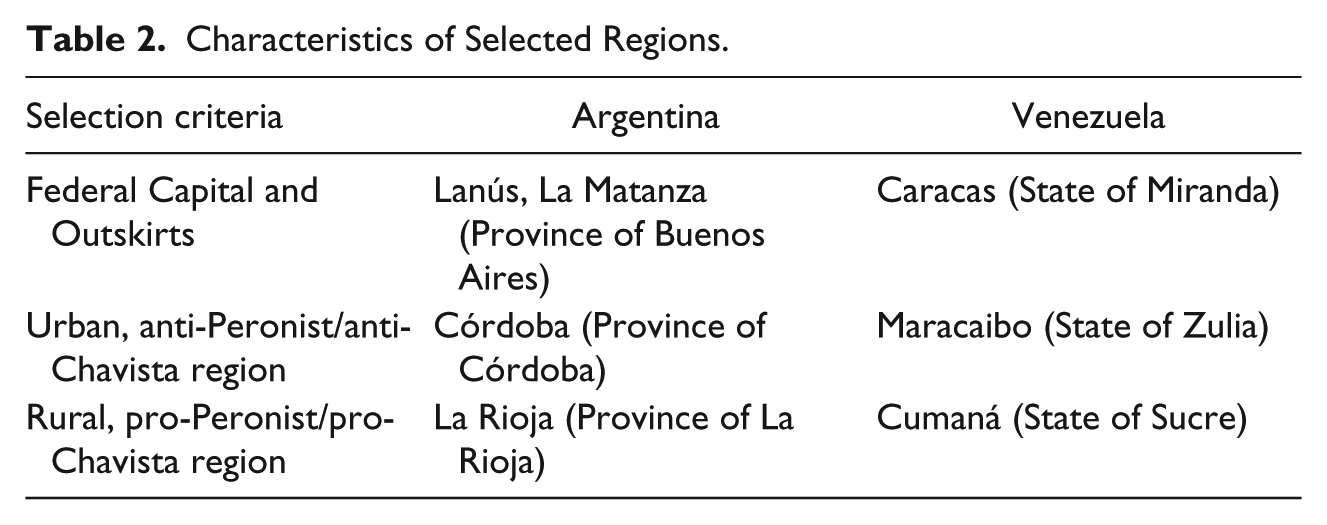
In sum, while the population of interest in this study—movement followers from the popular sectors—is limited, it provides a crucial foundation of support for aspiring political candidates. To approximate a nationally representative sample of this population, the experiment was fielded in three diverse regions of each country: the federal capital and its outskirts, an urban and traditionally anti-Peronist/anti-Chavista region, and a rural, traditionally pro-Peronist/pro-Chavista region (see Table 2). Many studies of Peronism and Chavismo focus exclusively on the federal capital, which, while populous and politically important, has distinct characteristics compared with the rest of the country. In contrast, this three-region design better captures followers’ attitudes and behaviors at the national level, accounting for demographic, cultural, and political variation.
Characteristics of Selected Regions.
The survey experiment was designed as follows. Respondents were randomly assigned to one of the four experimental conditions, each of which provided information about a hypothetical governor running for president. 9 After a set of filter questions intended to restrict the sample to individuals from the population of interest, enumerators carefully explained the scenario, verified respondents’ understanding, and proceeded to one of the four randomly assigned experimental manipulations, described below.
To maximize external validity, the two sets of manipulations—one for fulfillment/unfulfillment of bold policies and a second for the presence/absence of symbolic ties—imitated stimuli that voters would encounter in a real presidential campaign. I developed each manipulation with the assistance and feedback of local campaign strategists, in-depth interviews and pretests with individuals from the population of interest, and, in Argentina, a pilot survey distributed online via email and Facebook (N = 239). To enhance internal validity, the survey was conducted in face-to-face format with local, trained enumerators to ensure that respondents understood the scenario and received the correct manipulations. 10 Manipulation checks (described below) further verified that each stimulus achieved its intended purpose.
For the two conditions in which bold policies were enacted (fulfilled), the enumerator described to the respondent the candidate’s successful completion of bold policies as governor, emphasizing impressive, tangible benefits he provided to popular-sector citizens in his province/state. For the remaining two conditions (unfulfilled), the enumerator indicated the candidate’s failure to implement the same policies as governor. To stress the daring character of the candidate’s policies, exaggerated wording was used, such as the promise to “end” (rather than reduce) poverty, “eliminate” unemployment, and “combat” crime. The policies also addressed real citizens’ most pressing concerns, as indicated by surveys conducted no more than 3 months prior to fielding the study (economic crisis, unemployment, and poverty in Argentina; economic crisis, crime, and food shortages in Venezuela). Finally, to personalize and enhance the emotional persuasiveness of the scenario, I used an episodic frame (a personal anecdote) rather than a thematic frame (factual information) to depict the candidate’s successful/failed implementation bold policies (Iyengar, 1991; Klar, 2013). Prioritizing emotional responses to the candidate’s policies in this way corresponds to my theory that the implementation of bold, initially impressive policies strengthens followers’ charismatic—deeply emotional and personalistic—attachments to the movement.
Next, respondents were exposed to auditory and visual cues representing the presence/absence of the candidate’s symbolic ties to the founder. 11 First, respondents listened to a 90-s speech by the candidate using headphones provided by the enumerator. The speech was recorded rather than printed because voters tend to listen to, rather than read, candidate speeches in the context of presidential campaigns. Each speech was developed based on several real speeches made by prominent movement leaders including Carlos Menem and Cristina Fernández de Kirchner in Argentina and Nicolás Maduro and Henri Falcón in Venezuela. 12 In each country, local campaign experts with public speaking experience recorded the speech.
In both versions of the speech, the candidate reflected on the country’s current state of affairs and expressed bold promises that he would fulfill if elected. Next, in the two conditions in which symbolic ties were present (symbol), the candidate mentioned the founder by name (Perón/Chávez), referred to the followers using a typical in-group label (comrades/the Bolivarian people), and stressed the transformational character of the movement. 13 Conversely, in the two conditions where symbolic ties were absent (no symbol), the candidate did not mention the founder’s name, used a neutral label for the voters (compatriots/the Venezuelan people), and referred to progress in terms of realistic development rather than using the more grandiose and missionary language of transformation. The remaining content, tone, and length of the speech in each country were held constant across all four conditions.
While listening to the candidate’s speech, participants viewed a card with an image of the candidate’s campaign poster, which was also designed based on materials from recent presidential campaigns and feedback from local experts. 14 Each version of the poster contained a generic campaign slogan (Opportunity for All/Together With the People), a solid-color background, an image of children, the candidate’s name, the title “President,” and a picture of the candidate from the chest up. 15 In the version with symbolic ties, the background color corresponded to the movement (celeste/red) and the image featured the founder among the children. The version without symbolic ties had a generic background color unaffiliated with any major political party in the country, and the image of children did not include the founder. 16 Figure 1 illustrates the experimental manipulations for each country, including the candidate’s policy record as governor, transcriptions of the candidate’s speech, and campaign posters. 17
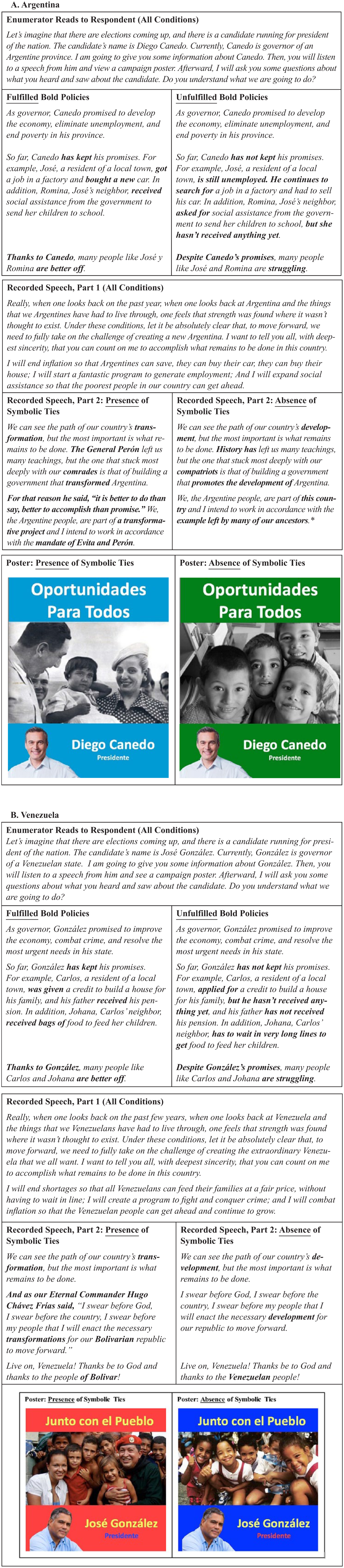
Experimental manipulations in (a) Argentina and (b) Venezuela.
Following exposure to one of the four randomly assigned conditions, respondents answered a range of survey questions regarding their emotional attachment to the movement and support for the candidate—the dependent variables of the study. To measure emotional attachment, respondents were asked how Peronist/Chavista they felt on a scale from 0 to 10.
They were also asked to indicate the intensity of their positive and negative feelings toward the movement on 4-point scales including pride, excitement, and hope; and anger, disappointment, and fear. Due to the high interitem correlation between the three survey items for positive and negative feelings, respectively, I collapsed each set into an additive index and rescaled it to range from 0 to 10. 18 I interpreted statistically significant increases in the former two measures and a significant decrease in the latter as successful reactivation of citizens’ emotional attachments to the movement. 19
To measure support for the candidate, respondents were first asked a series of questions regarding their perceptions of the candidate’s charisma. Based on my theory, a compelling leader who materially and symbolically embodies the founder’s heroic image should appear significantly more charismatic to the followers—especially if the candidate is to consolidate his own personalistic authority (Haslam et al., 2011; Hogg, 2001; Madsen & Snow, 1991).
To operationalize the candidate’s charisma, respondents were asked to indicate their level of agreement on a 4-point scale with three statements about his selflessness, vision of the future, and capacity to solve the country’s problems. While charisma is difficult to measure quantitatively, these items have been validated in previous studies of charisma in Latin America and represent key components of the concept as outlined in my theory. I drew the first two of these statements from a five-question charisma battery developed by Merolla and Zechmeister to assess citizens’ perceptions of leaders’ charisma in Mexico and Venezuela. 20 I selected the following items: “[Leader’s name] articulates a compelling vision of the future” and “[Leader’s name] goes beyond his own self-interest for the good of the group.” 21 The first reflects the leader’s enactment of the founder’s mission to establish a more prosperous future for the followers; the second relates to the leader’s willingness to sacrifice personal goals to fulfill this righteous mission on behalf of the followers. I incorporated the third statement—“[the leader] is capable of resolving [Argentina’s/Venezuela’s] problems”—to capture respondents’ perceptions of the leader’s heroic capacity to resolve their misery. Although this statement is not included in Merolla and Zechmeister’s battery, it comprises a central component of my definition of charisma that is also stressed by Weber: the leader’s extraordinary ability to solve the people’s problems. Unlike survey questions in which respondents are prompted to explicitly evaluate the candidate’s economic performance (which was also incorporated in the study as a manipulation check, described below), the broader and more prospective nature of this statement better (if imperfectly) captures whether the candidate inspires and convinces the followers of his or her heroic potential—a crucial component of charisma. I collapsed this three-item charisma battery into an additive index and rescaled to range from 0 to 10. 22
In addition to the charisma battery, I included a survey question to measure respondents’ intention to vote for the candidate in future elections. Whereas charismatic perceptions indicate respondents’ potential to form emotional ties to the leader, this item provides a more concrete measure of support that is also necessary for the leader’s consolidation of power. This item was also rescaled to range from 0 to 10 in both countries. Further details regarding all survey questions, including wording and response options, can be found in the appendix.
Manipulation Checks
The survey included additional questions to verify that the experimental manipulations had their intended effects. For bold policies, respondents were asked to evaluate the candidate’s performance as governor on a 4-point scale. As expected, respondents in the two conditions where the candidate fulfilled bold policies as governor rated his performance significantly higher than respondents in the two conditions where he failed to implement the policies (MPolicies = 3.21 vs. MNo Policies = 2.19, p < .05 in Argentina; MPolicies = 3.11 vs. MNo Policies = 2.42, p < .05 in Venezuela).
To verify the symbolic manipulation, respondents were asked to evaluate how Peronist/Chavista the candidate appeared on a scale from 0 to 10. On average, respondents in the two conditions with symbolic ties perceived the candidate as more Peronist/Chavista than in the two conditions without symbolic ties (MSymbol = 6.98 vs. MNo Symbol = 6.46, p < .05 in Argentina; MSymbol = 7.56 vs. MNo Symbol = 5.63, p < .05 in Venezuela). These data suggest that respondents in both countries received the correct cues for both sets of manipulations.
Results
For the most part, the results support H1, suggesting that the combined effect of bold policies and symbolic ties cause followers to express the most intense emotional attachment to the movement and the greatest support for the candidate. Specifically, in Argentina, respondents who received both cues (fulfilled/symbol) expressed the strongest identification with Peronism, the most intense positive feelings, and the weakest negative feelings toward the movement, providing strong support for H1a. Pairwise difference-of-means tests demonstrate that, on average, the joint effects of fulfilled bold policies and symbolic ties had a significantly greater, positive impact on followers’ expressions of emotional attachment based on these three indicators. The differences were statistically significant (p ⩽ .09) in seven of nine pairwise comparisons between the fulfilled/symbol condition and each of the remaining conditions. The two differences that did not reach statistical significance—between fulfilled/symbol and unfulfilled/symbol for Peronist identification and for positive feelings toward Peronism—were in the hypothesized direction, with larger scores in the fulfilled/symbol condition.
Likewise, Argentine respondents exposed to both fulfilled bold policies and symbolic ties endorsed the candidate most enthusiastically, supporting H1b. On average, respondents in the fulfilled/symbol condition perceived the candidate as more charismatic. These respondents also expressed greater willingness to vote for the candidate than respondents in the remaining conditions. All difference-of-means tests between this condition and each remaining condition were positive and significant (p ⩽ .076). Figure 2a presents a graphical illustration of the results and Figure 3a shows pairwise t tests between the fulfilled/symbol condition and each of the three remaining conditions (full ANOVA results and p values for all pairwise t tests are presented in the appendix).

Mean levels of movement attachment and candidate support by experimental condition (90% confidence intervals shown): (a) Argentina and (b) Venezuela.
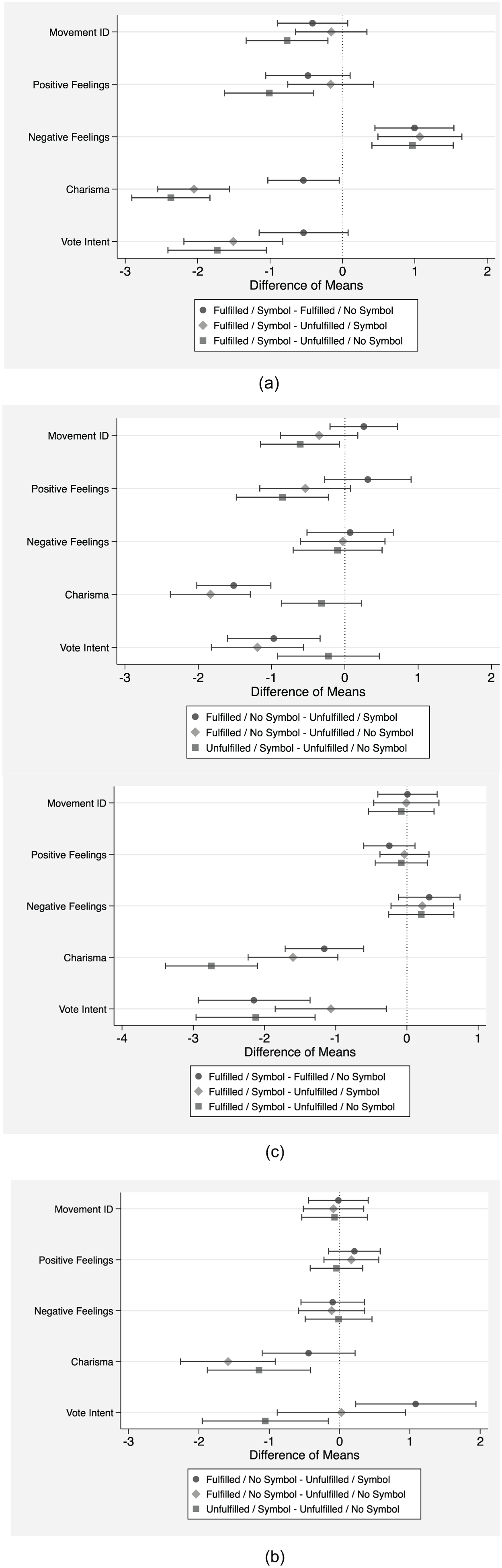
Difference of means: pairwise t tests (90% confidence intervals shown)—(a) Argentina: Hypothesis 1; (b) Argentina: Hypothesis 2; (c) Venezuela: Hypothesis 1; and (d) Venezuela: Hypothesis 2.
In Venezuela, the results for H1 are mixed. On one hand, H1a is not supported: In terms of movement attachment, respondents expressed equally strong identification with and feelings toward Chavismo across all four conditions, suggesting that neither bold policies nor symbolic ties had a noticeable effect. The reason is that respondents expressed much higher levels of attachment than their Argentine counterparts: in Argentina, across the four conditions, identification with Peronism ranged from 6.02 to 6.78 with a mean score of 6.45, positive feelings ranged from 6.15 to 7.07 with a mean score of 6.67, and negative feelings ranged from 3.98 to 4.94 with a mean score of 4.66. Conversely, in Venezuela, identification with Chavismo ranged from 8.48 to 8.56 with a mean score of 8.54, positive feelings ranged from 8.71 to 8.96 with a mean score of 8.87, and negative feelings ranged from 1.38 to 1.7 with a mean score of 1.56. In other words, whereas the lower overall intensity of attachments in Argentina allowed for differences to reveal themselves across the four conditions, the “ceiling effects” for attachment in Venezuela suppressed any potential differences.
I suspect these ceiling effects emerged in Venezuela due to the recent nature of Chávez’s death, just 4 years before the survey was conducted. Because Chávez’s followers continue to mourn his passing, it is likely that their attachments to his legacy remain highly activated, resulting in the expression of particularly raw, powerful feelings toward Chavismo—regardless of the behavior of new leaders. Indeed, the survey experiment was administered during the rule of Chávez’s handpicked successor, Nicolás Maduro, further intensifying the emotional salience of Chávez’s legacy. Conversely, because Perón died over 40 years ago, Argentines’ attachments to Peronism are likely to be more nuanced. Argentines who are not exposed to a new leader implementing Peronist cues may therefore be less likely to express their attachments as enthusiastically.
On the other hand, the results in Venezuela uphold H1b: the combined effects of bold policies and symbolic ties caused followers to express the strongest support for the candidate. On average, relative to all other conditions, respondents in the fulfilled/symbol condition perceived the candidate as significantly more charismatic (p ≈ 0 across all pairwise difference-of-means tests) and were more likely to vote for the candidate in future elections (p ⩽ .012 across all pairwise difference-of-means tests). The significance of these findings is noteworthy: while attachments to Chavismo remain strong among all followers, charismatic attachment to and support for new leaders vary based on the extent to which leaders can (a) demonstrate their own heroic capacities by fulfilling bold policies and (b) convincingly tie that heroism to Chávez’s legacy. Thus, to maximize their support, new candidates must behave similarly to and associate themselves with the charismatic founder to garner support—actions that perpetuate the founder’s legacy. Figure 2b presents a graphical illustration of the results and Figure 3c pairwise t tests between the fulfilled/symbol condition and each of the three remaining conditions in Venezuela (full ANOVA results and p values for all pairwise t tests are presented in the appendix).
The results provide partial support for H2. In terms of movement attachment, respondents in Argentina exposed to either bold policies or symbolic ties generally expressed stronger attachment than respondents exposed to neither of the two cues, supporting H2a. The results were significant in three of four pairwise t tests (p ⩽ .075), and were in the correct direction in the fourth t test. However, no significant differences were revealed across the three conditions in terms of negative feelings toward the movement, indicating that, unlike the combined effect of the two cues, the marginal effect of each is insufficient to attenuate respondents’ negative sentiments toward the movement. As for H2b, the results from Argentina suggest that bold policies by themselves caused respondents to express stronger support for the candidate, whereas symbolic ties had no significant marginal effect. On average, respondents in the fulfilled/no symbol condition perceived the candidate as more charismatic (p ≈ 0) and expressed greater intentions to vote for the candidate (p = .001) than in the unfulfilled/no symbol condition. In contrast, there was no significant difference between the unfulfilled/symbol condition and the unfulfilled/no symbol condition. These findings suggest that the impact of symbolic ties on voters’ support for the candidate is not as strong as the impact of bold policies. Figure 3b displays pairwise t tests pertaining to Hypothesis 2 in Argentina.
In Venezuela, no significant differences emerged across the four conditions in terms of movement attachment due to the ceiling effects described above. However, the results indicate that the marginal effects of bold policies and symbolic ties significantly impacted respondents’ support for the candidate, providing partial support for H2b. On average, respondents in the fulfilled/no symbol and unfulfilled/symbol conditions perceived the candidate as more charismatic than respondents in unfulfilled/no symbol condition (p ≈ 0 and p = .010, respectively). Furthermore, respondents in the unfulfilled/symbol condition expressed significantly greater willingness to vote for the candidate than respondents in the unfulfilled/no symbol condition (p = .054). Figure 3d displays pairwise t tests pertaining to these results in Venezuela.
In short, the findings reveal that the marginal effects of bold policies and symbolic ties influence followers’ expressions of emotional attachment to the movement, their perceptions of the new leader’s charisma, and their likelihood to vote for the new leader in future elections—though these effects are weaker than the joint effect of the two cues. Interestingly, the marginal effects of each cue vary according to the historical position of the charismatic movement: In Argentina, where the movement’s founder died decades ago, the impact of the symbolic cue is relatively weaker than in Venezuela, where the founder died very recently and the movement remains in power. Still, in both countries, the fulfillment of bold policies appears to have a stronger marginal effect on support for the candidate (with the exception of vote intention in Venezuela, perhaps due to the strength of symbolic ties in the current political climate). In contrast, symbolic ties are potentially more important than bold policies for reviving followers’ attachments to the movement. These results reinforce my theory that new leaders must fulfill material and symbolic cues to successfully revive the movement in their own name.
To further examine whether symbolic ties increase followers’ support for the candidate by enhancing their identification with the movement, I turn to the third hypothesis. Following Imai, Keele, and Tingley (2010), I estimate the average causal mediation effect of movement identification on the relationship between symbolic ties and followers’ support for the candidate, measured as charismatic perceptions and vote intention (see appendix for equations and full output of the analysis). In Argentina, results uphold the hypothesis. The direct and total effects of symbolic ties on charismatic perceptions and vote intent are not significant. More importantly, however, movement attachment has a positive, significant effect (see Table 3). 23 In other words, the symbolic cue has a significant but indirect effect on candidate support: Exposure to symbolic ties increases followers’ support for the candidate by intensifying their identification with the movement. In Venezuela, due to the ceiling effects for movement identification across the four experimental conditions, the results were not significant. Nevertheless, the Argentine findings underscore that, in addition to proving their own impressive leadership by implementing bold policies, successors who want to maximize their support should link themselves to the founder and his heroic mission to reactivate followers’ attachments to the movement.
Average Causal Mediated Effect of Movement Identification on the Relationship Between the Symbolic Cue and Candidate Support (95% Confidence Intervals Shown).

Discussion and Conclusion
This article challenges the notion that charismatic movements must undergo “routinization” to survive. Instead, I show that new politicians can resurrect such movements in their original, charismatic form to influence politics years after the death of the founder. Rather than needing a strong, consistent programmatic platform or a well-developed party organization, I contend that new leaders can achieve this revival by reactivating the followers’ deep, affective bonds with the charismatic founder and movement to win political support. Specifically, I claim that new leaders must establish their own charisma first by promising and fulfilling bold policies that make them appear as saviors in their own right; second, they must symbolically link themselves to the founder to appear as true heirs committed to reviving the founder’s redemptive mission. Doing so enhances followers’ emotional identification with the movement, which in turn increases their charismatic perceptions of and electoral support for the successor.
I demonstrate these mechanisms of charismatic revival through survey experiments conducted in Argentina and Venezuela with followers of Peronism and Chavismo, respectively. The results illustrate the enduring, deeply emotional nature of followers’ attachments. These bonds appeared especially strong in Venezuela, but also revealed themselves in Argentina. This is remarkable, given that Juan Perón died over 40 years ago, and many observers doubt the resilience of the Peronist identity. 24 Moreover, the evidence suggests that new leaders—even ones with whom citizens are unfamiliar, such as a hypothetical presidential candidate—can strategically leverage the founder’s legacy to reactivate followers’ charismatic attachments and increase their personal allure. In particular, successors who combine bold, initially successful policies and symbolic ties to the founder cause followers to express the strongest emotional attachment and elevate their own charismatic appeal.
The results also shed light on the marginal effects of material and symbolic cues. The material cue appears to have important, independent effects on support for the candidate, measured in terms of charismatic perceptions and vote intention. This implies that leaning on the symbolic legacy of a charismatic predecessor is, by itself, insufficient to consolidate power: New leaders seeking to inherit the founder’s mantle must also independently demonstrate their heroic potential. Yet the results also indicate that symbolic ties have a remarkably strong, marginal effect on citizens’ emotional attachments to the movement. Moreover, a causal mediation analysis with the Argentine data indicates the important, indirect effect of the symbolic cue on followers’ support for the candidate. The strength of this cue and its positive impact on candidate support, which operates by increasing followers’ identification with the movement, underscores the enduring influence of charismatic leaders’ symbolic legacies on voters’ attitudes and behaviors and suggests that leaders seeking to inherit the founders’ power must also tie themselves to those legacies.
Importantly, it is possible that this strategy of charismatic reactivation extends only to the movement’s traditional followers—those who come from the popular sectors and claim an affinity, however faint, with the movement. Moreover, the overall size of the effects can vary: the symbolic cue may be more powerful at the outset, as indicated in Venezuela, whereas the material cue may prove more essential as time goes on, as suggested in Argentina.
Implementation of the strategy therefore does not guarantee new leaders’ rise to power. Nevertheless, the importance of charismatic reactivation should not be underestimated. Indeed, followers need not be active, card-carrying members of the movement; they need to only have a latent identification with the movement to be influenced by successors’ cues. Popular-sector voters who satisfy this condition constitute a sizable proportion of the electorate in countries where charismatic movements take root, including Argentina and Venezuela. Politicians therefore have substantial incentives to enact a strategy of charismatic reactivation to enhance their personal appeal. In turn, as demonstrated in the survey experiment, this strategy can nudge up followers’ emotional attachment to the movement, thereby perpetuating its political relevance over time.
It is perhaps due to the enduring impact of symbolic ties on followers’ attachments and the resulting influence on political support that leaders in Argentina and Venezuela have continually linked themselves to their charismatic predecessors. In Argentina, for instance, Carlos Menem justified his audacious free-market reforms in the early 1990s by claiming, “This government, this president, is doing what Perón would have done if he had to govern Argentina in this era” (Comas, 1993, author translation). Years later, when former president Cristina Fernández de Kirchner sought to regain power as a senator in the 2017 elections, she claimed, “If Perón and Evita were alive, who would they vote for? Evita would vote for Cristina, Perón would vote for Taiana [Cristina’s fellow senatorial candidate], and both would vote for Citizen Unity [Cristina’s political movement]” (“Cristina Kirchner: Evita votaría a Cristina,” 2017, author translation). In Venezuela, despite his government’s dismal performance, President Nicolás Maduro has also heavily relied on his connection to Chávez to sustain his legitimacy, declaring himself the “son of Chávez” and emphasizing his spiritual connection to the founder (e.g., Scharfenberg, 2013; “Un holograma de Hugo Chávez camina,” 2012). The results of my survey experiment suggest that these leaders’ references to the charismatic founders of Peronism and Chavismo could be strategic attempts to revive popular enthusiasm for the movement and establish a strong foundation for the leaders’ support.
In sum, this article makes an important contribution to the study of charisma and politics by demonstrating the microfoundational process through which new leaders reactivate citizens’ emotional attachments to charismatic movements and increase personal appeal. Future research should investigate the macro-level conditions that influence under what conditions leaders can successfully implement these strategies to win elections and consolidate their own charismatic authority. For instance, the way in which successors rise to power—whether through handpicked selection by the founder or years later, on their own volition—may impact their ability to establish an independent, heroic image while sustaining symbolic ties to the founder. Second, the presence of a severe crisis would seem to intensify followers’ yearning for a new savior and could help successors demonstrate charisma through bold policies that relieve the people’s suffering. Third, the extent of successors’ entrepreneurialism, including their political skills and ambition to consolidate personalistic (rather than institutionally based) authority, may also impact their ability to convincingly implement material and symbolic cues to reactivate followers’ attachments. Further investigation of successful and failed heirs in Argentina, Venezuela, and other countries—such as Peru, Turkey, and China—is needed to assess the influence of these factors on new leaders’ ability to revive the movements of their charismatic predecessors.
Finally, given that new leaders can revive charismatic movements by reactivating citizens’ emotional attachments to them, future research should assess the potential trajectories these movements can take over the long term and examine their impact on democratic politics and party-system development. Indeed, it is likely that such movements produce different, more negative consequences than their institutionalized counterparts.
Supplemental Material
C._Andrews-Lee_Appendix – Supplemental material for The Revival of Charisma: Experimental Evidence From Argentina and Venezuela
Supplemental material, C._Andrews-Lee_Appendix for The Revival of Charisma: Experimental Evidence From Argentina and Venezuela by Caitlin Andrews-Lee in Comparative Political Studies
Footnotes
Acknowledgements
I would like to thank Kurt Weyland, Bethany Albertson, Raúl Madrid, Daron Shaw, Mike Findley, and the participants in the Comparative Politics Workshop and the Experiments Workshop at University of Texas at Austin for their feedback on this article. I thank Shila Vilker and trespuntozero in Argentina as well as Gerardo González and Consultores 21 in Venezuela for overseeing the implementation of the survey experiments. Carlos Gervasoni and Torcuato Di Tella University also provided invaluable support. Finally, I am grateful to the editors of Comparative Political Studies and three anonymous reviewers for their excellent comments.
Declaration of Conflicting Interests
The author declared no potential conflicts of interest with respect to the research, authorship, and/or publication of this article.
Funding
The author disclosed receipt of the following financial support for the research, authorship, and/or publication of this article: I am grateful for the support of a National Science Foundation Doctoral Dissertation Research Improvement Grant (Award No. 1559643) and a Fulbright Scholarship to complete the survey experiments and fieldwork cited in the study.

Notes
Author Biography
References
Supplementary Material
Please find the following supplemental material available below.
For Open Access articles published under a Creative Commons License, all supplemental material carries the same license as the article it is associated with.
For non-Open Access articles published, all supplemental material carries a non-exclusive license, and permission requests for re-use of supplemental material or any part of supplemental material shall be sent directly to the copyright owner as specified in the copyright notice associated with the article.
