




Abstract
While dictatorships perform worse than democracies in respect for most human rights, a large number of autocracies have prioritized the advancement of women’s rights. We present a theory of authoritarian rights provision that focuses on the incentives for dictatorships to secure women’s loyalty, and we identify the particular capacity of institutionalized party-based regimes to supply—and capitalize from—women’s rights policies. Analyzing a comprehensive sample of authoritarian regimes from 1963 to 2009, we find that party-based regimes are associated with greater economic and political rights for women irrespective of whether they hold multiparty elections. A comparative exploration of authoritarian Uganda, Tanzania, and Kenya sheds further light on these findings and examines alternative explanations. Our account of women’s rights as a tool of autocratic party coalition-building contrasts with the provision of civil and associational rights—so-called “coordination goods”—which represents a concession to the opposition and tends to accompany liberalization.
It is often proclaimed that women’s rights and democracy go hand in hand (Lindberg, 2004; Wang et al., 2017; Wyndow, Li, & Mattes, 2013). Yet, at least 40% of the world’s women live in authoritarian regimes, many of which have sought to advance women’s rights. Approximately 25% of present-day autocracies perform as well or better on respect for women’s rights than the average developing democracy; and the average proportion of female legislators is now equal across democracies and dictatorships in the developing world. 1 Cultural and sociological accounts of women’s empowerment fail to explain this large (and growing) number of high-performing dictatorships (Cherif, 2010; Fish, 2011, Chapter 6; Htun & Weldon, 2010).
We present a theory of authoritarian rights provision that focuses on the incentives for dictatorships to secure women’s loyalty. When effectively coopted, women can serve as a bulwark of political support. Importantly, for an autocrat, advancing women’s rights is less politically costly than providing “coordination goods” such as civil liberties, speech rights or clean elections, which can pose a direct threat to the regime’s survival (Bueno de Mesquita & Downs, 2005). But which types of authoritarian regimes are poised to take advantage of this opportunity? We argue that regimes governed by institutionalized ruling parties—in which party-based rules govern the distribution of power and patronage—can more readily make use of mechanisms for women’s representation, consultation, and mobilization. This is so because party-based regimes cultivate broader support coalitions than military, monarchical, or other highly personalist regimes (Boix & Svolik, 2013; Magaloni, 2008; Wright, 2009); and they possess more extensive linkages to society, often in the form of hierarchical and encompassing regime-affiliated associations. Although we are certainly not the first to focus on the stabilizing effects of authoritarian parties, our account highlights a mechanism of societal cooptation that is distinct from the prior focus on elites and the opposition as targets of cooptation (Boix & Svolik, 2013; Geddes, 2008; Magaloni, 2008; Meng, 2018).
We emphasize that the incentives and capacity of party-based autocracies to advance women’s rights hold irrespective of whether they open up to multiparty elections. Indeed, in terms of women’s economic and political rights, many of the better-performing dictatorships have historically been among the more politically closed. This includes not only communist and socialist regimes (Gal & Kligman, 2000; Tripp, 2013), but other cases in which the regime has prioritized (or controlled) women’s empowerment as a means to signal modernity, encourage economic growth, and bolster its popular support (Htun, 2003, Chapter 3; Lorch & Bunk, 2016; Mama, 2013; Salhi, 2010; Sater, 2007). In short, while elections in dictatorships may be associated with higher provision of some public goods (Miller, 2015), we expect that the direct contribution of autocratic elections to women’s empowerment should be limited. Multiparty competition may in fact unleash political forces that only crowd out progress on women’s rights and representation, for example, when political contestation has an ethnic dimension—a point that emerges in our case studies.
In an analysis of women’s rights in a comprehensive sample of authoritarian regimes, from 1963 to 2009, we find support for our claims. Party-based regimes are associated with higher economic and political rights for women, irrespective of whether they liberalize. Autocratic elections, in contrast, are associated with increased speech rights, civil liberties, and associational rights, but they are not accompanied by better performance on women’s rights. This suggests that, for autocrats, different forms of rights provision serve different ends: whereas coordination goods accompany liberalization and represent concessions that appease and empower the opposition, women’s rights are better understood as a tool of pre-emptive coalition-building that can be most effectively employed by institutionalized party-based regimes.
A comparative exploration of politics in authoritarian Uganda, Tanzania, and Kenya—neighboring states in East Africa and former British colonies—sheds further light on the causal relationships implied in our theory. The prioritization of women’s rights in Uganda and Tanzania occurred prior to (and independent of) the introduction of multiparty elections, and was deeply connected with ruling party institutions, which emphasized mass mobilization and support. In Uganda, Museveni was the central figure behind many gender equality policies, although party structures also played a role. In Kenya, a more elite-based ruling party, greater political competition, and high politicization of ethnicity have contributed to consistently lower governmental prioritization of women’s rights and representation. In conjunction, the three cases provide insight into causal processes, reveal avenues to explore in future research, and help rule out possible confounding factors. They suggest, for example, that civil conflict and a more autonomous women’s movement are neither necessary nor sufficient conditions for the prioritization of gender equality by the state.
Advancing Women’s Rights
Advancing women’s rights is a promising avenue for a ruling party seeking to coopt women into its support base. We focus on two areas: (a) women’s political rights encompass the right to vote, to join or lead political parties, to be represented in government, to petition the government and to run for political office; (b) women’s economic rights encompass the right to freely and autonomously seek employment in an occupation of one’s choosing, to own property and engage in economic exchange, to be free from sexual harassment, free from discrimination in hiring, and to enjoy a right to equal pay.
Advancing these rights requires government-sponsored legislative or policy change. As the Organisation for Economic Co-operation and Development (OECD) concluded in its evaluation of women’s empowerment in Uganda, rising income or education, alone, will not reduce inequalities; rather, “. . . gender equality requires targeted and specific gender-transformative measures” (OECD, 2015, p. 15). The scope for such action is hardly limited to democracies. In Rwanda, where women now enjoy the highest levels of political representation and economic activity in Africa, President Paul Kagame noted that “. . . the decision to involve women, we did not leave it to chance” (quoted in Kristof & WuDunn, 2010, p. 212). The Rwandan government implemented a robust gender quota (2003), reformed the property rights and inheritance regime (1999), and stiffened criminal penalties for sexual/domestic violence (2009-2011), among other measures. Other authoritarian regimes in Africa have adopted legislation that challenges oppressive customary practices, including efforts to outlaw forced marriage (Chad 2004), increase the age of marriage (Chad 2015; Mozambique 2003), and provide stronger land and property rights to women (Mozambique 1997; Tanzania 2004). Others, such as Algeria (2005) and Morocco (2003-2004), have reformed family law to expand women’s rights to seek divorce and retain guardianship of children. Many nondemocratic regimes have adopted legislation stiffening penalties for violence against women (e.g., Cambodia’s 2005 Domestic Violence Law Tanzania’s 1998 Sexual Offenses Bill), or sexual harassment (Senegal’s 1999 criminal code reform; Uganda’s 2006 Employment Act). Even if not effectively enforced, de jure change represents an important milestone. Jordanian member of parliament Wafa Bani Mustafa explained the significance of the recent repeal of the “marry your rapist” law by noting that a change in law would pave the way for a change in social norms: without repeal, “the state of impunity will continue, and the interest of the family will be put ahead of the victim’s right to justice” (Sengupta, 2017).
The above examples represent just a slice of a veritable deluge of gender-related legislative and policy initiatives undertaken by dictatorships in recent decades. 2 International incentives for such measures are real: in a context of evolving global gender norms, 3 advancing women’s equality signals modernity and wins praise from the international community, which can translate to a variety of tangible and intangible benefits (Bush, 2011; Towns, 2012).
From a domestic standpoint, making progress on women’s rights is “safer” than riskier types of electoral or civil society reforms, which can pose a direct threat to regime survival. Allowing multiple parties brings opposition into the open. Holding elections creates a risk of losing power. Manipulating elections requires often elaborate campaigns of intimidation, media bias, institutional meddling, stealing votes, or outright repression. Such efforts are also risky, in that success can never be guaranteed, and overt electoral fraud can backfire (Kuntz & Thompson, 2009; Tucker, 2007). Accordingly, Bueno de Mesquita and Downs (2005) find that providing coordination goods—especially press freedom and civil liberties—significantly decreases a regime’s survival prospects. By contrast, higher degrees of gender equality are demonstrably associated with a decreased risk of internal armed conflict (Caprioli, 2005; Melander, 2005), that is, with violent challenges to the regime’s hold on power. Relatedly, there is a positive association between the security of women within states and the security of states (Hudson, Ballif-Spanvill, Caprioli, & Emmett, 2012). In sum, investing in women’s rights can have a stabilizing effect for authoritarian regimes, in its own right and compared with other available “modernizing” options, such as electoral reforms.
This is also because advancing women’s rights poses fewer political costs, as they do not require—nor necessarily lead to—increased political openness (Ottaway, 2004). Policies that enhance women’s political representation, for example, can be enacted in a fully “regime-compatible” manner (Bush, 2015), as illustrated in our case studies of Tanzania and Uganda. Advancing women’s economic rights, such as the rights to inherit and own property, to work and to own businesses, also does not directly threaten autocratic survival; indeed, many communist/socialist autocracies have exhibited high female economic activity. Promoting gender equality may, instead, bring political benefits in the form of enlarging the regime’s support coalition. In Uganda, for example, the ruling National Resistance Movement’s (NRM) support for women’s political, educational, and economic equality has meant that “women as a group have for a long time been among the staunchest supporters of the NRM” (Tripp, 2010, p. 106). Women have consistently voted for incumbent president Yoweri Museveni; and a recent upswing in legislation—including the Domestic Violence Bill, Anti-FGM Bill, and a Marriage and Divorce Bill in 2009—has been interpreted as an effort to shore up their support (Tripp, 2010, p. 207).
Yet, the question remains: why have some autocratic regimes done more than others to prioritize gender equality? Our core contention is that understanding variation in women’s rights requires understanding governments’ institutional incentives and capacity to supply these rights. Many have studied how culture and religious norms, social movements, and transnational advocacy create (or impede) bottom-up demand for action on women’s rights (Htun & Weldon, 2012; Hughes, Krook, & Paxton, 2015; Krook, 2010). Yet, autocratic regimes are, by nature, insulated from societal pressure (albeit to varying degrees), making the question of top-down incentives of great consequence. 4 The extent to which autocracies prioritize women’s rights, we argue, relates to domestic institutional configurations determining the type and breadth of support that is needed to sustain the regime, and to the availability of mechanisms for coopting women into the regime’s support coalition. Drawing on research showing that authoritarian institutions matter for policy outcomes, we explore how one particular institutional form—regimes organized around an institutionalized ruling party—facilitates the provision of women’s rights.
Party-Based Regimes and Women’s Rights
Dictatorships governed by institutionalized ruling parties—which we refer to as “party-based” regimes—are marked by regularized elite competition and mechanisms for mobilizing mass support. In contrast to monarchical, military, and other personalist regimes, Geddes (1999, p. 124) defines party-based regimes as those in which the party exercises some power over the leader, controls the career paths of officials, organizes the distribution of benefits to supporters, and mobilizes citizens to vote and show support for the regime. It is important to note that the concept of a party-based regime is not limited to single-party autocracies. The extent of ruling party dominance can range from true one-party states in which no independent opposition parties are allowed (e.g., China and Vietnam); to “hegemonic” authoritarian regimes (Mexico under the PRI [Institutional Revolutionary Party]); to more competitive autocracies, which face stiffer opposition challenges (Cambodia under the CPP [Cambodian People’s Party]). The common thread is that irrespective of the strength of the opposition, it is the party (as opposed to simply the ruler or an unofficial clique) that exerts substantial control over internal governance, the crafting and management of a support coalition, and of societal mobilization.
For at least two reasons, we argue that institutionalized party-based regimes enjoy greater capacity to control and capitalize politically from the provision of women’s rights. First, as Gandhi (2008, p. 77) explains, a ruling party facilitates the regime’s ability to deliver policy concessions, as opposed to rents. 5 This is so because institutionalization allows the regimes to credibly commit not to renege on policy change in the future. More personalist, military or monarchical regimes—marked by weaker or absent institutions—lack such credibility and are thus less able to exchange policy concessions for societal support. Authoritarian parties enable particular forms of cooptation via the hierarchical assignment of services and benefits (Svolik, 2012, p. 193). Accordingly, studies have shown that authoritarian regimes with parties and/or legislatures tend to perform better on the provision of public goods (Conrad, 2011; Frantz & Kendall-Taylor, 2014; Gandhi, 2008). 6 Questions about the nature of which goods are provided, and when, remain unanswered, however. As outlined above, while concessions on speech and associational rights (so-called “coordination goods”) pose a direct threat to the regime’s grip on power, concessions on women’s rights generally do not. We should thus expect progress on these different baskets of rights to be governed by different logics: whereas coordination goods are likely to accompany (or result from) political liberalization, progress on women’s rights represents a “quieter” strategy of preemptive cooptation that can be deployed by closed and open regimes alike. 7
Second, compared to less-institutionalized regimes, party-based regimes possess greater formal linkages to society, which means greater capacity to effectively use gender-related policies for the cooptation of women. As scholars of authoritarian institutions note, ruling parties broaden the regime’s political base (Gandhi, 2008, pp. 78-79); “transmit societal concerns” and create an “arena in which those perspectives are renegotiated and reconciled” (Brownlee, 2007, p. 203); and can be used to coopt key segments of the general population (Svolik, 2012, p. 165). 8 Military regimes generally lack such formal linkage mechanisms; institutionalization—to the extent that it exists—centers on consultation and power-sharing agreements among junta elites (Geddes, 1999, p. 123). Thus, while women represent valuable potential targets for incorporation and mobilization in most any autocracy, 9 in party-based regimes the means for achieving and controlling these processes are greater than in less-institutionalized regimes marked by insular support coalitions. 10
How do authoritarian ruling parties control the cooptation and mobilization of women? One way is through party-sponsored women’s organizations, or women’s wings, which serve as “transmission belts for the regimes’ socialist ideologies, mobilize voters during elections, and prevent the emergence of more autonomous women’s groups” (Lorch & Bunk, 2016, p. 9).
11
Our examination of the record reveals that at least half of all party-based autocracies since 1960 have established an official women’s wing, many of which have an extensive network of provincial, district, and village-level chapters (a list is in Online Appendix 1). Women’s wings in parties born out of communist or anticolonial revolutionary struggles appear to possess particularly extensive local reach.
12
Women’s wings may be called upon to play a role in the policy-making process: for example, the Lao Women’s Union, in concert with other non-government-affiliated NGOs, drafted the country’s 2004 Comprehensive Women’s Rights Bill; in Angola, members of the party-sponsored women’s organization have representation on local councils; in Vietnam, the Women’s Union participates in the formulation of laws and policies on women and children, and also in monitoring implementation of these policies. Women’s wings also engage in propaganda and mobilization.
13
Local chapters are at the front lines of mobilizing women to vote or otherwise display support for the regime. Describing women’s gains in a 2015 election campaign event, the chairperson of Ethiopia’s Women’s League stated that . . . the only chance for women is to continue voting for the EPRDF. . . .To sustain the benefits and participation of women, it is better to vote for EPRDF as it has [a] resilient policy for women.
14
Two caveats should be borne in mind: not all authoritarian party regimes have government-controlled women’s wings, and the strength of women’s wings, where they do exist, has tended to decrease with liberalization. As our Ugandan case study illustrates, the women’s movement was not established by the regime. Nonetheless, it has a history of close ties to and cooperation with the government, as it is dependent on the regime’s goodwill to a greater extent than women’s movements in more democratic systems. In Tanzania, the emergence of a more autonomous women’s movement as part of the country’s liberalization process has weakened the influence of the official women’s wing. This is likely mirrored in other authoritarian regimes that have liberalized since the early 1990s.
Another way that party-based regimes manage cooptation is through the strategic use of gender quotas. 15 Bjarnegård and Zetterberg (2016, p. 466) argue that compared to democracies, gender quota adoption in dominant-party authoritarian states has an “even stronger strategic component” related to maintaining the party’s electoral strength. In Tanzania, they show that the ruling party’s (CCM, Chama Cha Mapinduzi) bureaucratized and territorially extensive organization allowed it to draw from a large pool of party-loyal women candidates. Thus, unlike opposition parties, Tanzania’s CCM was able to use the quota to bolster its dominance without sacrificing control over the party organization. Whereas the organizational and resource advantage allowed the CCM to prioritize gender equality issues alongside its electoral considerations, thus ensuring the continued popular support of women, the opposition parties struggled with mere electoral survival. The practice of using affiliated women’s organizations as recruitment pools for loyal women legislators clearly extends beyond Tanzania (Hazan & Rahat, 2010; Lorch & Bunk, 2016, pp. 14-15; 26). Sater’s (2007) study of quota-elected women legislators in Morocco, for example, reveals that their views reflect the regime’s “official consensus,” a result that he attributes both to the method of recruitment as well as to political socialization. Although our case study of Uganda also shows that women elected through the quota system tend to adhere to the official party line, there is some evidence that gender quotas in authoritarian regimes may enhance women’s substantive representation (Bauer, 2012; Bauer & Burnet, 2013).
In sum, through their advantages in policy provision and in the use of formal mechanisms for cooptation, institutionalized party-based regimes possess greater capacity to control and capitalize politically from prioritizing gender equality. Compared to other autocratic types, we, therefore, expect that they will do more to advance women’s rights.
We emphasize that this hypothesis should hold irrespective of whether the regime allows multiparty competition and holds elections. This is so most fundamental because the means and incentives for coopting women, as highlighted in our theory, exist even in closed systems where restrictions on political competition can coincide with policies of state-promoted gender equality. In such regimes, advancing women’s rights can be a means to simultaneously bolster economic growth and expand support without posing a direct political threat.
Moreover, while electoral authoritarian regimes do permit (at least some) independent associational activity and exhibit some tolerance for political pluralism, they remain authoritarian. We argue that they do not establish the conditions for just debate (access, voice, and capacity for contestation) that D. M. Walsh (2010) finds may increase gender justice in democratizing states. Women lack the ability to effectively serve as counterpublics and to influence gender policies through deliberative and democratic channels. In addition, repression, or the threat thereof, is an ever-present feature of political life, and elections are not conducted on a level playing field. It is, therefore, far from clear how prominently a “bottom up” logic of pressure for gender equality should operate in these settings, where women’s movements are either closely affiliated with or controlled by the government (Lorch & Bunk, 2016). Indeed, research shows that, even in more liberalized electoral dictatorships, the introduction of policies such as legislative gender quotas rarely results from independent civil society action (Dahlerup, 2006; David & Nanes, 2011; Howard-Merriam, 1990; Tripp & Kang, 2008).
It is also worth noting that increased political openness may stymie or even undermine progress for women if it introduces new cleavages that “crowd out” the prioritization of women’s empowerment. Consider post-Saddam Iraq, where the rise of sectarian strife and “religiously inflected political extremism” has left women and girls “worse off, in many respects” after having previously enjoyed some of the highest levels of rights protection and social participation in the region (Muscati, 2012, p. 81). The case studies give some insight into how electoral competition may stymie progress on women’s rights, especially in contexts where ethnic identities are fragmented and highly politicized.
Data and Method
We argue that institutional features of dictatorships shape capacity for the provision of women’s rights. Women’s political and economic rights should be greater in institutionalized party-based regimes, regardless of whether multiparty competition is allowed. Although authoritarian elections should be associated with coordination goods (speech and associational rights), they should not necessarily be associated with greater provision of women’s rights. Note that we do not seek to explain the particular timing of changes in women’s status. Rather, our focus is on differences in levels of women’s rights across different authoritarian institutional configurations. To put our predictions to the test, we examine the association between political institutions and four measures of women’s rights in a comprehensive sample of authoritarian regimes, from 1963 to 2009. 16 The unit of analysis is the country-year. We employ Geddes, Wright, and Frantz’s (2014; GWF) classification, whereby a regime is autocratic if it comes to power via means other than a “reasonably fair competitive election,” or if a democratically elected government changes rules to limit competition in future elections. 17
For our measures of women’s rights, we use two indicators that are coded based on laws/policies and their enforcement (outcomes which are under the control of the government), not on cultural or social practices. This is important because our claims focus on the government’s incentives and capacity, whereas social change is a far more multifaceted process. Our primary dependent variables are as follows:
The Cingranelli–Richards (CIRI) index of women’s political rights is a 4-point scale, where 0 indicates no political rights for women in law, 1 that women had some rights, which were not effectively enforced, 2 that women had some rights, which were enforced but some legal discrimination remained, 3 that “all or nearly all” rights were guaranteed by law and were enforced (Cingranelli, Richards, & Clay, 2014). These rights include the right to vote, to run for political office, to hold elected and appointed governmental positions, to join political parties, and to petition government officials.
The CIRI index of women’s economic rights is coded using the same 4-point criteria. These rights include a right to equal pay, free choice of employment without the consent of a male relative, equality in hiring and promotion; nondiscrimination by employers, right to be free from sexual harassment, right to work at night or in occupations classified as dangerous (including the military and police).
We next examine additional dependent variables, which capture outcomes for women. Because our theory centers on policies introduced by the government, we may expect results for these variables to be weaker, because they also reflect societal norms.
As a second measure of political rights, we use the share of legislative seats held by women (Coppedge et al., 2015). 18
As an outcome-based indicator of women’s economic rights, we use women’s labor force participation (World Bank development indicators). 19
Turning to the right-hand side of our model, we code for party-based regimes using the Geddes et al. (2014) data set. 20 This variable codes for regimes in which access to office and control over policy are determined by an autocratic political party (see Geddes, 1999, pp. 121-122). Recall that party-based regimes can include both single-party and multiparty (electoral) regimes.
We next include an indicator for regimes that hold multiparty elections. A competitive election is defined using the criteria laid out by the NELDA project (Hyde & Marinov, 2012): as occurring when at least one opposition group is allowed to exist, multiple political parties are allowed to exist, and the ballot contains a choice between more than one party/candidate. For each autocratic regime spell (as defined by GWF), we code whether a competitive election (executive or legislative) was held within the previous 6 years under that regime. 21 If one regime is replaced by a different autocratic regime, the variable is reset to “0” until a competitive election is held under the new regime. Note that this measure for multiparty elections is distinct from the measure of party-based regimes, which captures the importance of the ruling party (as opposed to the individual ruler) in determining access to office, spoils and policy. Nonparty-based (military, monarchical or personalist) regimes may yet hold multiparty elections, such as the Dominican Republic under Balaguer (1966-1978) or the Philippines under Marcos (1972-1986).
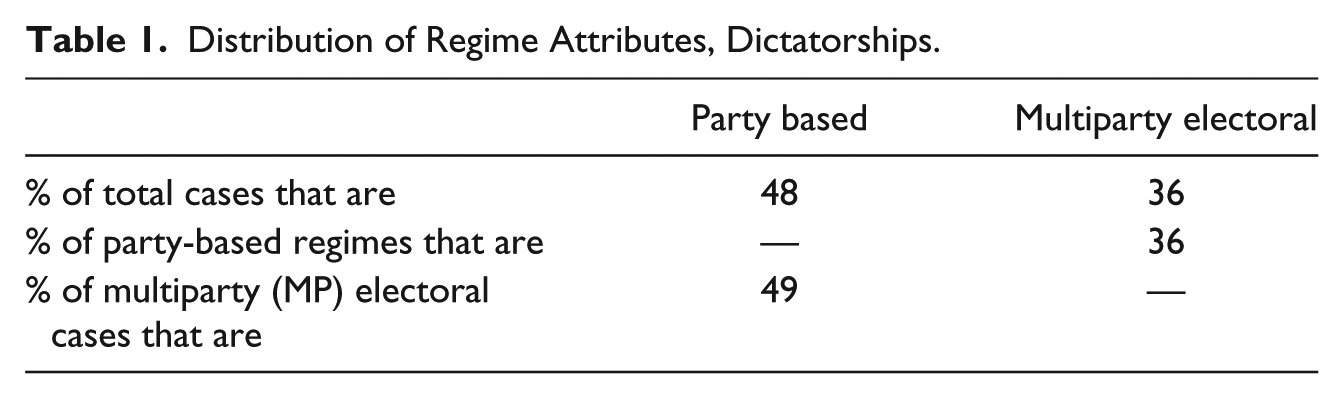
Table 1 summarizes the frequency of party-based and multiparty electoral regimes in the data. Forty-eight percent of autocratic country-years are party-based regimes, and of these, 36% hold multiparty elections. Of the regimes that hold multiparty elections, roughly half (49%) are party based.
Distribution of Regime Attributes, Dictatorships.
How do these institutional attributes correlate with women’s rights? Figure 1 displays average levels over time of women’s rights (sum of the CIRI political and economic rights) in party-based and nonparty-based authoritarian regimes. 22 The graph reveals a distinct and lasting difference between party-based and nonparty-based regimes, with the former scoring consistently higher. Among party-based regimes, there is no noticeable divergence between single-party regimes and those that allow multiparty elections. This initial evidence is consistent with our claim that multipartyism is not necessarily associated with improvements in women’s status.
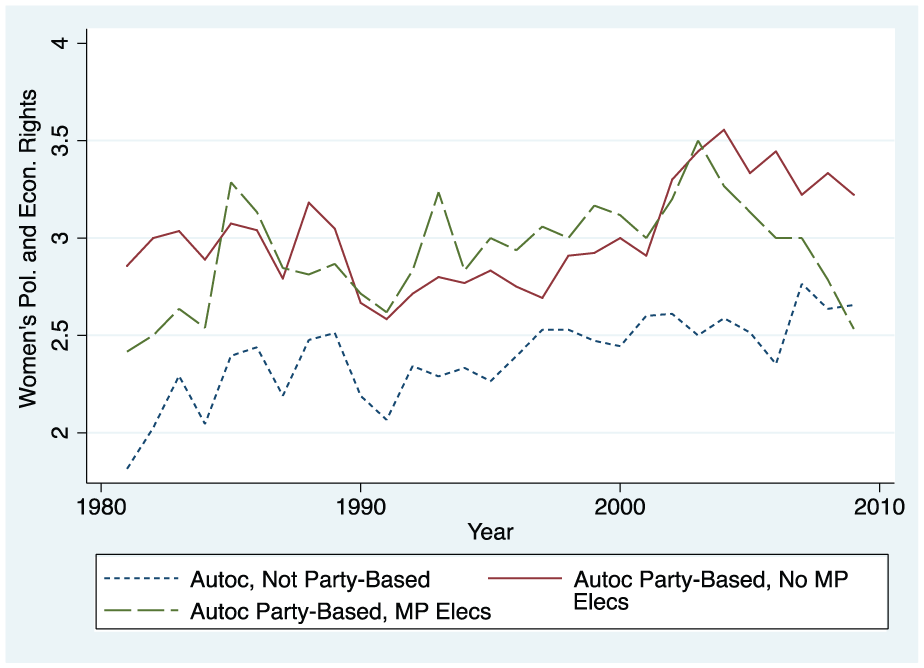
Women’s rights in party-based and nonparty-based dictatorships.
For our analyses of the CIRI dependent variables, we present ordered probit models (coverage: 1981-2009), and for our analyses of legislative representation and labor force participation, which are continuous variables, we estimate ordinary least squares (OLS) models (coverage: 1963-2009). All models include year fixed effects to account for system-wide temporal changes or shocks, such as the end of the Cold War. We opt for country random effects due to a relatively small number of countries that experience a change in status as a party-based regime during the years of coverage for the CIRI data. Nonetheless, our results are robust to alternative model specifications with country fixed effects (Online Appendices 5-6).
All models also control for the presence of a legislature (Cheibub, Gandhi, & Vreeland, 2010), which has been shown to be associated with policy outcomes in dictatorships. This dichotomous variable codes for the presence of any legislature (nonelected legislatures make up only 5% of the sample). We include six additional control variables, which previous research finds to be predictors of women’s status: GDP per capita; whether the country is presently experiencing a civil conflict; oil and gas production; the rate of GDP growth; foreign aid (as a % of GDP); and whether the country has ratified the CEDAW (Convention on the Elimination of All Forms of Discrimination Against Women) convention. 23 We also include regional controls to account for different average levels of women’s rights across regions, including persistently lower levels in the Middle East/North Africa, which scholars have attributed to oil wealth (Ross, 2008), conservative social norms, and to the fusion of political and religious authority (Htun & Weldon, 2010).
Findings
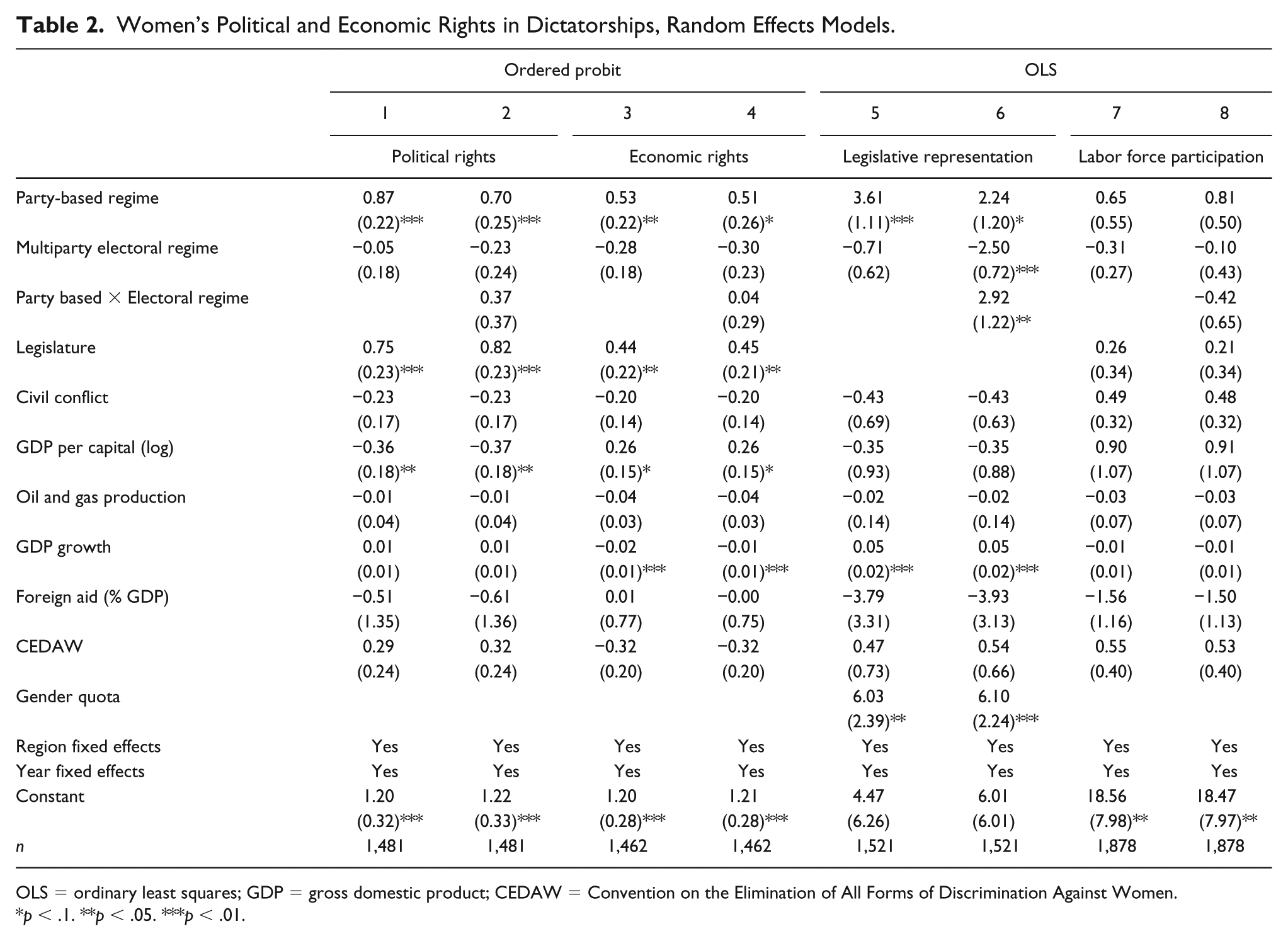
Table 2 presents our core results. Each model includes the measures of party-based regime and multiparty electoral regime. We also present models that interact these two variables, to assess whether elections exhibit a different association with women’s rights in party-based versus nonparty-based regimes. Mindful of those who caution against naively attributing causal effects to authoritarian institutions (cf. Pepinsky, 2014), we note that these models reveal associations but do not assess causality.
Women’s Political and Economic Rights in Dictatorships, Random Effects Models.
OLS = ordinary least squares; GDP = gross domestic product; CEDAW = Convention on the Elimination of All Forms of Discrimination Against Women.
p < .1. **p < .05. ***p < .01.
In support of our hypothesis, party-based regimes exhibit significantly higher political rights, economic rights, and legislative representation for women. Party-based regimes that do not hold multiparty elections (the constituent term in Model 8) are also associated with marginally higher female labor force participation (p = .10), perhaps reflecting the experience of politically closed communist regimes. In contrast, regimes that hold multiparty elections exhibit no apparent differences on women’s rights from those that do not. The sole finding of note in this regard is that the introduction of multiparty elections in party-based regimes is associated with higher women’s legislative representation. Our exploration of Tanzania’s experience with gender quotas in the multiparty era sheds light on the processes that may underpin these findings.
In sum, our evidence points to the positive association between authoritarian parties and women’s rights, whereas the relationship between authoritarian elections and women’s rights is either not significant or contingent on the presence of an institutionalized ruling party. It bears emphasizing that autocracies in which liberalization was followed by democratization fall out of our sample once they transition to democracy. Our conclusions about multiparty electoral competition are thus limited to electoral authoritarian regimes that either remain authoritarian or experience a delay in democratization after the introduction of multiparty elections. This is nevertheless a sizable—and durable—set of cases, as Levitsky and Way (2010) emphasize in their account of competitive authoritarianism.
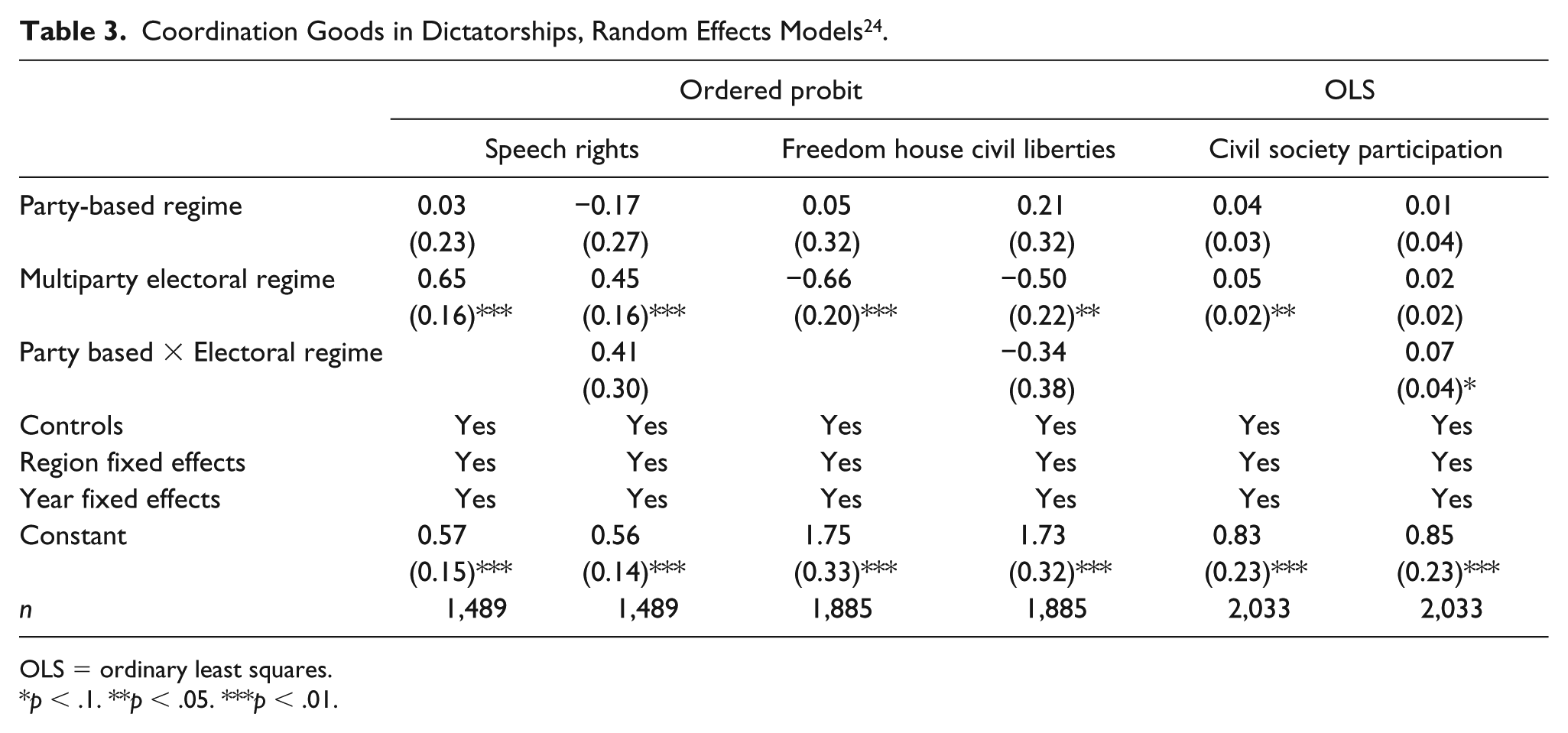
To further probe our argument about the capacity for party-based regimes to provide women’s rights in particular, Table 3 presents models predicting the provision of coordination goods in dictatorships. We employ three dependent variables: the CIRI index of speech rights (a 3-point scale); the Freedom House civil liberties index (a 7-point scale); and the V-Dem civil society participation index (a continuous measure). Note that for the Freedom House index, higher values represent worse performance.
Coordination Goods in Dictatorships, Random Effects Models 24 .
OLS = ordinary least squares.
p < .1. **p < .05. ***p < .01.
Strikingly, multiparty (authoritarian) elections are associated with better performance on all three “coordination” rights but party-based regimes are not. Thus, while party-based regimes exhibit significantly better performance on women’s rights, this is not the case for general speech, civil, and associational rights. 25 Women’s rights are a distinct policy area that do not rise and fall in lockstep with other baskets of rights. Our findings, therefore, support the idea that coordination goods are concessions made to the opposition in concert with—or as a result of—multiparty elections, whereas women’s rights are tools of preemptive cooptation that may be employed by closed and electoral authoritarian regimes alike.
Alternative Explanations and Robustness
We undertake additional tests to explore alternative explanations. 26 First, while our argument about party-based regimes focuses on party institutionalization, an alternative reason for the correlation between parties and women’s rights may be party ideology. Communist parties, for example, tend to be both highly institutionalized and espouse gender equality as a fundamental goal. We rerun our Table 2 models including Cheibub et al.’s (2010) coding of communist regimes (Online Appendix 7). We find that while communist dictatorships are associated with (even) higher political rights and legislative representation, the coefficients for party-based regimes remain positive and significant in all models. In short, institutionalization matters independent of ideology: even right-wing or nonpartisan autocratic parties—such as Singapore’s PAP, Indonesia’s Golkar, or Mexico’s PRI—are associated with higher women’s rights and representation.
Second, another reason why party-based dictatorships may be better for women stems from their higher levels of political stability: that such regimes enjoy longer life spans, fewer coups, and less violence may create important indirect benefits for women. Yet, in models where we included a variable for the regime’s age, our results are unchanged (Online Appendix 8).
Third, we consider possible endogeneity in our models. Dictatorships choose to liberalize and to hold elections when they are under pressure; thus the conditions under which elections emerge may be correlated with other (potentially unobserved) factors related with either the repression or expansion of rights. We note that this is less obviously a concern for women’s rights than for other types of civil rights that are related to liberalization. Nevertheless, we employ Miller’s (2015) approach for instrumenting for electoral authoritarian regimes, and we find our core result unchanged: multiparty elections are not associated with higher women’s rights. 27
Fourth, regimes exit our sample if they democratize, raising potential questions as to whether our finding of no association between multiparty elections and women’s rights may be explained by sample selection bias. As one step to explore this issue, we rerun our analyses splitting our sample between countries that (a) never democratized and (b) eventually democratized. We find no change in our results. Even in regimes where elections were eventually meaningful enough to bring about democratization, such elections, while held under the autocratic regime, are not associated with higher women’s rights.
Fifth, there are some differences across data sets in the classification of autocratic regime types. We first explore whether our results are robust if we define our sample using an alternative coding of autocracy by Magaloni, Chu, and Min (MCM; 2013), and we find that they are (Online Appendix 9). Next, we explore whether our results are robust to alternate codings of party-based regimes. We run tests in which we exclude from our coding of party-based regimes those country-years that are coded as military regimes by MCM. With the exception of a slight decline in significance for the economic rights models, our results are robust. We next employ the MCM coding of single-party regimes to probe whether our findings for party-based regimes are driven by these cases. Including an additional variable for single-party regimes does not reduce the significance of our original measure of party-based regime.
Finally, we find that our results are robust to the inclusion of additional control variables (Online Appendix 8): Cole’s (2013) count of international women’s NGOs with membership in the country, to control for civil society pressure; a dummy variable for whether the country ever experienced a civil war in its history, which research has shown often creates an upswing in women’s political activism and representation (Hughes & Tripp, 2015); a measure of the country’s fertility rate, to control for social norms related to women’s equality and empowerment; and a measure of ethnic fractionalization (Fearon, 2003), as public goods—potentially including women’s rights—tend to be underprovided in systems with fractionalized and politicized ethnicity (Arriola & Johnson, 2014).
Ruling Parties and Women’s Rights in Uganda, Tanzania, and Kenya
The preceding analyses uncovered a positive association between authoritarian parties and women’s economic and political rights. In the following case studies, we shed a light on hypothesized causal processes, we further evaluate alternative explanations, and we elucidate some scope conditions of our theory. For all three countries, we focus on an uninterrupted authoritarian spell: Uganda under the NRM (1986-present); Tanzania under TANU/CCM (Tanganyika African National Union/Chama Cha Mapinduzi; 1962-present); and Kenya under KANU (1963-2002). All three experienced some liberalization, that is, a transition to multipartyism, during these periods, allowing us to explore whether this was accompanied by a change in the regime’s approach toward women’s rights.
Uganda, Tanzania, and Kenya are neighboring East African countries and former British colonies, yet they differ on core elements of our independent variable: the institutionalization of the ruling party and the nature of its support base. Whereas Tanzania boasts a dominant party that prioritizes and strategically exploits mass support, and Uganda has a more personalized party system with similar characteristics, the regime in Kenya was more personalistic and elite-based. In Uganda and Tanzania, party structures and close ties to women’s organizations have facilitated processes of cooptation, while also opening up channels for women activists to exert some (controlled) influence on policy. These interactive processes of cooptation and cooperation have allowed the NRM in Uganda and the CCM in Tanzania to market themselves as the guarantors of women’s rights and have helped ensure their electoral dominance even after transitions to multipartyism. In authoritarian Kenya, by contrast, KANU was weaker and less institutionalized, and women never emerged as an important constituency. Figure 2 illustrates this divergence in regimes’ prioritization of women’s rights in terms of one outcome of interest: women’s legislative representation.

Female legislative representation in Uganda, Tanzania, and Kenya.
The countries also exhibit variation on other factors important for women’s rights, allowing us to evaluate alternative explanations. First, the potential of civil war to yield positive outcomes for women’s social, economic, and political participation (Buvinic, Gupta, Casabonne, & Verwimp, 2013; Tripp, 2015) justifies a comparison of Uganda (civil war from 1979 to 1986) and Tanzania (no war). Second, the countries differ in the autonomy of their women’s movements, with Tanzania exhibiting historically tighter control over women’s organizations than Uganda and Kenya. Third, ethnicity is heavily politicized in Kenya, whereas the regimes in Uganda and Tanzania have sought to actively depoliticize ethnicity and cultivate broad-based support.
Jointly, our case studies suggest that institutionalized ruling parties that have cultivated mass-based, nonethnic platforms rely to a greater extent on women’s support and have done more to prioritize women’s issues (Uganda, Tanzania)—regardless of other developments such as the legacies of civil war and a more autonomous women’s movement. When the ruling party instead relies on a smaller elite for support and when ethnic contestation is more pronounced (Kenya), women’s rights are less likely to become a government priority.
Uganda
Uganda has a highly institutionalized political system whose central force is the NRM under the strong leadership of Yoweri Museveni. The NRM first came to power in 1986, emerging victorious from a 6-year civil war. It established an inclusive, mass-based “no-party system,” as its leaders blamed sectarian divisions for the outbreak of the civil war: Individuals running for office were not allowed to do so as members of a party but instead joined the “non-party” NRM-led government if elected (Goetz, 1998, p. 244). In pursuing a broad support base, the NRM extended its societal reach across five levels of government, thus making Uganda a de facto one-party state from 1986 until its 2006 transition to multipartyism (Muriaas & Wang, 2012, pp. 318-330; Tripp, 2001, p. 103). Nonetheless, this system is more firmly centered around and guided by Museveni as leader than is the party system in Tanzania. This is why Uganda is best described as a personalized party system, that is, a personalist-party hybrid system.
The NRM has always attempted to bring many different constituencies into its support base, women prominent among them. As one of the first countries in Africa (and globally), Uganda instituted in 1989 a quota system for underrepresented and minority groups: women, youth, and people with disabilities (Muriaas & Wang, 2012, p. 310). The gender quota has significantly boosted women’s descriptive representation over the last three decades (Goetz, 1998; Muriaas & Wang, 2012), while the NRM has demonstrated its commitment to gender equality also in other ways. Museveni has, for example, appointed women to high-ranking political positions (Goetz, 2002, pp. 555-556), and Uganda has one of the most gender-equal constitutions in the world, in whose design women were centrally involved (Hanssen, 2006, pp. 3-4; Tripp, 2001).
Museveni’s personal support for gender equality has been an important driver of NRM policy; his commitment is attributed both to normative and—as per our theoretical expectations—instrumental concerns about sustaining popular support (Goetz, 1998). In the wake of the civil war, the confluence of state weakness and women’s extensive civil society mobilization made it prudent for the NRM to respond to the concerns of the women’s movement (Tripp, 1994, 2001). In this way, the NRM has cultivated women as an important constituency: the party repeatedly plays the gender equality commitment card to ensure its hold on power and actively coopt women (Hanssen, 2006, pp. 6-7; Muriaas & Wang, 2012; Tripp, 2001).
The quota system has proved an especially effective cooptation tool: it was implemented with the goal of broadening the support base of the NRM and extending its reach into society (Muriaas & Wang, 2012, pp. 318-322), while it has also diminished the ability of elected women to advocate independent policy positions. A crucial factor here is the “add-on” (Goetz, 2002, p. 558) character of the quota system, that is, the filling of the women’s seats in separate elections. Although this has increased women’s legislative representation, it has undermined the status of women legislators by creating uncertainty over whether “quota” representatives should represent women only or their entire district, and it has burdened women seeking to contest the open seats with additional structural and financial obstacles (Goetz, 2002, pp. 557-559; Women’s Democracy Group, 2013, pp. 8-16; 34-37). Although we cannot determine to what extent limiting the autonomy of women legislators was an intentional goal of the quota design, it is clear that the gender quota has raised the profile of the NRM as the guarantor of gender quality while allowing it to maintain control over the policy agenda.
These patterns of top-down cooptation have continued into the multiparty era. A tightly controlled transition to multipartyism in 2006 has ensured the NRM’s continued legislative and executive dominance (Makara, Rakner, & Svåsand, 2009). Patterns of patronage, strategic redistricting, and public NRM discourse have tied women running for and elected to the women’s seats strongly to the NRM, while the new notion of party discipline has further restricted women representatives’ ability to independently advocate for women’s issues (Muriaas & Wang, 2012). As yet another indication of cooptation, Muriaas and Wang (2012, pp. 332-333) attribute notable legislative gains for women between 2006 and 2011 to the NRM’s (and Museveni’s) efforts to ensure the continued support of women voters.
Besides such regime-directed cooptation, existing accounts suggest two other sources of Uganda’s comparatively gender-sensitive policy landscape. First, the active participation of women in the armed conflict transformed gender roles among the population and the NRM leadership (Tripp, 1994). As a result, women’s groups were able to actively and successfully lobby Museveni and the NRM during Uganda’s postwar transition, and thus made important inroads in political influence with the NRM (Tripp, 2001). The vibrant women’s movement in Uganda is, second, unusually autonomous compared with neighboring countries (Tripp, 2001). Although these developments were undoubtedly important in Uganda, a different societal configuration led to a similar outcome in Tanzania. Absent a history of civil war or an autonomous women’s movement, a strong, broad-based (and less personalist) ruling party has successfully engaged in active cooptation of women, as emphasized by our theory.
Tanzania
Tanzania’s institutionalized party regime generally parallels that of Uganda in its nature and its consequences for women. Until its transition to multipartyism in 1992, Tanzania had a one-party system characterized by (a) a high degree of institutionalization within the TANU, later rechristened CCM, (b) active measures to enhance women’s political representation, and (c) a nation-building project intended to supersede ethnic divisions (Tenga & Peter, 1996). Even once opposition parties were allowed, they had to be nationally inclusive in character and disavow any ethnic or religious affiliation (Kaiser, 1996, p. 234). As in Uganda, the transition to multipartyism was tightly controlled by the ruling party (Tenga & Peter, 1996, p. 160). Paralleling Museveni’s personal commitment to gender equality, Julius Nyerere sought to elevate the position of women in society and politics as a means toward advancing the socialist nation-building project (Tenga & Peter, 1996, p. 147). Nyerere has had a less prominent and powerful position within his party and regime, however, and Tanzania is more truly a party-based system.
Unlike in Uganda, a history of civil war and the accompanying radical transformation of gender roles were absent in Tanzania. Women’s mobilization was more subdued and centrally orchestrated. In contrast to the long tradition of political activism of the Ugandan women’s movement, women in Tanzania initially mobilized around economic issues, in self-help and income-generating groups, in response to a major economic crisis and state decline in the 1970s (Tripp, 1994, 2000). From the 1960s until the 1980s, the regime strongly restricted civil society organizations; the majority of women’s groups came to be organized under the central organization Umoja wa Wanawake wa Tanzania (UWT), the women’s wing of the ruling party (Tripp, 1994, p. 114): Clearly, the UWT was not in any way an independent organisation of women, for and by women. It was for all intents and purposes a branch of the ruling party through which the Government sent its policies to women, and through them to the rest of the population, particularly in the rural areas. (Tenga & Peter, 1996, p. 150)
We thus observe a pattern of cooptation whereby women were brought into the system as an important constituency and support base. Women were, however, primarily passive recipients of policy and a mouthpiece for the ruling party, with their ability to independently affect government policy more limited than in Uganda. This arrangement proved difficult to dismantle even following liberalization in 1992, when independent women’s organizations were allowed (Tripp, 2000). Newly formed opposition parties were quick to establish women’s wings of their own, and a new autonomous umbrella women’s organization (Bawata) formed in 1995 (Tenga & Peter, 1996). Yet, the CCM continued to enjoy an uneven playing field with respect to mobilizing women.
In the run-up to the first multiparty elections in 1995, for example, pressure from the government forced Bawata to curb its political activism (Tenga & Peter, 1996, p. 162). Several women’s organizations were deregistered or otherwise hindered in their work for allegedly being “too political” after they pressured the state on issues including inheritance, reproductive and land rights, and domestic violence (Tripp, 2000, p. 200). The government continued to interfere with civil society activity in an attempt to reduce competition with the UWT (Tripp, 2000, p. 205). All the while, the government has introduced important pieces of legislation during the multiparty era, including a law tightening penalties for sexual violence and FGM (1998), as well as the Land Act (2004), which strengthens women’s rights to use, transfer, and own land. These developments illustrate simultaneously the continued dominance of the CCM, including on gender equality issues, and growing societal challenges to the CCM’s status as the sole guarantor of women’s rights.
Finally, the CCM succeeded, like the NRM, in designing a gender quota system 28 that facilitated its cooptation of women. Of all the parties in the Tanzanian parliament in 2010-2015, only the CCM was able to advance both electoral and gender equality concerns through the gender quota system, aided by its resource advantage and high levels of control across all levels of government. For opposition parties, concerns for mere electoral survival took priority, undermining their ability to enhance the influence of women in their parties and prioritize women’s issues (Bjarnegård & Zetterberg, 2016). In conclusion, TANU/CCM has successfully used a combination of gender equality policies and institutional tools (especially women’s wings and gender quotas) to bind women to the regime.
Kenya
Kenya lags behind its neighbors on metrics of women’s rights and political participation. Although customary law and social practices complicate the implementation of women’s rights also in Uganda and Tanzania, studies attest to Kenya’s exceptionally poor record in safeguarding women’s property and inheritance rights (especially in rural areas), which has had devastating consequences for women’s HIV infection, poverty rates, health outcomes, and overall well-being (Dworkin et al., 2012; Kimani & Maina, 2010; Muchomba, Wang, & Agosta, 2014; J. Walsh, 2005). During the authoritarian period under study, the problem was not just weak implementation, but also a flawed legal framework, which failed to challenge deference to customary and religious law (J. Walsh, 2005, pp. 153-154).
Here, we focus on two factors that help explain the disparate outcomes on women’s rights in Kenya compared with Uganda and Tanzania: the relatively weak and elite-based nature of the ruling party, and the politicization of ethnicity. Although GWF also classify Kenya as a party-based system, we leverage here its theoretically important lack of institutionalization and societal reach. As Opalo (2015, p. 159) describes, the Kenyan African National Union (KANU) emerged as “a confederation of district parties” and as such lacked strong central organization. Kenya’s first president, Jomo Kenyatta, was known as “a staunch Kikuyu traditionalist” and thus lacked the leverage of Museveni or Nyerere to develop a strong, united party (Opalo, 2015, p. 160). Instead of forging party loyalty, Kenyatta ruled primarily through the provincial administration (PA), whose officials were accountable only to him and “routinely overruled legislators and cabinet ministers” (Opalo, 2015, p. 149). The result was a ruling party that was weakly institutionalized, elite- rather than mass-based, ethnically fractionalized and unable to enforce party discipline within the legislature.
The women’s movement was similarly weak and lacking robust links to society: the national umbrella organization Maendeleo ya Wanawake (MYWO, which in 1990 became KANU’s women’s wing) was founded in the 1950s by colonial women, subsequently morphed into a self-help organization and then declined in significance by the mid-1970s as a gulf emerged between the organizations’ dwindling rural base and the urban elite leadership, which had close (often family) ties to the regime and embraced philanthropic activities rather than seeking societal transformation to improve the lives of women (Wipper, 1975). This detached MYWO leadership stood in the way of KANU’s cooptation of women, who were at any rate not an important constituency for the elite-based party.
After succeeding Kenyatta as president in 1978, Moi attempted to transform KANU into a more unified and mass-based party (Widner, 1993, pp. 130-161). Moi turned Kenya into an official one-party state, expanded active recruitment of citizens into KANU, and sought to extend social control through youth wings acting as “vigilante organizations” (Widner, 1993, p. 153). The legacy of weak institutionalization and internal fractionalization ultimately foiled these efforts, however: although Moi succeeded in subsuming the PA within an improved KANU organizational structure, this also had the effect of increasing ethnic contestation (Opalo, 2015). In this context, women continued to elude KANU’s attention as a constituency. Even after the transition to multipartyism, women activists were unsuccessful in their push for gender-sensitive legislation, including the introduction of legislative party quotas and more gender-sensitive party funding (Tripp, 2016).
The politicization of ethnicity is a crucial factor distinguishing Uganda and Tanzania from Kenya, where political contestation occurs along ethnic lines and violent clashes between groups have been common (Ajulu, 2002; Holmquist & wa Githinji, 2009). Arriola and Johnson (2014, p. 498) demonstrate the consequences for women’s representation, noting that in Kenya, “the competition over the distribution of state resources among five to eight ethnic groups that expect cabinet-level representation” drove down the representation of women in the executive compared with neighboring Tanzania. Women are particularly disadvantaged in ethnically polarized environments because they “generally lack the social status and personal resources to become ethnic patrons” (Arriola & Johnson, 2014, p. 496). Moreover, the constitutionally recognized authority of customary law, which severely undermined women’s rights, probably also originated from the desire to accommodate different ethnic and religious groups.
Conclusion
This study represents the first step in a larger research agenda connecting women’s empowerment with the policy consequences of authoritarian institutions. 29 Thus, it answers the call for new research into the comparative politics of gender that extends beyond established democracies (Htun & Weldon, 2010), and it moves beyond cultural and religious traditions as influences on women’s rights. We join a growing body of research pointing to the policy advantages of autocracies that rely on stabilizing institutions such as parties and legislatures. Although this literature has tended to focus on the effects of institutions on elites and the opposition, our account instead highlights their role in societal coalition-building, and it demonstrates the importance of theorizing women’s rights as a distinct issue area governed by a different set of incentives than other types of civil or political rights. In short, we show that dictatorships organized around an institutionalized ruling party have greater capacity to advance women’s rights, and to translate this to effective cooptation.
We also show that autocratic performance on women’s rights is generally not enhanced by the holding of multiparty elections. As countries around the world continue to be coerced and cajoled into introducing elections, questions about their assumed societal benefits—and whether they may sometimes even be detrimental for peace, prosperity, and growth—are mounting (Flores & Nooruddin, 2016). We find that among authoritarian regimes, the relationship between political opening and women’s rights is far from straightforward. Although allowing multiple parties implies greater tolerance for associational activity, we should not necessarily expect gender-related policy change, given that women’s movements in autocracies are usually affiliated with or controlled by the government, and the top-down incentives for advancing women’s rights hold even in closed, uncompetitive contexts. Moreover, our case studies suggest that in countries where ethnicity is fragmented and politicized, multiparty competition may further crowd out a prioritization of women’s rights and representation.
Here, we have uncovered a set of “high-altitude” empirical associations between authoritarian parties, elections, and women’s rights. Future research will examine with greater precision why—and how—some regimes have actively sought to bring women into their coalition of supporters. Questions about the interfering role of ethnic politics, in particular, deserve more systematic treatment than space allows here. Future research will also zero in on the puzzling fact that some authoritarian regimes are adopting gender-equality laws and policies with greater fervor than many democracies. This points to the role of international norms, which when linked with external pressure and rewards, create incentives for regimes to make progress on women’s rights to signal their good standing. For dictatorships, in particular, women’s rights are an area in which governments can conform to international pressure without posing a direct threat to their grip on power.
Supplemental Material
CPS_appendix – Supplemental material for Authoritarian Institutions and Women’s Rights
Supplemental material, CPS_appendix for Authoritarian Institutions and Women’s Rights by Daniela Donno and Anne-Kathrin Kreft in Comparative Political Studies
Supplemental Material
Donno_Kreft_CPS_replication_data.dta – Supplemental material for Authoritarian Institutions and Women’s Rights
Supplemental material, Donno_Kreft_CPS_replication_data.dta for Authoritarian Institutions and Women’s Rights by Daniela Donno and Anne-Kathrin Kreft in Comparative Political Studies
Supplemental Material
Donno_Kreft_CPS_replication_do – Supplemental material for Authoritarian Institutions and Women’s Rights
Supplemental material, Donno_Kreft_CPS_replication_do for Authoritarian Institutions and Women’s Rights by Daniela Donno and Anne-Kathrin Kreft in Comparative Political Studies
Footnotes
Acknowledgements
For excellent comments on earlier drafts, we thank Mattias Agerberg, Noga Ardon, Amanda Clayton, Iza Ding, Dimitar Gueorguiev, Melanie Hughes, Alice Kang, Ken Opalo, Camilla Reuterswaerd, Helena Stensöta, and Aili Tripp; as well as participants at the University of Gothenburg Gender Workshop, Georgetown University GUITARS seminar, the University of Wisconsin International Relations Colloquium, SPSA Workshop on the Politics of Authoritarian Regimes, and the University of Pittsburgh Global Politics Seminar. We thank Omer Zarpli and Madison O’Brien for research assistance.
Declaration of Conflicting Interests
The authors declared no potential conflicts of interest with respect to the research, authorship, and/or publication of this article.
Funding
The authors received no financial support for the research, authorship, and/or publication of this article.

Notes
Author Biographies
References
Supplementary Material
Please find the following supplemental material available below.
For Open Access articles published under a Creative Commons License, all supplemental material carries the same license as the article it is associated with.
For non-Open Access articles published, all supplemental material carries a non-exclusive license, and permission requests for re-use of supplemental material or any part of supplemental material shall be sent directly to the copyright owner as specified in the copyright notice associated with the article.
