




Abstract
Are better educated individuals more likely to engage in anti-regime resistance and why? Scholars of democratic politics widely view education as a key factor shaping political participation. Yet, the effect of education on participation in noninstitutionalized political conflict is less well understood. Using data from an original large-scale survey of participants and nonparticipants in Palestinian resistance, this article demonstrates that education has a complex, curvilinear effect on participation: intermediate levels of education significantly increase the likelihood of participation in protest but additional years of education do not. These findings are explained through a novel, institutionalist argument, which focuses on the structure of education rather than its content. The article’s conclusions challenge existing perspectives that characterize participants in political conflict as either educated, underemployed, and disaffected or poor, uneducated, and marginalized.
In 2011, Mohamed Bouazizi set himself on fire, sparking a revolution in his native Tunisia and across the Arab world. After his self-immolation, Bouazizi was repeatedly misidentified in the press as a university graduate turned street vendor—a living emblem of the economic problems and frustrations facing Tunisia’s educated youth. This rumor about Bouazizi—who, in fact, never completed high school—reflects a conventional wisdom about participants in unarmed resistance: They are highly educated, under- or unemployed, and disaffected. 1
Are more educated individuals more likely to engage in anti-regime resistance and, if so, why? Scholars of political behavior almost universally view education as one of the most important factors shaping individual participation in democratic politics, such as voting, signing a petition, or contacting an elected representative. In contrast, the effect of education on participation in noninstitutionalized political conflict is less well understood. Existing perspectives tend to depict the typical participant in anti-regime resistance as either educated, underemployed, and aggrieved or poor, uneducated, and marginalized. However, there is relatively little micro-level, empirical research that examines whether and how education may shape individual decisions to participate in such resistance.
This article examines whether and how education affects participation in anti-regime resistance, by which I mean risky, unarmed collective action targeted against a repressive regime, such as demonstrations, marches, sit-ins, and strikes. Specifically, it examines the role of education in motivating participation in a theoretically and practically important case of unarmed resistance: the first Palestinian intifada and the decade of growing protest preceding it. 2 Understanding which individuals participate in unarmed resistance and why they do so is key to understanding when such resistance will occur and succeed. 3 This is all the more important in the case of the Israeli–Palestinian conflict, one of the world’s longest, ongoing civil conflicts.
Contrary to existing perspectives that paint participants in anti-regime resistance as either highly educated and aggrieved or uneducated and marginalized, this article argues that education has a complex, curvilinear effect on participation in anti-regime resistance. Drawing on an original large-scale survey of participants and nonparticipants in Palestinian resistance, the article shows that moderately educated individuals with at least 9 years of schooling—slightly over half of the sample—are significantly more likely to participate in anti-regime resistance than less educated individuals of the same age and generation. However, additional years of schooling over and above this intermediate level of education do not further increase their prospects of participation. These results are robust to including a variety of control variables, as well as for accounting for possible reverse causality.
Existing theories emphasizing the nationalist or political content of education cannot well explain these findings: for nearly all of its history, the Palestinian educational system was under foreign control. 4 To explain this puzzle, this article develops an institutionalist argument that focuses on the structure of education rather than its content. Its main argument is that, among groups with high anti-regime sentiment and low, internal organizational strength, education makes individuals more likely to participate in anti-regime resistance. 5 Under these conditions, integration into educational institutions provides students with informational and organizational advantages for collective action that are not generally available to nonstudents. As a result, students are more likely to begin participating in anti-regime resistance than their nonstudent peers. These early forays into protest forge habits of participation that persist even after individuals complete their schooling, producing a curvilinear relationship. Consistent with this institutionalist mechanism and contrary to the main alternatives, the article also shows that education makes individuals more likely to participate in more risky and more collective forms of protest.
These arguments are supported by diverse evidence collected over 12 months of field research in the Palestinian Territories. The centerpiece of this field research is an original, large-scale survey of former participants and nonparticipants in the first Palestinian intifada and the decade of growing anti-regime resistance preceding it. This survey is the first, large-scale study of participation in Palestinian resistance of which I know and one of only a few systematic studies of participation in anti-regime resistance conducted worldwide to date. 6 As such, it offers rare, fine-grained data on participation in unarmed resistance that are usually not available to scholars. This article complements these data with qualitative evidence, including in-depth interviews with Palestinian activists, teachers and students, and participants and nonparticipants.
This study makes three principal contributions. First, by focusing on the question of participation in unarmed resistance, this study adds important microfoundations to the growing political science literature on why nonviolent resistance occurs and succeeds. 7 One pivotal condition for success is wide participation: Broad-based participation allows movements to remain resilient in the face of repression, impose greater pressure on repressive regimes, and ultimately extract more meaningful concessions. 8 Yet, we know relatively little about when and why movements will be able to attract such participation. Due to the difficulties of gathering appropriate data, only a few systematic studies of participation in anti-regime resistance have been conducted to date and none focusing specifically on education. 9 A greater number of studies have explored the determinants of support for conflict and violence in Muslim societies. 10 However, because participation imposes costs and risks that support does not, the factors that drive attitudinal support for violence likely differ from those that drive actual participation in risky collective action.
Second, the study’s findings challenge conventional wisdom about who participates in anti-regime resistance. In contrast to prevailing perspectives on anti-regime protest, which point to the role of higher education in fostering dissent, it finds that high levels of education do not increase individuals’ propensity to protest. 11 Even among individuals with high levels of education and poor economic outcomes, who may experience “relative deprivation,” higher education does not uniformly increase the probability of protest. 12 However, in contrast to most existing research on armed resistance—which sees participants as disproportionately poor, uneducated, and marginalized—moderately educated individuals are more likely to resist than their less educated peers. 13 These findings suggest that the impact of education on participation in political conflict is likely to vary with the type of resistance and contextual factors, necessitating further comparative research.
Third, this article provides evidence for a new, institutional mechanism by which education can influence participation in unarmed resistance. Although there are relatively few systematic studies of participation in anti-regime resistance, relevant literature suggests that education exerts an effect primarily because of its nationalist or political content. 14 This article does not contradict these perspectives. Rather, it shows that, even when the educational system contains little or no overt nationalist or political content, education can still increase the likelihood of participation in unarmed resistance.
Finally, the article’s findings also have important implications for understanding the larger conditions under which anti-regime resistance will take place. In particular, they suggest that anti-regime resistance can occur even when groups lack the strong civil society organizations that many scholars regard as necessary for protest. 15 In the absence of these organizations, this article demonstrates that schools may instead function as sites of mobilization and resistance. Despite their control by the state, schools provide students with important advantages for collective action that make them more likely to protest, forging patterns of political participation that persist over time. Thus, although the increasing restrictions on global civil society likely have other adverse consequences, they may not dampen protest in the ways that scholars have traditionally theorized.
Education and Collective Action: An Institutional Explanation
Why do some individuals participate in risky, anti-regime resistance whereas other, similar individuals do not? Existing scholarship on the relationship between education and political participation offers three competing perspectives.
Scholars of democratic politics argue that education confers individuals with abilities and skills that promote participation in politics, such as political interest and awareness, civic skills, or a sense of civic duty. As a result, higher levels of education—particularly university education—cause individuals to participate more actively in democratic politics. 16 Recent studies have extended this argument to nondemocratic settings, pointing out that education may also endow individuals with the human resources for participation in these more difficult environments. 17 Together, these studies predict that participants in anti-regime resistance will be disproportionately drawn from the ranks of the highly educated. Although who exactly constitutes the highly educated may differ by context, these perspectives predict that secondary or higher levels of education will increase the chance that Palestinians participate in unarmed resistance. 18
Scholars of mass uprisings and revolutions also expect participants to be highly educated; however, they argue that higher education is not a sufficient condition for participation. Rather, it is the combination of higher education and poor economic circumstances that spurs protest against powerful regimes. Originating in relative deprivation theory, this perspective—arguably now the conventional wisdom—suggests that individuals rebel out of frustration due to the gap between their high expectations born of education and actual economic conditions. 19 This logic is often invoked to explain participation in anti-regime resistance in the Middle East. For example, Kepel observes that Islamist activists “are marginal in every sense of the word . . . contrary to their expectations, education (even higher education) fails to provide them with the keys to modernity.” 20 Similarly, many academic and popular accounts of the Arab uprisings locate their causes, in whole or part, in high rates of unemployment among educated young people. 21 Applied to Palestine, this perspective suggests that participants should be both highly educated and relatively poor when compared with nonparticipants.
Finally, a third influential perspective, which stems from the literature on armed conflict, suggests that participants in anti-regime resistance should be relatively uneducated. Since Marx, social scientists have linked participation in political conflict to low socioeconomic status. Although Marxist and neo-Marxist scholars have primarily focused on aspects of socioeconomic status like poverty and landlessness, 22 the logic of their arguments also applies to education. 23 Similarly, the logic of opportunity costs also suggests that less educated individuals should be more likely to participate in political conflict. 24 Two of the only representative studies of individual participation in political violence find support for this negative relationship. 25
In contrast to all three perspectives, this article finds that intermediate levels of education increase the propensity to participate in anti-regime resistance. Existing theories offer at least three possible explanations for this finding. First, education may instill a strong and lasting sense of national identity or grievance that motivates participation. 26 Second, education may give rise to grievances if unmatched by material or social advancement. 27 Finally, education may increase an individual’s political interest and knowledge, making him more likely to participate. 28
Departing from these perspectives, this article develops a novel, institutional argument linking education to participation in anti-regime resistance. My main argument is that, among groups with high anti-regime sentiment and low internal organizational strength, education makes individuals more likely to participate in anti-regime resistance. Under these conditions, integration into educational institutions provides students with informational and organizational advantages for collective action that are not generally available to nonstudents. As Figure 1 illustrates, this institutionalist mechanism can work in at least three interrelated ways.

How educational attainment leads to participation in anti-regime resistance.
First, integration into educational institutions facilitates communication and coordination. In societies in which assembly is restricted, schools gather hundreds or even thousands of like-minded youth in a single, geographical location. This “ecological concentration” allows for information to flow quickly and reduces organizational and transaction costs. 29 Thus, when a “trigger event” sparks protests—for example, a shooting by security forces—students are more likely to quickly hear about this event and the impending protests than their nonstudent peers. These institutional features of schools also make them an ideal target for “bloc recruitment” by activists. 30 As Lipset observed, “It is relatively easy to reach students; leaflets handed out at the campus gate will usually do the job.” 31 Thus, education can increase the likelihood of participation in anti-regime resistance through both bottom-up, student-led mobilization and top-down, activist-led recruitment. 32
Second, integration into educational institutions can also reduce uncertainty about the number of prospective protestors and lower the risks of protest participation. Influential models of revolution show that individuals will become more willing to participate in anti-regime protest as the number of protestors increases and the risks faced by any single protestor correspondingly decrease. 33 By gathering large numbers of youth in a single location, schools provide students with a relative degree of “safety in numbers.” As one in a large crowd, students face lower risks of identification and punishment than youth outside these institutions. 34 In addition, inside schools, large numbers of youth can legally gather, observe how many others are gathered, and assess their risks of participation—all before facing the state’s coercive apparatus. In contrast, outside schools, obtaining reliable information about the size of protests often involves greater risks.
Third and finally, integration into educational institutions can also join youth in wider and more diverse social networks, which provide them with access to scarce information about protest. According to influential network theories, new information and opportunities must come from “weak ties” from outside an individual’s immediate social networks. As a result, broader and more heterogeneous social networks tend to provide more novel information than more narrow and homogeneous networks. 35 In many developing countries, integration into educational institutions connects youth in such wider and more diverse social networks. For example, in the Palestinian Territories, most post-primary schools were located in large cities and towns, thus bringing urban students and rural students from outlying villages together. 36 Consequently, after the primary level, students are more likely to hear about anti-regime protests and the size and strength of the crowds gathered than similar youth outside schools. Thus, they are better able to participate in anti-regime resistance than their nonstudent peers. 37
To be sure, these institutional features are not unique to schools. For example, as I argue elsewhere, schools belong to a broader class of state-controlled, mass institutions that facilitate collective action. 38 Some workplaces, such as large factories, may also share these features. In the case of the Palestinian Territories, however, there were very few large factories that could serve as a basis for mobilization. 39 Furthermore, because schools gather youth together, they may be more conducive for participation in collective action than workplaces that gather people of different ages and propensities for participation. 40 Thus, youth who are integrated into educational institutions are more likely to begin participating in anti-regime resistance than working youth of the same age. 41
These initial forays into protest are likely to forge more lasting patterns of political participation, which persist even after youth leave the school environment. As mentioned above, integration into educational institutions links individuals in wider and more information-rich social networks, improving their access to political information and making them better able to protest. When individuals complete their schooling, these networks and relationships remain, providing a more lasting basis for political participation. In addition, participation in protest may also persist due to more general processes of socialization, emotional-psychological mechanisms, or other factors. Although individuals may initially participate through institutional channels, the act of participation can increase their ideological affinity with anti-regime movements, integrate them into participant social networks, and cause them to develop an identity as “activists.” 42 Participation in resistance can also engender pride and pleasure in asserting agency, motivating individuals to keep participating even as they face higher costs and risks. 43 Finally, participation in resistance may also persist by increasing individuals’ risk tolerance or lowering the costs of future participation. 44
Finally, patterns of participation forged in schools may be especially likely to endure. A large body of literature on political socialization identifies adolescence as the key period when political attitudes and behavior form. 45 During the “impressionable years” of adolescence, the social environment powerfully shapes youths’ basic attitudes, values, and worldviews. Once this early period of socialization is over, these core orientations become “sticky” and are unlikely to change. 46 Although there is some debate about exactly how stable these orientations are, there is considerable evidence that political attitudes and behavior persist across life stages. 47 These perspectives suggest that patterns of participation formed in school are especially likely to continue into adulthood.
Hypotheses
The preceding arguments suggest four testable hypotheses. The main hypothesis is that education should have a positive and curvilinear effect on the likelihood that individuals participate in anti-regime resistance (Hypothesis 1 [H1]). Specifically, individuals who attain intermediate levels of education should be more likely to participate in anti-regime resistance than their less educated peers. However, due to the persistence of participation, additional years of education over and above this intermediate level should not further increase their prospects of participation.
To illustrate why this is the case, consider how different levels of education affect the probability of participation in anti-regime resistance. At low levels of education (i.e., primary school), children are generally too young to participate in anti-regime resistance. Regardless of their education, their probability of participation is low. As youth enter adolescence, however, those who continue onto intermediate levels of education are integrated into an institutional environment—schools—that facilitates collective action. As a result, they are more likely to begin participating in anti-regime resistance than youth who do not continue their education and are not exposed to this institutional environment. Once youth begin participating, they are likely to be socialized into participation and continue protesting even after leaving the school environment. Thus, youth who continue onto still higher levels of education (i.e., secondary school or university) should not be significantly more likely to protest than youth who complete only intermediate levels of education. This produces a curvilinear relationship, with the probability of participation rising at intermediate levels of education and flattening with additional higher levels of education. In contrast, if participation did not persist, then the probability of participation should continue to rise with additional, higher levels of education rather than flattening in this manner. 48
Importantly, these arguments do not imply that highly educated individuals will not participate in anti-regime resistance. As observers of the Palestinian case know, university students were active participants in protest. Rather, this article argues that their participation is not due to university education but to earlier, preuniversity integration into mobilizing structures (i.e., schools). Similarly, Kam and Palmer have shown that, in the United States, university education does not affect political participation after accounting for preadult experiences and influences during high school. 49
In addition to this main hypothesis, these arguments suggest three testable implications of the institutionalist mechanism. First, in contrast to the main alternative mechanisms, they suggest that education should make individuals more likely to participate in some forms of resistance than others. In particular, education should be associated with both more risky and more collective forms of protest (Hypotheses 2 and 3 [H2 and H3]). Education should promote participation in more risky forms of protest because it lowers the relative risks of protest participation. In addition, education should also increase participation in more collective forms of protest or what Granovetter terms crowd collective action: that is, collective action in which members of a group are face-to-face, such as demonstrations and marches. 50 Unlike participants in individual acts of resistance, participants in crowd collective action face lower risks as the number of other participants increases. 51 For example, whereas a student who paints anti-regime graffiti must, ultimately, hold the brush alone, student demonstrators gain “power in numbers” as other students gather around them. Thus, the institutional mechanism implies, education should also make individuals more likely to participate in crowd collective action than in individual acts of resistance.
Finally, intermediate education should also be associated with larger and more diverse social networks (Hypothesis 4). As argued earlier, integration into intermediate-level educational institutions tends to connect youth in wider, more heterogeneous social networks, which provide students with greater access to information about protest and render them better able to participate than their nonstudent peers. Similarly, because schools’ advantages for collective action also make them attractive targets for activists, intermediate education may also bring youth into politicized, civic networks. 52 Thus, in addition to its impact on protest, intermediate education should also be associated with changes in an individual’s social networks.
Research Design
This article studies participation in the first Palestinian intifada and the decade of growing anti-regime resistance preceding it (1978-1989). Although often depicted as a rupture from the quiescent politics of the past, the uprising was less a sudden break from the past than an acceleration of already ongoing changes. In 1978, nearly a decade before the uprising began, organized demonstrations, strikes, and other forms of unarmed protest began to increase throughout the Palestinian Territories (see Figure 2). Over the next decade, these acts of protest grew in scale and scope, culminating in the first Palestinian intifada in 1987. Despite mounting Israeli repression, this uprising remained predominantly unarmed until 1989, after which more violent tactics came to the fore. Between 1978 and 1989, Palestinians thus had wide opportunity to participate in organized, unarmed resistance.
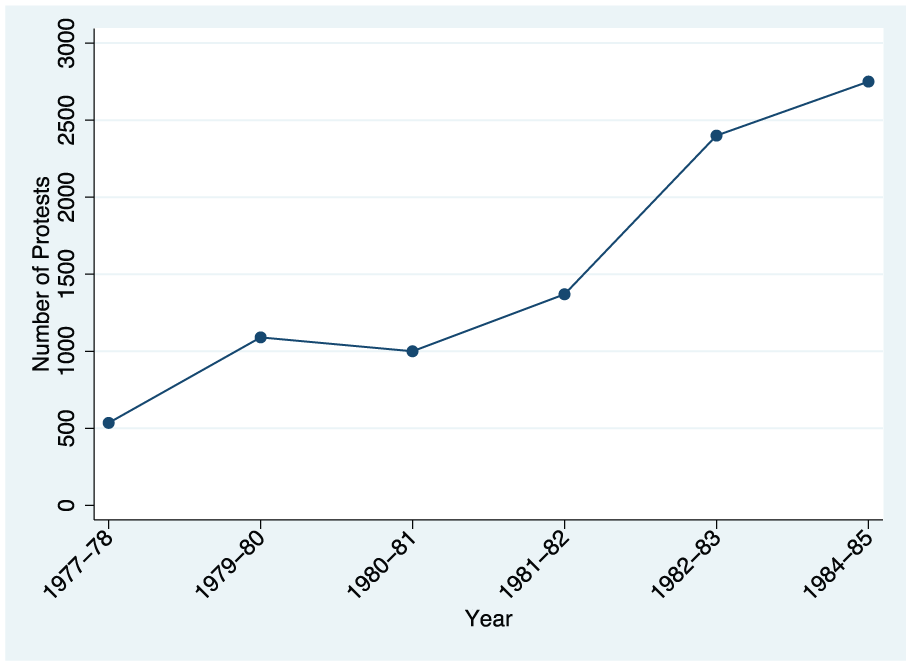
Unarmed protests in the Palestinian territories, 1977-1985.
At the same time, significant barriers to participation remained. While a growing sense of Palestinian nationalism deepened anti-regime grievances among Palestinians, participation in resistance involved substantial costs and risks: Protests were illegal, and those who violated the ban risked beating, arrest, or imprisonment. 53 Limited by media censorship and repression, information about anti-regime resistance was also scarce. Moreover, although Palestinians had high anti-regime sentiment, they initially lacked the internal organizational strength that is often seen as necessary for protest. 54 Facing such formidable obstacles, most Palestinians chose not to resist Israeli occupation. 55 By focusing on a case in which there were wide opportunities for protest over a sustained period but still relatively limited participation, this study identifies why, given similar opportunities, some individuals participate whereas others do not. 56
To explain why some Palestinians participated in anti-regime protest while other similar Palestinians did not, this article draws on an original survey of former participants and nonparticipants in the West Bank. The survey was conducted in 68 localities across the West Bank, including Palestinian cities, towns, villages, and refugee camps. To obtain a geographically and socioeconomically representative sample, randomization was used at every level of sample selection from the locality to the individual respondent. The resulting sample includes nearly 650 male Palestinian participants and nonparticipants in unarmed resistance. 57 As Section A.1 in the online appendix shows, this sample closely resembles the Palestinian population of the Occupied Territories in terms of its geography, household composition, and socioeconomic characteristics. 58 The response rate was 68%. 59
The survey consisted of a closed-ended questionnaire that was administered to respondents in person by a Palestinian enumerator. To protect respondents and reduce the possibility for social desirability bias, all questions regarding participation were self-administered by the respondent. Self-administration is the gold standard for collecting sensitive, individual-level data that cannot be collected using group-level methods like list experiments. 60 Using techniques developed by Scacco and described in the online appendix, 61 the survey was administered in such a way that the enumerator could not view any responses to sensitive questions or link them to other characteristics of the respondent.
Finally, the survey questionnaire used an innovative life history calendar (LHC) design to mitigate problems of accurate recall in retrospective surveys. In contrast to traditional survey questionnaires, LHCs employ a calendar-like questionnaire design that encourages respondents to retrieve autobiographical memories through multiple pathways (e.g., both thematically and chronologically), thereby increasing the chances that they will accurately remember them. 62 LHCs are used widely in sociology, public health, and other fields and, in a direct experimental comparison with standard surveys, they have been shown to yield more complete and accurate responses. 63 Unfortunately, conducting a similar experimental comparison on our data is not possible, as there are no comparable surveys conducted on a similar sample. However, most respondents did not find it particularly difficult to remember the information required by our survey, and excluding those who did yield similar results. 64 Finally, although LHCs may not eliminate all response error in retrospective surveys (see also below), these errors are expected to be randomly distributed rather than systematic. Thus, although they may make it more difficult to find statistically significant results, they should not unduly bias the analysis.
LHCs consist of a two-dimensional calendar or grid, which is divided into the time periods used in the study. In this study, the LHC collected data on each respondent over six, 2-year periods: 1978-1979, 1980-1981, 1982-1983, 1984-1985, 1986-1987, and 1988-1989. 65 As the online appendix describes, data on the independent variables were collected on the first (even) year of each period, and data on participation in anti-regime resistance were collected on the second (odd) year of each period. This approach allows for lagging the independent variables in the analysis without having to truncate the time period covered by the survey. The resulting data set thus contains six observations on 646 individuals for a total of 3,876 complete observations, with the unit of analysis being the individual-period.
Measuring Anti-Regime Resistance
This study’s main dependent variable is participation in anti-regime resistance, defined as regular participation in risky, unarmed collective action targeted against the ruling regime. In the Palestinian Territories during the period studied, such resistance included mass demonstrations, sit-ins, strikes, boycotts, and other acts of dissent. Resistance also drew on local, culturally encoded “repertoires of contention” such as illegal, cultural, and political seminars; organized prison visits; and mass funerals. 66 Although much of the resistance was nonviolent, youth also burned tires, threw stones, and clashed with Israeli soldiers. 67
Organized resistance was spearheaded by the Palestine Liberation Organization (PLO). 68 Following the Oslo Accords and the establishment of the Palestinian Authority, the PLO’s political-military factions became political parties and are today referred to accordingly.
Participation was thus coded based on the following survey question: In year [1979 . . .], did you support any political parties, where by support I mean regularly participating in party activities such as [illegal] cultural and political seminars, demonstrations, sit-ins, [mass] funerals or prison visits?
69
The response choices were “yes,” “no,” “I was participating in such activities, but they were not organized by a party,” and “I was participating in such activities but from all parties/not for any particular party.” Respondents were coded as participants if they chose “yes” or either of the two latter options.
Table 1 presents the distribution of participants and nonparticipants in the survey sample. Two hundred twenty-nine respondents—35% of the survey sample—reported participating in anti-regime resistance. Nearly 300 respondents, making up 46% of the sample, reported never participating in anti-regime resistance. Information on participation is missing for 19% of the sample, primarily due to failure to finish the entire survey. Section A.4 in the online appendix shows that the article’s core findings are robust to the presence of missing data on the dependent variable using bounding analysis.
Participants in Survey Sample.

Measuring Education
This study measures education as a series of three binary indicators corresponding to the structure of the Palestinian educational system. Preparatory indicates completion of preparatory school, which is equivalent to 9 years of schooling. Secondary indicates the completion of secondary school (12 years of schooling), and University indicates completing university or higher (16 years or more of schooling). 70 Primary school completion is the baseline category. Thus, the coefficient on Preparatory measures the effect of completing preparatory school compared with completing primary school or less. The coefficient on Secondary measures the additional effect of completing secondary school beyond that of completing preparatory school, and the coefficient on University measures the additional effect of university beyond secondary school. All three indicators were coded from an open-ended survey question asking respondents to report the number of years of education they had completed by each period. Table 2 presents descriptive statistics on education and other key variables. 71
Descriptive Statistics.
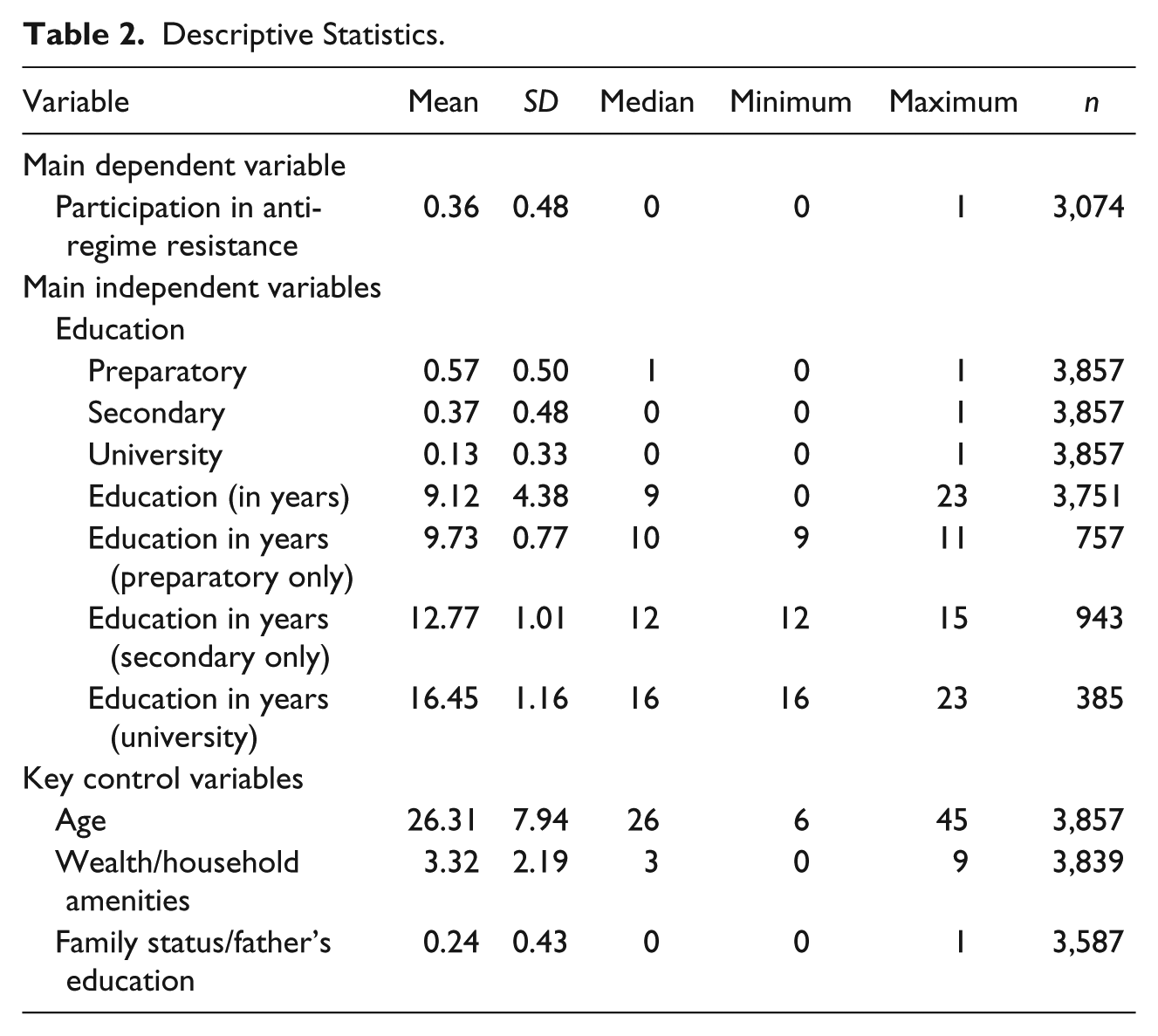
To model the hypothesized, curvilinear relationship between education and participation, all three education indicators are included in the model simultaneously. Including an indicator for each level of education completed allows for each level of schooling to have a distinct effect, producing a curvilinear relationship. However, unlike a polynomial model, this approach also allows for estimating the added effect of each subsequent level of education and, thus, identifying which level(s) of schooling account for the overall, curvilinear relationship between education and participation in resistance. All results are also robust to alternative ways of modeling this curvilinear relationship, including a polynomial model with a quadratic term for education and an alternative series of indicators measuring prior school attendance rather than completion (see Tables A.13 and A.14 in the online appendix). A binary indicator of student status and a continuous measure of years of education are also positive and significant. 72 Finally, a locally weighted (lowess) scatterplot also shows a curvilinear relationship, with education having the greatest effect between 7.5 and 10 years or roughly equivalent to preparatory schooling (see Figure A.4 in the online appendix).
Main Results
I estimate the effect of education on participation in anti-regime resistance using a multilevel logistic regression (logit) model with varying intercepts by locality. This model is identical to a logit model with locality-level random effects and similar to a logit model with locality fixed effects. Like locality-level random effects, including varying intercepts by locality accounts for variation in the participation rate across different localities and allows for better identification of the individual-level effects of interest in this study. The results of this analysis are also robust to including locality-level fixed effects, which compare only individuals within the same locality and thus rule out the possibility that the results are driven by rural/urban and/or other differences between localities (see Table A.12).
The baseline model is specified as follows. As described above, the dependent variable is a binary variable indicating participation in anti-regime resistance, and the main independent variables are three binary variables indicating completion of preparatory school, secondary school, and university or higher. In addition, the model controls for age, wealth, and family status. Wealth is measured as a binary variable indicating the number of “amenities” owned by the household (e.g., refrigerator, radio, etc.), which is a better measure than income in Palestine and many developing countries. Family status is measured as a binary variable indicating whether or not an individual’s father completed primary school, a relatively high level of education for this generation. Family background and parental education are among the most important determinants of educational attainment. 73 As these factors may also influence participation, I control for them in the analysis; however, the results are robust to excluding them (see Table A.18). 74 To minimize the possibility of reverse causality, all right-hand side variables are lagged by 1 year 75 ; additional robustness checks for reverse causality are reported in Section A.2 in the online appendix. Finally, the model controls for duration dependence stemming from the panel structure of the data by including three equally spaced cubic splines. 76 Table 3 and Figure 3 present the results.
Education and Participation in Anti-Regime Resistance.

Multilevel logit coefficients and standard errors reported. All models include cubic splines.
p < .10. **p < .05. ***p < .01.
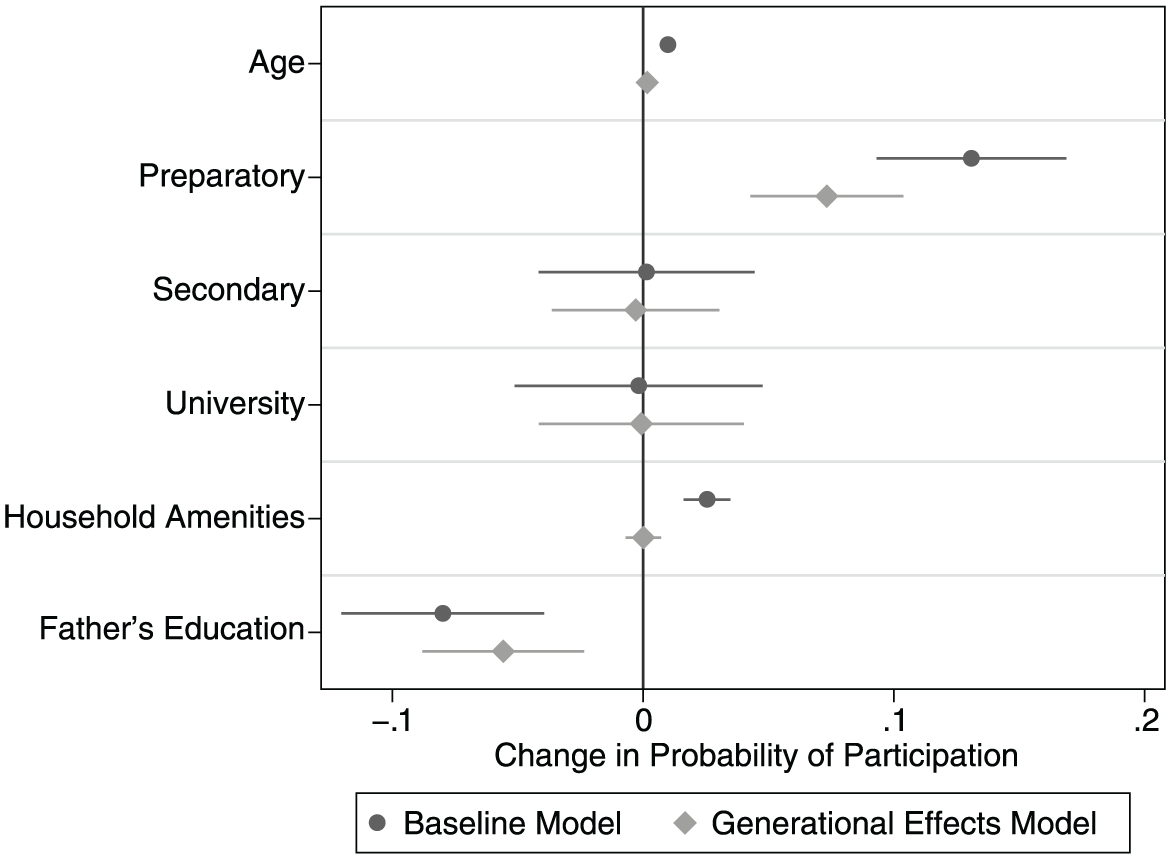
Education and participation in anti-regime resistance (marginal effects) (N = 2,874).
Consistent with my main hypothesis, Table 3 shows that education has a positive and curvilinear effect on participation in anti-regime resistance, which rises with preparatory education and subsequently diminishes. Individuals who completed preparatory school were significantly more likely to go on to participate in resistance than individuals who completed primary school or no schooling (p < .01). This impact of preparatory education on participation is substantial. As Figure 3 shows, preparatory education is associated with a 7-percentage-point (generational effects model) to 13-percentage-point (baseline model) average increase in the probability of participating in protest. For a typical individual in the sample, preparatory education raises the predicted probability of participation from 30% to 44%. 77 This effect is larger than or comparable with the within-sample effects of other key variables theorized to determine participation in political conflict, such as other aspects of socioeconomic status and membership in social networks. 78
In contrast to this effect of preparatory education, however, higher levels of education did not have any additional impact on the likelihood of participation in anti-regime resistance. Both secondary and university education had only a small effect, and neither was statistically significant. Thus, consistent with this chapter’s main hypothesis, the relationship between education and participation in resistance appears to be a curvilinear one. Data visualization and the results of a polynomial model also indicate a curvilinear relationship (see Figure A.4 and Table A.13).
This impact of education is independent of both age and generational effects. Thus, the findings are not simply due to differences in risks or opportunity costs between students and working-age adults. Controlling for generational effects in addition to age is important because opportunities for participation vary over time. For example, individuals who were youth during the first intifada should be more likely to participate than individuals who were youth during previous, less intense phases of protest. To account for this, the generational effects model includes age, time period dummies, and the interaction of age and time period dummies. 79 After controlling for these variables, education continues to have a substantively large and statistically significant effect.
These findings provide support for H1 and challenge existing perspectives on participation in anti-regime resistance. Contrary to perspectives that view participants in anti-regime resistance as well educated, underemployed, and disaffected, individuals who completed secondary school or university were no more likely to participate than those who completed preparatory school alone. 80 However, contrary to other perspectives that predict participants to be poor, uneducated, and marginalized, individuals who completed preparatory school—the median level of education—were significantly more likely to participate in resistance than less educated individuals.
Additional Robustness Checks
These results are robust to several, additional robustness checks. First, I examine whether reverse causality could be driving the observed relationship between education and participation in anti-regime resistance; that is, I test whether participation in resistance could be shaping educational attainment rather than the other way around. To do so, I estimate the effect of educational attainment in a given period on the probability that a previously politically inactive individual begins to participate in anti-regime resistance in later periods. The dependent variable in this analysis is thus the initial onset of participation in anti-regime resistance (among previous nonparticipants). The results, reported in Section A.2 in the online appendix, are similar to our previous findings.
Second, I account for the possibility of selection bias stemming from missing data on the dependent variable. Bounding analysis based on Manski’s extreme bounds shows that the results hold regardless of the distribution of participants and nonparticipants among the missing respondents. 81 Thus, regardless of the characteristics of the missing respondents, education has the same effect on participation in anti-regime resistance. 82
Finally, as Tables A.17 and A.8 show, the effect of education is also robust to controlling for a variety of possible confounding variables including biographical availability, refugee status, exposure to violence, religious activity, land ownership in mandatory Palestine, and personality traits.
The Institutional Mechanism
This article argues that education has a positive and curvilinear effect on the probability of participation in anti-regime resistance, which rises with intermediate levels of education and subsequently diminishes. This finding is puzzling given the history of foreign control over the Palestinian educational system. From 1967 to 1994, the Palestinian educational system fell under the purview of Israeli military authorities, who used their wide control over the curriculum, schoolbooks, and teachers to suppress identification with Palestinian national identity. All schoolbooks were subject to approval by military censors, and using supplementary materials was prohibited. 83 Why, then, did education promote anti-regime resistance?
Qualitative sources suggest that this effect is not due to the content of education but to its structure. For many Palestinian youth, schools served as the “primary source of social interaction beyond the family.”
84
Located in cities and towns, they brought together urban and rural youth in wider and more information-rich social networks. In crowded school hallways, information about anti-regime resistance spread quickly from student to student. For example, echoing Lipset’s observations on the ease of communication and coordination in schools, a student activist recalled how “we put four leaflets in each classroom, and I believe that our message reached most of the 1700 students in Palestine High School.”
85
With so many youth gathered in one place, students also enjoyed relative safety in numbers compared with other groups. As one former participant described,
86
The people who were participating were the school students, the university students . . . Workers, they were individuals. There was no school or university or organize them. Because the students would gather themselves and they would all say “Let’s go, let’s go!” There were a lot of them. But the worker, he would just go alone. (emphasis added)
87
As a result of these informational and organizational advantages, demonstrations and clashes became “part of a tradition” in Palestinian schools 88 : a “regular part of the formal educational experience.” 89 Attesting to these advantages, Israeli authorities attempted to contain demonstrations by breaking up the largest schools, as well as closing schools altogether. 90 During both the first intifada and the 1982 “mini-intifada” that preceded it, they shuttered Palestinian schools and universities for weeks at a time. 91
These accounts suggest three additional implications of the institutional mechanism. First, education should have a greater impact on some forms of resistance than others. As “Hypotheses” section described, it should make individuals more likely to participate in more risky and more collective forms of protest as compared with less risky and individual acts of dissent. In contrast, alternative mechanisms such as national identity, relative deprivation, or political interest imply that education should affect participation in different types of protest equally.
Table 4 shows the effect of education on different types of unarmed collective action. Participation in high-risk collective action is measured as participation in “demonstrations and mass funerals” and/or clashes; participation in crowd collective action includes these two categories as well as a third category—strikes—which often involves mass walkouts in which group members are face-to-face. 92
Education and Participation in Different Types of Resistance.
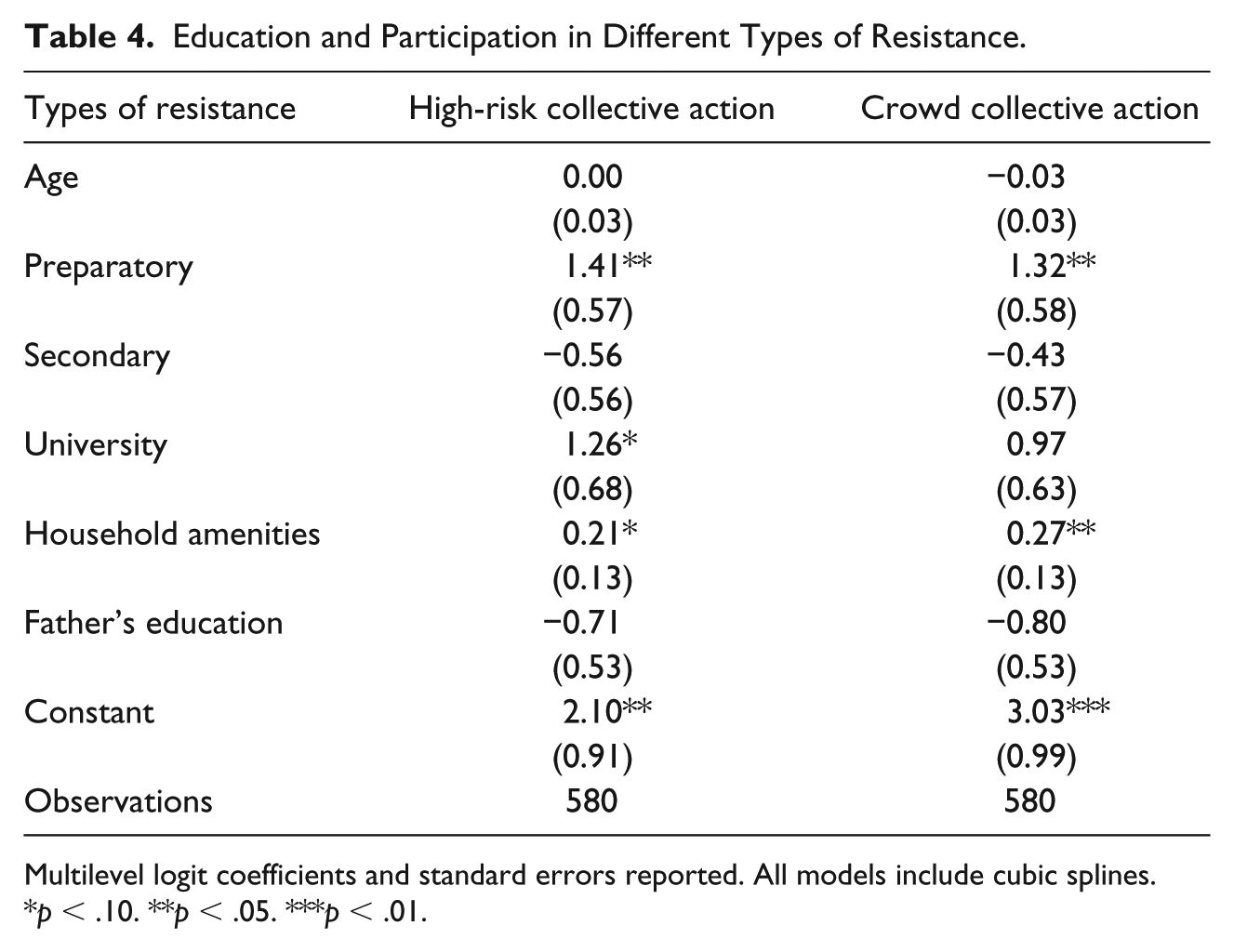
Multilevel logit coefficients and standard errors reported. All models include cubic splines.
p < .10. **p < .05. ***p < .01.
Conditional on any participation, individuals who completed preparatory school were significantly more likely to participate in high-risk collective action than in relatively less risky resistance (p < .01). In substantive terms, they were 10 percentage points more likely to participate in more risky forms of protest than less risky types of dissent. 93 Similarly, preparatory school graduates were also between 4 and 11 percentage points more likely to participate in crowd collective action than individual acts of resistance (p < .05). 94 These findings suggest that education affects participation in anti-regime resistance through institutional mechanisms that affect more risky and collective forms of protest in particular rather than alternative mechanisms that affect all anti-regime protest equally.
The institutional argument also implies that integration into educational institutions joins individuals in larger and more diverse social networks, which provide them with access to scarce information about protest. Consistent with this argument, Table 5 shows that integration into educational institutions is associated with an increase in the size of an individual’s extralocal social networks, meaning his social ties beyond his own immediate community. 95 Preparatory education is associated with a 0.28 increase in the size of an individual’s extralocal social networks, which is equivalent to approximately 0.25 standard deviations (p < .05). Preparatory education is also associated with a similar increase in the size of an individual’s civic networks. 96 In contrast, the impact of higher levels of schooling on the size and diversity of social networks is more mixed.
Education and Social Networks.
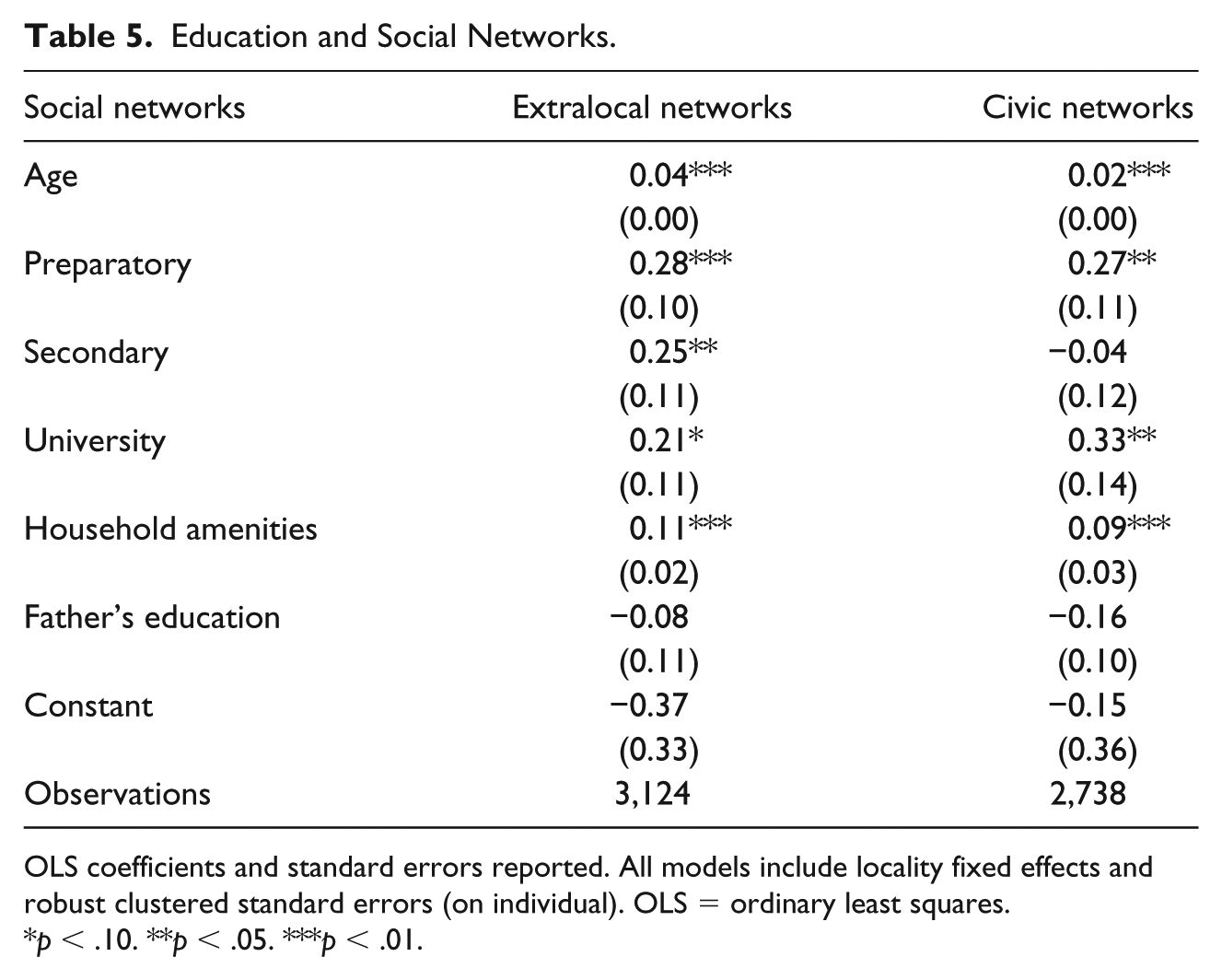
OLS coefficients and standard errors reported. All models include locality fixed effects and robust clustered standard errors (on individual). OLS = ordinary least squares.
p < .10. **p < .05. ***p < .01.
Alternative Explanations
This article has shown that preparatory education is associated with an increased probability of participation in anti-regime resistance. In addition, conditional on having participated at all, individuals who were integrated into preparatory schools were more likely to participate in more risky and collective forms of protest, as well as to form larger and more diverse social networks. These results suggest that the structure of educational institutions—which connect thousands of youth from diverse backgrounds and gather them in a single location—accounts for their effects. In contrast, alternative causal explanations for these findings point to the content of education rather than its structure.
National Identity and Grievances
Foundational theories of nationalism identify modern educational systems as “institutions of power” that transmit national identity to citizens. 97 More recently, Darden has argued that the national identities promoted through the educational system at the time of mass literacy explain subsequent patterns of resistance to foreign occupation. 98 These works suggest that education makes individuals more willing to participate in resistance by strengthening national identity or national grievances.
National identity and grievances offer unlikely explanations for the effect of education on participation in resistance in Palestine, however. As described previously, the Palestinian educational system was under Israeli authority between 1967 and 1994, when it first came under domestic, Palestinian control. Israeli officials used their wide authority over the curriculum, schoolbooks, and teachers to suppress rather than encourage Palestinian national identity. All schoolbooks were subject to approval by military censors, and teaching supplementary material was prohibited. 99
These restrictions had a chilling effect on teachers, who lacked the “safety in numbers” afforded to students. Unlike student protestors, teachers who taught nationalist subjects and/or from a nationalist perspective were highly visible and identifiable. As a result, most teachers hewed closely to the approved curriculum and avoided political topics or discussions. Those who did not were penalized severely, deterring others from following suit. As one teacher recalled, In the school in Beit Hanina, we had twelve teachers and only two were national—me and my friend. Most other teachers were scared to tell the students anything that was not in the textbook . . . The Shin Bet [Israel’s domestic intelligence agency] used students as informers, and of course there were also informers outside the school . . .
100
This tight control over the educational system and the resulting atmosphere of fear cast doubt on national identity and grievances as the operative causal mechanism. However, is it possible that the stark contrast between the depoliticized educational curriculum and the highly politicized reality of daily life under occupation developed a sense of national identity organically among school students? 101 Although this possibility cannot be dismissed, no interviewee described such a process. Indeed, the extensive efforts by Palestinian activists to provide informal nationalist education outside schools suggest that national awareness was not an organic response to the official curriculum. 102
Relative Deprivation
Relative deprivation theory may also explain the relationship between education and participation in anti-regime resistance. Education in the theory is a social force that gives rise to high expectations. When these expectations are not satisfied—for example, when economic conditions are poor and education does not reap commensurate economic rewards—they lead to frustration and rebellion. 103
The relative deprivation mechanism implies that there is an interactive effect between educational attainment and economic conditions. Educated and poor individuals, it predicts, will become frustrated with their situation and rebel. Educated and wealthy individuals, in contrast, will stay on the sidelines. We can test this implication by estimating the marginal effect of education conditional on wealth. If the relative deprivation explanation is correct, education should significantly increase the likelihood of participation in rebellion for poorer individuals but have no significant effect on participation for wealthier ones.
Table 6 estimates the marginal effect of preparatory school completion conditional on wealth. 104 For ease of interpretation, wealth is measured as a binary variable indicating whether the number of household amenities is above or below the sample median of three amenities. 105 An alternative measure of socioeconomic status based on father’s education yields similar results (see Table A.19).
The Marginal Effect of Education by Household Wealth.
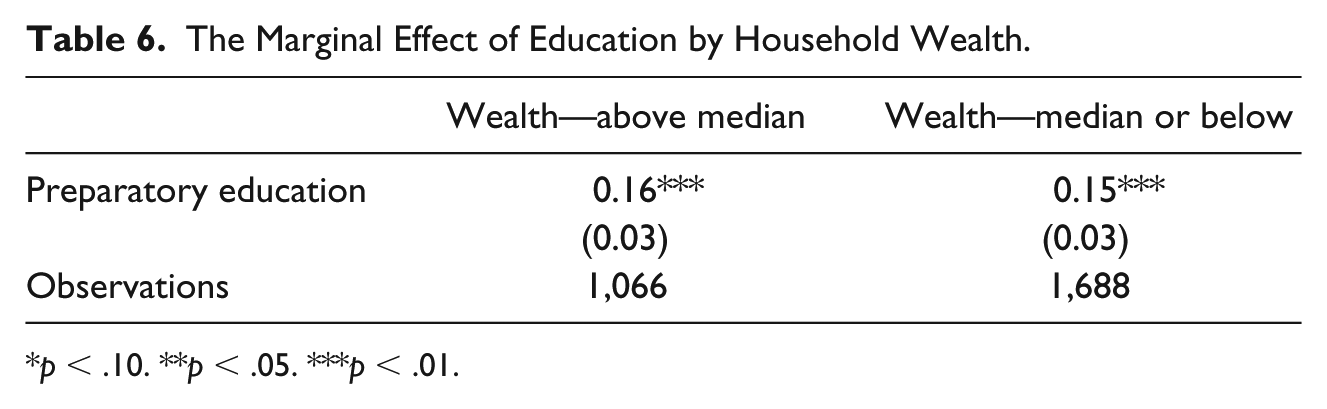
p < .10. **p < .05. ***p < .01.
As Table 6 shows, education increases the likelihood of participation in anti-regime resistance among poor individuals by 15 percentage points. However, it also increases the likelihood of participation in resistance among wealthy individuals by a similar and even slightly greater amount. Thus, based on the evidence at hand, relative deprivation does not seem to explain the effect of education on participation.
Political Interest and Awareness
Influential studies of participation in democratic politics argue that education develops political interest and awareness, civic skills, or a sense of civic duty that foster political involvement, and recent studies suggest that these factors also help determine participation in noninstitutionalized political conflict. 106 As with the preceding mechanisms, these studies suggest that it is not the structure of education but its content that matters.
Political interest and awareness offer unlikely explanations for participation in resistance in Palestine, however. As described previously, it is unlikely that depoliticized readings, lectures, and discussions generated political interest among students or that relevant information about Palestinian politics was transmitted in the classroom. Similarly, it is difficult to imagine how an educational system intended to depoliticize students could foster meaningful civic skills or a sense of duty to participate in anti-regime resistance.
The survey evidence also casts some doubt on the idea that education promotes participation in anti-regime resistance by increasing political interest and awareness. Using the frequency of newspaper readership as a proxy for political interest, 107 Table 7 shows that newspaper readership has a small, negative effect on the likelihood of future participation in anti-regime resistance; moreover, its inclusion in the baseline model does not diminish the effect of preparatory school completion as we would expect if it were the operative causal mechanism. Although a more conclusive test of the political interest and awareness mechanism would require additional, more fine-grained measures of these variables, this initial exploration suggests that these mechanisms are probably not at work. However, we cannot entirely dismiss the possibility that education augments human capital in other ways that could foster participation in anti-regime resistance.
Political Interest and Participation in Anti-Regime Resistance.
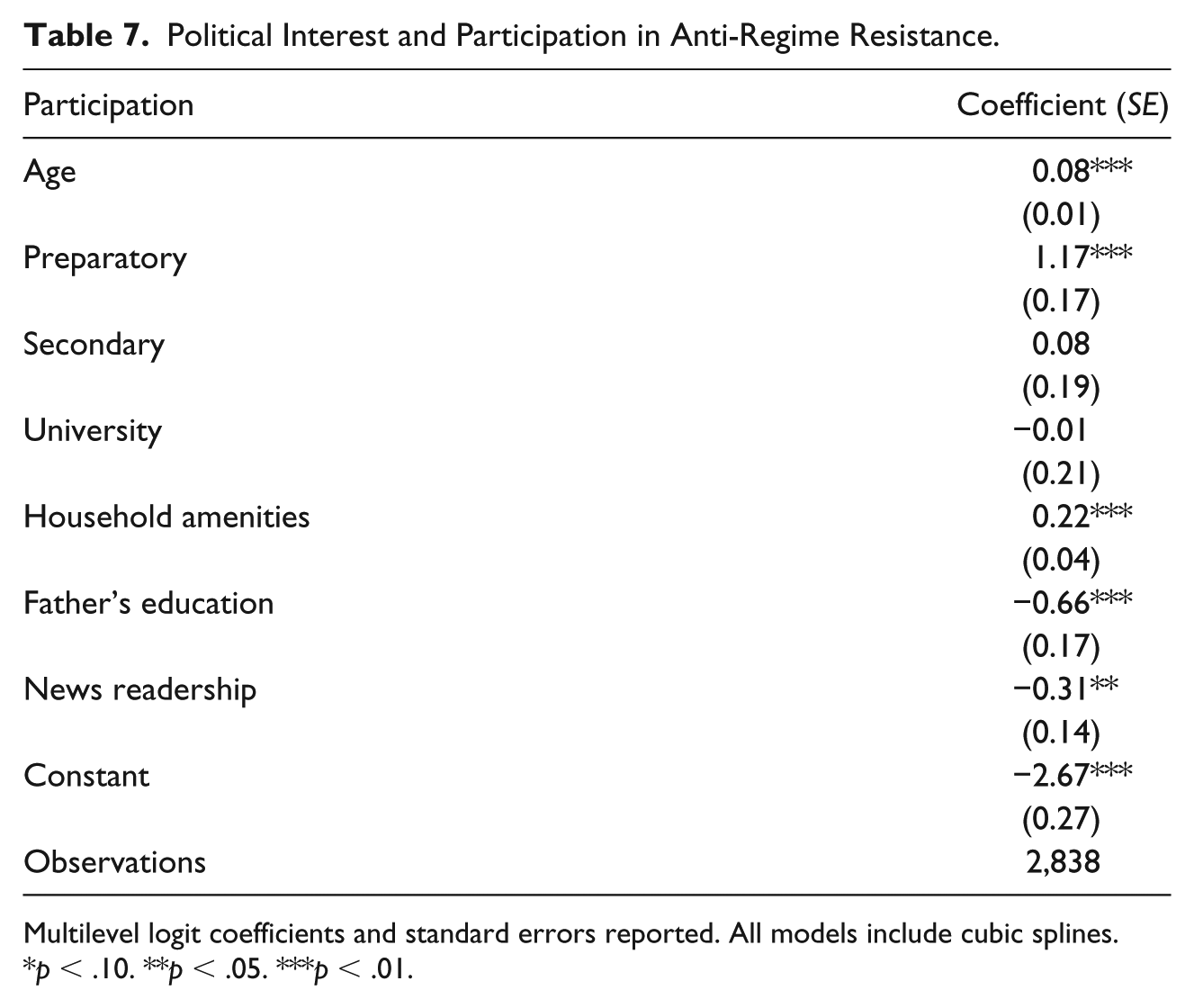
Multilevel logit coefficients and standard errors reported. All models include cubic splines.
p < .10. **p < .05. ***p < .01.
Conclusion
Scholars of democratic politics widely view education as one of the most important factors affecting political participation. This article demonstrates that education also has a strong and counterintuitive effect on participation in noninstitutionalized political conflict. Contrary to existing perspectives that regard participants in anti-regime resistance as educated, underemployed, and disaffected, it finds that, while intermediate levels of education increase the odds of participation in resistance, higher levels of education have little added effect. Also inconsistent with these perspectives, the effect of education does not vary with individuals’ economic conditions. Similarly, contrary to an alternative perspective from the political violence literature, poor, uneducated, and marginalized individuals are also less likely to participate in protest than moderately educated individuals.
This article explains these findings using an institutionalist argument that focuses on the structure of education rather than its content. It argues that educational attainment makes individuals more likely to participate in anti-regime resistance due to the informational and organizational advantages provided by the school environment. Being in this environment brings youth into wider and more information-rich social networks, facilitates communication and coordination, and reduces uncertainty about the risks of protest. Consistent with this institutional argument, this article also shows that education is associated with participation in more risky and collective forms of protest, as well as changes in social networks. Building on these findings, future research can more directly evaluate the relative explanatory power of these different, institutional micro-mechanisms and whether and how they persist over time.
This argument is expected to apply to cases in which groups have high anti-regime sentiment and low internal organizational strength, such as South Africa. During the Soweto Uprising of 1976, black South African school students initiated the largest demonstration against South Africa’s apartheid regime in over 15 years. 108 Existing theories would have largely failed to predict this uprising: Despite the spread of the Black consciousness movement, Black South Africans remained organizationally weak with few autonomous organizations that could channel their grievances against the apartheid regime into action. 109 Against this unlikely backdrop, integration into educational institutions provided Black South African youth with informational and organizational advantages that allowed them to launch a mass uprising.
Some readers may still be concerned that the Palestinian case is anomalous. However, although the long duration and international prominence of the Israeli–Palestinian conflict are unusual, many of the dynamics shaping Palestinian conflict behavior are not. 110 In particular, the effect of education on participation in anti-regime resistance found in the Palestinian case is generally consistent with the many documented examples of student activism in anti-regime movements and the findings of several recent studies on protest participation. 111 These studies also find a positive association between education and participation in anti-regime protest. However, because they focus on other variables, they do not explore precisely how and why education may affect participation.
Finally, these conclusions have important implications for understanding the macro-level causes of anti-regime resistance. Specifically, they suggest that anti-regime protest can occur even when groups lack the strong civil society organizations that many scholars view as necessary for protest. 112 In the absence of such organizations, this article shows that schools may instead function as sites of mobilization and resistance. Although they are under the state’s control, schools provide students with important advantages for collective action that make them more likely to protest, setting in place persistent patterns of political participation. Thus, while the recent constraints on civil society imposed by many regimes surely have other detrimental consequences, they may not stifle mass mobilization as much as is sometimes feared.
Supplemental Material
Zeira_SchoolstoStreets_ReplicationFiles_DoFile – Supplemental material for From the Schools to the Streets: Education and Anti-Regime Resistance in the West Bank
Supplemental material, Zeira_SchoolstoStreets_ReplicationFiles_DoFile for From the Schools to the Streets: Education and Anti-Regime Resistance in the West Bank by Yael Zeira in Comparative Political Studies
Footnotes
Acknowledgements
The author wishes to thank Bernd Beber, Neal Beck, Mark Beissinger, Anjali Thomas Bohlken, Nathan Brown, Bruce Bueno de Mesquita, Sarah Bush, Kanchan Chandra, Simon Chauchard, Dan Corstange, Kathleen Cunningham, Michael Gilligan, Macartan Humphreys, Amaney Jamal, Peter Krause, Timur Kuran, Greg Love, Marc Lynch, Aila Matanock, Devorah Manekin, Wendy Pearlman, Jeremy Pressman, Jim Ron, Cyrus Samii, Alexandra Scacco, Jake Shapiro, Nadav Shelef, Bilal Siddiqi, and Mark Tessler for their comments on this article or the larger project of which it is a part. The project also benefited from presentation at the 2016 Junior Scholars Book Development Workshop held by the Project on Middle East Political Sciences, the annual conferences of the American Political Science Association, the Empirical Studies of Conflict Project, the Project on Middle East Political Science, the Association for Analytic Learning about Islam and Muslim Societies, and the Middle East Studies Association, and seminars at the University of Connecticut, the University of Mississippi, NYU-Abu Dhabi, and Stanford University. All remaining errors are of the author’s.
Declaration of Conflicting Interests
The author declared no potential conflicts of interest with respect to the research, authorship, and/or publication of this article.
Funding
The author disclosed receipt of the following financial support for the research, authorship, and/or publication of this article: Financial support for this project was provided by a NYU GSAS Torch Fellowship for Dissertation Field Research and logistical support was generously extended from Al-Maqdese for Society Development (MSD), Palestine.

Notes
Author Biography
References
Supplementary Material
Please find the following supplemental material available below.
For Open Access articles published under a Creative Commons License, all supplemental material carries the same license as the article it is associated with.
For non-Open Access articles published, all supplemental material carries a non-exclusive license, and permission requests for re-use of supplemental material or any part of supplemental material shall be sent directly to the copyright owner as specified in the copyright notice associated with the article.
