



Abstract
Economic and cultural factors are often presented as alternative explanations of Brexit. Most studies have failed to recognize the interplay between contextual economic factors and individual attitudes such as nativism and Euroscepticism. We argue that both economic and cultural factors matter to explain the outcome of the referendum. Economic factors are critical because they shape cultural attitudes. British citizens who live in economically depressed and declining districts are more likely to develop anti-immigrant and Eurosceptic views. These cultural grievances, in turn, explain support for Brexit. Using both aggregate economic and electoral data at the local level (380 districts) and data from the 7th wave of the British Election Study 2014-2017 panel, we find strong support for our argument that cultural grievances mediate the effect of long-term economic decline on support for Brexit. Our results have important policy implications, and suggest targeted economic policies are necessary to protect the “losers of globalization.”
Historical research has long recognized that nativist and nationalist movements in North America and Western Europe tend to emerge during periods of economic duress (Dornel, 2014; Higham, 1955; Pelz, 2016; Shirer, 1960; Sternhell, 1978). Severe economic recessions have often led to nativist flare-ups in public opinion and to the success of anti-immigrant or nationalist political forces. Research in social and political psychology has also repeatedly shown that economic anxieties produce ethnocentric attitudes and fear of foreigners (Brader, Valentino, & Suhay, 2008; Gorodzeisky & Semyonov, 2016; Ruedin, in press). Work by political sociologists has similarly shown that perceived economic threats lead to anti-immigrant attitudes in a variety of contexts (Citrin, Green, Muste, & Wong, 1997; Olzak, 1989; Quillian, 1995). While this relationship between economic and cultural factors is part of the conventional wisdom in many academic disciplines, these insights have not been fully incorporated into the scholarly research on recent, and major, political events such as the United Kingdom’s Brexit vote.
Although an impressive body of work has been produced to explain the results of the Brexit referendum, the nature of the academic debate often presents economic factors and cultural factors as alternative and separate explanations of support for Brexit. For instance, individual-level studies using survey data compare the effects of variables capturing personal economic hardships (e.g., unemployment and retrospective economic evaluations) and items capturing cultural backlash (e.g., anti-immigration and Eurosceptic attitudes) on the decision to vote “Leave” in the referendum (H. D. Clarke, Goodwin, & Whiteley, 2017a; Hobolt, 2016; Norris & Inglehart, 2018; chap. 11). Most of these studies conclude that cultural values are better predictors of support for Brexit than economic variables.
These individual-level analyses, however, are not always consistent with aggregate-level results. Analyses of the Brexit vote using electoral data at the local level have shown that the level of unemployment, income deprivation, housing prices, and exposure to economic shocks related to globalization are all strong predictors of the share of support for “Leave” in the referendum (Ansell & Adler, in press; Arnorsson & Zoega, 2016; Becker, Fetzer, & Novy, 2016; Colantone & Stanig, 2018b). Moreover, there is no evidence suggesting higher support for Brexit in areas that have a higher share of immigrant population (Arnorsson & Zoega, 2016; Carozzi, 2016; Crescenzi, Di Cataldo, & Faggian, 2018). 1
While we now have a good understanding of the factors that predict the “Leave” vote at the individual and at the district level, we lack an integrated theoretical framework that explains the high support for Brexit in the referendum. In particular, we argue that most studies have failed to recognize the interplay between contextual economic factors and individual attitudes such as xenophobia, ethnocentrism, and Euroscepticism. Hopkin (2017, p. 475) rightly points out that “these different factors [i.e., the economy and culture] can be separated analytically and measured through separate survey questions, but the surveys do not tell us whether voter concerns about immigration were driven by predominantly cultural or economic motives.” It is, therefore, critical to investigate the contextual factors that lead citizens to adopt anti-immigration and Eurosceptic attitudes (Curtice, 2017). If economic decline leads to these sorts of cultural attitudes, then explanations of Brexit that adopt an either/or framework (i.e., either economic or cultural factors) are theoretically unsatisfying. 2
The argument in this article is simply that both economic and cultural factors matter to explain the outcome of the referendum, but they do so in different ways. Economic factors are critical because they shape values and attitudes. In particular, we argue that British citizens who live in economically depressed and declining districts are more likely to develop cultural grievances and especially anti-immigrant and Eurosceptic views. These cultural grievances then inform political choices, such as the decision to support the “Leave” option in the Brexit referendum.
The article is organized as follows. First, we discuss the increasing regional economic inequalities in Britain over the past 3 decades. The downward economic trajectory in many districts is a key explanatory factor in our theoretical framework. Second, we briefly discuss the “cultural backlash” theory; and we then proceed to develop our theoretical framework, which argues that long-term and geographically concentrated economic decline shapes cultural grievances. Third, the research design and the empirical strategy used in the article are discussed before the main findings are presented. The final section discusses some of the key findings and concludes.
Regional/Local Inequalities and Long-Term Economic Decline in the United Kingdom
Economic inequality and regional differences in the United Kingdom have been quite pronounced in the last decades. According to the Organisation for Economic Co-operation and Development’s (OECD) inequality report, the income of the richest 10% of the U.K. population is about 10 times that of the poorest 10% (OECD, 2015). While net income inequality at the national level, as measured by the Gini coefficient, has not increased in the last decade, the decades of the 1980s and 1990s saw a sharp increase in inequality.
Despite, or possibly because of, Britain’s highly centralized system of government, there are sizable differences in economic performance across the regions. Any equalizing impact of taxes and transfers is more limited in Britain than it is in countries such as Portugal, Ireland, or Spain (Aitken, Ebell, & Samek, 2017; OECD, 2015). As McCann (2016, p. 1) argues, in most other advanced economies . . . changing employment, skills and income distributions are dispersed much more evenly across the country, whereas in the UK they appear to be more heavily biased towards certain regions than in almost any other advanced economy.
Overall, disposable household income has become more unequally distributed across U.K. regions, in particular, since the onset of the economic recovery in 2011 (Aitken et al., 2017).
High regional inequalities in the United Kingdom are also demonstrated by differences in regional productivity. London is “decoupled” from the rest of the U.K. economy, as it is the hub of multinational companies and foreign direct investment, which reflect the “benefits of globalization.” The productivity levels of regions that are outside of London and the South are similar to those of the poor Central and Eastern European regions (McCann, 2016). In 2016, the GDP per capita was about £45,000 in London whereas in regions such as the North East of England or Wales, it was about £18,000 (“Britain’s Inequality Map—Stark and Growing,” 2016). Interregional inequalities in GDP per capita across small regions in the United Kingdom (TL3) are higher than the OECD average, in terms of their Gini levels. The gap increased between 2008 and 2013 because poorer regions saw their income decrease whereas the opposite trend took place in wealthier regions. According to McCann (2016), “the UK’s interregional inequalities are not a new phenomenon. Rather, it is the growing scale of these inequalities which is so remarkable and unusual by OECD and EU standards.” When we consider other dimensions of “well-being” such as jobs, the regions of South East England are in the top 15% of the OECD, whereas the Northeastern regions are in the bottom half (OECD, 2016).
The reasons for this economic “bifurcation” of England (Jennings & Stoker, 2016) between cosmopolitan areas of growth and economically depressed areas are well-known. Globalization has produced uneven development. Some cities and regions are economically dynamic and well-integrated in the global economy, creating high-skills and well-paid jobs. Other regions are suffering from a process of long-term economic decline as a result of deindustrialization and automation. These economically depressed areas have witnessed a decline in wages and an increase in long-term unemployment (Martin, 2015; McCann, 2016). Citizens living in these regions have been often characterized as the “losers of globalization” (Hobolt, 2016). The negative consequences of this uneven development for the regions (and citizens) “left behind” by globalization have been made more acute by the austerity policies adopted by British governments since the 1980s (Beatty & Fothergill, 2017; T. Fetzer, 2018; Hopkin, 2017).
These regional differences in long-term economic performance will, we argue, drive the cultural grievances that then shape support for Brexit. The alternative explanation is that Brexit was driven by cultural and economic factors that are modeled as largely separate from each other. To be sure, an explanation for Brexit grounded in cultural explanations is one to take seriously. And, in the following section, we review the standard cultural backlash hypothesis, which holds that cultural grievances result from value changes affecting Western societies in the second half of the 20th century. We then introduce our alternative hypothesis that long-term economic distress leads to the formation of anti-immigration and Eurosceptic attitudes.
Cultural Backlash
The cultural backlash theory holds that a large segment of Western societies reacted with nostalgia to long-term processes of value change that started in the 1970s and resulted in the adoption of postmaterial and progressive values (Inglehart, 1990, 1997). Western societies are today much more secular, tolerant, open-minded, and diverse than they were 50 years ago (Inglehart & Welzel, 2005; Norris & Inglehart, 2004). Cultural backlash is a reaction against these value changes, which is characterized by opposing values and attitudes, such as xenophobia, ethnocentrism, nationalism, anti-elite stances, and a generalized “sense of loss” (Inglehart & Norris, 2016).
One of the most obvious manifestations of this cultural reaction is the adoption of negative attitudes toward immigrants, ethnic minorities, and multiculturalism (or cosmopolitanism) more generally (Bonikowski, 2017; J. S. Fetzer, 2000; McLaren, 2012). Another dimension of this cultural backlash is Euroscepticism, insofar as the European Union can be perceived as a cultural threat and a challenge to national identities (Curtice, 2016; McLaren, 2002). The prominence of this new cultural cleavage has led to a reorganization of the political space in Western Europe, marked, in particular, by the emergence of right-wing populist parties (Bornschier, 2010; Kriesi, 2010).
The major proponents of the cultural backlash thesis argue that economic affluence in the second half of the 20th century led to the adoption of progressive (postmaterial) values, which, in turn, generated a conservative reaction (Inglehart & Norris, 2016). That conservative reaction shapes political choices in Western societies and leads to the success of antiestablishment options on the right side of the political spectrum, such as Trump in the United States, populist far-right parties in many European countries, and Brexit in the United Kingdom (Norris & Inglehart, 2018). According to Inglehart (2018, p. 181), “support for [populist] parties is motivated by a backlash against the cultural changes linked with the rise of Postmaterialist and Self-expression values, more than by economic factors.” While we do not take issue with the argument that the evolution of societies in a more progressive direction produced a conservative reaction, we argue that regionally concentrated economic decline also resulted in an increase in anti-immigration and Eurosceptic attitudes in Britain. These cultural attitudes, in turn, shaped support for Brexit.
Economic Decline and Cultural Grievances in Britain
We propose that geographically concentrated economic decline is related to cultural backlash in Britain for several reasons. First, we argue that individuals who live in areas suffering a long-term economic decline are more likely to perceive immigrants as an economic threat. Structural economic problems lead to a heightened sense of economic insecurity. Indeed, while Inglehart (2018) sees populism as a largely cultural phenomenon, his general argument emphasizes the roots of culture: “economic and physical insecurity are conducive to xenophobia, strong in-group solidarity, authoritarian politics and rigid adherence to their group’s traditional cultural norms” (Inglehart, 2018, p. 8). People who live in economically depressed areas might perceive foreign workers as a threat to their chances in the labor market or to the continued supply of welfare benefits (Hemes & Knudsen, 1992). They might, indeed, assess that outgroups (e.g., foreigners) are improving their economic status to the detriment of the relative status of native citizens (Green, Hellwig, & Fieldhouse, 2018). In particular, low-skilled workers in districts suffering a long-term economic decline might perceive immigrants as a threat to their jobs and their wages (Mayda, 2006; Scheve & Slaughter, 2001). For instance, previous research has shown that European citizens are more likely to develop anti-immigrant attitudes when they work in shrinking sectors of employment (Dancygier & Donnelly, 2013). In the case of the United Kingdom, Calhoun (2017, p. 66) notes in a sociological analysis of Brexit that the England of Brexit has had vastly more trouble than London in absorbing immigrants—largely because the economy offers fewer opportunities for immigrants and citizens alike. And this helps explain why immigration was so much less of an acute issue for Londoners.
Using survey data from 1997 and 2015, a recent analysis by Jennings and Stoker (2016), indeed, shows evidence of an increase in anti-immigration and Eurosceptic views in economically depressed areas of the United Kingdom over the past 2 decades.
It should be noted that citizens’ political attitudes and preferences are shaped by discussions with neighbors, family members, and coworkers (Huckfeldt, Ikeda, & Pappi, 2005; Huckfeldt & Sprague, 1987; McClurg, 2006). Our point is not that everyone in deindustrializing or declining regions has “pocketbook” problems, but they are much more likely to have personal interactions with people who are suffering economic hardships. More generally, citizens living in regions that are suffering an economic decline (e.g., deindustrialization and outsourcing of jobs) might feel that their economic prospects are much more uncertain than people living in regions with more booming economies. This perceived economic vulnerability might, in turn, lead to cultural grievances and xenophobic views.
Second, regardless of personal economic hardships, the perception that the economy is in a downward trajectory can lead to nativist sentiments and hostility toward outsiders. Previous research suggests that evaluations of the national economy have a stronger impact on immigration attitudes than personal economic circumstances (Citrin et al., 1997; Hainmueller & Hopkins, 2014; Valentino et al., in press; Wilkes, Guppy, & Farris, 2008). We also know that local economic conditions are correctly perceived (Newman, Velez, Hartman, & Bankert, 2015) and strongly influence citizens’ retrospective and prospective evaluations of the national economy (Ansolabehere, Meredith, & Snowberg, 2014; Books & Prysby, 1999; Reeves & Gimpel, 2012). In sum, pessimism regarding the economic trajectory of the country might lead people living in economically depressed areas to scapegoat immigrants and develop more nativist views.
Third, the information environment and elite rhetoric also plays a key role in shaping mass attitudes toward immigration and cultural grievances more generally (Hajnal & Rivera, 2014; Messina, 1989; Money, 1999). In the U.K. context, the UK Independence Party (UKIP) broadened its appeal (starting around 2010) by combining its hard Euroscepticism with a clear message of firm opposition to immigration. Immigrants were presented as a threat to the British national identity and to the economic well-being of workers in Britain (Goodwin & Milazzo, 2015). Moreover, UKIP leaders recognized the potential of targeting disenchanted, working-class, and poorly educated voters. As a result, they developed an electoral strategy that targeted districts suffering economic problems (former Labour bastions) with large concentrations of insecure and pessimistic voters (Ford & Goodwin, 2014). Although the Leave campaign before the Brexit referendum was a national campaign, many UKIP leaders continued to target struggling districts filled with economically left-behind and working-class voters, where the anti-EU and anti-immigration messages of the Leave campaign resonated more strongly (H. D. Clarke et al., 2017a).
Cultural arguments identify a set of predispositions and attitudes that are proximate to vote choice and are factors that lead voters to see some politicians and parties as appealing. As these attitudes rise in importance for an individual voter or in prevalence across the electorate, then we see a change in party preferences and vote choice both among individual voters and among the electorate as a whole. For instance, voters with anti-immigrant and Eurosceptic attitudes in the United Kingdom are more likely to vote for UKIP and to support Brexit (H. D. Clarke, Goodwin, & Whiteley, 2017b; Ford & Goodwin, 2014; Hobolt, 2016).
Our point is to say that these predispositions and attitudes are created. Changes in those predispositions—or in the importance of particular issues—are brought about by other factors, and particularly changes in economic circumstances. Not only that, but these cultural changes may well mask the importance of these underlying changes and economic factors.
Research Design
There are two main challenges when studying the political impact of geographically concentrated economic decline. The first one is the existence of posttreatment bias (Rosenbaum, 1984, 2010), which refers to adjusting for characteristics that can be affected by exposure to economic decline (e.g., the level of development, migration flows, sociodemographic characteristics, etc.). To address this concern, we only include pre-exposure covariates when using electoral data. The second critical challenge is endogeneity due to omitted variable bias (K. A. Clarke, 2005; Steiner & Kim, 2016). In fact, there might be some unobserved factors that both drive lower regional economic growth and higher “cultural grievances.” One potential source of such bias could be the initial employment in manufacturing. If districts of the United Kingdom that employed more unskilled labor in manufacturing also tended to have more anti-immigrant and ethnocentric views before experiencing sustained economic problems, then our estimates of the effect of economic decline on “cultural grievances” would be biased. 3 Another possible source of endogeneity is the individuals’ sociodemographic characteristics as it is well known that working-class, poorly educated, and older respondents tend to also exhibit more aversion to immigration and cosmopolitanism. All our empirical models, therefore, include a “pre-exposure” measure of regional manufacturing employment, and our individual-level models also include measures of respondents’ age, education, and social class.
Economic Decline and Support for Brexit
We evaluate whether economic decline is related to support for Brexit by using data from 380 districts in the United Kingdom. We have economic, sociodemographic, and electoral data for local districts in England, Scotland, and Wales. We analyze whether variations in economic conditions at the local level shape support for Brexit.
The dependent variable in this analysis is support for Brexit, which is captured by the share of the leave vote in the Brexit referendum. The independent variable of interest is geographically concentrated economic decline. This is captured through measures of change in real gross disposable household income at the local level. These data were obtained from the website of the Office for National Statistics (ONS). What constitutes long-term decline is, to some extent, an open question. We estimate different models including measures of 10-year and 18-year changes in real household income at the local level. 4 We expect a negative association between long-term income changes and support for Leave in the referendum.
Descriptive Statistics
Before undertaking the statistical analysis, we take a preliminary look at the data. Support for Brexit in the referendum was much higher in districts that have suffered long-term economic distress. Table 1 presents the average share of support for “Leave” in the referendum for different levels of long-term economic performance at the local level.
Mean Share of Support for “Leave” in the Brexit Referendum.
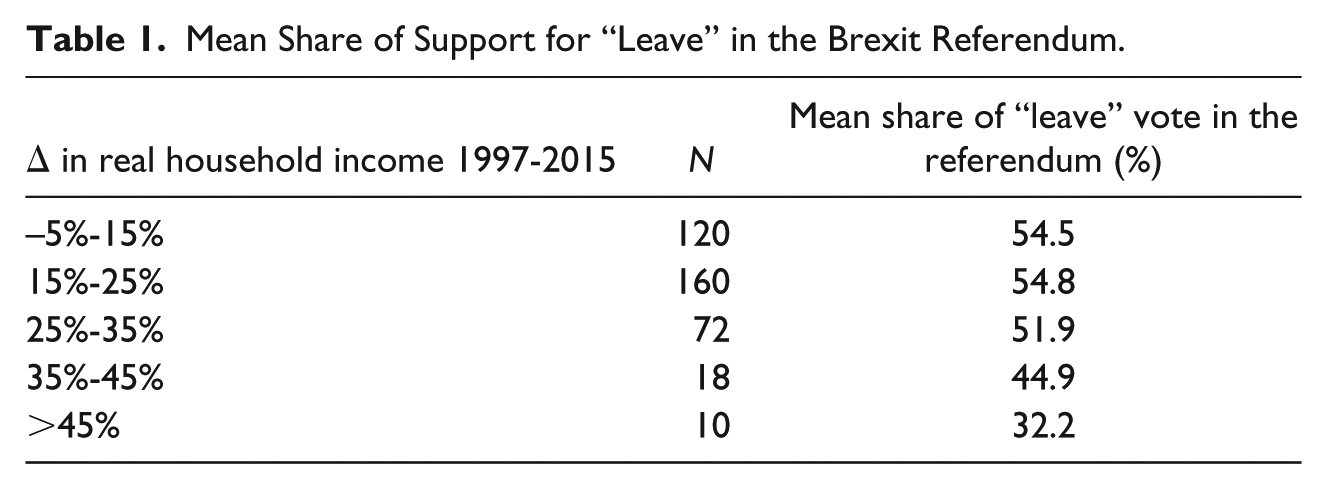
These descriptive statistics indicate that support for Brexit is much higher in areas where incomes have stagnated or declined in the past 2 decades. In fact, these data suggest that if the Brexit referendum had been held only in the (few) districts where the economy has been booming in the past 2 decades, the United Kingdom would have remained in the European Union.
The association between long-term economic performance and support for Brexit can also be seen in Figure 1, which presents a map showing the share of support for Brexit in the referendum (panel a) and a map showing the change in real household income between 1997 and 2015 (panel b).

Support for Brexit in the referendum and long-term economic trajectory in U.K. local authorities.
The maps again suggest that support for Brexit is higher (darker shades in panel a) in areas where the local economy is stagnant or in a downward trajectory (darker shades in panel b). All in all, these descriptive statistics suggest that contextual economic factors shape support for Brexit. The next section tests this hypothesis more rigorously using multivariate regressions.
Empirical Results
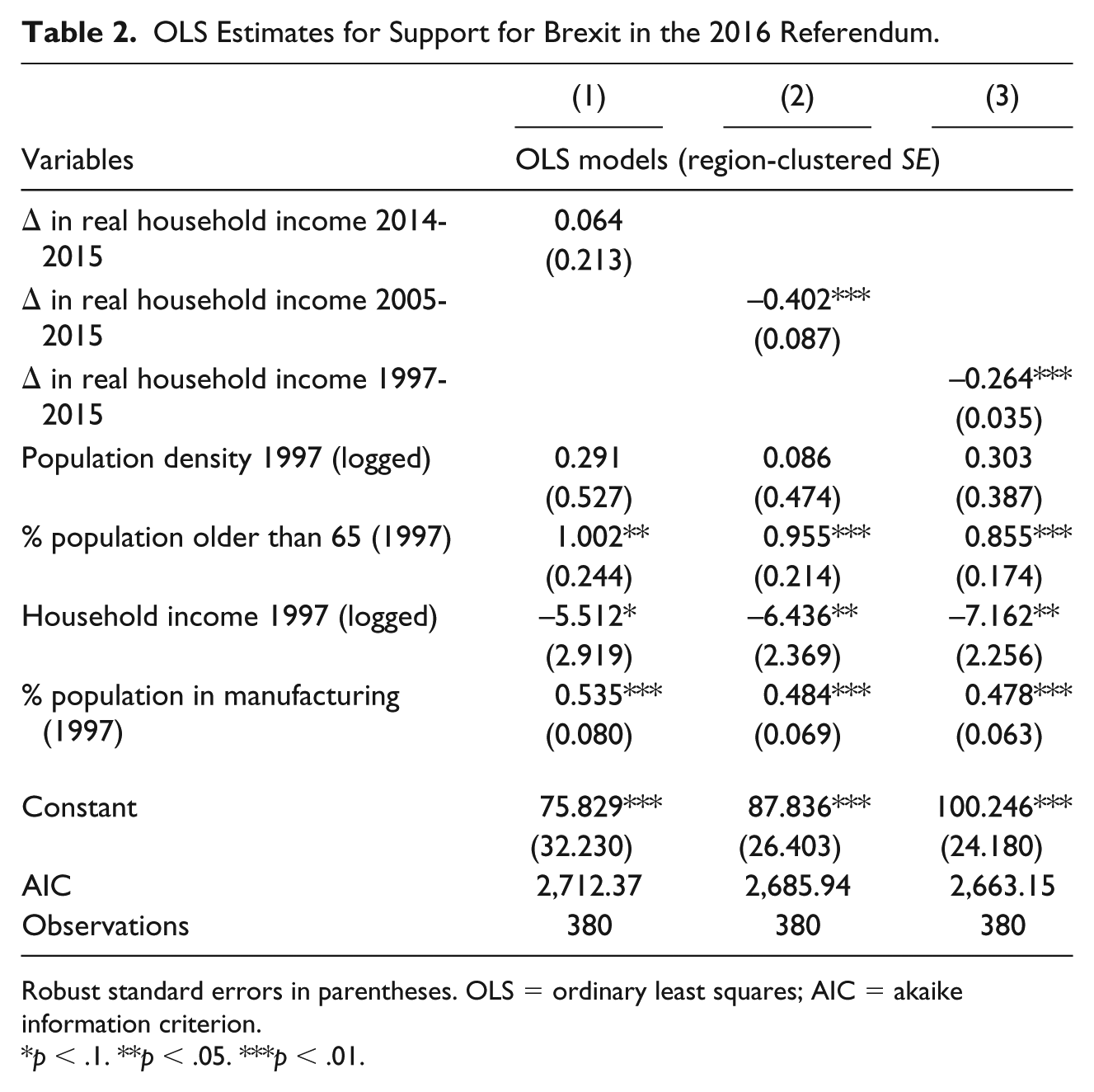
Table 2 presents the results of a series of ordinary least squares (OLS) models. These models have standard errors clustered at the regional (Nomenclature of Territorial Units for Statistics [NUTS] 1) level.
OLS Estimates for Support for Brexit in the 2016 Referendum.
Robust standard errors in parentheses. OLS = ordinary least squares; AIC = akaike information criterion.
p < .1. **p < .05. ***p < .01.
The results suggest that short-term changes in household income before the referendum are not related with support for Brexit. However, long-term economic decline is associated with the Leave vote in the expected direction. Adjusting for the level of income and the share of the population that worked in the manufacturing sector pre-exposure, support for Brexit is lower in areas where income is going up over the long term. In fact, the coefficient for the two measures of long-term economic fluctuation is always negative and statistically significant. The results are, therefore, consistent with accounts of Brexit that emphasize the importance of the long-term stagnation or decline of real incomes in deindustrializing areas of the United Kingdom.
To assess the substantive importance of this relationship, we estimate the predicted values of support for Leave in the Brexit referendum at different values of long-term (10 years) economic fluctuations (i.e., change in real household income between 2005 and 2015), holding other variables at their mean values. Figure 2 presents the results of this estimation.

Predicted values of support for Brexit in the referendum at the local level.
The predicted values reveal large differences in support for Brexit between districts where incomes are growing faster than the U.K. average and districts where real incomes are declining over the long term. More specifically, adjusting for the level of development and the size of the manufacturing sector at the local level, there is a 9-percentage points gap in the Leave vote share in the referendum when we compare districts where real incomes have declined 11% (−2 SD) and districts where real incomes have increased 11% (+2 SD) over this 10-year period. We also estimated the predicted values of support for Brexit given different values of our measure of the 18-year change in real household income based on the results of Model 3 above. The results show an even larger difference (12 percentage points) in support for Brexit between areas that suffered a severe decline and areas that experienced an economic boom, and they are reported in Figure A1 in the online appendix.
Robustness Models
We have shown in the previous section that support for Brexit is significantly higher in areas where incomes have stagnated or declined in the last 2 decades. Before exploring the causal mechanisms that explain the association between long-term economic decline and support for Brexit, we briefly discuss a few additional models we estimated to evaluate the impact of long-term economic fluctuations on the “Leave” vote share in the referendum at the local level.
First, a potential concern when analyzing geographical data is that similar processes and behaviors tend to be clustered across spatially proximate units, which can lead to bias in the OLS estimates (Darmofal, 2015). To deal with this challenge, we reestimated the OLS models presented in Table 2 using spatial error models via maximum likelihood estimation. The results of these spatial error models are very similar to the results of the OLS models in terms of substantive sign and statistical significance. The full results of the spatial analysis are presented in Tables A1 to A2 in the appendix.
Second, we reestimated the models in Table 2 with a different model specification. In the models shown above, we use pre-exposure covariates to avoid adjusting for characteristics that might have been shaped by exposure to economic decline. However, if we use the 2015 values of the same variables and we add two more contemporaneous variables (the percentage of people with high school education and the percentage of foreign population in the district), the results for the variables capturing economic decline remain the same. In other words, support for Brexit is higher in districts suffering long-term economic problems but is not shaped by short-term economic fluctuations. These alternative models are shown in Table A3 in the online appendix.
We also replicated the models in Table 2 with different measures of long-term economic fluctuations. First, we gathered data on the compensation of employees at the local level from the Business Register and Employment Survey (BRES) covering the same time period (1997-2015) and we calculated real changes in the average compensation of employees in the 380 districts. Second, we obtained unemployment data at the local level from the Official Labour Market Statistics of the Office for National Statistics. 5 Unfortunately, the unemployment data at the district level only exist since 2004 so the time series is shorter for this variable. Third, we obtained information on the change in house prices at the level of the local authority between 2007 and 2016 from the UK Land Registry. 6
The results of these robustness models are very similar to the ones reported in Table 2. Short-term changes in unemployment or in employee compensation do not drive support for Brexit in the referendum. However, the “Leave” vote share is significantly higher in districts that have suffered long-term economic decline (i.e., increase in unemployment, decline in real employee compensation, and decrease in house prices). We present the results of these models in Tables A4 to A6 in the online appendix.
Exploring the Causal Mechanism: Does Economic Decline Affect Political Attitudes?
In our theoretical discussion, we argue that long-term economic problems at the local level had an impact on support for Brexit because they led to the formation of nativist, Eurosceptic, and anti-immigrant attitudes (i.e., “cultural grievances”). In this section, we test whether this causal mechanism is plausible.
A major difficulty in analyzing the impact of long-term and regionally concentrated economic fluctuations on individual political attitudes is that surveys in general ask questions that measure short-term retrospective evaluations (e.g., perceptions of economic performance over the last 12 months) that fail to capture the effects of long-term economic changes. The results presented above suggest that short-term economic fluctuations do not predict the vote share for Leave in the Brexit referendum. An alternative is to use the place of residence indicated by the respondent in the survey and match that information with economic data at the local level. This empirical strategy is only possible if two conditions are met: (a) a survey item asks the district (rather than the region) of residence of the respondent, and (b) the sample is large enough that meaningful statistical analyses can be conducted matching individuals with local-level economic conditions.
Fortunately, the 7th wave of the British Election Study 2014-2017 Internet panel fulfills these two conditions. This wave was conducted by YouGov a few months before the Brexit referendum (between April 14 and May 4, 2016). The advantage of this particular dataset for our purposes is threefold: (a) its impressive sample size (30,895 respondents), (b) a survey item captures the district where respondents live, and (c) the number of variables included in the questionnaire that allow us to capture citizens’ cultural attitudes.
The first task in this individual-level analysis is to identify the right survey items to capture “cultural grievances” (a decidedly elusive concept). We reviewed several works that discuss the formation of “cultural grievances” or a “cultural backlash” against liberal cosmopolitanism in recent years in the United Kingdom (Calhoun, 2017; Goodhart, 2017; Inglehart & Norris, 2016; Jennings & Stoker, 2016). These works identify four main groups of attitudes that make up the broader “cultural grievances” construct: (a) nativism/anti-immigration, (b) Euroscepticism, (c) ethnocentrism, and (d) nostalgia for a past world. We identified 18 survey items in the BES survey that capture these different dimensions of cultural grievances. We provide a list of all these variables in Table A7 in the online appendix. 7
Rather than relying on a few variables, we use respondents’ answers to these 18 survey items to create a summary indicator of “cultural grievances” using principal component analysis (Fabrigar, Wegener, MacCallum, & Strahan, 1999). Remarkably, an exploratory factor analysis on these 18 items yields a one-factor solution. All the items load strongly on one dimension. We, therefore, estimate a latent indicator of “cultural grievances” based on a factor analysis that includes these 18 survey items. Our “cultural grievances” measure takes higher values when respondents have more anti-immigration, Eurosceptic, ethnocentric, and nostalgic attitudes. 8
In the survey analyses presented in this section, the dependent variable is this summary indicator of cultural grievances. To limit the possibility of posttreatment bias (Rosenbaum, 1984), in these models, we only include individual-level covariates that should not be affected by long-term economic decline (age, sex, education, and social class). The empirical models below apply multilevel techniques that distinguish between three levels, that is, the individual level, the local level, and the regional level. The multilevel approach takes the layered character of the data into account. The most important feature of these models for the purpose of this article is that the estimates of variances and their associated standard errors provide direct tests of the impact of measured contextual economic factors on political attitudes. Hierarchical models also allow for a more precise estimation of individual-level factors because they control for important contextual factors that may bias the results (Gelman & Hill, 2007; Steenbergen & Jones, 2002).
The results of these models are reported in Table 3. They are very much in line with our theoretical expectations. Short-term economic fluctuations do not influence cultural grievances. By contrast, all the coefficients capturing long-term economic fluctuations are in the expected direction and statistically significant. More precisely, the results indicate that cultural values typically associated with a backlash against immigrants and the European Union tend to be more prevalent in localities where unemployment is going up and lower in districts where real household incomes are increasing.
Determinants of Cultural Grievances in the United Kingdom (Multilevel Models).

Standard errors in parentheses.
p < .1. **p < .05. ***p < .01.
Figures 3 and 4 present the predicted values of the summary indicator that captures “cultural grievances” at different levels of long-term economic fluctuations. Figure 3 shows the predicted values of cultural grievances at different values of long-term change in household income. We observe a significant decrease in anti-immigrant and Eurosceptic attitudes as we move from declining areas to boroughs with booming economies. Holding other variables at their means, districts where real incomes have declined or stagnated over this 18-year period are predicted to have much higher values in the “cultural grievances” indicator (1 standard deviation higher than the mean). Figure 4 shows the predicted values of cultural grievances at different values of change in long-term unemployment (2004-2016). As can be observed, districts with a significant increase in unemployment are predicted to have a value in the “cultural grievances” indicator that is 1 standard deviation higher than the mean. Both estimations suggest a significant cultural backlash exists in areas suffering a long-term economic decline.
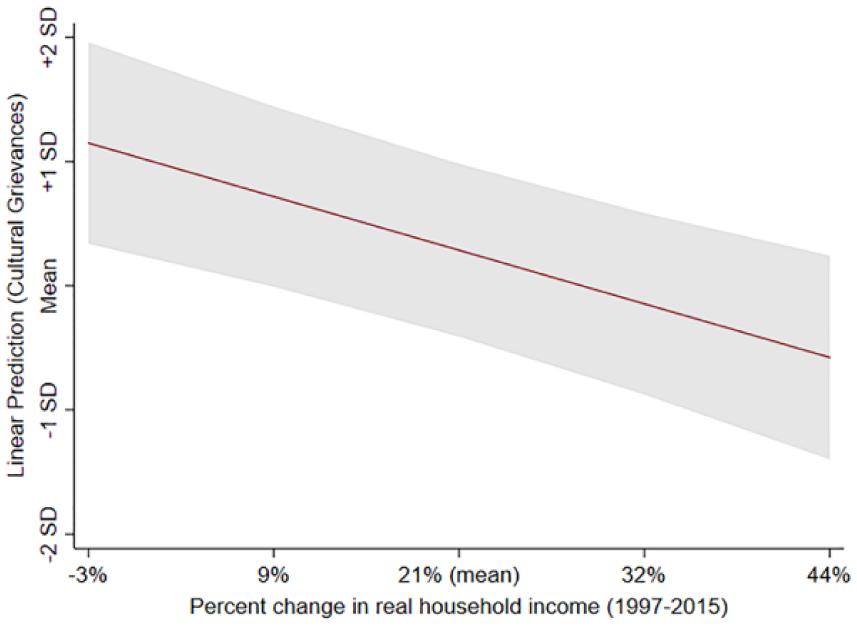
Predicted values of cultural grievances (at different levels of Δ in household income).
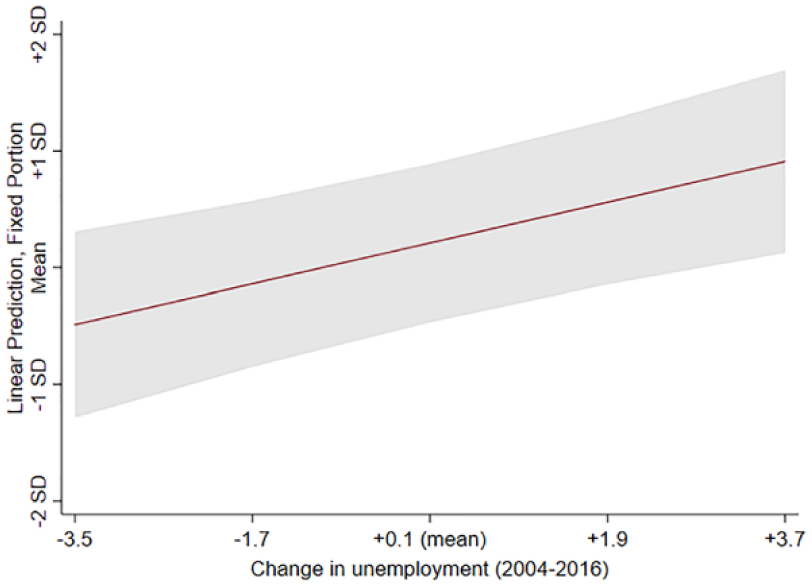
Predicted values of cultural grievances (at different values of Δ in unemployment).
As a robustness check, we replicated the models presented in Table 3 using scales that capture each of the dimensions of the “cultural grievances” indicator (anti-immigration, Euroscepticism, ethnocentrism, and nostalgia). These scales were created using the variables presented in Table A6, and their Cronbach’s alphas range from acceptable to excellent. 9 The results of these robustness models are shown in Tables A10 to A13 in the online appendix, and they are entirely consistent with the findings presented above. There is no robust relationship between short-term economic fluctuations and anti-immigration, Eurosceptic, ethnocentric, and nostalgic attitudes. However, all the models suggest that these attitudes tend to be more prevalent in districts suffering long-term economic decline. Three other individual-level variables (age, education, and social class) are also associated with these “cultural backlash” attitudes. Older, less educated, and working-class respondents are more likely to hold these cultural attitudes. The fact that all these different attitudinal scales are predicted by similar factors lends credence to our assertion that all these attitudes are part of a broader construct, “cultural grievances” (or “cultural backlash”).
We have now established two patterns. First, support for Brexit in the referendum was higher in districts suffering from long-term economic problems. Second, citizens living in localities affected by long-term economic distress tend to hold attitudes associated with a “cultural backlash” (i.e., anti-immigration attitudes, Euroscepticism, ethnocentrism, and nostalgia for the national past). Our theoretical framework suggests that these two patterns are related. But we have yet to demonstrate our key claim. We proceed now to this demonstration.
While the findings reported in Table 3 (and Figures 3-4) suggest that “cultural grievances” are a plausible causal mechanism linking long-term economic decline and support for Brexit, they do not directly show an effect of cultural backlash on the share of the Leave vote in the referendum. Showing causality with cross-sectional observational data is always a challenge, but we estimated a mediation analysis that suggests that cultural backlash is a plausible mechanism that can account for much of the correlation between economic decline and support for Brexit. In this mediation analysis, we used the information from the BES survey to create an average “cultural grievances” score for each district in the United Kingdom.
Because both the mediator (cultural grievances) and the outcome (share of support for Brexit) variables are continuous, the causal mediation analysis is implemented within the framework of linear structural equation modeling (LSEM; e.g., Baron & Kenny, 1986; Judd & Kenny, 1981). A strong assumption (sequential ignorability) must be met to draw causal inferences from mediation models. Sequential ignorability consists of two assumptions: (a) conditional on the observed pretreatment covariates, the treatment is independent of all potential values of the outcome and mediating variables, and (b) the observed mediator is independent of all potential outcomes given the observed treatment and pretreatment covariates (Imai, Keele, & Tingley, 2010; see also VanderWeele, 2015, pp. 24-26). An additional complication is that this assumption is nonrefutable because it cannot be tested with the observed data (Imai, Keele, & Tingley, 2010; Imai, Keele, Tingley, & Yamamoto, 2011). The first strategy to deal with this problem in observational studies is to “collect as many pretreatment confounders as possible so that the ignorability of treatment assignment is more credible once the observed differences in these confounders between the treatment and control groups are appropriately adjusted” (Imai, Keele, & Tingley, 2010, pp. 312-313). Our mediation analyses, therefore, adjust for the same pre-exposure covariates included in the models presented above (Tables 2 and 3). Moreover, in the LSEM framework, Imai, Keele, and Yamamoto (2010) have proposed a sensitivity analysis that makes it possible to check how severe the violation of the sequential ignorability assumption would have to be for the estimation of the average causal mediation effects (ACME) to be biased. We discuss the results of these sensitivity analyses below.
We estimated two mediation models using the full battery of controls. The first model uses change in real household income between 1997 and 2015, and the second one uses change in unemployment between 2004 and 2016 to capture exposure to long-term economic decline. The goal is to estimate a predicted value of the mediator at minimum and maximum values of long-term economic fluctuations (the exposure variable). These predicted values are then used in estimating the share of support for Brexit in the referendum (the outcome variable) to obtain the total effect, the direct effect, and the average causal mediation effect.
The results are shown in Table 4. The total unmediated effect of long-term economic fluctuations is statistically significant. As expected, the coefficient capturing the total effect is negative in the “Δ in real household income 1997-2015” model and positive in the “Δ in unemployment 2004-2016.” However, once we include the mediator variable (cultural grievances), we observe that much of the connection between long-term economic changes at the local level and support for Brexit in the referendum comes indirectly. Anti-immigrant and Eurosceptic attitudes are likely to be higher in economically depressed areas. These cultural grievances are, in turn, significantly connected to the share of support for Brexit in the referendum. The results show large indirect effects with as much as 64% of the effect of long-term change in real household income being mediated through cultural grievances, and 50% of the effect of long-term changes in unemployment being mediated through cultural grievances. 10 Note, however, that there is a statistically significant direct effect of long-term economic fluctuations on support for Brexit, a point to which we later return.
Mediation Analysis.

Confidence intervals of 95% are based on nonparametric bootstrap with 1,000 resamples. Equations were estimated with least squares. The results are computed via the “Medeff” package in Stata (Hicks & Tingley, 2011). ACME = Average Causal Mediation Effect.
The subsequent sensitivity analysis shows that the significant mediation effect of cultural grievances is highly robust to violations of the sequential ignorability assumption. In the “Δ in long-term real household income” model, the ACME (i.e., indirect effect) remains significant at a 95% level as long as the sensitivity parameter ρ is below 0.65. In the “Δ in long-term unemployment” model, the ACME remains significant at a 95% level as long as the sensitivity parameter ρ is below 0.69. Moreover, in both models, an omitted confounder would have to explain at least 65% of the remaining variance in the mediator and 65% of the remaining variance in the outcome for the ACME to be zero. The full results of the sensitivity analysis are presented in the appendix (Table A14 and Figure A2).
Conclusion
Recent political developments in advanced democracies (Brexit, the Trump election, the increasing electoral appeal of populist parties in Europe) have generated a fierce debate. While some scholars argue that economic grievances among the “losers of globalization” are at the root of these political changes, other works suggest that recent political developments result from a cultural backlash against immigrants and internationalism. This debate is very prominent in the academic literature on Brexit. While previous works have shown that contextual economic factors predict aggregate support for Brexit at the district level, other studies demonstrate that individuals with anti-immigrant and Eurosceptic attitudes are more likely to be in favor of leaving the European Union. However, these two literatures often talk past each other, which has led to theoretical explanations of Brexit that are unsatisfactory or incomplete. One of the contributions of this article is to point out that it is mistaken to draw too great a distinction between economic and cultural factors because the two factors are closely related. Our article, thus, contributes to a growing effort to call attention to the different ways in which economic and cultural grievances interact (Ballard-Rosa, Malik, Rickard, & Scheve, 2017; Cherlin, 2018; Colantone & Stanig, 2018a, 2018b; De Vries, 2018; Green et al., 2018; Jennings & Stoker, 2016; Magni, 2018; Morgan, 2018). Economic and cultural explanations can be distinguished for analytical purposes, but it is important to incorporate the interplay between economic and cultural factors in theoretical accounts of political events of such magnitude as the Brexit referendum and the Trump election.
In this article, we argue that both economic and cultural factors shape Brexit but they matter in a different way. Our theoretical framework postulates that regional economic inequalities are critical to explain the emergence of cultural grievances. People who live in districts that have suffered long periods of economic decline are more likely to adopt anti-immigrant and Eurosceptic attitudes. Those attitudes, in turn, are key predictors of support for Brexit. We should, therefore, not infer from individual-level models that tend to show more robust coefficients for cultural attitudes than for economic evaluations that economic conditions do not matter for Brexit. A second contribution of this project, then, is to highlight the fact that the economic context in which citizens live and work is important. For the case of Brexit, the context provided by the local (not national) economy over a long period of time (rather than just the year prior to the vote)—provides a key antecedent condition that shapes the attitudes that have been shown to predict Brexit at the individual level. Of course, these results do not imply that economic distress is the only reason for the recent rise of nativist and Eurosceptic attitudes. These cultural grievances might never completely disappear even under the best economic circumstances. But long-term economic distress might lead to a sense of despair that makes citizens more likely to accept political messages that blame in a rather simplistic way certain groups (e.g., immigrants or refugees), foreign countries (e.g., China), or international institutions (e.g., the European Union) for very real economic problems.
The findings of this article also contribute to our understanding of electoral politics in the current period. Studies that emphasize that voters who hold nativist, anti-immigrant, and ethnocentric views are to blame for the rise of populist and nationalist political movements can generate complacency among the liberal democratic establishment. If citizens support Trump, Le Pen, or Brexit because they are inherently xenophobic or racist, then it becomes easier to disregard their grievances. However, our study shows that this cultural backlash is a result of long-term inequalities in economic performance between areas benefiting from structural economic changes (e.g., globalization and automation) and regions engulfed in a long-term economic decline. Our analysis suggests that addressing the roots of this discontent and adopting targeted economic policies that help the regions (and citizens) left behind by economic changes is essential if liberal democratic forces want to limit the rise of nationalist and populist politicians. Examples of such policies include improving the infrastructure of declining regions, developing opportunities for public-sector investment in economically depressed areas, and helping educate and retrain workers “left-behind” by economic transformations (Coyle, 2017; Shen, 2017).
The empirical models deliver results that are consistent with our theoretical claim that cultural grievances mediate the association between long-term economic decline and the share of support for Leave in the referendum. However, there remains a smaller but statistically significant direct effect of long-term economic fluctuations on support for Brexit. This might be due to the fact that sustained economic problems shape voters’ propensity to take risks. Leaving the European Union was presented to the voters by the Remain campaign as a gamble that could make the United Kingdom poorer and isolate it from large international markets (H. D. Clarke et al., 2017a). Prospect theory tells us that people who are in the domain of losses are more likely to take risks (Kahneman & Tversky, 1979), and this framework was used to explain popular support for neoliberal policies in Latin America in the context of economic collapse (Weyland, 1996, 1998). It is possible that voters in the United Kingdom who lived in economically depressed areas took the risk of Brexit because they were clearly not benefiting from the status quo. This would be an interesting avenue for further research on the economic causes of Brexit.
Supplemental Material
appendix_R1_final – Supplemental material for Long-Term Economic Distress, Cultural Backlash, and Support for Brexit
Supplemental material, appendix_R1_final for Long-Term Economic Distress, Cultural Backlash, and Support for Brexit by Miguel Carreras, Yasemin Irepoglu Carreras and Shaun Bowler in Comparative Political Studies
Supplemental Material
CPS_Carrerasetal_aggregate_dofile – Supplemental material for Long-Term Economic Distress, Cultural Backlash, and Support for Brexit
Supplemental material, CPS_Carrerasetal_aggregate_dofile for Long-Term Economic Distress, Cultural Backlash, and Support for Brexit by Miguel Carreras, Yasemin Irepoglu Carreras and Shaun Bowler in Comparative Political Studies
Supplemental Material
CPS_Carrerasetal_survey_dofile – Supplemental material for Long-Term Economic Distress, Cultural Backlash, and Support for Brexit
Supplemental material, CPS_Carrerasetal_survey_dofile for Long-Term Economic Distress, Cultural Backlash, and Support for Brexit by Miguel Carreras, Yasemin Irepoglu Carreras and Shaun Bowler in Comparative Political Studies
Footnotes
Declaration of Conflicting Interests
The authors declared no potential conflicts of interest with respect to the research, authorship, and/or publication of this article.
Funding
The authors received no financial support for the research, authorship, and/or publication of this article.

Notes
Author Biographies
References
Supplementary Material
Please find the following supplemental material available below.
For Open Access articles published under a Creative Commons License, all supplemental material carries the same license as the article it is associated with.
For non-Open Access articles published, all supplemental material carries a non-exclusive license, and permission requests for re-use of supplemental material or any part of supplemental material shall be sent directly to the copyright owner as specified in the copyright notice associated with the article.
