




Abstract
During the Middle Ages, most European polities operated under a norm that gave only the close male relatives of a monarch a privileged place in the order of succession. When no such heirs were available, succession disputes were more likely, with distant relatives and female(-line) heirs laying competing claims to the throne. These disputes often produced conflicts that destroyed existing institutions and harmed subsequent economic development. A shortage of male heirs to a European monarchy in the Middle Ages could thus have harmful effects on the development trajectories of regions ruled by that monarchy. We provide evidence for this by showing that regions that were more likely to have a shortage of male heirs are today poorer than other regions. Our finding highlights the importance of the medieval period in European development and shows how small shocks can work in combination with institutions and norms in shaping long-run development paths.
Keywords
Introduction
A large body of scholarship argues that the process of political and economic development is path dependent. Most works in this “historical institutionalism” literature focus on studying the consequences of large, often deliberately initiated, macro-historical events that took place at certain “critical junctures” in shaping long-run development trajectories. 1 Some of this work, however, also points to the possibility that even small contingent events can produce path dependent outcomes. Paul Pierson, for example, writes that “path dependent arguments based on positive feedback suggest that not only ‘big’ events have big consequences; little ones that happen at the right time can have major consequences as well” (Pierson, 2000, p. 263). Despite this, empirical studies of the large, long-term consequences of such small contingent events have been relatively scarce. This article contributes one such study.
Our focus in this article is on the development of state institutions in medieval Europe, and how accidents of royal births—in particular, the availability of male heirs to the monarchs of medieval Europe—contributed to producing a variation in the success or failure of early state-building efforts. The effects of this variation appear to have lasted and can be seen in contemporary differences in development levels across Europe, overlaying other, better known dimensions of economic variation within the continent.
The link between royal births and medieval state development emerges from a simple theory connecting political gender bias and succession norms to political conflict and its consequences for state-building. During the medieval period, most polities operated under a norm that gave the close male relatives of the ruling monarch a relatively clear place in the line of succession, but often did not specify clear succession rules for female (and female-line) heirs. A shortage of male heirs could, therefore, destabilize the polity by creating conflict among the nobility, rival relatives, and opportunistic foreigners. In many cases, more distant male relatives would claim the throne over closer female or female-line relatives, leading to a succession dispute. These disputes often turned into violent wars. These wars in turn had harmful effects on the polity’s long-term development, by destroying existing state institutions and reducing political cohesion. It is also possible that ruling families and local elites in areas ruled by monarchs with relatively few close male relatives anticipated such conflict and became less willing to invest in building a strong and cohesive state in the first place. Both this underinvestment, and the damage caused by violent conflict, had a detrimental effect on contemporaneous and subsequent state development.
In areas with one or more potential male heirs, on the other hand, the high level of political stability afforded by a series of unambiguous and uncontested successions enabled certain polities to establish strong and lasting state institutions, making them more resistant to internal conflict and foreign influence, and even enabling them to conquer and exploit other less politically stable areas. Paris is one of Europe’s most prosperous metropolises today in part because it enjoyed the uninterrupted reign of a single dynasty for more than three centuries from 987 to 1316AD (Lewis, 1981). It was in this period that Capetian monarchs laid the foundations of the modern French state with their city as its capital. Naples, by contrast, was a more prosperous city than Paris in the early Middle Ages, but lost ground due to a series of destructive civil wars brought on by succession-related conflicts (Jones, 2000). Our theory provides a new explanation for this reversal.
Our main empirical findings demonstrate the path-dependent effects of the uneven nature of state-building in medieval Europe arising from the (un)availability of male heirs. Regions of Europe that were ruled by medieval monarchs who had an abundance of male heirs are today richer than other regions. These effects can also be traced over time: Urban density in each century between 1300 and 1800 was higher in regions that had an abundance of male heirs. In addition, we find that an abundance of male heirs decreased the frequency of internal wars and coups, and that contemporary economic development is negatively correlated with the occurrence of these violent medieval events, lending further support to our theory. To allay some concerns about endogeneity, we also conduct a placebo test that shows that availability of illegitimate male children (those who did not have claims to succeed the throne) does not predict prosperity today.
Authors such as Strayer (1970) and Tilly (1992) have argued that European polities began to develop state institutions in the period between 1000 and 1500, but that some polities built stronger and more durable states than others. Tilly (1992), in particular, highlights the destructive impact of internal wars and political instability on medieval state-building in Europe. In addition, Migdal (1988), Herbst (2000), and Besley and Persson (2011) have argued that strong state institutions, at both the local and central level, are essential for economic development. Our article provides evidence for these claims by identifying an aspect of medieval politics that is both readily measurable and has direct theoretical links to medieval state-building efforts (the availability of male heirs) and documenting its lasting effects on contemporary development.
Our work also relates to a vast literature that argues that societal and economic conditions preceding the period of Western industrialization played an important role in shaping the development paths of European polities. By focusing on pre-1500 conditions and the role of historical norms and prejudices in shaping long-run outcomes, our article contributes to a lively debate on how far back the different development trajectories of modern societies are discernible and what caused these divergent paths in the first place. Some scholars, such as Pomeranz (2009) and Acemoglu, Johnson, and Robinson (2002), for example, have argued that development trajectories became well-defined only in the post-1500 period and really only after the Industrial Revolution. Others, such as Maddison (2007), Putnam, Leonardi, and Nanetti (1994), Guiso, Sapienza, and Zingales (2016) and Chaney (2014) have argued that pre-1500 conditions also played an important role in setting the development trajectories of many European polities. While some of these authors (e.g., Acemoglu, Johnson, & Robinson, 2005) highlight the persistence of institutions in explaining development paths, others emphasize the importance of culture and social norms (e.g., Guiso et al., 2016). By stressing the importance of historical norms and prejudices in shaping institutional paths, our article brings together these two perspectives. 2
Theoretical Background
We connect contemporary development to the availability of male heirs to medieval European monarchs via conflict, political instability, and state-building. The theory is schematically summarized as follows:

As we document below, a rich literature provides support for the second and third links above: that political instability and conflict are harmful for the development of state institutions, and strong states are important for economic development. We briefly review this literature. We then provide theoretical background to the first link in the chain above between male heirs and conflict.
Conflict, State Building, and Development
The medieval period has long been recognized as a pivotal one for the growth of state institutions. Tilly (1992) and Strayer (1970) emphasized the importance of the medieval period for the development of durable state institutions in Europe. In turn, Migdal (1988), Evans (1995), and Herbst (2000) argued the importance of state building for economic development. According to this literature, developing state institutions that are capable of providing market-supporting public services, law enforcement, and protection of private property rights, is essential for laying the foundations to economic prosperity. 3
The Middle Ages are a period where the link between state building and long-run economic development is likely to have been especially strong as it was during this period that many of the basic conditions for modern states were being created, or failing to be created. Examples of the achievements of successful medieval states include the reduction of the ability of petty lords to levy arbitrary taxes and customs duties (North, 1973), the reduction in violence, especially the so called “private wars” within the borders of the state (Tilly, 1992), and the development of court systems that improved legal institutions (Harding, 2002). These developments made investments in economic activity more attractive by reducing the possibility of expropriation by greedy locals, bandits, and corrupt royal officials. Protection from a large coercive monopolist with long-term interests made obsolete many of the ad hoc techniques that medieval traders had developed to protect against these types of expropriation (Greif, 1993; Milgrom, North, & Weingast, 1990). 4 Complementary to the literature on state development, Bates (2001) argued that while having a strong state is important for development, building state institutions in the presence of political instability and conflict can be challenging. 5 In the face of high instability, rulers know that they could be ousted at any time and have little incentive to invest in state-building. And, in the presence of frequent conflict, their incremental investments would be periodically destroyed anyway. 6 These arguments give us a basic relationship between state capacity and development that has been summarized and extended formally by Besley and Persson (2010). We rely on their work as well as the previous literature to justify the second and third links of the theory represented by schematic diagram above, with two important additions.
First, previous work has focused on the argument that internal conflict and political instability reduce investments in state capacity in turn reducing economic investments. In many models of conflict and state capacity, such as that of Besley and Persson (2010), violent internal conflict does not have any direct destructive impact on state institutions or development outcomes; it simply diverts resources away from productive activities. In addition to this, we suggest the possibility that such conflict damages existing state institutions as well and therefore hurts development via this second, more direct, channel. 34
Second, most previous work on state capacity and development provides only a proximate theory of the impact of state capacity on development. Nevertheless, differences in state development that arose in the distant past are likely to have persisted, making it possible in our context that European polities in which conflict destroyed or stunted the development of the state in the medieval period have persistently lagged behind those in which such conflict did not destroy state institutions as severely. This view is consistent with an influential literature that argues that historical institutions are generally very persistent and their development over time tends to be incremental (Acemoglu et al., 2005; North, 1990).
Male Heirs, Conflict, and Political Instability
Our theory is that the availability of male heirs affected the likelihood of conflict, and subsequently development, in the (a) cultural context of political gender bias, and the (b) institutional context of weakly specified succession rules. That is, if we view the availability of male heirs as being largely contingent (i.e., reflecting luck) then the main theoretical contribution of our work is that luck works in combination with both culture and institutions in shaping development paths.
In nearly all of medieval Europe, inheritance practices contained a strong element of gender bias, preferring male heirs over female heirs and male lines of descent over female lines. 7 While matrilineal inheritance systems are common in some parts of Africa, Southeast Asia, and pre-Columbian America (Hartung, 1985), they were virtually unknown in premodern Europe, a continent that is also noted for having had a strong promale gender bias relative to other areas of the world (Alesina, Giuliano, & Nunn, 2013; Boserup, 1970). European aristocracy felt strongly that women would be incapable of exercising military power, and that a married woman would be heavily influenced, if not controlled, by her husband (Jansen, 2002; McLaughlin, 1990). Moreover, certain polities of the former Carolingian Empire that practiced “Salic law” outright prohibited inheritance through female lines of descent (Herlihy, 1962; Potter, 1937). Under these prejudices, it is not surprising that the availability of male heirs would be important for guaranteeing peaceful and smooth successions.
In addition, and despite such cultural gender bias, political stability in medieval European monarchies was closely tied to the succession procedures of the regime, with clearer succession procedures reducing instability (Herz, 1952). Kokkonen and Sundell (2014) have shown, for example, that the transition to primogeniture-based inheritance systems in medieval Europe was associated with increases in leader tenure and overall political stability. They trace Europe’s transition from agnatic systems of succession and selection by assemblies to a system of male-preferred primogeniture, which gives priority to the firstborn son of the monarch but allows female(-line) heirs to inherit the throne when direct male heirs are not available (Ward, 2014). 8 They document, however, that no matter which system was used, the nobility were rarely perfectly coordinated on the succession order, and the polity would experience a great deal of conflict and instability resulting primarily from competing claims to succession. For example, the throne might be claimed by living daughters and their husbands, or more distant relatives, who would cite various conflicting inheritance rules as justification. 9 The Hundred Years War is perhaps the best known historical example of a succession-related conflict. The central issue of the war was whether the French throne descended by primogeniture to Joan II of Navarre, half-sister of the deceased King John I (the Posthumous) and subsequently to Edward III of England; or whether Salic law prohibited this inheritance through a female-line, making John’s uncle, Phillip of Poitiers, the rightful heir (Sumption, 2009). 10 In fact, it is difficult to point to any part of the continent where the lack of a close male heir was not associated with a destructive war arising from such competing claims. In the online supplemental appendix, we provide a list of 18 known cases where the death of a king without any male heirs led to a civil war in which a disputed succession was unequivocally the main issue.
The importance of institutionalized succession rules points to the central place that coordination problems play in political organization: After a ruler dies, the nobles (and other members of the polity, more generally) must find a way to coordinate around a successor if they are to avoid conflicts arising from succession disputes (Kokkonen & Sundell, 2014; Kurrild-Klitgaard, 2000; Tullock, 1987). It also suggests that a shortage of male heirs should affect conflict and instability less—and therefore have a smaller effect on contemporary development—in polities where succession norms are more strongly institutionalized. Where succession rules are well-defined, the ambiguity in succession caused by a lack of males is much easier to resolve. For example, most regions in our study eventually institutionalized male-preferred primogeniture as their succession norm, and the effect of the availability of male heirs should be weaker in polities that were early adopters of this norm. In fact, inheritance norms such as primogeniture might themselves have become stronger in places where the abundance of male heirs limited the frequency with which the norm was challenged, in turn reinforcing the norm. We explore a number of these implications in the later part of the article. However, the main implication of our theory, which we explore first, is that due to the political gender bias against female(-line) succession, and the weak institutionalization of inheritance practices that pervaded all of Europe in the Middle Ages, the availability of male heirs should have affected the success of medieval state building efforts through its effect on conflict; and thus it should have had a long-run effect on development.
Contrasting Examples: Naples and France
One of the most striking examples of how violent conflict could destroy even a highly organized polity comes from the experience of Naples. According to Takayama (1993), the Norman Kingdom of Sicily was one of the best governed medieval polities in the 12th century with some already strong state institutions, such as a large bureaucracy and tax gathering apparatus, that drew on preexisting Arab and Byzantine traditions. This view is consistent with that of Abulafia (1988) who describes how the liber augustalis of Frederick II enshrined a set of limitations on aristocratic and urban power that were remarkable for their time, including a ban on wearing arms in public, a ban on the sale of fiefs, depriving the barons and towns of the right to administer justice, and subjecting clerics to the royal courts.
In the next 300 years, however, the Neapolitan state was comprehensively destroyed by a series of civil wars brought on by a shortage of male heirs. Six of its monarchs died without sons during the Middle Ages, leading to three destructive periods of political instability. These wars not only disrupted the operations of the central bureaucracy, but also allowed the aristocracy to win back some of their autonomy (Jones, 2000). Female inheritance provides the backdrop to the final and most destructive series of conflicts, which began in 1343 when King Robert died without any living sons, leaving the throne to his grand-daughter Joanna. This led to a series of conflicts between Joanna and the descendants of the more distant male line heirs and efforts to resolve the uncertainty by marrying the queen to one of them. These efforts were not successful: Both of Joanna’s first two marriages were marked by intrigues by the husbands against her, and contemporaries accused Joanna of the murder of her first husband, Andrew of Hungary. The result was a complicated series of at least four revolts and pacifications intertwined with the rivalries of the Neapolitan nobility, as well as with the contending claims of two rival popes. 11 The conflict lasted even after Joanna was strangled in prison in 1381, by which time the division between supporters of her claim—eventually vested in the kings of France, and the male-line Durazzo claim, eventually vested in the kings of Aragon—ran deep within the kingdom’s political class. In the next century and a half, the two factions would conduct five successful coups, usually with the support of foreign money and mercenaries. During this period, the nobility regained most of the autonomy that they had lost in the 12th and 13th centuries. 12
The persistence of the institutional weakness in Southern Italy relative to Northern Italy well after 1500, and its close correlation with medieval political history, is a pattern for which there is a good deal of evidence, both quantitative and qualitative (Guiso et al., 2016; Putnam et al., 1994). There are several plausible reasons for this: For instance, levels of social trust appear to be lower in the south (Banfield, 1967; Putnam et al., 1994), and lower trust is a well known legacy of violent conflict (Colletta & Cullen, 2000) and extractive instability (Nunn & Wantchekon, 2011). One other factor worth mentioning is the persistent political power of the aristocracy well into the 20th century, in particular their maintaining local political fiefs with little interference from central authority, much as they had in the medieval period. Astarita (2002, p. 1), in his remarkable study of the “‘continuity of feudal power” in Brienza, found that the local lords for three centuries “owned land there, they levied fees, they administered justice, they controlled local trade, they were involved in every aspect of the life of their subject population,” and that feudal powers were more “widespread, pervasive and influential” in Naples and Sicily than in any other part of Italy (p. 19).
The experience of Naples can be contrasted to the experience of the Ile-de-France, which enjoyed the exceptional stability of its royal family for more than three centuries from 987 to 1316AD. Every Capetian king was succeeded by an adult son in this period, a run of genetic good luck unparalleled in all of Europe. Historians, such as Lewis (1981), have argued that dynastic stability was a key factor in the rise of the Capetians from a regional power in the Ile-de-France to become the rulers of a centralized state covering much of Western Europe. Not only were the Capetians spared the problem of internal conflict, but also the stability of their dynasty put them in an advantaged position to expand their holdings by marrying their sons to the female heirs of their neighbors. This enabled them to acquire the territories of several rulers who had once rivaled them in wealth and power, including the Counts of Toulouse (1271) and Champagne (1314).
The territorial growth of the French royal domain was accompanied by a series of institutional changes that took place within the domain as well. Baldwin (1991), for example, explains how 11th-century France, like most medieval polities, contained a confusing mass of conflicting political authorities—aristocratic, clerical, and urban—all claiming the right to tax, administer justice, make war, and regulate trade. These claims were difficult for the royal authorities to limit, both because of a lack of a permanent royal administrative presence in the provinces and because many of these petty lords possessed fortified bases. Baldwin documents how in the 12th and 13th centuries, the Capetians, most notably Philip II Augustus, moved vigorously to limit the power of these rulers, seizing the castles of recalcitrant lords, basing permanent royal representatives (the ballis) in the major towns, and by institutionalizing a waiting period to prevent the escalation of private disputes into destructive wars before being diverted into the royal courts (via the quarantaine de la roi).
The end of French good luck came after Charles IV died leaving no close male heirs in 1328. The resulting disputes for the French throne between the Dukes of Valois (Charles’s closest male-line heirs) and kings of England (who held a closer, but female-line claim) resulted in the Hundred Years War. This was, nevertheless, the only failure in the male line of the French monarchy between 987 and 1498AD.
The most persistent legacy of the power of the Capetian kings was a relatively centralized state based in Paris—a legacy that was not altered by France’s subsequent history. As their medieval predecessors had already done much of the work of eliminating the power of feudal aristocrats and appenaged princes, it was easier for their Early Modern predecessors (notably Louis XIV and Cardinal Richelieu) to complete their work, subordinating the aristocracy to the state by incentivizing them to be oriented toward the court and the royal service rather than their estates, and replacing their local authority by that of royal officials (Beik, 1985). The relative ease of this achievement stems from the fact that the largest and most independent princes, such as the Valois Dukes of Burgundy, had been defeated centuries before. Many other direct continuities can be traced between the relatively strong institutions of the medieval French state and institutions of the contemporary one. Perhaps the most interesting is the French Army, which is descended directly from the creation of the modern West’s first standing army, the compagnies d’ordonnance, by the Valois kings.
Data and Empirical Strategy
Ideally, we would test our theory by collecting a full data set of succession disputes that were caused by the absence of a male heir, but it is impossible to assemble the universe of succession disputes let alone code their main causes. Estimating the effect of these succession disputes on contemporary development would then require us to find an exogenous source of variation in their likelihood as succession disputes are likely to be correlated with various regional characteristics that directly affect development. In light of these limitations, we therefore adopt a more indirect approach in which we estimate the reduced form of relationship between factors that drive succession disputes (mainly through the availability of male heirs) and contemporary development. We then present supporting evidence that the estimated relationship reflects our mechanism.
To measure contemporary development, we use the Log of GDP per capita, adjusted for purchasing power, and averaged across 2007 to 2009. These data are from the quality of government (QoG) EU Regional Database and are measured at the largest subnational (Classification of Territorial Units for Statistics [NUTS]) level by the European Union (Charron, Dijkstra, & Lapuente, 2014). 13
The majority of modern European regions can be associated with a single ruler for most years between 1000 and 1500AD. We collected data on 812 unique rulers who reigned in this 500-year period, and associated each to regions for all years in which he or she controlled approximately all of the region that year. 14 For each ruler, we collected data on the numbers of legitimate and illegitimate male and female children, how many of each died as infants, how many were alive at the time of the ruler’s death, and on how each ruler was replaced. Our coding is based primarily on McNaughton (1973), Morby (1989), and the Hull University Directory of Royal Genealogical Data. Royal genealogies are one of the few data sources of medieval society that were recorded with some regularity, and overall, we are missing data on only 5.5% of region-years.
We focus on the period 1000 to 1500AD because data on the children of monarchs are scarce prior to 1000, and European polities already begin to resemble much more institutionalized territorial states after 1500. These more institutionalized states, with their written succession laws and control over the nobility, should be less vulnerable to instability caused by a lack of male heirs, though the shortage of male heirs remained a common (but, by comparison, less important) source of territorial conflict in Europe until the 19th century. 15
We used these data to construct several measures of the likelihood of the availability of male heirs to the rulers of each region for the period 1000 to 1500AD. Perhaps the most straightforward way is to consider the number of times a monarch died or was replaced without a (legitimate) male heir—an inverse measure of the independent variable. Another way is to take the total number of male heirs of a monarch who were alive at the time of the monarch’s death or replacement, and sum this number over monarchs who ruled in the 500-year period. A third way is to construct the weighted average number of male heirs to each monarch, using the lengths of the monarchs’ reigns as weights. A fourth way is to consider the fraction of years that the region was ruled by a monarch who had a living male heir. A fifth measure is the fraction of males among all legitimate children of all monarchs who ruled the region in the 500-year period. We refer to this measure as “percent male” and depict it in Figure 1. Finally, a sixth measure is the fraction of firstborn legitimate children of a region’s monarchs who were male. All of these six measures are correlated (in the right way) with each other.
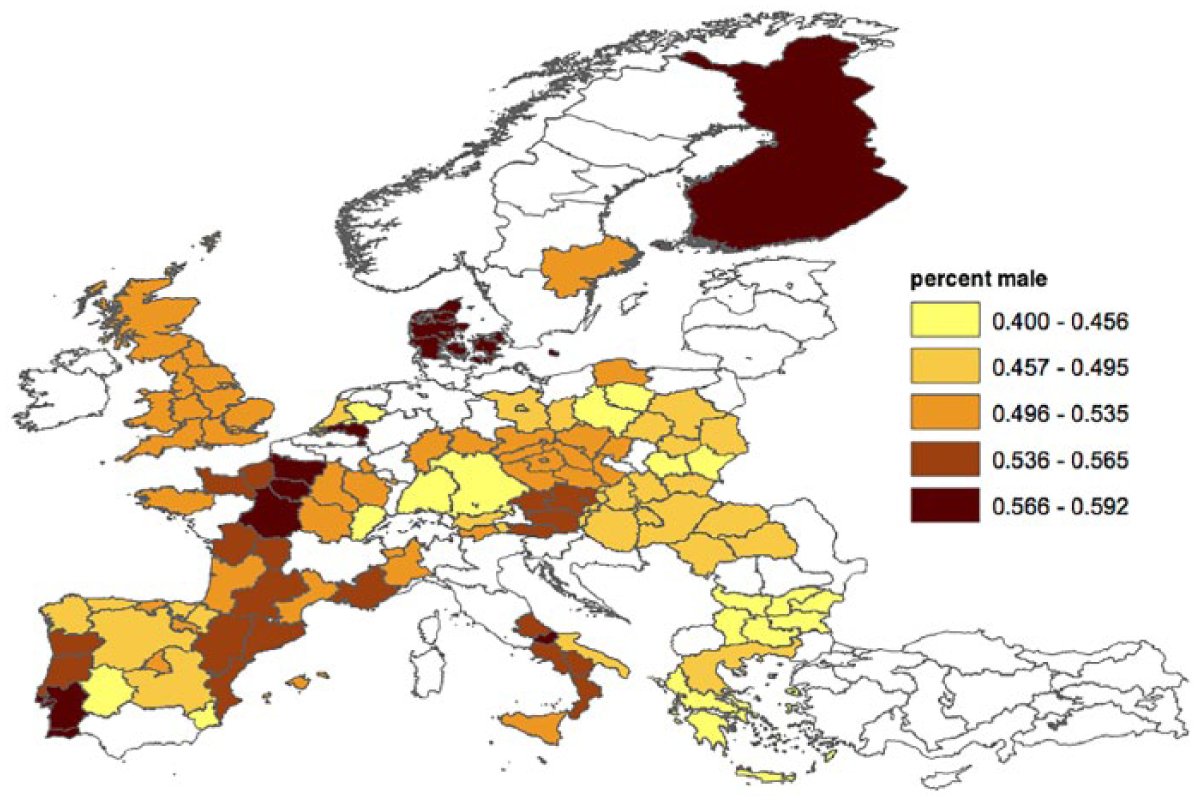
Shaded regions show the proportion of males among the legitimate children of rulers in the period 1000 to 1500AD.
Each of these measures has advantages and disadvantages. While the number of monarchs who died without heirs closely captures our theory, it is endogenous to royal birthrates and death rates and thus to the existing characteristics of regions. For similar reasons, we have not discussed two additional variables that are endogenous to local political patterns: the availability of brothers and the age of monarchs when they inherited. 16 Percent male, which is a noisier measure of the treatment variable, is however only influenced by the gender ratio at birth.
Our empirical approach assumes that political actors across Europe faced fairly similar political conflicts. Therefore, to create our baseline sample, we excluded the following region-years from the data: (a) region-years in which the region was controlled by multiple rulers, usually because they were divided among several petty lords or because the modern political boundary cuts across a medieval one; (b) region-years in which the region was not ruled by traditional monarchs, but rather by the church or by urban republics, or was populated by unorganized tribal groups; and (c) region-years in which the region was controlled by Muslims who had very different inheritance and marriage practices than non-Muslims in Europe (Blaydes & Chaney, 2013). 17 After excluding these region-years, some regions have very few years of data, so we excluded regions with less than 200 years of data to avoid basing our inferences on regions where the consequences of (Christian) monarchy were historically unimportant. In the online supplemental appendix, we show that our results are robust to varying this threshold.
Finally, in arguing that the long-term consequences of medieval inheritance practices have persisted over time, we have implicitly assumed that there is some level of continuity in the population of European regions between that time and ours. In seven regions of contemporary Poland and the Czech Republic, we know this assumption to be false. 18 These regions were populated by German speakers (and ruled by Germanic rulers during the Middle Ages) but their entire populations were forcibly removed after World War II and replaced by Poles and Ukrainians (Schechtman, 1953). Given a population change of nearly 100%, we have no reason to expect that medieval events could affect contemporary outcomes in these areas by either cultural or institutional means. Therefore, we exclude these regions from the main analysis. This gives us 114 regions, which constitute our baseline sample. These, along with the seven omitted regions, are depicted in Figure 1. Summary statistics for all of the data used in this article are provided in online supplemental appendix, Section A.1.
Results
Baseline Estimates
Table 1 presents coefficient estimates from ordinary least squares (OLS) regressions of the effect of each of our six measures of the independent variable on contemporary GDP per capita. In addition to the conventional standard errors, Table 1 also reports standard errors clustered at the level of what we call a “macro-polity.” As our unit of analysis is defined by modern region boundaries, these modern regions cannot be considered the unit of treatment. In particular, single medieval rulers often ruled over multiple modern-day regions, suggesting that the treatment was assigned at units larger than the modern region. For example, the three observations in Walachia that enter our data set all have the same values of our independent variables because all three of these regions were ruled in the medieval period by the same sequence of monarchs. The same is true for the eight observations in Hungary and the five observations in Denmark. Even areas with different sets of monarchs in different periods are not fully independent of each other because of their shared membership in supra-local political units like the Holy Roman Empire, “France,” or “Poland.” Therefore, to partially account for this dependence, we classified every modern region as belonging to a particular “macro-polity” that existed at the start of the period of our analysis. 19 The key upside to clustering errors at the macro-polity level is that the borders of these macro-polities are stable, unlike the borders of the medieval polities (see Section 5.2); and, although different rulers ruled over different sets of regions, most of them ruled over regions that belong to a single macro-polity. The downside is that even the macro-polities are not exactly the unit of treatment, and we have only 14 clusters, so even if the macro-polities corresponded perfectly to the unit of treatment, these standard errors may be downward biased. Therefore, to partially address this concern, Table 1 reports standard errors estimated using the block bootstrap method as well (Angrist & Pischke, 2008, pp. 319-323).
Baseline Results With Alternative Independent Variables.
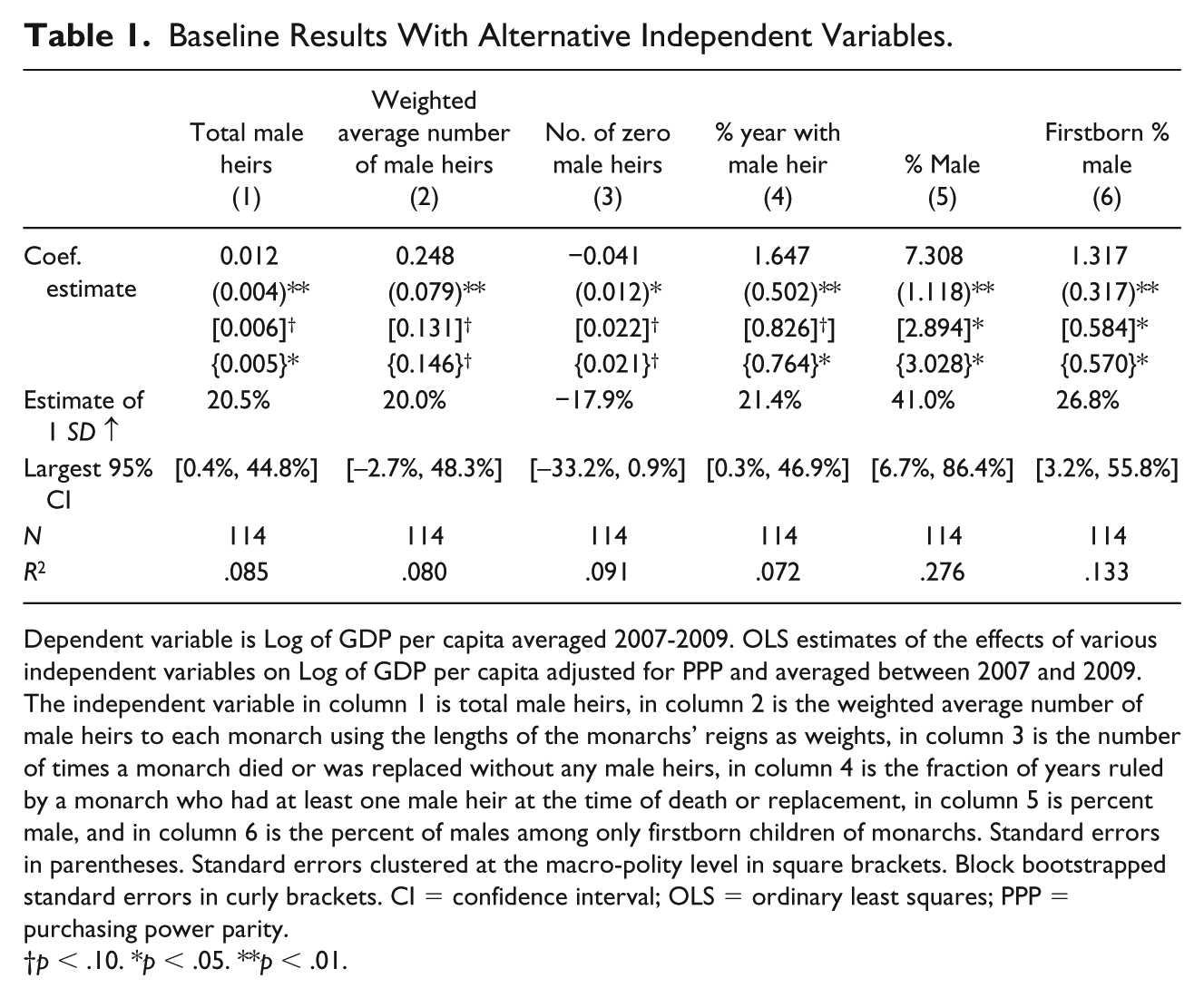
Dependent variable is Log of GDP per capita averaged 2007-2009. OLS estimates of the effects of various independent variables on Log of GDP per capita adjusted for PPP and averaged between 2007 and 2009. The independent variable in column 1 is total male heirs, in column 2 is the weighted average number of male heirs to each monarch using the lengths of the monarchs’ reigns as weights, in column 3 is the number of times a monarch died or was replaced without any male heirs, in column 4 is the fraction of years ruled by a monarch who had at least one male heir at the time of death or replacement, in column 5 is percent male, and in column 6 is the percent of males among only firstborn children of monarchs. Standard errors in parentheses. Standard errors clustered at the macro-polity level in square brackets. Block bootstrapped standard errors in curly brackets. CI = confidence interval; OLS = ordinary least squares; PPP = purchasing power parity.
p < .10. *p < .05. **p < .01.
In what follows, we adopt column 5 of Table 1 as our “baseline specification.” The challenge with the independent variables used in the first four columns is that they may vary significantly with unobservable characteristics of regions that affect family size and survival rates, which in turn may directly affect development. The measures used in columns 5 and 6 are much less likely to be affected by these confounders. For example, we show in the online supplemental appendix, Section A.1 that the percent male variable is balanced across a variety of region characteristics. 20 We also provide some additional evidence in the online supplemental appendix, Section A.2 that the effect of environmental factors on sex ratios is unlikely to be accounting for the effect of percent male on contemporary development. 21 Nevertheless, between the last two measures (percent male and firstborn percent male), we face a tradeoff. Whereas firstborn percent male cannot be affected by endogenous stopping rules, percent male can—though it is unlikely that it would be heavily affected as it is an average over many children. On the other hand, percent male is a less noisy measure of the availability of male heirs than is firstborn percent male, which accounts for the fact that the measured effect in column 6 is attenuated in comparison with that of column 5. 22 As we find limited evidence for stopping rules in the online supplemental appendix, Section A.3, we resolve this tradeoff in favor of the percent male measure. Figure 2 shows the bivariate relationship between percent male and GDP per capita with units labeled by their NUTS region code.
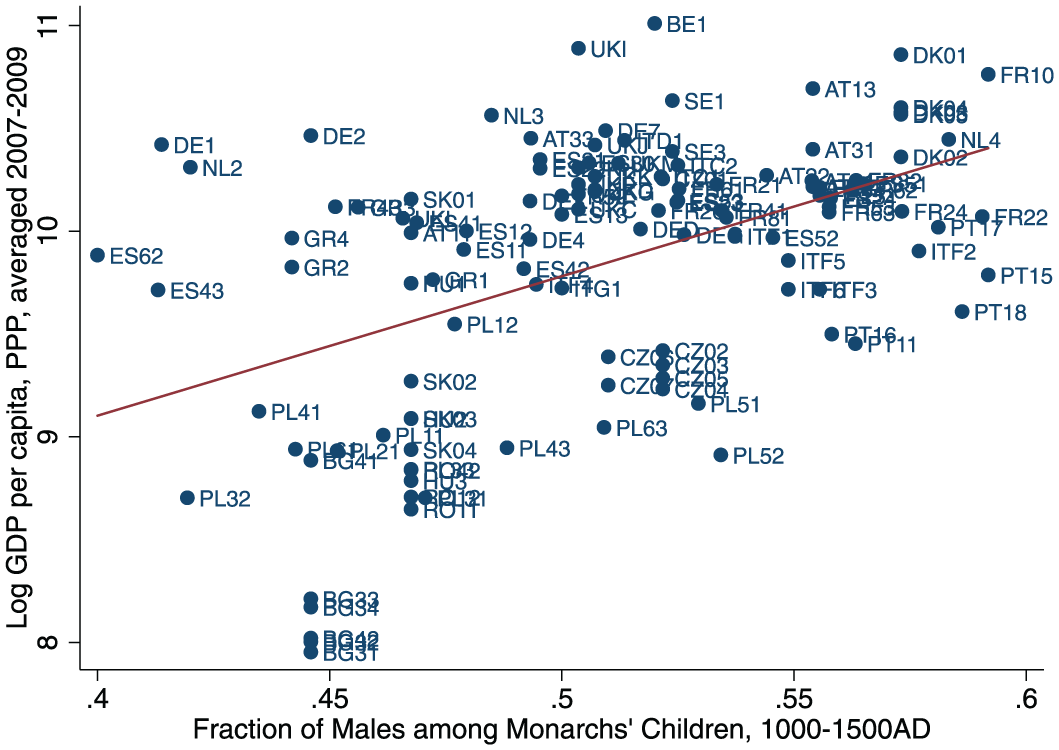
The fraction of males among all legitimate children of monarchs in the period 1000 to 1500AD plotted against Log of GDP per capita adjusted for purchasing power and averaged between 2007 and 2009.
Table 1 indicates that no matter how we measure it, the likelihood of having male heirs appears to have a substantial—albeit, very imprecise—positive effect on contemporary GDP per capita. For example, the point estimate for the effect of a 1 SD increase in percent male (roughly 0.047) is a rise in GDP per capita of 41.0%, but it is more important to emphasize the large 95% confidence interval for this estimate (taking the largest estimate of the standard error) of [6.7%, 86.4%]. Similarly, a 1 SD increase in firstborn percent male (roughly .180) is associated with a rise in GDP per capita of 26.8%, again with a large 95% confidence interval of [3.2%, 55.8%].
The relatively large size and lack of precision in our estimates (due to low statistical power) is an inherent limitation of this empirical exercise. If we add the pretreatment covariates mentioned in footnote 0 to the specification in column 5, the estimate of the effect of a 1 SD rise in percent male drops to 29.1% with a 95% confidence interval of [5.0%, 58.8%]. 23 Alternatively, if we add modern country fixed effects to this specification, the effect of a 1 SD rise in percent male drops is a more modest 7.8% with a 95% confidence interval of [0%, 16.6%]. 24 We should note, however, that these estimates potentially suffer from serious posttreatment bias as the map of Europe changes frequently and very dramatically after 1500, and these changes may be correlated with region characteristics.
Alternative Samples and Specifications
In the online supplemental appendix, Section A.4, we report results from an alternative analysis where we redefine the unit of analysis to be the “medieval polity” in a particular year. A medieval polity in Year 1000, for example, consists of the area that was ruled by a particular ruler in Year 1000. Medieval borders are changing rapidly and dramatically over the 500-year period of our analysis. To define the borders of a medieval polity, we need to fix a particular year, which dramatically reduces the number of observations for any particular year as most rulers controlled multiple regions. Despite this, our percent male variable has a discernible effect on contemporary GDP per capita when we redefine the unit of analysis to be the medieval polity by fixing political boundaries at the turn of each century from 1000 to 1500AD. In addition to this, we also report the very similar results of a specification where we use “treatment units” (the largest clusters of geographically contiguous NUTS regions for which the percent male variable does not vary) as the units of analysis.
In the online supplemental appendix, Section A.5, we report some additional robustness checks. First, as Figure 1 indicates, there are substantial differences in our main independent variable across larger regional blocs, raising concerns that our estimates are being driven by particular clusters of regions. For example, most of Poland is poorer than most of France and has much lower values of percent male. We address this concern by redoing the analysis after removing various geographic clusters of macro-polities and showing that the effect of percent male on contemporary development is positive and relatively stable across these subsamples. Second, we show that our results are robust to including the seven omitted regions of Poland and the Czech Republic. Third, we show that they are robust to varying the 200-year cutoff that defines the baseline sample. Fourth, we show that our results are robust to removing capital regions from the analysis. Fifth, we show that the results are robust to removing foreign rulers, suggesting that our results are not driven by the possibility that monarchs with more male heirs conquered more polities, especially richer ones, and are thus overrepresented in the data. Finally, we show that our results are robust to removing the 7 years of the Black Death (1347-1353) from the region-years. 25
Multiple Male Heirs
In the online supplemental appendix, Section A.6, we investigate whether having multiple male heirs is harmful for development because perhaps it leads these heirs to conflict over succession. We find no support for this hypothesis: Having multiple as opposed to only one male heir is not any more harmful for development and may be beneficial. The result is not surprising, given that most polities had relatively clear succession orders for close males relatives of the monarch regardless of the succession rule. For example, in polities that used primogeniture, the monarch’s oldest male son is first in the line of succession, followed by the second oldest male son, and so forth. Each potential male successor is likely to have known his position in the succession hierarchy. Nobles would have clear and coordinated expectations regarding the succession hierarchy as well. Where a female or female-line heir fell in the order of succession was, however, much less clear. Therefore, in the absence of close male relatives, succession disputes could be common, but they were unlikely to be common when the monarch had many potential male successors.
Illegitimate Children Placebo Test
As norms against succession by illegitimate children were very strong—though broken in a few notable cases by dynamic men—we have no reason to think that the sex ratio of illegitimate children should have influenced medieval politics. 26 Though illegitimate children are likely to be underreported, we have data on several hundred in our period. We ran an OLS model of the effect of the percent of illegitimate male children among all illegitimate children of European monarchs that ruled a particular region of Europe between 1000 and 1500AD on our main dependent variable, Log of contemporary GDP per capita—the same specification as in Table 1 column 5, but with percent male among illegitimate children as the independent variable. The coefficient estimate in a sample only slightly smaller than our baseline sample was small, barely discernible, and actually negative at −0.504 (SE = 0.273, macro-polity clustered SE = 0.506, block bootstrapped SE = 0.522, N = 107, R2 = .031). This provides additional justification to our claim that the large positive results we find in our baseline estimates are probably not being driven by underlying environmental differences.
Although royal genealogies are some of the best sources of data from the medieval period, one may be concerned that biased recording in the numbers of legitimate males may be driving our results. For example, rulers in already stronger states may have been more capable of “legitimizing” an illegitimate heir, or claiming a son who is not theirs. The data do not show signs of biased recording, however. For example, the monarchs in our data had male children 50.9% of the time, corresponding to a ratio equal to that of the contemporary Western world (Grech, Savona-Ventura, & Vassallo-Agius, 2002).
Nevertheless, to address the concern that biased recording is driving our results, we report the results of a sensitivity analysis in which we continued to randomly delete legitimate male heirs of rulers who ruled regions with higher than median contemporary GDP per capita until the effect of percent male on GDP per capita in the specification of column 5 in Table 1 lost significance at 10%. We did this a 100 times. The mean number of deletions needed was 397 (SD = 10.25, min = 360, max = 430), or 14.5% of male heirs. Thus, we estimate that more than one in seven legitimate princes in the wealthiest regions would have to be illegitimate for our results to be explained by biased recording. This is a fairly conservative analysis as it assumes that only the monarchs of the wealthiest regions could legitimize their illegitimate heirs—that is, none of the monarchs of the poorest regions could.
Luck
Our interpretation of the effect of percent male on contemporary development is that “luck” has played an important role in setting development paths. The balance tests and evidence on environmental factors reported in the online supplemental appendix, Sections A.1 and A.2 support this interpretation. We now report some additional evidence that the percent male variable can be interpreted as luck.
Fixing the total number of children of each ruler, we randomly and independently drew a new sex for each child of each ruler, with the probability of a male draw fixed at 0.51. This number corresponds to the modern sex ratio at birth estimated for North America and Europe, where sex-selective abortions are much rarer (almost nonexistent) in comparison with the rest of the world (Grech et al., 2002). We then computed values of percent male for each region from the simulated data. For each of 1,000 such simulations, we then did a Kolmogorv–Smirnov (KS) test of the hypothesis that our empirically observed distribution of sex ratios in European regions are from the same distribution as the simulated sex ratios. Only 6.4% of p values were below .10 and only 2.4% were below .05. 27 This suggests that it is difficult to reject the hypothesis that the distribution of percent male in the data is consistent with luck. In fact, Section A.1 of the online supplemental appendix presents a figure depicting the cumulative distributions for the 1,000 simulations along with the actual data. The figure shows that the observed distribution looks very much like a typical draw of the randomly generated distributions, suggesting that the distribution of percent male is consistent with random draws, that is, luck.
The idea behind these tests is that were the distribution of percent male in the data consistent with luck, then it should closely resemble the randomly generated distribution of percent male in which, fixing the total number of polities and total number of children in each polity, male children are drawn with the same probability that they are likely to be born in the absence of sex-selective abortions. The KS test asks how close these distributions are, and we ask this question over 1,000 different draws of the random distribution. If the observed distribution is consistent with luck, it should look like a typical draw from the many that we drew; and very few of the p values for the 1,000 KS tests should be small.
Evidence for the Mechanism
Persistence of the Effects Through Time
If the availability of male heirs in the medieval period has had a persistent effect on development, then we should be able to trace the effects of our main explanatory variable, percent male, on measures of economic development over time. Direct measures of development are generally not available prior to the late 20th century, so we use urbanization data from Bairoch (1991) to measure development, which is the standard practice in the literature (see, for example, Acemoglu et al., 2002; DeLong & Shleifer, 1993). Table 2 shows that there is essentially no relationship between percent male and urban density in the year 1000, as our theory would predict. However, in the year 1300, we begin to see a positive relationship, which gets stronger in subsequent centuries, implying a growing divergence in economic prosperity over time. These increasing effects are consistent with theories in which shocks affect trajectories rather than levels of development. The estimated effect grows steadily from the 14th century to the 19th century, where it is about three fifths of the effect size that we computed in our baseline specification in column 5 of Table 1. However, again we caution by emphasizing the precisions of these estimates, noting that the effects get noisier over time. This is consistent with the idea that other intervening shocks have made the effects of percent male less precise over time.
Tracing the Effects Through Time.
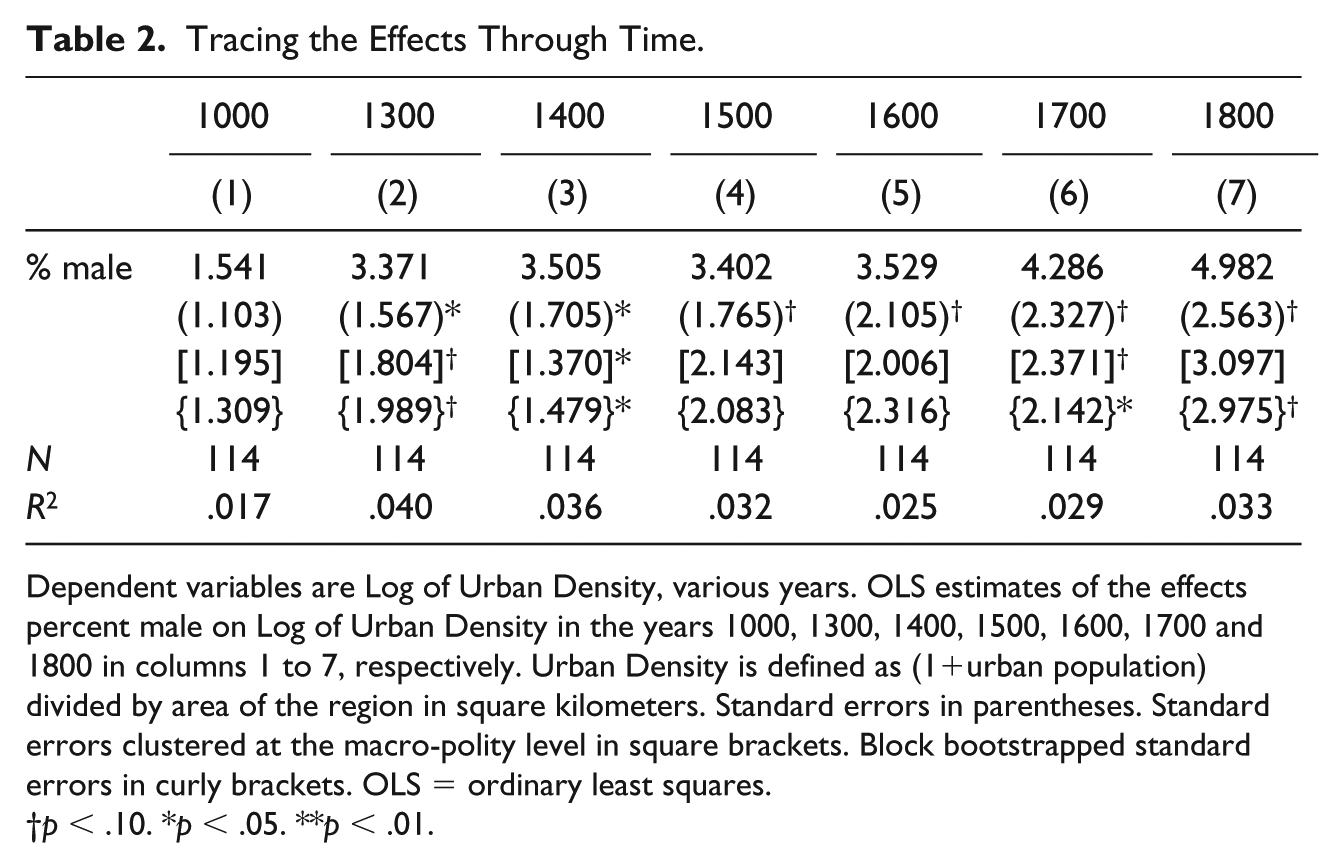
Dependent variables are Log of Urban Density, various years. OLS estimates of the effects percent male on Log of Urban Density in the years 1000, 1300, 1400, 1500, 1600, 1700 and 1800 in columns 1 to 7, respectively. Urban Density is defined as (1+urban population) divided by area of the region in square kilometers. Standard errors in parentheses. Standard errors clustered at the macro-polity level in square brackets. Block bootstrapped standard errors in curly brackets. OLS = ordinary least squares.
p < .10. *p < .05. **p < .01.
The persistent effects of our percent male measure should not be interpreted to mean that the numerous other events that shaped Europe between 1500 and 2009 were unimportant—in fact, the imprecision of our estimates strongly indicates that they were not. The fairly wide dispersion of GDP outcomes between countries within similar medieval inheritance values in our data indicates that medieval history is hardly the only important factor—in particular, communist rule during the Cold War and access to Atlantic trade appear strongly correlated with contemporary GDP, at times mitigating or reversing medieval legacies. Rather, the evidence supports the more modest statement that these events have not been sufficient to completely obliterate the influence of events in the long past. In fact, relative to the very strong claims for historical persistence being made in some branches of the political economy literature (e.g., Alesina et al., 2013), the claim that a correlation of this nature can persist for five centuries seems quite modest.
What might be the specific institutions that allow this persistence, even long after the physical damage from succession conflicts is rebuilt or the monarchies involved overthrown? There are several plausible pathways, and we are wary (pas Austin, 2008) of “compressing” historical periods and cases with distinct causal mechanisms. However, it is worth mentioning one that we believe is especially plausible: the presence of small, autonomous jurisdictions below the level of the state. Examples might include seignories with autonomous taxation and judicial powers, lordships and city states with the power to levy customs duties, privileged merchant groups with monopoly rights, or royal appenages not paying taxes to the center. Strong medieval monarchs were able to limit the legal powers of these “subnational” political actors or even eliminate them entirely. Weaker monarchs, by contrast, were too focused on political survival to destroy such powerful vested interests and indeed might even be indebted to them for support during civil conflict. These subnational actors, each focused on narrow rentseeking, are widely thought to be a major cause of the low levels of economic development of specific European regions (North, 1973) that could only be partially ameliorated through very radical reforms (Acemoglu, Cantoni, Johnson, & Robinson, 2011). While Early Modern monarchs made efforts, sometimes successful, to eliminate these political units (Anderson, 1979), they were hampered by path dependence—their medieval predecessors had created institutional guarantees such as charters and representative institutions that made eliminating these institutions much more difficult than it would have been had they never been created in the first place. This is one reason why many medieval political patterns were able to persist for centuries until disturbed by major external shocks (Acemoglu et al., 2011).
Coups, Conflict, and QoG
Our theory says that the likelihood of having male heirs affects the occurrence of conflict and political instability, which in turn affect contemporary development via state-building. Table 3 provides evidence for the first link in this mechanism. Column 1 of the upper panel shows that percent male has a negative effect on the frequency with which monarchs who were removed from power in a coup in a given region—either by being killed or by being forcibly deposed—which we treat as a proxy for political instability. Column 2 shows that percent male has a negative effect on the frequency of internal wars. 28 The internal war data is based on all wars mentioned in Kohn (2013). 29 To distinguish internal wars (hypothesized to decrease state capacity) from external ones (hypothesized to increase state capacity), we code internal wars as those where fighting occurred within the territory, no matter who the participants were. For instance, England is coded as not being at internal war during the Hundred years war as the fighting was confined to France. 30 As Kohn’s (2013) data for Eastern Europe are very poor, we drop Eastern Europe when we use war as a dependent or independent variable. Column 3 shows that in a panel logistic regression with monarch-polity as the unit of analysis, the estimated effect of the lagged number of legitimate male heirs on the occurrence of a violent transition is negative. Column 4 shows that the same is true with internal war as the dependent variable and region-year as the unit of analysis. 31
Male Heirs, Coups, and Conflicts.
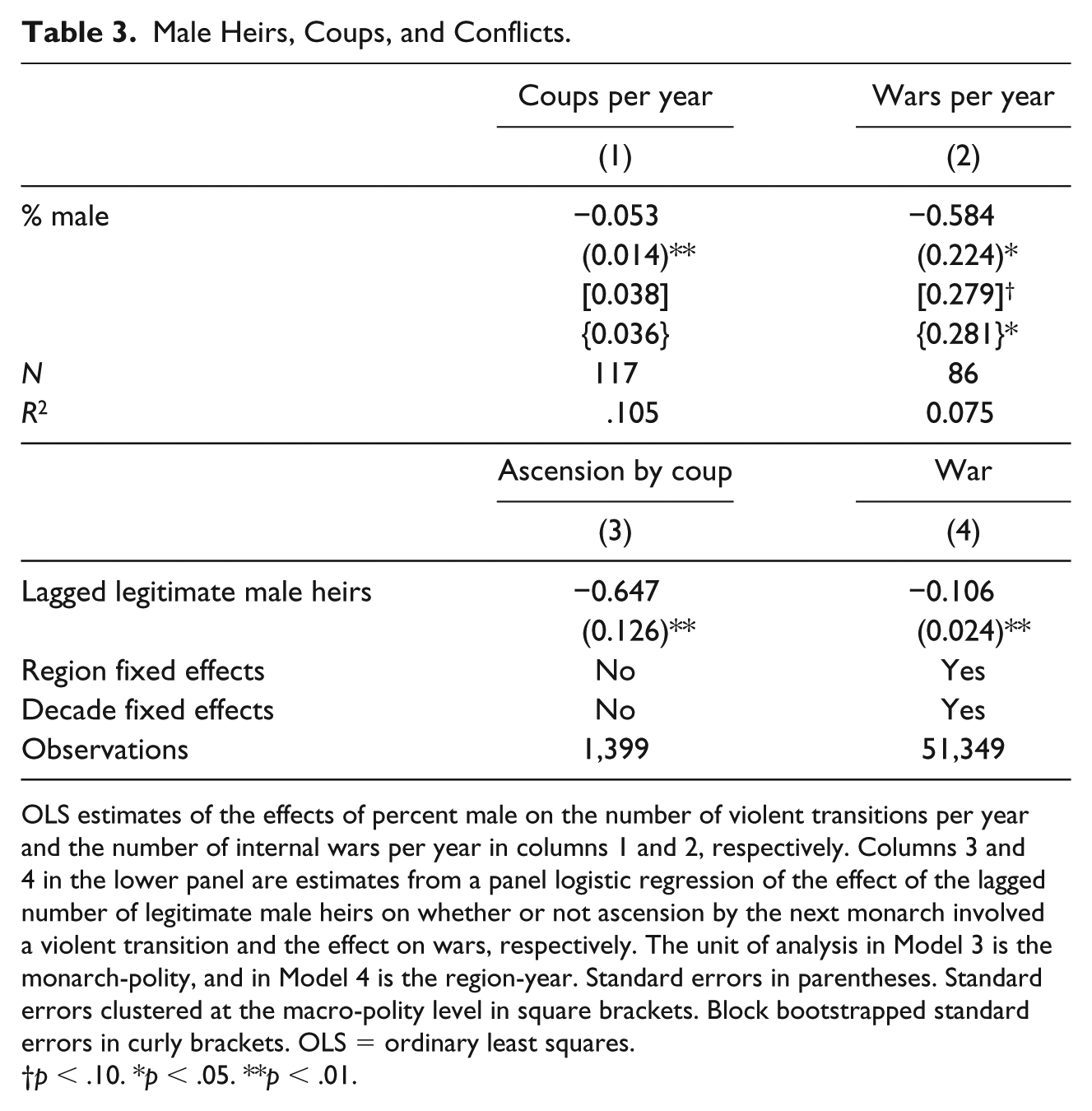
OLS estimates of the effects of percent male on the number of violent transitions per year and the number of internal wars per year in columns 1 and 2, respectively. Columns 3 and 4 in the lower panel are estimates from a panel logistic regression of the effect of the lagged number of legitimate male heirs on whether or not ascension by the next monarch involved a violent transition and the effect on wars, respectively. The unit of analysis in Model 3 is the monarch-polity, and in Model 4 is the region-year. Standard errors in parentheses. Standard errors clustered at the macro-polity level in square brackets. Block bootstrapped standard errors in curly brackets. OLS = ordinary least squares.
p < .10. *p < .05. **p < .01.
Table 4 provides evidence for the second and third links in the mechanism. Columns 1 and 2 show that the number of medieval coups and internal medieval wars are negatively correlated with contemporary GDP per capita. Columns 3 and 4 show that they are negatively correlated with contemporary QoG, which is a measure of the quality of contemporary state institutions from the QoG EU Regional Database (see the note under Table 4 for details). This provides some plausibility to the second and third links in our mechanism. Because we do not have measures of state quality from the medieval period with wide enough coverage, we are not able to provide any more direct evidence for the second link. However, Table 5 presents data on state revenues collected in 1500 for three polities for which we have revenue data and exchange rates (so as to make them comparable). Stronger states were able to collect larger revenues. The data suggest that the Castilian state was weaker than the English or French states, and had more frequent internal wars, though it had fewer coups than did England. Our measures of contemporary development (GDP per capita and QoG) are also lower in Castile than they are in England or France. Thus, the data are largely consistent with the idea that internal political conflicts are associated with lower levels of medieval state development, and greater medieval state development is positively associated with contemporary development.
Coups, Conflicts, and Development.
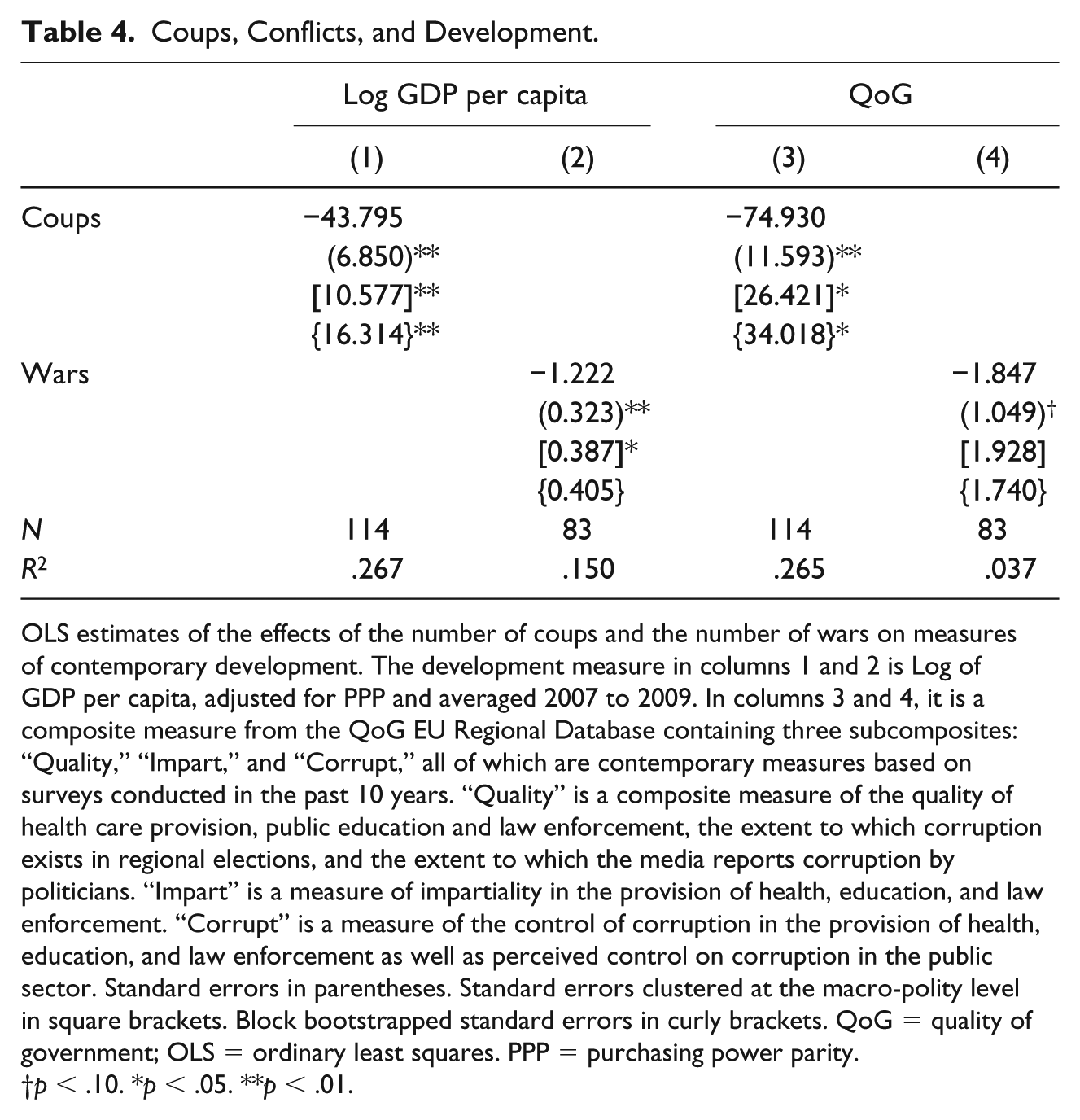
OLS estimates of the effects of the number of coups and the number of wars on measures of contemporary development. The development measure in columns 1 and 2 is Log of GDP per capita, adjusted for PPP and averaged 2007 to 2009. In columns 3 and 4, it is a composite measure from the QoG EU Regional Database containing three subcomposites: “Quality,” “Impart,” and “Corrupt,” all of which are contemporary measures based on surveys conducted in the past 10 years. “Quality” is a composite measure of the quality of health care provision, public education and law enforcement, the extent to which corruption exists in regional elections, and the extent to which the media reports corruption by politicians. “Impart” is a measure of impartiality in the provision of health, education, and law enforcement. “Corrupt” is a measure of the control of corruption in the provision of health, education, and law enforcement as well as perceived control on corruption in the public sector. Standard errors in parentheses. Standard errors clustered at the macro-polity level in square brackets. Block bootstrapped standard errors in curly brackets. QoG = quality of government; OLS = ordinary least squares. PPP = purchasing power parity.
p < .10. *p < .05. **p < .01.
State Development for Three Polities in 1500.
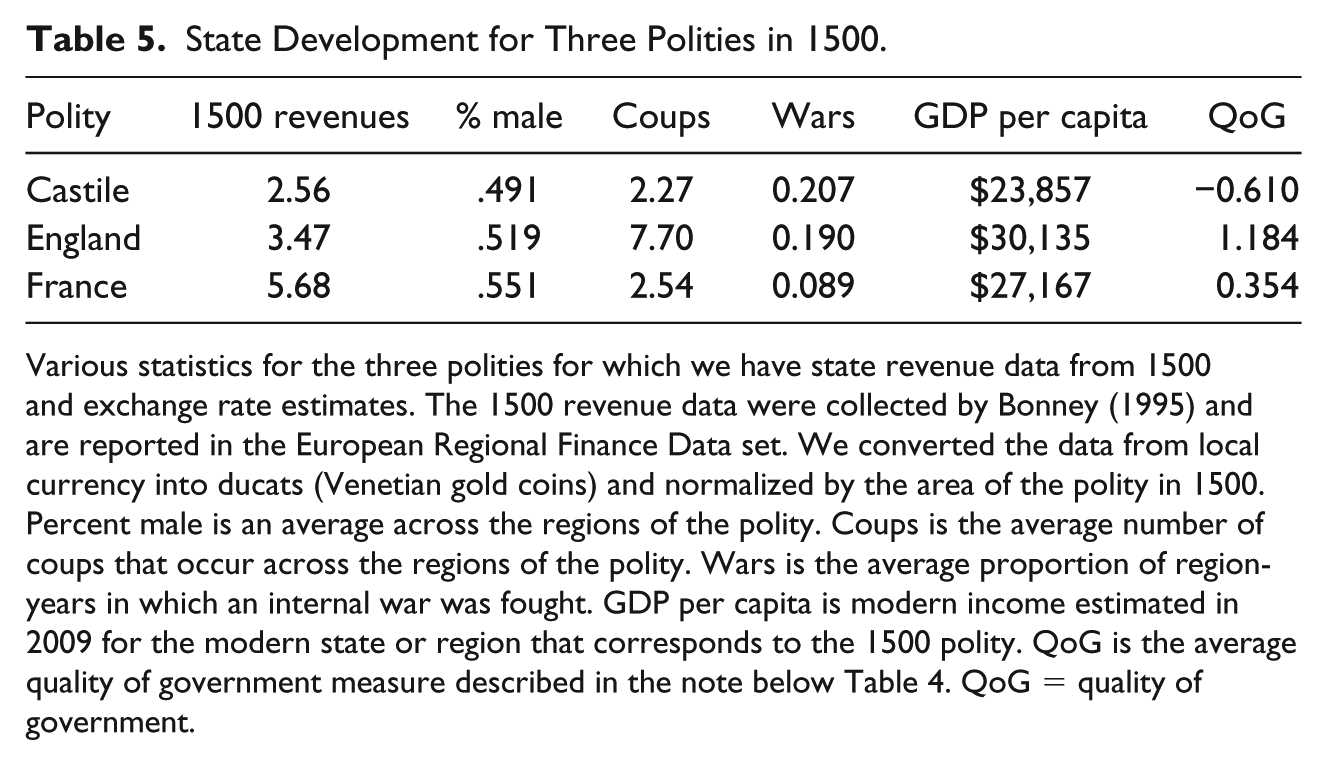
Various statistics for the three polities for which we have state revenue data from 1500 and exchange rate estimates. The 1500 revenue data were collected by Bonney (1995) and are reported in the European Regional Finance Data set. We converted the data from local currency into ducats (Venetian gold coins) and normalized by the area of the polity in 1500. Percent male is an average across the regions of the polity. Coups is the average number of coups that occur across the regions of the polity. Wars is the average proportion of region-years in which an internal war was fought. GDP per capita is modern income estimated in 2009 for the modern state or region that corresponds to the 1500 polity. QoG is the average quality of government measure described in the note below Table 4. QoG = quality of government.
The Institutionalization of Inheritance Norms
Different areas of medieval Europe had different inheritance norms and different levels of institutionalization of these norms. For example, many areas of the former Carolingian Empire practiced Salic law, which prohibited inheritance through female lines of decent. Polities that were not part of the former Carolingian Empire may have had equally high amount of uncoordinated, or uninstitutionalized, cultural gender bias against female-line inheritance, but they did not institutionalize a tradition that outright prohibited it. Here, we are interested in understanding how the effects of our percent male variable vary with the degree of institutionalization of inheritance norms.
For the case of Salic law, theory is silent as to whether we should expect percent male to have a higher or lower effect on contemporary development in Salic law regions than elsewhere. If cultural gender bias was much higher in Salic law regions than elsewhere, violent conflicts resulting from succession disputes could be more common in Salic law regions when percent male is lower and close male relatives are scarcer. Alternatively, because succession disputes often arose from female-line heirs prosecuting their claims to the throne, violent conflict might actually be rarer in regions that practiced Salic law because female-line heirs in these regions would less frequently dispute successions by more distant male-line relatives when close male relatives were not available. In this case, percent male might have a smaller effect on development in areas that practiced Salic law because gender bias is so highly institutionalized that conflict between male- and female-line heirs is rarer. The results of column 1 in Table 6 support the second perspective: Percent male has essentially no effect on contemporary development in areas that practiced Salic law, whereas it has a very large effect on contemporary development in other regions.
Interactions With Inheritance Norms and Women Rulers.
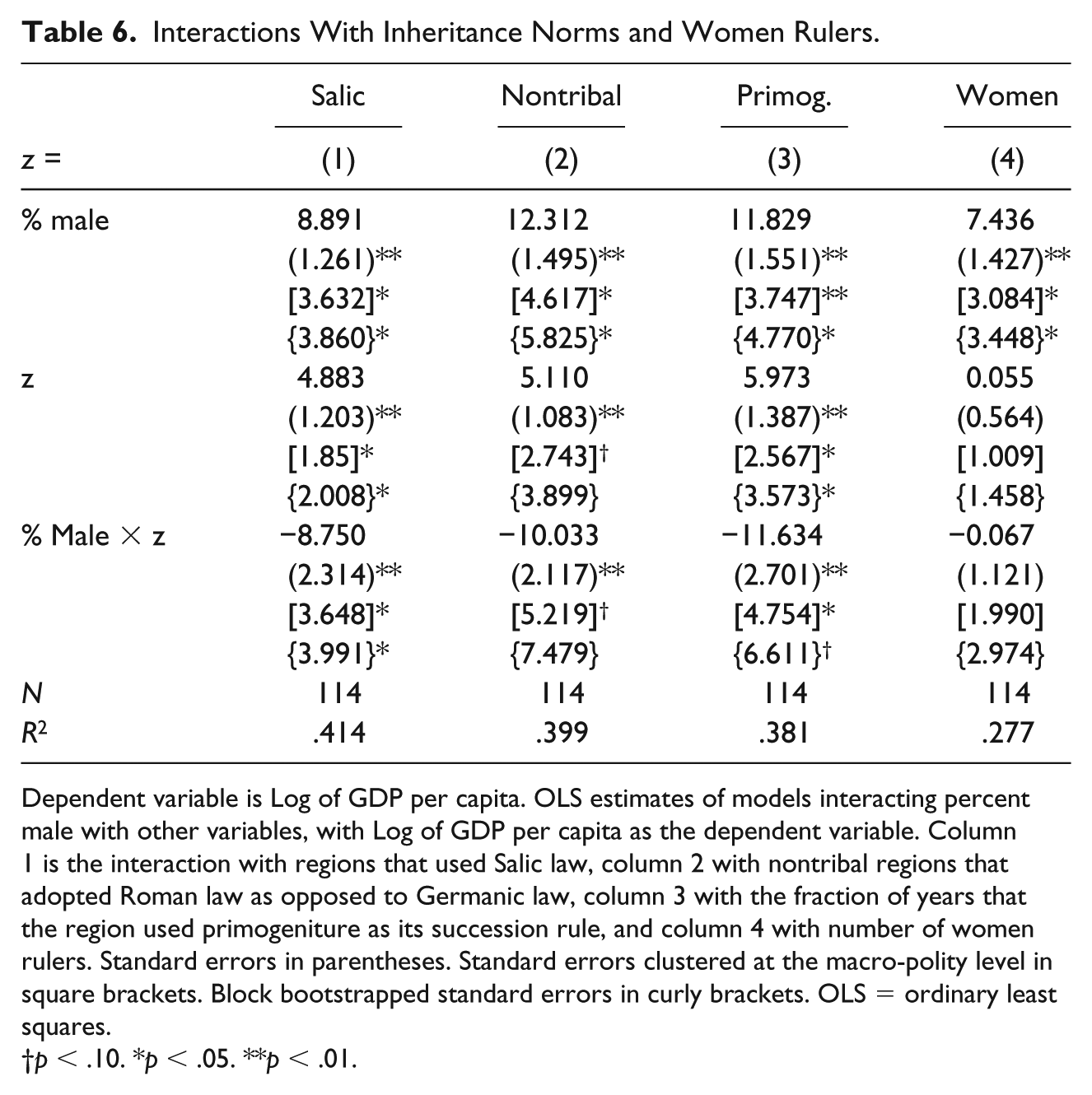
Dependent variable is Log of GDP per capita. OLS estimates of models interacting percent male with other variables, with Log of GDP per capita as the dependent variable. Column 1 is the interaction with regions that used Salic law, column 2 with nontribal regions that adopted Roman law as opposed to Germanic law, column 3 with the fraction of years that the region used primogeniture as its succession rule, and column 4 with number of women rulers. Standard errors in parentheses. Standard errors clustered at the macro-polity level in square brackets. Block bootstrapped standard errors in curly brackets. OLS = ordinary least squares.
p < .10. *p < .05. **p < .01.
Another instance of variation in the degree of institutionalization of succession rules comes from comparing the tribal areas that practiced Germanic law with those that were exposed to Roman legal traditions. Because Germanic law tended to be less codified than Roman law, we would expect to see the effect of percent male to be lower in the nontribal areas that were exposed to Roman law than in the tribal areas that practiced Germanic law. 32 This hypothesis is confirmed by column 2 of Table 6, which shows that in the nontribal polities of medieval Europe that had Roman and Greek traditions, the effect of percent male is significantly lower than it is in the tribal areas that had more weakly institutionalized succession rules. Again, the historical evidence points to political instability being greater in the tribal areas than in polities that drew on their Roman and Greek traditions to establish coordinated rules governing succession when close male relatives were unavailable. 33
A third instance of variation in the degree of institutionalization of inheritance norms comes from comparing monarchies that used primogeniture as their succession norm for more years with those that use primogeniture in fewer years. According to Kokkonen and Sundell (2014) and Blaydes and Chaney (2013), European polities gradually began to adopt primogeniture as their succession rule during the period of our study, increasing its institutionalization over time. Thus, regions that used primogeniture for more years are likely to be those in which inheritance norms were better institutionalized. Column 3 of Table 6 shows that the effect of percent male varies with the fraction of years that a polity used primogeniture in ways similar to how the effect varies with whether or not a polity used Salic Law or Roman Law: The effect of percent male is weaker in polities that increased the degree of institutionalization of their succession rule by adopting primogeniture.
The results of Table 6 columns 1 to 3 suggest that the degree of institutionalization of succession rules matters more for explaining variation in the effect of percent male on contemporary development than does any possible variation in gender bias that might account for variation in the adoption of these norms. Indeed, political gender bias is likely to have been high across all of Europe. This view is supported by the fact that there is a total of only 91 women rulers in our data (only 10.6% of the total number of rulers). It is also supported by the result of column 4 in Table 6, which shows that the effect of percent male does not discernibly vary with the number of female rulers.
The key takeaway from the results of this section is that the effect of shocks and luck (reflected here in the availability of male heirs) is conditioned by the institutional environment. Specifically, luck would play more of a role in weakly institutionalized environments. So a key function of institutions is to mitigate the impact of chance events. Western Europe’s long-run economic success is, we argue, at least in some part due to the ability of its rulers and subjects to control the vagaries of fate by designing institutions that resolve coordination problems. In the next section, we show, however, that the degree of institutionalization may itself be a consequence of chance events.
Endogenous Institutionalization of Succession Rules
Most European polities eventually adopted primogeniture as their succession norm at some point during the 500-year period of our analysis (Blaydes & Chaney, 2013; Kokkonen & Sundell, 2014). However, according to Kokkonen and Sundell (2014), primogeniture was often abandoned in many cases even after it was adopted. For example, according to Kokkonen and Sundell (2014), Bohemia adopted primogeniture in 1230, abandoned it in 1305, readopted it in 1346, and abandoned it in 1419. Notably, both adoptions of primogeniture occurred under sovereigns with multiple male heirs, while both abandonments of it occurred under monarchs with no children. The experience of Bohemia suggests that the availability of male heirs could be an important determinant of which regions adopted primogeniture early or for longer periods.
We find indirect evidence for the hypothesis that polities might have strategically adopted and abandoned primogeniture depending on the abundance or shortage of male heirs. For example, in a cross-sectional OLS specification, percent male has a positive effect on the fraction of years in the 500-year period of our analysis that a polity used primogeniture as its succession rule (coef. = 2.349, SE = 0.660, macro-polity clustered SE = 1.103, block bootstrapped SE = 1.176, N = 124, R2 = .094). In addition to this, we also find in a panel regression with decade fixed effects that the adoption of primogeniture (1 if adopted, 0 if not) is positively affected by the legitimate number of male heirs (coef. = 0.0022, SE = 0.0003, region clustered SE = 0.007, number of regions = 117, R2 = .99). These results provide evidence that the availability of male heirs also affected the speed and degree of institutionalization of succession norms.
Conclusion
Europe today—prosperous as it is in comparison with many other parts of the world—exhibits a great deal of internal variation in development levels across its regions. In this article, we argued that a substantial part of this variation is due to the uneven development of state institutions across medieval European polities. We showed that the likelihood of the availability of male heirs to a European region’s monarchies in the period 1000 to 1500AD has a positive effect on contemporary development in that region. As the unavailability of male heirs was an important driver of internal conflict and political instability, which in turn affected state development, our approach enabled us to sidestep the problem that reliable measures of medieval state development are scarce, as well as the fact that medieval state development could have been affected by a host of unobservable regional characteristics that directly affect contemporary development.
Besides emphasizing the importance of state building in general, our results show the pre-1500 period specifically was an important period in the political development of the modern world, and that within Europe the political trajectories of regions may have diverged much earlier than is sometimes argued. The emergence of the first modern states in this period was so important, and the states themselves so fragile, that even small disruptions could have long-term consequences—consequences that we have shown are measurable even after centuries of revolution, industrialization, war, and institutional growth. In addition, our results reinforce the findings of the political economy of development literature on the negative effects of violent conflict and the importance of political stability for development.
Finally, our findings emphasize the importance of chance and how chance works in combination with both culture and institutions in shaping development paths. In regions where accidents of male birth allowed for a series of uncontested leadership transitions, rulers were able to build the state institutions necessary to support economic development. In areas burdened by a greater potential for political instability, the path to economic prosperity was much more arduous. Far from being determined solely by natural resources, disease environments, preexisting political institutions, or even the plans of their rulers, the fortunes of regions like Naples and France were influenced by accidents of biology. As such, the results provide a rejoinder to a focus on large structural predictors of social scientific phenomena, reminding us of the chaos of politics in an unpredictable world.
Supplemental Material
Acharya_Lee_replication_materials – Supplemental material for Path Dependence in European Development: Medieval Politics, Conflict, and State Building
Supplemental material, Acharya_Lee_replication_materials for Path Dependence in European Development: Medieval Politics, Conflict, and State Building by Avidit Acharya and Alexander Lee in Comparative Political Studies
Footnotes
Acknowledgements
We are grateful to Lisa Blaydes, Gary Cox, Edo Grillo, Jens Hainmueller, Andrej Kokkonen, David Stasavage, and seminar audiences at the University of Rochester, Juan March, LSE, MPSA, Nottingham, Oxford, UC Berkeley, UCLA, and Yale for valuable comments and suggestions. Riva Yeo, Julie Dib, Jillian Johannes, Madalina Ciocanu, and especially Scott Williamson provided outstanding research assistance.
Declaration of Conflicting Interests
The authors declared no potential conflicts of interest with respect to the research, authorship, and/or publication of this article.
Funding
The authors received no financial support for the research, authorship, and/or publication of this article.

Notes
Author Biographies
References
Supplementary Material
Please find the following supplemental material available below.
For Open Access articles published under a Creative Commons License, all supplemental material carries the same license as the article it is associated with.
For non-Open Access articles published, all supplemental material carries a non-exclusive license, and permission requests for re-use of supplemental material or any part of supplemental material shall be sent directly to the copyright owner as specified in the copyright notice associated with the article.
