




Abstract
This study examines public support for a key contested multicultural policy in contemporary Europe: the provision of religious schools. It makes two main contributions, one substantive and one theoretical. Substantively, the main contribution is to provide new experimental evidence demonstrating the existence of discrimination against Muslims on a central issue of multicultural social policy. Theoretically, the main contribution is to propose an explanation for variations in patterns of discrimination that highlights the role of individuals’ motivation to control prejudice. Through moderation analysis, we show that individuals who express stronger motivation to control prejudice are more likely to treat Muslim and Christian requests for religious schools equally, and they are more likely to retain their support for Muslim schools in the wake of a threatening Islamist terrorist incident. Because we conducted the experiments in three countries, we in addition find societal-level patterns of variation: Individuals’ motivation to control prejudice is more strongly associated with nondiscriminatory responses to the question of religious schools where a more multicultural path of accommodation has been pursued. This societal-level variation raises new hypotheses about how multicultural policies may interact with public opinion and underlines the importance of comparative experimental work.
Introduction
The integration of new minority groups has been a pressing issue on the European political agenda since at least the 1980s. The past decade or so has seen a marked change in this debate away from general questions about migrants and ethnic minorities toward specific concerns about Muslims and Islam (Helbling, 2012; Sniderman & Hagendoorn, 2007; Sniderman, Petersen, Slothuus, & Stubager, 2014). In many European countries, Muslims now constitute one of the most visible and politically salient minority groups. They are perhaps the group that faces the most resistance to accommodation from the majority population and attract the most political opposition, particularly from actors on the radical and extreme right (Berntzen & Weisskircher, 2016; Caiani, della Porta, & Wagemann, 2012). Conflicts over multiculturalism in Europe increasingly focus on practical dilemmas about whether, and how, to accommodate the beliefs, practices, and preferences of Muslim minorities—sometimes in the face of skepticism or outright hostility from the majority (Adida, Laitin, & Valfort, 2016; Dancygier, 2017).
But what is the role of anti-Muslim sentiment or bias in these controversies? Public debate rarely justifies policy opposition on the grounds of explicit dislike of Muslims but instead invokes more socially acceptable justifications for opposing multicultural accommodation. Some Europeans may oppose public accommodations for Muslim practices on principled, group-neutral grounds (Sniderman & Hagendoorn, 2007) such as secularism (Imhoff & Recker, 2012), universalism (Elchardus & Spruyt, 2014), or liberal support for individual autonomy and gender equality (Gustavsson, van der Noll, & Sundberg, 2016). Research in multiple European countries shows that negativity toward Muslims is widespread (Helbling, 2012), but do all citizens allow anti-Muslim bias to shape policy positions? Prior studies in the United States have found that individuals who are highly motivated to control prejudice are less likely to allow their implicit bias shape their intergroup attitudes (e.g., Dunton & Fazio, 1997; Plant & Devine, 1998), but few studies exist that test whether motivation to control prejudice (MCP) can reduce discriminatory responses to multicultural policy in Europe.
In this study, we provide evidence of discrimination in public support for multicultural accommodation in the context of a concrete policy issue—state support for Muslim schools. In three Western European countries in which state-supported Christian schools exist—Britain, Norway, and Sweden—we find substantial opposition to granting the same rights to Muslims. Using a randomized controlled experiment, we show that a substantively significant portion of this opposition in Britain and Norway is specifically “targeted” against only Muslim schools, that is, it is opposition directed at Muslim schools that does not extend to other religious or nonuniversal private schools.
Nevertheless, we also find that some individuals resist discrimination, and continue to do so even under conditions of heightened threat. Individuals who are highly motivated to control prejudice do not systematically exhibit the same degree of targeted opposition to Muslim schools exhibited by those low in motivation. In Norway and Britain, the gap in public support for Muslim versus Christian schools is nearly eliminated among those highest in MCP, while the gap is completely eliminated or even reversed among highly motivated Swedish citizens. Further evidence from a natural experiment shows that many British respondents reacted to a Muslim terrorist attack by reducing support for Muslim schools, while support levels among those high in MCP were not affected.
Europeans’ Attitudes Toward Multicultural Policies Accommodating Muslims
Most previous work on policy conflicts about multiculturalism (Bleich, 2011) and views of Muslims (Helbling, 2012) has examined the issues involved in an abstract and general way, focusing on questions about principles and overall frameworks (Wright & Bloemraad, 2012; Wright, Johnston, Citrin, & Soroka, 2016). Although research and theorizing at this level is indispensable, this dominant approach departs from the ways in which multicultural conflicts are often discussed in politics and experienced by citizens. Focusing on a concrete political controversy over an everyday issue presents multicultural accommodation in more familiar terms, and hence provides clearer evidence on who will accommodate real minority demands in a multicultural society. A general focus may conflate two related but distinct policy debates: as Joppke (2017) notes, “. . . [C]ivic integration is national-level policy while persistent multiculturalist policies tend to be local level, so that both may coexist, p. 1154.”
A few recent studies examine attitudes toward specific multicultural policies or practices. However, these remain exceptions to the rule (Wright et al., 2016); moreover, most focus on attitudes toward Muslim religious garb such as the hijab, niqab, or burqa (Breton & Eady, 2015; Gustavsson et al., 2016; Helbling, 2014). We focus on the issue of state support for religious schools, a prominent example of the conflicts over multicultural accommodation that are multiplying in European and North American education systems, yet one that has seen little systematic study. The most closely related studies examine the issue of support for including Islam in religious education curricula. Van der Noll and Saroglou (2014) find that 27% of a German sample supported teaching about Christianity but not Islam; Statham (2016) finds greater support for teaching about Christianity than for similar teaching about Islam in four European countries.
School policy provides a useful issue context for examining attitudes toward multicultural policy. The three countries in our study—Britain, Sweden, and Norway—have all seen on-going controversy over the existence of Muslim schools and/or multicultural practices in educational settings, such as disputes over teachers and students wearing religious dress, Muslim parents seeking exemptions on religious grounds from activities such as swimming lessons, and the serving of Halal meat in school cafeterias. But while other issues involve aspects of Muslim practice that lack a clear parallel among Christian or secular majority groups, the schools issue allows for a straightforward comparison in willingness to grant precisely the same set of rights to different groups. A pattern in which citizens oppose Muslim schools while supporting other types of religious or particularistic schools would provide unusually straightforward evidence of discrimination. Moreover, religious schooling is an established part of each country’s educational system. Given this status quo, a legal change to ban or inhibit Muslim schools would constitute discrimination in a straightforward legal sense, even if supported by a majority of the population.
Patterns of Opposition: Targeting Muslims or School Types?
Observed opposition to Muslim schools does not provide evidence of discrimination per se. Opponents of Muslim schools might not support Christian schools either. Thus, we first ask whether opposition is specifically targeted toward Muslim schools. Given the array of negative attitudes toward Muslims among majority-group Europeans (Helbling, 2012; Storm, Sobolewska, & Ford, 2017), we expect an element of targeted opposition to Muslim schools. In other words, we expect that public opposition toward state sponsorship of distinctive schools will be more widespread when the policy concerns Muslim schools than when it concerns Christian schools or nonreligious independent or “free” schools.
However, opposition may stem mainly from general principles or values that influence preferences for school policy overall, rather than targeted opposition to Muslim schools in particular. The literature offers two principles that lead to divergent predictions at the aggregate level. First, opposition to Muslim schools may be rooted in secularism (Imhoff & Recker, 2012). Dedicated secularists among majority-group Europeans would consistently oppose religious schools, for the dominant Christian group in society as well as for the Muslim minority. Second, nontargeted opposition to Muslim schools might arise from a form of egalitarianism or universalism (Elchardus & Spruyt, 2014). Universalists would go further than secularists, opposing all forms of education, such as private or selective schools as well as religious schools, that depart from the ideal of all children receiving the same education from institutions with identical values and selection processes. The cross-national controlled survey experiment described in greater detail below is well suited to detecting the existence and extent of targeted opposition to Muslim schools, allowing us to compare levels of targeted opposition to Muslim schools to opposition to Christian schools (secularism) and private schools (universalism).
Does MCP Reduce Tendency to Discriminate?
Targeted opposition is clearly discriminatory, as it involves denying religious schools to Muslims while supporting the provision of identical schools to Christians. 1 As such, if we find a significant degree of targeted opposition on the aggregate level, this is substantively important. But discrimination of this kind may vary between citizens. What distinguishes those who discriminate from those who do not? Prior research suggests that a partial answer may lie in individual motivations to behave in accordance with social norms against prejudice. According to the logic of “dual process” models of prejudice (Devine, 1989), individuals who are highly motivated to control or avoid prejudice are more likely to prevent any underlying biases and stereotypes from shaping their policy preferences. Recent research on intergroup attitudes acknowledges the usefulness of the dual process model, which is increasingly common in social science research (Kahneman, 2011; Thaler & Sunstein, 2008). According to this logic, individuals who are highly motivated to control prejudice (corresponding in dual process jargon to “system two” or “thinking slow”) are more likely to prevent any underlying biases and stereotypes (corresponding to “system one” or “thinking fast”) from shaping their policy preferences.
It is important to clarify the nature of motivation to control prejudice (MCP) in relationship to conventional concepts of prejudice. Previous research has demonstrated that MCP is conceptually and empirically distinct from both implicit and explicit prejudice (Butz & Plant, 2009; Payne, Cheng, Govorun, & Stewart, 2005). Conceptually, a motivation represents an objective or orientation toward action, whereas prejudice is a negative attitude toward an out-group or perhaps as set of pejorative beliefs about out-group members. Empirically, as would be theoretically expected, there is a relationship between MCP and traditional prejudice measures: in particular, participants high in Internal Motivation to Control Prejudice (IMCP) 2 score lower on explicit prejudice measures (Amodio, Devine, & Harmon-Jones, 2008; Devine et al., 2002; Hausmann & Ryan, 2004). 3 This is to be expected, because MCP should lead to active (“system two”) attempts to avoid acting upon any underlying biases. But IMCP does not eliminate automatically activated underlying prejudice from the “system one” cognitive process, as a significant portion of high IMCP participants nonetheless exhibit a relatively high degree of bias on measures of implicit prejudice (Devine et al., 2002). High IMCP individuals also seem to respond more effectively to implicit prejudice reduction programs (Cooley, Lei, & Ellerkamp, 2018).
Rather than treating “social desirability” effects as a nuisance term that gets in the way of measuring true underlying prejudice, dual process models of prejudice incorporate motivation to conform to antiprejudice norms directly into our understanding of what constitutes prejudice and what drives prejudiced behavior. Such models provide a coherent account of the lack of association between explicit and implicit measures of prejudice: Automatically activated stereotypes and negative biases are widely held, but individuals vary in their motivation to control these automatic forms of prejudice. Those who are highly motivated to control the expression of implicit prejudice are most likely not to discriminate even if they harbor negative implicit biases inside or outside of conscious awareness (Dunton & Fazio, 1997; Plant & Devine, 1998).
Although MCP reflects the goal of conforming to social norms against prejudice, and is more likely to be found among those with more political tolerance, it is not reducible to a general tendency to engage in socially desirable behavior. Studies show little to no positive correlation between MCP and traditional measures of social desirability (Ivarsflaten, Blinder, & Ford, 2010; Plant & Devine, 1998). Moreover, previous research has shown that subjects who are high in IMCP continue to act in nonprejudiced ways even when others cannot observe or sanction their behavior (Butz & Plant, 2009). For example, subjects who are internally motivated to respond without prejudice are not more likely to endorse stereotypes of black people in private than they are in public (Fazio, Jackson, Dunton, & Williams, 1995; Plant, Devine, & Brazy, 2003).
Antiprejudice motivations have mostly been researched to examine the dynamics of racial prejudice and other forms of discrimination in the United States (Butz & Plant, 2009), but some studies conducted in Europe have employed this concept to explain otherwise puzzling patterns of support for the extreme right (Blinder, Ford, & Ivarsflaten, 2013; Harteveldt & Ivarsflaten, 2018). Building from this work, we hypothesize that MCP is likely to moderate any tendency to discriminate against Muslims in the question of schools provision.
Discrimination in the Wake of Terror
We have also examined whether and how discriminatory responses to Muslim schools in Britain was affected by the Paris terror attacks of November 2015, the worst terror incident Europe had experienced for over a decade. Previous research has shown that threatening events can produce a wider backlash, as occurred in Britain following the 9/11 attacks on the United States (Meer & Modood, 2009). We might expect, then, that news of a violent attack committed by Islamist terrorists may increase targeted opposition to Muslim schools.
However, a hostile backlash is not a foregone conclusion. For example, an expected backlash against Muslims in American public opinion after 9/11 did not initially materialize, perhaps due to an elite consensus that sharply distinguished Islamist terrorism from Islam in general (Panagopoulos, 2006). If MCP works as theory suggests, then it should shore up commitments to avoid discrimination, even under the pressure of a salient threat. British media was at the time filled with calls from elite and media figures across the political spectrum who encouraged people to resist the temptation to blame all Muslims for the acts of a tiny extremist minority. British people with high levels of MCP should be more likely to heed these calls and maintain their prior attitudes toward Muslim schools. Thus, we hypothesize that (a) the Paris attacks will generate additional opposition to Muslims schools among those low in IMCP, but (b) that IMCP will act as a countervailing force, such that these higher levels of opposition will be observed only among those with little or no MCP.
Data and Method
The data in the study come from embedding similar experiments in surveys conducted in each of the three countries, once in Norway and Sweden and twice in Britain. In Britain, the experiment was run on the YouGov opt-in Internet panel in November 2015 as part of a specially commissioned survey on Muslim integration, and then repeated immediately after the Paris terror attacks. In Sweden, the experiment was run on Wave 4 of the Swedish Citizen Panel (March-April 2012), an opt-in Internet panel owned by the University of Gothenburg. And in Norway, the experiment was run on Wave 4 of the Norwegian Citizen Panel (March 2015), a randomly recruited, academic-purpose Internet panel owned by the University of Bergen. The sample sizes were approximately 130 people per treatment condition in Sweden, 350 in Britain, and 400 in Norway. The British YouGov opt-in sample is representative by design (Twyman, 2008). The Norwegian Citizen Panel sample relies on random recruitment from high-quality population registers. There are some biases in the resulting sample, which we have addressed through controls in the moderation analysis (Høgestøl & Skjervheim, 2015). The Swedish sample is opt-in and is known to overrepresent men and more educated, liberal, and high-income respondents (Martinsson, Lindgren, Pettersson, & Åsbrink, 2013). 4
The differences between the panels make us cautious about comparing the level of commitment to antiprejudice norms between countries in a strict sense and about generalizing to the publics in the countries as whole. In particular, caution is advised with regard to generalizing the main effect results reported below in the case of Sweden. Because of the nature of biases in this sample, the survey may overstate overall levels of commitment to equal treatment of Muslims, and as our analysis shows, this could lead to an underestimation of the tendency to discriminate in the Swedish population more generally. Similar biases, although somewhat less severe, are also present in the Norwegian sample and so similar caution applies with regard to the generalizability of findings to the country as a whole.
Core Experimental Design and Natural Experiment
We used a between-subjects experimental design to test our hypothesis regarding targeted opposition, secularism, and universalism. We asked the respondents about state support for schools and randomly assigned respondents to be asked about different types of schools—Christian, Muslim, or “free schools.” Within each country, questions posed to the respondents were identical aside from the experimental manipulation of school type. Across countries, the content of the question was the same but the wording was slightly varied to sound appropriate in each language and setting. This approach follows the lead of past target group experiments used to study prejudice, tolerance, and its impact on policy preferences in the United States and Europe (e.g., Brooks & Manza, 2013, Chap. 4; Harell, 2010; Kootstra, 2016; Petersen, Slothuus, Stubager, & Togeby, 2011; Sniderman & Hagendoorn, 2007). The between-subjects design eliminates consistency pressures on respondents that might dampen the gaps in support between Muslim and Christian education in prior studies (Statham, 2016; Van der Noll & Saroglou, 2014). 5 The surveys were fielded online in all three countries, a survey mode which has been found to reduce social desirability bias in responses on sensitive topics (Gnambs & Kaspar, 2015; Kreuter, Presser, & Tourangeau, 2008).
In addition to the three-country experimental design, we made use of a natural experiment of sorts arising from the tragedy of the terrorist attacks in Paris in November 2015. By coincidence, the survey containing our experiment was in the field in Britain just prior to these attacks. To gauge the response of the British public to the attack in relation to our research questions, we fielded the same questions again in the days following the attack. Because the surveys were fielded so close in time, with the attack dominating news coverage in the interim, we can have reasonable confidence that the changes we observe are a result of the attack and the heightened atmosphere of threat in its wake, as discussed above.
Measurement of IMCP
We measured MCP through a series of previously validated items probing whether or not respondents have internalized being nonprejudiced as a personal goal or motivation. A representative item asks respondents to agree or disagree with the statement: “I get angry with myself if I have a prejudiced thought” (see the supplemental appendix for the full set of questions.) Prior psychometric validation studies have confirmed that this IMCP scale is a valid and reliable measure in both the United States and European contexts; in particular, IMCP is uncorrelated with more generalized tendencies to adjust one’s behavior to social norms or social contexts, such as social desirability or self-monitoring, in both the United states (Plant & Devine, 1998) and Europe (Ivarsflaten et al., 2010). Shortened IMCP scales have been validated and shown to predict political attitudes and vote choice in Britain and Germany (Blinder et al., 2013). The precise set of questions varied somewhat from country to country. Most notably, the British version included questions that asked specifically about Muslims, while the others were oriented more broadly toward “immigrants” or the antiprejudice norm in general. All results for Britain were robust to an alternative specification of IMCP omitting the Muslim-specific questions (see Table A2.2 in the supplemental appendix). Care was taken in question ordering to minimize priming-effects of the IMCP questions, in light of prior work in which prepriming respondents arguably distorted experimental effects (Huber & Lapinski, 2006; Mendelberg, 2008). In the Swedish and British samples, this meant that the IMCP items were administered after the experiment. In the Norwegian sample, they were administered at a separate point in time. 6
Country Selection
The choice of these three countries provides further leverage toward understanding connections between opposition to Muslim schools and to prejudice and/or antiprejudice norms. Sweden and Norway are close to one another and distant from Britain not only geographically but also in terms of their coordinated market economies (Hall & Soskice, 2001, although see Schneider & Paunescu, 2012), their more comprehensive welfare states (Esping-Andersen, 2013), their languages, and other politically relevant dimensions. Sweden and Norway are also among the most egalitarian nations in the world when it comes to gender roles (Inglehart & Norris, 2003).
Sweden and Norway are also similar to one another in their historical and current approaches to education, the policy area we are examining. In all three countries, large numbers of primary and secondary schools were originally run by Christian churches and then gradually (and not without controversy) taken over by the state. However, in both Scandinavian countries, schools were first taken over by states and later secularized. All schools are still publicly financed and strictly regulated by national curricula, but both countries have more recently enacted major reforms (in 1992 for Sweden, 2003 for Norway) to enable private entities to run schools. In both Sweden and Norway, confessional schools remain a marginal phenomenon, encompassing 1.5% and 3.4% of all primary schools, respectively. In Britain, however, a different bargain was struck. Educational reforms in 1944 preserved the status of church schools and their autonomy in the education system, while providing them with public support, an arrangement that has, with modifications, endured ever since. Confessional schools are a major part of the primary school system (37% of all schools in England). They must comply with national educational curriculum and intake rules, and they run alongside secular state run schools, which provide the majority of school places. 7
Unusually, in the midst of so many similarities, Norway differs from Sweden in one key respect that is critical to our study: the existing political climate around multiculturalism. Policy indices based on expert ratings highlight large differences between our cases in multicultural accommodation. Sweden scores highest (7 out of a possible 8) on the “multiculturalism policy index,” which documents the extent of policy accommodation for immigrant and minority groups, including bilingual and multicultural educational curricula, religious exemptions to dress codes, and mandates for representation of ethnic minorities in public media (Banting & Kymlicka, 2013; Tolley & Vonk, 2016). Britain scores a middling 5.5 on this index, while Norway scores the lowest of the three at 3.5.
Given this pattern, we would argue that Sweden and Norway should show similar patterns to one another, and distinct from Britain, if attitudes toward Muslim schools are primarily based on attitudes toward schooling, on attitudes toward gender roles, or on broader cultural determinants. However, if opposition to Muslim schools is primarily related to the politics of prejudice and multiculturalism, then it is Sweden that should be the tolerant outlier, and Britain and Norway that should show similar levels of opposition and patterns of connections between policy preferences and prejudice. This would provide further evidence, even if only suggestive, in support of a link between prejudice, societal norms, and school policy preferences.
Results
Identifying Targeted Opposition
Our first question regards the sources of opposition to Muslim schools in the three countries as revealed in the pattern of direct effects of the survey experimental treatments. Figure 1a to 1c displays the effects of the experimental manipulations in each of our three national contexts. They show the mean support for each school type, with responses rescaled to the unit interval. Higher values indicate stronger support for a given type of school. The confidence intervals are larger in the Swedish case, because there were fewer respondents in each condition there.

Target group effects of school type—Sweden (top), Great Britain (middle), and Norway (bottom).
The Swedish results show an aggregate pattern consistent with principled secularism, rather than targeted opposition or universalism. There is no statistically detectable difference in attitudes to the two kinds of religious schools, and both kinds of religious schools are less popular than secular private “free” schools. Just less than half of the respondents in the Swedish sample oppose each of the religious educational options. 8 Despite Sweden being a Scandinavian country with a history of a strong universal school system, this pattern of results is not consistent with universalism because of the considerably higher support for nondenominational but privately run free schools than for religious schools. However, we must be cautious about generalizing from our Swedish sample to the Swedish population as a whole due to the imbalances in the sample.
In contrast to the Swedish results, we find strong evidence of targeted opposition in the British and Norwegian samples, where respondents are much less willing to support Muslim schools than Christian schools. The starkest results are found in Britain. Mean support for Muslim schools is 0.23 (SE = .01) on the 0 to 1 scale, compared with 0.50 (SE = .01) for Christian schools and 0.38 (SE = .01) for free schools. Differences between support for Muslim schools and the other two school types are both statistically significant (p < .001, two-tailed t test). To a substantial degree, British opposition is targeted, rather than consistently secular or universalist: Schools run by churches from the dominant Christian tradition are very popular, and privately run “free schools,” though less popular, are also much more popular than Muslim schools.
In Norway, the experiment also reveals targeted opposition to Muslim schools, although the differences in support for Muslim and Christian conditions are not as large as in Britain. Mean support for Muslim schools is 0.41 (SE = .02), significantly lower than the mean of 0.61 (SE = .02) for Christian schools (p < .001, two-tailed t test) and below the midpoint of the scale, revealing more opposition than support. The pattern of effects in Norway is also the most consistent with targeted opposition and inconsistent with secularism. Much as in Sweden, the pattern of direct effects is clearly inconsistent with universalism as well, because both private and Christian schools are much more strongly supported than Muslim schools, whereas a universalist model would predict similar opposition to any deviation from standard, uniform public education.
The results from the experimental intervention randomly altering the school type show that Muslim schools face targeted opposition in two of the three countries under study—Norway and Britain—where Muslim schools were significantly and substantially less popular than otherwise identically described Christian schools. In this Swedish sample, Muslim schools are in the aggregate treated the same as Christian schools. However, as noted above the nature of our Swedish sample requires caution in generalizing this finding to the Swedish population as a whole. It is possible that the sample has a higher number of respondents committed to controlling prejudice than the country as a whole. As we will show below, individual-level variation in IMCP matters particularly strongly in the Swedish sample.
Moderation by MCP
Although many citizens in Britain and Norway single out Muslim schools for targeted opposition, are citizens highly motivated by anti-prejudice norms more likely to treat Muslims equally? We have suggested that those higher in MCP will be more supportive of Muslim schools in general, and we therefore expect to see little or no targeted opposition among those high in MCP. We therefore turn now to examine whether MCP moderates the effects of the experimental conditions, and reduces the observed gap in support for Muslim and Christian schools. We expect MCP will be associated with relatively higher support for Muslim schools in all of our contexts while not having a significant relationship with support for other sorts of schools.
Figures 2a to 2c summarize the impact of MCP on support for Muslim and Christian schools in regression models conducted separately for each treatment condition and each national context. 9 The figures show that IMCP has a significant impact on views of Muslim schools in all three countries. Meanwhile, IMCP has no effect on views of Christian schools in two of the countries as expected. In Britain, the effect of IMCP on support for Christian schools is negative: British respondents expressing higher MCP were less supportive of Christian schools. It is possible that those strongly committed to antiprejudice norms worry that Christian schools, which are much more widespread in England than the other two contexts, put Muslims and other minority religious groups at a disadvantage. In all three countries, individuals with high MCP treat Muslim and Christian schools more equally. IMCP has no significant relationship with support for private schools in any of the three cases. 10
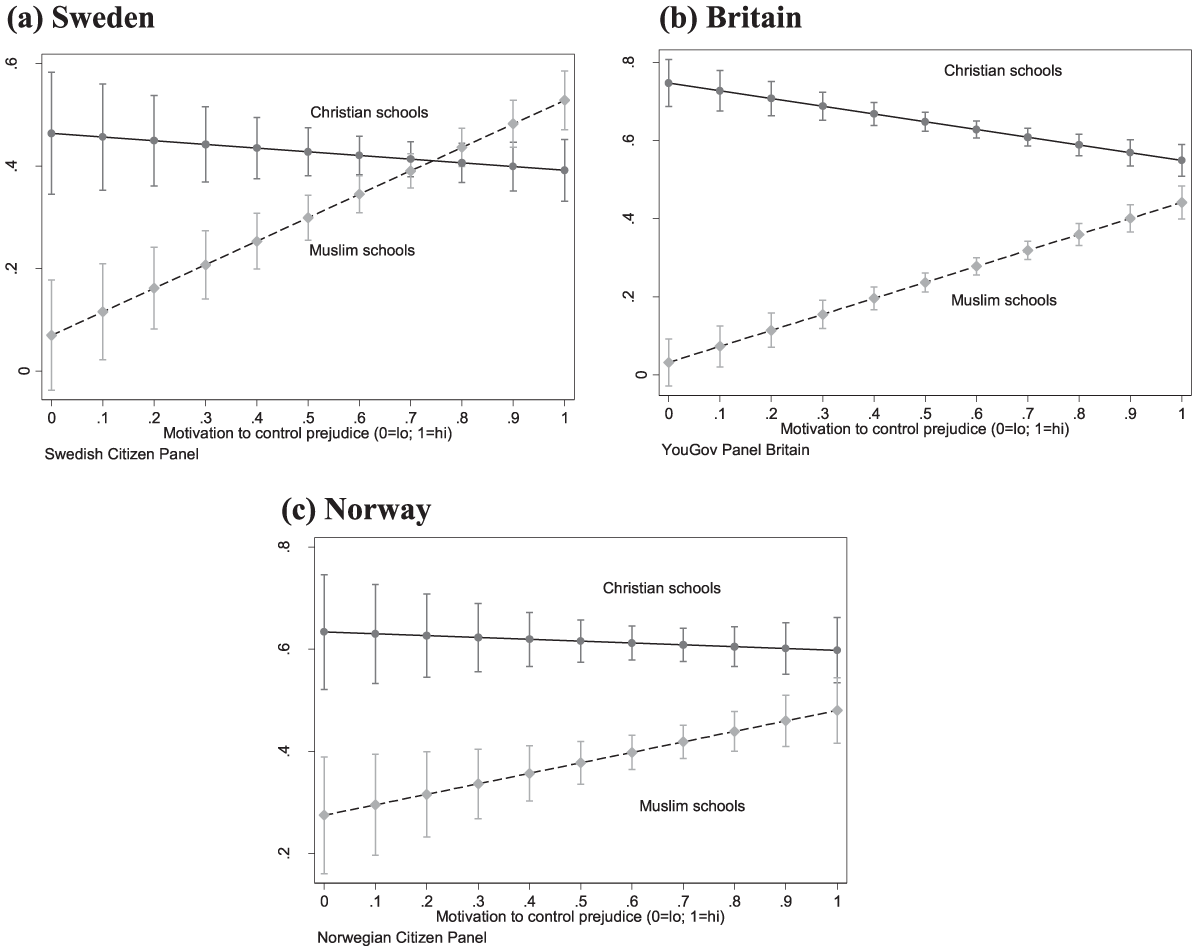
Predicted effect of IMCP on support for schools.
The positive impact of IMCP on support for Muslim schools, and the nil or negative effect on support for Christian schools, means that Muslim schools face less targeted opposition from those more motivated to control prejudice. However, this moderating effect is only strong enough to eliminate targeted opposition completely in the Swedish sample. As most respondents in the Swedish sample also express moderate to high IMCP, the positive effect of IMCP on support for Muslim schools renders the overall difference in reactions to Christian and Muslim schools statistically insignificant in this case. Put differently, the strong association between MCP and support for Muslim schools, combined with the higher levels of MCP expressed in the Swedish sample, can account for the absence of targeted opposition in the Swedish experiment overall—even though Swedish respondents who scored low on IMCP do discriminate against Muslim schools.
The IMCP moderation effect is not based on an experimental intervention and so it is vulnerable to omitted variable bias. In the supplemental appendix, we have included tables (Tables A2.1-A2.3) showing that the effect of IMCP is robust to the introduction of various demographic and attitudinal controls including demographic variables such as age, gender, and education. These models alleviate some of the concerns previously expressed about sampling bias, though caution is still required in generalizing the results reported here to the countries as a whole. Our empirical results, then, are consistent with our theory, but do not support a claim that IMCP is the one true moderator of our observed experimental effects. In fact, theory suggests that other and more indirect ways of measuring MCP such as explicit attitude measures could also be used to detect similar patterns. However, these attitudes will be a mix of implicit bias and MCP and will therefore contain more noise than the direct measure of IMCP.
Motivation and Response to Threat: Britain Before and After the Paris Terror Attacks
Finally, we present the results of our study of attitudes before and after the Paris terror attacks. A comparison of British attitudes before and immediately after these attacks in Paris is presented in Figure 3, which plots the predicted difference in support for Muslim schools at different levels of IMCP in the survey conducted after Paris, compared with the baseline level of support found in the pre-Paris survey. These results are based on a regression modeling support for schools, in the Muslim condition, as a function of IMCP, a dummy variable indicating pre- or post-attack, and an interaction between these two variables (full results in the supplemental appendix, Table A4). We find that predicted support for Muslim schools is lower after the Paris attacks among British respondents with low IMCP (below the mean score of 0.6 on the IMCP scale), but is the same in both surveys among those who score above the average (i.e., the preattack/postattack difference is small and not statistically different from zero). Opposition to Muslim schools was thus higher after the attack among the section of the British public who expressed low MCP, and turned against Muslim schools in the aftermath of a major Islamist terror incident. Among those with high IMCP, however, support was similar before and after the attacks, consistent with the hypothesis that those motivated to control prejudice will resist the temptation to respond to heightened threat with increased hostility to state accommodation of Muslims.
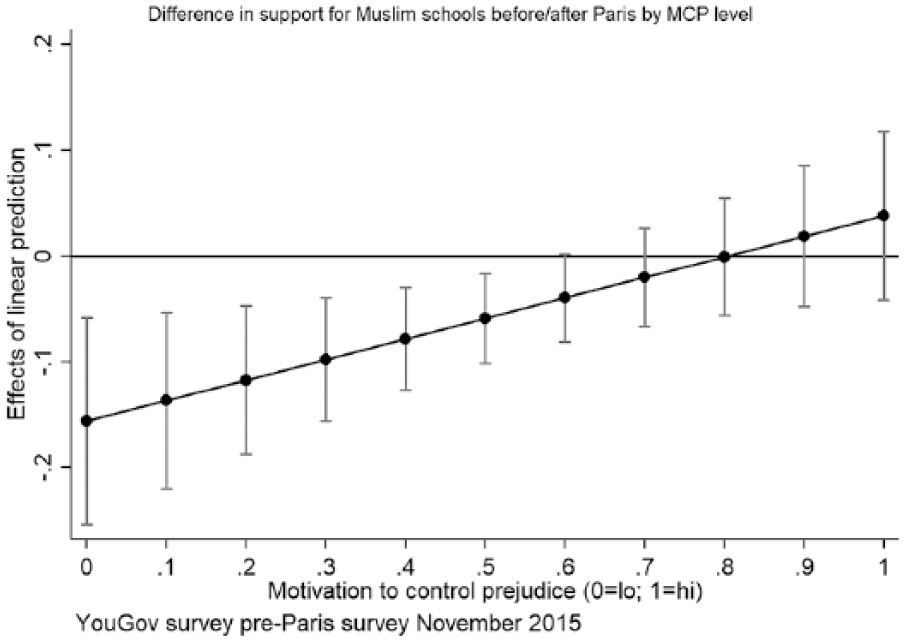
Change in British support for Muslim schools by MCP level, post-Paris attacks (baseline: pre-Paris).
Discussion
The results presented here demonstrate that discriminatory targeted opposition to Muslims on a central issue of multicultural accommodation—the provision of religious schooling—exists and is widespread enough to pose a serious challenge to multicultural accommodation in two of the three countries studied. Many majority-group citizens in Britain and Norway who would provide religious schools to the Christian majority would deny identical schools to the Muslim minority. In all three countries, support for Muslim schools was considerably lower than support for private schools, meaning results are not consistent with the claim that opposition to Muslim schools is based on universalist principles, which call for all pupils to be taught in identical school structures. With respect to Muslim schooling, at least, the majority is willing to support policies that violate egalitarian standards and instantiate not only de facto but even de jure discrimination.
Furthermore, beyond the core experimental design, a series of additional tests provide evidence that MCP can reduce or even eliminate targeted opposition. First, moderation analysis showed that individuals with high IMCP are more likely to support Muslim schools than those lower in motivation. In the Swedish sample, enough individuals have moderate to high levels of IMCP to essentially eliminate targeted opposition at the aggregate level. There are relatively fewer individuals with high levels of IMCP in Britain and Norway, but these individuals exhibit little to no discriminatory opposition to Muslim schools as compared with Christian schools.
Second, results from a natural experiment before and after a major terror attack carried out by Islamists show that opposition to Muslim schools was unaffected among those with high IMCP, while opposition to Muslim schools was higher after the attacks among those who were not motivated to control prejudice. In addition, our comparative experimental design provides further suggestive evidence that country-level variation in prejudice and associated political and social norms are critical to shaping national-level patterns in targeted opposition to Muslim schools. These latter forms of evidence do not stem from a controlled experiment, and therefore do not confirm a causal interpretation. Nonetheless, we have shown that MCP is consistently associated with lower levels of anti-Muslim discrimination in a central issue of policy accommodation across three European contexts, and provide further insight into the range of conditions under which motivation may reduce discrimination, including under conditions of heightened threat.
These results have important implications for both practical and scholarly debates about multicultural policy, and about whether negative responses to Muslims constitute Islamophobia or principled objections to Muslim practices. In the midst of political debates about multicultural policy, it is important to understand the extent to which opposition from majority-group citizens is rooted in principle or in prejudice. General opposition to private or religious schooling is a very different issue for governments than discriminatory opposition focused only on a stigmatized minority. The former is a legitimate preference that a responsive government might wish to accommodate; the latter would entail discrimination against citizens on the basis of religion, in a way that governments cannot legitimately enact into policy. Our experimental results provide clear evidence that opposition to accommodating Muslim demands for religious schools is often discriminatory, and our additional tests provide reason to suspect that anti-Muslim prejudice is an important driver of this targeted opposition.
Hostile views and discriminatory opposition are, however, only part of the story emerging from this study. We have highlighted the potentially critical role of antiprejudice norms in shaping policy debates and public opinion. Our results suggest that when majority-group members regard the equal treatment of minority groups as an important personal motivation, they are willing to apply this principle when considering controversial policy issues involving Muslims. Antiprejudice norms are a potentially valuable resource in building public support for multicultural policy. In all three countries studied, citizens who express a stronger commitment to such norms expressed greater support for, or at least weaker discriminatory opposition to, Muslim schools.
Commitments to social norms against prejudice show considerable power and robustness in shaping the national debate over Muslim integration. In the Swedish case, the strength of the normative motivation is sufficient to eliminate discrimination in the aggregate, even though respondents in Sweden who reject such norms do also discriminate against Muslim schools. The aggregate pattern found in our Swedish data is consistent with a notion of principled, secularist opposition to religious schooling, with Swedish respondents rejecting both Muslim and Christian schools equally.
The strong role for MCP in the Swedish sample suggests that the politics of prejudice are still highly relevant even in the absence of an aggregate-level gap in support for Muslim and Christian schools. Swedes who express little or no MCP still discriminate against Muslims. The absence of significant aggregate Muslim disadvantage reflects both that the level of MCP was higher overall in the Swedish sample compared with the other two countries and that IMCP had a stronger effect on Swedes’ support for Muslim schools. In other words, our Swedish respondents stand out for broader and deeper incorporation of Muslims under the protection of the antiprejudice norm, at least on this policy question.
However, while we have provided suggestive evidence that motivations to control prejudice can encourage more equal treatment of Muslim minorities in multiple European contexts, the limitations of our data mean that alternative possibilities cannot be fully ruled out. In particular, we lack the means in these data to fully tease apart the relative roles of motivations and underlying bias, or to fully rule out alternative interpretations of the effect captured by our IMCP measure from some of its correlates. For example, IMCP is correlated (by design) with more conventional explicit measures of prejudice. We argue for IMCP on theoretical grounds, as a better representation of validated dual process models of prejudice and as a more precise concept than the usual measures of “explicit prejudice.” However, our available data cannot fully exclude the possibility that the moderating effect of IMCP mixes together the impact of social norms as a conscious brake on discrimination with the mere absence of implicit or explicit hostility to minority groups. 11 We cannot fully separate out these effects in this study, given the limited items available on large multipurpose national-level surveys. In addition, although there is evidence from previous research that IMCP is a domain-specific measure, reflecting sensitivity to particular social norms sanctioning expressions of prejudice, we cannot determine in this study whether or not IMCP is in turn the product or expression of a broader form of political or social tolerance. This is not inconsistent with our view, but rather prompts further questions about the individual and societal sources of variation in IMCP that are beyond the scope of the present study.
Finally, our results demonstrate the value of conducting cross-national survey experiments, as we uncovered significant differences in responses across contexts. The divergence between Sweden and Norway, and convergence between Norway and Britain instead, suggests that more entrenched multicultural politics may help mitigate discriminatory behavior.
This unusual pattern suggests that each society’s path of multicultural accommodation could be important in setting standards for how broadly and deeply antiprejudice norms apply. Sweden and Norway differ most strikingly from one another in their approaches to multiculturalism, while being quite similar in numerous other social, political, and economic respects, including existing policy toward state-sponsored schools. Therefore, their divergence on preferences toward Muslim schools is striking. Sweden, with the strongest multicultural policies, also shows the strongest connection between antiprejudice norms and discrimination against Muslim schools, while such norms show the weakest connection to views of Muslim schools in Norway. This striking national difference points to the need for further research, with attention to the nuance of comparative settings. It demonstrates the theoretical and empirical complexity of this issue, and in so doing underlines why we need to be careful about generalizing from one context to another when addressing such issues in political science.
Supplemental Material
Appendix – Supplemental material for Discrimination, Antiprejudice Norms, and Public Support for Multicultural Policies in Europe: The Case of Religious Schools
Supplemental material, Appendix for Discrimination, Antiprejudice Norms, and Public Support for Multicultural Policies in Europe: The Case of Religious Schools by Scott Blinder, Robert Ford and Elisabeth Ivarsflaten in Comparative Political Studies
Supplemental Material
BritaindofileMuslimschoolsreplicationCPSaccepted – Supplemental material for Discrimination, Antiprejudice Norms, and Public Support for Multicultural Policies in Europe: The Case of Religious Schools
Supplemental material, BritaindofileMuslimschoolsreplicationCPSaccepted for Discrimination, Antiprejudice Norms, and Public Support for Multicultural Policies in Europe: The Case of Religious Schools by Scott Blinder, Robert Ford and Elisabeth Ivarsflaten in Comparative Political Studies
Supplemental Material
Britain_data_for_replication – Supplemental material for Discrimination, Antiprejudice Norms, and Public Support for Multicultural Policies in Europe: The Case of Religious Schools
Supplemental material, Britain_data_for_replication for Discrimination, Antiprejudice Norms, and Public Support for Multicultural Policies in Europe: The Case of Religious Schools by Scott Blinder, Robert Ford and Elisabeth Ivarsflaten in Comparative Political Studies
Supplemental Material
NorwaydofileMuslimschoolsreplicationCPSaccepted – Supplemental material for Discrimination, Antiprejudice Norms, and Public Support for Multicultural Policies in Europe: The Case of Religious Schools
Supplemental material, NorwaydofileMuslimschoolsreplicationCPSaccepted for Discrimination, Antiprejudice Norms, and Public Support for Multicultural Policies in Europe: The Case of Religious Schools by Scott Blinder, Robert Ford and Elisabeth Ivarsflaten in Comparative Political Studies
Supplemental Material
SwedendofileMuslimschoolsreplicationCPS – Supplemental material for Discrimination, Antiprejudice Norms, and Public Support for Multicultural Policies in Europe: The Case of Religious Schools
Supplemental material, SwedendofileMuslimschoolsreplicationCPS for Discrimination, Antiprejudice Norms, and Public Support for Multicultural Policies in Europe: The Case of Religious Schools by Scott Blinder, Robert Ford and Elisabeth Ivarsflaten in Comparative Political Studies
Supplemental Material
Sweden_data_for_replication – Supplemental material for Discrimination, Antiprejudice Norms, and Public Support for Multicultural Policies in Europe: The Case of Religious Schools
Supplemental material, Sweden_data_for_replication for Discrimination, Antiprejudice Norms, and Public Support for Multicultural Policies in Europe: The Case of Religious Schools by Scott Blinder, Robert Ford and Elisabeth Ivarsflaten in Comparative Political Studies
Footnotes
Acknowledgements
This paper has been long in the making and we are thankful to many colleagues. First of all, we would like to thank Maria Oskarsson and the Laboratory of Opinion Research at the University of Gothenburg for providing the opportunity to collect data in Sweden. Secondly, we would like to thank Paul Sniderman for encouragement and generosity that helped us field the second UK survey. We would also like to thank the participants at the New York Area Political Psychology Meeting at NYU in November 2015 for thorough feedback on a much earlier version of the paper and in particular to Leonie Huddy who provided the opportunity. We also gratefully acknowledge the useful feedback on the experimental design and analysis of participants at the Barcelona-Gothenburg-Bergen Workshop in Experimental Political Science in May 2016.
Declaration of Conflicting Interests
The authors declared no potential conflicts of interest with respect to the research, authorship, and/or publication of this article.
Funding
The authors disclosed receipt of the following financial support for the research, authorship, and/or publication of this article: The data collection in Norway through the University of Bergen Digital Social Science Core Facility was supported by a Bergen Research Foundation Infrastructure Grant.

Notes
Author Biographies
References
Supplementary Material
Please find the following supplemental material available below.
For Open Access articles published under a Creative Commons License, all supplemental material carries the same license as the article it is associated with.
For non-Open Access articles published, all supplemental material carries a non-exclusive license, and permission requests for re-use of supplemental material or any part of supplemental material shall be sent directly to the copyright owner as specified in the copyright notice associated with the article.
