



Abstract
Why would incumbent politicians adopt the secret ballot when doing so weakens the advantages of incumbency? Why is the secret ballot considered a democratizing reform in some settings, whereas in others it is associated with democratic backsliding? We provide theory and empirics to address these questions. Our starting point is the observation that the secret ballot had two consequences. It reduced the capacity to monitor the vote, thereby dampening the efficacy of clientelism. Yet, depending on literacy and electoral rules, it could also narrow political participation. Recognizing this, we endogenize politicians’ preferences over the secret ballot, concentrating on the role of their personal and constituency characteristics. Legislative roll call voting data from Brazil’s Second Republic (1945-1964) is used to test our framework. Consistent with expectations, the level of literacy of legislators’ supporters and the strength of their local ties strongly influenced the choice to adopt the secret ballot.
Introduction
Why would incumbent politicians adopt the secret ballot when doing so weakens the electoral advantages of incumbency, such as favored access to clientelist networks and state resources? Why is it that in some settings the introduction of the secret ballot appears to be a watershed moment in a country’s democratization process, whereas in others its contribution to competitive elections is much more dubious?
This article provides a novel theoretical framework and empirical evidence from mid-20th-century Brazil to address these questions. The starting point of our analysis is the observation that the adoption of the effective secret ballot represented first and foremost a change in the nature of voting technology. This shift in technology by its very nature affected the capacity to monitor the vote. Yet its effects were not limited to this domain. Depending on extant societal conditions and the format of electoral rules, it also held the potential to transform citizens’ ability to participate in the democratic process. It was an instrument that could both guarantee privacy and shape the electorate at the same time.
Building off the premise that the secret ballot may play this dual role, our framework points to a shortcoming in the widely held view that its adoption was intended to ensure that electoral outcomes would reflect the autonomous will of voting-age citizens. It could serve this function, but it could equally be utilized to purge voters viewed as political opponents or undesirables. This was especially the case for illiterate voters, for whom using the secret ballot could be a genuine challenge. Our model shows that the accessibility dimension of secret ballot reform lends itself to a political cleavage pitting modernizing disenfranchisers (those who favor a reduction in clientelism in tandem with a narrow franchise) against exploitative democrats (those who favor few restraints on clientelism and a broad franchise).
We test the expectations of our framework against roll call voting data from Brazil’s Second Republic (1945-1964). Brazil is a natural setting for such a test, as a large contingent of Brazilians of voting age could not read and write at the time the effective secret ballot was adopted (1955-1970). The electoral participation of illiterates was also a topic of active political debate during this period. Combining the roll call data with electoral statistics and census data, we examine how the personal and constituency-level characteristics of Brazilian legislators shaped legislative voting behavior on several different votes on the effective secret ballot (the so-called cédula oficial) taking place in the Chamber of Deputies during this period.
We find that the single most important predictor of legislative voting on the effective secret ballot was the literacy level of a legislator’s electoral base. Legislators whose electoral bases were composed mostly by illiterate voters were inclined to reject the secret vote; those whose electoral bases were composed mostly by literate voters were inclined to embrace it. The estimated impact of literacy was not simply a by-product of socioeconomic conditions conducive to clientelism: Literacy exerts a statistically significant influence on voting behavior even when one conditions on factors such as landholding inequality, sectoral employment, and the size of the electorate. This is important, as it indicates that legislators’ voting behavior reflected concerns about ballot accessibility for illiterates. Qualitative evidence from parliamentary debates is highly consistent with this view.
In terms of personal characteristics, we find that the capacity to activate local clientelist networks was also an important determinant of legislative voting behavior. In particular, former mayors were substantially more likely to vote against the effective secret ballot than non-former mayors. Overall, our findings underline the joint importance of both accessibility concerns and the perceived returns to clientelism in decisions to adopt the secret ballot.
Vote Secrecy and Democracy
A growing research program examines the origins of the rules of the democratic game. Referred to by political economists as the endogenous institutions agenda, this work offers a set of theoretical frameworks and empirical analyses that elucidate how factors such as demographic change and political information shape the choice of institutions that govern elections and delimit the power of governing elites (Aghion, Alesina, & Trebbi, 2004; Trebbi, Aghion, & Alesina, 2008). The logic of backward induction generates the insights of the approach. Institutional designers rationally anticipate the outcome of each political game that emerges from choosing each institution, and, given constraints at the time institutions are chosen, they adopt the institution that best advances their interests (Diermeier & Krehbiel, 2003).
Scholars of comparative political institutions have applied the approach to great effect in recent years. Studies of two historical outcomes dominate scholarly output in this vein: the extension of the franchise and the adoption of proportional representation. The literature on franchise extension emphasizes changes in social inequality, asset structure, public health crises, and inter-elite conflict as factors contributing to the choice to broaden the electorate (Açemoglu & Robinson, 2006; Ansell & Samuels, 2014; Boix, 2003; Lizzeri & Persico, 2004). The literature on the origins of proportional representation, in turn, revolves primarily around the question of whether or not this electoral system was adopted in response to the rising electoral strength of Left parties, the seats–votes disproportionality extant under the status quo majoritarian system, or the long-term economic interests of employers (Boix, 1999; Calvo, 2009; Cusack, Iversen, & Soskice, 2007; Leemann & Mares, 2014).
More recently, the endogenous institutions research program has set its sights on another key moment in the history of democracy: the adoption of the secret ballot. In general, treatments of the topic have tended to view the adoption of the secret ballot as a constitutive feature of democratization itself, in much the same way that the expansion of the franchise is viewed as an integral step for achieving a full-fledged democracy. Indeed, in a cross-national analysis of the transition to the secret ballot, one authority on democratization concludes that the dynamics undergirding suffrage expansion and vote secrecy should be thought of as one and the same (Przeworski, 2015).
This view of the secret ballot as a democratic stepping stone stems from a specific interpretation of what its adoption represented: the political liberation of poor and economically dependent voters. Whereas the expansion of the suffrage granted marginalized populations the legal right to participate in elections, the secret ballot was ostensibly the vehicle for making this right meaningful. As a shield from coercion and other forms of undue influence, it is typically held up as the central innovation in voting technology that made it possible for the downtrodden voter to cast a vote according to conscience, instead of according to the dictates of local bosses, party operatives, or employers. From this vantage point, explaining the choice for the secret ballot in effect reduces to explaining the choice to meaningfully enfranchise the poor.
Conceptualizing the choice for the secret ballot in this way makes good sense in contexts in which voter heterogeneity is primarily a function of wealth or skills acquisition. In such settings, elite preferences over the secret ballot will be driven primarily by a politician’s comparative advantage in bribing or intimidating the poor. A rich set of studies examining the adoption of vote secrecy in Imperial Germany and Victorian England bear this out. Examining legislative choices on electoral reform and other aspects of the historical record, the authors have found that politicians with the greatest resource advantages or with the greatest capacity to intimidate economically dependent voters—due to economic structures such as landholding inequality and workforce concentration—represented the reaction against reform, whereas politicians lacking these built-in advantages represented the vanguard in favor of it (Ardanaz & Mares, 2014; Kasara & Mares, 2017; Mares, 2015; Ziblatt, 2008). This pattern seems to have held in other European countries at comparable levels of social and economic development, such as Denmark (Elklit, 1983). In these cases, it is straightforward to divide the extant party system into groups in favor of reform, and, ipso facto, democratization (Social Democrats in Germany and Denmark, Liberals in England), and groups in favor of the old system, which represented the continuance of authoritarianism in democratic guise (the various conservative parties in Germany and Denmark, Conservatives in England).
The conceptual equivalence between the forces for or against the secret ballot and those in favor of or opposed to democracy itself does not extend easily to polities where voter heterogeneity extends beyond the realm of wealth and skills acquisition. A central dimension of such heterogeneity in a number of countries when they adopted the secret ballot consisted of functional literacy. Unlike for the case of Western and Northern Europe, where universal education largely preceded the adoption of vote secrecy, in many developing countries (and in regions of industrializing countries like the United States), illiteracy among politically relevant components of the population was widespread when the secret ballot was adopted. This matters greatly in understanding the effects of the secret ballot and the elite intent underlying its adoption.
Making the vote de facto secret, as opposed to doing so nominally through constitutional dictate, more often than not entailed the introduction of what has become popularly known as the Australian ballot (AB): a uniform and official ballot presenting the voter with the option to vote for any registered candidate or party, and which is distributed by electoral authorities and printed by the state at public expense. This institution is typically what students of democracy have in mind when they refer to the effective secret vote. Taken in conjunction with closed voting booths, the AB made it next to impossible for local powerholders to ascertain the individual votes of their dependents.
Yet the AB also made demands on voters that the extant modalities of voting, viva voce or, more commonly, the use of candidate and/or party printed ballots, did not make. In particular, it could require basic literacy: the ability to recognize printed names on a ballot or manipulate the written word to indicate one’s political preference. This was especially true in countries with candidate-centric electoral systems, such as open-list proportional representation or single-member districts with concurrent elections, which feature many candidates running for office in any given election cycle. In these cases, the new ballot required scanning through long lists of names often typed in small print, or in some instances that the voter writes in the name of his preferred candidate. In such settings, the multidimensional nature of voter heterogeneity, taken in conjunction with the accessibility challenges presented by the effective secret vote, lent itself to the formation of constituencies in favor of ballot reform that cannot in any reasonable sense be thought of as advocating for the deepening and expansion of democracy.
The best-known example of this occurred in the post-Reconstruction U.S. South, where white supremacists within the Democratic Party advocated for the AB based on the expectation that it would create an obstacle to the participation of African Americans (who constituted an important voting block for the Republicans; Kousser, 1974; Perman, 2001). As will be discussed below, a similar dynamic was operative in mid-20th-century Brazil, where the political party most supportive of its adoption, the National Democratic Union (UDN), publicly embraced the AB as a vehicle for purging illiterates from the electorate. Elements within the UDN also helped orchestrate repeated military interventions in politics during this period, activities that culminated in the 1964 coup that led to more than 20 years of military rule (Benevides, 1981). Thus, in these countries equating support for the effective secret vote with support for democracy would imply that disenfranchisers and coup mongers somehow represented the vanguard of democratization. Not only were the political forces arrayed in favor of the effective secret vote different from those of suffrage expansion, they were the exact opposite.
What made the AB an attractive tool for narrowing the electorate in these countries was the manner in which literacy overlapped with pre-existing political cleavages. Figure 1 illustrates this point by depicting levels of literacy across politically relevant subgroups of the population at the time of the introduction of the AB in Brazil and the United States. The cases are striking in the degree to which literacy covaried with politically relevant geographical and demographic cleavages. In Brazil, the AB was instituted at a time in which there was a gaping difference in literacy between urban and rural areas. This was also a time in which industrialization policy pitted the interests of industry and large population centers against those of agriculture and the countryside. In the United States, the politically relevant divide fell along racial lines; here differences in literacy levels were even starker. In both cases, the overlap between educational heterogeneity and political preferences made the AB a precise and effective instrument of disenfranchisement. Given the accessibility challenges the AB presented to illiterates, urban Brazilian modernizers and Southern white supremacists in the United States could use this technology to purge voters aligned against their political interests without purging their own followers at the same time.
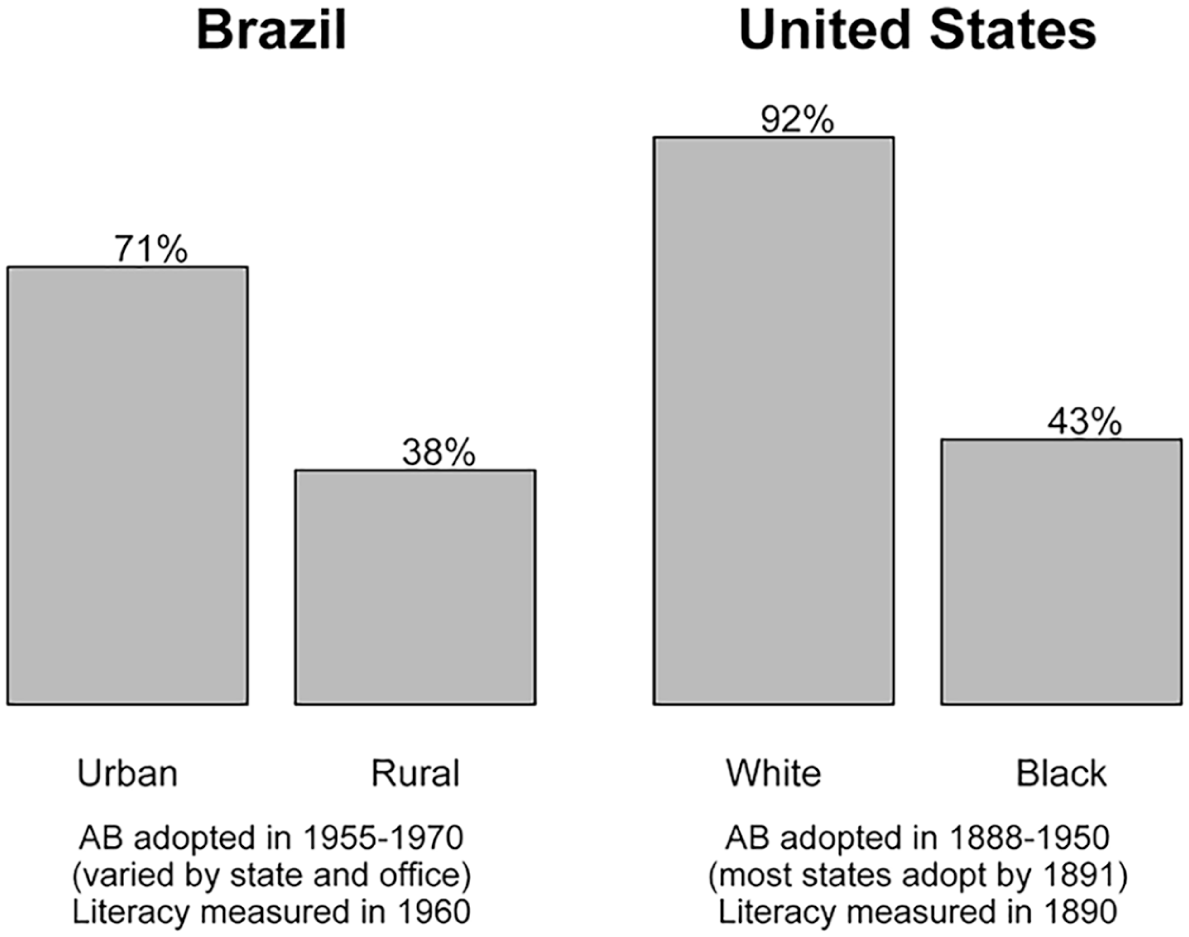
Literacy rates at the time of the introduction of the Australian ballot in Brazil and the United States.
Appreciation of the accessibility dimension of secret ballot reform demands a novel conceptual framework for understanding its implementation. To this end, our article endogenizes the choice for the secret ballot using a model that places diversity in voter education, and, by extension, the capacity to access a uniform and official ballot, front and center in the analysis. As in previous formal analyses of the adoption of the secret ballot, the framework considers how the secret ballot affects the efficacy of clientelist exchange, thereby shaping the preferences of incumbents over this modality of voting (Aidt & Jensen, 2017; Heckelman & Yates, 2002; cf. Baland & Robinson, 2008). Yet, by considering educational diversity among the electorate, the model is able to analyze how preferences for more or less effective forms of clientelism may trade off against preferences for a relatively narrow or broad franchise.
At an empirical level, we follow the example of Ziblatt (2008), Ardanaz and Mares (2014), and Mares (2015) in evaluating claims about the factors that drive the adoption of vote secrecy through an examination of legislative behavior in a specific country (mid-20th-century Brazil). Such an empirical strategy necessarily privileges concerns about internal validity over those about external validity. There are several reasons why we believe that this emphasis on internal validity is merited.
First, in studies of vote secrecy, it can be difficult to classify the institution of interest correctly because the adoption of vote secrecy is often not a single discrete moment but rather a series of steps typically beginning with the nominal proclamation of secrecy and ending with the supporting legislation and electoral procedures that make the proclamation of secrecy a reality. Decades often pass between these two steps. Moreover, in a number of countries, including Australia, Brazil, Germany, the United States, and Canada, the effective secret ballot was not implemented wholesale for the entire country, but rather adopted at different times for different regions. This makes a purely country-level, cross-sectional analysis difficult to interpret.
A second consideration counseling a more narrow focus is heterogeneity in the contrast space. Simply put, there is no such thing as “the” effective secret ballot, much like there is no single disease that can meaningfully be called cancer. To take the case of the AB, the format of the official ballot varies enormously around the world, and, in the United States, it also varied widely across states (Albright, 1942; Reynolds & Steenbergen, 2006). Moreover, the modality of voting prior to the effective secret ballot differed across countries and occasionally across regions within those countries. Consequently, cross-national analyses based on a simple dichotomization of the presence or absence of the effective secret vote are at risk of averaging across fundamentally heterogeneous contrast spaces for the units in a given sample.
Finally, we believe that a country-specific empirical analysis focusing on the behavior of legislators makes the most sense from a theoretical vantage point because it is ultimately electoral legislation passed by the legislature that determines whether or not the secret ballot prevails. By studying legislators, one ensures that the units of analysis emphasized in one’s theory of electoral reform are the same as those used to empirically assess said theory.
A Model of Vote Secrecy With Educationally Diverse Voters
Actors
Consider an electoral jurisdiction in which an incumbent politician (I) and a challenger (C) compete for the votes of a group of N voters, with a representative voter indexed by j. Voters are assumed to be heterogeneous in terms of their capacity to read and write (literacy). For simplicity, we treat literacy as a binary trait. Literate voters constitute a fraction σ ∈ (0, 1) of the total electorate.
Electoral Regimes
The election can take place under one of two different electoral regimes: an open voting regime or a secret ballot regime. In the open voting regime, the votes of individual voters can be ascertained directly by the incumbent. This scenario reflects the state of affairs under viva voce or voting under ballot-and-envelope systems in which ballots are printed and distributed by candidates or parties. In the secret ballot regime, the electoral choices of individual voters are not directly observable. This scenario reflects the state of affairs under the AB system.
The relevance of the distinction between the regimes lies with the nature of clientelist exchange that can be organized by the incumbent as well as the scope of the electorate itself. Under open voting, the incumbent can directly condition the receipt of a material benefit θ > 0 to the specific vote cast by each voter. Under secret voting, the incumbent can only indirectly condition the receipt of θ to the vote cast by a given voter.
The feasibility of indirect conditioning of benefits under the secret ballot has been explicated in two ways. First, vote brokers employed by candidates may be so deeply embedded in their communities that they can use behavioral cues to ascertain, with reasonable if imperfect reliability, if a citizen voted in the desired fashion (Stokes, 2005). This is the behavioral cues mechanism. Second, vote brokers may condition the receipt of benefits upon the aggregate electoral outcome in the jurisdiction under their control, thereby linking individual vote choice to benefits through the former’s influence on the observable jurisdiction-level outcome (Gingerich & Medina, 2013; Rueda, 2015). This is the outcome contingency mechanism. As both of these mechanisms are weak substitutes for the direct conditioning of benefits on vote choice, the transition from the open to the secret vote erodes the efficacy of clientelistic exchange.
The electoral regime is also relevant for the accessibility of the ballot. As discussed above, the introduction of the AB may, depending on the institutional context, have a disenfranchising effect for illiterate voters who cannot read or write names on a voting paper. Our model is structured to capture political dynamics in such settings, primarily candidate-centric electoral systems that cannot or do not use party symbols on official ballots. Consequently, one can conceptualize the introduction of vote secrecy as prohibiting meaningful political participation by functionally illiterate voters. We represent this by limiting the suffrage under the secret ballot to literates.
Actions
We assume a scenario of obligatory voting that engenders full turnout among those able to vote. As such, the action taken by a given voter consists solely of her vote vj ∈ {0, 1}, where vj = 1 is a vote for the incumbent and vj = 0 is a vote for the challenger. The action to be taken by the incumbent consists of the choice of the underlying electoral regime that will govern the election. This choice is made at the beginning of the game, prior to votes being cast by voters.
Remarks
Although stark, the assumption of compulsory voting and disenfranchisement of illiterate voters under the secret ballot is a limiting case of two real-world scenarios. In the first, voter turnout is non-compulsory but the increase in the cost of voting associated with the adoption of the secret ballot (due to ballot complexity) is much greater for illiterate voters. This is the experience described in several states in the U.S. South. In the second, turnout is compulsory but voters may make errors or omissions in voting which keep their votes from counting. If the increase in the errors engendered by the secret ballot (again, due to ballot complexity) is much greater among illiterates than literates, then disenfranchisement occurs via differential error rates. As discussed later, this was the historical experience of Brazil. Our setup is compatible with either modality of disenfranchisement.
Utility
Voters differ in their intrinsic tastes for the incumbent and challenger, resulting in varying expressive utilities associated with casting a vote for one or the other. In particular, let aj represent the expressive utility that j associates with casting a vote for I instead of C. We permit the distribution of such expressive utilities to differ according to literacy. More specifically, for literate voters, the expressive utilities are distributed uniformly with support [−µ − 1/2h, −µ + 1/2h], h > 0, whereas for illiterate voters the utilities are distributed uniformly with support [µ − 1/2h, µ + 1/2h]. According to this formulation, µ ∈
Given these preliminaries, we can describe the utility a representative voter associates with voting for the incumbent. Under open voting, the utility of voting for the incumbent is

By contrast, under the secret ballot regime, the utility of voting for the incumbent is

where ∆(N) ∈ [0, 1] (∂∆/∂N < 0) is the probability that a vote for the incumbent will result in the receipt of the benefit (equivalently, that the failure to vote for the incumbent will result in the benefit being withheld). This quantity reflects the capacity of the incumbent to monitor votes under the secret ballot. Values close to 0 indicate weak or non-existent monitoring capacity, whereas values close to 1 indicate that the secret ballot exists in name only.
Three points about the above equations merit mention. First, the key difference in voter utility across electoral regimes rests with the weight voters place on θ. Whereas in an open voting system this weight is unity, in a secret ballot system it is only equal to the marginal contribution of a vote for the incumbent on the likelihood of receiving θ.
Second, the model abstracts away from commitment issues: So long as the incumbent can verify that a voter voted his way, we assume he will never withhold the benefit ex post. This is a reasonable assumption in the context of long-run iterated interactions between politicians (or their brokers) and voters, which is typically the setting in which clientelism is electorally relevant.
Finally, we note that both the behavioral cues and outcome contingency mechanisms imply that ∆ is a decreasing function of N. According to the behavioral cues account, ∆ should decrease with N because it becomes more difficult for brokers to recognize the personal indicators of deceit among the members of their community as the size of said community grows. According to the logic of outcome contingency, ∆ decreases with N because the influence of any voter’s voting decision on the jurisdiction-level outcome, and hence on the likelihood of receiving the benefit, decreases as the jurisdiction grows. Either way, the transition from the open to secret ballot should undermine the efficacy of clientelism more in large jurisdictions than in the small ones. 1
We consider the case of an office-seeking incumbent, as this permits our model to speak directly to how the electoral calculi of sitting politicians shape the choice of the electoral regime. Let ΩO denote the vote share for the incumbent under open voting and ΩS denote the vote share for the incumbent under secret voting. The incumbent’s utility for instituting a secret ballot regime is

According to this formulation, the incumbent is electorally instrumental: He will adopt the electoral regime that provides the highest expected vote share.
Equilibrium Vote Shares
We begin with voting under the open voting regime. In this setting, any voter for whom a ≥ −θ will vote for I. Consequently, the vote share for I under open voting is equal to

Deriving the vote share under secret voting requires adjusting for the reduced scope of the electorate. Recall that in this context illiterates have been purged from the electorate so that all voters are literates. In this group, any voter for whom a ≥ −∆θ will vote for I. Thus, the proportion of the vote accruing to I under the secret ballot is written as

Using the above equations, the difference in vote shares the incumbent can expect across the two regimes is equal to

Choice of Regime
The above expression leads directly to the comparative statics described in the following proposition:
Proof. The proof follows directly from differentiating the expression in Equation 6 with respect to the indicated parameters.
Parts 1 and 2 of the proposition characterize how concerns about the scope of the franchise shape preferences over the secret ballot. Given that the secret ballot effectively limits the franchise, an incumbent’s stance on reform will be informed by the characteristics of the voters inclined to support him. An incumbent who enjoys a loyal following primarily among illiterate voters (µ > 0) will be disinclined to adopt the secret ballot, recognizing that the post-reform electoral landscape will be tilted against him. Contrariwise, an incumbent whose supporters are primarily literate (µ < 0) will be inclined in favor of the secret ballot, recognizing that its adoption entails a smaller and more sympathetic electorate. These effects of voter preferences are mediated by constituency demographics (σ). An incumbent favored by illiterates who represents a largely illiterate constituency will have the most to lose from reform and thus will be strongly opposed to it. On the contrary, an incumbent favored by literates will get greater utility from reform the greater the proportion of illiterates in his constituency because the electoral benefits of disenfranchisement are higher with more illiterates.
Part 3 of the proposition characterizes how concerns about the efficacy of material inducements determine preferences over the secret ballot. Although an increase in θ leads to an increase in the vote share for the incumbent under both the secret ballot and open voting, higher values of this parameter unambiguously favor the maintenance of open voting. This is because θ has less persuasive power under vote secrecy than open voting. The lesser persuasive power of θ under the secret ballot stems from voters’ awareness of the fact that the receipt of the benefit can at best be probabilistically tied to their vote choices. This contrasts to the open voting case where the receipt of the benefit is directly tied to individual voting behavior. Consequently, an incumbent whose personal resources, network ties, and community characteristics provide him with a high potential for material influence will be hesitant to adopt the secret ballot.
Part 4 of the proposition states that greater N reduces the inclination to adopt the secret ballot. This may seem surprising, as clientelism often thrives in rural communities with relatively few voters. Yet it follows from consideration of the opportunity costs of reform. Under the open vote, N is irrelevant for the viability of clientelist exchange because the incumbent can contract directly with individual voters on individual votes. Under the secret ballot, by contrast, N is highly relevant: Conditioning the allocation of benefits on behavioral cues or aggregate outcomes may be effective in maintaining clientelist exchange if jurisdictions are small, but not if they are large. Thus, as clientelism is more viable under the secret ballot in small jurisdictions than the large ones, it is in incumbents located in the latter who lose the most from reform.
Discussion
Examination of Equation 6 provides an insight into the types of incumbents who will be in favor of or against the adoption of the secret ballot. Note first that no incumbent favored by illiterates (µ > 0) will vote in favor of the secret ballot. For such an individual, both of the consequences of the secret ballot—a reduction in the efficacy of clientelism and the reshaping of the electorate—redound to his detriment. If, however, an incumbent is favored by literates relative to illiterates (µ < 0), he may or may not favor adopting the secret ballot. Ultimately, his inclination depends on the size of the electoral benefit from purging illiterates relative to the electoral loss from weakening the persuasive power of his material inducement, θ. If the value of his inducement is small, then an incumbent favored by literates will adopt the secret vote; otherwise, he will retain the open vote.
In this way, the model suggests that many incumbents inclined against the secret ballot are what we would call exploitative democrats. These individuals are willing to fight tooth-and-nail to maintain electoral technologies that permit a broad franchise. What makes them exploitative is the fact that this stance allows them to eat their cake and have it, too. They benefit from an unrestricted franchise containing less educated voters intrinsically disposed in their favor while at the same time retaining the ability to employ economic power to bribe or coerce the electorate. On the other side of the coin, many of the incumbents inclined in favor of the secret ballot could be called modernizing disenfranchisers. These individuals are the vanguard of ballot reform, touting its promise to modernize political life by inhibiting clientelist exchange. Although they are modernizing in the sense of being willing to give up clientelist practices that benefit them to some extent, they adopt this stance only because the narrowing of the franchise more than compensates them for this loss.
Empirical Implications
The framework generates several empirically falsifiable hypotheses about how the nature of politicians’ electoral bases affects preferences toward the secret ballot. We begin by considering the role of voter preferences across education groups. Because in practice incumbents favored by a particular education group will tend to represent areas dominated by members of that group (otherwise they would not be incumbents), we focus our empirical evaluation on the educational makeup of an incumbent’s support base (µ). Our central expectation is that greater literacy among a politician’s supporters leads to a more favorable disposition toward the secret ballot:
Another finding of the model is that incumbents with profound material influence over voters (high θ) will be less inclined toward the secret ballot than those whose influence is more limited (low θ). The intensity of such influence may be determined by a variety of factors, some of which are features of the electorate whereas others are features of the politician himself.
One constituency-level determinant of incumbent material influence is the level of inequality in agricultural landholding (Ansell & Samuels, 2014; Boix, 2003; Ziblatt, 2008). For countries with incipient or uneven industrialization, the concentration of land may reflect the existence of social hierarchies and power structures that permit landed elites to inflict harm upon dependents who behave at odds with their wishes. More specifically, it can imply the absence of viable alternative employment prospects for agricultural workers, thereby permitting the landed elites who employ these individuals to direct their votes to politicians of their preference (Baland & Robinson, 2008). This leads to our second hypothesis:
A second constituency-level determinant of incumbent influence is the manner in which voters are inserted into the labor market. The more such insertion affords incumbents or their local representatives discretionary power over employment, the more reticent the incumbents will be to adopt the AB. For countries initiating the process of industrialization, such discretionary power is typically positively related to the level of agricultural employment and negatively related to the level of industrial employment. This leads to the following hypothesis:
The personal characteristics of an incumbent are also determinants of his material influence. These may include the incumbent’s personal wealth, his ability to exploit state resources and personnel for political advantage, and/or the scope of local networks that can be brought to bear in favor of his candidacy. Incumbents who have significant personal campaign resources to rely on, or who can rely on state officials and local intermediaries to cajole or intimidate voters on their behalf, are likely to oppose the secret ballot (Kasara & Mares, 2017). This leads to the following hypothesis:
A final empirical implication of the model concerns the impact of the size of the electorate (N). Politicians facing larger electorates should be less disposed toward the secret ballot than those facing smaller electorates, all else equal, due to the opportunity cost argument elaborated above. Thus, our last hypothesis is as follows:
Historical Background
Whereas most of Europe and the majority of states in the United States adopted some variant of the AB by the beginning of the 20th century, this was not true for Latin America. A more typical pattern in the region was the promulgation of nominal vote secrecy in constitutions during the early decades of the century followed by the transition to the AB at mid-century or shortly thereafter. This was the basic trajectory of electoral reform in countries such as Brazil, Chile, and Peru. Prior to the adoption of the AB, voting was conducted through the use of the ballot-and-envelope system originally developed in France. Under this system, there were distinct ballots for each candidate or party. In theory, the system was supposed to provide vote secrecy by having voters receive official envelopes from electoral authorities and then retire to a private compartment, at which time they would place their ballots into the envelopes. In practice, however, votes were easily monitored and controlled. Ballots were printed by candidates or parties at their own expense, and they were distributed to voters by campaign workers or local landholders. Local elites would often shepherd voters to the polls to make sure that they did not receive ballots from competitors. Orlando M. Carvalho (1954) described this process in Minas Gerais, Brazil: Each landowner adopted a system of bringing to their own residence a group of voters-peasants. There, they were divided into small groups of 3 or 4, their electoral titles and voting section information ascertained. Afterwards, they were driven in trusted automobiles to locations close to the precincts and delivered to friendly ward heelers (cabos eleitorais) stationed next to the polling stations. Subsequently, they were handed over to a group of women who strategically positioned them and watched over them until it was time to vote. (p. 231)
Given the frequency of these practices in rural Brazil, it was understood that transitioning from the ballot-and-envelope system to the AB would represent a major step in putting into practice the principle of a secret vote.
Yet the transition was relevant for another reason: It held the potential to disenfranchise voters with low literacy. This was a pertinent issue for Brazil, which adopted the AB in a staggered fashion over 15 years (1955-1970). During this period, approximately 40% of the adult population could not read and write according to the census criteria (IBGE, 1967), with actual levels of functional illiteracy being certainly much higher. Although the constitution of the time formally prohibited illiterates from registering to vote, the lack of any meaningful check for literacy during the registration process led to large masses of illiterates registering under the tutelage of local political bosses (Limongi, 2015).
In fact, the AB did disenfranchise illiterate voters. In a municipal-level analysis of voting returns from the period, Gingerich (2019) shows that the introduction of the AB in federal deputy elections led to a vertiginous increase in wasted votes, particularly in areas of high illiteracy. The complexity of voting with the AB helps explain this outcome. For offices contested via proportional representation (federal deputy, state deputy, municipal councilor), the AB required voters to write in the name of their preferred candidate or a number that represented the candidate. This made the AB especially unfriendly to voters with low levels of education.
The legacy of the AB can be discerned in Figure 2, which displays wasted votes as a percentage of all votes cast in the country as a whole as well as in the state of São Paulo. In the initial years of the Second Republic, vote wastage was low. With the introduction of the AB for federal deputy elections in São Paulo, the city of Rio de Janeiro, and state capitals in 1962, the level of wastage rose exponentially, reaching a high point in the legislative election of 1970 (the first in which the AB was in place throughout the entire country). 2 Subsequently, wastage declined for three election cycles, although without reverting to the pre-reform level. With the passage of a constitutional amendment in 1985 formally giving illiterates the right to vote, wastage shot back up again. It was not until the universal adoption of electronic voting in 2000 that the level of vote wastage approximated that before the introduction of the AB. 3 All told, under the operation of the cédula oficial nearly one in three Brazilian voters cast votes that were irrelevant in determining the composition of the ruling elite.
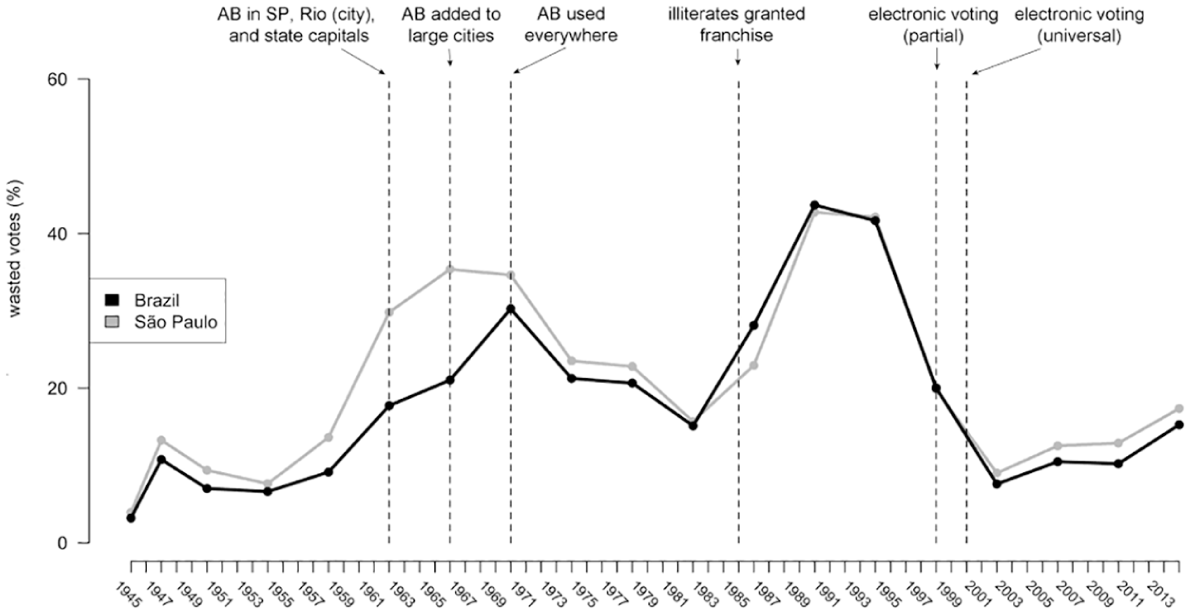
Wasted votes in federal deputy elections (1945-2014).
It is against this backdrop that we study the votes of Brazil’s legislators over the AB. We examine four different roll call votes on the AB that took place in the Chamber of Deputies from 1955 to 1962. To the best of our knowledge, these are all the recorded roll call votes on the AB in Brazil. All votes were recorded in Diário do Congreso Nacional I on the dates indicated below. Descriptions of these roll calls are provided in Supplemental Appendix.
In our statistical analyses of the roll calls, we focus on the choices of legislators who were free to vote according to their preferences. Such freedom was by no means guaranteed. Particularly in the 1955 roll call, and to a lesser degree in the subsequent roll calls, certain party leaders decided that voting on the AB for their parties was to be a “closed question.” This meant that all rank-and-file members of these parties were required to vote the same way on a given roll call. Eliminating the votes of legislators belonging to such parties is crucial for valid inference because the characteristics of a legislator’s background and constituency cannot possibly drive vote choice when voting behavior is determined ex ante by party leaders. Given that party leaders’ decisions to make votes open or closed are not available for all parties in the parliamentary records of this period, we proceed by removing from the analysis the votes of legislators belonging to a party that cast a strict party line vote on a given roll call. However, the section below first presents the party-level voting trends and discusses how these correspond to the intuitions of our framework.
Trends by Party
We begin with an overview of the roll call votes, aggregated by political party. As shown in Table 1, the first roll call on the AB was a party line affair. Among Brazil’s main parties, nearly all legislators present voted with the majority of their party. The breakdown of that vote, and early parliamentary discussions of the AB more generally, was driven by a rivalry between Brazil’s two largest parties of the time: the Social Democratic Party (PSD) and the UDN. As shown in the table, UDN deputies present for the vote aligned uniformly in favor of the AB, whereas PSD deputies aligned overwhelmingly against it.
Roll Call Votes on the Australian Ballot in Brazil (1955-1962) (by Party).
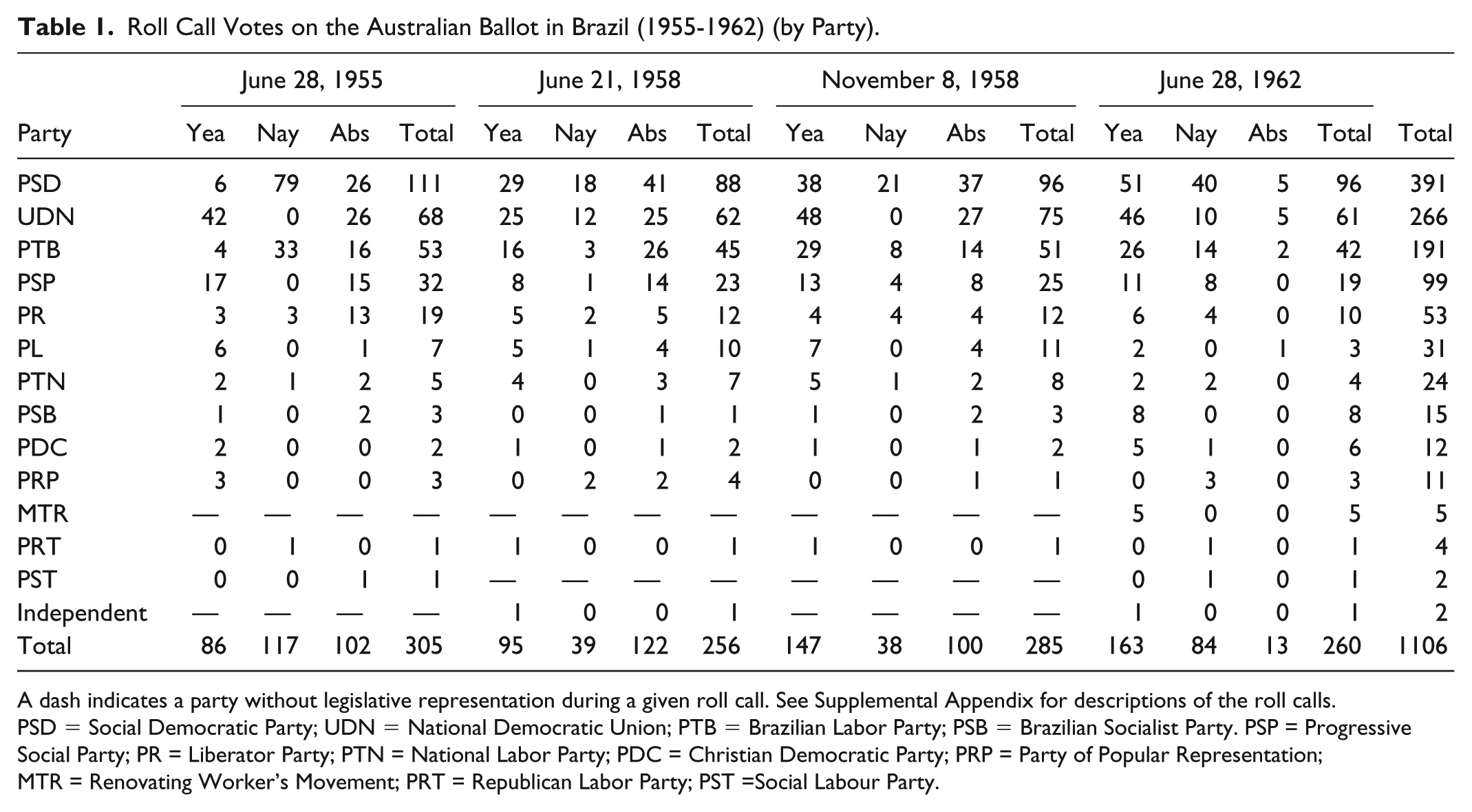
A dash indicates a party without legislative representation during a given roll call. See Supplemental Appendix for descriptions of the roll calls. PSD = Social Democratic Party; UDN = National Democratic Union; PTB = Brazilian Labor Party; PSB = Brazilian Socialist Party. PSP = Progressive Social Party; PR = Liberator Party; PTN = National Labor Party; PDC = Christian Democratic Party; PRP = Party of Popular Representation; MTR = Renovating Worker’s Movement; PRT = Republican Labor Party; PST =Social Labour Party.
The conflict between the PSD and UDN owes to their origins and differences in the ability to exploit clientelist networks in rural areas. Created during the dictatorship of Getúlio Vargas (1937-1945), the PSD was a conservative party whose founders consisted of Vargas’ state-level interveners and their municipal appointees. This had two consequences. First, it produced a decentralized organizational structure that tethered national leaders to state and local interests. Second, it led to a comprehensive network of municipal directorates, populated by rural vote brokers called coronéis that could be called upon to bring out the vote. Among other activities, coronéis and the local PSD directorates they often headed were crucial in distributing candidate printed ballots to voters. Given these realities, no other organization drew greater sustenance from clientelist networks in the countryside and no other organization was more opposed to the introduction of the AB. Using the labels introduced earlier, the members of the PSD can be characterized as the exploitative democrats in the debates over the AB.
Also a conservative organization, the UDN was founded by elite professionals who opposed the Vargas regime. Unlike the PSD, which was overwhelming rural, the UDN contained both urban and rural wings. Moreover, it was the urban wing—consisting of middle-class professionals from the city of Rio de Janeiro—that commanded the greatest influence within the party. Although the rural wing of the UDN cultivated its own set of coronéis, it did so at a disadvantage given the greater organizational strength of the PSD in the countryside. Thus, given the party’s social base and its organizational handicaps, the UDN leadership perceived the party as losing out from the continued operation of rural vote brokerage. Consequently, the UDN joined forces with likeminded actors in Brazil’s electoral justice system to break the dominance of the rural elites. They did this not by targeting the rural elites or their property directly, but by drafting electoral legislation—the official ballot reform—that attempted to purge the illiterate voters who constituted the basis of the rural elites’ power. In this way, the UDN and its allies in the judiciary fit the profile of what we call modernizing disenfranchisers.
As it turns out, the disenfranchising intent undergirding the UDN’s stance on the AB is well represented in the era’s parliamentary debates. For instance, Carlos Lacerda, UDN deputy from the Federal District, lauded the AB’s narrowing of the franchise on the grounds that although it is clear that it is in the interest of democracy to have voters, those voters should be conscious, capable, and not voters whose incompetent and uninformed opinion will destroy the collective patrimony (acêrvo) of the electorate that is already conscious, politicized, and capable of assuming the responsibility of choosing its leaders. (Boletim Eleitoral, June 1955, p. 542)
Fernandes Távora, UDN senator from Ceará, stated bluntly that if a voter could not utilize the AB, “then he is an illiterate and should be purged” (Diário do Congresso Nacional II, August 2, 1955, p. 1846).
The rhetoric of modernizing disenfranchisement was also evident in the statements of the UDN’s allies in the electoral justice system. Edgard Costa, then president of Brazil’s Superior Electoral Court (TSE) and the architect of the initial AB bill, framed his support of the AB in terms of its disenfranchising power: Those who are against the [AB] argue that its adoption would result in a significant reduction of the electorate, principally in the interior [countryside] of the country. This position is an admission that the interior electorate is in fact composed of a great number of illiterate and thoughtless voters, over which is most easily exercised the coercion, bribery, and domination that so delegitimate electoral results . . . Giving these voters the vote in such conditions is tantamount to sacrificing the modern populations (populações adiantadas) to the social norms (conveniências) of illiterates in the interior. (O Estado de São Paulo, May 11, 1955, p. 3).
The opposition of the PSD to the AB was no less intense than the advocacy of the UDN and its allies. Moreover, it was also motivated by concerns about the scope of the suffrage. Ulysses Guimarães, PSD federal deputy from São Paulo, inveighed against the AB based on the argument that the new ballot, by complicating the mechanics of voting, would operate in effect as a form of suffrage restriction for uneducated voters. In making his case, he compared the anticipated effects of the AB in Brazil with Jim Crow in the American South: The [AB] is an oblique or indirect way of violating the spirit of universal suffrage, enshrined in article 134 of the Federal Constitution . . . The [AB] would remove from the polls or prevent from voting—quite consciously—thousands of Brazilians legitimately enabled to do so. In the United States, similar subterfuges were invented and legal constructions arranged in order to facilitate discrimination, notably on the basis of color. (Diário do Congresso Nacional I, August 18, 1955, p. 5060)
Comparable language was later utilized by José Martins Rodrigues, a PSD leader from Ceará, who characterized the AB as an attempt to wrest the vote away from the “uneducated man of the interior”: The adoption of the [AB] poorly disguises or conceals the objective of selecting the electorate not at the moment of granting the right to exercise the vote, but rather at the exact instant of exercising it. In this respect, it is an anti-democratic measure, resulting in the devious limitation of the universality of the suffrage, which the Constitution established. (Diário do Congresso Nacional I, July 5, 1958, p. 4199, our emphasis)
Initially, Left parties, such as the Brazilian Labor Party (PTB), opposed the AB because they recognized it as a gambit to disenfranchise poor voters. Aarão Steinbruck, PTB federal deputy from Rio de Janeiro proclaimed that “the [AB] . . . will have as its sole objective the elimination of a considerable segment of the electorate from the polls, leaving the vote restricted to an electorate of the elite, an oligarchy of the elite” (Boletim Eleitoral, July 1955, p. 623). Yet following the introduction of the AB for majoritarian elections, it became evident that it was the illiterate clients of Right parties in the countryside, not the literate urban workers that supported the Left, who were being disenfranchised. Consequently, the Left warmed to the expansion of the AB as the roll calls proceeded. After the first roll call, the majority of the PTB shifted in favor of the AB, whereas by the final roll call some of the smaller Left parties, including the Renovating Workers’ Movement (MTR; an offshoot of the PTB) and the Brazilian Socialist Party (PSB), began casting party line votes in favor of it. At the same time, given the opening of the ballot question by party leaders, the large conservative parties started exhibiting internal splits on this issue.
These changes were also reflected in the parliamentary debates. Within the Left, the embrace of the AB was exemplified by the speeches of Mário Palmério (PTB-Minas Gerais), who framed his support for the AB as a defense of the interests of the educated electorate relative to the politically unconscious voters of the hinterland (Anais da Camara dos Deputados, July 2, 1962, pp. 450-451). Within the Right, one finds PSD deputies from relatively literate states, such as Lincoln Feliciano da Silva of São Paulo, breaking ranks with the previous position of the party and advocating for the AB as a means of enforcing the constitutional prohibition against the political participation of illiterates (Diário do Congresso Nacional I, July 4, 1958, p. 4139). The opposite occurred within the UDN, where one encounters legislators from low literacy states, such as Senator João Villasbôas of Mato Grosso, making the case against the AB due to its incompatibility with the educational attainment of the electorate (Diário do Congresso Nacional II, June 7, 1962, p.986).
Voting on the Official Ballot in Brazil
Measurement
Explanatory variables
To evaluate the impact of personal and constituency-level factors on individual legislative voting behavior on the AB, we combine the roll call voting data with information from four sources: the demographic census of 1960, the agrarian census of the same year, candidate-specific electoral returns available at the municipal level for Chamber of Deputies elections in 1954 and 1958, and detailed biographical information contained in the Historical Biographical Dictionary of Brazil (Dicionário Histórico-Biográfico Brasileiro [DHBB]).
The electoral returns are utilized to characterize a legislator’s electoral support base. Federal deputies in Brazil are elected according to a system of open-list proportional representation in which entire states serve as legislative districts. Given the extensive geographical scope of Brazilian states, most deputies concentrated their votes in a limited number of contiguous municipalities. Thus, to provide a sociodemographic profile of a deputy’s support base, we use information about the location of the votes he received in the most recent election in conjunction with information about municipal-level characteristics described in the census. In particular, we characterize a deputy’s vote base by taking a weighted average of the features of the municipalities where he received votes, where the weight assigned to a given municipality is equal to the share of the deputy’s vote that it represents. Formally, let k denote a generic federal deputy, l ∈ {1, . . ., L} denote a generic municipality contained within the state the deputy represents, and ω kl denote deputy k’s vote share in municipality l. For any constituency-level feature z, the value of that feature for deputy k is equal to

Electoral returns were acquired from the archives of state-level electoral courts. For the 1954 elections, returns containing votes for each candidate by municipality were available for the states of Acre, Bahia, Espirito Santo, the Federal District (contemporary city of Rio de Janeiro), Mato Grosso, Paraíba, Paraná, Pernambuco, Rio Grande do Sul, and São Paulo. For the 1958 elections, returns were available for these same states (except for Espirito Santo) plus Minas Gerais, Piauí, Rio de Janeiro (state), and Sergipe. The returns for the 1954 elections were used to characterize sitting deputies’ support bases for the roll calls taking place in 1958, whereas the electoral returns from 1958 are used to characterize sitting deputies’ support bases for the 1962 vote. In total, we are able to characterize the support bases of 144 out of 256 deputies in June 1958, 152 out of 285 deputies in November 1958, and 187 out of 260 deputies in 1962. 4
We measure five aspects of a deputy’s support base. The first is its rate of literacy, provided in the demographic census. The second is the level of inequality in agricultural landholding. This was measured by calculating the gini coefficient for such landholdings for each municipality, a statistic that can be calculated with substantial precision given that the agricultural census breaks down the number and area of landholdings according to 15 different size thresholds. The third and fourth aspects of a deputy’s support base that we measure are the percentages of the working-age population employed in agriculture and industry, respectively. The final aspect of a deputy’s support base we measure is its size: the average number of registered voters it contains. This information is provided directly in the electoral returns.
We utilize information about deputies’ occupational histories contained in the DHBB to tap into their ability to exploit personal and local network resources for electoral gain. In particular, we measure whether or not a deputy had served as a mayor, governor, cabinet minister, federal agency head, or state secretary prior to being seated in the legislature. The first variable, having formerly served as a mayor, is an indicator of the strength of a politician’s local ties and influence. Through kinship and friendship networks, former mayors may retain influence over the municipal machines that they once commanded. 5 This represents an instrument of substantial political power: Studies have shown that mayors and municipal machines can have a significant impact on electoral returns (cf. Avelino, Biderman, & Barone, 2012; Novaes, 2018).
The other occupational categories proxy for the size of a deputy’s campaign warchest and the capacity to target state resources to one’s electoral base. Stints in high-ranking positions in the federal and state bureaucracy offer ample opportunities for graft and other rent-seeking activities that can play an important role in financing political campaigns (Gingerich, 2013). They may also permit deputies to draw on personal contacts to liberate public projects in their support bases that are frozen by bureaucratic red tape. Given governors’ critical role in Brazil’s federal system and the discretionary control over public resources they enjoyed at the state level, these actors were especially notorious for amassing large campaign warchests. 6
Outcome
Our outcome variable is the legislator’s vote on a given roll call, which can be “yea,” “nay,” or “absent.” Given the intense partisan conflict during these roll calls, we recognize the possibility of strategic absenteeism. Consequently, we treat an absence as an intermediate category, representing a position on the AB that is neither sufficiently favorable to generate a public yea nor sufficiently unfavorable to generate a public nay. In essence, a recorded absence is treated as abstention. 7
Analysis
Our empirical analysis presents the conditional associations between our explanatory variables and legislative votes on the AB. We conduct the analysis with the intent of evaluating the predictions of our theoretical framework (as opposed to making strong claims about causality). We focus on the final three roll calls, as these were votes on which most legislators were free to vote according to their preferences. We present analyses that pool the votes across the roll calls as well as analyses that examine the 1962 roll call in insolation. This final vote is particularly informative about the determinants of legislators’ preferences because for that vote we can use information about the electoral bases of legislators in Minas Gerais, among Brazil’s largest states and one whose legislators featured prominently in debates on the AB.
The analyses presented in the main text utilized ordered logistic regression. Specifically, we modeled legislative voting outcomes according to the following equations:

where yk,v ∈ {1 (nay), 2 (absent), 3 (yea)} is the vote of legislator k on vote v, xk is the vector of legislator k’s personal characteristics, zk,v is the vector of k’s constituency characteristics (measured using the censuses in tandem with electoral returns from the election preceding vote v), τ is a vector of dummies for roll calls, and δ is a vector of dummies indicating the legislator’s political party. The function f(·) represents the ordered logit specification. 8
Table 2 presents the analysis of the determinants of legislators’ votes on the AB. Consistent with H1, the literacy level of a legislator’s support base is a strong determinant of voting on the AB. As expected, the more literate a legislator’s support base, the more inclined he was to vote for the AB (and vice versa). This was true when literacy was examined in a reduced form estimation including previous tenure as a mayor as the only other substantive predictor, as well as in a broad estimation including all personal and constituency-level characteristics. Thus, even when one controls for determinants of landed elite power such as landholding inequality and the proportion of the working-age population employed in agriculture and industry, the literacy of a legislator’s voters retains an important influence on legislative voting. In fact, the influence of literacy is greater than that of any other constituency-level variable. These findings support the notion that legislators’ preferences on the AB were driven by expectations about the prospect of disenfranchisement for illiterates.
Personal and Constituency-Level Determinants of Roll Call Votes on the Australian Ballot, 1958-1962 (Non-Party Line Votes)—Ordered Logistic Regression.
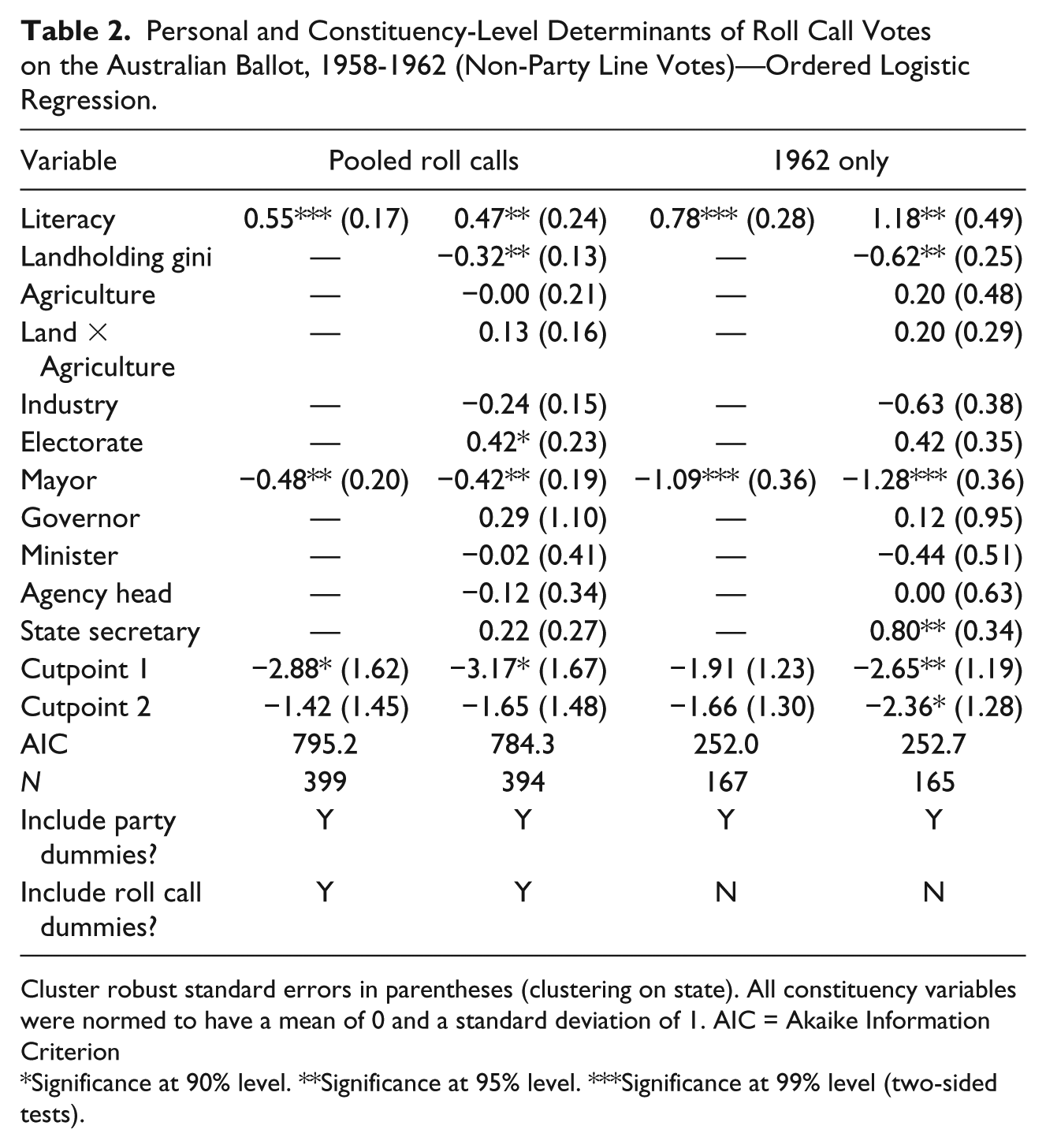
Cluster robust standard errors in parentheses (clustering on state). All constituency variables were normed to have a mean of 0 and a standard deviation of 1. AIC = Akaike Information Criterion
Significance at 90% level. **Significance at 95% level. ***Significance at 99% level (two-sided tests).
Besides literacy, landholding inequality is the only constituency-level predictor that exerts a statistically significant effect on legislative votes. Consistent with H2, the greater the landholding inequality in a legislator’s support base, the less inclined he was to vote for the AB (and vice versa). In this respect, our results for Brazil are in keeping with earlier findings on land tenure patterns and legislative behavior on the secret ballot in Imperial Germany (Ardanaz & Mares, 2014; Mares, 2015; Ziblatt, 2008). Following discussions in Ansell and Samuels (2014) and Mares (2015), we also included in our estimations an interactive term between landholding inequality and the size of the agricultural workforce. This term was not significant.
Contrary to H5, the size of the electorate in the areas where a deputy received votes was generally not a significant driver of legislative votes. To the degree it had any effect, its sign was opposite to that expected by our theory. This may be a result of legislators not fully anticipating how resilient vote brokerage would prove to be in the countryside in spite of the introduction of the AB. As legislators with vote bases in sparsely populated areas relied more heavily on clientelism before reform than those with bases in more populated areas, they may have simply assumed that they had the most to lose from the AB (and, indeed, if their supporters were illiterate, then this assumption would have been correct).
With respect to the personal characteristics of legislators, only one such characteristic systematically drove vote choice on the AB: having served as a mayor. Consistent with H4, former mayors were significantly less inclined to vote for the AB than non-former mayors. This result underlines the importance of local ties and network connections for preferences over democratic institutional design. The occupational categories most closely associated with the ability to raise money—serving as a former governor, federal agency head, or state secretary—had no systematic impact on preferences over the AB. The difference in the influence of these aspects of a legislator’s background suggests that the good graces of local brokers and municipal machines could not simply be bought by wealthy but otherwise unknown political actors. Although cementing exchanges with local bosses often did involve financial benefits for these individuals, the market for a boss’ services was likely limited to politicians with some previous linkage to the boss’ territory.
In sum, both determinants of the returns to reshaping the electorate and of the efficacy of clientelist exchange were associated with voting behavior on the AB. With respect to the former, legislators whose supporters were less literate, and therefore likely to be disenfranchised by the reform, tended to oppose it, whereas legislators with more literate support bases were more inclined to favor it. With respect to the latter, legislators who could leverage economic power effectively due to high levels of landholding inequality in their bases and network ties stemming from previous stints as a mayor were more inclined to oppose reform than those without these advantages.
We performed several simulations to gauge the impact of the level of literacy in a deputy’s support base and having served as a mayor, respectively, on votes for the AB. In the simulations, we calculated the average predicted probabilities for each legislative voting outcome as the variable of interest was varied. In both cases, the fitted models for the 1962 roll call were utilized.
Figure 3 displays the average predictive probabilities as the level of literacy increases from the value of the 5th percentile in the sample (30.5%) to the 95th percentile (81.9%). This change in literacy reduces the average probability of casting a nay vote from .59 to .09. At the same time, the change increases the average probability of casting a yea vote from .36 to .89. (The corresponding change in absenteeism is relatively small.) This indicates a major substantive effect of literacy. Indeed, differing levels of constituent literacy could have produced a strong majority vote against the AB or an overwhelming supermajority in favor of it.
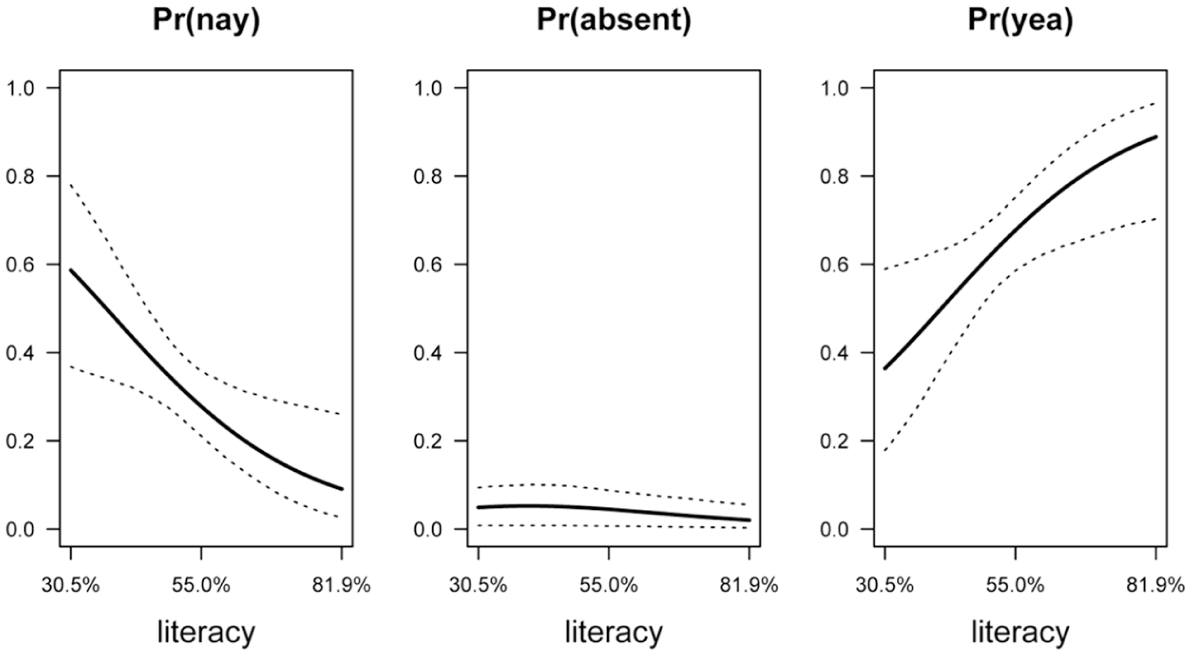
Average predicted probabilities of roll call voting outcomes on the Australian ballot, 1962 (by literacy). Thick solid lines depict average predicted probabilities; dashed lines depict 95% confidence intervals.
Figure 4 presents the average predictive probabilities corresponding to being a former mayor versus a non-former mayor, respectively. Assigning all legislators to the status of former mayor results in an average predicted probability of casting a nay vote of .47 and an average predicted probability of casting a yea vote of .48. In contrast, assigning all legislators to the status of non-former mayor results in an average predicted probability of casting a nay vote of .25 and an average predicted probability of casting a yea vote of .70. Again, this is a substantively large effect, sufficient to shift the balance of the vote from a near 50-50 split on the AB to a strong majority in favor of it.
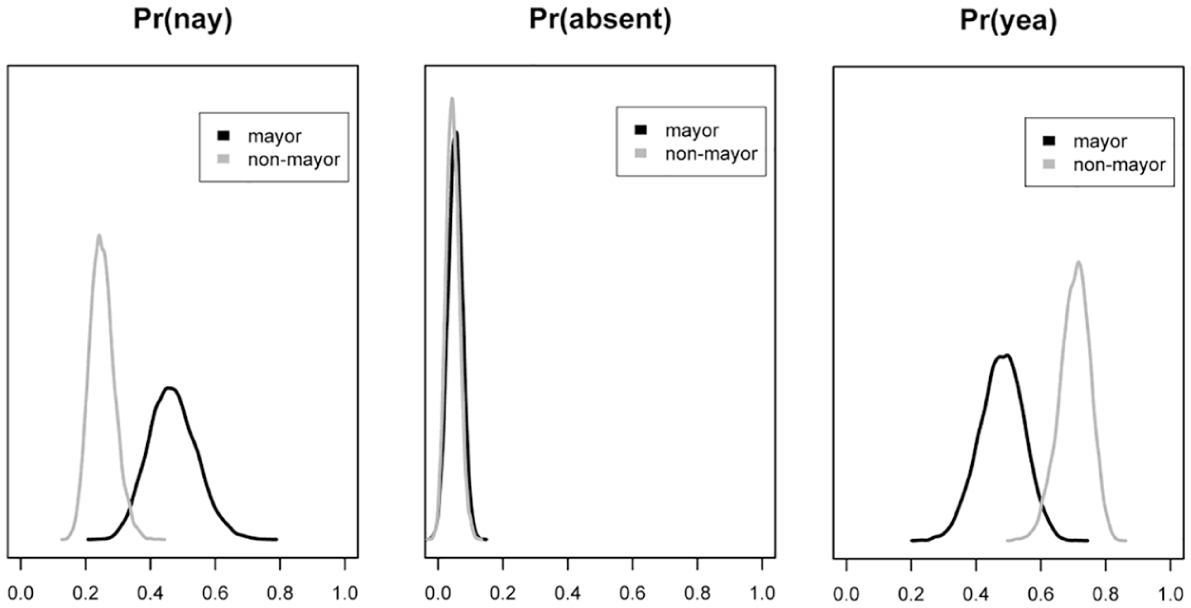
Average predicted probabilities of roll call voting outcomes on the Australian ballot, 1962 (by previous office). Displayed are the densities of the average predicted probability of each roll call voting outcome for the former mayor and non-former mayors.
Robustness checks
We performed several robustness checks to verify that our results withstand reasonable changes in the article’s empirical specification and measurement strategy. First, we reanalyzed our data with recorded absences removed, thereby restricting the outcome to only yea and nay votes (Table A5 in Supplemental Appendix). This approach produces results quite similar to those presented in the main text. Second, we redefined the location of a legislator’s support base as the single municipality contributing the greatest number of votes to his vote total (i.e., the legislator’s stronghold municipality). We then reanalyzed the data using the demographic characteristics of only the stronghold municipalities (Table A6 in Supplemental Appendix). Again, the findings obtained from this approach were highly consistent with those described in the text. Finally, we estimated a series of interactive models that interacted literacy with constituency-level demographic variables as well as having previously served as a mayor (Tables A7 and A8 in Supplemental Appendix). These estimations did not, on the whole, reveal strong interaction effects, but they did confirm that literacy, landholding inequality, and being a former mayor were robust and statistically significant predictors of vote choice on the AB.
Conclusion
This article offers a novel conceptual framework for understanding the incentives to adopt the effective secret ballot. Its central insight is that in certain contexts—educationally diverse societies with an overlap between political cleavages and literacy—the transition to the effective secret ballot simultaneously represented an opportunity to reduce the electoral returns to clientelism and to reshape the electorate. Accordingly, the preferences of politicians over the secret ballot in these settings should be governed by calculations of electoral advantage that take into account both of these consequences of the new voting technology.
Evidence from the Brazilian experience with the adoption of the AB is consistent with the assumptions and implications of our framework. In keeping with our assumption that the effective secret ballot may be used to shape the electorate, partisan stances on the AB and the public statements of legislators about this innovation—both for and against—were predicated on the expectation that functional illiterates would be disenfranchised should the AB be adopted. Moreover, in testing the implications of our framework, we find that both considerations of the accessibility of the ballot and its consequences for the efficacy of clientelist exchange played a role in legislative voting on the AB. In particular, the level of literacy of a legislator’s supporters strongly influenced legislative vote choice, as did an aspect of a legislator’s occupational history—having served as a mayor—that is indicative of the capacity to activate local clientelist networks.
The theory and empirics we bring to bear in this article cast into relief an important fact about democratization. Distinct institutional components of democracy may at times work at cross-purposes with one another. Reforms ostensibly designed to reinforce the autonomy of voters may in fact restrict the franchise, whereas reforms aiming to broaden the franchise may potentially extend the scope of coercion. Consequently, theories of democratization based on strategic calculi about suffrage extension may be of limited applicability in explaining the political dynamics undergirding the adoption of institutions thought to be critical to the operation of the franchise, such as an effective secret ballot. Given that several of the most influential theories of democratization envision democracy as coming into being at the moment when ruling elites decide to concede the franchise, the fact that the political logic of franchise extension does not carry over to other reforms means that much work remains to be done in achieving an understanding of how modern forms of democratic representation are actually produced.
Supplemental Material
replication_Gingerich_Medeiros – Supplemental material for Vote Secrecy With Diverse Voters
Supplemental material, replication_Gingerich_Medeiros for Vote Secrecy With Diverse Voters by Daniel W. Gingerich and Danilo Medeiros in Comparative Political Studies
Footnotes
Acknowledgements
The authors would like to thank George Avelino, Pablo Fernandez Vazquez, Simeon Nichter, Fernando Limongi, Anne Meng, Saulo Said, David Samuels, Jaqueline Zulini, and participants in the conferences “Moralizing the Vote in Brazil” (University of Virginia), “The Political Economy of Corruption and Accountability” (Instituto Carlos III-Juan March de Ciencias Sociales), and the 2018 Annual Meeting of the American Political Science Association for comments on earlier drafts of this paper.
Declaration of Conflicting Interests
The authors declared no potential conflicts of interest with respect to the research, authorship, and/or publication of this article.
Funding
The authors disclosed receipt of the following financial support for the research, authorship, and/or publication of this article: Data collection for this article was funded in part by National Science Foundation Grant SES-1119908. Both authors were supported by the Democracy Initiative at the University of Virginia. Danilo Medeiros was also supported by CAPES, Ministry of Education of Brazil.

Notes
Author Biographies
References
Supplementary Material
Please find the following supplemental material available below.
For Open Access articles published under a Creative Commons License, all supplemental material carries the same license as the article it is associated with.
For non-Open Access articles published, all supplemental material carries a non-exclusive license, and permission requests for re-use of supplemental material or any part of supplemental material shall be sent directly to the copyright owner as specified in the copyright notice associated with the article.
