



Abstract
How can governments in low-trust settings overcome their credibility deficit when promoting public welfare? To answer this question, we evaluate the effectiveness of the Liberian government’s door-to-door canvassing campaign during the 2014–2015 Ebola epidemic, which aimed to persuade residents to voluntarily comply with policies for containing the disease. Combining data from an original representative survey of Monrovia during the crisis with variation in the campaign’s reach and using multiple identification strategies, we find that the informational campaign was remarkably effective at increasing adherence to safety precautions, support for contentious control policies, and general trust in government. To uncover the pathways through which the campaign proved so effective, we conducted over 80 in-depth qualitative interviews in 40 randomly sampled communities. This investigation suggests that local intermediaries were effective because their embeddedness in communities subjected them to monitoring and sanctioning, thereby assuring their fellow residents that they were accountable and thus credible.
Keywords
Introduction
In countries where government corruption and abuse of power is pervasive (Keefer, 2007; Treisman, 2007), citizens often harbor distrust and cynicism about the honesty and intentions of those in government (see, for example, Seligson, 2002). But what happens when these governments act in the public interest and need citizens to believe what they say and voluntarily comply with their directives? What can authorities do when they need to implement critical initiatives such as vaccination campaigns or when they face national emergencies and existential threats such as insurgencies or natural disasters?
In this article, we examine political persuasion in low-trust settings. Because coercion tends to be ineffective, counterproductive, and prohibitively costly, government authorities often turn to informational campaigns to persuade citizens that it is in their own interests to voluntarily comply with their directives. But are these campaigns effective? Under what conditions can governments in low-trust settings succeed at persuading citizens to believe what they say?
Theories of political communication and institutional trust give us reason to doubt that deeply distrusted authorities can persuade citizens to believe what they say during times of crisis. This research shows that elites lack credibility as sources of information because citizens are likely to believe they have ulterior motives or incentives to deceive the public (Alt et al., 2016; Baron, 2006). Perceived differences in institutional expertise and institutional trust may also account for variation in credibility. Citizens are more likely to believe messages from elites whom they see as knowledgeable about political issues or, often more importantly, “like-minded” in having similar interests or values (Downs, 1957, p. 223; Gilens & Murakawa, 2002).
Existing studies, however, say little about how actors can build trust and credibility when they do not already have it. Much of this work treats information sources as either credible or not credible, implicitly or explicitly assuming that credibility is time-invariant (see, for example, Lupia et al., 1998, and experimental studies by Alt et al., 2016; Botero et al., 2015). Recent studies have shown how existing credibility can be sustained or damaged (e.g., Cone et al., 2019). But little empirical work exists on what an information source that has a long-standing reputation for not being credible can do to improve its credibility in the short term.
One approach, at least in the context of the United States, involves direct engagement between government workers and citizens, such as door-to-door canvassing and mass media campaigns (Bagcchi, 2015; Chong & Druckman, 2007, pp. 57 & 99–118). Evidence suggests that this form of direct engagement can persuade citizens that particular authorities are trustworthy sources of information, but this research comes almost exclusively from countries where general trust in government is already relatively high. In low-trust settings where citizens believe authorities are predatory or malevolent, government efforts to engage with citizens often fall on deaf ears. Indeed, when individuals mistrust the messenger, they tend to cling to their existing beliefs, even in the face of overwhelming evidence to the contrary (Gerber & Green, 1999, pp. 189–210). Uncertainty and fear, which prevail in crisis situations, can exacerbate these tendencies (Jost et al., 2009, p. 244). In northern Nigeria, where villagers rarely encounter government service provision, distrust of government led to years of resistance against government vaccination campaigns, contributing to the country’s status as one of the last to eradicate the disease (Grossman et al., 2018). In Liberia and Sierra Leone, where civil war and state abuse have made citizens suspicious of the police and other security forces, widespread non-reporting and reluctance to cooperate with police investigations have proven to be an enduring barrier to police effectiveness and citizen security (Blair et al., 2019).
How can governments in low-trust settings overcome their credibility deficit when promoting public welfare? Empirical research involving systematic data on citizens’ attitudes and especially behaviors is scarce, and data from crisis situations, where researchers face unique challenges to collecting data, are scarcer still. Yet it is precisely these settings where the need to understand how governments can persuade their citizens to act in the public interest is most pressing.
In this article, we address this gap by studying the effectiveness of the Government of Liberia’s (GoL) effort to engender trust and cooperation through ground-level canvassing during the 2014–2015 Ebola Crisis. Widely viewed as both a health crisis and a governance crisis, the epidemic provides a critical case for building our theoretical understanding of how governments can persuade citizens to cooperate under the most challenging of circumstances.
In the initial stages of the epidemic, mistrust rooted in decades of corruption and abuse led many Liberians to believe Ebola was a ploy by the government to generate more aid funding (International Crisis Group, 2015). As a result, many refused to comply with preventive measures and social distancing policies, causing the disease to spread unchecked (Blair et al., 2017). As conditions deteriorated, the GoL initiated an ambitious public awareness campaign in which locally recruited intermediaries working on behalf of government were deployed into communities to persuade their fellow citizens to trust health authorities and comply with control policies.
To assess the effectiveness of this campaign, we combine data from an original, representative survey of Monrovia conducted during the crisis with variation in where the campaign was and was not able to reach. Using both selection-on-observables and difference-in-differences design strategies, we provide evidence that the outreach campaign was remarkably (and surprisingly) effective. Respondents who report being visited by a canvasser from the campaign were nine percentage points more likely to trust the Ministry of Health (MoH), 15 more percentage points supportive of contentious control policies, and 10 percentage points less likely to violate a government-imposed ban on public gatherings. Our results also suggest that the campaign improved trust in the government generally, with those experiencing outreach expressing greater trust in government institutions and greater support for compliance with government laws and regulations outside the health sector.
To uncover the mechanisms through which the campaign proved so effective, we conducted over 80 in-depth, open-ended qualitative interviews from a random sample of communities with individuals involved in the campaign approximately 5 months after the epidemic had subsided. Analysis of these interviews suggests that local intermediaries were effective in persuading citizens to believe the government’s public awareness messages not simply because of preexisting trust or social ties with their fellow residents, but also because they were embedded in the communities they worked. Being embedded—that is, being a resident of the community and being part of community social networks and institutions—subjected intermediaries to monitoring and sanctioning from their fellow residents, thereby making them accountable. Because intermediaries’ living conditions were observable and easy to monitor, residents could verify that intermediaries were not part of a government scheme to attract and embezzle donor funds through the spread of Ebola, as rumors alleged. And because intermediaries would have been vulnerable to reprisal and punishment if the information they delivered from the government were false, residents were able to trust that they were telling the truth. Together, the ability of residents to monitor and sanction intermediaries ensured that they were accountable and thus credible sources of information.
Our qualitative interviews further suggest that once intermediaries had won the trust of their fellow residents, they became “opinion leaders” whom residents trusted to provide information about the government (Katz, 1957; Nisbet & Kotcher, 2009), using their standing to counter misinformation and misconceptions about government and thus helping to build trust in the government generally. This model of mediated outreach builds on a logic of “costly signaling” (Spence, 1973) to shed new light on how authorities can persuade citizens to view them as a credible source of information and a partner for cooperation by making themselves vulnerable to sanctions.
While this logic of persuasion through costly signaling and source accountability should hold across a variety of contexts, mediated outreach may have more practical value in low-trust settings where citizens see authorities as malevolent and potentially predatory, rather than simply under-resourced. In countries like Malawi and Zambia, for example, authorities have limited capacity for development but are not often seen to be ill-intentioned. In these cases, government may simply be able to persuade citizens to cooperate through direct engagement. In contrast, direct engagement is more likely to fail in places like Mali, Guinea, Sierra Leone—and, as we are seeing now, the Democratic Republic of Congo—where prior trust in the intentions and political will of authorities is precariously low. In these places, it is of course not always a good thing for citizens to be persuaded by government. Nevertheless, it is an important question, from both theoretical and policy perspectives, how mistrusted authorities can successfully persuade citizens to cooperate when it is indeed in the public’s interest to do so.
Prior Research on Government Persuasion
Efforts to persuade citizens to work with authorities to promote public welfare often involve government-sponsored media campaigns or face-to-face interaction between government officials and citizens. Public service announcements and public interest films are long-standing and widespread strategies and have been used to encourage buying government bonds to support war efforts (Horten, 2003), conserving water during periods of drought (Stockmann et al., 2010), and promoting health-seeking behavior (Faasse et al., 2012).
On the face of it, this form of engagement seems like it should be a good thing. Face-to-face interactions, even between people who belong to groups in conflict with one another, can build norms and networks of reciprocity and cooperation (Putnam, 2001, pp. 20–21). Shared activities and collective endeavors—for example, agricultural cooperatives, business associations, and parent-teacher committees—can increase information about others’ motives and trustworthiness and foster concern for others’ welfare, even if they hold different values (Ostrom, 2015; Varshney, 2003).
Research has also found that personal interactions with government officials can increase the likelihood of voluntary compliance when those interactions involve fair and “procedurally just” treatment (Huq et al., 2011, pp. 419–450). Studies of policing find that positive encounters with individual officers can have a bigger impact on citizens’ perceptions of the police than the effectiveness with which they fight crime (Tyler, 2004, pp. 84–99) and that such perceptions can begin to improve after just a small number of positive encounters (Mazerolle et al., 2013, pp. 33–63). Studies of door-to-door canvassing and direct voter contact during election campaigns show that just one conversation can increase the probability of turnout (Gerber & Green, 2000, pp. 653–663; Green et al., 2003, pp. 1083–1096; Hersh, 2015; Hillygus & Shields, 2008).
While these studies provide important insights into government persuasion in developed countries, it is not clear that they apply to weak states, where mistrust of government is often much more profound. Because source credibility is a key precondition to persuasion, direct outreach by government in these settings is unlikely to be persuasive, and could potentially backfire if such efforts serve only to increase the “fluency” of misinformation (Berinsky, 2017). Alternatively, people may engage in motivated reasoning, resisting information that runs counter to existing beliefs in an effort to defend their worldviews (Festinger, 1957; Kunda, 1987, pp. 636–647). For example, when U.S. parents who oppose vaccines received information from the Centers for Disease Control and Prevention debunking the link between measles vaccines and autism, they became less likely to say they intend to vaccinate their child (Mason & Donnelly, 2000, pp. 473–474; Nyhan et al., 2014, pp. 491–493).
The Case of Liberia During the 2014–2015 Ebola Epidemic
Liberia provides a critical case for studying the effectiveness of government persuasion due to the extreme levels of mistrust that authorities faced during efforts to curtail the devastating Ebola epidemic of 2014–2015. This lack of trust was rooted in citizens’ experiences dating back to the war, when governance failures characterized by autocratic rule, repression, exclusionist policies, and excessive rent-seeking by government officials dominated Liberia’s politics (Sawyer, 2005), and when acts of state-sponsored violence against civilians were common (Ellis, 1999). Abuse of power has continued in the form of rampant corruption since the incumbent party was inaugurated in January 2005, following the country’s historic peace accord in 2003. Despite reforms aimed at rooting out official corruption, wrongdoers have seldom been punished (Epstein, 2014).
Liberia’s long history with government corruption and abuse led to levels of mistrust that extended beyond simple dissatisfaction with government, to the point where many citizens believed authorities were willing to harm and even kill their own citizens for personal gain at the outset of the epidemic. As one report noted, “[W]hen the Health Ministry requested $1.5 million in emergency funds to fight Ebola . . . many Liberians assumed this was just another scam on the part of a secretive cartel of elites to steal more foreign aid” (Epstein, 2014). In our survey, 38% of respondents reported that in July 2014, at the beginning of the epidemic, they believed that Ebola was “a lie just so the government could get money” from external donors. As one of our respondents explained, people did not believe that Ebola was a real disease: “People thought it was a game from the government. They thought that the government would kill for money.” 1 Such profound mistrust contributed to a climate in which widespread non-compliance with control policies allowed the easily preventable disease to spiral out of control (Blair et al., 2017; McCoy, 2014).
Even after the severity of Ebola was indisputable, mistrust continued to impede the government’s ability to engender voluntary compliance. In September 2014, rumors circulated that government health workers were poisoning wells to spread Ebola (Epstein, 2014). And in December, allegations that emergency measures such as the ban on gatherings were a political ploy to suppress the opposition and avoid defeat in the December Senatorial bi-election led many to question whether the ban was justified (MacDougall & Fink, 2014). These rumors undermined government efforts to control the spread of the virus, as mistrustful citizens proved less likely to support Ebola control policies and less likely to comply with Ebola-related social distancing measures (Blair et al., 2017, pp. 89–97).
Community Outreach During the Epidemic
In response to the epidemic’s growing threat, the GoL initiated an ambitious public awareness campaign in June 2014 involving the mass media and ground-level canvassing. 2 Initially, the government used its own staff from the MoH to go door to door delivering public awareness messages to supplement radio and other media efforts. However, this model of direct outreach was quickly abandoned because it was met with disbelief and outright violence. A World Health Organization (WHO, 2014) update in July 2014 identified “persisting denial and resistance in the community” as a critical challenge to the government’s crisis response. Many of our respondents expressed similarly negative sentiments about direct outreach by government workers. According to one rumor, the government was dispatching strangers to infest community wells with poison and increase the death rate. Another rumor held that government was sending people into communities to spray poison through windows. 3
The failure of government direct engagement during Ebola suggests that the benefits of face-to-face engagement may not materialize during crisis situations in fragile states, where the stakes are high, mistrust is severe, and time is of the essence. The Liberian government’s experience is more consistent with theories emphasizing how negative reactions rooted in mistrust, fear, and uncertainty can render efforts to persuade ineffective. As Liberian President Ellen Johnson Sirleaf noted, “We have been unable to control the spread due to continued denials, cultural varying practices, disregard for the advice of health workers and disrespect for the warnings by the government.” 4
Mediated Outreach in Response to the Failure of Direct Outreach
After direct engagement failed, government officials adopted a model of mediated outreach in which they recruited local intermediaries to canvas communities on their behalf. As one social worker from the Monrovia city government explained, The communities and people were saying government was responsible for the disease and bloodshed and also Uncle Sam gave the government money to come and test the experiment. Some said Ellen [President Sirleaf] knew exactly what was going on so she was just pretending . . . These people were very harsh in talking to us and were not ever willing to listen. We went first—no good result. Second—the same thing, and third—also nothing good. So we strategized by giving their own community people the opportunity to visit them and talk to them. They too, caught a little tough time from the beginning—and gradually they succeeded.
5
To recruit intermediaries, government authorities posted fliers in markets and main intersections, aired radio advertisements, and identified volunteers through word-of-mouth. These intermediaries—many of whom were already engaged in self-organized community crisis response initiatives—were invited to attend 1- to 2-day training workshops on Ebola prevention protocols and public awareness.
Once trained, volunteers were issued T-shirts, vests, bibs, or badges to identify them as part of the government’s outreach campaign. 6 They were assigned to particular neighborhoods or blocks within their communities to educate citizens about the symptoms of Ebola, disseminate information about where to get care, and encourage voluntary compliance with control policies through door-to-door canvassing. 7 Most volunteers regularly reported to supervisors with information about community conditions, such as whether citizens were receptive to the outreach campaign, whether they were adhering to control policies, and whether there were any new suspected cases. Although they tried to reach all households, invariably some were missed, a fact we exploit in our quantitative analysis below.
Evaluating the Impact of Mediated Government Outreach
To evaluate the impact of government outreach on citizens’ attitudes toward government and cooperation with public health recommendations, we conducted a representative survey of Monrovia, Liberia, in December 2014. While Ebola spread throughout Liberia, we conducted our survey in Monrovia because it is where more than 80% of Liberia’s roughly 10,678 cases were reported, making it the epicenter of the epidemic and the place where both citizen resistance and government efforts toward persuasion were most intense (WHO, 2015). The survey was administered in-person by Liberian enumerators using handheld electronic devices. The selection of respondents followed a three-stage sampling procedure. In the first stage, 78 communities were randomly selected from each of Monrovia’s 15 administrative wards with selection probabilities proportional to their population size. In the second stage, 20 households were randomly selected within each community following a random-walk procedure. In the third stage, within each household, a single adult respondent was randomly selected for the survey. 8 A unique strength of our survey was that it entailed face-to-face interviews with experienced local enumerators rather than interviews conducted remotely via cell phone. This method resulted in a response rate of 95%. 9 The random-walk procedure, the precautions taken to ensure enumerator safety, and other details are outlined in further detail in the Online Appendix. 10
Independent Variables
The as-if random nature of the GoL’s outreach campaign provides a unique opportunity to rigorously assess the effectiveness of mediated outreach in a crisis situation without the ethical dilemmas that would arise in a field experiment. To measure exposure to this campaign, we asked respondents whether “government health workers” ever visited them to raise awareness about Ebola in the past 5 months and if so, with what frequency (daily, weekly, or monthly). We use these data to construct a dichotomous variable coded as 1 for any affirmative response and 0 otherwise. In our sample, 40% of respondents report government outreach (Online Appendix Table 1). 11 The modal frequency for government outreach was weekly. 12
Citizens categorized canvassers as government-affiliated based on the T-shirts they wore and the ID cards they carried. These means of identification were essential because at the time, residents were extremely wary of “outsiders,” even those they may have recognized as being from their own community. The importance of being visibly associated with an official organization—even one as mistrusted as the MoH—reflects the level of fear that gripped Monrovia during the crisis. For the purposes of this study, it also helps to limit concerns about recall bias—respondents were able to recall who gave them information because knowing who said what and whether they were credible was often a matter of life and death.
Dependent Variables
We assess the impact of mediated outreach on six sets of outcomes that are central to debates about political persuasion and building trust in government: (a) factual knowledge about Ebola; (b) “self-interested” or instrumental voluntary compliance with Ebola preventive measures; (c) “contentious” voluntary compliance with controversial control policies (such as the ban on public gatherings), which required individuals to incur costs on behalf of the collective good; (d) trust in government authorities generally and in the health sector specifically (e); and (f) support for everyday laws and regulations mandated by government.
To measure factual knowledge about Ebola, we asked respondents to report as many symptoms and transmission pathways as they could. We then asked about three common misconceptions: whether Ebola could spread through the air or before symptoms present, and whether drinking salt water could help cure Ebola. The latter three outcomes are coded as indicators for correct responses; the former most outcome is standardized on a 0 to 1 scale. We then aggregate these four outcomes into an additive knowledge of Ebola index, scaled to range from 0 to 1.
We measure self-interested voluntary compliance using two variables: whether respondents report using hand sanitizer daily, and whether they maintained a bucket of chlorinated water outside their home for hand washing, recommended by authorities at the time. Both outcomes are coded as indicators for affirmative responses and analyzed individually.
Support for contentious control policies is measured attitudinally and behaviorally. For our attitudinal measure, we asked respondents whether they supported six controversial control policies: the ban on public gatherings, travel restrictions, curfew, burials by government health workers, and cremation of those who died while suffering from Ebola-like symptoms. The latter policy was particularly contentious because it contravened traditional customs, and because Ebola’s symptoms are similar to other common ailments, such as malaria. Responses were measured on 4-point scale ranging from “strongly disagree” to “strongly agree,” from which we construct indicators for “agree” or “strongly agree” responses. The support for contentious control policies index takes the average of these four indicator variables before being rescaled to range from 0 to 1.
To measure voluntary compliance, we asked respondents whether they had attended any public gatherings “such as video clubs, entertainment centers, or other crowded areas” in the past 2 weeks, as well as how many days they had gone out at night, also in the past 2 weeks. At the time of our survey, both activities were illegal under the state of emergency. Although these questions may be subject to response bias, we believe such bias was rare, as field reports during the pretesting of our survey suggest these questions were not viewed as sensitive. Such bias seems particularly unlikely given the sizable number of affirmative responses reported (Online Appendix Table 1). Moreover, because these questions were not viewed as sensitive or overtly indicative of support for government, we do not believe whatever response bias did occur to associate with outreach—a contention supported by the placebo tests reported below.
We measure trust in government health authorities by asking respondents whether they trust the MoH; whether they believe the MoH is corrupt; whether they believe the government “has the heart to provide high quality health care”; and whether the government is capable of providing high-quality health care. Each of these variables is coded as an indicator denoting “Agree” and “strongly agree” responses and analyzed individual.
We measure general trust in government using a similar battery of questions about the Ministry of Education, the Liberian National Police, and “the government” in general. We used these questions to construct three indicator variables for “Agree” and “strongly agree” responses. We then take the average of the individual responses for the index of trust in government index, which is then rescaled to range from 0 to 1.
Separately, we ask respondents which service provider—government, non-governmental organizations (NGOs), traditional authorities, or community leaders—they would most prefer for three sectors: education, security, and health care. We use these questions to construct three indicator variables denoting “government” responses; the index of preferences for government service provision takes the average of these three variables before being scaled from 0 to 1.
We measure support for government regulations by asking respondents about their support of tax compliance, crime reporting, and support for rules against squatting on public lands. We construct three indicator variables denoting “Agree” and “Strongly agree” responses, with the index taking the average of these three variables before being scaled on a 0–1 scale. Finally, we ask respondents to express their level of agreement with the statement “I am willing to do what the government tells me to do, even if I do not agree with what they say,” constructing an indicator for “agree” and “strongly agree” responses. Online Appendix Table 1 summarizes the raw variables that make up each of the composite indices.
Follow-Up Data
At the end of the December–January survey, respondents were asked whether they would be willing to participate in a follow-up phone survey. In March 2015, we randomly re-sampled 775 of our respondents, 541 of whom were successfully re-surveyed. Attrition is not associated with sociodemographic variables, suggesting our follow-up sample remains representative of the general population in Monrovia (see Online Appendix). 13
The resulting panel provides data on the three outcome categories that remained relevant in March 2015—self-interested voluntary compliance, trust in government generally, and trust in the health sector specifically 14 —as well as information on government outreach that occurred between January and March 2015. We use these data to test the assumptions underlying our research design and to test the robustness of our results to alternative estimation strategies.
Empirical Strategy
Our main analysis compares individuals who reported government outreach to those that did not after accounting for differences in sociodemographic factors and community of residence. Formally, we estimate:

where
Balance.

OLS regression of government outreach on the socio-demographic variables listed in Column 1, with community fixed effects and standard errors clustered by community. OLS = ordinary least squares.
p* < .1. **p < .05. ***p < .01.
To evaluate this assumption, we conducted field interviews with community activists in a random sample of 40 communities between March and May 2015, as well as more than 20 elite interviews with decision makers from the MoH, local government, and humanitarian organizations involved in the crisis response. In these interviews, we asked respondents to describe how outreach was conducted in an open-ended way. We then followed up our initial questions by inquiring whether those conducting outreach went door to door delivering the campaign to every household, how they decided what geographic location in their community they would cover, and whether they ever encountered residents that tried to hide from them.
All of our respondents maintained that no particular households or neighborhoods were targeted for outreach within communities. To the contrary, organizers made efforts to reach every neighborhood within a given community, and canvassers were instructed to visit every household within their coverage area. 16 However, due to the scale of the effort, intermediaries simply could not reach all households. Our empirical strategy thus exploits the haphazard, within-community variation in where canvassers were or were not able to reach.
Table 1 explores the plausibility of the assumption that canvassers did not deliberately target particular types of individuals by comparing individuals who reported outreach to individuals that did not across a range of sociodemographic variables. Individuals reporting government outreach were less likely to be female than those that did not, but were otherwise similar in terms of education, age, income, religion, political participation, and vote choice in the 2011 election, which we use as an indirect measure of pre-crisis distrust of government.
As a second test of our assumption that exposure to outreach was independent of potential trust and voluntary compliance outcomes, we use our panel data to assess whether those who expressed high levels of trust in government and voluntary compliance in our December survey were subsequently more likely to experience outreach in January, February, and March. Because outreach during this time period was similar to outreach in earlier periods, 17 this analysis serves as a direct test of our identification assumption, namely that outreach was not inherently targeted toward trusting, compliant individuals. The results, reported in Table 2, reveal no association between trust and voluntary compliance outcomes in our initial survey in December 2014 and subsequent exposure to outreach in winter 2015.
(Non-)Association Between Outcomes in December 2014 and Outreach in Winter 2015.
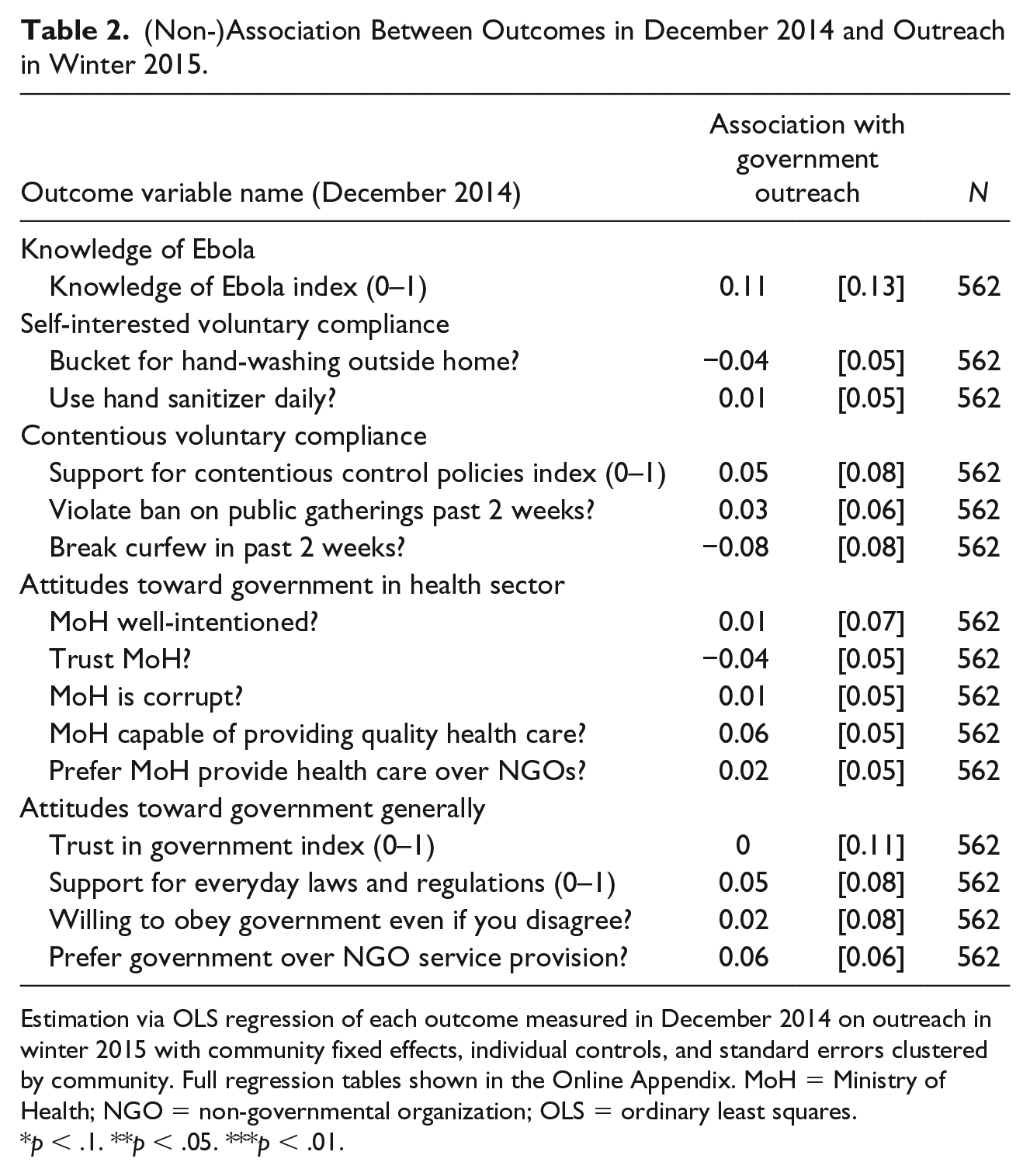
Estimation via OLS regression of each outcome measured in December 2014 on outreach in winter 2015 with community fixed effects, individual controls, and standard errors clustered by community. Full regression tables shown in the Online Appendix. MoH = Ministry of Health; NGO = non-governmental organization; OLS = ordinary least squares.
p < .1. **p < .05. ***p < .01.
Together, our fieldwork and balance analyses support our assumption that outreach was not targeted toward certain types of individuals within communities, and in particular was done without bias toward individuals who were inherently more trusting or compliant.
Results
Table 3 reports the association between outreach and measures for each of our five outcome clusters, controlling for community and sociodemographic factors. To correct for multiple comparisons across outcomes within clusters, we also report average standardized effects (AES), following the procedure outlined in Clingingsmith et al. (2009).
Impact of Outreach on Knowledge of Ebola, Voluntary Compliance, and Attitudes Toward Government.
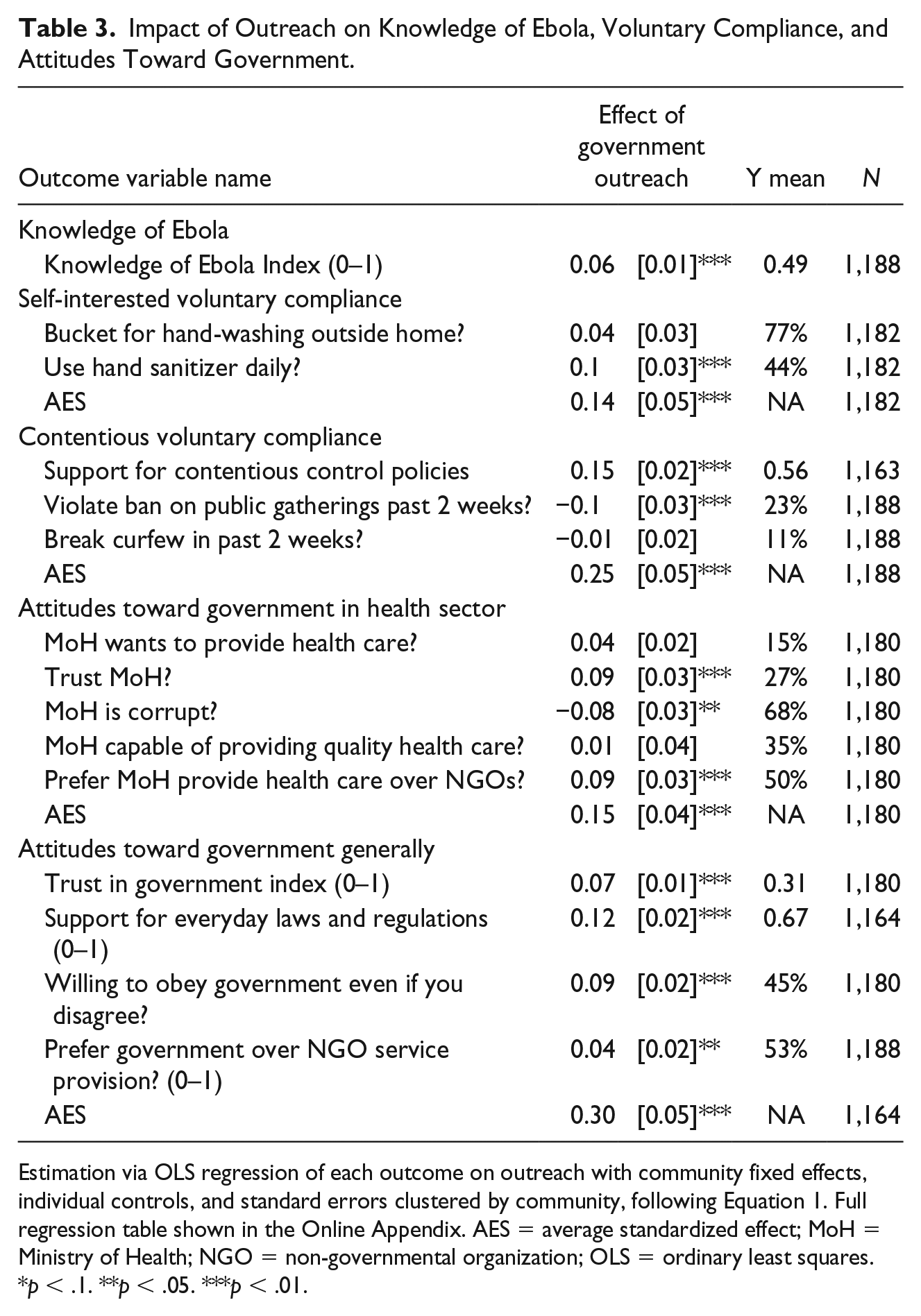
Estimation via OLS regression of each outcome on outreach with community fixed effects, individual controls, and standard errors clustered by community, following Equation 1. Full regression table shown in the Online Appendix. AES = average standardized effect; MoH = Ministry of Health; NGO = non-governmental organization; OLS = ordinary least squares.
p < .1. **p < .05. ***p < .01.
Our first finding is that government outreach is associated with greater factual knowledge about Ebola. Respondents reporting outreach were able to list 0.5 more transmission pathways and 0.6 more symptoms relative to those that did not; they were also six percentage points more likely to know that Ebola is not an airborne disease.
Perhaps as a result of their improved knowledge, respondents who reported outreach were 10 percentage points more likely to use hand sanitizer daily. Although they were no more or less likely to have a chlorinated bucket outside their home, this may be explained by the fact that the practice was already common at the time (77% of our respondents reported using a chlorinated bucket). Moreover, because this practice is particularly conspicuous, one might expect respondents to adopt it regardless of whether canvassers had reached them.
These results suggest that outreach was effective at increasing knowledge of the disease and promoting self-interested voluntary compliance. It is thus likely that these efforts helped to turn the tide on a disease that had initially spread unchecked among an ill-informed population.
But ending the epidemic required more than just educating citizens and building voluntary compliance with minimally invasive measures. To stamp out active transmission chains and prevent their reoccurrence, authorities needed to persuade citizens to put aside their customs and comply with a host of onerous restrictions, including the ban on social gatherings, a nighttime curfew, quarantines, and cremation by government health workers—a controversial practice that many viewed as alien and certain to deny the dead a peaceful afterlife. Changing these behaviors required building trust in the government’s capacity and intentions amid widespread fear and distrust.
On this count, government outreach was remarkably effective. Respondents who were visited by government canvassers were four percentage points more likely to believe the MoH was well-intentioned; nine percentage points more likely to say they trusted the MoH; eight percentage points less likely to believe the MoH was corrupt; nine percentage points more likely to prefer that government take the lead in providing health care; and one tenth of a standard deviation more trusting of government in general, relative to those that did not experience government outreach. (We do not, however, observe differences in perceptions of the MoH’s capacity among those reporting government outreach.)
Turning to voluntary compliance, those reporting government outreach were eight percentage points more likely to support the ban on gatherings, 10 percentage points more likely to support the curfew, 26 percentage points more likely to support burial by government workers, and 11 percentage points more likely to support cremation of those who died while suffering from Ebola-like symptoms. We also find that outreach improved voluntary compliance with (and support for) the ban on social gatherings: those reporting outreach were 10 percentage points less likely to report attending a social gathering in the past 2 weeks.
Table 3 suggests that outreach may have improved voluntary compliance with government laws and regulations outside the health sector as well. In particular, those reporting government outreach were more likely to express support for reporting crimes to the police, more likely to support government regulations against squatting on public lands, and more likely to support the government’s right to tax citizens. They were also nine percentage points more likely to agree with the statement “I am willing to do what the government tells me to do, even if I do not agree with what they say.”
Robustness Checks
The validity of our analysis rests on the assumption that exposure to outreach was independent of potential trust and compliance outcomes after accounting for community of residence and observable characteristics captured by our survey. To defend this assumption, we have shown that outreach is balanced across sociodemographic variables and pre-crisis measures of trust, and that those with high levels of trust and voluntary compliance in December were not subsequently more likely to experience outreach between January and March, 2015.
Both of these results are consistent with what we would expect if outreach were indeed conducted at random. Equally important, they are inconsistent with potential sources of confounding that could still emerge even if outreach were indeed conducted at random. For example, it is unlikely that those who are inherently compliant and supportive of government over-reported government outreach because they wanted to praise the government (Bullock et al., 2013), because if this were true, we would expect outreach to associate with pre-crisis measures of trust, like voting for the incumbent in the 2011 election. We would also expect these compliant, pro-government respondents to report higher levels of outreach in winter 2015, which we do not. Similarly, it is unlikely that respondents who simply have a knack for socially desirable responses (mis)report higher levels of trust, voluntary compliance, and outreach, because we would expect these seemingly “compliant” and “trustful” individuals to also report higher levels of outreach in March 2015.
While we cannot definitively prove the assumption of no unobserved confounding underlies this interpretation, we argue that the sum of these considerations favors a causal interpretation of our results. Given that outreach is balanced across observables in December 2014 and unassociated with prior measures of trust and voluntary compliance in March 2015, the conditions under which unobserved confounding could account for our results are quite limited. More precisely, our results would be confounded only if (a) the way that outreach was conducted (or reported) changed between fall 2014 and winter 2015, such that it did not associate with preexisting trust and voluntary compliance in winter 2015 but did associate with these preexisting outcomes in fall 2014; (b) there were unobserved differences between those reporting and not reporting outreach in fall 2014; and (c) these differences are weakly associated with the covariates measured in our balance analysis but (d) strongly and positively associated with trust and voluntary compliance. We believe the coincidence of these four conditions is unlikely, especially given that outreach in winter 2015 was similar in form and function to outreach in fall 2014—and had similar effects, as we show below. 18
Sensitivity Analysis
Another step we take to rule out unobserved confounding is to conduct a sensitivity analysis following the approach proposed by Oster (2019), which uses the bias eliminated by observed confounders to assess the potential bias induced by unobserved confounders. We present the results from this analysis in the Online Appendix, showing that unobserved confounders would have to be substantially more confounding than observed confounders to account for our results, a condition we believe is unlikely given the richness of our observed control variables.
Difference-in-Differences Analysis
Our final robustness check uses our panel data to validate the main findings through difference-in-differences analysis of the impact of outreach between January 2015 and March 2015 on the subset of outcomes measured in both December 2014 and March 2015. This design allows us to account for all time-invariant confounders that could drive a spurious association between outreach and trust and voluntary compliance, including the aforementioned sources of reporting bias. We implement this analysis via:

where
Table 4 reports the results of this analysis, showing that the effects of government outreach in winter 2015 on measures of trust and self-interested voluntary compliance are similar in magnitude to those reported in the section “Dependent variables,” though not all impacts are statistically significant due to the smaller sample size. Importantly, estimates of
Difference in Differences Estimates of the Impact of Outreach in Winter 2015 on Outcomes.
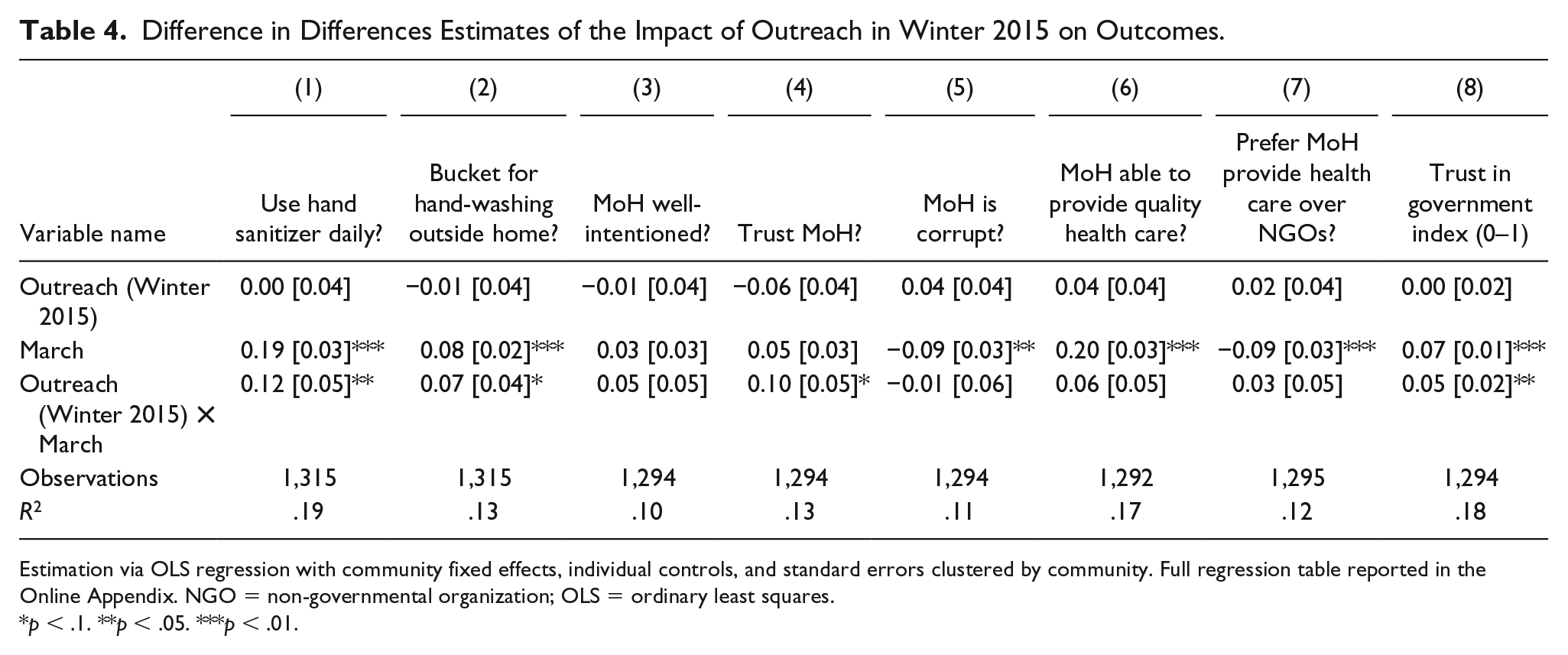
Estimation via OLS regression with community fixed effects, individual controls, and standard errors clustered by community. Full regression table reported in the Online Appendix. NGO = non-governmental organization; OLS = ordinary least squares.
p < .1. **p < .05. ***p < .01.
These results are important not only because they serve to validate our core findings but also because they suggest an important degree of external validity. Whereas the fall of 2014 was a period of widespread fear, uncertainty, and hardship under the state of emergency, by winter 2015 the state of emergency had been lifted, new cases of Ebola were rare, and attention was already turning toward economic recovery. Notwithstanding these differences in context, the basic form and content of outreach efforts remained quite similar. The Liberian government’s outreach strategy was thus effective at building trust and cooperation in at least two considerably different settings, suggesting its model may be an efficacious means to promote citizen-state cooperation in other settings where distrust is endemic. In the next section, we use qualitative data to document key elements of the model and highlight how they contributed to the program’s success.
Unpacking the Effectiveness of Mediated Outreach
Overall, our quantitative evidence suggests that mediated outreach by volunteer intermediaries was remarkably effective at persuading citizens to trust health authorities and comply with contentious control policies. To understand how this campaign proved so effective, we conducted in-depth, open-ended interviews with roughly 80 key informants between March and May 2015. Informants were selected from 40 communities sampled from the December survey. These communities were sampled at random, but we stratified by intensity of outreach and over-sampled communities with the highest levels of outreach (because the purpose was to unpack the effectiveness of outreach, we were less interested in communities with little to no reported outreach). In each community, we asked the town chairman to identify community members who were involved in the anti-Ebola Community Task Force, the institution responsible for conducting outreach during the epidemic. Further details on the selection procedure and interview protocol are provided in the Online Appendix.
Perhaps the most obvious explanation for why mediated outreach was effective is that local intermediaries were more familiar to community members and thus more trusted than government officials. Indeed, a large literature suggests that persuasion is most effective when it takes place through familiar local intermediaries or opinion leaders (Enos & Hersh, 2015, pp. 252–278; Katz & Lazarsfeld, 1955; Middleton & Green, 2008). Studies of previous epidemics have also suggested that “establishing relationships of trust and confidence with affected communities and involving community and religious leaders and respected individuals are fundamental to a successful response” (“Mistrust and Confusion Are Allowing Ebola to Thrive in West Africa,” 2014).
However, our qualitative data suggest that familiarity and preexisting social bonds cannot fully account for the campaign’s effectiveness. To the contrary, many canvassers initially encountered distrust and at times intense resistance from their fellow community members, the majority of whom they did not know personally before the crisis. 19 High levels of migration and dislocation during the civil war have resulted in Monrovia neighborhoods that are large, atomized, socially heterogeneous, and often transient (Shilue & Fagen, 2014). 20
Initial suspicion and resistance to these locally recruited canvassers was a common theme in our interviews. One respondent explained, “[P]eople here don’t believe in community initiative. People generally believe that if you’re coming around, you’re trying to trick them.” 21 Since the war, suspicion of young men is particularly high: “When you are a young man, they don’t assume you are there for just the community. They assume you are profiting.” 22 Others recalled, “They would say, ‘You’re printing these flyers to trick us’” 23 and “They were denial, people throw stones at us, insulted us.” 24
Throughout our interviews, respondents consistently emphasized how it was essential for intermediaries to alleviate the suspicions of others that they had been co-opted by the government or that they had ulterior motives. One volunteer noted, When we started, people insulted us. They said we were getting richer from Ebola. But we kept talking to them, and they got to know that we were members in their community. [We would say] “We are not the government. We are doing this because we are a community. We are trying to protect our community.”
25
In the Monrovia slum neighborhood of West Point, volunteer intermediaries would knock on doors, disseminate information about symptoms, and then make sure that people knew they were not getting paid: [We would say] “We work free of charge because we want to save community. I’m risking life because it is serious. We believe we are the only ones who can talk to you. What you hear outside is not true. Our government wouldn’t be that wicked.”
26
Persuasion Through Source Accountability
If preexisting trust and familiarity does not fully explain the effectiveness of mediated outreach, what does? Our qualitative evidence suggests that intermediaries’ embeddedness in their communities—that is, physically residing in the community and participating in community social networks and institutions—enabled other community members to monitor, and if necessary, sanction intermediaries should the information they deliver from the government prove to be false or harmful. This ability to monitor and sanction, in turn, assured residents that intermediaries were accountable and thus credible sources of information.
The importance of monitoring came up repeatedly during our interviews with intermediaries, in which they repeatedly emphasized how the ability of citizens to monitor them enabled them to dispel the notion that they were complicit in the government’s scheme to attract and embezzle donor money through the spread of Ebola. As one resident explained, “the moment you wear the MOH t-shirt, people become convinced you’re eating money . . . however, over time, people became convinced that I was not profiting because they never saw me with any extra materials.” 27 Echoing this sentiment, another respondent explained how he would reply when people accused him of “helping government identify people to kill”: “If I am going up there [to ‘big people’ in government] to sell you, would I still be wearing slippers? If I benefit in money, you would see my life would change.” 28
In another community, a respondent explained how people would often disregard his messages because they assumed that because he had no materials such as buckets, soap, or t-shirts to give, he must be keeping them for himself. Asked how he overcame this distrust, he explained how the only way for them to trust him was for “they themselves to see your whole life and see that nothing has improved . . . I had one bucket and they had to see it.” 29
As these testimonies illustrate, the repeated interaction between residents and local intermediaries and the associated monitoring capacities of ordinary citizens was key to establishing the credibility of intermediaries. However, another key contributor to their credibility was the fact that intermediaries’ embeddedness in their communities also exposed them to the risk of retribution and sanctioning. According to those we interviewed, this source of accountability was so valuable that canvassers frequently pursued deliberate strategies to make themselves more vulnerable and thus accountable to citizens. One strategy that our interviewees mentioned on several occasions was to give people information about where they personally lived to enable others to hold them accountable should the information they were disseminating prove to be false. A canvasser from the West Point slum, for example, noted how he would describe in detail the location of his house, at times going so far as to walk with residents to personally show them his house. 30 Our interviewees also reported giving out their phone numbers to people to overcome their suspicions. 31 One described how giving his phone number out to everyone and writing it on walls all over the community got people to listen to him and become less afraid. 32
Another strategy that canvassers used to make themselves more vulnerable and accountable—and thus more credible—was to reveal their workplaces or affiliations with known organizations located within the community. In West Point, for example, canvassers who were affiliated with More than Me, a well-known school and civil society organization within the community itself, made a point of emphasizing their affiliation. According to our interviewees, revealing their affiliation with More than Me was effective not simply because it revealed their status as an upstanding member of the community, but also because it enabled residents to track them down at a later point in time. Other canvassers affiliated with community churches or community task forces also talked about how people had more confidence in them because they knew of the physical location where they could be found. Having brick-and-mortar places where citizens could locate activists and their affiliated organizations allowed fellow community members to contact them for help—but also gave community members the power to hold them accountable and harass them in the case of wrongdoing. 33
A third approach was for volunteers to associate themselves with well-known community actors and places that residents could find and hold accountable in their stead. Several outreach workers, for example, spoke of reaching out to teachers and schools to assist with outreach. In one community on the eastern side of the city, outreach workers visited schools three times a week, where teachers then took them to classes to talk with students and answer questions. 34 In another community, outreach workers reported involving both public and private school teachers in their canvassing. 35 As one of the few permanent institutions in Monrovian communities, schools offered an easy-to-find location for unhappy citizens seeking to locate canvassers suspected of deception, or to punish school teachers as proxies for the canvassers. Another variant of this approach was for community volunteers to call mass meetings in each block and ask for volunteers. This public process thus produced common knowledge about who the canvassers were, how to find them, and who else in the community knew them and could be held accountable as proxies. 36
Through these strategies of promoting source accountability, embedded intermediaries slowly built trust over time and established themselves as opinion brokers. They used themselves as collateral to persuade their fellow community members to give government authorities the benefit of the doubt and “loan” the government their trust and cooperation. Intermediaries thus acted as guarantors for the government, making it possible for community members to enforce social or even physical punishment against them should they (or the government) prove untrustworthy or default on its obligations (Katz & Lazarsfeld, 1955). These strategies are consistent with Hardin’s observation that the essence of trustworthiness is that the trustee has an interest in fulfilling the truster’s trust. One of the most straightforward ways of creating an incentive for the trustee to do so is to enable the trustee to punish the truster for failing to fulfill the truster’s trust. (Hardin, 1998, pp. 9–27)
Source credibility increases when sources have no incentive to lie (Weitz-Shapiro & Winters, 2017), and when they deliver information that runs counter to their personal and political interests (Berinsky, 2007). In this case, local canvassers were persuasive because of the costly signals provided by the strategies they pursued for increasing source accountability.
Transferring Trust to Government
Once intermediaries had won the trust of their fellow residents, they were able to communicate information about Ebola without encountering resistance. However, our interview data suggest that they also began to serve as “opinion leaders,” or trustworthy sources of information about the government, and used this position to begin transferring the trust they had won to the government. One activist from West Point, for example, recounted how he and other outreach workers associated with the local nonprofit More than Me built up familiarity and a reputation for public service within the community by first organizing themselves independently from the government to go door-to-door in the community disseminating public health information. By September 2014, after having canvassed the community on a daily basis for weeks, this activist noted, “When they saw I love West Point, they know I am one of them,” referring to the tagline on his More than Me t-shirt. But in October, when they began working with the MoH and started wearing vests distributed in government training workshops, “People became afraid. They tried to waste [dump] water on us. They said, ‘Oh no, you are bringing Ebola! Because they were afraid of the MoH.’” The canvassers began wearing the More than Me T-shirt 3 days a week and the MoH vest 4 days a week: “We did that so people could see we were the same people doing the same thing [regardless of what we were wearing].” 37
Other outreach workers similarly reported working creatively to transfer the trust they developed with residents to the government. One respondent, for example, reported how he started putting on a T-shirt from the MoH to conduct outreach every day, and people gradually grew to believe in the regulations he was disseminating because “they saw there was a team going around” and “I am a serious person. [People thought:] ‘He wouldn’t be spending all this time if it wasn’t real.’” Another respondent noted that when they started to wear T-shirts from the MoH, people in the community started to associate their outreach efforts with the government taking “a stand against Ebola.” 38
In addition to helping change the “face” of government within communities, intermediaries also helped trigger a paradigm shift in the way citizens viewed government by delivering a coherent alternative to the conspiracy theories circulating about the government’s role in creating the epidemic. One volunteer, for example, reported that he would jot down specific points that people gave to explain why they believed the rumors and did not believe in Ebola. He would then contact the government-appointed head of the crisis response effort for factual information that he could use to counter these arguments. As this volunteer observed, “Everyone was confused, but we were giving facts. We erased mindset that government did this.” 39
Canvassers also informed citizens that the government was expending resources on efforts to fight the epidemic through training workshops, contact tracing forms, and chlorine and bucket distributions: “If the government were bringing disease and killing people for money, they wouldn’t spend money on saving people. They would just keep it for themselves.” 40 Similarly, canvassers relayed information about government health workers and international doctors were dying of Ebola: “If government brought these people to pay amount for bodies, why would I die? They saw international doctors die, which would cause them to wonder: If they were part of [the conspiracy], why would they be dying?” 41 People who deeply distrusted the government were willing to listen and believe activists from within the community: “When people had denial syndrome, when they came and they know the person, they listen.” 42
As embedded intermediaries successfully persuaded people that the Liberian government (rather than just individual government health officials) really was trying to halt the epidemic, these anomalous pieces of information about government intentions pushed individuals to change their paradigm for understanding government authorities. As citizens became persuaded that government authorities were genuinely doing good in one area, they came to reconsider their beliefs that those in power were inherently malevolent and simply maximizing power and material gain.
Motivations of Volunteer Intermediaries
Our results suggest that mediated outreach was effective because local intermediaries made themselves vulnerable to their fellow citizens. But given that they were acting as volunteers, why were intermediaries willing to take these risks? One answer is simply that intermediaries were motivated by self-preservation. Another is what Willer calls “the status solution” to the collective action problem. Groups reward individual sacrifice, and desire for social status can motivate individuals to bear the costs of persuasion (Burt, 1999, pp. 37–54; Willer, 2009, pp. 23–43). Once these individuals have put themselves out there, it becomes important to prove that they are right because they have tied the fate of the community to the results of their choices (Hirsch, 2016, pp. 68–84). If their efforts do result in improved public welfare, they then stand to benefit socially from a reputation for good judgment and access to high-quality information.
Reports from our qualitative interviews are consistent with both of these motivations. Intermediaries often described their work as matter of life and death for themselves and their communities. By the end of the crisis, when our in-depth qualitative interviews were conducted, respect and admiration for community intermediaries was common. People viewed government canvassers favorably for bringing resources and attention from the government to their communities. 43
For some, the possibility of material compensation also played a role. None of our respondents reported increased income and employment from government as a primary reason for coproducing outreach with the government, which is not surprising because no compensation was offered by the government for most of the crisis period. During the last few months, however, the MoH was eventually able to procure stipends for outreach workers. 44 Some outreach workers expressed bitterness about not receiving pay for their work, although their resentment may have stemmed at least in part from a desire for official acknowledgment of their significant efforts. 45
Summary and Implications
Our results suggest that authorities who are deeply mistrusted by citizens yet acting in the public interest can overcome their credibility deficit by enlisting embedded local intermediaries to advocate on their behalf. These findings are most likely to generalize to settings where mistrusted government authorities seek to persuade citizens to cooperate during epidemics and other humanitarian crises and are genuinely acting in the public interest. For example, in the ongoing struggle to contain the 2018–2019 Ebola epidemic in the Democratic Republic of Congo, mistrust of authorities has again triggered dozens of attacks on health workers and responders, leading the WHO (2019) to invest in anthropologist-led outreach teams who go to great lengths to spend time in remote villages and organize community dialogues, and leading Medecins Sans Frontieres to recommend integrating Ebola response into existing health systems rather than relying on outside organizations like itself (Child, 2019).
Our findings may also shed light on other situations where elites need to win the cooperation of suspicious citizens but do not have time to build trust gradually. For the counterinsurgency efforts in Mindanao and northern Nigeria, for example, experts have increasingly advocated for “persuasive counter-terrorism” approaches that center on the use of embedded intermediaries (Crelinsten, 1987; Schmid & de Graaf, 1982; Williams, 2008) such as civic education programs and the reorienting and moderating the beliefs of local university students who can then persuade others at home (Abdulazeez, 2016). In policing, authorities who lack the trust or confidence of residents often use community policing programs to establish groups of local intermediaries who can advocate for the police and facilitate cooperation through activities like crime reporting (Wisler & Onwudiwe, 2008).
A model of mediated outreach can be effective not only because of greater trust, shared identities, or affective ties, but also because of the source accountability of the intermediaries. When intermediaries are embedded and make themselves vulnerable to monitoring and sanctioning, they allow their fellow residents to hold them accountable should the information they are disseminating prove to be false or inaccurate. Once this channel of accountability has been established, local intermediaries can deliver information about the importance of cooperation with government policies without encountering resistance and begin the process of (re)building trust in government. In developing contexts source accountability may be more likely to operate via intermediaries and personal access established through friendship networks, shared residence in neighborhoods, or shared location of employment, though in theory, it could also be constructed through formal institutions (e.g., libel laws) and technological platforms (as with peer-to-peer lending apps).
Given the advantages of mediated persuasion, why do so many governments turn to strategies of direct persuasion? One possibility is that, as Scott (1998) notes, authorities tend to “see like a state” and favor programs and methods that they can standardize and directly control (UNICEF, 2013). Governments in developing countries often experience pressure from external funders to “act like a state.” Confronted with crisis situations, governments—particularly in hybrid and nondemocratic regimes—may tend toward simplistic, top-down approaches such as mass propaganda, martial law, and coercion when they need to accomplish something rapidly—often only to fail.
Recruiting the assistance of traditional leaders—religious, clan, or tribal authorities—is also a common strategy. But it may be important to distinguish between community intermediaries that persuade versus intermediaries that control. Many traditional leaders draw on established institutions and authority relationships, including means of social and physical coercion, to mobilize compliance. Ordinary people, however, often believe that traditional leaders have an interest in preserving their own power. As a result, they are susceptible to cooptation by government authorities, which can undermine their credibility as a source of information. Thus, traditional leaders may be more powerful at commanding obedience, but volunteer intermediaries may well be more persuasive. 46
Relatedly, our study joins a burgeoning area of research on the range of important functions played by intermediaries and brokers in developing contexts. Much of this work has examined the role of intermediaries in accessing the state and/or brokering votes (e.g., Auerbach & Thachil, 2018; Krishna, 2011; Kruks-Wisner, 2018; Stokes et al., 2013). Here, we show that it may also be useful for the state to use intermediaries in accessing citizens. In acting as “trust intermediaries” (Coleman, 1988) or “vouching intermediaries” (Karlan et al., 2009), the outreach workers in our study “lend” the state the credibility they have established within communities.
Finally, we contribute to theories of persuasion by going beyond its focus on source credibility to highlight the importance of source accountability. Research on political communication that examines source credibility defines it almost exclusively in terms of expertise or perceived trustworthiness (Hovland & Weiss, 1951, pp. 635–650; Tormala et al., 2006, pp. 684–691; Pornpitakpan, 2004, pp. 243–281). It may, however, be important to consider how mechanisms that enable information recipients to monitor and sanction sources contribute to source credibility (Dennis, 1996, pp. 532–550; El-Shinnawy & Vinze, 1997, pp. 473–496; Rains, 2007, pp. 100–125). This approach to establishing credibility can be particularly critical when message recipients have a negative predisposition toward the advocacy (Sternthal et al., 1978, p. 252), when message recipients are relatively unskilled at analyzing issues or processing information (Kumkale et al., 2010, pp. 1325–1356), and during crisis situations (Zakaria & Mustaffa, 2014, pp. 178–183), all of which are conditions that often plague weak and fragile states.
Supplemental Material
Outreach_paper_-_FINAL_-_Appendix – Supplemental material for Building Credibility and Cooperation in Low-Trust Settings: Persuasion and Source Accountability in Liberia During the 2014–2015 Ebola Crisis
Supplemental material, Outreach_paper_-_FINAL_-_Appendix for Building Credibility and Cooperation in Low-Trust Settings: Persuasion and Source Accountability in Liberia During the 2014–2015 Ebola Crisis by Lily L. Tsai, Benjamin S. Morse and Robert A. Blair in Comparative Political Studies
Footnotes
Declaration of Conflicting Interests
The authors declared no potential conflicts of interest with respect to the research, authorship, and/or publication of this article.
Funding
The authors disclosed receipt of the following financial support for the research, authorship, and/or publication of this article: The International Growth Centre, the Omidyar Network, and the MIT School of Humanities, Arts, and Sciences (MIT SHASS).

Notes
Author Biographies
References
Supplementary Material
Please find the following supplemental material available below.
For Open Access articles published under a Creative Commons License, all supplemental material carries the same license as the article it is associated with.
For non-Open Access articles published, all supplemental material carries a non-exclusive license, and permission requests for re-use of supplemental material or any part of supplemental material shall be sent directly to the copyright owner as specified in the copyright notice associated with the article.

