




Abstract
Rising popular discontent with globalization in Europe and the United States has occurred alongside increasing support for extreme right-wing parties, protectionism, and anti-immigrant views. This globalization backlash seems to be contributing to economic globalization’s abatement, especially with respect to trade but increasingly foreign investment, immigration, and participation in international institutions as well. What are the key forces driving these recent events and what are their broader political and institutional consequences? This special issue aims to provide an understanding of some central features of the anti-globalization furor. The studies in this special issue provide fresh insights into the economic factors contributing to the backlash while also addressing how they might interact with cultural forces. It concludes with a discussion of why the globalization backlash has not diffused widely to the developing world.
In Europe and the United States, growing popular discontent with globalization has occurred alongside increasing support for extreme right-wing parties, protectionism, and anti-immigrant views. This globalization backlash helped propel the United Kingdom’s vote to leave the European Union (EU) and gave rise to support in the United States for Donald Trump and his unabashedly protectionist and nativist policies. The contemporary era has also been marked by a protracted and fierce trade war between the United States and China, the world’s two largest economies; the rise of populist, nationalist, and xenophobic political parties throughout Europe; and mounting stress on international institutions—such as the World Trade Organization (WTO) (2019)—that have helped to promote global economic integration. Indeed, the backlash seems to be threatening a large number of facets of globalization, including trade, foreign investment, immigration, and international institutions.
This special issue aims to provide an understanding of some key forces driving the anti-globalization furor. Our primary focus is on the rising hostility to globalization in the advanced industrial world, although the concluding essay addresses the developing economies, which have generally experienced less antipathy to globalization. Globalization is a multifaceted phenomenon, including economic, political, cultural, and other features. These features often do not move in lockstep. We focus on economic globalization, and we define the backlash against such globalization as a significant decrease in support for it among the mass public, key interest groups, leading political parties, or governments, as well as the imposition of policies designed to roll it back (Walter, 2021). Existing research has focused primarily on two sources of the backlash: (1) rapid economic and technological change and the pain felt by those hurt by economic globalization (e.g., Autor et al., 2014; Colantone & Stanig, 2018a) and (2) increasing resistance to “liberal social values.” The latter involves an adverse reaction to cultural progressivism (such as efforts to promote diversity and the acceptance of “outgroups”)—particularly among the older generation, white men, and less-educated individuals—in regions where globalization has been most pronounced (Bornschier, 2012; Norris & Inglehart, 2019). The articles in this special issue provide fresh insights into the economic factors contributing to the backlash while also addressing how they might interact with cultural forces.
The Current Backlash and Trends in Economic Globalization
To put the following articles, as well as broader debates about the current antagonism toward globalization, into historical perspective, we start by addressing patterns in the international political economy since the fall of the Bretton Woods system in the 1970s. We find that trends in various facets of economic globalization are consistent with the existence of a backlash in recent years. During that period, certain global economic flows have plateaued and others have ebbed. There has also been a rise in protectionist policies, strains within the multilateral economic system, and anti-internationalist and protectionist political platforms and rhetoric.
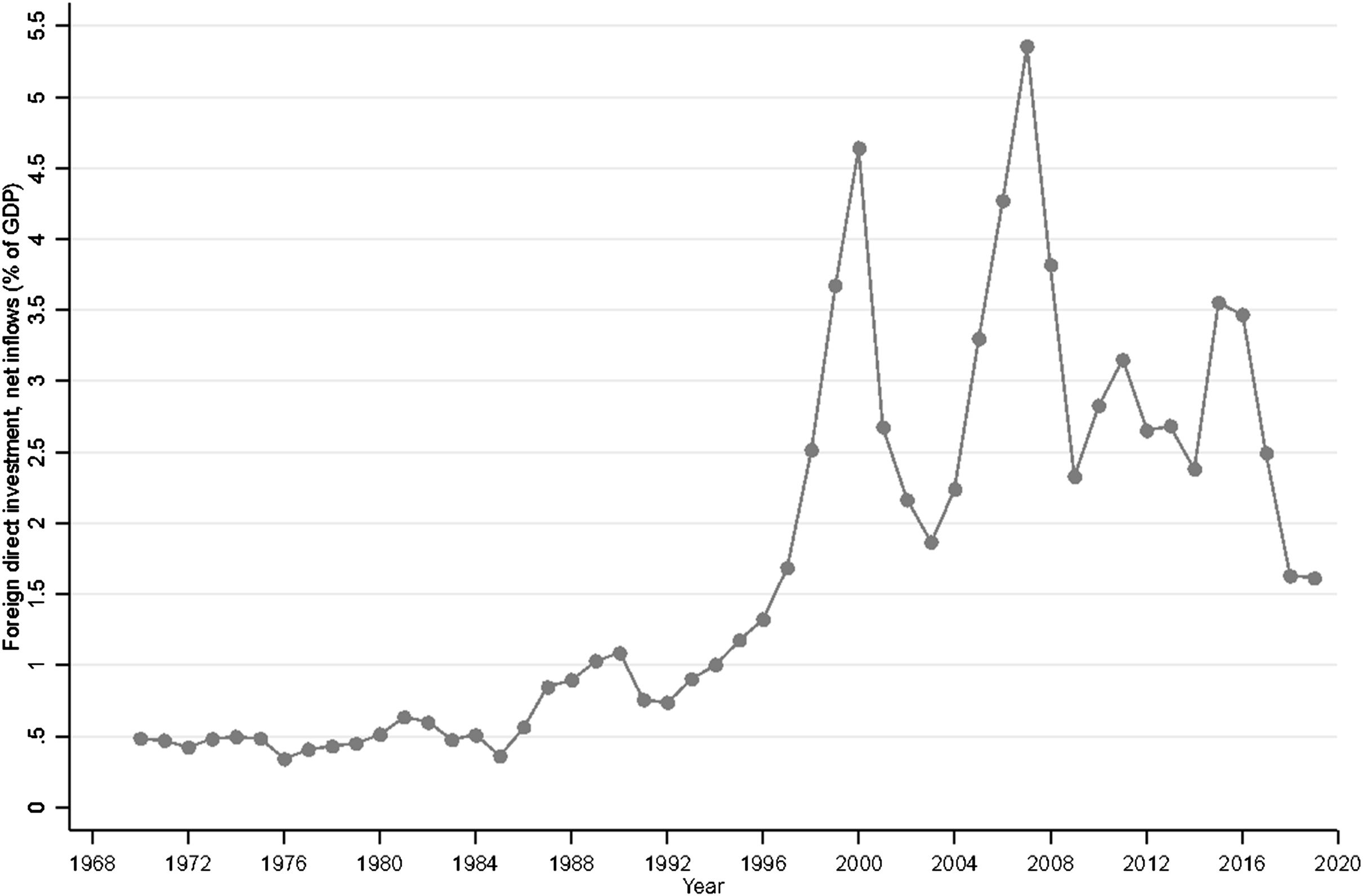
Initially, we consider trends in the flow of international trade and foreign direct investment (FDI), two features of international economic activity that are frequently used to measure globalization (e.g., Milner, 2021). As shown in Figure 1, both for the world as a whole and the countries that comprise the Organization for Economic Development and Cooperation (OECD), trade openness (which is defined as total global imports plus exports as a percentage of total global gross domestic product [GDP]) exhibited a sharp secular increase from 1970 until the Great Recession of 2007–2009. It then experienced a substantial decrease. After quickly recovering, trade openness has remained largely constant in recent years. Figure 2 reveals that net global inflows of FDI as a percentage of global GDP rose steadily from the mid-1980s until 2000, then dropped and spiked dramatically, before declining sharply after the start of the financial crisis in 2007. The trends in trade openness and FDI therefore seem to suggest that a backlash against economic globalization, driven at least partly by protectionist and restrictive policies, has occurred over roughly the past decade. Trade openness worldwide and for Organization for Economic Development and Cooperation countries, 1970–2018. Source: World Bank (n.d.). Total global net inflows of foreign direct investment as a percentage of total global gross domestic product, 1970–2020. Source: World Bank (n.d.).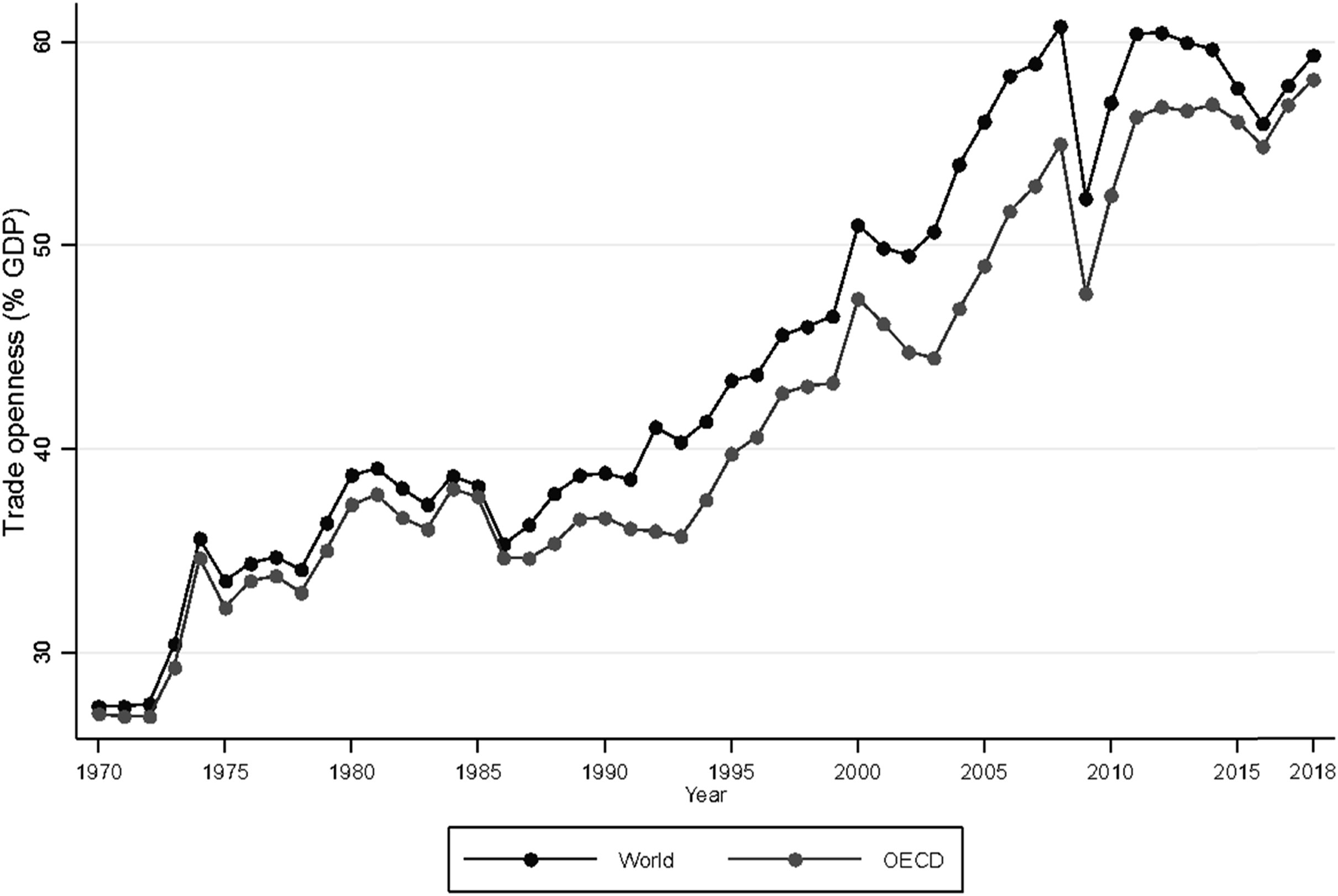
Of course, one problem with relying on economic flows to assess whether there has been a backlash against globalization is that although any such backlash involves government policies, economic flows are driven by a wide range of additional factors as well. For example, while protectionist trade policy may account for some of the recent stagnation in trade openness, it is widely acknowledged that declining demand in the wake of the Great Recession, falling commodity prices, a slowdown in the growth of global value chains, changes in China’s economy, and a global credit crunch also contributed to these trends (e.g., Gawande et al., 2014; Georgieva et al., 2018). Similarly, restrictive government policy may have stimulated some of the decline in FDI over the past decade or so, but various studies have also linked this drop to a reduction in corporate restructurings—especially cross-national mergers and acquisitions—and a declining rate of return on overseas investments (OECD, 2018; UNCTAD, 2018).
Consequently, it is also useful to directly analyze trends in foreign economic policies. Like the patterns in trade openness and FDI, these trends accord with claims that a globalization backlash is in full force. As shown in Figure 3, based on the 2019 KOF Globalization Index, de jure economic globalization (which is an index that reflects regulations, taxes, and tariffs on trade, as well as agreements on trade and international investment, investment restrictions, and capital account openness) was flat between 2010 and 2017, after having risen steadily since 1990 (Gygli et al., 2019). De jure trade globalization rose a mere 2% over this period (due primarily to a modest uptick between 2015 and 2017) and de jure financial globalization fell by over 6%. Both types of globalization had exhibited pronounced increases over the course of prior decades. De jure economic globalization, trade globalization, and financial globalization, 1970–2017. Source: Gygli et al. (2019).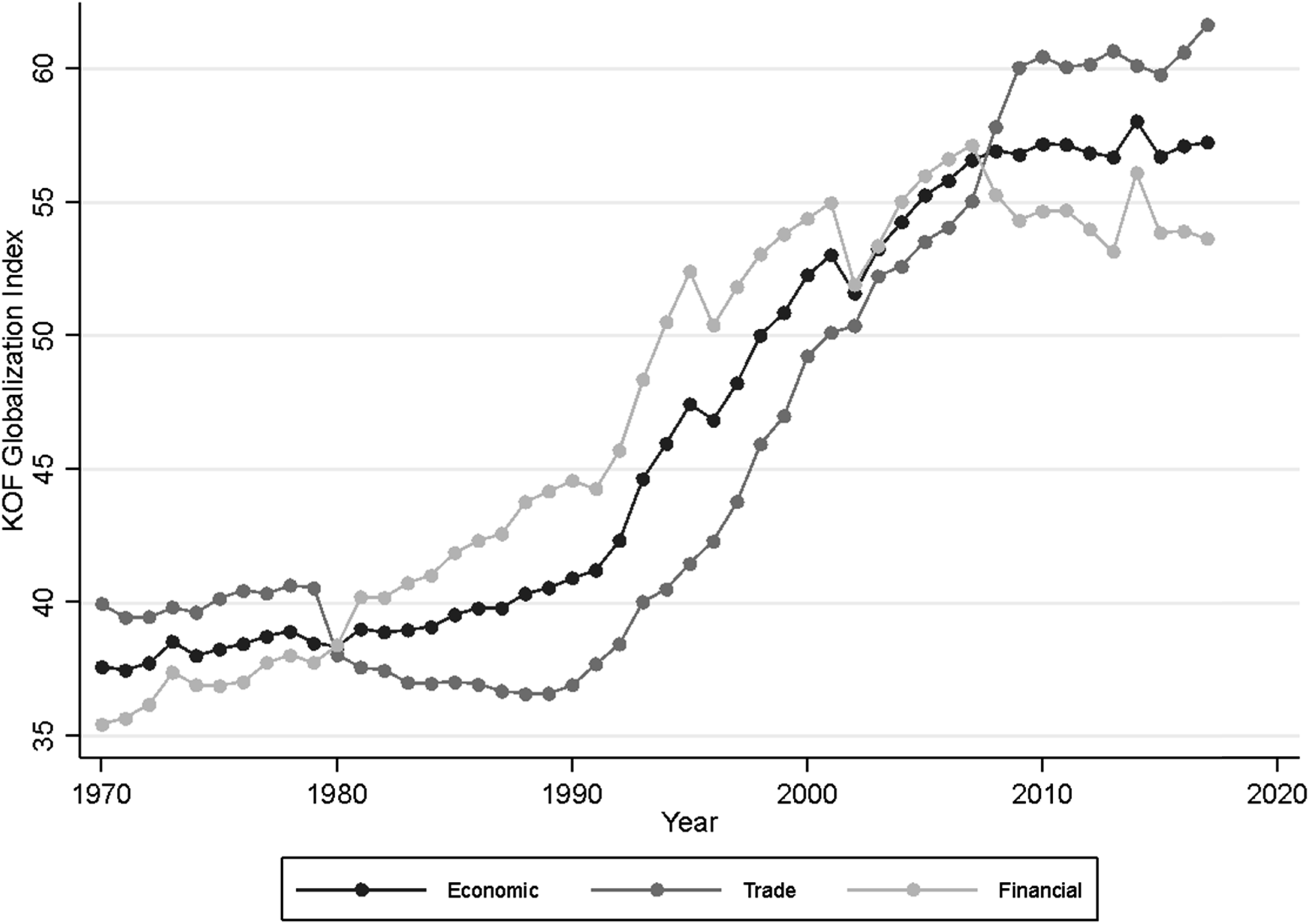
Data collected by Evenett and Fritz (2019) provide further evidence of a globalization backlash in the arena of foreign trade policy. Based on an analysis of thousands of government policy changes affecting overseas commerce, they find a steep increase in worldwide protectionism since 2012. Moreover, their data indicate that 2018 and 2019 witnessed a massive rise in the incidence of discriminatory trade measures, an outcome that Evenett and Fritz attribute to mounting populism and nationalism in many parts of the world. In fact, based on their estimates, over two-thirds more of these protectionist policies were recorded in 2018 and 2019 than in any previous year over the past decade. Consistent with this finding, the WTO (2019) reported that, during the period from October 2018 to October 2019, trade coverage of measures designed to restrict imports grew to their highest level since it started tracking this coverage. Equally, pro-trade reforms fell sharply in 2019 (Evenett & Fritz, 2019: 16).
This rise in discriminatory trade policies and the decline in trade reforms have been accompanied by a marked falloff in the establishment of trade agreements. It is widely argued that, at least for the past three decades, preferential trade agreements (PTAs) have been “trade creating” and been a liberalizing force in the global economy (Baier & Bergstrand, 2004; Freund & Ornelas, 2010; Krueger, 1999; Magee, 2008). As shown in Figure 4, data compiled by both the WTO and Mansfield and Milner (2012) indicate that PTAs proliferated rapidly during the 1990s and the first decade of the 21st century. Over the past decade, in contrast, the incidence of PTA formation has slowed markedly, which may further reflect a globalization backlash. PTAs between developing countries (so-called “South–South PTAs”), however, are an interesting exception to this trend, an issue that is discussed in greater detail in the special issue’s conclusion (Donno & Rudra, 2019). Incidence of preferential trade agreement formation, 1960–2019. Source: WTO (n.d.) and Mansfield and Milner (2012).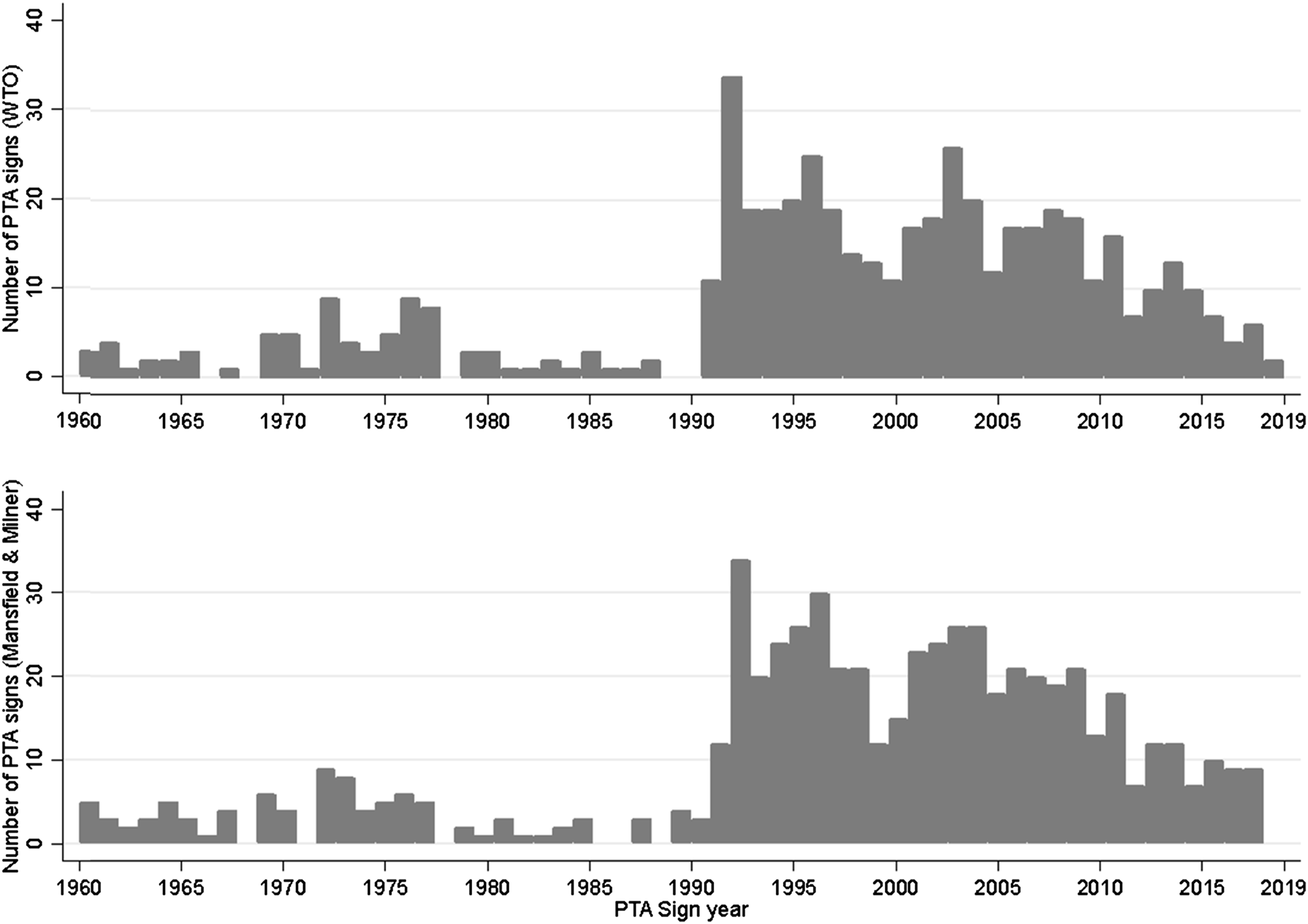
Trade agreements and dispute resolution within the multilateral trade regime have also ground to a halt. In November 2001, the WTO launched the Doha Development Round. Despite years of negotiations, the round has failed to generate an agreement, primarily as a result of unresolved differences between the advanced industrial member states and large developing economies. In addition to promoting multilateral liberation, the WTO is charged with resolving trade disputes between members. Central to the dispute settlement mechanism is the Appellate Body (AB), which hears appeals of rulings by WTO panels. As a result of the Trump Administration’s decision to block all appointments to this body—stemming at least partly from Trump’s aversion to globalization and the institutions that facilitate it—the AB had no standing members by the end of 2020, effectively paralyzing the WTO’s dispute resolution system.
Finally, the rhetoric of politicians and parties has been infused with growing hostility toward globalization in recent years. We address this topic by drawing on data compiled by the Manifesto Project, which covers more than 1000 parties in over 50 countries during the period since World War II.
1
Burgoon (2009) has used these data to construct an index of “Net Autarky,” which measures how protectionist, anti-internationalist (or more specifically, opposed to international institutions), and opposed to the EU each party platform has been in the run-up to elections. Figure 5 presents the median Net Autarky score for all parties worldwide and for those in OECD countries, where higher values represent greater hostility to globalization. In each case, we present 4-year averages starting in 1960 (1960–1963, 1964–1967, etc.) until 2018 (2016–2018 is the last period that we analyze), which is the final year data are available. The figure shows that the average party platform worldwide displayed progressively more antagonism toward globalization between 2000 and 2015, after which it became somewhat more muted. Among OECD countries, opposition to globalization has been on the rise since 1992, although it seems to have leveled off after 2011. Indeed, by 2018, the average party in the OECD expressed greater antipathy toward globalization than at any point since the late 1970s. Average Net Autarky scores worldwide and among Organization for Economic Development and Cooperation members, 1960–2018. Source: Party Manifesto project (https://manifesto-project.wzb.eu/) and Burgoon (2009).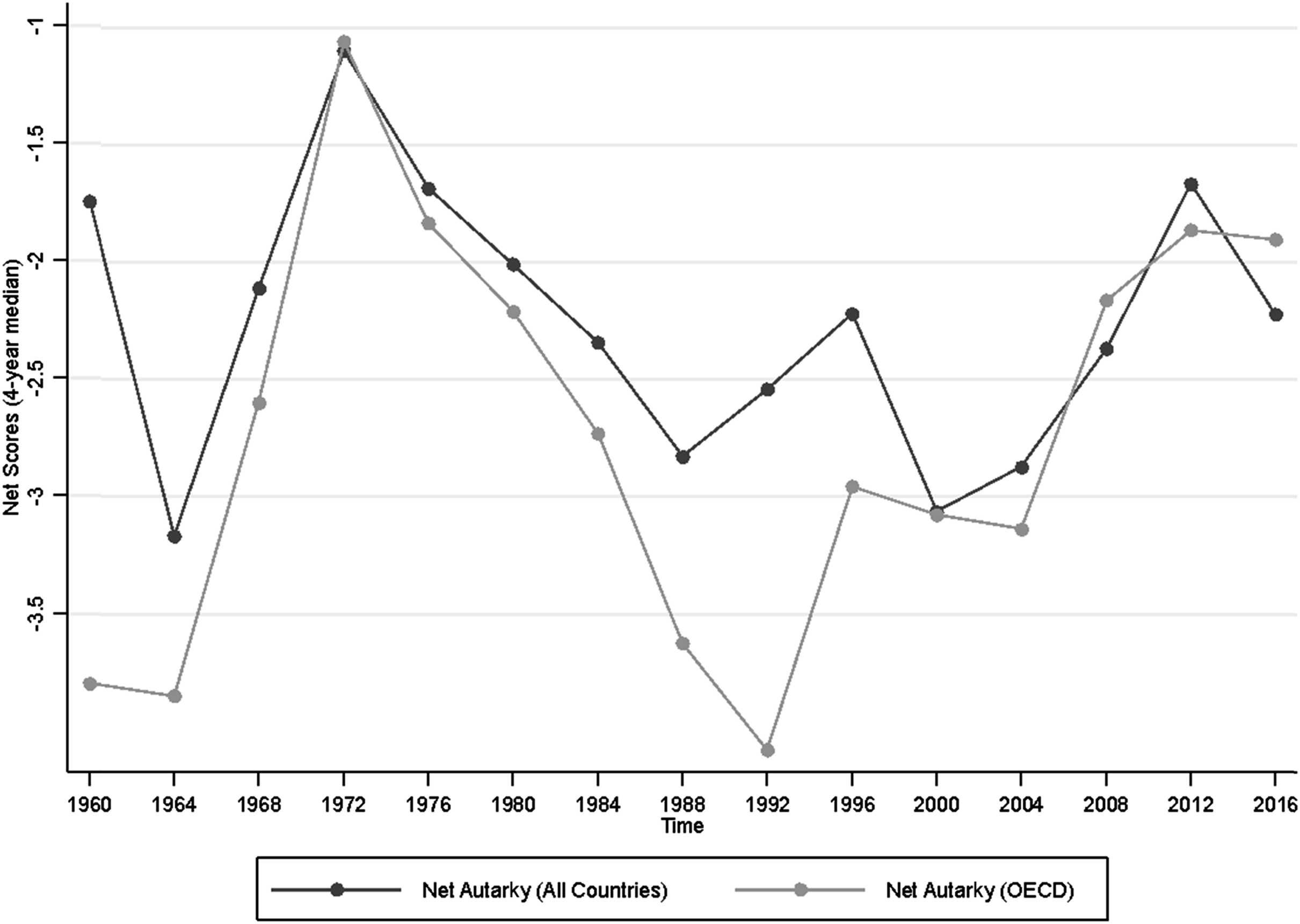
In sum, various indicators support the claim that we are in the midst of a backlash against economic globalization. Not only has trade plateaued and FDI declined, but protectionist policies are on the rise, trade liberalization has fallen, investment restrictions have increased, and the average political party has become more opposed to globalization, especially among richer countries. These trends suggest that we are experiencing a historical moment in the modern international economy.
Four Main Themes of the Special Issue
The articles in this special issue address various key questions associated with the backlash. What have been the political consequences of economic globalization? Have these consequences led to the rise of extreme right-wing parties in the advanced industrial democracies? How have these developments affected citizens’ political views? That is, what are the microfoundations of any tendency for globalization to stimulate support for the extreme right and for such support, in turn, to increase aversion to globalization? How have governments responded to economic globalization? Have some government policies—including those associated with the compromise of embedded liberalism—succeeded in mitigating the negative consequences of openness (Ruggie, 1982)? Finally, what have been the global repercussions from the political effects of globalization? Has the backlash diffused throughout the world? Have developing countries, in which the majority of workers are lower-skilled and should thus benefit from globalization, also experienced a backlash?
To begin, consider the political consequences of globalization. Numerous studies have taken up this topic, many focusing on international trade (e.g., Jensen et al., 2017). Much of this research shows that the “China shock”—that is, the surge of Chinese imports into advanced industrial countries after its accession to the WTO in 2001—has had key political implications, including increasing popular support for extreme right-wing parties and for Brexit (Autor et al., 2013, 2020; Barone & Kreuter, 2021; Colantone & Stanig, 2018a, 2018b; Dippel et al., 2015). A number of analyses also focus on how heightened immigration has precipitated mass support for extreme right-wing parties and restrictive immigration policies (Caselli et al., 2020; Dancygier & Margalit, 2020; Edo et al., 2019; Halikiopoulou & Vlandas, 2020; Halla et al., 2017; Mayda, 2006).
Less research has focused on the implications of foreign investment into the advanced democracies, but some of the studies that have been conducted on this topic also suggest that overseas investment can also have potent domestic political consequences (Owen, 2015, 2019; Scheve & Slaughter, 2004). More generally, a large body of work indicates that elements of economic globalization have had domestic effects that have ultimately bolstered the hand of globalization’s opponents. However, considerable debate remains about the size and importance of these effects (e.g., Becker et al., 2017; Citrin et al., 1997; Hainmueller & Hopkins, 2014; Mansfield & Mutz, 2009, 2013; Norris & Inglehart, 2019).
In this special issue, Milner updates and expands this vein of research by assessing the impact of most of the key facets of economic globalization, including trade, immigration, foreign investment, and technological change. Her focus is on explaining changes over time in support for political parties. As noted above, extreme right-wing parties have been especially fierce proponents of anti-globalization policies, driven by their nationalist and xenophobic manifestos. Milner addresses support for extreme right-wing parties in 15 European countries during the period from 1990 to 2018, a broader sample of countries and temporal coverage than most of the existing literature on this topic. Because the analysis is conducted at the regional level, she is better able than previous studies to establish how different aspects of globalization affect vote choice. Her analysis also examines individual-level survey data to uncover the factors associated with support for the extreme right. Milner’s results indicate that heightened trade and technological change have stimulated support for these parties while dampening support for center-left parties. Consequently, certain aspects of globalization do appear to generate support for its opponents. Surprisingly, however, immigration and foreign investment have a far less pronounced effect on support for the extreme right.
What are the microfoundations underlying the surge in opposition to globalization? How do the distributional consequences of globalization influence political behavior? Specifically, why do those segments of society that lose economically often turn to the extreme right politically? It is generally thought that lower-skilled workers in advanced industrial democracies embrace parties on the left, particularly during hard times (Gourevitch, 1986). But an important puzzle is why many of these individuals are currently turning to extreme right-wing parties. What do they find appealing about these parties and their rhetoric? These parties often combine relatively authoritarian tendencies with anti-internationalism, anti-elitism, nativism, and xenophobia. Cultural perspectives on the rise of the extreme right claim that these parties’ appeals have less to do with economic problems than with challenges to the core values and opinions of some voters and their social status (Inglehart & Norris, 2016).
Numerous studies suggest that political psychological factors draw these voters to the extreme right; some analyses link these factors to globalization by arguing that they are exacerbated by economic stress (Mansfield et al., 2019; Noland, 2020; Urbatsch, 2018). For example, authoritarian elements of people’s personalities, which might be amplified by economic pressures, can lead to rising support for the extreme right, which offers a program emphasizing executive authority (Norris & Inglehart, 2019). Put differently, economic grievances can threaten individuals’ social status and trigger underlying authoritarian tendencies. This promotes support for parties that host ethnonationalist and anti-immigration platforms (Gidron & Hall, 2017). Another line of research points to the rising insecurity of individuals as they face rapid and large economic and technological shifts. Such insecurity may precipitate growing distrust of existing political institutions and elites, creating political space to boost support for extreme right-wing parties and their anti-elite narratives (Algan et al., 2017). There are thus multiple psychological pathways by which deep economic shocks can prompt increasing support for parties on the far right. The shock of economic change for certain personality types may be part of the globalization backlash.
In this special issue, such a perspective is presented by Ballard-Rosa, Malik, Rickard, and Scheve. They propose that the oft-cited dichotomy between cultural and economic drivers of the globalization backlash may in fact be false. 2 Instead, they posit that cultural values are in part endogenous to economic change. More specifically, Ballard-Rosa, Malik, Rickard, and Scheve assess the role that economic shocks play in the adoption of “authoritarian values,” which reflect a preference for order and conformity, and a willingness to use force to achieve such outcomes. Based on an original survey of the British mass public, they find that individuals residing in areas that have been adversely affected by trade shocks are more likely to hold such values, an outcome that they attribute to the shocks frustrating the economic goals of individuals and thereby stimulating generalized aggression. Their analysis thus indicates that international economic pressures can trigger cultural values correlated with anti-globalization and protectionist sentiment.
Next, the special issue focuses on how government policies affect the backlash. The concept of embedded liberalism suggests that government policies aimed at helping citizens adversely affected by globalization reduce their tendency to turn to extreme parties and non-democratic solutions. Ruggie’s (1982) seminal study of this concept argued that attempts to forge an open multilateral system in the aftermath of World War II were coupled with an explicit recognition on the part of policymakers that domestic interventionism and a strong social safety net were needed to compensate individuals who were economically harmed as a result of openness. Since the publication of that study, scholars have analyzed the extent to which governments have actually crafted policies that reflect the compromise that embedded liberalism articulated. The bulk of this research has emphasized the relationship between trade and capital openness, on the one hand, and governments’ willingness to compensate the distributional losers from such openness through social welfare spending and programs, on the other. Much of this literature has found support for the embedded liberalism hypothesis, showing that welfare spending can cushion the domestic political impact of globalization (Hays et al., 2005; Nooruddin & Rudra, 2014; Swank & Betz, 2003).
Some of the articles in this special issue use the lens of embedded liberalism to explore the domestic and international sources of rising protectionism, driven primarily by those who are materially harmed by globalization. Two of the articles explore how and why efforts at implementing the embedded liberalism bargain have fallen short and prompted both rising strains on this bargain and the recent backlash. These studies focus on factors that have received short shrift in extant analyses of embedded liberalism, as well as identifying some of its unintended consequences.
Kim and Pelc question the direction of the causal arrow in existing studies of embedded liberalism. They argue that trade adjustment assistance and protectionism act as substitutes and that both offer a means of addressing import exposure. Using data at the firm and factory level covering 25 years, they find that US counties with more successful Trade Adjustment Assistance (TAA) petitions experience fewer demands for trade barriers in response to trade shocks. This is broadly consistent with the concept of embedded liberalism. However, they conclude that owing to the design of TAA, compensation efforts often come after protectionist demands have not been met, rather than beforehand, as studies of embedded liberalism would predict. Kim and Pelc also address whether protectionism and TAA have different political consequences. They find that whereas TAA yields electoral benefits for Democrats, protectionism generates electoral gains for Republicans.
In contrast, Milner’s results deviate from what would be expected based on embedded liberalism. She concludes that, in Europe, rising trade and technological change precipitate increased support for extreme right-wing parties regardless of whether social welfare policies are implemented that might help to buffer the economic costs of globalization. Her findings raise questions about whether a revised embedded liberalism compact that directly compensates individuals harmed by technological change may be required to revive support for globalization. Milner’s null results on the capacity of welfare states and other policies associated with embedded liberalism to mitigate the backlash are also consistent with the findings of Ballard-Rosa, Malik, Rickard, and Scheve. Taken together, Milner and Ballard-Rosa, Malik, Rickard, and Scheve suggest that social insurance and transfers may not be adequate compensation if and when trade and technological change block individuals’ life plans, limit their ability to fulfill their expected roles in their families and communities, and diminish their social status. Instead, these global economic forces may exacerbate the frustration–aggression reaction that Ballard-Rosa, Malik, Rickard, and Scheve argue contributes to authoritarian values and the backlash.
Finally, we consider the potential global ramifications of the backlash. Does hostility to globalization expressed by citizens in one country have consequences for other countries? Is there global diffusion of the backlash? International diffusion has been observed in numerous issue areas (Cao, 2010; Gilardi, 2012; Jandhyala et al., 2011; Malesky & Mosley, 2018; Mansfield, 2016; Simmons & Elkins 2004; Solingen, 2012; Sommerer & Tallberg, 2019). In one of the few studies to address this important topic, Minkus et al. (2019) show how Trump’s election increased support for European integration among European voters. However, relatively little effort has been made to analyze whether the political consequences of globalization have diffused globally.
In this special issue, Walter addresses whether and how the globalization backlash spreads from one country to the next by analyzing popular resistance to participation in international institutions. Specifically, she explores whether witnessing voters rejecting multilateralism in one country affects voters’ perceptions of multilateralism elsewhere. Walter argues that observing another country’s withdrawal from an international institution allows voters to better calibrate the economic, social, and political implications of disintegration. A positive withdrawal experience that renders the exiting state better off than it was as a member of the international institution is likely to encourage support for further withdrawals abroad, a dynamic that amplifies the globalization backlash across countries. In contrast, a negative withdrawal experience is likely to dampen support for leaving the institution among individuals in other member states. Walter examines the case of Brexit and relies on two sets of original survey data collected in the EU-27 during the Brexit withdrawal negotiations and in Switzerland before and after the first Brexit date extension in spring 2019. She finds that when voters abroad perceive Brexit as going well, they tend to support their own countries exiting the EU. When the Brexit process runs into difficulties, however, this support declines and voters’ willingness to support referendum proposals to maintain international cooperation increases.
Walter also finds that the observed effects are less pronounced for respondents holding strong prior beliefs and emphasizes the importance of dramatic events during disintegration processes. In the aggregate, the difficulties surrounding the Brexit negotiations undermined support for leaving the EU. To the extent that international institutions and their remaining member states can influence whether the withdrawing state’s experience is positive or negative, this suggests that they have a role to play in amplifying or mitigating globalization backlash. Walter’s investigation thus indicates that scholars would do well to examine not just how the losers from globalization contribute to rising protectionist sentiment, but also how systemic factors guide the spread of such sentiment.
Rudra, Nooruddin, and Bonifai provide the conclusion for the special issue. The experience of developing countries has been sorely neglected by scholars analyzing the backlash. Rudra, Nooruddin, and Bonifai call for further analysis of why the globalization backlash has generally been stronger in advanced industrialized countries than in the developing world. Their argument does not bode well for the future of globalization, although it does suggest that we are at a critical moment in the history of the liberal international economic order.
Rudra, Nooruddin, and Bonifai maintain that citizens in most developing countries are still in an early honeymoon phase of globalization. In the initial period following trade reforms, citizens have diffuse expectations about trade’s impact and extrapolate from the positive economic effects of reform that they witness throughout society to their own lives. But as time passes with limited gains from trade trickling down throughout the economy, the mood of these nations threatens to darken under clouds of rising inequality and relatively few benefits for low-skilled workers, who are the median voter. This deterioration of the reservoir of pro-trade goodwill, however, is not inevitable and could be stemmed if politicians at home and abroad use their power to design globalization so that it provides distributive gains for the more disadvantaged. But this policy regime will be one that embraces policies and institutions that function differently from the traditional welfare state explored by Milner and Kim and Pelc. Using the articles in the special issue as a foil, Rudra, Nooruddin, and Bonifai propose a research agenda for exploring if, how, and why the experience of late-liberalizing developing economies may be different than that of the more advanced industrialized democracies. The stakes are no less than the future of globalization.
Conclusions
The articles in this special issue focus on various economic sources of the current backlash against globalization while also exploring how the rising hostility to globalization within the developed world reflects the interaction between material and non-material forces. Nonetheless, various factors might be influencing the mounting hostility to globalization that are beyond the scope of this volume. A sizable literature, for example, argues that the backlash is not related to economic pressures and is part of a larger cultural revolt against more cosmopolitan, non-traditional norms that have been adopted as globalization has spread (Norris & Inglehart, 2019). Ballard-Rosa, Malik, Rickard, and Scheve explore a key cultural factor, and we encourage additional research on other such factors. However, we think it is likely to be especially fruitful to consider cultural and economic factors in combination, as Ballard-Rosa, Malik, Rickard, and Scheve do in showing how economic pressures amplify preexisting cultural traits.
Another issue that the special issue does not directly address is the political impact of growing economic inequality. Many scholars have argued that inequality poses serious challenges to democracy and perhaps to globalization as well (Rogowski & Flaherty, 2021; Scheve & Stasavage, 2017). The Great Recession may have also played a role in provoking the backlash by generating heightened anxiety about globalization (e.g., Mansfield et al., 2019). Moreover, Milner emphasizes that this crisis helped to stimulate support for the far right in Europe and to erode support for mainstream parties. In addition, we do not touch on changes to the welfare state that various countries have experienced and the austerity policies that were adopted in the wake of the 2007–2009 financial crisis. Some studies suggest that these changes stoked anti-globalization sentiment (e.g., Burgoon, 2009; Fetzer, 2019). These and other potential sources of the globalization backlash are important and merit additional research.
This special issue is timely. The current backlash poses significant and widespread challenges to the global economy. Existing demands for nationalist policies and protectionism began brewing around the same time that many international economic flows reached their peak levels. Thereafter, openness slowed, even retreating in some cases. Not only are some voters pushing back against liberal foreign economic policies, but this discontent is manifesting itself in political polarization and the fierce resistance of traditional cultural forces. Some voters are also rejecting the international institutions that have helped to support the global economy. Scholars and practitioners should consider how future multilateral negotiations can be conducted in a manner that promises more broadly distributed benefits both within and between nations. Reforming the WTO and other international institutions that support globalization could be important steps to help alleviate the political strains that have been placed on the world economy.
More generally, the globalization backlash may usher in an era in which international cooperation becomes increasingly fraught. In areas as diverse as global public goods provision, the management of great power rivalries, and global public health, as well as international economic relations, the anti-internationalist, nativist, and xenophobic rhetoric and policies that have accompanied the backlash are likely to serve as significant impediments to the cooperation and coordination between states that are needed to address global problems. The implications for the stability of the international system could be devastating.
Footnotes
Declaration of Conflicting Interests
The authors declared no potential conflicts of interest with respect to the research, authorship, and/or publication of this article.
Funding
The authors received no financial support for the research, authorship, and/or publication of this article.
