



Abstract
Little is known about how local context influences radical right voting. This paper advances the theory that the degradation of local socio-cultural hubs is linked to radical right support by contributing to loss of community and cultural identity. I examine this thesis by exploiting an original dataset on British community pub closures. I argue that the disappearance of community pubs triggers social isolation and signals the decline of the British working class condition, which is associated with UKIP support. Combining district-level data with UK panel data (2013–2016), I show that individuals living in districts that experience one additional community pub closure (relative to the total number of pubs per district) are more likely to support UKIP than any other party by 4.3 percentage points. The effect is magnified under conditions of material deprivation. This paper highlights the significance of local socio-cultural degradation as a mechanism to explain radical right support.
Keywords
Introduction
The sustained and growing electoral successes of radical right parties in several Western European countries has provoked extensive media coverage and widespread public concern. The question of how to explain such parties’ electoral support has also been the subject of intense academic study, including by scholars such as Evans (2000); Lubbers et al. (2000); Norris (2005); Arzheimer and Carter (2006); Ivarsflaten (2005); Kitschelt (1995), among others. Drawing from cross-sectional or individual-level survey data, the majority of studies have focused on the macro-level and individual-level factors behind this phenomenon. It is theoretically and empirically agreed that radical right supporters are socially conservative individuals who live in countries experiencing changes in overall immigration levels (or migration of particularly salient outgroups) and high levels of material deprivation, mostly proxied by the unemployment rate (Arzheimer & Carter, 2006; Mayer, 1998).
Yet, the individual and macro factors fail to explain all variation in radical right support. On the one hand, contextual studies restrict themselves to aggregate national or regional indicators that ignore local variations and potential ecological fallacies (Golder, 2003). On the other hand, individual-level data are detached from any local contextual dynamics and suffer from an under-reporting of radical right supporters in surveys due to social desirability bias. Some recent studies have begun to look more closely at subnational levels to investigate the local contextual determinants that explain radical right voting. These determinants include economic factors such as economic hardship (Carreras et al., 2019; Colantone & Stanig, 2018a), labor market competition (Bolet, 2020), austerity reforms (Fetzer, 2019) and changes in housing prices (Ansell & Adler, 2019); as well as changes in immigration levels (Patana, 2020), changes in the share of non-Western residents (Arzheimer & Carter, 2006; Lubbers et al., 2002; Rydgren & Ruth, 2011); and institutional and party system variables (Kestilä & Söderlund, 2007). Studies that combine the two units of analysis mostly use hierarchical models with cross-sectional data consisting of a handful of attitudinal measures and a set of sociodemographic variables (Arzheimer & Carter, 2006). The rare exceptions have investigated the role of local economic shocks and austerity in driving radical right nationalism (Colantone & Stanig, 2018b) and Brexit (Carreras et al., 2019; Colantone & Stanig, 2018a; Fetzer, 2019). While these studies bring important causal evidence of economic factors behind radical support, their focus is limited to material deprivation.
In this paper I advance the claim that another significant motivator pushes individuals to support a radical right party: the decline of local socio-cultural hubs, which increases the sense of social isolation and status anxiety among the affected community. I develop what I call the “‘Local Socio-Cultural Degradation Theory,” which improves upon social capital/social isolation theories. The latter posit a link between people’s lack of connectedness in their community and radical right support at the individual level, but they do not adequately capture the distinctive reasons why people would vote for radical right parties (as opposed to radical left voting or abstention). I draw on recent work on local sociotropic influences, which stresses the importance of people’s local socio-cultural hubs in shaping their political behavior, and status decline theories, which show how status loss of the white working class, a once dominant social-cultural group, translates into radical right support. The Local Socio-Cultural Degradation Theory advances that the closure of social places that are at the heart of a local community sparks a sense of social marginality among the people who used to frequent these places, causing them to question their place in their society. For many such people, these closures also mark the disappearance of their cultural heritage, and they experience a loss of cultural identity as a result. This process ultimately leads these individuals to vote for radical right parties, whose rhetoric and ideology tap into precisely such social and cultural grievances (Gest, 2016; Norris, 2005).
In my study, I aim to provide accounts of the role of local socio-cultural degradation in driving radical right support by using a novel empirical indicator: community pub closures in the United Kingdom. Community pubs are a focal point of local communities in Britain, through which social connections are established and sustained. My study focuses on community pubs because they embody the traditional “working-class white” identity, meaning their decline is likely to foster the processes of social isolation and cultural identity loss that eventually translate into radical right votes. Combining the UK Household panel study with a novel pub closure ratio—the ratio of the number of community pub closures per year to the number of pubs per district—I examine vote preferences for individual voters with logit and hierarchical models. I use year, wave and regional fixed effects in order to observe the intra-regional variability of radical right support while keeping time and wave constant. Conditional on individual and contextual variables, I find that individuals living in districts more affected by the closure of community pubs are more likely to vote UKIP. The propensity for an individual to support UKIP increases by around 4.3 percentage points as there is one additional community pub closure relative to the number of pubs per district. In addition, the effect of social deprivation is amplified under conditions of local material deprivation at the district level. My results are robust to controlling for several pub types, district characteristics, and alternative dependent and independent variables.
The contribution of this study is fourfold. It proposes a new theory to explain radical right support, the Local Socio-Cultural Degradation theory, that builds on and improves the social capital/social isolation and status anxiety theories by incorporating a spatial dimension. It does not simply consider individual isolation in a vacuum, but rather highlights the importance of socio-cultural places as subjectively-experienced and geographically-bounded communities whose closures reinforce feelings of social exclusion and cultural identity loss, which shape radical right support. Empirically, it employs an original empirical variable which goes beyond the unreliable and undetectable social capital indicators. The closure of community pubs provides a powerful explanatory variable of local socio-cultural degradation by capturing both the effects of social isolation and cultural identity of the white working class in Britain. In addition, this analysis finds that only economic deprivation, and not immigration, amplifies the socio-cultural decline because worsening economic conditions directly affect the financial viability of socio-cultural hubs, hence impacting residents’ sense of socio-cultural decline. By comparison, immigration is unlikely to be a significant predictor of socio-cultural hub closures, which means that individuals are less inclined to associate their perceived sense of social isolation with immigration influx. Finally, this study offers an analytic way to integrate the role of local socio-cultural factors over time, while still considering the importance of material considerations in the study of radical right voting. This supports the notion that the interaction of material and cultural factors shapes radical right voting, thereby providing a more nuanced understanding of this electoral support than the arbitrary “economic” versus “cultural” explanations.
The paper is organized as follows. I first give an overview of the social capital/social isolation and radical right voting literature to highlight its theoretical and empirical limitations and advance the Local Socio-Cultural Degradation Theory. After introducing community pub closures as a new indicator of this theory, I lay out my data, empirical strategy, results, and robustness checks. The final section of the paper discusses the potential implications of my findings.
The Local Socio-Cultural Degradation Theory
The Local Socio-Cultural Degradation Theory proposes that the decline of local socio-cultural spaces increases the propensity for an individual to support a radical right party. Drawing on recent work on local sociotropic influences and status decline, this hypothesis improves on social capital/social isolation theories by better linking adverse social conditions to radical right voting (as opposed to radical left support or abstention).
In what follows, I briefly discuss the theories of social capital/social isolation and their limitations, and then move on to the explanation of my theory.
Theories of Social Capital/Social Isolation
Observing that processes of globalization and deindustrialization were leaving individuals increasingly detached and alienated from their communities, sociologists and political scientists have explored the role of individuals’ social (dis)connectedness in explaining support for radical right parties (Gusfield, 1962; Kornhauser, 1959).
The vast “social capital” 1 literature focuses on hubs of social interaction, and resulting interpersonal bonds, as the crucial link. Scholars in this tradition argue that people who have active friendship networks and are active in civil society organizations—like bowling leagues or parent-teacher associations—are more likely to be trusting of others, to share civic virtues and democratic values, as well as to develop skills of cooperation, solidarity, and shared responsibility for collective endeavors (Hall, 1999; Leonard, 2004; Putnam, 1993, 2000). The absence of involvement in voluntary associations renders individuals less secure 2 and less able to establish interpersonal relations and generalized trust (Putnam, 2000). A sense of belonging is gradually replaced by unfulfilled needs for a community identity and by a distant and distrustful relationship to the country as a whole. 3
More recently, scholars in this tradition have argued that the social distrust exhibited by individuals isolated from such civic associations leads them to support radical right parties (Putnam, 1993, 2000) 4 . The diminished role of community structures—families and local voluntary or professional organizations—they argue, presents an opportunity for charismatic leaders to lure atomized individuals. A thriving radical right movement or party then provides local loyal “quasi-communities,” which fills the void left by decaying identities and prevents individuals from responding to isolation through political disengagement. A telling example is the large decline of trade unions and local working-class organizations which contributed to the growing popularity of radical right parties among former blue-collar and low-skilled workers (Mayer, 1998). 5 The radical right has indeed managed to tap into some elements of white working-class angst. US President Donald Trump proved successful in parts of the so-called “rust belt” in the United States in the 2016 elections, while in Britain the former leader of the far-right English Defence League, Tommy Robinson, poses as a kind of working-class hero.
A weakness of this theoretical explanation is that it does not explain why isolated individuals would necessarily be inclined to support parties or movements on the radical right, or for that matter why they become politically active at all, rather than passively holding extremist, anti-system attitudes. Empirically, theories in the social isolation/social capital tradition have largely been explored in ethnographic studies (Cramer, 2016; Gest, 2016; Hochschild, 2016), but have not been widely substantiated with large-n empirical evidence—a problem exacerbated by a lack of satisfactory indicators. In particular, only a few quantitative studies have empirically tested the claimed link between social isolation and radical right voting. These studies operationalized the relationship between social isolation and radical right support using either an objective indicator of social isolation, such as (lack of) friendship relations, (weak) family structures, or (no) membership in civil society organizations (Coffé et al., 2007; Fennema & Tillie, 1998; Rydgren, 2009; Veugelers, 2005), or measures of people’s subjective feelings of social isolation, such as feelings of loneliness, alienation, and distrust (Fennema & Tillie, 1998; Shils, 1996). Yet, these studies fail to show consistent results since the direction of the effect is variously negative, positive or null. They also often conflate social sources of radical right support with economic parameters, as with Jesuit et al. (2009), who used an indicator of economic equality to assess the role of regional social capital on radical right voting (a notable exception includes Gest’s research, discussed below 6 ).
These results illustrate a further theoretical weakness: the vagueness of the term “social capital.” “Social capital” has become a catch-all, umbrella term rather than a clear concept because it refers to a phenomenon with various dimensions, types, and levels of measurement (Bell, 2009) 7 . In addition, the lack of fine-grained systematic investigation of its links to radical right voting over time has prevented researchers from identifying local dynamic patterns. This weakness further motivated my reliance on additional theoretical building blocks in order to develop a more precise “social” explanatory variable for radical right support.
The Local Socio-Cultural Degradation Theory
The Local Socio-Cultural Degradation Theory improves upon the social capital/social isolation theory by incorporating elements of two nascent theories, local sociotropic, and status decline theories, and by better linking the effect of social conditions to radical right voting (as opposed to abstention or support for a radical left party).
The link between social capital/social isolation and radical right voting is incomplete without considering people’s connection to their local place and the way this shapes their political attitudes and voting behavior. In line with the nascent literature on “local sociotropic” accounts of voting (Enos, 2017), the local socio-cultural degradation hypothesis contextualises the social isolation theory by considering the declining social-cultural hubs of people’s lived experiences as a trigger for radical right support. These hubs are gathering places in which people meet to socialize. They can be bowling leagues, sports bars or pubs to name a few, and are signs of a healthy and cohesive community.
In many communities, the number of these local hubs has ostensibly been reduced over the years due to underlying demographic, economic, and social forces. Processes of deindustrialization and the increasing dominance of urban agglomeration, with the ageing of the populations of peripheral places, depopulation, and decline in income among manufacturing workers, have affected local community structures (Jennings & Stoker, 2019). Many rural areas and industrial clusters have moved from being communities with local employment to dormitory areas or second home locations where commuters no longer stop at the bars or pubs on their way home. In towns or big cities, the population is more transient (Travers et al., 2007) and so less inclined to gain an attachment to these local hubs. In addition, economic downturns have severely affected local hubs which are under economic strain to sell their businesses to larger companies (Muir, 2007). Changing social habits, such as people increasingly staying at home to watch streaming services instead of going out, have also hurt local socio-cultural hubs (Muir, 2007).
The decline in these social places matters because they are not only functional enablers of social interaction; they also convey historical, geographical, and social meanings that their inhabitants internalize and re-enact in their daily interactions within such spaces (Agnew, 2011). They develop a distinctive character, and become associated with distinctive traditions, for a specific social group, which has been described in sociology as a “communal ethos” (McQuarrie, 2017). In turn, people come to feel a sense of belonging in, and develop attachments to, these places, groups, and traditions; they become a part of their inhabitants’ cultural identity. Accordingly, the loss of these socio-cultural hubs triggers not only the individual pain of losing something valued but a sense that one’s social-cultural group (and its distinctive traditions, and values) has become marginalized and abandoned (while other groups ascend).
The Local Socio-Cultural Degradation Theory also builds on elements of the growing literature on status anxiety. The status anxiety literature suggests reasons why a decline of certain kinds of socio-cultural hubs might have an effect on a particular segment of the population, namely the white working class. Gest et al. (2018) and Gidron and Hall (2017) stress how this group has perceived they are shifting to the periphery of their society relative to a new dominant white class of professional elites, amid rising immigration, and economic crises. The transformation of the economy has contributed to the gradual disappearance of low-skilled, decent, and secure jobs in manufacturing sectors and the rising demand for highly skilled employees with higher education (Gidron & Hall, 2017). It has relegated low-skilled white workers to the fringes of the social order. Low levels of status inspire a diffuse cultural resentment against the loss of their social group’s previously established dominance in the social hierarchy. This resentment is translated into a radical right vote because radical right parties evoke a sense of nostalgia and pledge to return to an idealized image of the past characterized by its social cohesion and cultural homogeneity.
Following these theoretical accounts, the Local Socio-Cultural Degradation Theory proposes that it is the deterioration of white working class socio-cultural places that plays a role in shaping radical right support. Being exposed to a community in decline, manifested by the gradual disappearance of everyday socio-cultural experiences, can contribute to people’s sense of social isolation and low social status because people typically compare their experience to that which they have had in the past—and have come to expect—but now see “others” as having. The disappointment of their expectations, in turn, leaves them resentful and open to distinctively radical right appeals that invite reactionary nostalgia for earlier times (e.g., “Make America Great Again” in the US and “Take Back Control” in the UK) (Gest et al., 2018; Norris, 2005). People who feel disillusioned with the decline of social-cultural hubs that reflect their declining socio-cultural identity are more inclined to reject mainstream parties who appeal to the status quo—or to a form of “progress” with which these groups do not identify—and to support a party that celebrates a return to lost traditions. Recent ethnographic studies have endorsed this link, documenting people’s feelings that their local communities had deteriorated and suggesting that this has contributed to radical right support (Cramer, 2016; Hochschild, 2016), though quantitative studies of dynamic changes have, as noted earlier, focused mostly on economic factors (Colantone & Stanig, 2018a, 2018b).
The Local Socio-Cultural Degradation Theory improves upon the predictions of social capital/isolation theories by positing additional conditions under which declines in certain kinds of social hubs do incline the affected individuals toward active support for radical right wing parties. These additional conditions relate to the dynamics of these individuals’ perceived social-cultural status and the manifestation of such dynamics in the decline of particular kinds of social-cultural hubs. Under these conditions, I suggest, individuals are responsive not merely to attempts to rebuild community life (which is not distinctively right wing) but are responsive to distinctive appeals of radical-right parties.
Additionally, the Local Socio-Cultural Degradation Theory improves upon the social capital/social isolation by better linking adverse social conditions to voting (as opposed to abstaining) for a radical right party (as opposed to a radical left party). It does not predict that individuals who experience this kind of socio-cultural marginalization will abstain from voting. 8 Rather, unlike the social capital/social isolation theory, it distinguishes between those who have always felt isolated and those who have become isolated after experiencing a decline of activity in their local area. People who have always felt isolated, as assumed in the social isolation theory, could just as well respond with a radical right vote and an abstention. The relative loss of social interactions compared to the expectations is what leads to radical right support. This sense of relative decline provides fertile ground for the nostalgic rhetoric of radical right parties and figures (Gest et al., 2018; Norris, 2005).
Following these assumptions, I theorize:
Finally, I argue that the impact of local socio-cultural degradation on radical right support can be amplified under certain contextual conditions. Individuals correctly perceive local conditions (Newman et al., 2015) so changes in their local environment can influence their voting behavior. Recent studies have emphasized the role that real economic contexts have in conditioning individuals’ predispositions about political attitudes and voting behavior (Ansell & Adler, 2019; Carreras et al., 2019; Colantone & Stanig, 2018b; McKay, 2019). Local economic shocks, changes in housing prices, and local unemployment levels might lead people to scapegoat immigrants, adopt nativist attitudes, and eventually support anti-establishment movements such as Brexit (Ansell & Adler, 2019; Carreras et al., 2019; Colantone & Stanig, 2018b). Residents of low-income communities tend to have more negative views about how well their community is represented and perceptions of local economic difficulties are linked with more negative views of community representation in the UK (McKay, 2019). Those who live in economically depressed areas are more likely to perceive these economic difficulties and translate them in socio-cultural terms. Worsening economic conditions may directly impact the financial viability of socio-cultural hubs 9 and may degrade the social conditions of local residents, as unemployment may reinforce social isolation and feelings of political powerlessness. Local economic deprivation, which is perceived by residents, amplifies their actual and perceived sense of socio-cultural decline. I therefore expect that local economic difficulties compound the local socio-cultural degradation effect on radical right voting.
The same cannot be said about immigration. The relation between immigration and socio-cultural degradation is not as straightforward as it is for economic deprivation. Local socio-cultural degradation specifically looks at dysfunctional local conditions that translate an internal threat caused by national structural changes (i.e., higher business rates, taxation, and governmental regulation due to austerity measures) rather than an external threat caused by the arrival of newcomers. While the increasing number of immigrants may trigger an exclusionary response among the native residents that can be translated into a radical right ballot (Hainmueller & Hiscox, 2007; Malhotra et al., 2013), 10 actual immigration influx will not necessarily affect their social conditions. Indeed, social places that are characterized by a “communal ethos” with a distinctive cultural identity are for that reason less likely to attract other social groups. For instance, community pubs in the UK are unlikely to attract large numbers of Muslim immigrants because of distinctive cultural or religious practices in relation to alcohol consumption. 11 The other politically salient group targeted by the radical right, Eastern Europeans, also shares the British taste for drinking and socializing in pubs, but are more inclined to create new spaces for their own socialization than to frequent community pubs 12 . This means that local socio-cultural degradation is likely to be affected by economic circumstances only.
Following these assumptions, I therefore hypothesize:
Data, Case Study, and Research Design
Closures of Community Pubs as Indicators of Local Socio-Cultural Degradation in Britain
Pubs in the United Kingdom represent a compelling indicator of social-cultural hubs that define the place-rooted way of life of their residents. Being the central element of peoples’ social life at the local level, they are platforms through which social connections are established. They are channels in which “people formulate their preferences not just as individuals, but also as part of a broader social community, rooted in a particular geographic locale and set of cultural practices and everyday experiences and interactions” (Enos, 2017). Dunbar et al. (2017) have shown that frequenting a local pub can directly affect people’s social network size and how engaged they are with their local community, which in turn can affect how satisfied they feel in life. As a focal point of community, they represent a routinized way to maintain bonds with a local community. This is even the case for individuals who go to pubs alone. “Old folks who could sit quietly and enjoy the ambiance and be accepted as part of the furniture, they were alone, but they were never lonely” (Gest, 2016). Dunbar et al. (2017) even consider a biological effect of alcohol as triggering the endorphin system, which promotes social bonding. Like other complex bonding systems such as dancing, singing, and storytelling, alcohol consumption has often been adopted by large social communities as a ritual associated with bonding. Pubs play a unique role in offering a social environment to enjoy a drink with friends in a supervised community setting.
This paper is particularly looking at community-style pubs since they serve as one of the last bastions of British culture for the white working-class identity. Their closure not only induces a loss of community but also a loss of cultural identity, as proposed in the local socio-cultural degradation theory. Community pubs are pubs that have been existing in a community for more than a decade and connect individuals together in a “deep horizontal comradeship” around traditions and values which are representative of the British identity (Gest, 2016). In my empirical analysis, they are pubs which are located outside high streets in low-end areas and are independently owned or owned by the Wetherspoon company. 13 Gest reports from his ethnographic fieldwork of pubs in deprived and gentrified areas of East London that community pubs are channels for working class whites “to convene in a relatively homogeneous environment to meet, crack inside jokes, make obscure references, and retell stories of each other and, in doing so, to preserve a situated sense of solidarity” (Gest, 2016). They replace the lost trade union community centers to become a venue for the development of working-class consciousness. They manage to recreate the norms of reciprocity and implicit solidarity that the regulars like to think once existed in their local area. The barman of a community pub in East London says of her community pub: “We don’t really get any strangers in here. It’s a community, and don’t get me wrong, we serve anyone. But all these guys are on the [local housing] estate. It’s like a family.” (Gest, 2016).
Community pubs are attended by a particular segment of the population: white male, low educated with low disposable income. Gest (2016) reports a remark by 18-year-old Terry Hammonds: “People come to the pub to have a rest from the outside. This is where they have their time together. They’re just looking for a beverage and a chat with other Englishmen. They can’t get that outside. Here, you can play darts, watch sports, and talk.”. By contrast, gastro pubs are frequented by the middle-class and ethnically diverse communities in gentrified areas at the expense of local, deeply-rooted white working-class communities, and tourists and larger groups go to pub chains and pubs in the city centers (Dunbar et al., 2017). Dunbar et al. (2017) also showed that those who drink at community pubs tend to socialize in smaller groups, which encourages whole-group conversation, while those drinking in city-center bars tend to be in much larger groups, and participate much less in group conversation. As a result, the disappearance of community pubs signals both the erosion of local social bonding (loss of community) and the marginality of the working-class white population in Britain (loss of cultural identity).
The symbolic role of the community pub has been reprised by the radical right leader himself, Nigel Farage, who identifies himself as “a man of the people who like to drink beer in the local pub.” 14
Pub closures reflect the degrading conditions of local neighborhoods and result from underlying economic, demographic, and social forces. More than 25% of pubs 15 have closed since 2001 (Office for National Statistics, 2006) due to the increase of the cost of beers after a wave of government taxes on alcohol, the 2007 national smoking ban, housing price inflation, and reduced alcohol consumption that is, the number of people who drink four or more times a week has halved from 2006 to 2016 in the UK (Foley, 2006). Other plausible explanations behind pub closures range from the rise of cheaper beers in supermarkets and off-licenses to the change of drinking habits and tastes with the decline of alcohol consumption, and especially beer consumption that is, beer consumption went from 62% in 1975 to 32% in 2012 (Foley, 2006). Figure 1, which presents the mean of community pub closures per district from 2003 until 2015 (Local Data Company data), shows the stark increase of community pub closures from 2007. The maps in Figure 2 demonstrate that all pub closures and closure of community pubs are scattered across Britain 16 . Community pub closures range from 1,718 in the North East to 6,951 in London. It implies that the effect can be felt by all residents, no matter their place of residence. The sense of decline with the closures of pubs is therefore not only a perception but a reality for all English residents.
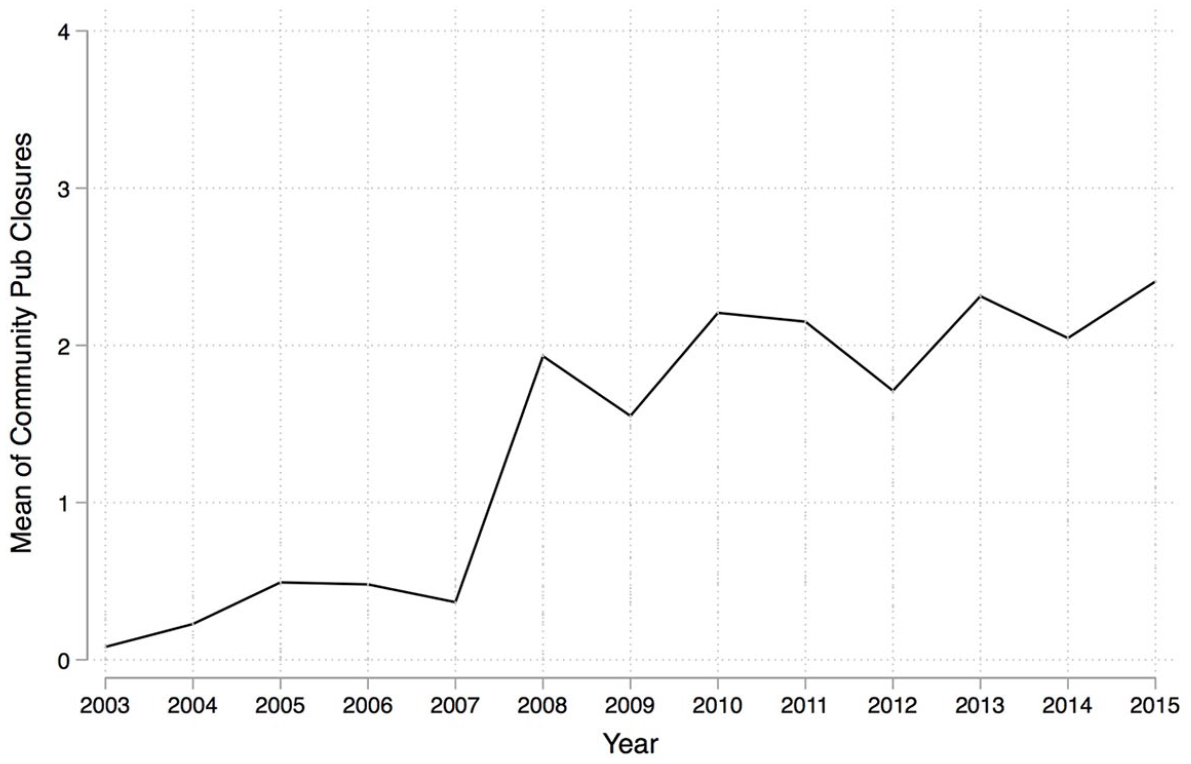
Mean of community pub closures per year in Britain.
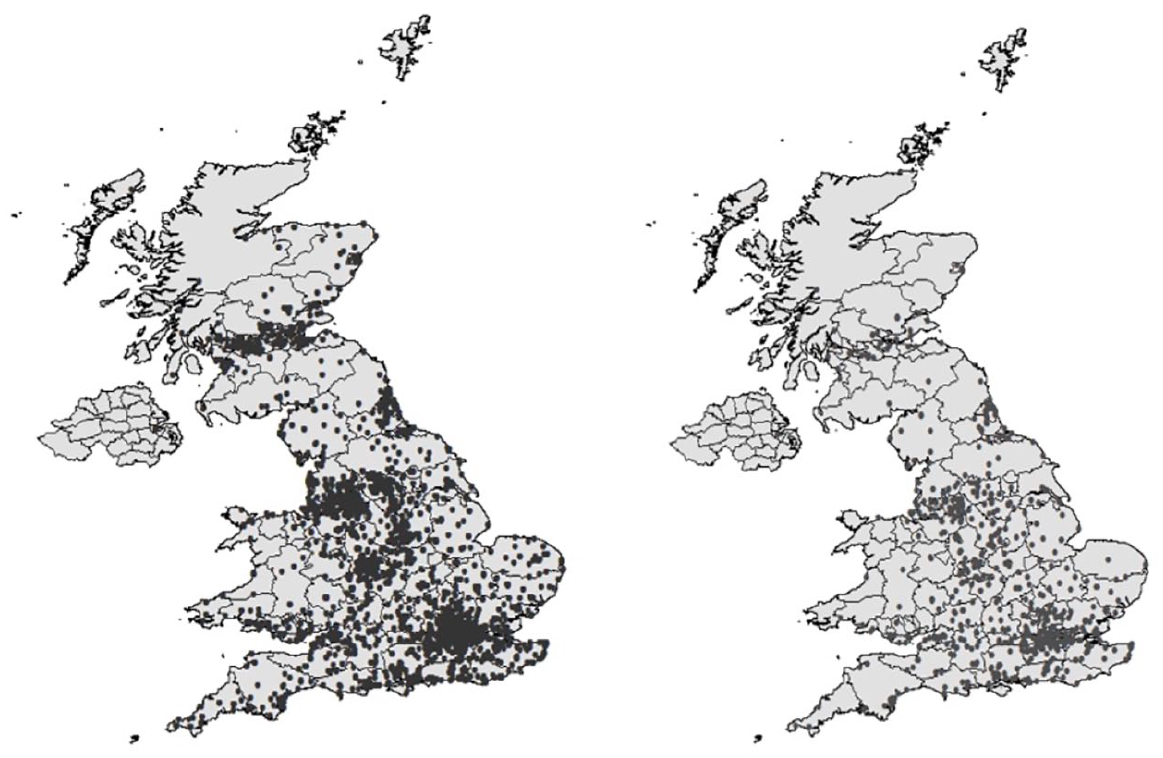
Pub closures (left) and community pub closures (right) since 2003.
The Local Socio-Cultural Degradation Theory predicts that community pub closures would trigger both processes of social isolation and loss of cultural identity and can eventually lead to radical right support. The disappearance of social spaces to bond that comes with the closure of community-style pubs would affect the ability of affected groups to sustain their “communal ethos” and increase their resentment toward the status quo and mainstream governing parties. They can therefore translate their desire to “take back control” of their vibrant community with radical right support. The Local Socio-Cultural Degradation Theory also predicts that community pub closures would particularly affect the white working class given its perceived shift to the periphery of social order.
The Rise of UKIP as a Radical Right Party
The United Kingdom provides a relevant case study to examine radical right voting given the rise of the United Kingdom Independence Party (UKIP) as an emblematic radical right party in Western Europe. From being a fringe party led by an academic (Alan Sked), UKIP became the third most popular national party in the period of 2013 to 2016. Nigel Farage, its charismatic leader from 2006 to 2016 (with the exception of an 11-month period), managed to attract large media attention to promote anti-EU, anti-immigrant, and anti-establishment issues in a way that deeply affected the UK political landscape (Evans & Mellon, 2019; Ford & Goodwin, 2014).
UKIP was composed of a coalition of voters that belonged to two main social and attitudinal groups. One group included former Labour supporters from the working class who have abandoned the party since 1997, when Labour focused on the middle class vote with its liberal consensus on the EU and immigration (Evans & Mellon, 2016). The other group of voters was affiliated to the Conservative party and belonged to the petty bourgeoisie, such as small business employers, who rejected the party’s political turn to the EU in 2005 to 2010 (Evans & Mellon, 2016). These two groups were divided on economic issues, but shared the types of non-economic preferences of UKIP (Arzheimer & Carter, 2006; Evans & Mellon, 2016; Ivarsflaten, 2005). It opened space for UKIP after 2010 to be the only party to reject EU membership and immigration from both within and outside the EU. These socio-cultural political concerns are commonly raised by the radical right parties of Western Europe, to which UKIP belongs to (Mudde, 2007; Rydgren, 2009). UKIP also appeals to traditional radical right supporters. 17
Substantial support is heavily concentrated among the white, working-class, low-educated men who live in declining industrial towns, and who feel threatened by local Muslim communities and hostile to the political establishment (Evans & Mellon, 2019; Ford & Goodwin, 2014). They represent the “left-behind” losers of economic and cultural globalization (Arzheimer, 2009; Betz, 1994; Mayer, 1998). Moreover, UKIP offers programmatic positions which appeal to a sense of Britishness, nostalgia and community that are resonating in light of the decline of community spaces such as pubs. By having Farage stressing the importance of the local pub, UKIP not only invokes a lost sense of community, but also a sense of threatened white working-class identity.
While traditionally belonging to the West European radical right party family, UKIP’s sustained success from 2013 to 2016 makes it interesting to study. The party garnered approximately 15.6% of the electorate in the 2013 local elections, became Britain’s largest party in the European Parliament as of 2018 (with 26.6% of votes and most seats in the 2014 EU parliamentary Elections) and 13% of the popular vote in the 2015 British General Election. UKIP’s apogee occurred with the victory of the Leave vote in the 2016 referendum on Britain’s membership of the EU, a watershed moment for the radical right force in the country. UKIP was crucial in making the referendum possible and fiercely campaigned for the Leave vote. Although the UK’s Brexit vote should not be equated with UKIP support or radical right voting, studies have shown that UKIP support is strongly predictive of the Leave vote (Hobolt, 2016; Jennings & Stoker, 2017). This sustained success of 2013 to 2016 shows that, despite using year dummies, I do not expect strong differences between years since my analysis covers these successful years.
UKIP has lost considerable political power after the Brexit victory as a result of Farage’s resignation following the referendum and internal leadership disputes. It currently has no Member of Parliament in the House of Commons. The electoral legacy of UKIP is volatile given its divided coalition of voters, as seen with the major split of support between Farage’s new party, the Brexit Party, and the Conservatives, in the 2019 General Elections. One in five (19%) UKIP voters backed the Brexit party while two thirds (67%) moved to the Tories (McDonnell & Curtis, 2019). 18 Yet, the political legacy of UKIP is expected to last on an attitudinal level with its supporters’ unanimous embrace of the Leave side in the Brexit debate, a position that is redefining the British political landscape (see Table 1). This was shown with the large support of the Brexit party by former UKIP supporters in the 2019 European Parliament elections, which contributed to the Brexit party finishing in first place, with 30.5% of the vote (Prosser, 2020).
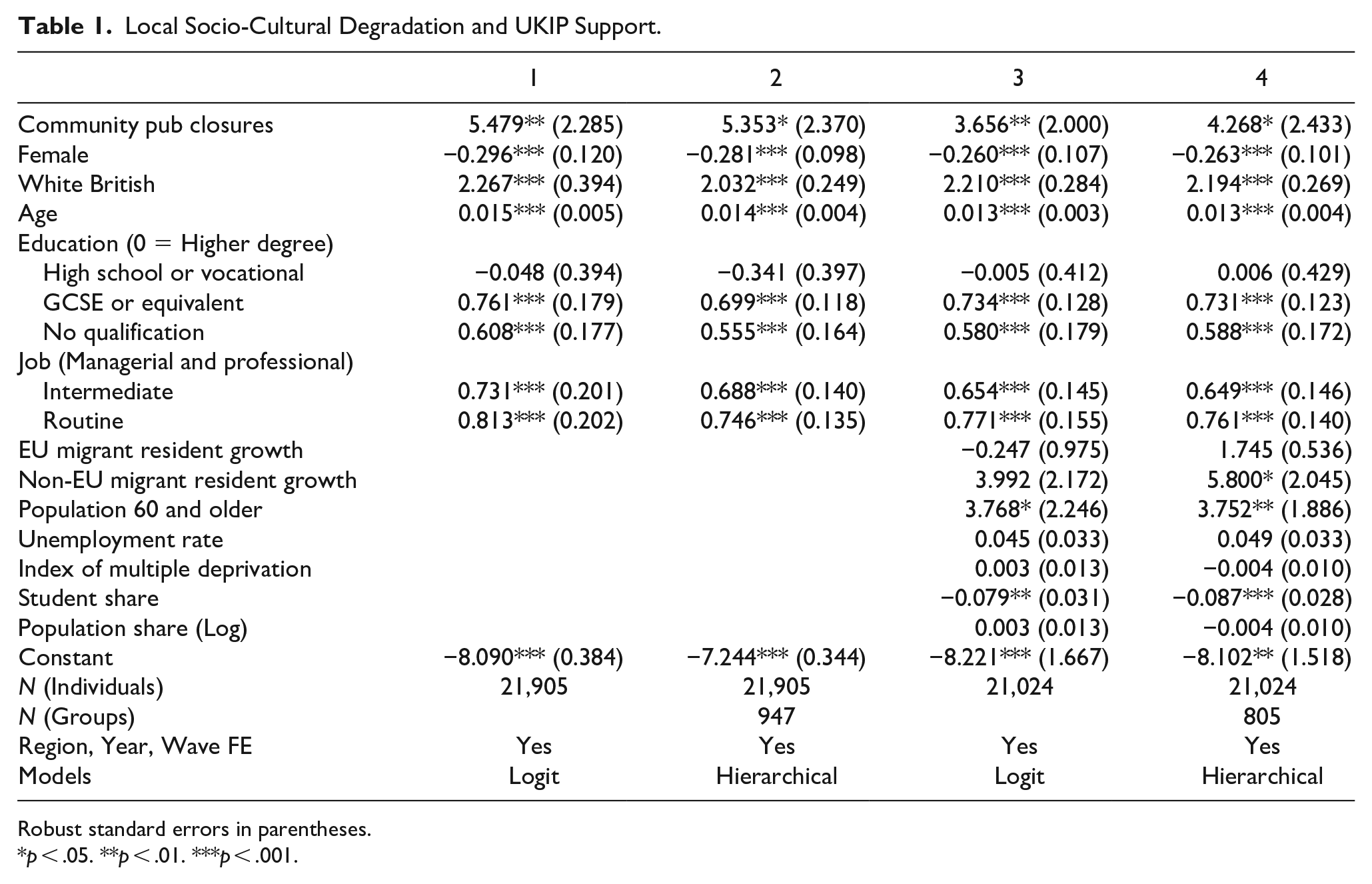
Local Socio-Cultural Degradation and UKIP Support.
Robust standard errors in parentheses.
p < .05. **p < .01. ***p < .001.
Data
Local Socio-Cultural Degradation is measured by the pub closure ratio—the ratio of community pub closures to the number of pubs for each local authority district in 2013, 2014, 2015, and 2016 19 . Data are drawn from the Local Data Company (LDC), a reliable retail location insight company that physically tracks opening and closure activity of every retail and leisure business in the United Kingdom. Data are only available for England and Wales since 2003 and their lowest scale available is the district level. 20 It registers pub closures that are not replaced by any other pubs. 21
The pub database provided by LDC gives information on the name of the pubs that closed, their year of closure and the city, town or village where they were located. Additionally, the database provides, for each pub, two types of locational information (whether each pub was located outside the high street of each city in the relevant district or not, and whether each pub was located in a high-end or poorer area) and information on the pub’s ownership type (whether it is privately owned or owned by one or multiple companies, and, if the latter, the name of the companies). Independently-owned pubs are those owned by members of the local communities. 22 Local inhabitants purchase membership shares and the pub is leased by tenants. These pubs rely on local volunteers to run the pub and can be protected by the protection policy established by the Localism Act in 2011. The Act designates local public places to be assets of community value to prevent their demolition, and the majority of these places are local pubs. 23
The availability of this information enables me to identify those pubs that closely track the characteristics of an ideal-type working class socio-cultural hub. We can expect pubs meeting this description to be located in poorer areas and away from high streets (which attract tourists), and to be independently-owned or owned by a private company that tends to cater to a working class constituency (among the companies that own pubs, only the Wetherspoon company meets this criterion 24 ). Accordingly, I label as a “community pub” those pubs that are located outside high streets in low-end areas and are independently owned or owned by the Wetherspoon company.
The other pub categories include broader classifications. Chain pubs are pubs which are owned by one or multiple companies, excluding the Wetherspoon Company. They are operating under specific pub franchises and are not specifically tied to brewers. City Center pubs are pubs that are located in high streets of main cities (more than 50,000 inhabitants) within districts. Gastro pubs are pubs that are located in higher-end areas of districts and are independently owned. They are more likely to serve high-quality food. This categorization enables me to specifically target traditional community pubs and to compare them to more generic pub categories. 25 I modelled separately the other common pub “types” to test whether their closure similarly affects the UKIP vote. The robustness section shows no effect of these other pubs, which confirms the singular impact of closure of community-style pubs on radical right voting.
I then combine this pub data with the multi-wave panel individual-level survey data of the UK Household Longitudinal Study (also known as Understanding Society) using the district of respondents. The panel data allows me to assess the gradual decline of community cohesion over time. All adult members of Understanding Society households, who form a representative sample of the population, are interviewed each year; original sample members are followed if they leave their original household and new (or newly eligible) members of the Understanding Society household are also added to the survey. Only interviewees who respond in waves 5 (2013–2014), 6 (2014–2015), and 7 (2015–2016) are included in the analysis (N = 21,905). The question on respondents’ vote, which asked for “which party respondents will vote for tomorrow” and is available in all waves, 26 is the binary dependent variable. It takes value 1 if a respondent declares support for UKIP and 0 for any other party. Another dependent variable that includes not only UKIP but also the British National Party (another radical right party) is included in the robustness section.
Using information about the place of residence of the respondent, I allocate each individual to a local authority district with its corresponding yearly closure of community pubs. 27 The assignment of individuals to community pub closure per district is completed for each year. Since the interviews are completed within 2 years, I assign each individual to their year of interview, and not their year of wave completion. 28 The longitudinal study also contains information on demographic characteristics: gender, age, ethnicity, type of job (managerial, intermediate or routine), and education. The level of urbanity (rural or urban areas) are not used because they show no correlation.
Finally, I add contextual variables of each individual’s district from the 2001 and 2011 Census Data available from the Office for National Statistics. They include the share growth of EU Migrant population from 2001 to 2011, the share growth of non-EU migrant population from 2001 to 2011. 29 The levels of immigration are also included in the robustness section but inflows are preferred as previous literature has shown a larger positive effect of rapid inflow of immigrants on UKIP support than levels of immigration (Kaufmann, 2017), the share of students, population density, the share of residents older than 60 years old 30 and the 2015 index of multiple deprivation. 31 The unemployment rate from the Annual Population Survey/Labour Force Survey is also included. Other contextual variables are tested in the Robustness section. Replication Materials and code can be found at (Bolet, 2021).
Empirical Strategy
I use three-wave individual-level survey data that combine yearly closure of community pubs and other control contextual variables to conduct logit models. The baseline specification for these estimations is:

where
Results and Discussion
Main Results
Table 1 displays the baseline estimate of equation (1) with logit and hierarchical models. I first look at the individual-level effect of community pub closures on UKIP support with individual characteristics (Models 1 and 2). Models 3 and 4 present the effect with both individual and contextual characteristics. All the specifications include regional and year dummies, and standard errors are clustered at the district level. The coefficient on the community pub closures is statistically significant and positive across the board, regardless of the estimation method. This result corroborates my socio-cultural degradation hypothesis.
How strong is the effect of community pub closures? The change in the probability of supporting UKIP when individuals are exposed to one more community pub closure per number of pubs in their district increases by around 6 percentage points with individual variables only and 4.3 percentage points with individual and contextual variables. 33 The effect is strong given that the average UKIP vote share is 5%. This provides evidence of social-cultural deprivation as a driver of radical right support in Britain.
Models 1 and 2 corroborate the sociological profile of the traditional radical right voter. The logit and hierarchical models confirm that the UKIP supporter is more likely to be male, of white ethnicity, with a General Certificate of Secondary Education (GCSE) or equivalent or no qualification (rather than a higher degree) and a routinised or intermediate job rather than a managerial position. These results are in line with previous studies on UKIP voters (Evans & Mellon, 2019; Ford & Goodwin, 2014), Brexit voters (Jennings & Stoker, 2017) and radical right voters in Western Europe (Betz, 1994; Ivarsflaten, 2005; Kitschelt, 1995). The closure of community pubs particularly affects the most vulnerable segment of the population. This result is also expected given that white, older, male individuals with low qualifications are those who most usually frequent community pubs (Gest, 2016). In Table 3 of the Supplemental Appendix I replicate the data with entropy balancing in order to reweight the survey sample to known characteristics from the target population, that is to say the white working class. The results are unaffected by using the entropy balancing model that reweight the sample to a white working-class population (see the Supplemental Appendix for more information on this point).
Models 3 and 4 include local contextual variables behind radical right support that are commonly defended in the literature. Their effects, whether in terms of relative decline or increased EU or non-EU migration, are insignificant and do not change the main effect of pub closures on radical right voting. Only the share of students significantly decreases UKIP support. Local economic and cultural changes do not independently affect radical right voting at the district level.
Interaction Effects
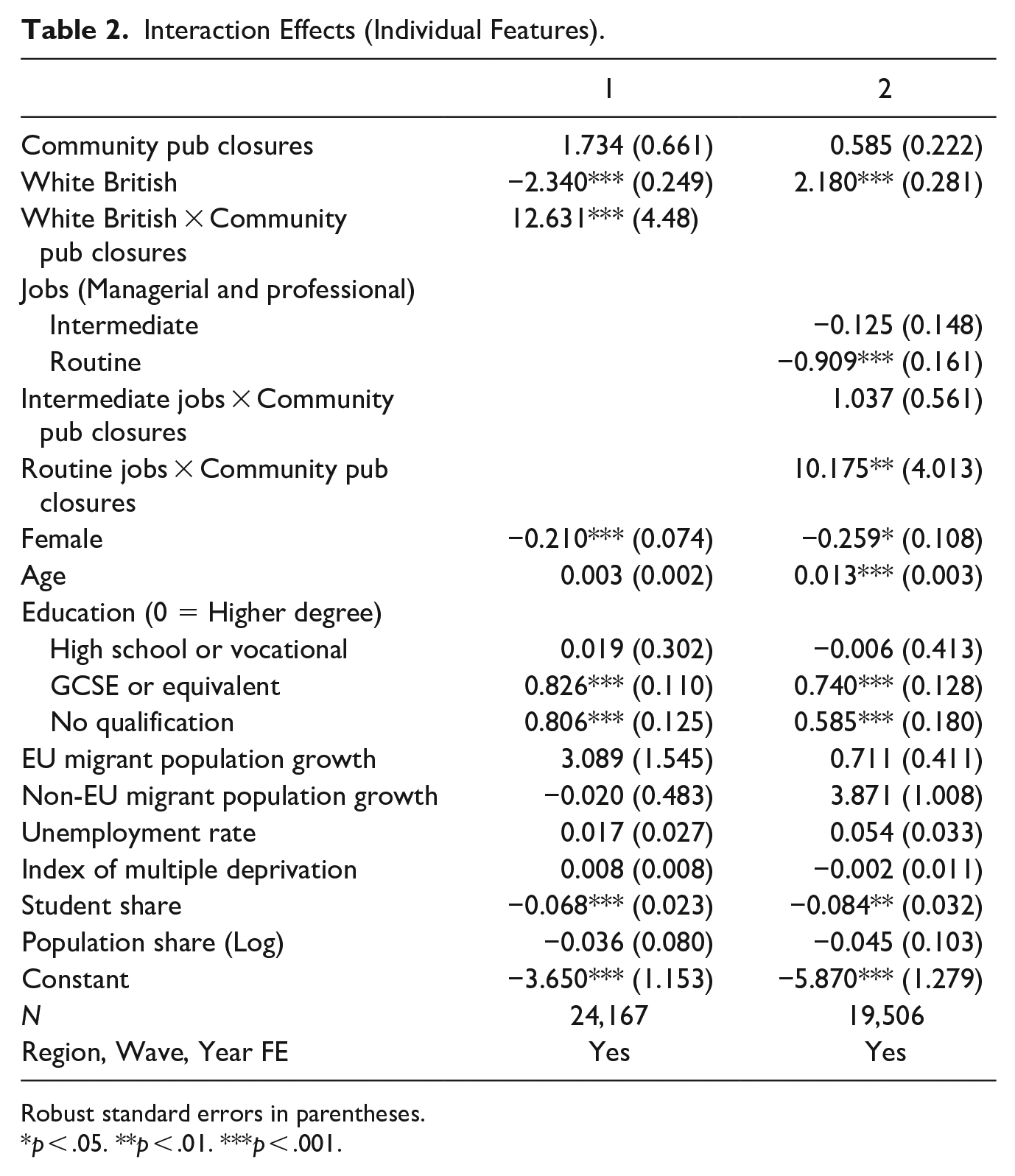
Table 2 and Figures 3 and 4 present the interaction terms of community pub closures with individual demographic determinants to evaluate who is inclined to vote UKIP when faced with closures of community pubs. Table 3 reports a statistically significant effect for the interaction with ethnicity and type of jobs. This shows that the white British respondents are more likely to support UKIP as the closure of pubs increases. The same goes for respondents with jobs with routinized tasks, by comparison to those with managerial or intermediate positions. This confirms that the relation between community pub closures and UKIP support is a white working-class phenomenon which is similar to the socio-demographics of community pub attendees and UKIP supporters (Evans & Mellon, 2019) 34 .
Interaction Effects (Individual Features).
Robust standard errors in parentheses.
p < .05. **p < .01. ***p < .001.
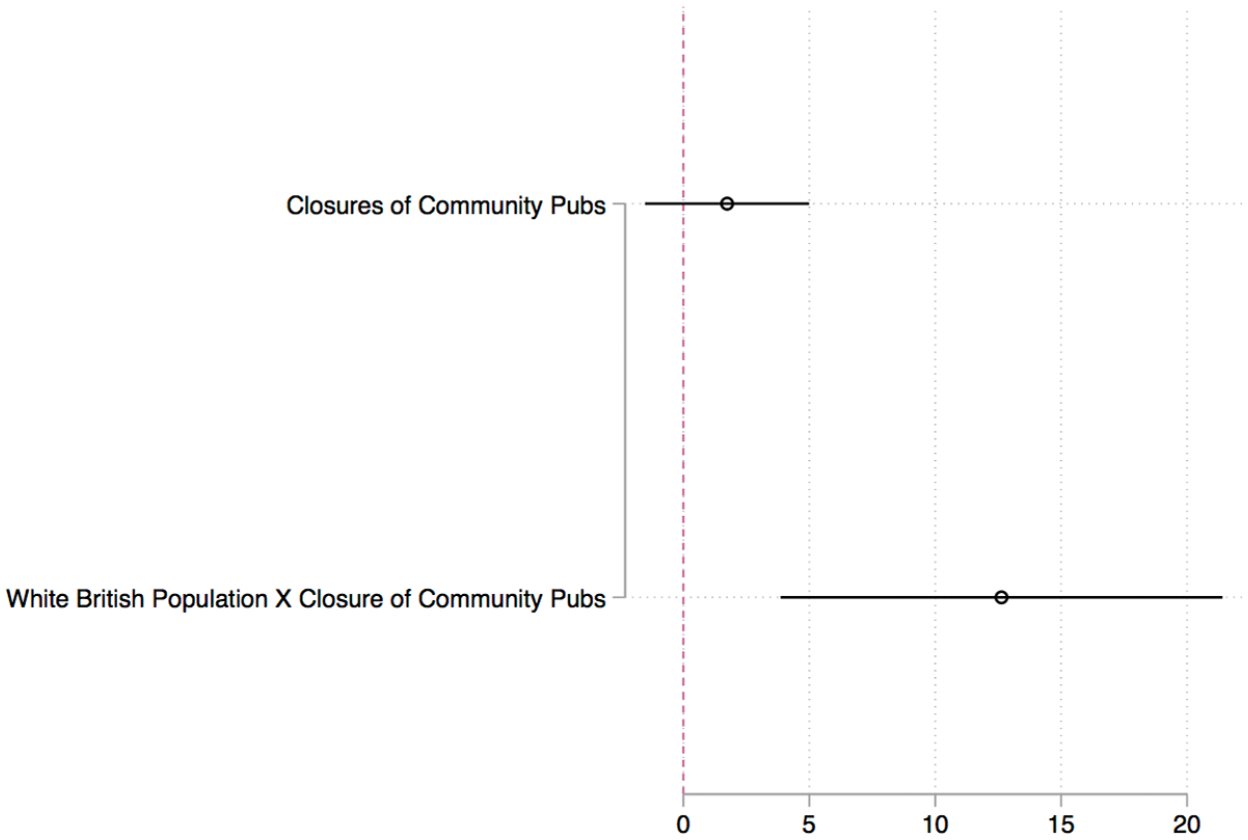
Interaction effects: White population.
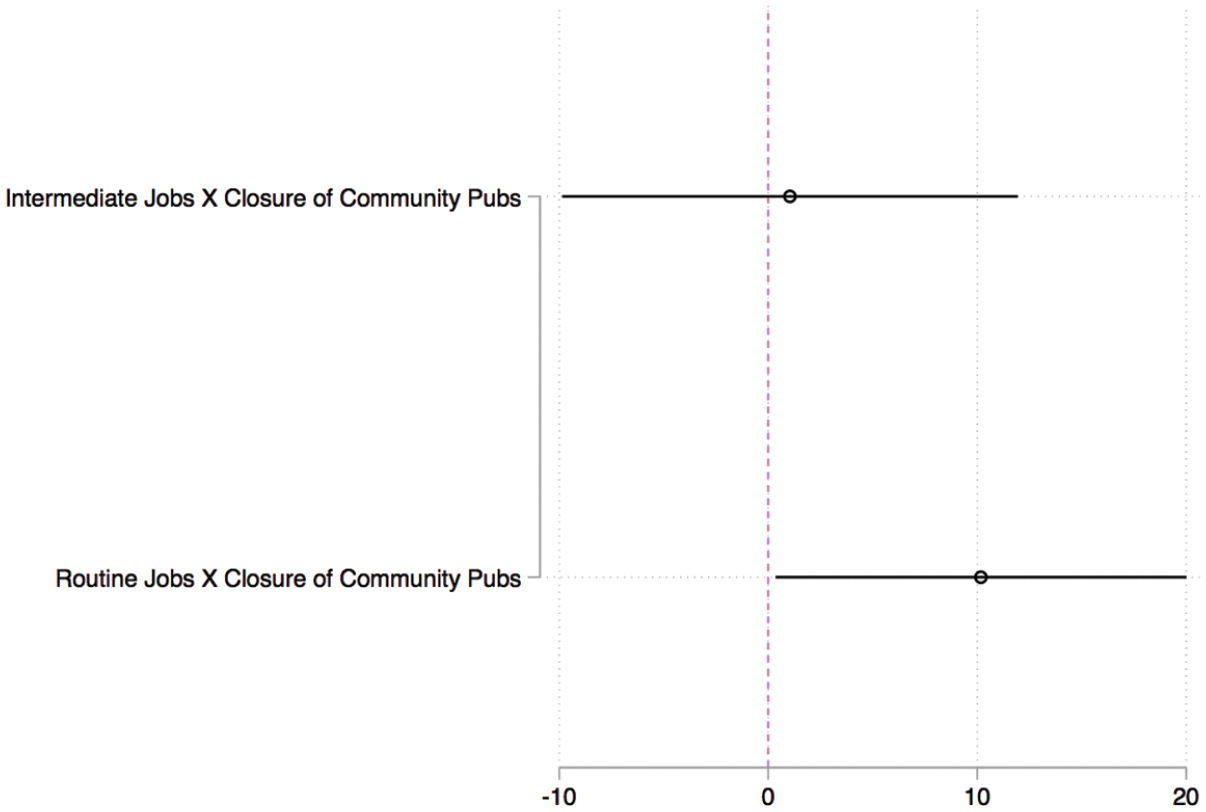
Interaction effects: Working class.
Table 3 and Figure 5 present the interaction terms of pub community closures with local contextual drivers to test the contextual hypotheses. I excluded the occupation variable (whether one has a managerial, intermediate, or routine job) because it considerably reduces the number of observations. Table 4 reports a statistically significant effect for the interaction with economic local drivers but not for the interaction with the immigration drivers. This confirms the material and cultural hypotheses in line with the Local Socio-Cultural Degradation Hypothesis. One may assume that the presence of EU or non-EU migrants does not affect the social degradation effect for pub regulars given that these newcomers are either more likely to frequent other types of pubs (pubs in the city center, pub chains or gastro pubs) or are not likely to frequent any pubs at all for cultural or religious reasons. This hypothesis seems particularly plausible because the coefficient of non-EU immigrant share on UKIP support is negative and non-EU immigrants are even less inclined to go to pubs because many of them do not drink alcohol. Figure 5 shows strong and positive marginal effects of economic local conditions on UKIP support. This means that individuals who are exposed to both an increase of unemployment (or to an increase of material deprivation in general) and community pub closures in their district are more inclined to support a radical right party. This is in line with previous studies which highlight the compounding effects of economic deprivation on radical right support (Golder, 2003; Jennings & Stoker, 2017). It also confirms the theoretical assumption that local socio-cultural degradation would not be affected by the actual size of immigration given that it reflects an internal issue caused by local structural conditions rather than an external threat caused by immigrants. Table 4 of the Supplemental Appendix, which uses new data collected in 2017 to 2018, shows a correlation between negative perceptions of the neighborhood and radical right support, and confirms this result.
Interaction Effects (Contextual Features).
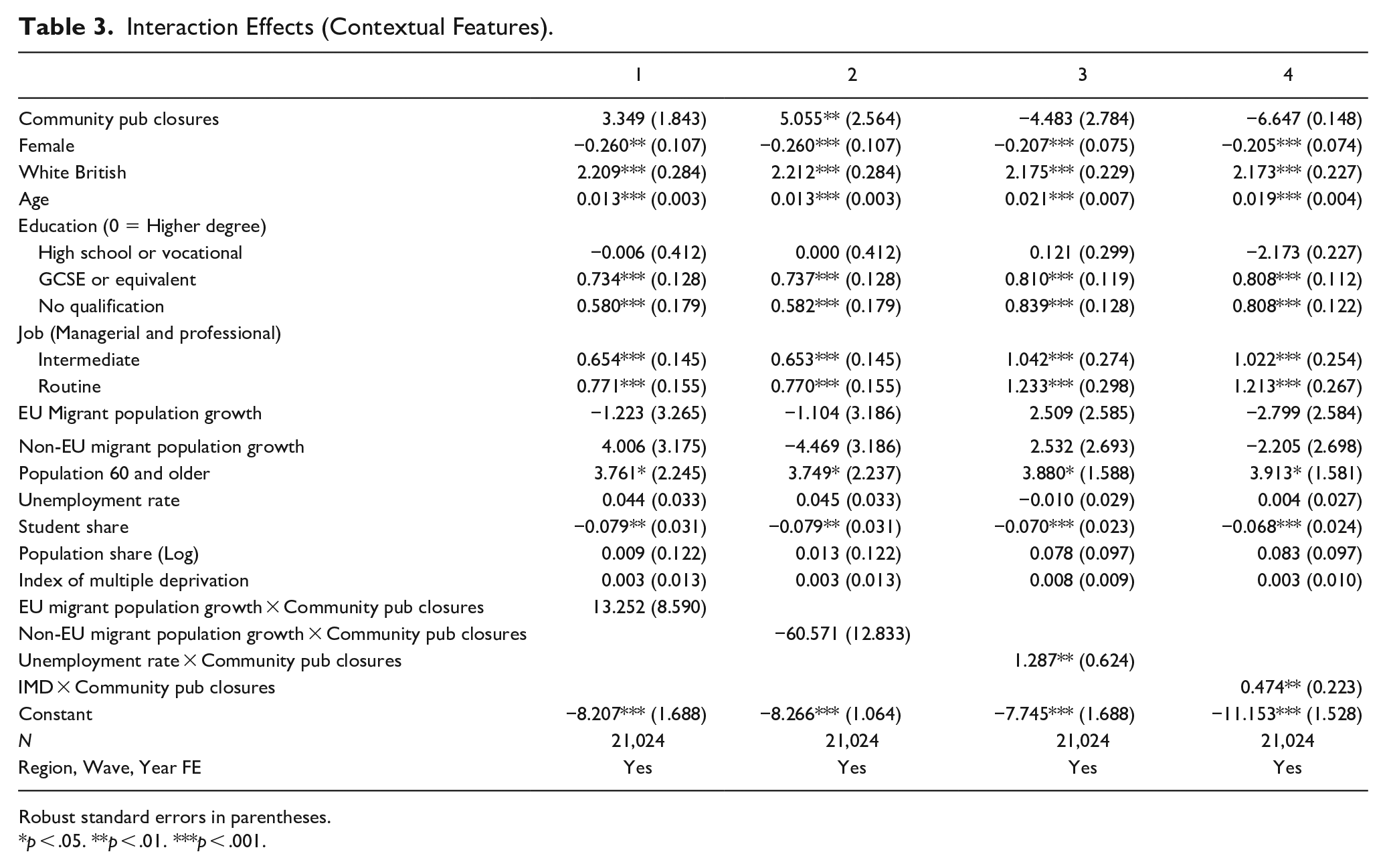
Robust standard errors in parentheses.
p < .05. **p < .01. ***p < .001.
Local Socio-Cultural Degradation and UKIP Support.

Robust standard errors in parentheses.
p < .05. **p < .01. ***p < .001.

Marginal effects.
Robustness Checks
As a last step, I address some concerns that might be raised to the presented results with several robustness checks. The first four models of Table 4 show that the community-styles pubs are uniquely affecting UKIP support given the insignificant effects of other types of pubs. The logit models show no effect for pub chains, pubs in the city centers and gastro pubs. Interestingly, the test is valid for the pubs in the city centers and gastro pubs but the sign of their coefficients is negative, which indicates a negative impact of their presence on UKIP support. This can be explained by the fact that those types of pubs attract other segments of the population, which do not support UKIP. Indeed, this corroborates previous findings which showed that middle- or upper-class voters with higher education and more ethnic diversity, as well as tourists, are more likely to frequent pubs in the city center and gastro pubs (Gest, 2016).
The last column of Table 4 presents the logit model with additional independent variables. The closure of community pubs is still significantly and positively affecting UKIP support, which aligns with my previous results. New control variables include other immigration variables that focus on stock of EU migrants and non-EU migrants in order to test the effect of levels, and not change, of immigration on radical right support. The absence of significant effects is consistent with previous studies that show an effect of rapid changes in ethnic diversity but not of immigration stocks (Kaufmann, 2017). The last model also adds other economic variables at the district level that may play a role in boosting radical right electoral support. The quantum of EU structural funds per capita 35 , the growth in the share of low-skilled workers and the number of total fiscal cuts from 2005 to 2010 are known to have predicted UKIP and Brexit (leave) votes (Becker et al., 2017; Colantone & Stanig, 2018b; Jennings & Stoker, 2017). However, despite the positive signs, no coefficient is significant. Finally, I add the change of business tax rates 36 in the last 10 years and other deprivation variables, which include average scores for levels of crime, barriers to housing and services, living environment, income deprivation (affecting old people), and health deprivation. No effect has been found and the models remain unchanged.
Table 5 reports the estimation of community pub closures on UKIP vote share (in the 2014 EU elections) at the district level. The independent variable is the ratio of community pub closures in the years 2011 to 2016 to the number of overall pubs in each district. District-level models show similar results to those that use the individual level survey data. While the effect is also strong and significant for the number of community pub closures in the years 2008 to 2016, it is not significant for the years 2001 to 2016. This confirms that the rapid decline of pubs that started in 2007 with the national smoking ban provoked a surge of radical right support, even when UKIP was not as successful as in recent years. This table therefore shows that changes in the rate of community pub closures affect radical right support.
Local Social Degradation and UKIP Vote Share (2014 EU Elections).

Robust standard errors in parentheses.
p < .05. **p < .01. ***p < .001.
Finally, I need to ensure that my results do not hinge on the exact specification of the dependent variable. The last two robustness models include variants of the UKIP support variable. It first includes in Table 6 the individual support for both UKIP and the British National Party (BNP), another radical right party (of lesser popularity). Respondents who indicated they would vote tomorrow for either UKIP or BNP take value 1 and those who indicated they would vote tomorrow for other parties take value 0. Model 2 then includes the percentage of Brexit support in the district given the last correlations of UKIP and Brexit found in previous studies (Becker et al., 2017; Jennings & Stoker, 2017). The effect of community pub closures remains strongly significant and positive in all models while the percentage of the Leave vote (per district) logically correlates with an individual’s propensity to support UKIP. The last column of this table tests my model by excluding London, an outlier with its relatively large presence of non-UKIP supporters by comparison to other regions. Results are unchanged by the exclusion of this outlier. Finally, the last table, Table 7, uses logit models to test whether the effect of community pub closures applies to other mainstream parties and abstention rate. The lack of significant effect for Labour or Conservative party support confirms that the closures of community pubs uniquely lead to UKIP support. Using abstention as the dependent variable (“Did you vote in the last election?”), the last model shows that community pub closures do not correlate with individuals’ propensity to abstain. This finding supports the Local Socio-Cultural Degradation Theory’s non-applicability to those who have always felt isolated and detached from the political system.
With Additional Dependent Variables.

Robust standard errors in parentheses.
p < .05. **p < .01. ***p < .001.
Local Social Degradation and Support for Mainstream Parties.

Robust standard errors in parentheses.
p < .05. **p < .01. ***p < .001.
Conclusion
This paper provides evidence of a local socio-cultural driver of radical right voting by deploying an original empirical indicator, the closure of community-style pubs in Britain. The presence of community pub closures is associated with the propensity for an individual to support a radical right party. One additional community pub closure relative to the number of pubs in the district increases an individual’s likelihood to support UKIP by around 4.3 percentage points. The impact is magnified under conditions of material deprivation. It is also unique to community pubs since no effect has been found for pub chains, pubs in the city center or gastro pubs. My findings are robust to additional dependent and independent variables, entropy balancing models, and the exclusion of an outlier (London).
Although this study applies to the UK context with its distinctive pub-going tradition, similar empirical data can be applied to other case studies in Western democracies. These countries either have an equivalent to the community pub, such as bars or cafés, or are home to other socio-cultural hubs that embody distinctive local traditions. To strengthen the causal link, follow-up studies could examine potential counter-factual cases to the UK, such as Ireland—given its similar pub culture and absence of a radical right party. Moreover, this study should pave the way toward using other original local contextual drivers that also capture social capital in the form of socio-cultural hubs, such as the growing decline of post offices, independent stores, or recreational centers. More innovative avenues should be considered in the future to find other empirical indicators of local socio-cultural degradation. Future research should also evaluate the causal nature of this local socio-cultural factor.
This study has important implications for our understanding of the relationship between social capital and radical right voting. It sheds light on a non-negligible socio-cultural component of radical right support which accompanies deindustrialization and globalization in Western countries. The socio-cultural dimensions of white working class marginalization should not be neglected in the overall understanding of the rise and success of radical right parties. In addition, this study highlights how material and cultural factors influence each other in the expression of radical right support, thereby providing a more nuanced picture of factors behind radical right voting than the unhelpful economic versus cultural dichotomy.
This study also has significant implications for policymakers, suggesting the importance of initiatives to maintain vibrant local communities. Without discounting the material dimension, the disappearance of socio-cultural hubs provides opportunities for radical right parties to increase their supporter base by galvanizing affected populations behind a powerful “left-behind” narrative. Highlighting the political dangers associated with the decline of local social activity lends urgency to state policies to improve social cohesiveness in economically deprived localities.
Supplemental Material
sj-pdf-1-cps-10.1177_0010414021997158 – Supplemental material for Drinking Alone: Local Socio-Cultural Degradation and Radical Right Support—The Case of British Pub Closures
Supplemental material, sj-pdf-1-cps-10.1177_0010414021997158 for Drinking Alone: Local Socio-Cultural Degradation and Radical Right Support—The Case of British Pub Closures by Diane Bolet in Comparative Political Studies
Footnotes
Author’s Note
Diane Bolet is now affiliated with King’s College London, UK.
Declaration of Conflicting Interests
The author declared no potential conflicts of interest with respect to the research, authorship, and/or publication of this article.
Funding
The authors disclosed receipt of the following financial support for the research, authorship, and/or publication of this article: This paper was part of my PhD which was funded by the Economic and Social Research Council.

Supplemental Material
Supplemental material for this article is available online.
Notes
Author Biography
References
Supplementary Material
Please find the following supplemental material available below.
For Open Access articles published under a Creative Commons License, all supplemental material carries the same license as the article it is associated with.
For non-Open Access articles published, all supplemental material carries a non-exclusive license, and permission requests for re-use of supplemental material or any part of supplemental material shall be sent directly to the copyright owner as specified in the copyright notice associated with the article.
