



Abstract
Political elites tend to favor their home region when distributing resources. But what explains how political power is distributed across a country’s regions to begin with? Explanations of cabinet formation focus on short-term strategic bargaining and some emphasize that ministries are allocated equitably to minimize conflict. Using new data on the cabinet members (1960–2010) of 16 former British and French African colonies, I find that some regions have been systematically much more represented than others. Combining novel historical and geospatial records, I show that this regional political inequality derives not from colonial-era development in general but from colonial-era education in particular. I argue that post-colonial ministers are partly a byproduct of civil service recruitment practices among European administrators that focused on levels of literacy. Regional political inequality is an understudied pathway through which colonial legacies impact distributive politics and unequal development in Africa today.
JEL: F54, I26, N37, N47
In a political system where nearly every adult may vote but where knowledge, wealth, social position, access to officials, and other resources are unequally distributed, who actually governs?
Introduction
Political elites fundamentally shape political representation, conflict, and the distribution of resources. Existing research shows that presidents and ministers disproportionately favor their home region, especially in less democratic countries (Andre et al., 2018; Hodler & Raschky, 2014; Kramon & Posner, 2016). As Bates (1974, p. 470) argued, “in the political arena, it is not just power that is at stake, but also the benefit which power can bring.” In this article, I begin by showing that political power is unequally distributed within African countries: some regions are heavily over-represented in cabinets while others are underrepresented. This presents an important puzzle: What explains the regional distribution of political power to begin with? More specifically, what explains the share of ministers hailing from each of a country’s regions or districts? 1
Existing literature offers two explanations of cabinet formation: regional favoritism and regional balancing. Regional favoritism emphasizes that the making of the cabinet is the result of short-term regional and ethnic strategic considerations such as patronage (Arriola, 2009). In 1970s Uganda, Colonel Idi Amin filled his cabinet with people from West Nile, his home region. In Côte d’Ivoire, Houphouët-Boigny’s cabinets favored the Baoulé, his ethnic group. Meanwhile, regional balancing posits that “representation in a president’s cabinet [. . .] has to appear to be equitable” (Keller, 1983, p. 259) to deter conflict. “President Kenyatta’s announcement of three ministerial appointments from Nyanza province in July 1969 was clearly calculated to appease the aggrieved feelings of the Luo people following the assassination of Tom Mboya, one of Kenya’s founding fathers” (Rothchild, 1970, p. 605). Consistent with this example, Francois et al. (2015, p. 472) show that ethnic group shares in the cabinet are correlated with population shares.
I contend that both explanations are incomplete and possibly shortsighted because they only examine the short-term strategy of politicians (Laver & Shepsle, 1996), ignore the historical origins of elites, and cannot account for the persistent regional political inequality that I uncover. Figure 1 shows the percentages of minister-years (most ministers stay in power for more than 1 year) by district in Uganda and Senegal between 1960 and 2010. 2 If regional balancing produced equitable distributions of minister-year shares, then the distribution would be uniform (the left graphs would be flat) or proportional to population (the right graphs would be flat). Neither is the case. Some districts have systematically punched above their weight since independence and others below. Averaged over 1960 to 2010, 14% of the minister-years in Uganda were born in Ankole district despite its population being only 9% of Uganda’s total. 14% of the minister-years in Senegal were born in Saint Louis even though the district comprises less than 2% of Senegal’s population.
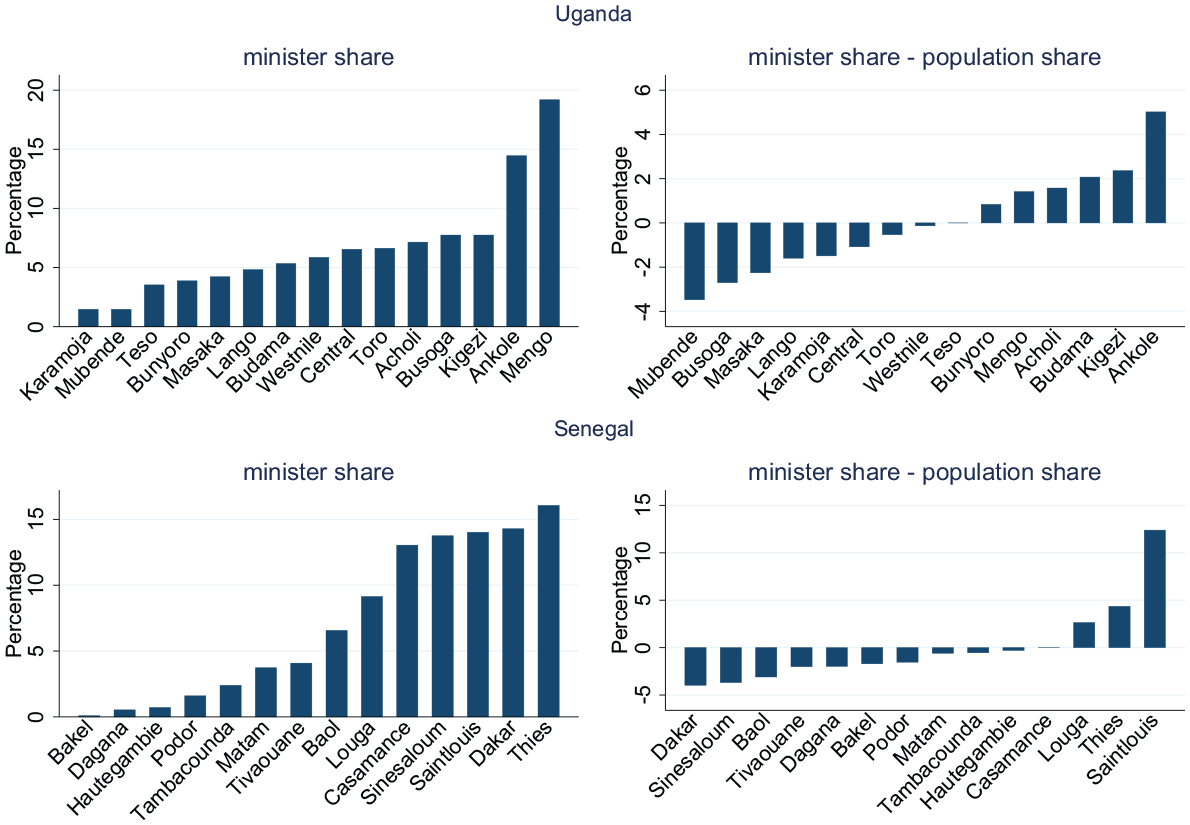
Minister-shares by district of birth (1960–2010 average).
Regional favoritism alone cannot explain the patterns in Figure 1 either. Ankole district in Uganda is over-represented partly because President Museveni (1986–) was born there. However, patronage-type explanations beg the question of why leaders hail from one district or another in the first place. Further, other districts beyond the president’s are over-represented. Regional favoritism cannot explain the case of Saint Louis either: no Senegalese president was born there. More generally, and in spite of political instability in many East and West African countries, district representation in the 1960s correlates with district representation in the 2000s (
In lieu of short-term strategic explanations, I offer a deeper historical explanation rooted in the colonial period. Most literature on colonialism focuses on its consequences for economic development. Instead, I leverage the colonization of East and West Africa to examine how colonialism influenced the distribution of political power in the short and long run. I show that colonial investments in education—but not in infrastructure, health, or other development proxies—increase cabinet shares by district in post-colonial governments. The political effect of education, proxied by the number of teachers and missionaries per district, is larger in earlier decades but persists after 1990 in spite of regime changes and instability during the Cold War.
My findings are based on original biographical data of the roughly 5,000 ministers in cabinets between 1960 and 2010 for the 16 former British and French colonies in East and West Africa. I georeference the ministers’ birth location using colonial maps with district boundaries and complement these data with district-level colonial investment records and other variables.
I argue that post-colonial ministers are a byproduct of education-based recruitment into the colonial state. East and West African colonies were poor and largely self-financed, so European administrators faced severe budget constraints (Young, 1994) and recruited educated Africans as civil servants to reduce costs (Mazrui, 1978). As a result, districts with more primary education became more represented in the civil service and in legislative councils because Europeans had little concern for regional balancing. Regional political inequality was the unintended long-term consequence of this selection criterion whereby education conditioned the pool of potential ministers from a region. Literacy and numeracy learned in school were transferable to the civil service (Mazrui, 1978; Sharkey, 2013). In turn, organizational skills acquired in the civil service and in colonial legislatures provided some with an early advantage in post-colonial politics that persists even today. For example, Saint Louis had ceded much of its early importance to Dakar, the economic and political capital, by 1900. However, Saint Louis remained an important center of primary and secondary education and that would prove crucial for its over-representation after 1960.
Support for two sub-hypotheses strengthens the main argument. First, military men were not members of the colonial civil service or legislature. Hence, I find that the effect of colonial education is larger in civilian than in military governments. Second, the expansion of education after independence reduced early human capital constraints and the 1990s wave of democratization led to more political inclusion. Hence, the effect of colonial education, although it persists post-1990, is larger in earlier decades (1960–1989).
To alleviate endogeneity concerns, I account for historical factors that drove educational investments, test for alternative explanations that distinguish education from state capacity or development more generally, and employ regional fixed effects and Oster bounds. Finally, I use a new matching method to reduce model dependence and bias from model misspecification.
This article makes three main contributions. First, unlike existing research focused on short-term strategic considerations, I provide a long-term explanation of cabinet formation and regional political inequality. This historical dimension is difficult to study because governments and states are typically formed as the result of long endogenous processes in Europe and elsewhere (Boix, 2015). Political elites allocate resources that in turn produce the following generation of elites, and so forth. The short but pervasive colonization of East and West Africa, during which European conquest fundamentally shaped political and socioeconomic structures, alleviates this problem. Second, most existing social science literature examines the consequences of colonialism for development (Nunn, 2009) and for democratization and conflict (Englebert et al., 2002; Woodberry, 2012) but rarely for elite formation and the distribution of political power. 3 Further, institutions rather than investments are central in most accounts (Acemoglu et al., 2001; Lange et al., 2006). Instead, I emphasize that districts with higher investments in education a century ago are more developed and educated today, and that regional political inequality may be a key mechanism to understand why. Political elites may be partly reproducing rather than reducing the large inequalities inherited from the colonial past.
Third, I contribute two novel datasets: one with information on around 5,000 African political elites and another with colonial investments records and other colonial and pre-colonial characteristics. The difficulty of systematically collecting such data across colonies and empires may explain why, in spite of abundant research on colonial legacies, few examine the consequences of actual colonial investments. The rest of the article proceeds as follows. Section 2 further motivates the article and section 3 develops the argument. Section 4 discusses the relevant historical context. Sections 5 and 6 present the data and results, respectively. Section 7 concludes.
The Importance of Cabinets in African Politics
“Who rules” has a fair claim to be the central question of empirical political science, just as its normative counterpart, “Who should rule?” is perhaps the central question of political philosophy. Putnam (1976, p. 2)
Cabinet ministers are important to understand political representation, the distribution of resources, and conflict, especially in semi- and non-democratic countries where legislatures and other formal institutions are often weak. Kramon and Posner (2016, p. 1) present evidence that “ministerial appointments [in Kenya] come with real power to impact distributive politics,” Andre et al. (2018) present similar findings for Benin, and Franck and Rainer (2012) and Haass and Ottmann (2020) present similar findings across Africa. 4 Hodler and Raschky (2014, p. 995) show that the birth region of the current leader develops more than the rest, especially in developing countries. On conflict, Arriola (2009) shows that increasing cabinet size reduces the probability of a coup by accommodating diverse groups, while Cederman et al. (2010) show that politically excluded ethnoregional groups are more likely to instigate coups and civil wars.
These findings are an important reason why the study of political elites and cabinet ministers, once central to political science (Putnam, 1976), is resurging (Fresh, 2018; Kroeger, 2018; Hartnett, 2019; Paniagua, 2019; Ricart-Huguet, 2019; Carbone & Pellegata, 2020; Nyrup & Bramwell, 2020). I focus on cabinet ministers rather than legislators as the key political elites for two reasons. First, legislatures take population into account when devising constituencies and thereby address regional political inequality by design. 5 Second, “the cabinet has served as the undisputed locus of power sharing” in almost all African countries since independence (Arriola & Johnson, 2014, p. 11). Ministers cannot be MPs in most former French colonies, as in semi-presidential France, while ministers have to be MPs in many former British colonies, as in parliamentary Great Britain. 6 In both sets of colonies, ministerial posts have long had an important representative dimension that is very limited in the cabinets of democracies (Cohen, 1988).
I define a district’s representation as the share of cabinet members that were born in that district. Throughout the article, district refers to the colonial administrative units that constitute my unit of analysis while region is used more generically (Appendix D explains why districts and not ethnic groups constitute my unit of analysis).
East and West African colonies provide a unique opportunity to study political elites when independent governments first form and to move beyond the short-term and strategic study of cabinet formation. This is for several reasons. First, the external imposition of colonial institutions alleviates historical endogeneity with respect to colonial state formation processes. Indeed, colonies of the same empire present very similar institutional structures. Colonialism rocked the political organization of society because highly centralized governments were the exception in the pre-colonial period. Second, investments were largely decided by European outsiders rather than the native population. Third, the British and the French implemented standard data collection procedures that allow comparisons between and within colonies.
Beyond Strategic Cabinet Formation: The Colonial Origins of African Cabinets
Budget Constraints Result in Education-Based Recruitment
London and Paris expected their colonies in East and West Africa to be self-sufficient in all domains other than the military. Metropolitan funds, such as grants-in-aid, were scarce before 1945 (Constantine, 1984, p. 14, p. 84; Gardner, 2012, p. 9) so generating revenue and reducing costs were paramount for these colonial states (Young, 1994, p. 124).
European colonial administrators limited expenditures by selecting literate natives to join the civil service, initially in the lower echelons and later in positions of more responsibility. Colonial states in Africa were “thin on the ground” and “skeletal” (Young, 1994, p. 124), so this practice reduced their shortage of administrators. Europeans “from the start had been training and hiring African men as petty government employees, who typed and filed papers, surveyed plots of land, taught in government schools, disbursed medicines, counted revenues and more” (Sharkey, 2013, p. 165). Europeans preferred to hire metropolitan administrators, but budget constraints induced them to minimize costs by recruiting Africans instead (Mazrui, 1978).
“Evolués” and “Europeanised Africans”—the racist terms used in each empire to denote Western-educated Africans—were also recruited into assemblées territoriales and legislative councils. Lugard (1922, p. 78), arguably the most influential colonial administrator in British Africa, considered that Western education had seen “remarkable results: The Europeanised African, defined by its education and Christian morals, occupies the positions of importance. For example, they sit in the Legislative Councils.”
Education was critical to selection into the civil service and legislatures but Europeans disregarded district population, a key factor to understand imbalances after independence. More educated districts, such as Saint Louis in Senegal, were over-represented in the colonial civil service because the French did not (care to) balance the regional composition of the civil service. In Nigeria, where regionalism and ethnicity were more salient than in Senegal, the British did not balance the civil service either. Eastern districts with high missionary activity composed the majority of civil servants even in Northern Nigeria. This source of tension during colonial rule intensified after independence and contributed to the Nigerian-Biafran Civil War (1967–1970). Post-independence political conflict lay not only in regionally imbalanced colonial militaries (Wilkinson, 2015; Harkness, 2016) but also in regionally imbalanced colonial bureaucracies.
Colonial Institutions as Mechanisms of Regional Political Inequality
I argue that the colonial civil service and legislature are the two colonial-era mechanisms that explain why unequal education provision across districts in particular—rather than unequal development in general—carried political consequences after independence. Literacy and numeracy learned in school were transferable to the public sector. Building on Le Vine (1968, p. 380), I contend that the “expertise and political skill acquired” in the civil service and the legislature provided an incumbency advantage of sorts at independence.
The advantages derived from membership in the civil service were not political but, nonetheless, civil servants enjoyed prestige and name recognition (Mazrui, 1978), two key mechanisms of incumbency advantage. They also garnered bureaucratic and management skills as they undertook senior positions after World War II. Colonial legislatures were rubber-stamp institutions until the 1950s. 7 However, a seat conferred relevant experience, political skills, and name recognition to their African members and enabled future leaders, such as Senghor in Senegal and Obote in Uganda, to build a base of support prior to independence.
Thus, and while often not the explicit political intention of European administrators, post-independence ministers are partly a byproduct of education-based recruitment into these two colonial institutions (Figure 2). The theory extends to ministers past the immediate post-colonial period because 66% of ministers in the 1960–2010 period were born before 1942 and hence grew up and were socialized under colonialism. 8
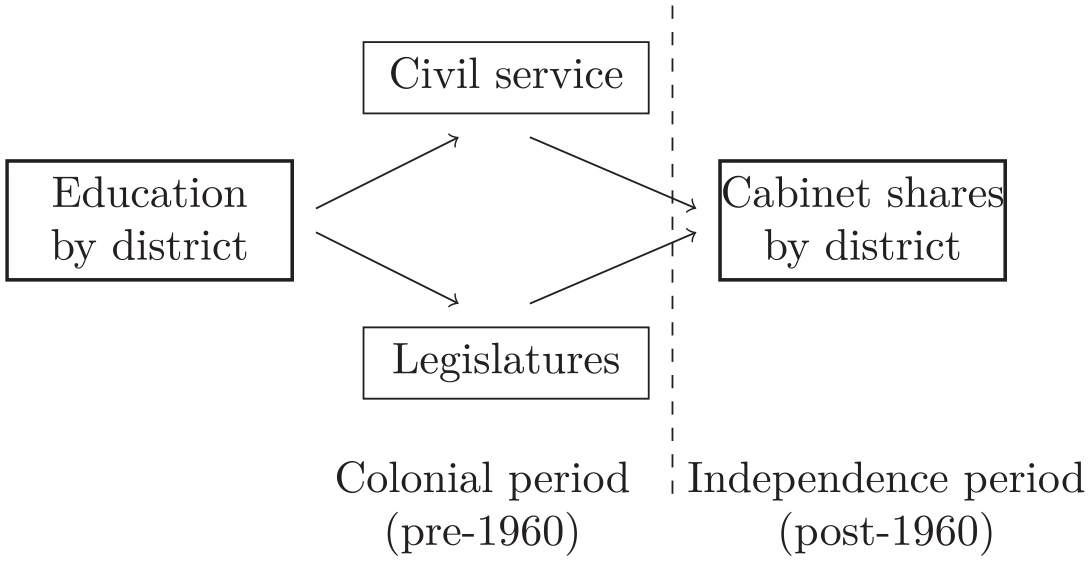
The political consequences of unequal education provision across districts.
I specify that ministers are partly a byproduct of education-based recruitment because regional balancing efforts right before independence probably reduced regional inequality. In British colonies, rebalancing efforts were often engineered at the Lancaster House Conferences, where independence agreements between Britain and several colonies were crafted. In Nigeria, for instance, the “[British] manipulation of the political situation just before independence meant to facilitate Northern leadership at the center” (Rothchild, 1970, p. 602) and reduce their alienation—the North was more populous and yet much less represented in the civil service than the East. Regionalism also existed in some French colonies like Dahomey (Benin), whose elites devised power-sharing arrangements at independence. The early 1960s were momentous, but disregarding the pre-independence period leads to a fundamentally incomplete understanding of political elite and cabinet formation.
My argument is far from attributing virtue or a fulfillment of the “white man’s burden.” Selecting on education was a reasonable choice for administrators ruling over cash-strapped colonies. Financial and administrative needs explain why the extent of education in one’s home district, rather than levels of development across districts more generally, is key to understand political elite formation and ultimately who governs after independence.
Hypotheses
The central hypothesis is that the level of education in a district during colonial rule should predict the minister-share of that district after independence. The counterfactual is therefore at the district level: between two otherwise equivalent districts, the district with higher colonial education should be more represented, as proxied by its minister share, after colonialism. Two colonial institutions, the civil service and the legislature, are the mechanisms that help explain the subsequent over-representation of more educated districts over less educated ones. The argument also provides two sub-hypotheses that I present here and test below.
First, I argue that civilian career paths in the colonial state are important and underpin post-colonial governments. Many East and West African countries endured military governments, usually as a result of successful coups. These “military ministers” were not former members of civilian legislatures or bureaucracies. Colonel Yeboah, a Ghanaian officer and later cabinet member who contributed to depose President Nkrumah in 1966, recounted that “in those days a career in the army was for someone who did not have an education. It was not considered a very attractive career. It was only for school drop-outs” (Baynham, 1994, p. 22). Others had never attended school to begin with, such as Uganda’s Idi Amin (1971–1979). While his early cabinets included some respected civilians (e.g., Apollo Kironde, a teacher and lawyer), others had received next to no formal education (e.g., Colonel and Foreign Minister Juma Oris). In brief, although some coups were led by educated officers, others were “coups from below” (Kandeh, 2004) carried out by subalterns who in turn placed loyal but uneducated military men in the cabinet. Therefore, the importance of colonial education should be larger under civilian governments than under military governments (sub-hypothesis 1).
Second, the importance of colonial education should be greatest in the early post-colonial period and diminish over time as human capital constraints lessen (sub-hypothesis 2). Patronage in the public sector has existed at least since independence (Ekeh, 1975), when “recruitment to legislatures often became one of the chief rewards for political fidelity” (Le Vine, 1968, p. 386). I do not question the role of patronage in the composition of legislatures or cabinets. Rather, I argue that a limited pool of qualified candidates provides another important explanation to understand post-colonial cabinets and that these constraints were especially important early in the post-colonial period: “it is difficult to see where alternative educated candidates might have been found to fill political offices” had civil servants not joined politics (Ruth Morgenthau, quoted in Le Vine, 1968, p. 377). The education campaigns of many African presidents keenly aware of its importance, such as Nkrumah (Ghana) and Houphouet-Boigny (Cote d’Ivoire) in the 1960s, partially reduced this shortcoming. By the 1990s, a still small but growing minority of the population were highly educated and professionally experienced, thus lessening early human capital constraints.
Colonial Education
The extent of colonial education in one’s home district was driven by both systematic and haphazard factors. “Groups located near the colonial capital, near a rail line or port, or near some center of colonial commerce—the sitting of which was usually determined by capricious factors, such as a harbor or a natural resource to be exploited—were well situated to take up opportunities as they arose” (Horowitz, 1985, p. 151). Convenient geography and proximity to pre-colonial trading posts facilitated early colonial infrastructure, including schools (Wantchekon et al., 2015). Because education was not randomly provided, all models account for these and other systematic factors, such as natural resources and disease environment. Collectively, these factors explain about 40% of the variation in colonial education across districts (Supplemental Figure C9).
I outline four reasons why most of the variation in education is hard to explain systematically: an ill-defined colonial investment strategy, a decentralized colonial state, the diverse backgrounds and preferences of colonial administrators (some civilians, other military men) combined with their inability to choose the district where they wished to serve, and the sometimes unplanned location of missions. These factors, well-known to historians, suggest that differences in education levels across a colony’s districts, while not random, were more haphazard than one might expect.
Uncoordinated Investments in a Decentralized Colonial State
The ‘command and control’ of [the British] empire was always ramshackle and quite often chaotic. To suppose that an order uttered in London was obeyed round the world by zealous proconsuls is an historical fantasy (although a popular one). Darwin (2012, p. xii)
European administrators lacked a systematic investment strategy because tropical Africa ranked lowest in the priorities of the British and French empires and because, until the late colonial period, their knowledge of the territory was limited. District expenditures presumably responded to needs, yet “no explicit investment strategy can be found in [French] local budgets. Motivations reported at the beginning of each local budget explain the general level of annual resources but do not motivate the spatial distribution of public goods provision” (Huillery, 2009, p. 181). The equivalent British documents emanating from the Colonial Office (Constantine, 1984) present a remarkably similar focus on administration rather than policy. “Colonial tax and spending patterns did not follow a similar logic throughout British Africa” (Frankema, 2011, p. 147) because “[Britain] did not strive to apply a common financial policy to the various dependencies” beyond “general instructions [. . .] from the Secretary of State for the Colonies” (Stammer, 1967, p. 194).
Ill-defined investment strategies are less surprising if we realize that colonies were decentralized and very much unlike Weberian states (Herbst, 2000). Short distances by today’s standards were long in the absence of adequate roads and railroads, as was the case especially before World War II. Limited knowledge of the territory as well as rudimentary communication hampered coordination between the core and the periphery of a colony (Darwin, 2012, p. xii; Delavignette, 1968, p. 63). “Physical distances and [lack] of communication” meant that the “administrative organization [in French West Africa] was officially centralized but effectively decentralized,” making district heads “the real chiefs of the French empire” (Huillery, 2009, p. 181; Delavignette, 1968).
Colonial administrators also provide some haphazard variation in public investment allocations due to their varied backgrounds and their inability to choose the district where they wished to serve. In British colonies, “candidates [typically Oxford and Cambridge graduates] were allowed to name three colonies where they would like to serve, although the Colonial Office made it clear that there was no guarantee that they would be granted any of them. [. . .] In the end it was where the vacancies were that governed the final appointment” (Kirk-Greene, 2006, p. 38). French candidates could not choose the district either. They could only rank the federations: French Indochina, French West Africa, and French Equatorial Africa (that was the most common ranking because Indochina was the most developed federation and Equatorial Africa the least developed). Further, the background of administrators was diverse, especially in the French case: some were recent graduates of the École coloniale and other grandes écoles, but others were regular metropolitan civil servants and even former soldiers (Cohen, 1973). District heads with a background in elite schools, for example, might have devoted more revenues to education than those with a military background, who instead might have focused on law and order expenditures (e.g., police).
Finally, missions were central to education provision in British colonies. On the one hand, missionary activity was usually higher in healthier and more developed areas. On the other hand, missionaries sometimes settled in remote locations despite having little information about the environment, suggesting that mission location was as-if random in some instances (Wantchekon et al., 2015). The colonial state subsidized some missions (Lugard, 1922) but rarely interfered with their location, except in some Muslim-majority areas. Overall, “the sitting of mission schools was not a wholly unplanned process, but it was often the result of ethnically random factors, such as the rivalries between Christian churches” (Horowitz, 1985, p. 153).
Ministerial Biographies and Colonial Records
The list of cabinet members for every country in the sample since 1960 comes from yearly almanacs called Europa World Year Books. The sample consists of the eight colonies of former French West Africa as well as the main eight East and West territories under the British Colonial Office: Benin (formerly Dahomey), Burkina Faso (Upper Volta), Côte d’Ivoire, Ghana (Gold Coast), Guinea, Kenya, Malawi (Nyasaland), Mali (French Soudan), Mauritania, Niger, Nigeria, Senegal, Sierra Leone, Tanzania (Tanganyika), Uganda, and Zambia (Northern Rhodesia). I combine the cabinet lists with the World Biographical Information System (WBIS), which contains over six million biographies worldwide, including those of many political leaders (Supplemental Figure F1). I complement WBIS with other sources such as the African Historical Dictionaries and Google Books.
The combination of the 16 country datasets result in 20,086 rows or minister-years for the 1960 to 2010 period (Supplemental Table C3). As many as 66% of the ministers were adults by 1960 (born before 1942) and hence grew up under colonial rule (henceforth “first generation ministers”) while the remaining 33% were born after 1942 (second generation ministers). About 92% of ministers in 1960 to 1989 cabinets and 31% in 1990 to 2010 cabinets are first-generation (Figure 3). 9

Birth years of ministers in pre-1990 and post-1990 cabinets.
I georeference the birth place of each minister and combine that information with district-level colonial maps (Supplemental Figure F4) to determine district of birth. 10 In spite of administrative and political changes since independence, 80% of colonial district boundaries remain as of 2015. Figure 4 presents the share of minister-years born in each district. In some countries, ministers were born along the coast (Senegal) while others present no obvious patterns (Burkina Faso).
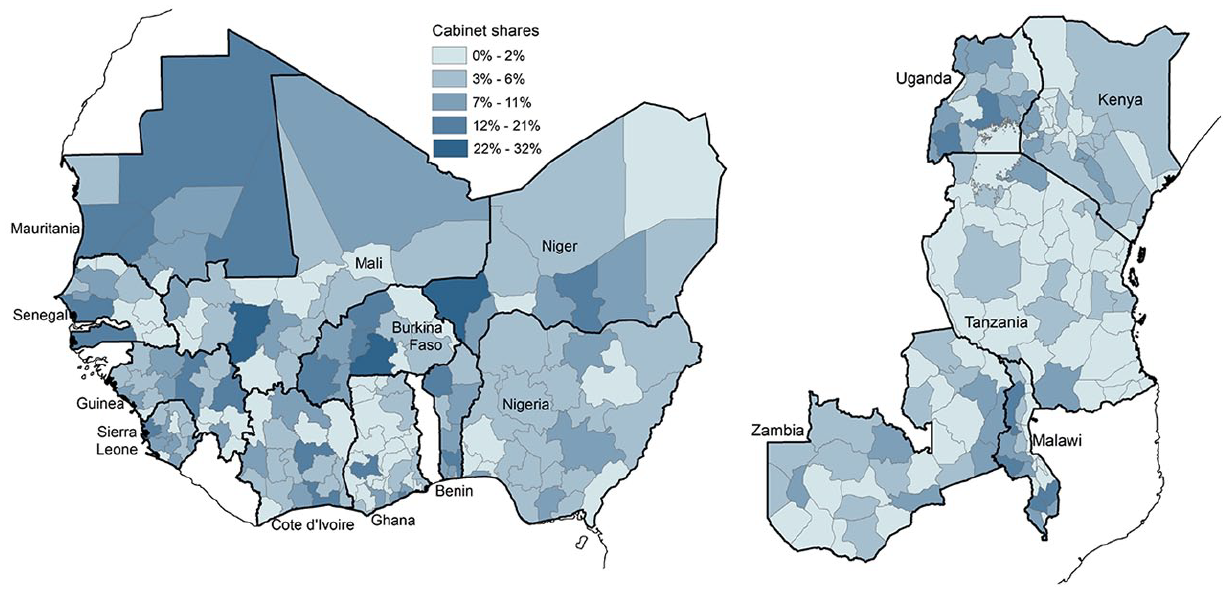
Birth locations of ministers in East and West Africa (1960–2010 average).
Colonial and pre-colonial data complement the biographies and historical maps. Colonial records (1910–1939) neatly overlap with first generation ministers, whose livelihoods were directly impacted by colonial investments. 11 I collect data on colonial investments at the district level by combining records for French West Africa and the main eight African colonies under the British Colonial Office. Huillery (2009) collected the original French records, including the number of teachers, health staff, and infrastructure expenditures per district for multiple years between 1910 and 1939. I collected British colonial records (Blue Books) in various libraries in 1915, 1920, 1927, 1928, and 1938 as a function of availability and completeness (Supplemental Figure F3 shows a page of a Blue Book for Uganda and a page of a Compte Définitif for Benin). Records often contain detailed information on demographics and infrastructure expenditures, among other activities, but also have many gaps. As concerns colonial education, my main measure is the number of public teachers in French districts, the main providers of education in some colonies because the French restricted the presence of missionaries in some areas (I am not aware of a comprehensive data source that lists the number of missionaries across denominations for French West Africa). For British districts, by contrast, I use the number of Protestant missionaries in 1923 (Woodberry, 2012) because they were the main education providers and because British colonial records sometimes do not disaggregate education measures by district.
An important advantage of restricting the sample to East and West Africa is the increased comparability within and between colonies. Record-keeping procedures were similar because all colonies in the sample reported equivalent data to the Colonial Office or the Ministère des Colonies. This comparability does not easily extend to colonies under the control of the Foreign Office, such as Sudan. Appendix F provides information on historical data sources for geographic, geologic, pre-colonial and socioeconomic covariates that could potentially affect investment decisions and confound the effect of colonial education.
Results
I begin by estimating the effect of colonial education on district minister-shares. The baseline specification is a log-log model that explains within-country variation in minister-shares as a function of educational investments and other covariates:

where outcome
Minister-Shares by District (1960–2010 Average).
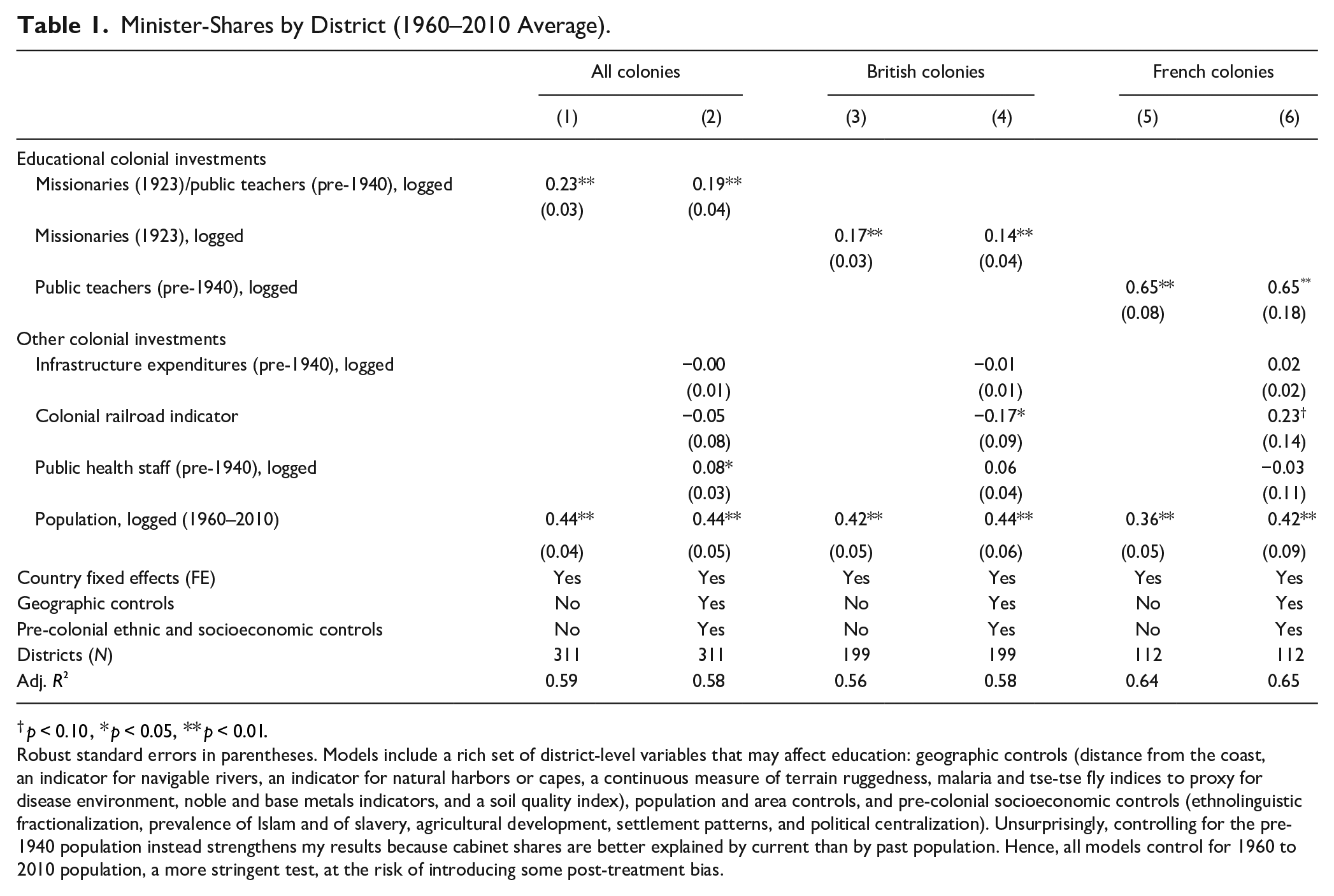
Robust standard errors in parentheses. Models include a rich set of district-level variables that may affect education: geographic controls (distance from the coast, an indicator for navigable rivers, an indicator for natural harbors or capes, a continuous measure of terrain ruggedness, malaria and tse-tse fly indices to proxy for disease environment, noble and base metals indicators, and a soil quality index), population and area controls, and pre-colonial socioeconomic controls (ethnolinguistic fractionalization, prevalence of Islam and of slavery, agricultural development, settlement patterns, and political centralization). Unsurprisingly, controlling for the pre-1940 population instead strengthens my results because cabinet shares are better explained by current than by past population. Hence, all models control for 1960 to 2010 population, a more stringent test, at the risk of introducing some post-treatment bias.
The results (Table 1) are interesting in three respects. First, colonial education matters in both empires but other investments do not.
14
Spending more on buildings, roads, sewage, and electricity—the four components of infrastructure investments in each empire—may foster development, but it does not increase the share of ministers from that district. Public health staff—the number of doctors and nurses—does not have a consistently positive effect either. The main coefficient,
Second, the political effect of education is type-specific: it derives from public education (teachers) in French colonies and from private education (missionaries) in British colonies, consistent with the type of education that dominated in each empire. By contrast, the effect of private education (i.e., missions) in French colonies and public education (i.e., government schools) in British colonies is also positive but small and insignificant (Supplemental Table C4).
15
Third,
Beyond average effects, I examine whether the importance of education is heterogeneous. Indeed, Table 1 shows that the effect is larger in French than in British districts. The smaller effect in British districts could result from the regional balancing efforts in British colonies during the independence transitions. These balancing efforts were a last-minute attempt to foster stability by politically compensating regions left behind in terms of their education and development, as discussed earlier in the case of Northern Nigeria. However, this difference could also result from a number of other differences between the two empires, measurement issues, or from the fact teachers focused on teaching while missionaries also spent time proselyting and providing health care.
I focus instead on the two sub-hypotheses presented in section 3. To test whether the education effect is larger under civilian than military governments (sub-hypothesis 1), I code each country-year as having either a civil or a military government. All 16 countries except for Kenya, Senegal, Tanzania, and Zambia endure some military rule between 1960 and 2010. Overall, 41% of the 816 country-years (
Regarding sub-hypothesis 1, Figure 5 shows that colonial education increases district minister-shares for all decades for civilian governments. However, for military governments, the effect is always smaller and even insignificant in four of five decades. As discussed, Africa experienced “coups from below” (Kandeh, 2004) led by uneducated officers that were unlike the Sandhurst-trained Indian military elite (Wilkinson, 2015). Biographical records show that some ministers under military governments were educated, even at Makerere, Oxbridge, the École William Ponty, or Paris, but many others received little schooling. Further, cabinet-level patronage is arguably more pervasive in military governments.
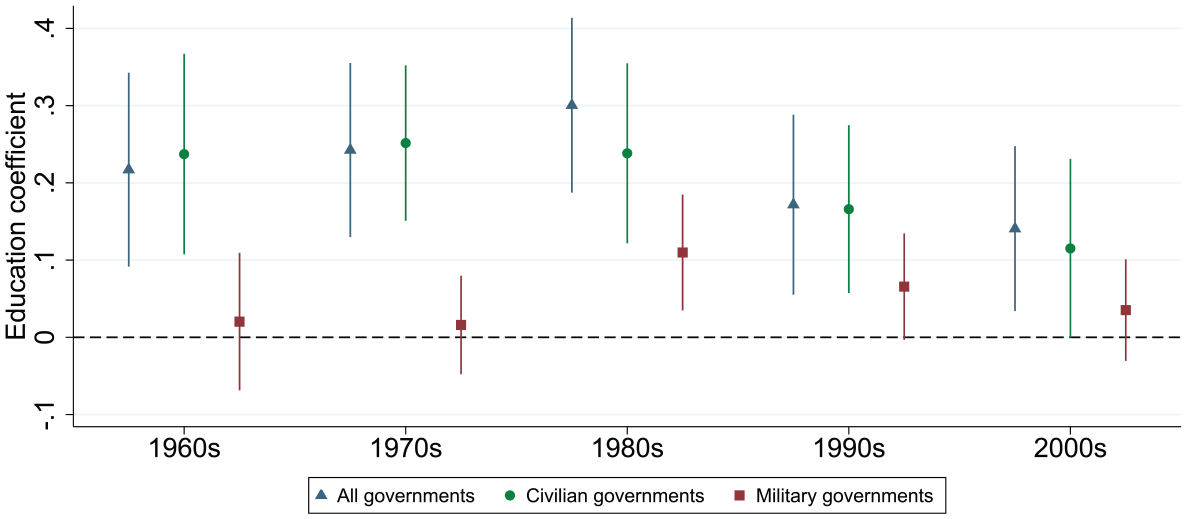
Effect of education on district minister-shares by decade and type of government.
Regarding sub-hypothesis 2, Figure 5 shows that the effect of education is larger in the 1960 to 1989 period than in the 1990 to 2010 period—whether we consider all governments or only civilian governments. This is consistent with the more direct impact of colonial education on earlier decades where almost all ministers were first-generation ministers and with the idea that human capital constraints were more pressing early on. It is also in line with the idea that Africa’s wave of democratization in the 1990s made cabinets more representative, which diminished the early political advantage of more educated districts. 17 These explanations for the smaller effect of education after 1990 notwithstanding, section 6.3 discusses why colonial education continues to increase political representation even post-1990 in spite of the political instability and turmoil that many East and West African countries experienced since the 1970s.
Alternative Explanations
Education could be proxying for European settlers, state capacity, or pre-colonial characteristics. I examine these three alternative explanations in turn. Settlers influenced investments and hence could be biasing the effect of education (Gardner, 2012, p. 98), but I find that European population is insignificant and does not alter the education point estimate, which remains 0.19 (Supplemental Table C7).
State capacity, proxied by levels of institutional and fiscal development, could also be confounding the effect of education. As Lugard (1922, p. 232) put it, “the payment of direct taxes is in Africa, as elsewhere, an unwelcome concomitant of progress.” This is likely the case in French West Africa where, more so than in British Africa, the colonial state engaged not just in taxation but also in education provision. However, institutional and fiscal development do not reduce the effect of education in French districts (Supplemental Table C7). If anything, the correlation between the number of administrators serving in a district, a proxy for local institutional development, and minister-shares is negative once we account for confounders such as colonial education.
A third set of plausible alternatives concerns pre-colonial characteristics of the ethnic groups in those districts. Ethnic diversity and fragmentation are inimical for growth and public goods provision (Easterly & Levine, 1997; Habyarimana et al., 2007). Recent literature provides evidence that ethnic groups with higher pre-colonial political centralization, namely kingdoms, provide better public services and are more developed today (Bandyopadhyay & Green, 2016). Hence, my findings may be explained by the over-representation of districts that were more ethnically homogeneous or more politically centralized pre-colonially. I find no evidence in either direction and the education coefficient remains unchanged (Supplemental Table C8).
Finally, I examine plausible determinants of colonial education. The presence of a pre-colonial trading post in the district increases colonial education and distance from trading posts decreases it (Supplemental Table C9). This is consistent with evidence that colonial investments in coastal colonies were concentrated around pre-colonial trading posts (Ricart-Huguet, 2021). Once we account for pre-colonial trade, other geographic explanations such as distance from the coast, terrain ruggedness, disease environment (Alsan, 2015), natural resources (Curtin et al., 1995), and various pre-colonial characteristics are largely irrelevant. As Table 1 showed, these controls reduce the magnitude but not the significance of the education coefficient.
The careful consideration of alternative explanations is important. However, alternative explanations do not eliminate endogeneity. While reverse causality is ruled out by design, omitted variable bias is a possible source of endogeneity and remains a concern. I employ two methods, regional fixed effects and Oster bounds, to reduce this concern. I also use a new machine learning method to reduce model dependence and bias from model misspecification. Because of space limitations, I present and discuss these three methods in more detail in Appendix B. The addition of regional fixed effects to the main models shows that the political effect of education remains even if we limit the comparison to more similar and often neighboring districts within each colony. The sensitivity analysis, following Oster (2019), shows that the importance of unobserved variables would have to be unrealistically large (given that the model already explains a majority of the variation) for the effect of education to disappear. Finally, the machine learning method by Ratkovic and Tingley (2017) is akin in spirit to a matching method but allows for continuous “treatments” (such as colonial education). It also minimizes bias from model misspecification, a common problem of matching methods, and model dependence because it is non-parametric.
Two Colonial Institutions as Mechanisms of Persistence
I leverage the ministerial biographies to provide evidence that the career development of many ministers involved the colonial civil service or the colonial legislature. 18 Most data come from first-generation ministers who served before the 1980s, many of whom have more detailed biographies than second-generation ministers because of their historical prominence. I find that over 75% were colonial civil servants, appointed or elected members of colonial legislatures, or both (Figure 6). Only around 10% were members of the colonial army. These percentages quantify the importance attributed to these two colonial institutions as a cradle of the educated class (Le Vine, 1968; Mazrui, 1978): they reveal that it was almost necessary to join one of these two institutions in order to become a minister in the early post-colonial period. The biographies help illustrate the argument’s mechanism at the individual level. Diamballa Maiga, the son of a Songhai district chief, was Niger’s Minister of Interior throughout the 1960s. Born in 1910, he was an “unwilling pupil and was actually forced to school by the police.” Nonetheless, “he flourished in school [and eventually became] a clerk in the Finance Department from 1929 to 1940” (WBIS, 2014). Senegalese Ousmane Camara, by contrast, came from an underprivileged and unstructured family. Nonetheless, he explains that “a bookish bulimia [boulimie livresque] with my friend Birane Wane [. . .] led us to devour all of what the municipal library of Kaolack contained” (Camara, 2010, p. 28). He eventually attended the Lycée Faidherbe and later became one of the first four judges of Senegal and Minister of Civil Services and Labor. These two examples are colorful in their details but typical in their essence.
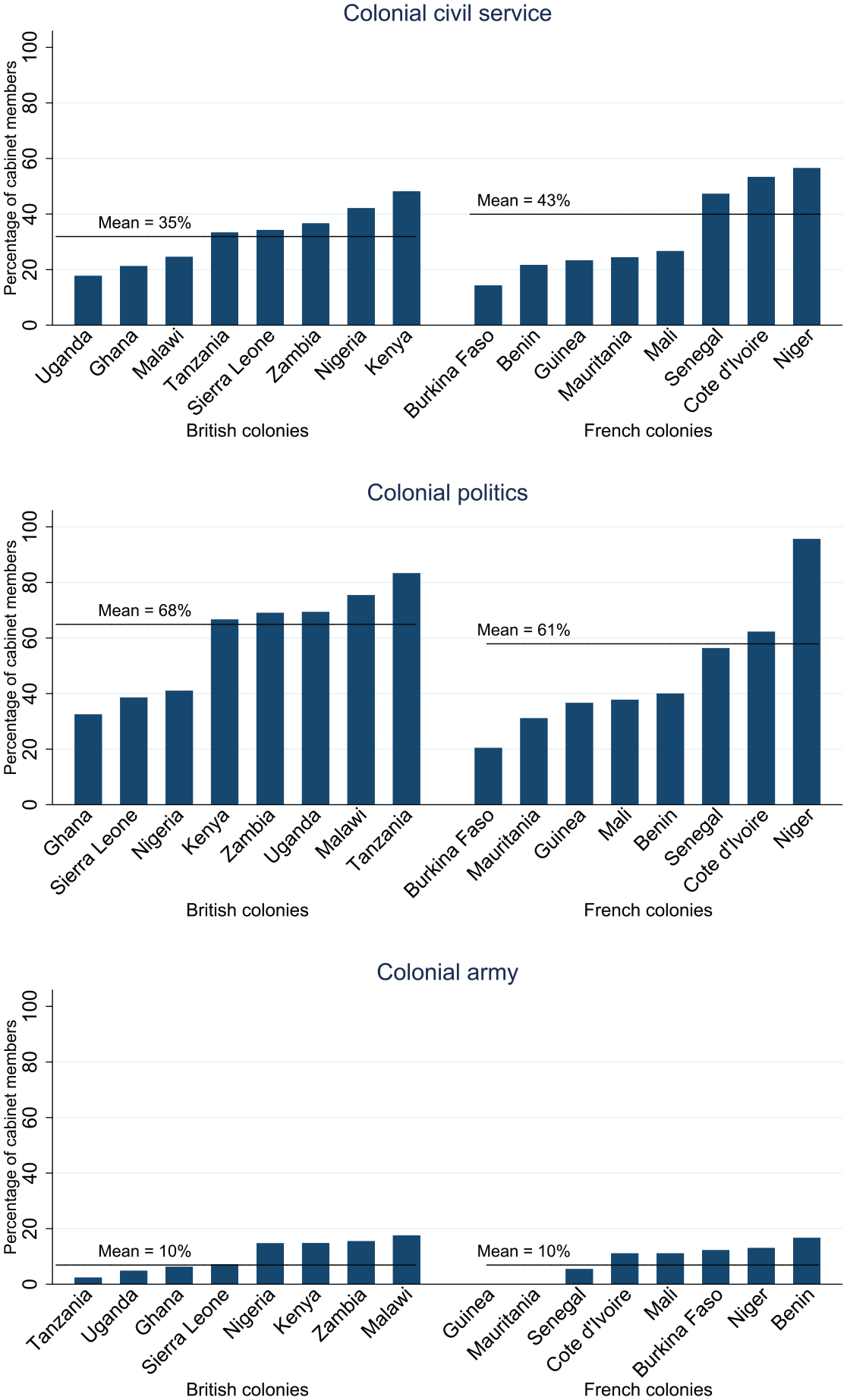
Cabinet members in the colonial civil service, legislature, and army.
The relevance of the civil service and the legislature as sources of highly qualified candidates for ministerial posts did not cease at independence. Many second-generation ministers in 1990 to 2010 cabinets joined these institutions after independence. The civil service remained the breeding ground for educated elites at least until the late 1980s, when public sector wages declined (van de Walle, 2001). At the same time, human capital constraints lessened, especially in large countries like Nigeria, but were not eliminated. Tertiary education remained rare and, although many presidents such as Nkrumah, Houphouët-Boigny, Nyerere, and others extended primary education, more educated districts during colonial rule remain more educated in 2011 (Figure 7). In brief, besides the patronage considerations I discuss next, leaders are constrained by the need to compose able cabinets or risk facing a shorter tenure (Arriola, 2009). This is one reason why even the cabinets of Colonel Idi Amin Dada (1971–1979) in Uganda included some capable academics and lawyers hailing from the civil service, the legislature, and previous civilian cabinets.
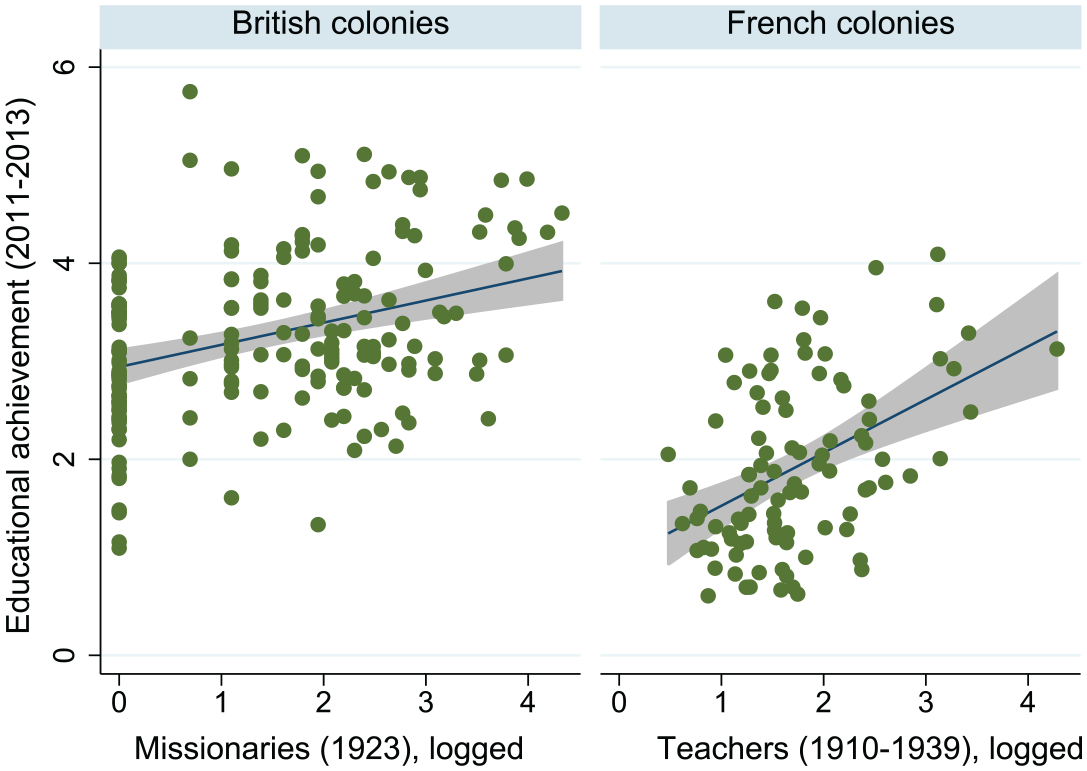
Colonial education predicts post-colonial educational achievement.
Post-Colonial Persistence: Patronage and Networks
This article does not question that regional favoritism via patronage has affected the composition of post-colonial legislatures and cabinets (Arriola & Johnson, 2014; Le Vine, 1968). In fact, the results below suggest that patronage is one reason why the effect of colonial education persists. Rather, I highlight that patronage-centered explanations (i) beg the question of why education was important to begin with, something that my argument elucidates, (ii) cannot explain why heads of government were born in more educated districts, and (iii) cannot fully account for the continued importance of colonial education. 19 I create an indicator that equals one in the 74 districts where one or more heads of government (president in presidential systems, prime minister in parliamentary systems) were born. I use this indicator as an outcome to show the importance of colonial education even if we limit the sample to heads of governments (Table 2).
Do Heads of Government (1960–2010) Hail from More Educated Districts?

Robust standard errors in parentheses. The table presents six linear probability models showing that districts with one or more post-colonial heads of government (presidents or prime ministers) received more education during the colonial period.
I then use this indicator as a covariate to proxy for district/regional favoritism. On the one hand, the indicator explains part of the education effect, consistent with favoritism being one mechanism of persistence (Supplemental Tables C11 and C12). This seems to be driven by former British colonies and by models where the indicator includes all heads of government, that is, military and civilian. Relatively, then, favoritism is lower in former French than British colonies and in civilian than military governments. On the other hand, the indicator only accounts for about 25% of the overall effect of colonial education. This is consistent with the argument that considerations other than patronage, such as human capital, can also be important (Brierley, 2020).
Whatever the considerations may be in each particular case, ministers are not selected in a vacuum—they are often part a political network, a term imbued with a negative connotation when discussed in the context of patronage. It is hardly controversial that political networks are important to understand cabinet formation. Rather, I suggest that the networks of post-colonial leaders like Kwame Nkrumah in Ghana or Félix Houphouët-Boigny in Côte d’Ivoire were not simply patronage networks but also “human capital networks,” allowing them to appoint ministers with regards to patronage but also with regards to human capital. Their early networks comprised most among the limited pool of highly qualified candidates. Many in Nkrumah’s “government of teachers” were both members of his network and highly educated public employees (Coe, 2005, p. 63). 20
Networks seem especially relevant for second-generation elites, who often attended the same schools as their first-generation counterparts (e.g., Achimota College in Ghana, the École William Ponty in Senegal) and thus benefited from connections that were not generally available to ministers educated under colonial rule. Further, the quality of colonial-era schools, including those that had become elite cradles, decreased after 1960. These two considerations suggest that network connections are an important mechanism to explain why second-generation ministers also hail from districts with higher levels of colonial education, perhaps more than colonial education per se.
Gonja district in Northern Ghana illustrates how human capital and networks go hand in hand to explain first and second-generation political elite formation. Although Gonja district was less educated than most districts in colonial Ghana and has been under-represented since independence (Supplemental Figure C3), recent President John Mahama was born there. A British district officer in the 1930s forced his father, Emmanuel Mahama, to attend a boarding school against his family’s will. The officer selected his father among a group of children because of his “protruding navel,” an act of chance that determined “the fate of my entire family” (Mahama, 2012, p. 24–27). Emmanuel Mahama became a successful teacher, MP in Nkrumah’s party, and finally Minister under Nkrumah. He became an aspirational role model for a group of educated second-generation Gonja politicians, including his son. 21 For his part, Nkrumah was educated at a Catholic mission and developed his network during his time as a teacher and pro-independence politician. These examples also illustrate why short-term explanations of cabinet formation are incomplete: networks matter but are endogenous to the early inequality in education that shaped these very networks.
Political Elites and Current Development
Existing literature on colonial legacies provides evidence that inequality in factor endowments and investments explains unequal contemporary development (e.g., Engerman & Sokoloff, 2012; Huillery, 2009). Much of this literature minimizes the role of political elites in explaining why inequality persists. Political elites are particularly well-placed to maintain or even increase colonial-era inequalities so long as they continue to hail from districts that were already ahead during colonialism, which they do. Minister-shares by district in the 1960s and the 2000s are correlated (
Table 3 shows that colonial education predicts educational achievement and economic development, as proxied by contemporary nightlight intensity (e.g., Weidmann & Schutte, 2017), even after controlling for a large set of covariates including regional fixed effects. More interestingly, I show that, beyond population shifts (e.g., internal migration), district minister-shares explain part of the effect of colonial education on both outcomes. For nightlights, district population explains 55% or (1.99–0.89)/1.99 of the colonial education effect, while district minister-shares explain 36%. For current educational achievement, district population explains 14% of the colonial education effect while district minister-shares explain 42%. Consistent with much of the distributive politics literature, I find that changes in nightlight intensity between 1992 and 2012 are driven by 1990 to 2010 ministers, who tend to favor their home district (Supplemental Figure C1).
Contemporary Economic Development and Educational Achievement by District.
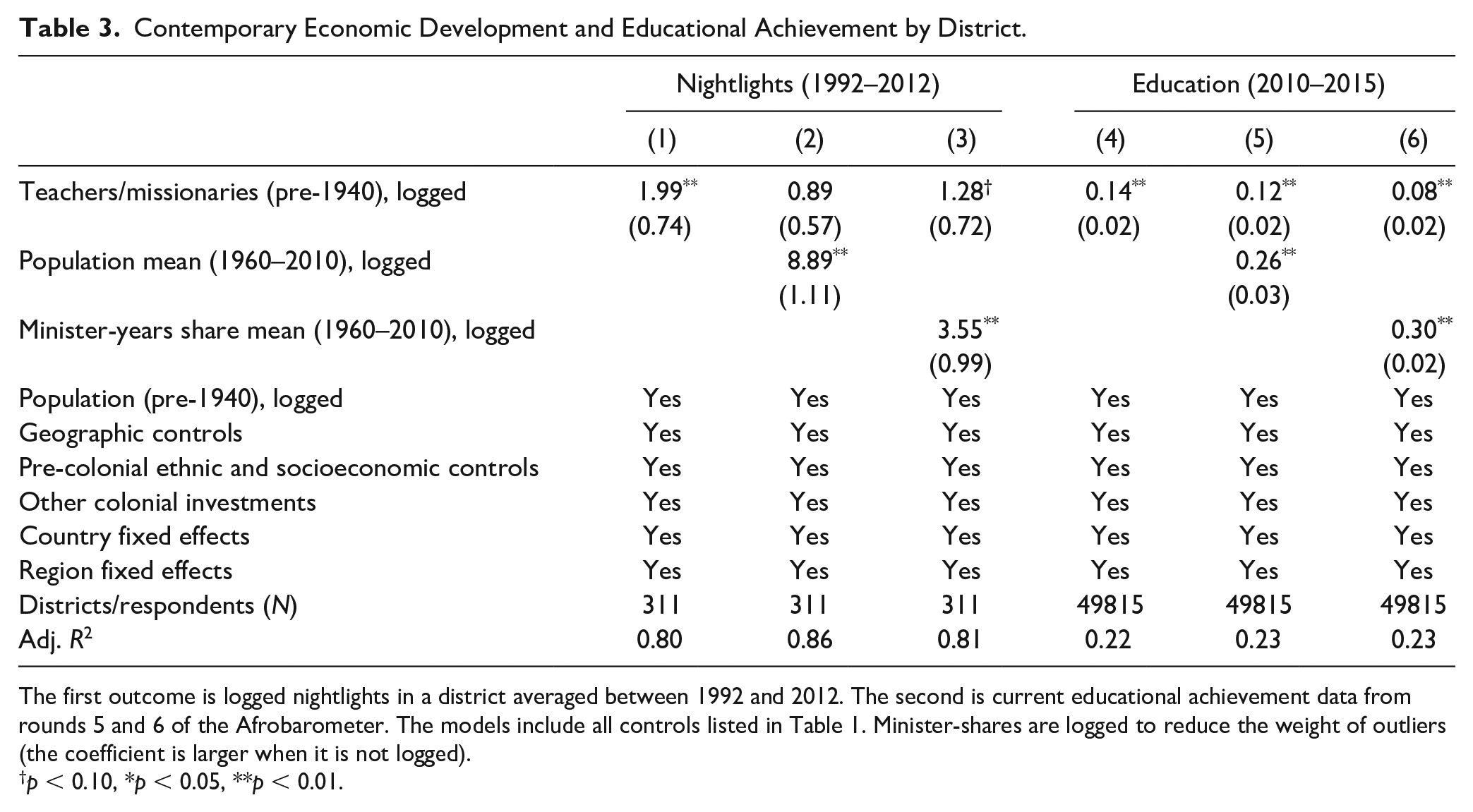
The first outcome is logged nightlights in a district averaged between 1992 and 2012. The second is current educational achievement data from rounds 5 and 6 of the Afrobarometer. The models include all controls listed in Table 1. Minister-shares are logged to reduce the weight of outliers (the coefficient is larger when it is not logged).
p < 0.10, *p < 0.05, **p < 0.01.
Overall, these results suggest two important takeaways. First, both population shares and minister shares are important mechanisms. The importance of population hints at the importance of (electoral) accountability in these former colonies, some of which are semi-democratic regimes since the 1990s. Second, and less hopefully, ministers seem to be reproducing rather than reducing the regional disparities inherited from the colonial period.
Conclusion
Government formation is widely considered to be a short-term and strategic process. This article expands our understanding of how governments emerge by providing instead a long-term explanation that leverages the historical process of political elite formation in Africa. Regional favoritism and patronage in the cabinet matter and existing work has examined them at length, but they ignore the possible structural determinants that favored a particular regional distribution of power. This historical approach is also motivated by the persistent political inequality that my data reveal: over-represented districts in the 1960s (i.e., districts whose share of ministers is higher than their population share) remain over-represented even after the 1990s democratization wave in Africa.
In this article, I show that this persistent regional political inequality is rooted in the pre-independence period. It is the result of unequal education during colonialism rather than of other uneven colonial investments, economic development, or pre-colonial ethnic characteristics. Some districts are more represented than others in post-colonial governments because they received higher colonial investments in primary education and because Europeans’ recruitment strategy into the colonial state selected on literacy but disregarded regional balancing. The civil service and the legislature became cradles of political elites and hence are key mechanisms to understand why colonial education explains who governs today.
My explanation departs from recent research on colonialism arguing that indirect rule explains which ethnic groups are politically represented in post-colonial governments (McAlexander, 2020; Wucherpfennig et al., 2016). The institution of (in)direct rule was often determined at the colony or region level. For example, Northern Nigeria was ruled indirectly and the South directly. Instead of institutions, I emphasize the promise of district-level investments (while holding regional-level institutions constant) to understand elite formation, political representation, and ultimately development.
More broadly, we know that colonial legacies matter for present-day socioeconomic outcomes but we have only begun to understand why. I argue that political elites are an important reason why districts with higher investments then are more developed today. In contexts with weak institutions and low accountability, political elites may reproduce rather than reduce regional inequality.
Does the argument extend beyond East and West Africa? It should extend to former colonies countries where local recruitment into colonial institutions was prevalent and political elites were the most educated segment of society, as was the case in many colonies (Putnam, 1976). Most-similar countries include those of former French Equatorial Africa (Cameroon, the Central African Republic, Chad, Gabon, and the Republic of Congo) and other British colonies such as Sudan or Gambia. Boone (1992, p. 20) noted that Africa was distinctive from other continents because the post-colonial ruling class was not a part of the “indigenous capitalist class.” Yet, my argument may extend to parts of South Asia and of the Middle East, where colonialism also transformed the social structure and the effendiyya (educated men) gained political prominence in some colonies (Hartnett, 2019). By contrast, the argument seems less relevant for settler colonies. European settlers ruled after independence (e.g., South Africa) in some colonies and colonization brought large-scale death to native populations in others (e.g., Central America). In most of Latin America, criollo settlers like Simón Bolívar rather than the indigenous population ruled after independence. Upcoming research will explore the causes of regional political inequality in some of these settings.
I conclude by briefly reflecting on underappreciated political consequences of education policy. In the decades following independence, many post-colonial governments (e.g., Ghana, Côte d’Ivoire, Tanzania, etc.) and policy-makers in international organizations (e.g., World Bank) emphasized extending primary education. In their pursuit to increase literacy rates, however, they often overlooked a key efficiency versus equity trade-off: increasing primary education in core districts was easier and cheaper because infrastructure was already in place, but it perpetuated political as well as socioeconomic regional inequality a generation later. The flipside of this observation is that, although perfect regional political equality may not be feasible or desirable, a more regionally-balanced provision of education may reduce the political exclusion of regions and groups that have been sidelined from power since independence.
Supplemental Material
sj-pdf-1-cps-10.1177_0010414021997176 – Supplemental material for Colonial Education, Political Elites, and Regional Political Inequality in Africa
Supplemental material, sj-pdf-1-cps-10.1177_0010414021997176 for Colonial Education, Political Elites, and Regional Political Inequality in Africa by Joan Ricart-Huguet in Comparative Political Studies
Footnotes
Acknowledgements
For useful comments, I thank Carles Boix, Marc Ratkovic, Leonard Wantchekon, and Jennifer Widner as well as Kate Baldwin, Torben Behmer, Volha Charnysh, Denis Cogneau, Ana de la O, Romain Ferrali, Adriane Fresh, Allison Hartnett, Phil Keefer, Ian Lustick, Felix Meier Zu Selhausen, Gautam Nair, Agustina Paglayan, Betsy Levy Paluck, Evan Lieberman, Brandon Miller de la Cuesta, Jeff Paller, Chris Parel, Tim Parsons, Costantino Pischedda, Rajesh Ranganath, Ron Rogowski, Tsering Wangyal Shawa, Emily Sellars, Robert Tignor, Stephanie Weber, Martha Wilfhart, Oscar Torres-Reyna, and three anonymous reviewers. I also thank seminar participants at the Aage Sorensen Memorial Conference, the Annual Meeting of the American Political Science Association, the Berlin Social Science Research Center (WZB), the Historical Political Economy working group, the Institute of Economic History at Humboldt University, Princeton University, UCLA, the University of Pennsylvania, the Yale African History Working Group, the Yale University Comparative Politics Workshop, the Working Group in African Political Economy at NYU-Abu Dhabi, and the World Economic History Congress. I am grateful to Elise Huillery and Bob Woodberry for sharing relevant data. Jeremy Darrington helped me locate multiple data sources. Hassan Saad, as well as Karen Gallagher-Teske, Sahshe Gerard, Sarah Malik, Edwin Mayoki, Seth Merkin Morokoff, Natalya Rahman, Diana Sandoval Siman, Bruno Schaffa, and Lulu Zhong provided excellent research assistance. Replication materials can be found at  .
.
Declaration of Conflicting Interests
The author declared no potential conflicts of interest with respect to the research, authorship, and/or publication of this article.
Funding
The authors disclosed receipt of the following financial support for the research, authorship, and/or publication of this article: Financial support from the Mamdouha Bobst Center for Peace and Justice, the Princeton Institute for International and Regional Studies, the Program on Ethics, Politics, and Economics at Yale is gratefully acknowledged.
Supplemental Material
Supplemental material for this article is available online.
Notes
Author Biography
References
Supplementary Material
Please find the following supplemental material available below.
For Open Access articles published under a Creative Commons License, all supplemental material carries the same license as the article it is associated with.
For non-Open Access articles published, all supplemental material carries a non-exclusive license, and permission requests for re-use of supplemental material or any part of supplemental material shall be sent directly to the copyright owner as specified in the copyright notice associated with the article.
