




Abstract
Social accountability initiatives seek to empower citizens to hold officials to account between and beyond elections, yet often meet with mixed results. This article highlights a neglected dimension in the study of accountability: intermediation by brokers who share and frame information. In contrast to literature that focuses on political brokers in clientelist networks, I introduce the concept of social brokerage: efforts to motivate and to link action by citizens and officials, without the expectation of an electoral return. I illustrate the practice of social brokerage in India, through study of a network of citizen journalists who attempt to mobilize citizen claim-making and to encourage official responsiveness to those claims. I argue that effective social brokerage requires both vernacularization (giving information meaning in local contexts) and interlocution (speaking to and between multiple audiences). This, in turn, rests upon a powerful—but often elusive—combination of community embeddedness and ties to bureaucracy.
Introduction
A community without lights, despite a village electrification scheme; homes without toilets, despite a “total sanitation” campaign; missing wages on a government worksite. These are but a handful of the problems that residents of rural India regularly face in accessing public resources and entitlements. Such experiences are common across the Global South, where economic and social rights are unevenly realized despite commitments enshrined in law and policy. This distance between rights and their realization reflects an accountability gap in which citizens struggle to ensure that officials make good on the promises of the state.
This article highlights a set of practices that seek to narrow the accountability gap: social brokerage, understood as efforts to motivate and link action by both citizens and officials. While partisan brokerage, which seeks to facilitate the exchange of votes for public resources, is well-studied in clientelist settings, less is understood about intermediation that operates beyond a partisan quid pro quo. Rather than mobilizing voters, social brokerage seeks to activate citizen claim-making between elections, and to motivate the responsiveness of appointed rather than elected officials. The practices involved require both framing information to give it meaning in local contexts (vernacularization) and engagement of multiple audiences along both horizontal (citizen-facing) and vertical (official-facing) dimensions (interlocution). These acts are non-partisan but not a-political, as they seek to shift the behavior of both citizens and officials.
I explore the practice of social brokerage in India, through the study of a network of citizen journalists (“Community Correspondents,” or CCs) who, supported by a community media NGO, use video to document local problems and needs. The CCs share their videos with both community members and officials, making accompanying calls to action. To explore this work, I draw on qualitative research (interviews with approximately 1/3 of the network, and over 1000 hours of ethnographic research with a selected group of 19 CCs), as well as a database tracking the CCs’ videos (n = 17,380). The CCs’ efforts, I show, meet with mixed success: some are well-placed to mobilize community members, others are effective at engaging officials, but only a sub-set are true interlocutors who do both. Reflecting on these patterns, I suggest that effective social brokerage rests upon a powerful—but often elusive—combination of community embeddedness and ties to the bureaucracy. Building from the rural Indian case, I consider the broader practice of and motivations for social brokerage in efforts to enhance accountability.
The social life of information
Social accountability is understood as a “nonelectoral yet vertical mechanism of control of political authorities” (Peruzzotti & Smulovitz, 2006, p.10). Citizens’ bottom-up (“vertical”) efforts to hold officials to account are particularly important in settings where “horizontal” accountability mechanisms within the state (checks and balances, internal monitoring, and oversight) are inadequate (Brinkerhoff & Wetterberg, 2016). In democratic societies, vertical accountability is most often associated with elections; citizens discipline politicians through the ballot box who, in turn, discipline bureaucrats—the so-called “long route” to accountability (World Bank, 2004). Yet scholars, policymakers, and practitioners increasingly recognize the importance of social accountability beyond the electoral arena, in particular where democratic representation is weak, and where frontline officials exercise substantial discretion (making the long route to accountability more tenuous).
Social accountability initiatives, the likes of which have proliferated worldwide, 1 rest on the presumption that better informed citizens will more effectively scrutinize and pressure officials, making information and transparency key features (Kosack & Fung, 2014). However, the observed effects of information provision are ambiguous at best (Tsai et al., 2019), often producing null results (Dunning et al., 2019; Lieberman et al., 2014), or even leading to lesser engagement if information simply confirms citizens’ low expectations (Chong et al., 2015). A large part of this puzzle, I suggest, is rooted in the fact that information is often treated in studies of accountability as simply factual and procedural—something to be disseminated through transparency and media campaigns. This article, in contrast, explores the social life of information as it is generated, framed, and consumed in local communities.
Scholars have long recognized the role of social networks in shaping the flow of information (Granovetter, 1973), the situated nature of knowledge (Haraway, 1988), and the cultural framing of repertoires of action (Swidler, 1986). Information is not simply injectable, but is interpreted through social frames (Snow et al., 1986). Social movement scholars have noted the importance of injustice framings (Tarrow, 1994), and of the social construction of grievances in both protest (Simmons, 2014) and legal mobilization (Taylor, 2020). Through a more quotidian lens, urban sociologists have probed how neighborhood frames influence the decision-making and political activity of individuals (Rosen, 2017; Small, 2004).
It is clear, then, that residents who are the targets of social accountability initiatives are not tabula rasa recipients of information, but rather come to engage, reject, or reinterpret information through the filter of existing local narratives. As Rosen (2017, p. 275) succinctly states: “As stories, told and retold, narratives help people make sense of their world and develop strategies to thrive within it.” The stories that circulate about the accessibility and responsiveness of the state play a critical role in shaping how citizens conceive of their needs and of available repertoires of action (Kruks-Wisner, 2018a; 2018b). Public officials are also not immune to narrative framings. As Joshi and McCluskey (2017) note, organizational cultures and local settings influence how officials “see citizens and their claims” (p. 4); “such claims are bolstered or undermined by how public officials view the world and how they perceive citizens and civil society organizations” (p. 6).
But how do these all-important local frames and narratives change? In situations where unresponsive governance is the norm, deficient services may appear uncontestable to citizens who are inured to patterns of neglect. In these contexts, greater transparency about government performance may do little to motivate action. Moreover, where citizen inaction is the norm, narratives about government failure may have a demotivating effect (Chong et al., 2015). Officials, for their part, are often embedded within structures that also dissuade action. Frequent transfers, political pressures, and resource constraints limit their capacity (Dasgupta & Kapur, 2020). At the same time, organizational cultures marked by a distrust of citizens may lead officials to question the legitimacy of claims (Joshi & McCluskey, 2017), while legalistic norms may leave officials unwilling to exercise discretion on behalf of those in need (Mangla, 2015). The result is a low-level governance equilibrium, marked by unresponsive officials and despondent citizens—dynamics widely observed in resource-constrained settings with uneven public sector capacity (Kruks-Wisner, 2018a; Lieberman et al., 2014).
We are left, then, with questions about what might disrupt this equilibrium, and about how norms of behavior on the part of both citizens and officials shift. As Rosen (2017, p. 275) notes, “theorists recognize that repertoires and frames may change over time and place, but we do not have a good understanding of how and why they change.”
Theory: Social Brokerage Beyond the Electoral Arena
Social brokerage, I argue, plays a key—but largely overlooked—role in reshaping local frames and political behavior. The power of social brokerage lies in its potential to craft disruptive narratives that shift expectations about the responsiveness of government and about the power of citizen action. Brokers, however, are surprisingly understudied in the literature on social accountability. 2 The comparative politics literature on intermediaries, in turn, is focused almost exclusively on political brokers embedded in electoral networks (Stokes et al., 2013; Kitschelt & Wilkinson, 2007), and so has relatively little to say about the role of brokers in social accountability. Recent literature on political intermediaries moves beyond the narrow conception of a “party broker” tied to single partisan machine (Holland & Palmer-Rubin, 2015), and relaxes the notion of a strict quid pro quo while also extending beyond elections (Auerbach et al., 2021; Nichter, 2018). The intermediation in these studies, however, is still firmly “political” in the classic sense that brokers serve as “gatekeepers” between citizen-voters and politician-agents (“acting as go-betweens between the flow of goods and services and the flow of support and votes,” Auyero, 2000, p. 67). Social brokerage, I argue, is a conceptually distinct set of activities, that unfold without the presumption of an exchange of electoral support for public resources.
The practice of social brokerage
Social brokers operate between elections and beyond partisan networks, and so without the carrots and sticks of votes and resources that facilitate clientelist exchange. These intermediaries must therefore look for other means to mobilize citizens and officials. Those means, I argue, center on two, intertwined sets of ideational practice: vernacularization, referring to the ways in which information, ideas, and narratives are given meaning in local contexts (Merry, 2006); and interlocution, referring to efforts to speak to and between multiple audiences (Fox, 2015).
Social brokers attempt to gain traction in communities and among frontline bureaucrats by crafting mobilizing narratives about citizenship practice and about governance. To do so, they present information about local wants and needs, as well as ideas about rights and responsibilities. However, knowledge of a problem or the paper existence of a right does little to guarantee that either affected citizens or responsible officials will act. This gap between knowledge and action is widely acknowledged, as is the fact that information, in order to mobilize, must be both “accessible” and “perceived as useful and actionable” (Fox, 2015, p. 352).
To be accessible and actionable, information and ideas must be “vernacularized, or adapted to local institutions and meanings” (Merry, 2006, p. 39). Central to this process are “the people in the middle: those who translate the discourses and practices” (Ibid, p. 39). Social brokers are, in this sense, less gatekeepers than narrators who interpret and ground information about government performance, and who frame ideas about rights and participation in locally resonant terms. Extending beyond the citizen arena, I suggest that officials—who like citizens are also embedded in local settings as well as in organizational cultures—also respond to information and ideas when presented in ways that resonate within their situated contexts.
Social brokers work to shift the underlying beliefs that citizens hold about the state and that officials hold about citizens. Their citizen-facing work aims to foster both individual and collective action by framing needs as grievances (Taylor, 2020), calling on notions of rights and entitlements (Simmons, 2014); and by presenting residents with credible courses of action (Ganz, 2011). Their official-facing work seeks to motivate bureaucrats by framing needs as urgent and as legitimate (Gallagher, 2017); and by calling on a combination of intrinsic motivations and extrinsic incentives (Joshi & McCluskey, 2017). The “supply” and “demand” sides of accountability thus intersect; citizen participation reflects expectations of government responsiveness, and vice versa. Social brokers sit at this intersection, acting as two-way interlocutors between citizens and officials (Fox, 2015).
The Logic of Social Brokerage
The power of social brokerage is not derived from the promise of electoral gains, but instead lies in the potential to shift citizens’ expectations and officials’ sense of obligation. The aim is to link citizens and officials by motivating claim-making and responsiveness to those claims. This, I argue, distinguishes social brokerage from other forms of intermediation in terms of what is being asked of citizens (claim-making, rather than votes or payment) and of officials (responsiveness without the expectation of an electoral return).
Along the citizen-facing dimension, social brokers do not simply attempt to deliver goods or solve problems in return for partisan reward or advancement. Instead, the aim is to compel claim-making by citizens themselves. Social brokers are, in this sense, asking citizens to participate in ways that are thicker—more time consuming and potentially costly—than casting votes. This same feature of seeking to draw citizens into claim-making also distinguishes social brokers from for-a-fee “fixers” who are paid by residents, and so who often engage in “information hoarding” to maintain their gatekeeping privilege (Auyero, 2000, p. 60). Social brokers, in contrast, attempt to build conceptual bridges between citizens and agents of the state. 3 This dual-facing nature of social brokerage also sets it apart it from the work of “protest brokers” (Lockwood, 2021), who connect political elites downward to community networks or social movement organizations to spark contentious action. While social brokers certainly can and do tap into such networks to activate claim-making, they do so in conjunction with vertical efforts to make officials more responsive to citizens’ claims. Targeting both citizens and officials is thus a defining feature of social brokerage.
Along the official-facing dimension, social brokers engage primarily with appointed rather than elected officials. Observers of clientelist settings are quick to note the politicization of bureaucracies. Yet, elected politicians do not exercise hegemonic control over the day-to-day functioning of bureaucratic agencies, particularly at the local level. The “long route” to accountability via pressure from elected politicians on appointed bureaucrats can thus be untenably long. Social brokers pursue a shorter route by directly engaging local officials with the mandates and means to solve problems. They do so without the express muscle of party backing. For some, this may be an active disavowal of political parties. For others, it is a necessity, as they lack requisite partisan ties; this is particularly true for those who lack strong representation in mainstream parties—for example, religious minorities, tribal communities, or other politically marginalized groups. For others still, it is a matter of context, recognizing that political parties are important loci of distributive politics at certain times and for certain allocative issues, but are not the only or even primary channel to make claims on the state (Gallagher et al., n.d.).
As this suggests, the line between “social” and “political” brokers is not always sharp. This is certainly the case for actors who operate during and between elections, who seek combinations of both political advancement and social standing. In India, for example, Berenschot (2014) identifies a class of “social workers” who are called on to support politicians only during elections, and who work during non-election time to influence bureaucrats. Krishna (2002) similarly documents a cast of “new leaders” (naya neta) who serve as links between officials and residents, but who are not bound to a particular party. Auerbach (2020) highlights the role of urban basti netas (slum leaders), who build their reputations as effective problem-solvers between elections, and who facilitate claim-making beyond established patron-client ties. These sometimes-partisan brokers are similarly observed in settings across the global south, in Latin America (Collier & Handlin, 2009), Africa (Bénit-Gbaffou & Oldfield, 2011), and the Middle East (Singerman, 1995). These actors, despite their political connections, may serve as social brokers if and when they operate beyond electoral and partisan logics. It is not, in sum, the specific societal position of a given actor that delineates whether they “count” as a social broker, but rather the practices they undertake and the logics that underlie them. A wide range of actors might (and do) engage in social brokerage, and it is possible for a given actor to move from social to partisan arenas and back again. I therefore conceive of social and political brokerage as stylized types of intermediation. The typology, I argue, is useful since it calls attention to the importance of practices and logics beyond the electoral arena.
Application: Citizen Journalism and Social Brokerage in Rural India
To illustrate the practice of social brokerage, I turn to the study of a network of citizen journalists in India. The network is supported by Video Volunteers (VV), a community media nonprofit dedicated to promoting journalism in India’s poorest districts. VV defines community media as “media for and by communities,” arguing that: “It empowers those who produce it (and appear in it) with a voice; it builds the social capital of a community to address critical local issues and gives people full control over their own narratives. Often, it communicates peoples’ needs to authority and leads to concrete resolution of local problems.” 4
This media-centered theory of change is illustrative of a wide range of social accountability initiatives that attempt to amplify citizen voices. As Peruzzotti and Smulovitz (2006, p. 23) note: “Social accountability requires visibility, and the media is the most important instrument to receive this goal.” Community media has received particular attention, given its local reach and centering of local voices (Campbell, 2015). An emerging movement for “participatory video” extols the particular importance of visual media, not only for sharing problems with external audiences, but also for the internal transformation of those who use it—building awareness as well as “capacity for action” (Plush, 2013, p. 55; Ichplani et al., 2018). Others, though, worry that citizen journalism might be co-opted by elites (Agrawal, 2013) or, when not directly tied to action, “fail to enhance citizen participation” (Chadha & Steiner, 2015, p. 716).
India Unheard
VV’s flagship program, India Unheard, launched in 2010, centers on a network of roughly 225 Community Correspondents 5 in 19 states and 190 districts. 6 To become part of the network, an individual must live below the poverty line. Just over half (52%) of the network is female, and just under two-thirds come from either the Scheduled Castes (31%) or Scheduled Tribes (32%). 7 The CCs are recruited by VV staff, who survey NGOs and social movement leaders to invite applicants with a reputation for being leaders in their communities; however, they expressly avoid those who hold local elected office or positions in party networks. Applicants are brought to training camps, where they are given instruction in videography, journalism, and advocacy methods. During these trainings, VV staff interview and observe the applicants; a small proportion are then selected to join the CC network. Once selected, the CCs receive additional media and advocacy training, access to technology (tablets, smartphones), and mentorship from the VV staff. The CCs work in and around their home communities, with some venturing farther afield within an administrative block or district. VV pays the CCs per video produced—once for a video documenting a local problem, and a second time for a video documenting its solution. 8
The CCs’ videos highlight local grievances, the vast majority of which (90%) center on a complaint directed at a government official or agency involving service provision, poverty alleviation programs, or access to public goods and infrastructure. 9 The CCs attempt to share their issue videos with residents through screenings on laptops, tablets, and smartphones. In the context of screening, they hold meetings in which they encourage residents to act on the issue at hand: for example, by signing a petition, attending a government meeting, or traveling to a block office. The CCs then attempt to screen the same videos to officials—typically bureaucrats at the block or district level.
CCs receive ₹3500 ($40 USD, or roughly one half the national monthly minimum wage) per completed “issue video.” If a CC successfully solves that issue, VV invites her to make a second “impact video” including footage of the outcome (e.g., before and after shots of repairs to a school, or interviews with pensioners before and after receiving payment). The CC is paid a second time at double the rate (₹7000) for these impact videos, which are reviewed by VV staff. This payment structure aims to free the CCs’ time to enable work on community issues. The payments are also intended to increase the CCs’ willingness to mobilize residents to become their own problem-solvers—thus setting the CCs apart from other local brokers who charge residents for their problem-solving services. These for-a-fee fixers are referred to locally as dalaals. In interviews, CCs were at pains to distinguish themselves from dalaals, stressing that they never ask for or accept payment from community members. A number of CCs noted that they face opposition from dalaals. One CC, for example, explained that dalaals, “fear that we are eating their space. They have been earning money by taking bribes from people to do certain work. They feel jealous, [and so] discourage those who are likely to come to us.” 10
By paying for videos, VV also attempts to reduce the financial pull that CCs might otherwise feel towards partisan networks and the financial incentives offered by politicians. The CCs are self-declared non-partisan actors, as required by VV. None among those interviewed held an official “pad” (position) within a party organization, and only a handful expressed a personal preference for or identification with a particular political party. Many actively distance themselves from political parties, in part because of a desire to distinguish themselves from clientelist networks that residents have come to associate with corruption. As one CC stated:
“I don’t want political recognition because it can spoil my relationships with other people [in the community] …. Not many politicians have a good image, so any association could damage [my] reputation”
11
This distancing from parties, though, does not imply that CCs are fully disengaged from politicians. A number of CCs reported that they do include politicians in their problem-solving efforts, particularly if they have exhausted more local options. Calling on an elected politician, such as a state Member of Legislative Assembly, is for some CCs an effective form of “level-hopping” when blocked by an unresponsive local official (Bussell, 2019). This engagement, however, does not take the form of a quid pro quo exchange; indeed, as Bussell has documented, higher-level politicians regularly engage in non-contingent constituency service.
Research Design and Data
Study of the CCs serves as an instructive case through which to examine the practice of social brokerage. However, the CCs, while exemplifying a growing class of intermediaries, are in some ways unique. The network is relatively small, and rests upon support from VV (video-based payments, training, and access to technology). Despite (and partially because) of these features, the CCs offer a revealing window into social brokerage—not least because significant portions of their activities are captured by video. At the time of research, VV’s database included 17,380 videos produced by 396 ever-active CCs between 2010 and 2020. Access to these data, as well to the network of CCs themselves, provided me with a rich basis upon which to ground my theory. Yet, as we will see, it is not simply the videos produced, but the in-person discussions and acts of persuasion that accompany them, that constitute social brokerage. Video, I will argue, is a potentially powerful, but neither necessary nor sufficient, tool for social brokerage.
Other features of the CC network (payment by VV, as well as requiring non-partisanship) made dimensions of the CCs’ incentives and their relationships to political parties easier to observe. This helped me, from a theory-building perspective, to delineate the concepts of social and political brokerage. The specificity of those features, though, may also make the case less generalizable. Acknowledging this, I aim first to describe the work of the CCs in their specific context, and second to situate the network within the broader conceptual category of social brokerage—a task to which I turn in the penultimate section.
To study the CCs, I draw first on VV’s video database.
12
The database captures basic demographic information about each CC, while tracking the videos they produce. Based on these data, I calculated an “impact rate” for each CC—a ratio of “impacts achieved” to the number of “issue videos” produced.
13
The average impact rate over time for the full network is 15.54%. But, as Figure 1 depicts, the CCs are highly variable in their impacts, ranging from zero (no issues resolved) to a maximum of 100% (all issues resolved). Problem-Solving Impacts. Notes: X-axis is number of issue videos produced between 2010 and 2020 (n=17,380). Y-axis is number of impacts achieved (n= 2694). Total number of CCs = 397. Research sample (n=19) consists of CCs in the qualitative study (dashed line). Non-sample (solid line) are the remaining CCs in the network.
The database, however, offers little upon which to explore the sources of this variation; we know if an issue was resolved, but not how. The database, moreover, tracks only successful resolution, leaving us without the counterfactual cases of when CCs are unable to resolve a problem. To fill these gaps, I turned to qualitative fieldwork to explore both impacts and non-impacts. Fieldwork extended over the course of 2 years (2017–2019), in successive stages. First, I worked with a team of RAs to carry out exploratory interviews with 65 CCs from 11 states. These included 45 CCs gathered at a national meeting in 2017, 14 and an additional 20 interviews that I carried out during field visits in Jharkhand, Bihar, and Uttar Pradesh (UP). These initial interviews helped me, inductively, to refine my questions and research design. Next, I selected a sample 20 of CCs, drawn from Bihar and UP (the two states with the highest network concentrations), 19 of whom participated in a sustained 4-month study. 15 I selected these CCs on the basis of their gender (9 women and 11 men), and by their impact rates (at, below, and above district means). As is visible in Figure 1, this qualitative research sample (plotted along the dashed line) surpasses the remaining (non-sampled) network (solid line) in impacts achieved, with an average impact rate of 20%. However, both the qualitative sample and the broader network exhibit variable impact rates. 16 This variation persists when disaggregated by a range of characteristics (gender, caste category, religion); as well as across different issue types (from infrastructure such as water and roads, to poverty alleviation, to health services); and by state. 17
Demographic and socioeconomic features of the CCs.

Source: Video Volunteers database, reporting June 2020. The full network includes all ever-active CCs from 2010–2020. The research sample includes the 19 participants in the qualitative study in Bihar and UP. * Note: Not all CCs in the full network report demographic data. Percent values are therefore of those who did report.
To study these 19 CCs, I worked with four Research Associates, two men and two women, each from northern India and fluent in Hindi and local dialects. Each RA had substantial prior field experience (with backgrounds in community media, anthropology, and social work). Each was assigned to an area of UP or Bihar and was charged with following 4 or 5 CCs. Over the course of 4 months, the RAs made repeated visits to their assigned CCs, making a minimum of four visits to each. 18 Each visit lasted 1–2 full days, resulting cumulatively in close to 1000 hours of observation. During those visits, the RA would pass time with the CC and their family, while also observing the CC (shadowing them as they attended community or official meetings). The RAs carried out a long-form interview with each CC, with questions on their background, social networks, community engagement, contact with officials, political networks, and video-making and problem-solving strategies. The extended interview format, spread out over 4 months, allowed the RAs to build trust before turning to sensitive questions, and to return to topics for follow-up. The RAs also carried out process tracing exercises (n = 38), offering detailed accounts of both successful and unsuccessful problem-solving (impacts achieved and not achieved).
RAs recorded, transcribed, and translated their interviews and typed detailed notes on their interactions. I analyzed these transcripts and notes, first, through weekly calls with each RA in which I asked clarifying questions and discussed their observations; second, through a coding exercise using Dedoose in which I engaged one RA from the fieldwork team to code the full set of notes on themes that were derived both deductively and inductively; and third, through close and multiple re-readings of all notes, manually partitioning them by themes that emerged, iteratively, through the prior rounds of analysis. I engaged a second RA, external to the fieldwork, to assist in this process, to ensure that my own interpretation of the texts was consistent with those of someone less embedded in the research.
A strength of these methods is the depth of exploration they enabled through repeated engagement with the same individuals over time. This depth allows us, in interpretive fashion, to understand how the CCs themselves see their relationships to the communities in which they work and the officials they engage. A limitation is that the research is almost exclusively CC-centered. The RAs carried out a small number of community focus group discussions (n = 9) in villages where the CCs are active (typically their home villages). However, further research is required to triangulate between the accounts of the CCs and those of residents and of officials. The CCs’ wide-ranging practices, moreover, are not a clean-cut intervention. The CCs highlight locally salient problems and devise context specific strategies in their attempts to mobilize residents and officials. They do so based on their local knowledge, leveraging their own social relationships. These endogenously derived practices are ill-suited for strict causal inference but offer rich ground for qualitative exploration of locally-situated attempts at information provision and mobilization.
Social brokerage in practice
The qualitative research, like the video database, reveals the CCs’ mixed impacts—both in mobilizing community members, and in leveraging responses from public officials. In interviews, the CCs spent much time lamenting low levels of citizen participation. Some, moreover, expressed concern that—far from mobilizing the community—they might create dependency. As one CC noted, “It has become a habit of the villagers that I should solve their problems, while they will keep sitting in the village.” 19 About half of those interviewed (47%) stated that they were able to organize community video screenings for all the videos they produced; the remainder said they were only sometimes able to do so (48%), or that they never could (5%). 20 Less than one-third (32%) reported being able to consistently organize community members to visit a government office; although all reported that could do so for at least some issues. No CC reported being consistently able to mobilize residents to visit politicians, and 79% stated that they had never done so for any issue. Mobilizing community members to attend protests was also sporadic, with 32% stating that they had never done so, and the remainder reporting that they could do so only some of the time.
CCs also elicit variable responses from officials, as we saw in Figure 1, resulting in the resolution of roughly one in six issues across the network (one in five for the sample of 19). Worse than non-resolution, though, is the possibility of backlash. One CC, for example, described a village official’s punitive response to residents’ requests for toilet construction, admonishing them to “go ask the video lady to make toilets for you.” 21 And yet, when they are successful, the results can be transformative: for example, a new school for girls in a village where students previously had to walk long distances and cross a dangerous river; 22 lights in a community previously excluded from a village electrification scheme; 23 toilets in 300 homes that previously had no sanitation facilities; 24 missing wages paid to 150 laborers on a government worksite. 25
The CCs’ mobilizing potential is conditioned—at times amplified and at times muted—by their audiences’ underlying understanding and expectations of the political system that surrounds them. Where experience suggests that residents should expect their voices to go unheard, calls for citizen action are likely to fall on deaf ears. Officials, for their part, are unlikely to respond favorably to appeals where they do not feel that the citizens in question are deserving or that their claims are legitimate. They are also unlikely to act if they do not feel it is their responsibility to do so, or if they expect neither sanction nor reward. The impact of the CCs rests largely on whether they can disrupt these dynamics. The CCs’ abilities thus hinge not just on the videos they produce, but on the social and institutional spaces in which their stories are consumed, and on their ability to shift expectations and alter beliefs within those spaces. In what follows, I trace this process along two dimensions: one citizen-facing and the other official-facing.
Framing to foster citizen action
When asked about the difficulties they face in mobilizing citizen action, almost all CCs (17/19 of those who participated in the qualitative study) referenced lack of information as a primary deterrent. It follows that the CCs articulate their own role in terms of information provision. As one CC explained:
I want people to be more informed about government schemes. I want them to know the officials they have to approach, and all the steps they must take …, so that they initiate the change themselves. I see my role as a capacity builder.
26
But simply knowing about an issue, or even about the process through which to resolve it, does not ensure that affected citizens will act. The roles that the CCs play in framing information to craft mobilizing narratives are summarized in Figure 2. Social brokers mobilize citizen action.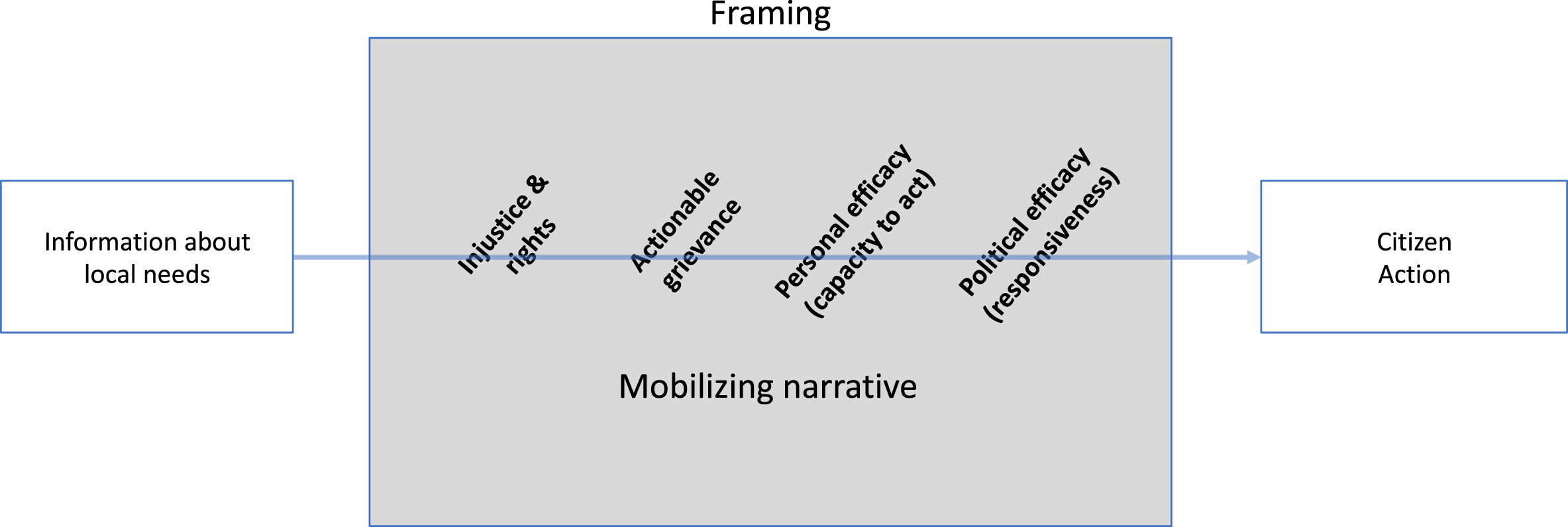
For many, a first step is to employ injustice and rights framings, making a local issue something worth complaining about while identifying the government as the legitimate target of those complaints. Social movement scholars have long observed that mobilization requires a “revision in the manner in which people look at some problematic condition or feature of their life, seeing it no longer as misfortune, but as an injustice” (Snow et al., 1986, p. 466). This insight is intuitive to the CCs, who know that community members who have “accepted the way in which they are living as a part of life” will “never make any effort to work on resolving the issues they face.”
27
The challenge for the CCs, then, is to shape residents’ conception of needs, as well as their sense of entitlement. One CC articulated this, explaining that by describing public goods as “rights,” he aimed to give residents the confidence to make claims of their own: We work to… make people brave enough to realize their rights living in a democratic country.... [Now] people have gotten better in terms of awareness, for example writing an application to repair a handpump because they have a right to drink water … applying to MGNREGA [work program] because they have the right to work.
28
But articulating an injustice or grievance also does not ensure action. Indeed, most residents are acutely aware of the many injustices they experience. Knowledge of one more right violated or entitlement unfulfilled may simply confirm their low expectations, leading to a “despondency trap” (Evans, 2020) in which low expectations beget low participation. In a community focus group discussion in a village in UP, for example, a woman expressed her disillusionment after efforts to have toilets constructed came to naught:
No officials have responded to our problems, even after we visited them in a group of 35 women…. Everything went to waste—our money, our time, or energy, and now we are hopeless.
29
To overcome this sense of despondency, CCs strive to frame local needs as actionable grievances. At issue here is whether residents feel that they have the capacity to act. While CCs regularly noted material obstacles to local participation, such as lack of time or money for travel, a far bigger set of obstacles, in the eyes of the CCs, are citizens’ beliefs about the possibility of change. As Piven and Cloward (1977, p. 12) noted of welfare rights mobilization in the United States, “social arrangements that are ordinarily perceived as just and immutable must come to seem both unjust and mutable” (emphasis added). This is one of the most difficult sets of dynamics for CCs to navigate. First, the CCs grapple with a low sense of personal efficacy among residents—that is, limited belief in their own abilities to navigate the political system. Almost three-quarters of CCs interviewed (14/19) stated that a lack of confidence was a primary factor inhibiting citizen action. For example:
If you tell them to go and meet the officials, they won’t go. They fear these officials… There is a certain image that people have…which makes them think that they can’t talk to them.
30
A primary task, then, is to shift individuals’ beliefs about their own abilities vis-à-vis the state. Video often plays a central role in efforts to build a sense of efficacy among residents. A number of CCs noted that there is something empowering about seeing oneself on screen. For example:
When community members … see themselves in the video speaking out on an issue they feel very proud of themselves. I remember one of the young men … who [after seeing himself] was asking everyone “Wasn’t I was looking like a hero?”
31
CCs also seek to mitigate residents’ fears by demonstrating, through their own actions, that officials are approachable. One CC, for example, explained:
“They see me working on an issue, for example writing an application and then reaching out to an official …, and the way in which I speak. These are things which the people never experienced before, but now are changing.”
32
Another CC reflected on the importance of accompanying residents on visits to government offices in order to ensure that they are treated with due courtesy:
I make sure they are treated well when they visit. Sitting on a chair in the office makes them feel so happy because they have never before been offered a chair by any official.
33
To believe that change is possible, residents must not only have faith in their own abilities to act but must also have some expectation that officials will respond. CCs’ efforts to bolster residents’ sense of political efficacy—that is, their belief in the responsiveness of the political system—must push against deeply engrained images of a distant and dismissive state. Almost 70% of CCs interviewed (13/19) cited the belief that officials will ignore them as a primary reason why community members do not engage in claim-making. CCs struggle, with some success, to re-frame residents’ expectations of government responsiveness. They do so, in large part, by attempting to demonstrate that contacting and petitioning an official can be effective. Video is a useful tool for demonstration. A number of CCs, for example, reported that they would screen successful “impact” videos produced in another village. As one recounted: The people from this community have suffered extreme exploitation for a very long time…. So, they don’t usually want to try their luck again. [But] after seeing the impact and knowing about the system of government officials, there are some people who willingly join my work….
34
CCs also try to build up a sense of efficacy by showing footage of prior impacts in the same village. One CC, for example, explained how he makes it a point to always return to show the final impact videos—even when no further action is required. This, he says, is an investment in his future work in that community: Whenever they see the videos, … they feel motivated and congratulate me for my work. Those who see the videos, it becomes easier for me to interact with them … and incorporate them in our process next time.
35
Some CCs, when working in a new community, try to get a quick “win,” in part to demonstrate their own competency, and in part to illustrate the possibility of change—even if it is related to something relatively small. A CC in UP, for example, explained how she would often choose something “easy” like a broken handpump when she was trying to motivate people.
“I can make them write an application and can go with them to the government officials to fix the hand pump …, and I am sure that it won’t take much time—within a week this problem can be resolved.”
36
The CCs, in sum, push against prevailing narratives of neglect, an unresponsive state, and the impossibility and inefficacy of action. They attempt to do so by articulating needs as injustices, by employing rights framings that identify the state as duty-bearer, and by signaling (often through demonstration) that residents have the capacity to act and that they should reasonably expect a response in return.
Framing to mobilize public officials
Much of the literature on accountability presumes a demand-driven chain from citizen mobilization, to pressure on officials, to improved governance outcomes. Recent scholarship questions this linearity, suggesting that citizens and officials might respond (or not) along different causal pathways (Fox, 2015; Tsai et al., 2019). This insight is not lost upon the CCs, who pursue distinct citizen-facing and official-facing strategies. This section examines the CCs’ accounts of their efforts to engage public officials, as summarized in Figure 3. Social brokers motivate bureaucratic responsiveness.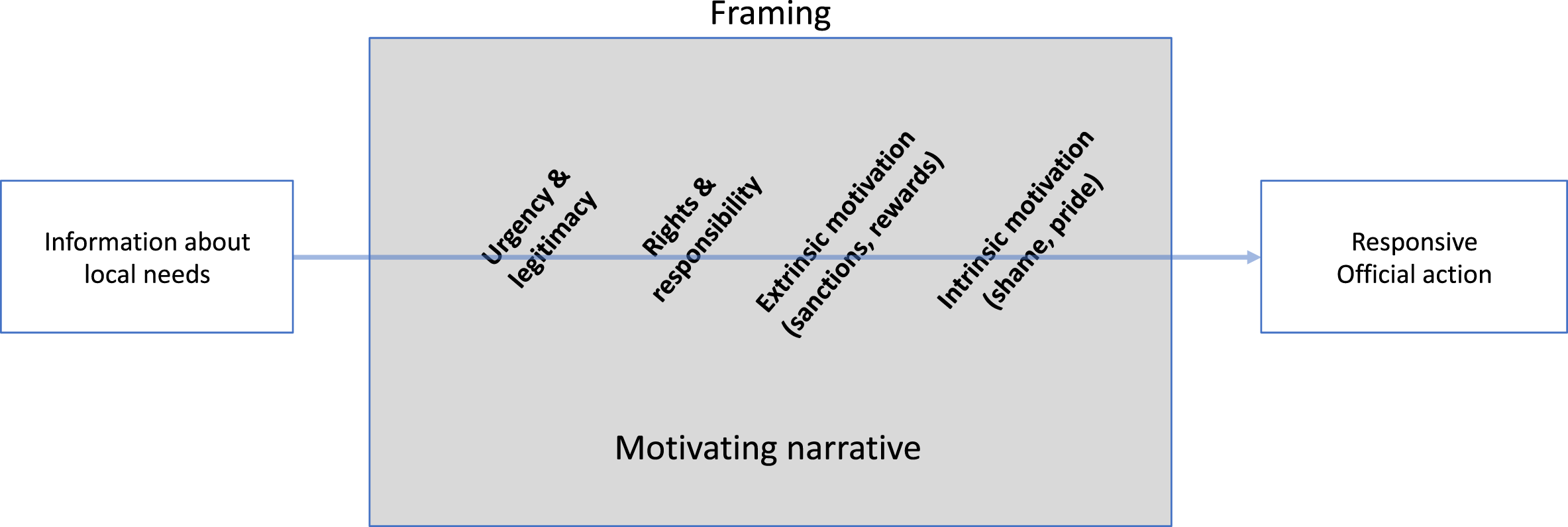
Simply presenting local needs may do little to stir an official, who likely faces myriad requests from citizens and who operates under conditions of near-constant overload (Dasgupta & Kapur, 2020). The CCs therefore strive to frame their accounts in ways that will make their claims stand out in the mix. They do so, often, by attempting to signal the urgency of a problem. Video footage helps in this regard, since it can illustrate and humanize the claims being put forth. Videos often involve an element of visual shaming as well as moral appeals. For example, a CC working on an issue of village electrification explained:
“I thought that with video it would be easy to capture the situation in which people were living, and that the official would come to empathize…. I captured one scene in which an old lady shared how she has been hoping since Independence to see electricity connections …. Those scenes moved the officials to think about the difficulty people were facing.”
37
Officials must also be convinced of the legitimacy of the claims being made, and believe that the claimants are deserving of support. CCs attempt to signal legitimacy on two levels: first, by presenting affected community members as credible and trustworthy, and second by employing rights framings that underscore legal mandates. Video again helps in the first regard, as CCs’ use their footage as visual evidence to corroborate citizens’ claims. To further underscore the legitimacy of their appeals, the CCs signal the depth of their procedural knowledge when conversing with officials. One CC, for example, explained: “We remind them about the application that has been made… [and] remind them about the status of application. We demand a date at which problem need to be solved.” 38 Another stated, “I update myself regularly on legal terms, because …. it can be helpful if the person sitting in front of [an official] is aware of all the legal tactics.” 39
But, just as the presentation of a grievance is insufficient to motivate citizen action, so too is the presentation of a demand—no matter how legitimate—insufficient to guarantee a response from officials. Interviews are replete with accounts in which an official refused to hear a claim, or even to view a CC’s video. In these cases, CCs need to frame their appeals in ways that motivate officials beyond a simple call to duty. A large literature explores the extrinsic incentives that may drive official responsiveness, including threats of sanction and promises of rewards (Tsai et al., 2019). CCs offered astute accounts of how they attempt to motivate officials along these lines. Many used their self-presentation as journalists (even carrying self-made “press” cards) and the video footage in their possession to threaten publicity, employing naming-and-shaming practices. One, for example, recounted a story of a refusal by local police to file a report: I posted the video in all my social groups like Facebook, WhatsApp, Twitter, and other media groups. When this video started circulating, within three days the report was done. The Director General of Police himself intervened.
40
The preceding example also highlights a second strategy: level-hopping to higher officials. As the same CC explained:
I will at first meet the official to gauge his personality. If he is a cooperative type, I will explain the problem to him. But if he is a difficult type, I will tell him that, if he does not give me a hearing, I will approach higher officials to tell them about the problem and the lack of assistance from the first [lower] official.
The aim, in contacting higher-level officials is to bring pressure to bear from within the bureaucracy (activating horizontal, within-government forms of accountability). The CCs, though, know how to combine carrots with sticks; in addition to threats of sanction, they offer credit and recognition. Crediting officials serves a dual purpose. It signals to officials that they might be recognized and rewarded by higher-ups for their performance. Just as importantly, it calls on intrinsic sources of motivation: pride and a sense of professional “calling” (Tendler, 1997). As one CC explained, “They [officials] feel good when their work is appreciated, since every day they receive a lot of applications and complaints.”
41
Another CC explained the strategy: We always give them [officials] their due credit and respect…. It helps in building good relations with them, and as a result it opens doors for many other problems which can be solved later. We show them the [impact] videos where we have mentioned their name. It is one of the ways to impress them.
42
One CC stated that he would intentionally try to call on officials’ sense of expertise and self-importance: Instead of telling them that they should do such and such to fix an issue, I ask them: “You tell us how to solve this. Is it within your ambit? If not, then please tell me who I should go to.” Often this approach will work since no one likes to be told what to do, but when asked for help or advice they feel bound to respond.
43
The CCs, in sum, work to shape how officials perceive citizens and their claims by applying frames of urgency and legitimacy, and by calling on extrinsic and intrinsic pressures (fear of sanctions, feelings of shame or obligation) and motivations (credit, pride, and a sense of professional calling). All these frames are amplified and made more powerful for officials if a CC acts with community members. If the CC is accompanied by residents when approaching an official, the urgency and credibility of their claims are more pronounced, the threats of sanction or promises of reward appear more real, and feelings of shame or pride are more poignant. This, though, requires linking the demand and supply chains of accountability. The next section investigates how this can be achieved, as why it is so difficult.
Interlocutors in the middle
As Brinkerhoff and Wetterberg (2016, p. 271) note, “Alignment between supply- and demand-side factors can promote mutual reinforcement for social accountability.” The CCs, I argue, have the potential to facilitate this alignment by combining two distinct social brokerage roles—one citizen-facing and the other official-facing, as depicted in Figure 4. Social brokers as interlocutors.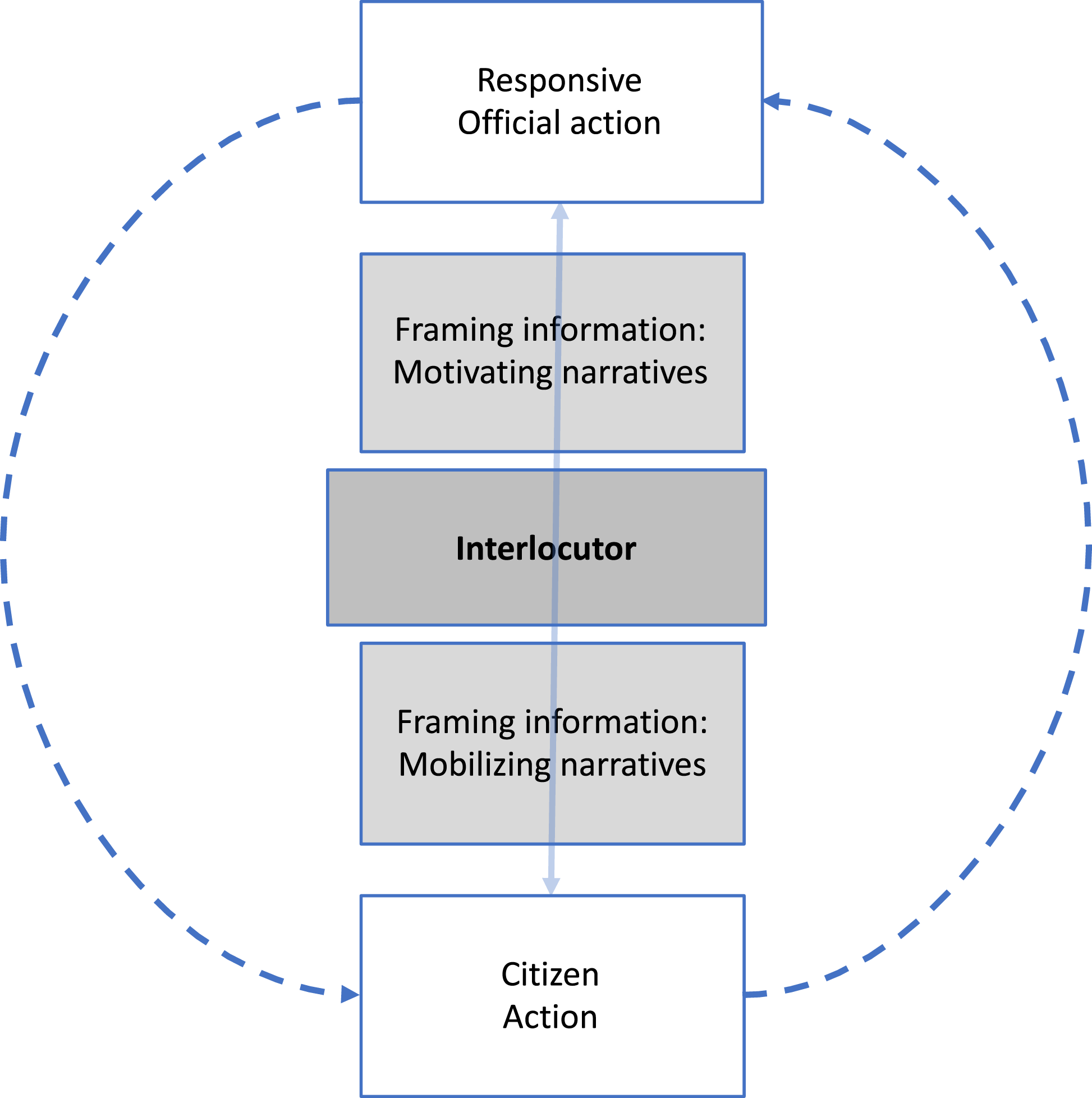
A CC in Bihar summed up this role very precisely:
I see my role as a bridge that connects people who need upliftment to the system that is supposed to help them, but which is somehow not working. I am the connecting point for both of them....
44
However, playing a bridging role is no easy feat. It requires the skill and savvy to speak simultaneously to two audiences, and to employ different framings and narratives for each. This is a tall order for many CCs—only some of whom (in particular settings, at particular times) manage to play this dual role. Figure 5 theorizes the different roles that a CC might play. These roles are not static; the CCs—almost all of whom work in multiple communities, including but extending beyond their home villages
45
—engage differently in different settings. Necessary conditions for social brokerage.
In some places, a CC might have strong local ties, which they leverage to deliver messages that are resonant and credible. So positioned, the CC might serve as an effective “mobilizer” who brings residents together for collective action. Mobilizers of this kind engage the demand side of accountability, prompting and amplifying citizen voices. However, if disconnected from the supply side, the voice generated may lack “teeth” or traction among officials (Fox, 2015). This, perversely, might contribute to a hollowing out of participation over time, if CCs raise citizens’ expectations beyond officials’ capacity or willingness to respond (Kruks-Wisner, 2021). A number of CCs pointed to this tension. They explained that their presence and the act of shooting a video could raise hopes. But, given the length of time involved in problem-solving attempts, and the fact that many such attempts are ultimately unsuccessful, hope can quickly turn to despair. As one CC worried out loud: “Their expectations have increased…. But, when impact does not follow, the motivation of the community falls down.” 46
A CC with vertical ties to bureaucratic networks, in contrast, is equipped to identify the channels through which to appeal to officials, and so may be well-positioned as a supply-side “fixer.” But if CCs operate solely on the supply side, acting on behalf of rather than with residents, they may reinforce views of the state as a distant entity accessible only through intermediaries. This, in the long-term, might create or deepen a sense of dependency on brokers. As one CC described of her interactions with community members: The moment I reach their village, if a certain issue is going on, I hear people say: “We should not worry anymore because Didi [older sister] has come and will get the solution.”
47
A CC with both strong local and vertical ties may be able to simultaneously leverage citizen voice and motivate bureaucratic responsiveness, acting as an interlocutor to bridge the accountability gap. It is in these instances that a CC serves as a true social broker, targeting and mobilizing both citizens and officials. Further research is required to systematically explore the conditions that enable individuals to play the role of interlocutor in some settings but not others. However, the experiences of those interviewed in Bihar and UP suggest that we should look to the CCs’ networks to understand the factors that support or constrain their abilities. 48 To illustrate, I present three “types” of CCs—representing different modes of intermediation—distilled from interviews and observations. These types should not be viewed as static, but as illustrative of a stylized range of roles that a CC might play.
At one extreme are the “handpump ladies,” so nicknamed by VV staff because of their tendency to repeatedly document the same kinds of issue (such as broken water pumps). These CCs, who are most often women, work in their own village and immediate surroundings (which are easily accessible and where they have family and social connections). These CCs enjoy some of the strongest local ties but may also have some of the weakest vertical linkages due to their restricted mobility. Thus, while they are well-positioned as local mobilizers, they may not have the ties to the bureaucracy necessary for problem-solving. A female CC in UP in her late 30s described a set of interactions that follow this mold. She recounted working in a nearby village where many did not have toilets due to the malfeasance of the elected village head who had diverted the funds for toilet construction. This CC had the advantage of community ties in a village nearby to her home, and sufficient trust from residents who were willing to join her in making demands. And yet she, just like the village residents, became blocked by the village politician who held sway in that locality. She lacked the outward connections to enable her to escalate the issue to higher-level officials or to other actors who could put pressure on the village head. Her attempts to solve the problem therefore ultimately failed, despite her ability to mobilize residents. 49 This was, in the end, a story of voice without teeth.
At the other extreme are “biker boys,” referencing the young men who move about (often on motorcycles) within an administrative block or district and who, given this mobility, have greater exposure to a wide range of public officials. These individuals may be effective problem-solving fixers. However, they may also be limited in their ability to motivate action in communities where they do not have strong prior ties. One CC in UP, for example, recounted his efforts to bring electricity and water connections to a village where he had not previously worked. He lamented that he could neither establish trust, nor shift residents’ deeply entrenched expectation that officials would not respond. Notably, he still “solved” the issue, by independently taking his video (without accompanying community support) directly to a district official. The CC in this case gained material “impact,” but was not able to mobilize citizen action. 50 This, then, was a case of problem-solving without citizen voice.
The “interlocutor” is a third type that sits in-between the handpump lady and biker boy, who is both grounded in local communities and connected to bureaucratic networks, and so who draws on a mix of local and vertical ties to mobilize community members and officials alike. Notably, these CCs (who often described themselves as “social workers”) were often older women with prior experience with development or social service organizations—experience that provided them with training and practice dealing with government agencies, and which helped them to build networks that extended beyond their immediate communities. One CC recounted how her prior engagement with a United Nations Development Programme (UNDP) project influenced her later work as a CC in village where she successfully secured back wages for laborers on a government worksite. She noted that, although this was not her home village, people there knew her from her work with UNDP, and so sought out her assistance. At the same time, she drew on her knowledge of the local administration (developed while working with UNDP) to effectively engage higher-level officials when she and the villagers were blocked by a corrupt village head. She drew, in other words, on a mix of both local and outward-reaching ties to successfully mobilize residents and bring pressure to bear on officials. 51 This was a case of voice with teeth.
The experiences of these CCs illustrate the challenges to but also enormous potential of intermediaries who attempt to motivate both citizen participation and government responsiveness. Brokers with ties to both local communities and to bureaucratic networks may be uniquely placed to align citizens’ and officials’ perceptions of local needs, responsibilities, and courses of action. This combination of strong local ties and effective outward connections is a powerful mix, but one which may be difficult to obtain and maintain.
Questions remain about the long-term dynamics of the CCs’ social brokerage, and its consequences for accountability. Much of what the CCs do is reactive—focused on discrete problem-solving objectives in the short term. Further research is required to explore whether this short-term engagement might contribute to more institutionalized forms of government responsiveness, which could perhaps prevent future accountability failures of the kind that made social brokerage necessary in the first place. An optimistic view might project that the CCs efforts set in motion a positive feedback loop, where citizen engagement helps the CC to frame their claims on officials more effectively, and official responsiveness increases the likelihood of further citizen engagement. These dynamics, though, are far from guaranteed, as claim-making can contribute to both positive and negative feedback loops depending on the responses of the state and of citizens (Gallagher et al., n.d). Whether deeper institutional changes in accountability take hold, I propose, likely rests on how successfully the CCs disrupt the equilibrium of a despondent citizenry and unresponsive officials.
Motivations for and varieties of social brokerage
Where else, beyond the CCs in rural India, might we observe similar patterns of social brokerage? To answer this question, I consider a range of cases that are both “induced” (supported by an external organization) and “organic” (occurring without formal organizational support). In making this distinction, I build from Mansuri and Rao (2013, pp. 31–32), who distinguish organic modes of participation that are “spurred by civic groups, acting independently of, and often in opposition to government” from induced participation that is “promoted through policy actions of the state and implemented by bureaucracies.” In the case of social accountability initiatives, inducement often comes from NGOs, who create and fund programs to support bottom-up monitoring of officials by citizens. 52
A key feature of “induced” social brokerage is that there is, in most cases, monetary remuneration from some kind of external organization for those who play the role of broker. The receipt of regularized payments, stipends, salaries, or other forms of compensation distinguishes social brokers in two important respects. First, it offers the financial freedom to break from a “clientelist feedback loop” (Rizzo, 2019, p. 3) in which intermediaries rely on the material support of political parties, and so work to keep citizens reliant on clientelist modes of exchange. 53 Second, it delineates social brokers from for-a-fee fixers who are paid directly by residents, who similarly are incentivized to perpetuate dependencies rather than build citizens’ own claim-making capabilities. Brokers are paid in all cases, but the sources of the payment vary, as do the different types of citizen engagement that they provoke, encouraging information sharing on the one hand and hoarding on the other.
Video Volunteers forms part of a large array of civic organizations active worldwide that seek—often but not always employing digital media or other technologies—to support local actors who serve as reporters-cum-mobilizers; 54 as “community change agents,” “support agents,” and “facilitators” assisting citizens to navigate administration; 55 or as “grassroots paralegals,” “court navigators,” and “advocates” brokering access to the legal system. 56 Government initiatives, often designed as part of participatory governance reforms, have similarly created roles for social intermediation; for example, through local fieldworkers trained under the Mahila Samakhya—a quasi-government agency for women’s empowerment in India (Mangla, 2021); or government-assigned “support workers” in Chile who assist residents in accessing poverty relief programs (Barrientos, 2010). The hybrid nature of these actors, who are embedded in both communities and in frontline state agencies, make them potentially important nodes for social brokerage. Future research might explore the differences between NGO- and government-induced social brokerage, with attention to differences in support structures, time horizons, scale, as well as partisan influence and autonomy.
Other forms of social brokerage are “organic,” in that they are not formally supported (or paid for) by an external organization, but rather emerge over time as individuals and groups identify and fill the need for intermediation. In rural India, for example, Kruks-Wisner (2018a) and Krishna (2002), have documented a wide array of brokers—only a small fraction of whom are affiliated with political parties—who create linkages between communities and state agencies. Some are elders or caste leaders in a community, who engage in intermediation to maintain their reputation and social standing. Others are younger, newer leaders seeking to build their reputations; they do not seek monetary payment, but instead expect to gain social returns—notably status, respect, and a “fund of social obligations” (Krishna, 2014, p. 179). Such brokers may also have political ambitions and, as noted above, may play the role of a partisan broker during elections; but most are “in it for the long haul” and so “invest in building longer-term relationships at the grassroots.” Auerbach and Thachil (2018) and Dunning (2009) observe similar sets of actors in urban India and Latin America, respectively. Dunning, moreover, observes that local neighborhood leaders may serve as “societal brokers” who, “rather than receiving requests from citizens and then using their power to contact the state, might help citizens themselves engage in unmediated direct action.” Roychowdhury (forthcoming), turning to the criminal justice system, identifies diverse “rights brokers” who help women experiencing violence to access the police and courts in India. Some of these, like dalaals, seek monetary enrichment; while others instead (or additionally) seek to build stocks of social, cultural, and symbolic capital by “becoming known as someone who did good works” (p. 4). Gallagher (2017) observes a similar role for “advocates” who assist families of the disappeared to navigate the Mexican judiciary. Many advocates are victims themselves, and so engage in this work because of a sense of solidarity and social mission. Such intrinsic motivations, often cynically dismissed, should not be ignored—particularly when brokers are also part of larger movements that provide normative and ideological framings for their work.
The motivations for social brokerage, in sum, are manifold, ranging from material incentives (payments by external organizations), to reputation (social standing and forms of capital), to political aspiration (for those who move between social and political brokerage), to sense of social mission (calling and vocation). Differently positioned individuals respond to different combinations of these. This was the case among the CCs. All referenced payments from VV as critical. But most also spoke in nuanced terms about their social commitments and convictions. One CC in Jharkhand—a woman in her twenties—summed this up powerfully, recounting her family history as part of a tribal rights movement: “We have always been for the people. My father is known in the community as a social worker; people come [to our] home any time anything is needed. And so it comes naturally to me as well. It is in my blood.” 57 Another young, female CC from a Muslim community in UP expressed her commitment to assisting women in accessing education. She was motivated in part by personal reasons; working as a CC gave her a degree of financial freedom (enabling her to leave her husband when in an unhappy marriage), but also was a pathway—in her eyes—to greater education (she had enrolled in an English language program) and future career advancement. She explained, “if I lead by example, I am lifting up myself and all the girls in my community.” 58 The gendered dimensions of these two accounts, as well as the fact that they come from members of tribal or minority communities, should not be overlooked. As Roychowdhury (forthcoming) reminds us, brokerage is neither class nor gender neutral, and we should expect differently placed individuals to have different reasons for engaging in social brokerage. The forms of capital (social, cultural, symbolic, reputational) that may be gained through social brokerage may be all the more critical and compelling to those (women, and members of marginalized social groups) who have the least access to economic and political capital.
Conclusions and implications
The accounts of the Community Correspondents, who I have argued are illustrative of a broader class of social brokers in India and beyond, offer a number of insights to inform theory and future research on social accountability. First, information is mutable; it takes on different meanings in different settings, filtered through the narratives and experiences of residents in a given locality. To understand the political uses of information—that is, how it can be employed to deepen citizenship practice—we must first understand its social life within particular local settings. Second, to be meaningful, information must be actionable. The issue here is not simply one of capacity, but of citizens’ expectations of the state and their belief in the efficacy of action. Third, social accountability initiatives must seek to activate both the demand and supply sides, avoiding the causal presumption that bottom-up demands from citizens will directly affect changes in the behavior of officials. Social accountability initiatives must therefore also consider the institutional settings and organizational cultures within which information takes on meaning for officials. Last, social accountability may hinge in large part on the role of social brokers and their ability to convert information and ideas into actionable narratives for citizens and officials alike. These dual-facing intermediaries are interlocutors between communities and the state, working to ground and vernacularize accounts of local needs. Commitments to social accountability therefore require investing in local social actors with the potential to play this intermediary role. Such local actors should not be romanticized; their embeddedness can also facilitate clientelist exchange or forms of elite capture. But their local knowledge and standing also make them best positioned to take on the hard but necessary task of social brokerage.
Supplemental Material
sj-pdf-1-cps-10.1177_00104140221089644 – Supplemental Material for Social Brokerage: Accountability and the Social Life of Information
Supplemental Material, sj-pdf-1-cps-10.1177_00104140221089644 for Social Brokerage: Accountability and the Social Life of Information by Gabrielle Kruks-Wisner in Comparative Political Studies
Footnotes
Acknowledgments
For research support and critical insights, I thank Jasneet Kaur, Amol Ranjan, Shahnawaz Siddiqui, Manisha Walia and Hayley Elszasz; and my partners at Video Volunteers, in particular, Jessica Mayberry, Stalin K. Padma, Grahesh Parker, Manish Kumar, Amrita Anand, and Mithilesh Kumar. For valuable comments on this and related drafts, I thank Adam Auerbach, Daniel Berliner, Jennifer Busssel, Rachel Brulé, Simon Chauchard, Janice Gallagher, Alisha Holland, Sonia Kruks, Tessalia Rizzo, Dyuti Saunik, Surili Sheth, Sandip Sukhtankar, Lily Tsai, Michael Walton, Ben Wisner, and Alisa Zomer.
Declaration of Conflicting Interests
The author declared no potential conflicts of interest with respect to the research, authorship, and/or publication of this article.
Funding
The author gratefully acknowledges financial support for the research of this article from the MIT GOV/LAB, the American Institute of Indian Studies, and the Quantiative Collaborative at the University of Virginia.

Supplementary Material
Notes
References
Supplementary Material
Please find the following supplemental material available below.
For Open Access articles published under a Creative Commons License, all supplemental material carries the same license as the article it is associated with.
For non-Open Access articles published, all supplemental material carries a non-exclusive license, and permission requests for re-use of supplemental material or any part of supplemental material shall be sent directly to the copyright owner as specified in the copyright notice associated with the article.
