




Abstract
A substantial literature concludes that democratic-type institutions curb governments’ propensity to expropriate foreign direct investment. However, little attention has been paid to the strategies of expropriation regimes employ. We theorize that more politically constrained regimes will utilize expropriation methods that help them overcome institutional impediments. Using data on expropriations in developing countries between 1960 and 2014, we show that rather than rely on the most direct and overt forms of expropriation, constrained regimes tend to use more indirect and covert methods, such as forced sale or contract renegotiation, tools which can be harder to identify, easier to justify, and frequently face lower legislative approval hurdles. Indeed, while more politically constrained regimes are less likely to overtly expropriate foreign investment than less constrained regimes, they are nearly as likely to do so covertly, introducing new questions about the extent to which institutional constraints really translate into improved protections for foreign investors.
1. Introduction
Foreign direct investment (FDI) can provide important benefits to developing countries, not only spurring productivity and growth but also encouraging the introduction of new technologies. Yet in order to attract this potentially lucrative form of capital, governments must be able to credibly commit not to expropriate the property of foreign direct investors. A substantial literature stemming from the work of Olson (1993) and North and Weingast (1989) concludes that regimes with more democratic-type institutional constraints have an inherent advantage when it comes to making such commitments. Proponents of this view argue that although all regimes may face similar temptations to expropriate, those governments with increased checks on their authority through legislative oversight of the executive and public accountability should be less likely to act on those temptations (see, e.g., Jensen, 2003, 2006, 2008; Li, 2009; Li & Resnick, 2003). Such theories offer important predictions about the rate of expropriation of FDI across various forms of government, yet there is another element of variation on which these theories are largely silent: the strategy of expropriation.
While all forced divestment may be undesirable from the perspective of the original property holder, there are important differences in how involuntary ownership transfer can be accomplished and the extent to which this is likely to be curbed by institutional impediments. The most overt forms of expropriation, exemplified by such instances as Venezuela’s issuance of an Expropriation Decree in 2010 ordering the immediate nationalization of a foreign-owned glass-container company, 1 represent clear and deliberate violations of the investor’s property rights. By contrast, less outright methods of expropriation, such as coerced sale or forced contract renegotiation, can similarly transfer ownership of a private asset to the state without adequate compensation but may be more difficult for third parties to distinguish from a mutual agreement. This may allow states to dissemble about the degree to which they are actually engaging in forced divestment. For example, when Bolivia coerced several oil companies into selling to the state in 2006, the government made a great show of claiming that the sale had been voluntary and then used this to argue that no expropriation had in fact occurred (Quiroga, 2008).
In other words, unlike outright nationalization via executive decree, strategies of expropriation that entail forcing the investor to agree under duress to sell or otherwise transfer his stake to the state can help governments claim publicly (albeit insincerely) that the terms of the transfer were fair. This not only might help reduce the economic consequences of the expropriation and any concomitant public backlash, but it may also allay the concerns of legislative veto players that the act will lead other investors to pull out en masse, a consideration that may be particularly important to legislators in so far as they have investments in foreign-owned companies and other stocks that may suffer reduced value as a result of domestic expropriations (Jha, 2015). In fact, as recently as 2012, the Kyrgyzstan legislature blocked an attempt to engage in outright nationalization of a gold mine while nevertheless later permitting steps to be taken toward a forced contract renegotiation transferring a greater portion of the mine to the state (Dzyubenko, 2012). Moreover, states can even engage in methods of expropriation that bypass the legislature altogether by pursuing property transfers through extra-legal means, such as when state-affiliated agents seize the asset in question without official approval from the central government. Under such extra-legal strategies, legislative constraints on the executive not only become entirely moot but governments gain plausible deniability regarding their involvement in the seizure, helping them avoid any domestic repercussions. Taken together, the above discussion suggests that executives that face political impediments to unilateral action may gravitate toward or even prefer methods of expropriation that offer an alternative to the more outright and unambiguous strategy of nationalization via decree. It also suggests that two of the primary mechanisms often assumed by scholars to play a central role in protecting foreign investors’ property rights from expropriation—legislative constraints and audience costs—may be less effective at preventing methods of confiscation in which government culpability is less clear cut.
Therefore, much as Kono (2006) has suggested that democracies tend to use less conspicuous methods of trade protections, we theorize that more constrained governments ought to use methods of forced divestment for which culpability on the part of the government can be disguised or what we term “covert” methods of expropriation. Such methods allow politically constrained regimes to enjoy the advantages of expropriation, while minimizing the bite of institutional impediments. By contrast, minimally constrained governments should tend to rely upon more explicit, outright methods of property transfer or what we term “overt” forms of expropriation. Overt expropriation, as exemplified by the previously mentioned Venezuelan case, is typically accomplished via an official act of the legislature (where one exists) or via executive writ. This is desirable for leaders with fewer checks on their authority because it provides an immediate and sizable benefit that accrues directly to the state without requiring any sort of extended show of negotiation with the aggrieved party, as can be required in the case of forced sales or contract renegotiations. At the same time, this strategy is also the most obviously expropriatory and, as we will demonstrate, the most difficult to achieve in the face of institutional impediments, which should make it less viable for more politically constrained regimes.
In order to test our claims, we leverage existing data collected by Kobrin (1980), Minor (1994), Hajzler (2012), and Hajzler and Rosborough (2016) on over 700 acts of expropriation of foreign direct investment that occurred in a substantial subset of developing countries between 1960 and 2014. Through a combination of our own investigative efforts and reliance on prior coding by the researchers who originally recorded the expropriatory acts, we have been able to categorize the types of forced divestment that actually occurred across nearly all of our dataset. Although scholars have observed a recent rise in “indirect expropriation,” which frequently involves regulatory encroachment as opposed to intentional takings (Pelc, 2017), and while international investment agreements now protect against a wide array of contract breaches, for our primary analysis, we purposely restrict our attention to instances in which the transfer of assets from the foreign investor was the apparent objective of the act in question. We do this for several reasons.
First, it offers a particularly hard test of the theory. While regulatory or other policy changes can harm foreign direct investors and do sometimes result in investment disputes, the intent of these acts is often unrelated to the transfer of assets or loss of value. For example, one recent investment dispute involved Australia’s plain packaging laws for cigarettes, laws that were presumably less motivated by a desire to reduce the wealth of multinational cigarette companies than by a desire to reduce instances of lung cancer in the Australian population. Likewise, though a foreign hotel company initiated arbitration against Costa Rica for refusing to grant it a building permit in Playa Grande, the refusal was seemingly based on an attempt to protect endangered sea turtles, rather than on a desire to transfer private assets. In fact, we might actually expect that regimes that are more accountable to the population may be especially likely to put in place public interest legislation, even when an unintended consequence of that legislation is harm to foreign investors. In both the Australian and Costa Rican case, public interest groups broadly supported the disputed laws. By contrast, we intend to show that even when it comes to the intentional forced divestment of foreign direct investors’ assets, behavior that scholars have broadly assumed should be hindered by political constraints, governments can still work around such constraints by simply using revised methods to attain the same end.
Second, the focus on deliberate expropriations allows us to speak directly to the literature on political constraints and property rights, work that has been explicitly concerned with predatory behavior on the part of governments. It also offers the opportunity to continue to build on recent research suggesting that the democratic advantage may be overstated when it comes to such predatory behaviors (see, e.g., Graham et al., 2018).
Finally, using acts of expropriation, rather than other types of harmful policies, helps us ensure that forced divestment is the goal, thereby holding constant the intent behind the act. Although this means we are not able to weigh in on the question of how governments differ in their propensity to honor investment contracts more broadly, it does allow us to speak to what we believe is an equally important question, which is how states’ institutional characteristics lead them to pursue similar outcomes in strategically dissimilar ways. This, in turn, can help scholars better understand the logic behind governments’ divergent behaviors across a broad array of policy areas.
Our empirical results offer support for our theoretical expectations, revealing that, conditional on expropriating at all, regimes with more robust political constraints in the form of greater legislative oversight on the executive and more vertical accountability to citizens are significantly more likely to utilize covert methods of forced divestment. Specifically, moving from the first to the third quartile in terms of legislative constraints is associated with a 30% increase in the likelihood of relying on covert rather than overt methods of expropriation, while the equivalent effect in terms of vertical accountability is a 25% increase. In addition, using a panel of developing countries that includes both nations that did and did not expropriate during the period under study, we find evidence that although political constraints are quite effective at reducing overt forms of expropriation, their ability to impede more covert methods is statistically and substantively far smaller, such that one cannot reject the null hypothesis that legislative constraints and vertical accountability play no role whatsoever in preventing covert modes of forced divestment.
Our findings provide important nuance to the long-standing conventional wisdom that politically constrained regimes are less likely to expropriate foreign direct investment than more autocratic alternatives. We show that this may be less a difference of rate than of strategy, raising fundamental questions about whether it is really the case that institutionally constrained regimes are less likely to engage in all forms of expropriation or just some. Considering that less overt forms of forced divestment are, by definition, harder to identify as constituting state-led expropriation, this suggests that the literature may have generally tended to overstate the advantage conferred by political institutions in protecting foreign direct investments from intentional encroachment.
The rest of the paper proceeds as follows. In the next section, we provide a brief overview of what is known about governments’ propensity to violate the property rights of foreign direct investors. We then outline our theory for why we expect to see differences not just in rates of property right violations but also in method. Our theoretical section is followed by a description of our data. Finally, we present our findings and conclude.
2. The Propensity to Expropriate
Governments have a variety of incentives to engage in the expropriation of foreign direct investment, defined here as the deliberate, involuntary transfer of ownership rights. 2 In some cases, the seizure of foreign assets may provide a short-term monetary windfall, which can then be used to refill dwindling state coffers in economic downturns, pay off government loyalists, appeal to special interest groups, or prop up an individual party or leader. In other instances, governments may simply decide that a contract that had been previously agreed upon no longer serves government interests and that the state would be better off controlling the asset itself. Expropriation may even be a way to satisfy certain domestic constituencies, who may value expropriation due to its potential for redistributing income from foreign to domestic actors.
While there are numerous possible reasons governments may engage in expropriation, the act can generally be said to reflect the prioritization of short-term gains over long-term costs. And expropriation is far from costless in the long-term. Perhaps the most obvious cost is that the seizure of private assets can lead to a loss of investor confidence, resulting in reduced investment or disinvestment by investors worried that their principal will be vulnerable (Wellhausen, 2015). To the extent that FDI contributes to economic growth and technological transfers, a substantial reduction in these investments also means that a country may miss out on opportunities to acquire beneficial financial inflows and valuable technical knowledge. Perhaps equally concerning from an economic standpoint, expropriation can result in substantial efficiency losses, particularly if it occurs in technologically complex industries, as states may be less capable of managing a previously foreign-owned company than the actor from which they seized it (Opp, 2012). Finally, expropriation can contribute to political tensions, as foreign governments step up to defend the financial interests of domestically headquartered multinationals who have been the victims of asset seizure. Such international political consequences were on full display following Argentina’s decision to expropriate a Spanish energy company in 2012, a move that led to public reprimands by the Spanish Foreign Minister (Argentina, Spain at Odds Over Oil Company Expropriation, 2012).
Given both the benefits and costs inherent to expropriation, what might explain a government’s relative propensity to engage in it? An influential literature has focused on the role of political institutions. Building off of Olson (1993) and North and Weingast (1989), who argued that democratic-type institutional constraints help to guarantee property rights more broadly, numerous scholars have sought to evaluate whether such constraints might similarly protect against expropriation of FDI in particular. There are several reasons why we might expect there to be a negative relationship between institutional constraints and expropriation of foreign investments.
First, greater institutional constraints on the executive should reduce the government’s ability to pass new statutes (Tsebelis, 1995, 2000), including those that allow for expropriation. Even if veto players alone are not always enough to constrain the state (Stasavage, 2002), because expropriation can damage current and future financial relationships, at least some legislators ought to oppose it (see, e.g., Wellhausen, 2014, p. 21), particularly those wealthy enough to hold assets in the form of investments (Jha, 2015). This suggests that the greater the degree to which there exist political actors willing and able to impose oversight on the executive, the more likely that the executive could face resistance to an expropriatory act and the more likely that the act would thus be prevented.
Second, to the extent that expropriation undermines current or future investments as well as long-term economic growth, certain sectors of the voting public, as well as private interest groups, ought to serve as a bulwark against it. This is not to say that voters will always oppose expropriation. On the contrary, there may be instances in which even a majority of the public supports the confiscation of foreign assets at the time that the confiscation takes place. 3 Nevertheless, as expropriating governments lose the trust of foreign investors, leading to reduced job opportunities and stagnant growth, there is an increased risk that voters, particularly those that are financially savvy, may be inclined to punish officials at the polls. Jensen (2003, 2006, 2008) refers to this mechanism as “audience costs,” positing that “If governments make agreements with multinational firms and renege on the contracts after the investment has been made, democratic leaders may suffer electoral costs” (Jensen, 2006, p. 81). Concern about these electoral costs could then play an additional role in dissuading certain legislators from voting in favor of an obvious expropriatory act. Notably, this could hold even in cases in which a large portion of the general population actually supports expropriation since legislators will predominantly be worried about their own voters, as opposed to the population as a whole.
2.1. Evidence on the Propensity to Expropriate
Among those who have examined whether politically constrained regimes are in fact better able to commit not to expropriate foreign direct investment, many have found support. For example, a number of scholars have identified a positive relationship between the property rights protections afforded under democratic-type legal institutions and FDI inflows (see, e.g., Jensen, 2003; Li, 2009; Li & Resnick, 2003; Nieman & Thies, 2018; Staats & Biglaiser, 2012). In addition, several studies have shown a direct link between expropriation risk and institutional constraints. For example, Jensen (2008) finds that political risk firms charge lower expropriation insurance rates for investments in democracies and offers evidence that this is due to increased constraints on the executive in democratic regimes. Li (2009) concludes, using actual instances of expropriation, that democracies are less likely to expropriate FDI overall, while also showing that leaders’ time horizons play an important mediating role. Wilson and Wright (2015) demonstrate that even in autocracies, legislatures can have a constraining effect on acts of expropriation, with this effect dependent on whether the autocracy is or is not a personalist regime. Finally, Graham et al. (2018) find that veto players reduce expropriation risk, as assessed by a leading political risk firm.
At the same time, several recent studies have offered caveats. Perhaps most notably, the Graham et al. (2018) article just mentioned shows that although veto players do protect against expropriation risk, they fail to protect against transfer risk, an important form of creeping expropriation. In addition, using Jensen’s political risk outcome, Fails (2012) shows that inequality has an important conditioning effect on executive constraints. Finally, Albornoz et al. (2012) find that democracies are actually more likely to expropriate in sectors that use labor less intensively. 4
The literature cited above provides valuable insight into the extent to which a regime’s institutional characteristics protect against the seizure of foreign direct investment. However, almost none of this work has attempted to evaluate whether different political institutions might encourage different methods of forced divestment. 5 In fact, there seems to be an implicit assumption across the vast majority of this work that any expropriatory act involving the deliberate, involuntary transfer of ownership away from foreign investors is theoretically equivalent to any other. 6 We believe that the absence of theorizing on the motivations behind different forms of forced divestment leaves under-explored an important way in which regimes ought to diverge.
In the next section, we outline the theoretical reasons to expect that countries under differing degrees of political constraints will systematically vary not only in their propensity to expropriate but also in their strategies of acquisition. Specifically, we suggest that although scholars have long-assumed that intentional acts of forced divestment are highly sensitive to institutional constraints, such constraints should only act to curb the most undisguised forms of this behavior, while doing very little to prevent more veiled methods.
3. Impact of Institutions on Expropriation Strategy
Because expropriation of foreign direct investment can have a negative impact on specific domestic actors, as well as on the economy as a whole, democratic or even autocratic leaders who have to navigate checks on their power through public accountability and legislative oversight ought to find it more difficult to engage in this type of behavior than those without commensurate institutional impediments. Yet here we introduce an important qualification that, to date, has received little attention from those seeking to explain patterns of forced divestment: not all expropriation is equally susceptible to domestic political constraints.
For constraints on the executive to be effective, expropriation must occur through channels in which institutional constraints come into play. In addition, those in a position to constrain the executive must have the motivation to do so. Crucially, however, not all methods of expropriation require legislative approval, making it unclear why legislators should be expected to constrain those means of expropriation over which they have no say. Moreover, in those cases in which potential veto players must sign off on an expropriatory act, there should be some variation in their willingness to do so. Specifically, officials are most likely to block an expropriation if failure to do so would hurt their ability to stay in office or their own financial fortunes. Yet officials’ future office prospects as well as their financial well-being may not be equally impacted by all methods of expropriation. For example, a paper by Pelc and Kerner (2021) suggests that more flagrant acts of contract breach are more likely to harm future investments, suggesting that less obvious property rights violations may do far less damage to the economy as a whole and to those who rely on FDI specifically. This implies that veto players may be less likely to veto and potentially impacted voters may be less likely to punish acts of expropriation in which the government’s culpability is less obvious.
Likewise, to the extent that some portion of the public acts as a mitigating force against legislators supporting an expropriation (in cases in which legislators are involved), the public is most likely to play this role if they are able to observe that the act actually constitutes a deliberate property rights violation by the government and conclude that the violation could either contribute to bad economic outcomes or damage the country’s reputation with foreign investors. This is not to say that the public will always oppose expropriations in the first place, nor is it to say that the public will be united in its opposition of the act. It is simply to say that to the extent that some portion of the public does disapprove of actions that could undermine the country’s reputation with foreign investors, this is only likely to be relevant if the public knows that the government is deliberately engaging in action that is damaging to the country’s reputation. Public observation, however, is most likely to occur through media coverage, 7 and the media is most likely to cover particularly egregious acts of expropriation since these make for better reading or viewing. By contrast, while acts of ambiguous forced divestment may receive some press, they make for far less sensational material, if they are covered at all. As a result, legislators who represent voters who may be financially harmed by expropriations will be most dissuaded from offering their support in cases in which expropriations are most likely to be observed by their constituents.
Taken together, this suggests that institutionally constrained regimes will be particularly unlikely to engage in acts of expropriation that visibly and unambiguously rob the foreign entity of its stake without its consent, that involve clear culpability on the part of the government, and that require the approval of potential veto players. At the same time, it is far less clear that such governments should be heavily dissuaded from forms of expropriation that are less visible, less clearly entail intentional violations of the foreign investor’s property rights, or do not require legislative approval. These are important distinctions. As it turns out, governments have a range of tools available to them when it comes to depriving foreign entities of the value of their investment, and these tools vary not only in their extent of encroachment but also in the degree to which they are visible to the public, provide the cloak of legitimacy, or require the approval of potential veto players. In particular, scholars such as Hawkins et al. (1976), Kobrin (1980), and Hajzler (2012) have identified four separate means by which governments might go about divesting foreign direct investors of their property.
3.1. Strategies of Expropriation
The first method through which governments can engage in forced divestment is via what Kobrin and others have termed formal expropriation. Formal expropriation is the most direct or, as we term it, “overt” means of forced divestment. According to Kobrin, formal expropriation can be defined as [t]he taking of foreign property directly by the government under the due process of local law. This generally entails an act of parliament or an executive order for which proper authority exists” (1980, p. 68). In other words, this form of expropriation involves the wholesale, government approved transfer of property from the foreign investor to the state. As evidenced by the flurry of international news coverage following Hugo Chávez’s 2009 decision to nationalize the oil industry through an official act of law, as well as following his explicit nationalization of several firms in the agricultural and manufacturing industries, formal expropriation tends to be a highly public and entirely undisguised form of seizure. In addition, it requires the official acquiescence of the legislative branch, where one exists.
The second means of expropriation is forced sale. This is when the government uses threats, harassment, or other forms of coercion to compel a foreign owner to sell to the government at a price that may not reflect the investment’s true value. Like formal expropriation, this occurs through legal channels, but unlike formal expropriation, it provides the government with the ability to claim, however insincerely, that the sale was voluntary. Indeed, even scholars studying expropriation acknowledge that “[i]n forced sales of foreign property it may be quite difficult to distinguish between the bargaining posture of an investor who may be quite happy to ‘get out’ and a legitimate forced divestment” (Kobrin, 1980, p. 68). Forced sale can also entail a lower legal bar for the executive, given that the sale is typically accomplished not through unilateral writ but after the company has already been coerced into accepting the proffered terms. As a result, even though the legislature may need to sign off on such a sale, given that legislators are making that decision at a point at which the company has already conceded the field, lawmakers ought to face less pressure from the public or the company itself to deny the sale than they would to deny an outright nationalization that has no pretense of mutual agreement.
The third method of expropriation is contract renegotiation. Similar to forced sale, this is when the state uses coercion or the threat of coercion to force the foreign entity to enter into a renegotiation of the original terms to which the two parties agreed in a way that transfers all or part of the foreign entity’s property to the state. 8 Much like forced sale, expropriatory contract renegotiation may be difficult to pinpoint, as it provides the facade of an agreement between the host government and the foreign investor, thereby offering cover to the expropriator. Indeed, some scholars who have attempted to code acts of expropriation have noted that recorded instances of contract renegotiation may be underestimated, which “may be more the result of their low visibility than their infrequency in practice” (Hawkins et al., 1976). In other words, contract renegotiation also differs in a crucial way from formal expropriation. Not only does it represent a less obvious form of breach, making it less newsworthy and less easy to identify, but it offers a veneer of compromise and mutual acceptability that is typically lacking with nationalization.
The final strategy of expropriation is intervention. Intervention occurs through extra-legal means, either by public agents or by private actors. In some cases, the government subsequently legitimates the transfer, and in all cases leaders do not step in to prevent it or provide immediate compensation, a decision that may stem from a desire to retain the property when the seizure is by a public agent or from a desire to appeal to the expropriating group when the seizure is by a private one. Because intervention does not occur through legal channels, it does not require the official approval of the executive or legislative branches of government. In addition, even in cases in which elements of the government play a central role in the taking, the central authorities can, at times credibly, claim a lack of complicity. For example, in 2003, 25 policemen took over the offices of an American telephone operator in Côte d’Ivoire, leading a senior Bush administration official to accuse the government of “the worst treatment of an investor and the worst example of state-sponsored thuggery I have seen anywhere.” In response, the Ivorian government issued a statement saying, “Côte d’Ivoire has never expropriated a foreign company, whatever the nationality, and has never had the intention to do so. The government deplores the incident that occurred between the protagonists and will take all necessary measures to deal appropriately and definitively with the issue” (Both quotes found in Kramer, 2003). As this example and the above discussion make clear, intervention is a fundamentally different act than formal expropriation, in that it not only requires no approval from the legislative branch, but it allows the government to claim a lack of complicity. 9
The discussion of these four strategies or types of expropriation demonstrates that they can vary significantly, not only in their mode of accomplishment but also in their degree of visibility and susceptibility to institutional constraints via either audience costs or legislative oversight. In particular, formal or what we term “overt” expropriation due to its unambiguous nature typically provides the fastest and greatest windfall for an actor facing few political impediments since it requires no negotiation with the foreign company and entails a wholesale taking. This form of expropriation may also be appealing to governments that only need to win over a narrow portion of the population (which also is likely to be the case in less constrained governments) since some portion of the public may directly benefit from and thus favor expropriation. At the same time, overt expropriation is also the most indisputable form of expropriation, as well the hardest to defend as either outside the government’s control or mutually agreed upon.
On the flip side, the remaining three means of forced divestment offer some element of plausible deniability and/or a facade of mutual agreement. Though the acts themselves may be quite visible at times, the degree to which they constitute a deliberate and one-sided decision on the part of the host government to deprive the foreign entity of its ownership rights is generally more ambiguous than in the case of formal or “overt” expropriation, a shared quality that leads us to term these three alternative strategies “covert” expropriation. Covert expropriations have some disadvantages relative to overt expropriations in the sense that both contract renegotiations and forced sales often require extended negotiations, meaning they may take longer to realize or may necessitate higher compensation than overt takings. As for intervention, the lack of legal legitimacy and the fact that the seized assets may not accrue directly to the state mean that this form of forced divestment may not offer the central government the same benefits as formal expropriation.
Nonetheless, these three alternate strategies of expropriation have the advantage of being more difficult to identify as a clear violation of property rights by the government, potentially offering cover both to the executive and to potential veto players worried about their constituents’ or their own future investments. Governments seem to appreciate and indeed play into the difficulty of labeling covert expropriation for what it is. Whereas denial of complicity may serve as a useful excuse in cases of intervention, as highlighted in the Côte d’Ivoire example, when it comes to contract renegotiation and forced sale, governments often fall back on legalistic rhetoric to mask the breach that has occurred. For example, in defending its decision to raise levies on foreign-owned Bauxite mines by 470% in 1974, the Jamaican Prime Minister painted himself as “entirely responsive” to discussions with the companies regarding their future and noted that additional contract changes would “of course, be subject to negotiation” (Riding, 1974). Subsequently, the Jamaican Prime Minister justified further encroachments against the companies by stating: “The companies have failed to prove that Jamaica’s position is unjust or based on faulty logic. In the [sic] light of this, the Government has decided to exercise its sovereign right to impose just and equitable taxation” (Neita, 2014). A more recent incident involving Bolivia offers another illustration of how governments can use covert forms of expropriation while still offering the appearance of mutual agreement. After a state takeover of four energy companies, Bolivia’s Energy Minister reassured reporters, “This is not a forced sale because since May 1, 2006, the companies have sent various letters where they accepted the nationalization decree. The sale is not compulsive and is being done within negotiated parameters” (Quiroga, 2008). These examples suggest that forced sale and contract renegotiation allow states to dissemble about whether a breach of contract has occurred. These forms of expropriation, therefore, help governments claim to respect the rule of law, even while engaging in an act that represents the repudiation of a formal agreement.
Because covert expropriation is less identifiable as a forced divestment than overt forms and also less obviously violates legal norms, we expect that both legislative constraints and audience costs ought to play a reduced role in preventing it, suggesting that more constrained regimes will gravitate toward covert strategies. Legislative constraints should have a lesser impact in part because legislators should be more willing to vote in favor of covert expropriation in situations in which their approval is required. Qualitative evidence provides some preliminary support for this hypothesis. For example, as mentioned in the Introduction, in 2012, Kyrgyzstan’s parliament blocked an attempt to nationalize a gold mine owned by Canadian mining company Centerra Gold. At the same time, the legislative body did allow a special commission to work on implementing a revised contract that transferred increased control and ownership of the property to the state (Dzyubenko, 2012). Legislators’ greater willingness to approve covert expropriation may also at times stem from the fact that such expropriations might only require them to approve the final deal, after a firm has already been forced into agreeing to a change of ownership. This then allows legislators to pretend (or possibly even believe) that they are merely facilitating a mutually agreeable outcome. Furthermore, because forced sales and contract renegotiations are framed as a negotiated bargain, legislators who would otherwise oppose expropriation can be brought on board by making the forced divestment seem slightly more beneficial to the aggrieved party, even if, in reality, that party is still acting under duress. Indeed, such dynamics appear to have played out during the 2006 Bolivian Petrobras expropriation, which was accomplished through a contract renegotiation (Hajzler, 2012). During the renegotiation process, members of the opposition party in the senate that otherwise might have blocked the action were brought on board after making changes to the revised contract that favored the foreign entity (Jones, 2007). Moreover, in the case of intervention, legislators can be entirely sidelined, as this form of expropriation is not accomplished through a formal act at all. All of this suggests that legislative constraints on the executive will often prove less binding or entirely irrelevant when it comes to using covert expropriation.
Similarly, to the extent that both the executive and legislative branches worry about members of their constituencies opposing expropriation before or after the fact and then holding them accountable, here too the strategies of expropriation that we term covert ought to be less sensitive to these sorts of audience cost constraints. The logic here is similar to that for legislative constraints. Specifically, because the public is often less able to identify contract renegotiation and forced sale as a form of expropriation that is damaging to the economy and to their financial interests, they will also be less likely to vote against politicians who support it. Indeed, this may explain why governments that engage in expropriatory contract renegotiations and forced sales are often at such pains to claim that the outcome was mutually agreed upon. 10 In addition, in the case of intervention, because this occurs outside of legal channels, in the same way that government officials can claim plausible deniability to investors, they can also claim plausible deniability to voters, thereby potentially reducing any electoral consequences.
The discussion thus far suggests that there are theoretical reasons to expect that when institutionally constrained regimes expropriate, they will gravitate toward the three methods of expropriation that we term “covert,” while being inhibited from using formal or “overt” expropriation. By contrast, unconstrained autocrats may actually prefer overt expropriation, due to its potential to provide an immediate benefit through unilateral declaration. In addition, regimes that only need to appeal to a subset of the population and are not constrained by legislators facing divergent voting blocs may actually benefit from overt expropriation in cases in which the executive’s selectorate supports such an action.
4. Data and Methods
In order to investigate the relationship between political constraints and strategies of expropriation, we leverage existing data on expropriations from several sources. 11 Our earliest data come from Kobrin (1980), who recorded acts of forced divestment in a subset of developing countries between 1960 and 1976. Kobrin defines an act of expropriation as “the forced divestment of any number of firms in a single industry in a single country in a given year” (72). This means that some acts involve the taking of only a single entity, while others entail the seizure of a large number of companies. While Kobrin acknowledges that this means that acts may vary in the value and number of firms expropriated, this unit of analysis most accurately captures each individual decision to expropriate. Kobrin collected his data through the systematic search of a large number of secondary sources, including U.S. State Department reports, business periodicals, and newspapers. To the extent that Kobrin’s reliance on secondary sources might introduce bias into the data, it ought to bias toward more frequent observations of the most clear-cut instances of expropriation relative to their use in practice. Considering that the covert forms of expropriation are less easily identifiable as such, we expect that the dataset ought to include the most flagrant examples of these cases, something that, if anything, ought to bias against a positive finding since the more obvious it is that an act constitutes expropriation, the more institutional constraints ought to protect against it. At the same time, it is important to note that although governments obviously have an incentive to dissemble about whether their actions constitute expropriation in cases in which they use a covert method, the acts are still on the legal record in the case of contract renegotiation and forced sale. Likewise, when it comes to determining that an act actually constitutes expropriation, across all three covert methods, this evidence often emerges, if not from news sources, then from the company itself, which has an incentive to publicize that the act constituted an infringement in order to seek compensation. Given that all expropriations constitute a taking, regardless of where or how they are accomplished, companies’ incentives to seek restitution should not look systematically different across different types of governments.
In addition to the data from Kobrin, we also include data from Minor (1994), who used Kobrin’s same coding and search techniques to update the expropriation database through 1992. Finally, we incorporate data from Hajzler (2012) and Hajzler and Rosborough (2016), 12 who built off of Kobrin and Minor’s work to bring the data up to date through 2014. 13
The combined datasets contain 729 acts of expropriation 14 over 54 years, perpetrated by 99 countries. As for the method or type of expropriation (formal, forced sale, contract renegotiation, or intervention), two of the three authors (Hajzler and Kobrin) include this in at least some of their data, with Hajzler noting that his definitions are consistent with Kobrin’s. Unfortunately, Minor omits type entirely, as do Hajzler and Rosborough, and Kobrin is missing it in approximately 14% of the cases. 15 This means that, combined, the method of expropriation was previously coded for 73% of acts. Using Kobrin’s definitions to ensure consistency, we were able to directly identify the means of expropriation for another 21% of cases. For the older acts, we relied on searches of U.S. State Department documents, newspaper archives, academic papers, and investment dispute cases, while for the more recent cases, we combined information provided directly by Hajzler with information available through various web searches. In the end, we were able to confirm the form of expropriation for 94% of the 729 acts. For models in which we use the expropriation act as the unit of analysis, we only relied on the 94% of expropriation events for which the method had been definitively coded, while dropping events in which the method was unknown. However, for our panel analysis, which explores the relative propensity of more politically constrained regimes to engage in different forms of expropriation, dropping acts of unknown type might bias the results, if missingness is not at random. In order to protect against this, we implemented multivariate imputation, using R’s mice package (van Buuren & Groothuis-Oudshoorn, 2011).
Figure 1 provides an overview of the data, plotting the number of overt and covert expropriations over time. While it is clear that expropriations peaked between 1970 and 1980, they began to rise again in the 2000s and 2010s, following a lull in the 1980s and 1990s. Although it is not within the scope of this paper to assess what accounts for these temporal patterns, previous work has suggested that the decline in expropriation may be partially attributable to governments already having expropriated everything there was to expropriate, governments’ disillusionment with what expropriation actually won them, and increased appreciation for the returns to foreign direct investment (Kobrin, 1984; Minor, 1994). 16 As for the more recent rise in forced divestment, this could relate in part to renewed opportunities for seizure. Prior work has also suggested that price fluctuations may influence expropriation timing in the affected sector (Guriev et al., 2011).

Expropriation events by year.
What is more relevant for our purposes than the overall prevalence of expropriation is the fact that the covert and overt methods closely mirror one another temporally. This provides reassurance that the different strategies are not due to broader temporal trends that may be unrelated to domestic institutions. As for the relative frequency of these two types of expropriation, we find that roughly half of the expropriation acts (53%) fall into the overt category, as compared to 47% that fall into the covert category. In other words, both overt and covert methods occur at roughly similar rates, though overt expropriation is a bit more common during the time period studied.
Our independent variables of interest aim to capture first the extent to which the executive is constrained via the legislative branch and second the extent to which officials are constrained by the public via potential audience costs. In order to capture the first of these, we used a metric from the Varieties of Democracy (VDem) project. Legislative constraints is a composite index from 0 to 1 answering the following: “To what extent are the legislature and government agencies e.g., comptroller general, general prosecutor, or ombudsman capable of questioning, investigating, and exercising oversight over the executive?” 17 With this we can test the degree to which legislative oversight constrains different methods of expropriation.
In order to capture the role of audience costs, we use VDem’s measure of vertical accountability, which “captures the extent to which citizens have the power to hold the government accountable. The mechanisms of vertical accountability include formal political participation on part [sic] of the citizens — such as being able to freely organize in political parties — and participate in free and fair elections, including for the chief executive.” Our theory suggests that audience costs should play a larger role in preventing overt expropriation, relative to covert, because this form of expropriation is particularly visible to the public and also especially difficult to defend as mutually agreed upon, in the interest of future economic growth, or consistent with respect for property rights.
To explore the relationship between these two types of political constraints and overt expropriation, we employ two primary strategies. Our central analysis estimates the relationship between political constraints and overt expropriation, conditional on a state using expropriation at all. To do this, we draw on an expropriation event-level dataset of all expropriatory acts identified by Kobrin (1980), Minor (1994), Hajzler (2012), and Hajzler and Rosborough (2016) for which we could definitively code the expropriation method. This allows us to identify how legislative constraints and audience costs change governments’ propensity to use overt relative to covert expropriation. Our theory predicts that the more constrained a regime is, the less likely it should be to use overt strategies of confiscation, instead relying upon more covert methods.
Second, we draw on a panel dataset of country-years to identify whether politically constrained regimes are less likely than their unconstrained counterparts to use both overt and covert expropriation or whether their behavior differs across the two. First, we use Ordinary Least Squares with the number of different acts of expropriation (any, overt, and covert) in a country-year as the dependent variable. Second, we use multinomial logistic models, where the dependent variable is coded as 0 for country-years with no expropriation events, 1 for country-years with covert expropriation, and 2 for country-years that saw overt expropriation. While this bins the number of events in a country-year, multinomial logit allows us to estimate the relationship between the two types of political constraints on both covert and overt expropriation and to test the difference between these two coefficients.
Whereas Kobrin and Minor focused on expropriations that occurred in developing countries outside of Europe and excluding Cuba, Hajzler, both alone and in combination with Rosborough extended the sample to include all developing countries. Therefore, the panel results reported in the body of the paper omit developing countries in Europe, as well as Cuba for the period 1960–1992 but then widen the panel to include all developing countries from 1993 onward. In the Appendix, we demonstrate that results hold using alternate forms of the panel, such as only including countries that Kobrin coded as having used expropriation, as these are the countries about which we can be sure there was available information.
We also incorporate a number of relevant controls. The first control we include is lagged GDP per capita and its squared term since wealth should be correlated with both expropriation and institutions. GDP per capita offers a metric of development standardized for the size of the economy, and we include its squared term because evidence suggests its relationship with expropriation is non-linear (Jodice, 1980). We lag these variables in case expropriation negatively impacts development (Li, 2009). To account for the possibility that states that expropriate have fewer investors, we control for a measure of expropriation history in the panel, which is the number of acts that occurred in a given country since 1960. The next control is democracy, for which we use the dichotomous polity score (Center for Systemic Peace, 2020). While democracy is undoubtedly correlated with legislative constraints and audience costs, controlling for it allows us to separate out the effects of the two types of constraints most thought to reduce the propensity for expropriation and the role of democracy more generally. We also control for region and decade fixed effects, given that levels and potentially patterns of expropriation change over time and may look different in different parts of the globe. Finally, in the conditional analysis, we control for the sector in which the expropriation occurred. 18
5. Results
Our theory predicts that when states expropriate, more constrained governments should be less likely to do so openly and outright, using what we term “overt” expropriation. We thus begin by analyzing whether—conditional on expropriating—those regimes with greater legislative constraints and public accountability gravitate toward the methods of expropriation that offer, among other things, plausible deniability and legalistic cover.
In order to assess the impact of legislative constraints and audience costs on expropriation strategy, we use our expropriation event-level dataset. We employ a logistic regression in which the outcome variable captures whether the state utilized overt (1) or covert (0) expropriation methods, and we analyze whether legislative constraints and vertical accountability, as measured by VDem, can explain this choice.
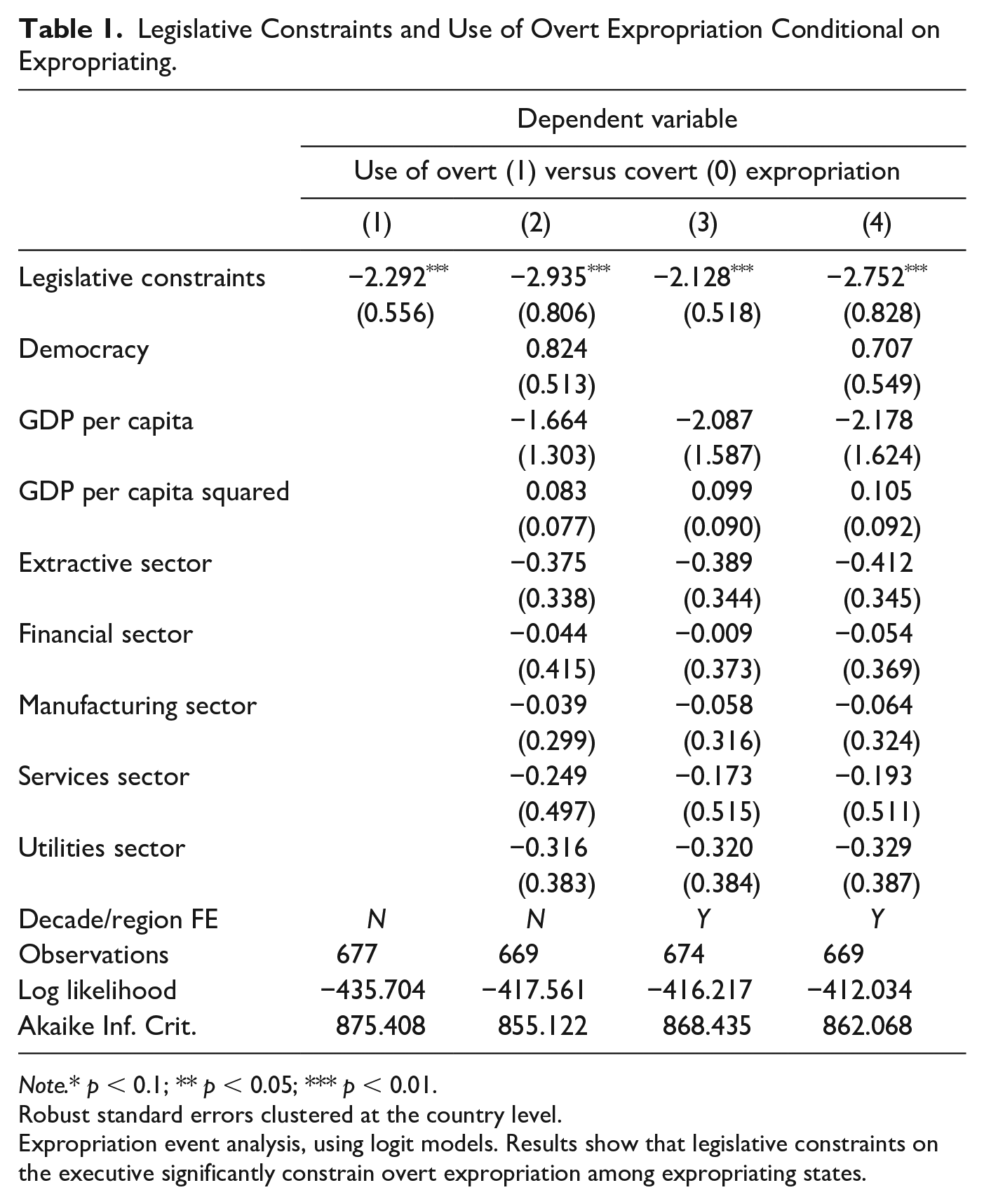
Our results, displayed in Table 1 and Table 2, demonstrate that, conditional on expropriating, regimes that have stronger legislative constraints and more vertical accountability are significantly more likely to rely on covert methods of seizure, such as forced sale, contract renegotiation, and intervention.
Legislative Constraints and Use of Overt Expropriation Conditional on Expropriating.
Note.* p < 0.1; ** p < 0.05; *** p < 0.01.
Robust standard errors clustered at the country level.
Expropriation event analysis, using logit models. Results show that legislative constraints on the executive significantly constrain overt expropriation among expropriating states.
Vertical Accountability and Use of Overt Expropriation Conditional on Expropriating.

Note.* p < 0.1; ** p < 0.05; *** p < 0.01.
Robust standard errors clustered at the country level.
Expropriation event analysis, using logit models. Results show that audience costs significantly constrain overt expropriation among expropriating states.
This is true even when controlling for regime type, suggesting that even among autocracies or democracies government oversight is negatively associated with overt expropriation. To put the legislative constraints results more concretely, moving from the first to the third quartile of legislative constraints is associated with a reduction in the likelihood of relying on overt expropriation of 30%, while the effect of moving from the first to the third quartile of vertical accountability leads to a similarly substantial 25% reduction in the probability a government will use overt relative to covert expropriation. 19
Importantly, this means that all expropriating states are not equal. While previous literature has predominantly focused on differences in the rate of expropriation, these results show that regimes also differ in the method of expropriation deployed. This analysis demonstrates that when politically constrained regimes expropriate, they tend toward strategies that are less clearly identifiable as state-sponsored acts of expropriation. In the Appendix, we show that results are broadly consistent when using Henisz’s Political Constraints Index (POLCON) rather than the VDem measure of legislative constraints (Henisz, 2000). We additionally show our findings are robust to controlling for periods of instability and regime change, when expropriation may be more likely, as well as for whether or not a regime was socialist. Finally, we show that our results hold when excluding intervention as a form of expropriation, in case this method follows a different logic than the other forms of covert expropriation.
These results provide information on the logic behind the different strategies expropriating regimes use, but we may also want to know whether legal institutions can still constrain governments from engaging in both types of expropriation or only from engaging in overt methods of forced acquisition. Indeed, our theory suggests that whereas institutional constraints should do little to rein in covert expropriation, they should be much more effective at preventing overt strategies.
We thus analyze a panel dataset of country-years in order to identify how legislative constraints and sensitivity to audience costs impact willingness to expropriate at all, using either covert or overt methods. This can also help reveal the degree to which overt expropriation drives the established finding that institutionally constrained regimes are less likely to expropriate. First, we use OLS with the dependent variable equal to the number of expropriation events of different types (any, overt, or covert). 20
Table 3 and Table 4 show that legislative constraints and vertical accountability, respectively, have a particularly strong role in constraining overt methods of expropriation, whereas they have no statistically significant effect on covert expropriation. Moreover, for both vertical accountability and legislative constraints, we see that the coefficient on overt expropriation is actually larger than when the two types of expropriation are pooled together in the “Any expropriation” model, suggesting that the relationship observed in previous studies between political constraints and expropriation more broadly is entirely or at least predominantly driven by the most overt types of expropriation. Taken together, the OLS results thus suggest that political constraints do indeed have a particularly constraining effect on more overt methods of expropriation.
Legislative Constraints and Likelihood of Using Different Types of Expropriation, OLS Panel.

Note.* p < 0.1; ** p < 0.05; *** p < 0.01.
Robust standard errors clustered at the country level.
Vertical Accountability and Likelihood of Using Different Types of Expropriation, OLS Panel.
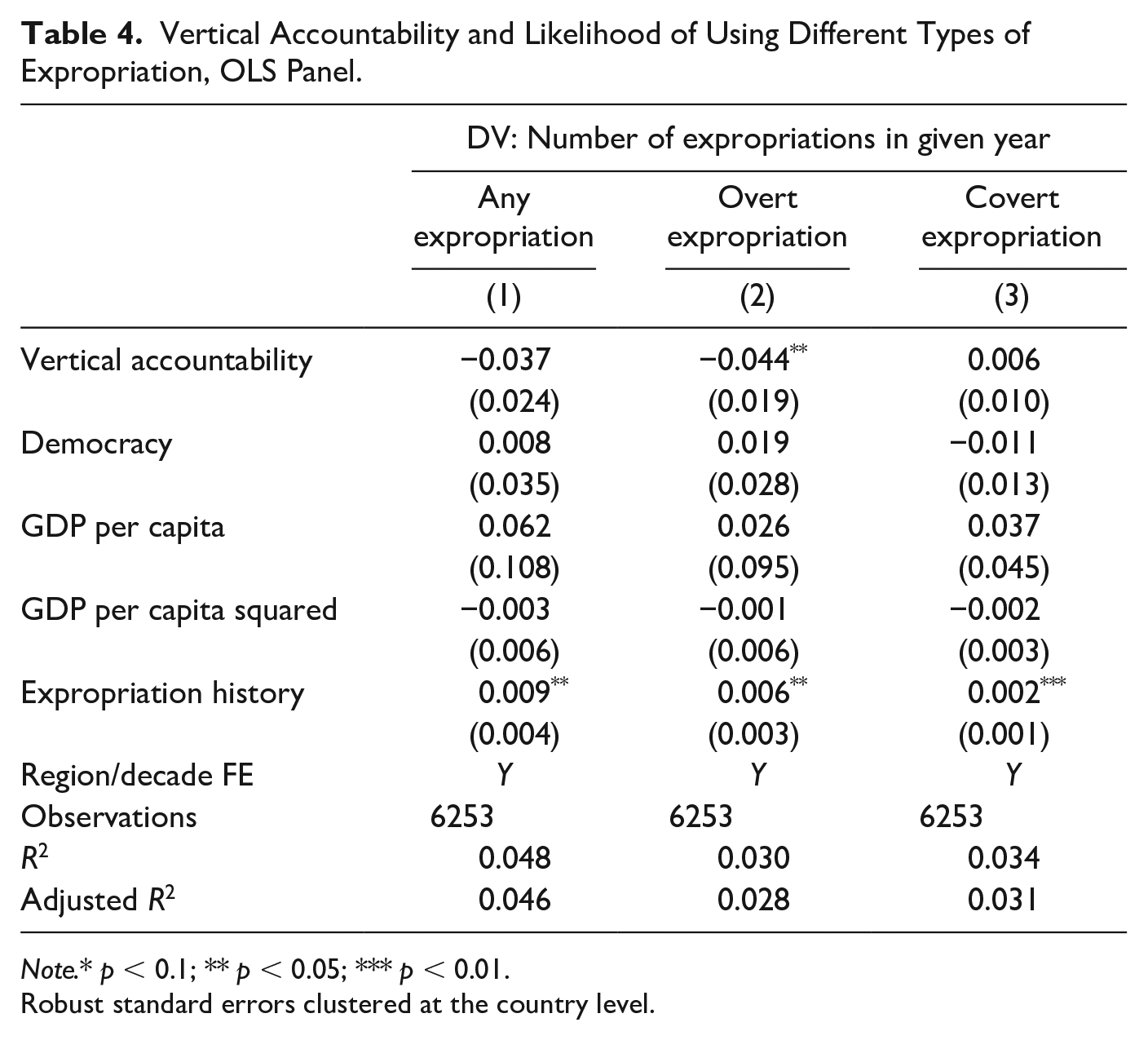
Note.* p < 0.1; ** p < 0.05; *** p < 0.01.
Robust standard errors clustered at the country level.
At the same time, the OLS model has a significant weakness in that the “Overt expropriation” and “Covert expropriation” models pool the alternative type of expropriation with country-years with no expropriation, making this an imperfect stand-alone estimate. In order to overcome some of the weaknesses in the OLS model, we therefore also employ multinomial logit which allows us to estimate the relationship between different forms of expropriation and the two types of political constraints. Multinomial logit makes it possible to simultaneously estimate the relationship between political constraints and the different types of expropriation, but the multinomial logit does also have a weakness, which is that unlike OLS, it flattens the number of events in a country-year, thereby treating multiple expropriations in a given year as a single event. While this again makes this model somewhat imperfect on its own, combined with the OLS, it offers a robust picture of the relationship between political constraints and expropriation outcomes.
Our dependent variable for the multinomial logit is a categorical measure of expropriation taking 0 if no expropriation occurred in a given country-year, 1 if only covert expropriation was used, and 2 if overt expropriation occurred. 21 This allows us to estimate three quantities of interest. First, we are interested in the likelihood more institutionally constrained regimes use overt expropriation (relative to no expropriation), compared to less constrained regimes. Second, we are interested in the likelihood more constrained regimes use covert expropriation (relative to no expropriation), compared to less constrained regimes. Third, we are interested in the difference between these first two likelihoods, or whether the propensity to engage in overt versus covert methods of expropriation is significantly different across more and less constrained regimes.
Figure 2 and Figure 3 present our results for legislative constraints and vertical accountability, respectively. They demonstrate that both legislative constraints and vertical accountability are significantly negatively associated with overt, but not covert, methods of expropriation. States with higher levels of legislative constraints are considerably less likely to engage in overt expropriation relative to not expropriating (“overt (base none)”), while the effect for covert expropriation is smaller and slightly positive in one specification, while also not statistically significant (“covert (base none)”). Moreover, the difference between these coefficients is statistically significant (“overt (base covert)”) in three of the four models at the p < 0.05 level and just shy of this for the remaining specification, 22 meaning that the difference in the ability of legislative constraints and vertical accountability to dissuade governments from engaging in overt expropriation is statistically distinguishable from these constraints’ ability to dissuade governments from engaging in covert expropriation. Taken together, our results consistently demonstrate that states with higher levels of political constraints in the form of legislative oversight and vertical accountability are significantly less likely to use overt, as opposed to covert, methods of expropriation.

Legislative constraints and expropriation, multinomial logit. Note. Effect of legislative constraints on expropriation, using multinomial logit. Coefficients show how a one unit change in legislative constraints affects the log of the odds of one outcome versus the other. “Base none” shows the effect of legislative constraints on the log odds a country engages in either overt or covert expropriation in a given year, relative to not expropriating at all. “Base covert” shows the effect of legislative constraints on the log odds a country engages in overt, relative to covert expropriation in a given year. Bivariate = no controls; full controls = democracy, GDP per capita and its squared term, history of expropriation, and region and decade fixed effects.
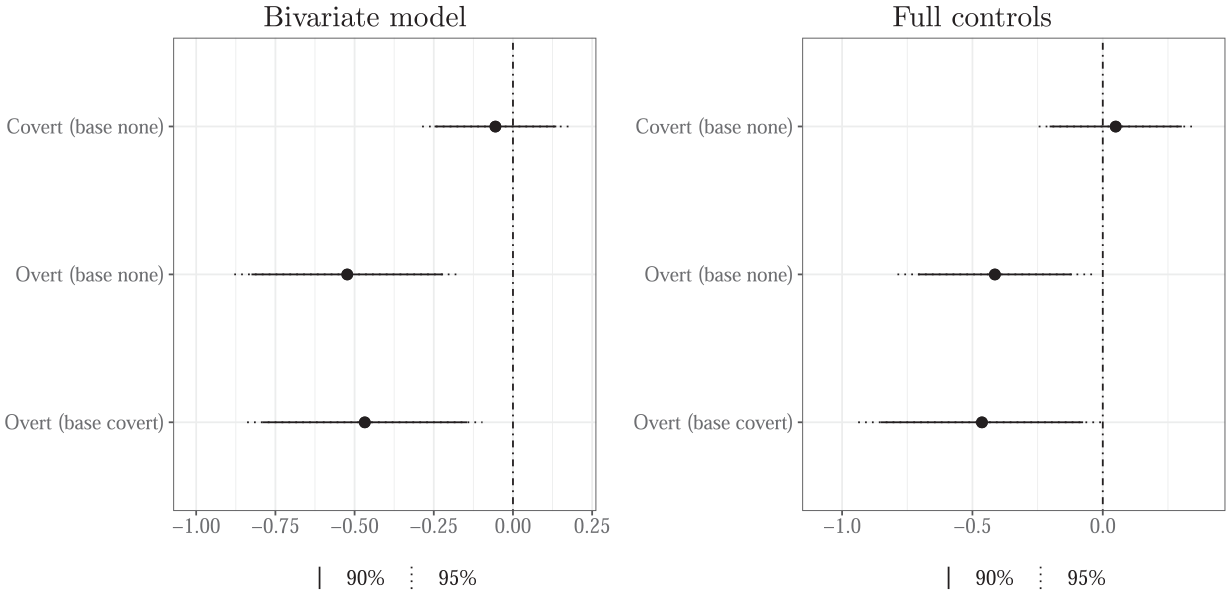
Vertical accountability and expropriation, multinomial logit. Note. Effect of vertical accountability on expropriation, using multinomial logit. Coefficients show how a one unit change in vertical accountability affects the log of the odds of one outcome versus the other. “Base none” shows the effect of vertical accountability on the log odds a country engages in either overt or covert expropriation in a given year, relative to not expropriating at all. “Base covert” shows the effect of vertical accountability on the log odds a country engages in overt, relative to covert expropriation in a given year. Bivariate = no controls; full controls = democracy, GDP per capita and its squared term, history of expropriation, and region and decade fixed effects.
6. Conclusion
Despite an extensive literature on how regimes differ in their overall propensity to protect the property of foreign direct investors, there has been limited attention paid to whether regime characteristics might also explain the strategies of expropriation in which different regimes engage. Our theoretical discussion and empirical results demonstrate the importance of considering strategy alongside propensity. Specifically, we show that the same political constraints that are generally assumed to protect foreign direct investment from encroachment do not bind equally tightly across all methods of expropriation. Rather, institutionally constrained regimes appear to have nearly as much leeway to engage in covert forms of expropriation as do their non-constrained counterparts. Thus, while vertical accountability and legislative checks on the executive play a central role in curbing the most visible and undeniable forms of government-led forced divestment, they do relatively little to impede acts of expropriation that provide expropriating governments more cover to claim that the terms were mutually agreed upon or that the events were outside of their direct control. These findings not only contribute to the literature on regime type and expropriation, specifically, but they also contribute to the literature on institutions and property rights, more generally.
First, our findings offer an important caveat to the conventional wisdom that democratic-type political constraints will offer better property right protections of foreign direct investment (Jensen, 2003, 2006, 2008; Li, 2009; Li & Resnick, 2003). We demonstrate that the truth may not be this simple. While politically constrained regimes do indeed provide better protection against overt takings, it is far from clear that they provide any better guarantees against methods that offer even a small veneer of plausible deniability. Notably, this conclusion follows logically from the very theories advanced by those suggesting that institutional constraints ought to lead countries to expropriate less: the same institutional protections that theoretically ought to discourage governments from engaging in expropriation or other forms of property rights violations also ought to encourage them to use means of appropriation that can be defended as outside the control of the state or accepted by the aggrieved party.
Second, because constrained governments have greater incentives to hide their expropriatory tendencies behind methods that have a veneer of mutual acceptability, this may help perpetuate the notion that institutional constraints offer greater protections than they really do. Given that the methods of confiscation preferred by politically constrained governments are, by definition, harder to pinpoint as forced divestment, both the literature and possibly international investors themselves may have tended to overestimate the positive relationship between institutional constraints and expropriation more broadly.
Finally, our results highlight that there are often important differences across regimes not only in outcomes but in strategies. This is a point that Kono (2006) makes in relation to trade barriers, and it is one that we echo in relation to the treatment of FDI. The broader conclusion seems to be that although differentially constrained regimes frequently pursue similar goals, they may not be able to achieve them using the same methods. In the case of expropriation, we have provided evidence that political constraints may not protect governments from their worst inclinations so much as force them to pursue those inclinations in less obvious ways.
Supplemental Material
sj-pdf-1-cps-10.1177_00104140221089650 – Supplemental material for Covert Confiscation: How Governments Differ in Their Strategies of Expropriation
Supplemental material, sj-pdf-1-cps-10.1177_00104140221089650 for Covert Confiscation: How Governments Differ in Their Strategies of Expropriation by Jane Esberg and Rebecca Perlman in Comparative Political Studies
Footnotes
Acknowledgements
For helpful comments and feedback on previous drafts, we would like to thank Michael Tomz, Stephen Kobrin, Ryan Brutger, Amy Pond, Dan Thompson, Elisabeth van Lieshout, Judy Goldstein, and Claire Lee. We would also like to thank participants at Georgetown’s International Theory and Research Seminar and New York University’s and Stanford University’s International Relations workshops. Finally, we thank our three reviewers for their detailed and thoughtful suggestions.
Declaration of Conflicting Interests
The author(s) declared no potential conflicts of interest with respect to the research, authorship, and/or publication of this article.
Funding
The author(s) received no financial support for the research, authorship, and/or publication of this article.

Supplemental Material
Supplemental material for this article is available online.
Notes
References
Supplementary Material
Please find the following supplemental material available below.
For Open Access articles published under a Creative Commons License, all supplemental material carries the same license as the article it is associated with.
For non-Open Access articles published, all supplemental material carries a non-exclusive license, and permission requests for re-use of supplemental material or any part of supplemental material shall be sent directly to the copyright owner as specified in the copyright notice associated with the article.
