



Abstract
Why do some groups survive government repression while others get eliminated? This paper offers a corrective to the widely held theory that locally embedded opposition organizations with large and interconnected networks of civilian supporters are better adapted to survive. It argues that extreme and selective violent repression from a capable state requires strict compartmentalization and social detachment. These measures slow the speed and reach of repression. I test these propositions by examining the top targets of the Pinochet dictatorship in Chile. Cross-checking individuals on the Pinochet’s target lists against the victims lists, the article shows that the Revolutionary Leftist Movement (MIR) had a significantly lower rate of victimization than the other top targets. Archival and interview data demonstrate that MIR’s higher survival rate is due to the mechanisms proposed. This study renders intended repression observable and offers implications for the survival of a wide range of actors.
Keywords
Introduction
Why do some opposition groups facing state repression have a higher rate of survival than others? This paper answers this question by focusing on the identification problem in counterinsurgency campaigns (Kalyvas, 2008; Lyall & Wilson III, 2009). 1 “The inability to tell friend from enemy is a recurring element of irregular war,” though it is just as commonplace in clandestine organizing more generally (Kalyvas, 2006, 89). The state has a difficulty identifying members of underground opposition groups and their supporters. Likewise, although dissidents can identify uniformed members of the state armed forces, actors like the secret police, paramilitaries, and spies are less visible—sometimes blending in with the population (Greitens, 2016). And even more insiduously for the clandestine organization, there is the problem of identifying true supporters among civilians and living with the risk of betrayal (della Porta, 1988; Sullivan, 2016b). The identification problem is thus fundamentally about information; information that dissidents within an organization have about each other, that civilians have about dissidents, and that state agents have about the underground group.
In contrast to the literature emphasizing rebel embeddedness in civilian communities (Lewis, 2017, 2020; Petersen, 2001; Sarbahi, 2014; Sinno, 2007; Staniland, 2014; Weinstein, 2006), this paper shows that when it comes to managing repression, there are significant costs to tight-knit networks. Building on research on the structures and practices of underground organizing (Finkel, 2015, 2017; Parkinson, 2013, 2016, 2023; Parkinson & Zaks, 2018; Shapiro, 2013), I argue that strict compartmentalization and detachment from the civilian population are fundamental for the survival of underground organizations under certain conditions. When the state is willing and capable of conducting a campaign of repression that is intense, intelligence-based and selective, the vulnerabilities of organizational interconnectedness and social embeddedness outweigh their benefits.
Interconnected organizations and tight-knit information networks facilitate cascades of repression. By contrast, a fully compartmentalized organizational structure makes the identification of militants more difficult, subsequent arrests less likely, and the capture of mid- and high-level leaders more challenging (Davenport, 2014; Serge, 1926; Tarrow, 1994). This is because access to information about the organization and its people is highly restricted; militants mainly know about the small group with which they operate. Of course compartmentalization does not ensure protection, but it slows cascades of repression--creating opportunities for escape and mitigation. In addition, a degree of separation from civilians means that community members cannot readily identify underground organizers.
This paper tests these claims about the importance of compartmentalization and social detachment by comparing repression and survival among the top three opposition groups of the Pinochet dictatorship in Chile (1973–1989): the Communist Party, the Socialist Party, and the Revolutionary Leftist Movement (MIR). Using an original dataset comparing the regime’s intended-to-repress population (i.e., the target lists) with the victims of the dictatorship according to the three Chilean truth commissions, this study is the first to compare different organizations’ survival rates knowing, under some assumptions, the intended levels of repression. The dataset, Targets and Victims of the Pinochet Dictatorship in Chile (1973–1989), includes the 6445 individuals in Pinochet’s target lists and their political affiliation. Cross-checking each individual on the target lists against the victims lists, the dataset documents whether people on the target lists were eventually forcibly displaced, tortured in prison, killed or disappeared.
The data show that the victimization rate for MIR militants was 14 percentage points lower than the rate for other militants, despite the fact that the MIR was the secret police’s top target (Dinges, 2005; Kornbluh, 2013; Rettig, 1991). 2 The article also shows that the speed of captures after an arrest was significantly lower for the group with the strictest compartmentalized structure and detachment from the local population, compared to those that were deeply embedded (Communists and Socialists). The central empirical contribution of the paper is that it examines a part of repression that is generally unobservable--intended repression.
Using archival documents from the three main opposition groups, the detailed files of the 3227 executed and disappeared from the National Commission for Truth and Reconciliation; and more than 100 semi-structured interviews with former leaders and militants from these organizations, the paper demonstrates that the observed difference in victimization rates is attributable to underground organizing capability and social embeddedness. It also explains the origins of these organizational forms and considers possible biases, discussing what is known and knowable about the process of selection into the lists of targets and victims. Factors such as the size of the group, resources, seeking exile/fleeing, and the security apparatus’s determination cannot explain the MIR’s higher rate of survival.
The implications of these findings on group survival are not limited to politics, to certain regions of the world, or to leftists during the Cold War. Contemporary armed insurgent organizations exhibit some of these qualities in Northern Ireland, Lebanon, and Palestine. Current armed and unarmed opposition groups facing high levels of selective repression in Iraq and Syria also adopt very similar organizational forms, even as they operate in a hyper-connected digital world (Joint Special Operations University & Jones, 2014). Additionally, criminal organizations like the mafia in Italy (Cappellaro, Compagni, & Vaara, 2020), drug cartels in Mexico, and hybrid criminal-political organizations such as gangs in Brazilian favelas also follow the logic of compartmentalization and underground mobilization (Magaloni, Franco, & Melo, 2020). Even though most work on clandestine organizations examines armed groups (della Porta, 2013; Klandermans et al., 1988), there are also nonviolent underground organizations that adopt similar strategies. Prime examples are the Gülen Movement in Turkey (Aras & Caha, 2000; Bozçağa & Christia, 2020), Syria’s initial uprising during the Arab Spring (Pearlman, 2020), and the Communist Party of Chile in the 1950s (Alvarez, 2003). What is common in all of these cases is that the adversary--the state—is highly capable (i.e., systematically gathers intelligence and uses it against the group to infiltrate it and disrupt its activities) and willing to use lethal force to neutralize the organization.
Theories of Underground Organizing
Repression increases the cost of collective action and incapacitates organizations (DeNardo, 1985; Kuran, 1989; Tilly, 1978). Theories about regime type and threat perception explain why certain organizations and territories face high levels of state terror (Berman, 2020; Carey, 2006, 2010; Chaudhry, 2022; Conrad & Moore, 2010; Conrad & Ritter, 2013; Danneman & Ritter, 2014; Gupta et al., 1993; Staniland et al., 2018; Sullivan, 2016b), but they are less focused on explaining the survival of those affected. Under what conditions do opposition groups survive state repression?
Certain patterns of repression are more insidious than others, including covert and targeted intelligence work that infiltrates organizations and sows distrust among militants (Davenport, 2014; Greitens, 2016), as well as repression that is directed at the clandestine structures of organizations (Sullivan, 2016a). This type of selective repression stands in contrast to indiscriminate violence, which can be counterproductive for the state because it solves the collective action problem for opposition organizations (Lichbach, 1998; Olson, 1965; Wood, 2003) and creates dependencies between civilians and rebels (Goodwin, 2001; Kalyvas & Kocher, 2007). Insurgent weakness, however, can also result from the state’s use of indiscriminate violence (Lyall, 2009), especially when the intensity is extremely high (Siegel, 2011), because it severely curtails the ability of militant organizations to operate, supply their ranks, and access the local population.
Much of this work on patterns of repression and opposition group survival focuses on understanding popular support because civilians are central to territorial control, the outcome of counterinsurgency campaigns, mass mobilization, and cycles of protest (Beissinger, 2002; Brockett, 2005; Kalyvas, 2006; Kalyvas & Kocher, 2007; Tarrow, 1994). Specifically, scholars have found local embeddedness and tight-knit networks to account for organizational survival, resilience, and cohesion (Lewis, 2017, 2020; Sarbahi, 2014). Staniland (2014) shows that whereas armed groups with weak ties to local communities are prone to fragmentation and collapse, those with strong vertical and horizontal ties build resilient and cohesive internal structures based on trust, shared norms, and worldviews. Local embeddedness and networks are also important for high-risk collective action through status rewards and sanctions, as well as community-level references about risk and norms of reciprocity (Petersen, 2001; Wood, 2003). Embeddedness is also related to militants’ ability to adapt and “remap” their everyday relationships through a process that Parkinson (2023) calls “relational plasticity,” which makes them more resilient in the face of repression (Parkinson, 2023, 227).
But the literature on the social resources of militant groups (Lewis, 2020; Siegel, 2011; Sinno, 2007; Staniland, 2014; Weinstein, 2006) overwhelmingly examines the benefits rather than the costs of embeddedness in civilian communities. Social embeddedness can be a liability in the early stages of group formation, particularly in contexts where the opposition group is facing a highly capable state, 3 and where there are no safe havens (Sinno, 2007) to operate more freely. When an opposition group’s networks and core supporters are clustered and clearly identifiable, repression can become more focused and systematic. If embeddedness implies that the local community can identify active militants, locate them, and provide information about how they operate—which is the case for integrated insurgencies (Staniland, 2014), ethnically homogenous/kinship networks (Lewis, 2020), and anchored rebel groups (Sarbahi, 2014)—then the organization is vulnerable to repression.
Meanwhile, there is extensive work on clandestine organizing among terrorist organizations (della Porta, 2013; Enders & Su, 2007; Shapiro, 2013), nonviolent and armed resistance to genocide (Braun, 2018; Finkel, 2015, 2017), armed insurgencies (Lewis, 2020; Parkinson, 2013; Parkinson & Zaks, 2018), drug cartels and mafias (Cappellaro et al., 2020; Morselli, 2009), and comparative historical case studies under different regime types (Erickson, 1981; Simmel, 1906). These works, in line with the writings of the most important revolutionary leaders in history (Guevara, 2013; Lenin, 1971) and military manuals (Kalyvas, 2008), establish secrecy and compartmentalization as fundamental elements for survival under repression. At the same time, these works also emphasize the importance of social embeddedness—of relying on the “full help from people of the area,” as Che Guevara wrote in his manifesto on guerrilla warfare—and grapple with the contradictions that it brings given the need to control information from reaching the state (Guevara, 2013, loc.142). This paper argues that strong ties with a community, which is a “combination of the amount of time, the emotional intensity, the intimacy (mutual confiding), and the reciprocal services which characterize the tie,” are in many ways in contradiction with secrecy and compartmentalization (Granovetter, 1973, 1361).
The literature has made significant progress on what scholars call the secrecy-efficiency tradeoff (Crossley et al., 2012), the security-control dilemma (Shapiro, 2013) and the clandestine collective action dilemma (Braun, 2018), which are germane to the secrecy-embeddedness tradeoff at the core of this paper. These are inescapable dilemmas for any underground organization facing a repressive state with the capacity to reach the areas where rebels are operating. The need for secrecy leads groups to compartmentalize their structures and work in cells, minimize the number of ties between militants, and restrict the spread of information. All these measures hamper communication with significant costs for efficiency, control, and embeddedness (della Porta, 2013). However, scholars have also demonstrated how important social embeddedness is for the survival of dissidents and rebel groups: underground organizers rely on strong ties to the civilian population to hide, maintain their supply chains, gain knowledge of the terrain, and detect infiltrators (Guevara, 2013; Lewis, 2017, 2020; Parkinson, 2013). Here, I specify the conditions under which deep social embeddedness (Erickson, 1981), historical ties to a community (Guevara, 2013; Sarbahi, 2014), ethnic and religious homogeneity (Braun, 2018; Lewis, 2017), and other strong ties to local communities are a liability.
It is unclear how underground groups make decisions—and evolve—to have certain organizational structures and practices while facing these dilemmas. 4 The literature is also missing rigorous testing of the basic tenets of clandestine organizing that have been around since Mao. Above all, the mechanisms behind underground organizing capability remain murky. Clandestine organizing is difficult to study given the level of secrecy around contemporaneous movements, the dearth of a paper trail after a conflict is over, and the lack of access to archives from security agencies, especially counterintelligence and the secret police.
This article builds on work examining the organizational structures and practices of militant organizations to survive in highly repressive environments (Finkel, 2017; Parkinson, 2013, 2023; Parkinson & Zaks, 2018), as well as research theorizing the security-embeddedness and control dilemmas (Crossley et al., 2012; Shapiro, 2013). At the same time, this paper contributes to the study of the onset of armed insurgency. I examine low-level and clandestine militant activity by putting repression management at the forefront, rather than offering an explanation based on the state’s absence or miscalculations (Lewis, 2017, 2020; Malone, 2019). Lastly, by further developing the security-embeddedness dilemma, this paper also speaks to work that shows how historical legacies and pre-movement bases of support condition the trajectories, (dis)advantages, and opportunities of organizations in conflict (Braun, 2018; Larson & Lewis, 2017; Lewis, 2017; Parkinson, 2023; Petersen, 2001; Staniland, 2014).
The following section develops two key ideas. First, underground organizations are able and willing to compartmentalize their structures to different degrees. Second, social embeddedness has disadvantages for survival. The section then ends by defining the scope conditions of the argument; namely, the pattern of repression and other conditions under which strict compartmentalization and limited social ties to the community make survival more likely.
Underground Organizing Capability: On Compartmentalization and Social Embeddedness
Underground organizations need operational security to withstand government repression and operational capacity to execute their actions against the state (Finkel, 2015; McCormick & Owen, 2000). Regardless of type of group—whether criminal, nonviolent or armed—operational security is important because of the constant level of threat.
5
Operational security usually involves compartmentalization, secrecy, and militants adopting fake identities, living parallel lives, and smuggling arms (for armed organizations) (Erickson, 1981; Finkel, 2015; Guevara, 2013; Lenin, 1971). Compartmentalization minimizes ties across small, densely connected subgroups, and it is the most common structural feature of clandestine groups. Generally, militants are placed in small cells of three to four individuals. Individuals in different cells of the same rank do not know each other. Communication between parallel cells is nonexistent, and communication between higher-ranking and lower-ranking cells, in the case of hierarchical organizations, is limited. As Figure 1 illustrates, militants of the cells headed by person B and C do not know each other or share information. If the secret police captures militant G, the highest number of subsequent arrests due to information from militant G is four (specifically, militants B, D, E and F are vulnerable). Militants C, H, I, J, K, and A are somewhat removed from further repression. Visualization of a compartmentalized, cell-like structure.
The idea behind compartmentalization is to significantly reduce the speed and effects of repression when the regime’s security forces are highly capable and willing to use extreme force (Shapiro, 2013). A compartmentalized organization mitigates the effects of security breaches by making it harder for the regime to identify targets. In addition, secrecy and identity changes also make it harder for repressors to find and capture a militant even once identified by name and photograph. These protections reduce fear among militants, helping the opposition maintain recruits. These incentives are similar across underground groups (Finkel, 2015), but not all underground organizations are capable of adopting—or even choose to adopt—strict secrecy and compartmentalization.
The compartmentalization of information does not just involve secrecy. It means most individuals do not even possess the information needed for counterintelligence, and they do not know or recognize fellow militants from other cells. Security agents aim to match a suspected person’s name with a face, to locate them, and find more affiliated militants. In high repression and state capacity environments, counterintelligence officers torture or otherwise compel captured militants or civilians to give up the names of other militants, their addresses, and safe houses, as well as to match names to faces. Therefore, anyone who has information about the appearance, name, or whereabouts of a militant is a liability.
The operational security of two clandestine organizations could look identical when we draw their structural connections (ties), as in Figure 1. But in practice, they could differ drastically on how strict their compartmentalization is. A strict or fully compartmentalized organizational structure means that beyond their immediate cell-mates and top leadership (whom most members can identify, even in a highly secret organization), militants will not know others’ appearances, names, families, addresses, or safe houses. This level of information control is not possible for organizations that emerged prior to the closing of civic space. If an opposition group previously operated in a more open environment, one can assume that its members were far more connected and informed than a compartmentalized organization would require. Compartmentalization is thus partially path dependent because militants cannot unlearn faces and identities—though addresses can be compartmentalized at any point, because militants move often. 6
So highly interconnected and public organizations that suddenly face severe repression will not be able to optimize their operational security because strict compartmentalization will be out of reach. While going from interconnection to compartmentalization prevents the free flow of new information, divides tasks by cells, and limits the number of people in communication with each other, they cannot undo acquired information about the identity and participation of militants. The implication is that a sudden increase in human rights violations disadvantages existing organizations and favors the creation of new ones with the ability to fully compartmentalize.
There are also underground organizations under threat that choose not to strictly compartmentalize. These groups tend to fall in at least four camps: organizations with territorial control; networks that have adopted a full-matrix or full-channel structure for redundancy; organizations with a high degree of in-group preference divergence; and groups that need a high degree of discrimination in their actions for survival. Armed groups that control territory can operate more freely in those areas, taking the form of hierarchical, well-connected, military organizations. The Revolutionary Armed Forces of Colombia (FARC) and the 26th of July Movement led by the Castros and Che Guevara during the Cuban Revolution are examples of organizations that operated underground in most of the country, but nonetheless held territory in other areas. Thus, neither their structure nor information was fully compartmentalized, especially inside their safe havens.
In all-channel or full-matrix networks all militants are connected to all other members (JCS, 2016). This redundancy significantly hampers efficiency, but it means that organizations can carry out their operations regardless of capture, at least for some period of time (because multiple operatives have the same instructions, training, and resources).
Additionally, some organizations avoid strict compartmentalization because the costs of losing operational control are too high compared to the security benefits of fully compartmentalizing information. When there is high in-group preference divergence (Shapiro, 2013), there is considerable internal disagreement about tactics and operations, and/or corruption. So leaders may try to exert more control over other militants to ensure that there is no discrepancy between their plans and how actions are carried out. A similar logic applies when groups place a high premium on target discrimination in the use of violence (Shapiro, 2013). When armed insurgents think they may lose significant support if they kill civilians, they may forego the benefits of full compartmentalization for the sake of retaining a high degree of control over operations.
These two types of groups tend to have lists of militants, organizational charts, and records of actions, funding and participation. While these documents allow leaders to maintain more efficient control over their operations, they can also be a liability. For example, Narodnya Volya, a leftist militant organization in 19th-century Russia “was crushed within several weeks of the assassination [of one of their leaders, G. A. Lopatin] as police traced the network of connections among its members” given that the leader was carrying membership lists (Shapiro, 2013, 132). Al-Qaeda in Iraq also maintained thorough accounting documents, with names and addresses of militants. These documents were seized in 2007 and used extensively to understand the inner-workings of the group (Bahney et al., 2010; Fishman, 2008).
The first hypothesis is thus that, under conditions of high, intelligence-based and selective repression, underground organizations without strict compartmentalization will be less likely to survive than those with strict compartmentalization (Survival: Hypothesis 1). This pattern should hold regardless of whether organizations chose not to fully compartmentalize or were unable to fully compartmentalize given constraints such as historical interconnectedness. A corollary of Hypothesis 1 is that we should observe fewer subsequent arrests if security forces capture a militant in a fully compartmentalized organization than if they capture a militant in an organization without compartmentalization (Cascading effect of repression: Hypothesis 2).
When it comes to social embeddedness, this paper argues that there are important disadvantages to civilians being able to identify and know militants of a clandestine group. The local population is an enormous liability for the survival of militants if two conditions hold: first, security forces have the reach and will to arrest, interrogate, torture, and otherwise compel them for information; 7 and second, the location of civilians supporting the clandestine group is known. Groups with historical ties to a community cannot seamlessly start operating in the underground without civilians knowing who they are, as was the case with the Irish Republican Army (IRA) and the Provisional IRA (Shapiro, 2013). When the British counterinsurgency efforts increased, these organizations were forced to compartmentalize their structures and operations (Shapiro, 2013). They could no longer rely on the faithful allegiance of their supporters for secrecy, and civilians often thwarted their efforts.
Another example is the Abu Dahdah Spanish Al-Qaeda cell, which was responsible for the March 11, 2004 Madrid train bombings. This tightly knit kinship network was able to execute one action effectively and without detection, but within three months the entire network was identified (Rodríguez, 2007). Spanish intelligence services relied, among others, on those with whom the insurgents worked and lived to understand connections. Scholars have shown that high-risk organizing requires deep connections with the civilian population and longstanding solidarity networks (Braun, 2018; Lewis, 2020; Sarbahi, 2014), yet our understanding of the risks posed by civilians remains underdeveloped.
How do detached underground organizers and militants operate in their environments? They could be living in isolation, removed from the civilian population (Sarbahi, 2014). This kind of social detachment occurs in hostile terrain that is sparsely populated and when the group is a newcomer to the area. The absence of connections with civilians provides a buffer of protection for opposition groups because counterinsurgents cannot reach militants through civilians. The exception is when militants are highly concentrated in a geographic area that the state can target. In this case, civilians may not be necessary to identify militants.
Social detachment could also involve contact with the civilian population. This form of social detachment is more common in urban centers; militants live, work and do community service without the population suspecting that they are part of an underground organization. A double identity allows militants to blend into the community and support themselves while continuing their underground activities. Sometimes these changes require migrating to another state or city, or adopting a different life altogether. In this form of social detachment, local civilians would only be a liability under very special circumstances: intelligence officers would need a picture or detailed description of a wanted individual; only then would civilians, who could recognize the person, be able to give the information needed for capture. But if the officers are simply looking for militants from the group or working off of names or pseudonyms, their residence in a community does not present a threat. This barrier to capture holds even if security forces take repression to the extreme to get information from civilians. Therefore, my third and final hypothesis is that socially embedded underground organizations facing high, intelligence-based, selective repression will be less likely to survive than those that are not deeply connected to civilian communities (Social embeddedness: Hypothesis 3).
Scope Conditions
Depending on the specific pattern of state violence that the underground organization is facing, strict compartmentalization and social embeddedness will have varying effects on survival. This section describes the specific pattern of violence that would most likely make strict compartmentalization a necessity and social embeddedness a liability for survival. It also emphasizes that this theory applies to a wide range of civil society organizations, state, and non-state actors.
A pattern of violence is defined by four components: repertoire, targeting, technique, and frequency (Gutiérrez-Sanín & Wood, 2017).
8
In defining high, intelligence-based, selective repression, the
Given the emphasis on intelligence-gathering, this paper’s argument about compartmentalization and social embeddedness applies only to capable states. A capable state has “informational penetration in its territory" and “strong domestic intelligence institutions” (Lewis, 2020, 16), which means that there are no domestic safe havens (Sinno, 2007) for rival organizations. A capable state has a significant amount of organization and bureaucratic capability to produce, manage, and use intelligence effectively, but not necessarily a high gross domestic product (GDP) or military spending. In this definition, a capable state could be relatively poor, like the Democratic People’s Republic of Korea, as long as it devotes significant resources to its security apparatus. Repressive states without selective and systematic targeting will be less likely to force the opposition underground (Finkel, 2015). By contrast, in capable, repressive states, compartmentalization and social detachment are essential for the survival of an opposition group.
What does this look like in practice? The next section introduces the three top targets of the Pinochet dictatorship, showing how these groups came to have different levels of community embeddedness and organizational forms. This section also explains the similarities and differences between these organizations and justifies their comparison for hypothesis testing. Appendix A complements this section by explaining how the pattern of repression varied during the first 4 years of the Pinochet dictatorship, and how compartmentalization and social embeddedness played a role in survival under different conditions of state violence.
Pinochet’s Top Targets
The social origins and ideological commitments of the top three targets of the Pinochet dictatorship largely explain their differences in organizational structure, internal practices, and local embeddedness. The Communist and Socialist parties, two of the oldest political organizations in Chile, emerged from the working class. Their leadership has traditionally come from these communities. As political parties, they have contested elections and sought change through the state’s institutions during most of their existence. The founding of the MIR, on the other hand, was much more recent. Its first movers and top leadership primarily came from the intellectual class, and they sought revolutionary change in Chile (Pérez, 2003). Miristas also organized the poor and indigenous communities, and contested local elections, but they ultimately viewed insurrectional methods as necessary to achieve their political objectives (Vidal, 1999). The organizational form and institutions adopted by each group only widened the gap in local embeddedness. Compartmentalization exacerbated the MIR’s lack of deep connections with civilians where they operated. Meanwhile, the interconnected, hierarchical networks and organizing work of the Communists and Socialists built deeply embedded political machines.
The MIR was an ultra-leftist political movement and party inspired by Marxist ideology and Che Guevara’s theoretical and practical contributions to guerrilla warfare in the context of the Cuban Revolution. It had a vision of Chile as a socialist utopia. Its founders were physicians, university students, and other intellectuals. Given their understanding that the political right would never willingly give up their wealth or power, popular insurrection 9 was the only way to achieve MIR’s goals (MIR, 1965c). From its founding, the MIR was a hierarchical and hybrid organization with compartmentalized cells, due to its expectation of conflict with the state. It trained militants during the Eduardo Frei (1964–1970) and Salvador Allende (1970–1973) administrations, so during democratic periods and well before the coup (MIR, 1965c, 1965b, 1965a, 1965d, 1970, 1975).
In contrast, the Socialist Party (PS) was a leftist political party with a long history of organizing communities in Chile. The PS was the political home of Salvador Allende. From its inception in 1933, it was an ideologically diverse yet hierarchical organization that sought to bring deep social and economic change through democratic means. It grouped together many social sectors under one political movement, including workers, leftist nationalists, anarchists, former Communists, Trotskyists, and others. By the 1960s and early 1970s, the party had achieved significant success and enjoyed many strongholds throughout the country (Faúndez, 1988). September 1973 was the first time that the Socialist Party ever needed to engage in clandestine work; before that, it “had never been an illegal organization” (Vargas & Díaz, 2007, 41).
The PS also went through a period of radicalization before Allende reached power. It came to a head at the 1967 Congress with the endorsement of marxism-leninism, the expulsion of members who disavowed armed action, and the election of leaders who wanted to “move forward without compromising” (avanzar sin transar) (Jobet, 1971; Socialista, 1974). The party developed a more radical flank that adopted a semi-clandestine cell structure, similar to the MIR (Interviewee 48, August 2018, Santiago, Chile). More extreme advocates within the Socialist Party thought that authoritarianism and even violence could prove necessary to implement their program (Altamirano, 1967). This wing of the PS was the Coordinadora Nacional de Regionales or CNR led by Carlos Altamirano. A key CNR militant attributes the post-1973 survival of a large part of the CNR to its compartmentalized structure and organizing skills developed before the coup, which most of the PS did not have (Interviewee 48, April 2016 and August 2018, Santiago, Chile). This PS branch was essentially the only organized structure of the Socialist Party that remained active in Chile during the years with the highest levels of repression, from 1973 to 1979 (Interviewee 48, April 2016 and August 2018, Santiago, Chile). The survival of the CNR under severe repression suggests that this paper’s argument is not just a story about the MIR, but rather about the organizational structure and practices that mitigate and delay repression by capable states.
The Communist Party of Chile was the oldest of the three organizations targeted by Pinochet. The PC was founded in 1922 and had close ties to the Soviet Union. Until the late 1970s, the PC advocated for marxism-leninism through nonviolent and democratic means. The PC embraced an incrementalist, electoral strategy to achieve its goals, which meant its militants were trained as democratic party operatives. The PC dominated most labor unions and prioritized community organizing. Communists tried to continue this work underground during the dictatorship, urging its militants to “fuse themselves closely with the masses” (Corvalán, 1977, 91). But closeness to the people did not prevent the party from experiencing “very hard blows…in fact, the core leadership team that operated inside the country fell in the hands of the tyranny, …and all those comrades are disappeared” (Corvalán, 1977, 91–92).
The PC had no recent experience with clandestine organizing except from 1948 to 1958, when President Gabriel González Videla instituted the “Law of Permanent Defense of Democracy,” banning the Communist Party (Chilena, 1948). Some institutional memory on how to survive underground might have remained. For example, before the 1973 coup, the PC set up “safe houses” to prepare for potential persecution (Interviewee 16, April 2016, Santiago, Chile). 10 Following the coup, the PC tried to adapt to the repressive environment by compartmentalizing the organization. But they could not unlearn the information that militants and civilians already knew about the organization. And although the PC ultimately built a powerful armed wing—the Patriotic Front Manuel Rodríguez—they did not engage in conflict in Chile until 1985, 12 years after the coup.
In short, the organizations targeted by Pinochet had all previously organized communities, had public-facing leadership and structures, and worked hierarchically. Therefore, none of them could ever achieve a perfect level of compartmentalization and social detachment. But some, namely, the MIR and the CNR within the Socialist Party, had built an underground infrastructure with compartmentalized cells that mitigated and delayed post-coup repression (Interviewee 22, May 2017, Santiago, Chile). The vanguardist social origins and extreme ideological beliefs of these groups caused them to adopt compartmentalization and social detachment before Pinochet came to power, giving them a survival advantage post-coup. 11
Main Similarities and Differences Between the MIR, Socialist Party, and Communist Party.

First, many variables are held constant by studying the same period, country, regime, security forces, and broad political ideology of the opposition organizations. That these factors do not vary allows for the focus of the analysis to be on how organizational form accounts for survival without as many confounders. Second, the most important differences between the MIR, PS, and PC are accounted for in the theory, including organizational structure and modus operandi (i.e., internal institutions and practices, and interactions with civilians). Third, the predicted effect of some differences between the organizations—in particular the armed strategy—do not necessarily make the paper’s findings about survival more likely. On the one hand, having an armed strategy should increase repression relative to nonviolent groups, which should in turn reduce survival. On the other hand, having an armed strategy often involves developing underground capabilities, which should increase survival. The ambiguity means that this difference between the actors will at least not obviously bias the results of this paper in favor of its findings. In addition, the direct implication of having an armed strategy that makes survival more likely, which is the development of underground capability, is one of the paper’s explanatory variables and thus fully taken into account by the theory and empirics.
Fourth, the three groups became more similar during the Pinochet dictatorship, which is the period under study. There were no elections to contest, all three groups attempt to go completely underground, and the Communists and Socialists start converging with the MIR on the use of force. Some differences persist, such as social embeddedness and the extent of compartmentalization, but these are the paper’s explanatory variables. Therefore, the diverging origins of the organizations, combined with the equalizing circumstances of the Pinochet dictatorship, provide the variation and leverage necessary to study how different organizational forms impact survival under repression.
And finally, sub-group analysis of the Socialist Party suggests that one of its more radical units was almost identical to the MIR in their internal operations, interactions with civilians, and views on armed action. By the time of Salvador Allende’s presidency, which was a result of a coalition of political parties, the Socialist Party had incorporated all the ultraleftist organizations except the MIR, including the Revolutionary Movement Manuel Rodríguez (MR-2) and the Revolutionary Front (FR). Both of these groups had split from the MIR. Dissidents from the Communist Youth also joined the PS at this time (Yocelevzky, 1986). This history suggests that the three opposition groups under study are not only comparable, they are interrelated. For a more in depth discussion of group comparability, see Appendix C.
Research Design and Data
This paper employs a multi-method research design at the subnational level. It includes quantitative analysis of a new individual-level dataset that shows the full variation of repression, from intended repression to actual repression of different types, including forced displacement, torture, executions, and disappearances. In addition, I leverage qualitative data, in particular archival materials and semi-structured interviews with former MIR, PS and PC militants, and experts, as causal-process observations 12 for a variety of purposes. These data justify assumptions, reaffirm a given interpretation of the quantitative data, and rebut potential critiques or counterarguments (Bennett & Checkel, 2014; Brady & Collier, 2010). The qualitative work also explains the variation in victimization rates.
The Targets and Victims of the Pinochet Dictatorship in Chile, 1973–1989 Dataset
The Targets and Victims of the Pinochet Dictatorship in Chile, 1973–1989 dataset includes the names of 6445 individuals in Pinochet’s target lists, whether or not they eventually became victimized, as well as the almost 2000 victims of the regime absent from the target lists, but for whom we have group membership information. I compiled this individual-level dataset from several archival sources. The head of the secret police DINA, Manuel Contreras Sepúlveda, while serving a 529-year sentence for human rights violations, published a book titled The Historic Truth: The Guerrilla Army (Contreras Sepúlveda, 2000). In it he lays out his version of the junta’s fight against communism. The 450-page appendix to the book consists of photocopies of the government’s lists of “dangerous individuals,” “wanted individuals,” and “members of leftist parties and sympathizers of the leftist guerrillas,” along with their political affiliation, leadership positions, information about the security agencies looking for each individual, whether they had military experience or explosives training, and sometimes even their home addresses. Although the Armed Forces and other Chilean security agencies insisted that they burned all the records from the dictatorship period and were thus unable to produce information about victims, it appears that Manuel Contreras took many DINA documents with him when the intelligence agency was dismantled in 1977 (Basso, 2015) (Interviewee 43, April 2017, Santiago, Chile). Figure 2 shows one of the lists. Sample of Pinochet’s target lists. Column 1: individual’s unique number; Column 2: first and last names; Column 3: target’s nationality; Column 4: individual’s government ID number; Column 5: city from where the target is; Column 6: target’s profession; Column 7: unclear; and Column 8: name of the security agency looking for the individual.
To code whether each individual on these lists was actually repressed, I consulted the lists of victims from the three Chilean truth and reconciliation commissions—Rettig, 1991, 13 Valech 2005 14 and Valech 2011 15 —as well as documents from two NGOs, CODEPU 16 and FASIC. 17 The three truth and reconciliation commissions investigated crimes throughout the country to create a complete list of those executed or disappeared (Rettig) and tortured in prison (Valech I and II) during the Pinochet dictatorship, 1973-1990. CODEPU’s additional records provide more fine-grained information on torture victims, and FASIC has the most complete list of those forcibly displaced (relegados) within Chile.
The Rettig archives include variables such as occupation, age, place of detention, city and state of residence, and political affiliation. On the other hand, the two truth commissions that documented cases of torture (Valech I and II) embargoed their archives for 50 years. Information about victims of torture is sparse: we only have their two family-names, two given-names, and identity numbers. So while we know the political affiliation of most people on the target lists (the secret police always included that information), and we know the political affiliation of victims of execution and disappearance who were not on the target lists thanks to the Rettig archives, we cannot know the political affiliation of those who were tortured but not on the target lists.
To make inferences about the targeted and victimized populations, it is important to know the origins, uses and sources of bias that the data may have. How were the target lists created and used, and what are the implications for this study? Based on interviews with the head of the Valech II truth commission, prosecutors who have built legal cases against DINA members, human rights experts, and militants who infiltrated DINA for a few months, as well as on cross-referencing names on the lists, I can draw a few conclusions. First, I am confident that the lists were developed before the coup of September 11, 1973 (Huneeus, 2001) (Interviewee 17, March 2017, Santiago, Chile). Gathering or updating these lists during the military dictatorship would bias the lists in favor of having more Communist and Socialist names than MIR militants, given the latter’s secrecy and underground practices. I argue that the lists are not likely to be biased in this way, and even if there was such disparity in the quality of information, the bias would make the results of this paper less likely, not more. Extra-secretive MIR militants who might be missing from the target lists would presumably be even less prone to capture than MIR militants on the target lists, which means that the group’s true rate of victimization would be even lower than what we can observe with the data. It is also very unlikely that there were other lists with different proportions of Communists, Socialists and MIR militants (Interviewee 15, April 2017, Santiago, Chile).
Additionally, it is improbable that the victims’ lists (the numerator to calculate victimization rate) are biased in such a way that would undermine this paper’s findings. If MIR members were indeed more secretive, their family members might not know their political affiliation and by extension the truth commission would categorize them as unaffiliated. However, the truth commissions also relied on testimony from former prisoners who survived and served as key witnesses to provide information on those who were later executed or disappeared. The work of reconstructing the memory of the MIR in the past 30 years has also dramatically increased the archival information on the disappeared and executed available today. I have used these additional sources to supplement the truth commission data. For a more in-depth discussion on the origins, uses and potential blind spots of the data, including how the intelligence services were able to gather information on secretive groups, see Appendix D.
On balance, this dataset is a major improvement on other studies of repression, which can only observe crackdowns that are carried out. This selection bias has prevented us from learning more about survival in the face of repression. Without knowing the targets of the regime and the extent to which the intelligence services go to gather information, we might make erroneous assumptions about repression and its effects. Just having the number of victims could lead us to wrongly conclude that the most victimized group was the regime’s worst enemy or top target. But what if the most victimized group was simply not as well-equipped to resist repression? What if another group with a lower rate of victimization was the top target, but they had more capacity to avoid repression? If we only compare the total number of victims from the MIR, PS and PC, then like most scholars of Chilean politics, we would conclude that the MIR was destroyed during the Pinochet dictatorship—failing to recognize its comparatively lower victimization rate and its advantages as an organization that survived in the underground (Bruey, 2018; Fruhling, 1983; Pérez, 2003; Wickham-Crowley, 1992).
Qualitative Evidence
The paper also relies on qualitative evidence gathered during 8 months of fieldwork in Chile over the course of three years. I conducted 106 semi-structured interviews with former and current militants from the Revolutionary Leftist Movement, the Communist Party, and the Socialist Party, as well as with militants from other leftist parties and organizations like the Popular Unitary Action Movement (MAPU), the Corporation for the Promotion and Defense of the Rights of the People (CODEPU), and the Committee for the Defense of Human and Labor Rights (CODEHS). I also interviewed leaders of the truth commissions, federal prosecutors in charge of building cases against the DINA, journalists, and human rights defenders and social workers from the Christian Churches Foundation for Social Assistance (FASIC) and the Vicariate of Solidarity. For all the archival sources I used, see Appendix E.
Findings
The Most Targeted is the Least Victimized
One of the most striking features of Pinochet’s target lists is the amount of ink spilled on the Revolutionary Leftist Movement (MIR). In fact, three lists were solely focused on this group—naming all the members on record, their military experience or explosives training, and whether they had trained in Cuba. More than 41 percent of militants with a group affiliation belong to the MIR, followed by what the government classified as “leftist parties,” which are mainly militants from the Communist and Socialist parties, with a few from MAPU or the Movement for Popular Unitary Action, the Christian Left or IC (Izquierda Cristiana), and Popular Unity or UP (Unidad Popular). This agglomeration of leftist parties makes up approximately 53 percent of the sample of militants with a group affiliation. Figure 3 below shows the distribution of opposition group membership in the government’s target lists. Count of individuals by opposition group in all target lists. This figure plots the number of individuals by the opposition group under which the secret police catalogued them.
In their report, the Chilean National Commission on Truth and Reconciliation highlights that the MIR was singled out for repression, which is consistent with the observed pattern in these lists. DINA “set for itself the basic task of eliminating what it regarded as the ultra-left, particularly the MIR and other groups or persons connected to it” (Rettig, 1991, 61). While these appraisals are based on actualized violence, the target lists similarly reveal the extent to which the security apparatus focused on MIR even compared to other leftist groups that were also considered top enemies of the state.
Despite their disproportionate numbers on the secret police lists, the MIR was the smallest of the top targets. At the height of the MIR movement, shortly before the coup, MIR had up to 10,000 militants. Meanwhile, the Communist Party had around 50,000 (Alvarez, 2011; Contreras Sepúlveda, 2000). And at the time, the Socialist Party was larger than the Communist Party, because the PS had grown during Allende’s presidential campaign and tenure in office (Gaudichaud, 2004). It is not possible to know the exact number of militants in these organizations, but one can confidently say that the Communists and Socialists had many more supporters than the MIR. Even so, the objective of the military junta was not to target every single MIR, PS, and PC militant. Rather, the Armed Forces most likely designed the target lists and overall repression campaign around eliminating all high-, mid- and low-level leaders, as well as the most committed militants (Interviewee 80, April 2017 Santiago, Chile).
Looking at those who were on the target lists and eventually victimized, Figure 4 shows that a total of 2435 individuals on the target lists were victimized during the military dictatorship. A total of 4006 people on the target lists were never victimized during the same period. That is, 37.8 percent of the target list suffered the most severe forms of repression, namely, disappearance, execution or torture. Based on the truth commission reports we can conclude that those who were disappeared and most of those executed were also tortured. In other words, all of the tortured, executed and disappeared in Figure 4) were victims of torture, though some were also executed and others were disappeared. Indeed, torture was so prevalent in detention centers that the two commissions addressing the victims of torture (Valech I and II) used the lists of those detained as proof of having been tortured, for purposes of receiving government benefits through Chile’s transitional justice measures (Interviewee 26, María Luisa Sepúlveda, Vice President of the Valech Commission, April 2017, Santiago de Chile). Number of individuals in target lists by form of repression.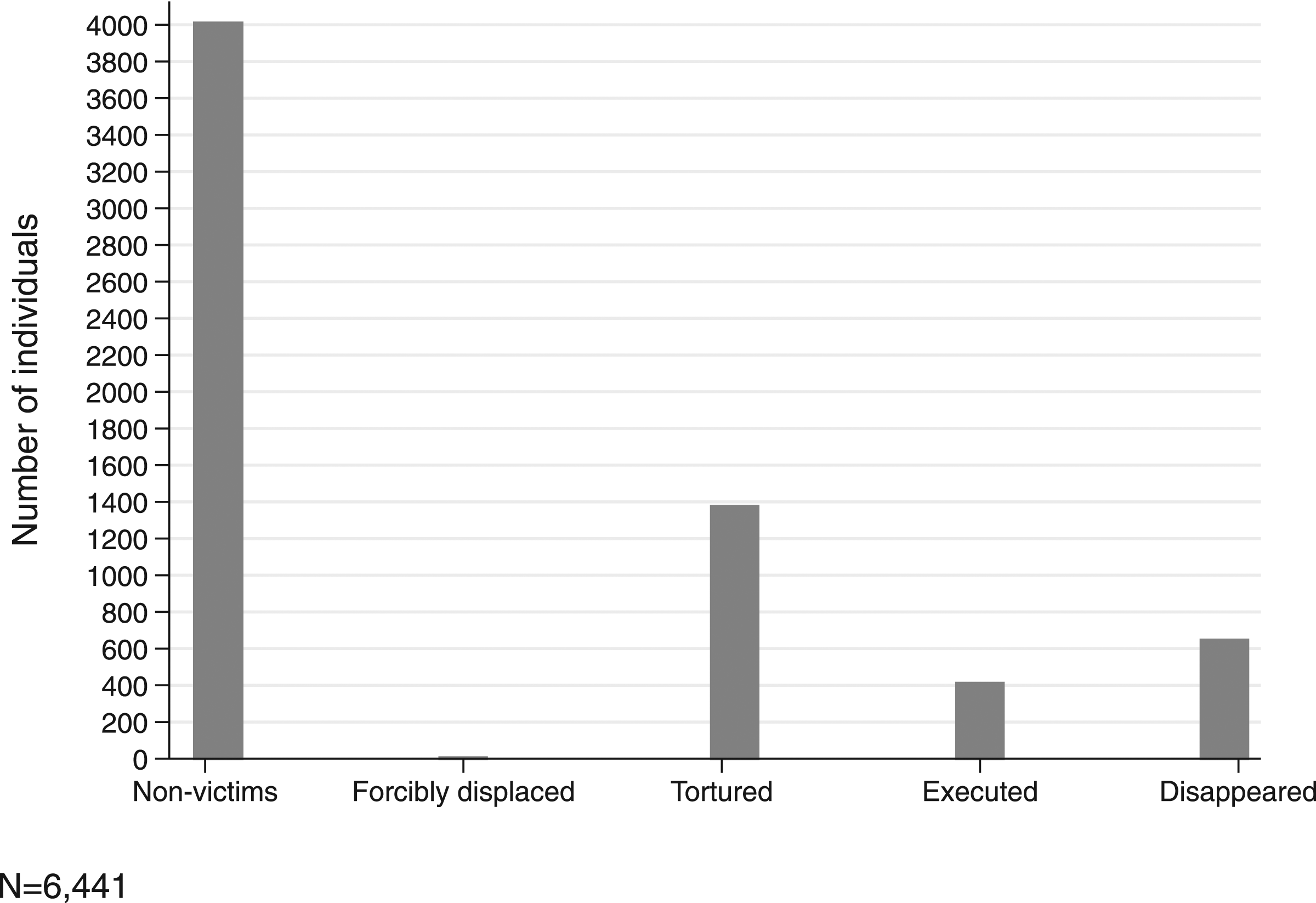
As illustrated in Figure 4, most of those who were on the target lists and victimized were victims of torture, followed by executions, and then disappearances. The number of forced displacements is very small (N = 5) in this sample, which might be because the displaced lists are not as complete as those for the other forms of repression. More likely, however, is that the opposition groups on these lists were top targets of the regime. The government tended to use forced displacement against those whom they perceived as less of a threat (Orellana, 2015).
Despite the secret police’s emphasis on demobilizing the MIR, Figure 5 shows that conditional on being on the target list, the rate of victimization of miristas was significantly lower than of other leftist groups. The MIR’s lower rate of victimization provides evidence for the theory of survival at the core of this paper, and is consistent with hypotheses one and three, which predict that groups with stricter compartmentalization and social detachment will tend to have lower rates of victimization. The probability of victimization for a targeted MIR militant is 43 percent. In contrast, approximately 58 percent of non-MIR militants (i.e., those identified as being from “leftist parties” “Communists” or “Socialists” were victimized. Of the 1900 MIR militants on the target lists, a total of 816 were disappeared, executed, or tortured. Meanwhile, 1065 MIR militants were never victimized, compared to just 665 members from the “other leftists” category who were spared the worst of the repression. See Appendix F for a disaggregation of the type of repression suffered by MIR vs. non-MIR militants. Percentage of victims and non-victims from MIR and Non-MIR groups.
To further probe the first and third hypotheses about compartmentalization and social embeddedness, I estimate a logit model. The outcome is victimization conditional on being targeted, with a value of 1 if the individual was tortured, executed, disappeared, or forcibly displaced, and 0 otherwise. The main independent variable is a binary indicator for whether the individual was a MIR militant or a militant from the “leftist parties” category or singled out as a PC or PS militant (1 = MIR militant; 0 = non-MIR militant), conditional on being on the target lists. Those with unknown affiliation are excluded. There are two control variables, which are both binary. The control variable DINA indicates whether the secret police was assigned to capture the individual (1 = DINA assigned to individual; 0 = otherwise), and the variable Leader indicates whether the individual held a leadership position in their opposition group (1 = leader; 0 = not leader). It is important to control for leadership status because otherwise this model assumes the security agencies prioritized all targets equally. 18
The first difference plot (Figure 6) shows that being a mirista is, on average, associated with a statistically significant decrease of 12% in the probability of victimization, even when controlling for security agency and leadership status. DINA was the most ruthless security agency and also in charge of eliminating the MIR, making it especially surprising that MIR militants had a lower rate of victimization than non-MIR militants. MIR’s Rate of Victimization is Significantly Lower than non-MIR’s Rate of Victimization. First difference plot from a logit model estimating the change in the probability of victimization (dependent variable) for a MIR militant vs. a militant from another group (main independent variable), controlling for the individual’s leadership status and whether the individual was assigned to the secret police (DINA).
Mitigating Cascading Effects of Repression
An implication of this paper’s theory is that we should observe fewer subsequent captures after the detention of a militant from a compartmentalized and socially detached organization than following the detention of a militant from an interconnected and embedded one. As explained in Appendix A, we would expect this survival advantage to hold whether the repressive tactic consists of mass arrests or going door-to-door. 19 As long as the goal is to find a type of person (e.g., leftists) or a specific individual, compartmentalization and social detachment should provide a survival advantage.
To evaluate this hypothesis on the cascading effects of repression (Hypothesis 2), I use time-series data from the executed and disappeared using the individual files of victims created during the National Truth and Reconciliation Commission (the Rettig Commission). There is an embargo on the archives from the two subsequent commissions on torture (the Valech Commissions), so we do not have fine-grained data on the more than 40,000 victims of torture. Because we know the day, month, year, and political affiliation of the disappeared and executed, I calculated the number of MIR, PS, and PC detentions 30 days and 60 days after each MIR, PS, and PC detention, divided by 30 and 60, respectively). These two cutoff points reflect the time security agencies might have taken to follow leads that emerged from a captured individual, based on interviews with former militants and prosecutors. The results from both cutoff points show the same overall pattern. The 30-day results are shown here and the 60-day results are in Appendix G, which also includes figures comparing the speed of detentions between the three groups and other analyses on the cascading effects of repression.
As Figure 7 shows, during the 30 days after the capture of a MIR militant, there are 2 fewer subsequent MIR captures per day, compared to the rate of subsequent captures following the detention of a Communist or Socialist. This model controls for the state where the militant was detained. The results are statistically significant at the p-value.05 level and remain unchanged when examining the period of peak repression (from the moment of the coup until 1977) or the entire Pinochet dictatorship (until the end of 1989). The main OLS model is as follows: Speed of detentions following a capture by militancy during peak repression and during dictatorial period (OLS coefficients).

Although the Communist and Socialist movements were much larger than the MIR, the evidence suggests that the larger cascading effects of repression for Communists and Socialists are not completely attributable to group size. First, the secret police and military intelligence agencies did not typically pick people up from the street at random. The Rettig truth commission data contains information about the original place of detention of each individual who ended up being killed or disappeared. Approximately 28 percent of the disappeared were originally detained in the street, while more than 71 percent of disappeared individuals were detained at their home, their workplace, at a friend’s house, at a family member’s house, in a foreign country, or crossing the border—indicating that they were likely victims of more targeted forms of repression. Group size plays less of a role in targeted repression, where security forces are looking for specific people with names, home addresses, and information about their workplaces.
Secondly, even when repression was the least selective—during the first 5 months after the coup—the vast majority of detentions took place at leftist centers of power, such as political party and labor union offices, universities, and government institutions run by the deposed Popular Unity government. Not only were there fewer public spaces where MIR militants would gather, because of their underground practices, but there was also less information that each militant could provide, and fewer militants connected to sympathizers in the workplace, place of residence, etc. Detentions at these sites led to many more subsequent detentions for the Communists and Socialists rather than the MIR precisely because torturing the average Communist or Socialist meant gathering more information about other militants than was the case for the MIR.
Finally, I spoke to dozens of leftist militants who attributed not being captured to specific measures that they took. For example, speaking about the repression she observed, a female militant from the CNR within the Socialist Party said that “the comrades who were captured did not do the sign and countersign (chequeo y contrachequeo) [to verify people’s identities], …did not develop a daily contact routine with signs that would alert other militants …that the [secret police] was taking you out to pick out militants (porotear) …In addition, they all knew each other, we didn’t” (Interviewee 94, April 2017, Santiago, Chile). I also interviewed militants who were captured. They trace back their detention to mistakes in compartmentalization and to specific informants that the secret police was able to gain (flipping militants into collaborators, of which there are several prominent cases in Chile (MemoriaViva, 2021; Skoknic, 2007)). As one MIR militant reflected on the runup to his detention by the DINA, “I relaxed my norms…" (Interviewee 38, May 2016, Santiago, Chile).
Psychologically, individuals may be prone to self-serving bias, assuming more personal responsibility for successes than failures (Arkin et al., 1980). However, militants generally did not attribute their survival while in prison to their specific actions, decisions, or skills. In conversations with militants who were detained, tortured and then released, they typically did not know why they survived prison while others were killed and disappeared. A MIR militant who was in charge of printing the underground magazine El Rebelde was detained with her sister, and said “they could have killed us” (Second interview with Interviewee 25, May, 2016, Santiago de Chile). Others shared that they think they survived prison because of interventions by Catholic priests rather than anything they did (Interviewee 12, May 2016, Santiago, Chile).
Compartmentalization and Social Detachment
Once Pinochet came to power, the Socialists and Communists recognized that their organizational structure and large numbers of civilians in their networks were liabilities—particularly during the height of repression. The head of the second clandestine directive of the Socialist Party, Eduardo Gutiérrez, was convinced that the Socialists had to start learning underground organizing skills and developing a compartmentalized structure: It was in the year ‘75 when we realized that we had to take drastic measures that would allow us to protect our lives and we decided to do what Europeans did in their resistance. We read texts that discussed the topic and decided to go completely into clandestinity; in order to do that we had to change our names, establish mechanisms of communications completely compartmentalized, no one knew your actual name, nor your address, and thanks to those measures we survived. (Vargas & Díaz, 2007, 41–42)
Similarly, Luis Corvalán, General Secretary of the Communist Party of Chile, said: “The Communist Party’s 20 years of legality lived during the Ibáñez, Alessandri, Frei, and Allende administrations, except for the short period in the first one, had driven us to a certain loss of acquired experience throughout the not so few reactionary governments that we had to confront in the past. That is how I would explain my detention, which took place on September 27, only 16 days after the military coup” (Corvalán, 1997).
On the other hand, MIR militants were building their clandestine structures before the 1973 coup. One of the Central Committee members of the MIR said that he started doing “work with the masses” (trabajo poblacional), but “I was there for a short period because afterwards I started doing other clandestine tasks. They took me out of the structure. I stopped being so public…I had other types of duties – I made contact with military officers and soldiers [to identify leftist allies, those who were pro-coup (golpistas) within the Armed Forces, and to make a diagnosis of the military]." This quote shows how militants’ everyday work and connections change when their organization compartmentalizes and goes underground. These transformations mitigate and slow the cascades of repression.
Personal interviews with MIR, PC, and PS militants also reveal that they all relied on trusted friends, relatives, and movement allies to change homes often. If the Armed Forces captured a militant, those connected to them would be at risk of capture. In those cases, the vulnerable militants relied on networks of informers to learn about the captures as quickly as possible, change homes, flee to another state, and take other precautionary actions (Interviewee 75, April 2017, Santiago, Chile; Interviewee 16, April 2016, Santiago, Chile). Even as late as 1977, Secretary General of the Communist Party, Luis Corvalán, explained: “The party has been capable, despite the brutality of the repression, of maintaining a strong clandestine organization, rooted in the support of thousands of families from the people whom from the first day opened their homes to the persecuted” (Corvalán, 1977, 91). Similarly, in 1974 the PS declared that the party was able to move activities underground despite the repression because of their strong organization, alliances between all leftists, and their ties to their bases of support (Corvalán, 1997; Socialista, 1974). The MIR repeatedly emphasized in their publications and internal documents the importance of politicizing students, peasants, and other “mass-based” organizations. These efforts demonstrated that the membership base has “high explosive power and is always willing to act as long as there is capable leadership to guide the way to insurrection” (MIR, 1965d, 11). Though the leadership of the top targets had an incentive to overstate their capabilities, including their level of support among the masses, these archival materials are representative of how the parties viewed their reliance on civilian communities.
However, the key difference between the MIR on the one hand, and the PS and PC on the other, is the way they controlled the flow of information when they worked in local communities. MIR militants lived among their constituents—in poor, working class neighborhoods—but they were not socially embedded. People did not know their true identities and political work: “One learns to live underground with time …you learn to represent your new name, to have a coherent facade with your new activities, your routine, schedule, what you talk about. You have to know the dynamics of your neighborhood, what people think…It’s a process of re-insertion with a new name …you have to learn how to live like fish in water” (Interviewee 38, May 2016, Santiago, Chile). Miristas continued their work in communities within the Catholic church, especially by tapping a less vulnerable population—women (Bruey, 2018). Hugo Flores, president of Movimiento Poblacional Solidaridad, described the dynamic in local churches when they became sites of resistance: “many Christians stopped attending church […] Paralyzed by fear, they hid in their homes. Communists and other leftists, on the other hand, fled their homes and sought shelter in the church” (Schneider, 1995, 116). Importantly, priests, nuns, and the Vicariate of Solidarity social workers and lawyers never asked or investigated the political affiliation of those who sought refuge within their religious community (Garretón, 2001).
In short, compartmentalization and social detachment involve a certain distance from civilian populations, which help slow and mitigate the cascading effects of repression. Although they eventually developed some clandestine structures, more deeply embedded and highly interconnected organizations like the Communist and Socialist parties remained more vulnerable to targeted repression from a capable state, because information about their leaders and organizers was widespread. Appendix H discusses plausible alternative explanations to the argument about underground organizing and social embeddedness, including variations in the determination to repress, the ability to seek exile, and socioeconomic status.
Implications for Group Survival and Effectiveness
Individual militant survival is a few steps removed from group durability, and even more from effectiveness and political success. Moreover, these outcomes are often in competition when it comes to underground organizations facing extreme repression. The institutions and measures that make individual survival more likely can hurt group durability and political effectiveness. Opposition groups have to decide between compartmentalization to reduce the spillover effects of repression vs. ease of communication and control over operations. They also have to make decisions about how to relate to civilians. In particular, social detachment insulates opposition groups from repression, but these measures hamper mass popular support and recruitment possibilities.
Both compartmentalization and social detachment are partly path dependent, but underground organizations also make decisions depending on their goals, constraints, and ideological commitments. I have outlined the conditions under which compartmentalization and social detachment make individual and group survival more likely (See Scope Conditions on page 11). During the height of repression—the first seven years of the Pinochet dictatorship—the MIR, PS, and PC were all targeted, with MIR militants relatively less vulnerable to repression. And while the three groups all survived this period as political entities, they turned inward, focused on individual and group survival, and dramatically reduced the scope of their actions. However, these groups never went completely dormant, unlike some other urban guerrillas in Latin America (Wickham-Crowley, 1992). And even if the PS, PC, and MIR had been inactive for a period of time, the Chilean intelligence services likely would have continued to pursue them regardless, aiming to destroy any possibility of future organization (Kornbluh, 2013).
The top three targeted organizations suffered greatly during the first years of repression, with hundreds of militants and whole cadres of leaders eliminated (Alvarez, 2003; Bruey, 2018; Dinges, 2005). By the 1980s, however, repression had eased 20 and the nonviolent opposition could operate openly. These changes, particularly by 1988, shifted the balance of the survival-effectiveness dilemma. Once again, social embeddedness and interconnectedness became political assets because they facilitated mass mobilization. What did these changes mean for the political success of the three top targets of the military junta? Initially, the MIR remained a player in Chilean politics, albeit a fringe one—not unlike before the coup. The MIR recovered its popular and military strength (Cavallo et al., 2008), and by 1979 it is able to finance its armed activity with domestic sources for the first time in its history, reducing its dependency on Cuba (MIR, 1986). In 1986, the MIR and the Communist Party were part of the Democratic Alliance and the mass protests to induce regime change (Garretón, 2001; Schneider, 1995). But given their continued commitment to an armed strategy, the Communist Party and the MIR were excluded from the National Accord. The opposition thus failed to become a unified front against the dictatorship (Valdivia et al., 2008). By the democratic transition in 1988, the MIR had essentially dissolved, “not so much due to the fury of repression which made it its number one target, but due to the consolidation of a new right-wing project, which, far from facilitating a transition to socialism, gave new verve to the capitalist hegemony” (Valdivia et al., 2008, 86).
Instead, it was the Christian Democratic Party and the Socialist Party that forged a successful alliance to oust Pinochet (Garretón, 2001; Schneider, 1995). In that sense, the Socialist Party—specifically the more moderate faction—was more politically successful than the Communists or the MIR, which remained an uncompromising, extreme leftist movement that failed to adapt to how the popular sectors in Chile had changed with the dictatorship (Valdivia et al., 2008).
Though the MIR, PS, and PC all aspired to attain power in Chile, they viewed the pathway toward that goal differently. As an extremist group, the MIR even considered the coup in 1973 to be helpful for the left, because the coup would lead people to realize that the movement was correct to reject gradualism and the “Chilean way” to Socialism (Dinges, 2005). Seeing the cruelty and intransigence of the right, miristas and later the Communists thought that more Chileans would join their insurrectional path to power. In addition, the MIR and the Communist Party had some important political successes during the period of mass mobilization and negotiated transition, including using pressure in the streets to force Pinochet to make economic concessions (Garretón, 2001), pushing for better terms at the negotiating table through the Civic Assembly (Schneider, 1995), and ending the regime’s project of historical erasure (Bruey, 2018; Valdivia et al., 2008).
Conclusion
Locally embedded organizations with large, interconnected networks of civilian supporters can become formidable opponents to states. But this paper offers a corrective to this widely held theory, arguing that extreme and selective violent repression from a capable state makes deeply embedded and interconnected groups very vulnerable. Unless they go into exile, this pattern of repression forces targets to organize underground—and the most effective way to organize underground is by compartmentalizing group structures. These measures slow the speed and reach of repression, making survival of opposition groups more likely.
Secrecy and compartmentalization mean militants share limited ties with other militants and civilians, and they restrict the information shared between ties. In underground organizations, militants are taught to treat with extreme caution personal information that security agents need to locate their fellow militants, such as their real names, home addresses, workplace, and appearance. Strict compartmentalization means that militants do not possess this information about their fellow militants in other cells. This form of organization and set of institutions makes it more difficult and time-consuming for security forces to identify and capture militants. And even if someone is captured, subsequent captures are less likely because security agents gain relatively little information from each detention.
During the Pinochet dictatorship in Chile, some opposition groups had different organizational strengths and weaknesses. The MIR had developed a semi-compartmentalized structure since its founding in 1965. The Socialist Party and the Communist Party, on the other hand, were highly interconnected and embedded organizations. The pattern of repression that all three organizations faced was similar—systematic detentions, torture, executions and disappearances—though the military junta was particularly intent on destroying the MIR. Yet the MIR’s rate of victimization was more than 14 percentage points lower than the Socialists and Communists. Subsequent captures in the 30 and 60 days after an arrest were also significantly lower for the MIR than for the Communists and Socialists. This paper makes the case that MIR militants were better equipped to survive repression thanks to compartmentalization and a lack of social embeddedness.
MIR’s underground organizing also positioned MIR militants to keep up the pressure on the dictatorship throughout the 1980s, even after the armed option lost traction. Indeed, miristas played an important role organizing in poor communities. Under the protective umbrella of pro-human rights Catholic priests and nuns, they continued educating, politicizing, and mobilizing people. In the underground, MIR militants were thus helping to rebuild the social fabric that state repression was destroying.
Supplemental Material
Supplemental Material - State Repression and Opposition Survival in Pinochet’s Chile
Supplemental Material for State Repression and Opposition Survival in Pinochet’s Chile by Consuelo Amat in Comparative Political Studies
Footnotes
Acknowledgments
Support for this project was provided by grants from the John F. Enders Foundation, the MacMillan Center for International and Area Studies at Yale University, the Tinker Foundation, and the United States Institute of Peace. For research assistance, I thank Enrique Gatica and Renato Dinamarca (Chile), as well as Francis Schmiede, Kate Simmons, Alexandra Small, Alexandra Esnouf and Jorge Meneses (Yale). Elisabeth Jean Wood, Susan Stokes, Adria Lawrence, P. M. Aronow, Sarah Elizabeth Parkinson, Woody Powell, Robb Willer, Daniel Ziblatt, Yael Zeira, Jonathan Pinckney, Jane Esberg, David Minchin, Gina Bateson, Matthew Cebul, Suparna Chaudhry, Victoria McGroary, as well as attendees of the Order, Conflict and Violence Speaker Series, the International Studies Association conference, the Politics and History Conference at New York University, the Stanford CDDRL Workshop, the Human Rights and Repression Latin America in Comparative Perspective Conference at Stanford, the CASBS Frontiers of Organizations Institute at Stanford, the Networks and Organizations workshop at Stanford, and the Stanford PACS Seminar provided very thoughtful feedback and advice regarding this project. I am especially indebted to my Chilean interlocutors for their openness, trust, and hospitality.
Declaration of Conflicting Interests
The author(s) declared no potential conflicts of interest with respect to the research, authorship, and/or publication of this article.
Funding
The author(s) disclosed receipt of the following financial support for the research, authorship, and/or publication of this article: Tinker Foundation, MacMillan Center for International and Area Studies at Yale University, John F. Enders Foundation, United States Institute of Peace.

Supplemental Material
Supplemental material for this article is available online.
Notes
Author biography
References
Supplementary Material
Please find the following supplemental material available below.
For Open Access articles published under a Creative Commons License, all supplemental material carries the same license as the article it is associated with.
For non-Open Access articles published, all supplemental material carries a non-exclusive license, and permission requests for re-use of supplemental material or any part of supplemental material shall be sent directly to the copyright owner as specified in the copyright notice associated with the article.
