



Abstract
Immigration is an extremely divisive political issue in Western Europe and North America. We examine whether immigration policy preferences are more nuanced than commonly understood. Too often, analyses of immigration policy preferences only consider the number of people allowed into the country. Yet, immigration policy must also address which people are allowed into the country and what rights they can have. We present results from a series of original surveys conducted in Germany between April 2020 and August 2022. We find preferences about policies governing immigration flows are conditional on policies governing entrance criteria and rights eligibility. Respondents who oppose immigration in general are willing to compromise and allow more immigration if entrance criteria become more selective. Respondents who support immigration are willing to compromise and accept less immigration if rights become more generous. Our findings have implications for understanding divides over immigration as well as policy debates more generally.
Introduction
Immigration is one of the most divisive political issues in Western Europe and North America. 1 Pro-immigration advocates push for increased migration numbers by arguing that host societies benefit from the labor, population growth and cultural diversity that come with migration. Anti-immigration constituencies mobilize for reduced migration numbers because they perceive migration as an invasion of their societies by unwanted and unassimilable foreigners (Clarke, Goodwin and Whiteley 2017; Mudde, 2019). The divide between these camps often feels like a zero-sum standoff and has been at the center of recent election campaigns across Western Europe and North America. Moreover, some analysts believe migration will be the central axis of 21st century political conflict (de Wilde et al., 2019; Hooghe & Marks, 2018).
In this paper, we demonstrate that immigration policy preferences are more nuanced than commonly understood. We start from the premise that immigration is a complex policy field that involves more than just the number of people who enter the country (Helbling et al., 2017). A comprehensive immigration policy must also address which people are allowed into the country and what rights they will have after arriving in the country (Helbling & Leblang, 2019). However, despite the close connection between these aspects of immigration policy, most research has examined them separately, without exploring whether preferences for one dimension are conditional on how policy is formulated on the other dimensions. Therefore, we strike new ground by analyzing immigration preferences from a multi-dimensional perspective (Lacy, 2001).
We use original nationally representative survey data from Germany. We conducted a series of survey experiments that randomly vary the contents of policy proposals to determine how variation in restrictiveness or openness across multiple immigration policy dimensions affects public support. Our key research question is whether respondents who are generally pro-/anti-immigration are willing to compromise on those preferences and admit fewer/more immigrants, conditional on the selectivity of the entrance criteria and the generosity of migrants’ rights eligibility. In addition, we gain insight on possibilities for compromise by examining the extent of support for bundles that mix open and restrictive policies with bundles that are consistently open or restrictive.
Our main finding is that sizeable percentages of our respondents would support policy combinations that involve compromising their general immigration preferences. Among respondents who oppose immigration in general, there is a roughly 40% chance of supporting a compromise and allowing more immigration if the entrance criteria become more selective. Among respondents who generally support immigration, there is a roughly 35% chance of compromising and accepting less immigration if rights become more generous for migrants already in the country. Additional analyses suggest the policy combination that would satisfy the largest numbers of pro- and anti-immigration Germans is one which decreases the number of migrants, is more selective about which migrants can enter, but is more generous about rights for migrants already in the country.
Our paper makes several contributions. First, our analysis of trade-offs across policy dimensions opens new directions for work on immigration preferences, which is mostly fragmented and tends to consider immigration policy dimensions in isolation. There is a well-established body of work on preferences for policies governing how many migrants (Citrin et al., 1997; Mayda, 2006; McLaren, 2003) or asylum seekers (Bansak et al., 2017; Heizmann & Ziller, 2020) should be admitted to a country. However, this work has mostly been separate from research on attitudes about other aspects of immigration policies.
There is also a body of work on the selectivity criteria that make potential migrants more attractive to mass publics. This research finds that immigrants’ education, occupation, national origin, religion, age, and gender are among the factors that make people more or less likely to support their admittance (Hainmueller & Hopkins, 2015; Helbling & Kriesi, 2014; Wright et al., 2016). However, research on attitudes toward different types of immigrants has been largely removed from the practical realities of immigration policies, which are not customized to select immigrants on all of the dimensions analyzed in these studies. In addition, this work has not examined how preferences for specific types of immigrants are related to preferences for the size of migration flows or the extent of migrant rights. We make these extensions with a framework for analyzing preferences across multiple concrete policy dimensions.
Similarly, existing work on preferences for migrants’ rights eligibility has largely been framed as a matter of "integration policy" and been analyzed separately from immigration policies (Degen et al., 2019; Kolbe & Crepaz, 2016). One exception is Margalit and Solodoch (2022), which broadly explores how policies governing the flow of migrants relate to preferences for policies governing migrants already in the country. We extend that work with a more detailed analysis of how preferences for migration flows are conditional on selectivity and rights policies. As such, we propose a new research agenda, which provides a more accurate and nuanced understanding of immigration policy preferences, as opposed to only analyzing preferences for one immigration policy dimension. 2
One benefit of our focus on the conditionality of immigration preferences is that it highlights concrete possibilities for compromise. Narratives about grand conflicts over immigration assume that European societies are polarized between pro- and anti-immigration factions that share no common ground (de Wilde et al., 2019; Hooghe & Marks, 2018). This implies that immigration policies will never receive broad support and will remain contentious for the foreseeable future. However, our results suggest that compromises can be found when one accounts for mixed preferences across different dimensions of immigration policy.
We also extend recent research which suggests governments face immigration policy trade-offs. This work highlights the compromises that policymakers must find to pass comprehensive immigration policies (de Haas et al., 2015; Schultz et al., 2020), in processes that engage multiple organized stakeholders (Boswell & Geddes, 2011; Hampshire, 2013). Moreover, research suggests governments are aware of societal trade-offs as they calculate options for different dimensions of immigration policies (Ruhs, 2013, 2018). We extend this work to the domain of public preferences, by showing how regular citizens think about the different dimensions of immigration policy.
Finally, we use policy complexity to contribute to literature on policy preferences. In recent years, there has been a growing awareness that many people hold non-separable policy preferences, in which their preferred outcome for one policy is dependent on the available options for another set of policies (Lacy, 2001). There is also growing awareness that human judgments in general are based on explicit trade-off calculations (Guzmán et al., 2022). However, these insights are not always applied to public opinion research, where it is often simpler and easier to analyze preferences in isolation from related policies. There is a growing body of research that investigates trade-offs between the introduction of new regulations and related individual or societal costs (Hansen, 1998; Hix et al., 2021). There is also a small and growing body of research on multi-dimensional policy preferences (Horiuchi et al., 2018; Kustov, 2021; Stadelmann-Steffen & Dermont, 2020). We build on this work and demonstrate that it is essential for understanding immigration policy preferences. More broadly, our research reinforces the point that a multi-dimensional perspective may help promote better political compromises in general.
Hypotheses
Our analytical leverage comes from comparing support for immigration policy combinations that mix open and restrictive policies across dimensions, thereby forcing respondents to evaluate trade-offs. Research on immigration divides expects polarization among the more extreme supporters on each side (de Wilde et al., 2019; Hooghe & Marks, 2018). Therefore, we expect policy combinations that are open on all dimensions to receive the most support from people who are generally positive about immigration, and the least support from people who generally oppose immigration. Similarly, we expect policies that are restrictive on all dimensions to receive the least support from people who are generally positive about immigration, and the most support from people who generally oppose immigration. 3 However, those extreme policy formulations offer no insight on the extent of conditional policy preferences. Instead, we focus our analysis on support for policy bundles that force respondents to weigh competing considerations across dimensions. In other words, when forced to choose, would people prefer policies that run counter to their preferences for flows, selectivity or migrant rights? This generates three hypotheses.
The first hypothesis assumes that people care most about how many migrants enter the country. Immigration policy may encompass multiple dimensions, but the number of migrants arriving in the country is a clear measure of the extent of new influences on society, which could make it the most salient dimension (de Wilde et al., 2019; Hooghe & Marks, 2018). Questions about selectivity and rights might be considered secondary considerations to be solved after the question of how much change people can expect to the size of their society (Kustov, 2022). Research suggests that people feel more obligation to migrants already in the country, as opposed to potential future migrants (Margalit & Solodoch, 2022). This implies that the biggest policy hurdle could be getting people to agree on how many people to admit. Moreover, even if research shows that people distinguish between different types of migrants who are more or less desirable, managing the border is a core function of the modern state. Questions about the number of people crossing the border evoke deep emotions about security and the definition of the nation-state, tapping into fundamental worldview values about how open the society should be (Adamson, 2006; Hess & Kasparek, 2017). Therefore, the first hypothesis is that people will be less flexible on their preferences for migration flows, as opposed to selectivity or rights.
H1: Respondents are unwilling to accept policies that compromise on their preferences for migration flows even if they are consistent with their preferences for selectivity or migrant rights. The second hypothesis emphasizes the importance of selectivity policies. In theory, the relationship between selectivity and migration flows can operate in multiple directions. Both policies could be restrictive if there were narrower criteria for allowing migrants and fewer people of that narrower type admitted to the country. Both policies could also be more permissive. In addition, tighter selectivity requirements could be combined with permissive flow policies that admit more of a narrower type (e.g., because they need lots of workers in a specific sector). The specifics of the combination can vary, but the focus for this hypothesis is whether selectivity policies can compensate for migration flow policies that run counter to respondents’ preferences. For people who tend to oppose immigration, their skepticism of migration could be overcome by the ability to choose "the right kind" of immigrants. Existing research indicates considerable variation in people’s willingness to accept different kinds of immigrants. People who lean anti-immigration might be persuaded by the idea of selecting immigrants with demographic, educational and occupational profiles that would contribute economically to the host country (Doomernik et al., 2009; Helbling et al., 2020). Skeptics might also be concerned about immigrants changing the culture and therefore be willing to accept larger numbers if they could select immigrants with cultural characteristics (e.g., national origin, religion, or language skills) that are considered more conducive to assimilation (FitzGerald et al., 2018; Goodman, 2012, 2014). Either way, the expectation is that people who are generally opposed to migration will care more about what kinds of migrants arrive as opposed to the overall number. For people who tend to support immigration, the logic is that their goals of an open society might be better accomplished by preserving open access for migrants. One of the main motivations for people to support immigration is a belief that diversity and multiculturalism are beneficial for society (Favell, 2008; Mahfud et al., 2018). Looser entrance criteria means a broader range of migrants can access the country, including those from demographic profiles targeted by the more virulent anti-immigration segments of a country. Therefore, for people who generally support immigration, looser entrance criteria might be a valuable tool for promoting diversity and make it worth the trade-off of reduced overall immigration numbers (de Wilde et al., 2019; Hooghe & Marks, 2018). In short, people who tend to be pro- or anti-immigration might both have reasons to prefer compromising on their preference for migration flows, if they get policies consistent with their preferences for selectivity.
H2: Respondents are willing to accept policies that compromise on their preferences for migration flows if they are consistent with their preferences for selectivity. The third and final hypothesis is based on the importance of migrant rights. Most people who arrive in a country as migrants do not already have citizenship. Therefore, most migrants occupy a separate legal status that does not allow them to receive a wide range of economic, cultural and political rights (Koopmans et al., 2005).
4
European countries have long debated which of these rights should be available to migrants and the conditions under which they should be granted (Koopmans et al., 2012). Restricting migrant rights might be very important to people who generally oppose immigration, because it would allow them to prevent migrants from getting access to valuable social welfare benefits. There is a well-developed literature on the strength of "welfare chauvinism," which is the desire to limit welfare rights to native-born citizens, who are seen as more deserving because of their historical commitment to the host country (Careja & Harris, 2022; Magni, 2022). If those concerns were removed by limiting migrant rights, then the anti-immigration camp might be willing to compromise and allow greater migration flows (e.g., for the purpose of providing valuable labor). In addition, if migrant rights are restricted, they may be less likely to become permanent settlers (Ruhs, 2013, 2018). If migrants only remain for a short time, the host country can benefit from migrant labor without having to incorporate migrants’ needs and interests in the host country institutions. This could further ease concerns about the effects of immigration among those opposed to it. Conversely, people who support immigration might prefer expanded rights to expanded numbers. This once again draws on the logic that immigration supporters care about diversity, multiculturalism and incorporating migrants into the fabric of the host society (Favell, 2008; Mahfud et al., 2018). Expanded rights means that migrants have more opportunities to become part of the host society. Therefore, people who generally support immigration might be willing to accept reduced immigration numbers if that were coupled with expanded migrant rights.
H3: Respondents are willing to accept policies that compromise on their preferences for migration flows if they are consistent with their preferences for migrant rights.
Background
We conduct our research in Germany, a country that has a long history—dating back to the 19th century—of welcoming diverse immigrants, just like many other West European and North American countries (Joppke, 1999). That said, for many decades, German society marginalized immigrants and it was more difficult to acquire citizenship and become a full member of German society than in other countries with similar levels of immigration. In recent years, German citizenship law has liberalized and converged toward European norms (Koopmans et al., 2012; Schmid, 2021). Germany now has similar debates as its European neighbors and is similarly divided over the role immigration should play in society (Geddes & Scholten, 2016).
Germany was an outlier among West European and North American countries during the 2015 Syrian refugee crisis, by opening its borders and not limiting the number of asylum seekers who could enter the country (Mushaben, 2017). The move was controversial but it remains to be seen what long-term effects it will have on immigration politics. In the short-term, Germany remains bitterly divided between people who believe immigration is a vital resource for a 21st century society and those who believe it is a destructive force.
Our data were collected during the COVID-19 pandemic, which has been an exceptional time period in many ways. Early data suggest European attitudes may have gotten more hostile to immigration during the pandemic, because of fears of contamination from outside the nation (Henley & Duncan, 2020). As a result, our data could indicate more negative immigration attitudes than if they were collected during a different temporal context. However, recent research suggests that—at least in Germany—broad patterns of support for immigration did not change during the COVID-19 pandemic, despite increasingly vocal complaints from anti-immigration factions (Drouhot et al., 2021). Moreover, our research is about the conditional nature of immigration preferences, not about overall levels of positive or negative attitudes. Even if immigration attitudes became more negative during the pandemic, that suggests people who are anti-immigration should be less likely to moderate their views and support increased flows. This implies that our finding of anti-immigration people supporting increased migration flows under the condition of stricter selectivity could be an even larger trade-off during non-pandemic times.
Study 1: Main Policy Dimensions
Aim
Study 1 is a general test of our three hypotheses about the extent to which respondents will support different immigration policy combinations.
Data Collection and Sample
The data for study 1 were collected in 13 cross-sectional survey waves from April to mid-August 2020. Each wave had roughly 500 respondents, and were conducted either weekly or biweekly. The survey was conducted online by the firm Respondi. 5 Respondents were above the age of 18 and the sample was designed to match the German population according to gender, age, and education. Roughly 20% of the respondents were either born abroad or have at least one parent who was born abroad.
Our main analyses pool across all waves (N = 7552). The multi-wave design was part of a larger project coordinated by multiple research teams, and was not intended to provide analytical leverage on testing our hypotheses. However, we can use the multi-wave design to conduct robustness checks and confirm that our results are consistent across time. All analyses are based on unweighted data and simple list-wise deletion of missing values. Descriptive statistics are provided in appendix Supplement Table A1.
Experimental Design
To measure preferences across immigration policy dimensions, we include an item at the end of the questionnaire that asks whether respondents would support an immigration policy proposal. The proposal has three components: the number of migrants admitted (increase vs. decrease), the extent of selectivity over which migrants are admitted (increase requirements vs. lower requirements), and the rights migrants receive once in the country (restrict vs. extend). The specific proposal for each dimension of the policy was randomized across respondents, which creates a 2 × 2 × 2 between-subjects design (i.e., each respondent saw only one combination). The original German text and a table with balance checks are in the appendix. The English translation is as follows: Some politicians have proposed a new immigration policy to [increase/decrease] the number of immigrants allowed to enter Germany. Immigration policy defines the requirements to be allowed to enter and the rights immigrants receive once they are in the country. The immigration policy proposed by some politicians is to [tighten/lower] the requirements to be allowed to enter Germany [and/but] at the same time [restrict/extend] the rights of migrants once they are in the country. To what extend to you agree or disagree with this policy?
Additional Measures
To identify respondents according to their general immigration preferences, we use an item that was included before the experiment in the middle of the questionnaire and asks about agreement with the statement "Germany should limit immigration." There are eight response categories, ranging from 0 ("I disagree") to 7 ("I completely agree"). We code the three lowest response categories as the pro-immigration subset (22.2% or N = 1665). The three highest response categories are the anti-immigration subset (52.8% or N = 3967). We classify the two middle categories as generally neutral on immigration (25% or N = 1884). In robustness checks discussed below, we vary the thresholds for categorizing respondents as pro- or anti-immigration.
Statistical Analysis
To test for the conditionality of immigration policy preferences, we require a flexible modeling approach that can readily accommodate and summarize the effects of complex interactions (i.e., numbers × requirements × rights) in a concise way. A suitable option is to turn to hierarchical modeling which treats the interactions as random effects. This allows us to deal with three key challenges (Gelman & Hill, 2007). First, entering full interactions of all experimental factors as random effects "partially pools" their effects to the overall mean, thus allowing for reliable estimation of interactions even if combinations have only few observations (Ghitza & Gelman, 2013). Second, partial pooling helps circumvent the well-known multiple comparisons problem (Gelman et al., 2012). By specifying the interactions as random effects, we reduce the type 1 error rate where testing for several interactions may lead to statistically significant results by chance. Third, by also including random effects for survey waves, we accommodate the repeated cross-sectional nature of our data. This accounts for wave-specific effects and does not require adjusting standard errors.
We use a linear model specification for a binary outcome (agree = 1 vs. disagree = 0), which permits a straightforward interpretation of coefficients as the probability of agreeing with the immigration policy proposal. Specifically, we model agreement with immigration policy using a specification which includes K = 3 main effects for the three policy dimensions (i.e., number of migrants, entry requirements and rights) as "fixed effects" β k along with a "random effects" specification for the J = 8 policy combinations resulting from a full interaction of all dimensions (i.e., numbers × requirements × rights), where each combination is now treated as having its own effect, α j . Assigning a distributional assumption to these combination-specific effects, namely, α j ∼ N (0, σ interaction ), provides us with a simple expression of conditionality: If preferences for immigration policy are conditional, there should be a notable random effects variation, which is not already captured by the main effects (Bell et al., 2019). In other words, σ interaction should be statistically different from zero. To test for this, we use a simple likelihood ratio test contrasting two nested models (with and without variance component σ interaction ) for the full policy interaction. Importantly, this modeling approach allows us to assess conditional policy preferences globally (i.e., are policy preferences conditional at all?) by assessing σ interaction . But the model also allows us to assess conditional policy preferences locally (i.e., which specific policy combination yields the highest levels of agreement?) by comparing specific combination effects α j s. Last, we include random effects for T survey waves, γ t ∼ N (0, σ wave ) and an individual residual error term ϵ ijt ∼ N (0, σ residual ) resulting in the model y ijt = μ + ∑β k + α j + γ t + ϵ ijt . We estimate this model in a Bayesian paradigm with weakly informative Wishart priors on the variance components.
Descriptive Results
Figure 1 presents the distribution of responses across each policy combination for pro-immigration, anti-immigration and neutral respondents. As one would expect, the pro- and anti-immigration subsets are polarized on the most extreme policy combinations. The pro-immigration subset prefers the policy combination that is open on all three dimensions and is least supportive of the proposal that is restrictive on all three dimensions. Conversely, for the anti-immigration subset, the most-preferred policy combination is restrictive on all three dimensions and the least preferred is open on all three dimensions. The neutral subset has fairly consistent levels of support across the policy options, which one would expect for people without strong views on immigration. Agreement with immigration policy proposals across pro-immigration, neutral, and anti-immigration subsets. Error bars are 95% confidence intervals. Pooled waves 1–13. Cell sizes of immigration subset × experimental condition range from N = 187 to N = 505.
To evaluate our hypotheses, the key comparisons are policy combinations that mix openness and restrictions. Examining the second favorite combination for pro- and anti-immigration respondents provides insight on the conditionality of their preferences. Among pro-immigration respondents, the second favorite combination is restrictive on migration flows but more open on entrance criteria and rights. The chance of supporting this combination is roughly 35%. This is less than the almost 50% chance of supporting the most open policy combination, but is nonetheless sizeable, given the fact that it involves an important compromise.
Among anti-immigration respondents, the second favorite combination (with probability of support at over 40%) is open on migration flows but restrictive on entrance criteria and rights. This is less than the almost 70% chance of supporting the most restrictive policy combination, but is nonetheless quite large, given the compromise. In short, large portions of both pro- and anti-immigration respondents would support policy bundles that trade migration flow preferences for their preferred outcome on the other dimensions, which runs counter to the logic of H1.
Modeling Fully Conditional Immigration Policy Preferences
For a more formal analysis, we model immigration policy preferences in a Bayesian hierarchical model which includes "main effects" for the three policy options as "fixed effects" (numbers, requirements, and rights) along with "random effects" for the full three-way interaction (numbers × requirements × rights).
To first answer the global question of whether immigration policy preferences are conditional in general, Figure 2 compares two model specifications: one model without random effects for the policy combinations (empty dots) and one allowing for full policy interaction effects (solid dots). We present results for the full sample, as well as the pro-immigration and the anti-immigration subsets. Coefficient plots of results from Bayesian hierarchical linear models of policy agreement. Empty dots: Policy main effects only specification, without interactions. Solid dots: Conditional policy effects specification with full interactions modeled as random effects. Estimates and 95% CIs shown. Default Wishart prior on variance components. Pooled waves 1–13. Full sample: N = 7128 respondents (including neutrals), Pro-immigration subset: N = 1563 respondents, Anti-immigration subset: N = 3800 respondents, T = 13 survey waves and J = 8 policy combinations. ***p < 0.001 from a likelihood ratio test (see Tables 1).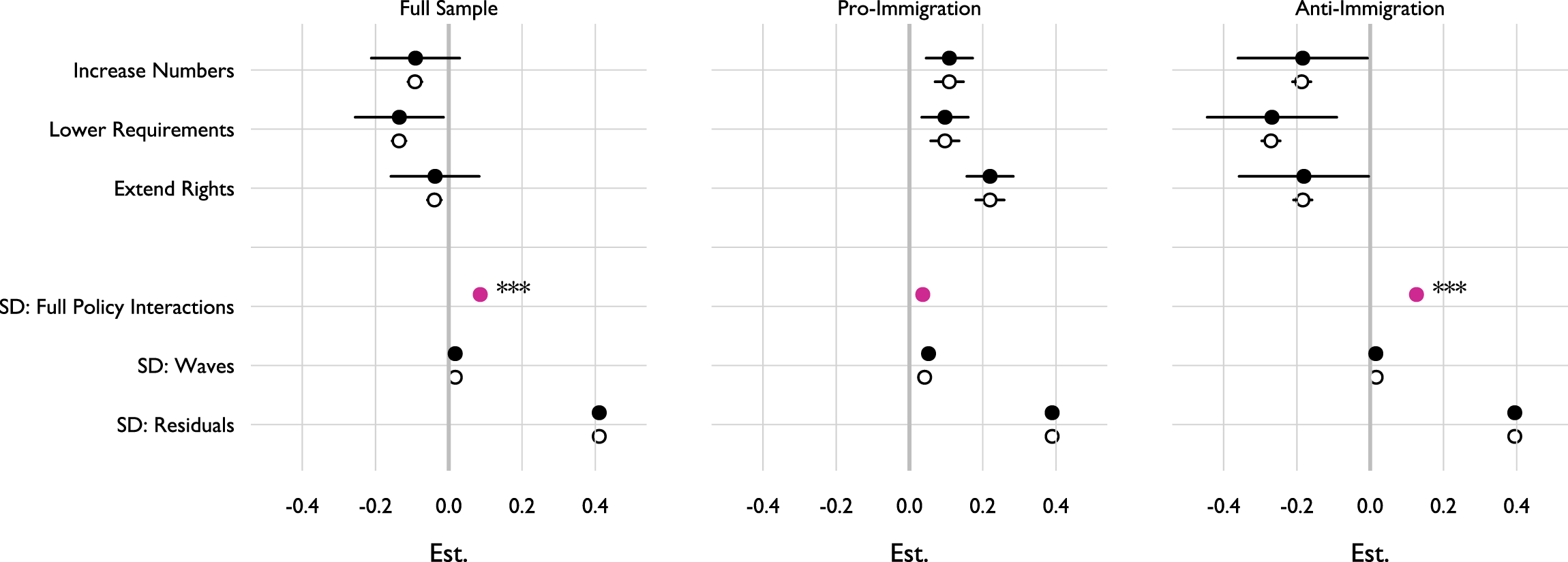
The left panel of Figure 2 is for all respondents and suggests that the general preference (empty dots) is for fewer immigrants (9% points more agreement than more immigrants), stricter entry requirements (14% more agreement than looser requirements) and fewer rights (4% more agreement than more rights). Yet, this "overall" result is mainly driven by the large anti-immigration subset (N = 3800 or 53% of all respondents). The right panel of Figure 2 plots results for anti-immigration respondents and shows the same pattern in even stronger terms. In contrast, the pro-immigration subset prefers higher numbers of immigrants, looser entry requirements and more rights.
Likelihood Ratio Test for the Existence of Conditional Policy Effects. Pooled Waves 1–13.
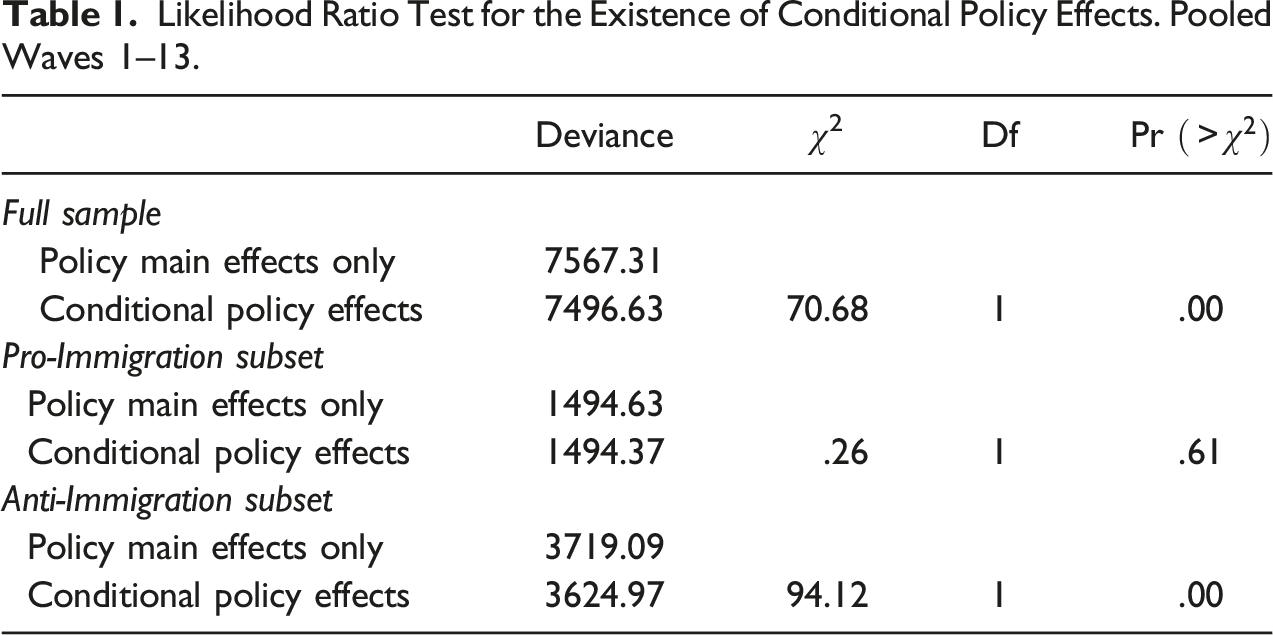
To assess conditional policy preferences locally, we use results from the models with full interactions in Figure 2 to calculate the probability of agreement with each policy combination. 6 As mentioned above, the highest probabilities of agreement are for the most extreme positions (restrictive on all three policy dimensions for anti-immigration respondents and open on all three dimensions for pro-immigration respondents). Yet, the second and third-best options are the ones that reveal potential trade-offs and are the strictest tests of our hypotheses.
The second-best policy combination for pro-immigration respondents is one that reduces immigration numbers but loosens entry requirements and extends immigrant rights. This second-best policy has an 80% higher probability of agreement than their third-best policy, which is increasing numbers, tightening entry requirements, and extending rights. The second and third-favorite policy combinations each have two open and one restrictive policy, but the specific ordering of the combinations provides insight on what pro-immigration Germans value. Our results suggest they are willing to be flexible on their preference for increasing immigration numbers if they get rights for migrants already in the country (H3).
For anti-immigration respondents, the second-best combination is one that increases immigration numbers but tightens requirements for entry and restricts rights for immigrants. 7 This second-best policy has a 67% higher probability of agreement than their third-best policy, which is decreasing numbers, tightening requirements, and extending rights. Here, the second and third-favorite policy combinations have two restrictive and one open option, which means the specific ordering provides insight on what anti-immigration German value. Our results suggest they are willing to be flexible on their preference for decreasing immigration numbers if they get stricter entry requirements (H2).
As a further test of policy priorities, we asked respondents about the importance of different principles (control over who can enter vs. access to rights) when formulating a comprehensive immigration policy. Pro-immigration respondents prioritized rights over entrance control (.72–.65—on a scale of 0–1, where 0 is low and 1 is high priority). Anti-immigration respondents prioritized entrance control over rights (.91–.41). It is beyond the scope of this paper to determine exactly why pro-immigration people seem to prioritize rights while anti-immigration people prioritize selectivity. These nuances would be fruitful for future research. Yet, at a minimum, our results strongly suggest different priorities and trade-offs for both sets of respondents.
Robustness Checks
We test the robustness of our findings in several ways. First, we address the fact that our overall analysis of several waves of survey data (T = 13, covering roughly 5 months) might obscure different preference dynamics at different points in time. In the appendix, we present results across moving windows of four survey waves for the full sample, the pro-immigration subset and the anti-immigration subset. In each case, results are consistent across survey waves and time.
Second, we conduct sensitivity analyses to ensure that our results are not an artifact of how we specified the "pro" and "anti" immigration subsets. Full details in the appendix suggest that our results are robust and consistent across different specifications of the subsets.
Finally, given the intense political debates around immigration, we explore how our results vary according to political affiliations. One possibility is that left-right divides track the general patterns of pro- and anti-immigration respondents we have analyzed thus far. However, if there are different patterns across political affiliations, that might suggest difficulties for translating conditional preferences into concrete policy compromises.
Results in the appendix examine variation according to the party respondents intended to vote for in the next general election. There is variation across parties, with Socialist (SPD) and Green (Grüne) voters more supportive of open policies and far-right (AfD) voters more supportive of closed policies. This is consistent with preference divides between the pro- and anti-immigration subsets. However, results from models with full policy interactions suggest that preferences among supporters of all political parties are conditional and involve trade-offs beyond the main effects. We also present results according to Left-Right ideological self-placement, which are similar to the outcomes for specific party preferences. In short, analyzing preferences according to political party affiliations is consistent with our main results.
Study 2: Economic versus Cultural Policy Criteria
Aim
Study 1 suggests that sizeable portions of the population are likely to support policy compromises, and that they prefer compromising on migration flows as opposed to entrance criteria or migrant rights. However, the survey design in study 1 used general language and did not address the specific selectivity criteria or the specific migrant rights that respondents may have considered. There are multiple criteria that can be used for policies on immigration selectivity or rights and conditional preferences may vary according to those specifics.
One of the most common frameworks for evaluating immigration issues is the distinction between economic and cultural motivations (Hainmueller & Hopkins, 2014). In study 2, we use this framework to explore whether economic or cultural policy criteria are more likely to attract public support. This is not intended to be an exhaustive analysis of all the ways in which entrance criteria or migrant rights policies could be structured. Instead, this is a suggestive exploration of the extent to which prioritizing selectivity and migrant rights criteria over flows might be dependent on policy specifics.
Data Collection and Sample
Data collection for study 2 was included in further iterations of the survey reported in study 1. Ten biweekly surveys (waves 14–23), with roughly 1000 respondents each, were fielded by Respondi between early November 2020 and March 2021. Each sample was again designed to match the German population in terms of gender, age, and education. As before, we pool all waves for our analysis (N = 10,234) and present descriptive statistics for the pooled sample in the appendix.
Experimental Design
We retain the core question from study 1 about support for an immigration policy proposal that varies across three dimensions (entry, selectivity, migrant rights), which can be more open or more restrictive. We then add randomized manipulations for whether the selectivity requirements are based on economic or cultural criteria and whether the migrant rights are economic or cultural (the original German text and balance checks are in the appendix).
To test the importance of economic versus cultural selectivity criteria, we randomly vary whether the proposed selectivity is based on education or nationality. Education is often considered an important "economic" selection criterion for migrants. Migrants with higher levels of formal education are generally considered more beneficial for the host country economy while migrants without formal educational qualifications are seen as potential economic burdens (Cerna, 2014; Kolbe & Kayran, 2019). Nationality is a common measure of cultural compatibility. People who believe migrants are a threat to the national culture often focus on preventing immigration from specific countries outside of Europe where the "cultural distance" is presumed to be greater (FitzGerald et al., 2018). This allows us to test whether our finding of anti-immigration respondents being willing to admit more migrants if the selectivity criteria are tightened (H2) is dependent on whether the selectivity criteria are economic or cultural.
To test the importance of economic versus cultural migrant rights criteria, we randomly vary whether the migrant rights that will be extended/restricted are welfare benefits or cultural rights. Migrant eligibility for welfare benefits is a common debate across Europe as different sides argue about whether the economic cost is justified (Degen et al., 2019; Kolbe & Crepaz, 2016). Migrants’ right to retain their homeland customs is another large debate in Europe. Immigration skeptics often argue that migrants should be forced to adopt the customs of the host society so as not to alter the broader cultural landscape of the host society. Immigration advocates tend to oppose that view and argue that immigrants should be allowed to keep their culture (Banting and Kymlicka 2006, 2017; Koopmans et al., 2012). This allows us to test whether our finding of pro-immigration respondents being willing to accept migration restrictions if migrant rights are expanded (H3) is dependent on whether the rights are economic or cultural.
Results
We use the same hierarchical modeling approach as above and contrast a specification that only includes the policy main effects with a full conditional model specification that includes all policy combinations as random effects.
8
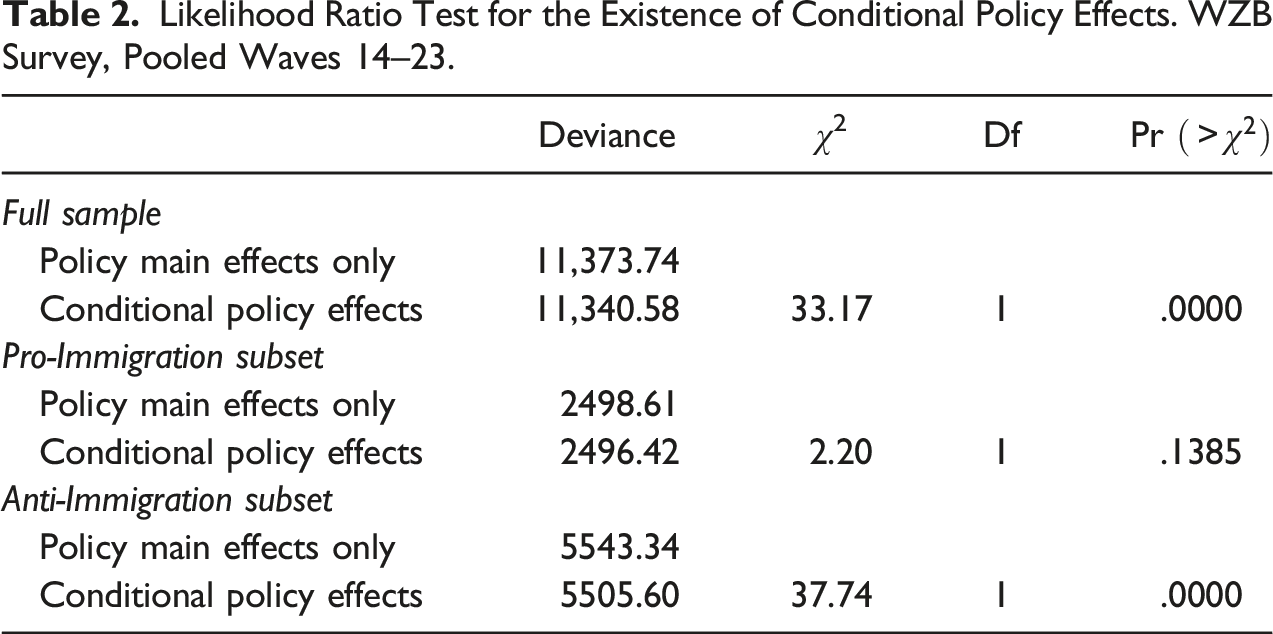
Results are in Figure 3 and are consistent with our previous findings in several ways. First, Figure 3 suggests that policy preferences are conditional for the full sample and the anti-immigrant sub-sample. In both cases, a model which accounts for all immigration policy interactions using a random effects specification captures additional variance (see likelihood ratio test results in Tables 2). For pro-immigration respondents, there are no reliable interactions. This is consistent with results from study 1, which suggests that specifying the type of entry requirements and migrant rights does not affect the overall conditionality of immigration preferences.
9
Coefficient plots of results from Bayesian hierarchical linear models of policy agreement. Empty dots: Policy main effects only specification, without interactions. Solid dots: Conditional policy effects specification with full interactions modeled as random effects. Estimates and 95% CIs shown. Default Wishart prior on variance components. Pooled waves 14–23. Full sample: N = 9806 respondents (including neutrals), Pro-immigration subset: N = 2218 respondents, Anti-immigration subset: N = 5180 respondents, T = 10 survey waves and J = 32 policy combinations. ***p < 0.001 from a likelihood ratio test (see Tables 2). Likelihood Ratio Test for the Existence of Conditional Policy Effects. WZB Survey, Pooled Waves 14–23.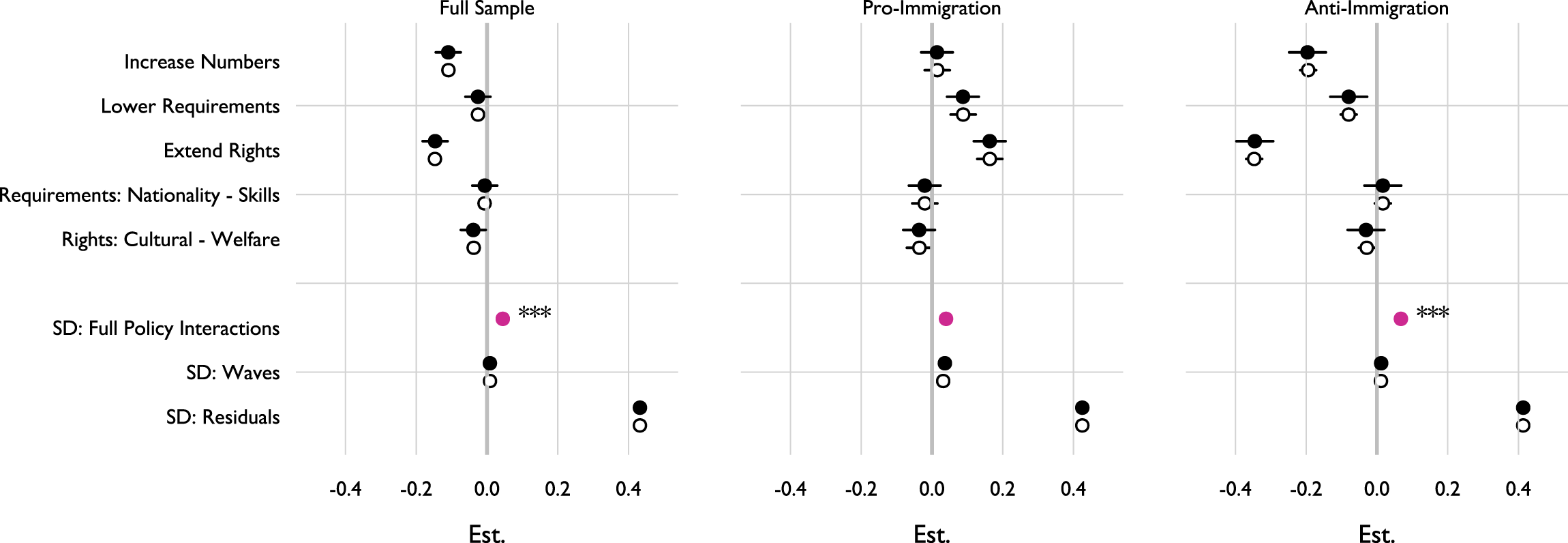
When we analyze the extent of support for specific immigration policy proposals that randomly vary economic and cultural criteria (full details in Appendix Supplement Figures A9–10), the results are again consistent with study 1. As expected, among pro-immigration respondents, the most-preferred options are open on each policy dimension, with probabilities of support above .4. However, the next cluster of preferred policies decreases the number of immigrants, lowers educational requirements and increases rights. Depending on the specific economic or cultural criteria, the probability of support for these trade-offs ranges from .35 to .39, although the confidence intervals all overlap, so we cannot be certain that one version is preferable to another. The support for these policy options is fairly close to the level of support for the consistently open bundles. Moreover, these trade-offs all get more support than the next cluster, which increases numbers and expands rights but tightens selectivity. This is consistent with H3, and the same pattern of first, second and third choices as in study 1.
Among anti-immigration respondents, the most-preferred options are restrictive on each policy dimension. As with pro-immigration respondents, there is small variation across options with different economic or cultural criteria, but with overlapping confidence intervals and no evidence that one version is preferable to another. The second most-preferred bundle is restrictive on numbers, open on selectivity and restrictive on rights, which is different from study 1. However, support for those policy bundles is statistically indistinguishable from support for policies that increase the number of immigrants, are selective regarding nationality, and either limit access to welfare or cultural rights. These results are broadly consistent with study 1, as they suggest anti-immigration respondents are likely to compromise on preferences for flows when they are forced to choose.
In summary, study 2 looks more closely at whether specific economic or cultural criteria affect the conditionality of immigration policy preferences. Our results suggest that the economic versus cultural distinction has modest implications for policy support, but the overall interpretation is consistent with study 1.
Study 3: Adaptive Design and Countries of Origin
Aim
In a final study, we introduce two refinements for probing the robustness of our previous findings. First, we adjust the survey design to more directly measure whether respondents are willing to compromise on their general immigration preferences. Second, we explore whether conditional policy preferences are dependent on the immigrants’ countries of origin.
Data Collection and Sample
Study 3 was an online survey conducted by the survey firm Respondi between August 8 and August 24, 2022. Discarding respondents who failed a simple screening question leaves us with a final sample of N = 2, 397 respondents. 10 As before, the respondent pool was designed to match the German population in terms of gender, age and education. All analyses use unweighted data and list-wise deletion of cases with missing values. Descriptive statistics are presented in the appendix.
Experimental Design
Our first refinement more directly measures the potential for compromise. In studies 1 and 2, we presented respondents with policy combinations that covered three dimensions. In study 3, we use an adaptive design which proceeds in two steps. We start by eliciting respondents’ preference for more or fewer immigrants, by introducing a policy proposal to increase/decrease inflows of labor immigrants and asking their degree of support (y1). Whether the policy proposes increasing or decreasing the number of migrants is randomized across respondents.
In the second step, we directly follow up on respondents’ preference for increasing or decreasing the number of immigrants and ask them to consider additional policy aspects to form their policy preference (y2). For this purpose, we grouped the respondents by dichotomizing the answer scale to the first question (y1). 11 Each respondent was reminded of their preference to either increase or decrease numbers, and then asked if they would still support that policy if it were combined with specific entry requirements (randomly assigned to either ease or tighten) and different degrees of immigrants’ rights (randomly assigned to either expand or restrict).
This adaptive experimental design provides a stricter test of citizens’ willingness to compromise on their preference for more or less immigration. Reminding them of their first answer and asking if they would be willing to change is a format that is biased toward consistency and makes it less likely that we measure willingness to compromise than in studies 1 and 2. Formally, we measure respondents’ willingness to change their preference by constructing a simple change score from their first and second answer, (y2 − y1).
The second refinement in study 3 addresses whether conditional policy preferences depend on the type of immigrant under consideration. We focus on whether responses vary when the immigrants are from the Middle East/North Africa or from non-EU European countries. In Germany (as in many other West European countries), immigrants from the Middle East and North Africa face some of the most intense stigmatization and discrimination, while immigrants from other European countries are seen as more desirable, or at times not even marked as outsiders because of their (religious/racial) similarities to the host society (Koopmans et al., 2019; Thijssen et al., 2022).
Given this distinction, it is possible that the conditional immigration policy preferences in studies 1 and 2 only apply to a specific subset of immigrants. For example, anti-immigration respondents’ willingness to accept larger numbers in exchange for greater selectivity may only apply to the more stigmatized immigrants who they feel need to be more closely scrutinized. Or, that a trade-off may only exist for European migrants, because anti-immigration respondents do not want more stigmatized migrants under any circumstances. In study 3, we test for these dynamics by randomly varying whether the immigration policy applies to migrants from the Middle East and North Africa or from non-EU European countries. 12 We also explicitly state that the policy proposal applies to labor migrants, to avoid any confusion with family reunification migrants or asylum seekers, which are smaller sources of migration where different calculations might apply.
The English translation of the study 3 survey experiment is below. The survey experiment was located in the very beginning of the questionnaire (after three quota items and one screening question), thus precluding any priming effects. The original German text and balance checks are in the appendix. Some politicians are proposing new rules for the immigration of workers to Germany. The aim is to [increase/decrease] the number of immigrants from [Middle East and North Africa/European countries that are not in the EU.] To what extent would you support or oppose such an immigration policy? (1- Fully oppose, …, 6 - Fully support) You have just indicated that you [agree/disagree] that labor immigration to Germany should be [increased/decreased]. What if these new rules would not only [increase/decrease] immigration from [Middle East and North Africa/European countries that are not in the EU], but at the same time [ease/tighten] the conditions of entry to Germany and [expand/restrict] the rights of these immigrants in Germany? This would mean that [more/less] immigrants would come to Germany, they would have to meet [more/less] selection criteria, and they would have [very few/very extensive] rights once they are in Germany. To what extent would you support or oppose such an immigration policy? (1- Fully oppose, …, 6 - Fully support)
Results
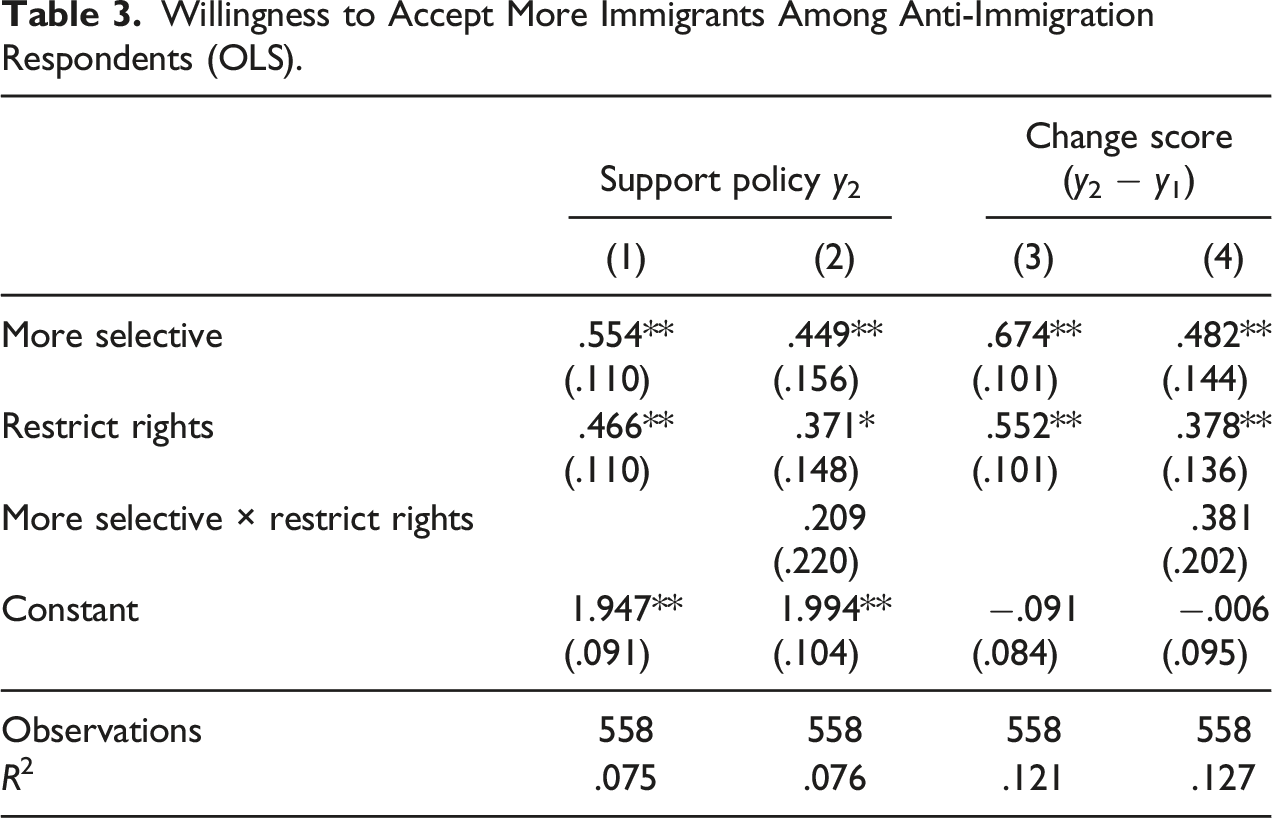
We first focus on the "hard cases" for agreement: respondents who are offered policy proposals that run counter to their preferences. This includes anti-immigration respondents who are offered a proposal that increases immigration flows, and pro-immigration respondents offered a decrease in immigration flows. For each, we consider two outcomes: (a) the level of support for the immigration policy proposal once additional information on selection criteria and immigrants’ rights is provided and (b) their willingness to change their initial opposition (as captured by a simple change score).
Willingness to Accept More Immigrants Among Anti-Immigration Respondents (OLS).
Willingness to Accept Fewer Immigrants Among Pro-immigration Respondents.
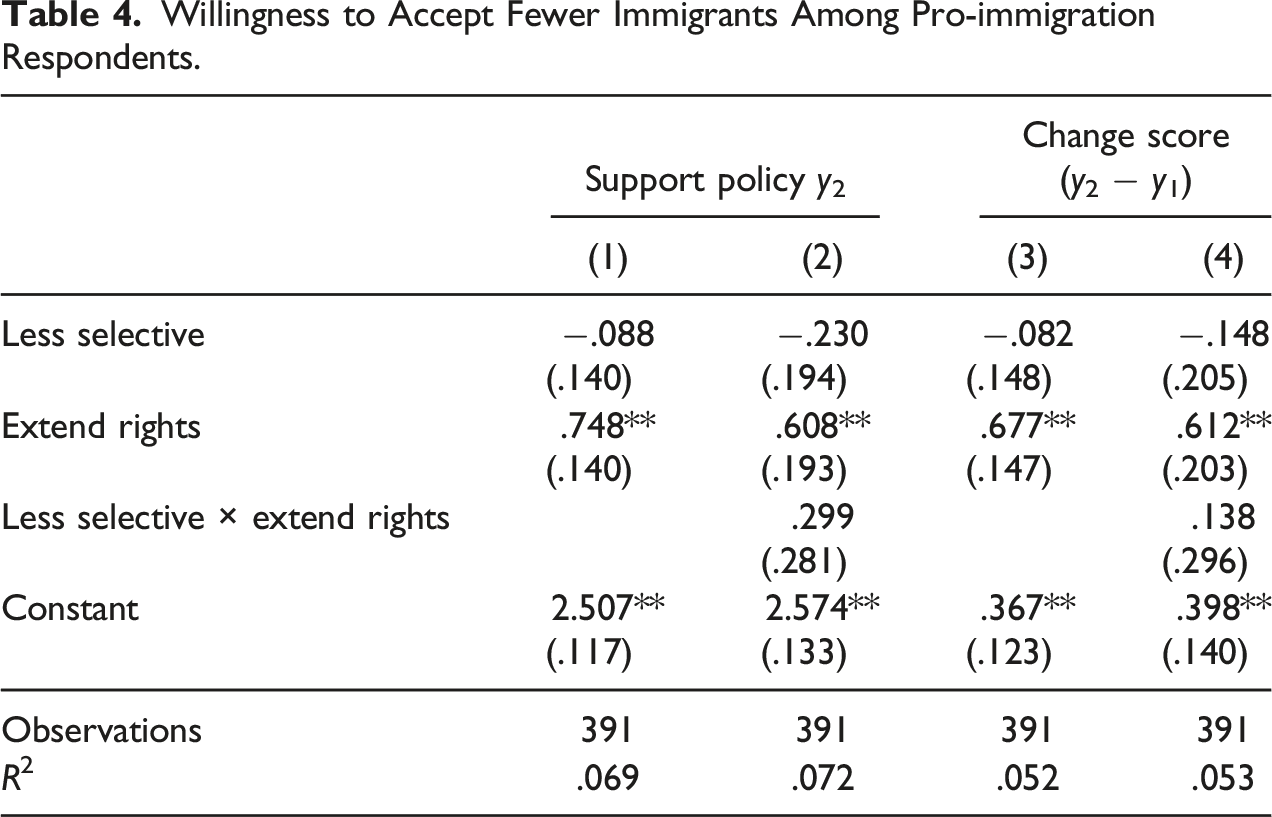
Table 4 presents results for respondents who are generally pro-immigration, and they are more likely to accept fewer immigrants (by β = .748 scale points) as long as immigrants are also granted more expansive rights once in the country (p < .01) (see Model 1). There is no effect of changing the entrance criteria. Results are the same for the change score model (Model 3), where pro-immigration respondents are more likely to change their mind if the policy bundle improves the rights of immigrants in the country (β = .677, p < .01). This is consistent with H3, and results from studies 1 and 2.
In short, results in Tables 3 and 4 suggest that the more rigorous research design in study 3 produces results that are consistent with studies 1 and 2. German respondents are willing to compromise on their general preferences for immigration flows, depending on how selectivity criteria and migrant rights policies are formulated. In appendix Supplement Tables A11–12, we generalize these models with results for the full study 3 sample (i.e., not just respondents who were given policy options that run counter to their general preferences). Results are consistent with those in Tables 3 and 4, and support H2 and H3.
Appendix Supplement Tables A13–16 present results that analyze separately the respondents who were presented with policies for Middle Eastern and North African immigrants and respondents who were presented with policies for non-EU European immigrants. The results for both groups are largely consistent, which suggests that conditional immigration preferences are not limited to specific types of migrants.
Possibilities for Immigration Policy Compromise?
The final stage of our analysis explores the possibilities for immigration policy compromise. Our approach assumes that if preferences are conditional on different dimensions of immigration policy, it may be possible to find a policy combination that could win support from people who are both "pro" and "anti" immigration. Our analyses suggest that pro-immigration respondents are willing to reduce immigration if the rights are more expansive, but they appear less concerned about selectivity. In addition, anti-immigration respondents are willing to increase immigration if the entry requirements are tightened, but they appear less concerned about rights. In principle, both preferences could be reconciled in an immigration policy that is highly selective but generous with rights.
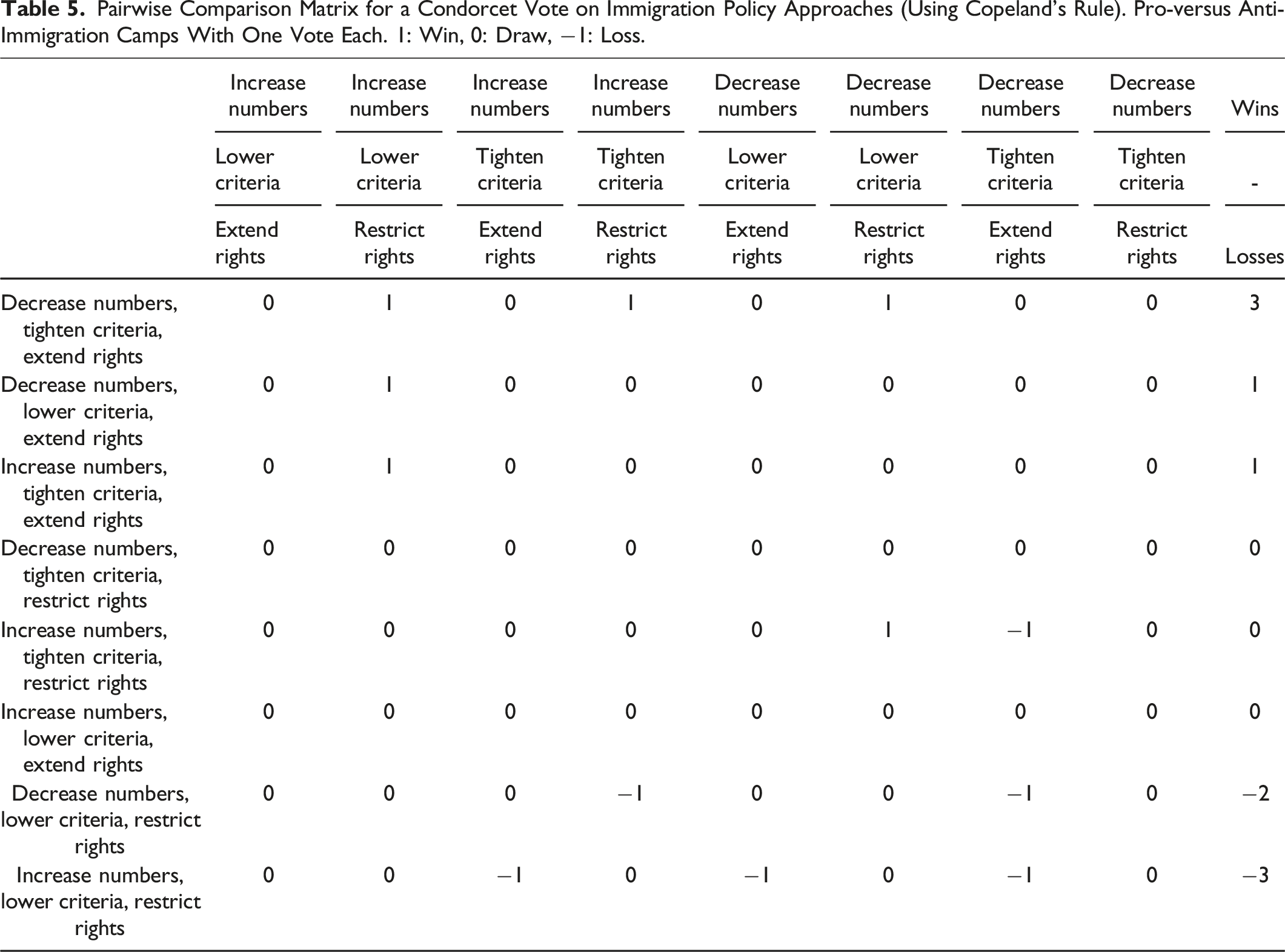
To study this question more formally, we examine which immigration policy the pro- and anti-immigration camps would choose if they had to make a collective decision. We use a Condorcet vote decision rule, where each immigration policy is paired with every other policy and the pro- and anti-immigration sides vote on the alternatives. This approach incorporates the most-preferred options of each person as well as the preference structure across all options (Black, 1958; Young, 1988). This method is most commonly used when evaluating preferences for candidates in an election. However, the underlying logic is similar when comparing policy options. An electoral equivalent to our decision would be a multi-optional referendum in which people do not simply take a yes/no vote on a certain policy issue (Bochsler, 2010; Wagenaar, 2020).
Both sides have only one vote. Their preference ordering across policy options is given by the results reported above in Figure 2. To aggregate the vote results, we use Copeland’s rule of summing the number of pairwise wins and subtracting the number of pairwise losses for each immigration policy.
Pairwise Comparison Matrix for a Condorcet Vote on Immigration Policy Approaches (Using Copeland’s Rule). Pro-versus Anti-Immigration Camps With One Vote Each. 1: Win, 0: Draw, −1: Loss.
Conclusion
This paper investigated the conditions under which people are willing to compromise on their general immigration preferences. Our central finding is that when respondents are forced to choose, they are willing to trade-off their general preferences for immigration flows. People who are generally anti-immigration are willing to compromise and allow more immigrants to arrive if the selection process is more restrictive. Similarly, people who are generally pro-immigration are willing to compromise and reduce the number of immigrants if those who arrive get more rights.
Previous research has explored immigration policy trade-offs for governments (Ruhs, 2013, 2018), but has not explored how public preferences may also exhibit trade-offs. There has been research on the trade-offs that immigrants face as they integrate into host societies on multiple dimensions (Maxwell, 2012), and research suggesting that public views on migrant groups incorporate multiple dimensions of evaluations (Sobolewska et al., 2017; Solodoch, 2021). However, this paper breaks new ground by exploring immigration preferences across a range of policy dimensions, and highlighting the conditionality of those views.
Results in this paper suggest that immigration policy preferences are nuanced and multi-dimensional. This insight is also relevant for understanding policy preferences in general, as most policy debates "involve actors expressing contingent, conditional, or constrained preferences" (Lacy, 2001, 239). Future research should incorporate these insights to better understand how preference structures operate. Beyond the specific case of immigration, this approach could be particularly relevant for multi-optional referenda (Wagenaar, 2020) or elections more generally, as parties take positions on numerous issues (Horiuchi et al., 2018).
Our results are from data collected in Germany between April 2020 and August 2022. We cannot claim that the exact same immigration policy compromises will apply to all countries, or even to Germany at a different point in time. Yet, given the easy availability of survey methodology and technology, our approach can be extended to other contexts to build a more robust body of knowledge on how conditional preferences may operate.
There are also several extensions that future research could pursue. In this paper, we focused on how preferences for immigration flows are conditional on selectivity and rights, but it is also possible that preferences for selectivity and rights are conditional on policies on other dimensions. There may be a distinction between short-term and long-term implications of immigration policies. There may also be non-linearities or thresholds points where the trade-offs no longer apply. For example, anti-immigration respondents may be willing to let in more immigrants if the selectivity criteria become more strict, but there are probably some mild restrictions that would not be seen as sufficient and some extreme restrictions that would be seen as too severe. Future research could map out some of these detailed nuances. In addition, there are many types of migrants (e.g., labor migrants, refugees, family reunification, and students), governed by different types of policies. It is beyond the scope of this paper to examine how conditional preferences may vary for all the specific types of migrants, but future research could explore these nuances.
As with all survey experiments, we can only capture stated preferences and cannot identify the extent to which German respondents are committed to act on these preferences. Nonetheless, our results suggest patterns of potential compromise that should have useful applications for policymakers struggling to build policy and electoral coalitions (Kuklinski et al., 2001, 414). This is particularly relevant when it comes to highly emotional and polarized issues such as immigration. Immigration has divided Western societies for years and the inability to find a workable compromise has contributed to the rise of anti-system right-wing populist parties (Kriesi et al., 2012). There will always be extremists who will never agree to compromise, but our findings suggest a broad base of support for carefully crafted policies that appeal to multiple interests. Future research should continue to apply these insights so that we can better understand which policies are more likely to gain support.
Supplemental Material
Supplemental Material - Numbers, Selectivity and Rights: The Conditional Nature of Immigration Policy Preferences
Supplemental Material for Numbers, Selectivity and Rights: The Conditional Nature of Immigration Policy Preferences by Marc Helbling, Rahsaan Maxwell and Richard Traunmüller in Comparative Political Studies
Footnotes
Acknowledgements
We would like to thank participants at all of these venues for helpful feedback, especially Keith Banting, Philipp Lutz, and Samuel Schmid.
Declaration of Conflicting Interests
The author(s) declared no potential conflicts of interest with respect to the research, authorship, and/or publication of this article.
Funding
The author(s) disclosed receipt of the following financial support for the research, authorship, and/or publication of this article: Funding for this research came from the Migration, Integration, Transnationalization unit at the Berlin Social Science Center (WZB) and the German Research Foundation (DFG). Previous versions were presented at the Migration, Integration, Transnationalization colloquium at the WZB, the University of British Columbia, the Hertie School, and the American Political Science Association annual conference.

Notes
Author Biographies
References
Supplementary Material
Please find the following supplemental material available below.
For Open Access articles published under a Creative Commons License, all supplemental material carries the same license as the article it is associated with.
For non-Open Access articles published, all supplemental material carries a non-exclusive license, and permission requests for re-use of supplemental material or any part of supplemental material shall be sent directly to the copyright owner as specified in the copyright notice associated with the article.
