



Abstract
City residents in the Global South commonly encounter the police. Yet, outside of established democracies, we know little about how ethnicity shapes everyday policing in diverse urban contexts. Existing approaches generate competing expectations, with some arguing that officers are more rather than less discriminatory towards coethnics. We test these theories through a survey experiment conducted in Karachi, Pakistan—one of the world’s largest megacities. We find that civilians are only marginally less likely to expect procedural justice from non-coethnic officers, even in a context where ethnicity is highly salient. However, suggestive evidence indicates that this small effect is significantly magnified for respondents who perceive their group to be underrepresented in the police. Descriptive representation is therefore a powerful moderator of the relationship between ethnicity and expectations of police bias. These results have implications for the development of effective and legitimate police institutions in weakly institutionalized contexts.
Introduction
From a Weberian perspective, a defining characteristic of the modern state is a monopoly over the legitimate use of violence. Because the police force is a primary institution used by states to maintain law and order, the study of citizen-police interactions is crucial for understanding how citizens relate to and feel about the state. Moreover, the importance of civilian attitudes towards the police is reflected in contemporary reforms aimed at improving public trust in the police, with hopes that greater trust will foster perceptions of institutional legitimacy and civilian cooperation with police officers in everyday encounters (Blair et al., 2021; Peyton et al., 2019). Civilian-police interactions have long been studied in the United States and United Kingdom, yet only recently has this scholarly focus expanded to include the study of policing in the Global South (Crabtree, 2018). In this paper, we contribute to this burgeoning literature by studying one type of interaction that is common in today’s multi-ethnic cities: encountering an officer that does not share one’s ascriptive identity.
Extant research on how identity salience shapes policing is either based in advanced industrialized democracies (Engel, 2005; Knox et al., 2019; Lundman & Kaufman, 2003), focused on post-conflict “ethnic balancing” reforms within the police (Blair et al., 2022; Nanes, 2018; Samii, 2013), or centered on repressive tactics employed by the police (Curtice, 2022; González, 2020). Consequently, less is known about how ethnicity shapes quotidian, commonplace interactions—such as traffic stops or crime reporting—between citizens and the police. And while there is an active research agenda on the effectiveness of community policing initiatives, this work does not focus on identity salience. 1 As a result, there is still much to learn about whether and how ethnicity shapes citizen expectations of everyday, mundane aspects of policing in weakly institutionalized settings.
We do know through a large literature that ethnicity affects a host of social and political outcomes, including public goods provision (Alesina et al., 1999; Habyarimana et al., 2007; Miguel & Gugerty, 2005), vote choice (Carlson, 2015; Chandra, 2004), political accountability (Adida et al., 2017), wartime informing (Lyall et al., 2013), and even survey responses (Adida et al., 2016). While the causal processes underlying these relationships continue to be debated, much of this work empirically establishes that, on average, people prefer coethnics to non-coethnics across a number of different settings.
Nevertheless, it is not immediately obvious that citizens should expect coethnic bias in the realm of policing. The few studies that focus on ethnicity and policing reforms in the Global South find mixed results and generate competing expectations about how ethnicity affects policing and, consequently, how citizens should view coethnic officers. For example, in their study of the Liberian National Police, Blair et al. (2022) find that police teams with more minority police officers are more discriminatory against coethnic civilians. This result is in line with findings from the U.S. context, where some studies claim that black police officers are more coercive towards black suspects than white officers (Brown & Frank, 2006; Sun & Payne, 2004), perhaps due to a felt need to demonstrate that their loyalties lie with the police as an institution and not with their race (Decker & Smith, 1980). Nevertheless, more recent work has challenged this claim and shown that black officers are less likely than white officers to use force against black civilians (Ba et al., 2021). Finally, it also remains unclear whether coethnic bias manifests in settings where generalized trust in the police force is very low. In such contexts, it could be that—regardless of identity—most police officers are considered untrustworthy, and that shared ascriptive identity makes little or no difference in perceptions of the police.
Given that the literature points us in different directions, we test these competing expectations with descriptive and experimental data from a representative face-to-face survey of respondents from Karachi, Pakistan. The multi-ethnic megacity of Karachi is in many ways emblematic of the dense and diverse cities of the Global South. Like other large urban centers, rates of crime and violence are high, making trust in and effectiveness of the police a major policy concern. Additionally, like in other developing metropolises, urbanization has led to rapid demographic changes and prompted inter-ethnic conflict over the city’s resources. The study of how ethnicity affects social and political relations in cities similar to Karachi is an active research agenda within political science, and reflects the fact that over half the world’s population now lives in urban areas (Auerbach & Thachil, 2018; Thachil, 2017). Moreover, it is in these multi-ethnic, urban areas that citizens are most likely to face interactions with police officers who do not share their own ethnicity. 2 Conducting this study in Karachi therefore not only provides basic information on citizen-police relations in a populous but understudied context, but also helps increase our small pool of knowledge on ethnicity and policing in the growing cities of the developing world.
The thrust of both our descriptive and experimental findings is that while ethnicity does affect expectations of police bias, this effect is small on average and significantly moderated by the distribution of ethnic groups in the population and the police force. More specifically, even in a context where ethnicity is highly salient, it is only those who find their ethnic group to be underrepresented in the police force that are substantively more likely to both expect unfair treatment from non-coethnic officers as well as preferential treatment from coethnic officers. 3 In the city of Karachi, the police force falls under the provincial government’s control and is therefore dominated by the largest ethnic group (the Sindhis) at the provincial level. Consequently, two of the city’s largest ethnic groups—the Muhajirs and the Pashtuns—are descriptively underrepresented in the police force. This mismatch between the demographic makeup of the urban population and the police is an important factor in understanding the relationship between coethnicity and expectations of police bias. Our findings highlight the importance of paying attention to the institutional set-up of the police force, and of asking which authorities control recruitment into the police and how this relates to the distribution of ethnic groups and political power in a given context.
Our empirical analysis first probes the relationship between ethnicity and policing by examining the descriptive socio-demographic correlates of trust in the police. We find that non-Sindhis—especially younger men—are much less likely to trust the police than Sindhis. Our experiment then focuses on how coethnicity (or lack thereof) affects citizen perceptions of “procedural justice” during common interactions such as traffic stops and security checkpoints. Procedural justice is theorized in the criminology literature as having three major components: citizen voice (allowing and encouraging citizen participation in the proceedings), neutrality and consistency (the quality of decision-making), and the conferral of dignity and respect (the quality of treatment) (Mazerolle et al., 2013; Tyler & Wakslak, 2004). 4 We asked survey respondents to imagine interacting with a police officer whose ethnicity was randomly varied through verbal and visual cues, and find that respondents have lower expectations of procedural justice from non-coethnic police officers. Importantly, while this effect is substantively small, it doubles among those respondents who perceive their ethnic group to have low representation in the police force. We take these results to indicate that the structure of police institutions in a given context is a crucial factor in determining whether or not ethnicity affects expectations of police bias.
This paper contributes to the literatures on ethnic politics and comparative policing. It shows that while ethnicity shapes perceptions of police fairness during mundane interactions, this effect is small in a weakly institutionalized context where citizen trust in the police is overall low. Our results contradict recent findings from Liberia, where studies have either found that less powerful groups are treated worse by their coethnics (Blair et al., 2022) or have found no effect of shared identity (Karim, 2020). Our findings are instead closest to Curtice (2022), who finds in Uganda that citizens are less willing to report crimes to non-coethnic officers. While his explanation focuses on the police as a repressive arm of a semi-authoritarian state—hence highlighting citizens’ fear of repression as a mechanism—our focus is on the fairness and tone of largely non-violent everyday interactions.
Our findings have implications for building trust in the police force. Trust in the police, in turn, shapes how effectively the police are able to fulfill their primary responsibilities: a substantial literature in criminology shows that perceptions of police behavior are an important determinant of compliance with the police and hence their capacity to combat crime. Our conclusion discusses the wider implications of these patterns and suggests how the divergent results on ethnicity and policing might be reconciled in future research.
Competing Priors: Procedural Justice and Officer-Citizen Coethnicity
The criminology literature identifies procedural justice as a key component of building and maintaining trust in the police, which in turn is shown to affect how willing citizens are to comply and cooperate with the police (Hinds & Murphy, 2007; Mazerolle et al., 2013; Tyler, 2003). Citizens feel that they have been treated in a procedurally just way when they are allowed to have a voice in the interaction before a decision is reached, when they feel the police is a neutral party, and when the police demonstrates dignity and respect throughout the interaction (Mazerolle et al., 2013). When these conditions are met and the police is seen as behaving in a procedurally fair manner, citizens are more likely to accept whatever decision is made by the police, less likely to feel that they have been unfairly singled out, and in general more likely to think of the police as a legitimate state authority (Tyler & Wakslak, 2004).
How might coethnicity affect citizen expectations of receiving procedural justice from the police? The literature on ethnic politics and policing generates competing expectations for how officer-citizen coethnicity could matter in routine interactions. On the one hand, a large literature on ethnic politics suggests a straightforward “coethnicity bias” in police-citizen interactions. Underlying this expectation are a handful of intuitive mechanisms hypothesized to make cooperation easier between coethnics—such as dense social networks that allow for monitoring and sanctioning, affinity and familiarity, similar preferences, and ease of communication (Fearon & Laitin, 1996; Habyarimana et al., 2007). It could be that citizens expect better treatment from coethnic officers because they are linked to these officers through ethnic social networks, and therefore hold some leverage over the officers’ reputation in what is otherwise an asymmetric power relationship. Or it could be that they expect to have more voice when interacting with an officer who shares their mother-tongue and cultural codes.
These mechanisms are largely apolitical in nature, and—if applied to the realm of policing—would not take specific features of the police as an institution into account. If this view is correct and coethnicity is predominantly a marker for shared social networks, cultural codes, or familiarity, then we should expect a clear positive relationship between coethnicity and expectations of police procedural justice across different types of contexts, different ethnic groups, and different arrangements of political institutions. Importantly, we should also see little variance in such a coethnicity bias across different levels of perceived descriptive representation—a coethnic police officer would be preferred over a non-coethnic police officer because of features such as shared cultural codes, regardless of the underlying ethnic composition of the force.
There are good reasons, however, to think that the effect of officer-citizen coethnicity is not invariant across political contexts and ethnic groups. The security apparatus is often shaped by political incentives (Dow, 2022; Hassan, 2017), with implications for the ethnic composition of the police force. In particular, it might be that the police force is structured so that certain ethnic groups are descriptively underrepresented in its ranks. In such cases, coethnic bias could be especially operative for interactions between the police and historically underrepresented groups, since it has been shown in some contexts that descriptive representation in institutions improves outcomes for marginalized groups (Kennedy et al., 2017; Selden, 1997) and can increase the group’s trust in the institution (Abney & Hutcheson, 1981; Howell & Fagan, 1988). When a group is descriptively represented in the police force, this may engender beliefs that the police force as an institution does not disadvantage members of one’s ethnic group. As a result, citizens expectations of police procedural justice may be independent of, or only marginally dependent on, coethnicity. Conversely, when a group is descriptively underrepresented in the police force, this may engender reasonable beliefs that the institution disadvantages one’s group within its ranks and—consequently—will also disadvantage this group in everyday encounters. Importantly, descriptive underrepresentation is rarely if ever accidental—rather, the composition of police forces and the inclusion or exclusion of certain identity groups are often reflective of either deliberate state policy, larger societal intergroup dynamics, or both. If that is the case, description representation and perceptions of such representation could moderate the relationship between coethnicity and expectations of police bias, with those who are less represented being less likely to expect procedural justice from non-coethnic police officers.
However, the evidence on this matter is decidedly mixed. Contrary to expectations, some studies show that police officers who belong to underrepresented groups are actually more discriminatory towards their coethnics. Using lab-in-the-field experiments, Blair et al. (2022) show in Liberia that police teams with officers from the “ethnic outsider” Mandingo tribe exhibit more discriminatory behavior toward their coethnics. They see these results as similar to what some research finds in the United States, where black police officers are shown to be more punitive towards black suspects than white officers (Brown & Frank, 2006; Forman, 2017; Kuykendall & Bums, 1980). 5 Brown and Frank (2006) argue that this behavior is borne out of a drive to prove one’s loyalty to the police: “Blacks who become police officers are caught in a loyalty conflict where they must choose to act in a manner that shows allegiance to the White male-dominated occupation by (over-)enforcing the law against Black citizens, showing no favoritism to minority citizens.” In a similar vein, Lyall (2010) shows coethnic counterinsurgency officers are more effective at identifying, sanctioning, and credibly threatening the target population. Such findings engender the opposite expectation to the one laid out above: those who are less represented should be less likely to expect procedural justice from coethnic officers.
Finally, it could be the case that coethnicity has no effect in the realm of law and order, due to the professionalism and internal norms of the police force. For example, Enloe (1980) argues: “It is possible that the police may be dominated by members of one community, and yet policemen and their political superiors be so committed to their roles as impartial dispensers of justice that the communal imbalance does not alienate communities who see few of their own members in police uniform.” Similarly, Nanes (2018) argues that the rigid and highly structured nature of security institutions should mitigate against the usual biases produced by differences in identity. For this reason, his hypotheses assume that the police treat each group in society “neutrally at worst.” If police subculture promotes this sort of “color-blind” professionalism, citizens should expect procedural justice from the police regardless of coethnicity. However, given that police forces in many developing states are widely mistrusted and frequently politicized or corrupt, it may be the case in such contexts that the police force is so unprofessional that coethnicity makes little difference in how officers are perceived. Rather, most officers are mistrusted regardless of whether one shares an identity with them.
In sum, the existing body of literature generates three competing expectations regarding the relationship between shared identity and expectations of police bias. On the one hand, we could expect a straightforward positive relationship due to reasons of affinity, familiarity, or shared cultural codes, with little to no variance across ethnic groups and political contexts. On the other hand, it may be that there is no relationship by dint of the police being either a highly professionalized “color-blind” institution or being so corrupt and incompetent that coethnicity makes little difference in shaping citizen expectations. Finally, it could be that the relationship between coethnicity and expectations of bias is moderated (positively or negatively) by descriptive representation because officers from underrpresented groups are more/less discriminatory towards their coethnics. Table A.1 in the appendix shows that the evidence for these competing expectations is quite mixed and varies—in part—by the focus on either police officers or civilians. In the next subsection, we narrow down these expectations by providing more background on our study site of Karachi. In particular, we argue that the mismatch between the demographic makeup of the city and the demographic makeup of the police force may make descriptive representation relevant in predicting how coethnicity affects citizen expectations of police bias.
The Karachi Case
With a population of around 15 million people, Karachi is Pakistan’s largest city and one of the most populous urban centers in the world. Like other cities, it suffers from high rates of crime and violence and its citizens come into frequent contact with the police. In our survey sample, for example, approximately 51 percent of respondents reported being stopped by the police in everyday encounters—such as traffic stops—at least once over the past year. 6 This number does not include other common interactions with the police, such as when citizens attempt to register First Information Reports (FIRs) with their local police station in the aftermath of a crime. Because approximately 33 percent of respondents report that either they or a member of their household had been a victim of a crime over the past 5 years, this number is likely not insignificant. Indeed, 27 percent of households that had experienced crime over this period say that they had personally approached the police to file a FIR. The police are therefore a highly visible arm of the state in Karachi, as is the case generally with dense urban areas in the Global South. 7
According to a report by Human Rights Watch (2016), the police force in Karachi and in Pakistan as a whole is corrupt, politicized, and abusive (see also Waseem, 2022). This report details how the country’s police force commonly engages—with impunity—in extrajudicial killings, the use of torture to obtain forced confessions, bringing false charges against the opponents of political elites, and corruption at all levels of the institutional hierarchy. It is little wonder that citizen trust in the police is incredibly low, even by the usual standards of weakly institutionalized contexts. As seen in Figure 1, among 60 countries surveyed in Wave 6 of the World Values Survey, Pakistan ranks second from the bottom in the level of citizen confidence in police. This is in contrast to the United States—the setting for most research on the relationship between identity and policing—where generalized trust is relatively high according to the WVS but trust among certain sub-segments of the population (e.g., racial minorities) is low (Tyler & Wakslak, 2004). This deep mistrust of the police should lead us to discount explanations emphasizing the professionalism and potential “color-blindness” of security institutions, as these explanations do not apply to a force like Pakistan’s. Rather, coethnicity (or lack thereof) may make little difference in a context where the police are generally seen as extremely untrustworthy. Confidence in Police Around the World.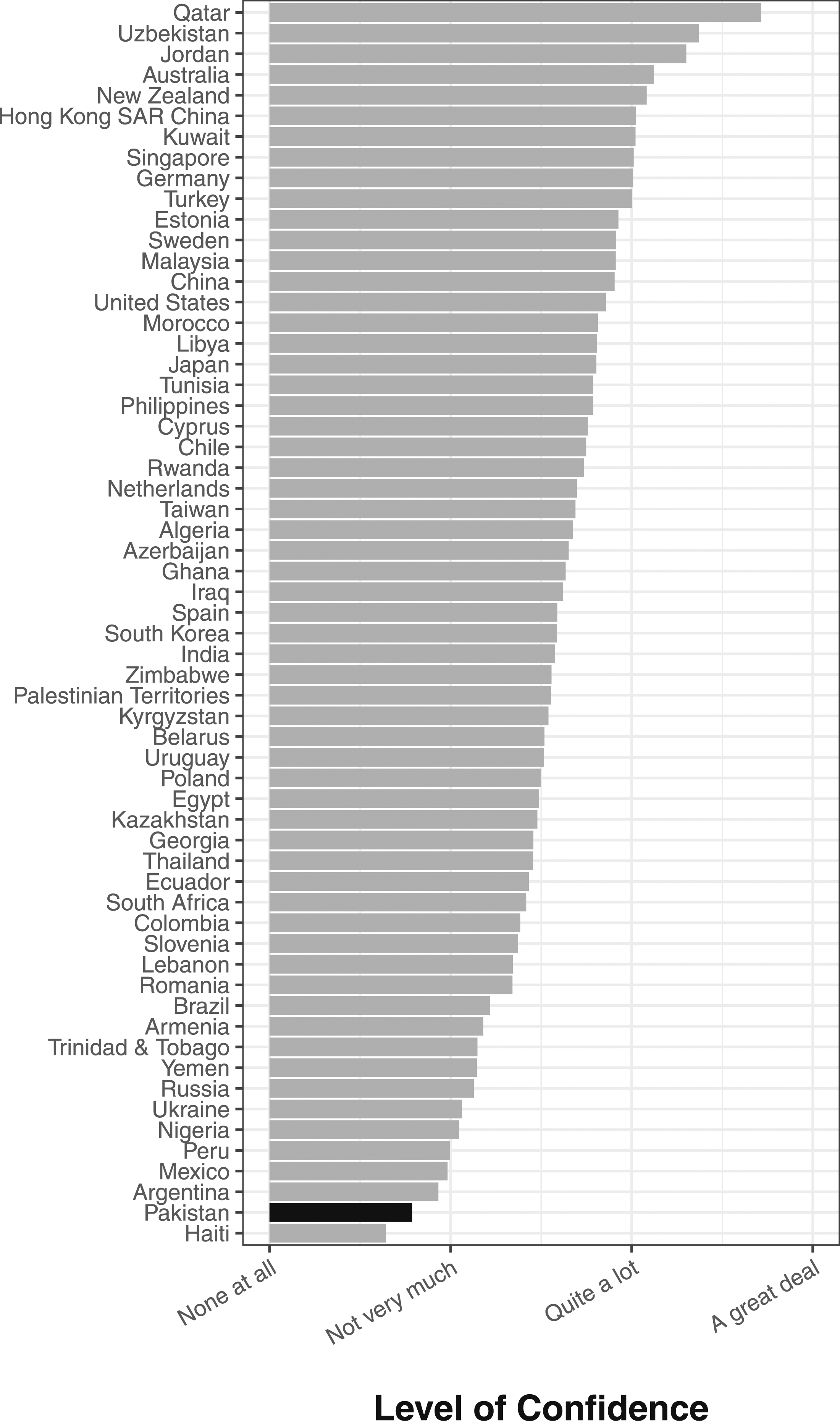
That said, Karachi is also a context where ethnicity is highly relevant in structuring social and political life (Gayer, 2014). Neighborhoods tend to be segregated along ethnic lines and ethnic parties compete for power in elections. Thus, we might reasonably expect that ethnicity should also affect citizen expectations of police procedural justice. However, we argue that these expectations should vary across ethnic groups in the city, given the distribution of ethnic groups in the population compared to the distribution of ethnic groups in the police force. More specifically, while all of Pakistan’s major ethnic groups reside in Karachi, this diversity is not reflected in state institutions: the police force falls under the jurisdiction of the provincial government, which is perennially controlled by the Sindhi-backed Pakistan People’s Party (PPP) (Soomro, 2021; Waseem, 2021). While Sindhis are a minority ethnic group in Karachi, they are the largest group at the provincial level. Since policing is under the provincial government’s control, Sindhis are over-represented in the city police relative to their population in Karachi. Conversely, citizens belonging to two of Karachi’s largest ethnic groups—the Muhajirs and the Pashtuns—are minorities at the provincial level and therefore underrepresented in the city police. As a consequence, we anticipate that the relationship between officer-citizen coethnicity and the expectations of procedural justice will be moderated by descriptive representation in the force.
Because administrative data on the ethnicity of police officers in Karachi is not available, we turn to citizen perceptions as a next-best alternative. Figure 2 uses data from our original survey to show that Muhajirs and Pashtuns have the lowest perceptions of their group’s descriptive representation in the police among the five largest ethnic groups in Karachi. When asked to estimate the percentage of their local police that shares their ethnicity, Muhajir and Pashtun respondents recorded the lowest guesses, on average, at approximately 21 percent and 25.7 percent (not statistically distinguishable from one another). In contrast, Sindhi respondents in our sample recorded the highest guess, on average, at approximately 40 percent—statistically distinct at the 0.01 level from the guesses of both Muhajirs and Pashtuns. Ideally, we would be able to present administrative data on the ethnic distribution of the city’s police force. However, given the sensitivity of the subject matter, such data is functionally impossible to access. Our subjective survey data on ethnic representation in the police force is in line with what is actually the case in Karachi, an observation backed by the secondary literature and news reports on Karachi’s policing.
8
Respondent Perceptions of Descriptive Representation in Police Force.
How might the underrepresentation of these ethnic groups affect policing and consequently expectations of police bias? Some existing literature argues that it is easier for political authorities to employ discriminatory, militarized, or violent policing against groups that are underrepresented in the force (Greitens, 2016; Hassan, 2017). Some ethnic groups may be deliberately underrepresented in the police force due to underlying political conflicts and power imbalances in the control of state institutions. This makes the use of the police to unfairly profile members of these groups easier. Moreover, even if their groups are not deliberately targeted by the police, it may be the case that simply being underrepresented in a key state institution renders members of these ethnic groups less likely to receive or expect fair treatment.
Indeed, Karachi’s history confirms some of these dynamics: both underrepresented groups, the Muhajirs and the Pashtuns, have suffered police abuse in the past. A paramilitary and police operation took place in the early 1990s, which—while presumably aimed at militant elements in the Muhajir ethnic party, the Muttahida Quami Movement (MQM) —was indiscriminate in its targeting of young Muhajir men (Gayer, 2014). A more recent operation that began in September 2013 similarly profiles Muhajirs in general and younger men suspected of crime and militancy in particular. Finally, in its fight against Taliban cells based in Karachi, the police has also been accused of carrying out hundreds of extrajudicial killings of Pashtun men in what are known as “fake police encounters,” (Dawn, 2019; Waseem, 2022). Because younger men of all ethnic backgrounds have made up the bulk of the criminal or violent elements in Karachi’s ethnic parties, they tend to be profiled by the security services more than older men and all women. 9 Finally, our exploratory qualitative fieldwork conducted in Karachi ahead of this survey experiment confirmed that descriptive representation—or the lack thereof—shapes attitudes about the police, with citizens from underrepresented groups expecting more biased treatment from non-coethnic officers.
In sum, given that the Karachi police force is structured in such a way that the city’s largest ethnic groups are also the ones least represented in the ranks, we expect that descriptive representation will moderate the relationship between coethnicity and expectations of police bias. More specifically, secondary and qualitative evidence suggests that the effect of coethnicity on expectations of bias should decrease with representation in the force. In the following section, we begin our empirical examination by first descriptively probing the socio-demographic correlates of trust in the police, where we pay special attention to how trust varies across the different ethnic groups in Karachi. We then present experimental evidence on the relationship between coethnicity and policing, and show how this relationship is conditioned by perceptions of descriptive representation in the police force.
Empirical Tests
Descriptive Analysis
To understand Karachi residents’ perceptions of the city’s police force, we conducted a representative face-to-face survey (N = 903) fielded in partnership with the Pakistan Institute of Public Opinion (an affiliate of Gallup International in Pakistan). The survey was conducted in Urdu, which is Pakistan’s national language and is widely understood across Karachi. In order to ensure a near-balance in the gender distribution among our sample, half the primary sampling units (PSUs) were randomly assigned to be female-only interviews while the other half were assigned to be male-only interviews. Though we expected women to have contact with the police much less frequently than men in the Karachi case, the sampling strategy ensured gender balance for two reasons. First, though women are less likely to be stopped by the police relative to men, they are stopped on occasion. This is reflected in data from our sample: 15 percent of women in the sample had encountered the police at least once in a routine stop within the last year, compared to a figure of 76 percent among men. Second, prior research establishes that interpersonal connections with those who have faced discrimination at the hands of the police can affect attitudes about the police, even among those who do not have personal encounters with the police (Mondak et al., 2017; Rosenbaum et al., 2005). Through this lens, women’s vicarious experience with police encounters through male relations may shape their attitudes towards the police. For a detailed description of the survey sampling protocol, please see the appendix.
Demographic Determinants of Trust in Police.
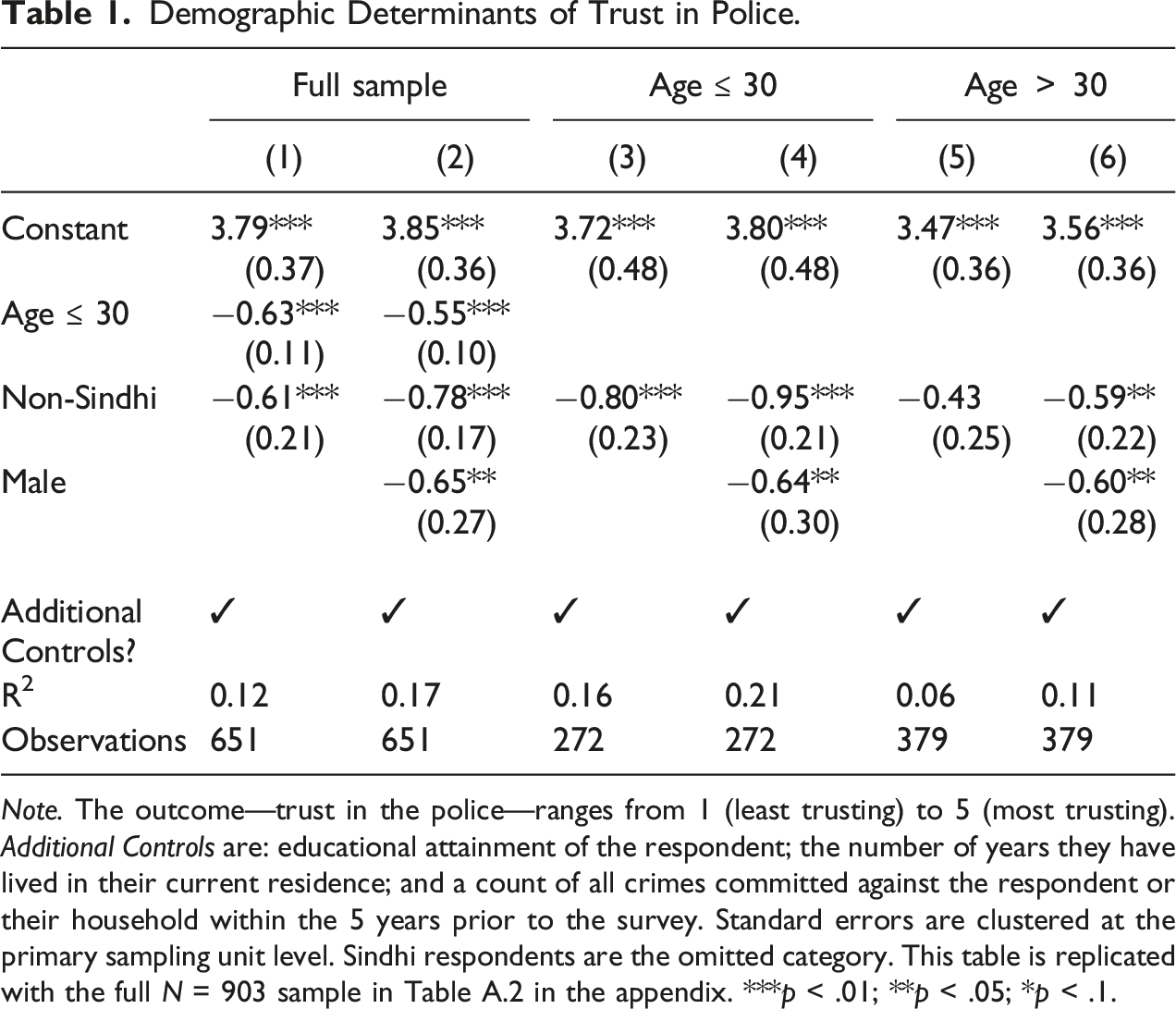
Note. The outcome—trust in the police—ranges from 1 (least trusting) to 5 (most trusting). Additional Controls are: educational attainment of the respondent; the number of years they have lived in their current residence; and a count of all crimes committed against the respondent or their household within the 5 years prior to the survey. Standard errors are clustered at the primary sampling unit level. Sindhi respondents are the omitted category. This table is replicated with the full N = 903 sample in Table A.2 in the appendix. ***p < .01; **p < .05; *p < .1.
In the Table 1 results, Sindhi respondents are the omitted category: the intercept term captures their average response. Models (1) and (2) are evaluated on the full sample of Muhajir, Pashtun, and Sindhi respondents. Because—as noted in the contextual priors—younger residents of Karachi are more likely to encounter the police—we also analyze trust in police separately among those age 30 or younger (Models 3 and 4) and those over age 30 (Models 5 and 6). Model 1 shows that, controlling for a respondent’s age, educational attainment, duration of residence in their current location, and past crime victimization, Muhajirs and Pashtuns—non-Sindhis in the regression results—are far less trusting of the police than their Sindhi counterparts. The difference of 0.61 (significant at the .01 level) is equivalent to a 0.47 SD shift in trust, indicating a magnitude that is substantively meaningful. Also in line with our contextual priors, males are generally less trusting of the police (Model 2). Controlling for the gender of the respondent increases the magnitude and precision of the difference between Sindhis and non-Sindhis in their level of trust. These results are magnified among the younger cohort of respondents (Models 3 and 4). Among those aged 30 or younger, non-Sindhis are estimated to be more than 0.80 points (or 0.62 standard deviations) less trusting of the police than Sindhis. Though older non-Sindhis are also less trusting of the police than older Sindhis, on average, the magnitude of this association is not as large and is not as precisely estimated. Overall, these results comport with our contextual priors. Young, male non-Sindhis are the demographic group that is the least trusting of the police. 11
These descriptive results demonstrate the importance of ethnicity as a factor that explains trust in the police as an institution. These perceptions may be driven by many different inputs: the association of the police administration with the Sindhi provincial authorities, perceived bias in everyday interactions with police officers on the street, or even generalized resentment of government authority that is correlated with ethnicity. To further investigate how ethnicity affects perceptions of the police, we turn to an experiment incorporated into the survey. This experiment seeks to uncover how respondents condition their expectations of everyday police behavior on the ethnicity of a particular (hypothetical) police officer.
Experimental Design
To assess whether Karachi citizens’ perceptions of treatment by police officers on the street are informed by the ethnicity of the officer, we embedded an experiment in our representative survey. Respondents were presented with a hypothetical interaction with a police officer, such as being stopped for a minor traffic infraction (e.g., speeding or not wearing a seatbelt) or seeking assistance with a legal matter. 12 Each respondent was randomly assigned to receive one of three versions of the prompt, with each version jointly varying the name and image (as shown on a tablet) of the hypothetical police officer. The resulting three officer profiles corresponded to three major ethnic groups in Karachi: Muhajirs (characteristic name, no facial hair), Pashtuns (characteristic name, mustache and beard), and Sindhis (characteristic name, mustache only). 13 To confirm that these two features communicated the intended ethnicity of the police officer to respondents, the survey tool was pretested with Karachi residents who were probed for the ethnicity they associated with the hypothetical officer profile. This pretesting affirmed that respondents matched the hypothetical profile to the intended ethnicity.
Respondents were then asked a set of three questions designed to capture expectations of police behavior. With reference to the hypothetical police encounter, respondents were asked how likely the police officer in question will: (1) “properly listen to your concerns”; (2) “treat you fairly and with respect”; and (3) “treat you preferentially compared to how he treats certain other people.” The first two questions were designed to capture key components of procedural justice—that is, citizen voice, neutrality, and quality of treatment. The last question was constructed to ascertain whether individuals expected coethnicity to provide them an advantage over the officer’s non-coethnics. In practice, preferential treatment could be—for instance—a police officer giving a coethnic civilian a warning instead of a fine in a traffic stop. This was included so we could separate out the effect of expecting unfair treatment from non-coethnic officers from the effect of expecting preferential treatment from coethnic officers. Theoretically, perceptions of police bias could be driven by one or both of these two distinct types of expectations. We expect descriptive representation to play an important role in conditioning the effect of coethnicity for each of these outcomes: as perceptions of descriptive representation rise, respondents are more likely to believe that the police force does not systematically disadvantage members of their group or advantage members of other groups. At low levels of descriptive representation, respondents are more likely to believe that their group is institutionally disadvantaged and less likely to believe that non-coethnic officers will listen to their concerns, treat them fairly, or give preferential treatment. Response options for each question were on a 5-point scale, with higher values indicating the expectation of a more positive interaction. We use these questions to create our three primary dependent variables: police listen, police fair, and police preferential.
To assess whether our three outcome measures capture a single, latent dimension of expectations of police encounters, we also form a composite index using principal components analysis. We restrict this analysis to observations in our sample that had no missing values on the three outcomes. The first principal component explains 88 percent of the variation across the outcomes, so we use the scores from the first principal component as our composite measure and rescale them from 1 to 5 for comparability to the other outcomes. Expectations of fair treatment and being listened to by the police are closely associated with expectations of preferential treatment in this context. Descriptive statistics for the outcome measures are shown in Table A.4 of the appendix.
To develop an understanding of how everyday citizens interact with the criminal justice system, the survey of 903 respondents was designed to be representative at the city-level in Karachi. Because Karachi is a multi-ethnic city with individuals who identify with groups other than Muhajir, Pashtun, and Sindhi, some respondents have zero probability of receiving the coethnic police treatment in this experimental setup. To conduct our analysis, below, we subset our data to those individuals with a non-zero probability of receiving a coethnic police officer in the hypothetical encounter. Out of the 903 respondents, 672 were either Muhajir, Pashtun, or Sindhi while the remaining respondents were either Baloch, Punjabi, or a member of another ethnic group. Because assignment to each police officer profile is randomized at the individual level, this subsetting procedure does not affect the interpretation of the results as the marginal effect of coethnicity on perceptions of the police among members of these three ethnic groups. 14
Research on attitudes towards policing in contexts where civilians routinely face police abuse risks re-traumatizing victims. To ensure the protection of survey respondents, participants were briefed prior to the survey about its focus, in part, on perspectives towards the police. Respondents were given the opportunity to decline participation before the survey began and were told that they could halt their participation at any point during the survey. The survey experimental design of this research helps mitigate concerns of re-traumatization compared to field experimental approaches, as the survey only features hypothetical encounters with hypothetical police officers as opposed to real encounters with members of the police force. Finally, our focus on mundane, non-violent interactions with the police renders this research unlikely to cause participants distress. This research received ethical approval from the institutional review board at the authors’ home institution prior to the implementation of the survey.
Experimental Results
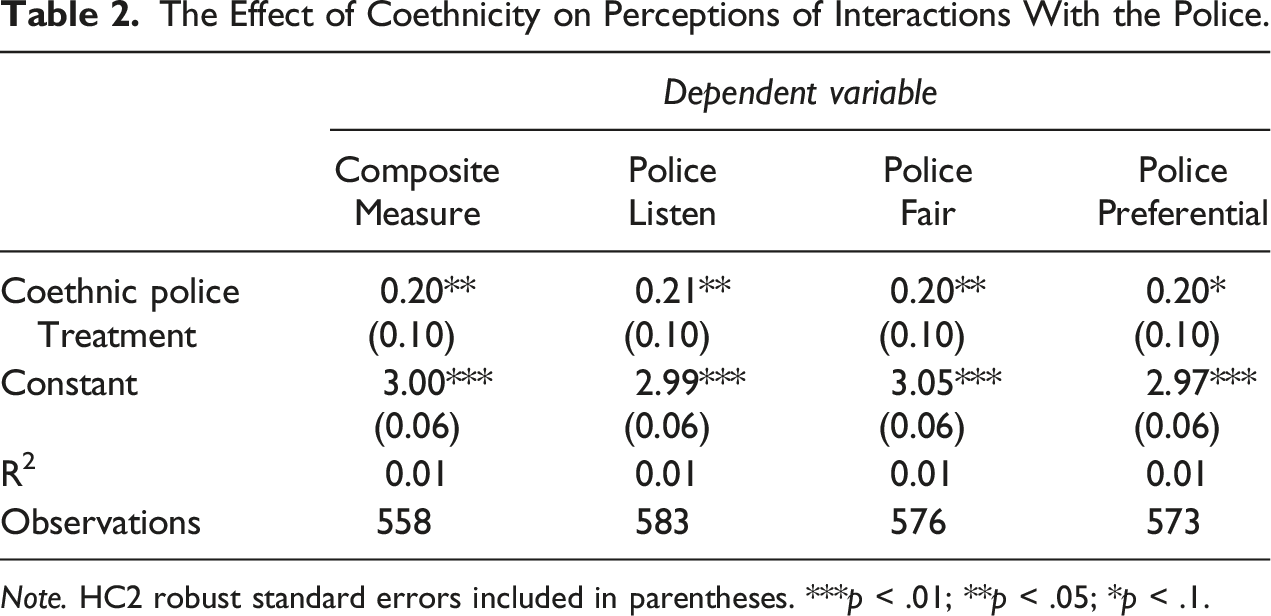
The random assignment of respondents into the coethnic or non-coethnic conditions produced balance on a set of ten pre-treatment covariates (including perceptions of descriptive representation, see Table A.3 in the appendix) and—in expectation—on all unobserved potential confounders. The results are shown in Figure 3 and Table 2. Figure 3 plots the means of each of our three outcome variables—as well as our composite variable that combines all three—by whether the respondent randomly received a coethnic or non-coethnic police officer profile. Respondents are less likely to expect a positive interaction with a non-coethnic police officer, but this effect is substantively small. Table 2 shows that these differences are statistically significant at conventional levels. Importantly, respondents feel that coethnic police officers will treat them preferentially: coethnicity matters for citizen interactions with police not only out of fear of non-coethnics (as in Curtice, 2022) but also out of the expectation of positive, preferential treatment from coethnics. Analyses that address attrition on the outcome measures affirm our conclusion that coethnicity matters for citizen expectations of proper treatment by the police (Tables A.6 - A.11 in the appendix). Outcome Means by Treatment Condition. The Effect of Coethnicity on Perceptions of Interactions With the Police. Note. HC2 robust standard errors included in parentheses. ***p < .01; **p < .05; *p < .1.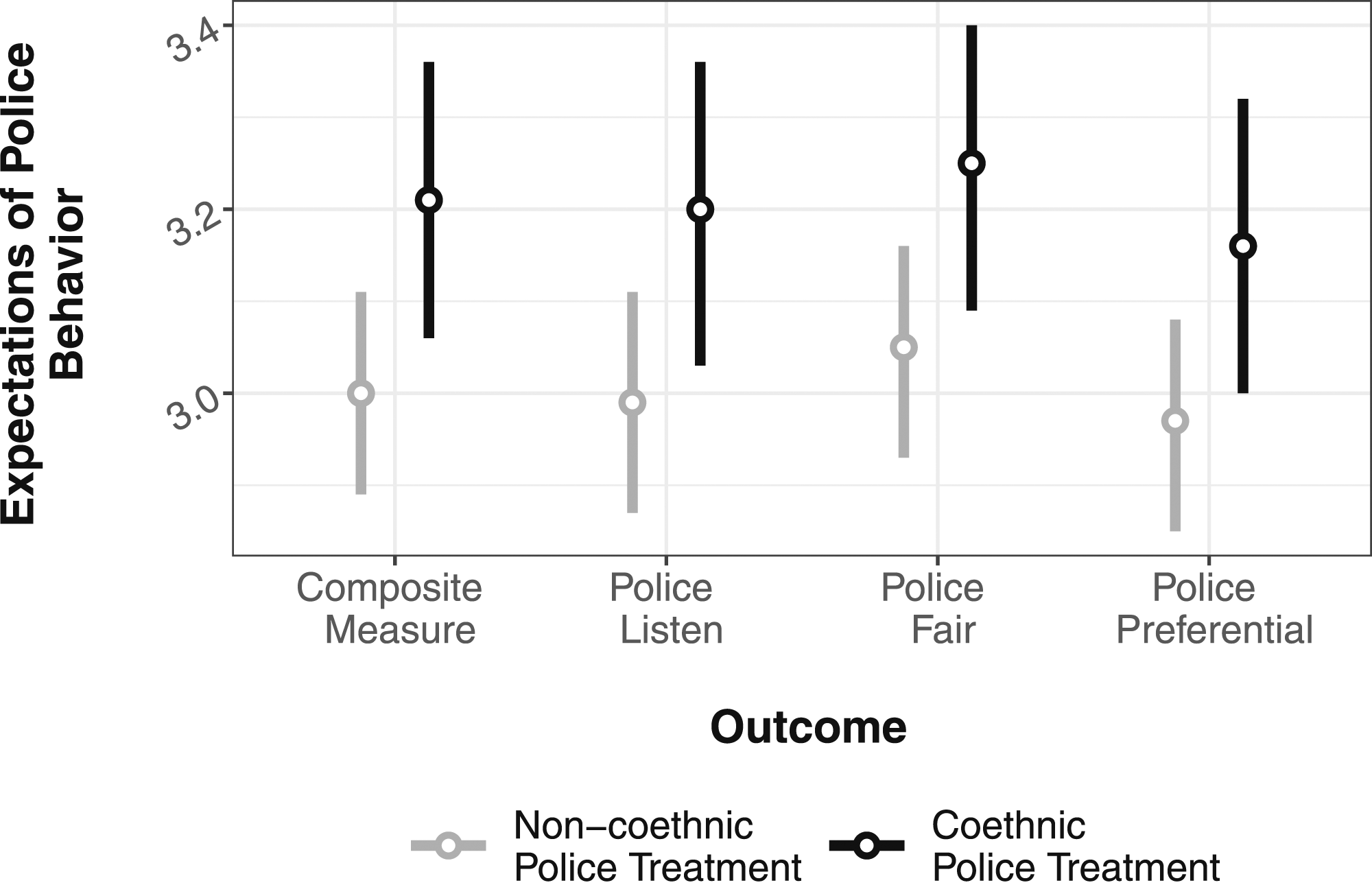
Research on sensitive topics such as attitudes towards the police raises the question of the potential for social desirability bias. For instance, respondents might feel pressure to falsely report positive perceptions of the police in a context—such as Karachi—where the police force holds considerable coercive power. This type of social desirability bias is unlikely to affect our experimental results, though, because both those who randomly received the coethnic prime and those who randomly received the non-coethnic prime face the same potential pressure regarding how to answer questions about the police force in general. The results could be affected by social desirability bias, though, if respondents felt differential pressure in how to respond to questions about a coethnic officer compared to how to respond to questions about a non-coethnic officer. For instance, a respondent may feel comfortable responding truthfully about a hypothetical police encounter with a coethnic, but may feel pressure to respond more positively than they would like when faced with a hypothetical police encounter with a non-coethnic. This is the most-likely direction of social desirability bias in Karachi, where non-Sindhi respondents may feel pressure to falsely report positive perceptions of the Sindhi-dominated police force. This type of social desirability bias would bias against our results: the coethnic premium on expectations of police encounters would be larger in magnitude than those reported in Table 2 if respondents falsely reported positive perceptions of non-coethnic police interactions.
These main experimental results are not driven by differential frequency of encounters with the police across groups. Muhajirs report being stopped by the police an average of approximately 1.98 times in the previous year, compared to figures of 1.74 and 2.08 for Pashtuns and Sindhis, respectively (these differences are not statistically significant at conventional levels). The effect of coethnicity on perceptions of police behavior is therefore likely to be driven by a group’s descriptive representation in the police force and the quality—but not the quantity—of previous police interactions.
Heterogeneous Treatment Effects by Perceptions of Descriptive Representation.
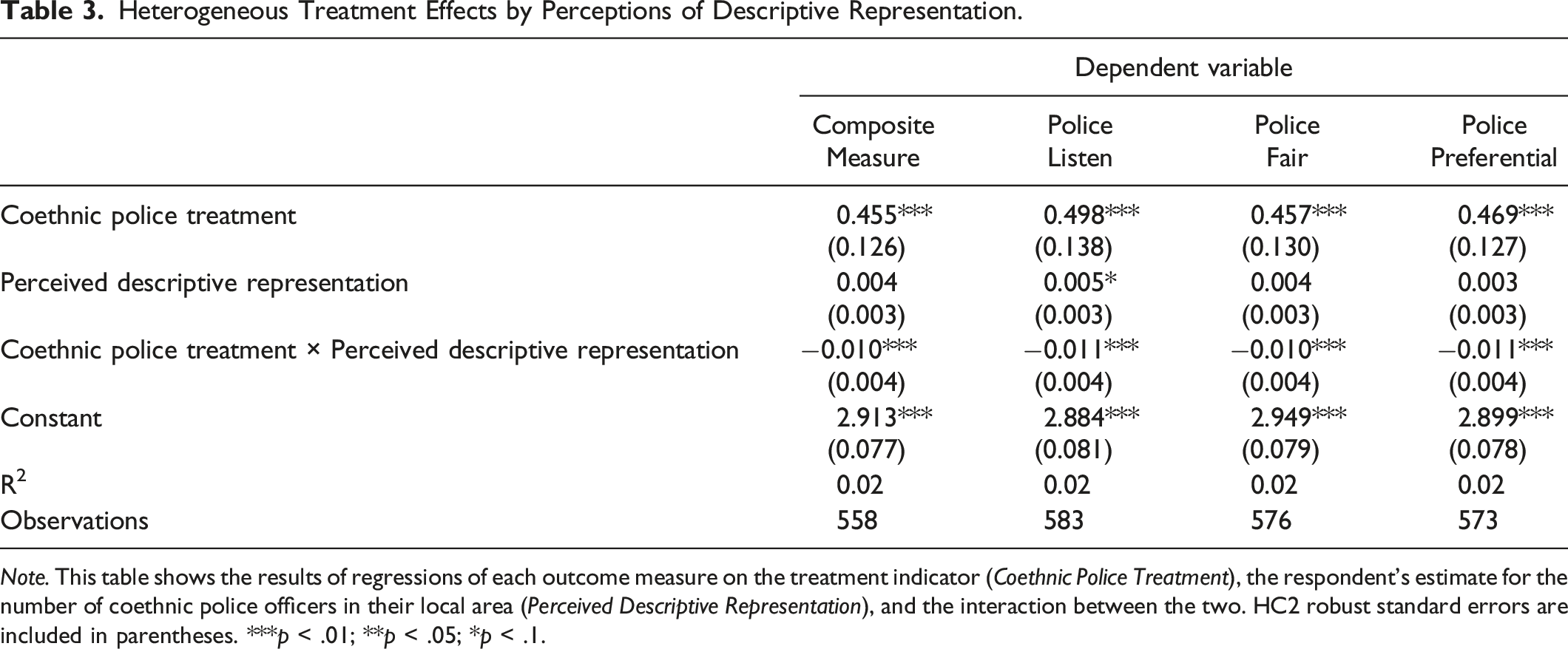
Note. This table shows the results of regressions of each outcome measure on the treatment indicator (Coethnic Police Treatment), the respondent’s estimate for the number of coethnic police officers in their local area (Perceived Descriptive Representation), and the interaction between the two. HC2 robust standard errors are included in parentheses. ***p < .01; **p < .05; *p < .1.
To assess the role of descriptive representation on perceptions of encounters with the police, we include an interaction between the coethnic police treatment and perceptions of representation in the force. We focus on perceptions of descriptive representation—as opposed to the actual representation of ethnic groups in the police force—for two reasons. First, as previously noted, information on the ethnicity of police officers is not publicly available, making the analysis of how attitudes towards the police vary by local police force composition impossible. Second, the proposed causal pathway between descriptive representation, coethnicity, and attitudes towards the police produces the prediction that individuals will be less likely to hold positive attitudes towards the police and non-coethnic police officers in particular when they believe their ethnic group is not being represented in the force. Using perceptions of descriptive representation allows for a more direct test of this prediction.
As seen in Table 3, when the respondent believes there to be zero coethnic police officers in their local area—as is the case for 127 respondents in our experimental sample—the estimated treatment effect of the coethnic police profile on perceptions of police behavior more than doubles relative to the estimates reported in Table 2. As seen in the interaction terms (all statistically significant at the .01 level), an increase in perceived descriptive representation in the local police force is associated with a decrease in the magnitude of the coethnic police treatment effect. We interpret this as suggestive evidence that the treatment effect of coethnicity on beliefs about police behavior decreases as perceptions of the descriptive representation of the respondent’s ethnic group in the police force increase.
One concern with this analysis is that perceptions of descriptive representation might be correlated with other factors—such as how often an individual has been stopped by the police—that could be linked to overall attitudes about the police. To support the conclusion that the heterogeneous effects presented in Table 3 are driven by variation in perceptions of descriptive representation—and not by some other factor that is correlated with these perceptions—we show that these results are robust to the inclusion of covariates and the interaction between the treatment and these covariates in Table A.12 of the appendix. 15 Though we caution that the heterogeneous effects should not be given a causal interpretation, the robustness of the interaction results to a range of plausible confounders strengthens the proposition that perceptions of descriptive representation matter for understanding citizens’ outlook on interactions with the police.
Figure 4 shows predicted values from the interaction model for the composite measure outcome. This figure shows that the effect of receiving the coethnic police treatment is only observed among respondents with low perceptions of the descriptive representation of their ethnic group in the police force, a result that is indicative of the importance of perceived representation within the police force for citizen expectations of police behavior. As discussed earlier and shown in Figure 2, there are clear, politically salient discrepancies in which ethnic groups are perceived to be over- and underrepresented in the Karachi police force: both Muhajirs and Pashtuns have low estimates of their descriptive representation in the force while Sindhis have the largest estimates.
16
We therefore see these results as confirming our contextual priors about the importance of descriptive representation for attitudes about interactions with the police and supplementing the descriptive evidence presented in the previous section: shared ethnicity with a police officer will increase expectations of a positive encounter among groups that have lower levels of representation in the force. While coethnicity does matter for perceptions of police procedural justice, it matters much more for members of certain ethnic groups—those that are underrepresented in the force—as compared to others. Predicted Values on Composite Measure from Interaction Model.
Discussion
This study contributes to our pool of empirical evidence on how ascriptive identity affects an important subset of citizen-state interactions in weakly institutionalized contexts. Residents of densely populated urban areas encounter the police on a regular basis: 51 percent of our representative survey sample indicated being stopped by the police at least once in the 12 months before the survey. With the police being a frequently encountered arm of the state, citizen attitudes towards the police are likely to reverberate into attitudes towards political institutions in general: in our sample, perceptions of coethnic police bias have negative conditional associations not only with trust in the police, but also with trust in the provincial and national governments (Table A.13 in the appendix).
This work provides an additional data point in the nascent but growing study of policing in the Global South. Prior empirical evidence from other contexts suggests that shared ethnicity with a police officer can have negative effects (Blair et al., 2022), positive effects (Curtice, 2022), or no effects (Karim, 2020) on interactions. This study shows that for mundane interactions in weakly institutionalized contexts, the answer may lie somewhere in the middle. Specifically, our results suggest that the overall lack of confidence in the police renders ethnicity as only a marginal contributor to perceptions of bias, but that this relationship varies across ethnic groups. We suggest that the institutional set-up of the police force is a crucial aspect of understanding how ethnicity sets expectations of policing interactions. In contexts such as Karachi, where the descriptive representation of large ethnic groups is low and the policing administration is politically captured by an alternative group, the presence of a coethnic police officer can create expectations of greater procedural justice. The evidence from the interaction between perceived descriptive representation and the coethnic police treatment is consistent with this conclusion.
Our study therefore joins a growing body of research that suggests civilians from historically marginalized ethnic groups in Global South settings prefer police officers who are coethnic (Curtice, 2022) and embedded in their local community (Denny et al., 2022), and police forces that are more inclusive of minority groups (Nanes, 2018, 2020). 17 We anticipate that these findings on the role of coethnicity and descriptive representation in conditioning police-civilian interactions are likely to hold in other settings where there is a mismatch between the institutionalized composition of the police force and the populations the force is charged with policing. Concerns about the descriptive representation of the police and security services more broadly can be found in many contexts. Ethnic stacking—or the selective recruitment of ethnic groups perceived to be loyal to the government into the security services—has been documented in many countries in the Global South (Harkness, 2016; Hassan, 2017; Roessler, 2011), creating a mismatch between the composition of those charged with upholding the law and the composition of citizens subject to the law. Likewise, police forces in developed, multicultural countries are often not representative of their diverse populations. Writing on policing in the United States Ba et al. (2021) note that “throughout the history of the United States, many police forces have been nearly all white and male.” We argue that in settings such as these, where historically underrepresented groups have low expectations of their representation in the force, shared ethnicity between police officer and citizen may often be an important component of establishing expectations of procedural justice in everyday encounters.
Why, then, do we observe divergent results in cases such as Liberia (Blair et al., 2022)? Blair et al. (2022) assess how the presence of one or two police officers from a marginalized ethnic group affects group-based decisions among police teams of four. In this context—where police officers from a marginalized group are embedded in teams with other members of the police force—pressure to demonstrate loyalty to the police force may be especially high and officers may feel compelled to demonstrate that loyalty by discriminating against their own group (Brown & Frank, 2006; Forman, 2017). It is unclear how group decision-making among policing teams might vary between mixed teams and teams made up entirely of the marginalized group, and this remains a question for future research. 18 What our study shows, however, is that coethnicity with a single police officer in a routine stop exerts a marginal effect on expectations of procedural justice, and that this effect is considerably amplified among those who believe their ethnic group is underrepresented in the force.
In addition, it may be the case that we are most likely to see such “loyalty conflict” in post-civil war contexts where explicit ethnic balancing reforms are implemented to presumably correct for past grievances. The selection process into the security sector after a bloody civil war might enable the recruitment (either implicitly or explicitly) of officers who are more susceptible to loyalty conflict and less likely to demonstrate coethnic preferences. However, such selection effects could also be operative in non-postwar contexts as well, and it remains a key question for future research to theorize under what conditions increasing descriptive representation of minorities in the police force translates to better or worse treatment for the minority group. Along with the selection effects we suggest above, another factor driving these divergent effects of descriptive representation may be the type of training and professionalization undergone by police recruits.
Future work should continue to probe the effect of ethnicity on policing for at least two additional reasons. First, if citizens experience the state differently based on their ascriptive identities, this may prompt them to refrain from making claims on the state (Fang, 2018) or to step outside of electoral politics and into violent mobilization to make such claims (Cederman et al., 2013). Indeed, interview respondents in Karachi who reported experiencing discrimination at the hands of non-coethnic police officers were also likely to strongly support ethnic parties with violent militant wings.
Second, both citizens and the state stand to gain from increased trust in and legitimacy of the police. Studies conducted in advanced industrialized democracies show that citizens are more likely to comply with the police when they view it as legitimate and trustworthy (Jackson et al., 2012; Tyler, 2006; Tyler & Fagan, 2008). This literature further shows that the police can establish legitimacy by treating people with dignity and respect (Mastrofski et al., 1996; Mazerolle et al., 2013; Sunshine & Tyler, 2003). Besides the normative importance of treating all individuals with dignity and fairness (especially while holding coercive power over them), establishing the perception of procedural justice is important for police effectiveness. The police as an institution depends upon citizens’ willingness to provide information, report crimes, comply with police directives, and tacitly obey the law (Blair et al., 2022; Mazerolle et al., 2013). We leave it to future work to explore whether this link between police legitimacy and citizen compliance holds in the urbanizing cities of the Global South.
Supplemental Material
Supplemental Material - Ethnicity and Policing in the Global South: Descriptive Representation and Expectations of Police Bias
Supplemental Material for Ethnicity and Policing in the Global South: Descriptive Representation and Expectations of Police Bias by Nicholas Lyon and Mashail Malik in Comparative Political Studies
Footnotes
Acknowledgments
The authors are grateful to James Fearon, David Laitin, Kenneth Scheve, Jeremy Weinstein, Beatriz Magaloni, Christiana Parreira, participants at the 2019 meeting of the Midwest Political Science Association, participants at the 2020 meeting of the American Political Science Association Meeting, and the three anonymous reviewers for their helpful comments.
Declaration of Conflicting Interests
The author(s) declared no potential conflicts of interest with respect to the research, authorship, and/or publication of this article.
Funding
The author(s) disclosed receipt of the following financial support for the research, authorship, and/or publication of this article: This work was supported by the J-PAL Crime and Violence Exploratory Grant.
Research Ethics

Supplemental Material
Supplemental material for this article is available online.
Notes
Author Biographies
References
Supplementary Material
Please find the following supplemental material available below.
For Open Access articles published under a Creative Commons License, all supplemental material carries the same license as the article it is associated with.
For non-Open Access articles published, all supplemental material carries a non-exclusive license, and permission requests for re-use of supplemental material or any part of supplemental material shall be sent directly to the copyright owner as specified in the copyright notice associated with the article.
