



Abstract
Does election fraud erode support for dictators? An original survey experiment from Russia following the 2020 vote on constitutional amendments reveals three key findings. First, regime supporters and opponents differ significantly in their baseline beliefs about election fairness. While regime opponents are already aware of fraud, supporters expect relatively fair elections. Consequently, only regime supporters revise their election beliefs when exposed to fraud information. Second, fraud revelations reduce regime legitimacy beliefs, but only among the regime’s political base. In contrast, regime opponents already perceive the regime as illegitimate at the baseline. Third, the experiment shows minimal, if any, effects on attitudes toward Putin. While fraud revelations cause regime supporters to adjust their views on the regime, their opinions about Putin remain largely unaffected. The findings imply that dictators can maintain popular support among their political base while manipulating elections, posing questions about the potential of fraud to undermine regime stability.
Keywords
Most autocracies hold elections that formally invite political competition and participation, but in reality, they subvert the process through pervasive electoral manipulation (Levitsky & Way, 2002; Magaloni & Kricheli, 2010). 1 Election fraud violates fundamental political freedoms and rights and undermines the function of elections as an accountability mechanism. Although autocrats rule without a public mandate, abundant evidence suggests that public support is important for regime stability and that autocrats pay great attention to public opinion (Frye et al., 2017; Geddes, 1999; Gerschewski, 2018; Rozenas, 2016). Consequently, scholars increasingly devote attention to understanding public opinion dynamics in nondemocratic regimes (e.g., Frye, 2019, 2021; Greene & Robertson, 2017; Şaşmaz et al., 2022). A key question is thus whether authoritarian leaders lose support when they meddle with elections.
Answering this question is important if we wish to understand how authoritarian regimes endure and function, as autocrats facing declining public support may be forced to rely on riskier and more repressive survival strategies (Guriev & Treisman, 2020; Rosenfeld, 2018; Treisman, 2011), and may be inclined to engage in diversionary wars to divert the public’s attention away from regime discontent (Smith, 1996; Tir, 2010). Moreover, as declining public support is an important driver for protest mobilization, answering this question also sheds light on how election dynamics create incentives for mass dissent in autocracies (Bunce & Wolchik, 2010; Tucker, 2007). Examining the consequences of election fraud for mass support thus adds new insights to ongoing debates about the regime (de)stabilizing functions of authoritarian elections (see e.g., Kaya & Bernhard, 2013; Knutsen et al., 2017; Svolik, 2012).
Comparative scholars often theorize negative societal repercussions as a deterrent against large-scale election fraud (Fearon, 2011; Schedler, 2013; Tucker, 2007). Yet, there is little evidence on how voters in authoritarian regimes evaluate the use of electoral fraud and how it shapes public support for authoritarian incumbents. However, in related literature, scholars have recently examined public support for politicians who violate democratic institutions. A prominent argument suggests that voters tolerate such violations if it aligns with their partisan aims (Şaşmaz et al., 2022). High polarization strengthens partisan preferences, making it costly for voters to defect from their favored party to punish democratic rule violations (Svolik, 2019, 2020). A similar argument posits that people apply partisan double standards when evaluating rule violations, disapproving more strongly of violations by opposing parties (Ahlquist et al., 2018; Daxecker & Fjelde, 2022). Yet, voters may not always tolerate authoritarian behavior by their party (Gutiérrez-Romero & Lebas, 2020). In Russia, informing pro-regime voters about election fraud reduces their support for United Russia candidates, indicating that electoral malpractice can be costly for autocrats by eroding support among their political base (Reuter & Szakonyi, 2021). Hence, existing work provides contradicting expectations regarding how voters respond to election fraud depending on their political loyalties.
To better understand the implications of election fraud for public opinion, I examine how providing information revealing electoral manipulation shapes support for authoritarian leaders and regime legitimacy more broadly. In doing so, this study contributes to existing work in several important ways. First, I examine how fraud revelations affect support for dictators. Previous work has examined the impact of fraud on support for (hypothetical) lower-level political candidates (e.g., Gutiérrez-Romero & Lebas, 2020; Reuter & Szakonyi, 2021; Svolik, 2019), yet people may be more inclined to change their views on lower-level officials than authoritarian leaders because the latter is a more central representation of the political preferences and leanings of the regime. For example, while United Russia sometimes struggles to win a simple majority in the Duma, Putin always wins comfortably, indicating that attitudes towards Putin and United Russia are qualitatively different. 2 It may well be that attitudes toward Putin are less sensitive to election fraud than attitudes toward UR candidates. We can, therefore, not apply the findings from previous research to authoritarian leaders without invoking further assumptions. Relatedly, I examine how information about real-world election fraud shapes support for a real-world dictator as people may be more willing to sanction malpractice in abstract, hypothetical scenarios (Boas et al., 2019).
Second, this study contributes to the existing literature by presenting a more fine-grained examination of how voters process information revealing election fraud. From public opinion research, we know that information processing and opinion updating involve several steps (Gaines et al., 2007; Zaller, 1992). Voters must first update factual beliefs, interpret these beliefs, and subsequently adjust their opinions. While previous work has primarily examined the impact of fraud revelations on vote choice (Gutiérrez-Romero & Lebas, 2020; Reuter & Szakonyi, 2021; Svolik, 2019), I use a two-step process to analyze both how voters update beliefs about elections and subsequently how voters update beliefs about the regime and the dictator. Doing so provides important nuance to our understanding of how voters in authoritarian regimes evaluate the use of fraud and allow me to identify where, if at all, the response chain breaks.
In line with research on public support for democratic subversion (Şaşmaz et al., 2022; Svolik, 2019), I differentiate between regime supporters and opponents. I argue that the regime’s core supporters are more likely to update their beliefs and opinions when exposed to election fraud information. The extent to which voters update their beliefs about the election depends on whether the election fraud information is new, and previous research shows that regime supporters and opponents hold different expectations for election fairness (Reuter & Szakonyi, 2015; Robertson, 2017). Consistent with the informational theory proposed by Reuter & Szakonyi (2021), I argue that mainly the regime’s political base updates their beliefs about elections and the regime in response to election fraud information.
However, election fraud information may not have downstream consequences for support for authoritarian incumbents. Due to the tangible social, personal, and economic costs regime opponents face, they are unlikely to change their attitudes towards autocrats. Regime supporters, in contrast, generally hold favorable opinions of the regime and its leader. Although they likely disapprove of election fraud, they may nevertheless prioritize desired political outcomes over clean elections. Additionally, regime supporters may acknowledge that the regime interfered in elections but refrain from holding the authoritarian leader responsible. As people tend to attribute blame in partisan ways (e.g., Bisgaard, 2019), regime supporters may attribute electoral malpractice to lower-level officials rather than holding the authoritarian leader. In other words, they may rationalize that the good tsar has been led astray by bad boyars and chinovniki (civil servants) lower down the bureaucratic ladder.
To examine how voters in nondemocratic settings evaluate the use of electoral manipulation and adjust their beliefs and attitudes, I fielded a nationally representative survey experiment in Russia following the 2020 vote on constitutional amendments. These amendments reset Putin’s term clock, allowing him to seek re-election in 2024 and again in 2030. The vote was largely seen as a vote on Putin and was fraught with allegations of fraud, providing fertile ground for examining how public opinion changes when electoral manipulation is revealed. 3 The experiment provided respondents with information revealing how the regime meddled with the 2020 vote and probed respondents’ support for President Putin, beliefs about regime legitimacy, and perceptions of election fairness.
The analysis reveals three key findings. First, regime supporters and opponents differ markedly in baseline evaluations of the election. While regime opponents are highly skeptical of its fairness in baseline, regime supporters perceive it as free and fair. Consequently, only regime supporters revise election fairness beliefs when exposed to election fraud information. Second, election fraud information has negative consequences for legitimacy beliefs but only among regime supporters. They perceive the regime as less entitled to govern when confronted with its electoral violations, whereas regime opponents already view the regime as illegitimate from the outset. These findings demonstrate that revelations of electoral interference are costly for authoritarian regimes as erode perceived regime legitimacy among the regime’s political base. Yet, the fraud information also has minimal—if any at all—impact on support for President Putin. Among core supporters, who revise their beliefs about the election and regime legitimacy, information about election fraud does not substantially change their views on Putin. This highlights the need to distinguish actors within an authoritarian regime. While parliamentary regime candidates face substantial electoral costs for cheating (Reuter & Szakonyi, 2021), there is no evidence of a similar cost for President Putin. These findings contribute to our understanding of the functioning of nondemocratic regimes and how authoritarian leaders can maintain public support despite manipulating elections, raising significant questions about the potential erosion of regime stability through electoral manipulation.
Theoretical Discussion
Should we expect that election fraud shapes political support for autocrats? If so, among which voters? Based on procedural justice theory and previous empirical work on election fraud, this study builds on the premise that voters in autocracies dislike electoral manipulation (Birch, 2008; Doherty & Wolak, 2012; Hibbing & Alford, 2004; Reuter & Szakonyi, 2021; Szakonyi, 2021; Wilking, 2011). Yet, research on public opinion formation shows that the process leading from information to opinion changes involves additional steps (Zaller, 1992). For fraud revelations to influence opinions, people must update their factual beliefs (e.g., did election fraud occur?), interpret these facts (e.g., how illegitimate and severe was it?), and subsequently adjust their attitudes toward dictators (e.g., is this enough to change opinions?) (Gaines et al., 2007).
Further, existing research suggests that a key distinction should be made between voters of regime-affiliated parties (regime supporters) and voters of regime-opposing parties (regime opponents) (cf. McAllister & White, 2015; Reuter & Szakonyi, 2015, 2021; Robertson, 2017; Şaşmaz et al., 2022). Regime supporters and opponents have different political preferences and may think differently about election fraud depending on whether it benefits their side (Ahlquist et al., 2018; Daxecker & Fjelde, 2022),
To fully understand the impact of election fraud information on support for autocrats, we, therefore, need to examine the different steps in how regime supporters and opponents respond to such information. Based on this, I theorize and examine how regime supporters and opponent update beliefs and attitudes in response to election fraud information in a two-step process. 4 Voters should respond to information about election fraud by (a) updating their beliefs and perceptions about elections and (b) updating their beliefs and opinions about the regime and the dictator based on their interpretations. If voters change their beliefs about facts, we should see that information about fraud causes negative changes in election beliefs. If people interpret these beliefs as severe and illegitimate, we should see substantive negative changes in election beliefs and legitimacy beliefs. Finally, if voters update their opinions about the authoritarian incumbent, we should see that these changes produce downstream consequences for political support.
Updating Perceptions of Election Fairness
How should we expect regime supporters and opponents to update their beliefs about elections when exposed to election fraud information? Whereas some recent accounts suggest that regime supporters should be more likely to discount information about regime electoral interference (Ahlquist et al., 2018; Daxecker & Fjelde, 2022), I argue that regime supporters may be more sensitive to news of election fraud. The extent to which voters update their beliefs about the election likely depends on whether the information about election fraud is new (Frye & Borisova, 2019; Little, 2012). If citizens have seen manipulation in past elections, they may already have factored in such fraud. In that case, information about election fraud is unlikely to change perceptions about elections. While fraud revelations would be new information in most democracies, this is not necessarily the case for all citizens in authoritarian regimes. Previous work has shown that regime supporters and opponents tend to have markedly different evaluations of elections and different awareness of past election fraud (McAllister & White, 2011; Reuter & Szakonyi, 2015; Robertson, 2017). Building on these findings, I argue that regime supporters and opponents have different baseline expectations of fraud and that regime opponents are less sensitive to news of election fraud than regime supporters because they are more likely to expect elections to be fraudulent.
Authoritarian regimes seek to control the flow of information and portray positive images of the regime (Geddes & Zaller, 1989). State-controlled media rarely broadcast electoral violations, and when they do mention allegations of fraud, they are often ridiculed or dismissed as inconsequential, accidental irregularities. Independent sources of information such as online blogs, media outlets, and social media nevertheless often exist outside state control, where news of election fraud is shared. As people tend to selectively seek out information that validates their preferences, regime opponents are likely more disposed to seek out independent information sources, whereas regime supporters are likely to consume state-controlled media (Greene & Robertson, 2019; Reuter & Szakonyi, 2015; Robertson, 2017). Consequently, research has shown that regime supporters tend to be more confident in the fairness of elections compared to opposition voters (McAllister & White, 2011; Reuter & Szakonyi, 2015, 2021; Robertson, 2017; Rose & Mishler, 2009). If regime opponents are more likely to expect that elections are manipulated, we should expect that they are less sensitive to information about electoral manipulation. In contrast, providing credible information about election meddling should cause regime supporters to adjust their perceptions of elections.
Information revealing election fraud causes regime supporters, but not regime opponents, to negatively update their perceptions of election fairness.
Downstream Consequences for Legitimacy Beliefs and Support
Does updating beliefs about election fairness have downstream consequences for beliefs about regime legitimacy? Regime legitimacy refers to the perception that government has a right to make binding political decisions and that people, therefore, have a moral obligation to comply with such decisions (Gilley, 2009; Levi et al., 2009). How might regime opponents and supporters update legitimacy beliefs in the face of fraud revelations?
It follows from the argument above that regime opponents may already have adjusted their legitimacy beliefs to regime interference in elections. That is, if regime opponents are aware of past election fraud, they may already view the regime as illegitimate. Moreover, being in opposition to an authoritarian regime is associated with tangible personal, social, and economic costs (Greene & Robertson, 2019; Young, 2019). People who publicly support opposition parties willingly risk harassment, intimidation, layoffs, social exclusion, and more to challenge the regime. Greene and Robertson (2019, p. 11), for example, note that Russians feel social pressure to be politically in step with their compatriots and that attachment to President Putin is associated with a sense of community. Those who step outside of this norm face real costs. Because of the risks and costs associated with challenging the regime, people who do so are likely so galvanized in their views on authoritarian regimes and incumbents that providing information about electoral malpractice does little to change their views. Hence, even if regime opponents do not expect elections to be unfair, election fraud information may not have downstream consequences for their regime legitimacy beliefs.
In contrast, we should, perhaps unsurprisingly, expect that regime supporters generally hold much more favorable beliefs about the regime. 5 To the extent that regime supporters believe that elections are generally free and fair, they should also view the regime as more legitimate in baseline. Elections in competitive authoritarian regimes are the only legitimate route to power, so voters would likely view the regime as less entitled to govern when they meddle with elections. Reuter & Szakonyi (2021) speculate that regime supporters may even support the regime precisely because they think that elections are free and fair. As voters in autocracies dislike election fraud (Reuter & Szakonyi, 2021; Szakonyi, 2021), regime supporters likely use information about election violations to inform their opinions and beliefs about the regime.
Information revealing election fraud causes regime supporters, but not regime opponents, to update their beliefs about regime legitimacy negatively. Yet, while regime supporters are likely to update their legitimacy beliefs negatively, they may not change their support for authoritarian incumbents. Political support is the attitude “by which a person orients himself to an object either favorably or unfavorably, positively or negatively” (Easton, 1975, p. 436). In this case, the object of interest is the authoritarian leader. Although legitimacy and support are neighboring concepts, there are important differences as one can acknowledge the government’s right to govern without liking its decisions, policies, or leader. In this perspective, we can think of support as specific and legitimacy as diffuse system attitudes (Easton, 1975). Support is a question of whether people like a specific leader, whereas legitimacy is a question of people’s views on the fundamental political arrangement of the country (Easton, 1975; Reuter, 2021). If the regime’s core base is more likely to adjust beliefs about the election and regime legitimacy, why should they not adjust their views on Putin? I contend that there are, at least, two likely reasons for this. First, social psychological work suggests that perceived procedural fairness and perceived outcome favorability interact in shaping voters’ attitudes (Doherty & Wolak, 2012; Magalhães & Aguiar-Conraria, 2019). Receiving desired outcomes (such as valued policies and outcomes, ideological representation, or social conformity) puts an instrumental brake on negative reactions to procedural unfairness (Brockner & Wiesenfeld, 1996; Krehbiel & Cropanzano, 2000). People react differently to unfair procedures when they provide desired outcomes compared to when they produce unfavorable outcomes. Hence, although regime supporters should update their views on the election and the regime, it does not necessarily imply holding authoritarian leaders responsible. Many contemporary autocrats have built genuine public backing through their performances, such as restoring the economy (Guriev & Treisman, 2020; Matovski, 2021; Treisman, 2011). In Russia, pro-regime voters—and indeed many Russians—place a great premium on the outcomes that Putin has delivered (Frye, 2019; Greene & Robertson, 2019; Matovski, 2021). Hence, autocrats like Putin may have built a reservoir of support, with which they may be able to withstand a public opinion backlash among their core supporters following revelations of election fraud. When regime supporters are confronted with evidence of election fraud, they must decide whether such unfairness is sufficient to substantively change their views on dictators when they have brought desired political outcomes. Although regime supporters adjust their perceptions of elections negatively and do hold the regime responsible, they may simply prioritize policy outcomes over clean elections; the ends justify the means (Svolik, 2019). A recent experiment in Turkey, for example, shows that voters support executive aggrandizement (the gradual dismantling of the constraints of constitutional checks and balances) to the extent that they believe it will help leaders put their partisan vision into action (Şaşmaz et al., 2022). Moreover, it may be that regime supporters disapprove of election fraud but do not attribute blame to the incumbent autocrat. Authoritarian incumbents are rarely involved in the actual manipulation of elections (Rundlett & Svolik, 2016).
6
Regime supporters may, therefore, rationalize that the good tsar had nothing to do with manipulating elections but was betrayed by bad boyars (elites) and chinovniki (civil servants) lower down the bureaucratic ladder. As people tend to process information in ways that fit their partisan preconceptions (Bartels, 2002; Bisgaard, 2019; Robertson, 2017), regime supporters may have motivations to selectively attribute blame on far-flung officials. Hence, while regime supporters may negatively adjust perceptions of regime legitimacy, they may not similarly adjust attitudes toward the authoritarian leader.
Information revealing election fraud does not shape support for dictators among respondents (regime supporters and opponents).
2020 Vote on Amendments to the Russian Constitution
To examine how election rigging shapes support for dictators, I focus on the 2020 nationwide vote on amendments to the Russian Constitution. On January 15, 2020, President Putin gave an annual address (poslanie) to the Federal Assembly, proposing several amendments to the Russian Constitution. 7 Although the Federal Assembly and regional legislatures could formally approve the amendments, President Putin called for a nationwide popular vote to ensure the legitimacy of the bill. Among the proposed amendments was a proposal to change Article 81(3) stating that presidents could only serve two consecutive terms. In changing this article, the bill proposed to reset Putin’s term clock, which would allow him to extend his rule by two additional terms. Although the bill contained several amendments that shifted power in favor of the president and the federal center, it was widely seen as a vote on extending President Putin’s tenure (Teague, 2020). Amidst the outbreak of the COVID-19 pandemic, the public vote was scheduled as a week-long vote ending on July 1, 2020. The vote was a simple “yes/no” for the entire package of proposed amendments. 8 According to official numbers, nearly 78% voted in favor of the reform package, with only 21% voting against it, which was heralded as a “triumphant vote of confidence in President Putin” by Kremlin spokesperson, Dmitry Peskov. 9 Appendix D describes the process of crafting this bill in more detail.
Opponents and domestic monitors were quick to denounce the elections as fraudulent. 10 Voters were pressured to vote in favor of the amendments, regime supporters voted multiple times, opponents were prevented from campaigning on state-controlled media, and videos showing blatant ballot stuffing were shared on independent media. 11 This provides an important condition necessary to examine regime opponents’ prior knowledge about elections.
A concern associated with survey data from authoritarian regimes is that respondents feel pressure to answer in a certain way on sensitive topics (Kuran, 1995). However, previous studies examining the extent of social desirability bias and preference falsification have generally shown that Russians are largely willing to say what they feel on sensitive matters (Rose, 2007). Frye et al. (2017), for example, use a series of list experiments to show that Putin’s approval rating is genuinely very high and largely unaffected by (modest levels of) attitude falsification. Similarly, interviews from Greene Robertson (2019) suggest that most Russians are willing to openly discuss political matters as well as Putin’s presidency, at least before the 2022 invasion of Ukraine. The 2020 vote on constitutional amendments in Russia thus provides fertile ground for examining how election rigging shapes support for authoritarian incumbent leaders because it was a vote on Putin, marred by substantial fraud, and Russians have been shown to answer truthfully on sensitive survey topics.
Nevertheless, examining how election fraud influences support for authoritarian leaders in a sole case could pose some limitations to the generalizability of the conclusions. Putin’s relationship with the Russian people is in some ways special. Putin enjoys widespread genuine popular support and has become a representation of a sense of community and national pride (Frye, 2021; Frye et al., 2017; Greene & Robertson, 2019). Most scholars nevertheless consider Putin’s Russia a typical case of a personalistic autocracy (Frye, 2021; Guriev & Treisman, 2023; Matovski, 2021). Putin is not the only dictator who is in public demand; Turkey’s Recep Erdoğan, Hungary’s Viktor Orbán, Venezuela’s Hugo Chávez, and Peru’s Alberto Fujimori also came to power with popular support following profound political, economic, or security crises (Matovski, 2021). In general, these autocrats tend to enjoy popular support because they are seen as fixers that can restore the countries’ economies as well as public order (Guriev & Treisman, 2020; Matovski, 2021; Rosenfeld, 2018; Treisman, 2011) Similarly, Putin’s Russia relies on similar informational survival strategies as seen in most other contemporary, personalistic autocracies (Guriev & Treisman, 2023). Because authoritarians such as Putin, Erdoğan, and Orbán claim to govern in the name of the people, they are sensitive to public opinion backlashes (Frye, 2021). Hence, there is reason to believe that the findings travel to other personalistic nondemocratic regimes, where authoritarian incumbents have genuine public appeal. While the findings from Russia may not accurately describe voters’ reactions to fraud revelations in different types of nondemocracies or in personalistic autocracies with highly unpopular leaders, there is reason to believe that the findings may well be representative of a broader set of authoritarian regimes. Indeed, comparative studies have found similar patterns of electoral perceptions and system support across autocracies in the former Eastern Bloc (McAllister & White, 2015). In the concluding section of this paper, I discuss how a range of conditions may shape the experimental results.
Experimental Design
I fielded a survey experiment to a nationally representative sample of 1500 Russian adults between September and October 2020. 12 The sampling was administered by YouGov, which selected participants from their panels to resemble the demographic distribution of the Russian adult population. Respondents were asked a few questions on politics before being randomly assigned to one of four groups with varying information about electoral interference in the July 1 nationwide vote. 13 Information about the survey and sampling is available in Appendix A.
Experimental Wording.
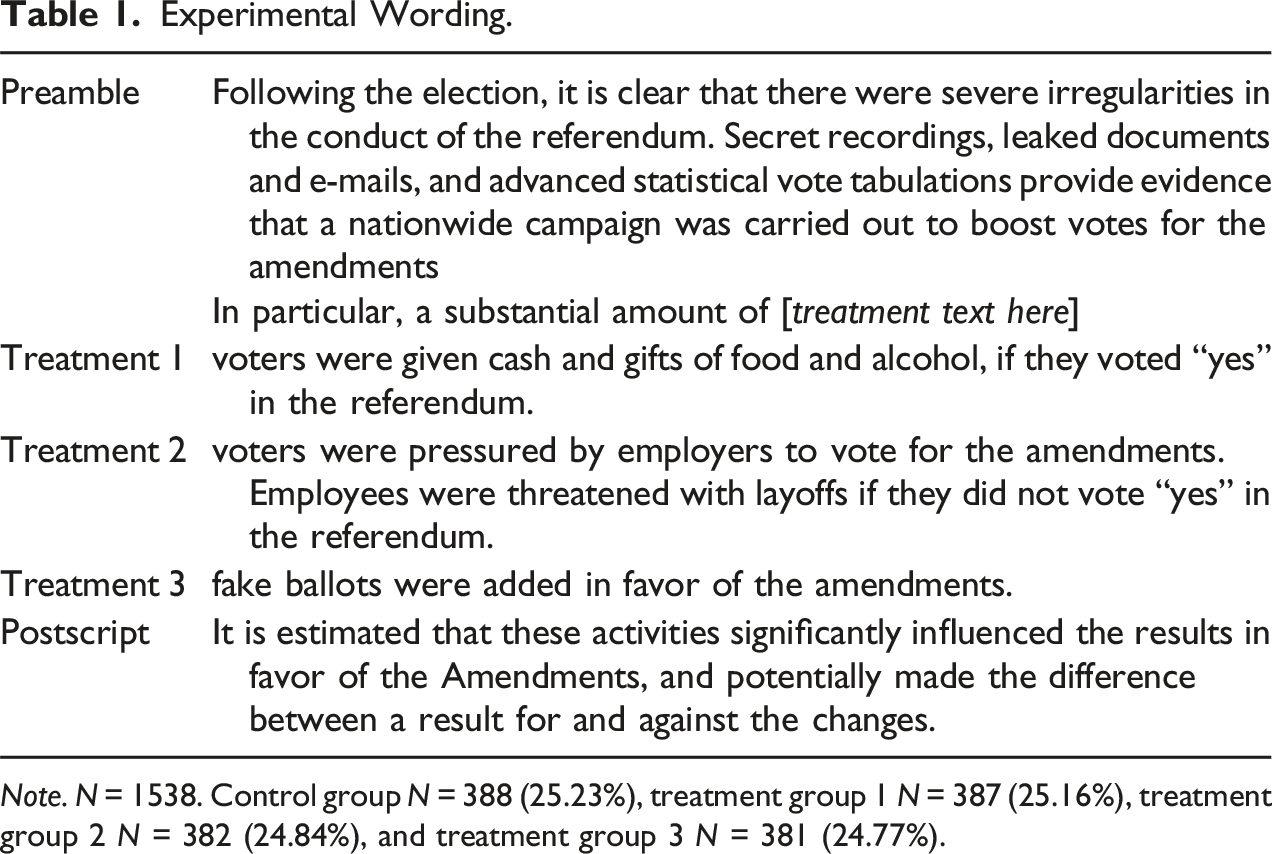
Note. N = 1538. Control group N = 388 (25.23%), treatment group 1 N = 387 (25.16%), treatment group 2 N = 382 (24.84%), and treatment group 3 N = 381 (24.77%).
The vignettes were designed to reduce uncertainty about whether fraud occurred. Comparative research has shown that information credibility affects how citizens respond to information about corruption scandals (Weitz-Shapiro & Winters, 2017). Information ambiguity could influence the extent to which respondents update their beliefs about the election and President Putin because ambiguous information can more easily be written off as unsubstantiated allegations. To avoid this, the vignette preamble state that secret recordings, leaked documents, and advanced statistical tabulations provide evidence of election rigging. Additionally, the postscript states that the electoral transgressions significantly influenced the results, highlighting the severity of the manipulation, which arguably influences whether people react to manipulation (Schedler, 2013). 14
The three outcomes of interest are perceived election fairness, regime legitimacy beliefs, and support for President Putin. To measure election quality judgments, I follow Birch (2010) and ask respondents to rate the fairness of the public vote on a five-point scale (M = 2.79; SD = 1.47). I measure regime legitimacy beliefs by constructing an index of three survey items, measuring respondents’ willingness to follow government decisions they disagree with, their moral inclination to obey laws that go against what they think is right, and whether they felt that disobedience could be justified. The index ranges from 0–1 (M = .45; SD = .26). Support for President Putin was measured with the following question; “some people think that Vladimir Putin should serve another term as President, while others oppose this. Do you support the idea that Putin should serve for another term?” Answers ranged from “fully support” to “fully oppose” on a four-point Likert-type scale (M = 2.40; SD = 1.21). Appendix A provides the exact question wordings, factor loadings from a principal component analysis for the legitimacy scale, as well as key descriptive statistics for all outcomes. After finishing the survey, respondents were given a thorough debriefing explicating that the information about the election was fictitious (see debriefing and discussion of ethics in Appendix C). 15
To distinguish between regime supporters and opponents, respondents were asked, before receiving treatment, which party they would vote for if State Duma elections were held. 16 I coded United Russia (UR; Edinaya Rossiya) voters as regime supporters, whereas those who would vote for Patriots of Russia (Patrioty Rossii), Yabloko, Russia for the Future (Rossiya Budushchego), Party of Growth (Partiya Rosta), or PARNAS (Partiya Narodnoy Svobody) as regime opponents. In Russia, the Communist Party of the Russian Federation (Kommunisticheskaya Partiya Rossiyskoy Federatsii), the Liberal-Democratic Party (Liberal’no-demokraticheskaya partiya Rossii), and A Just Russia (Spravedlivaya Rossiya) act as “systemic opposition” parties. I consider these parties’ voters “moderates” because their attachment to Putin likely lies in between that of regime supporters and opponents. As a robustness check, I also measured regime support based on respondents’ sense of identification with these parties. The findings are similar when using this measure to categorize regime supporters, systemic opponents, and opponents (Appendix O). Appendix B shows that randomization created balanced groups on pre-treatment covariates.
Findings
President Putin is a popular figure in Russia (Frye et al., 2017; Greene & Robertson, 2019), but how does information about election fraud influence such support? Above, I proposed to analyze voters’ responses to fraud revelations in a two-step process by which voters first update their views on elections and subsequently update their opinions on the regime and the authoritarian incumbent. To examine these steps, I first examine whether exposing respondents to information about election fraud in the 2020 vote on constitutional amendments caused regime supporters and regime opponents, respectively, to update their beliefs about the vote. Subsequently, I examine whether information about election fraud produces downstream consequences for beliefs about regime legitimacy and support for President Putin. The analyses below are based on unstandardized OLS regression of the outcomes (perceived election fairness, legitimacy beliefs, or support) on treatment, regime support, and treatment × regime support. 17 These analyses are treatment-by-covariate interactions, which are common in studies that examine how different voter groups respond to the same stimuli (e.g., Aarslew, 2023b; Ahlquist et al., 2018; Bisgaard, 2019; Daxecker & Fjelde, 2022; Frye, 2019; Graham & Svolik, 2020; Reuter & Szakonyi, 2021; Svolik, 2019), allowing for the identification of effects within groups. It is, however, worth noting that the differences in treatment effects between regime supporters and opponents are descriptive. I return to this limitation in the discussion. The supplementary material shows that the results are similar when including covariates to adjust for the non-randomized moderator (SI app L).
The Effects of Election Fraud on Perceived Election Fairness
Hypothesis one expected that information about election fraud should decrease beliefs about election fairness but only among regime supporters. Figure 1 displays the results from unstandardized OLS regression analyses of the conditional effects of election fraud on perceived election fairness (table in Appendix H). Information about Election Fraud Reduces Perceived Election Fairness among UR Supporters Only. Note. Predicted means (panel A) and marginal effects (panel B) based on unstandardized OLS regression estimates for the conditional effects of election fraud (treatment) on perceived election fairness. Bars are 95% confidence intervals based on robust standard errors. N = 1215.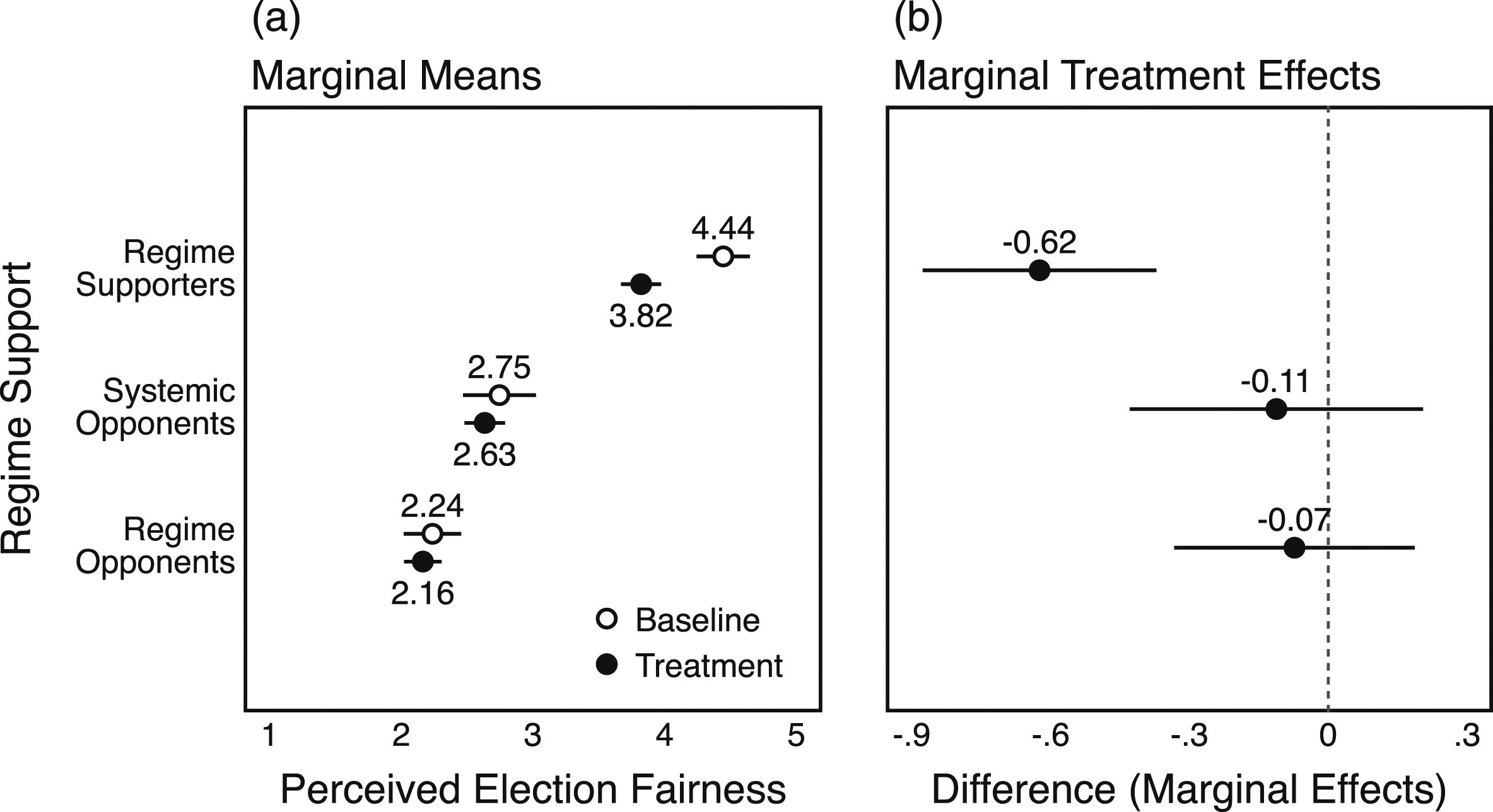
There are two key findings in Figure 1. First, panel A shows that Russians differ greatly in baseline levels of perceived election fairness. These baseline levels constitute a measure of different voter groups’ priors (cf. Arias et al., 2018). Figure 1(a) shows that while UR supporters express great confidence in the 2020 vote in baseline, voters of opposition parties and the systemic opposition parties do not. The estimated mean difference in perceived election fairness between regime supporters and opponents is 2.2 scale points (95% CI’s [1.91, 2.50]; p < .001), nearly half the full-scale range (1–5). This difference in baseline election fairness ratings correspond to 1.5 standard deviations. Supporters of systemic opposition parties also perceive elections as more fair compared to opponents in baseline (difference = .51; 95% CI’s [.15, .86]; p = .005). These are substantively large differences, corroborating previous findings that voters of regime-affiliated parties and opposition parties have substantially different perceptions of electoral quality (McAllister & White, 2011; Rose & Mishler, 2009).
Second, Figure 1(b) shows that only UR voters update their beliefs about the 2020 vote on constitutional amendments when exposed to information revealing election fraud. Exposing UR voters to information about the regime’s interference in the constitutional vote caused them to adjust their beliefs about the election. The mean level of perceived election fairness among UR supporters in the treatment group is 3.82, which is .62 scale points lower than their baseline levels (95% CI’s [−.87, −.37]; p < .001). This difference corresponds to .76 of the standard deviation of the election fairness measure in baseline. In contrast, neither opposition nor systemic opposition voters update their beliefs about the election. While exposing these voters to information about election fraud in the 2020 vote did move beliefs about election fairness in the right direction, these differences are small and indistinguishable from zero.
These findings suggest that regime opponents were already “priced in” on the regime’s election meddling. Regime opponents—and, perhaps surprisingly, systemic opponents—hold very low evaluations of electoral legitimacy in baseline and do not update those evaluations when provided with information about election cheating. While these findings indicate that prior expectations underpin this difference, it is difficult to directly observe this link. The supplementary material shows additional analyses, testing implications of this argument (app K).
Downstream Consequences for Legitimacy Beliefs
Do the changes in beliefs about the 2020 vote’s fairness have downstream consequences for beliefs about government legitimacy? Hypothesis two expects that regime supporters adjust their legitimacy beliefs negatively in response to information about election fraud, while regime opponents do not. Figure 2 displays the findings from unstandardized OLS regression estimates for the conditional effects of election fraud on perceived legitimacy (table in Appendix H). Information about Election Fraud Reduces Perceived Government Legitimacy among UR Supporters. Note. Predicted means (panel A) and marginal effects (panel B) based on unstandardized OLS regression estimates for the conditional effects of election fraud (treatment) on perceived legitimacy. Bars are 95% confidence intervals based on robust standard errors. N = 1073.
Figure 2(a) shows that baseline levels of perceived legitimacy vary with partisan attachments. UR supporters perceive the regime to be markedly more entitled to make binding political decisions compared to opposition voters and voters of systemic opposition parties. The difference between UR voters and opposition voters is 26 percentage points (95% CI’s [.19, .32]; Cohen’s D = 1.01; p < .001). These findings suggest that supporters of the Kremlin’s party feel more obliged to follow government rules and decisions ex-ante.
Does information about election fraud shape such views? Yes, but only among regime supporters. Figure 2(b) shows that exposing UR voters to information about how the regime interfered in the 2020 vote on constitutional amendments caused them to negatively update opinions on regime legitimacy by about 8 percentage points (95% CI’s [−.13, −.014]; Cohen’s D = .36; p = .016). In contrast, neither opposition nor systemic opposition voters update their opinions on regime legitimacy, which again suggests that these voters are were already priced in on the regime’s electoral transgressions and procedural illegitimacy. Importantly, these findings demonstrate that UR voters, the regime’s political base, do hold the regime responsible for manipulating elections. There are political downstream consequences of election fraud, particularly among regime supporters. Hence, in contrast to some recent findings (e.g., Daxecker & Fjelde, 2022), these findings show that that there are costs of subverting democratic rules.
Does Information about Fraud Reduce Support for Putin?
Do Russian voters also hold President Putin responsible for election fraud? On the one hand, authoritarian incumbents are not involved in the actual manipulation of elections (Rundlett & Svolik, 2016). On the other hand, these constitutional amendments were proposed exactly to pave the way for extending Putin’s tenure (Teague, 2020). Figures 3 and 4 display the findings from unstandardized OLS regression estimates for the conditional effects of election fraud on support for President Putin. I present two sets of findings. In one set of analyses, I collapsed the support scale into a dichotomous measure of whether respondents support Putin or not. There are two reasons for this. From a regime perspective, the key factor of interest is whether the dictator enjoys public support rather than more fine-grained differences in levels of support. Qualitative changes in support are important because autocrats facing declining support may be forced to rely on riskier and more repressive means to stay in power (Rosenfeld, 2018). Additionally, if election fraud can affect regime stability, for instance by sparking protest mobilization (e.g., Tucker, 2007), then we need to see qualitative and more fundamental changes in support. Figure 3 displays the findings from unstandardized OLS regression estimates using the dichotomous support measure. Information Revealing Election Fraud Does Not Change Voters’ Minds about Putin. Note. Predicted shares (left) and marginal effects (right) based on unstandardized OLS regression estimates for the conditional effects of election fraud on support for President Vladimir Putin. Bars are 95% confidence intervals based on robust standard errors. N = 1145. See table in Appendix H. Information Revealing Election Fraud Produces Small Drops in Support for Putin among UR Supporters. Note. Predicted means (a) and marginal effects (b) based on unstandardized OLS regression estimates for the conditional effects of election fraud on support for President Vladimir Putin. T = treatment, B = baseline. Bars are 95% confidence intervals based on robust standard errors. N = 1145.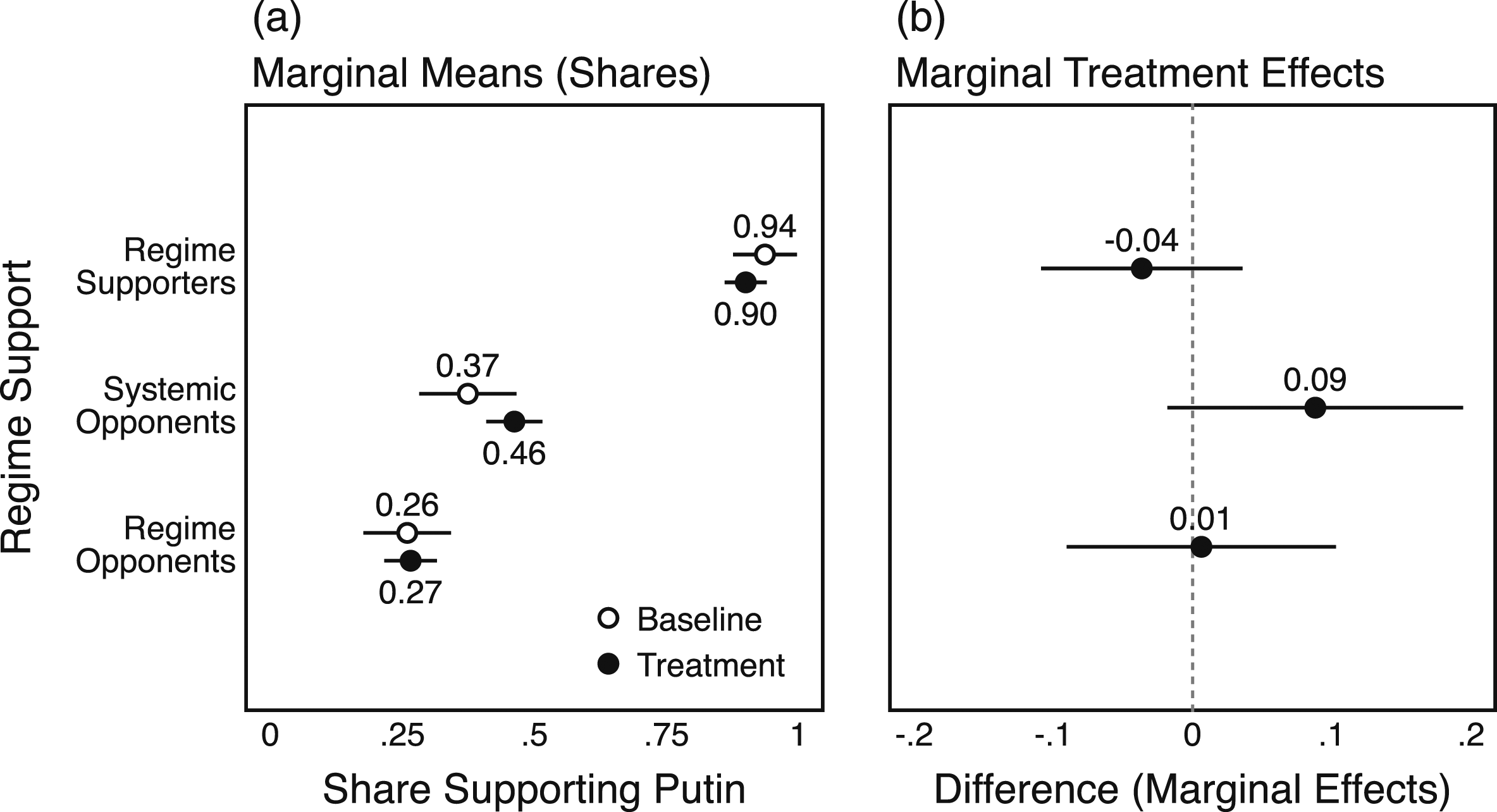

On the other hand, this measure also sets a high bar. While exposure of information about election fraud may not be sufficient to cause voters to substantively change their minds about Putin, it may be the case that they do make more subtle adjustments in their support for Putin. In the second set of analyses, I therefore examine the ordinal support scale (Figure 4 below).
Panel A in Figure 3 shows the share of respondents who support another Putin term, and panel B shows the marginal difference between treatment and baseline. Again, there are very large differences in support for President Putin in the baseline. A total of 94% of UR voters support another term, compared to 26% of opposition voters. Meanwhile, 37% of systemic opposition voters support another Putin term. The difference between UR voters and opposition voters is 68% points (95% CI’s [.57, .78]; p < .001).
However, Figure 3(b) shows that, contrary to the findings on legitimacy beliefs and election fairness, UR voters do not change their views on Putin when exposed to information about election fraud. While there is a 4% point drop in the share of UR voters who support Putin, this difference is small and insignificant (95% CI’s [−.11, .04]; p = .32). Similarly, the information treatment did not produce changes in support for Putin among regime opponents and systemic opponents. The findings presented in Figure 3 thus suggest that fraud revelations are not enough to qualitatively change voters’ minds about Putin (i.e., update from supporting to opposing Putin). But does this mean that regime supporters’ attitudes toward Putin are not at all affected by election fraud? Figure 4, which displays findings using the four-point support scale, examines the effects on attitudes towards President Putin further.
Figure 4 shows that election fraud may cause UR voters to view Putin in a slightly less favorable light. The fraud revelation treatment produced a .17 scale point drop in support among UR voters relative to the baseline levels (95% CI’s [-.35, .003]; p = .054). This corresponds to −.28 of a standard deviation, which would typically be considered a small effect.
18
Hence, although the fraud revelation treatment did not cause regime supporters to change their minds about Putin, as shown in Figure 3, election fraud information may lead core regime supporters to make more fine-grained adjustments in support. Again, the information about fraud did not produce significant differences in regime opponents’ and systemic opponents’ support for Putin. To better understand this potential drop in support for Putin among the regime’s political base, Figure 5 displays the predicted probabilities of different support levels for Putin among UR voters based on ordered logistic regression estimates. UR Supporters Update from Strong to Moderate Support for Putin. Note. Predicted probabilities of Putin support levels based on ordered logistic regression estimates. Bars are 95% confidence intervals based on robust standard errors. N = 1145.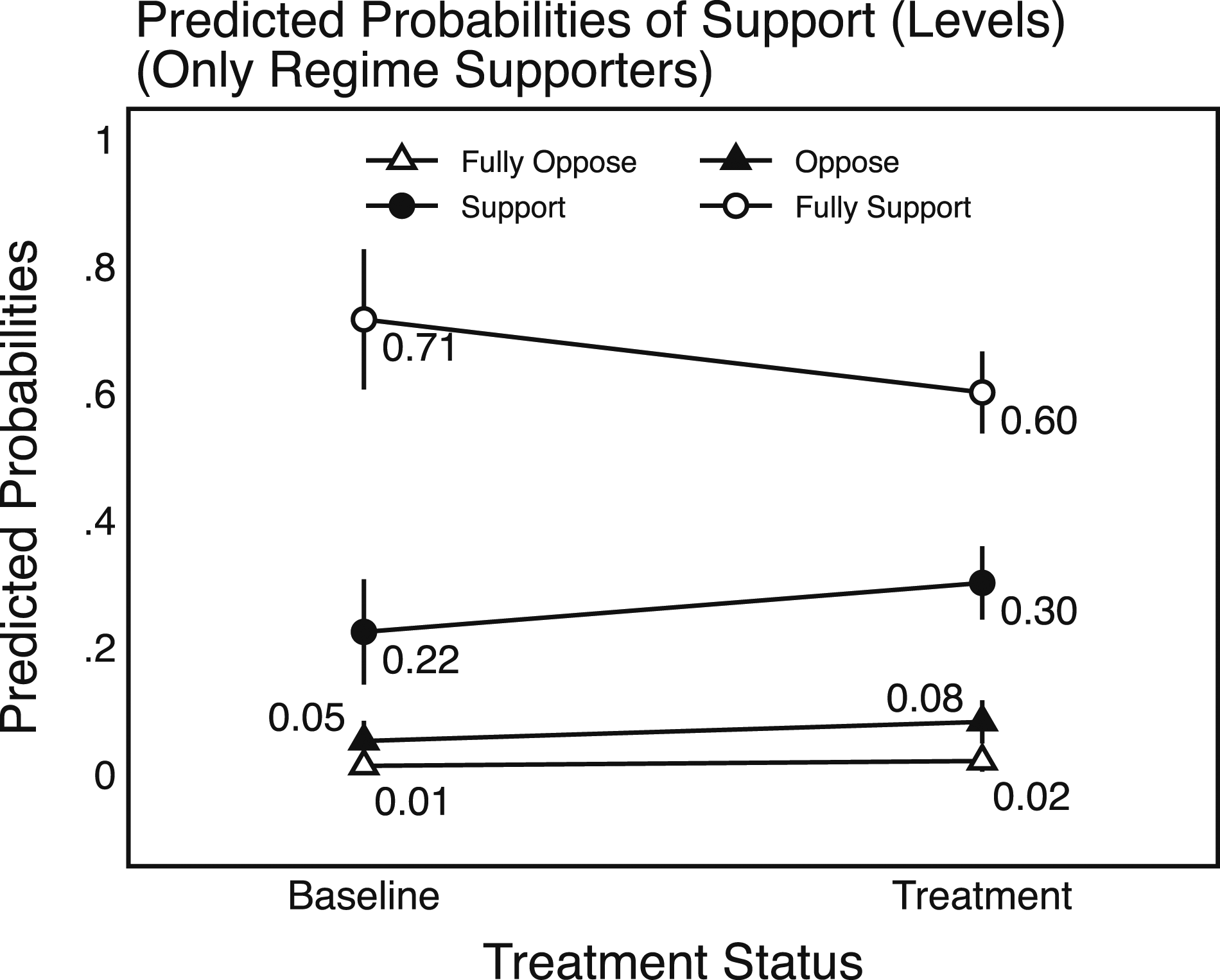
Figure 5 shows that the minimal changes observed in Figure 4 mainly consist of UR voters updating from strongly supporting Putin to somewhat supporting Putin. Among UR voters, the predicted probability of strongly supporting Putin drops from .71 in baseline to .60 if exposed to information about electoral malpractice (difference = −.11; 95% CI [−.24, .01]; p = .07), while the probability of somewhat supporting Putin increases from .22 to .30 (difference = .08; 95% CI [−.01, .17]; p = .09). As these changes in predicted probabilities fall outside conventional levels of statistical significance, they corroborate the interpretation that the election fraud treatments had very modest—if any at all—negative effects on support for Putin among the regime’s core supporters.
Taken together, the findings in Figures 3–5 show that although regime supporters are responsive to news of election fraud and do update regime legitimacy beliefs, there are only very modest political costs for Putin—if any at all. When push comes to shove, UR voters prefer to see Putin take another term in office despite acknowledging drops in regime legitimacy and reporting slightly less favorable opinions about Putin. Although the findings show only limited suggestive evidence of a modest effect on fine-grained support for Putin, these findings provide only mixed evidence for hypothesis three. On the one hand, fraud does not qualitatively change voters’ minds about President Putin. But on the other hand, regime supporters may report slightly less favorable opinions about Putin when informed about election fraud. Hence, while fraud revelations may not by themselves be enough to turn the tide against Putin, they may gradually chip away at his support.
Robustness and Auxiliary Analyses
The supplementary material presents a series of auxiliary analyses and additional robustness tests, including that findings are robust to the inclusion of covariates and their interaction with treatment (app N), to using a different measure of partisanship to categorize regime supporters and opponents (app. Q), and to sub-setting by pre-treatment attention (app. O). I also probe for potential sequencing effects (app. P) and run additional regressions using different proxies for prior expectations of election fairness to account for the one-shot nature of the experiment (app. K). Finally, I present evidence that the information treatment did not produce changes in respondents’ inclination to participate in protests, neither among regime supporters or opponents (app. L), and that the findings are similar for all three types of electoral manipulation, contrary to expectations (app. L and P).
Conclusions and Discussion
Despite the prevalence of elections and election fraud in contemporary autocracies, we know relatively little about how voters evaluate the use of manipulation and how it affects public opinion in nondemocratic settings. Analysis of an original survey experiment in Russia following the 2020 vote on constitutional amendments revealed three key findings.
Regime supporters and opponents have contrasting views on the election in baseline. Consequently, only regime supporters updated their beliefs about the election when confronted with election fraud information. Similarly, the information caused regime supporters to negatively adjust their beliefs about regime legitimacy. When exposed to information revealing malpractice in the 2020 vote on constitutional amendments, the regime’s core base perceived the regime as less entitled to govern, demonstrating that fraud revelations come at a political cost for authoritarian regimes. However, neither regime supporters nor opponents change their attitudes toward President Putin when exposed to fraud information. Regime opponents already hold unfavorable opinions toward Putin and do not update these beliefs when provided with information about electoral malpractice and contrary to election fairness and regime legitimacy beliefs, regime supporters do not substantially change their views on Putin when they learn about election cheating. These findings suggest that while there are real political costs of revealing electoral malpractice for the Russian regime writ large, Putin largely escapes such consequences.
The findings in this study contribute to ongoing debates on polarization, partisanship, and tolerance for the subversion of democratic rules in nondemocracies (e.g., Daxecker & Fjelde, 2022; Gutiérrez-Romero & Lebas, 2020; Reuter & Szakonyi, 2021; Svolik, 2019). They support the informational argument proposed by Reuter & Szakonyi (2021), which suggests that regime supporters are more sensitive to news of election cheating due to their higher ex-ante expectations of fair elections. Regime supporters generally perceive elections as fair in baseline, and it is only this group that updates their beliefs about elections and the regime when exposed to information about regime interference in the 2020 vote on constitutional amendments. The findings thus demonstrate significant political costs of revealing election fraud for the Russian regime, particularly among its core political base.
Yet, the findings in this study also add important nuances and qualifications to previous research. While Reuter & Szakonyi (2021) demonstrate that electoral fraud diminishes support for United Russia (UR) candidates among the regime’s core supporters, suggesting that authoritarian regimes risk losing mass support if fraud is exposed, my findings indicate a different outcome. Specifically, my research suggests that attitudes toward dictators are less affected by fraud revelation compared to attitudes toward lower-level candidates. Although I find negative effects on regime supporters’ election fairness perceptions and regime legitimacy beliefs, I observe only minimal—if any—impact on support for President Putin. Contrary to lower-level regime candidates, my findings suggest that Putin can get away with election fraud.
One possible explanation for the difference in opinion updating between UR candidates and Putin is the distinction between regime candidates and authoritarian incumbents (Hale & Colton, 2018). Previous studies have shown that many contemporary autocrats enjoy widespread political support because they are perceived as effective leaders who have improved their countries’ economies. Putin, for instance, is widely regarded as a stabilizing force in Russia and a catalyst for growth and development (Matovski, 2021). Among a significant portion of Russians, Putin represents a sense of community and national pride (Greene & Robertson, 2019), which may make voters hesitant to alter their views of him. Replacing a member of Parliament from United Russia, in comparison, might be perceived as less consequential for voters. It is worth noting that Russia has been characterized as a hyper-presidential regime, similar to countries like Turkey and Hungary (Guriev & Treisman, 2023; Matovski, 2021). Consequently, replacing Putin would imply a fundamental change in Russia’s political landscape. While fraud revelations can substantially influence voters’ opinions of lower-level candidates, they may not be sufficient to alter voters’ sentiments towards the good tsar himself.
Another likely explanation is the availability of alternatives. While finding alternative candidates to UR Duma candidates may be relatively easy, identifying viable alternatives to Putin is more challenging. This lack of credible alternatives may make voters hesitant to express opposition toward authoritarian incumbents. In a study on corruption voting, Agerberg (2020) demonstrates that voters only penalize political corruption when there are “clean” alternatives. When viable alternatives are absent, voters are more likely to tolerate corrupt candidates. Similarly, regime supporters may refrain from withdrawing support from Putin because they prefer the devil they know to the devil they do not know.
The findings on support for Putin thus align with the argument by Svolik (2019) that voters prioritize partisan gains over election fairness (see also Şaşmaz et al., 2022). Despite the relatively low polarization in Russian society at the time of the study, the cost of replacing Putin may be deemed too high for most regime supporters. Previous research indicates that most Russians desire a competent and effective government and attribute these qualities to Putin (Frye, 2021; Guriev & Treisman, 2020; Matovski, 2021; Treisman, 2011). Hence, while a pro-regime Duma candidate may not be considered central to individuals’ partisan preferences, Putin holds that significance for regime supporters. This line of reasoning implies that the voter trade-off calculation depends on the object under evaluation.
Given these findings, when—if ever—should we expect that election fraud information would erode support for authoritarian incumbents? I can only speculate as to the conditions under which regime supporters would revise their political allegiance to Putin. Building on prior research, however, one potentially important structural factor may be economic performance. As discussed above, many Russians credit Putin for the resurgence of the Russian economy following the collapse of the Soviet Union (similar to how Turkish voters tend to credit Erdoğan for the economic growth during his tenure). Such economic performance may provide a reservoir of support for incumbents, insulating them against major public backlashes. Studies have shown that electoral fraud—and similar malfeasance (such as corruption)—is more likely to spark protests when coupled with economic grievances (Brancati, 2014; Rød, 2019). Voters are more likely to tolerate corruption when the economy is performing well (Klašnja & Tucker, 2013; Rundquist et al., 1977; Zechmeister & Zizumbo-Colunga, 2013). Such an expectation fits with social psychological research on procedural fairness, demonstrating that people become more aggrieved when unfair procedures are coupled with unfavorable outcomes (Brockner & Wiesenfeld, 1996; Krehbiel & Cropanzano, 2000; Magalhães & Aguiar-Conraria, 2019). Based on this line of work, we should expect that attitudes toward authoritarian incumbents such as Putin are more sensitive to revelations of election fraud during economic crises.
Can we generalize these findings beyond the Russian case? As this study builds on survey experimental evidence from a single case, the opinion formation dynamics uncovered here may not accurately describe how voters in different authoritarian contexts react to news of election tampering. On the one hand, scholars of contemporary authoritarianism typically consider Putin’s Russia a typical case of a personalistic autocracy (Frye, 2021; Guriev & Treisman, 2023; Matovski, 2021). First, almost all autocracies hold elections that invite some extent of political competition (Frye, 2021; Levitsky & &Way, 2002; Magaloni & Kricheli, 2010). Second, authoritarians such as Recep Erdoğan, Viktor Orbán, Hugo Chávez, Lee Kuan Yew, and Alberto Fujimori also concentrated power around themselves with substantial public support. Authoritarians who succeed in managing public order and restoring the economy tend to enjoy genuine support among citizens (Guriev & Treisman, 2020; Matovski, 2021; Rosenfeld, 2018; Treisman, 2011), and Putin is by no means the only dictator who has done so. Similarly, Putin’s Russia has relied on survival strategies similar to those found in other personalistic, presidential nondemocracies (Guriev & Treisman, 2023). Because these dictators navigate in the gray zone between democracy and full-blown authoritarianism, they tend to rely on more subtle, informational ways of managing their hold on power, including disguising repression and violence, subtle media management, and sustaining the appearance of democracy. This balancing act also implies that authoritarian incumbents are sensitive to a public opinion backlash. Hence, there is reason to believe that the findings in this study are representative of a broader set of contemporary authoritarian regimes.
On the other hand, Putin has enjoyed substantial public support during his time in office (Frye et al., 2017; Treisman, 2011). The findings presented here may not apply to dictators who do not enjoy such popular backing. I argued that receiving desired outcomes (such as valued policies, ideological representation, or social conformity) can limit the negative reactions to election fraud. In contexts where the autocrat is less popular at baseline or is not credited with delivering economic development, fewer voters may be willing to tolerate electoral subversion simply because the incumbent dictator has a smaller reservoir of support. In addition, voters may prove more reluctant to give the authoritarian incumbent the benefit of the doubt concerning their involvement in orchestrating electoral malpractice. Less (genuinely) popular dictators may therefore find it more difficult to disperse blame for electoral malpractice on far-flung officials lower down the bureaucratic ladder.
Further, it is worth noting that President Putin rules a highly personalized autocracy. Such personalization has allowed Putin to fully reap the benefits of delivering economic development and increasing prosperity in Russia as he has become synonymous with the increasing welfare of ordinary Russians (Greene & Robertson, 2019; Guriev & Treisman, 2020; Treisman, 2011). This study’s findings may not travel to less personalized authoritarian regimes. As the delivery of desired and valued outcomes may protect the dictator from severe support losses, it could be the case that voters in non-personalized regimes are more willing to sanction the leader for tampering with elections because outcome delivery is not attributed mainly to one leader. As such considerations remain speculative, future studies could contribute to our understanding of how voters evaluate the use of electoral malpractice by examining these dynamics in less personalized regimes and in contexts where the incumbent dictator does not enjoy public support at baseline. Moreover, as discussed above, people may respond differently to fraud revelations depending on the availability of viable alternatives to the authoritarian incumbent leader. It is difficult to see which candidates could realistically replace President Putin, and regime supporters may refrain from changing their minds about Putin because they do not have alternative options. Finally, one could speculate that authoritarian regimes wielding a tighter grip on information flows may experience a greater backlash to revealed malpractice because a larger share of the population is unaware of previous electoral transgressions. Future studies could make important contributions by examining how voters respond to electoral malpractice in settings where viable alternatives exist or where fewer citizens expect election fraud.
At this point, it is worth considering the potential scope conditions, and limitations of this study. Above, I drew on previous work to argue that regime supporters and opponents respond differently to election fraud information because they hold different expectations for election fairness in baseline. It is worth noting that while this study captures baseline evaluations of the 2020 vote on constitutional amendments, the one-shot nature of the survey does not strictly capture voters’ expectations ex-ante. It could be the case that regime supporters had already factored in whether fraud occurred in the 2020 vote on constitutional amendments. On the other hand, previous work has consistently shown that regime supporters and opponents hold different expectations for elections (McAllister & White, 2015; Reuter & Szakonyi, 2015; Robertson, 2017). Yet, although the approach taken here is similar to previous related work (Arias et al., 2018; Reuter & Szakonyi, 2021), future research could provide important insights by more accurately capturing the temporal dynamics of opinion updating in response to election fraud information among regime supporters and opponents. A related limitation concerns the non-randomized nature of partisanship in this study. While the approach taken here is commonly used in studies of how different voter groups respond to information across different political science disciplines due to the inherent difficulty of manipulating voters’ identities such as partisanship (Bisgaard, 2019; Graham & Svolik, 2020; Reuter & Szakonyi, 2021), an implication is that the findings presented above do not allow me to causally flesh out the underlying mechanisms driving the observed differences in how regime supporters and opponents update their beliefs and attitudes when exposed to election fraud information. Hence, future work could make crucial advances by applying different approaches to carefully flesh out the underlying reasons why regime supporters and opponents react differently to news of election cheating.
It is also worth discussing the potential drawbacks of using online survey data in settings like Russia. Online opt-in sampling is always associated with certain costs to representativeness, which may be amplified in contexts like Russia, where urban and rural populations have markedly different internet usage (Reuter & Szakonyi, 2015). As internet use and political orientation likely correlate, the sample used here may over-represent urban voters who are more likely to support regime-opposing parties. On the one hand, this could imply that the estimated impact of fraud revelations is likely smaller than it would be with a more representative sample. Sampling more regime supporters mean sampling more supporters who expect elections to be relatively free and fair at baseline. These voters should, in turn, be more sensitive to fraud revelations. On the other hand, it could be that the type of regime supporters, who participate in surveys such as this, differ in important ways from regime supporters who are unlikely to ever participate in such surveys. If these differences correlate with the perceived importance of electoral fairness, the sampled regime supporters may be more willing to adjust their views on the regime and the authoritarian incumbent, implying that the estimated effects would represent an upper bound of the effect of fraud information on citizens’ attitudes.
These limitations notwithstanding, this study makes several key contributions to our understanding of the role of elections and election fraud in authoritarian regimes. The findings provided here shed new light on how voters in nondemocratic settings evaluate the use of electoral manipulation. By focusing on support for the authoritarian incumbent and beliefs about regime legitimacy, this study has contributed to our understanding of the consequences of election fraud for public opinion. An important implication of the findings in this study is that scholars should consider carefully the different incentives voters face when adjusting their beliefs and attitudes. As demonstrated in this study, regime supporters did acknowledge the illegitimacy of election fraud and adjusted their beliefs about the regime accordingly. However, the same group of voters proved unwilling to change their views on the authoritarian incumbent. These findings also have implications for our understanding of how authoritarian regimes endure and function. Scholars have long discussed the role of nominally democratic institutions in authoritarian contexts. For example, research has sought to understand how democratic institutions, such as elections, may help sustain authoritarian rule (Knutsen et al., 2017; Svolik, 2012). This study shed new light, at the level of the individual, to this literature, contributing to our understanding of election dynamics in authoritarian regimes. By providing fine-grained evidence of how the public evaluates electoral malpractice and by highlighting which voter groups are most responsive to news of electoral malpractice, this study demonstrates that the negative impact of election fraud revelations on regime survival may be quite modest regarding public opinion. While the negative effects on regime legitimacy beliefs are by no means trivial, the findings overall suggest that Putin can get away with manipulating elections.
Supplemental Material
Supplemental Material - Does Election Fraud Erode Support for Autocrats?
Supplemental Material for Does Election Fraud Erode Support for Autocrats? by Laurits F. Aarslew in Comparative Political Studies
Footnotes
Acknowledgments
The research was conducted in line with the ethical standards contained in the 1964 Declaration of Helsinki and its later amendments as well as APSA (2020) guidelines. An online appendix with supplementary material is available. This research was preregistered with the OSF ( ). The author thanks Jakob Tolstrup, Svend-Erik Skaaning, Nicholas Haas, Ora John Reuter, Lasse E. Leipziger, Kristian V.S. Frederiksen, Suthan Krishnarajan, David D. Andersen, Jonathan Doucette, Merete B. Seeberg, Yevgeniy Golovchenko, Mogens K. Justesen, Jacob Nyrup, as well as the editors and three anonymous reviewers at Comparative Political Studies for helpful comments on earlier drafts of this article.
Declaration of Conflicting Interests
The author(s) declared no potential conflicts of interest with respect to the research, authorship, and/or publication of this article.
Funding
The author(s) disclosed receipt of the following financial support for the research, authorship, and/or publication of this article: The author acknowledges funding for this research from Aarhus University.
Supplemental Material
Supplemental material for this article is available online.
Notes
Author Biography
References
Supplementary Material
Please find the following supplemental material available below.
For Open Access articles published under a Creative Commons License, all supplemental material carries the same license as the article it is associated with.
For non-Open Access articles published, all supplemental material carries a non-exclusive license, and permission requests for re-use of supplemental material or any part of supplemental material shall be sent directly to the copyright owner as specified in the copyright notice associated with the article.
