



Abstract
Women form a large part of the voting public in India. In the 2009 Indian National Election post-election survey, 82% of all adult women surveyed reported voting, but only 32% said that they were interested in politics. The paradox between high female turnout but low levels of interest has been noted in multiple developing country contexts, but the phenomenon is under-theorized. We suggest the reason is that women’s ideas (interest in politics) are discouraged and suppressed by societal patriarchal norms enforced in the household, but women’s bodies (their votes) are valued in competitive elections. We illustrate our argument using matched samples from two rounds (2009 and 2014) of the Indian National Election Survey and an original post-election survey in 2019. We find that women are consistently less likely to report either an interest in politics, or an opinion on political issues, if their spouse or an adult family member observes the interview. Our findings suggest that women’s political agency is systematically under-estimated by researchers, and that women are more likely to assert themselves politically in survey contexts, if given the privacy to do so.
Introduction
Recounting a visit to a rural community in South Africa, feminist scholar Bina Agarwal tells of a meeting with women who worked plots of land while their husbands were employed in non-farming sectors. Agarwal asked the women in whose names the plots were registered, and was told that, in the absence of the husband, the land would go to the eldest male son. When she asked whether the plots should be in the women’s name, since they worked the land, she was met with silence. Agarwal recalls asking the question again, at which point the women explain that their silence stems from the fact that “no one had ever asked us (this question) before” (Agarwal, 1997, p. 190). The women possessed both knowledge and opinions about land titles, but during a lifetime of invisibility had confronted multiple officials, bureaucrats, and possibly even researchers who never asked them that question, and, if asked, had to answer in the presence of others who would enforce social norms to ensure an appropriate answer.
Agarwal’s insight highlights a nuance particularly pertinent to feminist research: women have as many opinions on as many issues as do the men in their lives, but structures particular to the nature of research may discourage them from expressing them. Agarwal points to the “subversive” quality of female collective action and conversation in rural India—men, too often, perceive they have much to lose if women act politically and so women must mask their political selves. Such everyday barriers, we will argue, alter women’s participation in even a relatively benign political activity, such as answering a public opinion survey about their attitudes towards politics and politicians.
India’s high female electoral participation masks important variation in stated interest in politics. In India’s 2009 National Election Survey, 82% of female respondents reported voting, lagging just behind 85% of the male respondents who claimed they voted. Yet, in the same survey, only 32% of the women reported being interested in politics, compared to about 51% of the men. Such divergences are evident in other national surveys of the Indian electorate too.
Many scholars take for granted that women are less likely to be interested in politics, and that they would comprise the “don’t know’s” in public opinion surveys (Converse, 1964; Francis & Busch, 1975). However, there are several reasons why this ought not be true in the Indian context. First, the country has implemented universal adult suffrage since its independence in 1947. Second, the state ensures the right of its poorest and most vulnerable citizens to vote—a rare form of public service delivery that is prioritized (Ahuja & Chhibber, 2012; Kailash, 2012). Finally, reservations for women at the local level of government have been in place for several decades, leading to exposure to women in leadership positions (Bhavnani, 2009). Indeed, as we have noted, Indian women turn out to vote in high numbers making their self-reported disinterest in politics even more puzzling. We argue that consistent with feminist theories of the household, women are valued as voters (bodies), but may be expected to vote as directed by male adults in the household (Giné & Mansuri, 2011). In particular, their conscious decision-making (minds) as voters is undervalued, and even actively surveilled and censured. In this climate, we argue, women rationally mask their true interest in politics to avoid social sanction. If women were given the privacy to answer whether they are interested in politics honestly and without being overheard by family members, we argue they would be more likely to state an interest in politics, and to offer opinions on current affairs and politics.
Researchers work hard to ensure the survey context does not impact respondent outcomes. The study of interviewer effects has identified social desirability biases that are widely recognized to affect survey responses. Scholars have demonstrated such effects on expressed preferences for voting behavior (Hanmer et al., 2014), anti-war support (Berinsky, 2009), and racial attitudes (Adida et al., 2016). Similarly, race-of-interviewer effects predict respondent bias in racial attitudes, as well as pre-poll surveys (Finkel et al., 1991; Hatchett & Schuman, 1975). Survey experiments suggest that latent attitudes towards race and caste are better predictors for policy support than explicitly stated ones (Banks & Hicks, 2016; Chauchard, 2014), demonstrating that respondents are keenly aware of what is expected of them in an interview (Tourangeau & Rasinski, 1988).
In contrast, bystander effects are under-theorized in political science though better established in social psychology and adjacent disciplines. In a study on recreational drug use in the United States, Aquilino found that respondents were less likely to report drug use if their parents were in the room at the time of the interview, but more likely to report drug use truthfully if their spouse is present (Aquilino, 1994). These findings point to several important features of bystander effects. First, respondents modify their response to questions when someone else happens to be in the room. Second, the modification is dependent on the question—drug use is taboo, so respondents may adjust their responses, just as admitting racial bias is attenuated by having a Black survey interviewer (Hatchett & Schuman, 1975). Finally, the relationship between the respondent and their “observer” is crucial—confronted with parents, a teenager bets that they may be less well informed about her drug use and so less likely to realize she is dissembling to the interviewer. On the other hand, observed by an intimate partner, such as a spouse, the interview subject suspects or knows their partner knows the truth and so misrepresenting to the interviewer carries a risk.
Observer effects have fruitfully been used in experimental contexts to leverage social desirability bias though few of these studies include intimate family members. In an experiment conducted with men in North-West Pakistan, Gulzar and Khan (2021) find that individuals are more likely to file for candidacy in local elections if appeals to their sense of social duty are made, but particularly if the treatment takes place publicly, in a crowd of their peers. Elsewhere, varying the presence of an observer, particularly an outsider, has appreciable effects on generosity in dictator games (Cilliers et al., 2015). However, other studies show mixed or no-result findings: being observed by an outsider fails to suppress institutionalized rent-seeking on trucking routes on the West African coast (Cooper, 2018), and being observed by trained locals does not reduce the magnitude or frequency of bribes at ports (Sequeira & Djankov, 2014). 1
Bystander effects are fundamentally context specific, making them challenging to theorize. In this paper, we suggest that it is India’s peculiar duality of robust universal participatory politics, and strongly enforced patriarchal norms, that explains the gap between women’s robust political activity and their self-reported low political interest. We take advantage of the enumeration of bystanders across three different national surveys in India (2009, 2014, 2019), and the work of countless feminist scholars, to argue that patriarchal norms that are enforced by intimate family members distort female respondents’ responses to public opinion surveys. The data make clear that privacy is a luxury not enjoyed by most women; indeed, a majority of respondents to these surveys had someone else present during their interviews (and so did a plurality of male respondents). 2 Our results show that women are less likely to report being interested in politics, and more likely to choose a neutral or “don’t know” option in political opinion questions when they are being observed. This effect is attenuated for women with higher educational attainment. 3
Recent studies document several types of political survey questions that might be sensitive—receiving gifts in exchange for votes, biases against caste and racial minorities, support for autocrats/terrorist groups, and even voting itself (Blair et al., 2020). We argue instead that, in the context of an election survey, particular questions are not “sensitive” per se, but rather that a range of questions reveal a woman’s interest in politics over the course of an interview. These at minimum include questions directly about political interest during and outside the time of elections, and questions that elicit opinions about democracy, redistribution, poverty, and foreign affairs. By making use of existing large-n studies and employing matching techniques, our study has a considerable advantage in statistical power over previous experimental efforts. In most tables below, we report findings based on 5000–13,000 respondents. This means that even if the presence of an observer reduces the likelihood of women reporting an interest in politics by 20%, we can expect that our samples would adequately capture this bias.
Our study expands this body of survey research in several significant ways. First, we exploit information about the presence of intimate family members, friends, and neighbors during a survey to examine the impact of implicit social norms on expressed political attitudes. Second, we employ best practices in matching across three independent large-n national surveys to show these results are consistent across time, and not driven by exogenous variables. Finally, we offer insight into an issue of substantive importance—the contested experience of women as political citizens—in the world’s largest electoral democracy.
We proceed as follows: the next section highlights the context of surveys and political participation in South Asia, focusing on the deeply patriarchal hierarchies of citizenship, even within the household. We pose and outline a series of tests for five hypotheses. Next, we describe our methodology and the three surveys we analyze: Indian National Election Study surveys from 2009 and 2014, and an original national political survey conducted following India’s 2019 national election. After we report and discuss our findings, the final section concludes with implications for the design of public opinion surveys.
Argument: Seen but not Always Heard
Politics in India is intensely competitive and diffuse. The most recent national elections in 2019 attracted 66% of the voting population to the polls. Elections are marked by frequent party turnover and the making and breaking of alliances (Nooruddin & Chhibber, 2008). Scholars link welfare outcomes and particularistic distribution of public goods to electoral outcomes (Chhibber & Nooruddin, 2004; Kailthya & Kambhampati, 2022; Nooruddin & Simmons, 2015). Female voter turnout has lagged behind men’s, although this may be changing (Chhibber & Verma, 2019). Women have been historically under-represented in political life in India. Political parties overwhelmingly select male candidates to contest general seats though women’s representation has been given a boost by reservations at the local level (Bhavnani, 2009; Chattopadhyay & Duflo, 2004).
Survey work is difficult, and perhaps especially so in developing country contexts like India. Although ingenious methods to ensure respondent privacy exist (Chauchard, 2013), these are costly to implement, particularly for large-scale national opinion surveys. Survey administrators try to match enumerator and respondent gender, but note that ensuring privacy is difficult (Lokniti, 2009). Without privacy, respondents may self-censor (Diop et al., 2015; Smith, 1997). The inability to get privacy during a political opinion survey is plausibly non-random: respondents are more likely to have bystanders during interviews if the respondent is female, poorer, and young (Diop et al., 2015). Complicating this issue, many surveys are structured in ways that work against individuals with low literacy and numeracy. Women in developing countries, who typically acquire less schooling than their male peers, struggle the most with close-ended survey formats. In a 2018 survey of experts who administer surveys in the developing world, Lupu and Michelitch found that 35% reported respondents had “trouble discussing politics, naming women as the group with most difficulty” (Lupu & Michelitch, 2018, p. 202). In particular, women use the “don’t know” and “no response” option in surveys more frequently.
Don’t know and no response options in surveys have been used to map differential patterns in political knowledge, primarily between different socio-economic groups, but also between men and women. For example, respondents may form opinions in response to questions, but might be unwilling to express them for a multitude of reasons (Berinsky, 2002). Much of the research into item non-response focuses on the difficulty of individuals to comprehend survey questions. In 1964, Phillip Converse suggested that the public opinion survey itself is fraught with meaning: respondents approach opinion interviews as “intelligence tests,” and might offer an “agree” or “disagree” to avoid admitting ignorance (Converse, 1964, p. 21). More abstract questions are more likely to elicit “don’t know” (DK) responses. Elsewhere, the large number of DK responses are linked to low levels of political knowledge in general (Luskin & Bullock, 2011).
Multiple studies note that women are more likely to give non-substantive responses. In their study of three rounds of presidential election studies by the University of Michigan’s Survey Research Center, Joe Francis and Lawrence Busch suggest that the gender gap in responses might be driven by men in the sample who sought to impress their female interviewers by providing more substantive responses (Francis & Busch, 1975, p. 211). Similarly, even while controlling for income and education levels, Marta Fraile notes significant differences in political knowledge exist between men and women using European Election Studies surveys (Fraile, 2014). Some studies attribute this to risk aversion among women, and the propensity to admit more honestly that they “don’t know,” rather than to guess (Ferrín et al., 2017; Lizotte & Sidman, 2009). Finally, Dolan (2011) suggests that political opinion questions are biased toward male knowledge, and that women are more likely to demonstrate knowledge that concerns their own substantive representation in politics as a group.
In the developing world, work by Kailash (2012) suggests that, in India, women, low-caste, and poorer individuals are likely to offer non-substantive responses to political opinion questions. Similar to Syal (2012), the gap between India’s democratic upsurge and the relative lack of stated political interest or opinions is linked to the lagging educational and literacy outcomes in the country. Notably, Kailash (2012) suggests that the low education/information hypothesis could be undermined if non-substantive responses “represent a conscious and astute decision to remain ambiguous…Respondents could fear retribution…” (p. 342, emphasis added). Part of the urgency for this research therefore stems from the fact that many common explanations for low political participation—a lack of financial resources and lower levels of education—only partially explain why women do not participate (Burns et al., 1997). Instead, we argue social beliefs about the “correct” place of women in the household and thereby in the body politic better predict women’s ability to exercise political citizenship (Burns et al., 1997; Carpena & Jensenius, 2021).
The persistently high gender gap in political knowledge is all the more puzzling when examining the tendency of female voters, particularly in the West, to vote for progressive and left-of-center parties (Inglehart & Norris, 2000). Women’s over-representation in low-paying jobs despite their rising education levels creates a distinct and unique set of preferences. Female voters and elected representatives are more likely to support state-led efforts for welfare (Lott and Kenny, 1999; Svaleryd, 2009) and to prioritize government spending on public goods (Chattopadhyay & Duflo, 2004; Khan, 2017). Thus, the scholarly literature makes clear that women have distinct political preferences, yet women are all too often reluctant to articulate these in the survey context.
In their study of women’s attitudes towards political empowerment in Morocco, Diop et al. (2015) note that women modify their responses to some extent when being overheard by other adults, but not always. Diop et al. (2015) theorize that bystanders are likely to impact the quality of answers if they already “know” the truth (as previously suggested by Aquilino (1994) and others). Their study also examines potential social desirability bias, and finds the effect of bystanders negligible. Scholarship on bystanders suggest that the relationship between the respondent and the bystander is important to consider; however, many do not consider this relationship because surveys simply document “other adults” in the room, but not their specific relationship with the respondent (Diop et al., 2015). Zipp and Toth (2002) consider disagreements between spouses that would impact an opinion survey if the spouse was present in the room and suggest that spouses in general tend to agree more when interviewed together. Neither of these explicitly consider the fact of a power differential in the household, which is a mainstay of feminist analysis.
The implicit decision to conceive the household as an altruistic space, where all members enjoy equal rights, or as an arena of contestation and bargaining, is of critical academic and policy importance (Agarwal, 1994, 1997). Anukriti et al. (2020), Sen (1983), and classic feminist theorists focus on the impact of women’s bargaining power on their control over household and community assets, and their ability to make economic decisions within the household. Women’s bargaining power within the home is linked to their status outside it; at home, a woman’s relative position in the household can stem from her age and status (as a new bride, the eldest daughter, or a mother-in-law, to name a few common role identities), relative to other members (Agarwal, 1994, p. 51). It also is heavily dependent on her assets relative to the rest of the household, including but not limited to opportunities for employment, financial independence, and inheritance (Agarwal, 1994; Anukriti et al., 2020; Sen, 1983). A woman’s status in her home can also have important impacts on her autonomy outside it, especially when it comes to making claims on party leaders and politicians. Studies suggest that while women frequently are part of protesting and claim-making on the state (Auerbach & Thachil, 2018; Kruks-Wisner, 2018), their lack of representation in formal community organizations is ubiquitous (Auerbach, 2017). Political parties make frequent bids for female votes (Giné & Mansuri, 2011); however, evidence suggests that political parties consider women part of the household bargaining unit and assume that their needs coincide with those of the men in their lives (Liaqat, Cheema and Mohmand, 2020). This has clear implications for whether women’s opinions, particularly those that may clash with those of male gatekeepers, are welcome.
Women in a patriarchal democratic context are situated at a unique intersection of pressures: the competitive nature of the political systems values women as bodies; its patriarchal nature means they are going to be used instrumentally. The imperfect enumeration and reporting of women’s experiences are no exception to this context. A key concern in female labor force participation, for example, is the under-reporting of female labor—primarily by male family members, but also by women themselves (Klasen & Pieters, 2015). The surveyed individual is frequently confronted with the dilemma: “is this worth reporting?” (Tourangeau & Rasinski, 1988), and women consistently under-report their experiences in a variety of contexts. Domestic and sexual violence studies lament women not reporting abuse, partly out of fear, but also because they believe their experiences are “not important” (Ferns, 2006; Htun et al., 2019). Family members and communities monitor and seek to limit women’s non-labor activity (Ali, 2012). In politics, this manifests as party workers having infrequent and controlled access to female voters in the household (Cheema et al., 2023), and, as we document here, lack of privacy when participating in public opinion surveys.
Most public opinion surveys are designed to take place at home. Yet surveys, particularly face-to-face ones, are a social interaction, and households, especially perhaps developing country ones, are spaces uniquely unsuited to soliciting the free and unfettered opinions of women. On the one hand, the acknowledgment that the household is not an equal or altruistic space (Folbre, 1986) is central to survey best practices, as survey administrators make special efforts to interview equal numbers of men and women, and to match women respondents with female enumerators. On the other hand, considerable barriers exist to understanding the unequal opportunities presented to women in the household. More recent work has attempted to measure the extent to which women are central to the ability of households to bargain for resources in clientelistic contexts (Cheema et al., 2023; Prillaman, 2021), even as they re-establish their own subservience within the household (Khan, 2017). The evidence for this dual position is considerable—political parties choose to target households as a collective unit (Prillaman, 2021), and are frequently much better attuned to the preferences of men over women (Liaqat, Cheema and Mohmand, 2020).
The argument we develop is as follows: women face social and familial costs for demonstrating political “intelligence.” Women are therefore likely to perceive pressure from adult bystanders, or “observers,” to under-report their interest in politics. We therefore suggest that women will be more likely to provide non-substantive responses for political interest questions if another adult is present in the room at the time of the interview. Second, we posit that this expectation will be neutral for political participation since women know that their political worth as “bodies” is more highly valued than their thoughts, and so less necessary to hide.
Some men also have adults “observe” them while they give responses on these surveys. If our argument holds, men should not mask interest in or opinions on politics. On questions where men do downplay their political knowledge or opinions in the presence of observers, we should almost certainly expect female respondents to do the same. Like women, men might even feel pressure to over-report participation in politics. While we do find some evidence for this and provide some remarks, an extensive investigation on men’s political performance is beyond the scope of this study. Instead, we use political participation among women as a useful foil to discuss the prevalent suppression of political opinions for women in survey contexts. 4
By simply documenting who else was in the room at the time of the survey, the 2009 and 2014 Indian National Election Studies (NES) and our own original 2019 national survey offer a unique opportunity to learn how respondents alter their responses depending on the “social” context within which each survey occurred. We expect that each category of observer—an adult family member, a spouse, a small crowd—has a distinct and theoretically anticipated effect on responses. We state our expectations as formal hypotheses;
H1: Women are less likely to report an interest in politics if observed by family (their spouses and other adult household members) or neighbors.
H2: Women are more likely to provide non-substantive responses to political opinion questions if observed by family or neighbors.
H3: Women do not amend their responses to participation in election-related activities (e.g., attendances at rallies) or voting if observed by family or neighbors.
Does this effect obtain uniformly? We suspect not. We examine the possibility of two conditions attenuating the observer effect: location and literacy. We examine these through a series of interaction-term models. Scholars expect individuals to participate in politics more in rural areas where welfare and benefits might be contingent on political patrons. For one thing, neighbors in tightly knit villages may be particularly effective at enabling the kind of “perverse accountability” required for parties to engage in turnout buying (Auyero, 2000; Nichter, 2008; Stokes, 2005). However, the village-city dichotomy can be reductive. Densely populated urban spaces also form complex networks of information, hierarchy, and surveillance (Prowse et al., 2020; Stokes, 2005). From the perspective of the respondent, neighborhoods are not the neutral “private” spaces that a survey-taker may expect them to be. It is tempting to think of friends and neighbors who happen to be there when a researcher shows up to conduct an interview as casual by-standers, particularly if the neighbor does not appear to be of a distinctly higher income or social status. But neighbors occupy multiple roles. They could be petty informers or aspirant political brokers; they can play the role of “benign” distributers of state goods and services (Auyero, 2000). The expectation of a clear distinction between “patron” and “client” is therefore optimistic (or just naïve).
These caveats noted, it is likely that, overall, women in urban areas feel more empowered to express their preferences openly, even in front of other family members (Ahuja & Ostermann, 2016). We therefore hypothesize that women in urban areas will be less susceptible to the observer effect, compared to their rural peers.
H4: Urban residence among female respondents will attenuate observer effects for public opinion and political interest questions.
We know that educated (and, by association, richer) individuals tend to participate more in political life than their less educated and poorer counterparts (Chhibber, 2002; Syal, 2012). Educated, richer women with family members in politics reported higher rates of awareness of pro-women legislation (Chhibber, 2002). Similarly, the relevance and distinct nature of rural society and politics leads us to suspect that rural women should have different levels of privacy than their urban counterparts, and therefore a different susceptibility to bystander effects. We therefore test whether the education level one has achieved mitigates the “observer effect”—we propose that women with higher education will not be subject to the same pressure to conceal their interest in politics as women with low literacy.
H5: Educational attainment among female respondents will attenuate observer effects for public opinion and political interest questions.
What does it mean to report an interest in politics, both for men and for women? For men, taking an interest in politics correlates strongly with upward mobility, particularly educational mobility. Men with more education than their fathers are likely to report a greater interest in politics (Syal, 2012). Compared to the ultra-poor, low and middle income groups are generally expected to demonstrate greater ability to demand particularistic benefits from bureaucrats and politicians, and to see an interest in politics as an instrumental means to an end. Individuals find intrinsic value in saying they participate in politics, regardless of instrumental benefits that may be distributed to them as a reward. The ultra-poor in India cite voting as evidence of their existence; without it, they are virtually non-existent to politicians and the state (Ahuja & Chhibber, 2012). In this study, we seek to establish the unique pressures that women and men face when answering public opinion questions in a patriarchal context. Each of our hypotheses helps to understand the competing motivations to express an interest in politics and voice political opinions.
Our intention is not to denigrate the importance of observational data in gendered contexts; if anything, we suggest that most interactions between statistical enumeration and the lived world, including randomized trials and experiments, will be interpreted and assigned meaning by participants in rich, context-loaded, and unpredictable ways. These may well exist within the context of the interview even when a woman is alone, but there are fewer ways to study this. Instead, we compare samples of women from three nationally representative surveys conducted in India, matching respondents within surveys on a range of characteristics including age, income, and education. We then compare the likelihood of women stating their political opinions, interest, and behavior if the interview takes place in the presence of other household members or neighbors, or not. The next section describes our methodology.
Data
The data for this study come from three nationally representative surveys of India, conducted between 2009 and 2019. The first two are National Election Studies conducted by Lokniti, a research program run by the Centre for the Study of Developing Societies (CSDS) in New Delhi, India. The third study was conducted by Cicero Associates, an independent research firm. 9 All three surveys are post-poll surveys, that is, they were conducted after the conclusion of voting but before the announcement of results for the General Lok Sabha Elections in India in 2009, 2014, and 2019, respectively. The surveys use voter rolls to conducted stratified random samples of India’s 28 states and the capital territory of Delhi. The final sample sizes for the NES 2009 and NES 2014 are 36,169 and 22,295, respectively. The original survey conducted in 2019 has a sample size of 13,963. The 2009 survey is by far the longest, with 280 collected variables. Many of these are included in sub-sections that are randomized. Our variables (listed in full in Section A1 of the Appendix) are from the first part of each survey and were asked of the full sample. Our main dependent variable “are you interested in politics” was usually one of the first ten questions to be asked, minimizing chances of respondent fatigue.
Method
The probability other individuals are present during the interview is plausibly non-random, and could be a product of respondent characteristics (Aquilino, 1994; Diop et al., 2015). Indeed, if privacy is understood as a luxury good, then it is intuitive that it will be disproportionately afforded to some respondents and not to others. Female, younger, and poorer respondents are more likely to be observed or have bystanders during the interview (Diop et al., 2015; Smith, 1997). Assigning observers randomly to treated groups of respondents is not possible (or even desirable) without radically altering the scope of large-scale public opinion surveys. Therefore, following Diop et al. (2015) and others, we conduct nearest-neighbor matching of respondents on covariates, such as gender, income, education, age, and caste, that are known to be correlated with a lack of privacy as well as the likelihood of answering certain questions. Marital status is included where available (2009 and 2019). Father’s education is included where available, since we expect respondents to be more likely to report an interest in politics if they belong to households with higher educational attainment (Syal, 2012).
The statistical analysis for this study uses the psmatch2 function in Stata 16, using best practices for nearest-neighbor matching with replacement, and omitting outlier cases (Abadie & Imbens, 2006; Leuven & Sianesi, 2003). The default for psmatch2 is the Mahalanobis method that provides integer weights to each case; radius matching was applied as an alternative method but the former produced better matching results (see Section A3 in the Appendix). The “treatment” in this study is whether the respondent was observed by any adult other than the enumerator. We first create a propensity score that determines each individual’s likelihood of being observed (Tables A7.1–A9.1 in the Appendix). The propensity score estimates for each survey provide the basis of matching for the pre-processed data. We then restrict our analysis to the matched data, which allows us to estimate the causal impact of being observed on reported political interest (Angrist and Pischke, 2008, p. 51). While acknowledging that matching does not fulfill conditional independence assumptions entirely, matching in the first stage has the advantage of removing some of the bias in the pre-processed data (Morgan & Winship, 2015). Only models that use matched data are included in the findings reported below.
Some limitations and details of the matching technique are worth mentioning, particularly as this study compares findings from across three independent surveys. First, the default Mahalanobis specification with replacement is used across each survey, and the propensity score estimate includes every covariate that is ultimately also included in the subsequent logit estimation (Ho et al., 2007). Surveys are randomized before matching, yielding unique matched pairs (Morgan & Winship, 2015). Each result has been replicated after multiple rounds of randomization; however, minor changes in coefficients are expected between randomizations. The reported results therefore reflect best practices given the limitations of nearest-neighbor matching. In the 2014 and 2019 surveys, men and women are theoretically subject to two different “treatments”—men can be observed by their family members, neighbors, or small crowd, but the survey does not report men who were observed by their spouses. Women can be observed by all four groups. We therefore report results for matching with replacement for the full sample, but also conducted matching for female and male sub-samples in 2014 and 2019. The coefficients reported for these surveys are robust to alternate specifications.
To test H1, we use survey questions that ask respondents to provide an opinion on a political or current affairs subject, such as whether democracy is good for the country, or whether taxes should be increased. A list of dependent variables across each survey is available in Section A1 in the Appendix, as is the full text of each question from each survey. Unlike Zipp and Toth (2002), Diop et al. (2015), and others, we think that whether individual respondents, particularly women, answer questions at all is as important as the content of their responses.
Our key dependent variable is “political interest,” coded dichotomously for whether or not respondents say they are interested in politics. Iterations of this model include the “Don’t Know/Can’t Say” response with “Not Interested”; the results are indistinguishable. The next key dependent variable is an index of political opinions, compiled from survey questions on satisfaction with government performance, democracy, and current affairs issues. Each question is coded 1 if the person offers any opinion, positive or negative, and zero if the respondent uses the “Don’t Know/Can’t Say” option.
The advantage of using multiple surveys for this study is that we demonstrate that these effects are not confined to certain types of surveys, survey administrators, or time periods. It is not to point out poor or under-developed interview techniques—indeed, we laud the efforts of each of the survey administrators in documenting the presence of bystanders, without which data this study would not be possible.
In order to use multiple surveys, coding decisions were taken to ensure consistency across question wording and documentation. In the 2009 Indian National Election Study, for example, the presence of a spouse is documented for both male and female respondents. In NES 2014 and our original survey in 2019, the category “spouse” is dropped and replaced with “husband.” Some male respondents in both surveys are recorded as having a “husband” observing, which may simply have been a spouse. In our analysis, these are included in the “other adult family” category. Second, the wording of the opinion questions changes, as the needs of the survey have evolved over time. Therefore, we group questions according to themes across each model. Finally, in 2019, enumerators collapsed the “Neither Agree nor Disagree” and “Don’t Know/Can’t Say” category. We argue that systematic use of the “Don’t Know/Can’t Say” and the “Neither Agree nor Disagree” categories can be categorized as non-substantive responses (Francis & Busch, 1975).
The sequence of analysis is as follows: in each survey, the likelihood of being observed by any adult during the interview, including neighbors, spouses, and family members, is collapsed under the variable “Treatment.” The entire survey sample, men and women, is then matched on the treatment, and cases that do not have good matches are discarded. The next step is to use a logit link function to estimate the effect of the treatment on our dependent variable in the matched sample. All the covariates used in the matching process are included as controls for both models. Additionally, state fixed effects are included, and we estimate robust standard errors. This process is repeated for the other two dependent variables for each survey, which are analyzed via OLS since they are not binary. It is likely that clustering the entire set of potential observers as a single treatment risks eliding important variation. However, propensity score tests for individuals interviewed in the presence of a spouse and adult family member, or interviewed in front of neighbors or a small crowd, are indistinguishable. The treatment enforces a strict measure of privacy provided to the respondent—for example, one of the concerns with documenting observers is that we do not know how enumerators documented multiple observers, for example, a spouse and other adults in the family, or parents and neighbors.
Propensity score models use cases that are similar to each other on the same set of controls that we expect would bias our treatment. The post-processed data describes what individuals who are virtually the same on a range of socio-economic factors would do, if they happen to take the interview alone. We can therefore interpret the findings in the matched data as the average treatment effect (ATE) of being observed by each category of observer.
Findings
The Unequal Distribution of Privacy in the Household
The unequal distribution of resources is central to the study of the gender gap in politics. Scholarly consensus expects respondents from low-income and less educated backgrounds to have more difficulty discussing politics and answering political surveys. Building on work that illuminates the complex dynamics of households, we expect that residence-based surveys are biased against individuals who have relatively less power at home—specifically, women. Women experience uniquely gendered inequality in the household when it comes to privacy, regardless of age, income status of the household, marital status, and educational attainment. Our preliminary analyses therefore examine the impact of socioeconomic factors on access to privacy during interviews across three Indian national surveys (the results are reported in Tables A5.1 and A6.1 in the Appendix.) Per expectations, the respondent’s gender is highly predictive of them being “observed” during the interview by another adult. It is difficult to overstate this finding: patriarchal norms dictate that women are less likely to be afforded privacy, even after the interviewer is instructed to indicate specifically that this is an individual survey. Additionally, our results show that the lack of privacy for female respondents holds even when controlling for education, income, caste, and marital status.
A breakdown of the observers is shown in Figure 1. Women are more likely to be observed by their spouse, adult female and male family members, and female neighbors. They were less likely to be interviewed in the presence of a small crowd than one of those others potential onlookers. Since categories of observers were not uniformly documented across surveys, in subsequent analyses “adult family” and “neighbors” are grouped into separate categories. The next section examines the impact of each of these on the likelihood of women answering political opinion questions. Bystanders present during Indian and African national surveys, by gender.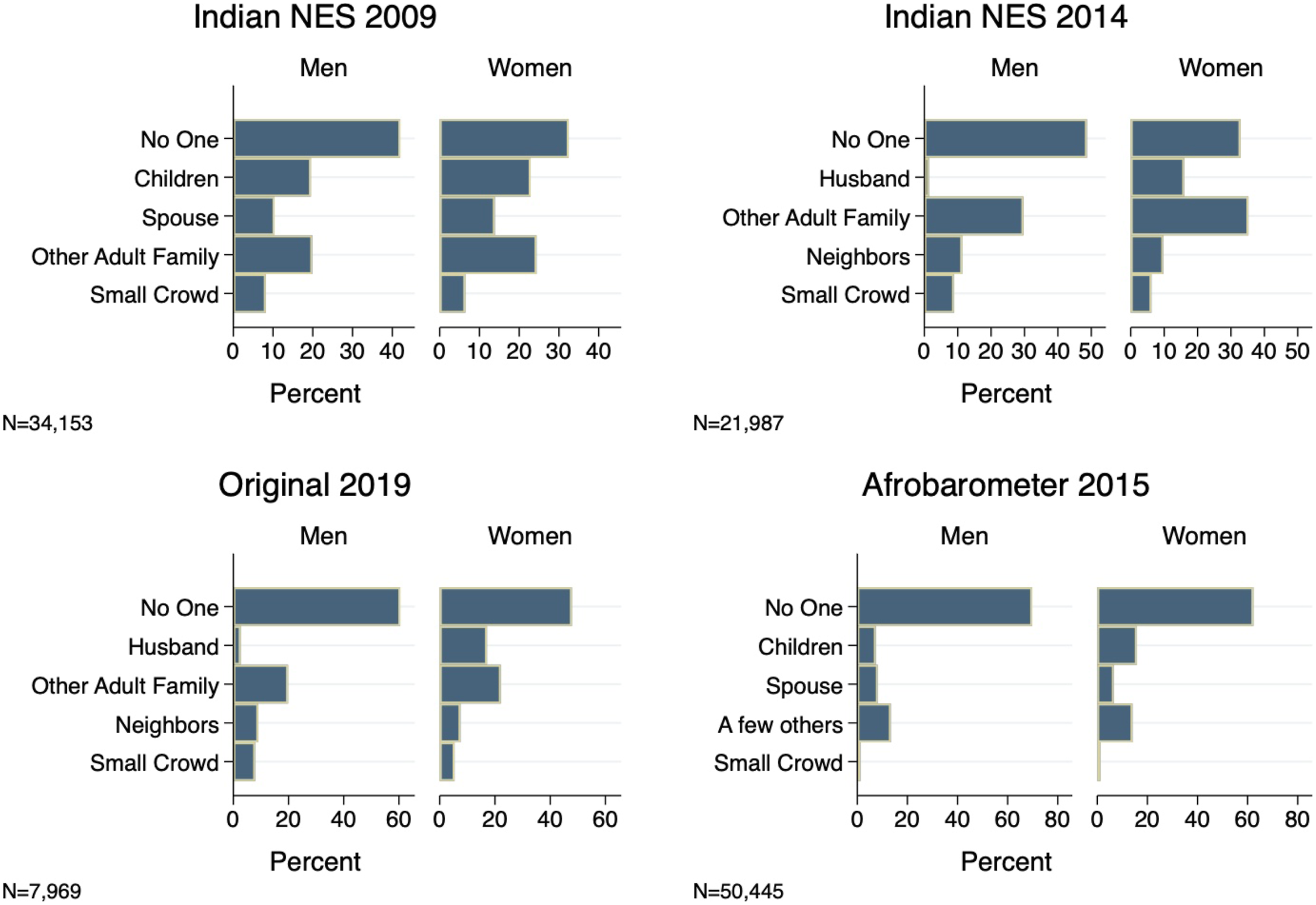
Female Respondents and Observer Effects on Political Opinion
NES 2009: Political Opinions and Interest for Female Respondents.
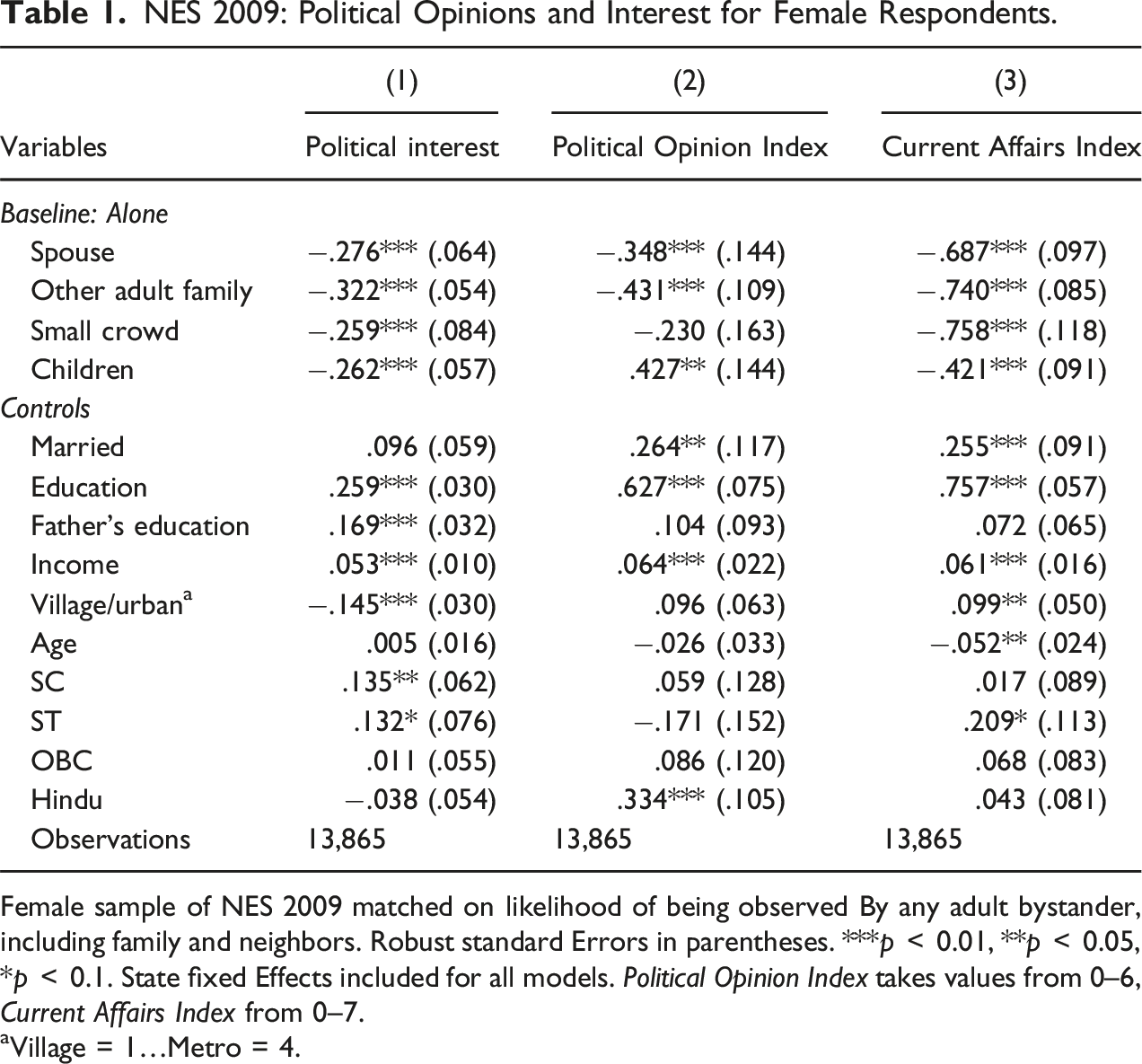
Female sample of NES 2009 matched on likelihood of being observed By any adult bystander, including family and neighbors. Robust standard Errors in parentheses. ***p
aVillage = 1…Metro = 4.
NES 2014, Original 2019: Political Opinions and Interest for Female Respondents.

Female sample of NES 2014 and original 2019 matched on likelihood of being observed by any Adult. Robust standard errors included in parentheses. ***p
aVillage = 1…Metro = 3.
We also report results for political opinion and current affairs indices. In 2009, the coefficients for Political Opinion Index and Current Affairs Index are negative and significant, suggesting that women who are observed by spouses and other adult family are likely to have fewer answered questions (Table 1). Substantively, being observed reduces the total number of questions answered by at least one. Particularly in the current affairs index, larger coefficients indicate that women are answering fewer opinion questions if observed. In 2014, the effect sizes for these are much smaller, but still significant. Since the political opinion index and current affairs index in that year are only four to five questions each, the substantive variation to be explained is limited. However, our model suggests that female respondents who take the interview in the presence of adult family bystanders or neighbors are significantly less likely to offer opinions on all five questions.
For the 2019 survey, we collapse a battery of 13 public opinion questions into an index that counts the number of questions to which a respondent offered a non-substantive answer. Women who took the survey while being observed by a spouse or neighbors were likely to answer at least one more question with “Neither Agree nor Disagree” than those who answered the survey alone—an effect that is robust controlling for the same socio-economic indicators as the other surveys. It is worth considering that at minimum, our use of a matched sample, and inclusion therefore of only those women who are similar to each other on a range of socio-economic indicators, lets us interpret these findings causally. Women refuse to provide an opinion, and defer to non-substantive options, when they are observed by their family or neighbors. This much stricter specification suggests that these results are a causal result of being observed, and not an artifact of other factors that may make it more likely for women to be observed.
Men Have Difficulty Answering Surveys too
Are the results in the previous section driven by factors that are common to men and women? Both men and women face certain costs when answering opinions in front of others—ranging from the relatively benign (embarrassment or ridicule at answering against social desirability norms) to the potentially violent (facing retribution for going against the family’s held opinions). In our study, women are not avoiding answering all questions, they are just answering fewer. Is this because women are not expected to have political opinions? Or because they fear censure over certain opinions?
One way of answering some of these questions is to examine male respondent’s performance when others are present in the room. In our 2019 survey, men were 28% more likely to say they were interested in politics if observed by a small crowd (p
Men, for the most part, respond to political attitude surveys the same whether they are alone, or in the presence of others. Women seem to be unable, or unwilling, to do so. It is the gap between the behavior of men and women, responding to exactly the same set of questions and subject to the same controls, that leads us to conclude that the pressures women face in the household when it comes to their political identity are significant and measurable. Women, we suggest, alter their responses to political interest and political opinion questions in the presence of intimate family members because of theoretically established patriarchal norms in Indian households. Sadly, these regressive norms survive the passage of time.
Robustness Checks on Findings
As described above, the matching technique used for all models relies on nearest-neighbor matching. A possible concern is that the matching is dependent on the order of the sort. To overcome this challenge, we conduct additional robustness tests for our main findings about political interest and voting. First, we generate coefficients and standard error estimates from 200 re-ordered and matched surveys for political interest in the female sample in NES 2009. The coefficient for respondents interviewed “Alone” has a mean of .35 and a standard deviation of .07 (see Table A18.1 in the Appendix). As the table shows, the coefficient is positive and significant in all 200 iterations. Conversely, the male sample has a coefficient of .05, and is not consistently positive or negative, suggesting non-significance.
The robustness estimate suggests that women are on average 35% more likely to say that they are interested in politics if they are interviewed alone. Conversely, men are no more likely to answer the question of whether they are interested in politics differently if they are alone or observed by other adults. In the instances that being alone might impact men’s answers, the effect size is less than 5%. This reinforces our core hypothesis that men do not answer the question of whether they are interested in politics any differently when they are alone, or observed by others; whereas being observed has a causal and negative impact on women’s stated political interest.
The conclusions drawn in this study are therefore a result of average effects over multiple iterations of these surveys. In the absence of any convergence, we assume a null effect. For example, women’s self-reported voting in NES 2009 may sometimes be impacted by the presence of bystanders, depending on the match. Similarly, men in the NES 2014 survey were likely to provide fewer substantive answers to the Current Affairs Index questions (see Tables A11.1 and A12.1 in the Appendix). However, in both these instances, the results were highly dependent on the matching sequence, and were not uniformly significant at p < 0.1. We therefore report them as null results, preferring to be conservative in the articulation of our findings.
Survey Wording, Performance, and “Intelligence”
Comparing results from men and women, matched on socio-economic indicators, has the additional advantage of avoiding bias against difficult and complex questions. Some questions are genuinely complicated, and systemically bias against poorer and less-educated respondents (Converse, 1964). It is therefore remarkable that, in general, men across socio-economic groups offer opinions on survey questions regardless of being observed (see Tables A11.1 and A12.1 in the Appendix), whereas women seem particularly sensitive to the presence of bystanders.
As noted in the methods section, we included all questions that pertain to either a general interest in politics, or a political opinion. We took care to avoid questions that asked individuals to “perform” loyalty to a party (Giné & Mansuri, 2011; Prillaman, 2021). We therefore excluded questions that are open-ended, or that require the respondent to name a specific political party. 5
A valid concern over the exclusion of these questions might be that they were excluded because they run counter to our findings. We therefore include results from a Party Performance Index from NES 2014 in Table 13.1 in the Appendix. Briefly, we find that women are more likely to provide a party name if observed by a spouse or adult family member, while men are also more likely to do so if observed by a small crowd. A possible explanation for these results is that asking respondents to name parties (instead of, say, recording them on a dummy ballot) serves directly as a performance central to securing patronage for themselves and their families. Indeed, women feel pressure to name parties when their family members are present, but men do not, reinforcing the fact that a person’s household is a vastly different space, depending on their gender. Taken together, comparing men and women’s responses in the company of a variety of bystanders indicates that women feel the kind of pressure at home that men feel outside their home.
Participation
If women are used instrumentally for the vote, and their ability to bargain with the state on behalf of the household, we should expect limited or no changes in reported political participation in the presence of family members (H3). The clearest form of participation in the democratic context is voting in general elections. Using matched samples across each of the three surveys, we test whether women are less likely to report voting in the most recent election (Appendix Table 10.1). We find women are almost 50% more likely to say they voted if in the presence of a small crowd (Original 2019, p
All three surveys capture self-reported attendance in political rallies, canvassing activities, and political meetings. Happily, these items are worded consistently: “During the election people participate in various activities related to election. Did you participate in any such activities…?” (see Appendix A1 for details). We created participation indices for each survey. In 2009, participants could score a minimum of zero (for no participation reported) and a maximum of 3. In 2014 and 2019, the list of activities was expanded to include ‘processions’ and distributing leaflets, providing up to 5 potential forms of participation. Overall participation is very low, with men and women on average reporting between 0–1 election-related activities.
Participating in Election Campaigns for Female Respondents. a
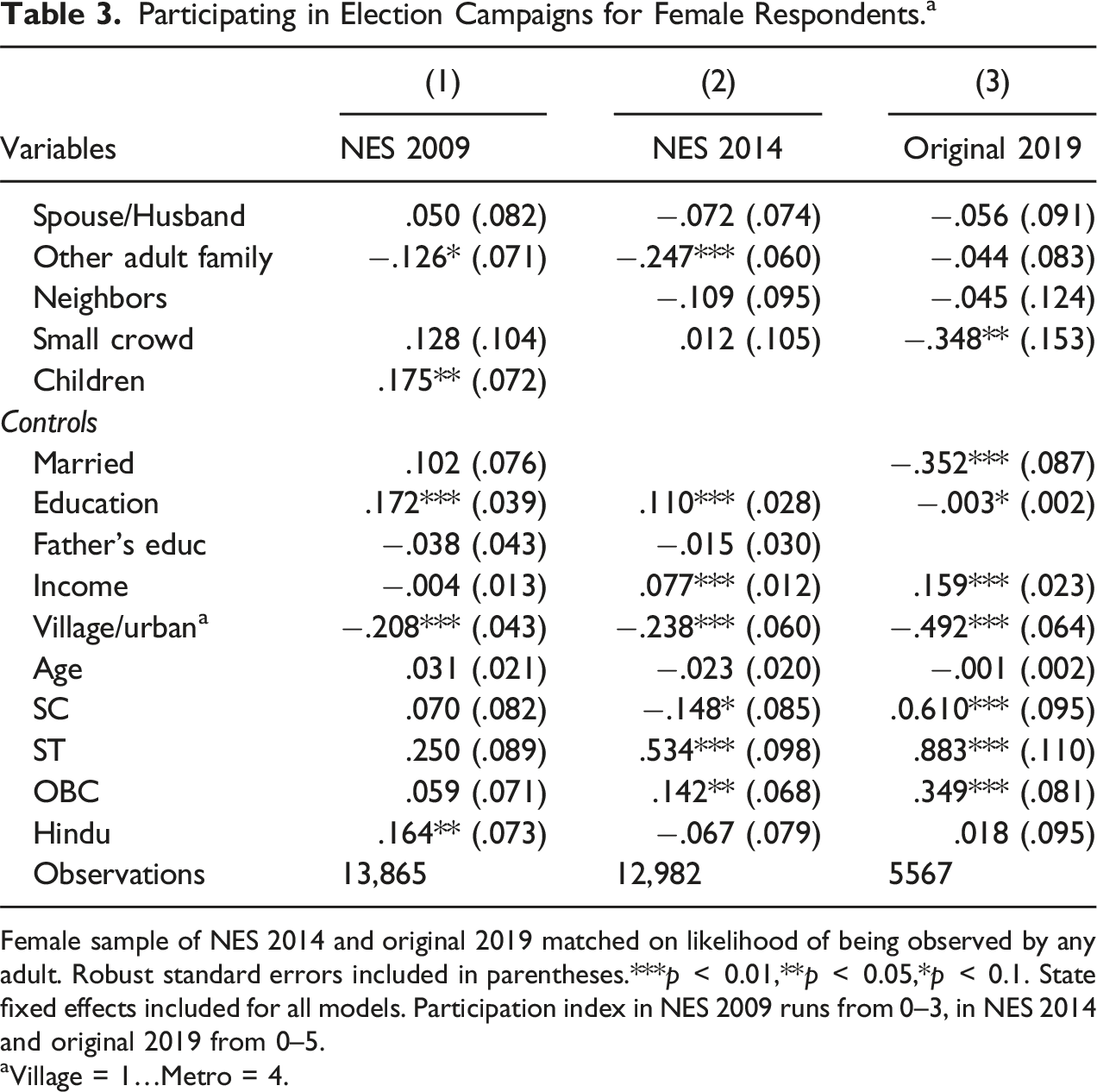
Female sample of NES 2014 and original 2019 matched on likelihood of being observed by any adult. Robust standard errors included in parentheses.***p
Village = 1…Metro = 4.
It is likely that voting and election-related activities are substantively different in the costs imposed on women, and the family. Evidence from deeply patriarchal contexts in South Asia suggests that women may be discouraged from voting if it is time-consuming (Cheema et al., 2023), or if there is a possibility that fights might break out at the polling station (Cheema et al., 2019). Similarly, participating in rallies and meetings is time-consuming and takes away from women’s labor in the household. Agarwal (2003) notes men getting ‘irritated’ when women stay out at political meetings late at night. However, at least three of the models suggest women are under pressure to report voting and participation when observed by friends and neighbors, and even in the presence of their husbands. We discuss these findings in detail in the next section.
What Mitigates the Observer effect?
Women are subject to surveillance inside the home, and the most consistent cure seems to be education (Agarwal, 1997; Syal, 2012). We also examine whether urbanization leads to women expressing greater participation and interest in politics (Chhibber, 2002). We use interactions between women and potential mitigating factors (education, urbanicity) to study these claims.
We study these effects by using an ordinary least squares (OLS) interaction to test H4 and H5 as follows NES 2009: Interaction between location (Village/urban) and Observer Effects. Calculated from results reported in full in Table A15.1 in Appendix.

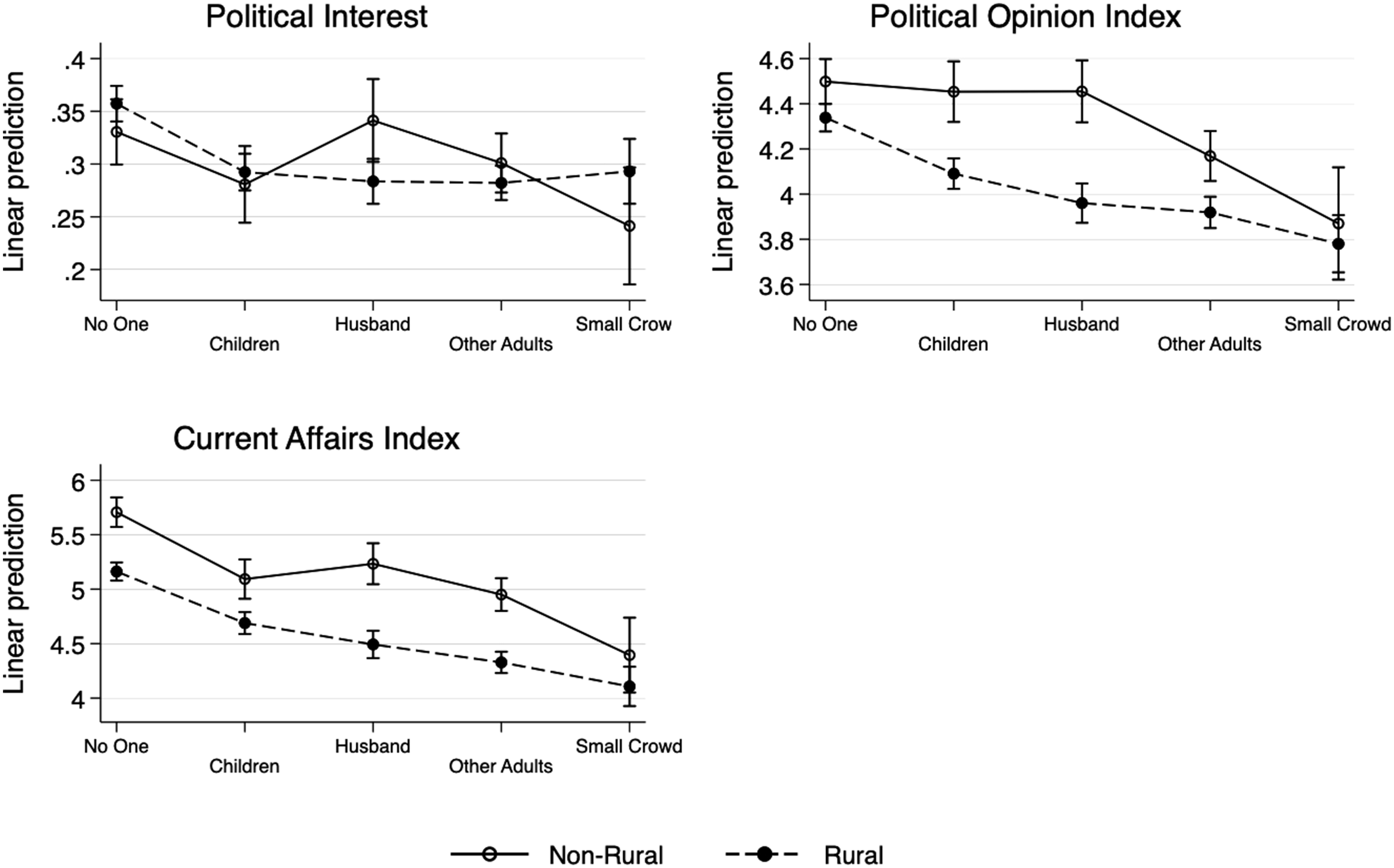
Some of the results are more mixed-urban female residents are still less likely to answer some current affairs questions, especially in front of neighbors or a small crowd, than when they are interviewed alone. Overall, these findings suggest that women in both rural and non-rural settings are susceptible to observer effect. But the size of this effect is larger in village (rural) settings, particularly for providing substantive responses on political knowledge questions.
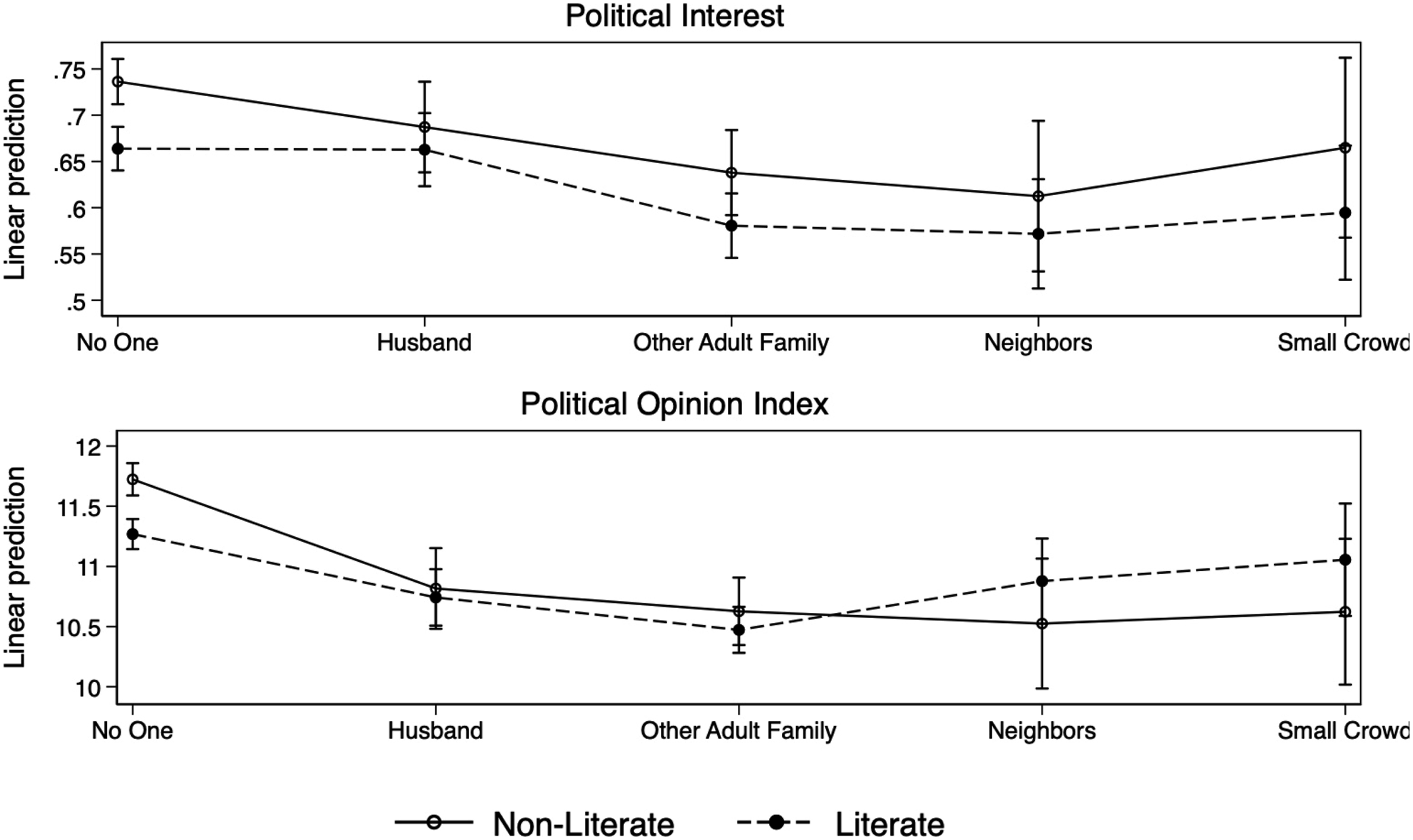
A second set of interactions tests the mitigating role of education. A key question in the research on women’s education is what level of female education allows women to assert themselves in the household. In some studies, the benchmark can be considerably high—Syal (2012) suggests that having more education than their father is the critical threshold for female political autonomy. Conversely, (Andrabi et al., 2008) find that as little as two years of schooling can make women much more assertive in their expectations for their children’s education. For this interaction, we use “literate” or “non-literate” as the key intervening variable. 8
We present these results in Figures 3 and 4. They show that education attenuates the effect of being observed, particularly in earlier surveys. Women with just over secondary level education, or any kind of literacy, are much less likely to be impacted by others present during the NES 2009 survey. This confirms arguments that even minimal levels of schooling expand women’s ability to assert themselves in the household financially and politically. In the survey from 2019, literacy’s effect is much more muted, with literate and non-literate women being about equally susceptible to observer effects, particularly when stating an interest in politics. However, literacy does attenuate the observer effect for women offering political opinions when observed by neighbors or a small crowd. We discuss this below. NES 2009: Interaction between education (Literate/Non-Literate) and Observer Effects. Calculated from results reported in full in Table A16.1 in Appendix. Original 2019: Interaction between education and Observer Effects. Calculated from results reported in full in Table A17.1 in Appendix.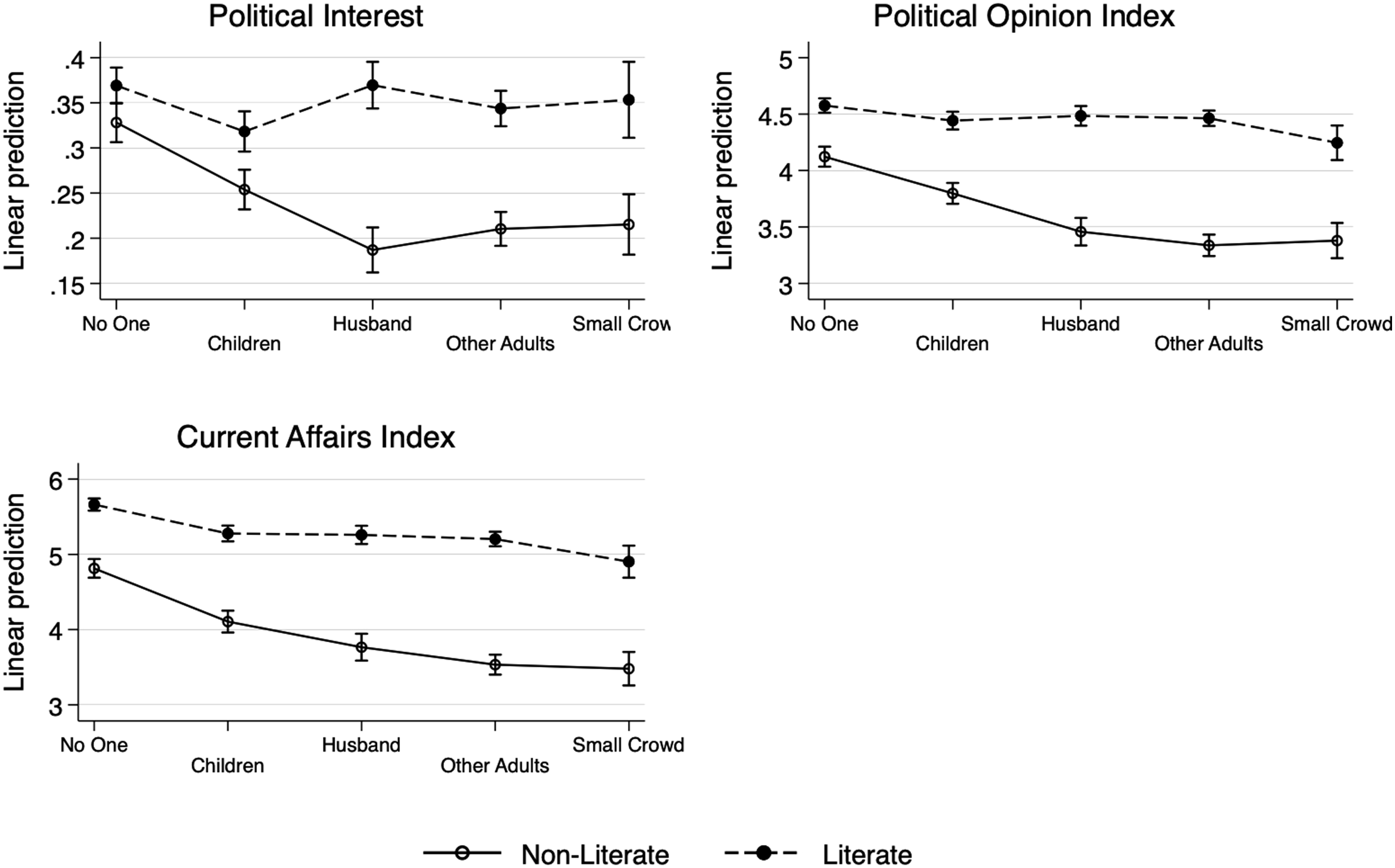
Discussion
The face-to-face survey is a powerful, if imperfect, instrument. We exploit a unique opportunity in the social context of the interview to find that women are less likely to express an interest in or opinions on politics if their husbands or other adults are in the room. This has serious implications for democracy: women are valued as bodies but not for their political interest or opinion. At minimum, we find support for our argument that women feel constrained by intimate family members, even when we control for educational attainment or economic mobility (Tables 1 and 2 and Figures 3 and 4). That this effect holds in urban settings (Figure 2) suggests women remain vulnerable to patriarchal norm enforcement in low-income urban contexts.
A more optimistic view is that women are able to report their experiences in interactions with outsiders, if given the privacy to do so. Each of the models use being interviewed alone as the baseline, suggesting that despite a range of pressures respondents are subject to in the interview context, privacy affords women the ability to express themselves on equal terms to their male peers. This is a profound finding in a patriarchal context where interactions with strangers may be discouraged. It sets the agenda not only for a range of sensitive legal and administrative services (Htun et al., 2019) but also for more innovative survey methods (Auerbach & Thachil, 2018; Chauchard, 2013; Corstange, 2014). We have presented strong evidence that women who meet basic literacy requirements, or have even some secondary education, can overcome the negative “observer” effect. Rather than suggesting that education encourages women simply to think of themselves as individuals, we suggest that education mobility for women might motivate family members to recognize women as independent actors in the political process. Educational attainment, like financial independence or external labor opportunities, is a means for women to leverage power in the household. Yet, the sobering reality is that educational empowerment remains dismally low in South Asia—in our 2019 survey, 57% of the women (and 49% of men) in the sample reported having only lower secondary schooling.
We find that, with limited exception, men do not vary their stated interest in politics in the presence of their families. Unlike women, for men, the private sphere is a relatively unobtrusive space when it comes to political opinions, underscoring empirically the feminist axiom “the personal is political” (Hansich, 1970). When comparing across a range of questions, men consistently behave “authentically” in front of family—that is, no different than if they were alone. On the other hand, women across socioeconomic lines censor themselves in the company of their spouse or intimate family members.
This study demonstrates that in India, as in low-income, densely populated countries across the world, privacy is a luxury. Men are more likely to be afforded privacy, and even those who lack privacy at home still behave as if they were alone. In this they are vastly different from their female counterparts, for whom the home space is far from private and for whom the lack of privacy alters how they present their private thoughts with the world. We suggest that at its most benign, this lack of privacy and the inability to live authentically reinforces the belief among individuals—including women themselves—that women are less intelligent on the subject of politics. Indeed, this resonates with much of the public opinion literature from the Western world. Yet, this likely only scratches the surface: extensive scholarship across disciplines in South Asia documents the real physical and emotional toll that surveillance within the household takes on women in patriarchal contexts. These surveys offer a remarkable insight into the workings of the South Asian household, and capture a snapshot of the sobering reality of women’s lived experience under a deeply-entrenched, multi-faceted patriarchy.
While men are considerably less subject to patriarchal norms in the household, they are subject to pressures outside the familial context. If political life is a performance, an election survey is the pièce de résistance—an opportunity to demonstrate participation, interest, and opinions to neighbors and friends. A few findings are worth discussing. First, men are under pressure to claim they show up for political activity (Table A14.1 in the Appendix). Second, these results are consistent across time, and highlight the contrast between expectations men face to participate in politics, as opposed to taking an interest and having opinions on political issues.
A final dimension to these findings is the somewhat surprising finding that women in urban areas might be more subject to surveillance than those in villages. Intuitively, an individual who lives in an urban area and is observed by non-familial individuals likely lives in a high-density, low-income settlement. If India’s vast slums are driving this result, then it is likely that women have even less privacy in their homes in densely populated urban contexts. We are constrained by relatively small numbers of women who are actually interviewed outside their homes. We can speculate that women are subject to competing pressures—the pressure to participate, as men are, but also the pressure to self-efface interest or opinions. We find that women are not more likely to report participating in politics, though they are somewhat less likely to express political interest when observed by a small crowd. In public, at least, they are bodies to be mobilized, but their opinions are not valued.
Conclusion
We analyze an unobtrusive indicator of the social milieu in which Indian citizens express their political opinions and report their political participation. The Indian National Election Studies and an original survey provide three stratified nationally representative samples of the Indian electorate for 2009, 2014, and 2019. In each survey, the interviewer recorded whether or not the interview was being observed. As is true in many parts of the developing world, many interviews are conducted not in private but in the presence of other adults in the household or in shared public spaces. To our knowledge, we are the first to examine the effect of being watched by specific categories of intimate family members and friends, particularly non-spouse adults and neighbors, on how respondents answered the survey.
This paper builds on findings from public opinion studies that have established the lack of privacy for female respondents, and the fact that women are less likely to provide non-substantive responses in public opinion surveys, but not necessarily that the two are linked. We argue that the unequal and gendered access to privacy in the household is central to the construction of women as unequal political citizens.
We utilize the observer question to test an argument about the gendered nature of political space in India. We find that in a patriarchal society, women, while valued for their bodies at the polling station or at rallies and meetings, are not expected to have political opinions and attitudes. Men, on the other hand, are free to express their political interests but also face greater pressure to participate in visible forms of political activism that are linked to collective benefits for their communities.
The implicit assumption in social science surveys is that respondents are answering the questions in private. Indeed considerable effort has been expended to understand interviewer effects, recognizing that simply having someone else in the room can induce social desirability effects. But in much of the developing world, we would argue, this notion of privacy for respondents is unrealistic. Nor is it obvious that we should force interviewers to require privacy, especially if doing so might increase unit non-response. Rather our analysis calls for the standard recording of whether or not observers were present—and what type—so that we can replicate the analysis reported above elsewhere (indeed, everywhere else). Politics is a collective exercise; it should not surprise us that answering political surveys often is too.
Supplemental Material
Supplemental Material - Well-Behaved Women: Engendering Political Interest in Public Opinion Research
Supplemental Material for Well-Behaved Women: Engendering Political Interest in Public Opinion Research by Erum Haider and Irfan Nooruddin in Comparative Political Studies
Footnotes
Acknowledgments
We thank the editors and reviewers for CPS for their helpful comments. Feedback from Adam Auerbach, Larry Bartels, Carew Boulding, Jennifer Bussell, Pradeep Chhibber, Dan Corstange, John Huber, Kimuli Kasara, Eunji Kim, Preeti Nambiar, Allyson Shortle, Niloufer Siddiqui, Joel Simmons, Dan Smith, and Milan Vaishnav sharpened our thinking. Audiences at MPSA 2016, the DC India Politics Roundtable (September 2016), 2021 Gender and Politics in South Asia workshop hosted by UC Berkeley, ISA 2022, Columbia University, and Vanderbilt University generously engaged earlier versions of the paper and made it better. Dhananjai Joshi at Cicero Associates implemented the 2019 survey analyzed here. The team at Lokniti in New Delhi does yeomen’s work conducting the Indian National Election Study; this research would be impossible without their collegiality and professionalism. All errors are our own.
Declaration of Conflicting Interests
The author(s) declared no potential conflicts of interest with respect to the research, authorship, and/or publication of this article.
Funding
The author(s) received no financial support for the research, authorship, and/or publication of this article.
Authors’ Note
The order of the authors is chosen alphabetically.

Data Availability Statement
All data and statistical code required to replicate all findings reported in the manuscript and supplemental materials will be deposited in the corresponding author’s Dataverse: [link withheld to preserve anonymity during review process]. (Haider & Nooruddin, 2023).
Supplemental Material
Supplemental material for this article is available online.
Notes
Author Biographies
References
Supplementary Material
Please find the following supplemental material available below.
For Open Access articles published under a Creative Commons License, all supplemental material carries the same license as the article it is associated with.
For non-Open Access articles published, all supplemental material carries a non-exclusive license, and permission requests for re-use of supplemental material or any part of supplemental material shall be sent directly to the copyright owner as specified in the copyright notice associated with the article.
