




Abstract
This study leverages the adoption and subsequent abandonment of proportional representation in interwar France to examine how electoral systems shape politicians’ incentives to engage in programmatic redistribution. Using novel data on the legislative initiatives and manifesto commitments of members of France’s Chamber of Deputies, we compare politicians against themselves under different electoral rules. We find that politicians devote more effort to programmatic redistribution under France’s single-member majoritarian system than under the open-list proportional rule, both in parliament and while campaigning. Our results contradict canonical work by economists on the distributive effects of electoral rules, but are consistent with work by political scientists that emphasizes the tendency of electoral competition under open-list PR to devolve into personalism at the expense of programmatic policy. Our findings point to the distributive significance of institutional variation among PR countries and highlight the shortcomings of stylized contrasts between PR and single-member systems.
The promise of democratic capitalism is that it can allow citizens to enjoy the allocative efficiency of the market while providing those in government with the proper incentives to ensure that this is not accompanied by intolerable levels of insecurity and inequality. Whether really existing capitalist democracies deliver on this promise is another matter. Both historically and in the present day, radical critics on the right and left have charged that democratic elections fail to secure the welfare of working people in the face of market-generated inequalities in the distribution of risks and rewards. For democratic capitalism to deliver on its promise and withstand these criticisms, the institutions in place must structure politicians’ incentives appropriately. The first step toward achieving this aim is to ensure that the rules of the democratic game encourage politicians to compete for office through programmatic commitments – i.e., by advocating for public policies – rather than through personalistic appeals or by providing discretionary benefits. Though not every programmatic policy provides broad-based benefits or increases the welfare of disadvantaged groups, it is only through programmatic policy that these goals can be consistently achieved.
It remains unclear, however, which types of democratic institutions favor the development of programmatic electoral competition that is necessary for systematic redistribution toward those disfavored by the market. This question has been at the been at the heart of comparative research on electoral politics for several decades (e.g., Kitschelt, 2000; Kitschelt & Wilkinson, 2007; Kuo, 2018; Stokes et al., 2013). Yet the debate remains unsettled, especially when it comes to the role of electoral systems. While there is widespread agreement that electoral rules matter, there is no consensus about the types of electoral rules that are most likely to encourage politicians to engage in programmatic competition. Programmatic competition refers to electoral competition over policies that distribute benefits and costs on the basis of publicly stated criteria and do not discriminate between otherwise similar individuals on the basis of their voting behavior or place of residence (Kitschelt, 2000, pp. 845, 850-51). 1 Many have argued that proportional representation (PR) systems are more likely than single-member-district (SMD) systems to incentivize politicians to supply programmatic policies rather than relying on non-programmatic appeals, such as the promise of pork barrel spending (e.g., Persson & Tabellini, 2003; Lizzeri & Persico, 2001; Milesi-Ferretti et al., 2002). Equivalently, some argue that SMD systems generate the strongest incentives for politicians to compete through the provision of non-programmatic benefits (e.g., Ashworth & Bueno de Mesquita, 2006; Gagliarducci et al., 2011; Lancaster, 1986), yielding correspondingly weak incentives to supply programmatic policy. 2
Others emphasize, however, that the putative link between PR and programmatic policy commitments depends on other features of the electoral rule in place (Carey & Shugart, 1995). When electoral lists are open, forcing politicians to compete against other candidates within the same party, electoral politics under PR may devolve into non-programmatic competition centered on individual personalities or pork barrel politics (e.g., Ames, 1995; Crisp et al., 2004; Kitschelt, 2000). Indeed, competition under open-list PR may generate stronger incentives for non-programmatic politics than does SMD (e.g., André & Depauw, 2013; Carey & Shugart, 1995; Edwards & Thames, 2007; Shugart et al., 2005), though this view has been subjected to considerable criticism (e.g., Cheibub & Gisela, 2020; Cheibub & Nalepa, 2020; Lancaster, 1986; Selb & Lutz, 2015).
The unsettled character of this debate reflects the empirical difficulties of studying the effects of electoral rules. The foremost empirical challenge is that electoral rules rarely change, meaning that scholars typically rely on cross-national variation for explanatory leverage. But electoral rules covary with other difficult-to-measure political, economic, and cultural conditions that may also affect legislator behavior. A second empirical challenge arises from the fact that the individual-level behaviors implied by existing theories are difficult to observe and measure. For this reason, many of the classic studies concerning the effects of electoral systems use aggregate outcome measures (e.g., total social expenditure) to draw inferences about legislator behavior rather than measuring this behavior directly.
This paper attempts to address these limitations with an empirical strategy that allows us to study how politicians’ behavior changes under different electoral rules. We do so by leveraging an electoral system change in Third Republic France, which abandoned its single-member majoritarian system for lower-house elections in 1919 in favor of open-list PR and used this system for two electoral cycles before returning to the single-member system for the 1928 elections. To study how legislators behaved under these two electoral systems, we construct a novel dataset that measures the content of the bills authored by every legislator in the Chamber of Deputies before, during, and after the PR interlude. This novel data set allows us to use within-politician comparisons to assess the extent to which French politicians’ propensity to advance programmatic policies in the arenas of social welfare, labor market regulation, and taxation changed along with the changes in the country’s electoral rules. We also examine politicians’ propensity to supply geographically targeted public goods (“pork”) under a single-member rule and under proportional representation. We complement this empirical strategy with a second novel data set that measures the programmatic commitments made by French politicians in their election manifestos in 1924 (under PR) and in 1928 (after the return to SMD). These two original data sets enable us to undertake an unusually fine-grained examination of politicians’ behavior under different electoral rules, contributing to recent electoral system research that focuses on individual candidates and legislators (e.g., Catalinac, 2016; Cox et al., 2019; Leemann & Mares, 2014).
The first part of our analysis shows that politicians in France’s Chamber of Deputies supplied significantly more effort on behalf of programmatic policy in the domains of social spending, labor market regulation, and taxation under SMD than they had under open-list PR. The results of this within-person longitudinal comparison hold when controlling for a range of time-varying individual- and district-level characteristics that might affect politicians’ propensity to increase or decrease their effort toward programmatic policy goals over time. The second part of our analysis shows that open-list proportional representation was also associated with fewer programmatic policy commitments of parliamentary candidates on campaign. Here, too, we use our longitudinal data to compare the same candidates’ individual election manifestos under two different electoral rules. Using the 1924 election campaign as a baseline, we show that winning candidates were more likely to make manifesto commitments in the domains of social insurance, labor market regulation, and tax policy after the return to SMD for France’s 1928 elections than they had been in the 1924 election under open-list proportional representation. Though this empirical strategy has some limitations, the pattern we identify is consistent with the view that returning to SMD created stronger incentives for candidates to advocate for a progressively financed welfare state accompanied by strong worker protections in the labor market.
The plausibility of these findings is enhanced by the fact that we obtain consistent estimates with our quite different measures of politicians’ behavior in the legislature and while campaigning. This alleviates concerns about the fact that our observation period is bounded on one end by the First World War and on the other end by the Great Depression. In our analysis of incumbent behavior, we show that our results hold whether we exclude or include the 1914–919 legislative period preceding the adoption of PR in 1919. If anything, the proximity of the war introduces bias in the opposite direction of our findings, since mass mobilization for war is thought to have given rise to progressive, programmatic reform in its aftermath (e.g., Obinger & Schmitt, 2020; Scheve & Stasavage, 2016). The end of the war also prompted massive labor mobilization and anxiety concerning the prospect of revolution in France (e.g., Bernard & Dubief, 1988, pp. 151–152; Guieu, 2015, pp. 188–195), which should have sharpened legislators’ incentives for programmatic reform during the PR interlude (1919–1928). Nonetheless, this paper demonstrates a significant increase in programmatic campaigning and policy-making after the reintroduction of SMD for the 1928 elections. We also emphasize that the Great Depression did not begin to seriously affect France until 1931, at the very end of our observation period for incumbent behavior, and is therefore unlikely to exert a strong influence on our estimates (e.g., Bernard & Dubief, 1988; Jackson, 1985). In any case, our measure of candidate behavior in the 1924 and 1928 elections precedes the onset of the Great Depression and is thus free of this potential source of bias.
This paper’s findings suggest that the adoption of open-list PR in France may have encouraged politicians to dissipate their energies through intra-party competition and personal vote cultivation and that the return to SMD may have yielded more programmatic policy. This interpretation of the consequences of open-list PR in France was endorsed by some observers at the time, including members of the parliament’s committee on electoral reform (Archives Nationales, (n.d), C 14826). Consistent with Carey and Shugart’s (1995) predictions, switching from open-list PR to SMD appears to have favored programmatic policymaking. Thus, even if closed-list PR would have been more conducive to programmatic policy outcomes than SMD, open-list PR may have been less desirable than both SMD and closed-list PR when it came to incentivizing programmatic competition. This suggests that the stylized contrast between PR and SMD may be unhelpful as a heuristic regarding the effects of electoral systems.
To be sure, there are important limits to what we can learn from a single case of electoral system change in early twentieth-century Europe, especially in the absence of a control group of French deputies unaffected by the rule changes we study. But even with these limitations in mind, this paper’s findings call into question received views regarding the relationship between proportional representation and European welfare state development. Much of the literature on the origins of proportional representation in Europe, as well as the literature on the putative effects of PR on social spending, overlooks the distinction between open-list and closed-list systems. Many of the European countries that adopted PR in the early 20th century opted for some version of an open-list system, including Belgium, Switzerland, and Italy (in 1919 and again in 1946). Our evidence suggests that the adoption of this system may have actually hindered welfare state development, and least in terms of its effect on politicians’ incentives to advance programmatic policy. It may still be the case that PR (whether open- or closed-list) facilitated welfare state development during this period through other channels – for instance, by promoting coalitions that included parties of the left or by disempowering right-leaning rural constituencies (Döring & Manow, 2017; Iversen & Soskice, 2006; Rodden, 2010). But our results weigh against explanations based on the allegedly greater tendency toward programmatic competition under proportional representation (Lizzeri & Persico, 2001; Persson & Tabellini, 2003). Inasmuch as PR favored welfare state development irrespective of list type, the conclusion to draw from this paper is that this is because PR affected the likelihood that certain parties entered government, not because it affected politicians’ propensity to offer programmatic redistribution.
Electoral Rules and Programmatic Policy
Several canonical contributors to the study of the political economy of electoral rules have argued that proportional representation (PR) encourages politicians to supply non-targeted policies that benefit voters irrespective of their geographic position, while single-member district systems (SMD) encourage the opposite (e.g., Persson & Tabellini, 2003). The logic is that the re-election prospects of politicians under SMD are tied to the welfare of voters in certain districts, allowing them to disregard the welfare of other voters. This encourages the provision of targeted goods (pork) to particular districts financed by taxes on voters living elsewhere. Under PR, politicians’ re-election prospects depend on the welfare of voters in larger districts (at the limit, comprising the entire country), meaning that targeted spending loses its allure relative to policies that benefit broad swaths of the electorate irrespective of geography – what we call programmatic policies. While different in the specifics, Lizzeri and Persico (2001) and Milesi-Ferretti et al. (2002) offer arguments in the same vein. 3
These arguments easily generalize to other forms of “personalistic” behavior beyond the provision of pork barrel spending. Persson and Tabellini’s (2003) argument implies that politicians whose fortunes are tied to the welfare of a small geographic area are likely to expend more effort on constituency service and local hobnobbing than are those whose fortunes are tied to broader districts. These personalistic activities can be understood as geographically targeted non-material benefits. Extending the logic of Persson and Tabellini (2003), the payoff to programmatic policies relative to the payoff from personalistic appeals should increase under proportional representation.
The possible limitation of arguments like that of Persson and Tabellini (2003) is that they may grant insufficient attention to institutional diversity among PR systems. Their results may only hold for a subset of PR countries, depending on differences in electoral rules that they consider to be of marginal significance. 4 In a canonical article, Carey and Shugart (1995) argue that the value of personal reputation should increase with district magnitude when the electoral rule allows for competition between candidates in the same party. Under open-list PR, voters have the opportunity to select which candidates within a given party list they favor, pitting co-partisans against one another within a given multi-member district and increasing candidates' incentives to distinguish themselves from their co-partisans through non-programmatic appeals to their voters. On this basis, we might expect politicians in open-list PR to devote more energy to personalistic appeals and non-programmatic forms of distribution than under SMD, since they face the additional challenge of distinguishing themselves from their co-partisans in the same district. 5 Given that politicians are constrained in the total amount of effort they can supply, this implies that politicians under open-list PR should supply less effort pushing for programmatic policy than politicians under SMD.
A countervailing consideration is that politicians may face greater difficulty claiming credit for targeted policies like local public goods in the multi-member districts characteristic of PR systems (Ashworth & Bueno de Mesquita, 2006; Lancaster, 1986; Tromborg & Schwindt-Bayer, 2022). Voters may not know whether a given local public good is attributable to the efforts of one legislator or another within their multi-member district. For this reason, Lancaster places open-list PR between SMD and closed-list PR in terms of its effect on geographic targeting (also Rickard, 2018).
Carey and Shugart (1995, 430–431) grant Lancaster’s (1986) point that credit-claiming for pork barrel projects may become more difficult as district magnitude increases. They therefore propose that pork-barreling may be lower in open-list PR systems than under SMD. But even if pork-barreling declines as district magnitude increases, this does not necessarily mean that legislators will shift their efforts to programmatic competition. After all, the provision of pork is only one way of cultivating a personal reputation among voters. Carey and Shugart argue that the cultivation of personal reputation may take a different form under open-list PR than under SMD: rather than providing pork, legislators may engage in other non-programmatic activities to distinguish themselves from co-partisans in the eyes of their voters. These authors’ conclusion remains that the total effort directed to personal reputation-building will be higher under OLPR than under SMD, since under SMD politicians are not compelled to distinguish themselves from their co-partisans within a given district. If we assume that all effort devoted to personal reputation-building comes at the expense of effort devoted to programmatic policy, this means that legislators face weaker incentives to advocate for programmatic policy under OLPR than under SMD.
We can thus sketch out two competing positions. The first is a version of the classic view articulated by Persson and Tabellini, which holds that PR – irrespective of list type – generates fewer incentives for non-programmatic appeals and correspondingly stronger incentives for programmatic policy than does SMD. Following Lancaster (1986), this view can be amended to incorporate a difference between open- and closed-list PR. Open-list PR may offer stronger incentives for personalism and non-programmatic targeting than closed-list PR, but weaker incentives than SMD, given the aforementioned credit-claiming difficulties. This interpretation of the ordering of electoral systems is consistent with recent comparative work by Rickard (2018), who characterizes open-list PR as a middle ground between SMD and closed-list PR. This ordering of electoral systems is reflected in ordering A of Figure 1 below. The second possibility is one that follows Carey and Shugart (1995) in predicting that open-list PR will generate stronger incentives for personalistic appeals than SMD does because the former forces candidates to compete against co-partisans within the same district. This ordering of electoral systems is reflected in ordering B of Figure 1. Two possible orderings of electoral systems according to their relative propensity to encourage personalistic and programmatic activity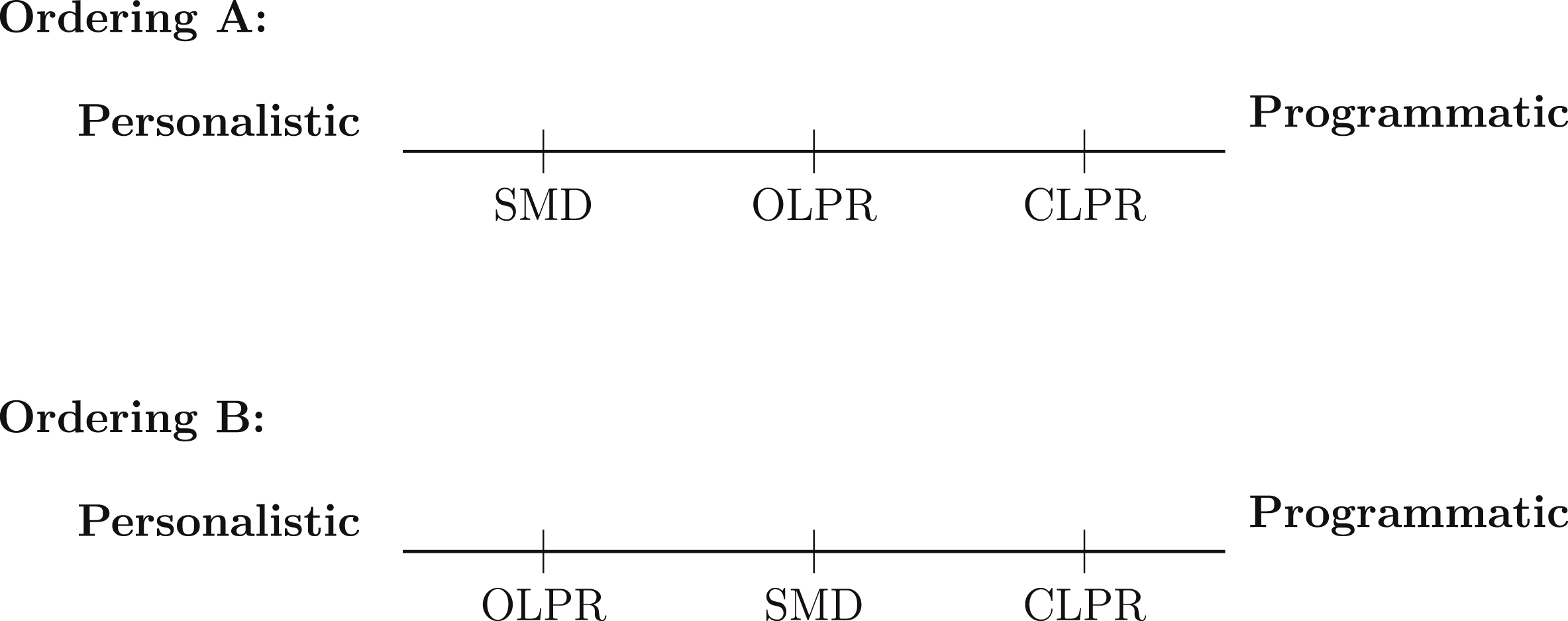
The existing evidence does not allow us to adjudicate decisively between these alternative views. Crisp et al. (2004) use cross-national evidence from Latin America to show that open-list PR encourages personalism, a finding that is consistent with ordering B above. Similarly, Chang and Golden (2007) present evidence indicating that non-programmatic appeals (corruption) increase with district magnitude under open-list PR. Edwards and Thames (2007) show cross-nationally that public goods spending decreases with district magnitude in open-list systems, a finding that supports ordering B. Shugart et al. (2005) show that candidates in open-list PR are more likely to have personal attributes that may endear them to local constituents than candidates under other electoral rules, consistent with ordering B. André and Depauw (2013) show that legislators’ time in-district and their propensity to advocate for local development projects increases with district magnitude under OLPR but decreases under CLPR, consistent with ordering B above.
Tromborg and Schwindt-Bayer (2022), on the other hand, present cross-national evidence indicating that geographic targeting declines with district magnitude irrespective of list type, which supports possibility A above. Selb and Lutz (2015) also challenge Carey and Shugart’s hypothesis with fine-grained evidence from Switzerland. Rickard (2018) shows that there are fewer geographically targeted subsidies under PR than under SMD, and fewer geographically targeted subsidies under CLPR than under OLPR, though she does not directly compare OLPR and SMD. Menendez (2016) shows that geographically targeted trade compensation schemes are less common under PR, but does not compare open- and closed-list cases. Gagliarducci et al. (2011) show that Italian legislators elected via SMD engage in more targeted spending than those elected via CLPR, but their study does not include a comparison to OLPR. Cheibub and Gisela (2020) offer evidence from Brazil indicating that the extent of intra-party competition under open-list PR is exaggerated, lending support to ordering A above.
A smaller number of studies leverage within-country variation to study the effects of changes in electoral rules on electoral promises or spending patterns. For the most part, these studies do not throw direct light on the question at hand in this paper. Pachón and Shugart (2010) examine the change from single non-transferable vote (SNTV) to PR in Colombia, while Catalinac (2016) studies the switch from SNTV to a mixed-member majoritarian system in Japan. Catalinac’s finding that intraparty competition encourages legislative particularism and pork-barrel spending is broadly consistent with ordering B above. On the other hand, Funk and Gathmann (2013) present evidence that switching from SMD to (mostly) OLPR in Swiss cantons decreased geographically targeted spending on roads, consistent with ordering A, though their paper lacks the measures of legislator-level behavior that would be necessary to validate the hypothesized mechanisms. Studying within-country change in electoral rules (along with fine-grained measures of legislator behavior) is the most promising way of assessing the distributive effects of electoral institutions (as argued, e.g., in Rickard, 2017). Nevertheless, work using this kind of research design remains underdeveloped. This is the avenue we pursue in this paper.
Electoral System Change in France
In what follows, we study the relationship between electoral rules and legislator behavior in France during the Third Republic, which was founded in 1875 and survived until the country’s defeat by Germany in 1940. Possessing universal male suffrage and a democratically accountable executive, the Third Republic compared favorably to its peer countries in Europe. The French case is relevant because it offers a rare instance of a shift from a single-member majoritarian system to open-list PR and back again. Between 1889 and 1914, French legislators were elected to its lower chamber, the Chamber of Deputies, from single-member districts (the scrutin d’arrondissement) using a two-round rule: if no candidate received a majority in the first round, all candidates could proceed to a second round in which the winner was determined by plurality. Voices in favor of proportional representation had existed since before the founding of the Third Republic (e.g., Rosanvallon, 1998, pp. 153–164), but pressure for electoral reform intensified after the turn of the century. Legislation to this effect passed the lower chamber in 1909 and 1912 but was stopped through procedural maneuvering and subsequently stymied in the upper chamber (Ahmed, 2013, pp. 158–159). A renewed effort following the end of the First World War led to the adoption of PR in July 1919 for use in the elections of November 1919.
In the public debate over electoral reform both before and after the war, it was commonly argued that the single-member scrutin d’arrondissement favored non-programmatic and personality-driven electoral competition, and that switching to proportional representation would incentivize programmatic competition (e.g., Lachapelle, 1911; Hoffmann, 2008, p. 200). Indeed, the single-member scrutin d’arrondissement was criticized as a “scrutin de gladiateurs” on the basis of its alleged tendency to yield electoral conflict based on personalities rather than on policy programs. 6 Others were more cautious about proportional representation, emphasizing that its effects would depend on the precise characteristics of the electoral rule in place. Among these voices was the mathematician Henri Poincaré. In a preface to a 1911 book on electoral reform, Poincaré argued that if France were to adopt proportional representation, it must avoid a system that would allow voters to select their preferred candidates from party lists: such an electoral rule would “permit a range of dubious maneuvers” and “embed in voters’ minds the notion that questions of persons must prevail over questions of principle” (Lachapelle, 1911, xi). In effect, Poincaré endorsed Carey and Shugart (1995) avant la lettre: whatever the shortcomings of France’s SMD system, he predicted that electoral personalism would only increase under proportional representation if lists were open. Similar concerns were aired in the parliamentary committee on electoral reform (Commission du Suffrage Universel), where it was argued that open-list PR would promote “vigorous but perhaps unscrupulous competition between candidates on the same list” (Archives Nationales, (n.d), C 14826).
As is often the case when it comes to the reform of electoral systems (e.g., Ahmed, 2013; Boix, 1999; Leemann & Mares, 2014; Walter & Emmenegger, 2019), parties’ attitudes toward reform were shaped in part by their expectations regarding its effects on their own electoral prospects. The adoption of proportional representation was favored by Socialists and by the parties of the right, both of whom thought that PR would improve their electoral prospects (Monier, 1999, p. 67). The adoption of PR was opposed by the centrist Radical Party, which was the dominant party after 1905 (Parti Républicain Radical et Radical Socialiste, 1910). The two-round SMD system that existed before the adoption of PR favored parties that could form local coalitions to win second-round elections. The centrist and ideologically flexible Radicals were able to form coalitions with Socialists or Rightist candidates (as local circumstances dictated), placing them in a strong position to form winning coalitions. Accordingly, they supported the majoritarian electoral system. 7
The PR system adopted in July 1919, known as representation proportionelle avec prime a la majorité, was a compromise solution in several important respects (e.g., Guieu, 2015, p. 196). First, the multi-member electoral districts were formed at the level of the pre-existing departments (France’s primary sub-national administrative unit) and the number of seats assigned to each department was equal to the number of seats within each department under the single-member system. This led to moderately sized districts with an average magnitude of 6.5 and an average voting population of 123,000 (Kreuzer, 2001, pp. 55–59). 8 Second, the new electoral rule allowed for an element of majoritarianism in that any candidates who received a vote from an absolute majority of voters in a given department would automatically receive a seat (Journal officiel 1919). Finally, the PR system was open-list: it allowed for voters to select their preferred candidates within a given party list and to split their votes between candidates on different lists (panachage) (e.g., Stuart, 1920). 9 In Appendix Q, we discuss the workings of France’s SMD system and its open-list system of proportional representation in detail and score them on the basis of Carey and Shugart’s (1995) criteria of ‘Ballot,’ ‘Pool,’ and ‘Votes.’ This yields the conclusion that France’s system of open-list PR created distinctively strong incentives for candidates to cultivate a personal reputation and was thus conducive to personalistic rather than programmatic electoral competition. 10
This open-list PR system was used in two elections, 1919 and 1924, before being abandoned prior to the 1928 elections. There is wide scholarly agreement that the proportional system was abandoned because it was seen as providing favorable of electoral opportunities for the French Communist Party, which had split from the Socialists in 1920. This made the PR system unpalatable to its former proponents: the Socialists were dissatisfied with an electoral rule that allowed for Communist inroads in parliament at their expense, while the Right sought to thwart the expansion of a party committed to a break with capitalism. Their response was therefore to return to the two-round SMD system that had previously been in place. This institutional change achieved its immediate goal of squeezing out the Communists, whose seat share dropped from 28 to 14 (Tiersky, 1974, p. 48). Its other possible effects are to be investigated below.
During the war, France had been governed by a broad national coalition (l’Union sacrée) and then by a center-right coalition. The 1919 election under PR yielded a large conservative majority in the Chamber of Deputies, as can be seen in Appendix Table F2 (Bernard & Dubief, 1988, p. 89; Guieu, 2015, p. 202). This election was a major defeat for the Socialists, contrary to their expectations about the effect of PR on their electoral performance. These fortunes reversed, however, in the 1924 election under PR, yielding a center-left majority (a Radical government supported by the Socialists, the Cartel des gauches) that “kindled great hopes in the French left” for redistributive reform (Bernard & Dubief, 1988, p. 163; also Cagé & Piketty, 2023, pp. 496–497, 509).
The Cartel was, however, unsuccessful in its ambitions and collapsed in the summer of 1926, leading to a mixed government under Raymond Poincaré, who pursued an austerity program to stabilize the franc (see Bernard & Dubief, 1988, pp. 98–99, 162–164; Keiger, 1997, pp. 320–324; Valance, 2017, pp. 411–414; Eichengreen, 1996, pp. 177–183). The 1928 election after the return to SMD reaffirmed conservative control of government. Poincaré, still in charge, announced shortly after the 1928 election that his government would subordinate all reform projects to the overriding aim of “fiscal prudence” (Journal Officiel 1928a, Dèbats Chambre, 7 June 1928). As we show in Appendix F, the governments during the 1928–1932 legislative period were considerably more conservative on average than those of the 1924–1928 legislative period. Accordingly, there is little prima facie reason to expect a surge in programmatic redistribution following the return to SMD in 1928, since this period was marked by conservative rule; the only time that the left had a chance to pursue its programmatic objectives in government was during the period under proportional representation.
Data and Empirical Strategy
In what follows, we examine how electoral system may have changed politicians’ incentives to make programmatic policy commitments, both as incumbents and as candidates. To measure the behavior of incumbents, we construct a dataset that measures the number of bills proposed by each legislator over a range of policy areas during four legislative periods between 1914 and 1932. Our data set is therefore in a panel format with a distinct observation for each deputy during each legislative period during which he sat in the Chamber. During the period 1914–1932, 889 deputies sat for a single legislative period, 347 deputies sat for two periods, 172 deputies sat for three periods, and 80 deputies sat for all four periods. In two of the legislative periods in our dataset (1914–1919 and 1928–1932), politicians were elected in a majoritarian electoral system, while in the other two periods (1919–1924 and 1924–1928) they were elected through the open-list proportional rule.
The source for the construction of our variables measuring deputies’ bill proposals are publications of the French Chamber of Deputies, which we consulted at the Archives of the National Assembly in Paris (Annales, various years). These publications record legislative proposals written and submitted by each deputy to the Chamber. We take advantage of the fact that deputies in the French parliament had an unlimited right of legislative initiative: any deputy could put forward a bill on any topic at any time (Larcher, 1896, p. 150; Gooch, 1928, pp. 150–151; Zeldin, 1993, p. 585). The deputy would request that the president of the chamber grant him the opportunity to introduce the bill and, having received permission, would read out the title of the bill and sometimes a brief summary of its contents. The president of the chamber could, at most, require the deputy to wait until after the debate had ended or until the next day to introduce the bill to the chamber (Larcher, 1896, p. 159). Once the deputy had introduced the bill to the chamber, the bill would be assigned to the committee of initiative, which would conduct a preliminary assessment of its merits before passing it along to subject-specific committees (Gooch, 1928, p. 154).
The unlimited right of legislative initiative possessed by every member of the Chamber of Deputies was unusual in comparative perspective and quite controversial in the Third Republic. Some believed that France’s deputies had “excessively fertile minds” and exercised legislative initiative with “regrettable abundance” (Larcher, 1896, pp. 213, 231). Any bill proposed by a deputy was printed in the chamber’s official journal. Since it was common for newspapers in the legislator’s home district or department to reproduce the bill in full, proposing bills in parliament was a formidable source of “electoral propaganda” (227–228). Deputies would likely discuss their recent bill proposals during their trips to their home districts, which in many cases occurred on a weekly basis (Siegfried, 1930, p. 214), and in their apparently voluminous correspondence with constituents (de Jouvenel, 1914, pp. 22–24). Economic liberals like the lawyer Émile Larcher feared that the unlimited right of legislative initiative encouraged undue regulatory intervention in the market and undesirably high levels of public spending: as Larcher wrote, a deputy might propose a law granting a public pension to every elderly citizen in order to win popular support (Larcher, 1896, pp. 228–229). This would be an example of a deputy using his right of legislative initiative to advocate for programmatic redistribution. Deputies would also, of course, use the right of legislative initiative to push bills that would channel non-programmatic benefits to their constituents (Siegfried, 1930, pp. 212–215; Larcher, 1896, p. 229).
We draw on the publications of the Chamber of Deputies to code information about the content of deputies’ legislative proposals. We record the number of programmatic bill proposals in three core substantive domains: social policy (social insurance, welfare spending, etc.), labor market regulation, and tax policy. We also measure the number of bills proposed by each legislator that entailed the targeted use of public funds for projects in their home district (pork barrel spending). Our measure of incumbent behavior thus directly captures legislator effort on behalf of programmatic policy provision, on one hand, and particularistic spending, on the other. Detailed information on the construction of each of these variables is in Appendix A and descriptive statistics in Appendix C. Although it is possible that our focus on these policy domains overlooks important programmatic activity in other areas, we believe that the policy areas we study capture most of the legislative activities that are relevant for testing theories about the relationship between electoral systems and programmatic redistribution, such as Persson and Tabellini (2003). Figure 2 reports the mean number of bills proposed per legislator in each of these four policy areas for the four parliamentary periods we study. This shows a very considerable increase in bill proposals in each of the three programmatic areas we study during the 1928–1932 period relative to the three earlier periods. The stability in the mean number of programmatic bills proposed in the 1919–1924 and 1924–1928 periods relative to the 1914–1919 period is striking, since one would expect a large increase in parliamentary advocacy for programmatic reform in the immediate aftermath of the First World War (e.g., Smith, 2018). In other words, given received views about the effect of war on welfare state development, it is unsurprising that we observe an increase in programmatic policymaking in the interwar period: what is surprising is that this increase does not come until the 1928–1932 period, a decade ‘late.’ This shift in legislator behavior is to be further investigated below. Mean number of bills proposed per legislator in France’s Chamber of Deputies in each legislative period, 1914–1932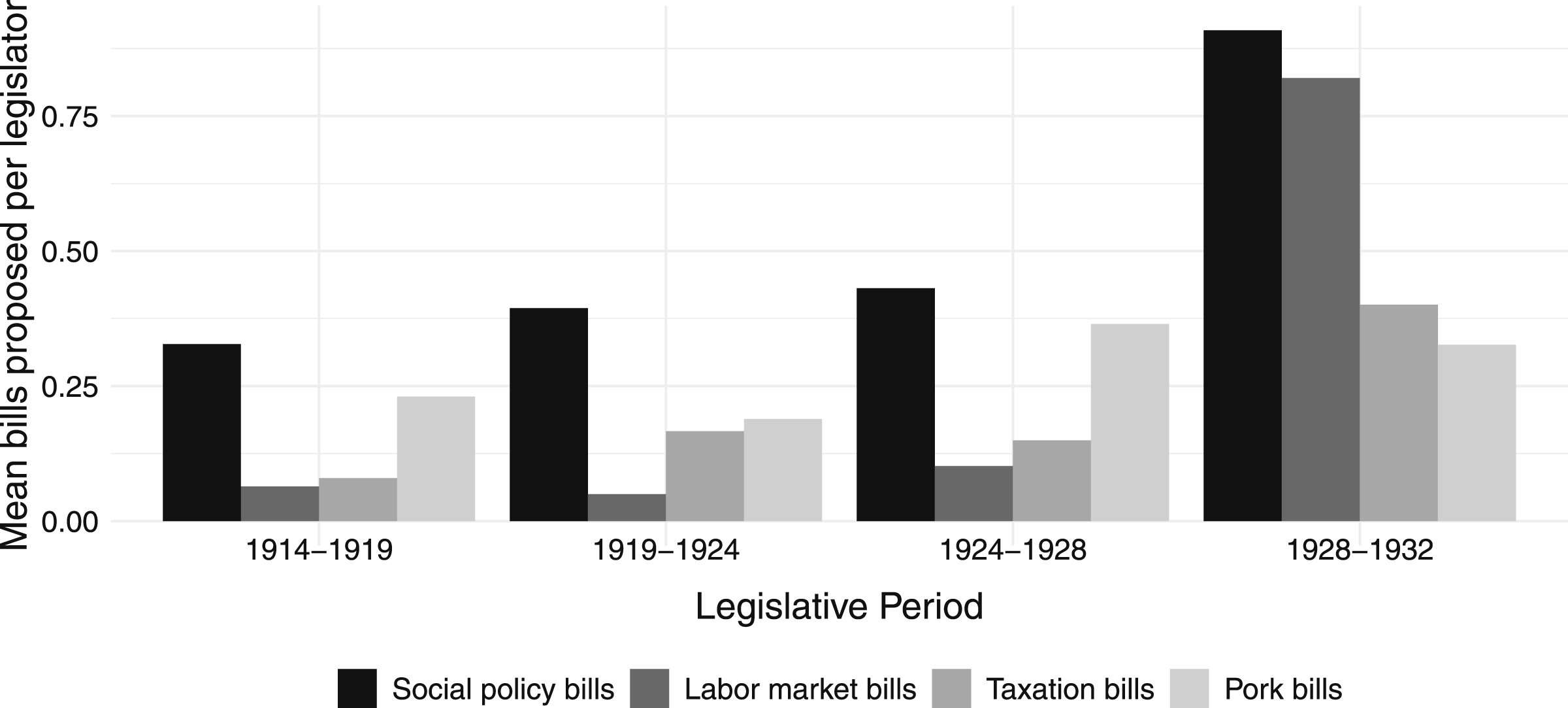
To measure politicians’ behavior as candidates, we code the programmatic content of the manifestos issued by candidates for the election of 1924 (under PR) and 1928 (under SMD). The source for this information is a publication of the manifestos (professions de foi) of all elected deputies (JORF, 1925; JORF, 1930). These manifestos were short documents (typically one to two pages in length) addressed from the candidate to the voters in his constituency. They typically included some biographical information, including the candidate’s past service to his constituency, along with political material ranging from denunciations of the incumbent government to warnings about the perils of socialism. Candidates usually made some statements about the groups in society that they stood for, but only some candidates made concrete policy commitments. Our sources only include the manifestos of winning candidates. This yields 542 observations of 271 legislators who won both elections. Using multiple researchers, we code the manifestos for programmatic policy content by examining whether the manifesto includes an endorsement of the following social, labor market, and fiscal policies: a commitment to provide public unemployment insurance, to establish or increase public pensions, to institute paid vacations, to institute a minimum wage, or to raise taxes on high incomes or wealth. 11 We develop a binary variable that indicates the presence or absence of a policy commitment in each of these domains for each candidate in each election, as well as a variable that reports the average support across these five policy areas. Information on the construction of each of these variables can be found in Appendix B and descriptive statistics in Appendix C.
Empirical Strategy
We first analyze the relationship between the electoral system and politicians’ behavior as legislators in the Chamber of Deputies. The complete specification takes the following form:

In an alternative specification, we use a continuous measure of district magnitude rather than a binary measure of the electoral rule in place. This takes the following form:

In what follows, we first report the results of simplified ‘baseline’ versions of these models that omit time-varying legislator and department characteristics (
These specifications also include a set of department-level control variables
Candidate Behavior
We then proceed to assess the relationship between the electoral system in place and politicians’ behavior as candidates. Our data on candidates’ manifesto commitments covers the 1924 and 1928 elections, conducted under open-list PR and SMD, respectively. We rely on a similar model to the one used to analyze incumbent behavior, which was discussed above. The model takes the following form:

Results
The results of our analyses are consistent with the view that the adoption of open-list proportional representation induced a decline in programmatic policy-making as politicians re-allocated effort toward non-programmatic intra-party competition. We begin by presenting the results concerning legislative behavior and then turn to the analysis of candidates’ manifesto commitments. 12
Legislator Behavior
The coefficient plot in Figure 3 below displays the estimated correlation between the presence of proportional representation and the number of bills proposed by French legislators in the Chamber of Deputies. The estimates depicted with diamonds are from an analysis using the baseline model (no time-varying controls) and the full data set covering four legislative periods (1914–1919, 1919–1924, 1924–1928, and 1929–1932), two of which were elected under the proportional rule (1919–1924 and 1924–1928). The estimates depicted with triangles are from an analysis using the model with time-varying controls covering the same period. The estimates depicted with circles are from an analysis that uses the baseline model and is restricted to the three postwar periods (1919 onward) to address concerns that the results are driven by wartime dynamics. The estimates depicted with squares are from an analysis using the model with time-varying controls covering the three postwar periods. The models estimated to generate these coefficients include legislator fixed effects, meaning that the estimates capture within-person variation in behavior across different electoral rules. The tabular version of the results reported in Figure 3 can be found in Appendix D. The relationship between open-list proportional representation and the number of bills proposed by each deputy in France’s Chamber of Deputies in the listed policy areas per legislative period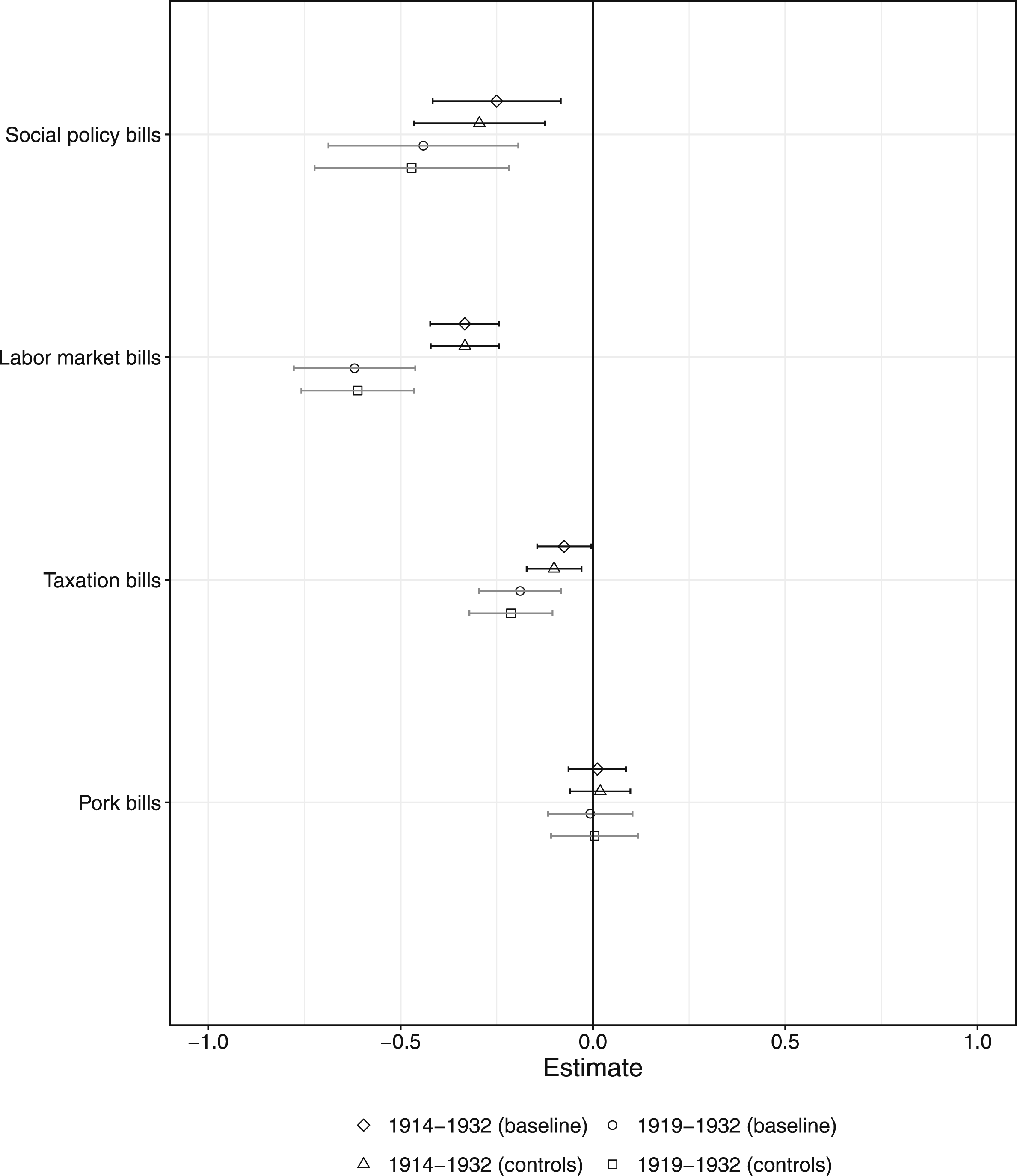
The coefficient plot in Figure 3 shows that proportional representation is associated with significantly fewer bill proposals per legislator in the areas of social policy, labor market regulation, and taxation. The baseline results from the analysis of all four legislative periods (diamonds in the plot) show that legislators proposed, on average, 0.25, 0.33, and 0.08 fewer bills in each of these policy areas under PR than under SMD (amounting to roughly a sixth, a third, and a 10th of a standard deviation). 13 When we restrict the analysis to the postwar legislative periods, we obtain similar and somewhat stronger results. The models with time-varying controls generate similar results. This supports the notion that legislators reallocated their efforts away from programmatic policy-making and toward other activities under open-list proportional representation. The results of the Poisson model, reported in Appendix O, are similar to those presented here.
The plot also shows that there was no statistically significant difference in the quantity of pork bills proposed by legislators under open-list PR and SMD. Taken together, the evidence indicates that the adoption of PR was followed by a decline in legislator efforts on behalf of programmatic policy but did not lead to a discernible spike in pork-barreling. This is consistent with the possibility that open-list PR induces legislators to devote greater effort to non-programmatic activities other than pork-barreling, as suggested by Carey and Shugart (1995). In general, the results presented in Figure 3 contradict the hypothesis proposed by Persson and Tabellini (2003), which was that the adoption of proportional representation should be followed by an increase in programmatic redistribution. We arrive at similar results when analyzing the behavior of legislators in each of France’s main party groups separately, indicating that our findings are driven by behavioral changes among legislators from across the political spectrum (Appendix M).
To further investigate the robustness of these findings, we widen the time frame of our analysis by incorporating observations from three earlier periods in which legislators were elected under SMD. These were the 1902–1906, 1906–1910, and 1910–1914 parliaments. Doing so increases the number of observations by close to 75% and allows us to track long-serving legislators over a greater span of their career in the Chamber of Deputies before the introduction of PR. The results, reported in Appendix I, are consistent with the findings reported in Figure 3, albeit at attenuated levels of significance in some models. In general, this analysis strengthens our confidence in the validity of the results on the consequences of PR adoption reported in Figure 3.
The Relationship Between District Magnitude and the Number of Bills Proposed by Each Deputy in France’s Chamber of Deputies in the Listed Policy Areas per Legislative Period
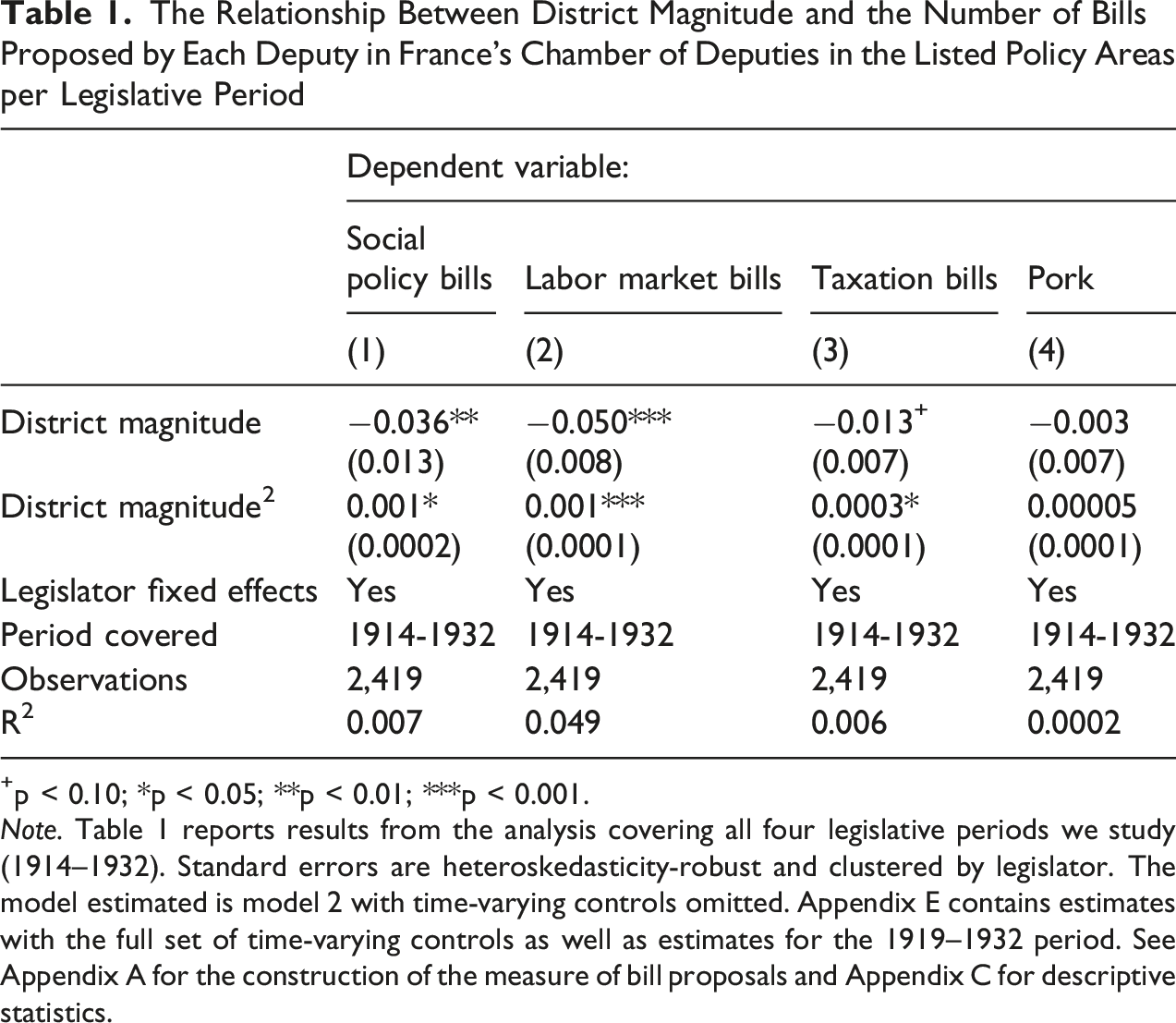
+p < 0.10; *p < 0.05; **p < 0.01; ***p < 0.001.
Note. Table 1 reports results from the analysis covering all four legislative periods we study (1914–1932). Standard errors are heteroskedasticity-robust and clustered by legislator. The model estimated is model 2 with time-varying controls omitted. Appendix E contains estimates with the full set of time-varying controls as well as estimates for the 1919–1932 period. See Appendix A for the construction of the measure of bill proposals and Appendix C for descriptive statistics.
The analyses reported in this section assess the relationship between electoral rules and legislator behavior using individual fixed effects. This addresses the question of whether the introduction of a new electoral rule induced legislators to behave differently than they had under the previous electoral rule. Naturally, this restricts the analysis to legislators who served in parliament under both electoral rules. To assess the overall consequences of electoral rule change for legislator behavior, it is also important to consider the effect that a change in electoral rules may have on the composition of the legislature, i.e., on the kinds of candidates who get elected. In addition to encouraging incumbent legislators to push for more programmatic policies than they had previously, the return to an SMD system for the 1928 election may have led to the replacement of some legislators with new, more vigorous advocates of programmatic policy expansion.
To assess the extent to which the behavior of legislators re-elected under SMD in 1928 differed from those who were newly elected in 1928, we first estimate a interaction model without legislator fixed effects. This allows us to study whether the ‘effect’ of SMD adoption in 1928 on programmatic policymaking was stronger among freshman legislators in the 1928–1932 parliament (for whom we have only one observation). The results, reported in Appendix J, show that the freshman legislators elected in 1928 were generally no more or less likely than legislators re-elected in 1928 to propose new bills in the domains of social policy, labor market regulation, and taxation. In other words, we observe that both new and experienced legislators proposed more programmatic policy bills in the 1928–1932 parliament than they or their counterparts had in earlier parliaments under OLPR. The same point can be shown by estimating a model that compares the behavior of re-elected legislators and freshman legislators in the 1928–1932 parliament. As shown in Appendix K, members of these two groups were generally not very different from one another in terms of the number of programmatic bills proposed during the 1928–1932 parliament, though freshman legislators were somewhat more likely to propose labor market bills and somewhat less likely to propose pork barrel legislation than were their more experienced counterparts. In general, these findings suggest that the return to SMD in France may have influenced programmatic policymaking both by changing the behavior of legislators who were already serving under the previous electoral rule and by facilitating the election of candidates committed to programmatic reform.
Candidate Behavior
The results we obtain from our analysis of candidate behavior are consistent with the findings from the analysis of legislative behavior in the preceding sub-section. The specification used to generate the results reported in Figure 4 below includes individual fixed effects. The models therefore compare winning candidates’ platform commitments in 1928 against their own commitments in 1924. The findings below show that the return to SMD for the 1928 elections was associated with an increase in candidates’ programmatic policy commitments in each of the five policy areas studied. In the baseline model, the return to SMD for the 1928 election is associated with a 5.6 point increase in average support for public unemployment insurance (p-value 0.025), a 6.7 point increase in support for public pensions (p-value 0.055), an 7.8 point increase in support for mandated paid vacations (p-value 0.000), an insignificant 3.0 point increase in average support for a minimum wage (p-value 0.157), and an 8.6 point increase in average support for tax hikes on high incomes (p-value 0.026). Thus, the coefficient reaches significance at the 90% level in four of five policy areas and significance at the 95% level in three of five. The coefficient for the shift in average support across the five policy areas is highly significant (p-value 0.00). These shifts amount to between a third and a seventh of a standard deviation in each area.
14
The results of the model with time-varying controls are quite similar. The full regression tables are available in Appendix G. Candidates’ likelihood of endorsing the listed policies in their campaign manifestos under SMD in 1928 compared to their likelihood of endorsing the same policies in their campaign manifestos under OLPR in 1924
It is important to note that these results are based on a source that only records the manifestos of winning candidates. This means that the estimates reported in Figure 4 may overstate the average change in candidates’ behavior induced by the return to SMD for the 1928 elections. This is for two reasons. First, candidates who failed to win election under OLPR in 1924 may have been more likely to make programmatic promises than those who won. This would be consistent with the theory that OLPR rewards politicians who engage in non-programmatic competition. Second, candidates who failed to win election under SMD in 1928 may have made fewer programmatic commitments than those who won. This would be consistent with the theory that SMD rewards programmatic competition relative to OLPR. In both ways, the absence of data on losing candidates upwardly biases our estimate of the ‘effect’ of SMD on candidates’ propensity to make programmatic commitments.
Despite this important limitation, the results presented in this section make clear that winning candidates became much more likely to make programmatic policy commitments after the return to SMD than they themselves had been under OLPR. In particular, we observe an increase in support for downwardly redistributive policy. The results presented here regarding candidate behavior are consistent with the findings on incumbent behavior presented above. The fact that these results support one another increases our confidence in the robustness of our findings regarding the effect of electoral systems on politician behavior. These results show that the politicians elected to the Chamber of Deputies in 1928 were already more committed to programmatic policy development than they had been in 1924, prior to the onset of the global economic crisis and several years before this crisis had serious repercussions for the French economy.
Alternative Explanations
A key limitation of a single-country study of national-level electoral system change like ours is that all units are ‘treated’ at the same time. We take several steps to ameliorate the inferential concerns that arise from this design. First, we conduct a series of placebo tests to examine whether we observe similar shifts in programmatic activity between legislative periods in which there is no change in electoral rules, going back to 1902. The results of these tests, reported in Appendix R, indicate that the behavioral changes documented above are indeed distinctive to the periods in which there was a change in electoral rules. Second, we develop a comparative case study between France and the United Kingdom in which we examine variation in the level of programmatic activity during the interwar period (as proxied by fiscal outcomes). This comparison shows that the United Kingdom experienced a surge in taxation and government expenditure after the First World War in a manner consistent with established theories of the relationship between war and programmatic reform (e.g., Obinger & Schmitt, 2020; Scheve & Stasavage, 2016). France, in contrast, remained at its prewar levels of taxation and government expenditure for most of the 1920s, despite much public discussion of the need for programmatic redistribution to compensate for wartime sacrifices (on which, Smith, 2018). Tax yields and public spending in France remained at their prewar levels until after 1928, when levels of taxation and public spending rapidly increased and converged with those of the UK. These findings, presented in Appendix S, are consistent with the idea that France’s adoption of open-list PR in 1919 stood in the way of a ‘normal’ path of postwar programmatic development (represented by the United Kingdom) by discouraging politicians from advocating for programmatic reform. The return to SMD for the 1928 elections may have allowed France to converge with the United Kingdom.
Still, it remains possible that changes in the behavior of French legislators during and after the 1928 elections were driven by factors other than those we have stressed above. First of all, it could be the case that the return to SMD influenced the behavior of legislators in a different way than the one conjectured above. Second, it could be the case that other changes within France around 1928 led to increase in programmatic policymaking and campaigning for reasons unrelated to the change in electoral system. Third, it could be that the changes in the electoral system we study were downstream from other changes in the political environment that affected levels of programmatic activity. Given the limits of our design, we now lay out possible rival explanations of the observed patterns and assess their plausibility in light of the evidence, as recommended by Stokes (2014).
Other Ways in Which the Return to SMD may Have Mattered
Some may wonder whether the change in electoral system prompted a change in the partisan composition of government that was more favorable toward programmatic reform. Yet as we discussed in the preceding section, the return to the SMD in 1928 did not induce a major shift in the partisan composition of the government. The conservative coalition led by Raymond Poincaré had been in office since 1926 and remained in office after the 1928 elections. As we show in Appendix F, the average partisan composition of cabinets during the legislative period from 1928 to 1932 was considerably more right-wing than the composition of cabinets from 1924 to 1928. Nor was there stronger pressure on the government from the left-wing opposition after the 1928 elections. The return to SMD reduced the share of legislative seats held by Communist Party deputies to half of what they had held under PR. If anything, this indicates that there was lower pressure for reform from the radical left than there had been previously. The most auspicious period for programmatic policy reform (in terms of the partisan composition of government) was during the period 1924-1926, when the center-left Cartel des gauches was in control. This is one reason why we might expect to see greater programmatic policy proposals under PR than under SMD. But we observe the opposite in all of the models analyzed above.
It is also worth considering how the change in electoral rules may have influenced the balance of power between party leaders and ordinary legislators. A recent line of scholarship argues that the adoption of proportional representation in European countries in the early 20th century led to the consolidation of control by party leaders over backbenchers (Cox et al., 2019; Schröder & Manow, 2020). Although this literature does not focus on the possible differences between open- and closed-list PR, it offers an alternative explanation for the lower levels of programmatic bill proposals by legislators in the French Chamber of Deputies during the PR interlude (1919–1928). This might reflect the consolidation of control over bill proposals by party leaders under PR. This ‘party consolidation’ hypothesis runs against the argument we have proposed above, which is that the relatively low number of programmatic bill proposals under OLPR reflected the dissipation of legislators’ energy in non-programmatic intra-party competition. To assess the plausibility of the ‘party consolidation’ hypothesis, we examine the standard deviation in the number of programmatic bills proposed by each legislator during each of the four legislative periods under study. If the ‘party consolidation’ hypothesis explained the variation we study, we would expect to see an increase in the standard deviation in the number of bills proposed per legislator during the PR interlude, since control over proposals would become more concentrated in the hands of party leaders. The data, however, shows the opposite: the standard deviation in the number of bills proposed per legislator is actually highest in the 1928–1932 period, after the return to SMD. This is reported in Appendix P. This indicates that the relatively low number of programmatic bill proposals per legislator under PR was not driven by the consolidation of proposal authority by party leaders.
A further point worthy of consideration is that the law that returned France to SMD was enacted in July 1927. In principle, the anticipated return to SMD may have affected legislator behavior during the latter part of the second legislative period under PR (1924–1928). This is not implausible: after all, the Chamber of Deputies voted for a major social insurance law (Loi sur les assurances sociales) in mid-March of 1928 (promulgated on April 5), weeks prior to the election. The law was a major breakthrough in the history of the French welfare state, creating a contribution-based social insurance system that covered the risk of earnings losses due to sickness, injury, and old age, among other things (Valance, 2017, p. 426). As Dutton reports with regard to the passage of the social insurance law, “critics of the legislation immediately attributed the law to election eve campaigning” (Dutton, 2002, p. 103). Whatever the truth of this hypothesis, the crucial point for our purposes is that any behavioral response by legislators to the anticipated return of SMD biases our analysis in favor of a null result. Behavioral responses of this sort would occlude the difference between candidates’ behavior under open-list PR and SMD, since any bill advanced in anticipation of the return to SMD would be counted as a bill advanced under open-list PR.
Other Factors That may Have Affected Programmatic Policymaking
It is also possible that the increase in programmatic campaigning and legislating from 1928 onward occurred for reasons unrelated to the change in electoral system. One might conjecture, for example, that the change in politicians’ behavior was driven by changes in economic conditions. We do not observe a major shift in economic conditions around 1928, however. On the whole, France enjoyed considerable growth throughout the 1920s, with industrial production increasing from 55% of its prewar level in 1921 to 139% in 1929 (Guieu, 2015, p. 368; also Bernard & Dubief, 1988, pp. 135–140). As Becker and Berstein put it, the decade was one of “spectacular growth” for French industry (Becker & Berstein, 1990, p. 314; Valance, 2017, 426; also Guieu, 2015, pp. 368-69; Kemp, 1971, p. 86; Jackson, 1985, p. 11). Poincaré’s program of monetary stabilization had induced a mild recession from 1926 into 1927, but this was overcome and the country remained on a steady trajectory before and after the 1928 election. France was not immediately buffeted by the downturn emanating from the United States in 1929. Investment and growth remained strong in France through the better part of 1930 (e.g., Eichengreen & Wyplosz, 1986, pp. 1-2; Jackson, 1985, p. 24), in part because of France’s relative insulation from the world economy.
France began to suffer severely from the global depression only at the end of the 1928-1932 legislative period, beginning toward the end of 1930 but especially in the wake of Britain’s departure from the gold standard in September 1931 (e.g., Kemp, 1971, p. 89). Jackson (1985, pp. 28-29) notes the persistent optimism that France would avoid mass unemployment and concludes that the “issue of unemployment” did not even begin to be discussed in Parliament until February 1931. Unemployment did not peak until 1935 (Jackson, 1985, p. 30). In short, most of the 1928–1932 legislative session was held under basically normal economic conditions. As Bernard and Dubief (1988, p. 173) write in their authoritative study of interwar France, the disaster on Wall Street “in no way affected the public’s quiet optimism or the government’s general satisfaction…1929 and 1930 were the peak years of French prosperity between the wars.” They add that “parliamentary life went on up to 1932 in the illusion of prosperity” (175). These scholars’ conclusions support our confidence that the increase in programmatic social policy proposals after the return to SMD in 1928 was not driven by the Depression, but rather by the changed institutional incentives facing individual legislators.
Even if it were the case that some of the programmatic bills proposed in the Chamber of Deputies during the 1928–1932 legislative period were motivated by concerns about a possible economic downturn, this would not explain the increase in programmatic content in candidates’ manifestos between 1924 and 1928, which was documented above. Since the 1928 election preceded the first signs of the downturn in France by more than two years, any observed variation in manifesto content cannot be attributed to concerns about an economic downturn. This increases our confidence that the results documented above are not driven by macroeconomic turbulence.
A further possibility is that the increase in programmatic campaigning and policymaking was somehow a consequence of the stabilization of the exchange rate in 1926 and the formal restoration of the gold standard in June 1928. On closer inspection, however, this view makes little sense. The Poincaré government, which oversaw the stabilization of the franc and its restoration to the gold standard, did not see this success as a rationale for increases in taxation or public spending. Rather, Poincaré expressly committed the government to a restrictive fiscal stance following the 1928 elections (Journal Officiel 1928a, Dèbats Chambre, 7 June 1928). More broadly, the restoration of the gold standard entailed a renewed commitment to orthodox principles of public finance (Eichengreen, 1996). For proponents of these principles, large-scale redistribution would only lead to capital flight and an unacceptable drain on gold reserves. The imposition of worker-friendly labor market regulations would stand in the way of the downward wage adjustments necessary to maintain external balance in the absence of exchange rate flexibility. The return of the franc to gold could therefore hardly be seen as providing a green light for politicians to militate for programmatic redistribution through the fisc or an increase in labor market regulation. It is implausible that the increase in programmatic activity during and after the 1928 election campaign was a consequence of the establishment of the ‘franc Poincaré.’
Did things change after Poincaré’s departure for health reasons in mid-1929? As shown in Appendix F, all of the cabinets during the 1928–1932 legislative period were conservative. So it is far from clear that Poincaré’s departure created a more favorable political climate for programmatic reform. It is true that Poincaré’s successor as prime minister, André Tardieu, was a conservative of a somewhat unconventional and interventionist bent who advocated for ‘national retooling’ (outillage national) through a campaign of public investment (e.g., Anderson, 1974, pp. 55–58). It is possible that this subtle change in the ideological complexion of the cabinet induced legislators in the Chamber of Deputies to advance more bills favoring increases in public spending, taxation, and labor market regulation than they would have otherwise. But this is unlikely to account for the changes in programmatic activity documented above. As we saw above, candidates in the 1928 election were more likely to advocate for programmatic redistribution than they had been in 1924. These developments considerably precede Tardieu’s ascent to the position of prime minister in November 1929. Even if we restrict the analysis to politicians of the republican right (the group that included Poincaré, Tardieu, and other conservatives), we observe that these politicians were significantly more likely to make programmatic commitments in the 1928 campaign than they had been in 1924. This is shown in Appendix L. This indicates that the increased interest in programmatic reform among conservatives in the Chamber of Deputies precedes Tardieu’s ascent and more plausibly reflects the electoral incentives created by the return to SMD.
Endogenizing Changes in Electoral Rules
This paper attempts to assess the effect of changes in electoral rules on politicians’ behavior. The fact that electoral rules are chosen for political reasons imposes an important limitation on our ability to draw sound inferences about the effects of changes in electoral rules. It could be that both a change in electoral rule and an associated change in politicians’ behavior are determined by some underlying change in the political environment. This could lead to biased estimates of the effect of changes in electoral rules on politicians’ behavior. In our setting, it could be the case that the French parliament adopted OLPR in 1919 in an attempt to accommodate a prior increase in intra-party competition. If true, it would be misguided to ‘blame’ OLPR for a high level of intra-party competition and a low level of programmatic activity during France’s OLPR interlude (1919–1928). Likewise, it could be that the French parliament voted to return to SMD for the 1928 election because a decline in intra-party competition over the preceding years had rendered this accommodation obsolete. This would imply that SMD itself did not encourage programmatic policymaking in place of non-programmatic party infighting.
This inferential challenge arises from the fact that electoral rules are not randomly assigned. This is no easy problem to overcome. Yet several considerations suggest that the adoption of OLPR in 1919 and the return to SMD for the 1928 elections were not motivated by underlying changes in the level of intra-party competition. First of all, other considerations appear to have been more significant in the adoption of open-list proportional representation in 1919. The existing literature indicates that the adoption of OLPR was the result of an alliance of convenience between conservatives and Socialists against the Radicals, while the return to SMD was motivated by the widespread desire to squeeze out the Communists (Ahmed, 2013; Ehrhard & Passard, 2020). Second, we observe significantly lower levels of programmatic bill proposals under OLPR for members of every party group in the Chamber of Deputies. The estimates for each party group are reported in Appendix M. This weighs against the view that the documented over-time variation in the number of programmatic bill proposals is a product of underlying changes in the level of intra-party competition, since an increase in the level of intra-party competition within one party is unlikely to coincide with an increase in the level of intra-party competition in another party unless the shift is driven by some structural feature of the political environment, such as a change in electoral rules.
There is also a subtler source of potential endogeneity having to do with the choice of district magnitude under proportional representation. In the context of a switch from SMD to PR, parties with geographically concentrated bases of support may manipulate the magnitude of multi-member districts in order to achieve an electoral advantage: specifically, they may advocate for low-magnitude districts in their geographic strongholds to benefit from the relatively high vote-seat disproportionalities that can arise in such districts (Walter & Emmenegger, 2023). In the French case, the district magnitudes under OLPR were determined by a compromise that established the existing departments as electoral districts and determined the magnitude of these districts on the basis of the number of deputies elected from constituencies in each department under the old single-member rule. This compromise ruled out any fine-grained gerrymandering of electoral districts under OLPR. Still, it is plausible that this compromise emerged as a concession to parties whose support was based in small towns and rural areas (such as the Radicals) and who may have therefore favored low-magnitude districts. If these parties were also disinclined from making programmatic policy commitments, one might find lower levels of programmatic policy advocacy in low-magnitude districts under OLPR because non-programmatic parties favored low-magnitude districts and not because low-magnitude multi-member districts discourage programmatic competition, as we have argued. 15 We address this issue by estimating a version of the district magnitude model that includes only Socialist deputies, a party with relatively strong programmatic commitments that would likely have benefited from higher-magnitude districts under OLPR. Even when restricting the analysis to Socialists, our results hold. The regression results are shown in Appendix N. This reinforces our confidence in the validity of our findings.
To be sure, this paper cannot rule out the existence of lurking confounders that might explain the increase in programmatic policymaking during and after 1928. Nor can it negate the possibility that the changes in electoral rules were endogenous to features of the political environment that might also affect programmatic policymaking. These limitations reflect our research design, which studies the relationship between a national-level policy change and politicians’ behavior in that country. Even so, the rival explanations canvassed in this section fail to offer a plausible account of the patterns documented in the preceding sections. It should therefore come as no surprise that scholars of French history have treated the increase in programmatic policymaking after 1928 as something of a mystery. Serge Berstein, France’s most renowned historian of the period, noted that the 1920s were a “low point in the area of social legislation. After the passage of the law on the 8-hour day in April 1919 and the legal recognition of collectively bargained contracts, it was necessary to wait until 1928 before things began to move again” (Berstein & Milza, 1990, p. 428). More recently, Guieu has concurred with this assessment, stating that the “social conquests were rather modest” for most of the decade (Guieu, 2015, p. 385). This paper has drawn on social-scientific theories of the effects of electoral rules to explain the pace of reform in interwar France.
Conclusion and Implications
What drives politicians in democracies to make programmatic policy commitments? In this paper, we have examined the relationship between electoral rules and programmatic policy development. A prominent body of research, especially by economists, suggests that the adoption of proportional representation should generate stronger incentives for politicians to compete on the basis of programmatic policies that benefit voters irrespective of their place of residence. In particular, proportional representation is thought to spur the introduction of redistributive social programs, yielding larger welfare states (Persson & Tabellini, 2003). A competing line of scholarship by political scientists has challenged this conclusion, arguing that proportional representation systems differ radically from one another in terms of the electoral incentives they generate for programmatic policy-making. According to the latter view, the stylized contrast between single-member and proportional electoral systems obscures more than it clarifies. Some kinds of PR systems – in particular, open-list PR – may actually generate weaker incentives for programmatic appeals than do single-member systems. This is because open-list PR may push politicians to dissipate their energies in non-programmatic intra-party competition (Carey & Shugart, 1995).
Progress on this question has been hindered by the fact that electoral systems rarely change, generating few opportunities for the kind of within-country comparisons that are the most plausible way of studying how electoral rules shape politicians’ behavior. Moreover, scholars are usually unable to directly measure the individual-level behaviors predicted by existing theories. This paper attempts to overcome these limitations by leveraging the adoption and subsequent abandonment of open-list proportional representation in Third Republic France. Using original legislator-level data hand-coded from historical sources, we have examined how open-list PR affected politicians’ behavior as both incumbents and candidates. Our results show that under proportional representation, French politicians were less likely to propose programmatic social policies and less likely to campaign on programmatic policy promises than they themselves were under the single-member electoral rule.
The evidence presented in this paper indicates that open-list proportional representation generates weaker incentives for programmatic policy development than does a single-member rule. This does not mean, of course, that SMD is the ideal system if the goal is to maximize programmatic electoral competition. Closed-list PR may still outperform single-member majoritarianism in terms of generating incentives for legislators to invest in programmatic redistribution. The point of this paper is to throw light on the relative standing of open-list PR and SMD with regard to candidates’ incentives to form programmatic linkages with voters.
Due to several important empirical limitations, this paper cannot decisively resolve the scholarly disagreement about the effects of different electoral systems on politicians’ incentives to supply programmatic policy. First of all, the changes in electoral rules that we study in this paper may have been endogenous to other changes in the political environment in interwar France that could have also exerted a direct influence on politicians’ behavior. Second, we lack a control group of French legislators who were unaffected by the changes in electoral rules, preventing us from cleanly separating the effect of rule changes from other features of the political environment that may have changed at the same time. Third, our analysis focuses on winning electoral candidates and legislators in parliament, introducing potential bias from the omission of losing candidates who faced the same electoral rule but perhaps behaved in systematically different ways. Fourth, our study is restricted to a single historical case with many distinctive features: among other things, France operated under an unusual form of SMD involving a second-round runoff and experimented with an unusual form of open-list PR that granted a considerable premium to lists that won a majority. These French peculiarities would impose a constraint on the generalizability of our findings even if the first three problems listed above were resolved.
Even with these limitations in mind, this paper’s findings indicate that scholars should retire the stylized distinction between proportional and single-member systems as a heuristic for predictions about legislators’ incentives to push for programmatic redistribution. This means that theories connecting proportional representation to welfare state development must be rethought with more attention to institutional variation among proportional regimes. When it comes to electoral rules and the incentives they generate, the devil is in the details.
Supplemental Material
Supplemental Material - Electoral Rules, Programmatic Competition, and Redistribution: Evidence From Interwar France
Supplemental Material for Electoral Rules, Programmatic Competition, and Redistribution: Evidence From Interwar France by Isabela Mares, Alexander Trubowitz in Comparative Political Studies.
Footnotes
Acknowledgements
We thank Carlo Prato, Travis Johnston, Zoey Xu, and panel participants at APSA 2023 for feedback on an earlier version of this paper and Houssam Kabli for excellent research assistance. We are also grateful to the editor and to our anonymous reviewers for helpful suggestions.

Funding
The authors received no financial support for the research, authorship, and/or publication of this article.
Declaration of Conflicting Interests
The authors declared no potential conflicts of interest with respect to the research, authorship, and/or publication of this article.
Data Availability Statement
Replication materials are available in Harvard Dataverse (Mares and Trubowitz, 2026).
Supplemental Material
Supplemental material for this article is available online.
Notes
Author Biographies
References
Supplementary Material
Please find the following supplemental material available below.
For Open Access articles published under a Creative Commons License, all supplemental material carries the same license as the article it is associated with.
For non-Open Access articles published, all supplemental material carries a non-exclusive license, and permission requests for re-use of supplemental material or any part of supplemental material shall be sent directly to the copyright owner as specified in the copyright notice associated with the article.
