



Abstract
This article engages in the debate on (the study of) regionalism in providing an overview of the nexus between European Studies (ES) and (New) Regionalism (NR). While the immediate purpose for doing so is to set the stage for the future debate on regional dynamics, this exploration can also be perceived as a case study into (the plurality of forms of) inter/intra-disciplinary dialogue demonstrating the necessity of engaging in ‘dialogues about dialogues’. The article starts by developing a new typology of four different ideal-typical notions of dialogue: hierarchical, reflexive, transformative and eristic models of dialogue. Each of these models is then used to examine different ways of answering questions about why a dialogue between ES/NR should be of interest or not; what ES has to offer; what the coveted impact of such a dialogue is supposed to be; and, finally, which promises and pitfalls such a conversation holds. In this fashion, the stage for future debate addressing regional integration is outlined. It is concluded that these futures look bleak, however, especially because ES and NR no longer appear as each other’s ideal partner-in-dialogue and the relationship is likely to come to an end and hence await its own funeral.
Introduction
This article engages in the debate on (the study of) regionalism by examining the nexus between the fields of European Studies and (New) Regionalism. 1 The immediate purpose for doing so is to set the stage for future debates on regional dynamics in Europe and elsewhere. However, exploration of the encounter between the two fields of study can also be perceived as a case study demonstrating the necessity of engaging not only in dialogues but also in ‘dialogues about dialogues’ as well as the usefulness of doing so by means of a new analytical framework, specifically a typology of models of dialogue. This additional feature is a direct result of a deliberate choice between the various possibilities to structure this overview.
One possible way of structuring an overview of the nexus between European Studies and the field of (New) Regionalism would be to organize it according to a historical principle and subsequently provide a reading of the evolution of this field of study (Jupille, 2006; Keeler, 2005; Rosamond, 2007; Warleigh, 2004; Warleigh-Lack and Phinnemore, 2009). Such a narrative could be divided into a number of stages based on claims about the rise and fall of various theoretical approaches. It would possibly go something like this: The 1950s and 1960s were characterized by normative federalist thinking, by David Mitrany’s functionalism and Karl Deutsch’s account of transnational security communities (Deutsch et al., 1957; Mitrany, 1943). The publication of Ernst Haas’s The Uniting of Europe (Haas, 1958) proved significant for subsequent developments, as neo-functionalism and other grand theories were created. By the mid-1970s, however, neo-functionalism was deemed obsolete by its own creator (Haas, 1975). A decade on, neo-functionalism was revived and updated, only to be challenged by liberal inter-governmentalism (Moravcsik, 1998). The 1990s also gave rise to comparative politics perspectives in European Studies (Hix, 1994). At the turn of the new millennium, the focus shifted to constructivism and the ‘normative turn’ characterized by an emphasis on issues related to democracy and legitimacy. This narrative is far from the only possible way of telling this story. As Ben Rosamond (2007) reminds us, the way the past is presented is often intimately linked to specific theoretical or social scientific preferences located in the present or projected into the future (see also Schmidt, 1998, 2002). Hence, a number of other stories can also – and have been – told (Rosamond, 2007). Instead of presenting yet another ‘true but untold’ story about the history of European Studies, an alternative and more (self-)critical strategy would be to engage in ‘double readings’ of existing narratives in order to uncover how the past is constructed through the perspective of the present (Rosamond, 2007).
While these options have merits, they have been avoided in this contribution. Instead, the article presents yet another way of structuring a theoretical review of European Studies and (other) regionalist literatures. This owes to the specific purpose of carrying out this exercise, i.e. offering an overview of the various theoretical interpretations of the regional dynamics while also highlighting the EU’s specific role in its development. In other words, the overview is meant to bring European Studies into some kind of dialogue with various parts of the wider (new and old) regionalist field of study. This is hardly the first time that there have been such calls for exchanging insights from studies of the European integration process and of regional integration initiatives elsewhere. Recall for instance the promises of neo-functionalism, which originally aspired to worldwide applicability. However, the goods European Studies is perceived as having to offer does depend greatly on how one imagines this dialogue. Thus, the key argument of this article is that different forms of conversation will relate to different assumptions of the purpose, procedure and product as well as the associated promises and pitfalls. Moreover, there is also the question about who is the best-suited ‘partner-in-dialogue’. Against this background, it is useful to allow the issue of inter/intra-disciplinary dialogue (see also Cini, 2006; Warleigh, 2004), or, more specifically, different forms of such a conversation to function as the structuring principle for this overview of theoretical perspectives.
The article therefore starts by developing a new typology of four different ideal-typical models of dialogue, which in the present context can be conceived of as a meta-study methodology. 2 The remainder of the article relates each of these forms of dialogue to examining different ways of answering questions about why a dialogue between European Studies and the larger (new) regionalist field of study should be of interest or not; what European Studies has to offer; and what the coveted impact of such a dialogue is supposed to be. In other words, what is the assumed purpose, procedure and product of each kind of dialogue, and which promises and pitfalls does such a conversation hold?
In this fashion, the scene is set for future debates on European and new regionalist studies. However, conceptions of European Studies and EU Studies, respectively, almost vary by the individual scholar and are, thus, in dire need of some serious consensus-making processes. In the midst of such definitional pluralism, some opt for their own subjective views, claiming, for example, that European Studies is the broad church bringing together all disciplines sharing an interest in Europe (Rumford and Murray, 2003), while EU Studies focuses strictly on one aspect of Europe, the European Union, and typically from a slightly narrow Political Science perspective (Cini and Bourne, 2005). In this article, we opt for a pragmatic approach and use the terms interchangeably. Moreover, the article focuses deliberately on encounters between four fields of study: European Studies, old and new regionalism, political science and International Relations. This explicit delimitation can also be seen as an invitation to others to apply the analytical framework when examining other encounters, e.g. between European Studies, regionalism and sociology. The article concludes that the future of debates between these fields of study looks bleak, especially because the relationship is likely to come to an end and, hence, awaits its own funeral. In other words, while both European Studies and the field of new regionalist studies are possibly interested in engaging in dialogues, they do not (any longer) appear as each other’s ideal ‘partner-in-dialogue’.
Dialogue on dialogues – four models of dialogue between fields of study
As explained above, the structuring principle of this article’s examination of the nexus between European Studies and New Regionalism relates to the issue of inter/intra-disciplinary dialogues. When discussing dialogues, the focus is usually on whether or not some kind of exchange is something to strive for, either between disciplines (inter-disciplinarity) or between the subfields of a given discipline (intra-disciplinarity). In such discussions, some will usually argue that inter/intra-disciplinary dialogues are important, as they render it possible to create what Robert Ward once coined as ‘the new scholar’; a person with ‘two skills in one skull’ (1975). This view is often countered by an argument as to how these kinds of dialogue are nothing but a dead-end, as they will only produce scholars that are ‘jacks of all trades, but masters of none’ (Nissani, 1997: 212; see also Beier and Arnold, 2005; Jacobs and Frickel, 2009; Klein, 1996).
Instead of engaging in this discussion, it is more interesting and rewarding for the present context to direct attention to how this whether-or-not question is far from the only point of dispute related to the issue of inter/intra-disciplinary dialogues. Upon closer inspection, it thus appears as though an agreement in principle regarding the desirability of inter/intra-disciplinarity does not necessarily also turn into consensus as to why and how such dialogues should take place or, for that matter, what is supposed to be exchanged and with which outcome. Along with the emergence of a ‘dialogical turn’ (Camic and Joas, 2004; see also the recent special issue of Millennium – Journal of International Studies, 2011), ‘dialogue’ has thus turned into ‘a weasel word, one that inevitably ends up meaning different things to different people’ (Burbules, 2000: 252). Besides disagreements concerning the specific level on which such a dialogue is supposed to take place, e.g. at an individual, institutional or disciplinary level (Valbjørn, 2008a: 70), and the primary target for a dialogical enrichment, e.g. specific persons, theories, paradigms or disciplines (Lapid, 2003: 129), this is also reflected in very different models of inter/intra-disciplinary dialogue. These are associated with different notions about the purpose, i.e., why is a dialogue assumed to be of interest, the procedures, i.e. how is a dialogue supposed to take place, and the product of this conversation; i.e. to what extent is a dialogue assumed to leave a field of study basically unaltered; to cause changes within the field of study, in terms of revisions of theories and concepts, but without changing the disciplinary boundaries; or to trigger a more radical transformation of a field of study in terms of the emergence of completely new ways of organizing academia as such. Besides that, there is the not less important question about who the best-suited partner-in-dialogue is supposed to be. The purpose here is not to make any normative judgements on whether one specific model of dialogue is better than others. The purpose is rather to bring attention to the importance of also engaging in what Yosef Lapid has coined as a ‘dialogue about dialogues’ (Lapid, 2003). The following section therefore identifies and compares four different ideal-typical models of inter/intra-disciplinary dialogue, each associated with different notions about the purpose, procedure and product of the dialogue.
Four models of dialogue a
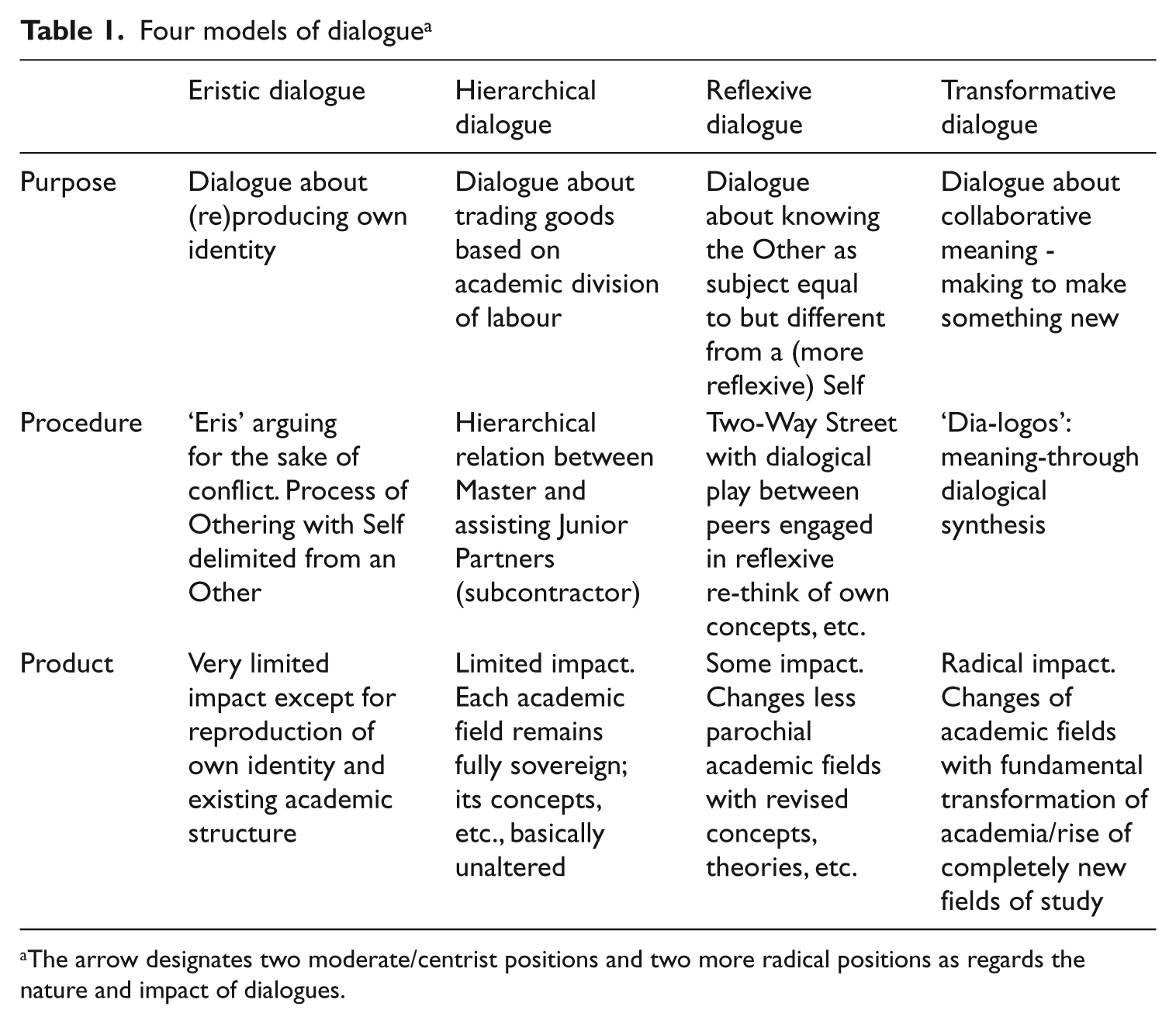
The arrow designates two moderate/centrist positions and two more radical positions as regards the nature and impact of dialogues.
The hierarchical model 3
The first of these ideal-types is the hierarchical model of inter/intra-disciplinary dialogue, which shares similarities with ideas in neo-classical economic theory on comparative advantages (Weldes et al., 1999: 21). It is grounded in a kind of complementary notion of a division of labour, where academia is perceived as being divided into a number of academic fields, each endowed with different but tradeable ‘goods’ such as theories, concepts, methods or specific kinds of empirical data. From this perspective, the purpose of inter/intra-disciplinary dialogue then becomes an issue of trading goods. For instance, if culture becomes a topic of interest to the study of international relations, as the case has been during the Cultural Turn (Lawson, 2006; Valbjørn, 2008b), IR should turn to the academic ‘possessor’ of culture: Anthropology. Anthropologists would then tell IR scholars about culture. In exchange, the latter will explain the state and the international system to the anthropologists (Weldes et al., 1999). On the surface, this exchange may appear as a complementary process, profitable to all and harmful to none involved. However, according to Weldes et al.– recalling the Marxist critique of capitalist economy – this kind of trading appears upon closer inspection to take place on uneven terms, as the procedures of the exchange are based on a hierarchical relationship. Some academic fields are considered ‘masters’ assuming the intellectual leadership, e.g. because they possess what is considered the most valuable goods and consequently define the terms of the relationship. Other fields of study are in turn only granted the role as ‘assisting junior partners’. They must submit to the wishes of their academic master, and their value is defined by their ability as subcontractors to deliver ‘raw materials’. An illustrative example of this view can be found in the Area Studies Controversy, 4 where advocates of a disciplinary perspective occasionally compare the field of Area Studies with a ‘gas station’, the primary function of which is to provide ‘local empirical data’ to be used in the testing of (grand) theories developed within the superior disciplines (e.g. Bates, 1996). Within IR, this attitude can for instance be found in Barry Buzan and Ole Wæver’s regional security complex theory, which is presented as a ‘matrix for area studies’. Even if credit is given to area specialists ‘on whose work we have drawn heavily’, Area Studies appears at closer inspection most of all as owners of local empirical data that can be purchased and appropriated for a substantially unaltered general theoretical framework for regional security (Buzan and Wæver, 2003).
Compared with some of the other models, the expected impact – or product – of this exchange is limited. Both academic fields are thus believed to remain sovereign, discrete and essentially the same, not least because the imported ‘goods’ are not assumed to impact on their identity, basic nature or existing key concepts, categories or theories. Hence, this exchange will, if anything, most likely only contribute to the reproduction of the already existing hierarchical academic division of labour.
The reflexive model of dialogue
Instead of using an analogy about the (uneven) exchange of goods in a capitalist market, the reflexive model of dialogue is closer to some of the ideas found in recent discussions about a ‘dialogue between civilizations/cultures/religions’ (cf. Dallmayr, 2002). This debate is usually based on the recognition of a plurality of different but equal cultures/civilizations, each marked by distinct values and visions. This leads to a Todorov’ian understanding of dialogue, where a dialogical conversation is supposed to be based on knowing and treating the ‘other-as-subject, equal to the I but different from it’ (Inayatullah and Blaney, 2004: 163; cf. Todorov, 1984). Accordingly, the purpose of these kinds of inter-civilization dialogues is neither to impose a superior civilizational vision upon the other nor to pave the way for some new universal civilization. Instead, the aim is to promote a more advanced understanding of the other while at the same time catalyzing a self-reflection process leading to a better, less parochial self-understanding.
From this perspective, the procedure of an intra/inter-disciplinary dialogue should appear as a two-way street conversation between peers. It should assume the form of a dialogical play between the taken-for-granted common sense of the participants and, insofar as they are testing their own prejudices against those of the other, they may end up undermining or transforming said prejudices (Weldes et al., 1999: 24). Although each academic field is assumed to continue to exist as a separate and distinct field, this last dimension indicates how the expected impact – or product – of this kind of dialogue is more extensive than the first model. As the participants in this dialogue will not only come to know the other better but also reach a better understanding of themselves, this kind of dialogue is expected to lead to changes within each academic field as reflected in a reflexive rethinking and contextualization of own categories, theories and concepts. This was the case when Michael Barnett engaged Middle East scholarship and Constructivist IR in an interdisciplinary dialogue addressing Arab politics. This dialogue clarified to Barnett how ‘IR theory can help us to better understand the making and unmaking of Arab politics and how its making and unmaking can help scholars of IR theory think more analytically and creatively about global politics’ (Barnett, 1998: 24).
The transformative model of dialogue
Much of the debate on inter/intra-disciplinarity revolves around the hierarchical and reflexive models of dialogue. However, if a continuum of models of dialogue is imagined, it also becomes possible to identify (at least) two more ideal-typical positions situated closer to each of the two poles as regards the impact – or product – of the dialogue. The first of these is the Transformative Model of Dialogue, which shares some of the assumptions concerning self-reflection also found in the former reflexive model. However, the purpose and intended product of this conversation is much more radical. Thus, this third model follows David Bohm’s (1996: 2) depiction of a dialogue as a ‘process of collaborative meaning making’ and draws on the original Greek meaning of the term dia-logos, ‘meaning-through’, to be understood as ‘an effort by two or more people to make something new together’ (Lapid, 2003: 130, our italics).
Against this background, the purpose of an inter/intra-disciplinary dialogue is to make what Gunther Hellmann (2003: 150) coins a ‘dialogical synthesis’. In other words, instead of only striving for changes within specific academic fields, the intended product of this dialogue is changes of these fields as part of a more fundamental transformation of academia as such. This much more radical vision is represented in Immanuel Wallerstein’s call to Open up the Social Sciences (1996). Here, Wallerstein argues how the existing academic division of labour rests on obsolete ‘meta-boundaries’ from the 19th century. In order to make these fit the 21st century, he finds it necessary to restructure the social sciences in a fundamental manner. Such restructuring can give rise to new fields of study such as the one Neil Waters (2000) calls ‘New International Studies’, which is the product of a ‘dialogical synthesis’ between IR and Area Studies; alternatively, it can pave the way for what Stephen Rosow (2003) presents as ‘anti-disciplinary Global Studies’. Instead of only destabilizing existing disciplines, the very idea of academic disciplines is here questioned in favour of an academic world of networks in which multiple forms of knowledge are possible without building some secure body of sovereign disciplines (cf. Mitchell, 2003).
The Eristic model of dialogue
At the other end of this imaginary spectrum of models is the fourth ideal-typical form of intra/inter-disciplinary engagement: the Eristic model of dialogue. ‘Eristic’ derives from the ancient Greek word Eris, referring to a wrangle or strife. Contrary to the former models, where a dialogue has been related to the trade of academic goods (the hierarchical model), de-provincializing self-reflexions (the reflexive model) or synthesis-making (the transformative model), dialogue in this last model is first and foremost about arguing for the sake of conflict, fighting and seeing who can yell the loudest. This does not mean that this is nothing but a pseudo-dialogue without any distinct purpose. From a constructivist perspective, the construction of an apparently stable identity is associated with a process of othering, where a ‘Self’ is delimited from an ‘Other’, which is represented as different (Hopf, 1998; Rumelili, 2004). Accordingly, the purpose of a dialogue will be to (re)produce a distinct (sub-)disciplinary identity. A distinct and curious feature of this kind of dialogue is that the nominal partner-in-dialogue primarily fulfils the function as the ‘significant other’, whereas the actual conversation often takes place among members within the same academic field discussing how ‘we’ are different from (and superior to) ‘them’.
Although this kind of dialogue has received limited attention in discussions addressing inter/intra-disciplinary dialogues, it nevertheless appears to be much more prevalent than usually acknowledged. Much of the recent dialogue between disciplinary-oriented scholars and regional specialists within the aforementioned Area Studies Controversy has assumed this form of mutual mud-slinging in which both fields have reproduced their respective identities (Valbjørn, 2004). Similarly, it is also rewarding to perceive many of the so-called ‘Great Debates’ within IR in these terms (Wæver, 1996). Recall for instance the so-called ‘First Great Debate’ between Idealists and Realists in the Inter-War years, which appears to be much of a myth. Little dialogue took place between the two strands, as the former were far too busy saving the world from future wars. Instead the self-proclaimed Realists were engaged in a dialogue among themselves on the superiority of their own ‘realist’ view on international relations compared to the ‘utopian Idealists’ (Schmidt, 2002). More recently, the Rationalist/Reflectivist ‘debate’(Ashley and Walker, 1990; Keohane, 1988) was supposed to be one of the most important dialogues in the 1990s between two major strands on how to perceive and study international relations. Upon closer inspection, however, it appears as though the contestants have rarely been in direct dialogue with each other (among exceptions, see Wendt and Fearon, 2002). Instead, they have been speaking about their opponents with like-minded fellows, hereby confirming their distinct identity and difference from others. Hence, the dialogue at ISA conventions and other major conferences has usually been carried out in separate panels, where post-colonialists/modernists/structuralists have engaged in dialogue with one another regarding the pitfalls of Neo-Realist/Liberalist/Positivist approaches discussed elsewhere at the same conferences. And vice versa.
Dialogues between European studies and new regionalism
Following this outline of four different models of dialogue, it is now appropriate to return to the promised overview of the encounters between European Studies and New Regionalism. This task is carried out over five subsections. The first four examine forms of dialogue between European Studies and New Regionalism. For each dialogue, the article addresses the questions about the purpose, procedure and product, before proceeding to discuss the pitfalls and promises of this kind of conversation. In addition to European Studies and New Regionalism, the disciplines of Political Science and International Relations play an important role in the examination, not least because they almost always provide the significant context in which the dialogues are situated. After the exploration into these different models of dialogue between European Studies and New Regionalism, attention turns to ‘the funeral of a beautiful relationship’ in the last subsection by asking whether these two fields of study – despite a lengthy yet troubled history of (different kinds of) dialogues – still constitute each other’s ideal partners-in-dialogue.
Hierarchical dialogues between European studies and new regionalism
When examining this kind of dialogue, a number of issues emerge in relation to the dialogue between European Studies and the broader field of (New) Regionalism. For instance, to the extent this dialogue has and will resemble the hierarchical model, should European Studies be perceived as the ‘master’ and producer of general abstract theoretical models on regional integration or rather the assisting ‘junior partner’ providing the ruling field of New Regionalism with local empirical data?
Though the purpose of dialogue varies from case to case, common key characteristics nevertheless exist. This is demonstrated by an example from an International Relations context, notably the prevalent perception (among IR scholars) of a division of labour between IR and the field of Area Studies, where the latter is perceived as a ‘gas station’ for local empirical data (but without possessing theories or concepts of any significant value) to be appropriated in the application and substantiation of general abstract theoretical models produced by the allegedly superior ‘IR master’, cf. the general characteristics of this model as outlined above. In this context, both European Studies and New Regionalism count as Area Studies and thus share key characteristics vis-à-vis IR.
Concerning specific European Studies–New Regionalism dialogues, the focus is on four major examples of hierarchical dialogue; in the first place, the argument that European Studies scholars should acknowledge that Europe is merely one among several regions and therefore merely one among many global regional integration processes. The master proposition in this example is that we all share an interest in the same phenomenon, i.e. processes of regional integration, and European Studies should therefore abandon research suggesting that the EU has developed – and more than any other region – the precious characteristics of a polity. While Alex Warleigh-Lack frequently encourages reflexive processes, dialogue and bridge-building, 5 he also insists that ‘both NRA and EU studies scholars must admit that they are all interested in the same phenomenon’ (2006: 751). Moreover, he concludes a major review of research by claiming that in order to derive maximum benefit from this, EU studies must rethink its dependent variable, and explicitly consider itself as a form of regionalism in the global political economy rather than a paradigm case of regionalism or a state-like polity (Warleigh-Lack, 2007: 570; on the EU as a polity). Hence, approaches intended to explore the dynamics of this polity and comparisons to other polities are considered inadequate. In short, in order to make the EU comparable (or similar) to other instances of regional integration, the insights of European Studies should be ‘rolled back’ to previous phases, because otherwise the European case will not be comparable to other cases of regional integration. The problem here is that the introduction of governance perspectives in European Studies triggered a second wave of Europeanization literature – different from the first wave focusing on the potentials for supranational community building, i.e. analysing how the euro-polity has an impact on national institutions and policy-making processes (Börzel and Risse, 2006; see also Hix, 2007; Jachtenfuchs, 2007). This second wave can hardly be applied elsewhere, as both polity-building and derived domestic impact have been minimal in most non-European regions (for an attempt, see Aspinwall, 2009). In turn, this leads to theories of European and global governance and the associated idea that European governance might serve as a model of global governance (cf. Jørgensen and Rosamond, 2002; Wunderlich and Bailey, 2010) and, logically, that theoretical perspectives on European governance can be used to explore dynamics of global governance. Similarly, EU studies can be seen as an early prototype of globalization studies. Hence, students of globalization need not ‘re-invent the wheel’, as students of European integration have already been there. They have seen it, done it and produced the necessary insights. Global regions drop out in both cases, as the focus is on global governance and globalization processes.
In the second example, (junior partner) European Studies finds itself in a rather peculiar relationship to (master) Political Science (Verdun, 2003). 6 Hence, European Studies scholars – European Europeanists in particular – should go to all lengths:
… to appear on the radar of the more general political scientists as well as American scholars with an interest in EU studies, these approaches need to be more outward looking and consider how their theories can be applicable to cases other than that of Europe. (Verdun, 2003: 96)
The masters of this dialogue/game are general political scientists and American Europeanists whose master insights are by definition applicable to the case of Europe. In other words, the plea is based on the assumption that theories of European integration have been developed separately from Political Science and, more generally, that Europeanist scholarship is not (genuine) Political Science. 7 When an approach such as neo-functionalism was developed, however, it was not built from scratch. 8 On the contrary, it was partly applying one of the most sophisticated theoretical frameworks in the political science of the day, specifically American pluralist theory. Gradually rising from the ashes of the Second World War, Europe seemed capable of playing the gas station role, delivering the raw empirical data necessary to explore the dynamics of regional (European) integration (Rosamond, 2007). In this example the master perspective, European Studies, that new regionalists fear or object to has been reduced to a gas station delivering raw materials to their masters, the general political scientists.
The third example is a combination of the first two examples, because both European Studies and New Regionalism can be seen as assisting junior partners, providing local knowledge to the Political Science master. In other words, European Studies and New Regionalism alike should make efforts to appear on the radar screen of general political science. The dialogue between European Studies and New Regionalism is therefore not an example of intra-disciplinary dialogue but rather a dialogue among junior partners within a master discipline: Political Science, including International Relations. The master discipline aims at incorporating both European Studies and New Regionalism into generalizations about politics, thereby leaving potential dialogue-generated benefits unexplored. The tendency is so widespread that most Europeanists probably have encountered it. Ben Rosamond (2007: 7–30, especially 14–24) has thoroughly analysed a range of attempts at making Political Science the master or parent discipline for EU studies and (other) area studies. He documents how aspiring masters make master claims. Moreover, he describes how preferred techniques include ‘benchmarks’ concerning research design, claims about ‘rigorous’ approaches, declarations of ‘normal science’ or increased ‘professionalization’. Also Michelle Cini and Angela Bourne (2005: 5–8) have observed how area studies increasingly have been under attack, even if global variation has been significant.
In the fourth and final example of hierarchical dialogue, European Studies is perceived as the master, whereas (old) Regionalism is seen as the junior partner (Bøås et al., 2005; see also Breslin et al., 2002). Here, scholars cultivating the (old) regionalist field of study should apply the superior insights of European Studies. Indeed, New Regionalism was developed in order to escape the junior partner identity. In this context it is significant that ‘isms’ are concepts that have been designed in order to cover up or paper over something that should not be unpacked or exposed to further scrutiny. New Regionalism does not seem to be an exception, as it is really a misnomer, especially because Europe mainly plays the role of the significant other. Hence, analysts are left with certain features characterizing regions in the global South.
In general, the nature of the exchange has shifted over time and has therefore not been unidirectionally hierarchical. More precisely, European Studies has served as gas station while also providing intellectual leadership. As emphasized when outlining the nature of the different dialogues, the outcome – or product – of this first form of dialogue is rather limited. In other words, each field of study remains sovereign, discrete and essentially the same as they were previously in terms of identity and basic nature. Moreover, the existing academic division of labour will only be reproduced in this exchange. The most significant impact of this dialogue is that a body of theoretical literature gradually emerged, conveniently called theories of (European) integration. It is well known that they come in different contents and form. Whereas ‘theories of integration’ are general, abstract generic theories on processes of integration, ‘theories of (universal) integration’ are specific theories regarding global dynamics (cf. Mitrany’s functionalism), and ‘theories of regional integration’ are general theories or theories with generalizable objectives, cf. the comparative regional integration project.
It can be seen as a pitfall that hierarchical dialogue aims at squeezing dialogue into unidirectional monologue. However, the various masters – general political scientists and International Relations scholars – have been largely unsuccessful in their endeavours, and variation remains pronounced. Even more importantly, the directions have not been unidirectional. A second pitfall is that political scientists cultivating global governance and globalization studies tend not to listen or learn from European Studies (Jørgensen and Rosamond, 2002; Wunderlich and Bailey, 2010). To the degree they do listen, there are potentials and promises. Promises include the potential of comparative region studies as a means of waking up introvert or second-image minded scholars from their convenient yet intellectually lazy neglect of global contexts of European integration and governance.
Reflexive dialogues between European studies and new regionalism
Many regard hierarchical dialogues as unwarranted and speak in favour of reflexive dialogues, i.e. dialogues where both parties are mentally prepared to both listen and reconsider their respective positions. Hence, in contrast to hierarchical dialogues the purpose of reflexive dialogues is not the imposition of a ‘superior’ or ‘normal’ political science. Nor is the purpose the teleological use of Europe or any other global region as comparator. Rather, the purpose is to gain an enhanced understanding of the other perspective, whether European Studies, New Regionalism, Political Science or International Relations – and engage in critical self-reflection, screening for prejudices or parochial assumptions even if they are presented as eternal truths or universal standards.
The nature of reflexive dialogue highlights understanding, critical self-reflection and a professional preparedness for reconsideration. Hence, if the charge is that European Studies, specifically concerning assessments of regional integration in Europe and elsewhere, is profoundly Euro-centric and teleological, then Europeanists should pause and consider the criticism. Criticism of European Studies has been caused by a varying degree of sensitivity towards notions of ‘model’ and ‘normative power’, not to speak of standards of civilization (see Breslin et al., 2002). One response has been that the new regionalist criticism is largely unfounded and, in any case, based on a biased reading of the literature of yesterday (Rosamond and Warleigh-Lack, 2010). If the criticism is contemporary political scientists claiming that neo-functionalism is a different word for ‘thick description’, then one response has been an invitation to actually read the classics (rather than caricature textbook interpretations) and acknowledge that neo-functionalism was sophisticated political science in its day (Rosamond, 2007; Schmitter, 2005). If Europeanists have delved so deeply into their region’s specificities that they have forgotten it is merely one of several world regions, then it might be time for an awakening. A solution based on reflexive dialogue might acknowledge Europe’s dual existence: both a region (comparable to other regions) and a polity (comparable to other polities). In this case, Europeanists should engage in multiple dialogues with different partners-in-dialogue. If research on regionalism has been too compartmentalized, then it might be a good idea to integrate insights from both political economy and international security when researching on regionalism (Mansfield and Solingen, 2010). If the purpose is to engage in comparative regional integration, then it might prove prudent to employ general parameters (Choi and Caporaso, 2002; Hurrell, 2005).
After processes of reflexive dialogue (if they come to an end), European Studies, New Regionalism, Political Science and International Relations will continue to exist as separate fields of study. None of these fields will have been the target of the imposition of exogenous standards or perspectives. However, the fields of study might well have changed internally, as encounters with own prejudices might trigger reconsideration of fundamental assumptions or parochial tacit understandings. There have been several pleas in this direction (see Rosamond and Warleigh-Lack 2010; Special issue of Journal of European Integration, 2010). The chosen approach, i.e. de-aggregating or unpacking a complex problematique seems particularly promising.
Are there really any pitfalls to this dialogue model aside from nostalgic minds that are unprepared for change? One thing is certain: The process of determining ‘pitfall’ or ‘promise’, respectively, will be an essentially contested process. Is it a pitfall or promise if Europe drops out of the analytical frameworks as a region and is substituted by the EU? Moreover, some new regionalists might deplore New Regionalism losing its significant other, not least because the loss makes it significantly more difficult to identify New Regionalism’s identity as a field of study. Finally, what will happen to the ambitious ‘generalizers’, whether in Political Science or International Relations, if they rigorously encounter their own prejudices and parochial insights, cherished as universal certainties? In his 2010 APSA presidential address, Peter Katzenstein highlighted eloquently the problematic nature of such an enterprise:
Champions of a parsimonious social science embrace the ‘imperialism of categories.’ They seek to free us, mistakenly in my opinion, from context as they build a social science grounded in universal standards. In doing so, they overlook that universal assumptions and arguments are always deeply embedded in unacknowledged common knowledge and the unexamined parochialism it reflects. (Katzenstein, 2010: 20; see also Crawford and Jarvis, 2001)
In summary, there have been instances of advances in the relationship between European Studies and New Regionalism, whereas generalizers within both Political Science and International Relations seem rather immune to reflexive dialogues.
A transformational dialogue between European studies and new regionalism
Transformational dialogues are more radical than other dialogues, especially because they might trigger the transformation or the end of the fields of study in question. The review of the transformational model of dialogue begins by observing that globalization processes and the emerging power dynamics of the early 21st century suggest that new states of affairs will characterize the future. In order to remain relevant, fields of studies, fault lines of positions and professional debates ought to reflect such changes (rather than yesterday’s state of affairs). Transformational dialogues aim at pointing out outdated disciplinary boundaries and suggesting the radical transformation of fields of study. In this light, one question concerns whether European Studies or New Regionalism should be abandoned as distinct fields of study and replaced by something radically new and different. Such thinking has not been entirely absent from European Studies. Notably, Ernst Haas (1975, 2001) contemplated whether neo-functionalism should be subsumed by general research on interdependence or by a broad conception of constructivism (Haas, 1975, 2001). This outcome only concerns one theory, however, not an entire field of study or discipline. Three examples of more radical transformation figure prominently.
The first takes a point of departure in the disciplines of Political Science and International Relations. Scholars with an interest in European integration, or regional integration more broadly, observed with increasing concern how most of their political science colleagues simply neglected integration processes and proceeded with their tried-and-true templates as if nothing had happened in Europe during the last 50 years. Comparative Politics ignored European integration well into the 1990s, when some (few) brave pioneers such as Simon Hix and Alberta Sbragia began seriously considering the European political system a unit comparable to national political systems (Hix, 1994; Sbragia, 1992). However, most comparativists soldiered on by means of comparing national political systems, completely unaffected by processes of European integration and globalization. Some journals on European politics (e.g. West European Politics) simply published very few articles on EU politics (Hooghe and Marks, 2008: 122–123). 9 The ECPR is primarily a corporation for European comparative politics research, playing at centre court. It is telling that its two biggest standing groups are International Relations and European Studies and that both groupings have organized quasi-associations, more or less complete with the infrastructure characterizing professional associations. Against this background, perhaps it is not difficult to understand why European Studies did not find general political science particularly attractive or superior, except being eminently late in recognizing the transformation of Europe. In this perspective, transformational dialogues within Political Science have produced European Studies as the distinct field of study without, however, transforming Political Science.
The second example focuses on New Regionalism as a product of transformational dialogue. New Regionalism is a field of study that took off when European integration and globalization processes began accelerating. Nonetheless, the age-old state-centric perspectives within International Relations seemed unaffected, and most European Studies scholars seemed to be completely absorbed by intra-EU affairs, notably at the cost of global outlooks. Innovative scholars took note of this kind of professional inertia and decided to launch something completely new, i.e. New Regionalism (Hettne et al., 1999). While some focused on the dynamics on the ground, i.e. the role of regionalism in world politics, others aspired to create new theories reflecting new realities (Söderbaum and Shaw, 2003). In short, both European Studies and New Regionalism can be seen as outcomes of a transformational dialogue on political science and International Relations. However, some New Regionalists have not lost hope in transforming International Relations and therefore make frequent pleas to re-integrate with the discipline rather than enjoy (marginalized) independence. Similarly, some European Studies scholars still see prospects for informing political science about the contemporary state of affairs in Europe.
The third example is radically different from the first two. During the 1990s and beyond, universal theories developed elsewhere, whether in political science (rational institutionalism), economics (principal–agent theory and rational choice) or sociology (constructivism) were imported and subsequently applied in studies of the EU. Armed with templates for research on the American Congress, some began cultivating ever more fine-tuned specializations of European parliamentary affairs. 10 This import of universal studies generally erased, with a single stroke, all of the Euro-centric features New Regionalists found unattractive in old regionalism. Moreover, Europe disappeared as the natural born comparator, a second feature irritating New Regionalists. However, one problem remains for New Regionalists scholars: Universal theoretical perspectives might also be relevant for their keen interest in global South regions, for which reason their own raison d’être also disappears and all of the identity-building efforts will prove to have been in vain.
As demonstrated above, transformational dialogues can end up with three different outcomes. They can produce perspectives transcending the discrete fields of study that traditionally have characterized European Studies and New Regionalism; they can completely empty European Studies for whatever Euro-centric perspectives there might have been; finally, they might provoke general political scientists and International Relations scholars to reconsider their precious generalized knowledge, thereby transforming contemporary political science.
The Eristic dialogue between European studies and new regionalism
Several indicators suggest that the dialogue between European Studies and regionalist scholars has occasionally turned into an eristic dialogue or is best understood as an eristic dialogue. As regards the purpose of the dialogue, no shared understanding seems to exist; indeed, one party – European Studies – is largely disinterested in dialogue, while the other party – regionalist scholars – seems primarily interested in criticizing the first party. To the degree a purpose can be identified, it seems as though New Regionalism scholars attempt to avoid what they see in European Studies as intellectual imperialism, triumphalist attitudes and Eurocentric arguments, perhaps epitomized in the n=1 problem (Acharya, 2002; Marchand et al., 1999). Moreover, the purpose of the exchange primarily seems to be ‘othering’ European Studies. Whenever processes of othering occur, instances of identity formation can also be identified. The New Regionalist scholars simply wanted to create new – not old – regionalism. Hence, they were bound to be critical of old regionalism and therefore have focused on what not to do.
The nature of the dialogue becomes apparent in the fact that the alleged dialogue hardly reflects advances within European Studies, specifically the insight that the EU’s cultivation of inter-regional relations has been complemented by EU foreign policy strategies, whether multilateral or bilateral (on inter-regional relations) (see Edwards and Regelsberger, 1990; Wunderlich, 2007). The inter-regional perspective is based on the assumption that two or more regions interact, usually in non-conflictual fashions. But while Europe might remain a region, European Studies research primarily concerns the EU. In many ways, the region has become an international actor pursuing various foreign policy strategies, including, but not exclusively, relations with a range of regions (cf. Telò, 2001).
Alex Warleigh-Lack (2006; see also Rosamond and Warleigh-Lack, 2010) has described how New Regionalism has perceived (in his view wrongly) European Studies as the significant other, for which reason New Regionalism has ignored potentially useful insights from European Studies. For better or for worse, however, the impact of the eristic dialogues has been marginal and most likely the result of unintended consequences. In any case, New Regionalism has proved to be a highly dynamic enterprise. During the past decade, it has perpetually been engaged in self-critical reflection, shuffling and re-shuffling notions of ‘region’ and ‘region-ness’. European Studies scholars have largely ignored the eristic dialogue and have generally been quite unwilling to engage in debates with New Regionalist scholars. The self-critical reflection in European Studies has concerned other dimensions, and even the global outlook has largely been missing. In this context it is useful to remember that the purpose of eristic dialogues is not to alter the ‘other’, it is about constituting a ‘self’ by means of criticizing the ‘other’. Alex Warleigh-Lack, Ben Rosamond, and Robinson (2011; see also Special Issue of the Journal of European Integration, 2010) have demonstrated that New Regionalists have excellent and relevant criticism of European Studies, but in the context of eristic dialogues it is simply irrelevant whether the other, here European Studies, has potential for self-critical reflection. The problem is not that New Regionalists are barking up the wrong tree; the problem is that barking is considered a necessary part of an identity-making process, perhaps because it has been so difficult for New Regionalists to positively define the substance matter of their field.
As mentioned above, both European Studies and New Regionalism remain largely unaffected by the dialogue – and this outcome is reflected in the pitfalls and promises. New Regionalism seems content to celebrate its role as opponent to an imagined other or cherishing its wider global outlook and, in turn, its interfaces with debates within International Relations. Furthermore, New Regionalism seems unprepared to copy analytical success or at least try out the usefulness of existing analytical templates. The good news is that New Regionalism is dynamic, constantly on the move. The bad news is that ‘dynamic’ seems to be just another word for being unable to create an acquis academique, that is, established insights for which reason even the key word regions remains highly fluid. New Regionalism is therefore left with second-best solutions, while praising less-than effective multilateralism beyond Europe or copying the inside-out biases of European Studies, now simply from a different inside. Promises concerning European Studies include acknowledging that the EU is perhaps not as unique as is often assumed; furthermore, the dialogue highlights Europe in the global context – a dimension that has been consistently downplayed. Finally, the dialogue can potentially question how Europeanists tend to reproduce inside-out biases in political practice, i.e. conceptual blinders as regards global perceptions of EU politics, including the EU promotion of effective multilateralism.
The preceding four subsections provide an overview of the nexus between European Studies and the field of New Regionalism. By adopting the typology of ideal-typical models of dialogue, it has been possible to show how it is not only possible to trace a lengthy history of dialogues between these two fields of study. It also appears as though the nature of these dialogues has been based on a range of different ideas as to their purpose, procedure and intended product. As already pointed out, however, a ‘dialogue about dialogues’ should not only address the question about the promises and pitfalls of different models of dialogues. It should also examine the no-less-controversial question about who the best-suited ‘partner-in-dialogue’ is supposed to be. This question brings us to the prophecy that despite a lengthy history of dialogues, European Studies and the field of New Regionalism no longer constitute each other’s ideal ‘partner-in-dialogue’. As further explained in the section below, the ‘funeral of a beautiful relationship’ might be up next.
The funeral of a beautiful relationship – or the question about ‘partners-in-dialogue’
This section explains why the ‘partner-in-dialogue’ issue is as important as the ‘why’ and ‘how’ to dialogue, arguing that European Studies and New Regionalism are no longer ideal ‘partners-in-dialogue’. However, two reasons explain why such dialogues still might have a chance. The first is that one of the prime theories of European integration, neo-functionalism, is less Euro-centric than is frequently claimed. The notion of theories of European integration suggests that findings have been reached by means of an inductive approach and that theorizing is the outcome of inductive research strategies.
In this context, Ernst Haas is commonly (erroneously) believed to have conducted research on the European Coal and Steel Community as the basis for the development of neo-functionalist grand theory, one of the first prominent theories of European integration (Hix, 1998; Jupille, 2006). In contrast, Ben Rosamond (2007) points out, rightly it seems, that Haas applied pre-existing theoretical bits and pieces on the case of Europe and subsequently called the theoretical outcome neo-functionalism. In specific terms, neo-functionalism is a combination of thoroughly revised Mitranian functionalism taken down to the regional level supplemented with a 1950s vintage American comparative politics pluralist theory and applied to the case of Europe. 11 Yet its propositions could in principle be applied to any region in the world. In other words, the region of North America delivered part of the template for the neo-functionalist theorizing of regional integration, making neo-functionalism less Eurocentric than many seem to believe.
At the general level, it is easy to see that we are dealing with the classic issue of the relations between the European and universal processes of international integration (Haas, 1961). When European Studies took off in the 1950s and 1960s, it was as the part of a wider ambition to examine regional integration processes. Europe was merely one among several cases, cf. Joseph Nye going to East Africa and Central America in order to conduct research on the dynamics of regional integration (Nye, 2004: 219). The main guiding idea was that several parallel processes of regional integration would gradually transform the international system and its state-centric, balance of power dynamics. Hence, theories of regional (European) integration are squarely within the liberal theoretical tradition, suspicious of and hostile to the theoretical balance of power politics perspectives (whether in Realist or English School versions) (see Bull, 1977; Waltz, 1979).
Second, given the emergence of multipolarity, it could be argued that power and geopolitics is back, however, leading us to approach the European dystopian scenario: ‘let 100 regional approaches/models blossom – except the EU model’. In this perspective, the EU is being overtaken by China, organizing regions in South East Asia and beyond; Russia, handling the CIS region; South Africa, taking responsibility for dynamics in Southern Africa; and India providing similar services for South Asia. This might also apply to Brazil, being the pre-eminent Latin American state and representing the global South in world trade negotiations. What is left for the US remains to be seen. From this perspective, the EU is hence a failed global wannabe region-builder. As Arvind Virmani’s scenario demonstrates, the future international order holds no role for the EU (cited in Pisani-Ferry, 2008) and European Studies will sooner or later acquire a pronounced provincial niche-production feel. Such a decline is bound to trigger fewer hegemonic or master theoretical perspectives regarding which templates should be used to understand the dynamics of regionalism in various parts of the world. In turn, this would result in more even dialogue partners.
Despite such arguments in favour of continued dialogue, it seems to us that developments within Political Science will bring an end to such dialogues. Ever since political science, comparative politics included, (re-)discovered European integration in the early 1990s, so-called universal theories have played an ever more important role in guiding the empirical analysis of European issues. Such theories range from Principal Agent Theory and Rational Choice models to generic universal theories of identity and discourse (Kelstrup and Williams, 2000; Pollack, 2003, 2006). Findings of such theory-informed studies might be interesting as regards Europe and the EU but utterly uninteresting as regards various (other) regional settings. Indeed, Europe – the region – has largely been substituted by the EU political system (Hix, 1998). In other words, the ‘region’ tends to drop out and the EU has, thus, left the phase of being an international organization and a case of regional integration behind. It has entered a phase in which it makes (more) sense to compare the EU to (other) states and to other political systems. In order to understand the dynamics of various non-European regional settings – Asian, African or American – analysts of New Regionalism could, if they so desire, begin applying relevant and adequate universal theories. As European Studies are strictly focused on EU issues, however, New Regionalists should not expect or fear European Studies scholars to start lecturing about appropriate avenues of enquiry. Hence, there is no lecturing to reject or be in opposition to. In any case, within this perspective, the application of, e.g. Andrew Moravcsik’s (1998) liberal intergovernmental framework would prompt analysts focusing on regionalism in ASEAN, Mercosur or the African Union to raise questions about domestic preference formation processes, strategic bargaining and the choice of institutional design. The interregional perspective would then be reduced to wondering why similar questions trigger dissimilar answers in different regional contexts or questions about factors possibly explaining such variation among regions.
Conclusion: Beware of dialogues!
While calls for dialogue frequently find their way into the literature, the most significant finding of this article is – in its most succinct and general form – beware of dialogues! However, such a finding should be thoroughly explained, i.e. the reasoning behind it should be fully explicated. Five more specific conclusions explain how this perhaps counterintuitive finding has been reached.
The first conclusion is that a comprehensive analysis of encounters between different fields of study requires an analytical framework. Otherwise analysis will be reduced to subjective speculation, to riding normative hobby-horses or be based on limited experience. In order to enable a focused and structured analysis, the analytical framework is designed to help analysts explore encounters, identify lines of argument and specify both the form and function of different kinds of dialogue. In short, it is an invitation to meta-study, i.e. to dialogues about dialogues. The analytical framework has certain limits. The employment of ideal types obviously reduces nuance, i.e. emphasize general rather than specific characteristics. But that is exactly the purpose of ideal types. Moreover, the analytical framework is applicable at the level of structures of argument but not necessarily at the level of empirical analysis of, for example, publication statistics. However, the latter might benefit from translating some of the categories into operational terms.
Second, the article shows that general calls for dialogue are insufficient if not accompanied by specification. The above examination demonstrates both that different kinds of dialogue exist and that their form and function vary significantly. Hence, if calls for dialogue are unspecified they might primarily serve rhetorical purposes. The analysis of the four dialogues and the funeral ought to make clear that the purpose of this article is neither to recommend one or the other kind of dialogue, nor to make claims about the relative density of each kind, requiring a comprehensive empirical analysis of the entire body of literature within European Studies and New Regionalism. Concerning recommendations, the authors of the article believe that it does no harm to engage in listening, sometimes revising, and occasionally giving up some precious claims. But in the present context that is not the point. Rather, the purpose has been to examine different lines of argument, including their likely ramifications.
The third conclusion is that all four ideal-types of dialogue are represented in the encounter between European Studies and New Regionalism. They contribute new insights to classic debates concerning the value of interdisciplinarity as such, as well as about more specific debates relating the nexus between European Studies and New Regionalism. For instance, they highlight the contentious purposes of inter- and intradisciplinary dialogues as well as the sometimes controversial product of such debates. Should dialogues result in de-Europeanization/provincialization of theories on regional integration in favour of more context-sensitive general theories or even provoke the destabilization of the very project of making general universal theories?
Fourth, while calls for dialogue presumably will be made also in the future, the strong contemporary tendencies within political science rule out dialogue. Given that the aim of such research is to arrive at generalizations about politics, both Europe and global regions will be reduced to cases – and cases do not engage in dialogues, whatever their form or function. Moreover, given the pronounced methodological nationalism in political science, preferred units include individuals, parties and states but less so awkward categories such as regions. The funeral of the beautiful relationship will therefore be deplored by both Europeanists and New Regionalists (all the quarrels suddenly forgotten), but it will be cherished by all those who consider themselves true political scientists. What is the nature of European Studies? Is the field of study a provider of general universal theory on integration? – a provider of local empirical data to universal International Relations theory, general political science or a superior new regionalist research agenda?
The fifth conclusion is that rather than limit the discussion to ‘dialogue or not’ it is beneficial also to engage in a ‘dialogue about dialogues’. This said, dangers have been highlighted – be aware of dialogues – because benign appearance might be seductive. While dialogue is in vogue these years, it has been demonstrated how a principled agreement regarding the desirability of dialogue neither has to translate into consensus as to why and how such dialogue is supposed to take place nor imply agreement about how roles should be distributed among the dialogue partners. The dialogue can end up in a master/servant relationship and as for the potential products entire fields of study might, for better or worse, be destabilized or simply disappear. Indeed, that is the intention of some dialogues. At the same time, it should be acknowledged that fields of study cannot do without encounters and serious debates concerning ends and means of scholarly enquiry. Progress within all fields of study depends on and is generated by debates and dialogues. However, both the specific direction of progress and the nature of progress depend on the choice of ‘partners-in-dialogue’.
Footnotes
Acknowledgements
For helpful comments and criticism on various ideas expressed in this article, we thank Ulla Holm, Fredrik Söderbaum, Luc van Langenhove, Henrik Breitenbauch, Casper Sylvest, Trine Willumsen, Matthew Eagleton-Pierce, the three referees and, finally, the editors of this journal.
This research received no specific grant from any funding agency in the public, commercial or not-for-profit sectors.