




Abstract
How and why do some foreign policy crises end successfully and efficiently, but others do not? Do democracies deal better than non-democracies with foreign policy crises? Focusing on both the outcome and the duration of foreign policy crises, this article employs event history (survival) analysis to model and test three models of foreign policy crisis derived from realist, liberal, and constructivist theories and the level-of-analysis framework. The dataset in this article is drawn from the International Crisis Behavior Project, 1918–2007. The analysis indicates that democracies are more likely to solve a foreign policy crisis successfully and efficiently than non-democracies. While the involvement of international organization during a crisis has a negative effect on a state’s goal of ‘winning’ a crisis more quickly, the increasing power of a rival also hinders and prolongs the achievement of success in a crisis. Finally, the more violence a state uses during a crisis, the more difficult it is for this state to solve the crisis in a timely manner.
Keywords
Introduction
In their seminal International Crisis Behavior (ICB) project, 1 Michael Brecher and Jonathan Wilkenfeld (2000: 3) suggest that a ‘foreign policy crisis’ occurs when ‘the highest level decision makers of the state actor experienced: a threat to one or more basic values, along with an awareness of finite time for response to the value threat, and a heightened probability of involvement in military hostilities’. According to this definition, value threat, finite time, and probability of war are three necessary and sufficient conditions for a foreign policy crisis. However, most work on foreign policy crises has focused on the value threat and the probability of war while paying less attention to the duration of the crisis. Scholars have examined the onset, the escalation, and the outcome of foreign policy crises (e.g., Brecher, 1996; Lai, 2004; O’Brien, 1996; Redd, 2002; Wilkenfeld, 1991), but few have explored the duration of foreign policy crises. 2
Successful crisis management has two requirements. On the one hand, states want to win crises, i.e., to fulfill their full or at least partial strategic goals during crises. On the other, states need to solve crises in a timely fashion. While the first requirement is straightforward, since no country wants to lose or be defeated during a crisis, the second one is also significant for two reasons. First, a prolonged foreign policy crisis may have a negative impact on the status of leadership in any country. As Bruce Russett (1990) suggests, although wars may produce a temporary spurt for leaders’ popularity, a prolonged war can bring more serious consequences, such as social dislocation, disputes, and violent political protests, upon the leadership. Empirically, the social and political damages of the Vietnam War to U.S. society present a vivid example of the negative impacts of prolonged wars or crises. 3
Second, prolonged wars or crises may lead to a vicious cycle of rivalries and crises in the future. It should be noted that foreign policy crises do not necessarily happen prior to wars. As Wilkenfeld and Brecher (2000: 271–272) point out, ‘‘the outbreak of war can also catalyze a crisis, for example, the German attack on 22 June 1941, triggering a crisis for the Soviet Union’. However, crises also often escalate to wars, as in the India–China territorial crisis of 1960–1962. Therefore, the relations between crises and wars are intertwined or viciously reinforced by each other. Some scholars introduce a negative duration dependence argument to suggest that the probability of a war ending decreases when the war continues and becomes entrenched (Vuchinich and Teachman, 1993). Although some scholars empirically challenge this argument (Bennett and Stam, 1996), a prolonged war or crisis will inevitably deepen the mutual distrust and rivalry between the two belligerents. In turn, many studies have argued that the presence of an enduring or historical rivalry increases the probability of war between states (Brecher and James, 1988; Colaresi and Thompson, 2002; Geller, 1993; Goertz and Diehl, 1992, 1993; Long, 2003). Therefore, the longer the crisis, the more political and security damage it can inflict on the leadership in particular and on the state in general.
By focusing on conditions that affect both the duration and the outcome of foreign policy crises, this article explores what factors can help as well as hinder a state to solve a foreign policy crisis successfully and efficiently. Since it examines simultaneously two dependent variables, the outcome and the duration of foreign policy crises, deduction from a single theory is insufficient or even impossible to employ in this research. A theoretical model for explaining the outcome of crisis may not consider variables that can influence the duration of a crisis. By the same token, a duration-focused theoretical model may not be able to shed light on the outcome of a foreign policy crisis.
Inspired by the eclectic approach suggested by Peter Katzenstein and Rudra Sil (2008), three models of foreign policy crisis are developed, which are largely derived from a combination of paradigmatic international relations and level-of-analysis frameworks. Methodologically, event history analysis (survival or hazard analysis) is employed in order to explore major factors in influencing the two dimensions of the success of states, a ‘winning’ outcome and a ‘short’ duration, in dealing with foreign policy crises. The general question in this project is what factors play the most important role in determining a state to solve foreign policy crisis successfully and efficiently. It also focuses on some specific theoretically contending and policy-relevant questions. For example, how does the power disparity between a state and its rival influence the success rate of states in solving crises? Will strong alliance capabilities, i.e., forming alliances with strong powers, help states solve foreign policy crises? If a state intends to win the crisis, should it invite more involvement from international organizations? Finally, do democracies handle foreign policy crises better, i.e., are they more likely than non-democracies to win a crisis in a short period of time?
There are four sections. First, the article employs an eclectic approach to suggest three theoretical models of foreign policy crisis behavior through combining the level-of-analysis framework and realist, liberal, and constructivist international relations theories. Second, it introduces two types of event history analysis techniques, namely Kaplan–Meier hazard curves and Cox proportional modeling, to test hypotheses associated with each model. In the third section, the ICB foreign policy crisis dataset is used in order to operationalize empirical tests. After reporting the empirical results, the article concludes with a discussion of theoretical and policy implications.
Three crisis solving models – power, institutions, and perceptions
The level-of-analysis approach is the major platform for the study of foreign policy crises. Charles Hermann (1972, 1989) suggests three models for studying state behavior during crises: the systemic, actor confrontation, and decision-making approaches. In the same vein, Ole Holsti (1989) identifies four perspectives on crisis decision making, which focus on the nation-state, bureaucratic organization, decision-making groups, and the individual decision maker. In the empirical study of wars, Daniel Geller (2000) suggests three analytical levels for the study of wars: state, dyad, and region/international system. Although scholars designate different levels of analysis in the study of crises or wars, one similar or shared argument is that the level-of-analysis approach is a useful theoretical tool in generating different research agendas in the study of foreign policy crises.
However, one potential problem for this level-of-analysis approach is that it provides limited information on which variables are the most important factors in determining the duration and outcome of foreign policy crises. For example, the systemic approach highlights the role of the distribution of power in the international system in determining state behavior. However, as Kenneth Waltz (1979: 121) points out, a systemic theory cannot tell ‘why state X made a certain move last Tuesday’. Thus, even if we rely on the systemic approach, we still need to consider other variables at different levels.
Another example can be drawn from the bureaucratic organization approach. It is true that bureaucratic bargaining over resources and dominant roles influences state behavior during a foreign policy crisis (Allison, 1971). However, the story of bureaucratic struggles tells us little about which bureaucratic structure, the civilian-dominated, the military-led, or other forms of bureaucratic organization, can facilitate a successful resolution of a foreign policy crisis in general. In addition, how regime type (democratic vs. authoritarian) influences bureaucratic politics during crises is also not specified.
Differing from the level-of-analysis approach, the mainstream international relations theories of realism, liberalism, and constructivism suggest a variable-driven, paradigmatic approach in the study of foreign policy behavior. Realism, despite its different stripes, focuses on the role of power, especially military power, in determining state behavior (Wohlforth, 2008). Neoliberalism highlights how both domestic and international institutions shape state behavior (Stein, 2008). Constructivism emphasizes the role of ideational variables, such as perceptions and identities, in influencing leaders’ decisions (Hurd, 2008). The major problem of the variable–driven approach is that the variables are often loosely defined within these research frameworks. For example, classical realists argue that leaders’ ‘lust for power’ is the major factor in dictating state decisions for war or peace (Morgenthau, 1948) but neorealists suggest that the ‘distribution of power’ in the international system determines the stability of international politics (Waltz, 1979). For constructivists, power can be labeled as an ‘ideational power factor’ in the culture of the international system, which constitutes state behavior in the material world (Wendt, 1999). The debates about ‘is anyone still a realist’ (Legro and Moravcsik, 1999) or ‘is anyone still not a constructivist’ (Acharya, 2005) are definitely useful for encouraging theoretical clarification and progress. However, the rigid paradigmatic divide between approaches is sometimes counterproductive for empirical investigation, especially in the study of foreign policy crises.
It should be noted that mainstream international theories rarely distinguish between foreign policy decision-making during crisis and non-crisis situations. They simply assume that their identified variables, such as power, institutions, and identity, play a constant role in determining state behavior (Holsti, 1989: 9–10). However, by definition, a trigger of foreign policy crises is perceptual in nature (Wilkenfeld and Brecher, 2000: 271), characterized by perceptions of ‘value threat, limitation of time, and the possibility of war’. Facing intense stress and pressure under crisis, the normal or usual determinants of state behavior may be strengthened or impaired. In addition, states may behave differently in various phases of crises given the possible interactions between crisis severity and other variables.
An eclectic approach is applied in order to introduce three crisis-solving models: power-politics, institution-regime, and leader-perception through integrating and combining the paradigmatic-theory and level-of-analysis frameworks. As Kazenstein and Sil (2008: 111) suggest, ‘self-conscious “trespassing” across research traditions can enable us to make better use of the innovative and creative analyses produced within these traditions in the process of recognizing socially important problems and building interpretations and hypotheses.’ As mentioned above, the major purpose of this project is to identify and examine factors that can influence states’ chances of solving foreign policy crises successfully and efficiently. Both the eclectic approach and the three related models of crisis solving serve as theoretical tools to generate relevant research hypotheses for empirical testing and theory building.
The power-politics model
The power-politics model derives from realism and focuses on states’ power and alliance capabilities. As Hans Morgenthau (1948) and other realists suggest, power is the currency of international politics and should be the first concern of states. Since this research focuses on the actors – the states – in foreign policy crises, the article highlights the role of power at the state level, i.e., the power of states compared with others. There are two dimensions of state power. One is a state’s internal power and the other is a state’s alliance power. While the internal power refers to a state’s own military and economic capabilities, the external alliance power means the capabilities a state can generate through external alliances. Some empirical research has shown a positive correlation between state capabilities and belligerency (Small and Singer, 1982; Wright, 1964). Bremer (1980) also clearly demonstrates that major states are the most war-prone and the most likely to initiate wars. In addition, some realists suggest that external threats also play an important role in shaping state behavior (Walt, 1987) and military alliances are normally used as a device for extending a nation’s power beyond its internal resources (Maoz, 2010: 111).
Integrating the power-politics of realism into states’ foreign policy crisis behavior, the following hypotheses are suggested:
Hpower1. The more power the state has, the more likely the state wins a crisis in a shorter time.
Hpower2. The more power the source of threat has, the less likely the state wins a crisis in a shorter time.
Hpower3. The stronger the alliance capability, the more likely the state wins a crisis in a shorter time.
The institution-regime model
The institution-regime model is rooted in the liberal tradition, which argues that domestic and international institutions play an important role in influencing state decision-making, especially on cooperation among states (Stein, 2008). Domestic institutions include two dimensions, regime type and bureaucratic structure. While regime type refers to the rough dichotomy between a democratic political system and an authoritarian regime, bureaucratic structure indicates the characteristics of the decision-making unit in states.
Whether a democracy is more like to win a fight than other types of regimes is a widely debated question. Some scholars argue that democracy does not matter when a state is in a military crisis (Desch, 2002), while others contend democratic institutions, culture, and high political legitimacy generate important advantages for democracies (Lake, 1992; Reiter and Stam, 1998, 2002). Still others (Bennett and Stam, 1998) suggest a time-dependent relationship between democracy and war, which argues that democracies are more likely to win a war than autocratic opponents in the short run, but the advantages of democracy will decrease in the long run. In this research, it is hypothesized that the regime type, i.e., democracy or other, has a significant impact on states’ success in solving foreign policy crises, although the directions of the effect are treated as open for empirical testing.
Regarding bureaucratic institutions, many scholars examine civil–military relations and bureaucratic politics among different governmental branches to investigate the dynamics of state decision making. In this empirical research, there is a focus on the effect of the size of the decision-making units on a state’s crisis-solving ability. The effect of the size of decision-making unit, however, is still debatable. On the one hand, the veto point or veto player argument by rational choice theorists suggests that the more veto points there are in a decision-making unit, the more slowly policy change occurs because of the different preferences and interests of individual veto players (Tsebelis, 1999, 2002). Echoing Allison’s (1971) bureaucratic model of decision making, veto point theorists hypothesize that the larger the decision unit is, the slower is the response to the crisis and the less likely the state is to succeed in a crisis. On the other hand, a larger decisional unit also means more policy experts and decision makers involved in the crisis-solving process. Compared with ‘one man’s’ decision, a more calculated/balanced decision by several policy makers may be conducive to facilitating states in solving foreign policy crises successfully and efficiently. Therefore, similar to the democracy hypothesis, it is hypothesized that the size of decision-making unit has a significant impact on states’ success in solving foreign policy crises, but the directions of the effect remain open for empirical testing.
International institutions are highlighted by neoliberals who suggest that such institutions can facilitate cooperation between states by providing information, increasing transparency, and offering focal points (Keohane, 1984; Keohane and Martin, 1995). In empirical research, the role of international organizations in mediating international and foreign policy crises is one of the most popular topics. Since there are many different ways for an international organization to mediate a foreign policy crisis from economic sanctions to peace-keeping efforts, scholars suggests diverse arguments on the role of international organizations in mediating foreign policy crises.
For example, Frazier and Dixon (2006) suggest that, compared with states and coalitions, international governmental organizations are the most effective in helping states reach a negotiated settlement. In particular, military actions, such as peace-keeping actions by the United Nations (UN), are the most effective way to settle crises. Beardsley (2012), however, suggests that different types of UN action, such as assurance, diplomatic engagement, military involvement, and intimidation, have different effects on the outcomes and durations of international crises. Particularly, military involvement of the UN can decrease the sense of urgency for compromise and therefore prolong the duration of crisis (Beardsley, 2012: 347).
In this research, the involvement of international organizations is hypothesized as having a significant impact on states’ success in solving crises. However, the directions of the impact can be either positive or negative. If we treat foreign policy crises as a bargaining process, the difficulties for settling crises lie in the information and commitment problems (Fearon, 1995). It is suggested here that international organizations may help states solve the commitment problem, but they can also complicate the information problem. On the one hand, the involvement of international organizations can certainly help the disputed states to alleviate the commitment problem because international organizations can help monitor and even enforce the implementation of negotiated agreements. On the other hand, the deep involvement of international organizations can make the revelation of private information more difficult because both sides of the dispute have more incentives to hide their private information after the mediation of international organizations. Therefore, theoretically, the impacts of international organizations on states’ crisis solving are mixed in nature. Nevertheless, the directions of this hypothesis are treated as being open for empirical testing.
In short, there are three open-ended hypotheses in the institution-regime model:
Hinstitution1. The regime type has a significant impact on states’ success rate of crisis solving (however, the direction of the impact can be either positive or negative).
Hinstitution2. The size of the decision-making unit has a significant impact on states’ success rate in crisis solving (but the direction of the impact can be either positive or negative).
Hinstitution3. The involvement of international institutions has a significant impact on states’ success rate in crisis solving (but the direction of the effect can be either positive or negative).
It is worth nothing that, compared with the power-politics model, this institution-regime model is less certain about the direction of the effects of institutions. This reflects the contending arguments on the role of institutions on the outcome and the duration of foreign policy crises. It also provides a valuable opportunity for this research to arbitrate between these competing arguments.
The threat-perception model
The threat-perception model is derived from social constructivism, which argues that ideational factors, such as perception and identity, constitute state interests and influence state behavior (Katzenstein, 1996; Wendt, 1999). Borrowing from Wendt’s famous phrase ‘Anarchy is what states make of it’ (1992), it is suggested in this article that a foreign policy crisis is largely a representation of how states perceive it. A foreign policy crisis starts when the leaders of states perceive a threat to their core values and terminates when the perception of threat diminishes. Therefore, the more severe the leaders’ threat perceptions during a crisis, the more likely that the state will move quickly to solve the crises because of the urgency of the perceived threats.
In addition, the rivalry is also a perceptual issue between states. Many empirical studies suggest that the presence of an enduring rivalry increases the probability of war within a dyad (Goertz and Diehl, 1992, 1993). In addition, some scholars argue that protracted rivalries, such as histories of armed conflict, increase war duration through effects on the electorate and the wartime bargaining process (Long, 2003).
The following are two hypotheses in the threat-perception model:
Hperception1. The higher the gravity of the threat to values, the more likely the state devotes more efforts to solve a crisis, raising the probability of success in winning the crisis in a shorter time.
Hperception2: The higher the perceived rivalry from past experience (protracted rivalries), the more difficult it is for the state to win a crisis in a shorter time.
Control variable
Violence is also a potential twin brother of foreign policy crisis. Although not all foreign policy crises are associated with violence, violence is an important factor influencing the duration and the outcome of foreign policy crisis. On the one hand, violence can help a state to solve a crisis quickly and successfully if one state’s violence can force its rival to compromise. On the other hand, violence may prolong and complicate the process of crisis solving because one country’s violent actions may trigger reciprocal actions, i.e., equally or even more violent behavior, from its rival. It can make the solving or settlement of the crises more difficult. Therefore, an open-ended hypothesis is proposed as regards the role of violence in foreign policy crises:
Hviolence: The violence associated with states has a significant impact on states’ success rate in solving foreign policy crises (but the direction of the effects can be either positive or negative).
These three models derived from realism, liberalism, and constructivism are only for building empirical models of foreign policy crises, not for initiating a theoretical debate among the three international relations paradigms. It is true that power is not exclusive to realists. Nor are institutions and perceptions only for liberals and constructivists. The three international relations paradigms are utilized here simply as three different theory-building tools to deduce empirical models for the study of both the duration and the outcome of foreign policy crises. Theoretically, this model-building method follows the eclectic approach in studying international relations suggested by Katzenstein and Sil (2008). Empirically, this strategy extends and refines the analytical approach of the architects of the ICB project. Michael Brecher and Jonathan Wilkenfeld (2000: 10–11) introduce a ‘unified model of crisis’ in the ICB project to examine both macro-system and micro-state variables in the four phases of crisis: onset/pre-crisis, escalation/crisis, de-escalation/end-crisis, and impact/post-crisis. The major contribution of this ‘unified model of crisis’ is to provide researchers a toolbox to conduct large-N, quantitative investigations of specific issues.
Model specification and methodology
Inspired by the ‘unified model of crisis’ of the ICB project, the tools of their respective toolbox are employed in order to specify three crisis-solving models through the variables in the ICB dataset. The latest version of the foreign policy crisis data set in the ICB project (no. 9286), released by the Inter-University Consortium for Political and Social Research in 2010, includes 1000 crisis actors over 89 years (1918–2007) and 80 variables are coded according to crisis dimensions, contextual conditions, and actor attributes. The unit of analysis in the foreign policy crisis data set is the state actor that is experiencing a foreign policy crisis. Table 1 summarizes the specification of the model by using the variables in the ICB foreign policy crisis dataset.
The specification of the foreign policy crisis models in the ICB

Note: The original variable name in the ICB is in the parentheses of the last column.
Event history analysis is utilized in order to model both the outcome and the duration of foreign policy crises from 1918 to 2007. As Box-Steffensmeier and Jones (1997, 2004) suggest, event history analysis accounts for both the timing and the change of a social event. It helps us understand if something happens, and also when something happens. By employing event history analysis, it is possible to explore not only whether but also when a state ‘wins’ a foreign policy crisis. Event history analysis, called survival or hazard analysis, focuses on modeling the hazard rate, the instantaneous rate at which subjects experience the hazard after duration t, given they have survived until t. In other words, the hazard rate is the probability that an individual (or a subject) will experience an event at time t while that individual is at risk of having an event. Therefore, when one variable (or covariate in the event history terminology) has some significant influence on the hazard rate, it means that this variable will affect the duration of survival (the time period from the beginning to the end of the hazard). 4
For example, if one variable increases a hazard rate of an event by 10%, it means that, holding other variables constant, one unit increase of this variable will lead to a 10% increase in probability for the subject to experience the event in a time interval that is one unit long. It should be noted that the hazard rate is an unobserved variable, but it encompasses both the occurrence and the timing of the events. It is the fundamental dependent variable in survival analysis (Hosmer and Lemeshow, 1999). Applying event history analysis to crisis research, the event (or the hazard) is defined as ‘the success rate of crisis-solving’. A higher hazard rate means that a state deals both more efficiently and successfully with crises.
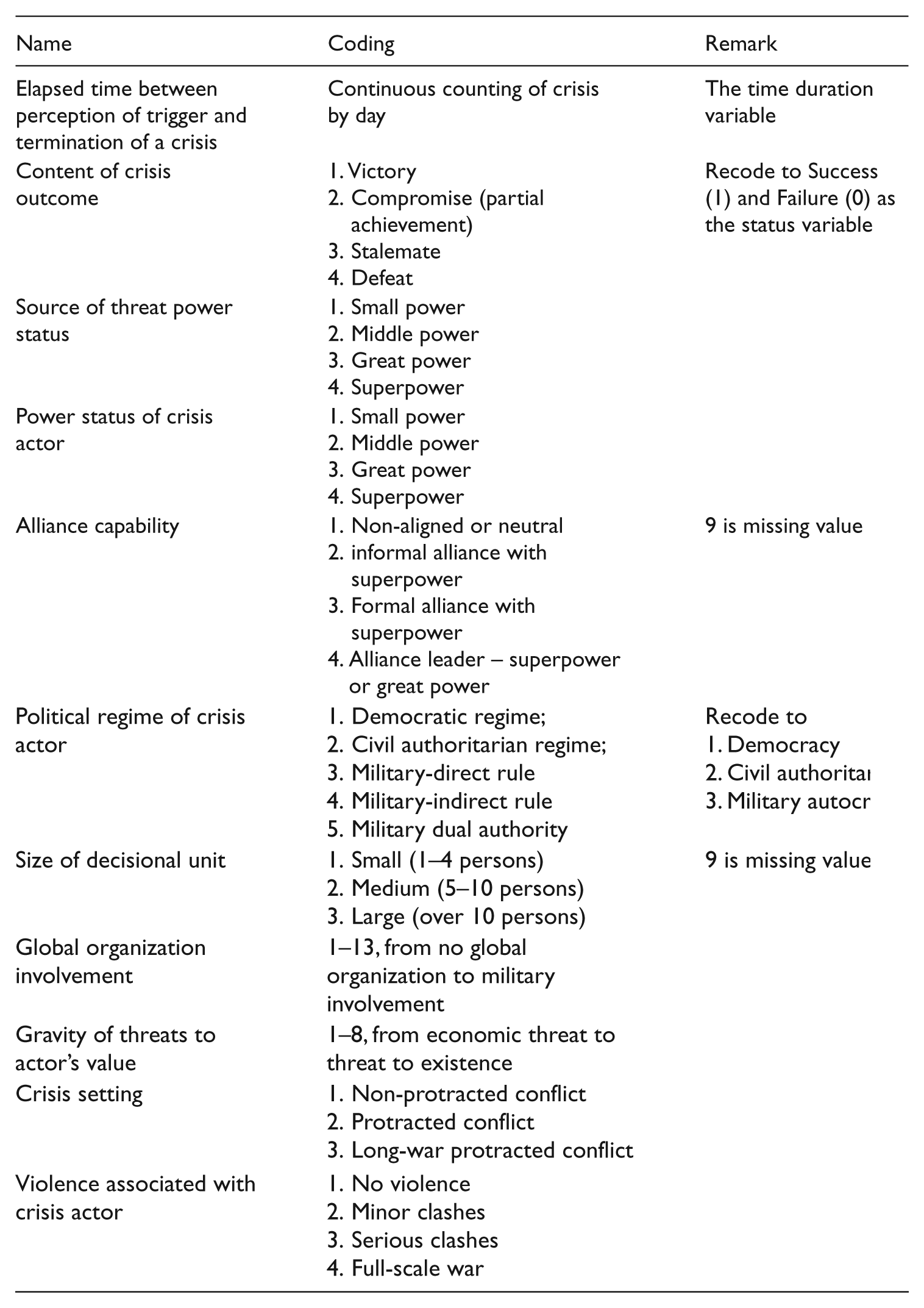
In the ICB dataset, one variable, ‘TRGTERRA’,’ measures the duration of crisis in days. In this article, it is renamed as DUR (duration) in order to measure the time of transition to the event. Another variable, named OUTCOM here, is a ‘content of crisis outcome’. It is coded as (1) victory; (2) compromise; (3) stalemate; (4) defeat. Since the compromise (value = 2) measures partial achievement of basic goals, the compromise result is also treated as a success in crisis solving. Therefore, a new binary variable, STATUS, is created in order to measure the ‘success and failure’ of foreign policy crises. STATUS is coded as ‘success = 1’ if the original variable OUTCOM’s value is either ‘victory = 1’ or ‘compromise = 2’. The STATUS variable’s value is ‘failure = 0’ if OUTCOM is either ‘stalemate = 3’ or ‘defeat = 4’. The risk for the transition to the event (the success of crisis solving) begins at the time when the crisis begins (T = 0). If a state achieves either ‘victory’ or ‘compromise’ at the end of the crisis, i.e., STATUS = 1, it means that this state experiences an event (or a hazard). If a state ends the crisis with either ‘stalemate’ or ‘defeat’, i.e., STATUS = 0, it is treated as a right-censored case and indicates that we do not know whether it may or may not experience an event, ‘the success of crisis-solving’, in the future.
It should be noted again that some hypotheses are contested theoretically and empirically in the study of foreign policy crises. For example, scholars are still debating whether democracy helps or hampers a state in winning a war. In the following empirical tests of these hypotheses, therefore, a two-tailed significance test is used to check the open-ended hypotheses. The descriptive statistics of all the variables in this analysis are displayed in Table 2. The coding information for the variables is in Appendix 1.
Descriptive statistics of variables

To test the hypotheses, Kaplan–Meier hazard curves and the Cox proportional hazard model are employed in this research. While the Kaplan–Meier survival analysis is used to test the effects of categorical variables, the Cox proportional hazard model is for testing the effects of continuous variables. In Table 2, since ‘regime type’, ‘size of decision unit’, and ‘conflict setting’ have three values, they are treated as categorical variables for the Kaplan–Meier hazard model test. Other variables have more than three values and, therefore, they are treated as continuous variables for the Cox proportional hazard model.
The Cox proportional hazard model was developed by Sir David Cox (1972). The major advantage of this model is to allow researchers to estimate the effects of individual characteristics (covariates or variables) on survival time without assuming a specific parametric form for the distribution of time until an event occurs (Box-Steffensmeier and Jones, 1997). However, the major constraint of this model is that the Cox model assumes that relative hazards over different covariate values are proportional. In other words, the effects of independent variables (or covariates) are not time-dependent (or do not change over time). Therefore, after specifying a Cox proportional model, it is necessary to run a non-proportionality test to verify the proportionality assumption. If the model fails this test, it is essential to either stratify the model or include the interactions between the covariates and time.
Here a stepwise regression approach is employed in order to build multivariate models of foreign policy crises. 5 The research design of this research, therefore, has three parts. First, a series of univariate analyses are run in order to preliminarily test the effects of individual covariates on the hazard rate of crisis solving. Kaplan–Meier hazard curves and log-rank tests are presented for the categorical variables. The Kaplan–Meier curves can help us visually to see the effects of different categories of a categorical variable on the hazard rate of crisis solving while the log-rank tests can statistically check the significant differences between different categories of a categorical variable. In addition, the Kaplan–Meier hazard curve can also help us identify whether the effects of categorical variables are proportional across time. The Cox proportional model will be used to check the effects of other continuous variables. Through the preliminary univariate analysis, it is possible to test which variables may have a significant effect on the hazard rate of crisis-solving in later multivariate models. The p-value at 0.20–0.25 is set as a cut-off standard to eliminate non-significant variables for the later multivariate analysis. 6
Second, the author empirically constructs a full model – a unified duration-outcome model of foreign policy crisis – by combining the three crisis-solving models – power-politics, institution-regime, and threat-perception – with the control variable of violence. The variables in the model are those that pass the cut-off (p < 0.25) tests in the univariate analyses. From the full model, we can see which variables have significant effects on the hazard rate of crisis-solving and start to construct a reduced model with the significant variables. Then it is possible to consider the interactions between variables and include significant interactions in the final model.
Finally, the proportionality assumption of the Cox proportional model is tested. The interactions between independent variables and time in the model are included to see whether the time interactions are significant. If the result shows any time-varying variables, the final model should include these interactions between variables and time.
Operationalization and results
Hazard analysis modeling
The Kaplan–Meier hazard curves for regime type, size of decisional unit, and crisis-setting are shown in Figures 1 to 3. In Figure 1, it is shown that democracies have a higher hazard rate than non-democracies from the beginning of crisis. Especially from the beginnings of crises to about 300 days, democracies have a clear, higher hazard rate than the civil authoritarian and military autocratic regimes. It means that, holding other things constant, democracies are more likely to achieve success in crisis solving in a shorter duration than non-democratic countries, especially from the beginning to about 300 days of the crisis. However, the advantage of democracy decreases, especially after 400 days. This result virtually confirms the declining advantages of democracy during wars suggested by Bennett and Stam (1998).
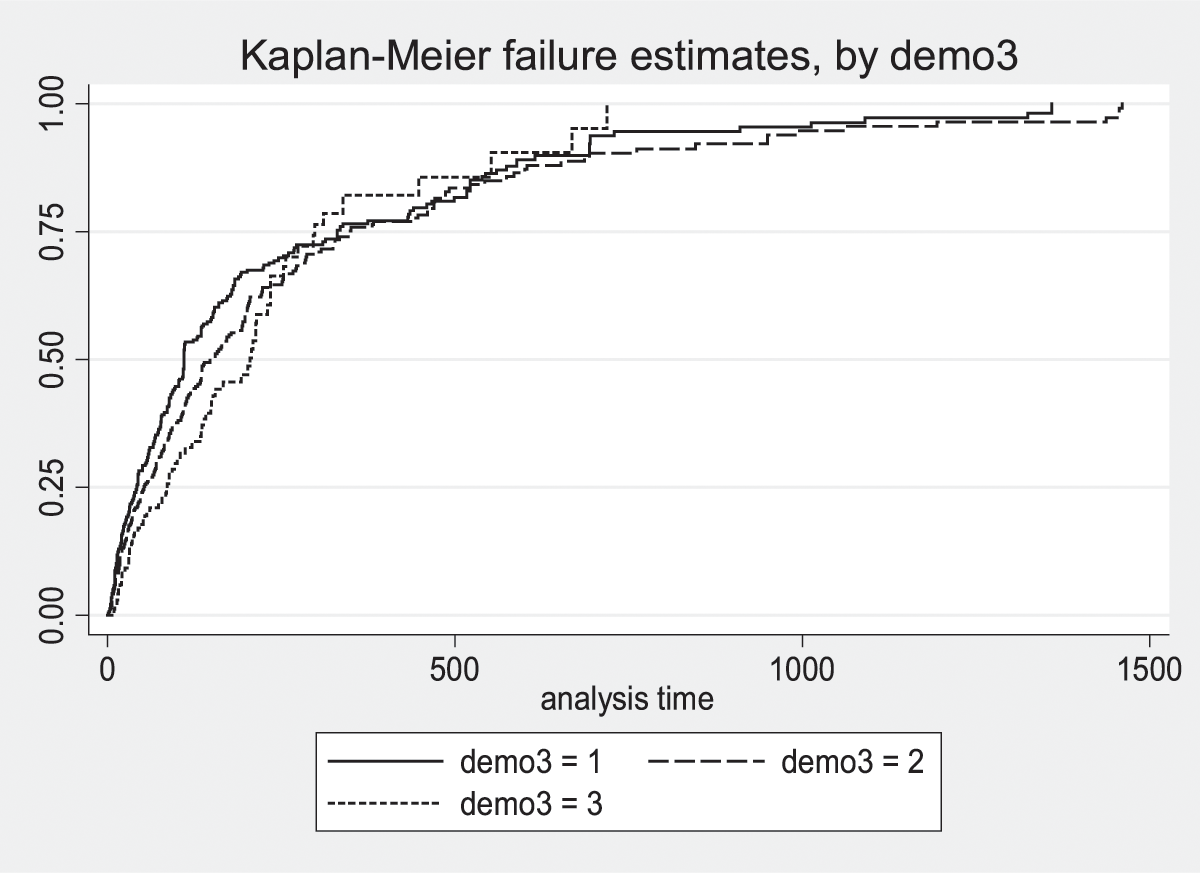
Kaplan–Meier hazard function for regime type.
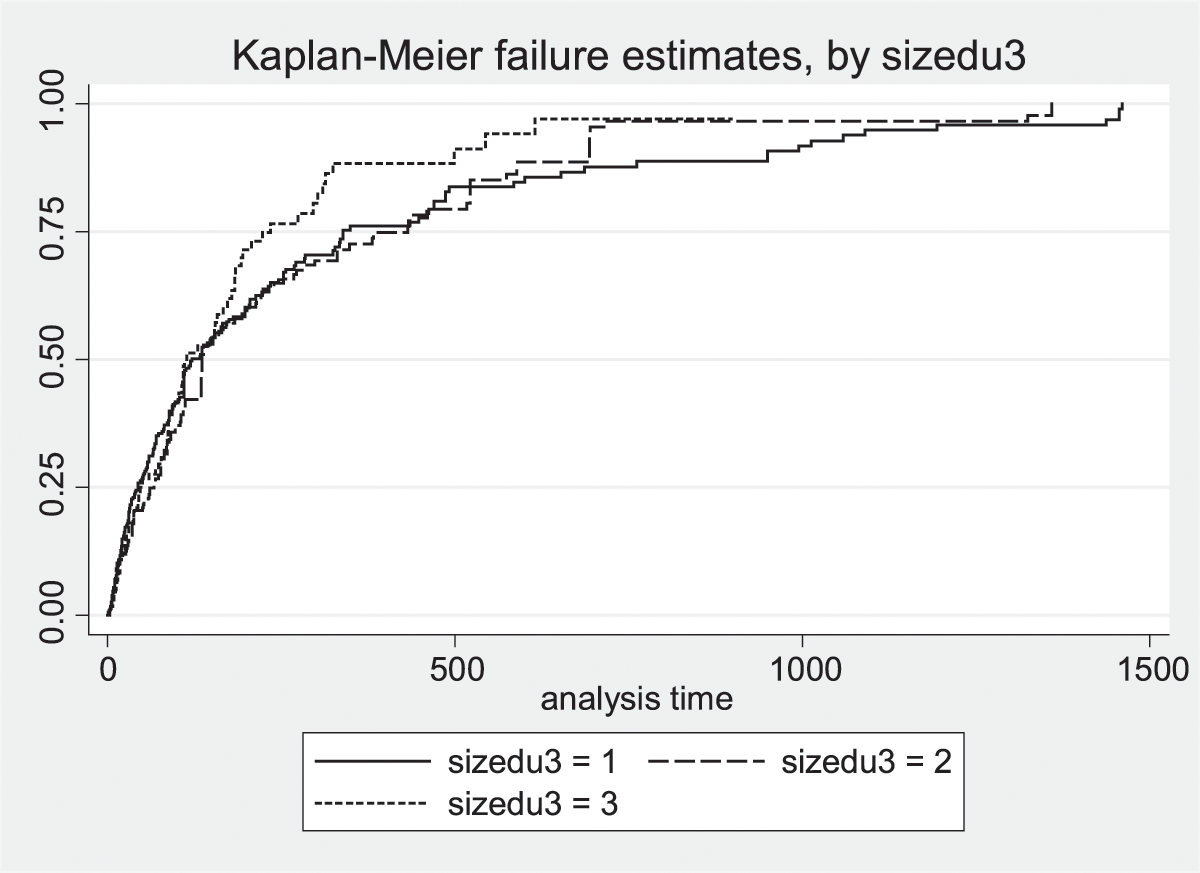
Kaplan–Meier hazard function for size of decisional unit.
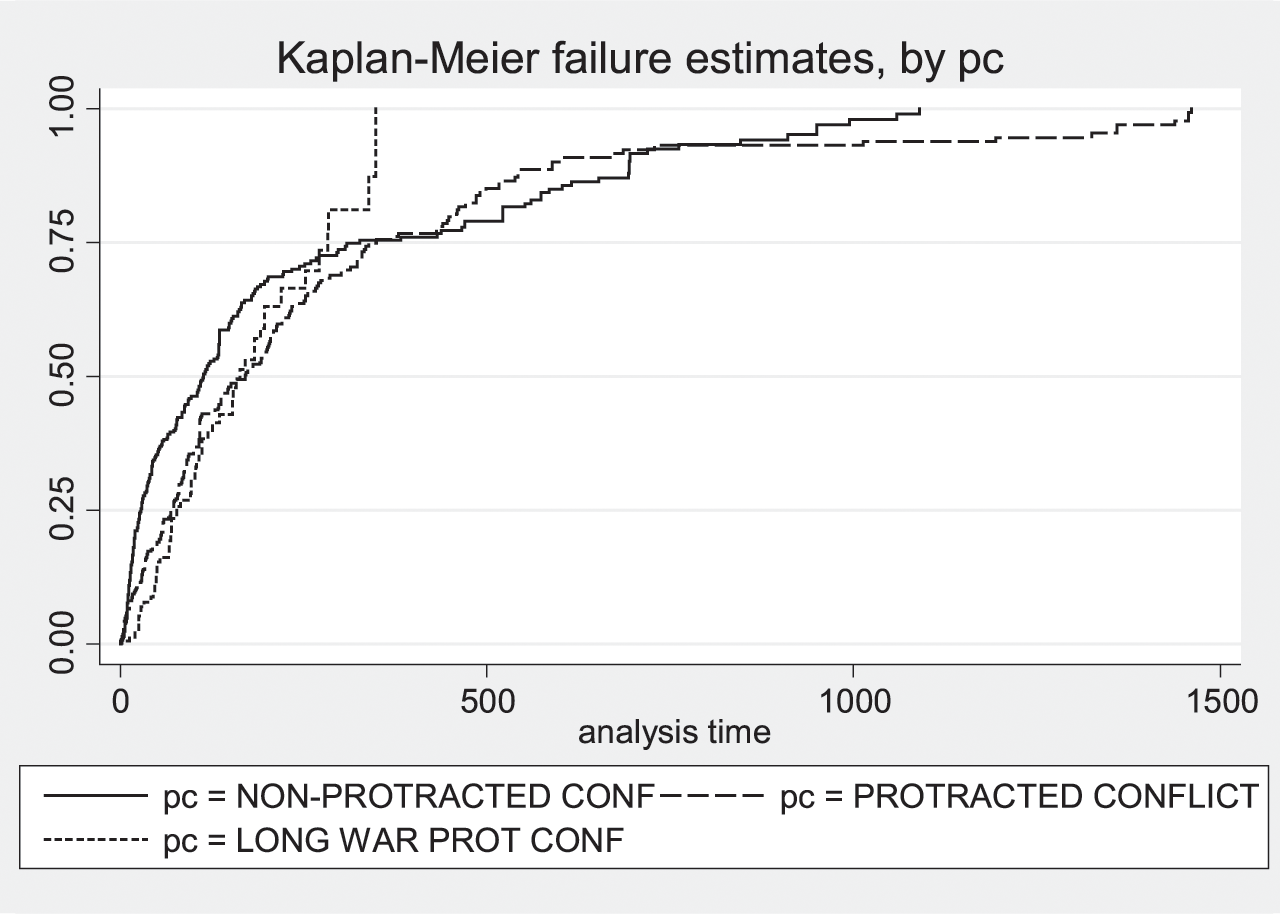
Kaplan–Meier hazard function for conflict setting.
In Figure 2, we see that the hazard curves of different sizes of decision-making unit are different after about 200 days of crisis. The larger the decision-making unit, the higher the hazard rate of crisis-solving. It rejects the veto-point hypothesis that favors the smaller size of decisional unit. In Figure 3, we see that different conflict settings have clear different hazard curves. During the period from the beginning of the crisis to about 250 days, states in non-protracted conflicts are more likely to achieve crisis-solving success than in protracted conflicts. However, after 250 days of crisis, protracted conflicts have higher hazard rates of crisis-solving than non-protracted conflicts. The cross shape of the hazard curves of conflict setting suggests that conflict setting is a time-varying variable.
Although we can identify by visual inspection the differences for these categorical variables through the Kaplan–Meier hazard curves, we still need to test statistically the differences among different categories of regime type, size of decisional unit, and conflict setting. Table 3 shows the results of the log-rank test of equality. The log-rank tests show that both the three categories of regime type and conflict setting have significant differences (p < 0.05). The size of decisional unit, however, does not have a significant difference among their respective categories. We can reject the veto-point-rooted hypothesis that the size of decisional unit matters for crisis-solving. The size of decisional unit also fails the cut-off of p < 0.25 test (p-value = 0.6805). It is unlikely to be significant in the later multivariate model. Since both regime type and conflict-setting are statistically significant, both are retained in relation to the later multivariate hazard analysis.
Log-rank test for equality of survivor functions for regime type, size of unit, and crisis-setting
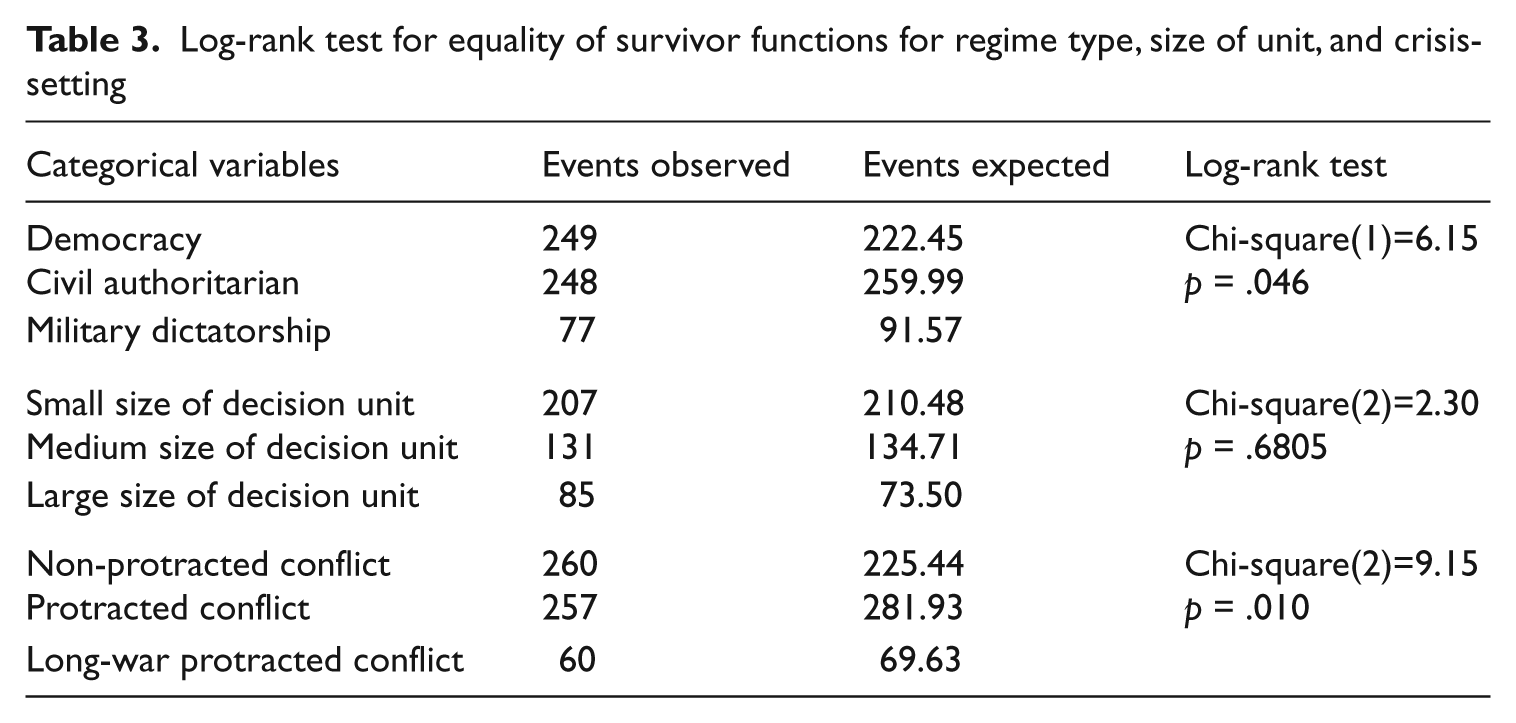
Table 4 summarizes the Cox proportional models for the univariate analysis of all the continuous variables in this research. We can see that some variables have positive coefficients while others have negative coefficients. While a positive coefficient means a shorter duration of crisis-solving, a negative coefficient indicates a longer time for crisis-solving. From the p-value tests, we see that alliance capability, global institution involvement, and violence are all significant (p < 0.05). While the increases in alliance capability can shorten the duration of crisis solving (positive coefficient), the increases of global institution involvement and violence can delay the crisis-solving (negative coefficient).
Univariate analyses of the effects of continuous variables on the crisis-solving

Three other variables, including source of threat power status, power status of crisis actor, and gravity of value threat, are not significant at the 0.05 level (p>0.05). However, the p-values of these variables are less than the cut-off value of 0.25. Therefore, these three variables are included in the multivariate Cox proportional model.
Table 5 summarizes the three multivariate analyses by using the Cox proportional model. Model 1 is the full model, including all the variables from the previous univariate analyses and two variables from the Kaplan–Meier tests (regime type and crisis-setting). From the p-value, we see that four variables – source of threat power status, alliance capability, global institutional involvement, and violence – are significant at the 0.05 level. Regime type is significant at the 0.10 level. Since we conduct a two-tailed test for the regime type, its p-value (p=0.06) is also significant.
Three multivariate Cox proportional models for testing the hazard rate of crisis solving

Reporting coefficients, with standard errors in parentheses.
p<.10, ** p<.05, *** p<.01, **** p<.001.
The next step is to modify the full model by reducing the insignificant variables from Model 1 to construct Model 2. Three variables, power status of crisis actor, gravity of value threatened, and conflict-setting, which are not significant in Model 1, are excluded from Model 2. The reduced Model 2 has five variables, source of threat power status, alliance capability, regime type, global organization involvement, and violence. Model 2 shows that the regime type is significant at the 0.10 level for a two-tailed test and the other four variables are significant at the 0.05 level. Through a likelihood-ratio test, we see that the reduced Model 2 is as good as the full Model 1 in terms of fitting the data (p > 0.05). Therefore, the reduced Model 2 is chosen rather than the full Model 1 for further testing.
The next procedure is to consider interactions between the variables in Model 2. Theoretically, all five variables can have interactions with one another. For example, regime type can interact with alliance capability. According to democratic peace theorists, democracies are less likely to wage wars against one another. Therefore, democracies may also be more likely to forge alliances with one another when facing threats. The author examined all the interactions among these five variables to test which interactions are significant. The result shows that three interactions, the interaction between source of threat power and global organization involvement, the interaction between alliance capability and global organization involvement, and the interaction between alliance capability and violence, are significant at the 0.05 level. Therefore, Model 3 is run by incorporating these three significant interactions into Model 2 (see Table 5). The likelihood ratio test is conducted between Model 2 and Model 3, which shows that Model 3, with three interactions, is better at incorporating the data than Model 2 (p < 0.05). This result implies that it is necessary to include interactions in the final model.
The next step is to test the proportionality assumption of the Cox model (Box-Steffensmeier et al., 2003; Box-Steffensmeier and Zorn, 2001). Model 4 is run by including interactions between all variables in Model 3 and log (time). Table 6 shows the comparison between Model 3 and Model 4. We can see that all but one of the interactions between variables and log (time) are not significant; the exception is the interaction between alliance capability and global organization involvement. Therefore, it is necessary to consider including the significant time-varying interaction – alliance capability and global organization involvement – in the final model. Model 5 shows the final model with the interactions and the time-varying interaction. Through the likelihood-ratio test, it is confirmed that Model 5 with the time-varying interaction is better than Model 3 (p < 0.05).
Cox proportionality assumption test by including time varying variables
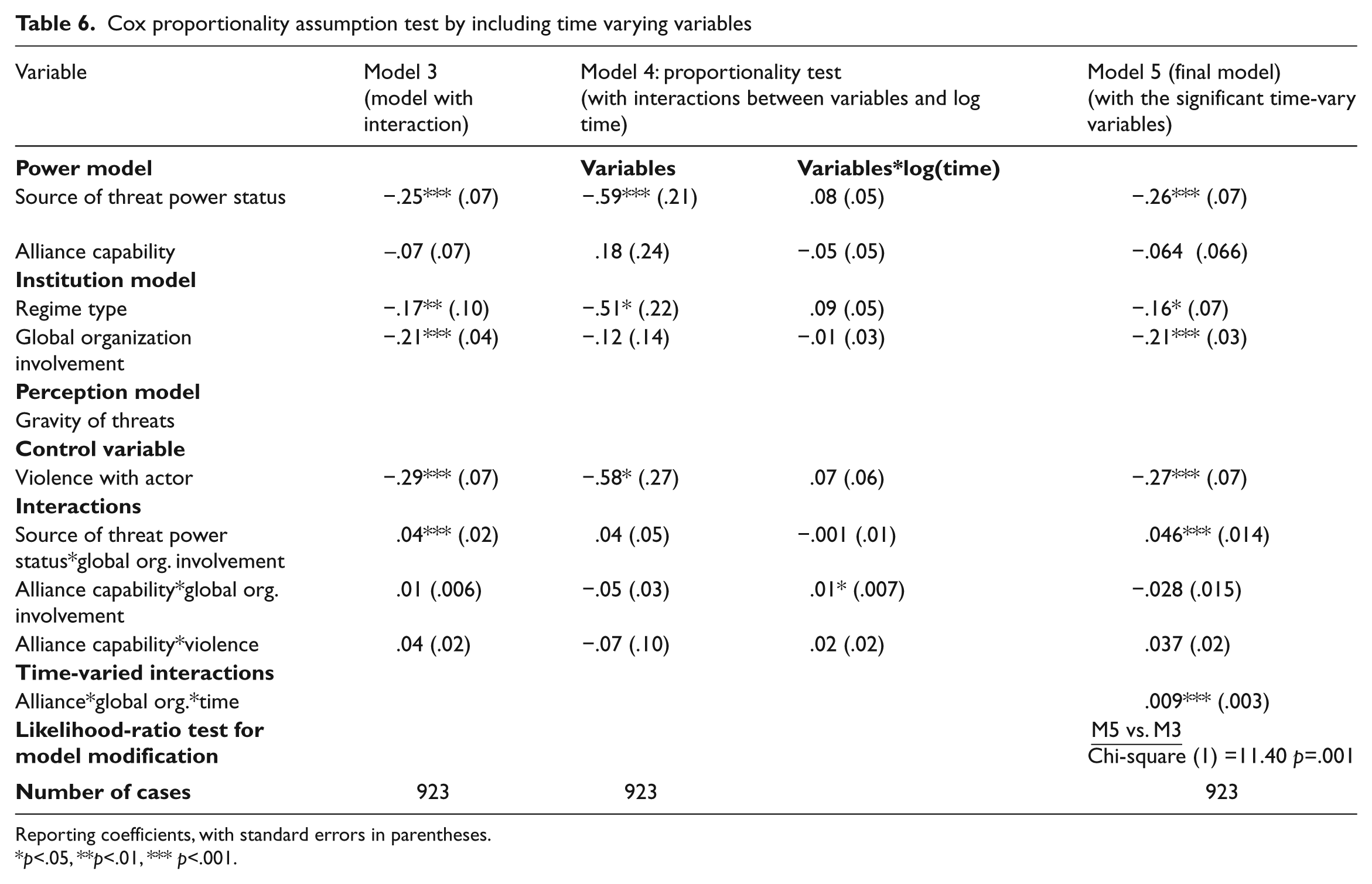
Reporting coefficients, with standard errors in parentheses.
p<.05, **p<.01, *** p<.001.
The last statistical test is the goodness of fit test for Model 5. The fit of the model can be evaluated by using the Cox–Snell residuals. If the model fits the data well, then the true cumulative hazard function conditional on the covariate vector has an exponential distribution with a hazard rate of 1. Figure 4 shows the Cox–Snell residual test, and indicated that the hazard function follows the 45-degree line very closely except for very large values of time. This test shows that Model 5 fits the data well and it is the final model for interpretation.

The goodness of fit test of the final Model 5.
Discussion of findings
Table 7 reports the hazard-rate results for the final Model 5. It is evident that source of threat power, regime type, global organization involvement, violence, and the two interactions between source of threat power and global organization involvement and between alliance capability and global organization with the time-varying term are significant at the 0.05 level. The percentage change in the hazard rate shows their effects on the hazard rate of crisis solving. The percentage change in hazard rate for source of threat power status is −23%. It suggests that during a crisis, if the power status of a state’s rival increases one unit, e.g., from a small power to a middle power, the hazard rate (i.e., the success rate in this research) for this state to solve the crisis will decrease by 23%, holding other variables constant. In other words, the more powerful the rival is, the more difficult it is for a state to solve the crisis in a short period of time.
Final Cox proportional model of the hazard rate of crisis-solving

Log-likelihood= −3022.8643; Chi-square (9)= 122.92; p< .001; number of cases=923.
The hazard rate change for regime type is −15%. Since democracy is coded as 1 and the two non-democratic regimes are coded as 2 (civil authoritarians) and 3 (military autocrats), it suggests that democracies have more advantages in solving foreign policy crises than non-democracies in a short period of time. When we compare a democracy with other regimes, the hazard rate of democracy in solving a foreign policy crisis is 15% higher than a civil authoritarian regime and 30% higher than a military autocrat, holding other variables constant.
The involvement of global organization is coded continuously from no involvement (1) to sending emergency military force (13). The percentage change of the hazard rate for organization involvement is −20%. It suggests that, holding other variables constant, one unit increase of global organization involvement, e.g., from ‘no involvement’ to ‘discuss without resolution’, will lead to a 20% decrease in the hazard rate of crisis solving for a state. It means that, if a state wants to win a crisis as soon as possible, it should avoid the involvement of global organization.
It is interesting that global organization has a negative effect on the hazard rate of crisis solving. This finding seems counterintuitive because neoliberals argue that international institutions facilitate state cooperation and coordination. However, from a realist perspective, it can be understood that institutions can sometimes constrain state behavior and damage state interests. As mentioned before, although the involvement of international organization can help alleviate the commitment problem, it can worsen the information problem because states have more incentives to hide their private information during the mediation process of international organizations. In addition, the major role of international organizations or international mediations is to restore peace and avoid conflict in the region (Beardsley and Schmidt, 2012). Therefore, the major approach of international organizations is often to force both parties in the crisis to give up certain interests and reach a temporary settlement.
From the perspective of states, international organizations indeed preclude them from achieving a full or partial success during a crisis, because states are forced to compromise when coming under the pressure and constraints of international institutions. With the involvement of international organization, the most probable outcome of a crisis is a stalemate, in which both parties in the crisis agree to negotiate but not to settle the problems. Therefore, international organizations may be conducive to peace and stability, but they also apparently reduce the probability for states to win foreign policy crises.
Global organization involvement has a significant interaction with source of threat power. One unit of increase in the interaction will increase the hazard rate of crisis solving by 4.6%. It means that global organizations can alleviate the negative effect of the increasing power of the source of threat. The source of threat power originally has a negative effect on the hazard rate of crisis solving for a state because the more power the rival has, the less likely it is for a state to solve the crisis successfully in a shorter duration. However, the interaction shows that global organizations may be able to constrain the aggressive behavior of the powerful rival and further help the state solve crisis successfully. It can also be argued that small powers may benefit more from global international organizations than great powers during a crisis.
The interaction among alliance capability, global organization involvement, and time also shows a small constraining, time-dependent, effect of international institutions on a state’s military-focused behavior since the hazard rate change is only 0.9%. In Table 5, we see that alliance capability originally has a strong positive effect (coefficient = 0.10, p < 0.001) on the hazard rate of crisis solving. It means that the stronger the alliance capability, the more likely it is for a state to achieve success in crisis solving within a shorter duration. However, after considering the interaction with global organization and time, the effect of alliance capability loses significance. Rather the interaction among alliance capability, global organization, and time has a small positive and time-varying effect (coefficient = 0.009, p < 0.001). It suggests that multilateral-based global organizations can reduce the benefit of bilateral-rooted alliances for states during crises.
The last significant variable is the control variable: violence, which has a significant negative effect on states’ hazard rate of crisis-solving. Violence is coded continuously from no violence (1) to war (4). It suggests that one unit increase of violence, which the state actor uses during crises, e.g., from ‘no violence’ to ‘minor clashes’, can lead to a 24% decrease in hazard rate of crisis solving, holding other variables constant. This result indicates a strong negative relation between violence and the probability for a state to solve a foreign policy crisis successfully and efficiently. It means that, if a state wants to win a foreign policy crisis in a timely fashion, it should constrain its violent actions simply because violence will breed violence.
Recalling the earlier Kaplan–Meier hazard curve on conflict setting, we know that conflict setting has time-varying effects on the hazard rate of crisis-solving. Many scholars also argue that protracted conflicts differ from non-protracted ones because states behave differently toward long-term rivals (Brecher and James, 1988; Colaresi and Thompson, 2002). Therefore, based on both empirical and theoretical reasons, three stratified crisis-solving models were constructed in order to examine the different effects of variables in Model 5 on the hazard rates of crisis-solving under three different conflict settings: non-protracted conflict, protracted conflict, and long-war protracted conflict.
In Table 8, it is evident that source of threat power status has a significant negative effect on the hazard rate of crisis solving under all three types of conflict setting from no protracted conflict to long-war protracted conflict. It means that, when facing threats from either new rivals or extremely long-term rivals, the increase of power by its rival will decrease the hazard rate of crisis solving for a state. It has a strong negative effect on the hazard rate of crisis solving under long-war protracted conflict (coefficient = −1.08, p < .01) and a medium, negative effect under non-protracted conflict (coefficient = −.28, p < .01). It has a relatively weak, but significant, effect under protracted conflict (coefficient = −.19, p <.05).
Stratified crisis-solving models by conflict setting
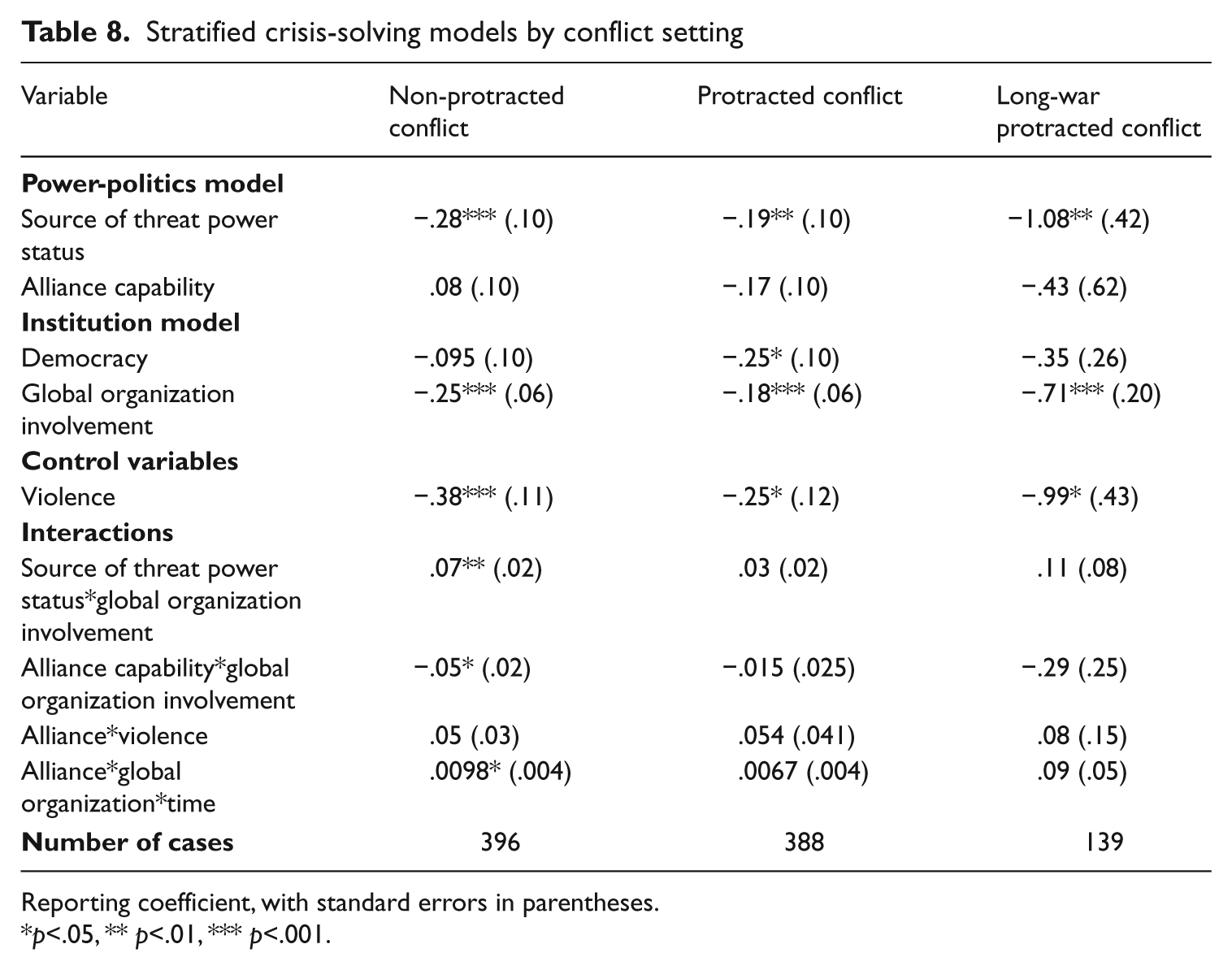
Reporting coefficient, with standard errors in parentheses.
p<.05, ** p<.01, *** p<.001.
Global organization involvement also has a significant, negative effect on the hazard rate of crisis-solving under all three conflict-settings. However, its effect is strongest under long-war protracted conflict (coefficient = −.71, p < .01) but becomes weakest under protracted conflict (coefficient = −.25, p < .01). The effect of global organization is medium under non-protracted conflict (coefficient = −.18, p < .01). This suggests that the involvement of global organization in a long-war protracted conflict can prolong and complicate the process for a state to solve the crisis successfully and efficiently.
Regime type has a significant, negative effect on the hazard rate of crisis-solving only in protracted conflicts (coefficient = −.25, p < .05), but not in either non-protracted or long-war protracted conflicts. We can calculate the hazard rate by exponentiating the coefficient [exp (−.25) = .78]. It shows that democracies have at least 22% (1 − 0.78) greater hazard rate of crisis-solving than non-democracies, including civil authoritarian and military autocrats, under protracted conflicts.
Violence shows a constant, significant, negative effect on the hazard rate of crisis solving across the three conflict settings. This effect becomes strongest in long-war protracted conflicts but drops in both non-protracted and protracted conflicts. It suggests that the more violence a state uses in a long-war protracted conflict, the more difficult it is for this state to solve the crisis successfully and efficiently. The three interactions which involve global organization involvement are significant only in non-protracted conflict and produce relatively weak effects on the hazard rate of crisis solving. These results mean that conflicts between long-time rivals are rarely settled through the involvement of international organizations.
Conclusion
How states solve foreign policy crises successfully as quickly as possible and under what conditions states can achieve this goal are not only theoretical questions but also policy-related issues. Based on the eclectic theory-building approach, this article derives three foreign policy crisis behavior models from three major international relations theories: realism, liberalism, and constructivism. By using event history analysis techniques and stepwise regression model-building strategies, the effects of variables related to power, institutions, and perceptions on the hazard rate of crisis solving have been tested empirically. This study represents a preliminary attempt at constructing a unified model in order to further analyses of foreign policy crisis. Future research could test these models by using different datasets or research designs.
This article has three potential contributions to the study of foreign policy crisis behavior. First, this project focuses on the actor – the state – in a crisis instead of the crisis itself. Most existing research on international crises or foreign policy crises examines the outcome and/or the duration of the crises, not a state’s success in solving the crises. For example, through examining the relationship between mediation and the duration of interstate disputes, Regan and Stam (2000) suggest that mediation efforts that occur soon after disputes begin have the best chance of reducing expected future dispute duration. In other words, their research focus is the factors that can influence the duration of the disputes. This research, however, intends to explore what factors can help states solve a foreign policy crisis in a short duration of time. By focusing on the state actor in the crises, this project can shed some light on some policy-relevant questions.
For example, this research empirically suggests a negative impact of international organizations on the success rate of states in solving foreign policy crises. The survival analysis test shows that, the deeper the involvement of international organization during the crisis is, the more difficult it is for a state to ‘win a crisis’ in a shorter time. The hazard rate of crisis solving drops 20% when the involvement of international organization increases one unit. This may explain why some states, especially strong powers, are reluctant to rely on international organizations to solve foreign policy crises.
Second, this research links multiple stages of foreign policy crises. As some scholars point out, a foreign policy crisis or dispute can be divided into several stages: initiation, escalation, war dynamics, and post-war (Diehl, 2006; for other designations, see Brecher and Wilkenfeld, 2000; Bremer, 1995). Most studies in the field focus on a single stage of the disputes or crises. As Diehl (2006) suggests, the initiation and escalation phases of crises or wars are the focal points for most scholars although the call for multi-stage research has been advocated for a long time in the field. It is understandable because wars and crises normally have taken place in very complicated processes. Focusing on one stage, such as exploring what factors drive states to initiate wars, has already been a theoretically important, policy-relevant, and, most importantly, time-consuming enterprise. However, it does not mean that a multi-stage approach is less important. Through examining the duration of foreign policy crises, this project theoretically connects the initiation and the outcome stages of crises and empirically examines determinants that can impact both the outcome and the duration of foreign policy crises.
Finally, through modeling both the duration and the outcome of foreign policy crises, this project tests some contending theories in the study of foreign policy crises. Besides the role of international organizations, scholars also debate about how military alliances affect a country’s success and whether democracy matters in solving a foreign policy crisis. This research suggests that, without considering the interactions between alliances and international organizations, a country’s alliance capability indeed matters during a foreign policy crisis. A state with more allies will have more advantages for winning a foreign policy crisis than a state with fewer allies. However, the effect of alliance is eroded significantly after the involvement of international organizations.
Regarding the role of democracy, this article suggests that democracies not only have more advantages than non-democracies in winning foreign policy crises, but also can achieve this goal in a shorter time. The hazard rate of crisis solving for democracies is 15% higher than for civil authoritarians and 30% higher than for military autocrats. This research also confirms the power-politics argument that a rival’s power status can affect a state’s success in solving a foreign policy crisis. The more powerful the rival is, the more difficult it is for a state to win a foreign policy crisis in a short time. In addition, this article argues that violence has a constant negative effect on the success of crisis solving. The more violent actions a state uses during a crisis, the more difficult it is for this state to solve the crisis in a short period of time. It suggests that states should constrain their violent behavior during foreign policy crises if they indeed intend to solve a crisis in a timely fashion.
Considering different conflict settings, we see that international organizations have more negative effects on states’ hazard rates of crisis solving when a crisis is between two long-war, protracted rivals rather than between two non-protracted rivals or between two existing protracted rivals. Another interesting finding is the effect of democracy across different conflict settings. The statistical result shows that democracy matters only when a crisis takes place in a protracted conflict setting, but not in non-protracted and long-war protracted conflicts. Why democracies and international organizations have such distinct and different effects across the different conflict settings deserves further theoretical and empirical investigation.
Footnotes
Appendix
Variable coding information
| Name | Coding | Remark |
|---|---|---|
| Elapsed time between perception of trigger and termination of a crisis | Continuous counting of crisis by day | The time duration variable |
| Content of crisis outcome | 1. Victory
2. Compromise (partial achievement) 3. Stalemate 4. Defeat |
Recode to Success (1) and Failure (0) as the status variable |
| Source of threat power status | 1. Small power
2. Middle power 3. Great power 4. Superpower |
|
| Power status of crisis actor | 1. Small power
|
|
| Alliance capability | 1. Non-aligned or neutral
|
9 is missing value |
| Political regime of crisis actor | 1. Democratic regime;
|
Recode to
|
| Size of decisional unit | 1. Small (1–4 persons)
|
9 is missing value |
| Global organization involvement | 1–13, from no global organization to military involvement | |
| Gravity of threats to actor’s value | 1–8, from economic threat to threat to existence | |
| Crisis setting | 1. Non-protracted conflict
|
|
| Violence associated with crisis actor | 1. No violence
|
Acknowledgements
The author would like to thank Stephen Walker, Xiao Chen, Joe Clare, Scott Yabiku, and Lee Miles, the lead editor of Cooperation and Conflict, for constructive suggestions and support. All errors and omission remain, however, the author’s own.
Funding
This research received no specific grant from any funding agency in the public, commercial, or not-for-profit sectors.