



Abstract
This article argues that the Responsibility to Protect (RtoP) adds value to international efforts to protect populations from genocide and mass atrocities, but not in the ways commonly thought. It suggests that RtoP is not particularly effective as a ‘rallying call’ that mobilises action in cases where international society may be initially reluctant to act. Where it does add value is in helping to reshape states’ identities and interests such that consideration of the protection needs of populations, in relation to the threat of genocide and mass atrocities, has been internalised to some extent by the UN Security Council. As such, RtoP is best seen as being a ‘habit former’. The principle does not, however, determine particular behaviours or guarantee international consensus because decision-making is heavily influenced by contextual factors. The argument proceeds in three parts. The first examines instances where RtoP has been invoked since early 2006. The second explores the role of context in shaping how the UN Security Council responds to particular crises. Finally, to amplify the points made in these sections, the third section considers the UN Security Council’s response to the crisis in Somalia after 2006.
Introduction
As is now well known, the responsibility to protect (RtoP) was unanimously adopted by UN member states at the 2005 World Summit. The principle recognises that states have a responsibility to protect their populations from genocide, war crimes, ethnic cleansing and crimes against humanity (hereafter ‘genocide and mass atrocities’); that international society has a duty to assist states to fulfil their RtoP; and that should a state ‘manifestly fail’ to protect its populations from these crimes, international society would take ‘timely and decisive’ action through the various provisions set out in the UN Charter (Bellamy, 2009; Evans, 2008b; Thakur, 2011a; UN General Assembly, 2005). Since 2005, RtoP has been reaffirmed in UN Security Council (hereafter also ‘Security Council’) resolutions – including 1674 (2006) and 1894 (2009) – in reports of the UN Secretary-General (Ban, 2009), and in the establishment of a joint office of the special advisers to the Secretary-General on genocide prevention and RtoP (Global Centre for the Responsibility to Protect, 2011).
Despite (or perhaps because of) the rapid rise of RtoP in 2001, from a concept articulated by an international commission (the International Commission on Intervention and State Sovereignty (ICISS)), to a principle reaffirmed multiple times by the UN Security Council and utilised by that body in its response to crises in Sudan, Libya, Cote d’Ivoire, South Sudan and Yemen, RtoP has been subjected to criticism from a handful of states and a significantly larger number of scholars. Critics have typically fallen into one of two camps. The first camp, more prominent immediately after the publication of the ICISS report in 2001, complains that the principle is effectively a ‘Trojan horse’ for western interventionism and neo-imperialism. As Mahmood Mamdani (2009: 300) put it, RtoP is a ‘slogan that masks the big power agenda to recolonise Africa’. This line of thinking diminished somewhat after the adoption of RtoP by UN member states, but resurfaced in 2011 in the form of arguments that the UN and NATO had stepped beyond the parameters of mandates to protect civilians in Cote d’Ivoire and Libya to effect regime change in those two countries, demonstrating that doctrines such as RtoP would always be put to nefarious use by the powerful (e.g. O’Shea, 2012).
The second line of criticism holds that RtoP is little more than ‘hot air’ that has made no positive difference. Aiden Hehir (2010: 218, 235), for example, argues that whilst the term is frequently used, RtoP ‘has contributed little of substance or prescriptive merit’, noting that ‘it is difficult to understand why state behaviour will change as a result of R2P [RtoP]’. As Michael Wesley (2005) argued a few years earlier, because state behaviour is guided by self-interest, the state will respond to mass atrocities in a timely and decisive manner only when it is believed it is in the state’s interest to do so (also see Pape, 2012). RtoP, Wesley assumes, cannot alter those essentially material calculations. Going one step further, David Chandler (2009) has accused RtoP of hollowing out ideas about international responsibility. Specifically, he argues that RtoP helps the West evade responsibility for genocide and mass atrocities, both by advancing an institutionalist logic that denies western complicity in the crimes themselves and by establishing ‘indirect mechanisms of policing and military intervention’, such as the African Union’s capacity for peacekeeping, that relieves it of responsibilities to contribute to the conflict management and protection duties in peripheral regions (Chandler, 2010). According to Chandler, therefore, RtoP has reduced international society’s political and institutional capacity to prevent and respond effectively to genocide and mass atrocities.
It is this second line of argument that this article examines: the question of whether RtoP has added value by contributing to positive changes of behaviour in relation to the way in which international society responds to the commission, or imminent commission, of genocide and mass atrocities. To date, these arguments have been conducted in a largely subjective fashion based on a particular selection of cases. This, of course, introduces selection bias into the debate, in as much as both sides of the argument are likely to highlight those cases that support their argument, whilst downplaying or ignoring altogether those cases that do not. Moreover, analysts have not looked systematically at the whole caseload of genocide and mass atrocities since 2005. In attempting to assess the extent and form of RtoP’s contribution to the protection of populations from these crimes, this article examines trends across all reported cases of one-sided killing since 2005 and examines a ‘hard’ case for RtoP that has not been discussed much by the critics either: Somalia. At the outset, it should be stressed that response to actual or imminent atrocities is only one facet of RtoP. Other aspects include longer-term action to mitigate underlying sources of risk and prevent incitement of genocide and mass atrocities (Bellamy, 2012). Thus, even if it was found that RtoP added little observable value in crisis situations, it would not necessarily follow that the principle itself lacks value.
Through a survey of all the relevant cases since 2005 and a detailed examination of a single ‘hard’ case, this article argues that RtoP has made a positive contribution to international responses to genocide and mass atrocities. However, this has not come through its putative capacity to act as a ‘rallying call’, as has often been surmised. Instead, the gradual internalisation of RtoP goals by the UN Security Council has supported the emergence of what has been described as ‘habits of protection’. Habits of protection mean that the Council gives consideration to RtoP related issues as a matter of routine, but they do not determine particular courses of action. The latter remain heavily influenced by contextual factors relating to the complexities of the situation at hand, relations between Council members and parties to the situation at hand, the availability of feasible policy options, expectations about the likely costs of various policy options, and the importance attached to the situation relative to other situations at the time. This argument proceeds in three parts. The first section examines the incidence of mass atrocities, instances where RtoP has been invoked and the response of the Security Council to determine the extent, and nature, of the relationship between RtoP and Council activism since early in 2006. To explain the findings of this survey, the second section explores the role of context in shaping how the Security Council responds to particular crises. To amplify the points made in these sections, the third section considers the Council’s response to a particularly hard case: the crisis in Somalia after 2006.
RtoP and the problem of mass atrocities since 2006
It is commonly assumed that the principal added value stemming from RtoP is its capacity to serve as a ‘rallying call’ to action in the defence of vulnerable populations. According to Gareth Evans, this was the concept’s main purpose: ‘the concept of “the responsibility to protect,” or R2P, was devised as a new rallying cry to replace the call for “the right to intervene”’ (Evans, 2008c). 1 Elsewhere, he wrote that ‘the whole point of embracing the new language of “the responsibility to protect” is that it is capable of generating an effective, consensual response to extreme, conscience-shocking cases in a way that “right to intervene” language simply could not. We need to preserve the focus and bite of “R2P” as a rallying cry in the face of mass atrocities’ (Evans, 2008b: 65). Expressing concern about efforts to broaden the concept to include deep prevention, Evans complained that ‘to widen the focus’ of RtoP in this way ‘is dangerous from the perspective of undermining R2P’s utility as a rallying cry. If too much is bundled under the R2P banner, we run the risk of diluting its capacity to mobilize in the cases where it is really needed’ (Evans, 2008a: 294–295, 2009). 2 Others were more succinct. Ramesh Thakur (2011), for example, argued simply that there are moments, such as that in Libya in early March 2011, in which the RtoP should ‘trigger’ international action. If these claims were true, they would give rise for thinking that RtoP has indeed made a significant impact on international society. In recent history, as Karen Smith (2010) has demonstrated, in a European context, the capacity of normative and legal developments to change the behaviour of states with respect to the protection of populations in other countries has proven quite limited. Whilst states have sometimes changed policy at the margins to address moral concerns about mass atrocities, they have just as often changed their rhetoric to justify policies of inaction (Smith, 2010). The claim that RtoP may be considered so legitimate and morally valuable that its mere invocation might cut through layers of competing norms, self-interest, preferences and priorities is therefore simultaneously important and challenging empirically.
Although RtoP is often referred to as an effective ‘rallying call’ for action in the face of grave human protection crises, the term ‘rallying call’ has not been adequately defined in this context. Eli Stamnes (2009: 77) has helpfully demonstrated that there are strong parallels between this account of RtoP and so-called ‘Copenhagen School’ theories of securitisation. A sociological theory of security, this account holds that issues come to be considered as ‘security issues’ through a process of securitisation. This happens when an ‘issue is presented as an existential threat, requiring emergency measures and justifying actions outside the normal bounds of political procedure’ (Buzan et al., 1998: 24). This is achieved by identifying something as an existential threat to a particular referent that requires the adoption of unusual and emergency measures. In other words, as Stamnes (2009: 77) explains, describing an issue as a ‘security issue’ accords it ‘special urgency and priority’ and elevates it above ‘everyday politics’. Stamnes shows that this account of security resonates well with the view of RtoP as a rallying call. Just as ‘securitisation’ aims to elevate certain issues above normal politics, so too RtoP can be used as a speech act which has the effect of elevating certain issues above normal politics to a catalyst for decisive action. In other words, RtoP can be used as a label that is attached to particular crises in order to generate the will and agreement necessary to mobilise a decisive response.
The idea that RtoP’s ‘rallying call’ is similar in form to the effects of securitisation is substantiated by the fact that this is clearly how some actors have employed RtoP. Essentially, some political leaders have invoked RtoP to lift a particular emergency out of the realm of normal politics in order to raise an issue’s profile or claim legitimacy for the use of extraordinary measures. Similarly, it may be understood as a form of ‘argument-based learning’, whereby prior consensual agreement on the validity of certain types of arguments makes it possible to persuade actors to take action because they accept the validity of the argument presented (Riddervold, 2011). However it is conceptualised, there is plenty of evidence to suggest that political leaders and others have tried to employ RtoP language strategically to persuade others to take particular actions. In relation to Darfur, some advocates invoked RtoP to generate the political will to intervene (Badescu and Beregholm, 2009; Feinstein, 2007; Mepham, 2007); in Myanmar, French Foreign Minister Bernard Kouchner used ‘RtoP’ to justify calls for the forcible delivery of humanitarian aid (New York Times, 2008); in the case of Kenya, some actors used RtoP to persuade the country’s political leaders to step back from the brink and also to galvanise international attention (Sharma, 2012); in Gaza, activists referred to RtoP to generate international attention to the commission of war crimes (World Council of Churches, 2009); and in relation to North Korea, RtoP was invoked as part of an effort to persuade international society to adopt a tougher response to the human rights situation (Havel et al., 2008).Indeed, since January 2006, RtoP has been invoked in relation to more than 35 separate human rights crises by states, UN officials, non-governmental organisations (NGOs) and, most often, a combination of these actors (see Table 1). In each of these cases, invocation of RtoP has been tied to calls for action in pursuit of the principle’s goals.
Crises, RtoP and the UN Security Council (1 January 2006 to 31 December 2011). 3

To what extent has RtoP been effective as a ‘rallying call’ to action in the face of the risk of mass atrocities? Prior to the 2011 intervention in Libya, the ongoing crisis in Darfur was commonly viewed as RtoP’s test-case; it was almost universally judged to have ignominiously failed (e.g. Badescu and Bergholm, 2009; Feinstein, 2007; Grono, 2006; Traub, 2010). However, as the Secretary-General’s Special Adviser, Edward Luck (2009a), argued, Darfur was not an appropriate test because the crisis, which began in earnest in 2003, preceded agreement on the RtoP norm. Just as compelling was David Lanz’s (2011) argument that RtoP had not ‘failed’ to mobilise action in the case of Darfur because the international community had, in fact, applied almost every measure in the ‘RtoP toolkit’ to address the problem, though obviously without complete success. The complexities revealed by this case, he argues, pointed to the need to avoid speaking in broad terms about the ‘success’ or ‘failure’ of RtoP (Lanz, 2011: 247).
Lanz’s insight leads to two other important points. First, precision is needed regarding what is meant by ‘success’ and ‘failure’ in this context. Very few people, if any, have been so naive as to argue that RtoP will produce ‘perfect results’ in terms of human protection. Equally, in the midst of complex crises, it is often difficult to know what the most effective policy options are likely to be and genuine disagreement on what should be done is possible. As such, the effectiveness of the response cannot be used as a benchmark for evaluating the contribution of RtoP. In terms of measuring the principle’s capacity to serve as a rallying call, the key test is whether the international community responded to calls for action. Second, only general inferences can be drawn about RtoP’s capacity to serve as a rallying call by studying multiple cases and, crucially, by comparing cases where RtoP language was used with like-cases where it was not.
In order to examine whether RtoP adds value as a rallying call, a list of cases of ‘mass atrocities’ for the period of January 2006 to June 2011 was created by the author, based on the Uppsala Conflict Data Project’s (UCDP) database on ‘one-sided violence’ and incorporating data from its ‘armed conflicts’ dataset that included conflicts with high rates of intentional civilian killing (see Table 1). This was augmented with data on the ‘Arab Spring’ to establish a list of 26 cases. This included 19 cases where RtoP was referred to and seven where it was not. It is worth noting that there were around 10 cases in which RtoP was invoked but which did not involve the commission or imminent threat of mass atrocities. Sometimes this was done by states trying to secure legitimacy for armed intervention or other forms of coercion, as in the case of the Russian government in relation to Georgia and the French government in relation to Myanmar after Cyclone Nargis. However, this was more often done by non-state actors trying to leverage additional public attention by attaching the RtoP label to broader problems of human rights abuse or armed conflict as in the invocation of RtoP in relation to crises in Gaza, Zimbabwe, North Korea, South Africa and the Philippines. On none of these occasions did the invocation of RtoP in relation to issues other than the commission or imminent threat of genocide and mass atrocities succeed in eliciting a positive response from international society. This suggests that there exists a shared understanding among states and governments of the meaning and scope of RtoP and that efforts to use the principle to further national goals not directly related to the principle’s own protection objectives are unlikely to prove persuasive.
The first question to ask is whether the Security Council was more likely to act when RtoP was invoked than in similar cases where it was not? As Figure 1 shows, there appears to be a connection between the use of RtoP language by governments, UN officials or NGOs and the likelihood that the Council will pass a resolution on the same issue. In a little over half (53%) of the cases of war crimes or crimes against humanity where RtoP was invoked by any actor, the Security Council adopted resolutions in relation to that crisis. This compares with only 14% of cases where RtoP was not invoked. At face value, this suggests that the Council is more likely to adopt measures when a situation is framed in RtoP terms than in relation to similar events that are not so framed.
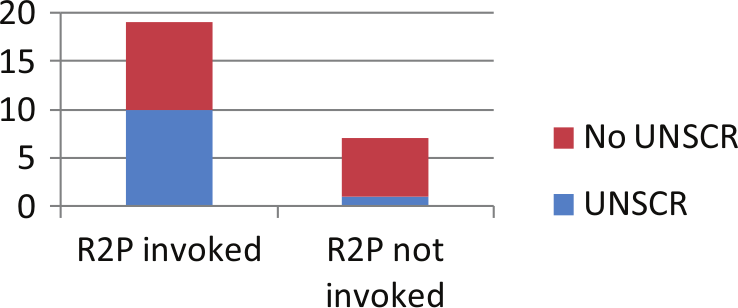
RtoP and UN Security Council Resolutions (UNSCR) 2006–2011.
There is at least one potential alternative explanation, however. It might be contended that it is the gravity of the crisis and not RtoP that is doing the work in creating this variation in Security Council responses. In other words, the worse the situation is, the more likely it is both that actors will use RtoP language and that the Security Council will adopt resolutions. As Page Fortna (2004: 281) argued in a different context, ‘peacekeepers go where they are most needed rather than where peace is easy to keep’. Viewed this way, the invocation of RtoP and the passage of Council resolutions are both products of the gravity of the problem. However, there appears to be no clear relationship between the number of deaths and the likelihood that RtoP will be invoked. In the period examined, the median estimated number of deaths in cases where RtoP was invoked was 750, compared with 727 for cases where it was not. The median estimated number of deaths for cases where RtoP was invoked and the Security Council adopted measures was 788, higher again but not sufficiently high to suggest that casualty rates were a determining influence on Security Council behaviour. Expressed another way, there were two cases involving crimes against humanity (Pakistan and India) where the estimated death tolls were greater than in six other cases where RtoP was invoked and the Council adopted measures. In these two cases, RtoP was not invoked and the Security Council took no action. Of the 10 deadliest episodes of anti-civilian violence between 2006 and 2011, RtoP was invoked in relation to seven and the Security Council acted in only five of these cases. This suggests that there is no clear linkage between the gravity of the problem in terms of civilian lives lost, the invocation of RtoP and the likelihood of Security Council resolutions.
It appears, therefore, that RtoP does indeed fulfil a type of ‘securitising’ function, as some of the principle’s advocates claim. Invocation of the principle elevates a particular crisis above ‘normal politics’ and demands a response of some form from the Security Council. The principle’s capacity to generate the will and consensus to act is limited (in only half of the relevant cases was invocation followed by a resolution) but comparing cases where it was invoked with those where it was not indicates that RtoP does add value.
To understand precisely how RtoP adds value, the cases need to be examined a little more carefully. Closer scrutiny suggests that it is not at all clear that one (invocation of RtoP) causes the other (a Security Council resolution). To test this relationship, the author examined the time lapse between the invocation of RtoP and the passage of a resolution by the Security Council. The subsequent analysis by the author was based on two assumptions. First, its was assumed that where the time lapse was less than 1 month, there was a strong likelihood that the Council, or at least several Council members, were already contemplating action when RtoP was invoked. In this situation, it was just as likely that RtoP language was used to explain or justify already determined action as it was that the action itself was triggered or encouraged by the invocation of RtoP. Second, where the lapse of time was greater than 12 months, it was assumed that factors not directly related to the invocation of RtoP accounted for the resolution.
There were 10 cases where RtoP was invoked and the Security Council issued a resolution. In only three of these cases (Chad, Libya and Yemen) did Council action fall between 1 month and 1 year after the initial invocation of RtoP. In the seven other cases, Council engagement either predated the invocation of RtoP or followed it by more than 12 months, suggesting either that the Council would have acted regardless of the invocation of RtoP or that factors other than RtoP were at play in pushing the Council to act when it did. Expressed another way, in only 3 of 19 cases (15%) was the invocation of RtoP clearly associated with a subsequent Security Council resolution; around the same percentage of cases in which RtoP was not used but the Council acted anyway. This suggests that whilst RtoP is associated with higher levels of international activism relating to the protection of populations from mass atrocities, it does not necessarily follow that the principle acts as a ‘rallying call’ capable of elevating crises above normal politics in order to generate the will and capacity to act.
Securitisation and the role of context
To understand this seeming paradox, it is worth revisiting debates about securitisation and the politics of communication and legitimacy. Recent scholarship has questioned the capacity of ‘speaking security’, by itself, to elevate crises above ‘normal politics’ within short spaces of time. This challenges the idea that the invocation of ‘security’ by itself creates an external pressure on decision-makers. There are at least three main problems with securitisation theory’s starting claim in this regard. First, as Matt McDonald (2008: 576) has argued, issues generally come to be viewed as security threats over long periods of time. Thus, for example, the idea that aspects of climate change might be related to security, increasingly common today though still contested, was first articulated in the 1980s. Likewise, international terrorism was regarded as a security issue well before the 9/11 atrocities. From this perspective, it is the steady accumulation of language, practice, evidence and expectations that determines whether an issue is given ‘special treatment’.
This highlights the second point, which is that successful securitisation is dependent on context. What constitutes an issue requiring urgent attention and the consequences that flow from this judgement ‘is not simply an “objective description” of a fact but an intersubjective appraisal’ (Kratochwil and Ruggie, 1986: 774). As such, the extent to which actors accept the attachment of RtoP to a particular situation and the consequences they think should flow from this are influenced by more than just the plausibility of the argument and its relation to shared norms and interpretations of the case at hand. These judgements are heavily influenced by the situation. 4 Persuasive and consistent argumentation is more likely in less politicised and more insulated settings than in highly political settings, such as those relating to mass atrocities, where contextual variables exert greater effect (see Chayes and Chayes, 1995; Checkel, 2001; Johnston, 2007). For illustrative purposes, it is possible to identify four such variables that might impact on the relationship between the principle and observed behaviour:
Perceptions. How external actors perceive a situation influences how they respond (Hermann and Shannon, 2001: 650). All other things being equal, actors are much more likely to react to clearly apparent atrocities committed by obvious perpetrators than they are to punish the perpetrators of atrocities where uncertainty remains as to the nature of the situation (Jervis, 1976).
Social relations. Actors that are thought legitimate, or whose purposes are considered legitimate, are likely to get away with norm-violating behaviour to a greater extent than actors whose legitimacy is already in doubt. As Hermann and Shannon (2001: 651) put it, ‘[t]here is a tendency to defend norms more actively when violated by foes than when they are violated by friends’.
Interests. This relates to the importance attached to protecting civilians from genocide and mass atrocities relative to other policy concerns which might dictate validating, tolerating or excusing norm-violations or refraining from acting against those violations. Such interests are not pre-given and are constituted by factors such as identity, social norms, political preferences, social relations and judgements about the expected relative utility of different courses of action.
Relative power. The relative material and the institutional and ideational power of the actors involved influences judgements about how to portray a situation and the effects that follow. Clearly, powerful states are much more likely to avoid being labelled perpetrators of RtoP crimes, in a manner that makes them liable for the adoption of extraordinary measures against them (Carr, 1946: 111).
Contextual factors can magnify or nullify judgements about the legitimacy of mass atrocities and the consequences that flow from those judgements. Indeed, one study of mass atrocities has found that contextual factors can be more important in determining responses to mass killing than either the justifications proffered by perpetrators or the extent to which the norm was embedded (see Bellamy, 2012). However, it is important to recognise that principles such as RtoP may also play a role in shaping the context and not just as a filter through which individual crises are perceived. Of the four potential factors identified above, RtoP might have an impact on context through its capacity to shape perceptions about how individual cases should be framed (e.g. by persuading third parties to view situations in terms of atrocities prevention rather than conflict management), to shape prior judgements about the legitimacy of particular actors (based, for example, on past compliance with RtoP norms), and to shape third-party interests (e.g. by encouraging third parties to see synergies between atrocity prevention and protection, regional stability and material interests or by domestic expectations about a state’s international protection obligations).
Third, the idea that there is a sharp distinction between ‘normal’ political issues and securitised issues has been challenged. Rita Abrahamsen (2005) has argued that, in reality, there are gradations in the way that an issue is characterised. What is more, the characterisation of an issue is likely to be contested and to move back and forth as a result of changes to the situation itself and the wider political context. For example, an issue might gain more traction as a ‘threat’ or ‘emergency’ in contexts where the Security Council is not already engaged than in contexts where the Security Council is engaged and holding regular meetings. In the latter scenario, the routine addressing of a situation might make it more difficult to create the sense of emergency required to lift an item above ‘normal politics’. This may partly explain why the periodic escalation of violence against civilians in the eastern Democratic Republic of Congo or Somalia does not attract the same level of international concern as other, higher profile, emergencies where the Council is less engaged as a matter of routine.
Together, the longer time spans associated with the elevation of issues above normal politics, the role of context and the fuzzy distinctions between normal and emergency politics, go some way towards explaining why RtoP has been associated with increased activism on mass atrocities without being an obviously effective ‘rallying call’. The answer may lie in the relationship between RtoP and the identities, interests and shared expectations of states themselves. As Edward Luck (2009b: 21) put it: [RtoP’s] greatest contributions over time may lie less in setting rules and guidelines for inter-governmental mechanisms to follow and more in influencing the conceptions of interest, doctrine and strategy within national capitals, and hence voting patterns in international bodies. If influential states do not reconsider their national interests and values because of the growing prominence of RtoP in public and political circles, then posting rules for the Security Council and other inter-governmental bodies to follow would make little difference. If national values and perspectives change because of RtoP, however, the rules and guidelines would hardly be needed’.
5
In other words, the increased international activism, evidenced by Figure 1 above, may produce more of the internalisation of RtoP by member states and adoption of habits of protection by the Security Council, both of which may have the effect of altering the balance of contextual factors noted above, rather than altering the principle’s capacity for ‘rallying’ will and consensus out of the blue. According to Ward Thomas (2001: 38), once a norm becomes internalised, ‘it is not simply one among a number of considerations that must be factored into the calculus of foreign policy decision-making. It instead becomes one of the foundational assumptions upon which that calculus is premised’. The more deeply internalised a norm becomes, the more it becomes taken for granted, naturalised and habitually practised. Such norms are insulated from normal processes of decision-making. 6 Relating this back to the three problems with ‘securitisation’, norm internalisation would mean that shared moral abhorrence to mass atrocities, and expectations that the international community should act to protect populations from them, preceded RtoP and preceded the principle’s invocation in specific cases. In other words, rather than acting primarily as an external pressure, the rise of RtoP reflects, and contributes to, changes in the interests and identities of states to some extent and especially the context in which decisions about mass atrocity responses are taken. As such, there may not be a sharp division between ‘normal’ and ‘emergency’ politics when it comes to genocide and mass atrocities, such that a securitising type move is necessary. Instead, all that may be necessary to convince states to take action is clear evidence that one or more of the four RtoP crimes (genocide, war crimes, ethnic cleansing and crimes against humanity) is being committed by a particular group and that international action is required to redress this situation. In at least three of the cases noted in Table 1, for example, it could have been plausibly argued that the deployment of force by the host state was the best approach, forestalling the need for deliberation on international action (cases in Nigeria, India and Pakistan). Of course, generating international consensus around the principle that international society should take steps to protect populations at risk of mass atrocities is quite different from generating consensus on the most appropriate form of international response in specific cases and it is important that the two not be confused.
A closer examination of the cases lends support to this view by demonstrating that RtoP invocations and Security Council activism are interconnected rather than causally linked. Viewed this way, actors use the language of RtoP in contexts where they already accept their responsibility to protect. In 6 of the 10 cases in which RtoP was invoked and the Security Council passed a resolution, UN Security Council members themselves referred to the situation in RtoP terms (Cote d’Ivoire, LRA, Iraq, Libya, Sudan, Yemen) at about the same time and even sometimes earlier than either NGOs or UN officials began using this language (see Table 1). In five of those six cases, the Council itself referred to RtoP. There is evidence of the internalisation effect working in the remaining four cases too. In two of these remaining four cases, the Democratic Republic of Congo and Somalia, at the time when NGOs invoked RtoP as a rallying call for action, the Security Council was already seized of the matter and had discussed or acted on the issue of threats to civilians under different rubrics (e.g. the protection of civilians) (Bellamy, 2011: 51–52, 65–66). The third case was Afghanistan, where, at the time when RtoP was invoked, there was already an extensive international military deployment in place with a significant protection function. The fourth case was Chad. In that case, although Security Council action came after the invocation of RtoP by civil society actors, the Council’s engagement was directly related to the situation in neighbouring Darfur, where member states and the Council (Resolution 1706) itself had already invoked the RtoP principle. This analysis suggests both that Luck (2009b) was correct to argue that RtoP’s added value may lie in the changing of national values and perspectives, and that the principle may already be having an impact in that regard.
Clearly, the degree of internalisation is somewhat limited because, in almost half of all cases, the invocation of RtoP was not associated with Security Council activism. This amounts to nine cases where RtoP was invoked in response to a situation where mass atrocities were committed or imminently apprehended but where the Council did not pass a resolution. Of these nine cases, however, four (Sri Lanka, Myanmar, Ethiopia and Nigeria) involved episodes where only non-governmental actors invoked RtoP. In each of these cases, either the state itself was not responsible for the atrocities and proved able to bring them under control (Nigeria), or there was doubt at the time as to whether mass atrocities were in fact being perpetrated, the scale on which they were being perpetrated, and the intentionality of civilian devastation (Sri Lanka, Myanmar and Ethiopia). As noted earlier, how an episode is perceived at the time will influence behaviour regardless of the degree of norm internalisation. In cases where the facts of the case are in doubt, actors are left unsure as to whether it is appropriate to apply particular norms and less sure still about the best way of achieving the norm’s goals.
In another three cases, where the Security Council did not pass a resolution (Kyrgyzstan, Kenya and Guinea), RtoP was invoked by UN officials and NGOs, but again not directly by the Council or individual members. In all three cases, however, regional arrangements played the leading role, either by brokering negotiated agreements (the African Union (AU) in Kenya and the Economic Community of West African States (ECOWAS) in Guinea) or by holding state leaders to account and encouraging them to restore order (the Organization for Security and Co-operation in Europe (OSCE) in Kyrgyzstan), suggesting that ‘normal’ politics (i.e. politics without the Security Council) was able to meet the threat. It should be recalled that the UN Charter does not require the UN Security Council to involve itself in each and every case, only in those cases that other actors are incapable of resolving (Luck, 2006: 8). What is more, in each of these cases, there was profound uncertainty at the time as to where primary blame for atrocities lay (Kyrgyzstan and Kenya) or whether killing was sufficiently widespread and systematic to distinguish it from regular civil disorder (Guinea). It should also be stressed that, although it stopped short of issuing a resolution on the crisis, the Security Council issued a presidential statement on Kenya, giving its support to the AU-led mediation. Finally, all three cases were resolved relatively quickly and without the need for escalation to ‘emergency measures’.
Taking these two classes of case together (seven cases in all), there are two common factors which suggest that decisions not to act on RtoP were not inconsistent with internalisation of the norm. First, some states were not convinced that the situation was sufficiently grave to warrant the adoption of ‘emergency measures’ or sufficiently clear to enable them to determine the most appropriate and effective course of action. For example, the UN’s Internal Review Panel (2012) on its actions in Sri Lanka found that several member states, especially non-permanent members of the Security Council, complained that they did not have sufficient information about the situation on which to base recommended responses. These states, and others, did not doubt the norm itself, but rather were unsure about the best way to realise their goals. Second, even when the Council decided not to act itself, in cases where RtoP was invoked by UN officials as well as by civil society groups, there were multilateral responses marshalled by regional arrangements. The OSCE, for example, led the international response to the crisis in Kyrgyzstan and since the Cyclone Nargis relief effort, the Association of Southeast Asian Nations (ASEAN) has played a predominant role in leading international responses to the situation in Myanmar. All of this suggests that whilst contextual factors, especially perceptions and the flow of information, remain significant factors in shaping responses, the international community is getting into the habit of responding in some form to the commission of mass atrocities. This is because, as the basic principles of RtoP are internalised by individual states, they also come to shape the international context in which these crimes are committed.
The internalisation of RtoP goals and their incorporation into the international context have contributed to the emergence of an international ‘habit’ of responding to mass atrocities. This habit, and the effect of the various other contextual factors described earlier, on decision-making, can perhaps be best seen by examining cases in more detail. To illustrate the point, the final section briefly outlines the Security Council’s response to the crisis in Somalia during the 5 years following the formal adoption of RtoP in 2005. This is a ‘hard case’ for RtoP because of its complexity, the UN’s past history in Somalia, the fact that the Council did not invoke the RtoP principle in this case, and its record of responding incrementally. These factors encouraged some advocates of RtoP to argue that Somalia was not a ‘classic’ case and others to claim that the principle did not directly apply. 7 Nonetheless, several NGOs and at least one UN official – the Special Representative of the UN Secretary-General, Ahmedou Ould-Abdallah – invoked RtoP in relation to this case. In 2008, Ould-Abdallah stated that ‘the Security Council has the responsibility to protect and assist the government of Somalia’. 8 It is for this reason that Somalia is a legitimate case to examine here. The case demonstrates the increasingly habitual nature of RtoP’s goals, the protection of populations from genocide and mass atrocities, but also the way in which a range of contextual factors shape decision-making.
Security Council decision-making: Somalia, 2006–2010
Approximately 16,000 civilians were killed and over two million were displaced by the conflict in Somalia between 2006 and 2010. The Security Council’s re-engagement with this crisis bucked most of the identifiable trends in its recent politics. Most especially, China, the US and the AU repeatedly pushed for greater UN activism and the deployment of a UN peace operation, whilst European members of the Council and the UN Secretariat expressed persistent scepticism. What blocked the deployment of UN peacekeepers was not, therefore, concerns about sovereignty, but prudential concerns related to the case at hand. These concerns focused on the absence of conditions thought necessary for successful peacekeeping, the funding and composition of any such force and the impact of this on the UN’s other missions, and doubts as to whether peacekeepers would do more harm than good. They were animated by a series of challenges in Somalia, including the presence of multiple armed groups responsible for war crimes and crimes against humanity, significant doubts about the capacity and legitimacy of the Transitional Federal Government (TFG), the conflict’s association with wider regional tensions involving Ethiopia, Eritrea, Djibouti and, to a lesser extent, Kenya and Yemen, the association of some of the conflict parties with al-Qaeda an the US-led ‘war on terror’, and the proliferation of maritime piracy (Human Rights Watch, 2008; UN News, 2009). As a result of these complexities, Council members adopted divergent views on the best way to address the conflict and protect civilians from potential mass atrocities. 9
In 2004, the Intergovernmental Authority on Development (IGAD) negotiated a peace agreement of sorts for Somalia, which saw the establishment of the TFG, whose parliament (then based in Nairobi) promptly elected Abdillahi Yusuf Ahmed as President and established a base in Baidoa. 10 The selection of Yusuf, a notorious Somali warlord, was controversial because of his long-standing ties with the regime in Ethiopia. Yusuf compounded that unpopularity by calling for the deployment of a 20,000 strong AU peacekeeping force, a move read by many Somalis as indicating an intention to impose his will by force (International Crisis Group, 2004: 2). The following year, at the request of the AU and the TFG, IGAD agreed to deploy a peace operation (IGASOM) to support the new government. However, the proposed mission ran into a number of roadblocks that ultimately prevented its deployment. In particular, there were serious disagreements about the composition of the force, with several armed groups in Somalia insisting that IGASOM not use troops from neighbouring states (meaning that only Eritrea, Sudan and Uganda could contribute). There were also questions about IGAD’s capacity to deploy, fund and sustain an operation of this kind and doubts about its impartiality.
In early 2006, fighting around Mogadishu between the Union of Islamic Courts (UIC) and an anti-Islamist group of warlords, calling themselves the Forces of the Alliance for Peace and Fight Against International Terrorism, escalated (Barnes and Hassan, 2007). The Security Council responded by supporting the IGAD initiative, though some European members worried about the TFG’s legitimacy and IGAD’s capacity (Security Council Report, 2006d). These same Council members were also concerned that IGASOM’s association with a conflict party could cause further escalation of the conflict. As a compromise, the Council indicated that it would not support the mission unless a satisfactory plan was submitted. In addition, the Council called upon the TFG to submit a plan for national security and stability that included a viable political process. 11
On the ground in Somalia, the UIC continued to advance, taking control of Mogadishu and other important cities (e.g. Jowhar), whilst several states, including the US, stepped up the supply of arms and other assistance to anti-Islamist groups. This culminated in the deployment of Ethiopian troops to support the TFG in Baidoa (BBC News, 2006, 2009). For its part, the TFG delivered its national security strategy and agreement was reached that Sudan and Uganda would provide around 7000 troops for IGASOM. However, in response to the deployment of Ethiopian troops, the UIC rejected the government’s plan and threatened to wage ‘holy war’ (Agence France-Presse, 2006). This encouraged some Security Council members, such as the UK and Russia, which had been sceptical about IGASOM, to take a more favourable view and support the idea that the UN should provide security support to the TFG whilst at the same time encouraging an inclusive political process (Security Council Report, 2006a, 2006b). These sentiments were tempered by evidence of divisions within the TFG, its failure to involve the UIC in the proposed peace process, evidence of emerging divisions within IGAD, and IGAD’s failure to set out a viable plan for IGASOM (Security Council Report, 2006b).
The Security Council’s position put pressure on the TFG to initiate dialogue with the UIC. In September 2006, the parties agreed to work towards a power-sharing agreement and establishment of a joint security force (Weinstein, 2006). The AU and IGAD took advantage of this apparent progress to once again call upon the Council to endorse IGASOM. The plea won informal support from China and Tanzania, but other Council members continued to express concerns. Not least, they remained sceptical about the viability of the peace process, given evidence of persistent fighting, the UIC’s steady expansion (UIC seized Kismayo on 25 September 2006) and the TFG’s counter-assaults supported by Ethiopian forces. They also worried that without the UIC’s consent, the proposed deployment could undermine the nascent peace process (Security Council Report, 2006c).
Despite the interim agreement, UIC forces encircled the TFG in Baidoa and began to threaten the autonomous regions of Puntland and Somaliland to the north. Emboldened, the Islamists also rejected international peacekeeping (Pflanz, 2006). Concerned about the TFG’s impending collapse and an outright victory for the Islamists, the Bush administration defected from the Council’s cautious approach and circulated a draft resolution supporting IGASOM and granting it a mandate to support the TFG (Security Council Report, 2006c). The draft enjoyed the support of China, Russia and the Council’s African members. However, the UK, France and the Special Representative of the UN Secretary-General, Francois Lonseny Fall, argued against granting IGASOM a mandate. Lonseny Fall advised that IGASOM’s deployment could hasten the TFG’s collapse and noted a number of shortfalls in the mission’s plan (Security Council Report, 2006c). However, events on the ground in late 2006 forced the Council’s hand. The TFG’s imminent defeat prompted Ethiopia to intervene with US backing and persuaded the Council to authorise IGASOM, though the Europeans and the UN Secretariat remained sceptical as to its merits.
European concerns were soon realised. By the end of December 2006, full-scale fighting had erupted around Baidoa, prompting Ethiopia to step up its military involvement. Ethiopian forces rapidly defeated the UIC, relieving Baidoa and forcing the Islamists from their major strongholds, including Mogadishu (on 28 December 2006). On 10 January 2007, the USA joined the fray by launching air strikes against suspected al-Qaeda sites (International Crisis Group, 2007). The nascent political process collapsed and the Islamists and other opponents of Ethiopia launched an insurgency. As predicted, the insurgents argued that there was no meaningful difference between the TFG, Ethiopian forces and other foreign peacekeeping forces, including the later African Union Mission in Somalia (AMISOM) (see Williams, 2009: 517). 12 As such, although the intervention delivered some short-term benefits to the TFG, it reduced the Council’s options and made its earlier strategy of linking peacekeepers to a viable political process less relevant.
In this context, attention turned to what measures could be taken to support the TFG. On 19 January 2007, the AU’s Peace and Security Council authorised the deployment of a peacekeeping mission (AMISOM) comprising 8000 troops that would obviate the need for the deployment of IGASOM. The AU, however, was desperate for UN support, not least financial support, and its resolution stated that AMISOM would evolve into a UN operation, though this was not the view of the Council. 13 The Council agreed that it should give support to AMISOM and duly authorised the mission under Chapter VII of the Charter (Resolution 1744, 21 February 2007). AMISOM was authorised to use ‘all necessary means’ to provide security to the participants in political dialogue and to support TFG in developing effective security forces. In an attempt to distinguish AMISOM from the Ethiopian intervention, the Resolution ‘welcomed’ Ethiopia’s decision to withdraw its forces. The Council remained divided, however, on whether the UN should take over the mission. In addition to concerns about conditions in Somalia and the viability of AMISOM, sceptics questioned the potential impact of such a large mission on the UN’s capacity to deploy, simultaneously, a potentially large and complex deployment in Darfur. 14
As the insurgency deepened into 2007, the humanitarian situation in Somalia deteriorated (PBS News Hour, 2007; Wakabi, 2007). TFG, Ethiopian and AMISOM troops were all targeted by insurgents and responded with sometimes heavy-handed force, leading some observers to complain that all sides were committing war crimes and/or crimes against humanity. In April to May 2007, TFG and Ethiopian forces launched an offensive to reassert its control of Mogadishu, which led to indiscriminate attacks on civilians and caused widespread displacement (Security Council Report, 2007a). In response, Al-Shabaab, a radical Islamist militia with suspected links to al-Qaeda, rose to prominence among the oppositionist militia (International Crisis Group, 2008: 11).
Under intense international pressure from the Security Council, the TFG launched a political process and held an AU-supported ‘national reconciliation conference’ in mid-2007. However, the negotiations were not inclusive and did not produce a viable peace process (Cornwell, 2007). The Council’s assessment of the TFG’s legitimacy and credibility was further damaged by reports that it was obstructing the delivery of humanitarian assistance (control of food aid was thought crucial to public support) and that TFG forces indiscriminately targeted civilians (Security Council Report, 2007a, 2007c).
Amidst all of this, AMISOM was also confronting serious operational problems (Willams, 2009: 519).By July 2008, around only 2500 of the projected 8000 troops had actually been deployed, growing to around 5200 by early 2010 (Security Council Report, 2007b). This allowed Ethiopia to delay its withdrawal and placed the questions of whether and when AMISOM might hand over to the UN at the forefront of the Council’s deliberations (Williams, 2009: 519). The UN Secretariat and several Council members continued to resist the transfer on prudential grounds. In April 2007, the Secretary-General concluded that conditions necessary for a UN peace operation to be effective were not in place (Ban, 2007a, para 60). Should the situation not improve, he argued the only viable intervention path for the Council was for it to authorise the deployment of a ‘coalition of the willing’ to undertake enforcement action.
New impetus came with the appointment of Ahmedou Ould-Abdallah as the Special Representative of the Secretary-General in September 2007. In his first report, drafted by Ould-Abdallah, the Secretary-General stated more bluntly his assessment that ‘the deployment of a United Nations peacekeeping operation cannot be considered a realistic and viable option’. Instead, he suggested that further consideration be given to the deployment of a (non-UN) multinational enforcement mission to improve security and pave the way for the complete withdrawal of Ethiopian forces (Ban, 2007, paras 33–34). For his part, Ould-Abdullah used his first briefing to the Council to argue that the UN’s ‘business as usual’ approach had failed to improve the situation and that the Council should become more proactive. On the political front, he indicated his intention to play a role as mediator and helped broker a political agreement (the ‘Djibouti agreement’, 9 June 2008) that included many (but not all) of the key factions. 15 At a press conference in Nairobi, he also suggested that the Security Council refer the situation in Somalia to the International Criminal Court (ICC) (Agence France-Presse, 2007). The Secretary-General’s suggestion that the Council consider authorising a non-UN enforcement mission was supported by both the TFG and the AU, which renewed their call for the UN to take over peacekeeping duties and support AMISOM in the meantime, but it was supported by few others. 16 There was also little support for direct financial assistance to the AU on the grounds that it might set a precedent of regional arrangements expecting to be bankrolled by the UN (Security Council Report, 2008). By the end of the year, however, the Council had shifted position once more and accepted the need to support AMISOM financially.
The situation in Somalia continued to deteriorate in 2008, with the estimated number of displaced civilians increasing to 700,000, escalating attacks on civilians and humanitarian workers, and renewed US bombing (3 March 2008) of suspected al-Qaeda sites. At the request of the Security Council, the Secretary-General set out a roadmap identifying steps towards the deployment of a UN peace operation: the establishment of a UN office to support AMISOM, moving the UN office to Mogadishu, and the conclusion of a comprehensive political agreement amongst all the parties. Assuming that the peace agreement held, the security situation stabilised and the parties granted their consent, the final stage would see the deployment of a 30,000 strong, robustly mandated, UN peace operation (Ban, 2008, paras 37–40).
Positive signs in Somalia at the beginning of 2009 seemed to lend support to the idea of deploying UN peacekeepers. At the end of January 2009, Ethiopia completed its withdrawal. However, these positive moves, which Ould-Abdullah believed brought Somalia ‘back from the brink’, were soon cancelled out. The insurgents established a new united front led by Al-Shabaab and stepped up attacks on AMISOM, killing 11 Burundian peacekeepers on 22 February 2009. The UN Security Council approved a support package worth around $81 million, increased to $138 million in June 2009, and agreed to establish a UN office to marshal logistical and technical support for AMISOM (United Nations Programme of Action (UNPOA)) (De Coning, 2010: 20).
After the flurry of activity in late 2008 to early 2009, debate in the Council settled down into a familiar pattern. In March 2009, the Secretary-General reiterated his assessment that the conditions for a UN peace operation were not in place (Ban, 2009). The head of the Department of Peacekeeping Operations (DPKO), Alain Le Roy, agreed. The generally negative assessment was borne out in May 2009, when conflict erupted in Mogadishu between TFG forces and insurgents, with the government accusing Eritrea of supporting the rebels (Security Council Report, 2009a). In light of these events, the Council reaffirmed the Secretary-General’s approach in Resolution 1865, with the new US administration dropping its predecessor’s calls for a UN mission (Security Council Report, 2009a). Although some members expressed dissatisfaction with this approach, complaining that it did little to improve the situation in Somalia, there was general recognition that there were few viable alternatives (Security Council Report, 2009b). In September 2009, a further 17 peacekeepers, including the deputy force commander, were killed in a suicide attack, strengthening the Council’s reticence.
This case might be read as an example of RtoP’s ineffectiveness. However, there are clear signs of the emergence of the habits of protection described earlier. Throughout the period, no member of the Security Council disputed the need for engagement or the focus on the protection of populations from atrocity crimes and resolution of the civil war. As noted earlier, a ‘habit’ or ‘internalised norm’ is one that comes into play in an uncontroversial manner. In that sense, the Somalia case clearly shows that human protection has become habitual for the Security Council. This is confirmed by other research and by the fact that during the same period some governments (notably Sudan and Sri Lanka) went to considerable lengths to try to keep protection issues off the Council’s agenda, with mixed results. 17 The fact, however, that states mobilise to keep protection matters off the agenda confirms that the habit has become for them to be on it.
Although clearly impacted by other political concerns, such as the ‘war on terror’ and regional stability, the Council’s deliberations were largely prudential and reflected some of the lessons identified by the UN’s ‘Brahimi report’ on peacekeeping operations delivered in 2000. Learning that the Council works most effectively when united, Council members tried to find consensus wherever possible and both sides of the debate were open to compromises. The Secretariat provided frank advice to the Council about the difficulties associated with mounting a peace operation in Somalia and a realistic assessment of what such an operation might be able to achieve.
Perhaps most importantly, however, the Council’s reticence to pursue stronger measures was driven primarily by prudential considerations, different interpretations of the facts on the ground, and differing beliefs about the likely consequences of various proposed courses of action, precisely the sorts of factors that the analysis in the previous section suggests might impact on the influence of norms on behaviour. Thus, cautious Council members worried that without stable conditions, a viable peace process, the consent of the belligerents or an exit strategy, a conventional UN peace operation was unlikely to succeed and quite likely to further inflame the situation. Whilst there was some recognition that a robust non-UN enforcement operation could try to create more suitable conditions for UN peacekeeping, the likelihood of success was thought sufficiently low and potential costs sufficiently high to deter more detailed consideration.
In this case, therefore, although the invocation of RtoP failed to ‘trigger’ decisive international action, owing to the role played by important contextual factors, the accumulation of protection habits by the Council, of which RtoP is both a product and a contributor, generated a variety of diplomatic, economic and peacekeeping initiatives aimed at contributing to the protection of vulnerable populations. In this context, without a viable strategy for intervening to protect vulnerable populations, using RtoP as a catalyst for action would not have contributed much to the debate. Yet without RtoP and its associated habits, the Council might not have been so actively engaged in the issue and Council members might not have been prepared to compromise (on matters such as support for IGASOM and AMISOM, the establishment of a political office, etc.) once it became clear that there were few alternative pathways to prevention.
Conclusion
This article argues that RtoP adds value to international efforts to protect populations from genocide and mass atrocities, though perhaps not in the ways commonly thought. It suggests that RtoP is not particularly effective as a stand-alone ‘rallying call’ that mobilises action in cases where international society may be initially reluctant to act. There is little evidence to suggest that, by itself, the RtoP principle has the capacity to reshape state interests in relation to specific crises or highlight hitherto overlooked policy options. Where it does add value is in helping to reshape states’ identities and interests, such that consideration of the protection needs of populations in relation to the threat of genocide and mass atrocities has been internalised to some extent. As a result, the RtoP principle has also altered the international context in which actors take decisions about how to respond to imminent or actual cases of genocide and mass atrocities. In combination, these two effects have shifted the balance of relevant international factors in the direction of supporting the protection of populations from these grave crimes. As a result, consideration of protection issues has become almost habitual for some key international institutions, most notably the UN Security Council. By that, the author of this article means that there is a presumption that the international community, whether acting through the Security Council, regional and sub-regional arrangements, or other mechanisms, will involve itself in the protection of populations from these crimes as a matter of routine. To borrow the language explicitly used by the AU, the presumption of non-interference has given way to a presumption of ‘non-indifference’ in the face of genocide and mass atrocities.
Within this context, RtoP’s principal role has been to contribute to the establishment of habits of protection among UN member states, through the aligning of protection goals with state interests and identities, and, through that, to influence changes in the international context surrounding the commission of genocide and mass atrocities. In this capacity, RtoP helps influence the extent to which calls for action might be translated into positive action, by increasing the likelihood not only that there will be such calls but also that they will resonate among actors who accept that they have a responsibility to protect foreign populations when they can. This does not, of course, determine particular behaviours or guarantee international consensus because decision-making is heavily influenced by contextual factors over which RtoP has only limited influence. These include the flow of information and interpretation of events, the presence or absence of countervailing interests or concerns, the relationship between a crises and other regional order considerations, and the relationship between the conflict parties and key members of international society and the availability of seemingly viable policy options. The case of Somalia demonstrates the role of context particularly well, but it also demonstrates the emergence of habits of protection that are associated with, and a product of, the rise of RtoP.
As well as helping the development of a better understanding of the role of RtoP in contemporary international society, these findings provide guidance about the future direction of RtoP. In particular, if its assessment of RtoP’s limited capacity to act as a rallying call and the principle’s role as a habit shaper is correct, then, far from weakening the principle, approaches that adopt a comprehensive account of atrocity prevention and focus on the building of relevant preventive capacities are likely to have a strongly positive effect. That is because such activities reinforce habits of protection and, when such measures result in the establishment of institutions sensitive towards atrocity prevention goals, build a degree of path dependency. In this sense, the more that RtoP language is used and atrocity prevention mainstreamed, the more that the habits of protection will be established.
Footnotes
Acknowledgements
The author would like to thank the editors and anonymous reviewers at Cooperation and Conflict, Sara E. Davies, Kim Nackers and Paul D. Williams for their helpful advice on earlier drafts of this article.
Funding
This research received no specific grant from any funding agency in the public, commercial, or not-for-profit sectors.